

Panzer

Encyclopedia
A Panzer (ˈpænzər) is a German language
word that, when used as a noun
, means "tank
". When it is used as an adjective
, it means either tank (e.g. "panzer battle") or "armour
ed" (e.g. panzer division
).
1_-_relic38.jpg) Panzer is a loanword
Panzer is a loanword
from the German (ˈpantsɐ), meaning "armour
". It is also used in the compounds , ‘panzer division
’ and dated , ‘tank’ or literally ‘armoured combat vehicle’ (the modern synonym is , or just ).
The German word refers to any kind of body armour, as in , ‘plate armour
’, , ‘mail
’, or generally , ‘armoured’. The word also refers to an animal's protective shell or thick hide, as in , ‘turtle shell'. It derives through the French
, ‘breastplate
’, from Latin , ‘belly, paunch’, and is possibly related to , ‘swelling’.
A good example for the use of the word "Panzer" in German is the Indian Rhinoceros
or , whose appearance resembles an armoured mediaeval knight.
The word has been calque
d in many other languages, such as Swedish or Finnish , ‘tracked armoured fighting vehicle’, Danish and Norwegian , ‘armoured vehicle’, but means ‘tank’. Due to the similarities of the words, Panzer is commonly, and erroneously, confused with the German Panther tank
.
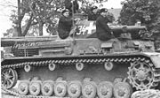
 Although the post-World War I Treaty of Versailles
greatly restricted its military development, Germany started to secretly develop armoured tactics in the 1920s, in cooperation with the Soviet Union (while assisting in the establishment of a Soviet tank-building industry). In the 1930s, the light Panzer I
and Panzer II
tanks were built primarily for training, and tested in battle during the Spanish Civil War
.
At the beginning of the Second World War, German forces gained notoriety for the rapid and successful invasions of Poland
, the Netherlands, Belgium and France
, and the Soviet Union
, in 1939–41. Although the early-war Panzer II, III
, and IV
were in some respects inferior to some of their French and Soviet counterparts, this blitzkrieg
(‘lightning warfare’) was made possible by several factors: the German military experience in World War I, their level of training, integrated communications, coordinated use of airpower, and, perhaps most famously, by the combined-arms employment of integrated infantry
and armoured forces, the panzer divisions of the Germany Army
.
As the blitzkrieg began to stall on the Eastern Front
, and a mobile war pushed back and forth across North Africa
, Germany was quickly forced into an arms race in armour and antitank weapons. 88 mm antiaircraft guns
were used as antitank weapons, thousands of captured antitank guns were marshaled into German service as the 7.62 cm PaK 36(r)
, new inexpensive tank destroyers such as the Marder
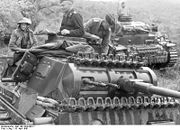
series were put into production, while Panzer III & IV tanks & the Sturmgeschütz were hastily up-armoured and up-gunned.
.jpg) A new generation of big tanks, the heavy Tiger
A new generation of big tanks, the heavy Tiger
, Panther
, and King Tiger
tanks were developed and rushed into the battlefield. During the war, the mass of a panzer increased from the 5.4 tonnes of a pre-war Panzer I
light tank, to the 68.5 tonnes of the Tiger II. In the meantime, the Soviets continued to produce the medium-sized T-34
by the tens of thousands as well as introducing the heavy Iosef Stalin (IS series) tanks, and U.S. industry nearly matched them in the number of M4 Sherman tanks
built and deployed in Europe after D-Day
.
Throughout the war, the panzer was a key piece of the combined arms doctrines supporting the German blitzkrieg. The tanks were used in almost every theatre of German involvement. Their largest engagement occurred at the Battle of Prokhorovka
, which saw about three hundred panzers pitted against five hundred Soviet tanks.
German language
German is a West Germanic language, related to and classified alongside English and Dutch. With an estimated 90 – 98 million native speakers, German is one of the world's major languages and is the most widely-spoken first language in the European Union....
word that, when used as a noun
Noun
In linguistics, a noun is a member of a large, open lexical category whose members can occur as the main word in the subject of a clause, the object of a verb, or the object of a preposition .Lexical categories are defined in terms of how their members combine with other kinds of...
, means "tank
Tank
A tank is a tracked, armoured fighting vehicle designed for front-line combat which combines operational mobility, tactical offensive, and defensive capabilities...
". When it is used as an adjective
Adjective
In grammar, an adjective is a 'describing' word; the main syntactic role of which is to qualify a noun or noun phrase, giving more information about the object signified....
, it means either tank (e.g. "panzer battle") or "armour
Armour
Armour or armor is protective covering used to prevent damage from being inflicted to an object, individual or a vehicle through use of direct contact weapons or projectiles, usually during combat, or from damage caused by a potentially dangerous environment or action...
ed" (e.g. panzer division
Panzer Division
A panzer division was an armored division in the army and air force branches of the Wehrmacht as well as the Waffen-SS of Nazi Germany during World War II....
).
Etymology
Loanword
A loanword is a word borrowed from a donor language and incorporated into a recipient language. By contrast, a calque or loan translation is a related concept where the meaning or idiom is borrowed rather than the lexical item itself. The word loanword is itself a calque of the German Lehnwort,...
from the German (ˈpantsɐ), meaning "armour
Armour
Armour or armor is protective covering used to prevent damage from being inflicted to an object, individual or a vehicle through use of direct contact weapons or projectiles, usually during combat, or from damage caused by a potentially dangerous environment or action...
". It is also used in the compounds , ‘panzer division
Panzer Division
A panzer division was an armored division in the army and air force branches of the Wehrmacht as well as the Waffen-SS of Nazi Germany during World War II....
’ and dated , ‘tank’ or literally ‘armoured combat vehicle’ (the modern synonym is , or just ).
The German word refers to any kind of body armour, as in , ‘plate armour
Plate armour
Plate armour is a historical type of personal armour made from iron or steel plates.While there are early predecessors such the Roman-era lorica segmentata, full plate armour developed in Europe during the Late Middle Ages, especially in the context of the Hundred Years' War, from the coat of...
Mail (armour)
Mail is a type of armour consisting of small metal rings linked together in a pattern to form a mesh.-History:Mail was a highly successful type of armour and was used by nearly every metalworking culture....
’, or generally , ‘armoured’. The word also refers to an animal's protective shell or thick hide, as in , ‘turtle shell'. It derives through the French
French language
French is a Romance language spoken as a first language in France, the Romandy region in Switzerland, Wallonia and Brussels in Belgium, Monaco, the regions of Quebec and Acadia in Canada, and by various communities elsewhere. Second-language speakers of French are distributed throughout many parts...
, ‘breastplate
Breastplate
A breastplate is a device worn over the torso to protect it from injury, as an item of religious significance, or as an item of status. A breastplate is sometimes worn by mythological beings as a distinctive item of clothing.- Armour :...
’, from Latin , ‘belly, paunch’, and is possibly related to , ‘swelling’.
A good example for the use of the word "Panzer" in German is the Indian Rhinoceros
Indian Rhinoceros
The Indian Rhinoceros is also called Greater One-horned Rhinoceros and Asian One-horned Rhinoceros and belongs to the Rhinocerotidae family...
or , whose appearance resembles an armoured mediaeval knight.
The word has been calque
Calque
In linguistics, a calque or loan translation is a word or phrase borrowed from another language by literal, word-for-word or root-for-root translation.-Calque:...
d in many other languages, such as Swedish or Finnish , ‘tracked armoured fighting vehicle’, Danish and Norwegian , ‘armoured vehicle’, but means ‘tank’. Due to the similarities of the words, Panzer is commonly, and erroneously, confused with the German Panther tank
Panther tank
Panther is the common name of a medium tank fielded by Nazi Germany in World War II that served from mid-1943 to the end of the European war in 1945. It was intended as a counter to the T-34, and to replace the Panzer III and Panzer IV; while never replacing the latter, it served alongside it as...
.
Panzers in World War II
Treaty of Versailles
The Treaty of Versailles was one of the peace treaties at the end of World War I. It ended the state of war between Germany and the Allied Powers. It was signed on 28 June 1919, exactly five years after the assassination of Archduke Franz Ferdinand. The other Central Powers on the German side of...
greatly restricted its military development, Germany started to secretly develop armoured tactics in the 1920s, in cooperation with the Soviet Union (while assisting in the establishment of a Soviet tank-building industry). In the 1930s, the light Panzer I
Panzer I
The Panzer I was a light tank produced in Germany in the 1930s. The name is short for the German ' , abbreviated . The tank's official German ordnance inventory designation was SdKfz 101 .Design of the Panzer I began in 1932 and mass production in 1934...
and Panzer II
Panzer II
The Panzer II was the common name for a family of German tanks used in World War II. The official German designation was Panzerkampfwagen II...
tanks were built primarily for training, and tested in battle during the Spanish Civil War
Spanish Civil War
The Spanish Civil WarAlso known as The Crusade among Nationalists, the Fourth Carlist War among Carlists, and The Rebellion or Uprising among Republicans. was a major conflict fought in Spain from 17 July 1936 to 1 April 1939...
.
At the beginning of the Second World War, German forces gained notoriety for the rapid and successful invasions of Poland
Invasion of Poland (1939)
The Invasion of Poland, also known as the September Campaign or 1939 Defensive War in Poland and the Poland Campaign in Germany, was an invasion of Poland by Germany, the Soviet Union, and a small Slovak contingent that marked the start of World War II in Europe...
, the Netherlands, Belgium and France
Battle of France
In the Second World War, the Battle of France was the German invasion of France and the Low Countries, beginning on 10 May 1940, which ended the Phoney War. The battle consisted of two main operations. In the first, Fall Gelb , German armoured units pushed through the Ardennes, to cut off and...
, and the Soviet Union
Operation Barbarossa
Operation Barbarossa was the code name for Germany's invasion of the Soviet Union during World War II that began on 22 June 1941. Over 4.5 million troops of the Axis powers invaded the USSR along a front., the largest invasion in the history of warfare...
, in 1939–41. Although the early-war Panzer II, III
Panzer III
Panzer III was the common name of a medium tank that was developed in the 1930s by Germany and was used extensively in World War II. The official German designation was Panzerkampfwagen III translating as "armoured battle vehicle". It was intended to fight other armoured fighting vehicles and...
, and IV
Panzer IV
The Panzerkampfwagen IV , commonly known as the Panzer IV, was a medium tank developed in Nazi Germany in the late 1930s and used extensively during the Second World War. Its ordnance inventory designation was Sd.Kfz...
were in some respects inferior to some of their French and Soviet counterparts, this blitzkrieg
Blitzkrieg
For other uses of the word, see: Blitzkrieg Blitzkrieg is an anglicized word describing all-motorised force concentration of tanks, infantry, artillery, combat engineers and air power, concentrating overwhelming force at high speed to break through enemy lines, and, once the lines are broken,...
(‘lightning warfare’) was made possible by several factors: the German military experience in World War I, their level of training, integrated communications, coordinated use of airpower, and, perhaps most famously, by the combined-arms employment of integrated infantry
Infantry
Infantrymen are soldiers who are specifically trained for the role of fighting on foot to engage the enemy face to face and have historically borne the brunt of the casualties of combat in wars. As the oldest branch of combat arms, they are the backbone of armies...
and armoured forces, the panzer divisions of the Germany Army
Panzerwaffe
Panzerwaffe refers to a command within the Heer of the German Wehrmacht, responsible for the affairs of panzer and motorized forces shortly before and during the Second World War...
.
As the blitzkrieg began to stall on the Eastern Front
Eastern Front (World War II)
The Eastern Front of World War II was a theatre of World War II between the European Axis powers and co-belligerent Finland against the Soviet Union, Poland, and some other Allies which encompassed Northern, Southern and Eastern Europe from 22 June 1941 to 9 May 1945...
, and a mobile war pushed back and forth across North Africa
North African campaign
During the Second World War, the North African Campaign took place in North Africa from 10 June 1940 to 13 May 1943. It included campaigns fought in the Libyan and Egyptian deserts and in Morocco and Algeria and Tunisia .The campaign was fought between the Allies and Axis powers, many of whom had...
, Germany was quickly forced into an arms race in armour and antitank weapons. 88 mm antiaircraft guns
88 mm gun
The 88 mm gun was a German anti-aircraft and anti-tank artillery gun from World War II. It was widely used by Germany throughout the war, and was one of the most recognizable German weapons of the war...
were used as antitank weapons, thousands of captured antitank guns were marshaled into German service as the 7.62 cm PaK 36(r)
7.62 cm PaK 36(r)
The 7.62 cm FK 36 and Pak 36 were German anti-tank guns used by the Wehrmacht in World War II...
, new inexpensive tank destroyers such as the Marder
Marder
Marder may refer to :* Marder , German name for European Pine Marten * Marder , a tribal union in Prehistoric Armenia* a series of German tank destroyers from World War II:**Marder I**Marder II**Marder III...
series were put into production, while Panzer III & IV tanks & the Sturmgeschütz were hastily up-armoured and up-gunned.
Tiger I
Tiger I is the common name of a German heavy tank developed in 1942 and used in World War II. The final official German designation was Panzerkampfwagen Tiger Ausf. E, often shortened to Tiger. It was an answer to the unexpectedly formidable Soviet armour encountered in the initial months of...
, Panther
Panther tank
Panther is the common name of a medium tank fielded by Nazi Germany in World War II that served from mid-1943 to the end of the European war in 1945. It was intended as a counter to the T-34, and to replace the Panzer III and Panzer IV; while never replacing the latter, it served alongside it as...
, and King Tiger
Tiger II
Tiger II is the common name of a German heavy tank of the Second World War. The final official German designation was Panzerkampfwagen Tiger Ausf. B,Panzerkampfwagen – abbr: Pz. or Pz.Kfw. Ausführung – abbr: Ausf. .The full titles Panzerkampfwagen Tiger Ausf...
tanks were developed and rushed into the battlefield. During the war, the mass of a panzer increased from the 5.4 tonnes of a pre-war Panzer I
Panzer I
The Panzer I was a light tank produced in Germany in the 1930s. The name is short for the German ' , abbreviated . The tank's official German ordnance inventory designation was SdKfz 101 .Design of the Panzer I began in 1932 and mass production in 1934...
light tank, to the 68.5 tonnes of the Tiger II. In the meantime, the Soviets continued to produce the medium-sized T-34
T-34
The T-34 was a Soviet medium tank produced from 1940 to 1958. Although its armour and armament were surpassed by later tanks of the era, it has been often credited as the most effective, efficient and influential design of World War II...
by the tens of thousands as well as introducing the heavy Iosef Stalin (IS series) tanks, and U.S. industry nearly matched them in the number of M4 Sherman tanks
M4 Sherman
The M4 Sherman, formally Medium Tank, M4, was the primary tank used by the United States during World War II. Thousands were also distributed to the Allies, including the British Commonwealth and Soviet armies, via lend-lease...
built and deployed in Europe after D-Day
D-Day
D-Day is a term often used in military parlance to denote the day on which a combat attack or operation is to be initiated. "D-Day" often represents a variable, designating the day upon which some significant event will occur or has occurred; see Military designation of days and hours for similar...
.
Throughout the war, the panzer was a key piece of the combined arms doctrines supporting the German blitzkrieg. The tanks were used in almost every theatre of German involvement. Their largest engagement occurred at the Battle of Prokhorovka
Battle of Prokhorovka
The Battle of Prokhorovka was fought on the Eastern Front during the Second World War as part of the Battle of Kursk in the Soviet Union . Principally, the German Wehrmachts Fourth Panzer Army clashed with the Soviet Red Army's 5th Guards Tank Army...
, which saw about three hundred panzers pitted against five hundred Soviet tanks.
See also
- PanzerfaustPanzerfaustThe Panzerfaust was an inexpensive, recoilless German anti-tank weapon of World War II. It consisted of a small, disposable preloaded launch tube firing a high explosive anti-tank warhead, operated by a single soldier...
- PanzerschreckPanzerschreckPanzerschreck was the popular name for the Raketenpanzerbüchse , an 88 mm calibre reusable anti-tank rocket launcher developed by Nazi Germany in World War II. Another popular nickname was Ofenrohr ....
- Panzer GeneralPanzer GeneralPanzer General is a computer wargame published by Strategic Simulations in 1994 and set in World War II.- Overview:Panzer General is turn-based game, set on operational level hex maps. One plays lone scenarios from either Axis or Allied side and against a computer or human opponent...