
Encyclopedia
New Guinea, located just north of
Australia, is the
world's second largest island, having become separated from the Australian mainland when the area now known as the
Torres Strait flooded around 5000 BC. The name
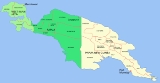
Papua has also been long-associated with the island: this is discussed further under "History", below. The western half of the island contains the
Indonesian provinces of Papua and
West Irian Jaya, while the eastern half forms the mainland of the independent country of
Papua New Guinea.
New Guinea is the world's fourth highest landmass.
Political divisions
The island of New Guinea is divided politically into roughly equal halves across a north-south line:
- The western portion of the island , located west of 141°E longitude, was formerly a Dutch colony and is now incorporated into Indonesia as the provinces:
- West Irian Jaya with Manokwari as its capital
- Papua with the city of Jayapura as its capital. A proposal to split this province into Central Papua and East Papua has not been implemented.
- '
- The eastern part forms the mainland of Papua New Guinea, which has been an independent country since 1975. It was formerly a territory governed by Australia.
People
The current population of the island is about 6.9 million people .
Evidence for human habitation on the island has been dated to as early as approximately 40,000 BP, and first settlement dates of up to 60,000 years ago have been proposed. The island is presently populated by very nearly a thousand different tribal groups and a near-equivalent number of separate
languages, all falling into one of two groups, the Papuan languages and the
Austronesian languages. The separation was not merely linguistic; warfare among societies was a factor in the evolution of the
men's house: separate housing of groups of adult men, from the single-family houses of the women and children, for mutual protection against the other groups.
Pig-based trade between the groups and pig-based feasts are a common theme with the other peoples of southeast Asia and Oceania. Most societies practise
agriculture, supplemented by hunting and gathering.
The great variety of the island's indigenous populations are frequently assigned to one of two main ethnological divisions, based on archaeological, linguistic and genetic evidence: the Papuan and
Austronesian groups.
Current evidence indicates that the Papuans are descended from the earliest human inhabitants of New Guinea. These original inhabitants first arrived in New Guinea at a time when the island was connected to the
Australian continent via a land bridge, forming the landmass known as
Sahul. These peoples had made the sea-crossing from the islands of
Wallacea and Sundaland by at least 40,000 years ago, subsequent to the dispersal of peoples from Africa 50,000 years ago.
The ancestral Austronesian peoples are believed to have arrived considerably later, approximately 3,500 years ago, as part of a gradual seafaring migration from
Southeast Asia, possibly originating in eastern
China. Austronesian-speaking peoples colonised many of the offshore islands to the north and east of New Guinea, such as
New Ireland and
New Britain, with settlements also on the coastal fringes of the main island in places.
Human habitation of New Guinea over tens of thousands of years has led to a great deal of diversity, which was further increased by the later arrival of the Austronesians and the more recent history of European and Asian colonisation. This process has been accelerated by the transmigration programs and conscious policies enacted by successive Indonesian governments, which over recent decades has encouraged the resettlement of as many as one million immigrants to western New Guinea, predominantly from the islands of
Java,
Madura, and
Bali.
Biodiversity and ecology
With some 786,000 km² of tropical land, New Guinea has an immense ecological value in terms of
biodiversity, with between 5 to 8% of the total species on the planet. A high percentage of New Guinea's species are endemic , and thousands are still unknown to Western science: probably well over 200,000 species of insect, between 11,000 to 20,000 plant species; over 650 resident bird species, including most species of
birds of paradise and
bowerbirds,
parrots, and
cassowaries; over 400
amphibians; 455
butterfly species;
marsupials including Bondegezou,
Goodfellow's Tree-kangaroo,
Huon Tree-kangaroo,
Long-beaked Echidna, Tenkile, Agile Wallaby, Alpine Wallaby, cuscuses and
possums; and various other mammal species. Most of these species are shared, at least in their origin, with the continent of
Australia, which was until fairly recent geological times, part of the same landmass. See
Australia-New Guinea for an overview. Biogeographically, New Guinea is part of
Australasia rather than the Asian biotic realm. The island is so large that it is considered 'nearly a continent' in terms of its biological distinctiveness.
New Guinea has 284 species and six orders of mammals: ; 195 of the mammal species are endemic. New Guinea has 578 species of breeding birds, of which 324 species are endemic. The island's frogs are one of the most poorly known vertebrate groups, currently totalling 282 species, but this number is expected to double or even triple when all species have been documented. New Guinea has a mass number of coral life and 1,200 species of fish have been found. Also about 600 species of reef-building coral — the latter equal to 75 percent of the world’s known total. The entire coral area covers 45 million acres off a peninsula in northwest New Guinea.
History
The first inhabitants of New Guinea arrived at least around 40,000 years ago, having travelled through the south-east Asian peninsula. These first inhabitants, from whom the Papuan people are probably descended, adapted to the range of ecologies and in time developed one of the earliest known agricultures. Remains of this agricultural system, in the form of ancient irrigation systems in the highlands of Papua New Guinea, are being studied by archaeologists. This work is still in its early stages so there is still uncertainty as to precisely what crop was being grown, or when/where agriculture arose.
The gardens of the New Guinea highlands are ancient, intensive
permacultures, adapted to high population densities, very high rainfalls , earthquakes, hilly land, and occasional frost. Complex mulches, crop rotations and tillages are used in rotation on terraces with complex irrigation systems. Western agronomists still do not understand all practices, and native gardeners are notably more successful than most scientific farmers. Some authorities believe that New Guinea gardeners invented crop rotation well before western Europeans. A unique feature of New Guinea permaculture is the silviculture of
Casuarina oligodon, a tall, sturdy native
ironwood tree, suited to use for timber and fuel, with root nodules that fix nitrogen.
Pollen studies show that it was adopted during an ancient period of extreme deforestation.
In more recent millennia another wave of people arrived on the shores of New Guinea. These were the Austronesian people, who had spread down from Taiwan, through the south-east Asian archipelago, colonising many of the islands on the way. The Austronesian people had technology and skills extremely well adapted to ocean voyaging and Austronesian language speaking people are present along much of the coastal areas and islands of New Guinea.
The first European contact with New Guinea was by Portuguese and/or Spanish sailors in the 16th century. In 1526-27 Don Jorge de Meneses saw the western tip of New Guinea and named it
ilhas dos Papuas. Ploeg reports that the word
papua is often said to derive from the Malay word
papua or
pua-pua, meaning ‘frizzly-haired’, referring to the highly curly hair of the inhabitants of these areas. Another possibility, is that it comes from the
Biak phrase
sup i papwa which means ‘the land below [the sunset]’ and refers to the islands west of the Bird’s Head, as far as Halmahera.
Whatever the origin of the name
Papua, it came to be associated with this area, and more especially with Halmahera, which was known to the Portuguese by this name during the era of their colonisation in this part of the world.
In 1545 the Spaniard Yñigo Ortiz de Retez sailed along the north coast of New Guinea as far as the
Mamberamo River near which he landed, naming the island 'Nueva Guinea'. The first map showing the whole island was published in 1600 and shows it as 'Nova Guinea'.
The first European claim occurred in 1828, when the
Netherlands formally claimed the western half of the island as
Netherlands New Guinea. In 1883, following a short-lived French annexation of
New Ireland, the
British colony of
Queensland annexed south-eastern New Guinea. However, the Queensland government's superiors in the
United Kingdom revoked the claim, and assumed direct responsibility in 1884, when
Germany claimed north-eastern New Guinea as the protectorate of
German New Guinea . The first Dutch government posts were established in 1898 and in 1902 Manokwari on the North coast, Fak-Fak in the West and Merauke in the South at the border with
British New Guinea.
Both the Dutch and the British tried to suppress warfare and headhunting once common between the villages of the populace.
In 1905 the British government renamed their territory to Papua and in 1906 transferred total responsibility for it to Australia. During
World War I, Australian forces seized German New Guinea, which in 1920 became a
League of Nations mandated territory of Australia. The Australian territories became collectively known as The
Territories of Papua and New Guinea .
Before about 1930, most European maps showed the highlands as uninhabited forests. When first flown over by aircraft, numerous settlements with agricultural terraces and stockades were observed. The most startling discovery took place on August 4 1938, when Richard Archbold discovered the Grand Valley of the Balim River which had 50,000 yet-undiscovered Stone Age farmers living in orderly villages. The people, known as the Dani, were the last society of its size to make first contact with the western world.
Netherlands New Guinea and the Australian territories were invaded in 1942 by the
Japanese. The Australian territories were put under military administration and were known simply as New Guinea. The highlands, northern and eastern parts of the island became key battlefields in the
South West Pacific Theatre of
World War II. Papuans often gave vital assistance to the Allies, fighting alongside Australian and
US troops, and carrying equipment and injured men across New Guinea. Following the return to civil administration, the Australian section was known as the
Territory of Papua-New Guinea and then as
Papua and New Guinea. Although the rest of the Dutch East Indies achieved independence as Indonesia on December 27, 1949, the Netherlands regained control of western New Guinea.
During the 1950s the Dutch government began to prepare Netherlands New Guinea for full independence and allowed elections in 1959; an elected Papuan council, the New Guinea Council took office on April 5, 1961. The Council decided on the name of
West Papua, a national emblem, a flag called the
Morning Star or
Bintang Kejora, and a national anthem; the flag was first raised — next to the Dutch flag — on December 1, 1961. However, Indonesia threatened with an invasion, after full mobilisation of its army, by August 15, 1962, after receiving military help from the Soviet Union. Under strong pressure of the
United States government the Dutch, who were prepared to resist an Indonesian attack, attended diplomatic talks. On October 1, 1962, the Dutch handed over the territory to a temporary
UN administration . On May 1, 1963, Indonesia took control. The territory was renamed
West Irian and then
Irian Jaya. In 1969 Indonesia, under the 1962 New York Agreement, was required to organize a plebiscite to seek the consent of the Papuans for Indonesian rule. This so called Act of Free Choice resulted, under strong threats and intimidations of the Indonesian military, in a 100% vote for continued Indonesian rule.
From 1971, the name
Papua New Guinea was used for the Australian territory. On September 16 1975, Australia granted full independence to
Papua New Guinea.
In 2000, amid increasing discontent and opposition to Indonesian rule, Irian Jaya was formally renamed "The Province of Papua" and a large measure of "special autonomy" was granted in 2001. This law on special autonomy, however, was never implemented. On the contrary, at the beginning of 2003 President
Megawati Sukarnoputri announced the division of the province into three parts, while the name "Papua" for the province would again revert to Irian. With strong public protest by Papuans, only the province of
West Irian Jaya was split from Papua Province. In 2005 a new proposal came from Jakarta to split the province into five provinces. This plan has not yet been implemented.
Cannibalism
New Guinea is well-known in the popular imagination for supposed ritual
cannibalism that was apparently practiced by some ethnic groups. The Korowai and Kombai peoples of southeastern
Papua are two of the last surviving tribes in the world said to have engaged in cannibalism in the recent past. In the Asmat area of southwestern Papua, it may have occcured up until the early 1970s. In a 2006 episode of the documentary series "Going Tribal", a Kombai man recounts his participation in cannibal rituals. In 1963, a missionary named Tom Bozeman described the Dani tribe feasting on an enemy slain in battle. New Guinea cannibalism has also been described in fictional works such as the novel
Cryptonomicon by
Neal Stephenson.
According to Jared Diamond in
Guns, Germs, and Steel, cannibalism may have arisen in New Guinea due to the scarcity of sources of
protein. The traditional crops,
taro and
sweet potato, are low in protein compared to wheat and pulses, and the only edible animals available were small and unappetizing, such as mice, spiders, and frogs. Cannibalism led to the spread of kuru, prompting the Australian administration to outlaw the practice in 1959.
See also
References
External links