
Encyclopedia
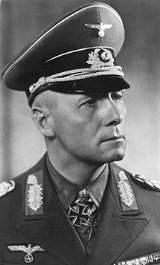
Erwin Johannes Eugen Rommel was one of the most distinguished
German Field Marshals of
World War II. He was the commander of the
Deutsches Afrika Korps and also became known by the nickname
The Desert Fox for the skillful military campaigns he waged on behalf of the
German Army in
North Africa. He was later put in command of the German forces following the Allied invasion at
Normandy in the final effort to defend the German homeland.
Rommel is often remembered not only for his remarkable military prowess, but also for his
chivalry towards his adversaries - being one of the German commanders who disobeyed the commando order. He is also noted for possibly having taken part in a plot to assassinate Hitler, for which he was forced to commit suicide before the war's end.
Early life and career
Rommel was born in
Heidenheim, Germany, approximately 45 kilometres from
Ulm, in the state of
Württemberg. He was baptised on November 17 1891. He was the second son of a Protestant headmaster of the secondary school at Aalen, Erwin Rommel the elder and Helene von Luz, a daughter of a prominent local dignitary. The couple also had three more children, two sons, Karl and Gerhard, and a daughter, Helene. Later, recalling his childhood, Rommel wrote that "my early years passed very happily". At the age of fourteen, Rommel and a friend built a full-scale glider that was able to fly, although not very far. Young Erwin considered becoming an engineer; however, on his father's insistence, he joined the local 124th Württemberg Infantry Regiment as an officer cadet in 1910 and, shortly after, was sent to the Officer Cadet School in
Danzig.
While at Cadet School, early in 1911, Rommel met his future wife, Lucie Maria Mollin. He graduated in November 1911 and was commissioned as a
Lieutenant January 1912. Rommel and Lucie married in 1916, and in 1928, they had a son, Manfred, who would later become the mayor of
Stuttgart. Scholars Bierman and Smith argue that, during this time, Rommel also had an affair with Walburga Stemmer in 1913 and that relationship produced a daughter named Gertrud. .
World War I
During
World War I, Rommel fought in
France, as well as in
Romania and
Italy as part of the elite
Alpen Korps. While serving with that unit, he gained a reputation for making quick tactical decisions and taking advantage of enemy confusion. He was wounded three times and awarded the
Iron Cross; First and Second Class. Rommel also received
Prussia's highest medal, the
Pour le Mérite - an honor traditionally reserved for generals only - after fighting in the mountains of west
Slovenia – Battle of the Isonzo – Soca front. The award came as a result of the Battle of Longarone, and the capture of Mount Matajur,
Slovenia, and its defenders, numbering 150 Italian officers, 7,000 men and 81 artillery guns. His battalion also played a key role in the decisive victory of the
Central Powers over the
Italian Army at the
Battle of Caporetto. Interestingly, Rommel for a time served in the same infantry regiment as
Friedrich Paulus, both of whom were to preside over catastrophic defeats for the Third Reich in their own markedly different ways.
Inter-war years
After the war, Rommel held battalion commands and was an instructor at the
Dresden Infantry School from 1929 to 1933 and the Potsdam War Academy from 1935 to 1938. Rommel's war diaries,
Infanterie greift an , published in 1937, became a highly regarded military textbook, and attracted the attention of
Adolf Hitler, who placed him in charge of the training of the
Hitler Jugend that same year, all the while retaining his place at Potsdam. Rommel was awarded in his class highest war ribbons for excellent performance. In 1937, it was rumoured that Rommel travelled to the United States to study the tactics of Confederate generals such as the brilliant strategist
Thomas J. "Stonewall" Jackson and
Nathan Bedford Forrest. In the town of
Clifton, Tennessee, there is a log book at the Russ Hotel with his and several other German signatures, though this has never been verified. Rommel applied his knowledge of past military leaders in his North Africa campaign.
In 1938, Rommel, now a colonel, was appointed commandant of the War Academy at
Wiener Neustadt. Here he started his follow up to
Infantry Attacks,
Panzer greift an . Rommel was removed after a short time however, to take command of
Adolf Hitler's personal protection battalion , assigned to protect him in the special railway train used during his visits to occupied
Czechoslovakia and
Memel.
World War II
Poland 1939
Rommel continued as
FührerBegleitbataillon commander during the Polish campaign, often moving up close to the front in the
Führersonderzug, and seeing much of Hitler. After the Polish defeat, Rommel returned to Berlin to organise the Führer's victory parade, taking part himself as a member of Hitler's entourage.
France 1940
On 6 February 1940, only three months before the invasion, Rommel was given command of the
7th Panzer Division, later nicknamed
Gespenster-Division , for
Fall Gelb , the invasion of
France and the
Low Countries. Remarkably, this was Rommel's first command of a Panzer unit. He showed considerable skill in this operation, repulsing a counter-attack by the British Expeditionary Force at Arras. 7th Panzer was one of the first German units to reach the
English Channel and captured the vital port of
Cherbourg on 19 June. As a reward, Rommel was promoted and appointed commander of the 5th Light Division and of the 15th Panzer Division, which were sent to
Libya in early 1941 to aid the hapless and demoralized Italian troops, forming the
Deutsches Afrika Korps. It was in
Africa where Rommel achieved his greatest fame as a commander.
Africa 1941-43
His campaign in Africa earned Rommel the nickname "The Desert Fox". He spent most of 1941 building up his forces, the Italian component of which had suffered a string of defeats at the hands of
British Commonwealth forces under Major General
Richard O'Connor. An offensive pushed the Allied forces out of
Libya, but stalled a relatively short way into Egypt, and the important port of
Tobruk, although surrounded, was still held by Allied forces under the
Australian General, Leslie Morshead. The Allied Commander-in-Chief, General
Archibald Wavell made two unsuccessful attempts to relieve Tobruk .
Following the costly failure of Battleaxe, Wavell was relieved by Commander-in-Chief India, General
Claude Auchinleck. Auchinleck launched a major offensive to relieve Tobruk which eventually succeeded. During the confusion caused by the Crusader operation, Rommel and his staff found themselves behind Allied lines several times. On one occasion, he visited a New Zealand Army field hospital, which was still under Allied control. "[Rommel] inquired if anything was needed, promised the British [
sic] medical supplies and drove off unhindered."
Crusader was a defeat for Rommel. After several weeks of fighting, Rommel ordered the withdrawal of all his forces from the area around Tobruk towards El Agheila. The Allies followed, attempting to cut off the retreating troops as they had done in 1940, but Rommel's counter-attack on January 20 1942 mauled the Allied forces. The Afrika Korps retook
Benghazi and the Allies pulled back to the Tobruk area and commenced building defensive positions.
On May 24 1942 Rommel's army attacked. In a classic
blitzkrieg is a popular name for an offensive operational-level [i] military doctrine [i]...
, he outflanked the Allies at
Gazala, surrounded and reduced the strongpoint at
Bir Hakeim and forced the Allies to quickly retreat, in the so-called "Gazala Gallop", to avoid being completely cut off. Tobruk, isolated and alone, was now all that stood between the Afrika Korps and Egypt. On 21 June 1942, after a swift, coordinated and fierce combined arms assault, the city surrendered along with its 33,000 defenders. Only at the
fall of Singapore, earlier that year, had more
British Commonwealth troops been captured. Hitler made Rommel a field marshal. Within weeks, the Allies were pushed back far into
Egypt.
Rommel's 21st Panzer Division was eventually stopped at the small railway town of
El Alamein, just sixty miles from
Alexandria.
With Allied forces from
Malta interdicting his supplies at sea, and the enormous distances supplies had to travel to reach his forward troops, Rommel could not hold the El Alamein position forever. Still, it took a large set piece battle, the
Second Battle of El Alamein, to dislodge his forces.
In September, he took sick leave in Italy and Germany, but immediately returned when news of the battle reached him. After the defeat at El Alamein, Rommel's forces managed to escape by using all the Italian transports. Despite urgings from
Hitler and
Mussolini, Rommel's forces did not again stand and fight until they had entered
Tunisia. Even then, their first battle was not against the British Eighth Army, but against the
U.S. II Corps. Rommel inflicted a sharp defeat on the American forces at the
Battle of Kasserine Pass.
Turning once again to face the British Commonwealth forces in the old French border defences of the Mareth Line, Rommel could only delay the inevitable. At the end of January 1943, the Italian General
Giovanni Messe was appointed as the new commander of Rommel’s Panzer Army Africa, which was now re-named 1st Italo-German Panzer Army . Though Messe was to replace Rommel, he diplomatically deferred to the German, and the two co-existed in what was theoretically the same command until March 9th, when Rommel finally departed Africa. Rommel's departure was kept secret on Hitler's explicit orders, so that the morale of the Axis troops could be maintained and respectful fear by their enemies retained. The last Rommel offensive in North Africa occurred on March 6 1943, when he attacked Montgomery's 8th Army at the Battle of Medenine with three panzer divisions . Decoded Ultra intercepts allowed Montgomery to deploy large numbers of anti-tank guns in the path of the offensive. After losing 52 tanks, Rommel was forced to call off the assault. On 9 March he handed over command of Armeegruppe Afrika to Arnim and left Africa, because of health reasons, never to return. On May 13, 1943, after the collapse of the 5th German Army, the fall of
Tunis and the surrounding of the 1st Italian Army, still holding the line at Enfidaville,
Giovanni Messe formally surrendered the remnants of Army Group Afrika to the Allies. On May 12th, one day before the surrender, Messe was promoted to the rank of field marshal.
Some historians contrast Rommel's withdrawal back to Tunisia against Hitler's wishes with
Friedrich Paulus's obedience of orders to have the German 6th Army stand its ground at the
Battle of Stalingrad, which resulted in its annihilation.
Some sources state that during this period, there was a failed Allied attempt to capture Rommel from his headquarters, 250 miles behind enemy lines.
France 1943-1944
Back in Germany, Rommel was for some time virtually "unemployed". On 23 July 1943 he moved to
Greece as commander of Army Group E, to defend the Greek coast against a possible allied landing that never happened, only to return to Germany two days later, upon the overthrow of Mussolini. On 17 August 1943, Rommel moved his headquarters from
Munich to
Lake Garda, as commander of a new Army Group B, created to defend the north of Italy. After Hitler gave General
Albert Kesselring sole Italian command, on 21 November, Rommel moved Army Group B to
Normandy, France, with responsibility for defending the French coast against the long anticipated Allied invasion. Dismayed by the situation he found, the slow building pace, and fearing he had just months before an invasion, Rommel reinvigorated the whole fortification effort along the Atlantic coast. Under his direction, work was significantly sped up, millions of mines laid, and thousands of tank traps and obstacles set up on beaches and throughout the countryside.
After his battles in Africa, Rommel concluded that any offensive movement would be nearly impossible due to overwhelming Allied air superiority. He argued that the tank forces should be dispersed in small units and kept in heavily fortified positions as close to the front as possible, so they would not have to move far and en masse when the invasion started. He wanted the invasion stopped right on the beaches. However his commander,
Gerd von Rundstedt, felt that there was no way to stop the invasion near the beaches due to the equally overwhelming firepower of the
Royal Navy. He felt the tanks should be formed into large units well inland near
Paris, where they could allow the Allies to extend into France and then cut off the Allied troops. When asked to pick a plan, Hitler vacillated and placed them in the middle, far enough to be useless to Rommel, not far enough to watch the fight for von Rundstedt.
During
D-Day, several tank units, notably the
12th SS Panzer Division, were close enough to the beaches to create serious havoc. Hitler refused however to release the panzer reserves as he believed the Normandy landings were a diversion. Hitler and the German High Command expected the main assault in the
Pas de Calais area, thanks to the success of a secret Allied deception campaign . Facing only small-scale German attacks, the Allies quickly secured a beachhead.
The plot against Hitler
On July 17 1944, Rommel's staff car was strafed by an
RCAF Spitfire piloted by Charley Fox; he was hospitalized with major head injuries. . In the meantime, after the failed July 20 Plot against
Adolf Hitler a major crackdown was conducted throughout the Wehrmacht. As the investigation proceeded, numerous connections started appearing that tied Rommel to the conspiracy, many of his closest aides being deeply involved. At the same time, local Nazi party officials reported on Rommel's extensive and scornful criticism of Nazi leadership during the time he was hospitalized.
Bormann was certain of Rommel's involvement,
Goebbels was not.
The true extent of Rommel's knowledge of or involvement with the plot is still unclear. After the war, however, his wife maintained that Rommel had been against the plot. It has been stated that Rommel wanted to avoid giving future generations of Germans the perception that the war was lost because of backstabbing, the infamous Dolchstoßlegende, as was commonly believed by some Germans of
World War I. Instead, he favored a coup where Hitler would be taken alive and made to stand trial before the public.
Recent evidence seems to indicate that Rommel was aware of the July 20 plot and the intentions of
Claus von Stauffenberg, but avoided participating, not merely because of the chance of repeating the 'November Criminals' fable. He was all too aware of the crudity and poorly organised nature of the plot, and the slim chance of the Western Allies accepting a separate peace. He thus took an objective and realistic attitude towards the planned coup, though for all his forbearance and cautious nature, he still fell afoul of Hitler's growing paranoia and petty hatred towards the Prussian officer caste. It was even reported that, shortly after Rommel regained consciousness following his accident, he confided to his son "Stauffenberg botched his plans, but a front line officer would have finished Hitler off."
Because of Rommel's popularity with the German people, Hitler gave him an option to commit
suicide with
cyanide or face a humiliating sham trial before
Roland Freisler's "People's Court" and the murder of his family and staff. Rommel ended his own life on October 14, 1944, and was buried with full military honours. After the war, his diary was published as
The Rommel Papers. He is the only member of the
Third Reich establishment to have a museum dedicated to him. His grave can be found in Herrlingen, a short distance west of
Ulm.
Battles
Popular perception
Rommel was in his lifetime extraordinarily popular, not only with the German people, but also with his adversaries. His chivalry and tactical prowess earned him the respect of many of them, particularly the British.
Claude Auchinleck,
Winston Churchill,
George S. Patton, and
Bernard Montgomery are all on record as having positive things to say about the "Desert Fox" , as both a general and a man; Montgomery even named a dog after him. Rommel, for his part, was complimentary towards and respectful of his foes. Hitler considered Rommel one of his favorite generals and kept him in Africa largely for propaganda purposes, believing he could win easy victories when he might not be able to in Russia.
After the war, when his involvement in the plot to kill Hitler became known, his stature was enhanced greatly among the former Allied nations. Rommel was often cited by his former opponents as a general who, though a loyal German, was willing to stand up to the evil that was Hitler . The release of the film
helped enhance his reputation as one of the most widely known and well-regarded leaders in the German army. In 1970 a
Lütjens class destroyer was named the FGS Rommel in his honor.
In fiction
He has been portrayed by:
- Erich von Stroheim in the 1943 film Five Graves to Cairo
- James Mason in both the 1951 and the 1953 The Desert Rats
- Werner Hinz in 1962's The Longest Day
- Karl Michael Vogler in the 1970 Patton, starring George C. Scott
- Wolfgang Priess in the 1971 Raid on Rommel
- Hardy Kruger in the 1988 television miniseries War and Remembrance is a novel by Herman Wouk [i], published in 1978, which is the sequel to The Winds of War [i] ...
- Michael York in the 1990 TV-movie Night of the Fox
In
Philip K. Dick's alternative history novel
The Man in the High Castle, Rommel is the Nazi-appointed president of the United States of America in the early 1960s.
In Douglas Niles's and
Michael Dobson's alternative history novel
Fox on the Rhine , Hitler is killed by the bomb plot of July 20 1944. This leads to Rommel's survival, and a different quick offensive strike. This is repelled and the book ends with his surrender to the Americans and British, in the belief that the Germans would be better off with the western powers than with the Soviets.
Fox on the Rhine was followed by a sequel,
Fox at the Front .
In Donna Barr's novel
Bread and Swans, the historical Rommel shares his concerns and career with a fictitious younger brother, Pfirsich, also known as The Desert Peach. Both Rommels also appear as focal characters of Barr's long-running comic strip series about "The Peach".
During the 1980's, there was a popular arcade tank-based game called
Rommel's Revenge which found its way to the home computer market.
Quotations about Rommel
- The British Parliament considered a censure vote against Winston Churchill following the surrender of Tobruk. The vote failed, but in the course of the debate, Churchill would say:
- "We have a very daring and skillful opponent against us, and, may I say across the havoc of war, a great General."
- Churchill again, on hearing of Rommel's death:
- "He also deserves our respect, because, although a loyal German soldier, he came to hate Hitler and all his works, and took part in the conspiracy to rescue Germany by displacing the maniac and tyrant. For this, he paid the forfeit of his life. In the sombre wars of modern democracy, there is little place for chivalry."
- Theodor Werner was an officer who, during World War I, served under Rommel.
- "Anybody who came under the spell of his personality turned into a real soldier. He seemed to know what the enemy were like and how they would react."
- Attributed to General George S. Patton in North Africa
- "Rommel, you magnificent bastard! I read your book!"
Quotations
- "Sweat saves blood, blood saves lives, and brains saves both."
- "Mortal danger is an effective antidote for fixed ideas."
- "The best form of welfare for the troops is first-rate training."
- "Don't fight a battle if you don't gain anything by winning."
- "In a man-to-man fight, the winner is he who has one more round in his magazine."
- "Courage which goes against military expediency is stupidity, or, if it is insisted upon by a commander, irresponsibility."
- "In the absence of orders, find something and kill it."
- Referring to Italians: "Good troops, bad officers. But remember that without them we wouldn't have civilization."
- "Training errors are recorded on paper. Tactical errors are etched in stone."
- "It is not a Commonwealth division, it is an Australian Division. Why, give me two Australian Divisions and I will conquer the world for you!"
References
- The Battle of Alamein: Turning Point, World War II, by Bierman and Smith . ISBN 0-670-03040-6
- Rommel's Greatest Victory, by Samuel W. Mitcham, Samuel Mitcham. ISBN 0-89141-730-3
- Meeting the Fox: The Allied Invasion of Africa, from Operation Torch to Kasserine Pass to Victory in Tunisia, by Orr Kelly. ISBN 0-471-41429-8
- Inside the Afrika Korps: The Crusader Battles, 1941-1942. ISBN 1-85367-322-6
- Alamein, by Jon Latimer. ISBN 0-674-01016-7
- Tank Combat in North Africa: The Opening Rounds : Operations Sonnenblume, Brevity, Skorpion and Battleaxe February 1941-June 1941 , by Thomas L. Jentz. ISBN 0-7643-0226-4
- Rommel's North Africa Campaign: September 1940 - November 1942, by Jack Greene. ISBN 1-58097-018-4
- Tobruk 1941: Rommel's Opening Move , by Jon Latimer. ISBN 1-84176-092-7
- 21st Panzer Division: Rommel's Africa Korps Spearhead , by Chris Ellis. ISBN 0-7110-2853-2
- Afrikakorps, 1941-1943: The Libya Egypt Campaign, by Francois De Lannoy. ISBN 2-84048-152-9
- With Rommel's Army in Libya, by Almasy, Gabriel Francis Horchler, Janos Kubassek. ISBN 0-7596-1608-6
- Generalfeldmarschall Rommel: opperbevelhebber van Heeresgruppe B bij de voorbereiding van de verdediging van West-Europa, 5 November 1943 tot 6 juni 1944, by Hans Sakkers . ISBN 90-800900-2-6 [text/photobook in Dutch about Rommel at the Atlantic Wall 1943/44]
- Knight's Cross: A Life of Field Marshal Erwin Rommel, by David Fraser. ISBN 0-06-092597-3
- Rommel The Desert Fox, by Desmond Young, Foreword by Sir Claude Auchinleck.
- The Armies of Rommel, by George Forty, ISBN 1-85409-379-7
External links