


Bristol Beaufort

Discussions

Encyclopedia
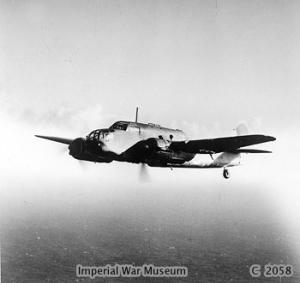
The Bristol Beaufort (manufacturer designation Type 152) was a British twin-engined torpedo bomber
Torpedo bomber
A torpedo bomber is a bomber aircraft designed primarily to attack ships with aerial torpedoes which could also carry out conventional bombings. Torpedo bombers existed almost exclusively prior to and during World War II when they were an important element in many famous battles, notably the...
designed by the Bristol Aeroplane Company
Bristol Aeroplane Company
The Bristol Aeroplane Company, originally the British and Colonial Aeroplane Company, was both one of the first and one of the most important British aviation companies, designing and manufacturing both airframes and aero engines...
, and developed from experience gained designing and building the earlier Blenheim
Bristol Blenheim
The Bristol Blenheim was a British light bomber aircraft designed and built by the Bristol Aeroplane Company that was used extensively in the early days of the Second World War. It was adapted as an interim long-range and night fighter, pending the availability of the Beaufighter...
light bomber
Light bomber
A light bomber is a relatively small and fast class of military bomber aircraft which were primarily employed before the 1950s. Such aircraft would typically not carry more than one ton of ordnance....
.
Beauforts first saw service with Royal Air Force
Royal Air Force
The Royal Air Force is the aerial warfare service branch of the British Armed Forces. Formed on 1 April 1918, it is the oldest independent air force in the world...
Coastal Command
RAF Coastal Command
RAF Coastal Command was a formation within the Royal Air Force . Founded in 1936, it was the RAF's premier maritime arm, after the Royal Navy's secondment of the Fleet Air Arm in 1937. Naval aviation was neglected in the inter-war period, 1919–1939, and as a consequence the service did not receive...
and then the Royal Navy
Royal Navy
The Royal Navy is the naval warfare service branch of the British Armed Forces. Founded in the 16th century, it is the oldest service branch and is known as the Senior Service...
Fleet Air Arm
Fleet Air Arm
The Fleet Air Arm is the branch of the British Royal Navy responsible for the operation of naval aircraft. The Fleet Air Arm currently operates the AgustaWestland Merlin, Westland Sea King and Westland Lynx helicopters...
from 1940, until they were withdrawn from operational service in the European theatre in 1942. RAF Beauforts flying from Britain operated as torpedo bombers, conventional bombers and mine-layers and were then used as training aircraft until being declared obsolete in 1945.
Beauforts also saw considerable action in the Mediterranean; Beaufort squadrons based in Egypt and on Malta
Malta
Malta , officially known as the Republic of Malta , is a Southern European country consisting of an archipelago situated in the centre of the Mediterranean, south of Sicily, east of Tunisia and north of Libya, with Gibraltar to the west and Alexandria to the east.Malta covers just over in...
helped put an end to Axis shipping supplying Rommel
Rommel
Erwin Rommel was a German World War II field marshal.Rommel may also refer to:*Rommel *Rommel Adducul , Filipino basketball player*Rommel Fernández , first Panamanian footballer to play in Europe...
's Deutsches Afrikakorps
Afrika Korps
The German Africa Corps , or the Afrika Korps as it was popularly called, was the German expeditionary force in Libya and Tunisia during the North African Campaign of World War II...
in North Africa. Beauforts were most widely used, until the end of the Second World War, by the Royal Australian Air Force
Royal Australian Air Force
The Royal Australian Air Force is the air force branch of the Australian Defence Force. The RAAF was formed in March 1921. It continues the traditions of the Australian Flying Corps , which was formed on 22 October 1912. The RAAF has taken part in many of the 20th century's major conflicts...
in the Pacific theatre
Pacific War
The Pacific War, also sometimes called the Asia-Pacific War refers broadly to the parts of World War II that took place in the Pacific Ocean, its islands, and in East Asia, then called the Far East...
. All but six of the RAAF's Beauforts were manufactured under licence in Australia.
Although designed as a torpedo-bomber, the Beaufort more often flew as a level-bomber. The Beaufort also flew more hours in training than on operational missions and more were lost through accidents and mechanical failures than were lost to enemy fire. However, the Beaufort did spawn a long-range heavy fighter variant called the Beaufighter
Bristol Beaufighter
The Bristol Type 156 Beaufighter, often referred to as simply the Beau, was a British long-range heavy fighter modification of the Bristol Aeroplane Company's earlier Beaufort torpedo bomber design...
, which proved to be very successful and many Beaufort units eventually converted to the Beaufighter.
Design and development
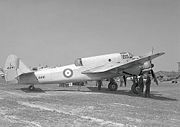
Air Ministry
The Air Ministry was a department of the British Government with the responsibility of managing the affairs of the Royal Air Force, that existed from 1918 to 1964...
Specifications M.I5/35 and G.24/35 for respectively a land-based twin-engined torpedo-bomber and a general reconnaissance aircraft. With a production order following under Specification 10/36, the Bristol Type 152 was given the name Beaufort after the Duke of Beaufort
Duke of Beaufort
Duke of Beaufort is a title in the Peerage of England. It was created by Charles II in 1682 for Henry Somerset, 3rd Marquess of Worcester, a descendant of Charles Somerset, 1st Earl of Worcester, illegitimate son of Henry Beaufort, 3rd Duke of Somerset, a Lancastrian leader in the Wars of the...
, whose ancestral home was nearby in Gloucestershire
Gloucestershire
Gloucestershire is a county in South West England. The county comprises part of the Cotswold Hills, part of the flat fertile valley of the River Severn, and the entire Forest of Dean....
.
The competing torpedo bomber entry from Blackburn was also ordered as the Blackburn Botha
Blackburn Botha
-See also:-External links:*...
. In an unprecedented step both designs were ordered straight off the drawing board, an indication of how urgently the RAF needed a new torpedo bomber. Three hundred and twenty Beauforts were ordered. Initially, because of their commitment to the Blenheim, Bristol were to build 78 at their Filton
Filton
Filton is a town in South Gloucestershire, England, situated on the northern outskirts of the city of Bristol, about from the city centre. Filton lies in Bristol postcode areas BS7 and BS34. The town centres upon Filton Church, which dates back to the 12th century and is a grade II listed building...
factory, with the other 242 being built by Blackburn. These allocations would be changed later.
Although the design looked similar in many ways to the Blenheim, it was somewhat larger, with an 18 in (46 cm) increase in wingspan. With the fuselage
Fuselage
The fuselage is an aircraft's main body section that holds crew and passengers or cargo. In single-engine aircraft it will usually contain an engine, although in some amphibious aircraft the single engine is mounted on a pylon attached to the fuselage which in turn is used as a floating hull...
being made longer in the nose and taller to accommodate a fourth crew member, it was also considerably heavier. The larger bomb-bay was designed to house a semi-recessed torpedo
Torpedo
The modern torpedo is a self-propelled missile weapon with an explosive warhead, launched above or below the water surface, propelled underwater towards a target, and designed to detonate either on contact with it or in proximity to it.The term torpedo was originally employed for...
, or it could carry an increased bomb load. Due to the increased weight the Blenheim's Bristol Mercury
Bristol Mercury
|-See also:-Bibliography:* Bridgman, L, Jane's fighting aircraft of World War II. Crescent. ISBN 0-517-67964-7* Gunston, Bill. World Encyclopedia of Aero Engines. Cambridge, England. Patrick Stephens Limited, 1989. ISBN 1-85260-163-9...
engines were to be replaced by the more powerful, sleeve valve
Sleeve valve
The sleeve valve is a type of valve mechanism for piston engines, distinct from the usual poppet valve. Sleeve-valve engines saw use in a number of pre-World War II luxury cars and in USA in the Willys-Knight car and light truck...
, Bristol Perseus
Bristol Perseus
|-See also:-Bibliography:* Bridgman, L, Jane's Fighting Aircraft of World War II. Crescent . ISBN 0-517-67964-7* Gunston, Bill. World Encyclopedia of Aero Engines. Cambridge, England. Patrick Stephens Limited, 1989. ISBN 1-85260-163-9...
. It was soon determined that even with the Perseus, the Beaufort would be slower than the Blenheim and so a switch was made to the larger Bristol Taurus
Bristol Taurus
|-See also:-Bibliography:*Gunston, Bill. World Encyclopedia of Aero Engines. Cambridge, England. Patrick Stephens Limited, 1989. ISBN 1-85260-163-9...
engine, also a sleeve valve design. For these engines, chief designer Roy Fedden
Roy Fedden
Sir Alfred Hubert Roy Fedden MBE was an engineer who designed most of Bristol Engine Company's successful aircraft engine designs.-Early life:...
developed special low-drag NACA cowling
NACA cowling
The NACA cowling is a type of aerodynamic fairing used to streamline radial engines for use on airplanes and developed by the National Advisory Committee for Aeronautics in 1927...
s which exhausted air through vertical slots flanking the nacelles under the wings. Air flow was controlled by adjustable flaps.
The basic structure, although similar to the Blenheim, introduced refinements such as the use of high-strength light alloy
Alloy
An alloy is a mixture or metallic solid solution composed of two or more elements. Complete solid solution alloys give single solid phase microstructure, while partial solutions give two or more phases that may or may not be homogeneous in distribution, depending on thermal history...
forging
Forging
Forging is a manufacturing process involving the shaping of metal using localized compressive forces. Forging is often classified according to the temperature at which it is performed: '"cold," "warm," or "hot" forging. Forged parts can range in weight from less than a kilogram to 580 metric tons...
s and extrusion
Extrusion
Extrusion is a process used to create objects of a fixed cross-sectional profile. A material is pushed or drawn through a die of the desired cross-section...
s in place of high-tensile steel
Steel
Steel is an alloy that consists mostly of iron and has a carbon content between 0.2% and 2.1% by weight, depending on the grade. Carbon is the most common alloying material for iron, but various other alloying elements are used, such as manganese, chromium, vanadium, and tungsten...
plates and angles; as a result the overall structural weight was lighter than that of the Blenheim.In addition, the wing centre section was inserted into the centre fuselage and the nacelle structure was an integral part of the ribs to which the main undercarriage
Undercarriage
The undercarriage or landing gear in aviation, is the structure that supports an aircraft on the ground and allows it to taxi, takeoff and land...
was attached. Transport joints were used on the fuselage and wings: this allowed sub-contractors to manufacture the Beaufort in easily transportable sections, and was to be important when Australian production got underway. The Vickers
Vickers
Vickers was a famous name in British engineering that existed through many companies from 1828 until 1999.-Early history:Vickers was formed in Sheffield as a steel foundry by the miller Edward Vickers and his father-in-law George Naylor in 1828. Naylor was a partner in the foundry Naylor &...
main undercarriage units were similar to, but larger than those of the Blenheim and used hydraulic retraction with a cartridge operated emergency lowering system.
The first prototype rolled out of Filton in mid-1938. Problems immediately arose with the Taurus engines continually overheating during ground testing. New more conventional engine cowlings with circumferential cooling gills had to be designed and installed, delaying the first flight which took place on 15 October 1938. As flight testing progressed it was found that the large apron-type undercarriage doors, similar to those on the Blenheim, were causing the aircraft to yaw on landing. These doors were taken off for subsequent flights. On the second prototype and all production aircraft more conventional split doors, which left a small part of the tyres exposed when retracted, were used.
The results of high level bombing tests carried out at Boscombe Down at an altitude of 10000 ft (3,048 m) and an airspeed of 238 mi/h showed that the Beaufort was in the words of the test pilot: "An exceptionally poor bombing platform, being subject to an excessive and continuous roll which made determination of drift particularly difficult." After 1941, British Beauforts were fitted with semi-circular plates on the trailing edges of the upper wing behind the engine nacelles to smooth airflow and improve directional stability.
With Blenheim production taking priority and continued overheating of the Taurus engines there were delays in production, so while the bomber had first flown in October 1938 and should have been available almost immediately, it was not until November 1939 that production started in earnest. Several of the first production Beauforts were engaged in working-up trials and final service entry began in January 1940 with 22 Squadron
No. 22 Squadron RAF
No. 22 Squadron of the Royal Air Force operates the Sea King HAR.3 and HAR.3A at three stations in the southern United Kingdom. The squadron was originally formed in 1915 as an aerial reconnaissance unit of the Royal Flying Corps serving on the Western Front during First World War...
of RAF Coastal Command
RAF Coastal Command
RAF Coastal Command was a formation within the Royal Air Force . Founded in 1936, it was the RAF's premier maritime arm, after the Royal Navy's secondment of the Fleet Air Arm in 1937. Naval aviation was neglected in the inter-war period, 1919–1939, and as a consequence the service did not receive...
.
British Beauforts
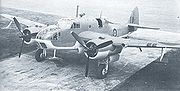
The original curved perspex bomb aimers nose panels were replaced by flat, non-distorting panels from the 10th production aircraft. Successive Marks of the Bristol Taurus engine were installed: starting with the Taurus III, the more reliable Taurus IIs were used whenever possible. Initially Beauforts with the Taurus II engines were designated Beaufort Mk.II, while those with other Taurus Marks continued to be Beaufort Mk.Is. Finally all Taurus-engined Beauforts became Mk.Is with the introduction of the Wasp-powered Beaufort Mk.II. The Taurus Mk.IIs were modified to Mk.IIa, which later became the Taurus Mk.VI. All of these versions produced 860/900 hp (640/670 kW). The final marks of Taurus engines used were the more powerful 1,130 hp (840 kW) XII and XVIs. The Taurus engines drove de Havilland
De Havilland
The de Havilland Aircraft Company was a British aviation manufacturer founded in 1920 when Airco, of which Geoffrey de Havilland had been chief designer, was sold to BSA by the owner George Holt Thomas. De Havilland then set up a company under his name in September of that year at Stag Lane...
Type DH5/19 constant speed propeller
Constant speed propeller
A constant speed propeller is a type of propeller that can change its blade pitch to take better advantage of the power supplied by an engine in much the same way that a transmission in a car takes better advantage of its power source...
s.
As Beaufort units entered combat it was found that the defensive armament fitted was inadequate. As a result extra .303 in (7.7 mm) Vickers GO
Vickers K machine gun
Not to be confused with the Vickers light machine gunThe Vickers K machine gun, known as the Vickers Gas Operated in British service, was a rapid-firing machine gun developed and manufactured for use in aircraft by Vickers-Armstrongs...
machine guns were fitted; two on a gimbal mounting in the forward nose and single guns on pivots on either beam. A remotely controlled .303 in (7.7 mm) Browning machine gun
M1919 Browning machine gun
The M1919 Browning is a .30 caliber medium machine gun that was widely used during the 20th century. It was used as a light infantry, coaxial, mounted, aircraft, and anti-aircraft machine gun by the U.S. and many other countries, especially during World War II, the Korean War, and the Vietnam War...
was fitted, firing to the rear under the nose. Housed in a clear blown transparency, it was found to be of little use and most operational units soon discarded them.
Fairey
Fairey
-People:*Charles Richard Fairey, British aircraft manufacturer*Francis Fairey, , Canadian politician,*Jim Fairey, outfielder*Shepard Fairey, American artist-Companies:*Fairey Aviation Company, British aircraft company...
-Youngman pneumatic dive brakes were fitted to the wing trailing edges of several Beaufort IIs. After adverse reports from pilots these were locked shut. However it was found that the curved alloy extensions on the trailing edges improved the flight characteristics and similar panels were fitted on all later production Beauforts.
When it became apparent that the Taurus engines had problems, planning commenced to re-engine the aircraft with 1,200 hp (900 kW) Pratt & Whitney R-1830 Twin-Wasp radials, which were of similar diameter and slightly lighter. These engines drove Hamilton Standard
Hamilton Standard
Hamilton Standard, an aircraft propeller parts supplier, was formed in 1929 when United Aircraft and Transport Corporation consolidated Hamilton Aero Manufacturing and Standard Steel Propeller into the Hamilton Standard Propeller Corporation. Other members of the corporation included Boeing,...
bracket-type variable pitch propellers. There was however no guarantee that the supply of the Twin Wasp would not be cut off, and production reverted to the Taurus-engined Mark Is after 165 Beaufort Mark IIs had been built, starting with AW244 which first flew in September 1941. Performance with the Twin-Wasps was marginally improved: maximum speed went up from 271 mph (437 km/h) to 277 mph (446 km/h) and the service ceiling
Service ceiling
With respect to aircraft, a ceiling is the maximum density altitude an aircraft can reach under a set of conditions.The word ceiling can also refer to the height of the lowest obscuring cloud layer above the ground.-Service ceiling:...
increased from 16,500 ft (5,030 m) to 18,000 ft (5,486 m). Normal range was reduced from 1,600 mi (2,580 km) to 1,450 mi (2,330 km).
Other modifications introduced on the Mk II also used on late Mk Is included a replacing the elongated direction finding
Direction finding
Direction finding refers to the establishment of the direction from which a received signal was transmitted. This can refer to radio or other forms of wireless communication...
antenna with a loop aerial
Loop antenna
A loop antenna is a radio antenna consisting of a loop of wire, tubing, or other electrical conductor with its ends connected to a balanced transmission line...
, enclosed in a clear, tear-drop fairing on the top of the cabin. ASV Mk III was added with yagi antenna
Yagi antenna
A Yagi-Uda array, commonly known simply as a Yagi antenna, is a directional antenna consisting of a driven element and additional parasitic elements...
e under the nose and wings and a Bristol B1.Mk.V turret with two .303 in (7.7 mm) Browning machine guns was fitted.
The final British-built version of the Beaufort was the Pratt & Whitney-powered T.Mk.II, with 250 produced from August 1943. In this version, the turret was removed and the position was faired over. The last ever Beaufort was a T.Mk.II which left the Bristol Banwell
Banwell
Banwell is a village and civil parish on the River Banwell in the North Somerset district of Somerset, England. Its population was 2,923 according to the 2001 census.-History:...
factory on 25 November 1944.
Australian-built Beauforts
As the design for the Beaufort began to mature, the Australian Government invited a British Air Mission to discuss the defence needs of Australia and Singapore. It was also a step towards expanding Australia's domestic aircraft industry. The Beaufort was chosen as the best General Reconnaissance (G.R.) aircraft available and on 1 July 1939 orders were placed for 180 airframes and spares, with the specially formed Beaufort Division of the Commonwealth's Department of Aircraft ProductionGovernment Aircraft Factories
Government Aircraft Factories was the name of an aircraft manufacturer owned by the Government of Australia based at Fishermans Bend, a suburb of Melbourne in Victoria. It had its origins in the lead-up to World War II, during which it was known as the Department of Aircraft Production...
(DAP). The Australian made variants are often known as the DAP Beaufort.
The Australian Beauforts were to be built at the established DAP plant in Fisherman's Bend
Port Melbourne, Victoria
Port Melbourne is a suburb of Melbourne, Victoria, Australia, 5 km southwest of Melbourne's central business district. Its Local Government areas are the cities of Port Phillip and Melbourne. At the 2006 Census, Port Melbourne had a population of 13,293....
, Melbourne, Victoria and a new factory at Mascot, New South Wales
Mascot, New South Wales
Mascot is a suburb in south-eastern Sydney, in the state of New South Wales, Australia. Mascot is located 7 kilometres south of the Sydney central business district and is the administrative centre of the City of Botany Bay...
; to speed up the process drawings, jigs and tools and complete parts for six airframes were supplied by Bristol. The bulk of Australian-built Beauforts used locally available materials.
One of the decisive factors in choosing the Beaufort was the ability to produce it in sections. Because of this railway workshops were key subcontractor
Subcontractor
A subcontractor is an individual or in many cases a business that signs a contract to perform part or all of the obligations of another's contract....
s:
- ChulloraChullora, New South WalesChullora, a suburb of local government areas City of Bankstown and the Municipality of Strathfield, is located 15 kilometres west of the Sydney central business district, in the state of New South Wales, Australia, and forms a part of the Greater Western Sydney region.-History:The suburb of...
NSW: Front fuselage, undercarriage, stern frames, nacelles. - Newport Workshops Victoria: Rear fuselage, empennageEmpennageThe empennage , also known as the tail or tail assembly, of most aircraft gives stability to the aircraft, in a similar way to the feathers on an arrow...
. - Islington Workshops, South AustraliaSouth AustraliaSouth Australia is a state of Australia in the southern central part of the country. It covers some of the most arid parts of the continent; with a total land area of , it is the fourth largest of Australia's six states and two territories.South Australia shares borders with all of the mainland...
: Mainplanes, centre-section.
Taurus engines, aircraft components and the associated equipment were shipped out to be joined, in October 1939, by the eighth production Beaufort L4448. With the outbreak of war the possibility that supplies of the Taurus engines could be disrupted or halted was considered even before the British government placed an embargo on exporting war materials with the Blitzkrieg
Blitzkrieg
For other uses of the word, see: Blitzkrieg Blitzkrieg is an anglicized word describing all-motorised force concentration of tanks, infantry, artillery, combat engineers and air power, concentrating overwhelming force at high speed to break through enemy lines, and, once the lines are broken,...
on France
Battle of France
In the Second World War, the Battle of France was the German invasion of France and the Low Countries, beginning on 10 May 1940, which ended the Phoney War. The battle consisted of two main operations. In the first, Fall Gelb , German armoured units pushed through the Ardennes, to cut off and...
, the Netherlands and Belgium in May 1940. It was proposed that a change of powerplant could be made to the Pratt & Whitney Twin Wasp, which was already in use on RAAF
Royal Australian Air Force
The Royal Australian Air Force is the air force branch of the Australian Defence Force. The RAAF was formed in March 1921. It continues the traditions of the Australian Flying Corps , which was formed on 22 October 1912. The RAAF has taken part in many of the 20th century's major conflicts...
Lockheed Hudson
Lockheed Hudson
The Lockheed Hudson was an American-built light bomber and coastal reconnaissance aircraft built initially for the Royal Air Force shortly before the outbreak of the Second World War and primarily operated by the RAF thereafter...
s. Orders for the engine were placed and a factory was set up at Lidcombe, New South Wales
Lidcombe, New South Wales
Lidcombe is a suburb in western Sydney, in the state of New South Wales Australia. Lidcombe is located 14 kilometres west of the Sydney central business district, in the local government area of Auburn Council....
and run by General Motors
General Motors
General Motors Company , commonly known as GM, formerly incorporated as General Motors Corporation, is an American multinational automotive corporation headquartered in Detroit, Michigan and the world's second-largest automaker in 2010...
-Holden
Holden
GM Holden Ltd is an automaker that operates in Australia, based in Port Melbourne, Victoria. The company was founded in 1856 as a saddlery manufacturer. In 1908 it moved into the automotive field, before becoming a subsidiary of the U.S.-based General Motors in 1931...
Ltd. The locally built engines were coded S3C4-G, while those imported from America were coded S1C3-4. Three-bladed Curtiss-Electric
Curtiss-Wright
The Curtiss-Wright Corporation was the largest aircraft manufacturer in the United States at the end of World War II, but has evolved to largely become a component manufacturer, specializing in actuators, aircraft controls, valves, and metalworking....
propellers were fitted to Beaufort Mks V, VI, VIII and IX while Beaufort Mks VA and VIII used Hamilton Standard
Hamilton Standard
Hamilton Standard, an aircraft propeller parts supplier, was formed in 1929 when United Aircraft and Transport Corporation consolidated Hamilton Aero Manufacturing and Standard Steel Propeller into the Hamilton Standard Propeller Corporation. Other members of the corporation included Boeing,...
propellers. In early 1941, L4448 was converted as a trials aircraft and the combination was considered a success.
The first Australian-assembled Beaufort A9-1 flew on 5 May 1941 with the first Australian-built aircraft A9-7 coming off the production line in August. In total 700 Australian Beauforts were manufactured in six series (see variants).
A distinguishing feature of Australian Beauforts was a larger tailfin, which was used from the Mk VI on. Armament varied from British aircraft: British or American torpedoes were able to be carried and the final 140 Mk VIII were fitted with a locally manufactured Mk VE turret with .50 cal machine guns. A distinctive diamond-shaped DF aerial was fitted on the cabin roof, replacing the loop antenna. Other Australian improvements included fully enclosed landing gear and Browning 12.7mm machine guns in the wings. Some were also fitted with ASV radar aerial arrays on either side of the rear fuselage.
The Mk.XI was a transport conversion, stripped of armament, operational equipment and armour and rebuilt with a redesigned centre fuselage. Maximum speed was 300 mph (480 km/h) and a payload of 4,600 lb (2,100 kg) could be carried. Production of the Australian Beaufort ended in August 1944 when production switched to the Beaufighter.
Europe
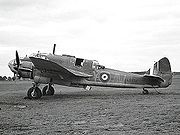
Battleship
A battleship is a large armored warship with a main battery consisting of heavy caliber guns. Battleships were larger, better armed and armored than cruisers and destroyers. As the largest armed ships in a fleet, battleships were used to attain command of the sea and represented the apex of a...
s and while in port in Brest
Brest, France
Brest is a city in the Finistère department in Brittany in northwestern France. Located in a sheltered position not far from the western tip of the Breton peninsula, and the western extremity of metropolitan France, Brest is an important harbour and the second French military port after Toulon...
, the Beaufort more often used bombs while in European service.
In early 1940, 22 Squadron
No. 22 Squadron RAF
No. 22 Squadron of the Royal Air Force operates the Sea King HAR.3 and HAR.3A at three stations in the southern United Kingdom. The squadron was originally formed in 1915 as an aerial reconnaissance unit of the Royal Flying Corps serving on the Western Front during First World War...
equipped with Vildebeests
Vickers Vildebeest
The Vickers Vildebeest and the similar Vickers Vincent were two very large two- to three-seat single-engined British biplanes designed and built by Vickers and used as a light bomber, torpedo bomber and in the army cooperation roles...
, began to receive Beauforts. The Beaufort was a much faster, heavier aircraft than the biplane and the crews needed a great deal of training in torpedo-dropping using new techniques required by the Beaufort. The lighter, slower Vildebeest was able to dive then flatten out before launching the torpedo; Beauforts carried too much speed after diving so it needed a longer, level approach to the torpedo drop. Because of this, and because of a shortage of torpedoes the squadron's first operations consisted of laying magnetic mines
Naval mine
A naval mine is a self-contained explosive device placed in water to destroy surface ships or submarines. Unlike depth charges, mines are deposited and left to wait until they are triggered by the approach of, or contact with, an enemy vessel...
("Gardening" in RAF parlance) and dropping conventional bombs. As an alternative to the torpedo the Beaufort could carry a 2,000 lb (910 kg) bomb using a purpose built carrier. On one of its first bombing operations, on 7 May 1940, a Beaufort dropped the first British 2,000 lb (910 kg) bomb, aiming at a German cruiser
Cruiser
A cruiser is a type of warship. The term has been in use for several hundreds of years, and has had different meanings throughout this period...
anchored off Norderney
Norderney
Norderney is one of the seven populated East Frisian Islands off the North Sea coast of Germany. It is also a municipality in the district of Aurich in Lower Saxony....
.
The first Beaufort operation took place on the night of 15/16 April, when nine Beauforts successfully laid mines in the Schilling Roads (north of Wilhelmshaven
Wilhelmshaven
Wilhelmshaven is a coastal town in Lower Saxony, Germany. It is situated on the western side of the Jade Bight, a bay of the North Sea.-History:...
). One Beaufort failed to return. A second unit, 42 Squadron
No. 42 Squadron RAF
No. 42 Squadron of the Royal Air Force has served during World War I as an army co-operation squadron and during World War II in various roles. In recent years, it was the Operational Conversion Unit for the Nimrod MR.2, based at RAF Kinloss, Moray, until the Nimrod MR2's retirement in 2010.-First...
began to re-equipped with Beauforts, starting in April. The Beaufort, however still had teething problems and, after some Beauforts were lost in mysterious circumstances, a Court of Enquiry in June 1940 concluded that the Taurus engines were still unreliable and grounded both operational squadrons until the engines could be modified.
The first RAF torpedo attack of the war came on 11 September 1940, when five aircraft of 22 Squadron attacked a convoy of three merchant ships off Ostend (Oostende in Belgium)
Ostend
Ostend is a Belgian city and municipality located in the Flemish province of West Flanders. It comprises the boroughs of Mariakerke , Stene and Zandvoorde, and the city of Ostend proper – the largest on the Belgian coast....
. One torpedo hit a 6,000 ton (5,440 tonne) ship. Four days later, the first "Rover" was mounted; a Rover was an armed reconnaissance mission carried out against enemy shipping by a small number of aircraft operating independently. "Rovers" became a major part of Beaufort operations over the next 18 months.
Other more hazardous operations were to follow, with one Beaufort pilot being awarded a posthumous VC
Victoria Cross
The Victoria Cross is the highest military decoration awarded for valour "in the face of the enemy" to members of the armed forces of various Commonwealth countries, and previous British Empire territories....
.
The only other UK based units to be equipped and fly operationally with the Beaufort, 86 Squadron
No. 86 Squadron RAF
No. 86 Squadron RAF was a unit of the Royal Air Force during World War II. Attached to Coastal Command the unit flew reconnaissance and air-sea rescue missions, anti-shipping strikes, and anti-submarine patrols.-Formation:No...
and 217 Squadron
No. 217 Squadron RAF
No. 217 Squadron RAF was originally formed on 1 April 1918, from the No. 17 Naval Squadron at Bergues, near Dunkerque. It conducted daylight raids using Airco DH.4s on enemy bases and airfields in Belgium. The squadron was disbanded on 18 October 1919, after the end of World War I.No...
, were operational by the middle of 1941. Beauforts also equipped some Commonwealth
Commonwealth of Nations
The Commonwealth of Nations, normally referred to as the Commonwealth and formerly known as the British Commonwealth, is an intergovernmental organisation of fifty-four independent member states...
Article XV squadrons
Article XV squadrons
Article XV squadrons were Australian, Canadian, and New Zealand air force squadrons formed from graduates of the British Commonwealth Air Training Plan , during World War II....
serving within the RAF, but, because of supply shortages, were replaced by other aircraft types before the units flew operationally.
Torpedo dropping
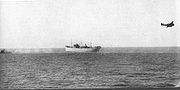
Altimeter
An altimeter is an instrument used to measure the altitude of an object above a fixed level. The measurement of altitude is called altimetry, which is related to the term bathymetry, the measurement of depth underwater.-Pressure altimeter:...
and misjudgement was easy, especially in calm conditions. For the Beauforts using the 18-inch (450-mm) Mk XII
British 18 inch torpedo
There have been a number of 18 inch torpedoes in service with the United Kingdom. These have been used on ships of the Royal Navy and aircraft of both the Fleet Air Arm and Royal Air Force...
aerial torpedo
Aerial torpedo
The aerial torpedo, airborne torpedo or air-dropped torpedo is a naval weapon, the torpedo, designed to be dropped into water from an aircraft after which it propels itself to the target. First used in World War I, air-dropped torpedoes were used extensively in World War II, and remain in limited...
, the average drop-height was 68 ft (21 m) and the average range of release was 670 yd (610 m). During the run-in, the aircraft was vulnerable to defensive anti-aircraft
Anti-aircraft warfare
NATO defines air defence as "all measures designed to nullify or reduce the effectiveness of hostile air action." They include ground and air based weapon systems, associated sensor systems, command and control arrangements and passive measures. It may be to protect naval, ground and air forces...
fire, and it took courage to fly through it with no chance of evasive manoeuvres. The Beaufort's optimum torpedo dropping speed was a great deal higher than that of the Vildebeests it was replacing, and it took practice to accurately judge the range to, and speed of, the target ship. A ship the size and speed of the Scharnhorst, for example, would look huge, filling the windscreen at well over 1 mi (1.6 km) and it was easy to under-estimate the range. In action, torpedoes were often released too far away from the target, although there was one recorded instance of a torpedo being released too close. For safety reasons, torpedo warhead
Warhead
The term warhead refers to the explosive material and detonator that is delivered by a missile, rocket, or torpedo.- Etymology :During the early development of naval torpedoes, they could be equipped with an inert payload that was intended for use during training, test firing and exercises. This...
s had a set distance (usually about 300 yd/274 m) from the release point before they were armed. It also took some distance for the torpedo to settle to its running depth.
Once the torpedo had been dropped, if there was room, a sharp turn away from the enemy was possible: more often than not the aircraft had to fly around or over the ship, usually at full-throttle and below mast height. A sharp pull-up could be fatal, as it could expose a large area of the aircraft to anti-aircraft guns.
Attacks on capital ships
Kriegsmarine
The Kriegsmarine was the name of the German Navy during the Nazi regime . It superseded the Kaiserliche Marine of World War I and the post-war Reichsmarine. The Kriegsmarine was one of three official branches of the Wehrmacht, the unified armed forces of Nazi Germany.The Kriegsmarine grew rapidly...
. The first attack was on 21 June 1940, when nine Beauforts of 42 Squadron attacked the Scharnhorst off the Norwegian coast. No torpedoes were available at RAF Wick and a dive bombing
Dive bomber
A dive bomber is a bomber aircraft that dives directly at its targets in order to provide greater accuracy for the bomb it drops. Diving towards the target reduces the distance the bomb has to fall, which is the primary factor in determining the accuracy of the drop...
attack was carried out using two 500 lb (230 kg) bombs. The Beauforts encountered Messerschmitt Bf 109
Messerschmitt Bf 109
The Messerschmitt Bf 109, often called Me 109, was a German World War II fighter aircraft designed by Willy Messerschmitt and Robert Lusser during the early to mid 1930s...
s protecting the battleship and only four of them returned. Shortly after this the Beauforts were grounded for modifications to their Taurus engines.
In early April 1941, after an air raid on Brest
Brest, France
Brest is a city in the Finistère department in Brittany in northwestern France. Located in a sheltered position not far from the western tip of the Breton peninsula, and the western extremity of metropolitan France, Brest is an important harbour and the second French military port after Toulon...
by Bomber Command
RAF Bomber Command
RAF Bomber Command controlled the RAF's bomber forces from 1936 to 1968. During World War II the command destroyed a significant proportion of Nazi Germany's industries and many German cities, and in the 1960s stood at the peak of its postwar military power with the V bombers and a supplemental...
, the Gneisenau had to move out of dry-dock because of an unexploded bomb. Photo reconnaissance revealed that the ship was in the inner harbour. An estimated 1,000 flak guns of all calibres protected the base and adding complication to the danger was the realisation that Gneisenau was only about 500 yd (460 m) from a harbour mole, requiring extremely accurate torpedo drops. The aircraft would be forced into a steep banking turn during the escape to avoid rising ground surrounding the harbour. In spite of these dangers 22 Squadron
No. 22 Squadron RAF
No. 22 Squadron of the Royal Air Force operates the Sea King HAR.3 and HAR.3A at three stations in the southern United Kingdom. The squadron was originally formed in 1915 as an aerial reconnaissance unit of the Royal Flying Corps serving on the Western Front during First World War...
, based at RAF St Eval
RAF St Eval
RAF St Eval was a strategic airbase for the RAF Coastal Command in the Second World War . St Eval's primary role was to provided anti-submarine and anti-shipping patrols off the south west coast of England...
was ordered to make a torpedo attack, timed to take place just after dawn on 6 April 1941. It was planned to attack the torpedo nets, which were thought to be protecting the ship, using three Beauforts armed with bombs; another three Beauforts would then attack the ship with torpedoes. Following heavy rain that had drenched the airfield, the bomb-carrying aircraft became bogged down. Because of a sea mist the other three Beauforts arrived at Brest independently; one, flown by F/O
Flying Officer
Flying officer is a junior commissioned rank in the Royal Air Force and the air forces of many countries which have historical British influence...
Kenneth Campbell
Kenneth Campbell
Kenneth Campbell VC was a Scottish recipient of the Victoria Cross, the highest and most prestigious award for gallantry in the face of the enemy that can be awarded to British and Commonwealth forces.-Details:...
, managed to penetrate the harbour and torpedo the Gneisenau but was shot down immediately afterwards. Campbell was awarded the VC
Victoria Cross
The Victoria Cross is the highest military decoration awarded for valour "in the face of the enemy" to members of the armed forces of various Commonwealth countries, and previous British Empire territories....
and his Observer, Sergeant
Sergeant
Sergeant is a rank used in some form by most militaries, police forces, and other uniformed organizations around the world. Its origins are the Latin serviens, "one who serves", through the French term Sergent....
J.P. Scott of Canada, the DFM
Distinguished Flying Medal
The Distinguished Flying Medal was a military decoration awarded to personnel of the Royal Air Force and the other services, and formerly also to personnel of other Commonwealth countries, below commissioned rank, for "an act or acts of valour, courage or devotion to duty whilst flying in active...
. The other two crew members were Sgts R.W. Hillman and W. Mallis.
On the night of 12/13 June 1941, 13 Beauforts of 42 Squadron, based at RAF Leuchars
RAF Leuchars
RAF Leuchars is the most northerly air defence station in the United Kingdom. It is located in Leuchars, Fife, on the east coast of Scotland, near to the university town of St Andrews.-Operations:...
and a detachment of five Beauforts of 22 Squadron from Wick, were sent out to find the heavy cruiser Lūtzow
German pocket battleship Deutschland
Deutschland was the lead ship of her class of heavy cruisers which served with the Kriegsmarine of Nazi Germany during World War II. Ordered by the Weimar government for the Reichsmarine, she was laid down at the Deutsche Werke shipyard in Kiel in February 1929 and completed by April 1933...
and an escort of four destroyer
Destroyer
In naval terminology, a destroyer is a fast and maneuverable yet long-endurance warship intended to escort larger vessels in a fleet, convoy or battle group and defend them against smaller, powerful, short-range attackers. Destroyers, originally called torpedo-boat destroyers in 1892, evolved from...
s which had been sighted near Norway. At midnight a signal from a Blenheim of 114 Squadron
No. 114 Squadron RAF
-Formation and World War I:No. 114 Squadron Royal Flying Corps was formed In Lahore, India on 27 Sep 1917. It was equipped with the B.E.2 and Bristol F2B and operated on the North-West Frontier...
confirmed the position of the ships but most of the Beauforts failed to find them. One 42 Squadron aircraft piloted by Flight Sergeant
Flight Sergeant
Flight sergeant is a senior non-commissioned rank in the British Royal Air Force and several other air forces which have adopted all or part of the RAF rank structure...
Ray Loviett (who had become separated from the main force) took the Lūtzow by surprise (the Beaufort had been mistaken for a Junkers Ju 88
Junkers Ju 88
The Junkers Ju 88 was a World War II German Luftwaffe twin-engine, multi-role aircraft. Designed by Hugo Junkers' company through the services of two American aviation engineers in the mid-1930s, it suffered from a number of technical problems during the later stages of its development and early...
which was known by the ships to be on patrol in the area) and without a defensive shot being fired, Loviett's torpedo hit her on the port side. One other Beafort subsequently found Lūtzow limping back to port and attacked but was shot down by a Messerschmitt Bf 109
Messerschmitt Bf 109
The Messerschmitt Bf 109, often called Me 109, was a German World War II fighter aircraft designed by Willy Messerschmitt and Robert Lusser during the early to mid 1930s...
. Because of Loviett's attack Lūtzow was under repairs for six months.
During the famous Operation Cerberus
Operation Cerberus
The Channel Dash, , was a major naval engagement during World War II in which a German Kriegsmarine squadron consisting of both Scharnhorst class battleships, and heavy cruiser along with escorts, ran a British blockade and successfully sailed from Brest in Brittany to their home bases in Germany...
, the "Channel Dash" by Scharnhorst and Gneisenau and the heavy cruiser
Heavy cruiser
The heavy cruiser was a type of cruiser, a naval warship designed for long range, high speed and an armament of naval guns roughly 203mm calibre . The heavy cruiser can be seen as a lineage of ship design from 1915 until 1945, although the term 'heavy cruiser' only came into formal use in 1930...
which took place from 12 February 1942, three Beaufort units, with a total of 33 serviceable aircraft, were available: 22 Squadron was under orders to move to Singapore
Singapore
Singapore , officially the Republic of Singapore, is a Southeast Asian city-state off the southern tip of the Malay Peninsula, north of the equator. An island country made up of 63 islands, it is separated from Malaysia by the Straits of Johor to its north and from Indonesia's Riau Islands by the...
. 42 Squadron, based at Leuchars in Scotland, were supposed to move to Manston
RAF Manston
RAF Manston was an RAF station in the north-east of Kent, at on the Isle of Thanet from 1916 until 1996. The site is now split between a commercial airport Kent International Airport and a continuing military use by the Defence Fire Training and Development Centre , following on from a long...
but had been delayed by snow. 86 and 217 squadrons were in position to attack the German ships. For various reasons only 11 Beauforts sighted the battleships and launched torpedoes. Three were shot down.
One of the conclusions reached by a later Court of Inquiry was that a faster, longer-ranged torpedo bomber than the Beaufort was needed: Bristol already had under way a torpedo carrying conversion of their Beaufighter
Bristol Beaufighter
The Bristol Type 156 Beaufighter, often referred to as simply the Beau, was a British long-range heavy fighter modification of the Bristol Aeroplane Company's earlier Beaufort torpedo bomber design...
, a development of the basic Beaufort airframe and were later to produce the Brigand.
The final major operation to feature Beauforts before they were moved to other theatres, was an attack on the heavy cruiser Prinz Eugen. A report reached Coastal Command on 16 May 1942 that this ship, escorted by two destroyers, was off Trondheim
Trondheim
Trondheim , historically, Nidaros and Trondhjem, is a city and municipality in Sør-Trøndelag county, Norway. With a population of 173,486, it is the third most populous municipality and city in the country, although the fourth largest metropolitan area. It is the administrative centre of...
steaming south-west at high speed. A strike force was formed consisting of 12 Beauforts of 42 Squadron, with six Blenheims of 404 (RCAF) Squadron
No. 404 Squadron RCAF
404 Maritime Patrol and Training Squadron is a long range patrol and training squadron in the Royal Canadian Air Force. The squadron was originally No. 404 Squadron of the Royal Canadian Air Force .-History:...
and four flak-suppression Beaufighters, two each from 235 Squadron
No. 235 Squadron RAF
No. 235 Squadron RAF was an anti-submarine squadron of the Royal Air Force in World War I and in World War II served as a squadron in RAF Coastal Command-Formation and World War I:...
and 248 Squadron
No. 248 Squadron RAF
No. 248 Squadron was a squadron of the Royal Air Force, active immediately after World War I, and again during World War II.-Post-World War I:...
. When the Prinz Eugen was sighted it was discovered that she was escorted by four destroyers. The Beaufighters went in first, raking the ships with cannon fire, as the Blenheims made dummy torpedo runs to further distract the gunners. Some Bf 109s (more than likely from I./JG 5
Jagdgeschwader 5
Jagdgeschwader 5 Eismeer was a Luftwaffe fighter Wing that served during World War II. As the name Eismeer implies, it was created to operate in the far North of Europe, namely Norway, Scandinavia and northern parts of Finland, all nearest the Arctic Ocean...
) appeared and the Blenheims attempted to fend them off as the Beauforts started their attack. Three Beauforts were shot down by defensive fire from the ships before they could launch their torpedoes and the nine torpedoes which were launched failed to hit the target. One Beaufort, already damaged by flak, was then attacked by three Bf 109s: in spite of further heavy damage, the pilot made a successful crash-landing back at base. In the meantime another strike force of 15 Beauforts from 86 Squadron was sent too far north by a reporting error. They too were attacked by Bf 109s: four Beauforts were shot down (in return the crews claimed to have shot down five fighters) and of the 11 Beauforts remaining, seven were forced to jettison their torpedoes.
In spite of its failure, this operation set the pattern for Coastal Command for future operations: Beaufighters were used for the first time in the flak-suppression and escort roles and there had been diversionary tactics used to try and reduce attention on the attacking torpedo aircraft. It also marked the end of Beaufort operations from Britain.
The remaining Beaufort squadrons now started moving east:
- 42 Squadron left Scotland in June 1942 bound for Ceylon but operated in North Africa until December.
- 86 Squadron Beauforts and aircrews moved to the Mediterranean in July and the unit was reduced to cadre: In October it was re-equipped with Liberator Mk.IIIsB-24 LiberatorThe Consolidated B-24 Liberator was an American heavy bomber, designed by Consolidated Aircraft of San Diego, California. It was known within the company as the Model 32, and a small number of early models were sold under the name LB-30, for Land Bomber...
. One ex-86 Squadron Beaufort flight, along with one from 217 Squadron, joined up with a flight from 39 SquadronNo. 39 Squadron RAFNo. 39 Squadron of the Royal Air Force operates the MQ-9 Reaper since 2007, operating from Creech AFB, Nevada, USA.-World War I:39 Squadron was founded at Hounslow Heath Aerodrome in April 1916 with B.E.2s and Royal Aircraft Factory B.E.12s in an attempt to defend against German Zeppelin raids on...
on MaltaMaltaMalta , officially known as the Republic of Malta , is a Southern European country consisting of an archipelago situated in the centre of the Mediterranean, south of Sicily, east of Tunisia and north of Libya, with Gibraltar to the west and Alexandria to the east.Malta covers just over in...
, later becoming a part of a reconstituted 39 Squadron. - 217 Squadron's ground echelon left for Ceylon in May 1942 while the Beauforts flew out via Malta. In August 217 Squadron, minus a Beaufort flight, moved on to Ceylon to be re-equipped with Hudsons. 22 Squadron at various times operated Beauforts out of VavuniyaSLAF VavuniyaSLAF Vavuniya is a Sri Lanka Air Force station located in Vavuniya, Sri Lanka. It forms part of the military complex in Vavuniya that includes the Security Forces Headquarters - Wanni....
and RatmalanaRatmalana AirportRatmalana Airport , formally known as Colombo Airport, is a major domestic airport and military base in Colombo, Sri Lanka. It was once Colombo's international airport, until the current Bandaranaike International Airport opened in the 1960s...
, Ceylon.
Mediterranean and Malta
The first Beaufort unit in the Mediterranean was 39 SquadronNo. 39 Squadron RAF
No. 39 Squadron of the Royal Air Force operates the MQ-9 Reaper since 2007, operating from Creech AFB, Nevada, USA.-World War I:39 Squadron was founded at Hounslow Heath Aerodrome in April 1916 with B.E.2s and Royal Aircraft Factory B.E.12s in an attempt to defend against German Zeppelin raids on...
which had reformed in Egypt in January 1941. Initially equipped with Bristol Blenheims and Martin Marylands, the unit started re-equipping with Beaufort Mk.Is the following August.
The first operation in which Beauforts took part was an attack on an Italian convoy on 28 January 1942. The three Beauforts of 39 Squadron included in a large strike force succeeded in crippling the 14,000 ton (12,700 tonne) merchant ship Victoria , which was then sunk by Albacores
Fairey Albacore
The Fairey Albacore was a British single-engine carrier-borne biplane torpedo bomber built by Fairey Aviation between 1939 and 1943 for the Royal Navy Fleet Air Arm and used during the Second World War. It had a three-man crew and was designed for spotting and reconnaissance as well as delivering...
.
In another operation during the early hours of 15 June 1942, nine Beauforts of 217 Squadron, which had just flown in from England, took off from RAF Luqa
RAF Luqa
Royal Air Force Luqa was a flying station and location of RAF Mediterranean Command headquarters of the Royal Air Force on the island of Malta during World War II...
, Malta
Malta
Malta , officially known as the Republic of Malta , is a Southern European country consisting of an archipelago situated in the centre of the Mediterranean, south of Sicily, east of Tunisia and north of Libya, with Gibraltar to the west and Alexandria to the east.Malta covers just over in...
to intercept ships of the Regia Marina
Regia Marina
The Regia Marina dates from the proclamation of the Kingdom of Italy in 1861 after Italian unification...
which had sailed from Taranto
Taranto
Taranto is a coastal city in Apulia, Southern Italy. It is the capital of the Province of Taranto and is an important commercial port as well as the main Italian naval base....
. Few of the Beaufort crews had experience in night-flying: four aircraft failed to find the rendezvous and set out independently. One, flown by Flying Officer
Flying Officer
Flying officer is a junior commissioned rank in the Royal Air Force and the air forces of many countries which have historical British influence...
Arthur Aldridge discovered the Italian Fleet some 200 mi (320 km) to the east of Malta. Like Loviett's attack on the Lūtzow, his Beaufort was mistaken for a friendly aircraft by Italian lookouts. Aldridge successfully torpedoed and crippled the heavy cruiser Trento
Trento class cruiser
The Trento class was an Italian heavy cruiser design of the Regia Marina from the late 1920s. The three ships of the class were named after the three unredeemed cities taken from the Austro-Hungarian empire after the victory in World War I, Trento, Trieste, and Bolzano.The Trentos were the first...
. The anti-aircraft fire started only after Aldridge had escaped. The main formation of Beauforts came in to attack, having been guided in by the gunfire. In the confusion and the smokescreen which had been laid down by the Italian warships, 217 Squadron claimed several torpedo hits for one Beaufort which belly-landed at Luqa. In spite of the claims, none of the other ships were hit. Trento was later sunk by two torpedoes fired by the submarine HMS Umbra
HMS Umbra (P35)
HMS Umbra was a Royal Navy U-class submarine built by Vickers-Armstrong at Barrow-in-Furness. So far she has been the only ship of the Royal Navy to bear the name Umbra.-Career:...
, which had witnessed the aerial attack.
By July 1942, 86 Squadron Beauforts and crews had arrived on Malta and were soon absorbed into a reconstituted 39 Squadron, which came under the command of the inspirational Squadron Leader
Squadron Leader
Squadron Leader is a commissioned rank in the Royal Air Force and the air forces of many countries which have historical British influence. It is also sometimes used as the English translation of an equivalent rank in countries which have a non-English air force-specific rank structure. In these...
Patrick Gibbs
Patrick Gibbs
Wing Commander Reginald Patrick Mahoney Gibbs DSO DFC & Bar was a Welsh military pilot and journalist. Gibbs fought in World War II and was noted for his specialised torpedo attacks against shipping.-Early history:...
, who was soon promoted to Wing Commander
Wing Commander (rank)
Wing commander is a commissioned rank in the Royal Air Force and the air forces of many other Commonwealth countries...
. 217 squadron moved on to Ceylon.
Over the next 11 months the Beaufort force, now usually accompanied by Beaufighters, was instrumental in crippling the convoy supply lines which were vital to Rommel's
Erwin Rommel
Erwin Johannes Eugen Rommel , popularly known as the Desert Fox , was a German Field Marshal of World War II. He won the respect of both his own troops and the enemies he fought....
Afrika Korps
Afrika Korps
The German Africa Corps , or the Afrika Korps as it was popularly called, was the German expeditionary force in Libya and Tunisia during the North African Campaign of World War II...
. At night, torpedo-carrying Vickers Wellington
Vickers Wellington
The Vickers Wellington was a British twin-engine, long range medium bomber designed in the mid-1930s at Brooklands in Weybridge, Surrey, by Vickers-Armstrongs' Chief Designer, R. K. Pierson. It was widely used as a night bomber in the early years of the Second World War, before being displaced as a...
s of 38 Squadron
No. 38 Squadron RAF
No. 38 Squadron of the Royal Air Force was a bomber squadron formed in 1916 and was disbanded for the last time in 1967.-World War I :...
also played an important part in attacking convoys. Some important ships destroyed or badly damaged were:
- MV (Motor Vessel) Reichenfels, 7,744 tons (7,025 tonnes): torpedoed by 217 Sqn Beaufort, 21 June.
- MV Rosalino Pilo, 8,300 tons (7,530 tonnes): torpedoed by two aircraft of 39 Sqn, torpedoed and sunk by submarine HMS UnitedHMS United (P44)HMS United was a Royal Navy U-class submarine built by Vickers-Armstrong at Barrow-in-Furness. So far she has been the only ship of the Royal Navy to bear the name United.-Career:...
, 17 August. - Tanker Pozarica, 7,800 tons (7,925 tonnes): torpedoed and badly damaged by three aircraft of 39 Sqn, later beached, 21 August.
- Steam Ship Dielpi, 1,500 tons (1,360 tonnes) : torpedoed and sunk by three aircraft of 217 Sqn, 27 August.
- Tanker San Andrea, 5,077 tons (4,606 tonnes) : torpedoed and sunk by two aircraft of 39 Sqn, 30 August. (Gibbs' last operation.)
- Tanker Proserpina, 5,000 tons (4,530 tonnes) : Destroyed by combined strike of Beauforts of 47 SqnNo. 47 Squadron RAFNo. 47 Squadron of the Royal Air Force operates the Hercules from RAF Brize Norton, Oxfordshire.-First formation:No. 47 Squadron Royal Flying Corps was formed at Beverley, East Riding of Yorkshire on 1 March 1916 as a home defence unit, protecting Hull and East Yorkshire against attack by German...
and BisleysBristol BlenheimThe Bristol Blenheim was a British light bomber aircraft designed and built by the Bristol Aeroplane Company that was used extensively in the early days of the Second World War. It was adapted as an interim long-range and night fighter, pending the availability of the Beaufighter...
of 15 SAAF Sqn, 27 October. - Tanker Thorsheimer, 9,955 tons (9,031 tonnes): Torpedoed by four Beauforts of 39 Sqn, 21 February 1943.
In June 1943, 39 Squadron, the last operational Beaufort unit, converted to Beaufighters.
Capturing a CANT
On 28 July 1942, a Beaufort of 217 Squadron was forced to ditch during an attack on an Italian convoy. The crew, LieutenantLieutenant
A lieutenant is a junior commissioned officer in many nations' armed forces. Typically, the rank of lieutenant in naval usage, while still a junior officer rank, is senior to the army rank...
E.T. Strever (SAAF-pilot), Plt Off
Pilot Officer
Pilot officer is the lowest commissioned rank in the Royal Air Force and the air forces of many other Commonwealth countries. It ranks immediately below flying officer...
W.M. Dumsmore and two New Zealanders, Sergeants A.R. Brown and J.A. Wilkinson, were later picked up by a Cant Z.506
CANT Z.506
The CANT Z.506 Airone was a triple-engine floatplane produced by CANT from 1935. It served as a transport and postal aircraft with the Italian airline "Ala Littoria"...
B floatplane
Floatplane
A floatplane is a type of seaplane, with slender pontoons mounted under the fuselage; only the floats of a floatplane normally come into contact with water, with the fuselage remaining above water...
. They were taken to an Italian base at Prevesa, Greece where they were well looked after overnight. Next morning the prisoners boarded another Cant Z.506B: the Italians decided not to use handcuffs in case the aircraft was forced down at sea.
Some 45 minutes into the flight, Sgt Wilkinson distracted the guard who was overpowered and disarmed. The five Italian crew were forced to surrender the Cant and Lt Strever took over the controls, altering course to fly to Malta. There were no proper maps on board and a rough heading to the south-west was set.
Eventually Cape Spartivento
Extreme points of Italy
-Latitude and longitude:The following are the points that are farther north, south, east or west than any other location.- Whole of Italy :* Northernmost point — Westliches Zwillingsköpfl, South Tyrol at...
, the southernmost point of Italy, was recognised and a new course was set for Malta, some 100 mi (160 km) to the south. The aircraft was soon detected by radar on Malta and a section of four Spitfire
Supermarine Spitfire
The Supermarine Spitfire is a British single-seat fighter aircraft that was used by the Royal Air Force and many other Allied countries throughout the Second World War. The Spitfire continued to be used as a front line fighter and in secondary roles into the 1950s...
s of 603 Squadron
No. 603 Squadron RAF
No. 603 Squadron is a squadron of the Royal Auxiliary Air Force, based in Edinburgh, Scotland. The primary role of 603 Squadron, since reforming on 1 October 1999, has been as a Survive to Operate squadron, as well as providing Force Protection.-Formation and early years:No...
was scrambled to intercept. They found the Cant about 10 mi (16 km) off the coast and forced it to alight with a burst through the port wing.
HSL 107 (an RAF High Speed Launch, used to rescue aircrew) arrived an hour later and found the five Italians and four Beaufort crew sitting on the wings enjoying wine and brandy provided by the Italians. Cant No. MM45352 13 of 139 Squadrilia was taken into service by the RAF and used for air-sea rescue (ASR) duties. Lt Strever and Plt Off Dunsmore were awarded the DFC
Distinguished Flying Cross (United Kingdom)
The Distinguished Flying Cross is a military decoration awarded to personnel of the United Kingdom's Royal Air Force and other services, and formerly to officers of other Commonwealth countries, for "an act or acts of valour, courage or devotion to duty whilst flying in active operations against...
and Sgts Wilkinson and Brown, the DFM
Distinguished Flying Medal
The Distinguished Flying Medal was a military decoration awarded to personnel of the Royal Air Force and the other services, and formerly also to personnel of other Commonwealth countries, below commissioned rank, for "an act or acts of valour, courage or devotion to duty whilst flying in active...
.
Pacific
.jpg)
Pacific War
The Pacific War, also sometimes called the Asia-Pacific War refers broadly to the parts of World War II that took place in the Pacific Ocean, its islands, and in East Asia, then called the Far East...
, the Beaufort performed a vital role for the RAAF. With the United States unable to supply many aircraft to Australia, the DAP Beaufort became a mainstay of the RAAF during 1941-44.
The first six Australian built Beauforts reached Singapore
Singapore
Singapore , officially the Republic of Singapore, is a Southeast Asian city-state off the southern tip of the Malay Peninsula, north of the equator. An island country made up of 63 islands, it is separated from Malaysia by the Straits of Johor to its north and from Indonesia's Riau Islands by the...
just after the Japanese invasion of Malaya
British Malaya
British Malaya loosely described a set of states on the Malay Peninsula and the Island of Singapore that were brought under British control between the 18th and the 20th centuries...
in December 1941. One of these was attached to Air Headquarters, Singapore as a special reconnaissance aircraft; this Beaufort carried out one mission, during which it was attacked by Japanese fighters and returned to base to be written-off. It was soon decided that the Beauforts were under-armed, with insufficiently trained crews and the five remaining Beauforts returned to Australia.
The first Australian Beaufort Squadron formed on 25 February 1942 was 100 Squadron
No. 100 Squadron RAAF
No. 100 Squadron was a Royal Australian Air Force bomber and maritime patrol squadron of World War II. The Squadron was formed in 1942 and was disbanded in 1946.-Squadron history:...
, so named in honour of the RAF's 100 Squadron
No. 100 Squadron RAF
No. 100 Squadron of the Royal Air Force is based at RAF Leeming in North Yorkshire, UK, and operates the Hawker-Siddeley Hawk.-World War I:No. 100 was established on 23 February 1917 at Hingham in Norfolk as the Royal Flying Corps' first squadron formed specifically as a night bombing unit and...
which had flown Vildebeests
Vickers Vildebeest
The Vickers Vildebeest and the similar Vickers Vincent were two very large two- to three-seat single-engined British biplanes designed and built by Vickers and used as a light bomber, torpedo bomber and in the army cooperation roles...
from Singapore during the Malayan Campaign. In light of the problems encountered with the first Beauforts based at Singapore the unit was carefully trained and slowly brought up to operational status, carrying out its first operational sorties on 25 June: a Japanese ship heading towards Lae
Lae
Lae, the capital of Morobe Province, is the second-largest city in Papua New Guinea. It is located at the start of the Highlands Highway which is the main land transport corridor from the Highlands region to the coast...
, New Guinea
Papua New Guinea
Papua New Guinea , officially the Independent State of Papua New Guinea, is a country in Oceania, occupying the eastern half of the island of New Guinea and numerous offshore islands...
was attacked by five Beauforts operating from Port Moresby
Port Moresby
Port Moresby , or Pot Mosbi in Tok Pisin, is the capital and largest city of Papua New Guinea . It is located on the shores of the Gulf of Papua, on the southeastern coast of the island of New Guinea, which made it a prime objective for conquest by the Imperial Japanese forces during 1942–43...
resulting in three Beauforts hitting the ship with bombs, with one Beaufort being damaged by anti-aircraft fire. One Beaufort out of two which carried out a diversionary attack on Lae failed to return.
Production continued to increase, reaching almost one a day in 1943. The Beaufort served with 19 squadrons and played an important role in the South West Pacific Area
South West Pacific theatre of World War II
The South West Pacific Theatre, technically the South West Pacific Area, between 1942 and 1945, was one of two designated area commands and war theatres enumerated by the Combined Chiefs of Staff of World War II in the Pacific region....
, as a maritime patrol
Maritime patrol
Maritime patrol is the task of monitoring areas of water. Generally conducted by military and law enforcement agencies, maritime patrol is usually aimed at identifying human activities....
and strike aircraft and bomber. Aviation historian William Green has written that the Beaufort's "part in the defeat of the Japanese forces in the South-West Pacific was probably of greater importance than that of any other single aircraft type."
British
Beaufort Mk.I- 1,013 built.Torpedo bomber, reconnaissance version for the RAF, powered by two Bristol TaurusBristol Taurus|-See also:-Bibliography:*Gunston, Bill. World Encyclopedia of Aero Engines. Cambridge, England. Patrick Stephens Limited, 1989. ISBN 1-85260-163-9...
II, III, VI, XII or XVI sleeve valve radial engines. This is the first British production version.
Beaufort Mk.II
- 167 built. Torpedo bomber, reconnaissance version for the RAF, powered by two Pratt & Whitney R-1830-S3C4-G Twin Wasp radial engines.
Beaufort T Mk. II
- 249 conversions from Mk II. Trainer with rear turret position faired over; allocated to Torpedo training units and OTUs.
Beaufort Mk.III
- Project only. It was intended to be powered by two Rolls-Royce MerlinRolls-Royce MerlinThe Rolls-Royce Merlin is a British liquid-cooled, V-12, piston aero engine, of 27-litre capacity. Rolls-Royce Limited designed and built the engine which was initially known as the PV-12: the PV-12 became known as the Merlin following the company convention of naming its piston aero engines after...
XX inline piston engines.
Beaufort Mk.IV
- One prototype only; powered by two Bristol Taurus XX radial piston engines.
Total Production = 1,180
Australian
Beaufort Mk.V- 50 built. This was the first Australian built version, it was powered by two Pratt & Whitney R-1830-S3C4-G Twin Wasp radial piston engines with Curtiss Electric propellers.
Beaufort Mk.Va
- 30 built. Pratt & Whitney S3C4-G with Hamilton Standard propellers. Similar to the Beaufort Mk V, but fitted with a larger tail.
Beaufort Mk.VI
- 40 built. Pratt & Whitney-S1C3 Twin Wasp radial piston engines with Curtiss Electric propellers.
Beaufort Mk.VII
- 60 built. Pratt & Whitney S1C3-G with Hamilton Standard propellers.
Beaufort Mk.VIII
- 520 built. Pratt & Whitney S3C4-G with Curtiss Electric propellers. Improved version fitted with an ASV radar, it could carry American or British mines or torpedoes.
Total Production = 700:
Beaufort Mk.IX
- 46 Beauforts of various marks were converted into light transport aircraft for the RAAF and used Pratt & Whitney S3C4-G with Curtiss Electric propellers.
Operators
: Canada:
:
 South Africa:
:
: