

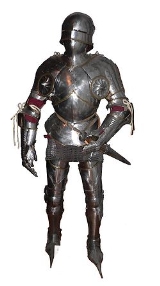
Armour

Encyclopedia

Weapon
A weapon, arm, or armament is a tool or instrument used with the aim of causing damage or harm to living beings or artificial structures or systems...
s or projectiles, usually during combat, or from damage caused by a potentially dangerous environment or action (e.g., cycling, sites of construction works). Personal armour is used to protect soldiers, and war animals such as war horses (the application for the latter called barding
Barding
Barding is armour for horses. During the late Middle Ages as armour protection for knights became more effective, their mounts became targets...
). Vehicle armour
Vehicle armour
Military vehicles are commonly armoured to withstand the impact of shrapnel, bullets, missiles, or shells, protecting the personnel inside from enemy fire. Such vehicles include tanks, aircraft, and ships....
is used on warship
Warship
A warship is a ship that is built and primarily intended for combat. Warships are usually built in a completely different way from merchant ships. As well as being armed, warships are designed to withstand damage and are usually faster and more maneuvrable than merchant ships...
s and armoured fighting vehicle
Armoured fighting vehicle
An armoured fighting vehicle is a combat vehicle, protected by strong armour and armed with weapons. AFVs can be wheeled or tracked....
s.
Etymology
The word "armour" came into use in the Middle Ages as a borrowing from the French. It is dated from 1297, as a "mail, defensive covering worn in combat" from Old French armeure, itself derived from the Latin armatura "arms and/or equipment" with the root arma "arms or gear".Personal
Armour has been used throughout recorded historyRecorded history
Recorded history is the period in history of the world after prehistory. It has been written down using language, or recorded using other means of communication. It starts around the 4th millennium BC, with the invention of writing.-Historical accounts:...
. It has been made from a variety of materials; from rudimentary leather protection, personal armour evolved to Mail
Mail (armour)
Mail is a type of armour consisting of small metal rings linked together in a pattern to form a mesh.-History:Mail was a highly successful type of armour and was used by nearly every metalworking culture....
and full plated suits of armour. For much of military history
Military history
Military history is a humanities discipline within the scope of general historical recording of armed conflict in the history of humanity, and its impact on the societies, their cultures, economies and changing intra and international relationships....
the manufacture of metal armour in Europe has dominated the technology and employment of armour. Armour drove the development of many important technologies of the Ancient World, including wood lamination
Laminate
A laminate is a material that can be constructed by uniting two or more layers of material together. The process of creating a laminate is lamination, which in common parlance refers to the placing of something between layers of plastic and gluing them with heat and/or pressure, usually with an...
, mining, metal refining
Refining (metallurgy)
Refining consists of purifying an impure material, in this case a metal. It is to be distinguished from other processes such as smelting and calcining in that those two involve a chemical change to the raw material, whereas in refining, the final material is usually identical chemically to the...
, vehicle manufacture, leather processing, and later decorative metal working. Its production was influential in the industrial revolution
Industrial Revolution
The Industrial Revolution was a period from the 18th to the 19th century where major changes in agriculture, manufacturing, mining, transportation, and technology had a profound effect on the social, economic and cultural conditions of the times...
, and influenced commercial development of metallurgy and engineering. Armour was the single most influential factor in the development of firearms that revolutionised warfare.
History
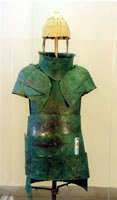
Well known armour types in European history include the lorica hamata
Lorica hamata
The lorica hamata is a type of mail armour used by the Roman Republic and the Roman Empire. During the 1st century it was starting to be supplemented by lorica segmentata, but had been reintroduced as sole standard-issue armor by the 4th century. It was issued for both primary Legionary and...
, Lorica squamata
Lorica squamata
The Lorica squamata is a type of scale armour used by the ancient Roman military during the Roman Republic and at later periods. It was made from small metal scales sewn to a fabric backing. It is typically seen on depictions of standard bearers, musicians, centurions, cavalry troops, and even...
, and the lorica segmentata
Lorica segmentata
The lōrīca segmentāta was a type of segmented armour almost exclusively used in the Roman Empire, but the Latin name was first used in the 16th century...
of the Roman legions, the mail
Mail (armour)
Mail is a type of armour consisting of small metal rings linked together in a pattern to form a mesh.-History:Mail was a highly successful type of armour and was used by nearly every metalworking culture....
hauberk
Hauberk
A hauberk is a shirt of chainmail. The term is usually used to describe a shirt reaching at least to mid-thigh and including sleeves. Haubergeon generally refers to a shorter variant with partial sleeves, but the terms are often used interchangeably.- History :The word hauberk is derived from the...
of the early medieval age, and the full steel plate harness
Plate armour
Plate armour is a historical type of personal armour made from iron or steel plates.While there are early predecessors such the Roman-era lorica segmentata, full plate armour developed in Europe during the Late Middle Ages, especially in the context of the Hundred Years' War, from the coat of...
worn by later Medieval and Renaissance
Renaissance
The Renaissance was a cultural movement that spanned roughly the 14th to the 17th century, beginning in Italy in the Late Middle Ages and later spreading to the rest of Europe. The term is also used more loosely to refer to the historical era, but since the changes of the Renaissance were not...
knight
Knight
A knight was a member of a class of lower nobility in the High Middle Ages.By the Late Middle Ages, the rank had become associated with the ideals of chivalry, a code of conduct for the perfect courtly Christian warrior....
s, and breast and back plates worn by heavy cavalry in several European countries until the first year of World War I (1914–15). The samurai
Samurai
is the term for the military nobility of pre-industrial Japan. According to translator William Scott Wilson: "In Chinese, the character 侍 was originally a verb meaning to wait upon or accompany a person in the upper ranks of society, and this is also true of the original term in Japanese, saburau...
warriors of feudal Japan utilized many types of armour
Japanese armour
Armour in Japan has a history that goes back as far as the 4th century. Japanese armour developed enormously over the centuries since its introduction to the battlefield. It was worn to varying degrees by numerous classes; most notably by the Samurai , and was seen on the battlefield both on...
for hundreds of years up to the 19th century.
Early
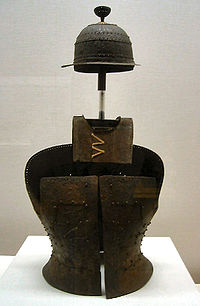
Japanese armour
Armour in Japan has a history that goes back as far as the 4th century. Japanese armour developed enormously over the centuries since its introduction to the battlefield. It was worn to varying degrees by numerous classes; most notably by the Samurai , and was seen on the battlefield both on...
constructed from iron plates connected together by leather thongs. Japanese lamellar armour (keiko) passed through Korea and reached Japan around the 5th century. These early Japanese lamellar armours took the form of a sleeveless jacket and a helmet.
Armour did not always cover all of the body; sometimes no more than a helmet and leg plates where worn. The rest of the body was generally protected by means of a large shield. Examples of armies equipping their troops in this fashion were the Aztecs (16th century DC), and the hoplites in Ancient Greece.
In East Asia many types of armour were commonly used at different times by various cultures including, scale armour
Scale armour
Scale armour is an early form of armour sometimes erroneously called scale mail consisting of many individual small armour scales of various shapes attached to each other and to a backing of cloth or leather in overlapping rows. Scale armour was worn by warriors of many different cultures as well...
, lamellar armour
Lamellar armour
Lamellar armour was one of three early body armour types made from armour plates. The other two types are scale armour and laminar armour.-Description:...
, laminar armour
Laminar armour
Laminar armour , sometimes confusingly referred to as "banded mail", is an armour made from horizontal overlapping rows of solid armour plates as opposed to lamellar armour which is made from individual armor scales laced together to form a solid looking strip of armor.Prominent examples of such...
, plated mail
Plated mail
Plated mail is a type of mail with embedded plates. Armour of this type has been used in the Middle East, Japan, China, Korea, Central Asia, Greater Iran, India, Eastern Europe, and by the Moors.-Types of plated mail:In Russia there are three known varieties of this armour...
Chainmail
Mail is a type of armour consisting of small metal rings linked together in a pattern to form a mesh.-History:Mail was a highly successful type of armour and was used by nearly every metalworking culture....
, plate armour
Plate armour
Plate armour is a historical type of personal armour made from iron or steel plates.While there are early predecessors such the Roman-era lorica segmentata, full plate armour developed in Europe during the Late Middle Ages, especially in the context of the Hundred Years' War, from the coat of...
and brigandine
Brigandine
A brigandine is a form of body armour from the Middle Ages. It is a cloth garment, generally canvas or leather, lined with small oblong steel plates riveted to the fabric....
. Around the dynastic Tang, Song, and early Ming Period, cuirasses and plates (mingguangjia) were also used, with more elaborate versions for officers in war. The Chinese, during that time used partial plates for "important" body parts instead of covering their whole body since too much plate armour hinders their martial arts movement. The "Other" body parts were covered in cloth, leather, lamellar, and/or Mountain pattern. In pre-Qin dynasty times, leather armour was made out of various animals, with more exotic ones such as the rhinoceros.
Mail (armour)
Mail is a type of armour consisting of small metal rings linked together in a pattern to form a mesh.-History:Mail was a highly successful type of armour and was used by nearly every metalworking culture....
, sometimes called "chainmail", made of interlocking iron rings is believed to have first appeared some time after 300 BC. Its invention is credited to the Celts, the Romans were thought to have adopted their design.
Gradually, small additional plates or discs of iron were added to the mail to protect vulnerable areas. Hardened leather and splinted
Splint armour
Splint armour, also referred to as splinted armour. Splint armour first appears in a Scythian grave from the 4th century BCE..-Splint Armor:...
construction were used for arm and leg pieces. The coat of plates
Coat of plates
A coat of plates is a form of torso armour consisting of metal plates sewn or riveted inside a cloth or leather garment. The coat of plates makes a fairly brief appearance in the history of European armour during the era of transitional armour, during a portion of the 14th century...
was developed, an armour made of large plates sewn inside a textile or leather coat.
Early plate in Italy, and elsewhere in the 13th–15th century were made of iron. Iron armour could be carburised or case hardened
Case hardening
Case hardening or surface hardening is the process of hardening the surface of a metal, often a low carbon steel, by infusing elements into the material's surface, forming a thin layer of a harder alloy...
to give a surface of harder steel. Plate armour became cheaper than mail by the 15th century as it required much less labour and labour had become much more expensive after the Black Death
Black Death
The Black Death was one of the most devastating pandemics in human history, peaking in Europe between 1348 and 1350. Of several competing theories, the dominant explanation for the Black Death is the plague theory, which attributes the outbreak to the bacterium Yersinia pestis. Thought to have...
, though it did require larger furnaces to produce larger blooms. Mail continued to be used to protect those joints which could not be adequately protected by plate, such as the armpit, crook of the elbow and groin. Another advantage of plate was that a lance rest could be fitted to the breast plate.
The small skull cap evolved into a bigger true helmet, the bascinet
Bascinet
The bascinet was a Medieval European open-faced military helmet, typically fitted with an aventail and hinged visor. The term is also written as bassinet or basinet.-Early versions:...
, as it was lengthened downward to protect the back of the neck and the sides of the head. Additionally, several new forms of fully enclosed helmets were introduced in the late 14th century.
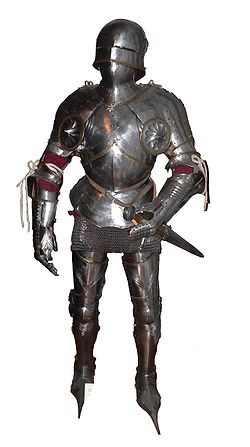
Plate armour
Plate armour is a historical type of personal armour made from iron or steel plates.While there are early predecessors such the Roman-era lorica segmentata, full plate armour developed in Europe during the Late Middle Ages, especially in the context of the Hundred Years' War, from the coat of...
associated with the knight
Knight
A knight was a member of a class of lower nobility in the High Middle Ages.By the Late Middle Ages, the rank had become associated with the ideals of chivalry, a code of conduct for the perfect courtly Christian warrior....
s of the European Late Middle Ages
Late Middle Ages
The Late Middle Ages was the period of European history generally comprising the 14th to the 16th century . The Late Middle Ages followed the High Middle Ages and preceded the onset of the early modern era ....
, but continuing to the early 17th century Age of Enlightenment
Age of Enlightenment
The Age of Enlightenment was an elite cultural movement of intellectuals in 18th century Europe that sought to mobilize the power of reason in order to reform society and advance knowledge. It promoted intellectual interchange and opposed intolerance and abuses in church and state...
in all European countries.
By about 1400 the full harness of plate armour had been developed in armouries of Lombardy Heavy cavalry dominated the battlefield for centuries in part because of their armour.
In the early 15th century, advances in weaponry allowed infantry to defeat armoured knights on the battlefield. The quality of the metal used in armour deteriorated as armies became bigger and armour was made thicker, necessitating breeding of larger cavalry horses. If during the 14–15th centuries armour seldom weighed more than 15 kg, then by the late 16th century it weighed 25 kg. The increasing weight and thickness of late 16th century armour therefore gave substantial resistance.
In the early years of low velocity firearms, full suits of armour, or breast plates actually stopped bullets fired from a modest distance. Crossbow bolts, if still used, would seldom penetrate good plate, nor would any bullet unless fired from close range. In effect, rather than making plate armour obsolete, the use of firearms stimulated the development of plate armour into its later stages. For most of that period, it allowed horsemen to fight while being the targets of defending arquebuseers without being easily killed. Full suits of armour were actually worn by generals and princely commanders right up to the second decade of the 18th century. It was the only way they could be mounted and survey the overall battlefield with safety from distant musket fire.
The horse was afforded protection from lances and infantry weapons by steel plate barding
Barding
Barding is armour for horses. During the late Middle Ages as armour protection for knights became more effective, their mounts became targets...
. This gave the horse protection and enhanced the visual impression of a mounted knight. Late in the era, elaborate barding was used in parade armour.
Later
Gradually starting in the mid-16th century, one plate element after another was discarded to save weight for foot soldiers.Back and breast plates continued to be used throughout the entire period of the 18th century and through Napoleonic times, in many European (heavy) cavalry units, until the early 20th century. From their introduction, muskets could pierce plate armour, so cavalry had to be far more mindful of the fire. In Japan armour continued to be used until the end of the samurai era, with the last major fighting in which armour was used happening in 1868.Samurai armour had one last short lived use in 1877 during the Satsuma Rebellion
Satsuma Rebellion
The was a revolt of Satsuma ex-samurai against the Meiji government from January 29 to September 24, 1877, 9 years into the Meiji Era. It was the last, and the most serious, of a series of armed uprisings against the new government.-Background:...
Though the age of the knight was over, armour continued to be used in many capacities. Soldiers in the American Civil War bought iron and steel vests from peddlers (both sides had considered but rejected body armour for standard issue). The effectiveness of the vests varied widely- some successfully deflected bullets and saved lives, but others were poorly made and resulted in tragedy for the soldiers. In any case the vests were abandoned by many soldiers due to their weight on long marches as well as the stigma they got for being cowards from their fellow troops.
At the start of World War I, thousands of the French Cuirassier
Cuirassier
Cuirassiers were mounted cavalry soldiers equipped with armour and firearms, first appearing in late 15th-century Europe. They were the successors of the medieval armoured knights...
s rode out to engage the German Cavalry who likewise used helmets and armour. By that period, the shiny armour plate was covered in dark paint and a canvas wrap covered their elaborate Napoleonic style helmets. Their armour was meant to protect only against sabre
Sabre
The sabre or saber is a kind of backsword that usually has a curved, single-edged blade and a rather large hand guard, covering the knuckles of the hand as well as the thumb and forefinger...
s and light lance
Lance
A Lance is a pole weapon or spear designed to be used by a mounted warrior. The lance is longer, stout and heavier than an infantry spear, and unsuited for throwing, or for rapid thrusting. Lances did not have tips designed to intentionally break off or bend, unlike many throwing weapons of the...
s. The cavalry had to beware of high velocity rifle
Rifle
A rifle is a firearm designed to be fired from the shoulder, with a barrel that has a helical groove or pattern of grooves cut into the barrel walls. The raised areas of the rifling are called "lands," which make contact with the projectile , imparting spin around an axis corresponding to the...
s and machine gun
Machine gun
A machine gun is a fully automatic mounted or portable firearm, usually designed to fire rounds in quick succession from an ammunition belt or large-capacity magazine, typically at a rate of several hundred rounds per minute....
s like the foot soldiers, who at least had a trench
Trench
A trench is a type of excavation or depression in the ground. Trenches are generally defined by being deeper than they are wide , and by being narrow compared to their length ....
to protect them.
Present
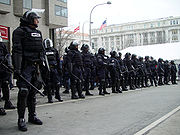
Flak jacket
thumb|300px|The two components of an obsolete British military flak vest. On the left, the nylon vest. On the right, the several layers of [[ballistic nylon]] that provide the actual protection...
, made of ballistic cloth (e.g. kevlar
Kevlar
Kevlar is the registered trademark for a para-aramid synthetic fiber, related to other aramids such as Nomex and Technora. Developed at DuPont in 1965, this high strength material was first commercially used in the early 1970s as a replacement for steel in racing tires...
, dyneema, twaron
Twaron
Twaron is the brandname of Teijin Aramid for a para-aramid. It is a heat-resistant and strong synthetic fibre developed in the early 1970s by the Dutch company AKZO, division Enka, later Akzo Industrial Fibers. The research name of the para-aramid fibre was originally Fiber X, but it was soon...
, spectra etc.) and ceramic or metal plates are common among police forces, security staff
Security guard
A security guard is a person who is paid to protect property, assets, or people. Security guards are usually privately and formally employed personnel...
, corrections officers
Prison officer
A prison officer , also referred to as a corrections officer , correctional officer , or detention officer , is a person charged with the responsibility of the supervision, safety and security of prisoners in a prison, jail, or similar form of secure...
and some branches of the military.
The US Army has adopted Interceptor body armour, which uses Enhanced Small Arms Protective Inserts (E-S.A.P.I) in the chest, sides and back of the armour. Each plate is rated to stop a range of ammunition including 3 hits from a 7.62×51 NATO AP round at a range of 10 m (33 ft), though accounts in Iraq and Afghanistan tell of soldiers shot as many as seven times in the chest without penetration. Dragon Skin body armour is another ballistic vest which is currently in testing with mixed results.
Despite advances in the protection offered by ballistic armour against projectiles, as the name implies, modern ballistic body armour is much less impervious to stabbing weapons unless they are augmented with anti-knife/anti-stab armour (usually a form of mail
Mail (armour)
Mail is a type of armour consisting of small metal rings linked together in a pattern to form a mesh.-History:Mail was a highly successful type of armour and was used by nearly every metalworking culture....
).
Other types
The first ships protected by iron armour were Kobuksons built in the early 15th century.The first modern production technology for armour plating was used by navies in the construction of the Ironclad warship
Ironclad warship
An ironclad was a steam-propelled warship in the early part of the second half of the 19th century, protected by iron or steel armor plates. The ironclad was developed as a result of the vulnerability of wooden warships to explosive or incendiary shells. The first ironclad battleship, La Gloire,...
, reaching its pinnacle of development with the battleship
Battleship
A battleship is a large armored warship with a main battery consisting of heavy caliber guns. Battleships were larger, better armed and armored than cruisers and destroyers. As the largest armed ships in a fleet, battleships were used to attain command of the sea and represented the apex of a...
. It was also naval engineers that constructed the first tanks during World War I, giving rise to armoured fighting vehicle
Armoured fighting vehicle
An armoured fighting vehicle is a combat vehicle, protected by strong armour and armed with weapons. AFVs can be wheeled or tracked....
s. Aerial armour has been used to protect pilots and aircraft systems since the Second World War.
In modern ground forces' usage, the meaning of armour has expanded to include the role of troops in combat. After the evolution of armoured warfare
Armoured warfare
Armoured warfare or tank warfare is the use of armoured fighting vehicles in modern warfare. It is a major component of modern methods of war....
, mechanised infantry were mounted in armoured fighting vehicles and replaced light infantry
Light infantry
Traditionally light infantry were soldiers whose job was to provide a skirmishing screen ahead of the main body of infantry, harassing and delaying the enemy advance. Light infantry was distinct from medium, heavy or line infantry. Heavy infantry were dedicated primarily to fighting in tight...
in many situations. In modern armoured warfare, armoured units equipped with tanks and infantry fighting vehicle
Infantry fighting vehicle
An infantry fighting vehicle , also known as a mechanized infantry combat vehicle , is a type of armoured fighting vehicle used to carry infantry into battle and provide fire support for them...
s serve the historic role of both the battle cavalry
Heavy cavalry
Heavy cavalry is a class of cavalry whose primary role was to engage in direct combat with enemy forces . Although their equipment differed greatly depending on the region and historical period, they were generally mounted on large powerful horses, and were often equipped with some form of scale,...
, light cavalry
Light cavalry
Light cavalry refers to lightly armed and lightly armored troops mounted on horses, as opposed to heavy cavalry, where the riders are heavily armored...
and dragoon
Dragoon
The word dragoon originally meant mounted infantry, who were trained in horse riding as well as infantry fighting skills. However, usage altered over time and during the 18th century, dragoons evolved into conventional light cavalry units and personnel...
s, and belong to the armoured branch.
Ships

The first ironclad battleship, with iron armour over a wooden hull, La Gloire
French battleship La Gloire
The French Navy's La Gloire was the first ocean-going ironclad battleship in history.She was developed following the Crimean War, in response to new developments in naval gun technology, especially the Paixhans guns and rifled guns, which used explosive shells with increased destructive power...
, was launched by the French Navy
French Navy
The French Navy, officially the Marine nationale and often called La Royale is the maritime arm of the French military. It includes a full range of fighting vessels, from patrol boats to a nuclear powered aircraft carrier and 10 nuclear-powered submarines, four of which are capable of launching...
in 1859; she prompted the British Royal Navy
Royal Navy
The Royal Navy is the naval warfare service branch of the British Armed Forces. Founded in the 16th century, it is the oldest service branch and is known as the Senior Service...
to build a counter. The following year they launched Warrior
HMS Warrior (1860)
HMS Warrior was the first iron-hulled, armour-plated warship, built for the Royal Navy in response to the first ironclad warship, the French Gloire, launched a year earlier....
, which was twice the size and had iron armour over an iron hull. After the first battle between two ironclads
Battle of Hampton Roads
The Battle of Hampton Roads, often referred to as either the Battle of the Monitor and Merrimack or the Battle of Ironclads, was the most noted and arguably most important naval battle of the American Civil War from the standpoint of the development of navies...
took place in 1862 during the American Civil War
American Civil War
The American Civil War was a civil war fought in the United States of America. In response to the election of Abraham Lincoln as President of the United States, 11 southern slave states declared their secession from the United States and formed the Confederate States of America ; the other 25...
, it became clear that the ironclad had replaced the unarmoured line-of-battle ship
Ship of the line
A ship of the line was a type of naval warship constructed from the 17th through the mid-19th century to take part in the naval tactic known as the line of battle, in which two columns of opposing warships would manoeuvre to bring the greatest weight of broadside guns to bear...
as the most powerful warship afloat.
Ironclads were designed for several roles, including as high seas battleship
Battleship
A battleship is a large armored warship with a main battery consisting of heavy caliber guns. Battleships were larger, better armed and armored than cruisers and destroyers. As the largest armed ships in a fleet, battleships were used to attain command of the sea and represented the apex of a...
s, coastal defence ships, and long-range cruiser
Cruiser
A cruiser is a type of warship. The term has been in use for several hundreds of years, and has had different meanings throughout this period...
s. The rapid evolution of warship design in the late 19th century transformed the ironclad from a wooden-hulled vessel which carried sails to supplement its steam engines into the steel-built, turreted battleships and cruisers familiar in the 20th century. This change was pushed forward by the development of heavier naval guns (the ironclads of the 1880s carried some of the heaviest guns ever mounted at sea), more sophisticated steam engines, and advances in metallurgy which made steel shipbuilding possible.
The rapid pace of change in the ironclad period meant that many ships were obsolete as soon as they were complete, and that naval tactics were in a state of flux. Many ironclads were built to make use of the ram
Naval ram
A naval ram was a weapon carried by varied types of ships, dating back to antiquity. The weapon consisted of an underwater prolongation of the bow of the ship to form an armoured beak, usually between six and twelve feet in length...
or the torpedo
Torpedo
The modern torpedo is a self-propelled missile weapon with an explosive warhead, launched above or below the water surface, propelled underwater towards a target, and designed to detonate either on contact with it or in proximity to it.The term torpedo was originally employed for...
, which a number of naval designers considered the crucial weapons of naval combat. There is no clear end to the ironclad period, but towards the end of the 1890s the term ironclad dropped out of use. New ships were increasingly constructed to a standard pattern and designated battleships or armoured cruisers.
Trains
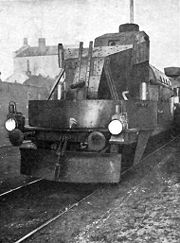
Armoured train
An armoured train is a train protected with armour. They are usually equipped with railroad cars armed with artillery and machine guns. They were mostly used during the late 19th and early 20th century, when they offered an innovative way to quickly move large amounts of firepower...
s saw use during the 19th century in the American Civil War
American Civil War
The American Civil War was a civil war fought in the United States of America. In response to the election of Abraham Lincoln as President of the United States, 11 southern slave states declared their secession from the United States and formed the Confederate States of America ; the other 25...
(1861–1865), the Franco-Prussian War
Franco-Prussian War
The Franco-Prussian War or Franco-German War, often referred to in France as the 1870 War was a conflict between the Second French Empire and the Kingdom of Prussia. Prussia was aided by the North German Confederation, of which it was a member, and the South German states of Baden, Württemberg and...
(1870–1871), the First
First Boer War
The First Boer War also known as the First Anglo-Boer War or the Transvaal War, was fought from 16 December 1880 until 23 March 1881-1877 annexation:...
and Second
Second Boer War
The Second Boer War was fought from 11 October 1899 until 31 May 1902 between the British Empire and the Afrikaans-speaking Dutch settlers of two independent Boer republics, the South African Republic and the Orange Free State...
Boer Wars (1880–81 and 1899–1902), the First
World War I
World War I , which was predominantly called the World War or the Great War from its occurrence until 1939, and the First World War or World War I thereafter, was a major war centred in Europe that began on 28 July 1914 and lasted until 11 November 1918...
(1914–1918) and Second World Wars
World War II
World War II, or the Second World War , was a global conflict lasting from 1939 to 1945, involving most of the world's nations—including all of the great powers—eventually forming two opposing military alliances: the Allies and the Axis...
(1939–1945) and the First Indochina War
First Indochina War
The First Indochina War was fought in French Indochina from December 19, 1946, until August 1, 1954, between the French Union's French Far East...
(1946–1954). The most intensive use of armoured trains was during the Russian Civil War
Russian Civil War
The Russian Civil War was a multi-party war that occurred within the former Russian Empire after the Russian provisional government collapsed to the Soviets, under the domination of the Bolshevik party. Soviet forces first assumed power in Petrograd The Russian Civil War (1917–1923) was a...
(1918–1920).
During the Second Boer War
Second Boer War
The Second Boer War was fought from 11 October 1899 until 31 May 1902 between the British Empire and the Afrikaans-speaking Dutch settlers of two independent Boer republics, the South African Republic and the Orange Free State...
on 15 November 1899, Winston Churchill
Winston Churchill
Sir Winston Leonard Spencer-Churchill, was a predominantly Conservative British politician and statesman known for his leadership of the United Kingdom during the Second World War. He is widely regarded as one of the greatest wartime leaders of the century and served as Prime Minister twice...
, then a war-correspondent, was travelling on board an armoured train when it was ambushed by Boer commandos. Churchill and many of the train's garrison were captured, though many others escaped, including wounded placed on the train's engine.
Armoured fighting vehicles
Towards the end of World War I, armies on both sides were experimenting with plate armour as protection against shrapnel and ricocheting projectiles. The first proposal for a tank was by the Austrian Oberleutenant Günther BurstynGünther Burstyn
Gunther Burstyn was an inventor, technician, and officer of the Austro-Hungarian Army....
who, in 1911, proposed a design for "motor artillery" (Motorengeschütz) with a turret, but his design never progressed beyond a German patent in 1912.
Amoured cars were put into use by the British on the Western Front. Initially an innovation to aid the recovery of downed pilots, they were sidelined when the front became static. They continued to be used in the more open Middle East battlefields.
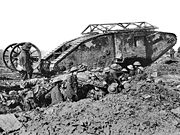
Landships Committee
The Landships Committee was a small British war cabinet committee established in February 1915 to deal with the design and construction of what would turn out to be tanks during the First World War...
was sponsored by the First Lord of the Admiralty, Winston Churchill
Winston Churchill
Sir Winston Leonard Spencer-Churchill, was a predominantly Conservative British politician and statesman known for his leadership of the United Kingdom during the Second World War. He is widely regarded as one of the greatest wartime leaders of the century and served as Prime Minister twice...
and proceeded through a number of prototypes culminating in the Mark I tank
Mark I tank
The British Mark I was a tracked vehicle developed by the British Army during the First World War and the world's first combat tank. The Mark I entered service in August 1916, and was first used in action on the morning of 15 September 1916 during the Battle of Flers-Courcelette, of the Somme...
prototype, named Mother. The first tank to engage in battle was designated D1, a British Mark I
Mark I tank
The British Mark I was a tracked vehicle developed by the British Army during the First World War and the world's first combat tank. The Mark I entered service in August 1916, and was first used in action on the morning of 15 September 1916 during the Battle of Flers-Courcelette, of the Somme...
, during the Battle of Flers-Courcelette
Battle of Flers-Courcelette
The Battle of Flers-Courcelette, was a battle within the Franco-British Somme Offensive which took place in the summer and autumn of 1916. Launched on the 15th of September 1916 the battle went on for one week. Flers-Courcelette began with the overall objective of cutting a hole in the German...
(part of the Somme Offensive) on 15 September 1916.
In contrast to World War II, Germany fielded very few tanks during WWI, with only 15 of the A7V
A7V
The A7V was a tank introduced by Germany in 1918, near the end of World War I. One hundred vehicles were ordered during the spring of 1918, but only 21 were delivered. It was nicknamed "The Moving Fortress" by the British because of the shape of the hull...
type being produced in Germany during the war. Most German tanks were captured British ones. The first tank versus tank action took place on 24 April 1918 at Second Battle of Villers-Bretonneux
Second Battle of Villers-Bretonneux
The Second Battle of Villers-Bretonneux came during the period of the battle of Lys, 24–27 April 1918, but was launched against the British lines in front of Amiens.The Germans developed a small number of tanks, and used them in this offensive...
, when three British Mark IVs met an advance of three German A7V
A7V
The A7V was a tank introduced by Germany in 1918, near the end of World War I. One hundred vehicles were ordered during the spring of 1918, but only 21 were delivered. It was nicknamed "The Moving Fortress" by the British because of the shape of the hull...
s, supported by infantry. Tanks were knocked out on both sides, but the German attack failed and they retreated.
Mechanical problems, poor mobility and piecemeal tactical deployment limited the military significance of the tank in World War I and the tank did not fulfil its promise of rendering trench warfare obsolete. Nonetheless, it was clear to military thinkers on both sides that tanks would play a significant role in future conflicts.
Aircraft
The development of effective anti-aircraft artillery before the Second World War meant that the pilots, once the "knights of the air" during the First World War were left far more vulnerable to ground fire. This not only created the requirement for the introduction of the cockpit armour plating that eventually came to be known variously as the "bucket" or the "bathtub", but also the design of such aircraft as the Il-2Ilyushin Il-2
The Ilyushin Il-2 was a ground-attack aircraft in the Second World War, produced by the Soviet Union in very large numbers...
which also were heavily armoured to protect the fuel and engine, allowing much greater survivability during ground assaults.
Present
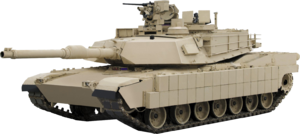
Composite armour
Composite armour is a type of vehicle armour consisting of layers of different material such as metals, plastics, ceramics or air. Most composite armour are lighter than their all-metal equivalent, but instead occupy a larger volume for the same resistance to penetration...
, but also reactive armour
Reactive armour
Reactive armour is a type of vehicle armour that reacts in some way to the impact of a weapon to reduce the damage done to the vehicle being protected. It is most effective in protecting against shaped charges and specially hardened long rod penetrators...
designed to defeat shaped charge
Shaped charge
A shaped charge is an explosive charge shaped to focus the effect of the explosive's energy. Various types are used to cut and form metal, to initiate nuclear weapons, to penetrate armor, and in the oil and gas industry...
s. As a result of this, the main battle tank
Main battle tank
A main battle tank , also known as a battle tank or universal tank, is a tank that fills the heavy direct fire role of many modern armies. They were originally conceived to replace the light, medium, heavy and super-heavy tanks. Development was spurred onwards in the Cold War with the development...
(MBT) conceived in the Cold War
Cold War
The Cold War was the continuing state from roughly 1946 to 1991 of political conflict, military tension, proxy wars, and economic competition between the Communist World—primarily the Soviet Union and its satellite states and allies—and the powers of the Western world, primarily the United States...
era can survive multiple RPG strikes with minimal effect on the crew or the operation of the vehicle. The light tank
Light tank
A light tank is a tank variant initially designed for rapid movement, and now primarily employed in low-intensity conflict. Early light tanks were generally armed and armored similar to an armored car, but used tracks in order to provide better cross-country mobility.The light tank was a major...
s that were the last descendants of the light cavalry
Light cavalry
Light cavalry refers to lightly armed and lightly armored troops mounted on horses, as opposed to heavy cavalry, where the riders are heavily armored...
during the Second World War have almost completely disappeared from the world's militaries due to increased lethality of the weapons available to the vehicle-mounted infantry.
The armoured personnel carrier
Armoured personnel carrier
An armoured personnel carrier is an armoured fighting vehicle designed to transport infantry to the battlefield.APCs are usually armed with only a machine gun although variants carry recoilless rifles, anti-tank guided missiles , or mortars...
(APC) is a relatively recent development, stemming from trials and experiences during the Second World War. The APC allows the safe and rapid movement of infantry in a combat zone, minimising casualties and maximising mobility. APCs are fundamentally different from the previously used armoured half-track
Half-track
A half-track is a civilian or military vehicle with regular wheels on the front for steering, and caterpillar tracks on the back to propel the vehicle and carry most of the load. The purpose of this combination is to produce a vehicle with the cross-country capabilities of a tank and the handling...
s in that they offer a higher level of protection from artillery burst
Air burst
An air burst is the detonation of an explosive device such as an anti-personnel artillery shell or a nuclear weapon in the air instead of on contact with the ground or target or a delayed armor piercing explosion....
fragments, and greater mobility in more terrain types. The basic APC design was substantially expanded to an Infantry fighting vehicle
Infantry fighting vehicle
An infantry fighting vehicle , also known as a mechanized infantry combat vehicle , is a type of armoured fighting vehicle used to carry infantry into battle and provide fire support for them...
(IFV) when properties of an armoured personnel carrier and a light tank
Light tank
A light tank is a tank variant initially designed for rapid movement, and now primarily employed in low-intensity conflict. Early light tanks were generally armed and armored similar to an armored car, but used tracks in order to provide better cross-country mobility.The light tank was a major...
were combined in one vehicle.
Naval armour has fundamentally changed from the Second World War doctrine of thicker plating to defend against shells
Shell (projectile)
A shell is a payload-carrying projectile, which, as opposed to shot, contains an explosive or other filling, though modern usage sometimes includes large solid projectiles properly termed shot . Solid shot may contain a pyrotechnic compound if a tracer or spotting charge is used...
, bomb
Bomb
A bomb is any of a range of explosive weapons that only rely on the exothermic reaction of an explosive material to provide an extremely sudden and violent release of energy...
s and torpedo
Torpedo
The modern torpedo is a self-propelled missile weapon with an explosive warhead, launched above or below the water surface, propelled underwater towards a target, and designed to detonate either on contact with it or in proximity to it.The term torpedo was originally employed for...
s. Passive defence naval armour for use against shells and other projectile weapons has almost completely disappeared on modern warships. It has been replaced by systems designed to detect and evade, or in the case of the cruise missile
Cruise missile
A cruise missile is a guided missile that carries an explosive payload and is propelled, usually by a jet engine, towards a land-based or sea-based target. Cruise missiles are designed to deliver a large warhead over long distances with high accuracy...
s, to destroy threats, including extensive use of radar
Radar
Radar is an object-detection system which uses radio waves to determine the range, altitude, direction, or speed of objects. It can be used to detect aircraft, ships, spacecraft, guided missiles, motor vehicles, weather formations, and terrain. The radar dish or antenna transmits pulses of radio...
, sonar
Sonar
Sonar is a technique that uses sound propagation to navigate, communicate with or detect other vessels...
and electronic warfare
Electronic warfare
Electronic warfare refers to any action involving the use of the electromagnetic spectrum or directed energy to control the spectrum, attack an enemy, or impede enemy assaults via the spectrum. The purpose of electronic warfare is to deny the opponent the advantage of, and ensure friendly...
.
Although the role of the ground attack aircraft significantly diminished after the Korean War
Korean War
The Korean War was a conventional war between South Korea, supported by the United Nations, and North Korea, supported by the People's Republic of China , with military material aid from the Soviet Union...
, it re-emerged during the Vietnam War
Vietnam War
The Vietnam War was a Cold War-era military conflict that occurred in Vietnam, Laos, and Cambodia from 1 November 1955 to the fall of Saigon on 30 April 1975. This war followed the First Indochina War and was fought between North Vietnam, supported by its communist allies, and the government of...
, and in the recognition of this, the US Air Force authorised the design and production of what was later to become the A-10
A-10 Thunderbolt II
The Fairchild Republic A-10 Thunderbolt II is an American single-seat, twin-engine, straight-wing jet aircraft developed by Fairchild-Republic in the early 1970s. The A-10 was designed for a United States Air Force requirement to provide close air support for ground forces by attacking tanks,...
dedicated anti-armour and ground-attack aircraft of the Cold War
Cold War
The Cold War was the continuing state from roughly 1946 to 1991 of political conflict, military tension, proxy wars, and economic competition between the Communist World—primarily the Soviet Union and its satellite states and allies—and the powers of the Western world, primarily the United States...
.
See also
- Ballistic vest
- BattledressBattledressBattledress, or fatigues in the general sense, is the type of uniform used as combat uniforms, as opposed to 'display' dress or formal uniform worn at parades and functions. It may be either monochrome or in a camouflage pattern...
- BombsuitBombsuitA bomb suit or a blast suit is a heavy suit of body armor designed to withstand the pressure released from a bomb and any projectiles the bomb may produce. It is usually worn by trained personnel attempting bomb disposal...
- CuirassCuirassA cuirass is a piece of armour, formed of a single or multiple pieces of metal or other rigid material, which covers the front of the torso...
- LinothoraxLinothoraxThe linothorax was a type of upper body armor used by the Ancient Greeks, as well as other civilizations, from the Mycenaean Period through the Hellenistic Period. The earliest attested account of a linothorax used for battle is recorded in Book 2 of Homer's Iliad . It is worn by Ajax the lesser...
- Powered exoskeletonPowered exoskeletonA powered exoskeleton, also known as powered armor, or exoframe, is a powered mobile machine consisting primarily of an exoskeleton-like framework worn by a person and a power supply that supplies at least part of the activation-energy for limb movement.Powered exoskeletons are designed to assist...
- Rolled homogeneous armourRolled homogeneous armourRolled homogeneous armour is a type of steel which is used to armour vehicles.-Composition:Armoured steel must be hard yet impervious to shock in order to resist high velocity metal projectiles. Steel with these characteristics is produced by processing cast steel billets of appropriate size and...
- Japanese armourJapanese armourArmour in Japan has a history that goes back as far as the 4th century. Japanese armour developed enormously over the centuries since its introduction to the battlefield. It was worn to varying degrees by numerous classes; most notably by the Samurai , and was seen on the battlefield both on...