

Sydney Opera House

Encyclopedia
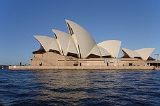
The Sydney Opera House is a multi-venue performing arts centre in the Australia
n city of Sydney
. It was conceived and largely built by Danish architect Jørn Utzon
, finally opening in 1973 after a long gestation starting with his competition-winning design in 1957. Utzon received the Pritzker Prize
, architecture's highest honour, in 2003.
The Pritzker Prize citation stated:
The Sydney Opera House was made a UNESCO World Heritage Site
on 28 June 2007.
It is one of the 20th century's most distinctive buildings and one of the most famous performing arts centres
in the world.
The Sydney Opera House is situated on Bennelong Point
in Sydney Harbour
, close to the Sydney Harbour Bridge
. It sits at the northeastern tip of the Sydney central business district
(the CBD), surrounded on three sides by the harbour (Sydney Cove
and Farm Cove
) and neighboured by the Royal Botanic Gardens
.
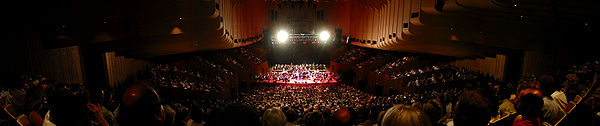
Contrary to its name, the building houses multiple performance venues. As one of the busiest performing arts centres in the world, hosting over 1,500 performances each year attended by some 1.2 million people, the Sydney Opera House provides a venue for many performing arts companies including the four key resident companies Opera Australia
, The Australian Ballet, the Sydney Theatre Company
and the Sydney Symphony Orchestra
, and presents a wide range of productions on its own account. It is also one of the most popular visitor attractions in Australia, with more than seven million people visiting the site each year, 300,000 of whom take a guided tour.
The Sydney Opera House is administered by the Sydney Opera House Trust
, under the New South Wales Ministry of the Arts.
, with a series of large precast concrete "shells
", each composed of sections of a sphere
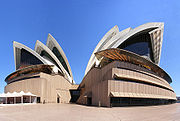
of 75.2 metre radius, forming the roofs of the structure, set on a monumental podium. The building covers 1.8 hectares (4.4 acre) of land and is 183 m (600 ft) long and 120 m (394 ft) wide at its widest point. It is supported on 588 concrete piers sunk as much as 25 m (82 ft) below sea level.
Although the roof structures of the Sydney Opera House are commonly referred to as "shells" (as they are in this article), they are in fact not shells in a strictly structural sense, but are instead precast concrete
panels supported by precast concrete ribs.
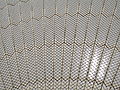
The shells are covered in a subtle chevron pattern with 1,056,006 glossy white- and matte-cream-coloured Swedish-made tiles from Höganäs AB
, though, from a distance, the shells appear a uniform white.
Apart from the tile of the shells and the glass curtain walls of the foyer spaces, the building's exterior is largely clad with aggregate panels composed of pink granite quarried at Tarana
. Significant interior surface treatments also include off-form concrete, Australian white birch
plywood
supplied from Wauchope
in northern New South Wales, and brush box glulam.
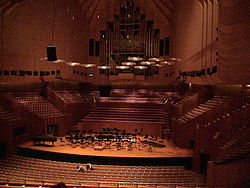
Of the two larger spaces, the Concert Hall is located within the western group of shells, and the Opera Theatre within the eastern group. The scale of the shells was chosen to reflect the internal height requirements, with low entrance spaces, rising over the seating areas and up to the high stage towers. The smaller venues (the Drama Theatre, the Playhouse, and The Studio) are located within the podium, beneath the Concert Hall. A smaller group of shells set to the western side of the Monumental Steps houses the Bennelong Restaurant. The podium is surrounded by substantial open public spaces, of which the large stone-paved forecourt area with the adjacent monumental steps is also regularly used as a performance space.
Other areas (for example the northern and western foyers) are also used for performances on an occasional basis. Venues at the Sydney Opera House are also used for conferences, ceremonies, and social functions.
, the Director of the NSW State Conservatorium of Music
, lobbied for a suitable venue for large theatrical productions. The normal venue for such productions, the Sydney Town Hall
, was not considered large enough. By 1954, Goossens succeeded in gaining the support of NSW Premier
Joseph Cahill
, who called for designs for a dedicated opera house. It was also Goossens who insisted that Bennelong Point be the site for the Opera House. Cahill had wanted it to be on or near Wynyard Railway Station
in the northwest of the CBD.
A design competition
was launched by Cahill on 13 September 1955 and received 233 entries, representing architects from 32 countries. The criteria specified a large hall seating 3000 and a small hall for 1200 people, each to be designed for different uses, including full-scale operas, orchestral and choral concerts, mass meetings, lectures, ballet performances and other presentations.
The winner, announced in 1957, was Jørn Utzon
, a Danish architect. According to legend the Utzon design was rescued from a final cut of 30 "rejects" by the noted Finnish architect Eero Saarinen. The prize was £5,000. Utzon visited Sydney in 1957 to help supervise the project. His office moved to Sydney in February 1963.
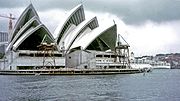
, occupying the site at the time of these plans, was demolished in 1958 and formal construction of the Opera House began in March 1959. The project was built in three stages. Stage I (1959–1963) consisted of building the upper podium. Stage II (1963–1967) saw the construction of the outer shells. Stage III (1967–1973) consisted of the interior design and construction.
of the competition entry were originally of undefined geometry
, but, early in the design process, the "shells" were perceived as a series of parabola
s supported by precast concrete
ribs. However, engineers Ove Arup and Partners were unable to find an acceptable solution to constructing them. The formwork
for using in-situ concrete would have been prohibitively expensive, but, because there was no repetition in any of the roof forms, the construction of precast concrete for each individual section would possibly have been even more expensive.
 From 1957 to 1963, the design team went through at least twelve iterations of the form of the shells trying to find an economically acceptable form (including schemes with parabolas, circular ribs and ellipsoids) before a workable solution was completed. The design work on the shells involved one of the earliest uses of computers in structural analysis
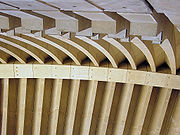
, in order to understand the complex forces to which the shells would be subjected. In mid-1961, the design team found a solution to the problem: the shells all being created as sections from a sphere
. This solution allows arches of varying length to be cast in a common mould, and a number of arch segments of common length to be placed adjacent to one another, to form a spherical section. With whom exactly this solution originated has been the subject of some controversy. It was originally credited to Utzon. Ove Arup's letter to Ashworth, a member of the Sydney Opera House Executive Committee, states: "Utzon came up with an idea of making all the shells of uniform curvature throughout in both directions." Peter Jones, the author of Ove Arup's biography, states that "the architect and his supporters alike claimed to recall the precise eureka moment
...; the engineers and some of their associates, with equal conviction, recall discussion in both central London and at Ove's house."
 He goes on to claim that "the existing evidence shows that Arup's canvassed several possibilities for the geometry of the shells, from parabolas to ellipsoids and spheres." Yuzo Mikami, a member of the design team, presents an opposite view in his book on the project, Utzon's Sphere. It is unlikely that the truth will ever be categorically known, but there is a clear consensus that the design team worked very well indeed for the first part of the project and that Utzon, Arup, and Ronald Jenkins (partner of Ove Arup and Partners responsible for the Opera House project) all played a very significant part in the design development.
As Peter Murray
states in The Saga of the Sydney Opera House:
 The shells were constructed by Hornibrook Group Pty Ltd
, who were also responsible for construction in Stage III. Hornibrook manufactured the 2400 precast ribs and 4000 roof panels in an on-site factory and also developed the construction processes. The achievement of this solution avoided the need for expensive formwork construction by allowing the use of precast units (it also allowed the roof tiles to be prefabricated in sheets on the ground, instead of being stuck on individually at height). Ove Arup and Partners' site engineer supervised the construction of the shells, which used an innovative adjustable steel-trussed "erection arch" to support the different roofs before completion. On 6 April 1962, it was estimated that the Opera House would be completed between August 1964 and March 1965.
 Stage III, the interiors, started with Utzon moving his entire office to Sydney in February 1963. However, there was a change of government in 1965, and the new Robert Askin
government declared the project under the jurisdiction of the Ministry of Public Works. This ultimately led to Utzon's resignation in 1966 (see below).
The cost of the project so far, even in October 1966, was still only $22.9 million, less than a quarter of the final $102 million cost. However, the projected costs for the design were at this stage much more significant.
The second stage of construction was progressing toward completion when Utzon resigned. His position was principally taken over by Peter Hall, who became largely responsible for the interior design. Other persons appointed that same year to replace Utzon were E. H. Farmer as government architect, D. S. Littlemore and Lionel Todd.
Following Utzon's resignation, the acoustic advisor, Lothar Cremer, confirmed to the Sydney Opera House Executive Committee (SOHEC) that Utzon's original acoustic design only allowed for 2000 seats in the main hall and further stated that increasing the number of seats to 3000 as specified in the brief
would be disastrous for the acoustics. According to Peter Jones, the stage designer, Martin Carr, criticised the "shape, height and width of the stage, the physical facilities for artists, the location of the dressing rooms, the widths of doors and lifts, and the location of lighting switchboards."
Stage I: podium Civil & Civic Pty Ltd approximately $5.5m.
Stage II: roof shells M.R. Hornibrook (NSW) Pty Ltd approximately $12.5m.
Stage III: completion The Hornibrook Group $56.5m.
Separate contracts: stage equipment, stage lighting and organ $9.0m.
Fees and other costs $16.5m.
The original cost estimate in 1957 was £
3,500,000 ($7 million). The original completion date set by the government was 26 January 1963 (Australia Day
). Thus, the project was completed ten years late and over-budget by more than fourteen times.
 Before the Sydney Opera House competition, Jørn Utzon had won seven of the eighteen competitions he had entered but had never seen any of his designs built. Utzon's submitted concept for the Sydney Opera House was almost universally admired and considered groundbreaking. The Assessors Report of January 1957, stated:
For the first stage of the project, Utzon worked very successfully with the rest of the design team and the client, but, as the project progressed, the Cahill government insisted on progressive revisions. They also did not fully appreciate the costs or work involved in design and construction. Tensions between the client and the design team grew further when an early start to construction was demanded despite an incomplete design. This resulted in a continuing series of delays and setbacks while various technical engineering issues were being refined. The building was unique, and the problems with the design issues and cost increases were exacerbated by commencement of work before the completion of the final plans.
After the election of Robert Askin
as premier of New South Wales
in 1965, the relationship of client, architect, engineers and contractors became increasingly tense. Askin had been a "vocal critic of the project prior to gaining office."
His new Minister for Public Works, Davis Hughes
, was even less sympathetic. Elizabeth Farrelly
, Australian architecture critic, has written that:
Differences ensued. One of the first was that Utzon believed the clients should receive information on all aspects of the design and construction through his practice, while the clients wanted a system (notably drawn in sketch form by Davis Hughes) where architect, contractors, and engineers each reported to the client directly and separately. This had great implications for procurement
methods and cost control, with Utzon wishing to negotiate contracts with chosen suppliers (such as Ralph Symonds for the plywood interiors) and the New South Wales government insisting contracts be put out to tender.
Utzon was highly reluctant to respond to questions or criticism from the client's Sydney Opera House Executive Committee (SOHEC). However, he was greatly supported throughout by a member of the committee and one of the original competition judges, Professor Harry Ingham Ashworth. Utzon was unwilling to compromise on some aspects of his designs that the clients wanted to change.
Utzon's ability was never in doubt, despite questions raised by Davis Hughes, who attempted to portray Utzon as an impractical dreamer. Ove Arup actually stated that Utzon was "probably the best of any I have come across in my long experience of working with architects" and:
In October 1965, Utzon gave Hughes a schedule setting out the completion dates of parts of his work for stage III. Utzon was at this time working closely with Ralph Symonds, a manufacturer of plywood
based in Sydney and highly regarded by many, despite an Arup engineer warning that Ralph Symonds's "knowledge of the design stresses of plywood, was extremely sketchy" and that the technical advice was "elementary to say the least and completely useless for our purposes." Australian architecture critic Elizabeth Farrelly has referred to Ove Arup's project engineer Michael Lewis as having "other agendas". In any case, Hughes shortly after withheld permission for the construction of plywood prototypes for the interiors, and the relationship between Utzon and the client never recovered. By February 1966, Utzon was owed more than $100,000 in fees. Hughes then withheld funding so that Utzon could not even pay his own staff. The government minutes record that following several threats of resignation, Utzon finally stated to Davis Hughes: "If you don't do it, I resign." Hughes replied: "I accept your resignation. Thank you very much. Goodbye."
Utzon left the project on 28 February 1966. He said that Hughes's refusal to pay him any fees and the lack of collaboration caused his resignation and later famously described the situation as "Malice in Blunderland". In March 1966, Hughes offered him a subordinate role as "design architect" under a panel of executive architects, without any supervisory powers over the House's construction, but Utzon rejected this. Utzon left the country never to return.
Following the resignation, there was great controversy about who was in the right and who was in the wrong. The Sydney Morning Herald initially reported: "No architect in the world has enjoyed greater freedom than Mr Utzon. Few clients have been more patient or more generous than the people and the Government of NSW. One would not like history to record that this partnership was brought to an end by a fit of temper on the one side or by a fit of meanness on the other." On 17 March 1966, it reported: "It was not his fault that a succession of Governments and the Opera House Trust should so signally have failed to impose any control or order on the project .... his concept was so daring that he himself could solve its problems only step by step .... his insistence on perfection led him to alter his design as he went along."
Yet, in an article in Harvard Design Magazine in 2005, Oxford University professor Bent Flyvbjerg
notes that Utzon fell victim to a politically lowballed construction budget, which eventually resulted in a cost overrun
of 1,400 per cent. The overrun and the ensuing scandal that it created kept Utzon from building more masterpieces. This, according to Flyvbjerg, is the real cost of the Sydney Opera House:
 The Sydney Opera House opened the way for the immensely complex geometries of some modern architecture. The design was one of the first examples of the use of computer-aided design
to design complex shapes. The design techniques developed by Utzon and Arup for the Sydney Opera House have been further developed and are now used for architecture, such as works of Gehry and blobitecture
, as well as most reinforced concrete structures. The design is also one of the first in the world to use araldite
to glue
the precast structural elements together and proved the concept for future use.
The Opera House was also a first in mechanical engineering. Another Danish firm, Steensen Varming
, was responsible for designing the new air-conditioning plant, the largest in Australia at the time, supplying over 600000 cubic feet (16,990.1 m³) of air per minute, using the innovative idea of harnessing the harbour water to create a water-cooled heat pump system that is still in operation today.
Symphony No. 9
.
the first artist to perform at the (unfinished) Opera House in 1960.
A number of performances was presented in the finished building prior to the official opening:
After the opening:
 Beginning in the late 1990s, the Sydney Opera House Trust
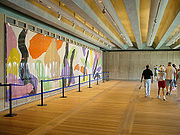
began to communicate with Jørn Utzon in an attempt to effect a reconciliation and to secure his involvement in future changes to the building. In 1999, he was appointed by the Trust as a design consultant for future work. In 2004, the first interior space rebuilt to an Utzon design was opened, and renamed "The Utzon Room" in his honour. In April 2007, he proposed a major reconstruction of the Opera Theatre. Utzon died on 29 November 2008.
A state memorial service, attended by Utzon's son Jan and daughter Lin, celebrating the creative genius of Jørn Utzon was held in the Sydney Opera House Concert Hall on 25 March 2009 featuring performances, readings and recollections from prominent figures in the Australian performing arts scene.
On 17 November 2009, Sydney Opera House officially opened the refurbished Western Foyers and Accessibility improvements, the largest building project completed since Jørn Utzon was re-engaged in 1999. Designed by Utzon and his son Jan
, in collaboration with Richard Johnson of Johnson Pilton Walker, the project has transformed the Western Foyers into a stylish and functional space providing patrons with additional amenities including new ticketing, toilet and cloaking facilities. Importantly, new escalators and a public lift have vastly improved access for less mobile visitors, people with a disability and families with prams
.
On the same day, Louise Sauvage
OAM was announced as Sydney Opera House's inaugural Accessibility Ambassador. In this role Louise Sauvage will provide advice on the implementation of Sydney Opera House's Access Strategic Plan with a view to further improving access for people with disabilities.
was commissioned by the Sydney Opera House Trust in association with REM Theatre to compose Icon, a large-scale music theatre piece for the 20th anniversary of the Sydney Opera House.
, the venue served as the focal point for the triathlon
events. The event had a 1.5 km (0.93205910497471 mi) swimming loop at Farm Cove, along with competitions in the neighbouring Royal Botanical Gardens for the cycling and running portions of the event.
Australia
Australia , officially the Commonwealth of Australia, is a country in the Southern Hemisphere comprising the mainland of the Australian continent, the island of Tasmania, and numerous smaller islands in the Indian and Pacific Oceans. It is the world's sixth-largest country by total area...
n city of Sydney
Sydney
Sydney is the most populous city in Australia and the state capital of New South Wales. Sydney is located on Australia's south-east coast of the Tasman Sea. As of June 2010, the greater metropolitan area had an approximate population of 4.6 million people...
. It was conceived and largely built by Danish architect Jørn Utzon
Jørn Utzon
Jørn Oberg Utzon, , AC was a Danish architect, most notable for designing the Sydney Opera House in Australia. When it was declared a World Heritage Site on 28 June 2007, Utzon became only the second person to have received such recognition for one of his works during his lifetime...
, finally opening in 1973 after a long gestation starting with his competition-winning design in 1957. Utzon received the Pritzker Prize
Pritzker Prize
The Pritzker Architecture Prize is awarded annually by the Hyatt Foundation to honour "a living architect whose built work demonstrates a combination of those qualities of talent, vision and commitment, which has produced consistent and significant contributions to humanity and the built...
, architecture's highest honour, in 2003.
The Pritzker Prize citation stated:
The Sydney Opera House was made a UNESCO World Heritage Site
World Heritage Site
A UNESCO World Heritage Site is a place that is listed by the UNESCO as of special cultural or physical significance...
on 28 June 2007.
It is one of the 20th century's most distinctive buildings and one of the most famous performing arts centres
Performing arts center
Performing arts center, often abbreviated PAC, is used to refer to* A multi-use performance space that is intended for use by various types of the performing arts, including dance, music and theatre....
in the world.
The Sydney Opera House is situated on Bennelong Point
Bennelong Point, New South Wales
Bennelong Point is the location of the Sydney Opera House in Sydney, Australia . It was called Tubowghule by the indigenous Eora peoples....
in Sydney Harbour
Port Jackson
Port Jackson, containing Sydney Harbour, is the natural harbour of Sydney, Australia. It is known for its beauty, and in particular, as the location of the Sydney Opera House and Sydney Harbour Bridge...
, close to the Sydney Harbour Bridge
Sydney Harbour Bridge
The Sydney Harbour Bridge is a steel through arch bridge across Sydney Harbour that carries rail, vehicular, bicycle and pedestrian traffic between the Sydney central business district and the North Shore. The dramatic view of the bridge, the harbour, and the nearby Sydney Opera House is an iconic...
. It sits at the northeastern tip of the Sydney central business district
Sydney central business district
The Sydney central business district is the main commercial centre of Sydney, New South Wales, Australia. It extends southwards for about 3 kilometres from Sydney Cove, the point of first European settlement. Its north–south axis runs from Circular Quay in the north to Central railway station in...
(the CBD), surrounded on three sides by the harbour (Sydney Cove
Sydney Cove
Sydney Cove is a small bay on the southern shore of Port Jackson , on the coast of the state of New South Wales, Australia....
and Farm Cove
Farm Cove, New South Wales
Farm Cove is a tidal inlet and shallow bay in Sydney Harbour, separated from Sydney Cove by Bennelong Point . Known to the indigenous inhabitants of Sydney as Woccanmagully, Farm Cove was used by them as an initiation ground and for the "Kangaroo and Dog Dance".The land immediately adjacent to Farm...
) and neighboured by the Royal Botanic Gardens
Royal Botanic Gardens, Sydney
The Royal Botanic Gardens in Sydney, Australia, are the most central of the three major botanical gardens open to the public in Sydney....
.
Contrary to its name, the building houses multiple performance venues. As one of the busiest performing arts centres in the world, hosting over 1,500 performances each year attended by some 1.2 million people, the Sydney Opera House provides a venue for many performing arts companies including the four key resident companies Opera Australia
Opera Australia
Opera Australia is the principal opera company in Australia. Based in Sydney, its performance season at the Sydney Opera House runs for approximately eight months of the year, with the remainder of its time spent in the The Arts Centre in Melbourne...
, The Australian Ballet, the Sydney Theatre Company
Sydney Theatre Company
The Sydney Theatre Company is one of Australia's best-known theatre companies operating from The Wharf Theatre near The Rocks area of Sydney, as well as the Sydney Theatre and the Sydney Opera House Drama Theatre....
and the Sydney Symphony Orchestra
Sydney Symphony Orchestra
The Sydney Symphony Orchestra , commonly known as the Sydney Symphony, is an Australian symphony orchestra based in Sydney...
, and presents a wide range of productions on its own account. It is also one of the most popular visitor attractions in Australia, with more than seven million people visiting the site each year, 300,000 of whom take a guided tour.
The Sydney Opera House is administered by the Sydney Opera House Trust
Sydney Opera House Trust
The Sydney Opera House Trust operates and maintains the Sydney Opera House for the Government of New South Wales.The Trust operates as one of the State's cultural institutions within the Arts portfolio. It is constituted as a body corporate under the Sydney Opera House Trust Act 1961...
, under the New South Wales Ministry of the Arts.
Description
The Sydney Opera House is a modern expressionist designExpressionist architecture
Expressionist architecture was an architectural movement that developed in Europe during the first decades of the 20th century in parallel with the expressionist visual and performing arts....
, with a series of large precast concrete "shells
Thin-shell structure
Thin-shell structures are light weight constructions using shell elements. These elements are typically curved and are assembled to large structures...
", each composed of sections of a sphere
Sphere
A sphere is a perfectly round geometrical object in three-dimensional space, such as the shape of a round ball. Like a circle in two dimensions, a perfect sphere is completely symmetrical around its center, with all points on the surface lying the same distance r from the center point...
of 75.2 metre radius, forming the roofs of the structure, set on a monumental podium. The building covers 1.8 hectares (4.4 acre) of land and is 183 m (600 ft) long and 120 m (394 ft) wide at its widest point. It is supported on 588 concrete piers sunk as much as 25 m (82 ft) below sea level.
Although the roof structures of the Sydney Opera House are commonly referred to as "shells" (as they are in this article), they are in fact not shells in a strictly structural sense, but are instead precast concrete
Precast concrete
By producing precast concrete in a controlled environment , the precast concrete is afforded the opportunity to properly cure and be closely monitored by plant employees. Utilizing a Precast Concrete system offers many potential advantages over site casting of concrete...
panels supported by precast concrete ribs.
The shells are covered in a subtle chevron pattern with 1,056,006 glossy white- and matte-cream-coloured Swedish-made tiles from Höganäs AB
Höganäs AB
Hoganas AB is a Swedish multinational which is the world's largest producer of powdered metals.-History:The company was founded in 1797 as a coal mine by Count Eric Ruuth. It also made refractory and salt glazed ceramics...
, though, from a distance, the shells appear a uniform white.
Apart from the tile of the shells and the glass curtain walls of the foyer spaces, the building's exterior is largely clad with aggregate panels composed of pink granite quarried at Tarana
Tarana, New South Wales
Tarana is a small town in the Central West of New South Wales, Australia in the City of Lithgow.It is the former junction of the Oberon Branch railway with the Main Western Line. This branch line was notable for its steep 1 in 30 gradients and sharp 100 m curves. This little station could be...
. Significant interior surface treatments also include off-form concrete, Australian white birch
Schizomeria ovata
Schizomeria ovata, a medium to large Australian rainforest tree, is widespread in warm-temperate rainforest in coastal New South Wales north from Narooma and southern Queensland south from Fraser Island...
plywood
Plywood
Plywood is a type of manufactured timber made from thin sheets of wood veneer. It is one of the most widely used wood products. It is flexible, inexpensive, workable, re-usable, and can usually be locally manufactured...
supplied from Wauchope
Wauchope, New South Wales
-People from Wauchope:* Iva Davies - Musician, Icehouse* Alison Langdon - Channel Nine News Reader - Today Show* Phil Jamieson - Musician, Grinspoon* Andrew Stoner - NSW National Party of Australia leader, Member for Oxley...
in northern New South Wales, and brush box glulam.
Of the two larger spaces, the Concert Hall is located within the western group of shells, and the Opera Theatre within the eastern group. The scale of the shells was chosen to reflect the internal height requirements, with low entrance spaces, rising over the seating areas and up to the high stage towers. The smaller venues (the Drama Theatre, the Playhouse, and The Studio) are located within the podium, beneath the Concert Hall. A smaller group of shells set to the western side of the Monumental Steps houses the Bennelong Restaurant. The podium is surrounded by substantial open public spaces, of which the large stone-paved forecourt area with the adjacent monumental steps is also regularly used as a performance space.
Performance venues and facilities
The Opera House houses the following performance venues:- The Concert Hall, with 2,679 seats, is the home of the Sydney Symphony and used by a large number of other concert presenters. It contains the Sydney Opera House Grand OrganSydney Opera House Grand OrganThe Sydney Opera House Grand Organ is the world's largest mechanical tracker-action pipe organ by Ronald Sharp, located in the concert hall of Sydney Opera House in Sydney, Australia....
, the largest mechanical tracker action organ in the world, with over 10,000 pipes. - The Opera Theatre, a proscenium theatre with 1,507 seats, is the Sydney home of Opera AustraliaOpera AustraliaOpera Australia is the principal opera company in Australia. Based in Sydney, its performance season at the Sydney Opera House runs for approximately eight months of the year, with the remainder of its time spent in the The Arts Centre in Melbourne...
and The Australian Ballet. - The Drama Theatre, a proscenium theatre with 544 seats, is used by the Sydney Theatre CompanySydney Theatre CompanyThe Sydney Theatre Company is one of Australia's best-known theatre companies operating from The Wharf Theatre near The Rocks area of Sydney, as well as the Sydney Theatre and the Sydney Opera House Drama Theatre....
and other dance and theatrical presenters. - The Playhouse, an end-stage theatreProsceniumA proscenium theatre is a theatre space whose primary feature is a large frame or arch , which is located at or near the front of the stage...
with 398 seats. - The Studio, a flexible space with a maximum capacity of 400 people, depending on configuration.
- The Utzon Room, a small multi-purpose venue, seating up to 210.
- The Forecourt, a flexible open-air venue with a wide range of configuration options, including the possibility of utilising the Monumental Steps as audience seating, used for a range of community events and major outdoor performances. The Forecourt will be closed to visitors and performances 2011–2014 to construct a new entrance tunnel to a rebuilt loading dock for the Opera Theatre.
Other areas (for example the northern and western foyers) are also used for performances on an occasional basis. Venues at the Sydney Opera House are also used for conferences, ceremonies, and social functions.
Other facilities
The building also houses a recording studio, cafes, restaurants and bars and retail outlets. Guided tours are available to the public, including a frequent tour of the front-of-house spaces, and a daily backstage tour which takes visitors backstage to see areas normally reserved for performers and crew members.Origins
Planning for the Sydney Opera House began in the late 1940s, when Eugene GoossensEugène Aynsley Goossens
Sir Eugene Aynsley Goossens was an English conductor and composer.-Biography:He was born in Camden Town, London, the son of the Belgian conductor and violinist Eugène Goossens and the grandson of the conductor Eugène Goossens...
, the Director of the NSW State Conservatorium of Music
Sydney Conservatorium of Music
The Sydney Conservatorium of Music is one of the oldest and most prestigious music schools in Australia...
, lobbied for a suitable venue for large theatrical productions. The normal venue for such productions, the Sydney Town Hall
Sydney Town Hall
The Sydney Town Hall is a landmark sandstone building located in the heart of Sydney. It stands opposite the Queen Victoria Building and alongside St Andrew's Cathedral...
, was not considered large enough. By 1954, Goossens succeeded in gaining the support of NSW Premier
Premiers of New South Wales
The Premier of New South Wales is the head of government in the state of New South Wales, Australia. The Government of New South Wales follows the Westminster system, with a Parliament of New South Wales acting as the legislature...
Joseph Cahill
Joseph Cahill
John Joseph Cahill was Premier of New South Wales in Australia from 1952 to 1959. He is best remembered as the Premier who approved construction on the Sydney Opera House, and for his work increasing the authority of local government in the state.-Early years:Joe Cahill, as he was popularly known,...
, who called for designs for a dedicated opera house. It was also Goossens who insisted that Bennelong Point be the site for the Opera House. Cahill had wanted it to be on or near Wynyard Railway Station
Wynyard railway station, Sydney
Wynyard is a major underground CityRail station in the central business district of Sydney, Australia, 2.05 km from Central. Wynyard averages 108000 passenger movements per day Monday to Friday.-History:The station opened on 28 February 1932...
in the northwest of the CBD.
A design competition
Architectural design competition
An architectural design competition is a special type of competition in which an organization or government body that plans to build a new building asks for architects to submit a proposed design for a building. The winning design is usually chosen by an independent panel of design professionals...
was launched by Cahill on 13 September 1955 and received 233 entries, representing architects from 32 countries. The criteria specified a large hall seating 3000 and a small hall for 1200 people, each to be designed for different uses, including full-scale operas, orchestral and choral concerts, mass meetings, lectures, ballet performances and other presentations.
The winner, announced in 1957, was Jørn Utzon
Jørn Utzon
Jørn Oberg Utzon, , AC was a Danish architect, most notable for designing the Sydney Opera House in Australia. When it was declared a World Heritage Site on 28 June 2007, Utzon became only the second person to have received such recognition for one of his works during his lifetime...
, a Danish architect. According to legend the Utzon design was rescued from a final cut of 30 "rejects" by the noted Finnish architect Eero Saarinen. The prize was £5,000. Utzon visited Sydney in 1957 to help supervise the project. His office moved to Sydney in February 1963.
Design and construction
The Fort Macquarie Tram DepotFort Macquarie Tram Depot
The Fort Macquarie Tram Depot or Sydney Tram Depot was built on Bennelong Point in Sydney in 1901, on the site of the old Fort Macquarie. The depot was constructed in the design of a fortress with castellated ramparts in homage to the previous building...
, occupying the site at the time of these plans, was demolished in 1958 and formal construction of the Opera House began in March 1959. The project was built in three stages. Stage I (1959–1963) consisted of building the upper podium. Stage II (1963–1967) saw the construction of the outer shells. Stage III (1967–1973) consisted of the interior design and construction.
Stage I: Podium
Stage I commenced on 2 March 1959 by the construction firm Civil & Civic, monitored by the engineers Ove Arup and Partners. The government had pushed for work to begin early, fearing that funding, or public opinion, might turn against them. However, Utzon had still not completed the final designs. Major structural issues still remained unresolved. By 23 January 1961, work was running 47 weeks behind, mainly because of unexpected difficulties (inclement weather, unexpected difficulty diverting stormwater, construction beginning before proper construction drawings had been prepared, changes of original contract documents). Work on the podium was finally completed in February 1963. The forced early start led to significant later problems, not least of which was the fact that the podium columns were not strong enough to support the roof structure, and had to be re-built.Stage II: Roof
The shellsThin-shell structure
Thin-shell structures are light weight constructions using shell elements. These elements are typically curved and are assembled to large structures...
of the competition entry were originally of undefined geometry
Geometry
Geometry arose as the field of knowledge dealing with spatial relationships. Geometry was one of the two fields of pre-modern mathematics, the other being the study of numbers ....
, but, early in the design process, the "shells" were perceived as a series of parabola
Parabola
In mathematics, the parabola is a conic section, the intersection of a right circular conical surface and a plane parallel to a generating straight line of that surface...
s supported by precast concrete
Precast concrete
By producing precast concrete in a controlled environment , the precast concrete is afforded the opportunity to properly cure and be closely monitored by plant employees. Utilizing a Precast Concrete system offers many potential advantages over site casting of concrete...
ribs. However, engineers Ove Arup and Partners were unable to find an acceptable solution to constructing them. The formwork
Formwork
Formwork is the term given to either temporary or permanent molds into which concrete or similar materials are poured. In the context of concrete construction, the falsework supports the shuttering moulds.-Formwork and concrete form types:...
for using in-situ concrete would have been prohibitively expensive, but, because there was no repetition in any of the roof forms, the construction of precast concrete for each individual section would possibly have been even more expensive.
Structural analysis
Structural analysis is the determination of the effects of loads on physical structures and their components. Structures subject to this type of analysis include all that must withstand loads, such as buildings, bridges, vehicles, machinery, furniture, attire, soil strata, prostheses and...
, in order to understand the complex forces to which the shells would be subjected. In mid-1961, the design team found a solution to the problem: the shells all being created as sections from a sphere
Sphere
A sphere is a perfectly round geometrical object in three-dimensional space, such as the shape of a round ball. Like a circle in two dimensions, a perfect sphere is completely symmetrical around its center, with all points on the surface lying the same distance r from the center point...
. This solution allows arches of varying length to be cast in a common mould, and a number of arch segments of common length to be placed adjacent to one another, to form a spherical section. With whom exactly this solution originated has been the subject of some controversy. It was originally credited to Utzon. Ove Arup's letter to Ashworth, a member of the Sydney Opera House Executive Committee, states: "Utzon came up with an idea of making all the shells of uniform curvature throughout in both directions." Peter Jones, the author of Ove Arup's biography, states that "the architect and his supporters alike claimed to recall the precise eureka moment
Eureka effect
The eureka effect is any sudden unexpected discovery, or the sudden realization of the solution to a problem, resulting in a eureka moment , also dubbed as "breakthrough thinking"...
...; the engineers and some of their associates, with equal conviction, recall discussion in both central London and at Ove's house."
As Peter Murray
Peter Murray (architect)
Peter Gerald Stewart Murray is a British architect and journalist who has made a career in architectural communications and surface design....
states in The Saga of the Sydney Opera House:
Bilfinger Berger
Bilfinger Berger is a large, internationally active construction and services company based in Mannheim, Germany.-History:Bilfinger Berger dates back to 1880 when August Bernatz founded an engineering business which became known, from 1886 as Bernatz & Grün and, from 1892, as Grün & Bilfinger.In...
, who were also responsible for construction in Stage III. Hornibrook manufactured the 2400 precast ribs and 4000 roof panels in an on-site factory and also developed the construction processes. The achievement of this solution avoided the need for expensive formwork construction by allowing the use of precast units (it also allowed the roof tiles to be prefabricated in sheets on the ground, instead of being stuck on individually at height). Ove Arup and Partners' site engineer supervised the construction of the shells, which used an innovative adjustable steel-trussed "erection arch" to support the different roofs before completion. On 6 April 1962, it was estimated that the Opera House would be completed between August 1964 and March 1965.
Stage III: Interiors
Robert Askin
Sir Robert William Askin GCMG, was an Australian politician and the 32nd Premier of New South Wales from 1965 to 1975, the first representing the Liberal Party of Australia. He was born in 1907 as Robin William Askin, but always disliked his first name and changed it by deed poll in 1971...
government declared the project under the jurisdiction of the Ministry of Public Works. This ultimately led to Utzon's resignation in 1966 (see below).
The cost of the project so far, even in October 1966, was still only $22.9 million, less than a quarter of the final $102 million cost. However, the projected costs for the design were at this stage much more significant.
The second stage of construction was progressing toward completion when Utzon resigned. His position was principally taken over by Peter Hall, who became largely responsible for the interior design. Other persons appointed that same year to replace Utzon were E. H. Farmer as government architect, D. S. Littlemore and Lionel Todd.
Following Utzon's resignation, the acoustic advisor, Lothar Cremer, confirmed to the Sydney Opera House Executive Committee (SOHEC) that Utzon's original acoustic design only allowed for 2000 seats in the main hall and further stated that increasing the number of seats to 3000 as specified in the brief
Brief (architecture)
An architectural brief is, in its broadest sense, a requirement a client may have that an architect designs to meet, usually by creating a building to accommodate the requirement. A brief is a written document that might be anything from a single page to a multiple volume set of documents...
would be disastrous for the acoustics. According to Peter Jones, the stage designer, Martin Carr, criticised the "shape, height and width of the stage, the physical facilities for artists, the location of the dressing rooms, the widths of doors and lifts, and the location of lighting switchboards."
Significant changes to Utzon's design
- The major hall, which was originally to be a multipurpose opera/concert hall, became solely a concert hall, called the Concert Hall. The minor hall, originally for stage productions only, had the added function of opera and ballet to deal with and is called the Opera Theatre. As a result, the Opera Theatre is inadequate to stage large-scale opera and ballet. A theatre, a cinema and a library were also added. These were later changed to two live drama theatres and a smaller theatre "in the round". These now comprise the Drama Theatre, the Playhouse, and the Studio, respectively. These changes were primarily because of inadequacies in the original competition brief, which did not make it adequately clear how the Opera House was to be used. The layout of the interiors was changed, and the stage machinery, already designed and fitted inside the major hall, was pulled out and largely thrown away.
- Externally, the cladding to the podium and the paving (the podium was originally not to be clad down to the water, but to be left open).
- The construction of the glass walls (Utzon was planning to use a system of prefabricated plywood mullions, but a different system was designed to deal with the glass).
- Utzon's plywood corridor designs, and his acoustic and seating designs for the interior of both major halls, were scrapped completely. His design for the Concert Hall was rejected as it only seated 2000, which was considered insufficient. Utzon employed the acoustic consultant Lothar Cremer, and his designs for the major halls were later modelled and found to be very good. The subsequent Todd, Hall and Littlemore versions of both major halls have some problems with acoustics, particularly for the performing musicians. The orchestra pit in the Opera Theatre is cramped and dangerous to musicians' hearing. The Concert Hall has a very high roof, leading to a lack of early reflections onstage—perspex rings (the "acoustic clouds") hanging over the stage were added shortly before opening in an (unsuccessful) attempt to address this problem.
Completion and cost
The Opera House was formally completed in 1973, having cost $102 million. H.R. "Sam" Hoare, the Hornibrook director in charge of the project, provided the following approximations in 1973:Stage I: podium Civil & Civic Pty Ltd approximately $5.5m.
Stage II: roof shells M.R. Hornibrook (NSW) Pty Ltd approximately $12.5m.
Stage III: completion The Hornibrook Group $56.5m.
Separate contracts: stage equipment, stage lighting and organ $9.0m.
Fees and other costs $16.5m.
The original cost estimate in 1957 was £
Australian pound
The pound was the currency of Australia from 1910 until 13 February 1966, when it was replaced by the Australian dollar. It was subdivided into 20 shillings, each of 12 pence.- Earlier Australian currencies :...
3,500,000 ($7 million). The original completion date set by the government was 26 January 1963 (Australia Day
Australia Day
Australia Day is the official national day of Australia...
). Thus, the project was completed ten years late and over-budget by more than fourteen times.
Jørn Utzon and his resignation
For the first stage of the project, Utzon worked very successfully with the rest of the design team and the client, but, as the project progressed, the Cahill government insisted on progressive revisions. They also did not fully appreciate the costs or work involved in design and construction. Tensions between the client and the design team grew further when an early start to construction was demanded despite an incomplete design. This resulted in a continuing series of delays and setbacks while various technical engineering issues were being refined. The building was unique, and the problems with the design issues and cost increases were exacerbated by commencement of work before the completion of the final plans.
After the election of Robert Askin
Robert Askin
Sir Robert William Askin GCMG, was an Australian politician and the 32nd Premier of New South Wales from 1965 to 1975, the first representing the Liberal Party of Australia. He was born in 1907 as Robin William Askin, but always disliked his first name and changed it by deed poll in 1971...
as premier of New South Wales
New South Wales
New South Wales is a state of :Australia, located in the east of the country. It is bordered by Queensland, Victoria and South Australia to the north, south and west respectively. To the east, the state is bordered by the Tasman Sea, which forms part of the Pacific Ocean. New South Wales...
in 1965, the relationship of client, architect, engineers and contractors became increasingly tense. Askin had been a "vocal critic of the project prior to gaining office."
His new Minister for Public Works, Davis Hughes
Davis Hughes
Sir Davis Hughes was an Australian politician and bureaucrat.-Early life:Hughes was born in Launceston, Tasmania and was educated at Launceston High School and the University of Tasmania, although he did not graduate. He married Joan Johnson in 1940 and they had issue one son and two daughters...
, was even less sympathetic. Elizabeth Farrelly
Elizabeth Farrelly
Elizabeth Margaret Farrelly is a Sydney-based author, architecture critic, essayist, columnist and speaker who contributes tocurrent debates about aesthetics, design, public art, architecture and urban environments...
, Australian architecture critic, has written that:
Differences ensued. One of the first was that Utzon believed the clients should receive information on all aspects of the design and construction through his practice, while the clients wanted a system (notably drawn in sketch form by Davis Hughes) where architect, contractors, and engineers each reported to the client directly and separately. This had great implications for procurement
Procurement
Procurement is the acquisition of goods or services. It is favourable that the goods/services are appropriate and that they are procured at the best possible cost to meet the needs of the purchaser in terms of quality and quantity, time, and location...
methods and cost control, with Utzon wishing to negotiate contracts with chosen suppliers (such as Ralph Symonds for the plywood interiors) and the New South Wales government insisting contracts be put out to tender.
Utzon was highly reluctant to respond to questions or criticism from the client's Sydney Opera House Executive Committee (SOHEC). However, he was greatly supported throughout by a member of the committee and one of the original competition judges, Professor Harry Ingham Ashworth. Utzon was unwilling to compromise on some aspects of his designs that the clients wanted to change.
Utzon's ability was never in doubt, despite questions raised by Davis Hughes, who attempted to portray Utzon as an impractical dreamer. Ove Arup actually stated that Utzon was "probably the best of any I have come across in my long experience of working with architects" and:
In October 1965, Utzon gave Hughes a schedule setting out the completion dates of parts of his work for stage III. Utzon was at this time working closely with Ralph Symonds, a manufacturer of plywood
Plywood
Plywood is a type of manufactured timber made from thin sheets of wood veneer. It is one of the most widely used wood products. It is flexible, inexpensive, workable, re-usable, and can usually be locally manufactured...
based in Sydney and highly regarded by many, despite an Arup engineer warning that Ralph Symonds's "knowledge of the design stresses of plywood, was extremely sketchy" and that the technical advice was "elementary to say the least and completely useless for our purposes." Australian architecture critic Elizabeth Farrelly has referred to Ove Arup's project engineer Michael Lewis as having "other agendas". In any case, Hughes shortly after withheld permission for the construction of plywood prototypes for the interiors, and the relationship between Utzon and the client never recovered. By February 1966, Utzon was owed more than $100,000 in fees. Hughes then withheld funding so that Utzon could not even pay his own staff. The government minutes record that following several threats of resignation, Utzon finally stated to Davis Hughes: "If you don't do it, I resign." Hughes replied: "I accept your resignation. Thank you very much. Goodbye."
Utzon left the project on 28 February 1966. He said that Hughes's refusal to pay him any fees and the lack of collaboration caused his resignation and later famously described the situation as "Malice in Blunderland". In March 1966, Hughes offered him a subordinate role as "design architect" under a panel of executive architects, without any supervisory powers over the House's construction, but Utzon rejected this. Utzon left the country never to return.
Following the resignation, there was great controversy about who was in the right and who was in the wrong. The Sydney Morning Herald initially reported: "No architect in the world has enjoyed greater freedom than Mr Utzon. Few clients have been more patient or more generous than the people and the Government of NSW. One would not like history to record that this partnership was brought to an end by a fit of temper on the one side or by a fit of meanness on the other." On 17 March 1966, it reported: "It was not his fault that a succession of Governments and the Opera House Trust should so signally have failed to impose any control or order on the project .... his concept was so daring that he himself could solve its problems only step by step .... his insistence on perfection led him to alter his design as he went along."
Yet, in an article in Harvard Design Magazine in 2005, Oxford University professor Bent Flyvbjerg
Bent Flyvbjerg
Bent Flyvbjerg is the first Chair and BT Professor of Major Programme Management at Oxford University's Saïd Business School and is Founding Director of the University's BT Centre for Major Programme Management. He was previously Professor of Planning at Aalborg University, Denmark and Chair of...
notes that Utzon fell victim to a politically lowballed construction budget, which eventually resulted in a cost overrun
Cost overrun
A cost overrun, also known as a cost increase or budget overrun, is an unexpected cost incurred in excess of a budgeted amount due to an under-estimation of the actual cost during budgeting...
of 1,400 per cent. The overrun and the ensuing scandal that it created kept Utzon from building more masterpieces. This, according to Flyvbjerg, is the real cost of the Sydney Opera House:
Computer-aided design
Computer-aided design , also known as computer-aided design and drafting , is the use of computer technology for the process of design and design-documentation. Computer Aided Drafting describes the process of drafting with a computer...
to design complex shapes. The design techniques developed by Utzon and Arup for the Sydney Opera House have been further developed and are now used for architecture, such as works of Gehry and blobitecture
Blobitecture
Blobitecture from blob architecture, blobism or blobismus are terms for a movement in architecture in which buildings have an organic, amoeba-shaped, bulging form...
, as well as most reinforced concrete structures. The design is also one of the first in the world to use araldite
Araldite
Araldite is a registered trademark of Huntsman Advanced Materials referring to their range of engineering and structural epoxy, acrylic, and polyurethane adhesives. The name was first used in 1946 for a two-part epoxy adhesive....
to glue
Glue
This is a list of various types of glue. Historically, the term "glue" only referred to protein colloids prepared from animal flesh. The meaning has been extended to refer to any fluid adhesive....
the precast structural elements together and proved the concept for future use.
The Opera House was also a first in mechanical engineering. Another Danish firm, Steensen Varming
Steensen Varming
Steensen Varming is a Danish engineering firm. It was founded by Niels Steensen & Jørgen Varming in Copenhagen, Denmark, in 1933. The firm specialised in civil, structural and building services engineering...
, was responsible for designing the new air-conditioning plant, the largest in Australia at the time, supplying over 600000 cubic feet (16,990.1 m³) of air per minute, using the innovative idea of harnessing the harbour water to create a water-cooled heat pump system that is still in operation today.
Opening
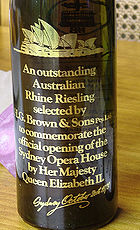
The Opera House was formally opened by Elizabeth II, Queen of Australia, on 20 October 1973. A large crowd attended. The architect, Jørn Utzon, was not invited to the ceremony, nor was his name mentioned. The opening was televised and included fireworks and a performance of Beethoven'sLudwig van Beethoven
Ludwig van Beethoven was a German composer and pianist. A crucial figure in the transition between the Classical and Romantic eras in Western art music, he remains one of the most famous and influential composers of all time.Born in Bonn, then the capital of the Electorate of Cologne and part of...
Symphony No. 9
Symphony No. 9 (Beethoven)
The Symphony No. 9 in D minor, Op. 125, is the final complete symphony of Ludwig van Beethoven. Completed in 1824, the symphony is one of the best known works of the Western classical repertoire, and has been adapted for use as the European Anthem...
.
Performance firsts
During the construction of the Opera House, a number of lunchtime performances was arranged for the workers, with Paul RobesonPaul Robeson
Paul Leroy Robeson was an American concert singer , recording artist, actor, athlete, scholar who was an advocate for the Civil Rights Movement in the first half of the twentieth century...
the first artist to perform at the (unfinished) Opera House in 1960.
A number of performances was presented in the finished building prior to the official opening:
- The first solo piano recital was in the Concert Hall on 10 April 1973, played by Romola CostantinoRomola CostantinoRomola Helen Louise Costantino OBE was a noted Australian pianist, accompanist and teacher, who also worked as a music, film and theatre critic....
to an invited audience. - The first opera performed was Sergei ProkofievSergei ProkofievSergei Sergeyevich Prokofiev was a Russian composer, pianist and conductor who mastered numerous musical genres and is regarded as one of the major composers of the 20th century...
's War and PeaceWar and Peace (Prokofiev)War and Peace is an opera in two parts , sometimes arranged as five acts, by Sergei Prokofiev to a Russian libretto by the composer and Mira Mendelson, based on the novel War and Peace by Leo Tolstoy...
, in the Opera Theatre on 28 September 1973, conducted by the Australian OperaOpera AustraliaOpera Australia is the principal opera company in Australia. Based in Sydney, its performance season at the Sydney Opera House runs for approximately eight months of the year, with the remainder of its time spent in the The Arts Centre in Melbourne...
's Music Director, Edward DownesEdward DownesSir Edward Thomas "Ted" Downes, CBE was an English conductor, specialising in opera.He was associated with the Royal Opera House from 1952, and with Opera Australia from 1970. He was also well known for his long working relationship with the BBC Philharmonic and for working with the Netherlands...
. (It had been intended that Peter SculthorpePeter SculthorpePeter Joshua Sculthorpe AO OBE is an Australian composer. Much of his music has resulted from an interest in the music of Australia's neighbours as well as from the impulse to bring together aspects of native Australian music with that of the heritage of the West...
's work Rites of PassageRites of Passage (Sculthorpe)Rites of Passage is a music theatre work written by the Australian composer Peter Sculthorpe in 1972-73. It is often categorised as an opera, but it does not conform to the traditional concept of opera...
would have this honour, but it was not ready on time. Rites of Passage was premiered exactly a year later, on 27 September 1974) - The first public concert in the Concert Hall took place on 29 September 1973. It was an all-WagnerRichard WagnerWilhelm Richard Wagner was a German composer, conductor, theatre director, philosopher, music theorist, poet, essayist and writer primarily known for his operas...
concert performed by the Sydney Symphony OrchestraSydney Symphony OrchestraThe Sydney Symphony Orchestra , commonly known as the Sydney Symphony, is an Australian symphony orchestra based in Sydney...
, conducted by Charles MackerrasCharles MackerrasSir Alan Charles Maclaurin Mackerras, AC, CH, CBE was an Australian conductor. He was an authority on the operas of Janáček and Mozart, and the comic operas of Gilbert and Sullivan...
and with Birgit NilssonBirgit Nilssonright|thumb|Nilsson in 1948.Birgit Nilsson was a celebrated Swedish dramatic soprano who specialized in operatic and symphonic works...
as the soprano soloist. The first music played was the Prelude to Die Meistersinger von NürnbergDie Meistersinger von NürnbergDie Meistersinger von Nürnberg is an opera in three acts, written and composed by Richard Wagner. It is among the longest operas still commonly performed today, usually taking around four and a half hours. It was first performed at the Königliches Hof- und National-Theater in Munich, on June 21,...
. The concert closed with the Immolation Scene. - The first lieder recital was given by Birgit Nilsson on 6 October 1973, accompanied by Geoffrey ParsonsGeoffrey Parsons (pianist)Geoffrey Penwill Parsons AO OBE was an Australian pianist, most particularly notable as an accompanist to singers and instrumentalists...
.
After the opening:
- The first violin and piano recital was given by Wanda Wiłkomirska, also with Geoffrey Parsons.
- The first vocalist to perform at the Opera House was American singer Dick Roman.
Reconciliation with Utzon
Sydney Opera House Trust
The Sydney Opera House Trust operates and maintains the Sydney Opera House for the Government of New South Wales.The Trust operates as one of the State's cultural institutions within the Arts portfolio. It is constituted as a body corporate under the Sydney Opera House Trust Act 1961...
began to communicate with Jørn Utzon in an attempt to effect a reconciliation and to secure his involvement in future changes to the building. In 1999, he was appointed by the Trust as a design consultant for future work. In 2004, the first interior space rebuilt to an Utzon design was opened, and renamed "The Utzon Room" in his honour. In April 2007, he proposed a major reconstruction of the Opera Theatre. Utzon died on 29 November 2008.
A state memorial service, attended by Utzon's son Jan and daughter Lin, celebrating the creative genius of Jørn Utzon was held in the Sydney Opera House Concert Hall on 25 March 2009 featuring performances, readings and recollections from prominent figures in the Australian performing arts scene.
On 17 November 2009, Sydney Opera House officially opened the refurbished Western Foyers and Accessibility improvements, the largest building project completed since Jørn Utzon was re-engaged in 1999. Designed by Utzon and his son Jan
Jan Utzon
Jan Utzon is a Danish architect. The son of Jørn Utzon, with whom he worked closely on several prestigious projects, he has completed a number of fine works of his own including the Performing Arts Centre in Esbjerg.-Early life:...
, in collaboration with Richard Johnson of Johnson Pilton Walker, the project has transformed the Western Foyers into a stylish and functional space providing patrons with additional amenities including new ticketing, toilet and cloaking facilities. Importantly, new escalators and a public lift have vastly improved access for less mobile visitors, people with a disability and families with prams
Baby transport
Baby transport consists of devices for transporting and carrying infants. A "child carrier" or "baby carrier" is a device used to carry an infant or small child on the body of an adult...
.
On the same day, Louise Sauvage
Louise Sauvage
Alix Louise Sauvage OAM is an Australian paralympic wheelchair racer.Sauvage is often regarded as the most renowned disabled sportswoman in Australia. She won two gold medals and a silver medal at the 2000 Sydney Paralympic games in front of a home crowd...
OAM was announced as Sydney Opera House's inaugural Accessibility Ambassador. In this role Louise Sauvage will provide advice on the implementation of Sydney Opera House's Access Strategic Plan with a view to further improving access for people with disabilities.
Inspiration for new works
In 1993, Constantine KoukiasConstantine Koukias
Constantine Koukias is a Greek-Australian composer and flautist.He is the co-founder and Artistic Director of IHOS Music Theatre and Opera, based in Hobart, Tasmania. He is well known for his innovative work in contemporary opera and other forms...
was commissioned by the Sydney Opera House Trust in association with REM Theatre to compose Icon, a large-scale music theatre piece for the 20th anniversary of the Sydney Opera House.
Sport
For the 2000 Summer Olympics2000 Summer Olympics
The Sydney 2000 Summer Olympic Games or the Millennium Games/Games of the New Millennium, officially known as the Games of the XXVII Olympiad, were an international multi-sport event which was celebrated between 15 September and 1 October 2000 in Sydney, New South Wales, Australia...
, the venue served as the focal point for the triathlon
Triathlon at the 2000 Summer Olympics
Triathlon made its Olympic Games debut at the 2000 Summer Olympics in Sydney, Australia. The sport consists of three different disciplines, competed consecutively with no rest between them.The Olympic distances for the three disciplines are:...
events. The event had a 1.5 km (0.93205910497471 mi) swimming loop at Farm Cove, along with competitions in the neighbouring Royal Botanical Gardens for the cycling and running portions of the event.
See also
- Australian landmarks
- List of official openings by Elizabeth II in Australia
- Wonders of the WorldWonders of the WorldVarious lists of the Wonders of the World have been compiled from antiquity to the present day, to catalogue the world's most spectacular natural wonders and manmade structures....
Further reading
- Hubble, Ava, The Strange Case of Eugene Goossens and Other Tales from The Opera House, Collins Publishers, Australia, 1988. (Ava Hubble was Press Officer for the Sydney Opera House for 15 years.)
- Duek-Cohen, Elias, Utzon and the Sydney Opera House, Morgan Publications, Sydney, 1967–1998. (A small publication intended to gather public opinion to bring Utzon back to the project.)
- Stübe, Katarina and Utzon, Jan, Sydney Opera House: A Tribute to Jørn Utzon. Reveal Books, 2009. ISBN 978-0-9806123-0-1
- Stuber, Fritz, "Sydney's Opera House—Not a World Heritage Item? – Open letter to the Hon. John W. Howard, Prime Minister", in: Australian Planner (Sydney), Vol. 35, No. 3, 1998 (p. 116); Architecture + Design (New Delhi), Vol. XV, No. 5, 1998 (pp. 12–14); Collage (Berne), No. 3, 1998, (pp. 33–34, 1 ill.).
- Opera House an architectural "tragedy", ABC News Online, 28 April 2005.
- Flyvbjerg, Bent, "Design by Deception: The Politics of Megaproject Approval", Harvard Design Magazine, Volume 22, 2005.
- Watson, Anne (editor), "Building a Masterpiece: The Sydney Opera House", Lund Humphries, 2006, ISBN 0-85331-941-3, ISBN 978-0-85331-941-2.
External links
- Official website
- World heritage listing for Sydney Opera House
- Photographs of the construction
- Competition drawings submitted by Jørn Utzon to the Opera House Committee
- Wolanski Foundation's annotated list of sources on Sydney Opera House
- Interview with Utzon, October 1992
- Sydney Opera House
- Listen to an excerpt from the 'Sydney Opera House Opening Concert' and read more about it on australianscreen online
- The 'Sydney Opera House Opening Concert' has been added to the National Film and Sound Archive's Sounds of Australia Registry