All Topics  
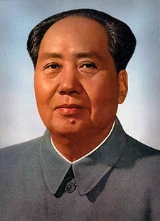
Mao Zedong

 
Mao Zedong

   Email Print
   Bookmark   Link


Mao Zedong


Mao Zedong (Simplified Chinese:???; Traditional Chinese:???; Wade-Giles
Wade-Giles

Wade-Giles , sometimes abbreviated Wade, is a Romanization system for the Mandarin Chinese language used in Beijing. It developed from a system produced by Thomas Francis Wade in the mid-19th century, and reached settled form with Herbert Giles' Chinese language-English language dictionary of 1892....
:Mao Tse-tung; Pinyin
Pinyin

Pinyin, more formally Hanyu pinyin, is the most commonly used Romanization system for Standard Mandarin. Hanyu is the Chinese Language, and pinyin means "phonetics", or more literally, "spelling sound" or "spelled sound"....
:máo zé dong) ( 26 December 1893 9 September 1976 ) was a Chinese
China

China is a Culture of China, an ancient civilization, and, depending on perspective, a national or multinational entity extending over a large area in East Asia....
 military
Military

A military is an organization authorized by its nation to use force, usually including use of weapons, in defending its country by combating actual or Threat of force ....
 and political
Politics

Politics is the process by which groups of people make decisions. The term is generally applied to behaviour within civil governments, but politics has been observed in all human group interactions, including corporation, academia, and religion institutions....
 dictator. Mao led the Communist Party of China
Communist Party of China

The Communist Party of China , also known as the Chinese Communist Party , is the founding and the ruling party of the People's Republic of China and the world's largest political party....
 (CPC) to victory against the Kuomintang
Kuomintang

The Kuomintang of China , also often translated as the Chinese Nationalist Party, is the founding and the ruling party of the Republic of China ....
 (KMT) in the Chinese Civil War
Chinese Civil War

The Chinese Civil War or , which lasted from April 1927 to May 1950, was a civil war in China between the Kuomintang and the Chinese Communist Party ....
, and was the leader of the People’s Republic of China (PRC) from its establishment in 1949 until his death in 1976. Chairman Mao has been regarded as one of the most important figures in modern world history, and named by Time Magazine as one of the 100 most influential
Time 100: The Most Important People of the Century

The Time 100: The Most Important People of the Century is a compilation of the 20th century 100 most influential people, published in Time magazine in 1999....
 people of the 20th century.


Discussion
Ask a question about 'Mao Zedong'
Start a new discussion about 'Mao Zedong'
Answer questions from other users
Full Discussion Forum


Recent Posts


Quotations


Ours is a people's democratic dictatorship, led by the working class and based on the worker-peasant alliance.

On the Correct Handling of Contradiction (1957)


Encyclopedia


Mao Zedong (Simplified Chinese:???; Traditional Chinese:???; Wade-Giles
Wade-Giles

Wade-Giles , sometimes abbreviated Wade, is a Romanization system for the Mandarin Chinese language used in Beijing. It developed from a system produced by Thomas Francis Wade in the mid-19th century, and reached settled form with Herbert Giles' Chinese language-English language dictionary of 1892....
:Mao Tse-tung; Pinyin
Pinyin

Pinyin, more formally Hanyu pinyin, is the most commonly used Romanization system for Standard Mandarin. Hanyu is the Chinese Language, and pinyin means "phonetics", or more literally, "spelling sound" or "spelled sound"....
:máo zé dong) ( 26 December 1893 9 September 1976 ) was a Chinese
China

China is a Culture of China, an ancient civilization, and, depending on perspective, a national or multinational entity extending over a large area in East Asia....
 military
Military

A military is an organization authorized by its nation to use force, usually including use of weapons, in defending its country by combating actual or Threat of force ....
 and political
Politics

Politics is the process by which groups of people make decisions. The term is generally applied to behaviour within civil governments, but politics has been observed in all human group interactions, including corporation, academia, and religion institutions....
 dictator. Mao led the Communist Party of China
Communist Party of China

The Communist Party of China , also known as the Chinese Communist Party , is the founding and the ruling party of the People's Republic of China and the world's largest political party....
 (CPC) to victory against the Kuomintang
Kuomintang

The Kuomintang of China , also often translated as the Chinese Nationalist Party, is the founding and the ruling party of the Republic of China ....
 (KMT) in the Chinese Civil War
Chinese Civil War

The Chinese Civil War or , which lasted from April 1927 to May 1950, was a civil war in China between the Kuomintang and the Chinese Communist Party ....
, and was the leader of the People’s Republic of China (PRC) from its establishment in 1949 until his death in 1976. Chairman Mao has been regarded as one of the most important figures in modern world history, and named by Time Magazine as one of the 100 most influential
Time 100: The Most Important People of the Century

The Time 100: The Most Important People of the Century is a compilation of the 20th century 100 most influential people, published in Time magazine in 1999....
 people of the 20th century. He is officially held in high regard in China where he is portrayed as a great revolutionary, political strategist, and military mastermind who defeated Generalissimo Chiang Kai-shek
Chiang Kai-shek

Chiang Kai-shek , Order of the Bath , served as Generalissimo of the Nationalist Government of the Republic of China from 1928 to 1948. He was sometimes referred to simply as "the Generalissimo"....
 in the Chinese Civil War
Chinese Civil War

The Chinese Civil War or , which lasted from April 1927 to May 1950, was a civil war in China between the Kuomintang and the Chinese Communist Party ....
, and then through his policies transformed the country into a major world power. Additionally, Mao is viewed by many in China as a poet
Poet

A poet is a person who writes poetry....
, philosopher, and visionary
Visionary

Defined narrowly, a visionary is one who claims to experience a vision or apparition connected to the supernatural. At times this involves seeing into the future....
. However, Mao remains a controversial figure to this day, with a contentious and ever evolving legacy. Critics blame many of Mao's socio-political programs, such as the Great Leap Forward
Great Leap Forward

The Great Leap Forward of the People's Republic of China was an economic and social plan used from 1958 to 1961 which aimed to use China's vast population to rapidly transform China from a primarily agrarian economy dominated by peasant farmers into a modern, agriculturalized and industrialized communist society....
 and the Cultural Revolution
Cultural Revolution

The Great Proletarian Cultural Revolution in the People?s Republic of China was a period of widespread social and political upheaval that led to nation-wide chaos and economic disarray, which would engulf much of Chinese society between 1966 and 1976....
, for causing severe damage to the culture, society, economy
Economy of the People's Republic of China

The economy of the People's Republic of China is the second largest in the world after that of the Economy of the United States with a GDP of International dollar7.8 trillion when measured on a purchasing power parity basis....
, and foreign relations
Foreign relations of the People's Republic of China

The foreign relations of the People's Republic of China draw upon traditions extending back to imperial China in the Qing Dynasty and the Opium Wars, despite Chinese society having undergone many radical upheavals over the past two and a half centuries....
 of China, as well as a probable death toll in the tens of millions.

Early life in China


During the 1911 Revolution, Mao enlisted as a soldier in a local regiment in Hunan
Hunan

is a province of China of People's Republic of China, located in the middle reaches of the Yangtze River and south of Lake Dongting . Hunan is sometimes called wikt:? for short, after the Xiang River which runs through the province....
, which fought on the side of the revolutionaries. Once the Qing Dynasty
Qing Dynasty

The Qing Dynasty , also known as the Manchu Dynasty, followed the Ming Dynasty in History of China, and was the last ruling Chinese Dynasties of China, ruling from 1644 to 1912 ....
 had been effectively toppled, Mao left the army and returned to school.

After graduating from the First Provincial Normal School of Hunan in 1918, Mao traveled with Professor Yang Changji, his high school teacher and future mother-in-law, to Beijing
Beijing

is a metropolis in northern China and the Capital of the People's Republic of China. It is one of the four municipality of China, which are equivalent to province in China's Political divisions of China....
 during the May Fourth Movement in 1919.

Professor Yang held a faculty position at Peking University
Peking University

Peking University , colloquially known in Chinese as Beida , is a major research university located in Beijing, China. It is the first formally established modern research university, and the first national university of China....
. Because of Yang's recommendation, Mao worked as an assistant librarian at the University with Li Dazhao
Li Dazhao

Li Dazhao was a China intellectual who co-founded the Communist Party of China with Chen Duxiu in 1921....
 as curator. Mao registered as a part-time student at Beijing University and attended few lectures and seminars by intellectuals, such as Chen Duxiu
Chen Duxiu

Chen Duxiu played many different roles in Chinese history. He was a leading figure in the anti-imperial Xinhai Revolution and the May Fourth Movement for Science and Democracy....
, Hu Shi, and Qian Xuantong
Qian Xuantong

Qian Xuantong Born in Huzhou, Zhejiang, Qian was trained in traditional Chinese philology. After receiving his university education in Japan, Qian held a number of teaching positions in mainland China....
. During his stay in Shanghai, he engaged himself as much as possible in reading which introduced him to Communist theories. He married Yang Kaihui
Yang Kaihui

Y?ng Kaihu? was the first wife of Mao Zedong from 1920 to 1930.She was born in Bancang village, Changsha, Hunan, Qing Dynasty the daughter of Yang Changji, head of the Hunan First Normal School and one of Mao's favorite teachers....
, Professor Yang's daughter and a fellow student, despite an existing marriage arranged by his father at home. Mao never acknowledged this marriage. In October 1930, the Kuomintang
Kuomintang

The Kuomintang of China , also often translated as the Chinese Nationalist Party, is the founding and the ruling party of the Republic of China ....
 (KMT) captured Yang Kaihui
Yang Kaihui

Y?ng Kaihu? was the first wife of Mao Zedong from 1920 to 1930.She was born in Bancang village, Changsha, Hunan, Qing Dynasty the daughter of Yang Changji, head of the Hunan First Normal School and one of Mao's favorite teachers....
 as well as her son, Anying. The KMT imprisoned them both, and Anying was later sent to his relatives after the KMT killed his mother. At this time , Mao was living with He Zizhen
He Zizhen

He Zizhen was the second wife of Mao Zedong from May 1930 to 1937....
, a co-worker and 17 year old girl from Yongxing, Jiangxi
Jiangxi

is a southern province of China of the People's Republic of China, spanning from the banks of the Yangtze River in the north into hillier areas in the south....
. Mao turned down an opportunity to study in France
France

France , officially the French Republic , is a country whose Metropolitan France is located in Western Europe and that also comprises various Overseas departments and territories of France....
 because he firmly believed that China's problems could be studied and resolved only within China. Unlike his contemporaries, Mao concentrated on studying the peasant majority of China's population.

On 23 July 1921, Mao, age 27, attended the first session of the National Congress of the Communist Party of China
National Congress of the Communist Party of China

The National Congress of the Communist Party of China is a party congress that is held about once every five years. The National Congress is theoretically the highest body within the Communist Party of China, but in practice important decisions are made before the meeting....
 in Shanghai
Shanghai

Shanghai is the List of cities in the People's Republic of China by population in China and one of the List of metropolitan areas by population in the world, with over 20 million people....
. Two years later, he was elected as one of the five commissars of the Central Committee of the Party during the third Congress session. Later that year, Mao returned to Hunan at the instruction of the CPC Central Committee and the Kuomintang Central Committee to organize the Hunan branch of the Kuomintang. In 1924, he was a delegate to the first National Conference of the Kuomintang, where he was elected an Alternate Executive of the Central Committee. In 1924, he became an Executive of the Shanghai branch of the Kuomintang and Secretary of the Organization Department.

For a while, Mao remained in Shanghai, an important city that the CPC emphasized for the Revolution
Revolution

A revolution is a fundamental social change in power or organizational structures that takes place in a relatively short period of time....
. However, the Party encountered major difficulties organizing labor union movements and building a relationship with its nationalist ally, the Kuomintang
Kuomintang

The Kuomintang of China , also often translated as the Chinese Nationalist Party, is the founding and the ruling party of the Republic of China ....
 (KMT). The Party had become poor, and Mao became disillusioned with the revolution and moved back to Shaoshan. During his stay at home, Mao's interest in the revolution was rekindled after hearing of the 1925 uprisings in Shanghai and Guangzhou. His political ambitions returned, and he then went to Guangdong, the base of the Kuomintang, to take part in the preparations for the second session of the National Congress of Kuomintang. In October 1925, Mao became acting Propaganda Director of the Kuomintang.

In early 1927, Mao returned to Hunan where, in an urgent meeting held by the Communist Party, he made a report based on his investigations of the peasant uprisings in the wake of the Northern Expedition. This is considered the initial and decisive step towards the successful application of Mao's revolutionary theories.

Political ideas


Mao had a great interest in the political system, encouraged by his father. His two most famous essays, both from 1937, 'On Contradiction' and 'On Practice', are concerned with the practical strategies of a revolutionary movement and stress the importance of practical, grassroots knowledge, obtained through experience. Both essays reflect the guerrilla roots of Maoism in the need to build up support in the countryside against a Japanese occupying force and emphasise the need to win over 'hearts and minds' through 'education'. The essays, reproduced later as part of the 'Red Book
Quotations from Chairman Mao Zedong

Quotations from Chairman Mao Zedong , better known in the Western world as The Little Red Book, was published by the Government of the People's Republic of China from April 1964 until approximately 1976....
', warn against the behaviour of the blindfolded man trying to catch sparrows, and the 'Imperial envoy' descending from his carriage to 'spout opinions' .

After graduating from Hunan Normal School, the highest level of schooling available in his province, Mao spent six months studying independently. Mao was first introduced to communism while working at Peking University
Peking University

Peking University , colloquially known in Chinese as Beida , is a major research university located in Beijing, China. It is the first formally established modern research university, and the first national university of China....
, and in 1921 he attended the organizational meeting of the Communist Party of China (or CPC). He first encountered Marxism while he worked as a library assistant at Peking University.

Other important influences on Mao were the Russian revolution
Russian Revolution of 1917

The Russian Revolution is the series of revolutions in Russia in 1917, which destroyed the Tsarist autocracy and led to the creation of the Soviet Union....
 and, according to some scholars, the Chinese literary works: Outlaws of the Marsh and Romance of the Three Kingdoms
Romance of the Three Kingdoms

Romance of the Three Kingdoms , written by Luo Guanzhong in the 14th century, is a Chinese historical novel based upon events in the turbulent years near the end of the Han Dynasty and the Three Kingdoms era of China, starting in 169 and ending with the reunification of the land in 280....
. Mao sought to subvert the alliance of imperialism and feudalism in China. He thought the Nationalists
Kuomintang

The Kuomintang of China , also often translated as the Chinese Nationalist Party, is the founding and the ruling party of the Republic of China ....
 to be both economically and politically vulnerable and thus that the revolution could not be steered by Nationalists.

Throughout the 1920s, Mao led several labour struggles based upon his studies of the propagation and organization of the contemporary labour movements. However, these struggles were successfully subdued by the government, and Mao fled from Changsha
Changsha

Changsha is the capital city of Hunan, a province of south-central China, located on the lower reaches of Xiang river, a branch of the Yangtze River....
 after he was labeled a radical activist. He pondered these failures and finally realized that industrial
Industry

An industry is the manufacturing of a Good or Service within a category. Although industry is a broad term for any kind of economic production, in economics and urban planning industry is a synonym for the secondary sector, which is a type of economic activity involved in the manufacturing of raw materials into goods and products....
 workers were unable to lead the revolution because they made up only a small portion of China's population, and unarmed labour struggles could not resolve the problems of imperial and feudal suppression.

Mao began to depend on Chinese peasant
Peasant

A peasant is an agriculture worker who subsists by working a small plot of ground. The word is derived from 15th century French language pa?sant meaning one from the pays, or rural, ultimately from the Latin pagus, or outlying administrative district ....
s who later became staunch supporters of his theory of violent revolution. This dependence on the rural rather than the urban proletariat to instigate violent revolution distinguished Mao from his predecessors and contemporaries. Mao himself was from a peasant family, and thus he cultivated his reputation among the farmers and peasants and introduced them to Marxism.

War and Revolution


In 1927, Mao conducted the famous Autumn Harvest Uprising
Autumn Harvest Uprising

The Autumn Harvest Uprising was an insurrection that took place in Hunan province and Jiangxi province, China on September 7, 1927, led by Mao Zedong, who established a short-lived Hunan Soviet....
 in Changsha
Changsha

Changsha is the capital city of Hunan, a province of south-central China, located on the lower reaches of Xiang river, a branch of the Yangtze River....
, Hunan
Hunan

is a province of China of People's Republic of China, located in the middle reaches of the Yangtze River and south of Lake Dongting . Hunan is sometimes called wikt:? for short, after the Xiang River which runs through the province....
, as commander-in-chief. Mao led an army, called the "Revolutionary Army of Workers and Peasants", which was defeated and scattered after fierce battles. Afterwards, the exhausted troops were forced to leave Hunan for Sanwan, Jiangxi, where Mao re-organized the scattered soldiers, rearranging the military division into smaller regiments. Mao also ordered that each company must have a party branch office with a commissar as its leader who would give political instructions based upon superior mandates. This military rearrangement in Sanwan, Jiangxi initiated the CPC's absolute control over its military force and has been considered to have the most fundamental and profound impact upon the Chinese revolution. Later, they moved to the Jinggang Mountains, Jiangxi.

In the Jinggang Mountains, Mao persuaded two local insurgent leaders to pledge their allegiance to him. There, Mao joined his army with that of Zhu De
Zhu De

Zhu D? was a Communist Party of China military leader and statesman. He is regarded as the founder of the Chinese Red Army and the tactician who engineered the revolution from which emerged the People's Republic of China....
, creating the Workers' and Peasants' Red Guard of China, Red Guard in short.

From 1931 to 1934, Mao helped establish the Soviet Republic of China and was elected Chairman of this small republic in the mountainous areas in Jiangxi. Here, Mao was married to He Zizhen
He Zizhen

He Zizhen was the second wife of Mao Zedong from May 1930 to 1937....
. His previous wife, Yang Kaihui
Yang Kaihui

Y?ng Kaihu? was the first wife of Mao Zedong from 1920 to 1930.She was born in Bancang village, Changsha, Hunan, Qing Dynasty the daughter of Yang Changji, head of the Hunan First Normal School and one of Mao's favorite teachers....
, had been arrested and executed in 1930, just three years after their departure.

Mao1931
In Jiangxi, Mao's authoritative domination, especially that of the military force, was challenged by the Jiangxi branch of the CPC and military officers! Mao's opponents, among whom the most prominent was Li Wenlin, the founder of the CPC's branch and Red Guard in Jiangxi, were against Mao's land policies and proposals to reform the local party branch and army leadership. Mao reacted first by accusing the opponents of opportunism
Opportunism

Opportunism is a term used in politics and political science. It forms an important rationale as well for transaction cost economics. It is interpreted in different ways, but usually refers to one or more of the following:...
 and kulak
Kulak

Kulaks were a category of relatively affluent and well-endowed peasants in the later Russian Empire, Soviet Russia, and early Soviet Union. The word kulak originally referred to independent farmers in the Russian Empire who emerged as a result of the Stolypin reform which began in 1906....
ism and then set off a series of systematic suppressions of them. It is reported that horrible forms of torture and killing took place. Jung Chang and Jon Halliday claim that victims were subjected to a red-hot gun-rod being rammed into the anus and that there were many cases of cutting open the stomach and scooping out the heart. The estimated number of the victims amounted to several thousands and could be as high as 186,000. Critics accuse Mao's authority in Jiangxi of being secured and reassured through the revolutionary terrorism, or red terrorism
Red Terror

The Red Terror in Soviet Russia was the campaign of mass arrests and executions conducted by the Bolshevik government. In Soviet historiography, the Red Terror is described as officially announced on September 2, 1918 by Yakov Sverdlov and ended in about October 1918....
.

Mao, with the help of Zhu De
Zhu De

Zhu D? was a Communist Party of China military leader and statesman. He is regarded as the founder of the Chinese Red Army and the tactician who engineered the revolution from which emerged the People's Republic of China....
, built a modest but effective army, undertook experiments in rural reform and government, and provided refuge for Communists fleeing the rightist purges in the cities. Mao's methods are normally referred to as Guerrilla warfare; but he himself made a distinction between guerrilla warfare (youji zhan) and Mobile Warfare
Mobile warfare

*For various forms of wars based on mobility, see Maneuver warfare.*For the specific military methods of Mao Zedong, yundong zhan, see Mobile Warfare....
 (yundong zhan).

Mao's Guerrilla Warfare
Guerrilla warfare

Guerrilla warfare is the Irregular warfare warfare and combat with which a small group of combatants use mobile Military tactics to combat a larger and less mobile formal army....
 and Mobile Warfare
Mobile warfare

*For various forms of wars based on mobility, see Maneuver warfare.*For the specific military methods of Mao Zedong, yundong zhan, see Mobile Warfare....
 was based upon the fact of the poor armament and military training of the Red Guard which consisted mainly of impoverished peasants, who, however, were all encouraged by revolutionary passions and aspiring after a communist utopia
Utopia

Utopia is a name for an ideal community or society, taken from the Utopia written in 1516 by Sir Thomas More describing a fictional island in the Atlantic Ocean, possessing a seemingly perfect social system-politics-legal system....
.

Around 1930, there had been more than ten regions, usually entitled "soviet areas", under control of the CPC. The prosperity of "soviet areas" startled and worried Chiang Kai-shek
Chiang Kai-shek

Chiang Kai-shek , Order of the Bath , served as Generalissimo of the Nationalist Government of the Republic of China from 1928 to 1948. He was sometimes referred to simply as "the Generalissimo"....
, chairman of the Kuomintang government, who waged five waves of besieging campaigns against the "central soviet area." More than one million Kuomintang soldiers were involved in these five campaigns, four of which were defeated by the Red Guard led by Mao. By June 1932 (the height of its power), the Red Guard had no less than 45,000 soldiers, with a further 200,000 local militia acting as a subsidiary force.

Under increasing pressures from the KMT encirclement campaigns, there was a struggle for power within the Communist leadership. Mao was removed from his important positions and replaced by individuals (including Zhou Enlai
Zhou Enlai

Zhou Enlai was the first Premier of the People's Republic of China, serving from October 1949 until his death in January 1976. Zhou was instrumental in the Communist Party of China rise to power, and subsequently in the construction of the Economy of the People's Republic of China and restructuring of Chinese society....
) who appeared loyal to the orthodox line advocated by Moscow and represented within the CPC by a group known as the 28 Bolsheviks
28 Bolsheviks

The 28 Bolsheviks were a group of China students who studied at the Moscow Sun Yat-sen University from the late 1920s until early 1935, also known as the "Returned Students"....
.

Chiang Kai-shek
Chiang Kai-shek

Chiang Kai-shek , Order of the Bath , served as Generalissimo of the Nationalist Government of the Republic of China from 1928 to 1948. He was sometimes referred to simply as "the Generalissimo"....
, who had earlier assumed nominal control of China due in part to the Northern Expedition, was determined to eliminate the Communists. By October 1934, he had them surrounded, prompting them to engage in the "Long March," a retreat from Jiangxi in the southeast to Shaanxi
Shaanxi

is a north-central political divisions of China of the People's Republic of China, and includes portions of the Loess Plateau on the middle reaches of the Yellow River as well as the Qinling Mountains across the southern part of the province....
 in the northwest of China. It was during this 9,600 kilometer (5,965 mile), year-long journey that Mao emerged as the top Communist leader, aided by the Zunyi Conference
Zunyi Conference

The Zunyi Conference was a meeting of the Communist Party of China in January of 1935 during the Long March. This meeting involved a power struggle between the leadership of Bo Gu and Otto Braun and the opposition led by Mao Zedong....
 and the defection of Zhou Enlai
Zhou Enlai

Zhou Enlai was the first Premier of the People's Republic of China, serving from October 1949 until his death in January 1976. Zhou was instrumental in the Communist Party of China rise to power, and subsequently in the construction of the Economy of the People's Republic of China and restructuring of Chinese society....
 to Mao's side. At this Conference, Mao entered the Standing Committee of the Politburo of the Communist Party of China.

According to the standard Chinese Communist Party line, from his base in Yan'an
Yan'an

Yan'an , is a city in the Shanbei region of Shaanxi province in China.Yan'an was the endpoint of the Long March, and the center of the Communist Party of China revolution from 1935 to 1948....
, Mao led the Communist resistance against the Japanese in the Second Sino-Japanese War
Second Sino-Japanese War

The Second Sino-Japanese War was the largest Asian war in the twentieth century. From 1937 to 1941, it was fought between the Republic of China and the Empire of Japan....
 (1937-1945). However, Mao further consolidated power over the Communist Party in 1942 by launching the Zheng Feng
Zheng Feng

Category:Articles needing more viewpointsThe Yan'an Rectification Movement also known as the Rectification Movement , Zheng Feng or Cheng Feng was the first ideology movement initiated by the Communist Party of China....
, or "Rectification" campaign against rival CPC members such as Wang Ming
Wang Ming

Wang Ming was a senior leader of the early Chinese Communist Party as well as the mastermind of the famous 28 Bolsheviks group. Wang was also a major political rival of Mao Zedong during the 1930s, opposing Mao's nationalist deviation from the Comintern and orthodox Marxism and Leninism lines....
, Wang Shiwei
Wang Shiwei

Wang Shiwei , originally named Wang Sidao , was a journalist and literary writer. He became famous for his contribution to the Chinese history of modern revolution and to Chinese modern literature....
, and Ding Ling
Ding Ling

Ding L?ng was the pseudonym of Jiang Bingzhi , also known as Bin Zhi , a Chinese woman author from Linli in Hunan province....
. Also while in Yan'an, Mao divorced He Zizhen and married the actress Lan Ping, who would become known as Jiang Qing
Jiang Qing

Jiang Qing was the pseudonym that was used by Chinese leader Mao Zedong's last wife and major Chinese Communist Party power figure. She went by the stage name Lan Ping during her acting career, and was known by various other names during her life....
.

Mao1938a
During the Sino-Japanese War, Mao Zedong's strategies were opposed by both Chiang Kai-shek and the United States. The US regarded Chiang as an important ally, able to help shorten the war by engaging the Japanese occupiers in China. Chiang, in contrast, sought to build the ROC army for the certain conflict with Mao's communist forces after the end of World War II
World War II

World War II, or the Second World War , was a global military conflict which involved a Participants in World War II, including all of the great powers, organised into two opposing military alliances: the Allies of World War II and the Axis powers....
. This fact was not understood well in the US, and precious lend-lease
Lend-Lease

Lend-Lease was the name of the program under which the United States supplied the United Kingdom, the Soviet Union, Republic of China, Free France and other Allies of World War II with vast amounts of materiel between 1941 and 1945 in return for, in the case of Britain, military bases in Newfoundland and Labrador, Bermuda, and the British W...
 armaments continued to be allocated to the Kuomintang. In turn, Mao spent part of the war (as to whether it was most or only a little is disputed) fighting the Kuomintang for control of certain parts of China. Both the Communists and Nationalists have been criticised for fighting amongst themselves rather than allying against the Japanese Imperial Army. Some argue, however, that the Nationalists were better equipped and fought more against Japan.

In 1944, the Americans sent a special diplomatic envoy, called the Dixie Mission
Dixie Mission

The United States Army Observation Group, commonly known as the Dixie Mission, was the first U.S. effort to establish official relations with the Communist Party of China....
, to the Communist Party of China. According to Edwin Moise, in Modern China: A History 2nd Edition:

Most of the Americans were favorably impressed. The CPC seemed less corrupt, more unified, and more vigorous in its resistance to Japan
Japan

Japan is an island country in East Asia. Located in the Pacific Ocean, it lies to the east of the Sea of Japan, People's Republic of China, North Korea, South Korea and Russia, stretching from the Sea of Okhotsk in the north to the East China Sea and Taiwan in the south....
 than the Guomindang. United States fliers shot down over North China...confirmed to their superiors that the CPC was both strong and popular over a broad area. In the end, the contacts with the USA developed with the CPC led to very little.


Then again, modern commentators have disputed such claims. Amongst others, Willy Lam stated that during the war with Japan:

Mao1946
After the end of World War II, the U.S. continued to support Chiang Kai-shek, now openly against the Communist Red Guard
People's Liberation Army

The People's Liberation Army is the unified military organization of all land, sea, and air forces of the People's Republic of China. The PLA was established on August 1, 1927 ? celebrated annually as "PLA Day" ? as the military arm of the Communist Party of China....
 (led by Mao Zedong) in the civil war
Chinese Civil War

The Chinese Civil War or , which lasted from April 1927 to May 1950, was a civil war in China between the Kuomintang and the Chinese Communist Party ....
 for control of China. The U.S. support was part of its view to contain and defeat world communism. Likewise, the Soviet Union gave quasi-covert support to Mao (acting as a concerned neighbor more than a military ally, to avoid open conflict with the U.S.) and gave large supplies of arms to the Communist Party of China, although newer Chinese records indicate the Soviet "supplies" were not as large as previously believed, and consistently fell short of the promised amount of aid.

On 21 January 1949, Kuomintang forces suffered massive losses against Mao's Red Guard. In the early morning of 10 December 1949, Red Guard troops laid siege to Chengdu
Chengdu

Chengdu , located in southwest People's Republic of China, is the capital of Sichuan provinces of China and a sub-provincial city. Chengdu is also one of the most important economic centers and transportation and communication hubs in Southwestern China....
, the last KMT-occupied city in mainland China, and Chiang Kai-shek evacuated from the mainland to Taiwan
Taiwan

Taiwan is an island in East Asia. "Taiwan" is also commonly used to refer to the country governed by the Republic of China and to the ROC itself, which governs the island of Taiwan, Orchid Island and Green Island, Taiwan in the Pacific Ocean off the Taiwan coast, the Penghu islands in the Taiwan Strait, and Kinmen and the Matsu Islands...
 (Formosa) that same day.

Leadership of China

The People's Republic of China
People's Republic of China

The People's Republic of China , commonly known as China, is the largest country in East Asia and the List of countries by population in the world with over 1.3 billion people, approximately a fifth of the world's population....
 was established on October 1, 1949. It was the culmination of over two decades of civil and international war. From 1954 to 1959, Mao was the Chairman of the PRC
President of the People's Republic of China

The President of the People's Republic of China is the head of state of the People's Republic of China. The office was created by the Constitution of the People's Republic of China....
. During this period, Mao was called Chairman Mao or the Great Leader Chairman Mao . The Communist Party assumed control of all media in the country and used it to promote the image of Mao and the Party. The Nationalists under General Chiang Kai-Shek
Chiang Kai-shek

Chiang Kai-shek , Order of the Bath , served as Generalissimo of the Nationalist Government of the Republic of China from 1928 to 1948. He was sometimes referred to simply as "the Generalissimo"....
 were vilified as were countries such as the United States of America and Japan. The Chinese people were exhorted to devote themselves to build and strengthen their country. In his speech declaring the foundation of the PRC, Mao announced: "The Chinese people have stood up!"

Mao took up residence in Zhongnanhai
Zhongnanhai

The Zhongnanhai is a complex of buildings in Beijing, China adjacent to the Forbidden City which serves as the central headquarters for the Communist Party of China and the State Council of the People's Republic of China of the People's Republic of China....
, a compound next to the Forbidden City
Forbidden City

The Forbidden City was the China imperial palace from the Ming Dynasty to the end of the Qing Dynasty. It is located in the middle of Beijing, People's Republic of China, and now houses the Palace Museum....
 in Beijing, and there he ordered the construction of an indoor swimming pool and other buildings. Mao often did his work either in bed or by the side of the pool, preferring not to wear formal clothes unless absolutely necessary, according to Dr. Li Zhisui
Li Zhisui

Dr. Li Zhisui was Mao Zedong's personal physician and confidante. After immigrating to the United States, he wrote a biography of his experiences with Mao entitled The Private Life of Chairman Mao ....
, his personal physician. (Li's book, The Private Life of Chairman Mao
The Private Life of Chairman Mao

The Private Life of Chairman Mao is a memoir published in 1994 by Dr. Li Zhisui, one of the physicians of Mao Zedong, who emigrated to the United States in the years after Mao's death....
, is regarded as controversial, especially by those sympathetic to Mao.)

Along with land reform
Land reform

Land reforms is an often-Land reform#Arguments for and against land reform alteration in the societal arrangements whereby government administers possession and use of land....
, there were also campaigns of mass repression
Political repression

Political repression is the persecution of an individual or group for political reasons, particularly for the purpose of restricting or preventing their ability to take part in the politics of society....
 and public executions targeting alleged counter-revolutionaries (zhenfan), such as former KMT officials, businessmen, former employees of Western companies, intellectuals whose loyalty was suspect, and significant numbers of rural gentry
Gentry

Gentry generally refers to people of high social class, especially in the past. The word derives from the Latin gentis, meaning a clan or extended family....
. The U.S. State department
United States Department of State

The United States Department of State, often referred to as the State Department, is the United States Cabinet-level foreign affairs agency of the United States Federal government of the United States, similar to foreign ministries, foreign offices, ministries of external relations, etc....
 in 1976 estimated that there may have been a million killed in the land reform, 800,000 killed in the counterrevolutionary campaign. Mao himself claimed that a total of 700,000 people were executed during the years 1949–53. However, because there was a policy to select "at least one landlord, and usually several, in virtually every village for public execution", the number of deaths range between between 2 million and 5 million. In addition, at least 1.5 million people were sent to "reform through labour"
Laogai

Laogai , the abbreviation for L?od?ng Gaiz?o , which means "reform through labor," is a slogan of the China criminal justice and has been used to refer to the use of Penal labour and prison farms in the People's Republic of China ....
 camps. Mao’s personal role in ordering mass executions is undeniable. He defended these killings as necessary for the securing of power.

Starting in 1951, Mao initiated two successive movements in an effort to rid urban areas of corruption
Corruption

Corruption is essentially termed as an "impairment of integrity, virtue or moral principle; depravity, decay, and/or an inducement to wrong by improper or unlawful means, a departure from the original or from what is pure or correct, and/or an agency or influence that corrupts."...
 by targeting wealthy capitalists and political opponents, known as the three-anti/five-anti campaigns
Three-anti/five-anti campaigns

The Three-anti Campaign and Five-anti Campaign were reform movements originally issued by Mao Zedong a few years after the founding of the People's Republic of China in an effort to rid Chinese cities of Political corruption and enemy of the state....
. A climate of raw terror developed as workers denounced their bosses, wives turned on their husbands, and children informed on their parents; the victims often being humiliated at mass meetings. Mao insisted that minor offenders be criticized and reformed or sent to labor camps, "while the worst among them should be shot." These campaigns took several hundred thousand lives, the vast majority via suicide. In Shanghai
Shanghai

Shanghai is the List of cities in the People's Republic of China by population in China and one of the List of metropolitan areas by population in the world, with over 20 million people....
, people jumping to their deaths from skyscrapers became so commonplace that they acquired the nickname 'parachutes'.

Following the consolidation of power, Mao launched the First Five-Year Plan (1953-8). The plan aimed to end Chinese dependence upon agriculture in order to become a world power. With the Soviet Union
Soviet Union

The Union of Soviet Socialist Republics was a Constitution of the Soviet Union socialist state that existed in Eurasia from 1922 to 1991.The name is a translation of the , romanization of Russian Soyuz Sovetskikh Sotsialisticheskikh Respublik, abbreviated ????, SSSR....
's assistance, new industrial plants were built and agricultural production eventually fell to a point where industry was beginning to produce enough capital that China no longer needed the USSR's support. The success of the First Five Year Plan was to encourage Mao to instigate the Second Five Year Plan, the Great Leap Forward, in 1958. Mao also launched a phase of rapid collectivization. The CPC introduced price controls as well as a Chinese character simplification
Simplified Chinese character

Simplified Chinese Characters are one of two standard sets of Chinese characters of the contemporary Chinese written language. They are based mostly on popular cursive forms embodying graphic or phonetic simplifications of the "traditional" forms that were used in printed text for over a thousand years....
 aimed at increasing literacy. Land was taken from landlords and more wealthy peasants and given to poorer peasants. Large scale industrialization projects were also undertaken.

Programs pursued during this time include the Hundred Flowers Campaign
Hundred Flowers Campaign

The 'Hundred Flowers Campaign', also termed the 'Hundred Flowers Movement', is the period referring to a brief interlude in the People's Republic of China from 1956 to 1957 during which the Communist Party of China encouraged a variety of views and solutions to national policy issues, launched under the slogan: "Letting a hundred flower...
, in which Mao indicated his supposed willingness to consider different opinions about how China should be governed. Given the freedom to express themselves, liberal and intellectual Chinese began opposing the Communist Party and questioning its leadership. This was initially tolerated and encouraged. After a few months, Mao's government reversed its policy and persecuted those, totalling perhaps 500,000, who criticized, as well as those who were merely alleged to have criticized, the Party in what is called the Anti-Rightist Movement
Anti-Rightist Movement

The Anti-Rightist Movement of the People's Republic of China in the 1950s and early 1960s consisted of a series of campaigns to purge alleged Right-wing within the Communist Party of China and abroad....
. Authors such as Jung Chang
Jung Chang

Jung Chang is a China-born United Kingdom writer now living in London, best known for her family autobiography Wild Swans, selling over 10 million copies worldwide but censorship in the People's Republic of China in mainland China....
 have alleged that the Hundred Flowers Campaign was merely a ruse to root out "dangerous" thinking. Others such as Dr Li Zhisui
Li Zhisui

Dr. Li Zhisui was Mao Zedong's personal physician and confidante. After immigrating to the United States, he wrote a biography of his experiences with Mao entitled The Private Life of Chairman Mao ....
 have suggested that Mao had initially seen the policy as a way of weakening those within his party who opposed him, but was surprised by the extent of criticism and the fact that it began to be directed at his own leadership. It was only then that he used it as a method of identifying and subsequently persecuting those critical of his government. The Hundred Flowers movement led to the condemnation, silencing, and death of many citizens, also linked to Mao's Anti-Rightist Movement, with death tolls possibly in the millions.

Great Leap Forward

In January 1958, Mao Zedong launched the second Five-Year Plan known as the Great Leap Forward
Great Leap Forward

The Great Leap Forward of the People's Republic of China was an economic and social plan used from 1958 to 1961 which aimed to use China's vast population to rapidly transform China from a primarily agrarian economy dominated by peasant farmers into a modern, agriculturalized and industrialized communist society....
, a plan intended as an alternative model for economic growth to the Soviet model focusing on heavy industry that was advocated by others in the party. Under this economic program, the relatively small agricultural collectives which had been formed to date were rapidly merged into far larger people's communes, and many of the peasants ordered to work on massive infrastructure projects and the small-scale production of iron and steel. All private food production was banned; livestock and farm implements were brought under collective ownership.

Under the Great Leap Forward, Mao and other party leaders ordered the implementation of a variety of unproven and unscientific new agricultural techniques by the new communes. Combined with the diversion of labor to steel production and infrastructure projects and the reduced personal incentives under a commune system this led to an approximately 15% drop in grain production in 1959 followed by further 10% reduction in 1960 and no recovery in 1961. In an effort to win favor with their superiors and avoid being purged, each layer in the party hierarchy exaggerated the amount of grain produced under them and based on the fabricated success, party cadres were ordered to requisition a disproportionately high amount of the true harvest for state use primarily in the cities and urban areas but also for export. The net result, which was compounded in some areas by drought and in others by floods, was that the rural peasants were not left enough to eat and many millions starved to death in what is thought to be the largest famine
Famine

A famine is a widespread shortage of food that may apply to any faunal species, which phenomenon is usually accompanied by regional malnutrition, starvation, epidemic, and increased death....
 in human history. This famine was a direct cause of the death of tens of millions of Chinese peasants between 1959 and 1962. Further, many children who became emaciated and malnourished during years of hardship and struggle for survival, died shortly after the Great Leap Forward came to an end in 1962 (Spence, 553).

The extent of Mao's knowledge as to the severity of the situation has been disputed. According to some, most notably Dr. Li Zhisui, Mao was not aware of anything more than a mild food and general supply shortage until late 1959.

"But I do not think that when he spoke on 2 July 1959, he knew how bad the disaster had become, and he believed the party was doing everything it could to manage the situation"


Jung Chang and Jon Halliday, in Mao: the Unknown Story, alleged that Mao knew of the vast suffering and that he was dismissive of it, blaming bad weather or other officials for the famine.

"Although slaughter was not his purpose with the Leap, he was more than ready for myriad deaths to result, and hinted to his top echelon that they should not be too shocked if they happened (438-439)."


Whatever the case, the Great Leap Forward led to millions of deaths in China. Mao lost esteem among many of the top party cadres and was eventually forced to abandon the policy in 1962, also losing some political power to moderate leaders, notably Liu Shaoqi
Liu Shaoqi

Liu Shaoqi was a Chinese revolutionary, statesman, and theorist. He was President of the People's Republic of China, China's head of state, from 27 April 1959 to 31 October 1968, during which he implemented policies of economic reconstruction in China....
 and Deng Xiaoping
Deng Xiaoping

Deng Xiaoping was a prominent Chinese revolutionary, politician, pragmatist and reformer, as well as the late leader of the Communist Party of China ....
. However, Mao and national propaganda claimed that he was only partly to blame. As a result, he was able to remain Chairman of the Communist Party, with the Presidency transferred to Liu Shaoqi.

The Great Leap Forward was a disaster for China. Although the steel quotas were officially reached, almost all of it made in the countryside was useless lumps of iron, as it had been made from assorted scrap metal in home made furnaces with no reliable source of fuel such as coal. According to Zhang Rongmei, a geometry teacher in rural Shanghai during the Great Leap Forward:

We took all the furniture, pots, and pans we had in our house, and all our neighbors did likewise. We put all everything in a big fire and melted down all the metal.


Moreover, most of the dams, canals and other infrastructure projects, which millions of peasants and prisoners had been forced to toil on and in many cases die for, proved useless as they had been built without the input of trained engineers, whom Mao had rejected on ideological grounds.

Kissinger Mao
In the Party Congress at Lushan
Lushan

Lushan District is the name of a district in Jiujiang, Jiangxi, China. Its history dates thousand of years in China's past. It is a popular domestic and foreign tourist attraction and hosts both the famous mountain resort town of Lushan and the Mount Lushan ....
 in July/August 1959, several leaders expressed concern that the Great Leap Forward was not as successful as planned. The most direct of these was Minister of Defence and Korean War
Korean War

The Korean War refers to a period of military conflict between North Korea and South Korea regimes, with major hostilities lasting from June 25, 1950 until the armistice signed on July 27, 1953....
 General Peng Dehuai
Peng Dehuai

Peng Dehuai was a prominent military leader of the Communist Party of China, and China's Defence Minister from 1954 to 1959. Peng was an important commander during the Second Sino-Japanese War, the Chinese civil war and was also the commander-in-chief of People's Volunteer Army in the Korean War....
. Mao, fearing loss of his position, orchestrated a purge of Peng and his supporters, stifling criticism of the Great Leap policies.

There is a great deal of controversy over the number of deaths by starvation during the Great Leap Forward. Until the mid 1980s, when official census figures were finally published by the Chinese Government, little was known about the scale of the disaster in the Chinese countryside, as the handful of Western observers allowed access during this time had been restricted to model villages where they were deceived into believing that Great Leap Forward had been a great success. There was also an assumption that the flow of individual reports of starvation that had been reaching the West, primarily through Hong Kong and Taiwan, must be localized or exaggerated as China was continuing to claim record harvests and was a net exporter of grain through the period. Censuses were carried out in China in 1953, 1964 and 1982. The first attempt to analyse this data in order to estimate the number of famine deaths was carried out by American demographer Dr Judith Banister and published in 1984. Given the lengthy gaps between the censuses and doubts over the reliability of the data, an accurate figure is difficult to ascertain. Nevertheless, Banister concluded that the official data implied that around 15 million excess deaths incurred in China during 1958-61 and that based on her modelling of Chinese demographics during the period and taking account of assumed underreporting during the famine years, the figure was around 30 million. The official statistic is 20 million deaths, as given by Hu Yaobang
Hu Yaobang

Hu Yaobang was a leader of the People's Republic of China.He was famous for supporting reforms toward capitalism and political reform in China....
. Various other sources have put the figure between 20 and 72 million.

On the international front, the period was dominated by the further isolation of China, due to start of the Sino-Soviet split
Sino-Soviet split

Sino-Soviet split was a gradual worsening of relations between the People's Republic of China and the Soviet Union during the Cold War. There is no particular date or event which marked the onset of the split, for tensions had plagued the Sino-Soviet alliance even at its best, but there was growing divergence between the two countries sinc...
 which resulted in Khrushchev withdrawing all Soviet technical experts and aid from the country. The split was triggered by border disputes, and arguments over the control and direction of world communism, and other disputes pertaining to foreign policy. Most of the problems regarding communist unity resulted from the death of Stalin and his replacement by Khrushchev. Stalin had established himself as the successor of "correct" Marxist thought well before Mao controlled the Communist Party of China
Communist Party of China

The Communist Party of China , also known as the Chinese Communist Party , is the founding and the ruling party of the People's Republic of China and the world's largest political party....
, and therefore Mao never challenged the suitability of any Stalinist doctrine (at least while Stalin was alive). Upon the death of Stalin, Mao believed (perhaps because of seniority) that the leadership of the "correct" Marxist doctrine would fall to him. The resulting tension between Khrushchev (at the head of a politically/militarily superior government), and Mao (believing he had a superior understanding of Marxist ideology) eroded the previous patron-client relationship between the CPSU and CPC. In China, the formerly favourable Soviets were now denounced as "revisionists" and listed alongside "American imperialism" as movements to oppose. Partly-surrounded by hostile American
United States

The United States of America is a Federal government constitutional republic comprising U.S. state and a federal district. The country is situated mostly in central North America, where its Contiguous United States and Washington, D.C., the Capital districts and territories, lie between the Pacific Ocean and Atlantic Oceans, Borders of the U...
 military bases (reaching from South Korea
South Korea

South Korea, officially the Republic of Korea , ), often referred to as Korea and the "names of Korea#Revival of the names", is a Semi-presidential system republic in East Asia, located in the southern half of the Korean Peninsula....
, Japan
Japan

Japan is an island country in East Asia. Located in the Pacific Ocean, it lies to the east of the Sea of Japan, People's Republic of China, North Korea, South Korea and Russia, stretching from the Sea of Okhotsk in the north to the East China Sea and Taiwan in the south....
, Okinawa, and Taiwan
Taiwan

Taiwan is an island in East Asia. "Taiwan" is also commonly used to refer to the country governed by the Republic of China and to the ROC itself, which governs the island of Taiwan, Orchid Island and Green Island, Taiwan in the Pacific Ocean off the Taiwan coast, the Penghu islands in the Taiwan Strait, and Kinmen and the Matsu Islands...
), China was now confronted with a new Soviet
Soviet Union

The Union of Soviet Socialist Republics was a Constitution of the Soviet Union socialist state that existed in Eurasia from 1922 to 1991.The name is a translation of the , romanization of Russian Soyuz Sovetskikh Sotsialisticheskikh Respublik, abbreviated ????, SSSR....
 threat from the north and west. Both the internal crisis and the external threat called for extraordinary statesmanship from Mao, but as China entered the new decade the statesmen of the People's Republic were in hostile confrontation with each other.

At a large Communist Party conference in Beijing in January 1962, called the "Conference of the Seven Thousand," State President
President of the People's Republic of China

The President of the People's Republic of China is the head of state of the People's Republic of China. The office was created by the Constitution of the People's Republic of China....
 Liu Shaoqi
Liu Shaoqi

Liu Shaoqi was a Chinese revolutionary, statesman, and theorist. He was President of the People's Republic of China, China's head of state, from 27 April 1959 to 31 October 1968, during which he implemented policies of economic reconstruction in China....
 denounced the Great Leap Forward as responsible for widespread famine. The overwhelming majority of delegates expressed agreement, but Defense Minister Lin Biao
Lin Biao

Lin Biao , born as Lin Yurong was a Communist Party of China military leader who was instrumental in the communist victory in the Chinese Civil War, especially in Northeastern China, and was the General who led the People's Liberation Army into Beijing in 1949....
 staunchly defended Mao. A brief period of liberalization followed while Mao and Lin plotted a comeback. Liu and Deng Xiaoping
Deng Xiaoping

Deng Xiaoping was a prominent Chinese revolutionary, politician, pragmatist and reformer, as well as the late leader of the Communist Party of China ....
 rescued the economy by disbanding the people's communes, introducing elements of private control of peasant smallholdings and importing grain from Canada and Australia to mitigate the worst effects of famine.

Cultural Revolution

Liu Shaoqi
Liu Shaoqi

Liu Shaoqi was a Chinese revolutionary, statesman, and theorist. He was President of the People's Republic of China, China's head of state, from 27 April 1959 to 31 October 1968, during which he implemented policies of economic reconstruction in China....
 and Deng Xiaoping
Deng Xiaoping

Deng Xiaoping was a prominent Chinese revolutionary, politician, pragmatist and reformer, as well as the late leader of the Communist Party of China ....
's prominence gradually became more powerful. Liu and Deng, then the State President and General Secretary, respectively, had favored the idea that Mao should be removed from actual power but maintain his ceremonial and symbolic role, and the party will uphold all of his positive contributions to the revolution. They attempted to marginalize Mao by taking control of economic policy and asserting themselves politically as well.

Facing the prospect of losing his place on the political stage, Mao responded to Liu and Deng's movements by launching the Cultural Revolution
Cultural Revolution

The Great Proletarian Cultural Revolution in the People?s Republic of China was a period of widespread social and political upheaval that led to nation-wide chaos and economic disarray, which would engulf much of Chinese society between 1966 and 1976....
 in 1966. Under the pretext that certain liberal "bourgeois" elements of society, labeled as class enemies, continue to threaten the socialist framework under the existing dictatorship of the proletariat, the idea that a Cultural Revolution must continue after armed struggle allowed Mao to circumvent the Communist hierarchy by giving power directly to the Red Guards, groups of young people, often teenagers, who set up their own tribunals. Chaos reigned over the country, and millions were prosecuted, including a famous philosopher, Chen Yuen. During the Cultural Revolution, Mao closed the schools in China and the young intellectuals living in cities were ordered to the countryside. They were forced to manufacture weapons for the Red Army. The Revolution led to the destruction of much of China's cultural heritage and the imprisonment of a huge number of Chinese citizens, as well as creating general economic and social chaos in the country. Millions of lives were ruined during this period, as the Cultural Revolution pierced into every part of Chinese life, depicted by such Chinese film
Film

Film encompasses individual motion pictures, the field of film as an art form, and the film industry. Films are produced by recording images from the world with cameras, or by creating images using animation techniques or special effects....
s as To Live, The Blue Kite
The Blue Kite

The Blue Kite is a film directed by Tian Zhuangzhuang in 1993. Though banned by the Chinese government upon its completion , the film soon found a receptive international audience....
 and Farewell My Concubine. It is estimated that hundreds of thousands, perhaps millions, perished in the violence of the Cultural Revolution. When Mao was informed of such losses, particularly that people had been driven to suicide, he blithely commented: "People who try to commit suicide — don't attempt to save them! . . . China is such a populous nation, it is not as if we cannot do without a few people."

Nixon Mao 1972 02 29
It was during this period that Mao chose Lin Biao
Lin Biao

Lin Biao , born as Lin Yurong was a Communist Party of China military leader who was instrumental in the communist victory in the Chinese Civil War, especially in Northeastern China, and was the General who led the People's Liberation Army into Beijing in 1949....
, who seemed to echo all of Mao's ideas, to become his successor. Mao and Lin Biao formed an alliance leading up to the Cultural Revolution in order for the purges to succeed. Mao needed Lin's clout for his plan to work. In return, Lin was made Mao's successor. By 1971, however, because of Lin's grip over the military and Mao's own paranoia, a divide between the two men became clear, and it was unclear whether Lin was planning a military coup or an assassination attempt. Lin Biao died trying to flee China, probably anticipating his arrest, in a suspicious plane crash over Mongolia
Mongolia

Mongolia is a landlocked country in East Asia and Central Asia. It borders Russia to the north and People's Republic of China to the south, east and west....
. It was declared that Lin was planning to depose Mao, and he was posthumously expelled from the CPC. At this time, Mao lost trust in many of the top CPC figures. The highest-ranking Soviet Bloc intelligence defector, Lt. Gen. Ion Mihai Pacepa
Ion Mihai Pacepa

Ion Mihai Pacepa is the highest-ranking intelligence official ever to have defector from the former Eastern Bloc. He is now a United States citizen, a writer, and a columnist....
 described his conversation with Nicolae Ceausescu
Nicolae Ceausescu

Nicolae Ceausescu was the Secretary General of the Romanian Workers' Party, later the Romanian Communist Party from 1965 until 1989, President of the Council of State from 1967 and President of Romania from 1974 until 1989....
 who told him about a plot to kill Mao Zedong with the help of Lin Biao
Lin Biao

Lin Biao , born as Lin Yurong was a Communist Party of China military leader who was instrumental in the communist victory in the Chinese Civil War, especially in Northeastern China, and was the General who led the People's Liberation Army into Beijing in 1949....
 organized by KGB
KGB

KGB is the Russian language abbreviation of Committee for State Security , which was the official name of the umbrella organization serving as the Soviet Union's premier security agency, secret police, and intelligence agency, from 1954 to 1991....
.

In 1969, Mao declared the Cultural Revolution to be over, although the official history of the People's Republic of China marks the end of the Cultural Revolution in 1976 with Mao's death. In the last years of his life, Mao was faced with declining health due to either Parkinson's disease
Parkinson's disease

Parkinson's disease is a degenerative disorder of the central nervous system that often impairs the sufferer's motor skills and speech, as well as other functions....
 or, according to Li Zhisui, motor neurone disease
Motor neurone disease

The motor neurone diseases are a group of progressive neurological disorders that destroy motor neuron, the cells that control voluntary muscle activity including speaking, walking, breathing, swallowing and general movement of the body....
, as well as lung ailments due to smoking
Tobacco smoking

Tobacco smoking is the inhalation of smoke from burned dried or cured leaves of the tobacco plant, most often in the form of a cigarette. People may smoke casually for pleasure, habitually to satisfy an addiction to the nicotine present in tobacco and to the act of smoking, or in response to social pressure....
 and heart trouble
Heart disease

Heart disease is an umbrella term for a variety for different diseases affecting the heart. As of 2007, it is the leading cause of death in the United States, England, Canada and Wales, killing one person every 34 seconds in the United States alone....
. Mao remained passive as various factions within the Communist Party mobilized for the power struggle anticipated after his death.

Final days and Mao's death

At five o'clock in the afternoon of September 2, 1976, Mao suffered a heart attack, far more severe than his previous two and affecting a much larger area of his heart. X rays indicated that his lung infection had worsened, and his urine output dropped to less than 300 cc a day.

Mao was awake and alert throughout the crisis and asked several times whether he was in danger. His condition continued to fluctuate and his life hung in the balance.

Three days later, on 5 September Mao's condition was still critical, and Hua Guofeng called Jiang Qing back from her trip. She spent only a few moments in Building 202 (where Mao was staying) before returning to her own residence in the Spring Lotus Chamber.

On the afternoon of September 7, Mao took a turn for the worse. Jiang Qing came to Building 202 where she learned the bad news. Mao had just fallen asleep and needed the rest, but she insisted on rubbing his back and moving his limbs, and she sprinkled powder on his body. The medical team protested that the dust from the powder was not good for his lungs, but she instructed the nurses on duty to follow her example later. The next morning, 8 September, she came again. She wanted the medical staff to change Mao's sleeping position, claiming that he had been lying too long on his left side. The doctor on duty objected, knowing that he could breathe only on his left side, but she had him moved nonetheless. Mao's breathing stopped and his face turned blue. Jiang Qing left the room while the medical staff put him on a respirator and performed emergency cardiopulmonary resuscitation. Mao barely revived and Hua Guofeng urged Jiang Qing not to interfere further with the doctors' work, as her actions were detrimental to Mao's health and helped cause his death faster. Mao's organs were failing and he was taken off the life support a few minutes after midnight. September 9 was chosen because it was an easy day to remember. Mao had been in poor health for several years and had declined visibly for some months prior to his death.

His body lay in state at the Great Hall of the People
Great Hall of the People

The Great Hall of the People is located at the western edge of Tiananmen Square, Beijing, People's Republic of China, and is used for legislative and ceremonial activities by the People's Republic of China and the Communist Party of China....
. A memorial service was held in Tiananmen Square
Tiananmen Square

Tiananmen Square is the large plaza near the center of Beijing, People's Republic of China, named after the Tiananmen which sits to its north, separating it from the Forbidden City....
 on 18 September 1976. There was a three minute silence observed during this service. His body was later placed into the Mausoleum of Mao Zedong
Mausoleum of Mao Zedong

The Chairman Mao Memorial Hall , commonly known as the Mausoleum of Mao Zedong, or the Mao Mausoleum, is the final resting place of Mao Zedong, Chairman of the Politburo of the Communist Party of China of the Communist Party of China from 1943 and the chairman of the Central Committee of the Communist Party of China from 1945 un...
, even though he had wished to be cremated and had been one of the first high-ranking officials to sign the "Proposal that all Central Leaders be Cremated after Death" in November 1956.

Cult of Mao

Mao's figure is largely symbolic both in China and in the global communist movement as a whole. During the Cultural Revolution, Mao's already glorified image manifested into a personality cult that influenced every aspect of Chinese life. Mao presented himself as an enemy to landowners, businessmen, and Western and American imperialism
Imperialism

Imperialism has two meanings; one describing an action and the other describing an attitude.#Action: Imperialism is the practice of extending the power, control or rule by one country over areas outside its borders....
, as well as an ally of impoverished peasants, farmers and workers.

At the 1958 Party congress in Chengdu, Mao expressed support for the idea of personality cults if they venerated figures who were genuinely worthy of adulation:

In 1962, Mao proposed the Socialist Education Movement (SEM) in an attempt to educate the peasants to resist the temptations of feudalism
Feudalism

Feudalism, a term first used in the early modern period , in its most classic sense refers to a Middle Ages European political system composed of a set of reciprocal law and military obligations among the warrior nobility, revolving around the three key concepts of lords, vassals, and fiefs....
 and the sprouts of capitalism that he saw re-emerging in the countryside from Liu's economic reforms. Large quantities of politicized art were produced and circulated — with Mao at the centre. Numerous posters and musical compositions referred to Mao as "A red sun in the centre of our hearts" (????????) and a "Savior of the people".

The Cult of Mao proved vital in starting the Cultural Revolution. China's youth had generally been raised during the Communist era, which had taught them to idolize Mao. The youth also did not remember the immense starvation and suffering caused by Mao's Great Leap Forward, and thus their thoughts of Mao were generally positive. Thus, they were his greatest supporters. Their feelings for him were of such strength that many followed his urge to challenge all established authority.

In October 1966, Mao's Quotations From Chairman Mao Tse-Tung, which was known as the Little Red Book was published. Party members were encouraged to carry a copy with them and possession was almost mandatory as a criterion for membership. Over the years, Mao's image became displayed almost everywhere, present in homes, offices and shops. His quotations were typographically emphasized
Emphasis (typography)

In typography, emphasis is the exaggeration of words in a text with a font in a different style from the rest of the text—to emphasise them....
 by putting them in boldface or red type in even the most obscure writings. Music from the period emphasized Mao's stature, as did children's rhymes. The phrase Long Live Chairman Mao for ten thousand years
Ten thousand years

The use of the phrase ten thousand years in various East Asian languages originated in History of China as an expression used to wish long life to the Emperor, and is typically translated as "long live" in English....
 was commonly heard during the era, which was traditionally a phrase reserved for the reigning Emperor
Emperor of China

The Emperor of China refers to any monarch of Imperial China reigning since the founding of the Qin Dynasty in 221 BC until the fall of the Qing Dynasty in 1912....
.

Even after the Cultural Revolution, there remain people who still worship Mao in family altars or even temples for Mao.

Legacy

As anticipated after Mao’s death, there was a power struggle for control of China. On one side was the left wing led by the Gang of Four, who wanted to continue the policy of revolutionary mass mobilization. On the other side was the right wing opposing these policies. Among the latter group, the restorationists, led by Chairman Hua Guofeng
Hua Guofeng

Su Zhu , better known by the Pseudonym Hua Guofeng , was Mao Zedong's designated successor as the paramount leader of the Communist Party of China and the People's Republic of China....
, advocated a return to central planning along the Soviet model, whereas the reformers, led by Deng Xiaoping
Deng Xiaoping

Deng Xiaoping was a prominent Chinese revolutionary, politician, pragmatist and reformer, as well as the late leader of the Communist Party of China ....
, wanted to overhaul the Chinese economy based on market-oriented policies and to de-emphasize the role of Maoist ideology in determining economic and political policy. Eventually, the reformers won control of the government. Deng Xiaoping, with clear seniority over Hua Guofeng, defeated Hua in a bloodless power struggle a few years later.

Mao is regarded as a national hero of China. In 2008, China opened the Mao Zedong Square to visitors in his hometown of central Hunan Province to mark the 115th anniversary of his birth.

Supporters of Mao credit him with advancing the social and economic development of Chinese society. They point out that before 1949, for instance, the illiteracy rate
List of countries by literacy rate

List of countries by literacy rate, as included in the United Nations Development Programme Report 2007/2008....
 in Mainland China was 80%, and life expectancy
Life expectancy

Life expectancy is the average number of years of life remaining at a given age. It is the average expected lifespan of an individual. Life expectancy is heavily dependent on the criteria used to select the group....
 was a meager 35 years. At his death, illiteracy had declined to less than seven percent, and average life expectancy had increased to more than 70 years (alternative statistics also quote improvements, though not nearly as dramatic). In addition to these increases, the total population of China increased 57% to 700 million, from the constant 400 million mark during the span between the Opium War and the Chinese Civil War
Chinese Civil War

The Chinese Civil War or , which lasted from April 1927 to May 1950, was a civil war in China between the Kuomintang and the Chinese Communist Party ....
. Supporters also state that, under Mao's government, China ended its "Century of Humiliation" from Western and Japanese imperialism and regained its status as a major world power. They also state their belief that Mao also industrialized China to a considerable extent and ensured China's sovereignty during his rule. Many, including some of Mao's supporters, view the Kuomintang
Kuomintang

The Kuomintang of China , also often translated as the Chinese Nationalist Party, is the founding and the ruling party of the Republic of China ....
, which Mao drove off the mainland, as having been corrupt.

They also argue that the Maoist era improved women's rights by abolishing prostitution
Prostitution

The word prostitution is used to indicate:1. The exposing or otherwise offering oneself or someone else with the purpose of tempting potential customers to exchange money or goods for the promise of cooperativeness in sexual intercourse from the exposed person;...
 and foot binding
Foot binding

Foot binding was a custom practiced on young girls and women for approximately one thousand years in China, beginning in the 10th century and ending in the early 20th century....
, the former phenomenon returned after Deng Xiaoping and post-Maoist CPC leaders increased liberalization
Liberalization

In general, liberalization refers to a relaxation of previous government restrictions, usually in areas of social or economic policy. Liberalization of autocratic regimes may precede democratization ....
 of the economy. Mao also created reforms that allowed women to initiate divorce and inherit property. Indeed, Mao once famously remarked that "Women hold up half the heavens". A popular slogan during the Cultural Revolution was, "Break the chains, unleash the fury of women as a mighty force for revolution!"

Skeptics observe that similar gains in literacy and life expectancy occurred after 1949 on the small neighboring island of Taiwan
Republic of China

The Republic of China , also known as Nationalist China is a country in East Asia that has evolved from a single-party state with full global recognition into a multi-party democratic state with Political status of Taiwan....
, which was ruled by Mao's opponents, namely Chiang Kai-Shek and the Kuomintang, even though they themselves perpetrated substantial violent repression in their own right. The government that continued to rule Taiwan was composed of the same people ruling the Mainland for over 20 years when life expectancy was so low, yet life expectancy there also increased. A counterpoint, however, is that the United States helped Taiwan with aid, along with Japan and other countries, until the early 1960s when Taiwan asked that the aid cease. The mainland was under economic sanctions from the same countries for many years. The mainland also broke with the USSR after disputes, which had been aiding it. In addition, there is considerable difference in magnitude between increasing the literacy and lifespan of a nation of less than 20 million people (Taiwan) and a nation of nearly a billion people.

There are disagreements on Mao's legacy. Some historians claim that Mao Zedong was a dictator comparable to Hitler
Adolf Hitler

Adolf Hitler was an Austrian-born Germany politician and the leader of the National Socialist German Workers Party , popularly known as the Nazi Party....
 and Stalin
Joseph Stalin

Joseph Stalin was the General Secretary of the Communist Party of the Soviet Union's Central Committee of the Communist Party of the Soviet Union from 1922 until his death in 1953....
, with a death toll perhaps surpassing both. Mao was also frequently compared to China's First Emperor Qin Shi Huang
Qin Shi Huang

Qin Shi Huang , personal name Ying Zheng , was king of the Chinese Qin from 246 BCE to 221 BCE during the Warring States Period. He became the first emperor of a unified China in 221 BCE....
, notorious for burying alive hundreds of scholars
Burning of books and burying of scholars

Burning of the books and burial of the scholars is a phrase that refers to a policy and a sequence of events in the Qin Dynasty of China, between the period of 213 and 206 BCE....
. During a speech to party cadre in 1958, Mao said: "He buried 460 scholars alive; we have buried forty-six thousand scholars alive... You [intellectuals] revile us for being Qin Shi Huangs. You are wrong. We have surpassed Qin Shi Huang a hundredfold."

Another comparison has been between India and China. Noam Chomsky
Noam Chomsky

Avram Noam Chomsky is an United States linguistics, philosopher, cognitive science, political activist, author, and lecturer. He is an Institute Professor emeritus and professor emeritus of linguistics at the Massachusetts Institute of Technology....
 commented on a study by the Indian economist Amartya Sen
Amartya Sen

Amartya Kumar Sen Order of the Companions of Honour , is a Bengali people Indian economist, philosopher, and a winner of the Nobel Memorial Prize in Economic Sciences in 1998, "for his contributions to welfare economics" for his work on famine, human development theory, welfare economics, the underlying mechanisms of poverty, and political C...
.

He observes that India and China had "similarities that were quite striking" when development planning began 50 years ago, including death rates. "But there is little doubt that as far as morbidity, mortality and longevity are concerned, China has a large and decisive lead over India" (in education and other social indicators as well). In both cases, the outcomes have to do with the "ideological predispositions" of the political systems: for China, relatively equitable distribution of medical resources, including rural health services and public distribution of food, all lacking in India.


The United States placed a trade embargo on China as a result of its involvement in the Korean War
Korean War

The Korean War refers to a period of military conflict between North Korea and South Korea regimes, with major hostilities lasting from June 25, 1950 until the armistice signed on July 27, 1953....
, lasting until Richard Nixon
Richard Nixon

Richard Milhous Nixon was the List of Presidents of the United States President of the United States and the only president to resign the office....
 decided that developing relations with China would be useful in also dealing with the Soviet Union.

Mao's military writings continue to have a large amount of influence both among those who seek to create an insurgency
Insurgency

An insurgency is a rebellion against a constituted authority when those taking part in the rebellion are not recognised as belligerents. Not all rebellions are insurgencies, because a state of belligerency may exist between one or more sovereign states and rebel forces....
 and those who seek to crush one, especially in manners of guerrilla warfare, at which Mao is popularly regarded as a genius. As an example, the Communist Party of Nepal (Maoist)
Communist Party of Nepal (Maoist)

The Communist Party of Nepal is a political party in Nepal, founded in 1994 and currently led by Pushpa Kamal Dahal, more popular with the nom de guerre Prachanda....
 followed Mao's examples of guerrilla warfare to considerable political and military success even in the 21st century.

Chairman Mao
The ideology of Maoism
Maoism

Maoism, variably and officially known as Mao Zedong Thought , is a variant of Marxism derived from the teachings of the late People's Republic of China leader Mao Zedong , widely applied as the political and military guiding ideology in the Communist Party of China from Mao's ascendancy to its leadership until the inception of Deng Xi...
 has influenced many communists around the world, including Third World
Third World

Third World is a categorical label used to describe states that are considered to be developed in terms of their economy or level of industrialization, globalization, standard of living, health, education or other criteria for 'advancements'....
 revolutionary movements such as Cambodia
Cambodia

The Kingdom of Cambodia is a country in South East Asia with a population of over 13 million people. The kingdom's capital and largest city is Phnom Penh....
's Khmer Rouge
Khmer Rouge

File:CPKbanner.PNGThe Khmer Rouge was the communist ruling party of Cambodia — which it renamed Democratic Kampuchea — from 1975 to 1979....
, The Communist Party of Peru, and the revolutionary movement
Communist Party of Nepal (Maoist)

The Communist Party of Nepal is a political party in Nepal, founded in 1994 and currently led by Pushpa Kamal Dahal, more popular with the nom de guerre Prachanda....
 in Nepal
Nepal

Nepal , officially the Federal Democratic Republic of Nepal, is a landlocked country in South Asia and is the world's youngest republic. It is bordered to the north by the People's Republic of China, and to the south, east, and west by India....
. The Revolutionary Communist Party, USA
Revolutionary Communist Party, USA

The Revolutionary Communist Party, USA , known originally as the Revolutionary Union, is a Maoist communist party formed in 1975 in the United States....
 also claims Marxism-Leninism-Maoism as its ideology, as do other Communist Parties around the world which are part of the Revolutionary Internationalist Movement
Revolutionary Internationalist Movement

The Revolutionary Internationalist Movement is an international Communist organization which upholds Marxism-Leninism-Maoism.Founded in 1984, the Revolutionary Internationalist Movement seeks to unite the Marxist-Leninist-Maoist parties of the world into a single political tendency....
. China itself has moved sharply away from Maoism since Mao's death, and most people outside of China who describe themselves as Maoist regard the Deng Xiaoping reforms to be a betrayal of Maoism, in line with Mao's view of "Capitalist roader
Capitalist roader

In Maoist thought, a capitalist roader is a person or group on the political Left-wing politics who demonstrates a marked tendency to bow to pressure from Bourgeoisie forces and subsequently attempts to pull the Revolution in a capitalism direction....
s" within the Communist Party.

As the Chinese government instituted free market economic reforms starting in the late 1970s and as later Chinese leaders took power, less recognition was given to the status of Mao. This accompanied a decline in state recognition of Mao in later years in contrast to previous years when the state organized numerous events and seminars commemorating Mao's 100th birthday. Nevertheless, the Chinese government has never officially repudiated the tactics of Mao.

In the mid-1990s, Mao Zedong's picture began to appear on all new renminbi
Renminbi

The renminbi is the currency of the People's Republic of China, whose principal unit is the Chinese yuan , subdivided into 10 jiao , each of 10 fen ....
 currency from the People’s Republic of China. This was officially instituted as an anti-counterfeiting measure as Mao's face is widely recognized in contrast to the generic figures that appear in older currency. On 13 March 2006, a story in the People's Daily
People's Daily

The People's Daily , a daily newspaper, is the organ of the Central Committee of the Communist Party of China of the Communist Party of China , published worldwide with a circulation of 3 to 4 million....
 reported that a proposal had been made to print the portraits of Sun Yat-sen
Sun Yat-sen

Sun Yat-sen , also known as Sun Yixian, Sun Wen, Sun Itchisen/Sun Itchiyama and Sun Zhongshan , was a China revolutionary and Politician leader often referred to as the Father of the Nation....
 and Deng Xiaoping
Deng Xiaoping

Deng Xiaoping was a prominent Chinese revolutionary, politician, pragmatist and reformer, as well as the late leader of the Communist Party of China ....
.

In 2006, the government in Shanghai issued a new set of high school history textbooks which omit Mao, with the exception of a single mention in a section on etiquette. Students in Shanghai now only learn about Mao in junior high school.

Mao lived in the government complex in Zhongnanhai
Zhongnanhai

The Zhongnanhai is a complex of buildings in Beijing, China adjacent to the Forbidden City which serves as the central headquarters for the Communist Party of China and the State Council of the People's Republic of China of the People's Republic of China....
, Beijing
Beijing

is a metropolis in northern China and the Capital of the People's Republic of China. It is one of the four municipality of China, which are equivalent to province in China's Political divisions of China....
.

Genealogy

Mao Zedong had several wives which contributed to a large family. These were:
  1. Luo Yixiu
    Luo Yixiu

    Luo Yixiu was the first wife of Mao Zedong from 1907 until her death in 1910. She was from the town of Shaoshan, Hunan province, China.It was an arranged marriage, but Mao was far too ambitious to simply settle down to the normal life of a farmer and family man....
     (???, 1889-1910) of Shaoshan
    Shaoshan

    Shaoshan is a county-level city in Xiangtan, Hunan Province. It is most popularly known as the birthplace of Mao Zedong, the founder of the People's Republic of China....
    : married 1907 to 1910
  2. Yang Kaihui
    Yang Kaihui

    Y?ng Kaihu? was the first wife of Mao Zedong from 1920 to 1930.She was born in Bancang village, Changsha, Hunan, Qing Dynasty the daughter of Yang Changji, head of the Hunan First Normal School and one of Mao's favorite teachers....
     (???, 1901-1930) of Changsha
    Changsha

    Changsha is the capital city of Hunan, a province of south-central China, located on the lower reaches of Xiang river, a branch of the Yangtze River....
    : married 1921 to 1927, executed by the KMT
    Kuomintang

    The Kuomintang of China , also often translated as the Chinese Nationalist Party, is the founding and the ruling party of the Republic of China ....
     in 1930
  3. He Zizhen
    He Zizhen

    He Zizhen was the second wife of Mao Zedong from May 1930 to 1937....
     (???, 1910-1984) of Jiangxi: married May 1928 to 1939
  4. Jiang Qing
    Jiang Qing

    Jiang Qing was the pseudonym that was used by Chinese leader Mao Zedong's last wife and major Chinese Communist Party power figure. She went by the stage name Lan Ping during her acting career, and was known by various other names during her life....
    : (??, 1914-1991), married 1939 to Mao's death


Mao Family 1919
His ancestors were:
  • Wen Qimei (???, 1867-1919), mother. She was illiterate and a devout Buddhist.
  • Mao Yichang (???, 1870-1920), father, courtesy name Mao Shunsheng or also known as Mao Jen-sheng
  • Mao Enpu, paternal grandfather
  • Mao Zuren, paternal great-grandfather


He had several siblings:
  • Mao Zemin
    Mao Zemin

    Mao Zemin was communist leader Mao Zedong and Mao Zetan's brother. He joined the Communist Party of China in 1922 and acted as the head of the state bank of the Red State in Ruijin....
     (???, 1895-1943), younger brother
  • Mao Zetan
    Mao Zetan

    M?o Z?t?n was the younger one of Mao Zedong's two brothers. He joined the Communist Party of China in 1923. In 1927, he participated in the Nanchang Uprising, retreating with the Communists to the Jinggang Mountains at its completion....
     (???, 1905-1935), younger brother
  • Mao Zejian (???, 1905-1929), adopted sister, executed by the KMT
    Kuomintang

    The Kuomintang of China , also often translated as the Chinese Nationalist Party, is the founding and the ruling party of the Republic of China ....


Mao Zedong's parents altogether had six sons and two daughters. Two of the sons and both daughters died young, leaving the three brothers Mao Zedong, Mao Zemin, and Mao Zetan. Like all three of Mao Zedong's wives, Mao Zemin and Mao Zetan were communists. Like Yang Kaihui, both Zemin and Zetan were killed in warfare during Mao Zedong's lifetime.
Note that the character ze appears in all of the siblings' given names. This is a common Chinese naming convention.

From the next generation, Zemin's son, Mao Yuanxin
Mao Yuanxin

Mao Yuanxin was the liaison between Chinese leader Mao Zedong and the Communist Party's Central Committee in the latter's ailing years, when he was no longer able to regularly attend political functions....
, was raised by Mao Zedong's family. He became Mao Zedong's liaison with the Politburo in 1975. Sources like Li Zhisui
Li Zhisui

Dr. Li Zhisui was Mao Zedong's personal physician and confidante. After immigrating to the United States, he wrote a biography of his experiences with Mao entitled The Private Life of Chairman Mao ....
 (The Private Life of Chairman Mao
The Private Life of Chairman Mao

The Private Life of Chairman Mao is a memoir published in 1994 by Dr. Li Zhisui, one of the physicians of Mao Zedong, who emigrated to the United States in the years after Mao's death....
) say that he played a role in the final power-struggles.

Mao Zedong had several children:
  • Mao Anying
    Mao Anying

    Mao Anying was the eldest son of Mao Zedong and Yang Kaihui. Educated in Moscow, he was killed in action by an air attack during the Korean War....
    : son to Yang, married to Liu Siqi, who was born Liu Songlin, killed in action during the Korean War
    Korean War

    The Korean War refers to a period of military conflict between North Korea and South Korea regimes, with major hostilities lasting from June 25, 1950 until the armistice signed on July 27, 1953....
  • Mao Anqing
    Mao Anqing

    Mao Anqing was the last known surviving son of Mao Zedong. He was the second son of Chairman Mao and his wife, Yang Kaihui. He lived his life in the shadow of his father, and suffered from a mental illness....
     (1923-2007): son to Yang, married to Shao Hua
    Shao Hua

    Shao Hua was a China photographer and a major general in the People's Liberation Army. Shao was the daughter-in-law of the late Chinese Communist Party Chairman Mao Zedong and the wife of Mao's second son, Mao Anqing, who had died in 2007....
    , son Mao Xinyu
    Mao Xinyu

    Mao Xinyu is one of Mao Zedong's grandsons. His mother and Chairman Mao's daughter-in-law was Shao Hua . His father was Mao Anqing , child of Mao's marriage with Yang Kaihui ....
    , grandson Mao Dongdong
    Mao Dongdong

    Mao Dongdong is currently the only great-grandson of Mao Zedong and was born on the 110th anniversary of Chairman Mao's birth. His father is Mao Xinyu, the son of Mao Zedong's second son, Mao Anqing, and his wife Shao Hua....
     (last surviving known male line of Mao).
  • Li Min
    Li Min

    Li Min , original name Mao Jiaojiao , is the daughter of Mao Zedong, former chairman of the Chinese Communist Party and the Peoples' Republic of China and his second wife, He Zizhen....
    : daughter to He, married to Kong Linghua, son Kong Ji'ning, daughter Kong Dongmei
  • Li Na
    Li Na (daughter of Mao Zedong)

    Li Na The names of Li Na and her sister Li Min come from Book 4 of the Analects of Confucius: "ne yu yan er min yu xing" ....
     (Chinese:??; Pinyin: Li Nà): daughter to Jiang (whose birth given name was Li, a name also used by Mao while evading the KMT), married to Wang Jingqing, son Wang Xiaozhi
  • Tra My: daughter to He, married to Kong Linghua, son Kong Ji'ning, daughter Kong Dongmei


Sources suggest that Mao did have other children during his revolutionary days; some died, but in most of these cases the children were left with peasant families because it was difficult to take care of the children while focusing on revolution. Two English researchers who retraced the entire Long March route in 2002-2003 located a woman who they believe might well be a missing child abandoned by Mao to peasants in 1935. Ed Jocelyn and Andrew McEwen hope a member of the Mao family will respond to requests for a DNA test. It has been confirmed that Yang Kaihui had given birth to three children while with Mao and He Zizhen had six, most probably all Mao's.

Writings and calligraphy

Mao was a prolific writer of political and philosophical literature. Mao is the attributed author of Quotations From Chairman Mao Tse-Tung, known in the West as the "Little Red Book" and in Cultural-revolution China as the "Red Treasure Book": this is a collection of short extracts from his speeches and articles, edited by Lin Biao
Lin Biao

Lin Biao , born as Lin Yurong was a Communist Party of China military leader who was instrumental in the communist victory in the Chinese Civil War, especially in Northeastern China, and was the General who led the People's Liberation Army into Beijing in 1949....
 and ordered topically. Mao wrote several other philosophical treatises, both before and after he assumed power. These include:
  • On Practice («???»); 1937
  • On Contradiction («???»); 1937
  • On Protracted War
    On Protracted War

    On Protracted War is a work comprising a series of speeches by Mao Zedong given from May 26 to June 3, 1938, at the Yenan Association for the Study of the War of Resistance Against Japan....
     («????»); 1938
  • In Memory of Norman Bethune
    Norman Bethune

    Henry Norman Bethune was a Canada physician and medical innovator. Bethune is best known for his service in war time medical units during the Spanish Civil War and with the Chinese Communists during the Second Sino-Japanese War....
     («?????»); 1939
  • On New Democracy
    New Democracy

    New Democracy or the New Democratic Revolution is a Maoist concept based on Mao Zedong's "Bloc of Four social class" theory in Chinese Revolution....
     («??????»); 1940
  • Talks at the Yan'an Forum on Literature and Art («????????????»); 1942
  • Serve the People
    Serve the People

    "Serve the People" or "Service for the People" is a political slogan which first appeared in Mao Zedong-era People's Republic of China. It originates from the title of a speech by Mao Zedong, delivered on September 8, 1944....
     («?????»); 1944
  • On the Correct Handling of the Contradictions Among the People («????????????»); 1957
  • The Foolish Old Man Who Removed the Mountains («????»); 1957


Mao Calligraphy1
Mao was also a skilled calligrapher with a highly personal style. In China, Mao was considered a master calligrapher during his lifetime. His calligraphy can be seen today throughout mainland China. His work gave rise to a new form of Chinese calligraphy called "Mao-style" or Maoti, which has gained increasing popularity since his death. There currently exist various competitions specializing in Mao-style calligraphy.

Literary figure

Politics aside, Mao is considered one of modern China's most influential literary figures, and was an avid poet, mainly in the classical ci
Ci (poetry)

Ci is a kind of Lyric poetry Chinese poetry. For speakers of English, the word "ci" is pronounced somewhat like "tsuh". It is also known as Changduanju and Shiyu ....
 and shi
Shi (poetry)

Shi is the Chinese language word for "poetry" or "poem". It can be used as an umbrella term to mean Chinese poetry in any form, including ci and qu , but it is most commonly used to refer to the classical form of poetry which reached its zenith in the Tang Dynasty....
 forms. His poems are all in the traditional Chinese verse style.

As did most Chinese intellectuals of his generation, Mao received rigorous education in Chinese classical literature. His style was deeply influenced by the great Tang Dynasty
Tang Dynasty

The Tang Dynasty was an Dynasties in Chinese history preceded by the Sui Dynasty and followed by the Five Dynasties and Ten Kingdoms Period. It was founded by the Li family, who seized power during the decline and collapse of the Sui Empire....
 poets Li Bai
Li Bai

Li Bai or Li Po was a List of Chinese language poets. He was part of the group of Chinese scholars called the "Eight Immortals of the Wine Cup" in a poem by fellow poet Du Fu....
 and Li He
Li He

Li He , courtesy name Changji , was a short-lived Chinese poet of the late Tang Dynasty, known for his unconventional and imaginative style....
. He is considered to be a romantic
Romanticism

Romanticism is a complex artistic, literary, and intellectual movement that originated in the second half of the 18th century in Western Europe, and gained strength during the Industrial Revolution....
 poet, in contrast to the realist
Literary realism

Literary realism most often refers to the trend, beginning with certain works of French literature of the 19th century and extending to late-nineteenth- and early-twentieth-century authors in various countries, towards depictions of contemporary life and society 'as they were'....
 poets represented by Du Fu
Du Fu

Du Fu was a prominent Chinese poet of the Tang Dynasty.Along with Li Bai , he is frequently called the greatest of the Chinese poets.His own greatest ambition was to serve his country as a successful civil servant, but he proved unable to make the necessary accommodations....
.

Many of Mao's poems are still popular in China and a few are taught as a mandatory part of the elementary school curriculum. Some of his most well-known poems are: Changsha
Changsha (poem)

Changsha is a poem written by Mao Zedong in 1925. It is considered by many Chinese to be of high literature quality and one of the best of Mao's poems....
 (1925), The Double Ninth (1929.10), Loushan Pass (1935), The Long March (1935), Snow (1936.02), The PLA Captures Nanjing (1949.04), Reply to Li Shuyi (1957.05.11), and Ode to the Plum Blossom (1961.12).

Figure in popular culture

The face of Mao Zedong, arguably still one of the most recognizable in the modern world, continues to appear on t-shirts and other merchandise.

He is widely recognized by people of many backgrounds within China as a cultural icon.

See also

  • Chiang Kai-shek
    Chiang Kai-shek

    Chiang Kai-shek , Order of the Bath , served as Generalissimo of the Nationalist Government of the Republic of China from 1928 to 1948. He was sometimes referred to simply as "the Generalissimo"....
  • Famous military writers
  • Mao suit
    Mao suit

    The modern Chinese tunic suit is a style of male attire known in China as the Chungshan suit or Zhongshan suit , and known in the West as the Mao suit ....
  • Mausoleum of Mao Zedong
    Mausoleum of Mao Zedong

    The Chairman Mao Memorial Hall , commonly known as the Mausoleum of Mao Zedong, or the Mao Mausoleum, is the final resting place of Mao Zedong, Chairman of the Politburo of the Communist Party of China of the Communist Party of China from 1943 and the chairman of the Central Committee of the Communist Party of China from 1945 un...
  • Nixon in China (opera)
    Nixon in China (opera)

    Nixon in China is an opera with music by the American composer John Coolidge Adams and a libretto by Alice Goodman, about the Nixon visit to China 1972 of United States President Richard M....
  • Red Star Over China
    Red Star Over China

    Red Star Over China, a book by Edgar Snow, is an account of the Communist Party of China written when they were a guerrilla warfare army still obscure to Westerners....
  • Jiang Qing
    Jiang Qing

    Jiang Qing was the pseudonym that was used by Chinese leader Mao Zedong's last wife and major Chinese Communist Party power figure. She went by the stage name Lan Ping during her acting career, and was known by various other names during her life....


Further reading


External links


Audio and video
  • Brief video clip from Biography.com


|-

|-

|-

|-