


Holden

Encyclopedia
GM Holden Ltd is an automaker
that operates in Australia, based in Port Melbourne, Victoria
. The company was founded in 1856 as a saddle
ry manufacturer. In 1908 it moved into the automotive field, before becoming a subsidiary
of the U.S.-based General Motors
(GM) in 1931. After the GM takeover, the company was named General Motors-Holden's Ltd, becoming Holden Ltd in 1998, with the current name adopted in 2005.
Holden has taken charge of GM's vehicle operations in Australasia
, and on their behalf, held partial ownership of GM Daewoo
in South Korea between 2002 and 2009. Holden has offered a broad range of locally produced vehicles, supplemented by imported GM models. Holden has offered badge engineered
Chevrolet
, Nissan
, Suzuki
, Toyota, and Vauxhall Motors
models in sharing arrangements, with Daewoo, Opel
and Isuzu
-sourced models sold currently.
All Australian-built Holden vehicles are manufactured
at Elizabeth
in South Australia
, and engines are produced at the Fishermans Bend plant in Port Melbourne, Victoria
. Historically, production or assembly plants were operated in all mainland states of Australia
, with GM's New Zealand
subsidiary Holden New Zealand
operating a plant until 1990. The consolidation of car production at Elizabeth was completed in 1988, but some assembly operations continued at Dandenong until 1996.
Although Holden's involvement in exports has fluctuated since the 1950s, the declining sales of large cars in Australia has led the company to look to international markets to increase profitability.
from Walsall
, England and in 1856 established J.A. Holden & Co, a saddlery business in Adelaide
. In 1885 German born Henry Frederick Frost joined the business as a junior partner and J.A. Holden & Co turned into Holden & Frost Ltd. Edward Holden
, James' grandson, joined the firm in 1905 with an interest in automobiles. From there, the firm evolved through various partnerships and, in 1908, Holden and Frost moved into the business of minor repairs to car upholstery. The company began to produce complete motorcycle sidecar bodies in 1913, and Edward experimented with fitting bodies to different types of carriages. After 1917, wartime trade restrictions led the company to start full-scale production of vehicle body shells. J.A. Holden founded a new company in 1919, Holden's Motor Body Builders Ltd (HMBB) specialising in car bodies and utilising a facility on King Wiliam Street in Adelaide. By 1923, HMBB were producing 12,000 units per year. During this time, HMBB was the first company to assemble bodies for Ford Australia until their Geelong, plant was completed. From 1924, HMBB became the exclusive supplier of car bodies for GM in Australia, with manufacturing taking place at the new Woodville, South Australia plant. These bodies were made to suit a number of chassis
imported from manufacturers such as Chevrolet
and Dodge
. In 1926 General Motors (Australia) was established with assembly plants at Newstead, Queensland
; Marrickville, New South Wales
; City Road, Melbourne, Victoria
; Birkenhead, South Australia
; and Cottesloe, Western Australia
utilizing bodies produced by Holden Motor Body Builders and imported complete knock down (CKD) chassis. The Great Depression
era led to a substantial downturn in production by Holden, from 34,000 units annually in 1930 to just 1,651 units one year later. In 1931 General Motors purchased Holden Motor Body Builders and merged it with General Motors (Australia) Pty Ltd to form General Motors-Holden's Ltd (GM-H).
. However, World War II
delayed car production with efforts shifted to the construction of vehicle bodies, field gun
s, aircraft
and engines. Before the war ended, the Australian Government
took steps to encourage an Australian automotive industry. Both GM and Ford
provided studies to the Australian Government outlining the production of the first Australian designed car. Ford's proposal was the government's first choice, but required substantial financial assistance. GM's study was ultimately chosen because of its low level of government intervention. After the war, Holden returned to producing vehicle bodies, this time for Buick
, Chevrolet
, Pontiac
and Vauxhall
. The Oldsmobile Ace was also produced from 1946 to 1948.
From here, Holden continued to pursue the goal of producing an Australian car. This involved compromise with GM, as Holden's managing director, Laurence Hartnett, favoured development of a local design, while GM preferred to see an American design as the basis for "Australia's Own Car". In the end, the design was based on a previously rejected post-war Chevrolet proposal. The Holden was launched in 1948, creating long waiting lists extending through 1949 and beyond. The name "Holden" was chosen in honour of Sir Edward Holden, the company's first chairman and grandson of J.A. Holden. Other names considered were "GeM", "Austral", "Melba", "Woomerah", "Boomerang", "Emu" and "Canbra", a phonetic spelling of Canberra
.Although officially designated "48-215
", the car was marketed simply as the "Holden". The unofficial usage of the name "FX" originated within Holden, referring to the updated suspension on the 48-215 of 1953.
sedans were produced in parallel with the 50-2106
coupé utility
from 1951; the latter was known colloquially
as the "ute" and became ubiquitous in Australian rural
areas as the workhorse of choice. Production of both the utility and sedan continued with minor changes until 1953, when they were replaced by the facelifted FJ
model, introducing a third panel van
body style
. The FJ was the first major change to the Holden since its 1948 introduction. Over time it gained iconic status and remains one of Australia's most recognisable automotive symbols. A new horizontally-slatted grille
dominated the front-end of the FJ, which received various other trim and minor mechanical revisions. In 1954 Holden began exporting the FJ to New Zealand
.. Although little changed from the 48-215, marketing campaigns and price cuts kept FJ sales steady until a completely redesigned model was launched. At the 2005 Australian International Motor Show
in Sydney
, Holden paid homage to the FJ with the Efijy
concept car
.
Holden's next model, the FE
, launched in 1956; offered in a new station wagon
body style dubbed "Station Sedan" in the company's sales literature. In the same year Holden commenced exports to Malayia
, Thailand
and North Borneo
. Strong sales continued in Australia, and Holden achieved a market share of more than 50 percent in 1958 with the revised FC
model. This was the first Holden to be tested on the new Holden Proving Ground based in Lang Lang, Victoria
. 1957 saw Holden's export markets grow to 17 countries, with new additions including Indonesia
, Hong Kong
, Singapore
, Fiji
, Sudan
, the East Africa
region and South Africa
. The opening of the Dandenong, Victoria
, production facility in 1956 brought further jobs; by 1959 Holden employed 19,000 workers country-wide. In 1959 complete knock down assembly began in South Africa and Indonesia.
. The car's style was inspired by 1950s’ Chevrolets, with tailfin
s and a wrap-around windshield
with "dog leg" A-pillars
. By the time it was introduced, many considered the appearance dated. Much of the motoring industry at the time noted that the adopted style did not translate well to the more compact Holden. The FB became the first Holden that was adapted for left-hand-drive markets, enhancing its export potential, and as such was exported to New Caledonia
, New Hebrides
, the Philippines
and Hawaii
.
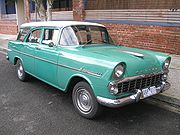 In 1960, Ford
unveiled the new Falcon
in Australia, only months after its introduction in the United States. To Holden's advantage, the Falcon was not durable, particularly in the front suspension, making it ill-suited for Australian conditions
. In response to the Falcon, Holden introduced the facelifted EK series
in 1961; the new model featured two-tone paintwork and optional Hydramatic
automatic transmission
. A restyled EJ series
came in 1962, debuting the new luxury oriented Premier
model. The EH
update came a year later bringing the new Red motor, providing better performance than the previous Grey motor. The HD series
of 1965 saw the introduction of the Powerglide
automatic transmission. At the same time, an "X2" performance option with a more powerful version of the 179 cubic inches (2.9 l) six-cylinder engine was made available. 1966 saw the introduction of the HR
, with changes in the form of new front and rear styling and higher-capacity engines. More significantly, the HR fitted standard front seat belt
s; Holden thus became the first Australian automaker to provide the safety device as standard equipment across all models. This coincided with the completion of the production plant in Acacia Ridge, Queensland
. By 1963, Holden was exporting cars to Africa, the Middle East, South-East Asia, the Pacific Islands, and the Caribbean.
Holden began assembling the compact
HA series Vauxhall Viva
in 1964. This was superseded by the Holden Torana
in 1967, a development of the Viva ending Vauxhall production in Australia. Holden offered the LC, a Torana with new styling, in 1969 with the availability of Holden's six-cylinder engine. In the development days, the six-cylinder Torana was reserved for motor racing
, but research had shown that there was a business case for such a model. The LC Torana was the first application of Holden's new three-speed Tri-Matic automatic transmission. This was the result of Holden's A$16.5 million transformation of the Woodville, South Australia
factory for its production.
 Holden's association with the manufacture of Chevrolets and Pontiac
s ended in 1968, coinciding with the year of Holden's next major new model, the HK
. This included Holden's first V8 engine
, a Chevrolet
engine imported from Canada. Models based on the HK series included an extended-length prestige model, the Brougham
, and a two-door coupé
, the Monaro
. The mainstream Holden Special
was rebranded the Kingswood
, and the basic fleet model, the Standard, became the Belmont
. On 3 March 1969 Alexander Rhea
, managing director of General Motors-Holden's at the time, was joined by press photographers and the Federal Minister of Shipping and Transport, Ian Sinclair
as the two men drove the two millionth Holden, an HK Brougham
off the production line. This came just over half a decade since the one millionth car, an EJ Premier
sedan rolled off the Dandenong
line on 25 October 1962. Following the Chevrolet V8 fitted to the HK, the first Australian-designed and mass-produced V8, the Holden V8 engine
debuted in the Hurricane concept of 1969 before fitment to facelifted HT model
. This was available in two capacities: 253 cubic inches (4.1 l) and 308 cubic inches (5.1 l). Late in HT production, use of the new Tri-Matic automatic transmission, first seen in the LC Torana was phased in as Powerglide
stock was exhausted, but Holden's official line was that the HG of 1971 was the first full-size Holden to receive it.
Despite the arrival of serious competitors—namely, the Ford Falcon, Chrysler Valiant
, and Japanese cars—in the 1960s, Holden's locally produced large six- and eight-cylinder cars remained Australia's top-selling vehicles. Sales were boosted by exporting the Kingswood sedan, station wagon, and utility body styles to Indonesia
, Trinidad and Tobago
, Pakistan
, the Philippines
and South Africa
in complete knock down form.
series in 1971. At this time, the company was producing all of its passenger cars in Australia, and every model was of Australian design; however, by the end of the decade, Holden was producing cars based on overseas designs. The HQ was thoroughly re-engineered, featuring a perimeter frame and semi-monocoque
(unibody) construction. Other firsts included an all-coil suspension and an extended wheelbase for station wagons, while the utilities and panel vans retained the traditional coil/leaf suspension configuration. The series included the new prestige Statesman
brand, which also had a longer wheelbase, replacing the Brougham
. The Statesman remains noteworthy because it was not marketed as a "Holden", but rather a "Statesman".
 The HQ framework led to a new generation of two-door Monaros
, and, despite the introduction of the similar sized competitors, the HQ range became the top-selling Holden of all time, with 485,650 units sold in three years. 14,558 units were exported and 72,290 CKD kits were constructed. The HQ series was facelifted in 1974 with the introduction of the HJ
, heralding new front panel styling and a revised rear fascia. This new bodywork was to remain, albeit with minor upgrades through the HX and HZ series. Detuned engines adhering to government emission standard
s were brought in with the HX series, whilst the HZ brought considerably improved road handling
and comfort with the introduction of "Radial Tuned Suspension" (RTS). As a result of GM's toying with the Wankel rotary engine
, as used by Mazda
of Japan, an export agreement was initiated in 1975. This involved Holden exporting with powertrain
s, HJ, and later, HX series Premiers as the Mazda Roadpacer AP. Mazda then fitted these cars with the 13B rotary engine and three-speed automatic transmission. Production ended in 1977, after just 840 units sold.
During the 1970s, Holden ran an advertising jingle
"Football, Meat Pies, Kangaroos and Holden cars", based on the "Baseball, Hot Dogs, Apple Pies and Chevrolet" jingle used by Chevrolet in the United States. Also, development of the Torana continued in with the larger mid-sized
LH series released in 1974, offered only as a four-door sedan. The LH Torana was one of the few cars worldwide engineered to occupy four-, six-and eight-cylinder engines. This trend continued until Holden introduced the Sunbird in 1976; essentially the four-cylinder Torana with a new name. Designated LX, both the Sunbird and Torana introduced a three-door hatchback variant. A final UC update appeared in 1978. During its production run, the Torana achieved legendary racing success in Australia, achieving victories at the Mount Panorama Circuit
in Bathurst, New South Wales
.
In 1975, Holden introduced the compact
Gemini
, the Australian version of the "T-car
", based on the Opel Kadett
C. The Gemini was an overseas design developed jointly with Isuzu
, GM's Japanese affiliate; and was powered by a 1.6-litre four-cylinder engine. Fast becoming a popular car, the Gemini rapidly attained sales leadership in its class, and the nameplate lived on until 1987.
Holden's most popular car to date, the Commodore
, was introduced in 1978 as the VB. The new family car was loosely based on the Opel Rekord
E body shell, but with the front from the Opel Senator
grafted to accommodate the larger Holden six-cylinder and V8 engines. Initially, the Commodore maintained Holden's sales leadership in Australia. However, some of the compromises resulting from the adoption of a design intended for another market hampered the car's acceptance. In particular, it was narrower than its predecessor and its Falcon rival, making it less comfortable for three rear-seat passengers. With the abandonment of left-hand drive markets, Holden exported almost 100,000 Commodores to markets such as New Zealand
, Thailand
, Hong Kong
, Malaysia, Indonesia
, Malta
and Singapore
.
Holden discontinued the Torana in 1979 and the Sunbird in 1980. After the 1978 introduction of the Commodore, the Torana became the "in-between" car, surrounded by the smaller and more economical Gemini
and the larger, more sophisticated Commodore. The closest successor to the Torana was the Camira
, released in 1982 as Australia's version of GM's medium-sized "J-car
".
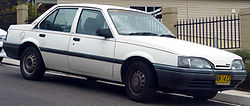 The 1980s were challenging for Holden and the Australian automotive industry. The Australian Government tried to revive the industry with the Button car plan
, which encouraged car makers to focus on producing fewer models at higher, more economical volumes, and to export cars. The decade opened with the shut-down of the Pagewood, New South Wales
production plant and introduction of the light commercial
Rodeo
, sourced from Isuzu in Japan. The Rodeo was available in both two- and four-wheel drive chassis cab
models with a choice of petrol
and diesel
powerplants. The range was updated in 1988 with the TF series, based on the Isuzu TF
. Other cars sourced from Isuzu during the 1980s were the four-wheel drive Jackaroo (1981), the Shuttle (1982) van and the Piazza (1986) three-door sports hatchback. The second generation Holden Gemini
from 1985 was also based on an Isuzu design, although, its manufacture was undertaken in Australia.
The new Holden WB
commercial vehicles and the Statesman WB limousines were introduced in 1980. However, the designs, based on the HQ and updated HJ
, HX
and HZ
models from the 1970s were less competitive than similar models in Ford's
lineup. Thus, Holden abandoned those vehicle classes
altogether in 1984. Sales of the Commodore
also fell, with the effects of the 1979 energy crisis
lessening, and for the first time the Commodore lost ground to the Ford Falcon
. Sales in other segments also suffered when competition from Ford intensified, and other Australian manufacturers: Mitsubishi
, Nissan
and Toyota gained market share. When released in 1982, the Camira
initially generated good sales, which later declined because buyers considered the 1.6-litre engine underpowered, and the car's build and ride quality below-average. The Camira lasted just seven years, and contributed to Holden's accumulated losses of over A$500 million by the mid-1980s.
_02.jpg) In 1984 Holden introduced the VK Commodore
In 1984 Holden introduced the VK Commodore
, with significant styling changes from the previous VH
. The Commodore was next updated in 1986 as the VL
, which had new front and rear styling. Controversially, the VL was powered by the 3.0-litre Nissan RB30 six-cylinder engine and had an electronically controlled four-speed automatic transmission. The engine change was necessitated by the legal requirement that all new cars sold in Australia after 1986 had to consume unleaded petrol. Because it was unfeasible to convert the existing six-cylinder engine to run on unleaded fuel, the Nissan engine was chosen as the best engine available. However, changing exchange rate
s doubled the cost of the engine and transmission over the life of the VL. The decision to opt for a Japanese-made transmission led to the closure of the Woodville, South Australia assembly plant. Confident by the apparent sign of turnaround, GM paid off Holden's mounted losses of A$780 million on 19 December 1986. At GM headquarters’ request, Holden was then reorganised and recapitalised, separating the engine and car manufacturing divisions in the process. This involved the splitting of Holden into Holden's Motor Company (HMC) and Holden's Engine Company (HEC). For the most part, car bodies were now manufactured at Elizabeth, South Australia
, with engines as before, confined to the Fishermans Bend plant in Port Melbourne, Victoria
. The engine manufacturing business was successful, building four-cylinder Family II
engines for use in cars built overseas. The final phase of the Commodore's recovery strategy involved the 1988 VN
, a significantly wider model powered by the American-designed, Australian-assembled 3.8-litre Buick V6 engine
.
Holden began to sell the subcompact Suzuki Swift
-based Barina
in 1985. The Barina was launched concurrently with the Suzuki
-sourced Holden Drover, followed by the Scurry
later on in 1985. In the previous year, Nissan Pulsar
hatchbacks were rebadged as the Holden Astra
, as a result of a deal with Nissan. This arrangement ceased in 1989 when Holden entered a new alliance with Toyota, forming a new company: United Australian Automobile Industries
(UAAI). UAAI resulted in Holden selling rebadged versions of Toyota's Corolla
and Camry
, as the Holden Nova
and Apollo
respectively, with Toyota re-branding the Commodore as the Lexcen.
On 26 April 1990 GM's New Zealand subsidiary, Holden New Zealand
, announced that production at the assembly plant based in Trentham would be phased out and that vehicles would be imported duty
-free. This came after the 1984 closure of the Petone
assembly line due to low output volumes. During the 1990s Holden, other Australian automakers and trade union
ists pressured the Australian Government to halt the lowering of car import tariff
s. By 1997, the federal government had already cut tariffs to 22.5 percent from 57.5 percent ten years earlier, and by 2000 were planning to reduce this even further down to 15 percent. Holden was critical, saying that Australia's population was not large enough, and that the changes could tarnish the local industry.
Holden re-introduced its defunct Statesman
name in 1990, this time under the Holden marque, as the Statesman and Caprice. For 1991, Holden updated the Statesman and Caprice with a range of improvements, including the introduction of four-wheel anti-lock brakes
(ABS), although a rear-wheel system had been standard on the Statesman Caprice from March 1976. ABS was added to short-wheelbase Commodore range in 1992. Another returning variant was the full-size utility, this time based on the Commodore. The VN Commodore
received a major facelift in 1993 with the VR
. Compared to the VN, approximately 80 percent of car was new. Exterior changes brought an overall smoother body and a "twin-kidney" grille
—a Commodore styling trait which remained until the 2002 VY model. Holden introduced the all-new VT Commodore
in 1997, the outcome of an A$600 million development programme that spanned more than half a decade. The new model sported a rounded exterior body shell, improved dynamics
, and many firsts for an Australian-built car. A stronger body structure increased crash safety. The Buick
-sourced V6 engine
, produced locally, powered the Commodore range, as did the 5.0-litre Holden V8 engine
, replaced in 1999 by the 5.7-litre LS
unit.
The UAAI badge-engineered cars first introduced in 1989 sold in far fewer numbers than anticipated, but the Holden Commodore, Toyota Camry, and Corolla were all successful when sold under their original nameplates. UAAI was dissolved in 1996, and Holden returned to selling only GM products. This signalled the closure of the Dandenong, Victoria
facility, the sole plant for Corolla and Nova production. The Holden Astra
and Vectra
, both designed by Opel
in Germany, replaced the Toyota-sourced Holden Nova and Apollo. This came after the 1994 introduction of the Opel Corsa
replacing the already available Suzuki Swift
as the source for the Holden Barina
. Sales of the full-size Holden Suburban
SUV
sourced from Chevrolet commenced in 1998—lasting until 2001. Also in 1998, local assembly of the Vectra began at Elizabeth, South Australia. These cars were exported to Japan and Southeast Asia
with Opel badges. However, the Vectra did not achieve sufficient sales in Australia to justify local assembly, and reverted to being fully imported in 2000.
This overall downturn affected Holden's profits; the company recorded a combined gain of A$842.9 million between 2002 and 2004, and a combined loss of A$290 million between 2005 and 2006. Factors contributing to the loss included the development of an all-new model, the strong Australian dollar
and the cost of reducing the workforce at the Elizabeth plant, including the loss of 1,400 jobs after the closure of the third-shift assembly line in 2005, after two years in operation. Holden fared better in 2007, posting an A$6 million loss. This was followed by an A$70.2 million loss in the 2008, an A$210.6 million loss in 2009, and a profit of A$112 million in 2010. On 18 May 2005, "Holden Ltd" became "GM Holden Ltd", coinciding with the resettling to the new Holden headquarters on 191 Salmon Street, Port Melbourne, Victoria
.
 Holden caused controversy in 2005 with their Holden Employee Pricing television advertisement
, which ran between October and December 2005. The campaign publicised, "for the first time ever, all Australians can enjoy the financial benefit of Holden Employee Pricing". However, this did not include a discounted dealer delivery fee and savings on factory fitted options and accessories that employees received. At the same time, employees were given a further discount between 25 and 29 percent on selected models.
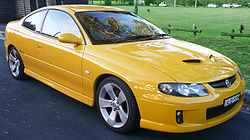
Holden revived the Monaro
coupe in 2001. Based on the VT Commodore
architecture, the coupe attracted worldwide attention after being shown as a concept car at Australian auto show
s. The VT Commodore received its first major update in 2002 with the VY series. A mildly facelifted VZ model launched in 2004, introducing the High Feature
engine. This was built at the Fishermans Bend facility completed in 2003, with a maximum output of 900 engines per day. This has reportedly added A$5.2 billion to the Australian economy
; exports account for about A$450 million alone. After the VZ, the High Feature engine powered the all-new VE Commodore. In contrast to previous models, the VE no longer utilises an Opel
-sourced platform
adapted both mechanically and in size.
Throughout the 1990s, Opel had also been the source of many Holden models. To increase profitability, Holden looked to the South Korean Daewoo
brand for replacements after acquiring a 44.6 percent stake—worth US$251 million—in the company in 2002 as a representative of GM. This was increased to 50.9 percent in 2005, but when GM further increased its stake to 70.1 percent around the time of its 2009 Chapter 11 reorganisation
, Holden's interest was relinquished and transferred to another (undisclosed) part of GM. The commencement of the Holden-branded Daewoo models began with the 2005 Holden Barina
, which based on the Daewoo Kalos
, replaced the Opel Corsa
as the source of the Barina. In the same year, the Viva, based on the Daewoo Lacetti
, replaced the entry-level Holden Astra
Classic, although the new-generation Astra introduced in 2004 continued on. The Captiva
crossover SUV
came next in 2006. After discontinuing the Frontera
and Jackaroo models in 2003, Holden was only left with one all-wheel drive model: the Adventra
, a Commodore-based station wagon. The fourth model to be replaced with a South Korean alternative was the Vectra
by the mid-size Epica
in 2007. As a result of the split between GM and Isuzu
, Holden lost the rights to use the "Rodeo" nameplate. Consequently, the Holden Rodeo
was facelifted and relaunched as the Colorado
during 2008. Following Holden's successful application for a A$149 million government grant to build a localised version of the Chevrolet Cruze
in Australia from 2011, Holden in 2009 announced that it would initially import the small car unchanged from South Korea as the Holden Cruze
. Following the grant announcement, Kevin Rudd
, Australia's then Prime Minister
, stated that production would support 600 new jobs at the Elizabeth facility. However, this failed to take into account the 600 jobs that Holden previously announced would be shed when production of the Family II
engine is set to wrap up in late 2009.

As of 22 March 2010, chairman and managing director Mike Devereux heads operations at Holden. Vehicles are sold countrywide through the Holden Dealer Network (310 authorised stores and 12 service centres), which employs more than 13,500 people.
Since the 1960s, Holden models have been a staple of domestic touring car racing
, and the quasi-factory Holden Racing Team
(HRT) has successfully participated in V8 Supercar racing. In 1987, Holden Special Vehicles
(HSV) was formed in partnership with Tom Walkinshaw, who primarily manufactures modified, high-performance Commodore variants. To further reinforce the brand, HSV introduced the HSV Dealer Team into the V8 Supercar fold in 2005 under the naming rights of Toll HSV Dealer Team.
The logo, or "Holden lion and stone" as it is known, has played a vital role in establishing Holden's identity. In 1928, Holden's Motor Body Builders appointed Rayner Hoff
to design the emblem. The logo refers to a prehistoric
fable, in which observations of lion
s rolling stones led to the invention of the wheel. With the 1948 launch of the 48-215
, Holden revised its logo and commissioned another redesign in 1972 to better represent the company. The emblem was reworked once more in 1994.
to New Zealand. Exports to New Zealand have continued ever since, but to broaden their export potential, Holden began to cater their Commodore
, Monaro
and Statesman/Caprice models for both right- and left-hand drive markets. The Middle East
is now Holden's largest export market, with the Commodore sold as the Chevrolet Lumina
since 1998, and the Statesman since 1999 as the Chevrolet Caprice
. Commodores are also sold as the Chevrolet Lumina in Brunei
, Fiji
and South Africa, and to Brazil
as the Chevrolet Omega
. Pontiac
in North America also imported Commodore sedans from 2008 through to 2009 as the G8
. The G8's cessation was a consequence of GM's Chapter 11 bankruptcy
resulting in the demise of the Pontiac brand.
Sales of the Monaro began in 2003 to the Middle East as the Chevrolet Lumina Coupe. Later on in the year, a modified version of the Monaro began selling in North America as the Pontiac GTO
, and under the Monaro name through Vauxhall
dealerships in the United Kingdom. This arrangement continued through to 2005 when the car was discontinued. The long-wheelbase Statesman sales in the Chinese market as the Buick Royaum began in 2005, before being replaced in 2007 by the Statesman-based Buick Park Avenue. Statesman/Caprice exports to South Korea also began in 2005. These Korean models were sold as the Daewoo Statesman, and later as the Daewoo Veritas from 2008. Holden's move into international markets has been profitable; export revenue increased from A$973 million in 1999 to just under $1.3 billion in 2006.
Automotive industry
The automotive industry designs, develops, manufactures, markets, and sells motor vehicles, and is one of the world's most important economic sectors by revenue....
that operates in Australia, based in Port Melbourne, Victoria
Port Melbourne, Victoria
Port Melbourne is a suburb of Melbourne, Victoria, Australia, 5 km southwest of Melbourne's central business district. Its Local Government areas are the cities of Port Phillip and Melbourne. At the 2006 Census, Port Melbourne had a population of 13,293....
. The company was founded in 1856 as a saddle
Saddle
A saddle is a supportive structure for a rider or other load, fastened to an animal's back by a girth. The most common type is the equestrian saddle designed for a horse, but specialized saddles have been created for camels and other creatures...
ry manufacturer. In 1908 it moved into the automotive field, before becoming a subsidiary
Subsidiary
A subsidiary company, subsidiary, or daughter company is a company that is completely or partly owned and wholly controlled by another company that owns more than half of the subsidiary's stock. The subsidiary can be a company, corporation, or limited liability company. In some cases it is a...
of the U.S.-based General Motors
General Motors
General Motors Company , commonly known as GM, formerly incorporated as General Motors Corporation, is an American multinational automotive corporation headquartered in Detroit, Michigan and the world's second-largest automaker in 2010...
(GM) in 1931. After the GM takeover, the company was named General Motors-Holden's Ltd, becoming Holden Ltd in 1998, with the current name adopted in 2005.
Holden has taken charge of GM's vehicle operations in Australasia
Australasia
Australasia is a region of Oceania comprising Australia, New Zealand, the island of New Guinea, and neighbouring islands in the Pacific Ocean. The term was coined by Charles de Brosses in Histoire des navigations aux terres australes...
, and on their behalf, held partial ownership of GM Daewoo
GM Daewoo
GM Korea Company is South Korea's second largest automobile manufacturer and is a division of the General Motors Company. GM Korea's roots go back to the former Daewoo which was split from its parent company, Daewoo Group, in 2001...
in South Korea between 2002 and 2009. Holden has offered a broad range of locally produced vehicles, supplemented by imported GM models. Holden has offered badge engineered
Badge engineering
Badge engineering is an ironic term that describes the rebadging of one product as another...
Chevrolet
Chevrolet
Chevrolet , also known as Chevy , is a brand of vehicle produced by General Motors Company . Founded by Louis Chevrolet and ousted GM founder William C. Durant on November 3, 1911, General Motors acquired Chevrolet in 1918...
, Nissan
Nissan Motors
, usually shortened to Nissan , is a multinational automaker headquartered in Japan. It was a core member of the Nissan Group, but has become more independent after its restructuring under Carlos Ghosn ....
, Suzuki
Suzuki
is a Japanese multinational corporation headquartered in Hamamatsu, Japan that specializes in manufacturing compact automobiles and 4x4 vehicles, a full range of motorcycles, all-terrain vehicles , outboard marine engines, wheelchairs and a variety of other small internal combustion engines...
, Toyota, and Vauxhall Motors
Vauxhall Motors
Vauxhall Motors is a British automotive company owned by General Motors and headquartered in Luton. It was founded in 1857 as a pump and marine engine manufacturer, began manufacturing cars in 1903 and was acquired by GM in 1925. It has been the second-largest selling car brand in the UK for...
models in sharing arrangements, with Daewoo, Opel
Opel
Adam Opel AG, generally shortened to Opel, is a German automobile company founded by Adam Opel in 1862. Opel has been building automobiles since 1899, and became an Aktiengesellschaft in 1929...
and Isuzu
Isuzu
, is a Japanese car, commercial vehicle and heavy truck manufacturing company, headquartered in Tokyo. In 2005, Isuzu became the world's largest manufacturer of medium to heavy duty trucks. It has assembly and manufacturing plants in the Japanese city of Fujisawa, as well as in the prefectures...
-sourced models sold currently.
All Australian-built Holden vehicles are manufactured
Manufacturing in Australia
Although primary production is the main industry in Australia, manufacturing in Australia is still a significant industry.-History:The contribution of manufacturing to Australia's gross domestic product peaked in the 1960s at 25%, and had dropped to 13% by 2001–2 and 10.5% by 2005–6.In 2004–05, the...
at Elizabeth
City of Elizabeth
The City of Elizabeth was a Local Government Area located in the northern suburbs of Adelaide from 1955 to 1997.-History:Prior to the 1950s, most of the area surrounding today's suburb of Elizabeth was farming estates...
in South Australia
South Australia
South Australia is a state of Australia in the southern central part of the country. It covers some of the most arid parts of the continent; with a total land area of , it is the fourth largest of Australia's six states and two territories.South Australia shares borders with all of the mainland...
, and engines are produced at the Fishermans Bend plant in Port Melbourne, Victoria
Port Melbourne, Victoria
Port Melbourne is a suburb of Melbourne, Victoria, Australia, 5 km southwest of Melbourne's central business district. Its Local Government areas are the cities of Port Phillip and Melbourne. At the 2006 Census, Port Melbourne had a population of 13,293....
. Historically, production or assembly plants were operated in all mainland states of Australia
States and territories of Australia
The Commonwealth of Australia is a union of six states and various territories. The Australian mainland is made up of five states and three territories, with the sixth state of Tasmania being made up of islands. In addition there are six island territories, known as external territories, and a...
, with GM's New Zealand
New Zealand
New Zealand is an island country in the south-western Pacific Ocean comprising two main landmasses and numerous smaller islands. The country is situated some east of Australia across the Tasman Sea, and roughly south of the Pacific island nations of New Caledonia, Fiji, and Tonga...
subsidiary Holden New Zealand
Holden New Zealand
Holden New Zealand Limited, formerly General Motors New Zealand Limited before 1994 is the sales subsidiary for General Motors in New Zealand...
operating a plant until 1990. The consolidation of car production at Elizabeth was completed in 1988, but some assembly operations continued at Dandenong until 1996.
Although Holden's involvement in exports has fluctuated since the 1950s, the declining sales of large cars in Australia has led the company to look to international markets to increase profitability.
Early history
In 1852, James Alexander Holden emigrated to South AustraliaSouth Australia
South Australia is a state of Australia in the southern central part of the country. It covers some of the most arid parts of the continent; with a total land area of , it is the fourth largest of Australia's six states and two territories.South Australia shares borders with all of the mainland...
from Walsall
Walsall
Walsall is a large industrial town in the West Midlands of England. It is located northwest of Birmingham and east of Wolverhampton. Historically a part of Staffordshire, Walsall is a component area of the West Midlands conurbation and part of the Black Country.Walsall is the administrative...
, England and in 1856 established J.A. Holden & Co, a saddlery business in Adelaide
Adelaide
Adelaide is the capital city of South Australia and the fifth-largest city in Australia. Adelaide has an estimated population of more than 1.2 million...
. In 1885 German born Henry Frederick Frost joined the business as a junior partner and J.A. Holden & Co turned into Holden & Frost Ltd. Edward Holden
Edward Holden
Sir Edward Wheewall Holden was an Australian vehicle manufacturer. He is considered the father of the Australian car industry.-Early years:Edward Holden was born at College Town Sir Edward Wheewall Holden (14 August 1885 – 17 June 1947) was an Australian vehicle manufacturer. He is considered the...
, James' grandson, joined the firm in 1905 with an interest in automobiles. From there, the firm evolved through various partnerships and, in 1908, Holden and Frost moved into the business of minor repairs to car upholstery. The company began to produce complete motorcycle sidecar bodies in 1913, and Edward experimented with fitting bodies to different types of carriages. After 1917, wartime trade restrictions led the company to start full-scale production of vehicle body shells. J.A. Holden founded a new company in 1919, Holden's Motor Body Builders Ltd (HMBB) specialising in car bodies and utilising a facility on King Wiliam Street in Adelaide. By 1923, HMBB were producing 12,000 units per year. During this time, HMBB was the first company to assemble bodies for Ford Australia until their Geelong, plant was completed. From 1924, HMBB became the exclusive supplier of car bodies for GM in Australia, with manufacturing taking place at the new Woodville, South Australia plant. These bodies were made to suit a number of chassis
Chassis
A chassis consists of an internal framework that supports a man-made object. It is analogous to an animal's skeleton. An example of a chassis is the underpart of a motor vehicle, consisting of the frame with the wheels and machinery.- Vehicles :In the case of vehicles, the term chassis means the...
imported from manufacturers such as Chevrolet
Chevrolet
Chevrolet , also known as Chevy , is a brand of vehicle produced by General Motors Company . Founded by Louis Chevrolet and ousted GM founder William C. Durant on November 3, 1911, General Motors acquired Chevrolet in 1918...
and Dodge
Dodge
Dodge is a United States-based brand of automobiles, minivans, and sport utility vehicles, manufactured and marketed by Chrysler Group LLC in more than 60 different countries and territories worldwide....
. In 1926 General Motors (Australia) was established with assembly plants at Newstead, Queensland
Newstead, Queensland
Newstead is a riverside suburb of the city of Brisbane, Queensland, Australia. It is situated 3 km north of the Brisbane central business district...
; Marrickville, New South Wales
Marrickville, New South Wales
Marrickville, a suburb of Sydney's Inner West is located 7 kilometres south-west of the Sydney central business district in the state of New South Wales, Australia and is the largest suburb in the Marrickville Council local government area...
; City Road, Melbourne, Victoria
Melbourne
Melbourne is the capital and most populous city in the state of Victoria, and the second most populous city in Australia. The Melbourne City Centre is the hub of the greater metropolitan area and the Census statistical division—of which "Melbourne" is the common name. As of June 2009, the greater...
; Birkenhead, South Australia
Birkenhead, South Australia
Birkenhead is a north-western suburb of Adelaide 14 km from the CBD, on the Lefevre Peninsula, in the state of South Australia, Australia and falls under the City of Port Adelaide Enfield. It is adjacent to Peterhead, Exeter and Glanville...
; and Cottesloe, Western Australia
Cottesloe, Western Australia
-Transport:Cottesloe is served by Swanbourne, Grant Street, Cottesloe, Mosman Park and Victoria Street railway stations on the Fremantle line. Various bus routes along Stirling Highway and through the suburb's western and eastern sections link Cottesloe to Perth and Fremantle. All services are...
utilizing bodies produced by Holden Motor Body Builders and imported complete knock down (CKD) chassis. The Great Depression
Great Depression
The Great Depression was a severe worldwide economic depression in the decade preceding World War II. The timing of the Great Depression varied across nations, but in most countries it started in about 1929 and lasted until the late 1930s or early 1940s...
era led to a substantial downturn in production by Holden, from 34,000 units annually in 1930 to just 1,651 units one year later. In 1931 General Motors purchased Holden Motor Body Builders and merged it with General Motors (Australia) Pty Ltd to form General Motors-Holden's Ltd (GM-H).
1940s
Holden's second full-scale car factory, located in Fishermans Bend (Port Melbourne), was completed in 1936, with construction beginning in 1939 on a new plant in Pagewood, New South WalesPagewood, New South Wales
Pagewood is a suburb in south-eastern Sydney, in the state of New South Wales, Australia. Pagewood is located 8 kilometres south-east of the Sydney central business district and is part of the City of Botany Bay....
. However, World War II
World War II
World War II, or the Second World War , was a global conflict lasting from 1939 to 1945, involving most of the world's nations—including all of the great powers—eventually forming two opposing military alliances: the Allies and the Axis...
delayed car production with efforts shifted to the construction of vehicle bodies, field gun
Field gun
A field gun is an artillery piece. Originally the term referred to smaller guns that could accompany a field army on the march and when in combat could be moved about the battlefield in response to changing circumstances, as to opposed guns installed in a fort, or to siege cannon or mortars which...
s, aircraft
Aircraft
An aircraft is a vehicle that is able to fly by gaining support from the air, or, in general, the atmosphere of a planet. An aircraft counters the force of gravity by using either static lift or by using the dynamic lift of an airfoil, or in a few cases the downward thrust from jet engines.Although...
and engines. Before the war ended, the Australian Government
Government of Australia
The Commonwealth of Australia is a federal constitutional monarchy under a parliamentary democracy. The Commonwealth of Australia was formed in 1901 as a result of an agreement among six self-governing British colonies, which became the six states...
took steps to encourage an Australian automotive industry. Both GM and Ford
Ford Motor Company
Ford Motor Company is an American multinational automaker based in Dearborn, Michigan, a suburb of Detroit. The automaker was founded by Henry Ford and incorporated on June 16, 1903. In addition to the Ford and Lincoln brands, Ford also owns a small stake in Mazda in Japan and Aston Martin in the UK...
provided studies to the Australian Government outlining the production of the first Australian designed car. Ford's proposal was the government's first choice, but required substantial financial assistance. GM's study was ultimately chosen because of its low level of government intervention. After the war, Holden returned to producing vehicle bodies, this time for Buick
Buick
Buick is a premium brand of General Motors . Buick models are sold in the United States, Canada, Mexico, China, Taiwan, and Israel, with China being its largest market. Buick holds the distinction as the oldest active American make...
, Chevrolet
Chevrolet
Chevrolet , also known as Chevy , is a brand of vehicle produced by General Motors Company . Founded by Louis Chevrolet and ousted GM founder William C. Durant on November 3, 1911, General Motors acquired Chevrolet in 1918...
, Pontiac
Pontiac
Pontiac was an automobile brand that was established in 1926 as a companion make for General Motors' Oakland. Quickly overtaking its parent in popularity, it supplanted the Oakland brand entirely by 1933 and, for most of its life, became a companion make for Chevrolet. Pontiac was sold in the...
and Vauxhall
Vauxhall Motors
Vauxhall Motors is a British automotive company owned by General Motors and headquartered in Luton. It was founded in 1857 as a pump and marine engine manufacturer, began manufacturing cars in 1903 and was acquired by GM in 1925. It has been the second-largest selling car brand in the UK for...
. The Oldsmobile Ace was also produced from 1946 to 1948.
From here, Holden continued to pursue the goal of producing an Australian car. This involved compromise with GM, as Holden's managing director, Laurence Hartnett, favoured development of a local design, while GM preferred to see an American design as the basis for "Australia's Own Car". In the end, the design was based on a previously rejected post-war Chevrolet proposal. The Holden was launched in 1948, creating long waiting lists extending through 1949 and beyond. The name "Holden" was chosen in honour of Sir Edward Holden, the company's first chairman and grandson of J.A. Holden. Other names considered were "GeM", "Austral", "Melba", "Woomerah", "Boomerang", "Emu" and "Canbra", a phonetic spelling of Canberra
Canberra
Canberra is the capital city of Australia. With a population of over 345,000, it is Australia's largest inland city and the eighth-largest city overall. The city is located at the northern end of the Australian Capital Territory , south-west of Sydney, and north-east of Melbourne...
.Although officially designated "48-215
Holden 48-215
The Holden 48-215, also known unofficially as the Holden FX is a mid-size, six-cylinder sedan which was produced by the Australian automaker, General Motors–Holden's Ltd between November 1948 and October 1953....
", the car was marketed simply as the "Holden". The unofficial usage of the name "FX" originated within Holden, referring to the updated suspension on the 48-215 of 1953.
1950s
During the 1950s, Holden dominated the Australian car market. GM invested heavily in production capacity, which allowed the company to meet increased post-war demand for motor cars. Less expensive four-cylinder cars did not offer Holden's ability to deal with rugged rural areas. 48-215Holden 48-215
The Holden 48-215, also known unofficially as the Holden FX is a mid-size, six-cylinder sedan which was produced by the Australian automaker, General Motors–Holden's Ltd between November 1948 and October 1953....
sedans were produced in parallel with the 50-2106
Holden 48-215
The Holden 48-215, also known unofficially as the Holden FX is a mid-size, six-cylinder sedan which was produced by the Australian automaker, General Motors–Holden's Ltd between November 1948 and October 1953....
coupé utility
Coupé utility
The coupé utility automobile body style, also known colloquially as the ute in Australia and New Zealand, combines a two-door "coupé" cabin with an integral cargo bed behind the cabin—using a light-duty passenger vehicle-derived platform....
from 1951; the latter was known colloquially
Colloquialism
A colloquialism is a word or phrase that is common in everyday, unconstrained conversation rather than in formal speech, academic writing, or paralinguistics. Dictionaries often display colloquial words and phrases with the abbreviation colloq. as an identifier...
as the "ute" and became ubiquitous in Australian rural
Rural
Rural areas or the country or countryside are areas that are not urbanized, though when large areas are described, country towns and smaller cities will be included. They have a low population density, and typically much of the land is devoted to agriculture...
areas as the workhorse of choice. Production of both the utility and sedan continued with minor changes until 1953, when they were replaced by the facelifted FJ
Holden FJ
The Holden FJ series is a range of motor vehicles which was produced in Australia by General Motors-Holden’s from 1953 to 1957. The FJ was the second model of an "all Australian car" manufactured by Holden and was based upon the established 48-215 series, commonly referred to as the “FX”...
model, introducing a third panel van
Panel van
A panel van is a form of solid van, smaller than a lorry or truck, without rear side windows...
body style
Car body style
Automobiles' body styles are highly variable. Some body styles remain in production, while others become less common or obsolete. They may or may not correlate to a car's price, size or intended market classification. The same car model might be available in multiple body styles comprising a...
. The FJ was the first major change to the Holden since its 1948 introduction. Over time it gained iconic status and remains one of Australia's most recognisable automotive symbols. A new horizontally-slatted grille
Grille
A grille or grill is an opening of several slits side by side in a wall or metal sheet or other barrier, usually to let air or water enter and/or leave but keep larger objects including people and animals in or out.-Spelling:In the United States, "grille" is used to differentiate the automotive...
dominated the front-end of the FJ, which received various other trim and minor mechanical revisions. In 1954 Holden began exporting the FJ to New Zealand
New Zealand
New Zealand is an island country in the south-western Pacific Ocean comprising two main landmasses and numerous smaller islands. The country is situated some east of Australia across the Tasman Sea, and roughly south of the Pacific island nations of New Caledonia, Fiji, and Tonga...
.. Although little changed from the 48-215, marketing campaigns and price cuts kept FJ sales steady until a completely redesigned model was launched. At the 2005 Australian International Motor Show
Australian International Motor Show
The Australian International Motor Show is an annual auto show held in Australia, alternating between the cities of Sydney and Melbourne. Prior to the Sydney event in 2010, both cities previously hosted separate annual exhibitions...
in Sydney
Sydney
Sydney is the most populous city in Australia and the state capital of New South Wales. Sydney is located on Australia's south-east coast of the Tasman Sea. As of June 2010, the greater metropolitan area had an approximate population of 4.6 million people...
, Holden paid homage to the FJ with the Efijy
Holden Efijy
The Holden Efijy is a concept car created in Australia by Holden. It is based around the iconic Holden FJ, the second model built by Holden. The concept is based on the Chevrolet Corvette floor pan, a 6.0 litre V8 engine with Rootes supercharger putting out at a little shy of 6500 r.p.m...
concept car
Concept car
A concept vehicle or show vehicle is a car made to showcase new styling and or new technology. They are often shown at motor shows to gauge customer reaction to new and radical designs which may or may not have a chance of being produced....
.
Holden's next model, the FE
Holden FE
The Holden FE is an automobile which was produced by General Motors–Holden's in Australia from 1956 to 1958.-Changes:The FE models were built on a longer wheelbase than the FJ series Holdens which they replaced and they featured totally different styling, the FJ models having used a body shape...
, launched in 1956; offered in a new station wagon
Station wagon
A station wagon is a body style variant of a sedan/saloon with its roof extended rearward over a shared passenger/cargo volume with access at the back via a third or fifth door , instead of a trunk lid...
body style dubbed "Station Sedan" in the company's sales literature. In the same year Holden commenced exports to Malayia
Malayan Union
The Malayan Union was a federation of the Malay states and the Straits Settlements of Penang and Malacca. It was the successor to British Malaya and was conceived to unify the Malay Peninsula under a single government so as to simplify administration. The Malayan Union later became the independent...
, Thailand
Thailand
Thailand , officially the Kingdom of Thailand , formerly known as Siam , is a country located at the centre of the Indochina peninsula and Southeast Asia. It is bordered to the north by Burma and Laos, to the east by Laos and Cambodia, to the south by the Gulf of Thailand and Malaysia, and to the...
and North Borneo
North Borneo
North Borneo was a British protectorate under the sovereign North Borneo Chartered Company from 1882 to 1946. After the war it became a crown colony of Great Britain from 1946 to 1963, known in this time as British North Borneo. It is located on the northeastern end of the island of Borneo. It is...
. Strong sales continued in Australia, and Holden achieved a market share of more than 50 percent in 1958 with the revised FC
Holden FC
The Holden FC series is a range of motor vehicles which was produced by General Motors–Holden's in Australia from 1958 to 1960. Introduced on 6 May 1958, the FC is a facelifted and improved version of the Holden FE series, which it replaced.- Model range :...
model. This was the first Holden to be tested on the new Holden Proving Ground based in Lang Lang, Victoria
Lang Lang, Victoria
Lang Lang is a town in Victoria, Australia, 73 km south-east from Melbourne's central business district. Its Local Government Area is the Shire of Cardinia...
. 1957 saw Holden's export markets grow to 17 countries, with new additions including Indonesia
Indonesia
Indonesia , officially the Republic of Indonesia , is a country in Southeast Asia and Oceania. Indonesia is an archipelago comprising approximately 13,000 islands. It has 33 provinces with over 238 million people, and is the world's fourth most populous country. Indonesia is a republic, with an...
, Hong Kong
Hong Kong
Hong Kong is one of two Special Administrative Regions of the People's Republic of China , the other being Macau. A city-state situated on China's south coast and enclosed by the Pearl River Delta and South China Sea, it is renowned for its expansive skyline and deep natural harbour...
, Singapore
Singapore
Singapore , officially the Republic of Singapore, is a Southeast Asian city-state off the southern tip of the Malay Peninsula, north of the equator. An island country made up of 63 islands, it is separated from Malaysia by the Straits of Johor to its north and from Indonesia's Riau Islands by the...
, Fiji
Fiji
Fiji , officially the Republic of Fiji , is an island nation in Melanesia in the South Pacific Ocean about northeast of New Zealand's North Island...
, Sudan
Sudan
Sudan , officially the Republic of the Sudan , is a country in North Africa, sometimes considered part of the Middle East politically. It is bordered by Egypt to the north, the Red Sea to the northeast, Eritrea and Ethiopia to the east, South Sudan to the south, the Central African Republic to the...
, the East Africa
East Africa
East Africa or Eastern Africa is the easterly region of the African continent, variably defined by geography or geopolitics. In the UN scheme of geographic regions, 19 territories constitute Eastern Africa:...
region and South Africa
South Africa
The Republic of South Africa is a country in southern Africa. Located at the southern tip of Africa, it is divided into nine provinces, with of coastline on the Atlantic and Indian oceans...
. The opening of the Dandenong, Victoria
Dandenong, Victoria
Dandenong is a suburb and major urban centre in metropolitan Melbourne, Victoria, Australia, 30 km south-east from Melbourne's central business district. Situated on Dandenong Creek and mostly flat land at the foothills of Mount Dandenong, it is the main administrative centre for the City of...
, production facility in 1956 brought further jobs; by 1959 Holden employed 19,000 workers country-wide. In 1959 complete knock down assembly began in South Africa and Indonesia.
1960s
In 1960, Holden introduced its third major new model, the FBHolden FB
The Holden FB series is a range of motor vehicles that was produced by General Motors-Holden's in Australia from 1960 to 1961. Introduced on 14 January 1960, the FB series replaced the Holden FC range.- Model range :...
. The car's style was inspired by 1950s’ Chevrolets, with tailfin
Tailfin
The tailfin era of automobile styling encompassed the 1950s and 1960s, peaking between 1957 and 1960. It was a style that spread worldwide, as car designers picked up styling trends from the US automobile industry where it was the golden epoch of American autodesign.General Motors design chief...
s and a wrap-around windshield
Windshield
The windshield or windscreen of an aircraft, car, bus, motorbike or tram is the front window. Modern windshields are generally made of laminated safety glass, a type of treated glass, which consists of two curved sheets of glass with a plastic layer laminated between them for safety, and are glued...
with "dog leg" A-pillars
Pillar (car)
Pillars are the vertical supports of the greenhouse of an automobile — known respectively as the A, B, C or D-pillar moving in profile view from the front to rear....
. By the time it was introduced, many considered the appearance dated. Much of the motoring industry at the time noted that the adopted style did not translate well to the more compact Holden. The FB became the first Holden that was adapted for left-hand-drive markets, enhancing its export potential, and as such was exported to New Caledonia
New Caledonia
New Caledonia is a special collectivity of France located in the southwest Pacific Ocean, east of Australia and about from Metropolitan France. The archipelago, part of the Melanesia subregion, includes the main island of Grande Terre, the Loyalty Islands, the Belep archipelago, the Isle of...
, New Hebrides
New Hebrides
New Hebrides was the colonial name for an island group in the South Pacific that now forms the nation of Vanuatu. The New Hebrides were colonized by both the British and French in the 18th century shortly after Captain James Cook visited the islands...
, the Philippines
Philippines
The Philippines , officially known as the Republic of the Philippines , is a country in Southeast Asia in the western Pacific Ocean. To its north across the Luzon Strait lies Taiwan. West across the South China Sea sits Vietnam...
and Hawaii
Hawaii
Hawaii is the newest of the 50 U.S. states , and is the only U.S. state made up entirely of islands. It is the northernmost island group in Polynesia, occupying most of an archipelago in the central Pacific Ocean, southwest of the continental United States, southeast of Japan, and northeast of...
.
Ford Motor Company
Ford Motor Company is an American multinational automaker based in Dearborn, Michigan, a suburb of Detroit. The automaker was founded by Henry Ford and incorporated on June 16, 1903. In addition to the Ford and Lincoln brands, Ford also owns a small stake in Mazda in Japan and Aston Martin in the UK...
unveiled the new Falcon
Ford Falcon (Australia)
The Ford Falcon is a full-size car which has been manufactured by Ford Australia since 1960. Each model from the XA series of 1972 onward has been designed, developed and built in Australia and/or New Zealand, following the phasing out of the American Falcon of 1960–71 which had been re-engineered...
in Australia, only months after its introduction in the United States. To Holden's advantage, the Falcon was not durable, particularly in the front suspension, making it ill-suited for Australian conditions
Environment of Australia
The Australian environment ranges from virtually pristine Antarctic territory and rainforests to degraded industrial areas of major cities.- Issues :...
. In response to the Falcon, Holden introduced the facelifted EK series
Holden EK
The Holden EK series is a motor vehicle that was produced by General Motors-Holden's in Australia from 1961 to 1962. Introduced on 2 May 1961, the EK series was a facelifted version of the Holden FB, which it replaced.- Model range :...
in 1961; the new model featured two-tone paintwork and optional Hydramatic
Hydramatic
Hydramatic was an automatic transmission developed by both General Motors' Cadillac and Oldsmobile divisions. Introduced in 1939 for the 1940 model year vehicles, the Hydramatic was the first fully automatic mass-produced transmission developed for passenger automobile use.-History:During the...
automatic transmission
Automatic transmission
An automatic transmission is one type of motor vehicle transmission that can automatically change gear ratios as the vehicle moves, freeing the driver from having to shift gears manually...
. A restyled EJ series
Holden EJ
The Holden EJ is a motor vehicle that was produced by General Motors-Holden's in Australia from 1962 to 1963. Introduced in July 1962, the EJ replaced the Holden EK series.-Model range:...
came in 1962, debuting the new luxury oriented Premier
Holden Premier
The Holden Premier is an automobile that was produced by Holden, the Australian subsidiary of General Motors between 1962 and 1980. The Premier was an upmarket version of the:* Holden Standard/Special: between 1962 and 1968....
model. The EH
Holden EH
The Holden EH is an automobile which was produced by General Motors-Holden's in Australia from 1963 to 1965.The EH was released in August 1963 replacing the Holden EJ series and was the first Holden to incorporate the new "Red" motor. This new "Red" motor featured 7 main bearings as opposed to 4...
update came a year later bringing the new Red motor, providing better performance than the previous Grey motor. The HD series
Holden HD
The Holden HD series is a range of automobiles which was produced by General Motors-Holden's in Australia from 1965 to 1966.-Introduction:The Holden HD sedans and station wagons were released in February 1965 with coupe utility and panel van body styles following in July of that year. The HD range...
of 1965 saw the introduction of the Powerglide
Powerglide
The Powerglide is a two-speed automatic transmission designed by General Motors. It was available primarily on Chevrolet from January, 1950 through 1973, although some Pontiac models also used this automatic transmission, extensively on models produced for the Canadian market with Chevrolet...
automatic transmission. At the same time, an "X2" performance option with a more powerful version of the 179 cubic inches (2.9 l) six-cylinder engine was made available. 1966 saw the introduction of the HR
Holden HR
The Holden HR is an automobile that was produced by General Motors-Holden's in Australia from 1966 to 1968.-Introduction:The Holden HR range was released in April 1966, replacing the Holden HD series which had been in production since 1965...
, with changes in the form of new front and rear styling and higher-capacity engines. More significantly, the HR fitted standard front seat belt
Seat belt
A seat belt or seatbelt, sometimes called a safety belt, is a safety harness designed to secure the occupant of a vehicle against harmful movement that may result from a collision or a sudden stop...
s; Holden thus became the first Australian automaker to provide the safety device as standard equipment across all models. This coincided with the completion of the production plant in Acacia Ridge, Queensland
Acacia Ridge, Queensland
Acacia Ridge is a suburb of Brisbane, Queensland, Australia. Acacia Ridge is south of the central business district. The population in the 2001 census was 6648....
. By 1963, Holden was exporting cars to Africa, the Middle East, South-East Asia, the Pacific Islands, and the Caribbean.
Holden began assembling the compact
Compact car
A compact car , or small family car , is a classification of cars which are larger than a supermini but smaller than or equal to a mid-size car...
HA series Vauxhall Viva
Vauxhall Viva
The Viva was a small family car produced by Vauxhall Motors in a succession of three versions between 1963 and 1979. These were known as the HA, the HB and the HC series....
in 1964. This was superseded by the Holden Torana
Holden Torana
The Holden Torana is a car which was produced by General Motors–Holden's , the Australian subsidiary of General Motors from 1967 to 1980. The name comes from an Aboriginal word meaning "to fly". The first Torana appeared in 1967 and was a four-cylinder compact vehicle that had its origins in the...
in 1967, a development of the Viva ending Vauxhall production in Australia. Holden offered the LC, a Torana with new styling, in 1969 with the availability of Holden's six-cylinder engine. In the development days, the six-cylinder Torana was reserved for motor racing
Auto racing
Auto racing is a motorsport involving the racing of cars for competition. It is one of the world's most watched televised sports.-The beginning of racing:...
, but research had shown that there was a business case for such a model. The LC Torana was the first application of Holden's new three-speed Tri-Matic automatic transmission. This was the result of Holden's A$16.5 million transformation of the Woodville, South Australia
Woodville, South Australia
Woodville is a suburb of Adelaide, situated about 8 kilometres northwest of the Central Business District of Adelaide. It lies within the City of Charles Sturt. The postcode of Woodville is 5011...
factory for its production.
Pontiac
Pontiac was an automobile brand that was established in 1926 as a companion make for General Motors' Oakland. Quickly overtaking its parent in popularity, it supplanted the Oakland brand entirely by 1933 and, for most of its life, became a companion make for Chevrolet. Pontiac was sold in the...
s ended in 1968, coinciding with the year of Holden's next major new model, the HK
Holden HK
The Holden HK series is an automobile which was produced by General Motors-Holden's in Australia from 1968 to 1969. Introduced in January 1968, the HK range progressively replaced the Holden HR series which had been in production since 1966...
. This included Holden's first V8 engine
V8 engine
A V8 engine is a V engine with eight cylinders mounted on the crankcase in two banks of four cylinders, in most cases set at a right angle to each other but sometimes at a narrower angle, with all eight pistons driving a common crankshaft....
, a Chevrolet
Chevrolet
Chevrolet , also known as Chevy , is a brand of vehicle produced by General Motors Company . Founded by Louis Chevrolet and ousted GM founder William C. Durant on November 3, 1911, General Motors acquired Chevrolet in 1918...
engine imported from Canada. Models based on the HK series included an extended-length prestige model, the Brougham
Holden Brougham
The Holden Brougham is a large, luxury automobile which was produced by General Motors–Holden's in Australia between July 1968 and 1971.It was based on the mainstream Holden Premier of the same years, but with a lengthened rear body. The boot was simply extended by rather than increasing the ...
, and a two-door coupé
Coupé
A coupé or coupe is a closed car body style , the precise definition of which varies from manufacturer to manufacturer, and over time...
, the Monaro
Holden Monaro
The Holden Monaro is an automobile that was produced by GM Holden Ltd, an Australian subsidiary of General Motors, between 1968 and 1977 and between 2001 and 2005...
. The mainstream Holden Special
Holden Special
The Holden Special is a mid-size car that was manufactured by General Motors-Holden's, the Australian subsidiary of General Motors . Introduced as the top-level trim in the new Holden FJ range of 1953, the Special was complemented by the entry-level Holden Standard and the mid-range Holden Business...
was rebranded the Kingswood
Holden Kingswood
The Holden Kingswood is a full-size car that was manufactured by General Motors-Holden's, the Australian subsidiary of General Motors , from the beginning of the HK series in 1968 through to the conclusion of the WB series in 1984...
, and the basic fleet model, the Standard, became the Belmont
Holden Kingswood
The Holden Kingswood is a full-size car that was manufactured by General Motors-Holden's, the Australian subsidiary of General Motors , from the beginning of the HK series in 1968 through to the conclusion of the WB series in 1984...
. On 3 March 1969 Alexander Rhea
Alexander Rhea
Alexander Dodson Rhea was a U.S. born industrialist who occupied a series of senior roles with General Motors in the decades following World War II. Between 1949 and 1955 he was treasury and managing director with General Motors de Venezuela based in Caracas before returning to North America...
, managing director of General Motors-Holden's at the time, was joined by press photographers and the Federal Minister of Shipping and Transport, Ian Sinclair
Ian Sinclair
Ian McCahon Sinclair AC , is an Australian politician and former leader of the National Party of Australia.Sinclair was born in Sydney, the son of a suburban accountant. He was educated at Knox Grammar School and at the University of Sydney, where he graduated in arts and law...
as the two men drove the two millionth Holden, an HK Brougham
Holden Brougham
The Holden Brougham is a large, luxury automobile which was produced by General Motors–Holden's in Australia between July 1968 and 1971.It was based on the mainstream Holden Premier of the same years, but with a lengthened rear body. The boot was simply extended by rather than increasing the ...
off the production line. This came just over half a decade since the one millionth car, an EJ Premier
Holden EJ
The Holden EJ is a motor vehicle that was produced by General Motors-Holden's in Australia from 1962 to 1963. Introduced in July 1962, the EJ replaced the Holden EK series.-Model range:...
sedan rolled off the Dandenong
Dandenong, Victoria
Dandenong is a suburb and major urban centre in metropolitan Melbourne, Victoria, Australia, 30 km south-east from Melbourne's central business district. Situated on Dandenong Creek and mostly flat land at the foothills of Mount Dandenong, it is the main administrative centre for the City of...
line on 25 October 1962. Following the Chevrolet V8 fitted to the HK, the first Australian-designed and mass-produced V8, the Holden V8 engine
Holden V8 engine
The Holden V8 is an overhead valve V8 engine which was produced by the Australian General Motors subsidiary Holden between 1969 and 2000. The engine was used initially in the Kingswood and Monaro model ranges; it was later utilised in the Torana and Commodore ranges...
debuted in the Hurricane concept of 1969 before fitment to facelifted HT model
Holden HT
The Holden HT series is a range of automobiles which was produced by General Motors Holden’s in Australia between 1969 and 1970.-Introduction:Holden HT Belmont, Kingswood and Premier models were introduced in May 1969,...
. This was available in two capacities: 253 cubic inches (4.1 l) and 308 cubic inches (5.1 l). Late in HT production, use of the new Tri-Matic automatic transmission, first seen in the LC Torana was phased in as Powerglide
Powerglide
The Powerglide is a two-speed automatic transmission designed by General Motors. It was available primarily on Chevrolet from January, 1950 through 1973, although some Pontiac models also used this automatic transmission, extensively on models produced for the Canadian market with Chevrolet...
stock was exhausted, but Holden's official line was that the HG of 1971 was the first full-size Holden to receive it.
Despite the arrival of serious competitors—namely, the Ford Falcon, Chrysler Valiant
Chrysler Valiant
The Chrysler Valiant is a passenger car which was introduced by Chrysler Australia in 1962 with production ceasing in 1981. Initially a rebadged locally assembled Plymouth Valiant from the U.S., the Valiant range was sold throughout Australia and New Zealand, as well as South Africa...
, and Japanese cars—in the 1960s, Holden's locally produced large six- and eight-cylinder cars remained Australia's top-selling vehicles. Sales were boosted by exporting the Kingswood sedan, station wagon, and utility body styles to Indonesia
Indonesia
Indonesia , officially the Republic of Indonesia , is a country in Southeast Asia and Oceania. Indonesia is an archipelago comprising approximately 13,000 islands. It has 33 provinces with over 238 million people, and is the world's fourth most populous country. Indonesia is a republic, with an...
, Trinidad and Tobago
Trinidad and Tobago
Trinidad and Tobago officially the Republic of Trinidad and Tobago is an archipelagic state in the southern Caribbean, lying just off the coast of northeastern Venezuela and south of Grenada in the Lesser Antilles...
, Pakistan
Pakistan
Pakistan , officially the Islamic Republic of Pakistan is a sovereign state in South Asia. It has a coastline along the Arabian Sea and the Gulf of Oman in the south and is bordered by Afghanistan and Iran in the west, India in the east and China in the far northeast. In the north, Tajikistan...
, the Philippines
Philippines
The Philippines , officially known as the Republic of the Philippines , is a country in Southeast Asia in the western Pacific Ocean. To its north across the Luzon Strait lies Taiwan. West across the South China Sea sits Vietnam...
and South Africa
South Africa
The Republic of South Africa is a country in southern Africa. Located at the southern tip of Africa, it is divided into nine provinces, with of coastline on the Atlantic and Indian oceans...
in complete knock down form.
1970s
Holden launched the new HQHolden HQ
The Holden HQ series is a range of automobiles that was produced by General Motors-Holden’s in Australia from 1971 to 1974. The HQ was released on 15 July 1971, replacing the Holden HG series...
series in 1971. At this time, the company was producing all of its passenger cars in Australia, and every model was of Australian design; however, by the end of the decade, Holden was producing cars based on overseas designs. The HQ was thoroughly re-engineered, featuring a perimeter frame and semi-monocoque
Monocoque
Monocoque is a construction technique that supports structural load by using an object's external skin, as opposed to using an internal frame or truss that is then covered with a non-load-bearing skin or coachwork...
(unibody) construction. Other firsts included an all-coil suspension and an extended wheelbase for station wagons, while the utilities and panel vans retained the traditional coil/leaf suspension configuration. The series included the new prestige Statesman
Statesman (automobile)
Statesman was an automotive marque created in 1971 by General Motors Holden , the Australian subsidiary of General Motors. Statesman vehicles were sold through Holden dealerships, and were initially based on the mainstream Holden HQ station wagon platform, thereby providing more interior room and...
brand, which also had a longer wheelbase, replacing the Brougham
Holden Brougham
The Holden Brougham is a large, luxury automobile which was produced by General Motors–Holden's in Australia between July 1968 and 1971.It was based on the mainstream Holden Premier of the same years, but with a lengthened rear body. The boot was simply extended by rather than increasing the ...
. The Statesman remains noteworthy because it was not marketed as a "Holden", but rather a "Statesman".
Holden Monaro
The Holden Monaro is an automobile that was produced by GM Holden Ltd, an Australian subsidiary of General Motors, between 1968 and 1977 and between 2001 and 2005...
, and, despite the introduction of the similar sized competitors, the HQ range became the top-selling Holden of all time, with 485,650 units sold in three years. 14,558 units were exported and 72,290 CKD kits were constructed. The HQ series was facelifted in 1974 with the introduction of the HJ
Holden HJ
The Holden HJ is a series of automobiles which were produced by General Motors-Holden’s in Australia from 1974 to 1976. The HJ series was released on 4 October 1974 and was an improved and facelifted version of the superseded Holden HQ series which had been in production since 1971.- Model range...
, heralding new front panel styling and a revised rear fascia. This new bodywork was to remain, albeit with minor upgrades through the HX and HZ series. Detuned engines adhering to government emission standard
Emission standard
Emission standards are requirements that set specific limits to the amount of pollutants that can be released into the environment. Many emissions standards focus on regulating pollutants released by automobiles and other powered vehicles but they can also regulate emissions from industry, power...
s were brought in with the HX series, whilst the HZ brought considerably improved road handling
Car handling
Automobile handling and vehicle handling are descriptions of the way wheeled vehicles perform transverse to their direction of motion, particularly during cornering and swerving. It also includes their stability when moving at rest. Handling and braking are the major components of a vehicle's...
and comfort with the introduction of "Radial Tuned Suspension" (RTS). As a result of GM's toying with the Wankel rotary engine
Wankel engine
The Wankel engine is a type of internal combustion engine using an eccentric rotary design to convert pressure into a rotating motion instead of using reciprocating pistons. Its four-stroke cycle takes place in a space between the inside of an oval-like epitrochoid-shaped housing and a rotor that...
, as used by Mazda
Mazda
is a Japanese automotive manufacturer based in Fuchū, Aki District, Hiroshima Prefecture, Japan.In 2007, Mazda produced almost 1.3 million vehicles for global sales...
of Japan, an export agreement was initiated in 1975. This involved Holden exporting with powertrain
Powertrain
In a motor vehicle, the term powertrain or powerplant refers to the group of components that generate power and deliver it to the road surface, water, or air. This includes the engine, transmission, drive shafts, differentials, and the final drive...
s, HJ, and later, HX series Premiers as the Mazda Roadpacer AP. Mazda then fitted these cars with the 13B rotary engine and three-speed automatic transmission. Production ended in 1977, after just 840 units sold.
During the 1970s, Holden ran an advertising jingle
Jingle
A jingle is a short tune used in advertising and for other commercial uses. The jingle contains one or more hooks and lyrics that explicitly promote the product being advertised, usually through the use of one or more advertising slogans. Ad buyers use jingles in radio and television...
"Football, Meat Pies, Kangaroos and Holden cars", based on the "Baseball, Hot Dogs, Apple Pies and Chevrolet" jingle used by Chevrolet in the United States. Also, development of the Torana continued in with the larger mid-sized
Mid-size car
A mid-size car is the North American/Australian standard for an automobile with a size equal to or greater than that of a compact...
LH series released in 1974, offered only as a four-door sedan. The LH Torana was one of the few cars worldwide engineered to occupy four-, six-and eight-cylinder engines. This trend continued until Holden introduced the Sunbird in 1976; essentially the four-cylinder Torana with a new name. Designated LX, both the Sunbird and Torana introduced a three-door hatchback variant. A final UC update appeared in 1978. During its production run, the Torana achieved legendary racing success in Australia, achieving victories at the Mount Panorama Circuit
Mount Panorama Circuit
Mount Panorama Circuit is a motor racing track located in Bathurst, New South Wales, Australia. It is the home of the Bathurst 12 Hour motor race, held each February, and the Bathurst 1000 motor race, held each October...
in Bathurst, New South Wales
Bathurst, New South Wales
-CBD and suburbs:Bathurst's CBD is located on William, George, Howick, Russell, and Durham Streets. The CBD is approximately 25 hectares and surrounds two city blocks. Within this block layout is banking, government services, shopping centres, retail shops, a park* and monuments...
.
In 1975, Holden introduced the compact
Compact car
A compact car , or small family car , is a classification of cars which are larger than a supermini but smaller than or equal to a mid-size car...
Gemini
Isuzu Gemini
General Motors sought a replacement for their world car T-body Kadett / Gemini, and this time, instead of building one design on several continents, they decided to build a world car in one location and export it to several continents...
, the Australian version of the "T-car
GM T platform
The General Motors T-car was an automobile platform designation for subcompact cars. It was the 1970s' most prolific world car program. The original T-cars were all rear-wheel drive unibody cars....
", based on the Opel Kadett
Opel Kadett
The Opel Kadett is a small family car produced by the German automobile manufacturer Opel between 1937 and 1940, and then again from 1962 until 1991 , when it was replaced by the Opel Astra.-Original model :...
C. The Gemini was an overseas design developed jointly with Isuzu
Isuzu
, is a Japanese car, commercial vehicle and heavy truck manufacturing company, headquartered in Tokyo. In 2005, Isuzu became the world's largest manufacturer of medium to heavy duty trucks. It has assembly and manufacturing plants in the Japanese city of Fujisawa, as well as in the prefectures...
, GM's Japanese affiliate; and was powered by a 1.6-litre four-cylinder engine. Fast becoming a popular car, the Gemini rapidly attained sales leadership in its class, and the nameplate lived on until 1987.
Holden's most popular car to date, the Commodore
Holden Commodore
The Holden Commodore is an automobile manufactured since 1978 by the Holden subsidiary of General Motors in Australia, and, formerly, in New Zealand. In the mid-1970s, Holden established proposals to replace the long-serving Kingswood nameplate with a smaller, Opel-based model...
, was introduced in 1978 as the VB. The new family car was loosely based on the Opel Rekord
Opel Rekord
The Opel Rekord was a large family car/executive car which was built in several generations by the German car manufacturer Opel.-Naming:The Rekord name evolved into the main name of the model; at first the name was used in close relationship with the Opel Olympia name, which pre-dated the Rekord...
E body shell, but with the front from the Opel Senator
Opel Senator
The Opel Senator was a large automobile, two generations of which were sold in Europe by Opel, from 1978 until 1993. A saloon, its first incarnation was also available with a fastback coupé body as the Opel Monza and Vauxhall Royale Coupe....
grafted to accommodate the larger Holden six-cylinder and V8 engines. Initially, the Commodore maintained Holden's sales leadership in Australia. However, some of the compromises resulting from the adoption of a design intended for another market hampered the car's acceptance. In particular, it was narrower than its predecessor and its Falcon rival, making it less comfortable for three rear-seat passengers. With the abandonment of left-hand drive markets, Holden exported almost 100,000 Commodores to markets such as New Zealand
New Zealand
New Zealand is an island country in the south-western Pacific Ocean comprising two main landmasses and numerous smaller islands. The country is situated some east of Australia across the Tasman Sea, and roughly south of the Pacific island nations of New Caledonia, Fiji, and Tonga...
, Thailand
Thailand
Thailand , officially the Kingdom of Thailand , formerly known as Siam , is a country located at the centre of the Indochina peninsula and Southeast Asia. It is bordered to the north by Burma and Laos, to the east by Laos and Cambodia, to the south by the Gulf of Thailand and Malaysia, and to the...
, Hong Kong
Hong Kong
Hong Kong is one of two Special Administrative Regions of the People's Republic of China , the other being Macau. A city-state situated on China's south coast and enclosed by the Pearl River Delta and South China Sea, it is renowned for its expansive skyline and deep natural harbour...
, Malaysia, Indonesia
Indonesia
Indonesia , officially the Republic of Indonesia , is a country in Southeast Asia and Oceania. Indonesia is an archipelago comprising approximately 13,000 islands. It has 33 provinces with over 238 million people, and is the world's fourth most populous country. Indonesia is a republic, with an...
, Malta
Malta
Malta , officially known as the Republic of Malta , is a Southern European country consisting of an archipelago situated in the centre of the Mediterranean, south of Sicily, east of Tunisia and north of Libya, with Gibraltar to the west and Alexandria to the east.Malta covers just over in...
and Singapore
Singapore
Singapore , officially the Republic of Singapore, is a Southeast Asian city-state off the southern tip of the Malay Peninsula, north of the equator. An island country made up of 63 islands, it is separated from Malaysia by the Straits of Johor to its north and from Indonesia's Riau Islands by the...
.
Holden discontinued the Torana in 1979 and the Sunbird in 1980. After the 1978 introduction of the Commodore, the Torana became the "in-between" car, surrounded by the smaller and more economical Gemini
Isuzu Gemini
General Motors sought a replacement for their world car T-body Kadett / Gemini, and this time, instead of building one design on several continents, they decided to build a world car in one location and export it to several continents...
and the larger, more sophisticated Commodore. The closest successor to the Torana was the Camira
Holden Camira
The Holden Camira was a mid-size car produced by Holden, the Australian subsidiary of General Motors between 1982 and 1989. It was Holden's version of GM's J-body family of cars—GM's third "global" car platform....
, released in 1982 as Australia's version of GM's medium-sized "J-car
GM J platform
The J platform, or J-body, was General Motors' inexpensive front-wheel drive automobile platform from the 1980s and 1990s. The platform replaced the GM H platform. The J-platform is the only platform of GM to have a model in each of its "Original 5" passenger car divisions...
".
1980s
Button car plan
The Button car plan, also known as the Button plan was the informal name given to the Motor Industry Development Plan. The plan was an Australian federal government initiative, intended to rationalise the Australian motor vehicle industry. Industry consultation had begun in 1984 with a proposed...
, which encouraged car makers to focus on producing fewer models at higher, more economical volumes, and to export cars. The decade opened with the shut-down of the Pagewood, New South Wales
Pagewood, New South Wales
Pagewood is a suburb in south-eastern Sydney, in the state of New South Wales, Australia. Pagewood is located 8 kilometres south-east of the Sydney central business district and is part of the City of Botany Bay....
production plant and introduction of the light commercial
Light commercial vehicle
Light commercial vehicles is a commercial carrier vehicles with a Gross vehicle weight of up to 3.5 tonnes. The formal term within the European Union is Light commercial vehicles. Vehicles which qualify in this category are pickup trucks, vans and 3 wheelers all commercially based goods or...
Rodeo
Holden Rodeo
The Holden Rodeo is a utility vehicle that was sold in Australasia by Holden, a General Motors subsidiary...
, sourced from Isuzu in Japan. The Rodeo was available in both two- and four-wheel drive chassis cab
Chassis cab
A chassis cab or cab chassis is a body style, and type of vehicle construction, often found in medium duty truck commercial vehicles.Instead of supplying the customer with a factory pre-assembled flatbed, cargo container, or other equipment - the customer is given the vehicle with just 'chassis'...
models with a choice of petrol
Gasoline
Gasoline , or petrol , is a toxic, translucent, petroleum-derived liquid that is primarily used as a fuel in internal combustion engines. It consists mostly of organic compounds obtained by the fractional distillation of petroleum, enhanced with a variety of additives. Some gasolines also contain...
and diesel
Diesel engine
A diesel engine is an internal combustion engine that uses the heat of compression to initiate ignition to burn the fuel, which is injected into the combustion chamber...
powerplants. The range was updated in 1988 with the TF series, based on the Isuzu TF
Isuzu TF
The Isuzu Rodeo is an automotive nameplate that was used by the Japanese automobile manufacturer Isuzu between 1988 and 2004. Isuzu has utilized the "Rodeo" name on two different vehicles—a compact pickup truck sold in Japan—and a compact SUV offered in North America.Prior to its establishment as a...
. Other cars sourced from Isuzu during the 1980s were the four-wheel drive Jackaroo (1981), the Shuttle (1982) van and the Piazza (1986) three-door sports hatchback. The second generation Holden Gemini
Holden Gemini
The Holden Gemini is a compact car that was built and sold by General Motors-Holden's from 1975 to 1986. It was derived from the Japanese Isuzu Gemini, one of the many cars based on the GM T-car platform.- TX :...
from 1985 was also based on an Isuzu design, although, its manufacture was undertaken in Australia.
The new Holden WB
Holden WB
The Holden WB series is an automobile which was produced by General Motors-Holden's in Australia from 1980 to 1984. It is a facelifted version of the Holden HZ series, which it replaced. Unlike the HZ and every other full size Holden series before it, the Holden WB was only offered in commercial...
commercial vehicles and the Statesman WB limousines were introduced in 1980. However, the designs, based on the HQ and updated HJ
Holden HJ
The Holden HJ is a series of automobiles which were produced by General Motors-Holden’s in Australia from 1974 to 1976. The HJ series was released on 4 October 1974 and was an improved and facelifted version of the superseded Holden HQ series which had been in production since 1971.- Model range...
, HX
Holden HX
The Holden HX is a range of automobiles which was produced by General Motors-Holden’s in Australia from 1976 to 1977.-Changes:The HX series was released in July 1976 and featured a range of models developed from those in the superseded Holden HJ range, which had been in production since 1974. The...
and HZ
Holden HZ
Holden HZ is an automobile which was produced between 1977 and 1980 by General Motors-Holden's Ltd.The Holden HZ received minor updates to the exterior over the HX series, and saw the introduction of what Holden termed "Radial Tuned Suspension" on all models...
models from the 1970s were less competitive than similar models in Ford's
Ford Motor Company
Ford Motor Company is an American multinational automaker based in Dearborn, Michigan, a suburb of Detroit. The automaker was founded by Henry Ford and incorporated on June 16, 1903. In addition to the Ford and Lincoln brands, Ford also owns a small stake in Mazda in Japan and Aston Martin in the UK...
lineup. Thus, Holden abandoned those vehicle classes
Car classification
Cars may be classified by a number of different criteria; however, comprehensive classification is elusive, because a vehicle may fit into multiple categories, or not completely satisfy the requirements for any. This article details the most commonly used systems of classification. Where...
altogether in 1984. Sales of the Commodore
Holden Commodore
The Holden Commodore is an automobile manufactured since 1978 by the Holden subsidiary of General Motors in Australia, and, formerly, in New Zealand. In the mid-1970s, Holden established proposals to replace the long-serving Kingswood nameplate with a smaller, Opel-based model...
also fell, with the effects of the 1979 energy crisis
1979 energy crisis
The 1979 oil crisis in the United States occurred in the wake of the Iranian Revolution. Amid massive protests, the Shah of Iran, Mohammad Reza Pahlavi, fled his country in early 1979 and the Ayatollah Khomeini soon became the new leader of Iran. Protests severely disrupted the Iranian oil...
lessening, and for the first time the Commodore lost ground to the Ford Falcon
Ford Falcon (Australia)
The Ford Falcon is a full-size car which has been manufactured by Ford Australia since 1960. Each model from the XA series of 1972 onward has been designed, developed and built in Australia and/or New Zealand, following the phasing out of the American Falcon of 1960–71 which had been re-engineered...
. Sales in other segments also suffered when competition from Ford intensified, and other Australian manufacturers: Mitsubishi
Mitsubishi Motors Australia
Mitsubishi Motors Australia Limited is a fully owned subsidiary of parent company Mitsubishi Motors Corporation of Japan. Its Australian administrative headquarters are located at Tonsley Park , with branch offices in Brisbane, Sydney, Melbourne and Perth...
, Nissan
Nissan Motors
, usually shortened to Nissan , is a multinational automaker headquartered in Japan. It was a core member of the Nissan Group, but has become more independent after its restructuring under Carlos Ghosn ....
and Toyota gained market share. When released in 1982, the Camira
Holden Camira
The Holden Camira was a mid-size car produced by Holden, the Australian subsidiary of General Motors between 1982 and 1989. It was Holden's version of GM's J-body family of cars—GM's third "global" car platform....
initially generated good sales, which later declined because buyers considered the 1.6-litre engine underpowered, and the car's build and ride quality below-average. The Camira lasted just seven years, and contributed to Holden's accumulated losses of over A$500 million by the mid-1980s.
Holden VK Commodore
The Holden VK Commodore was introduced in 1984 and replaced the VH. It was the first Commodore to have plastic bumpers and introduced rear quarter windows for a six-window design as opposed to the four-window design on previous Commodore models...
, with significant styling changes from the previous VH
Holden VH Commodore
The Holden VH Commodore, an evolution of the previous Holden Commodore VC model, was released in October 1981. The frontal appearance was mildly facelifted with a new horizontal-slat grille and new lighting components designed to give a lower, wider look, and for interest of aerodynamics...
. The Commodore was next updated in 1986 as the VL
Holden VL Commodore
The Holden VL Commodore and Calais were a range of mid-sized cars manufactured between 1986 and 1988 by the General Motors Australian arm, Holden...
, which had new front and rear styling. Controversially, the VL was powered by the 3.0-litre Nissan RB30 six-cylinder engine and had an electronically controlled four-speed automatic transmission. The engine change was necessitated by the legal requirement that all new cars sold in Australia after 1986 had to consume unleaded petrol. Because it was unfeasible to convert the existing six-cylinder engine to run on unleaded fuel, the Nissan engine was chosen as the best engine available. However, changing exchange rate
Exchange rate
In finance, an exchange rate between two currencies is the rate at which one currency will be exchanged for another. It is also regarded as the value of one country’s currency in terms of another currency...
s doubled the cost of the engine and transmission over the life of the VL. The decision to opt for a Japanese-made transmission led to the closure of the Woodville, South Australia assembly plant. Confident by the apparent sign of turnaround, GM paid off Holden's mounted losses of A$780 million on 19 December 1986. At GM headquarters’ request, Holden was then reorganised and recapitalised, separating the engine and car manufacturing divisions in the process. This involved the splitting of Holden into Holden's Motor Company (HMC) and Holden's Engine Company (HEC). For the most part, car bodies were now manufactured at Elizabeth, South Australia
Elizabeth, South Australia
Elizabeth is a northern suburb of Adelaide, South Australia. It is located in the City of Playford.-History:Elizabeth was established in 1955 as part of a planned satellite town by the South Australian Housing Trust on rural land between the older towns of Salisbury and...
, with engines as before, confined to the Fishermans Bend plant in Port Melbourne, Victoria
Port Melbourne, Victoria
Port Melbourne is a suburb of Melbourne, Victoria, Australia, 5 km southwest of Melbourne's central business district. Its Local Government areas are the cities of Port Phillip and Melbourne. At the 2006 Census, Port Melbourne had a population of 13,293....
. The engine manufacturing business was successful, building four-cylinder Family II
GM Family II engine
The Family II is a straight-4 piston engine that was originally developed by Opel in the early 1970s. It was used in the Opel Ascona and Opel Kadett and their corresponding sister models the Vauxhall Cavalier and Vauxhall Astra...
engines for use in cars built overseas. The final phase of the Commodore's recovery strategy involved the 1988 VN
Holden VN Commodore
The Holden VN Commodore was the sixth model of the Holden Commodore, a full-size car produced by the Australian automotive marque, Holden. It is essentially made out of an Opel donor body mated to either a Buick V6 or Holden V8, depending on the model, with slight tweaks to the front and rear ends...
, a significantly wider model powered by the American-designed, Australian-assembled 3.8-litre Buick V6 engine
Buick V6 engine
The Buick V6, initially marketed as Fireball at its introduction in 1962, was a large V6 engine used by General Motors. The block is made of cast iron and all use two-valve-per-cylinder iron heads, actuated by pushrods....
.
Holden began to sell the subcompact Suzuki Swift
Suzuki Swift
The Suzuki Swift is a subcompact car produced by Suzuki in Japan since 2000. Prior to this, the "Swift" nameplate had been applied to the Suzuki Cultus in export markets such as Australasia, Europe, India and North America.- Predecessor :...
-based Barina
Holden Barina
The Holden Barina is a subcompact automobile sold since 1985 by Holden, the Australian arm of General Motors . Each of the five generations have been badge-engineered versions of GM vehicles: Suzuki Cultus, Opel Corsa, and Daewoo Kalos....
in 1985. The Barina was launched concurrently with the Suzuki
Suzuki
is a Japanese multinational corporation headquartered in Hamamatsu, Japan that specializes in manufacturing compact automobiles and 4x4 vehicles, a full range of motorcycles, all-terrain vehicles , outboard marine engines, wheelchairs and a variety of other small internal combustion engines...
-sourced Holden Drover, followed by the Scurry
Suzuki Carry
The Suzuki Carry is a kei truck produced by the Japanese automaker Suzuki. The microvan version was originally called the Carry van until 1982 when the van was renamed as the '...
later on in 1985. In the previous year, Nissan Pulsar
Nissan Pulsar
The Nissan Pulsar is an automobile that was produced by the Japanese automaker Nissan from 1978, when it debuted as a subcompact car, to 2007, when it was replaced in all markets by the Nissan Tiida. It was originally conceived as a replacement for Nissan's first front-wheel drive platform, the...
hatchbacks were rebadged as the Holden Astra
Holden Astra
The Holden Astra is a compact car that was marketed by Holden, the Australian subsidiary of General Motors. Spanning five generations, the original, Australia-only Astra of 1984 was a derivative of the locally-produced Nissan Pulsar, as was the 1987 Astra...
, as a result of a deal with Nissan. This arrangement ceased in 1989 when Holden entered a new alliance with Toyota, forming a new company: United Australian Automobile Industries
United Australian Automobile Industries
United Australian Automobile Industries was a firm founded in Australia in 1989 as the result of an agreement between Holden and Toyota. For Holden, it replaced the earlier Holden-Nissan joint venture that had existed since 1983.UAAI produced three vehicles: the Holden Apollo, Holden Nova and...
(UAAI). UAAI resulted in Holden selling rebadged versions of Toyota's Corolla
Toyota Corolla
The Toyota Corolla is a line of subcompact and compact cars manufactured by the Japanese automaker Toyota, which has become very popular throughout the world since the nameplate was first introduced in 1966. In 1997, the Corolla became the best selling nameplate in the world, with over 35 million...
and Camry
Toyota Camry
The Toyota Camry is a series of mid-size automobiles manufactured by Toyota since 1982, and sold in the majority of automotive markets throughout the world...
, as the Holden Nova
Holden Nova
The Holden Nova was a compact car that was produced by the GM-Holden-Toyota alliance, known as United Australian Automobile Industries in Australia between August 1989 and 1996. The alliance, and therefore the car, was a result of the failed Button car plan which attempted to rationalise the...
and Apollo
Holden Apollo
The Holden Apollo is a compact and later mid-size car that was distributed from 1989 to 1997 by Holden, the Australian subsidiary of General Motors . As a successor to the GM-engineered Holden Camira, the Apollo was a badge engineered version of the Toyota Camry, also sold in Australia...
respectively, with Toyota re-branding the Commodore as the Lexcen.
1990s
The company changed throughout the 1990s, increasing its Australian market share from 21 percent in 1991 to 28.2 percent in 1999. Besides manufacturing Australia's best selling car, which was exported in significant numbers, Holden continued to export many locally produced engines to power cars made elsewhere. In this decade, Holden adopted a strategy of importing cars it needed to offer a full range of competitive vehicles. During 1998, General Motors-Holden's Ltd name was shortened to "Holden Ltd".On 26 April 1990 GM's New Zealand subsidiary, Holden New Zealand
Holden New Zealand
Holden New Zealand Limited, formerly General Motors New Zealand Limited before 1994 is the sales subsidiary for General Motors in New Zealand...
, announced that production at the assembly plant based in Trentham would be phased out and that vehicles would be imported duty
Duty (economics)
In economics, a duty is a kind of tax, often associated with customs, a payment due to the revenue of a state, levied by force of law. It is a tax on certain items purchased abroad...
-free. This came after the 1984 closure of the Petone
Petone
Petone is a major suburb of the city of Lower Hutt in New Zealand. It is located at the southern end of the narrow triangular plain of the Hutt River, on the northern shore of Wellington Harbour...
assembly line due to low output volumes. During the 1990s Holden, other Australian automakers and trade union
Trade union
A trade union, trades union or labor union is an organization of workers that have banded together to achieve common goals such as better working conditions. The trade union, through its leadership, bargains with the employer on behalf of union members and negotiates labour contracts with...
ists pressured the Australian Government to halt the lowering of car import tariff
Tariff
A tariff may be either tax on imports or exports , or a list or schedule of prices for such things as rail service, bus routes, and electrical usage ....
s. By 1997, the federal government had already cut tariffs to 22.5 percent from 57.5 percent ten years earlier, and by 2000 were planning to reduce this even further down to 15 percent. Holden was critical, saying that Australia's population was not large enough, and that the changes could tarnish the local industry.
Holden re-introduced its defunct Statesman
Statesman (automobile)
Statesman was an automotive marque created in 1971 by General Motors Holden , the Australian subsidiary of General Motors. Statesman vehicles were sold through Holden dealerships, and were initially based on the mainstream Holden HQ station wagon platform, thereby providing more interior room and...
name in 1990, this time under the Holden marque, as the Statesman and Caprice. For 1991, Holden updated the Statesman and Caprice with a range of improvements, including the introduction of four-wheel anti-lock brakes
Anti-lock braking system
An anti-lock braking system is a safety system that allows the wheels on a motor vehicle to continue interacting tractively with the road surface as directed by driver steering inputs while braking, preventing the wheels from locking up and therefore avoiding skidding.An ABS generally offers...
(ABS), although a rear-wheel system had been standard on the Statesman Caprice from March 1976. ABS was added to short-wheelbase Commodore range in 1992. Another returning variant was the full-size utility, this time based on the Commodore. The VN Commodore
Holden VN Commodore
The Holden VN Commodore was the sixth model of the Holden Commodore, a full-size car produced by the Australian automotive marque, Holden. It is essentially made out of an Opel donor body mated to either a Buick V6 or Holden V8, depending on the model, with slight tweaks to the front and rear ends...
received a major facelift in 1993 with the VR
Holden VR Commodore
The Holden VR Commodore of July 1993 came with an updated, sleeker and more modern design, as well as safety enhancements such as anti-lock brakes . From the side, the biggest change was the use of a round rear wheelarch, instead of a squared-off shape used on the previous VN and VP model Commodores...
. Compared to the VN, approximately 80 percent of car was new. Exterior changes brought an overall smoother body and a "twin-kidney" grille
Grille
A grille or grill is an opening of several slits side by side in a wall or metal sheet or other barrier, usually to let air or water enter and/or leave but keep larger objects including people and animals in or out.-Spelling:In the United States, "grille" is used to differentiate the automotive...
—a Commodore styling trait which remained until the 2002 VY model. Holden introduced the all-new VT Commodore
Holden VT Commodore
The Holden VT Commodore, Berlina, and Calais are the tenth iteration of the Holden Commodore, a full-size car built by Holden, the Australian subsidiary of General Motors...
in 1997, the outcome of an A$600 million development programme that spanned more than half a decade. The new model sported a rounded exterior body shell, improved dynamics
Car handling
Automobile handling and vehicle handling are descriptions of the way wheeled vehicles perform transverse to their direction of motion, particularly during cornering and swerving. It also includes their stability when moving at rest. Handling and braking are the major components of a vehicle's...
, and many firsts for an Australian-built car. A stronger body structure increased crash safety. The Buick
Buick
Buick is a premium brand of General Motors . Buick models are sold in the United States, Canada, Mexico, China, Taiwan, and Israel, with China being its largest market. Buick holds the distinction as the oldest active American make...
-sourced V6 engine
V6 engine
A V6 engine is a V engine with six cylinders mounted on the crankcase in two banks of three cylinders, usually set at either a right angle or an acute angle to each other, with all six pistons driving a common crankshaft...
, produced locally, powered the Commodore range, as did the 5.0-litre Holden V8 engine
Holden V8 engine
The Holden V8 is an overhead valve V8 engine which was produced by the Australian General Motors subsidiary Holden between 1969 and 2000. The engine was used initially in the Kingswood and Monaro model ranges; it was later utilised in the Torana and Commodore ranges...
, replaced in 1999 by the 5.7-litre LS
GM LS engine
The GM LS engine family is an engine design intended as the only V-8 engine used in General Motors' line of rear-wheel-drive cars and trucks. The LS series was a "clean sheet" design with little in common with the classic Chevrolet small block V8...
unit.
The UAAI badge-engineered cars first introduced in 1989 sold in far fewer numbers than anticipated, but the Holden Commodore, Toyota Camry, and Corolla were all successful when sold under their original nameplates. UAAI was dissolved in 1996, and Holden returned to selling only GM products. This signalled the closure of the Dandenong, Victoria
Dandenong, Victoria
Dandenong is a suburb and major urban centre in metropolitan Melbourne, Victoria, Australia, 30 km south-east from Melbourne's central business district. Situated on Dandenong Creek and mostly flat land at the foothills of Mount Dandenong, it is the main administrative centre for the City of...
facility, the sole plant for Corolla and Nova production. The Holden Astra
Holden Astra
The Holden Astra is a compact car that was marketed by Holden, the Australian subsidiary of General Motors. Spanning five generations, the original, Australia-only Astra of 1984 was a derivative of the locally-produced Nissan Pulsar, as was the 1987 Astra...
and Vectra
Opel Vectra
The Opel Vectra is a large family car that was engineered and produced by Opel. In the United Kingdom, the car was sold under the Vauxhall marque as the Vauxhall Cavalier and later as the Vauxhall Vectra, from 1995 onwards...
, both designed by Opel
Opel
Adam Opel AG, generally shortened to Opel, is a German automobile company founded by Adam Opel in 1862. Opel has been building automobiles since 1899, and became an Aktiengesellschaft in 1929...
in Germany, replaced the Toyota-sourced Holden Nova and Apollo. This came after the 1994 introduction of the Opel Corsa
Opel Corsa
The front-wheel drive Opel Corsa was first launched in September 1982 to replace the Opel Kadett C City, and to fill the gap vacated as the Kadett grew in size and price. Built in Zaragoza, Spain, the first Corsas were three-door hatchback and two-door saloon models, with four-door and five-door...
replacing the already available Suzuki Swift
Suzuki Swift
The Suzuki Swift is a subcompact car produced by Suzuki in Japan since 2000. Prior to this, the "Swift" nameplate had been applied to the Suzuki Cultus in export markets such as Australasia, Europe, India and North America.- Predecessor :...
as the source for the Holden Barina
Holden Barina
The Holden Barina is a subcompact automobile sold since 1985 by Holden, the Australian arm of General Motors . Each of the five generations have been badge-engineered versions of GM vehicles: Suzuki Cultus, Opel Corsa, and Daewoo Kalos....
. Sales of the full-size Holden Suburban
Holden Suburban
The Holden Suburban is a full-size SUV built by General Motors in Silao, Mexico between February 1998 and January 2001. Sold under GM Holden brand in Australia and New Zealand, the Suburban was a right-hand drive, badge engineered version of the 1992 to 1999 Chevrolet Suburban, available in North...
SUV
Sport utility vehicle
A sport utility vehicle is a generic marketing term for a vehicle similar to a station wagon, but built on a light-truck chassis. It is usually equipped with four-wheel drive for on- or off-road ability, and with some pretension or ability to be used as an off-road vehicle. Not all four-wheel...
sourced from Chevrolet commenced in 1998—lasting until 2001. Also in 1998, local assembly of the Vectra began at Elizabeth, South Australia. These cars were exported to Japan and Southeast Asia
Southeast Asia
Southeast Asia, South-East Asia, South East Asia or Southeastern Asia is a subregion of Asia, consisting of the countries that are geographically south of China, east of India, west of New Guinea and north of Australia. The region lies on the intersection of geological plates, with heavy seismic...
with Opel badges. However, the Vectra did not achieve sufficient sales in Australia to justify local assembly, and reverted to being fully imported in 2000.
2000s
Holden's market surge from the 1990s reversed in the 2000s decade. In Australia, Holden's market share dropped from 27.5 percent in 2000 to 15.2 percent in 2006. From March 2003, Holden no longer held the number one sales position in Australia, losing ground to Toyota.This overall downturn affected Holden's profits; the company recorded a combined gain of A$842.9 million between 2002 and 2004, and a combined loss of A$290 million between 2005 and 2006. Factors contributing to the loss included the development of an all-new model, the strong Australian dollar
Australian dollar
The Australian dollar is the currency of the Commonwealth of Australia, including Christmas Island, Cocos Islands, and Norfolk Island, as well as the independent Pacific Island states of Kiribati, Nauru and Tuvalu...
and the cost of reducing the workforce at the Elizabeth plant, including the loss of 1,400 jobs after the closure of the third-shift assembly line in 2005, after two years in operation. Holden fared better in 2007, posting an A$6 million loss. This was followed by an A$70.2 million loss in the 2008, an A$210.6 million loss in 2009, and a profit of A$112 million in 2010. On 18 May 2005, "Holden Ltd" became "GM Holden Ltd", coinciding with the resettling to the new Holden headquarters on 191 Salmon Street, Port Melbourne, Victoria
Port Melbourne, Victoria
Port Melbourne is a suburb of Melbourne, Victoria, Australia, 5 km southwest of Melbourne's central business district. Its Local Government areas are the cities of Port Phillip and Melbourne. At the 2006 Census, Port Melbourne had a population of 13,293....
.
Television advertisement
A television advertisement or television commercial, often just commercial, advert, ad, or ad-film – is a span of television programming produced and paid for by an organization that conveys a message, typically one intended to market a product...
, which ran between October and December 2005. The campaign publicised, "for the first time ever, all Australians can enjoy the financial benefit of Holden Employee Pricing". However, this did not include a discounted dealer delivery fee and savings on factory fitted options and accessories that employees received. At the same time, employees were given a further discount between 25 and 29 percent on selected models.
Holden revived the Monaro
Holden Monaro
The Holden Monaro is an automobile that was produced by GM Holden Ltd, an Australian subsidiary of General Motors, between 1968 and 1977 and between 2001 and 2005...
coupe in 2001. Based on the VT Commodore
Holden VT Commodore
The Holden VT Commodore, Berlina, and Calais are the tenth iteration of the Holden Commodore, a full-size car built by Holden, the Australian subsidiary of General Motors...
architecture, the coupe attracted worldwide attention after being shown as a concept car at Australian auto show
Auto show
An auto show, or motor show, is a public exhibition of current automobile models, debuts, concept cars, or out-of-production classics. It is commonly attended by automobile manufacturers. Most auto shows occur once or twice a year...
s. The VT Commodore received its first major update in 2002 with the VY series. A mildly facelifted VZ model launched in 2004, introducing the High Feature
GM High Feature engine
The 3600 LY7 are members of General Motors' new High Feature engine family of modern DOHC V6s. This new family of engines was introduced in 2004 with the Cadillac CTS. Holden sells the HFV6 under the name Alloytec. The High Feature moniker on the Holden produced engine is reserved for the twin...
engine. This was built at the Fishermans Bend facility completed in 2003, with a maximum output of 900 engines per day. This has reportedly added A$5.2 billion to the Australian economy
Economy of Australia
The economy of Australia is a developed, modern market economy with a GDP of approximately US$1.23 trillion. In 2011, it was the 13th largest national economy by nominal GDP and the 17th largest measured by PPP adjusted GDP, representing about 1.7% of the World economy. Australia was also ranked...
; exports account for about A$450 million alone. After the VZ, the High Feature engine powered the all-new VE Commodore. In contrast to previous models, the VE no longer utilises an Opel
Opel
Adam Opel AG, generally shortened to Opel, is a German automobile company founded by Adam Opel in 1862. Opel has been building automobiles since 1899, and became an Aktiengesellschaft in 1929...
-sourced platform
Automobile platform
An automobile platform is a shared set of common design, engineering, and production efforts, as well as major components over a number of outwardly distinct models and even types of automobiles, often from different, but related marques...
adapted both mechanically and in size.
Throughout the 1990s, Opel had also been the source of many Holden models. To increase profitability, Holden looked to the South Korean Daewoo
GM Daewoo
GM Korea Company is South Korea's second largest automobile manufacturer and is a division of the General Motors Company. GM Korea's roots go back to the former Daewoo which was split from its parent company, Daewoo Group, in 2001...
brand for replacements after acquiring a 44.6 percent stake—worth US$251 million—in the company in 2002 as a representative of GM. This was increased to 50.9 percent in 2005, but when GM further increased its stake to 70.1 percent around the time of its 2009 Chapter 11 reorganisation
General Motors Chapter 11 reorganization
The General Motors Chapter 11 sale of the assets of automobile manufacturer General Motors and some of its subsidiaries was implemented through section 363 of Chapter 11, Title 11, United States Code in the United States Bankruptcy Court for the Southern District of New York...
, Holden's interest was relinquished and transferred to another (undisclosed) part of GM. The commencement of the Holden-branded Daewoo models began with the 2005 Holden Barina
Holden Barina
The Holden Barina is a subcompact automobile sold since 1985 by Holden, the Australian arm of General Motors . Each of the five generations have been badge-engineered versions of GM vehicles: Suzuki Cultus, Opel Corsa, and Daewoo Kalos....
, which based on the Daewoo Kalos
Daewoo Kalos
The Chevrolet Aveo is the first generation of the Chevrolet Aveo, a subcompact automobile manufactured since 2002 by GM Daewoo, the South Korean subsidiary of General Motors — originally marketed as the Daewoo Kalos and prominently marketed as the Aveo...
, replaced the Opel Corsa
Opel Corsa
The front-wheel drive Opel Corsa was first launched in September 1982 to replace the Opel Kadett C City, and to fill the gap vacated as the Kadett grew in size and price. Built in Zaragoza, Spain, the first Corsas were three-door hatchback and two-door saloon models, with four-door and five-door...
as the source of the Barina. In the same year, the Viva, based on the Daewoo Lacetti
Daewoo Lacetti
The Daewoo Lacetti is a compact car made by the South Korean automaker GM Daewoo since 2002. The first-generation Lacetti was available as a four-door sedan, a five-door hatchback or a five-door station wagon. The sedan and wagon were designed by Pininfarina, and the hatchback by Giorgetto Giugiaro...
, replaced the entry-level Holden Astra
Holden Astra
The Holden Astra is a compact car that was marketed by Holden, the Australian subsidiary of General Motors. Spanning five generations, the original, Australia-only Astra of 1984 was a derivative of the locally-produced Nissan Pulsar, as was the 1987 Astra...
Classic, although the new-generation Astra introduced in 2004 continued on. The Captiva
Daewoo Winstorm
- 2006–2011 :Designated C100 by Daewoo and CG in Holden's terminology, the Captiva was launched in 2006. Styling of the Captiva was inspired by the 2004 Chevrolet S3X concept car. The S3X concept was developed by GM Daewoo's design center in Bupyeong-gu, Incheon and is based on the GM Theta...
crossover SUV
Crossover SUV
A crossover SUV is a vehicle built on a car platform and combining, in highly variable degrees, features of a sport utility vehicle with features from a passenger vehicle, especially those of a station wagon or hatchback.Using the unibody construction typical of passenger vehicles, the crossover...
came next in 2006. After discontinuing the Frontera
Holden Frontera
The Holden Frontera is a sport utility vehicle that was sold in Australia and New Zealand by Holden, a General Motors subsidiary, between 1995 and 2003.The Frontera is an Isuzu design, two generations of which were imported by Holden:...
and Jackaroo models in 2003, Holden was only left with one all-wheel drive model: the Adventra
Holden Adventra
The Holden Adventra is a crossover SUV manufactured between 2003 to 2006 by Holden, the Australian arm of General Motors . The Adventra is based on the Holden Commodore station wagon of the same years, but features an all-wheel drive configuration as opposed to a rear-wheel drive running gear.Sales...
, a Commodore-based station wagon. The fourth model to be replaced with a South Korean alternative was the Vectra
Opel Vectra
The Opel Vectra is a large family car that was engineered and produced by Opel. In the United Kingdom, the car was sold under the Vauxhall marque as the Vauxhall Cavalier and later as the Vauxhall Vectra, from 1995 onwards...
by the mid-size Epica
Daewoo Tosca
The Daewoo Tosca is a mid-size car built by GM Daewoo in South Korea and marketed worldwide by General Motors as the Chevrolet Epica, Chevrolet Tosca and Holden Epica. Codenamed V250, it replaces the Daewoo Magnus and its derivatives. The Chevrolet Epica was officially launched in Europe at the...
in 2007. As a result of the split between GM and Isuzu
Isuzu
, is a Japanese car, commercial vehicle and heavy truck manufacturing company, headquartered in Tokyo. In 2005, Isuzu became the world's largest manufacturer of medium to heavy duty trucks. It has assembly and manufacturing plants in the Japanese city of Fujisawa, as well as in the prefectures...
, Holden lost the rights to use the "Rodeo" nameplate. Consequently, the Holden Rodeo
Holden Rodeo
The Holden Rodeo is a utility vehicle that was sold in Australasia by Holden, a General Motors subsidiary...
was facelifted and relaunched as the Colorado
Isuzu D-Max
Isuzu D-Max is a pickup truck made by Isuzu. It shares the same platform with several General Motors mid-size trucks in the United States. These being the Chevrolet Colorado, GMC Canyon and Isuzu i-Series. The Chevrolet Colorado name is also applied to a rebadged version of the D-Max in the Middle...
during 2008. Following Holden's successful application for a A$149 million government grant to build a localised version of the Chevrolet Cruze
Chevrolet Cruze
The Chevrolet Cruze is a General Motors automobile, spanning two unrelated models. The original iteration, a subcompact crossover SUV, was manufactured by Suzuki in Japan between 2001 and 2008 under joint venture with GM...
in Australia from 2011, Holden in 2009 announced that it would initially import the small car unchanged from South Korea as the Holden Cruze
Chevrolet Cruze
The Chevrolet Cruze is a General Motors automobile, spanning two unrelated models. The original iteration, a subcompact crossover SUV, was manufactured by Suzuki in Japan between 2001 and 2008 under joint venture with GM...
. Following the grant announcement, Kevin Rudd
Kevin Rudd
Kevin Michael Rudd is an Australian politician who was the 26th Prime Minister of Australia from 2007 to 2010. He has been Minister for Foreign Affairs since 2010...
, Australia's then Prime Minister
Prime Minister of Australia
The Prime Minister of the Commonwealth of Australia is the highest minister of the Crown, leader of the Cabinet and Head of Her Majesty's Australian Government, holding office on commission from the Governor-General of Australia. The office of Prime Minister is, in practice, the most powerful...
, stated that production would support 600 new jobs at the Elizabeth facility. However, this failed to take into account the 600 jobs that Holden previously announced would be shed when production of the Family II
GM Family II engine
The Family II is a straight-4 piston engine that was originally developed by Opel in the early 1970s. It was used in the Opel Ascona and Opel Kadett and their corresponding sister models the Vauxhall Cavalier and Vauxhall Astra...
engine is set to wrap up in late 2009.
Corporate affairs and identity
| Vehicle sales | Units |
|---|---|
| Passenger vehicles Automobile An automobile, autocar, motor car or car is a wheeled motor vehicle used for transporting passengers, which also carries its own engine or motor... |
104,848 |
| Light commercial vehicle Light commercial vehicle Light commercial vehicles is a commercial carrier vehicles with a Gross vehicle weight of up to 3.5 tonnes. The formal term within the European Union is Light commercial vehicles. Vehicles which qualify in this category are pickup trucks, vans and 3 wheelers all commercially based goods or... s |
33,554 |
| Sport utility vehicle Sport utility vehicle A sport utility vehicle is a generic marketing term for a vehicle similar to a station wagon, but built on a light-truck chassis. It is usually equipped with four-wheel drive for on- or off-road ability, and with some pretension or ability to be used as an off-road vehicle. Not all four-wheel... s |
11,091 |
| Total | 146,680 |
| Vehicle production | Units |
| Total | 107,795 |
| Engine production | Units |
| Family II GM Family II engine The Family II is a straight-4 piston engine that was originally developed by Opel in the early 1970s. It was used in the Opel Ascona and Opel Kadett and their corresponding sister models the Vauxhall Cavalier and Vauxhall Astra... |
136,699 |
| High Feature GM High Feature engine The 3600 LY7 are members of General Motors' new High Feature engine family of modern DOHC V6s. This new family of engines was introduced in 2004 with the Cadillac CTS. Holden sells the HFV6 under the name Alloytec. The High Feature moniker on the Holden produced engine is reserved for the twin... |
132,722 |
| Total | 269,421 |
| Exports | Units |
| Engines | 173,463 |
| Vehicles | 36,534 |
| Total | 209,997 |
As of 22 March 2010, chairman and managing director Mike Devereux heads operations at Holden. Vehicles are sold countrywide through the Holden Dealer Network (310 authorised stores and 12 service centres), which employs more than 13,500 people.
Since the 1960s, Holden models have been a staple of domestic touring car racing
Touring car racing
Touring car racing is a general term for a number of distinct auto racing competitions in heavily-modified street cars. It is notably popular in Argentina, Australia, Brazil, Germany, Japan, Scandinavia and Britain.-Characteristics of a touring car:...
, and the quasi-factory Holden Racing Team
Holden Racing Team
The Holden Racing Team is a Melbourne based motor racing team. HRT is the most successful V8 Supercar racing team in the history of the category, having won the drivers championship six times, and the series signature race the Bathurst 1000 seven times...
(HRT) has successfully participated in V8 Supercar racing. In 1987, Holden Special Vehicles
Holden Special Vehicles
Holden Special Vehicles is the officially designated performance vehicle partner of Australian automobile manufacturer Holden. Established in 1987 and based in Clayton, Victoria, the company modifies Holden models such as the Commodore, Caprice and Ute and markets them under the HSV brandname.-...
(HSV) was formed in partnership with Tom Walkinshaw, who primarily manufactures modified, high-performance Commodore variants. To further reinforce the brand, HSV introduced the HSV Dealer Team into the V8 Supercar fold in 2005 under the naming rights of Toll HSV Dealer Team.
The logo, or "Holden lion and stone" as it is known, has played a vital role in establishing Holden's identity. In 1928, Holden's Motor Body Builders appointed Rayner Hoff
Rayner Hoff
Rayner Hoff was a sculptor who worked in Australia.Born on the Isle of Man, Hoff was the son of a stone and wood carver of Dutch descent. He began helping his father on architectural commissions at a very young age and briefly attended the Nottingham School of Art where he studied drawing, design,...
to design the emblem. The logo refers to a prehistoric
Prehistory
Prehistory is the span of time before recorded history. Prehistory can refer to the period of human existence before the availability of those written records with which recorded history begins. More broadly, it refers to all the time preceding human existence and the invention of writing...
fable, in which observations of lion
Lion
The lion is one of the four big cats in the genus Panthera, and a member of the family Felidae. With some males exceeding 250 kg in weight, it is the second-largest living cat after the tiger...
s rolling stones led to the invention of the wheel. With the 1948 launch of the 48-215
Holden 48-215
The Holden 48-215, also known unofficially as the Holden FX is a mid-size, six-cylinder sedan which was produced by the Australian automaker, General Motors–Holden's Ltd between November 1948 and October 1953....
, Holden revised its logo and commissioned another redesign in 1972 to better represent the company. The emblem was reworked once more in 1994.
Exports
Holden began to export vehicles in 1954, sending the FJHolden FJ
The Holden FJ series is a range of motor vehicles which was produced in Australia by General Motors-Holden’s from 1953 to 1957. The FJ was the second model of an "all Australian car" manufactured by Holden and was based upon the established 48-215 series, commonly referred to as the “FX”...
to New Zealand. Exports to New Zealand have continued ever since, but to broaden their export potential, Holden began to cater their Commodore
Holden Commodore
The Holden Commodore is an automobile manufactured since 1978 by the Holden subsidiary of General Motors in Australia, and, formerly, in New Zealand. In the mid-1970s, Holden established proposals to replace the long-serving Kingswood nameplate with a smaller, Opel-based model...
, Monaro
Holden Monaro
The Holden Monaro is an automobile that was produced by GM Holden Ltd, an Australian subsidiary of General Motors, between 1968 and 1977 and between 2001 and 2005...
and Statesman/Caprice models for both right- and left-hand drive markets. The Middle East
Middle East
The Middle East is a region that encompasses Western Asia and Northern Africa. It is often used as a synonym for Near East, in opposition to Far East...
is now Holden's largest export market, with the Commodore sold as the Chevrolet Lumina
Chevrolet Lumina
The North American Chevrolet Lumina sedan , coupe and minivan were first introduced in 1989 for the 1990 model year as a new range of vehicles from the Chevrolet brand of General Motors to replace the Chevrolet Camaro, Chevrolet Celebrity sedan, and the Monte Carlo coupe. The Lumina was an answer...
since 1998, and the Statesman since 1999 as the Chevrolet Caprice
Chevrolet Caprice
The Chevrolet Caprice is a full-sized automobile produced by the Chevrolet Division of General Motors in North America for the 1965 through 1996 model years. Full-size Chevrolet sales peaked in 1965 with over a million sold. It was the most popular American car in the sixties and early seventies....
. Commodores are also sold as the Chevrolet Lumina in Brunei
Brunei
Brunei , officially the State of Brunei Darussalam or the Nation of Brunei, the Abode of Peace , is a sovereign state located on the north coast of the island of Borneo, in Southeast Asia...
, Fiji
Fiji
Fiji , officially the Republic of Fiji , is an island nation in Melanesia in the South Pacific Ocean about northeast of New Zealand's North Island...
and South Africa, and to Brazil
Brazil
Brazil , officially the Federative Republic of Brazil , is the largest country in South America. It is the world's fifth largest country, both by geographical area and by population with over 192 million people...
as the Chevrolet Omega
Chevrolet Omega
Based on the Opel Omega A, the Chevrolet Omega A debuted in Brazil in 1992 with a choice of two engines — a 2.0 L four-cylinder and 3.0 L six-cylinder . From 1995, the engines were upgraded to a 2.2 L four and a 4.1 L six respectively...
. Pontiac
Pontiac
Pontiac was an automobile brand that was established in 1926 as a companion make for General Motors' Oakland. Quickly overtaking its parent in popularity, it supplanted the Oakland brand entirely by 1933 and, for most of its life, became a companion make for Chevrolet. Pontiac was sold in the...
in North America also imported Commodore sedans from 2008 through to 2009 as the G8
Pontiac G8
The Pontiac G8 is a rear-wheel drive sedan that was produced by Holden, the Australian General Motors subsidiary. The G8, a rebadged Holden Commodore, was released in early 2008 for the 2008 model year in the United States, and in 2008 for the 2009 model year in Canada. Production stopped in...
. The G8's cessation was a consequence of GM's Chapter 11 bankruptcy
General Motors Chapter 11 reorganization
The General Motors Chapter 11 sale of the assets of automobile manufacturer General Motors and some of its subsidiaries was implemented through section 363 of Chapter 11, Title 11, United States Code in the United States Bankruptcy Court for the Southern District of New York...
resulting in the demise of the Pontiac brand.
Sales of the Monaro began in 2003 to the Middle East as the Chevrolet Lumina Coupe. Later on in the year, a modified version of the Monaro began selling in North America as the Pontiac GTO
Pontiac GTO
The Pontiac GTO is an automobile built by Pontiac Division of General Motors in the United States from 1964 to 1974, and by GM subsidiary Holden in Australia from 2004 to 2006. It is considered an innovative, and now classic muscle car of the 1960s and 1970s...
, and under the Monaro name through Vauxhall
Vauxhall Motors
Vauxhall Motors is a British automotive company owned by General Motors and headquartered in Luton. It was founded in 1857 as a pump and marine engine manufacturer, began manufacturing cars in 1903 and was acquired by GM in 1925. It has been the second-largest selling car brand in the UK for...
dealerships in the United Kingdom. This arrangement continued through to 2005 when the car was discontinued. The long-wheelbase Statesman sales in the Chinese market as the Buick Royaum began in 2005, before being replaced in 2007 by the Statesman-based Buick Park Avenue. Statesman/Caprice exports to South Korea also began in 2005. These Korean models were sold as the Daewoo Statesman, and later as the Daewoo Veritas from 2008. Holden's move into international markets has been profitable; export revenue increased from A$973 million in 1999 to just under $1.3 billion in 2006.