

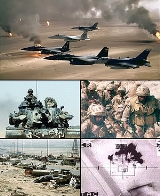


1990 Iraq invades Kuwait, eventually leading to the Gulf War.
1990 Gulf War: the United Nations Security Council orders a global trade embargo against Iraq in response to Iraq's invasion of Kuwait.
1990 Iraq occupies Kuwait and the state is annexed to Iraq. This would lead to the Gulf War shortly afterward.
1990 Saddam Hussein appears on Iraqi state television with a number of Western "guests" (actually hostages) to try to prevent the Gulf War.
1990 Gulf War: The United Nations Security Council passes United Nations Security Council Resolution 678, authorizing "use all necessary means to uphold and implement" United Nations Security Council Resolution 660 "to restore international peace and security" if Iraq did not withdraw its forces from Kuwait and free all foreign hostages by January 15, 1991.
1991 Gulf War: An act of the U.S. Congress authorizes the use of military force to drive Iraq out of Kuwait.
1991 The United States goes to war with Iraq, beginning the Gulf War (U.S. Time).
1991 Gulf War: Operation Desert Storm begins early in the morning. Iraq fires 8 Scud missiles into Israel in an unsuccessful bid to provoke Israeli retaliation.
1991 Gulf War: SCUD attack from Iraq causes 15 injuries in Israel.
1991 Gulf War: Three SCUDs and one Patriot missile hit Ramat Gan in Israel, injuring 96 people. Three elderly people die of heart attacks.
-authorized coalition force from 34 nations led by the United States
, against Iraq
in response to Iraq's invasion and annexation
of Kuwait
.
The war is also known under other names, such as the First Gulf War, Gulf War I, or the Iraq War, before the term "Iraq War"
became identified instead with the 2003 Iraq War (also referred to in the U.S. as "Operation Iraqi Freedom").
The invasion of Kuwait
by Iraqi troops
that began 2 August 1990 was met with international condemnation, and brought immediate economic sanctions
against Iraq by members of the UN Security Council. U.S. President George H. W. Bush
deployed American forces into Saudi Arabia, and urged other countries to send their own forces to the scene. An array of nations joined the coalition. The great majority of the military forces in the coalition were from the United States, with Saudi Arabia, the United Kingdom and Egypt as leading contributors, in that order. Around US$36 billion of the US$60 billion cost was paid by Saudi Arabia.
The war was marked by the beginning of live news on the front lines of the fight, with the primacy of the U.S. network CNN
. The war has also earned the nickname Video Game War after the daily broadcast images on board the American bomber
s during Operation Desert Storm.
The initial conflict to expel Iraqi troops from Kuwait began with an aerial bombardment on 17 January 1991. This was followed by a ground assault on 23 February. This was a decisive victory for the coalition forces, who liberated Kuwait and advanced into Iraqi territory. The coalition ceased their advance, and declared a cease-fire 100 hours after the ground campaign started. Aerial and ground combat was confined to Iraq, Kuwait, and areas on the border of Saudi Arabia. However, Iraq launched Scud
missiles against coalition military targets in Saudi Arabia and against Israel.
Origins
Throughout much of the Cold War, Iraq had been an ally of the Soviet Union
, and there was a history of friction between it and the United States. The U.S. was concerned with Iraq's position on Israel
i–Palestinian politics, and its disapproval of the nature of the peace between Israel and Egypt.
The United States also disliked Iraqi support for many Arab
and Palestinian militant groups such as Abu Nidal
, which led to its inclusion on the developing U.S. list of State Sponsors of Terrorism on 29 December 1979. The U.S. remained officially neutral after the invasion of Iran
in 1980, which became the Iran–Iraq War, although it assisted Iraq covertly. In March 1982, however, Iran began a successful counteroffensive — Operation Undeniable Victory
, and the United States increased its support for Iraq
to prevent Iran from forcing a surrender.
In a U.S. bid to open full diplomatic relations with Iraq, the country was removed from the U.S. list of State Sponsors of Terrorism. Ostensibly this was because of improvement in the regime’s record, although former United States Assistant Secretary of Defense Noel Koch later stated, "No one had any doubts about [the Iraqis'] continued involvement in terrorism
... The real reason was to help them succeed in the war against Iran."
With Iraq's newfound success in the war, and the Iranian rebuff of a peace offer in July, arms sales to Iraq
reached a record spike in 1982. An obstacle, however, remained to any potential U.S.–Iraqi relationship — Abu Nidal continued to operate with official support in Baghdad
. When Iraqi President Saddam Hussein
expelled the group to Syria
at the United States' request in November 1983, the Reagan administration
sent Donald Rumsfeld
to meet President Hussein as a special envoy and to cultivate ties.
Tensions with Kuwait
By the time the ceasefire with Iran was signed in August 1988, Iraq was virtually bankrupt, with most of its debt owed to Saudi Arabiaand Kuwait
. Iraq pressured both nations to forgive the debts, but they refused. Iraq also accused Kuwait of exceeding its OPEC
quotas and driving down the price of oil, thus further hurting the Iraqi economy.
The collapse in oil prices had a catastrophic impact on the Iraqi economy. The Iraqi Government described it as a form of economic warfare, which it claimed was aggravated by Kuwait slant-drilling
across the border into Iraq's Rumaila oil field.
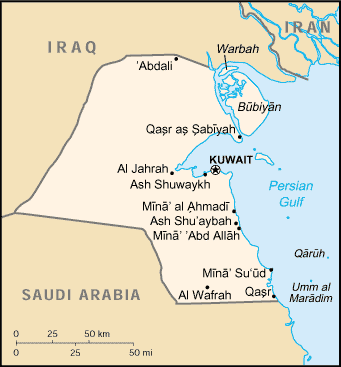
and thus stated that Kuwait was a British imperialist invention. Iraq claimed Kuwait had been a part of the Ottoman Empire
's province of Basra
. Its ruling dynasty, the al-Sabah family, had concluded a protectorate
agreement in 1899 that assigned responsibility for its foreign affairs to Britain
. Britain drew the border between the two countries, and deliberately tried to limit Iraq's access to the ocean so that any future Iraqi government would be in no position to threaten Britain's domination of the Persian Gulf
. Iraq refused to accept the border, and did not recognize the Kuwaiti government until 1963.
In early July 1990, Iraq complained about Kuwait's behavior, such as not respecting their quota, and openly threatened to take military action. On the 23rd, the CIA
reported that Iraq had moved 30,000 troops to the Iraq-Kuwait border, and the U.S. naval fleet in the Persian Gulf was placed on alert. On the 25th, Saddam Hussein met with April Glaspie
, an American ambassador, in Baghdad. According to an Iraqi transcript of that meeting, Glaspie told the Iraqi delegation,
- "We have no opinion on the Arab-Arab conflicts."
According to Glaspie's own account, she stated in reference to the precise border between Kuwait and Iraq,
- "(...) that she had served in Kuwait 20 years before; then, as now, we took no position on these Arab affairs."
On the 31st, negotiations between Iraq and Kuwait in Jeddah failed violently.
Invasion of Kuwait

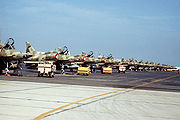
, the Kuwaiti capital. In spite of Iraqi saber-rattling, Kuwait did not have its forces on alert, and was caught unaware. Iraqi commandos infiltrated the Kuwaiti border first to prepare for the major units which began the attack at the stroke of midnight. The Iraqi attack had two prongs, with the primary attack force driving south straight for Kuwait City down the main highway, and a supporting attack entering Kuwait farther west, but then turning and driving due east, cutting off the capital city from the southern half of the country. The commander of a Kuwaiti armored battalion, 35th Armoured Brigade
, deployed them against the Iraqi attack and was able to conduct a robust defense (The Battle of the Bridges
), near Al Jahra
, west of Kuwait City.
Kuwait Air Force
aircraft scrambled
to meet the invading force, but approximately 20% were lost or captured. An air battle with the Iraqi helicopter airborne forces
was fought over Kuwait City, inflicting heavy losses on the Iraqi elite troops, and a few combat sorties were flown against Iraqi ground forces.
The main Iraqi thrust into Kuwait City was conducted by commando
s deployed by helicopters and boats to attack the city from the sea, while other divisions seized the airports and two airbase
s. The Iraqis attacked the Dasman Palace, the Royal Residence of the Emir of Kuwait, Jaber Al-Ahmad Al-Jaber Al-Sabah
, which was defended by the Emiri Guard supported with M-84
tanks. In the process, the Iraqis killed Fahad Al-Ahmed Al-Jaber Al-Sabah, the Emir of Kuwait's youngest brother.
After two days of intense combat, most of the Kuwaiti Armed Forces
were either overrun by the Iraqi Republican Guard
, or had escaped to neighboring Saudi Arabia. The emir and key ministers were able to get out and head south along the highway for refuge in Saudi Arabia. Iraqi ground forces consolidated their control on Kuwait City, then headed south and redeployed along the border of Saudi Arabia. After the decisive Iraqi victory, Saddam Hussein initially installed a puppet regime known as the "Provisional Government of Free Kuwait
" before installing his cousin Ali Hassan al-Majid
as the governor
of Kuwait on August 8.
UN resolution
Within hours of the invasion, Kuwaiti and U.S. delegations requested a meeting of the UN Security Council, which passed Resolution 660, condemning the invasion and demanding a withdrawal of Iraqi troops. On 3 August the Arab League
passed its own resolution, which called for a solution to the conflict from within the League, and warned against outside intervention; Iraq and Libya were the only two nations in the Arab League which opposed a resolution for Iraq to withdraw from Kuwait. The PLO opposed it as well. The Arab nations of Yemen and Jordan-a Western ally which bordered Iraq and relied on the country for economic support- also opposed military intervention from non-Arab nations. The Arab nation of Sudan also aligned itself with Hussein. On 6 August UN Resolution 661 placed economic sanctions
on Iraq.
United Nations Security Council Resolution 665
followed soon after, which authorized a naval blockade to enforce the economic sanctions against Iraq. It said the “use of measures commensurate to the specific circumstances as may be necessary ... to halt all inward and outward maritime shipping in order to inspect and verify their cargoes and destinations and to ensure strict implementation of resolution 661.”
Iraqi-American diplomacy
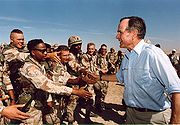
influence in the region for years to come.
On 12 August 1990, Saddam Hussein called for compromise via Baghdad radio and the former Iraqi News Agency. Hussein "propose[d] that all cases of occupation, and those cases that have been portrayed as occupation, in the region, be resolved simultaneouly [sic]". Specifically, he called for Israel to withdraw from occupied territories in Palestine, Syria, and Lebanon, Syria to withdraw from Lebanon, and "mutual withdrawals by Iraq and Iran and arrangement for the situation in Kuwait." He also called for a replacement of US troops that mobilized in Saudi Arabia in response to the invasion of Kuwait with "an Arab force", as long as that force did not involve Egypt. Additionally, he requested an "immediate freeze of all boycott and siege decisions" and a general normalization of relations with Iraq. From the beginning of the crisis, President Bush was strongly opposed to any "linkage" between the Iraqi occupation of Kuwait and the Palestinian issue.
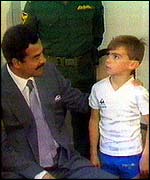
Another Iraqi proposal communicated in August 1990 was delivered to National Security Advisor Brent Scowcroft
by an unidentified Iraqi official. The official communicated to the White House that Iraq would "withdraw from Kuwait and allow foreigners to leave" provided that the UN lifted sanctions, allowed "'guaranteed access' to the Persian Gulf through the Kuwaiti islands of Bubiyan and Warbah", and allowed Iraq to "gain full control of the Rumailah oil field that extends slightly into Kuwaiti territory". The proposal also "include[d] offers to negotiate an oil agreement with the United States 'satisfactory to both nations' national security interests,' develop a joint plan 'to alleviate Iraq's economical and financial problems' and 'jointly work on the stability of the gulf.'"
In December 1990, Iraq made a proposal to withdraw from Kuwait provided that their forces were not attacked as they left, and that a consensus was reached regarding the banning of WMD in the Palestinian region. The White House
rejected the proposal. Yasser Arafat
of the PLO
expressed that neither he nor Hussein insisted that solving the Israel-Palestine issues should be a precondition to solving the issues in Kuwait, though he did acknowledge a "strong link" between these problems.
Ultimately, the US stuck to its hard line position that there would be no negotiations until Iraq withdrew from Kuwait and that they should not grant Iraq concessions, lest they give the impression that Iraq benefited from its military campaign. Also, when Secretary of State James Baker
met with Tariq Aziz
in Geneva for last minute peace talks in early 1991, Aziz reportedly made no concrete proposals and did not outline any hypothetical Iraqi moves.
UN Diplomacy
On 29 November 1990 the U.N. passed security council resolution 678 which gave Iraq until 15 January 1991 to withdraw from Kuwait and empowered states to use "all necessary means" to force Iraq out of Kuwait after the deadline.On 14 January 1991, France proposed that the U.N. Security Council call for "a rapid and massive withdrawal" from Kuwait along with a statement to Iraq that Council members would bring their "active contribution" to a settlement of other problems of the region, "in particular, of the Arab-Israeli conflict and in particular to the Palestinian problem by convening, at an
appropriate moment, an international conference" to assure "the security, stability and development of this region of the world." The French proposal was supported by Belgium (at the moment one of the rotating Security Council members), and Germany,
Spain, Italy, Algeria, Morocco, Tunisia, and several non-aligned nations. The U.S., Great Britain, and the Soviet Union, rejected it. American U.N. Ambassador Thomas Pickering stated that the French proposal was unacceptable, because it went
beyond previous U.N. Security Council resolutions on the Iraqi invasion.
Operation Desert Shield
One of the main concerns to the West was the significant threat Iraq posed to Saudi Arabia. Following the conquest of Kuwait, the Iraqi army was within easy striking distance of Saudi oil fields. Control of these fields, along with Kuwaiti and Iraqi reserves, would have given Hussein control over the majority of the world's oil reserves. Iraq also had a number of grievances with Saudi Arabia. The Saudis had lent Iraq some 26 billion dollars during its war with Iran. The Saudis backed Iraq, as they feared the influence of Shia Iran's Islamic revolution on its own Shia minority. After the war, Saddam felt he should not have to repay the loans due to the help he had given the Saudis by fighting Iran.
. He argued that the U.S.-supported Saudi state was an illegitimate and unworthy guardian of the holy cities of Mecca
and Medina
. He combined the language of the Islamist groups that had recently fought in Afghanistan
with the rhetoric Iran had long used to attack the Saudis.
Acting on the policy of the Carter Doctrine
, and out of fear the Iraqi army could launch an invasion of Saudi Arabia, U.S. President George H. W. Bush quickly announced that the U.S. would launch a "wholly defensive" mission to prevent Iraq from invading Saudi Arabia under the codename Operation Desert Shield. Operation Desert Shield began on 7 August 1990 when U.S. troops were sent to Saudi Arabia due also to the request of its monarch, King Fahd, who had earlier called for U.S. military assistance. This "wholly defensive" doctrine was quickly abandoned when, on 8 August, Iraq declared Kuwait to be the 19th province of Iraq and Saddam Hussein named his cousin, Ali Hassan Al-Majid as its military-governor.
The United States Navy
dispatched two naval battle groups built around the aircraft carriers USS Dwight D. Eisenhower
and USS Independence
to the Gulf, where they were ready by 8 August. The U.S. also sent the battleships USS Missouri
and USS Wisconsin
to the region. A total of 48 U.S. Air Force F-15s from the 1st Fighter Wing
at Langley Air Force Base, Virginia, landed in Saudi Arabia, and immediately commenced round the clock air patrols of the Saudi–Kuwait–Iraq border areas to discourage further Iraqi military advances. They were joined by 36 F-15 A-Ds from the 36th TFW at Bitburg, Germany. The Bitburg contingent was based at Al Kharj Air Base, approximately 1 hour southeast of Riyadh. The 36th TFW would be responsible for 11 confirmed Iraqi Air Force aircraft shot down during the war. There were also two Air National Guard units stationed at Al Kharj Air Base, the South Carolina Air National Guard (169th Fighter Wing) flew bombing missions with 24 F-16's flying 2,000 combat missions and dropping 4 million pounds of munitions, and the New York Air National Guard 174th Fighter Wing from Syracuse flew 24 F-16's on bombing missions. Military buildup continued from there, eventually reaching 543,000 troops, twice the number used in the 2003 invasion of Iraq
. Much of the material was airlifted or carried to the staging areas via fast sealift ships
, allowing a quick buildup.
Creating a coalition
A series of UN Security Council resolutions and Arab League resolutions were passed regarding the invasion of Kuwait by Saddam Hussein's Iraq. One of the most important was Resolution 678, passed on 29 November 1990, which gave Iraq a withdrawal deadline until 15 January 1991, and authorized “all necessary means to uphold and implement Resolution 660,” and a diplomatic formulation authorizing the use of force if Iraq failed to comply.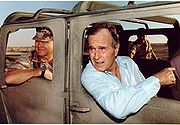
, Australia
, Bahrain
, Bangladesh
, Belgium
, Canada
, Denmark
, Egypt
, France
, Greece
, Italy
, Kuwait
, Morocco
, Netherlands
, New Zealand
, Niger
, Norway
, Oman
, Pakistan
, Portugal
, Qatar
, South Korea
, Saudi Arabia
, Senegal
, Sierra Leone
, Singapore
, Spain
, Syria
, the United Arab Emirates
, the United Kingdom
and the United States
itself. US Army General Norman Schwarzkopf was designated to be the commander of the coalition forces in the Persian Gulf area.
Although they did not contribute any forces, Japan
and Germany
made financial contributions totaling $10 billion and $6.6 billion respectively. U.S. troops represented 73% of the coalition’s 956,600 troops in Iraq.
Many of the coalition forces were reluctant to join. Some felt that the war was an internal Arab affair, or did not want to increase U.S. influence in the Middle East. In the end, however, many nations were persuaded by Iraq’s belligerence towards other Arab states, offers of economic aid or debt forgiveness, and threats to withhold aid.
Reasons and campaign for intervention
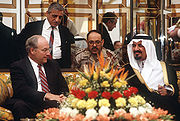
importance. Shortly after the Iraqi invasion, Secretary of Defense Dick Cheney
made the first of several visits to Saudi Arabia where King Fahd requested US military assistance. During a speech in a special joint session of the U.S. Congress given on 11 September 1990, U.S. President George H. W. Bush summed up the reasons with the following remarks: "Within three days, 120,000 Iraqi troops with 850 tanks had poured into Kuwait and moved south to threaten Saudi Arabia. It was then that I decided to act to check that aggression."
The Pentagon claimed that satellite photos showing a buildup of Iraqi forces along the border were the source of this information, but this was later shown to be false. A reporter for the Saint Petersburg Times acquired commercial satellite images made at the time in question, which showed nothing but empty desert.
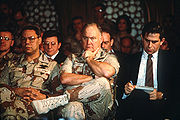
abuses under President Saddam. Iraq was also known to possess biological weapons
and chemical weapons
, which Saddam had used against Iranian troops during the Iran–Iraq War and against his own country's Kurdish
population in the Al-Anfal Campaign
. Iraq was also known to have a nuclear weapon
s program.
Although there were human rights abuses committed in Kuwait by the invading Iraqi military, the ones best known in the U.S. were inventions of the public relations
firm hired by the government of Kuwait to influence U.S. opinion in favor of military intervention. Shortly after Iraq’s invasion of Kuwait, the organization Citizens for a Free Kuwait
was formed in the U.S. It hired the public relations firm Hill & Knowlton
for about $11 million, paid by the Kuwaiti government.
Among many other means of influencing U.S. opinion (distributing books on Iraqi atrocities to U.S. soldiers deployed in the region, 'Free Kuwait' T-shirts and speakers to college campuses, and dozens of video news releases to television stations), the firm arranged for an appearance before a group of members of the U.S. Congress
in which a woman identifying herself as a nurse working in the Kuwait City hospital
described Iraqi soldiers pulling babies out of incubators and letting them die on the floor.
The story was an influence in tipping both the public and Congress towards a war with Iraq: six Congressmen said the testimony was enough for them to support military action against Iraq and seven Senators referenced the testimony in debate. The Senate supported the military actions in a 52-47 vote. A year after the war, however, this allegation was revealed to be a fabrication. The woman who had testified was found to be a member of the Kuwaiti Royal Family, in fact the daughter of the Kuwaiti ambassador to the U.S. She had not been living in Kuwait during the Iraqi invasion.
The details of the Hill & Knowlton public relations campaign, including the incubator testimony, were published in a John R. MacArthur
's Second Front: Censorship and Propaganda in the Gulf War (Berkeley, CA: University of CA Press, 1992), and came to wide public attention when an Op-ed
by MacArthur was published in the New York Times. This prompted a reexamination by Amnesty International
, which had originally promoted an account alleging even greater numbers of babies torn from incubators than the original fake testimony. After finding no evidence to support it, the organization issued a retraction. President George H. W. Bush then repeated the incubator allegations on television.
At the same time, the Iraqi army committed several well-documented crimes during its occupation of Kuwait, such as the summary execution without trial
of three brothers after which their bodies were stacked in a pile and left to decay in a public street. Iraqi troops also ransacked and looted private Kuwaiti homes, one residence was repeatedly defecated in. A resident later commented, "The whole thing was violence for the sake of violence, destruction for the sake of destruction... Imagine a surrealistic painting
by Salvador Dalí
".
Air campaign
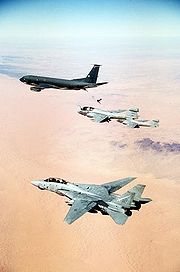
campaign on 17 January 1991. The coalition flew over 100,000 sortie
s, dropping 88,500 tons of bombs, and widely destroying military and civilian infrastructure. The air campaign was commanded by USAF Lieutenant General
Chuck Horner
, who briefly served as Commander-in-Chief - Forward of U.S. Central Command while General Schwarzkopf was still in the United States.
A day after the deadline set in Resolution 678, the coalition launched a massive air campaign, which began the general offensive codenamed Operation Desert Storm. The first priority for Coalition forces was the destruction of the Iraqi air force and anti-aircraft facilities.
The sorties were launched mostly from Saudi Arabia and the six Coalition aircraft carrier battle groups (CVBG) in the Persian Gulf
and Red Sea
.
The next coalition targets were command and communication facilities. Saddam Hussein had closely micromanaged
the Iraqi forces in the Iran–Iraq War, and initiative at lower levels was discouraged. Coalition planners hoped that Iraqi resistance would quickly collapse if deprived of command and control.
The third and largest phase of the air campaign targeted military targets throughout Iraq and Kuwait: Scud
missile launchers, weapons research facilities, and naval forces. About one-third of the Coalition airpower was devoted to attacking Scuds, some of which were on trucks and therefore difficult to locate. Some U.S. and British special forces
teams had been covertly inserted into western Iraq to aid in the search and destruction of Scuds.
Iraqi antiaircraft defenses, including MANPADS, were surprisingly ineffective against coalition aircraft and the coalition suffered only 75 aircraft losses in over 100,000 sorties, 44 of which were the result of Iraqi action. Two of these losses are the result of aircraft colliding with the ground while evading Iraqi ground fired weapons. One of these losses is a confirmed air-air victory.
Iraq launches missile strikes
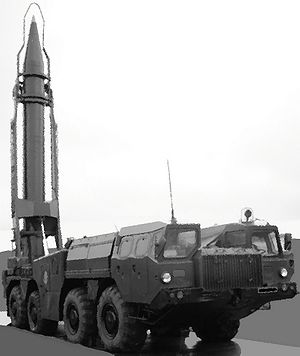
if invaded. Prior to the start of the war, Tariq Aziz, Iraq's English-speaking Foreign Minister and Deputy Prime Minister, was asked in the aftermath of the failed U.S.-Iraq peace talks in Geneva, Switzerland by a reporter. “Mr. Foreign Minister, if war starts...will you attack Israel?” the reporter asked. His response was, “Yes, absolutely, yes.”
Five hours after the first attacks, Iraq's state radio broadcast a voice identified as Saddam Hussein declaring that "The great duel, the mother of all battles has begun. The dawn of victory nears as this great showdown begins." Iraq responded by launching eight Al Hussein
missiles into Israel the next day. These missile attacks on Israel were to continue throughout the six weeks of the war.
The Iraqis hoped that they would provoke a military response from Israel. It was expected that many Arab nations would withdraw from the coalition, as they would be reluctant to fight alongside Israel. Israel, at the request of the United States, did not launch counterstrikes, and all Arab states remained in the coalition.
The Scud missiles targeting Israel were relatively ineffective, as firing at extreme range resulted in a dramatic reduction in accuracy and payload.
Two Israeli civilians died from these attacks, and approximately 230 were injured. Of the reported injuries, 10 were considered moderate injuries, while one was considered a severe injury. Several others suffered fatal heart attacks immediately following the missile strikes. Extensive property damage was also caused. It was also feared that Iraq would fire missiles filled with nerve agent
s or sarin
. As a result, the Israeli government issued gas mask
s to its citizens. When the first Iraqi missiles hit Tel Aviv
, some people injected themselves with an antidote for nerve gas.
Israeli Air Force
jets were deployed to patrol the northern airspace with Iraq, and Israel was prepared to respond with military force, as it's policy for the previous forty years had always been retaliation. Israeli Prime Minister Yitzhak Shamir
agreed not to retaliate and withdraw Israeli jets when asked by the United States, which feared that if Israel attacked Iraq, the other Arab nations would either desert from the coalition or join Iraq. It was also feared that if Israel used Syria
n or Jordan
ian airspace to attack Iraq, they would intervene in the war on Iraq's side or attack Israel. Israel was promised that the Coalition would deploy Patriot missile
s to defend Israel if it refrained from responding to the Scud attacks.
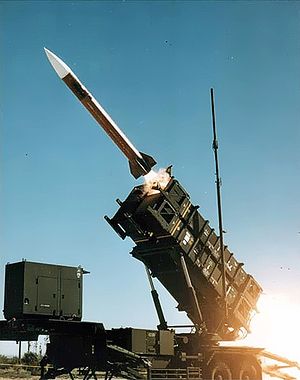
In response to the threat of Scuds on Israel, the United States rapidly sent a Patriot missile air defense artillery battalion to Israel along with two batteries of MIM-104 Patriot
missiles for the protection of civilians. Coalition air forces were also extensively exercised in "Scud hunts" in the Iraqi desert, trying to locate the camouflaged trucks before they fired their missiles at Israel or Saudi Arabia. On the ground, special forces also infiltrated Iraq, tasked with locating and destroying Scuds. Once special operations were combined with air patrols, the number of attacks fell sharply, then increased slightly as Iraqi forces adjusted to Coalition tactics. At one point, Israeli commandos boarded helicopters ready to fly to Iraq, but the mission was called off after a phone call from US Defense Secretary Dick Cheney
, reporting on the extent of Coalition efforts to destroy Scuds and emphasizing that Israeli intervention could endanger American forces.
The Royal Netherlands Air Force
also deployed Patriot missiles in both Turkey
and Israel to counter the Scud threat. The Dutch Defense Ministry later stated that the military use of the Patriot missile system was largely ineffective, but its psychological value was high, even though the Patriot missiles caused far more casualties and property damage than the Scuds themselves did. It has been suggested that the sturdy construction techniques used in Israeli cities, coupled with the fact that Scuds were only launched at night, played an important role in limiting the number of deaths and injuries from Scud attacks.
Three Scud missiles and a coalition Patriot that malfunctioned hit Ramat Gan in Israel on 22 January 1991, injuring 96 people, and possibly causing the deaths of three elderly people who died of heart attacks.
Forty-two Scud missiles were fired by Iraq into Israel during the seven weeks of the war. In addition, 44 Scud missiles were fired into Saudi Arabia, and one missile was fired at Bahrain and another at Qatar. The missiles were fired at both military and civilian targets. One Saudi civilian was killed, and 65 others were injured. No casualties were reported in Bahrain or Qatar.
On 25 February 1991, a Scud missile hit a U.S. Army barracks of the 14th Quartermaster Detachment, out of Greensburg, PA, stationed in Dhahran
, Saudi Arabia, killing 28 soldiers and injuring over 100.
Battle of Khafji
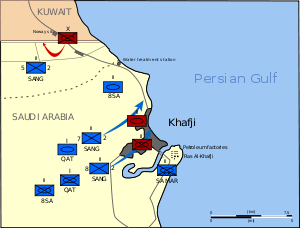
with tanks and infantry. The Battle of Khafji ended two days later when the Iraqis were driven back by the Saudi Arabian National Guard
and the United States Marine Corps
, supported by Qatar
i forces. The allied forces provided close air support
and used extensive artillery fire.
Casualties were heavy on both sides, although Iraqi forces sustained substantially more dead and captured than the allied forces. Eleven Americans were killed in two separate friendly fire
incidents, an additional 14 U.S. airmen were killed when an American AC-130 gunship was shot down by an Iraqi surface-to-air missile (SAM), and two American soldiers were captured during the battle.
Saudi and Qatari forces had a total of 18 dead. Iraqi forces in Khafji had 60–300 dead and 400 captured.
Khafji was a strategically important city immediately after the Iraqi invasion of Kuwait. The Iraqi reluctance to commit several armored divisions to the occupation, and its subsequent use of Khafji as a launching pad into the initially lightly defended east of Saudi Arabia is considered by many academics a grave strategic error. Not only would Iraq have secured a majority of Middle Eastern oil supplies, but it would have found itself better able to threaten the subsequent U.S. deployment along superior defensive lines.
Ground campaign
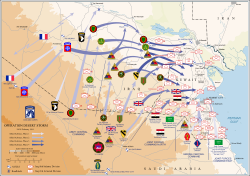
that had been achieved by their air force
s before the start of the main ground offensive. Coalition forces also had two key technological advantages:
- The Coalition main battle tankMain battle tankA main battle tank , also known as a battle tank or universal tank, is a tank that fills the heavy direct fire role of many modern armies. They were originally conceived to replace the light, medium, heavy and super-heavy tanks. Development was spurred onwards in the Cold War with the development...
s, such as the U.S. M1 AbramsM1 AbramsThe M1 Abrams is a third-generation main battle tank produced in the United States. It is named after General Creighton Abrams, former Army Chief of Staff and Commander of US military forces in Vietnam from 1968 to 1972. The M1 is a well armed, heavily armored, and highly mobile tank designed for...
, British Challenger 1Challenger 1 tankThe British FV4030/4 Challenger 1, was the main battle tank of the British Army from 1983 to the mid 1990s, when it was superseded by the Challenger 2. It is also currently used by the Jordanian Armed Forces as their main battle tank after heavy modifications...
, and Kuwaiti M-84M-84The M-84 is a Yugoslav 2nd generation main battle tank. The M-84 is in service in Bosnia and Herzegovina, Croatia, Kuwait, Slovenia and Serbia.-Development and production:...
AB were vastly superior to the Chinese Type 69 and domestically built T-72 tanks used by the Iraqis, with crews better trained and armoured doctrine better developed. - The use of GPSGlobal Positioning SystemThe Global Positioning System is a space-based global navigation satellite system that provides location and time information in all weather, anywhere on or near the Earth, where there is an unobstructed line of sight to four or more GPS satellites...
made it possible for Coalition forces to navigate without reference to roads or other fixed landmarks. This, along with air reconnaissance, allowed them to fight a battle of maneuver rather than a battle of encounter: they knew where they were and where the enemy was, so they could attack a specific target rather than searching on the ground for enemy forces.
Liberation of Kuwait
American decoy attacks by air attacks and naval gunfire the night before the liberation of Kuwait were designed to make the Iraqis believe the main coalition ground attack would focus on Central Kuwait.For months, American units in Saudi Arabia had been under almost constant Iraqi artillery fire, as well as threats from Scud missile or chemical attacks. On 23 February 1991, the 1st Marine Division, 2nd Marine Division, and the 1st Light Armored Infantry crossed into Kuwait and headed toward Kuwait City. They encountered trenches, barbed wire, and minefields. However, these positions were poorly defended, and were overrun in the first few hours. Several tank battles took place, but apart from that, Coalition troops encountered minimal resistance, as most Iraqi troops surrendered. The general pattern was that the Iraqis would put up a short fight before surrendering. However, Iraqi air defenses shot down nine American aircraft. Meanwhile, forces from Arab countries advanced into Kuwait from the east, encountering little resistance and suffering few casualties.
Despite the successes of Coalition forces, it was feared that the Republican Guard would escape into Iraq before it could be destroyed. It was decided to send British armored forces into Kuwait fifteen hours ahead of schedule, and to send American forces after the Republican Guard. The Coalition advance was preceded by a heavy artillery and rocket barrage, after which 150,000 troops and 1,500 tanks began their advance. Iraqi forces in Kuwait counterattacked against U.S. troops, acting on a direct order from Saddam himself. Despite the intense combat, the Americans repulsed the Iraqis and continued to advance towards Kuwait city.
Kuwaiti forces were tasked with liberating the city. Iraqi troops offered only light resistance. The Kuwaitis lost one soldier killed and one plane shot down, and quickly liberated the city. On 27 February, Saddam ordered a retreat from Kuwait, and President George H.W. Bush declared it liberated. However, an Iraqi unit at Kuwait International Airport
appeared not to have gotten the message, and fiercely resisted. U.S. Marines had to fight for hours before securing the airport, after which Kuwait was declared secure. After four days of fighting, Iraqi forces were expelled from Kuwait. As part of a scorched-earth policy, they set fire
to nearly 700 oil wells, and placed land mines around the wells to make extinguishing the fires more difficult.
Initial moves into Iraq
The ground phase of the war was given the official designation Operation Desert Sabre.The first units to move into Iraq were three patrols of the B squadron of the British Special Air Service
, call signs Bravo One Zero, Bravo Two Zero
, and Bravo Three Zero, in late January. These eight-man patrols landed behind Iraqi lines to gather intelligence on the movements of Scud mobile missile launchers, which could not be detected from the air, as they were hidden under bridges and camouflage netting during the day. Other objectives included the destruction of the launchers and their fiber-optic communications arrays that lay in pipelines and relayed coordinates to the TEL
operators that were launching attacks against Israel. The operations were designed to prevent any possible Israeli intervention. Due to lack of sufficient ground cover to carry out their assignment, One Zero and Three Zero abandoned their operations, while Two Zero remained, and was later compromised, with only Sergeant
Chris Ryan
escaping to Syria
.
Elements of the 2nd Brigade, 1st Battalion 5th Cav of the 1st Cavalry Division of the U.S. Army performed a Direct attack into Iraq on 15 February 1991, followed by one in force on 20 February that led directly through 7 iraqi divisions which were caught off guard. From 15–20 February, the Battle of Wadi Al-Batin
took place inside Iraq, this was the first of two attacks by 1 Battalion 5th Cavalry of the 1st Cavalry Division. It was a feint attack, designed to make the Iraqis think that a coalition invasion would take place from the south. The Iraqis fiercely resisted, and the Americans eventually withdrew as planned back into the Wadi Al-Batin. Three American soldiers were killed and nine wounded as well with only 1 M-2 IFV turret destroyed, but they had taken 40 prisoners and destroyed five tanks, and successfully deceived the Iraqis. This attack led the way for the XVIII Airborne Corps. to sweep around behind the 1st Cav and attack Iraqi forces to the west. On 22 February 1991, Iraq agreed to a Soviet-proposed ceasefire agreement. The agreement called for Iraq to withdraw troops to pre-invasion positions within six weeks following a total cease-fire, and called for monitoring of the cease-fire and withdrawal to be overseen by the UN Security Council.
The Coalition rejected the proposal, but said that retreating Iraqi forces would not be attacked, and gave twenty-four hours for Iraq to begin withdrawing forces. On 23 February, fighting resulted in the capture of 500 Iraqi soldiers. On 24 February, British and American armoured forces crossed the Iraq/Kuwait border and entered Iraq in large numbers, taking hundreds of prisoners. Iraqi resistance was light, and 4 Americans were killed.
Coalition forces enter Iraq
, in full strength and spearheaded by the 3rd Squadron of the 2nd Armored Cavalry Regiment (3/2 ACR), launched an armored attack into Iraq early on 24 February, just to the west of Kuwait, taking Iraqi forces by surprise. Simultaneously, the U.S. XVIII Airborne Corps
launched a sweeping “left-hook” attack across the largely undefended desert of southern Iraq, led by the 3rd Armoured Cavalry Regiment (3rd ACR)
and the 24th Infantry Division (Mechanized). The left flank of this movement was protected by the French 6th Light Armoured Division Daguet.
The French force quickly overcame the Iraqi 45th Infantry Division, suffering light casualties and taking a large number of prisoners, and took up blocking positions to prevent an Iraqi counter-attack on the Coalition flank. The right flank of the movement was protected by the British 1st Armoured Division
. Once the allies had penetrated deep into Iraqi territory, they turned eastward, launching a flank attack against the elite Republican Guard before it could escape. The Iraqis resisted fiercely from dug-in positions and stationary vehicles, and even mounted armored charges.
Unlike many previous engagements, the destruction of the first Iraqi tanks did not result in a mass surrender. The Iraqis suffered massive losses and lost dozens of tanks and vehicles, while American casualties were comparatively low, with a single Bradley knocked out. Coalition forces pressed another ten kilometers into Iraqi territory, and captured their objective within three hours. They took 500 prisoners and inflicted heavy losses, defeating the Iraqi 26th Infantry Division. An American soldier was killed by an Iraqi land mine, another five by friendly fire, and thirty wounded during the battle. Meanwhile, British forces attacked the Iraqi Medina Division and a major Republican Guard logistics base. In nearly two days of some of the war's most intense fighting, the British destroyed 40 enemy tanks and captured a division commander.
Meanwhile, American forces attacked the village of Al Busayyah, meeting fierce resistance. They suffered no casualties, but destroyed a considerable amount of military hardware and took prisoners.
On 25 February 1991, Iraqi forces fired a scud missile at an American barracks in Dhahran, Saudi Arabia. The missile attack killed 28 American military personnel.
The Coalition advance was much swifter than U.S. generals had expected. On 26 February, Iraqi troops began retreating from Kuwait, after they had set its oil field
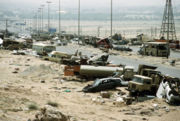
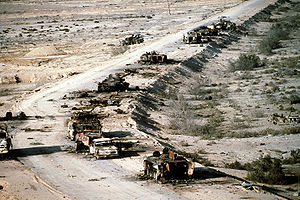
s on fire (737 oil wells were set on fire). A long convoy of retreating Iraqi troops formed along the main Iraq-Kuwait highway. Although they were retreating, this convoy was bombed so extensively by Coalition air forces that it came to be known as the Highway of Death
. Hundreds of Iraqi troops were killed. Forces from the United States, the United Kingdom, and France continued to pursue retreating Iraqi forces over the border and back into Iraq, eventually moving to within 150 miles (240 km) of Baghdad before withdrawing back to the Iraqi border with Kuwait and Saudi Arabia.
One hundred hours after the ground campaign started, on 28 February, President Bush declared a ceasefire, and he also declared that Kuwait had been liberated.
Post-war military analysis
Although it was said in Western media at the time that Iraqi troops numbered approximately 545,000 to 600,000, most experts today believe that both the qualitative and quantitative descriptions of the Iraqi army at the time were exaggerated, as they included both temporary and auxiliary support elements. Many of the Iraqi troops were young, under-resourced, and poorly trained conscripts.The Coalition committed 540,000 troops, and a further 100,000 Turkish troops were deployed along the Turkish-Iraqi border. This caused a significant force dilution of the Iraqi military by forcing it to deploy its forces along all its borders. This allowed the main thrust by the U.S. to possess not only a significant technological advantage, but also a numerical superiority.
The widespread support for Iraq during the Iran-Iraq war equipped Iraq with military equipment from most major world arms dealers. This resulted in a lack of standardization in this large heterogeneous force, which additionally suffered from poor training and poor motivation. The majority of Iraqi armored forces still used old Chinese Type 59
s and Type 69s, Soviet-made T-55
s from the 1950s and 1960s, and some poor quality Asad Babil tanks
(domestically assembled tank based on Polish T-72 hulls with other parts of mixed origin). These machines were not equipped with up-to-date equipment, such as thermal sights or laser rangefinders, and their effectiveness in modern combat was very limited.
The Iraqis failed to find an effective countermeasure to the thermal sights and sabot rounds used by the Coalition tanks. This equipment enabled them to engage and destroy Iraqi tanks from more than three times the range that Iraqi tanks could engage coalition tanks. The Iraqi crews used old, cheap steel penetrators
against the advanced Chobham Armour
of the U.S. and British tanks, with ineffective results. The Iraqis also failed to utilize the advantage that could be gained from using urban warfare
— fighting within Kuwait City — which could have inflicted significant casualties on the attacking forces. Urban combat reduces the range at which fighting occurs, and can negate some of the technological advantages of well-equipped forces.
The Iraqis also tried to use Soviet military doctrine, but the implementation failed due to the lack of skill of their commanders, and the preventive coalition air strikes on communication centers and bunkers.
The end of active hostilities
In Iraqi territory that was occupied by the coalition, a peace conference was held where a ceasefire agreement was negotiated and signed by both sides. At the conference, Iraq was approved to fly armed helicopters on their side of the temporary border, ostensibly for government transit due to the damage done to civilian infrastructure. Soon after, these helicopters and much of the Iraqi armed forces were used to fight a Shi'ite uprising in the south. The rebellions were encouraged by an airing of "The Voice of Free Iraq" on 2 February 1991, which was broadcast from a CIA run radio station out of Saudi Arabia. The Arabic service of the Voice of America supported the uprising by stating that the rebellion was large, and that they soon would be liberated from Saddam.
In the North, Kurdish leaders took American statements that they would support an uprising to heart, and began fighting, hoping to trigger a coup d'état
. However, when no American support came, Iraqi generals remained loyal to Saddam and brutally crushed the Kurdish uprising
. Millions of Kurds fled across the mountains to Kurdish areas of Turkey and Iran. These events later resulted in no-fly zone
s being established in both the North and the South of Iraq. In Kuwait, the Emir was restored, and suspected Iraqi collaborators were repressed. Eventually, over 400,000 people were expelled from the country, including a large number of Palestinian
s, due to PLO support of Saddam Hussein. Yasser Arafat did not apologize for his support of Iraq, but after his death the Fatah under the authority of Mahmoud Abbas would formally apologize in 2004.
There was some criticism of the Bush administration, as they chose to allow Saddam Hussein to remain in power instead of pushing on to capture Baghdad and overthrowing his government. In their co-written 1998 book, A World Transformed
, Bush and Brent Scowcroft
argued that such a course would have fractured the alliance, and would have had many unnecessary political and human costs associated with it.
In 1992, the United States Secretary of Defense
during the war, Dick Cheney
, made the same point:
Instead of a greater involvement of its own military, the United States hoped that Saddam Hussein would be overthrown in an internal coup d'état. The Central Intelligence Agency used its assets in Iraq to organize a revolt, but the Iraqi government defeated the effort.
On 10 March 1991, 540,000 American troops began to move out of the Persian Gulf.
Coalition involvement
Members of the Coalition included Argentina, Australia, Bahrain, Bangladesh, Belgium, Canada, Czechoslovakia, Denmark, Egypt, France, Greece, Honduras, Hungary, Italy, Kuwait, Malaysia, Morocco, Netherlands, New Zealand, Niger, Norway, Oman, Pakistan, Philippines, Poland, Portugal, Qatar, Romania, Saudi Arabia, Senegal, South Korea, Spain, Sweden, Syria, Turkey, United Arab Emirates, United Kingdom of Great Britain and Northern Ireland, and the United States of America.Germany and Japan provided financial assistance and donated military hardware, but did not send direct military assistance. This later became known as checkbook diplomacy
.
United Kingdom
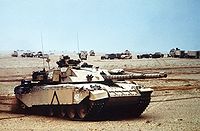
was the codename for the operations in the Persian Gulf. British Army
regiments (mainly with the British 1st Armoured Division), Royal Air Force
squadrons and Royal Navy
vessels were mobilized in the Gulf. The Royal Air Force, using various aircraft, operated from airbase
s in Saudi Arabia. Almost 2,500 armored vehicles and 43,000 troops were shipped for action.
Chief Royal Navy vessels deployed to the gulf included a number of Broadsword-class frigates
, and Sheffield-class destroyers
, other RN and RFA
ships were also deployed. The light aircraft carrier HMS Ark Royal
was not deployed to the Gulf area, but was deployed to the Mediterranean Sea
.
France
The second largest European contingent was France, which committed 18,000 troops. Operating on the left flank of the U.S. XVIII Airborne Corps, the main French army force was the 6th Light Armoured Division, including troops from the French Foreign Legion. Initially, the French operated independently under national command and control, but coordinated closely with the Americans, Saudis and CENTCOM. In January, the Division was placed under the tactical control of the U.S. XVIII Airborne Corps. France also deployed several combat aircraft and naval units. The French called their contribution Opération Daguet
.
Canada
Canada was one of the first nations to condemn Iraq's invasion of Kuwait, and it quickly agreed to join the U.S.-led coalition. In August 1990, Prime MinisterBrian Mulroney
committed the Canadian Forces
to deploy a Naval Task Group. The destroyers and to joined the maritime interdiction force supported by the supply ship . The Canadian Task Group led the coalition maritime logistics forces in the Persian Gulf. A fourth ship, , arrived in-theater after hostilities had ceased and was the first allied ship to visit Kuwait.
Following the UN authorized use of force against Iraq, the Canadian Forces deployed a CF-18 Hornet
and Sikorsky CH-124 Sea King squadron with support personnel, as well as a field hospital
to deal with casualties from the ground war. When the air war began, Canada's CF-18s were integrated into the coalition force and were tasked with providing air cover and attacking ground targets. This was the first time since the Korean War
that the Canadian military had participated in offensive combat operations.
The Canadian Commander in the Middle East was Commodore Ken Summers.
Australia

Australia contributed a Naval Task Group, which formed part of the multi-national fleet in the Persian Gulf and Gulf of Oman
, under Operation Damask. In addition, medical teams were deployed aboard a U.S. hospital ship
, and a naval clearance diving team
took part in de-mining Kuwait’s port facilities following the end of combat operations.
Australia was a member of the international coalition which contributed military forces to the 1991 Persian Gulf War. While the Australian forces did not see combat, they did play a significant role in enforcing the sanctions put in place against Iraq following the invasion of Kuwait, as well as other small support contributions to Operation Desert Storm. Following the end of the Persian Gulf War, Australia deployed a medical unit on Operation Habitat
to northern Iraq as part of Operation Provide Comfort
.
Civilian
The increased importance of air attacks from both warplanes and cruise missiles led to controversy over the number of civilian deaths caused during the initial stages of the war. Within the first 24 hours of the war, more than 1,000 sorties were flown, many against targets in Baghdad. The city was the target of heavy bombing, as it was the seat of power for President Saddam Hussein and the Iraqi forces' command and control. This ultimately led to civilian casualties.
In one noted incident, two USAF stealth planes bombed a bunker in Amiriyah, causing the deaths of 408 civilians who were in the shelter at the time. Scenes of burned and mutilated bodies were subsequently broadcast, and controversy arose over the status of the bunker, with some stating that it was a civilian shelter, while others contended that it was a center of Iraqi military operations, and that the civilians had been deliberately moved there to act as human shields.
An investigation by Beth Osborne Daponte estimated total civilian fatalities at about 3,500 from bombing, and some 100,000 from other effects of the war.
Iraqi
The exact number of Iraqi combat casualties is unknown, but it is believed to have been heavy. Some estimate that Iraq sustained between 20,000 and 35,000 fatalities. A report commissioned by the U.S. Air Force, estimated 10,000-12,000 Iraqi combat deaths in the air campaign, and as many as 10,000 casualties in the ground war. This analysis is based on Iraqi prisoner of war reports.Saddam Hussein's government gave high civilian casualty figures in order to draw support from the Islamic countries. The Iraqi government claimed that 2,300 civilians died during the air campaign. According to the Project on Defense Alternatives study, 3,664 Iraqi civilians, and between 20,000 and 26,000 military personnel, were killed in the conflict, while 75,000 Iraqi soldiers were wounded.
Coalition
listed as MIA
(his remains were found and identified in August 2009). A further 145 Americans died in non-combat accidents. The UK suffered 47 deaths (9 to friendly fire), France two, and the other countries, not including Kuwait, suffered 37 deaths (18 Saudis, 1 Egyptians, 6 UAE, and 3 Qataris). At least 605 Kuwaiti soldiers were still missing 10 years after their capture.
The largest single loss of life among Coalition forces happened on 25 February 1991, when an Iraqi Al Hussein (missile)
hit an American military barrack in Dhahran, Saudi Arabia, killing 28 U.S. Army Reservists from Pennsylvania
. In all, 190 coalition troops were killed by Iraqi fire during the war, 113 of whom were American, out of a total of 358 coalition deaths. Another 44 soldiers were killed, and 57 wounded, by friendly fire. 145 soldiers died of exploding munitions, or non-combat accidents.
The largest accident among Coalition forces happened on 21 March 1991, a C-130H of the Royal Saudi Air Force crashed in heavy smoke on approach to Ras Al-Mishab Airport, Saudi Arabia. 92 Senegalese soldiers were killed.
The number of coalition wounded in combat seems to have been 776, including 458 Americans.
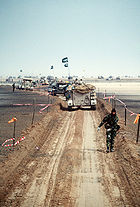
This is a list of Coalition troops killed by country.
 United States - 294 (114 by enemy fire, 145 in accidents, 35 to friendly fire)
 Senegal - 92 (accident)
 United Kingdom - 47 (38 by enemy fire, 9 to friendly fire)
 Saudi Arabia - 18
 Early Modern France - 2
 United Arab Emirates - 6
 Qatar - 3
 Egypt - 1
 Kuwait - 1 (as part of Operation Desert Storm)
Friendly fire
While the death toll among Coalition forces engaging Iraqi combatants was very low, a substantial number of deaths were caused by accidental attacks from other allied units. Of the 148 American troops who died in battle, 24% were killed by friendly fire, a total of 35 service personnel. A further 11 died in detonations of allied munitions. Nine British service personnel were killed in a friendly fire incident when a United States Air ForceA-10 Thunderbolt II
attacked a group of two Warrior
IFV
s.
Gulf War Illness
Many returning coalition soldiers reported illnesses following their action in the Gulf War, a phenomenon known as Gulf War syndrome or Gulf War illness. There has been widespread speculation and disagreement about the causes of the illness and the reported birth defects. Some factors considered as possibilities include exposure to depleted uranium, chemical weapons, anthrax vaccine
s given to deploying soldiers, and/or infectious diseases. Major Michael Donnelly
, a former USAF officer during the Gulf War, helped publicize the syndrome and advocated for veterans' rights in this regard.
Effects of depleted uranium

. DU is a pyrophoric
, genotoxic, and teratogenic heavy metal
. Many have cited its use during the Gulf War as a contributing factor to a number of instances of health issues in both veterans of the conflict and surrounding civilian populations. However, scientific opinion on the risk is mixed.
Highway of Death
On the night of 26–27 February 1991, some Iraqi forces began leaving Kuwait on the main highway north of Al Jahrain a column of some 1,400 vehicles. A patrolling E-8 Joint STARS
aircraft observed the retreating forces and relayed the information to the DDM-8 air operations center in Riyadh, Saudi Arabia. These vehicles and the retreating soldiers were subsequently attacked, resulting in a 60 km stretch of highway strewn with debris—the Highway of Death.
Chuck Horner, Commander of U.S. and allied air operations has written:
Bulldozer assault
Another incident during the war highlighted the question of large-scale Iraqi combat deaths. This was the “bulldozerassault”, wherein two brigades from the 1st Infantry Division (Mechanized)
were faced with a large and complex trench network, as part of the heavily fortified "Saddam Hussein Line." After some deliberation, they opted to use anti-mine plows mounted on tank
s and combat earthmovers to simply plow over and bury alive the defending Iraqi soldiers. One newspaper story reported that the U.S. commanders estimated thousands of Iraqi soldiers surrendered, escaping live burial during the two-day assault 24–25 February 1991.
Patrick Day Sloyan of Newsday reported, "Bradley Fighting Vehicles and Vulcan armored carriers straddled the trench lines and fired into the Iraqi soldiers as the tanks covered them with mounds of sand. 'I came through right after the lead company,' [Col. Anthony] Moreno said. 'What you saw was a bunch of buried trenches with peoples' arms and things sticking out of them. . .'"
However, after the war, the Iraqi government claimed to have found only 44 bodies. In his book The Wars Against Saddam, John Simpson alleges that U.S. forces attempted to cover up this incident.
1991 Palestinian exodus from Kuwait
Kuwait expulsion policy was a response to alignment of Palestinian leader Yasser Arafatand the PLO with Saddam Hussein
, who had earlier invaded Kuwait. Prior to the Gulf War, Palestinians made up about 30% of Kuwait's population
of 2.2 million. The exodus took place during one week in March 1991, following Kuwait's liberation from Iraq
i occupation. Kuwait
expelled about 450,000 Palestinians from its territory, an event, which has become the second largest displacement of Palestinian Arabs ever, and is related as an ethnic cleansing
. By 2006, only a few had returned to Kuwait and today the number of Palestinians living in Kuwait is less than 40,000 (under 3% of the population).
Coalition bombing of Iraq's civilian infrastructure
In the 23 June 1991 edition of the Washington Post, reporter Bart Gellman wrote: "Many of the targets were chosen only secondarily to contribute to the military defeat of [Iraq]. . . . Military planners hoped the bombing would amplify the economic and psychological impact of international sanctions on Iraqi society. . . . They deliberately did great harm to Iraq's ability to support itself as an industrial society. . . ." In the Jan/Feb 1995 edition of Foreign Affairs, French diplomat Eric Rouleau wrote: "[T]he Iraqi people, who were not consulted about the invasion, have paid the price for their government's madness. . . . Iraqis understood the legitimacy of a military action to drive their army from Kuwait, but they have had difficulty comprehending the Allied rationale for using air power to systematically destroy or cripple Iraqi infrastructure and industry: electric power stations (92 percent of installed capacity destroyed), refineries (80 percent of production capacity), petrochemical complexes, telecommunications centers (including 135 telephone networks), bridges (more than 100), roads, highways, railroads, hundreds of locomotives and boxcars full of goods, radio and television broadcasting stations, cement plants, and factories producing aluminum, textiles, electric cables, and medical supplies."Abuse of coalition POWs
During the conflict coalition aircrew shot down over Iraq were displayed as POWson TV, most with visible signs of abuse. Amongst several testimonies to poor treatment, Royal Air Force Tornado
crew John Nichol
and John Peters have both alleged that they were tortured during this time. Nichol and Peters were forced to make statements against the war in front of television cameras. Members of a British Special Forces group named Bravo Two Zero were captured whilst providing information about an Iraqi Supply line of Scud Missiles to coalition forces, only one, Chris Ryan, evaded capture whilst other surviving members of the group were violently tortured. Flight surgeon (later General) Rhonda Cornum was molested by one of her captors after the Blackhawk she was riding in was shot down while searching for a downed F-16 pilot.
Operation Southern Watch
Since the Gulf war, the U.S. has had a continued presence of 5,000 troops stationed in Saudi Arabia - a figure that rose to 10,000 during the 2003 conflict in Iraq.Operation Southern Watch enforced the no-fly zones
over southern Iraq set up after 1991; oil exports through the shipping lanes of the Persian Gulf were protected by the U.S. Fifth Fleet, based in Bahrain
.
Since Saudi Arabia houses the holiest sites in Islam
(Mecca and Medina) — many Muslims were upset at the permanent military presence.
The continued presence of U.S. troops after the Gulf War in Saudi Arabia was one of the stated motivations behind the September 11th terrorist attacks, the Khobar Towers bombing
, as well, the date chosen for the 1998 United States embassy bombings
(7 August), was eight years to the day that American troops were sent to Saudi Arabia. Osama Bin Laden
interpreted the Prophet Muhammad
as banning the "permanent presence of infidels in Arabia".
In 1996, Bin Laden issued a fatwa
, calling for American troops to get out of Saudi Arabia.
In the December 1999 interview with Rahimullah Yusufzai, bin Laden said he felt that Americans were "too near to Mecca" and considered this a provocation to the entire Muslim world.
Gulf war sanctions
On 6 August 1990, after the Iraqi invasion of Kuwait, the U.N. Security Council adopted Resolution 661 which imposed economic sanctions on Iraq, providing for a full trade embargo, excluding medical supplies, food and other items of humanitarian necessity, these to be determined by the Security Council sanctions committee. From 1991 until 2003 the effects of government policy and sanctions regime led to hyperinflation, widespread poverty and malnutrition.
During the latter part of the 1990s the UN considered relaxing the sanctions imposed because of the hardships suffered by ordinary Iraqis. According to UN estimates, between 500,000 and 1.2 million children died during the years of the sanctions.
Draining of the Qurna Marshes
The draining of the Qurna Marshes was an irrigation project in Iraq during and immediately after the Gulf War, to drain a large area of marshes in the Tigris-Euphrates river system. Formerly covering an area of around 3000 square kilometres, the large complex of wetlands were almost completely emptied of water, and the local Shi'ite population relocated, following the Gulf War and 1991 uprisings
. By 2000, United Nations Environment Programme estimated that 90% of the marshlands had disappeared, causing desertification
of over 7500 square miles (19,424.9 km²).
Many international organizations such as the U.N. Human Rights Commission, the Supreme Council of the Islamic Revolution in Iraq, the International Wildfowl and Wetlands Research Bureau, and Middle East Watch have described the project as a political attempt to force the Marsh Arabs
out of the area through water diversion tactics.
Gulf War oil spill
On 23 January, Iraq dumped 400 million USgals (1,514,164.8 m³) of crude oil into the Persian Gulf, causing the largest offshore oil spillin history at that time. It was reported as a deliberate natural resources attack to keep U.S. Marine forces from coming ashore (Missouri and Wisconsin had shelled Failaka Island
during the war to reinforce the idea that there would be an amphibious assault attempt). About 30-40% of this came from Allied raids on Iraqi coastal targets.
Kuwaiti oil fires
The Kuwaiti oil fires were caused by Iraqi military forces setting fire to 700 oil wells as part of a scorched earth policy while retreating from Kuwait in 1991 after conquering the country but being driven out by Coalition military forces. The fires started in January and February 1991 and the last one was extinguished by November 1991.The resulting fires burned out of control because of the dangers of sending in firefighting crews. Land mines had been placed in areas around the oil wells, and a military cleaning of the areas was necessary before the fires could be put out. Somewhere around 6 Moilbbl of oil were lost each day. Eventually, privately contracted crews extinguished the fires, at a total cost of US$1.5 billion to Kuwait. By that time, however, the fires had burned for approximately ten months, causing widespread pollution.
Cost
The cost of the war to the United States was calculated by the United States Congress to be $61.1 billion. About $52 billion of that amount was paid by different countries around the world: $36 billion by Kuwait, Saudi Arabia and other Arab states of the Persian Gulf; $16 billion by Germany and Japan (which sent no combat forces due to their constitutions). About 25% of Saudi Arabia's contribution was paid in the form of in-kind services to the troops, such as foodand transportation. U.S. troops represented about 74% of the combined force, and the global cost was therefore higher.
Cost of Gulf Crisis on Developing Countries and International Response
Apart from the impact on the Gulf States themselves, the resulting economic disruptions after the crisis affected many countries. The ODIundertook a study in 1991 to assess the effects on developing countries and the response of the international community. A Briefing Paper finalized on the day that the conflict ended draws on their findings which had two main conclusions: Many developing countries were severely affected and while there has been a considerable response to the crisis, the distribution of assistance was highly selective.
The ODI
factored in elements of ‘cost’ which included; Oil imports, remittance flows, re-settlement costs, loss of export earnings and tourism. For Egypt
the cost totaled: 1bn – 3% of GDP. Yemen
was badly affected with a cost of 1bn – 10% of GDP, while it cost Jordan
2bn, 32% of GDP.
International response to the crisis on developing countries came with the channeling of aid through The Gulf Crisis Financial Co-ordination Group. They were 24 countries, comprising most of the OECD countries plus some Gulf States: Saudi Arabia
, United Arab Emirates
, Qatar
and Kuwait
. The members of this group agreed to disperse 14bn in development assistance.
The World Bank
responded by speeding up the disbursement of existing project and adjustment loans. The International Monetary Fund
adopted two lending facilities — the Enhanced Structural Adjustment Facility (ESAF) and the Compensatory & Contingency Financing Facility (CCFF). The European Community offered 2 billion in assistance.
Media coverage
The Persian Gulf War was a heavily televisedwar. For the first time people all over the world were able to watch live pictures of missile
s hitting their targets and fighters taking off from aircraft carriers. Allied forces were keen to demonstrate the accuracy of their weapons.
In the United States, the "big three" network anchors led the network news
coverage of the war: ABC
's Peter Jennings
, CBS
's Dan Rather
, and NBC
's Tom Brokaw
were anchoring their evening newscasts when air strikes began on 16 January 1991. ABC News correspondent Gary Shepard, reporting live from Baghdad, told Jennings of the quietness of the city. But, moments later, Shepard was back on the air as flashes of light were seen on the horizon and tracer fire was heard on the ground.
On CBS, viewers were watching a report from correspondent Allen Pizzey, who was also reporting from Baghdad, when the war began. Rather, after the report was finished, announced that there were unconfirmed reports of flashes in Baghdad and heavy air traffic
at bases in Saudi Arabia. On the "NBC Nightly News", correspondent Mike Boettcher
reported unusual air activity in Dhahran, Saudi Arabia. Moments later, Brokaw announced to his viewers that the air attack had begun.
Still, it was CNN which gained the most popularity for their coverage, and indeed its wartime coverage is often cited as one of the landmark events in the development of the network. CNN correspondents John Holliman
and Peter Arnett
and CNN anchor Bernard Shaw
relayed audio reports from the Al-Rashid Hotel as the air strikes began. The network had previously convinced the Iraqi government to allow installation of a permanent audio circuit in their makeshift bureau. When the telephones of all of the other Western TV correspondents went dead during the bombing, CNN was the only service able to provide live reporting. After the initial bombing, Arnett remained behind and was, for a time, the only American TV correspondent reporting from Iraq.
In Britain, the BBC
devoted the FM portion of its national speech radio station BBC Radio 4
to a 18h rolling news format creating Radio 4 News FM. The station was short lived, ending shortly after the President Bush declared the ceasefire and the liberation of Kuwait. However, it paved the way for the later introduction of Radio Five Live.
Two BBC journalists, John Simpson and Bob Simpson
(who, despite sharing a surname, are unrelated), defied their editors and remained in Baghdad to report on the progress of the war. They were responsible for a report which included an "infamous cruise missile that travelled down a street and turned left at a traffic light."
Newspapers all over the world also covered the war and Time magazine
published a special issue dated 28 January 1991, the headline "WAR IN THE GULF" emblazoned on the cover over a picture of Baghdad taken as the war began.
U.S. policy regarding media freedom was much more restrictive than in the Vietnam War
. The policy had been spelled out in a Pentagon document entitled Annex Foxtrot
. Most of the press information came from briefings organized by the military. Only selected journalists were allowed to visit the front lines or conduct interviews with soldiers. Those visits were always conducted in the presence of officers, and were subject to both prior approval by the military and censorship
afterward. This was ostensibly to protect sensitive information from being revealed to Iraq. This policy was heavily influenced by the military's experience with the Vietnam War, in which public opposition within the United States grew throughout the course of the war. It wasn't only the limiting of information in the Middle East, media were also restricting what was shown about the war with more graphic depictions like Ken Jarecke's image of a burnt Iraqi soldier being pulled from the American AP wire where as in Europe it was given extensive coverage.
At the same time, the coverage of this war was new in its instantaneousness. About halfway through the war, Iraq's government decided to allow live satellite transmissions from the country by Western news organizations, and U.S. journalists returned en masse to Baghdad. Tom Aspell of NBC
, Bill Blakemore of ABC, and Betsy Aaron of CBS News filed reports, subject to acknowledged Iraqi censorship. Throughout the war, footage of incoming missiles was broadcast almost immediately.
A British crew from CBS News (David Green and Andy Thompson), equipped with satellite transmission equipment traveled with the front line forces and, having transmitted live TV pictures of the fighting en route, arrived the day before the forces in Kuwait City, broadcasting live television from the city and covering the entrance of the Arab forces the following day.
Alternative media outlets provided views in opposition to the Gulf War. Deep Dish Television compiled segments from independent producers in the U.S. and abroad, and produced a ten hour series that was distributed internationally, called The Gulf Crisis TV Project. The first program of this series War, Oil and Power was compiled and released in 1990, before the war broke out. News World Order was the title of another program in the series; it focused on the complicity of the media in promoting the war, as well as Americans' reactions to the media coverage. In San Francisco, as a local example, Paper Tiger Television West produced a weekly cable television show with highlights of mass demonstrations, artists' actions, lectures, and protests against mainstream media coverage at newspaper offices and television stations. Local media outlets in cities across the country screened similar oppositional media.
The organization Fairness and Accuracy in Reporting (FAIR)
critically analyzed media coverage during the Gulf War in various articles and books, such as the 1991 Gulf War Coverage: The Worst Censorship was at Home.
Technology
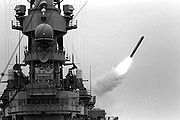
s, such as the United States Air Force guided missile AGM-130, were heralded as key in allowing military strikes to be made with a minimum of civilian casualties compared to previous wars, although they were not used as often as more traditional, less accurate bombs. Specific buildings in downtown Baghdad could be bombed whilst journalists in their hotels watched cruise missiles fly by.
Precision-guided munitions amounted to approximately 7.4% of all bombs dropped by the coalition. Other bombs included cluster bomb
s, which disperse numerous submunitions, and daisy cutters
, 15,000-pound bombs which can disintegrate everything within hundreds of yards.
Global Positioning System
units were important in enabling coalition units to navigate easily across the desert.
Airborne Warning and Control System (AWACS) and satellite communication systems were also important. Two examples of this are the U.S. Navy E-2 Hawkeye
and the U.S. Air Force E-3 Sentry
. Both were used in command and control area of operations. These systems provided essential communications links between the ground forces, air forces, and the navy. It is one of the many reasons why the air war was dominated by the Coalition Forces.
American-made color photocopiers were used to produce some of Iraq's battle plans. Some of the copiers contained concealed high-tech transmitters that revealed their positions to American electronic-warfare air-crafts leading to more precise bombings.
Scud and Patriot missiles
The role of Iraq's Scud missiles featured prominently in the war. Scud is a tactical ballistic missilethat the Soviet Union developed and deployed among the forward deployed Red Army
divisions in East Germany. The role of the Scuds which were armed with nuclear and chemical warheads was to destroy command, control, and communication facilities and delay full mobilisation of Western German and Allied Forces in Germany. It could also be used to directly target ground forces.
Scud missiles utilise inertial guidance which operates for the duration that the engines operate. Iraq used Scud missiles, launching them into both Saudi Arabia and Israel. Some missiles caused extensive casualties, while others caused little damage. Concerns were raised of possible chemical or biological warheads on these rockets, but if they existed they were not used.
Scud missiles are not as effective at delivering chemical payloads as is commonly believed because intense heat during the Scud's flight at approximately Mach 5 denatures most of the chemical payload. Chemical weapons are inherently better suited to being delivered by cruise missiles or fighter bombers. The Scud is best suited to delivering tactical nuclear warheads, a role for which it is as capable today as it was when it was first developed.
The U.S. Patriot missile
was used for the first time in combat. The U.S. military claimed a high effectiveness against Scuds at the time, but later analysis gives figures as low as nine percent, with forty-five percent of the 158 Patriot launches being against debris or false targets. The Dutch Ministry of Defense who also sent Patriot missiles to protect civilians in Israel and Turkey, later disputed the higher claim. Further, there is at least one incident of a software error causing a Patriot missile's failure to engage an incoming Scud, resulting in deaths. Both the U.S. Army and the missile manufacturers maintained the Patriot delivered a "miracle performance" in the Gulf War.
Alternate names for the Gulf War
The following names have been used to describe the conflict itself:- Gulf War and Persian GulfPersian GulfThe Persian Gulf, in Southwest Asia, is an extension of the Indian Ocean located between Iran and the Arabian Peninsula.The Persian Gulf was the focus of the 1980–1988 Iran-Iraq War, in which each side attacked the other's oil tankers...
War have been the most common terms for the conflict used within the Western countries. These names have been used by the overwhelming majority of popular historians and journalistJournalistA journalist collects and distributes news and other information. A journalist's work is referred to as journalism.A reporter is a type of journalist who researchs, writes, and reports on information to be presented in mass media, including print media , electronic media , and digital media A...
s in the United StatesUnited StatesThe United States of America is a federal constitutional republic comprising fifty states and a federal district...
. The major problem with these terms is that the usage is ambiguous, having now been applied to at least three conflicts: see Gulf War (disambiguation)Gulf War (disambiguation)The Gulf War was a war against Iraq by a U.S.-led coalition, following Iraq's invasion of Kuwait.Gulf War or Persian Gulf War may also refer to:* Anglo-Iraqi War * Iran–Iraq War...
. With no consensus of naming, various publications have attempted to refine the name. Some variants include:- War in the Gulf
- 1990 Gulf War
- Gulf War (1990–1991)
- Gulf War Sr.
- First Gulf War: to distinguish it from the U.S. invasion of Iraq2003 invasion of IraqThe 2003 invasion of Iraq , was the start of the conflict known as the Iraq War, or Operation Iraqi Freedom, in which a combined force of troops from the United States, the United Kingdom, Australia and Poland invaded Iraq and toppled the regime of Saddam Hussein in 21 days of major combat operations...
. - Second Gulf War: to distinguish it from the Iran–Iraq War.
- Liberation of Kuwait (ArabicArabic languageArabic is a name applied to the descendants of the Classical Arabic language of the 6th century AD, used most prominently in the Quran, the Islamic Holy Book...
: تحرير الكويت taḥrīr al-kuwayt) is the term used by Kuwait and most of the Arab state members of the Coalition Forces including Saudi ArabiaSaudi ArabiaThe Kingdom of Saudi Arabia , commonly known in British English as Saudi Arabia and in Arabic as as-Sa‘ūdiyyah , is the largest state in Western Asia by land area, constituting the bulk of the Arabian Peninsula, and the second-largest in the Arab World...
, BahrainBahrain' , officially the Kingdom of Bahrain , is a small island state near the western shores of the Persian Gulf. It is ruled by the Al Khalifa royal family. The population in 2010 stood at 1,214,705, including 235,108 non-nationals. Formerly an emirate, Bahrain was declared a kingdom in 2002.Bahrain is...
, Egypt and the United Arab Emirates.
- War of Kuwait and Second Gulf War appear to be the names commonly used in France and Germany.
- Mother ofThe mother of allThe mother of all... has become a stock phrase in English-language public discourse and popular culture. It implies the largest or most significant example of a class, which completely overshadows all other cases in the class...
Battles (ArabicArabic languageArabic is a name applied to the descendants of the Classical Arabic language of the 6th century AD, used most prominently in the Quran, the Islamic Holy Book...
: أم المعارك umm al-ma‘ārik) is the term used by Iraq.
- Other names sometimes used include Iraq-Kuwait conflict and UN-Iraq conflict.
Operational names
Most of the Coalition Force countries used various names for their operations and operational phases of the war. These are sometimes incorrectly used as the overall name of the conflict, especially the US Desert Storm:- Operation Desert Shield was the US operational name for the US buildup of forces and the defense of Saudi Arabia from 2 August 1990, to 16 January 1991.
- Operation Desert Storm was the US name of the airland conflictAirLand BattleAirLand Battle was the overall conceptual framework that formed the basis of the US Army's European warfighting doctrine from 1982 into the late 1990s. AirLand Battle emphasized close coordination between land forces acting as an aggressively maneuvering defense, and air forces attacking...
from 17 January 1991, through 11 April 1991. - Opération DaguetOpération DaguetOpération Daguet was the codename for French operations during the 1991 Gulf War...
was the French name for French armed forces' activities in this conflict. - Operation FRICTIONOperation FRICTIONOperation FRICTION was a Canadian military operation that saw the contribution of 4,500 Canadian Forces personnel to the 1991 Gulf War. The US components, by far the largest, were Operation Desert Shield and Operation Desert Storm....
was the name of the Canadian operations - Operazione Locusta (Italian for LocustLocustLocusts are the swarming phase of short-horned grasshoppers of the family Acrididae. These are species that can breed rapidly under suitable conditions and subsequently become gregarious and migratory...
) was the Italian name for the operations and conflict. - Operation GranbyOperation GranbyOperation Granby was the name given to the British military operations during the Gulf War. 53,462 troops were deployed during the conflict. The total cost of operations was £2.434 billion of which at least £2.049 billion was paid for by other nations such as Kuwait and Saudi Arabia; £200...
was the British name for British armed forces' activities during the operations and conflict. - Operation Desert FarewellOperation Desert FarewellIn the first Gulf War, Operation Desert Farewell was the name given to the return of American units and equipment to the United States in 1991 after the liberation of Kuwait. Some U.S. Marine Corps units were diverted en route to conduct humanitarian assistance in flooded Bangladesh . Also called...
was the name given to the return of US units and equipment to the United States in 1991 after the liberation of Kuwait, sometimes referred to as Operation Desert Calm. - Operation Desert Sabre was the US name for the airland offensive against the Iraqi Army in the Kuwaiti Theater of Operations (the "100-hour war") from 24–28 February 1991, in itself, part of Operation Desert Storm. Operation Desert Sword was an early name for Operation Desert Sabre.
In addition, various phases of each operation may have a unique operational name.
Campaigns
The US divided the conflict into three major campaigns:- Defense of Saudi Arabia for the period 2 August 1990, through 16 January 1991.
- Liberation and Defense of Kuwait for the period 17 January 1991, through 11 April 1991.
- Southwest Asia Cease-Fire for the period 12 April 1991, through 30 November 1995, including Operation Provide ComfortOperation Provide ComfortOperation Provide Comfort and Provide Comfort II were military operations by the United States and some of its Gulf War allies, starting in April 1991, to defend Kurds fleeing their homes in northern Iraq in the aftermath of the Persian Gulf War and deliver humanitarian aid to them.-Operation...
.
See also
- Gulf War military awardsGulf War Military AwardsAfter the 1990-91 Gulf War, many of the forces issued service and campaign awards. This is a list of known awards:-Coalition Forces:Argentina*Medal for the Gulf War 1991Australia*Australian Active Service Medal with Kuwait claspBahrain...
- Iraq disarmament crisis timeline 1990-1996Iraq disarmament crisis timeline 1990-1996-1990:July 24, 1990* Nine days before Iraq's invasion of Kuwait US State Department spokeswoman, Margaret Tutweiller states: "We do not have any defence treaties with Kuwait, and there are no special defence or security commitments to Kuwait."August 2, 1990...
, 1997-2000, 2001-2003 - Iraq–Russia relationsIraq–Russia relationsIraq–Russia relations is the bilateral relationship between Iraq and Russia and, prior to Russia's independence, between Iraq and the Soviet Union.-History:...
- Lion of Babylon tankLion of Babylon tankThe Lion of Babylon or Asad Babil was an Iraqi-built version of the Soviet T-72 main battle tank, assembled in a factory established in the 1980s near Taji, north of Baghdad....
- List of Gulf War military equipment
- Operation SimoomOperation SimoomOperation Simoom was a top secret Polish intelligence operation conducted in Iraq in 1990.In 1990 the CIA asked European intelligence agencies to assist in the withdrawal of six American operatives investigating Iraqi troops movements in Iraq before the Gulf War...
- Organization of United States Air Force Units in the Gulf WarOrganization of United States Air Force Units in the Gulf WarThe 1990-1991 Gulf War was the last major United States Air Force combat operation of the 20th Century. The command and control of forces deployed to the Middle East initially as part of Operation Desert Shield, later engaging in combat operations during Operation Desert Storm, were assigned to...
- SIPRI Arms Transfers Database, Iraq 1973–1990
- Timeline of the Gulf WarTimeline of the Gulf War-1990:* May 28-30: Iraqi dictatorSaddam Hussein says that oil overproduction by Kuwait and United Arab Emirates was an "economic warfare" against Iraq....
Regional wars:
- Iran-Iraq WarIran-Iraq WarThe Iran–Iraq War was an armed conflict between the armed forces of Iraq and Iran, lasting from September 1980 to August 1988, making it the longest conventional war of the twentieth century...
- Al-Anfal CampaignAl-Anfal CampaignThe al-Anfal Campaign , also known as Operation Anfal or simply Anfal, was a genocidal campaign against the Kurdish people in Northern Iraq, led by the Iraqi regime of Saddam Hussein and headed by Ali Hassan al-Majid in the final stages of Iran-Iraq War...
- 1991 uprisings in Iraq1991 uprisings in IraqThe 1991 uprisings in Iraq were a series of anti-governmental rebellions in southern and northern Iraq during the aftermath of the Gulf War. The revolt was fueled by the perception that the power of Iraqi President Saddam Hussein was vulnerable at the time; as well as by heavily fueled anger at...
- List of conflicts in the Middle East
- List of modern conflicts in the Middle East
General:
- Loss of Strength GradientLoss of Strength GradientThe Loss of Strength Gradient was devised by Kenneth Boulding in 1962. He argued that the amount of a nation’s military power that could be brought to bear in any part of the world depended on geographic distance. The Loss of Strength Gradient demonstrated, in graphical form, that the further away...
- Military history of the United StatesMilitary history of the United StatesThe military history of the United States spans a period of over two centuries. During the course of those years, the United States evolved from a new nation fighting the British Empire for independence without a professional military , through a monumental American Civil War to the world's sole...
- Post–World War II air-to-air combat losses
Films
- Dawn of the WorldDawn of the WorldDawn of the World is a feature film written and directed by the Iraqi-French film director Abbas Fahdel.Starring Venice Film Festival revelation Hafsia Herzi and Hiam Abbass , Dawn of the World gives an unexpected account of the multiple impacts of the Iran–Iraq War, the Gulf War and the 1991...
- Bravo Two ZeroBravo Two Zero (film)Bravo Two Zero is a 1999 two hour television miniseries , based on the book of the same name by Andy McNab. The film covers real life events - from the perspective of Andy McNab, patrol commander of Bravo Two Zero, a British SAS patrol , tasked to find Iraqi Scud missile launchers during the Gulf...
- Courage Under FireCourage Under FireCourage Under Fire is a 1996 film directed by Edward Zwick, and starring Denzel Washington, Meg Ryan, Lou Diamond Phillips and Matt Damon. It is one of the first films to depict the 1991 Gulf War.-Plot:...
- The Finest HourThe Finest Hour (film)The Finest Hour is a 1991 war-drama film. The film stars Rob Lowe and Gale Hansen as Navy SEALs-in-training who become best friends. When a woman comes between them, however, it takes a war to bring them back together again.- Cast :...
- JarheadJarhead (film)Jarhead is a 2005 biographical drama war film based on U.S. Marine Anthony Swofford's 1991 Gulf War memoir of the same name, directed by Sam Mendes, starring Jake Gyllenhaal as Swofford with co-stars Jamie Foxx, Peter Sarsgaard, and Chris Cooper. The title comes from the slang term used to refer to...
- Lessons of Darkness
- Live From BaghdadLive from Baghdad (film)Live from Baghdad is a television movie produced in 2002 by HBO. It was directed by Mick Jackson and written by Robert Wiener . The movie was released during the prelude stage of the Iraq War....
- Heroes of Desert StormThe Heroes of Desert StormThe Heroes of Desert Storm is a 1991 film that told the story of Operation Desert Shield and Operation Desert Storm from the point of view of several participants.-Plot:...
- TowelheadTowelhead (film)Towelhead is a 2007 black comedy film written and directed by Alan Ball and based on Alicia Erian's novel of the same name. The film made its world premiere at the Toronto Film Festival on September 8, 2007 under the name Nothing is Private...
- Three Kings
- The Manchurian Candidate (2004 film)The Manchurian Candidate (2004 film)The Manchurian Candidate is a 2004 American thriller film based on the 1959 novel of the same name by Richard Condon, and a reimagining of the previous 1962 film....
- Used as a back drop for the film, The Big LebowskiThe Big LebowskiThe Big Lebowski is a 1998 comedy film written and directed by Joel and Ethan Coen. Jeff Bridges stars as Jeff Lebowski, an unemployed Los Angeles slacker and avid bowler, who is referred to as "The Dude". After a case of mistaken identity, The Dude is introduced to a millionaire also named...
. It is frequently discussed as well. - Used in retconned backstory for The Punisher (2004 film)The Punisher (2004 film)The Punisher is a 2004 American comic book action film, based on the Marvel Comics character of the same name, starring Thomas Jane as the antihero Frank Castle / The Punisher and John Travolta as the villain Howard Saint, a money launderer who orders the death of Castle's entire family...
Novels
- Third Graders At War- Thr true story of a Cavalry Scout in the First Infantry Division
- Braving the Fear - The True Story of Rowdy US Marines in the Gulf War (by Douglas Foster)
- Glass (Pray the Electrons Back to Sand)
- The Fist of GodThe Fist of GodThe Fist of God is a 1994 novel by Frederick Forsyth, mixing known fact with fiction to tell a story of the coalition forces in the Persian Gulf War racing against time to discover the true nature of Saddam Hussein's secret weapon, 'The Fist of God.'...
(by Frederick Forsyth) - To Die In Babylon by Nick Livingston
- Hogs dime novelDime novelDime novel, though it has a specific meaning, has also become a catch-all term for several different forms of late 19th-century and early 20th-century U.S...
series by James Ferro - Burning Desert by Zahida Zaidi
- Bravo Two Zero - The true story of an SAS Patrol behind enemy lines in Iraq (by Andy McNab)
- Summer 1990 Firyal AlShalabi
External links
http://www.thirdgradersatwar.com find out what really happened as told by a Cavalry Scout- Website about the french Daguet Division
- Gulf War Guide - Iraq, U.S., UK Operation Desert storm War site with special features on the war
- Saddam Hussein & the invasion of Kuwait.
- CBC Digital Archives - The 1991 Gulf War
- Master Index of Desert Storm Oral History Interviews by the United States Army Center of Military History
- Bibliography of the Desert Shield and Desert Storm compiled by the United States Army Center of Military History
- Persian Gulf War