
All Topics  
Kyoto Protocol

 
Kyoto Protocol

   Email Print
   Bookmark   Link


Kyoto Protocol


The Kyoto Protocol is a protocol
Protocol (diplomacy)

In international politics, protocol is the etiquette of diplomacy and affairs of state.A protocol is a wiktionary:rule which guides how an activity should be performed, especially in the field of diplomacy....
 to the United Nations Framework Convention on Climate Change
United Nations Framework Convention on Climate Change

The United Nations Framework Convention on Climate Change is an international environmental treaty produced at the United Nations Conference on Environment and Development , informally known as the Earth Summit, held in Rio de Janeiro from 3 to 14 June 1992....
 (UNFCCC or FCCC), an international environment
Environment

Environment may refer to:* Built environment, constructed surroundings that provide the setting for human activity, ranging from the large-scale civic surroundings to the personal places....
al treaty
Treaty

A Treaty is an agreement under international law entered into by actors in international law, namely states and international organizations. A Treaty may also be known as: agreement, protocol, covenant, convention, exchange of letters, etc....
 produced at the United Nations
United Nations

The United Nations is an international organization whose stated aims are to facilitate cooperation in international law, international security, economic development, Social change, human rights and achieving world peace....
 Conference on Environment and Development (UNCED), informally known as the Earth Summit
Earth Summit

The United Nations Conference on Environment and Development, also known as the Rio Summit, Earth Summit was a major United Nations conference held in Rio de Janeiro from June 3 to June 14, 1992....
, held in Rio de Janeiro
Rio de Janeiro

Rio de Janeiro , is the second largest city of Brazil and South America, behind S?o Paulo, and the third largest metropolitan area in South America, behind S?o Paulo and Buenos Aires....
, Brazil
Brazil

Brazil , officially the Federative Republic of Brazil , is a country in South America. It is the List of countries and outlying territories by total area country by geographical area, occupying nearly half of South America, the List of countries by population country, and the fourth most populous democracy in the world....
, from 3–14 June 1992. The treaty is intended to achieve "stabilization of greenhouse gas
Greenhouse gas

Greenhouse gases are gases in an atmosphere that Absorption and Emission radiation within the Infrared#Different regions in the infrared range....
 concentrations in the atmosphere
Atmosphere

An atmosphere is a layer of gases that may surround a material body of sufficient mass, by the gravity of the body, and are retained for a longer duration if gravity is high and the atmosphere's temperature is low....
 at a level that would prevent dangerous anthropogenic interference
Global warming

Global warming is the increase in the Instrumental temperature record of the Earth's near-surface air and the oceans since the mid-twentieth century and its projected continuation....
 with the climate system." The Kyoto Protocol establishes legally binding commitments for the reduction of four greenhouse gases (carbon dioxide
Carbon dioxide

Carbon dioxide is a chemical compound composed of two oxygen atoms covalent bond to a single carbon atom. It is a gas at standard temperature and pressure and exists in Earth's atmosphere in this state....
, methane
Methane

Methane is a chemical compound with the molecular formula . It is the simplest alkane, and the principal component of natural gas. Methane's bond angles are 109.5 degrees....
, nitrous oxide
Nitrous oxide

Nitrous oxide, commonly known as "laughing gas", is a chemical compound with the chemical formula Nitrogen2Oxygen. At room temperature, it is a colorless Flammability gas, with a pleasant, slightly sweet odor and taste....
, sulphur hexafluoride), and two groups of gases (hydrofluorocarbons and perfluorocarbon
Perfluorocarbon

Perfluorocarbons are fluorocarbons, compounds derived from hydrocarbons by replacement of hydrogen atoms by fluorine atoms. PFCs are made up of carbon and fluorine atoms only, such as octafluoropropane, perfluorohexane and perfluorodecalin....
s) produced by "Annex I
United Nations Framework Convention on Climate Change

The United Nations Framework Convention on Climate Change is an international environmental treaty produced at the United Nations Conference on Environment and Development , informally known as the Earth Summit, held in Rio de Janeiro from 3 to 14 June 1992....
" (industrialized) nations, as well as general commitments for all member countries.


Discussion
Ask a question about 'Kyoto Protocol'
Start a new discussion about 'Kyoto Protocol'
Answer questions from other users
Full Discussion Forum


Encyclopedia


The Kyoto Protocol is a protocol
Protocol (diplomacy)

In international politics, protocol is the etiquette of diplomacy and affairs of state.A protocol is a wiktionary:rule which guides how an activity should be performed, especially in the field of diplomacy....
 to the United Nations Framework Convention on Climate Change
United Nations Framework Convention on Climate Change

The United Nations Framework Convention on Climate Change is an international environmental treaty produced at the United Nations Conference on Environment and Development , informally known as the Earth Summit, held in Rio de Janeiro from 3 to 14 June 1992....
 (UNFCCC or FCCC), an international environment
Environment

Environment may refer to:* Built environment, constructed surroundings that provide the setting for human activity, ranging from the large-scale civic surroundings to the personal places....
al treaty
Treaty

A Treaty is an agreement under international law entered into by actors in international law, namely states and international organizations. A Treaty may also be known as: agreement, protocol, covenant, convention, exchange of letters, etc....
 produced at the United Nations
United Nations

The United Nations is an international organization whose stated aims are to facilitate cooperation in international law, international security, economic development, Social change, human rights and achieving world peace....
 Conference on Environment and Development (UNCED), informally known as the Earth Summit
Earth Summit

The United Nations Conference on Environment and Development, also known as the Rio Summit, Earth Summit was a major United Nations conference held in Rio de Janeiro from June 3 to June 14, 1992....
, held in Rio de Janeiro
Rio de Janeiro

Rio de Janeiro , is the second largest city of Brazil and South America, behind S?o Paulo, and the third largest metropolitan area in South America, behind S?o Paulo and Buenos Aires....
, Brazil
Brazil

Brazil , officially the Federative Republic of Brazil , is a country in South America. It is the List of countries and outlying territories by total area country by geographical area, occupying nearly half of South America, the List of countries by population country, and the fourth most populous democracy in the world....
, from 3–14 June 1992. The treaty is intended to achieve "stabilization of greenhouse gas
Greenhouse gas

Greenhouse gases are gases in an atmosphere that Absorption and Emission radiation within the Infrared#Different regions in the infrared range....
 concentrations in the atmosphere
Atmosphere

An atmosphere is a layer of gases that may surround a material body of sufficient mass, by the gravity of the body, and are retained for a longer duration if gravity is high and the atmosphere's temperature is low....
 at a level that would prevent dangerous anthropogenic interference
Global warming

Global warming is the increase in the Instrumental temperature record of the Earth's near-surface air and the oceans since the mid-twentieth century and its projected continuation....
 with the climate system." The Kyoto Protocol establishes legally binding commitments for the reduction of four greenhouse gases (carbon dioxide
Carbon dioxide

Carbon dioxide is a chemical compound composed of two oxygen atoms covalent bond to a single carbon atom. It is a gas at standard temperature and pressure and exists in Earth's atmosphere in this state....
, methane
Methane

Methane is a chemical compound with the molecular formula . It is the simplest alkane, and the principal component of natural gas. Methane's bond angles are 109.5 degrees....
, nitrous oxide
Nitrous oxide

Nitrous oxide, commonly known as "laughing gas", is a chemical compound with the chemical formula Nitrogen2Oxygen. At room temperature, it is a colorless Flammability gas, with a pleasant, slightly sweet odor and taste....
, sulphur hexafluoride), and two groups of gases (hydrofluorocarbons and perfluorocarbon
Perfluorocarbon

Perfluorocarbons are fluorocarbons, compounds derived from hydrocarbons by replacement of hydrogen atoms by fluorine atoms. PFCs are made up of carbon and fluorine atoms only, such as octafluoropropane, perfluorohexane and perfluorodecalin....
s) produced by "Annex I
United Nations Framework Convention on Climate Change

The United Nations Framework Convention on Climate Change is an international environmental treaty produced at the United Nations Conference on Environment and Development , informally known as the Earth Summit, held in Rio de Janeiro from 3 to 14 June 1992....
" (industrialized) nations, as well as general commitments for all member countries. , 183 parties
List of Kyoto Protocol signatories

As of February 2009, 181 states have signed and ratified the Kyoto Protocol to the United Nations Framework Convention on Climate Change, aimed at combating global warming....
 have ratified the protocol, which was initially adopted for use on 11 December 1997 in Kyoto
Kyoto

Sorry, no overview for this topic
, Japan
Japan

Japan is an island country in East Asia. Located in the Pacific Ocean, it lies to the east of the Sea of Japan, People's Republic of China, North Korea, South Korea and Russia, stretching from the Sea of Okhotsk in the north to the East China Sea and Taiwan in the south....
 and which entered into force on 16 February 2005. Under Kyoto, industrialized countries agreed to reduce their collective GHG emissions by 5.2% compared to the year 1990. National limitations range from 8% reductions for the European Union
European Union

The European Union is an economic and political union of 27 European Union member state, located primarily in Europe. It was established by the Treaty of Maastricht on 1 November 1993 upon the foundations of the pre-existing European Economic Community....
 and some others to 7% for the United States, 6% for Japan, and 0% for Russia. The treaty permitted GHG emission increases of 8% for Australia and 10% for Iceland.

Kyoto includes defined "flexible mechanisms" such as Emissions Trading
Emissions trading

Emissions trading is an administration approach used to control pollution by providing economics incentives for achieving reductions in the emissions of pollutants....
, the Clean Development Mechanism
Clean Development Mechanism

The Clean Development Mechanism is an arrangement under the Kyoto Protocol allowing industrialised countries with a greenhouse gas reduction commitment to invest in projects that reduce emissions in developing countries as an alternative to more expensive emission reductions in their own countries....
 and Joint Implementation
Joint Implementation

Joint implementation is one of three flexibility mechanisms set forth in the Kyoto Protocol to help countries with binding greenhouse gas emissions targets meet their obligations....
 to allow Annex I economies to meet their greenhouse gas (GHG) emission limitations by purchasing GHG emission reductions credits from elsewhere, through financial exchanges, projects that reduce emissions in non-Annex I economies, from other Annex I countries, or from Annex I countries with excess allowances. In practice this means that Non-Annex I economies have no GHG emission restrictions, but have financial incentives to develop GHG emission reduction projects to receive "carbon credit
Carbon credit

Carbon credits are a key component of national and international emissions trading schemes that have been implemented to mitigate global warming....
s" that can then be sold to Annex I buyers, encouraging sustainable development
Sustainable development

Sustainable development is a pattern of resource use that aims to meet human needs while preserving the environment so that these needs can be met not only in the present, but in the indefinite future....
. In addition, the flexible mechanisms allow Annex I nations with efficient, low GHG-emitting industries, and high prevailing environmental standard
Environmental standard

An environmental standard is a policy guideline that regulates the effect of human activity upon the environment. Standardizations may specify a desired state or limit alterations ....
s to purchase carbon credits on the world market instead of reducing greenhouse gas emissions domestically. Annex I entities typically will want to acquire carbon credits as cheaply as possible, while Non-Annex I entities want to maximize the value of carbon credits generated from their domestic Greenhouse Gas Projects.

Among the Annex I signatories, all nations have established Designated National Authorities to manage their greenhouse gas portfolios; countries including Japan
Japan

Japan is an island country in East Asia. Located in the Pacific Ocean, it lies to the east of the Sea of Japan, People's Republic of China, North Korea, South Korea and Russia, stretching from the Sea of Okhotsk in the north to the East China Sea and Taiwan in the south....
, Canada
Canada

Canada is a country occupying most of northern North America, extending from the Atlantic Ocean in the east to the Pacific Ocean in the west and northward into the Arctic Ocean....
, Italy
Italy

Italy , officially the Italian Republic , is a country located on the Italian Peninsula in Southern Europe and on the two largest islands in the Mediterranean Sea, Sicily and Sardinia....
, the Netherlands
Netherlands

The Netherlands is a country that is part of the Kingdom of the Netherlands. It is a parliamentary democratic constitutional monarchy. The Netherlands is located in North-West Europe, and bordered by the North Sea to the north and west, Belgium to the south, and Germany to the east....
, Germany
Germany

Germany , officially the Federal Republic of Germany , is a country in Central Europe. It is bordered to the north by the North Sea, Denmark, and the Baltic Sea; to the east by Poland and the Czech Republic; to the south by Austria and Switzerland; and to the west by France, Luxembourg, Belgium, and the Netherlands....
, France
France

France , officially the French Republic , is a country whose Metropolitan France is located in Western Europe and that also comprises various Overseas departments and territories of France....
, Spain
Spain

Spain or the Kingdom of Spain , is a country located in Southern Europe on the Iberian Peninsula.The Spanish constitution does not establish any official denomination of the country, even though Espa?a , Estado espa?ol and Naci?n espa?ola are used interchangeably....
 and others are actively promoting government carbon funds, supporting multilateral carbon funds intent on purchasing Carbon Credits from Non-Annex I countries, and are working closely with their major utility, energy, oil & gas and chemicals conglomerates to acquire Greenhouse Gas Certificates as cheaply as possible. Virtually all of the non-Annex I countries have also established Designated National Authorities to manage the Kyoto process, specifically the "CDM process" that determines which GHG Projects they wish to propose for accreditation by the CDM Executive Board.

Objectives

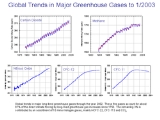
Major Greenhouse Gas Trends
The objective is to achieve "stabilization of greenhouse gas concentrations in the atmosphere at a level that would prevent dangerous anthropogenic interference with the climate system."

The Intergovernmental Panel on Climate Change
Intergovernmental Panel on Climate Change

The Intergovernmental Panel on Climate Change is a scientific intergovernmental body tasked to risk management of climate change caused by human activity....
 (IPCC) has predicted an average global rise in temperature
Temperature

In physics, temperature is a physical property of a Physical system that underlies the common notions of hot and cold; something that feels hotter generally has the greater temperature....
 of 1.4°C
Celsius

Celsius is a temperature scale that is named after the Swedish astronomer Anders Celsius , who developed a similar temperature scale two years before his death....
 (2.5°F
Fahrenheit

Fahrenheit is a temperature scale named after the physicist Daniel Gabriel Fahrenheit , who proposed it in 1724. Today, the scale has largely been replaced by the Celsius scale; it is still in use for non-scientific purposes in the United States and a few other countries such as Belize....
) to 5.8°C (10.4°F
Fahrenheit

Fahrenheit is a temperature scale named after the physicist Daniel Gabriel Fahrenheit , who proposed it in 1724. Today, the scale has largely been replaced by the Celsius scale; it is still in use for non-scientific purposes in the United States and a few other countries such as Belize....
) between 1990 and 2100.

Proponents also note that Kyoto is a first step as requirements to meet the UNFCCC will be modified until the objective is met, as required by UNFCCC Article 4.2(d).

The treaty was negotiated in Kyoto, Japan in December 1997, opened for signature on 16 March 1998, and closed on 15 March 1999. The agreement came into force on 16 February 2005 following ratification by Russia
Russia

Russia , or the Russian Federation , is a list of countries spanning more than one continent country extending over much of northern Eurasia....
 on 18 November 2004. As of May 2008, a total of 181 countries and 1 regional economic integration organization (the EC
EC

EC may mainly refer to the European Community - a supranational organisation established in Europe to achieve non-inflational sustainable growth, high employment level, equal opportunities for men and women, high competitiveness and convergence level, high level of environmental protection, higher quality of life and solidarity among its memb...
) have ratified the agreement (representing over 61.6% of emissions from Annex I countries).

According to article 25 of the protocol, it enters into force "on the ninetieth day after the date on which not less than 55 Parties to the Convention, incorporating Parties included in Annex I which accounted in total for at least 55% of the total carbon dioxide emissions for 1990 of the Parties included in Annex I, have deposited their instruments of ratification, acceptance, approval or accession." Of the two conditions, the "55 parties" clause was reached on 23 May 2002 when Iceland
Iceland

Iceland, officially the Republic of Iceland , is an island country located in the North Atlantic Ocean between mainland Europe and Greenland....
 ratified. The ratification by Russia on 18 November 2004 satisfied the "55%" clause and brought the treaty into force, effective 16 February 2005. Australian Prime Minister Kevin Rudd
Kevin Rudd

Kevin Michael Rudd is the 26th and current Prime Minister of Australia of Australia and federal leader of the centre-left Australian Labor Party ....
 ratified the Kyoto protocol on 3 December 2007. This came into effect after 90 days (the end of March 2008), as is stated in the guidelines set by the United Nations
United Nations

The United Nations is an international organization whose stated aims are to facilitate cooperation in international law, international security, economic development, Social change, human rights and achieving world peace....
.

The five principal concepts of the Kyoto Protocol are:

  • Commitments. The heart of the Protocol lies in establishing commitments for the reduction of greenhouse gases that are legally binding for Annex I countries, as well as general commitments for all member countries.


  • Implementation. In order to meet the objectives of the Protocol, Annex I countries are required to prepare policies and measures for the reduction of greenhouse gases in their respective countries. In addition, they are required to increase the absorption of these gases and utilize all mechanisms available, such as joint implementation, the clean development mechanism and emissions trading, in order to be rewarded with credits that would allow more greenhouse gas emissions at home.


  • Minimizing Impacts on Developing Countries by establishing an adaptation fund for climate change.


  • Accounting, Reporting and Review in order to ensure the integrity of the Protocol.


  • Compliance. Establishing a Compliance Committee to enforce compliance with the commitments under the Protocol.


Details of the agreement

According to a press release from the United Nations Environment Programme
United Nations Environment Programme

The UN Environment Programme coordinates United Nations environmental activities, assisting developing countries in implementing environmentally sound policies and encourages sustainable development through sound environmental practices....
:

"The Kyoto Protocol is an agreement under which industrialized countries will reduce their collective emissions of greenhouse gas
Greenhouse gas

Greenhouse gases are gases in an atmosphere that Absorption and Emission radiation within the Infrared#Different regions in the infrared range....
es by 5.2% compared to the year 1990 (but note that, compared to the emissions levels that would be expected by 2010 without the Protocol, this limitation represents a 29% cut). The goal is to lower overall emissions of six greenhouse gases - carbon dioxide
Carbon dioxide

Carbon dioxide is a chemical compound composed of two oxygen atoms covalent bond to a single carbon atom. It is a gas at standard temperature and pressure and exists in Earth's atmosphere in this state....
, methane
Methane

Methane is a chemical compound with the molecular formula . It is the simplest alkane, and the principal component of natural gas. Methane's bond angles are 109.5 degrees....
, nitrous oxide
Nitrous oxide

Nitrous oxide, commonly known as "laughing gas", is a chemical compound with the chemical formula Nitrogen2Oxygen. At room temperature, it is a colorless Flammability gas, with a pleasant, slightly sweet odor and taste....
, sulfur hexafluoride
Sulfur hexafluoride

Sulfur hexafluoride is an inorganic compound with the formula . It is a colorless, odorless, non-toxicity and non-flammable gas . has an octahedral geometry, consisting of six fluorine atoms attached to a central sulfur atom....
, hydrofluorocarbons, and perfluorocarbon
Perfluorocarbon

Perfluorocarbons are fluorocarbons, compounds derived from hydrocarbons by replacement of hydrogen atoms by fluorine atoms. PFCs are made up of carbon and fluorine atoms only, such as octafluoropropane, perfluorohexane and perfluorodecalin....
s - averaged over the period of 2008-2012. National limitations range from 8% reductions for the European Union and some others to 7% for the US, 6% for Japan, 0% for Russia, and permitted increases of 8% for Australia and 10% for Iceland.


It is an agreement negotiated as an amendment to the United Nations Framework Convention on Climate Change
United Nations Framework Convention on Climate Change

The United Nations Framework Convention on Climate Change is an international environmental treaty produced at the United Nations Conference on Environment and Development , informally known as the Earth Summit, held in Rio de Janeiro from 3 to 14 June 1992....
 (UNFCCC, which was adopted at the Earth Summit
Earth Summit

The United Nations Conference on Environment and Development, also known as the Rio Summit, Earth Summit was a major United Nations conference held in Rio de Janeiro from June 3 to June 14, 1992....
 in Rio de Janeiro
Rio de Janeiro

Rio de Janeiro , is the second largest city of Brazil and South America, behind S?o Paulo, and the third largest metropolitan area in South America, behind S?o Paulo and Buenos Aires....
 in 1992). All parties to the UNFCCC can sign or ratify the Kyoto Protocol, while non-parties to the UNFCCC cannot. The Kyoto Protocol was adopted at the third session of the Conference of Parties to the UNFCCC (COP3) in 1997 in Beijing, China]].

Most provisions of the Kyoto Protocol apply to developed countries, listed in Annex I to the UNFCCC. Emission figures exclude international aviation and shipping.

Common but differentiated responsibility

The United Nations Framework Convention on Climate Change agreed to a set of a "common but differentiated responsibilities." The parties agreed that:

  1. The largest share of historical and current global emissions of greenhouse gases has originated in developed countries;
  2. Per capita emissions in developing countries are still relatively low, and
  3. The share of global emissions originating in developing countries will grow to meet their social and development needs.


In other words, China, India, and other developing countries were not included in any numerical limitation of the Kyoto Protocol because they were not the main contributors to the greenhouse gas emissions during the pre-treaty industrialization period. However, even without the commitment to reduce according to the Kyoto target, developing countries do share the common responsibility that all countries have in reducing emissions.

There will be a mechanism of "compliance", which means a "monitoring compliance with the commitments and penalties for non compliance."

Financial commitments

The Protocol also reaffirms the principle that developed countries have to pay billions of dollars, and supply technology to other countries for climate-related studies and projects. This was originally agreed in the UNFCCC.

Emissions trading

Kyoto is a 'cap and trade' system that imposes national caps on the emissions of Annex I countries. On average, this cap requires countries to reduce their emissions 5.2% below their 1990 baseline over the 2008 to 2012 period. Although these caps are national-level commitments, in practice most countries will devolve their emissions targets to individual industrial entities, such as a power plant or paper factory. One example of a 'cap and trade' system is the 'EU ETS'. Other schemes may follow suit in time.

This means that the ultimate buyers of credits
Carbon credit

Carbon credits are a key component of national and international emissions trading schemes that have been implemented to mitigate global warming....
 are often individual companies that expect their emissions to exceed their quota (their Assigned Allocation Units, AAUs or 'allowances' for short). Typically, they will purchase credits directly from another party with excess allowances, from a broker, from a JI/CDM developer, or on an exchange.

National governments, some of whom may not have devolved responsibility for meeting Kyoto obligations to industry, and that have a net deficit of allowances, will buy credits for their own account, mainly from JI/CDM developers. These deals are occasionally done directly through a national fund or agency, as in the case of the Dutch government's ERUPT programme, or via collective funds such as the World Bank’s Prototype Carbon Fund (PCF
PCF

The acronym PCF may refer to:* Fast Patrol Craft, a small, shallow draft water vessel* French Communist Party, the French Communist Party* Prepaid Charging Function , which is used to handle the accounts of PAYG subscribers...
). The PCF, for example, represents a consortium of six governments and 17 major utility and energy companies on whose behalf it purchases credits.

Since allowances and carbon credits are tradeable instruments with a transparent price, financial investors can buy them on the spot market
Spot market

The spot market or cash market is a commodities or securities market in which goods are sold for cash and delivered immediately. Contracts bought and sold on these markets are immediately effective....
 for speculation purposes, or link them to futures contracts. A high volume of trading in this secondary market helps price discovery and liquidity, and in this way helps to keep down costs and set a clear price signal in CO2 which helps businesses to plan investments. This market has grown substantially, with banks, brokers, funds, arbitrageurs and private traders now participating in a market valued at about $60 billion in 2007. Emissions Trading PLC, for example, was floated on the London Stock Exchange
London Stock Exchange

The London Stock Exchange or LSE is a stock exchange located in London, United Kingdom. Founded in 1801, it is one of the largest stock exchanges in the world, with many overseas listings as well as British companies....
's AIM market in 2005 with the specific remit of investing in emissions instruments.

Although Kyoto created a framework and a set of rules for a global carbon market, there are in practice several distinct schemes or markets in operation today, with varying degrees of linkages among them.

Kyoto enables a group of several Annex I countries to join together to create a market-within-a-market. The EU elected to be treated as such a group, and created the EU Emissions Trading Scheme (ETS). The EU ETS uses EAUs (EU Allowance Units), each equivalent to a Kyoto AAU. The scheme went into operation on 1 January 2005, although a forward market has existed since 2003.

The UK established its own learning-by-doing voluntary scheme, the UK ETS, which ran from 2002 through 2006. This market existed alongside the EU's scheme, and participants in the UK scheme have the option of applying to opt out of the first phase of the EU ETS, which lasts through 2007.

The sources of Kyoto credits are the Clean Development Mechanism
Clean Development Mechanism

The Clean Development Mechanism is an arrangement under the Kyoto Protocol allowing industrialised countries with a greenhouse gas reduction commitment to invest in projects that reduce emissions in developing countries as an alternative to more expensive emission reductions in their own countries....
 (CDM) and Joint Implementation
Joint Implementation

Joint implementation is one of three flexibility mechanisms set forth in the Kyoto Protocol to help countries with binding greenhouse gas emissions targets meet their obligations....
 (JI) projects. The CDM allows the creation of new carbon credits by developing emission reduction projects in Non-Annex I countries, while JI allows project-specific credits to be converted from existing credits within Annex I countries. CDM projects produce Certified Emission Reductions (CERs), and JI projects produce Emission Reduction Units (ERUs), each equivalent to one AAU. Kyoto CERs are also accepted for meeting EU ETS obligations, and ERUs will become similarly valid from 2008 for meeting ETS obligations (although individual countries may choose to limit the number and source of CER/JIs they will allow for compliance purposes starting from 2008). CERs/ERUs are overwhelmingly bought from project developers by funds or individual entities, rather than being exchange-traded like allowances.

Since the creation of Kyoto instruments is subject to a lengthy process of registration and certification by the UNFCCC, and the projects themselves require several years to develop, this market is at this point largely a forward market where purchases are made at a discount to their equivalent currency, the EUA, and are almost always subject to certification and delivery (although up-front payments are sometimes made). According to IETA, the market value of CDM/JI credits transacted in 2004 was EUR 245 m; it is estimated that more than EUR 620 m worth of credits were transacted in 2005.

Several non-Kyoto carbon markets are in existence or being planned, and these are likely to grow in importance and numbers in the coming years. These include the New South Wales Greenhouse Gas Abatement Scheme
New South Wales Greenhouse Gas Abatement Scheme

The New South Wales Greenhouse Gas Abatement Scheme , which commenced on 1 January, 2003, is a mandatory greenhouse gas Trade scheme that aims to lower greenhouse gas emissions to 7.27 tonnes of carbon dioxide per capita by the year 2007....
, the Regional Greenhouse Gas Initiative
Regional Greenhouse Gas Initiative

name = Regional Greenhouse Gas Initiative|image=|image_border =|size =|caption =|abbreviation = RGGI or ReGGIe|motto=...
 and Western Climate Initiative
Western Climate Initiative

The Western Climate Initiative or WCI is an initiative—started by states and provinces along the western rim of North America—to combat climate change caused by global warming, independent of their national governments....
 in the United States and Canada, the Chicago Climate Exchange
Chicago Climate Exchange

Chicago Climate Exchange is North America?s only voluntary, legally binding greenhouse gas emissions trading for emission sources and offset projects in North America and Brazil....
 and the State of California’s recent initiative
Global Warming Solutions Act of 2006

The Global Warming Solutions Act of 2006 is an Environmentalism law in California, wikt:sign into law by Governor of California Arnold Schwarzenegger on September 27, 2006....
 to reduce emissions.

These initiatives, taken together may create a series of partly-linked markets, rather than a single carbon market. The common theme across most of them is the adoption of market-based mechanisms centered on carbon credits that represent a reduction of CO2 emissions. The fact that some of these initiatives have similar approaches to certifying their credits makes it conceivable that carbon credits in one market may in the long run be tradeable in other schemes. This would broaden the current carbon market far more than the current focus on the CDM/JI and EU ETS domains. An obvious precondition, however, is a realignment of penalties and fines to similar levels,since these create an effective ceiling for each market.

Revisions

The protocol left several issues open to be decided later by the sixth Conference of Parties (COP). COP6 attempted to resolve these issues at its meeting in the Hague
The Hague

The Hague is the third largest city in the Netherlands after Amsterdam and Rotterdam, with a population of 475,904 and an area of approximately 100 km?....
 in late 2000, but was unable to reach an agreement due to disputes between the European Union on the one hand (which favoured a tougher agreement) and the United States, Canada, Japan and Australia on the other (which wanted the agreement to be less demanding and more flexible).

In 2001, a continuation of the previous meeting (COP6bis) was held in Bonn
Bonn

Bonn is the 19th largest city in Germany. Located about 20 kilometres south of Cologne on the river Rhine in the Federal State of North Rhine-Westphalia, it was the Capital of Germany West Germany from 1949 to 1990 and the official seat of government of united Germany from 1990 to 1999....
 where the required decisions were adopted. After some concessions, the supporters of the protocol (led by the European Union
European Union

The European Union is an economic and political union of 27 European Union member state, located primarily in Europe. It was established by the Treaty of Maastricht on 1 November 1993 upon the foundations of the pre-existing European Economic Community....
) managed to get Japan
Japan

Japan is an island country in East Asia. Located in the Pacific Ocean, it lies to the east of the Sea of Japan, People's Republic of China, North Korea, South Korea and Russia, stretching from the Sea of Okhotsk in the north to the East China Sea and Taiwan in the south....
 and Russia
Russia

Russia , or the Russian Federation , is a list of countries spanning more than one continent country extending over much of northern Eurasia....
 in as well by allowing more use of carbon dioxide sinks.

COP7 was held from 29 October 2001 through 9 November 2001 in Marrakech
Marrakech

Marrakesh or Marrakech , known as the "Red City", is an important city/Wiktionary:medina in Morocco. It has a population of 1,036,500 , and is the capital of the mid-southwestern economic region of Marrakech-Tensift-Al Haouz , near the foothills of the snow-capped Atlas Mountains....
 to establish the final details of the protocol.

The first Meeting of the Parties to the Kyoto Protocol (MOP1) was held in Montreal
Montreal

Montreal, or Montr?al, is the largest city in the Provinces and territories of Canada of Quebec and the List of largest cities and second largest cities by country List of the 100 largest municipalities in Canada by population....
 from 28 November to 9 December 2005, along with the 11th conference of the Parties to the UNFCCC (COP11). See United Nations Climate Change Conference.

The 3 December 2007, Australia ratified the protocol during the first day of the COP13 in Bali.

Of the signatories, 36 developed C.G.
Contact Group

The Contact Group is the name for an informal grouping of influential countries that have a significant interest in policy developments in the Balkans....
 countries (plus the EU
European Union

The European Union is an economic and political union of 27 European Union member state, located primarily in Europe. It was established by the Treaty of Maastricht on 1 November 1993 upon the foundations of the pre-existing European Economic Community....
 as a party in the European Union
European Union

The European Union is an economic and political union of 27 European Union member state, located primarily in Europe. It was established by the Treaty of Maastricht on 1 November 1993 upon the foundations of the pre-existing European Economic Community....
)agreed to a 10% emissions increase for Iceland
Iceland

Iceland, officially the Republic of Iceland , is an island country located in the North Atlantic Ocean between mainland Europe and Greenland....
; but, since the EU's member states each have individual obligations, much larger increases (up to 27%) are allowed for some of the less developed EU countries (see below #Increase in greenhouse gas emission since 1990). Reduction limitations expire in 2013.

Enforcement

If the Enforcement Branch determines that an Annex I country is not in compliance with its emissions limitation, then that country is required to make up the difference plus an additional 30%. In addition, that country will be suspended from making transfers under an emissions trading program.

Current positions of governments

Carbon Emission By Region

Australia

Australia's new Rudd government
Rudd Government

File:Firstruddministry.jpgThe Rudd Government refers to the federal Government of Australia during Kevin Rudd Prime minister of Australia. This government began on 24 November 2007 when the Australian Labor Party won the Australian federal election, 2007....
 elected after the November 2007 election fully supports the protocol and Prime Minister Kevin Rudd
Kevin Rudd

Kevin Michael Rudd is the 26th and current Prime Minister of Australia of Australia and federal leader of the centre-left Australian Labor Party ....
 signed the instrument of ratification immediately after assuming office on 3 December 2007, just before the meeting of the UN Framework Convention on Climate Change
2007 United Nations Climate Change Conference

The 2007 United Nations Climate Change Conference took place at the Bali International Conference Centre, Nusa Dua, in Bali, Indonesia, between December 3 and December 15, 2007 ....
; it took effect in March, 2008. When still in Opposition
Opposition (Australia)

Her Majesty's Loyal Opposition, commonly known as The Opposition, in Australia fulfils the same function as the official opposition in other Commonwealth of Nations monarchy....
, Kevin Rudd commissioned Professor Ross Garnaut
Ross Garnaut

Dr Ross Garnaut Order of Australia BA , PhD is a professor of economics at the Australian National University.On 30 April 2007 the State and Territory Governments of Australia, at the request of Kevin Rudd, then leader of the Australian Labor Party and Leader of the Opposition, appointed Professor Garnaut to examine the claimed impacts of...
 to report into the economic issues of reducing greenhouse gas emissions. Garnaut's report was handed to the Australian Government on September 30, 2008. The Rudd Government's position contrasts with the former Australian government
Howard Government

The Howard Government refers to the federal Executive Government of Australia for the 11 years that John Howard was Prime Minister of Australia....
, which declined to ratify the Agreement arguing that the protocol would cost Australians jobs, and due to countries with booming economies and massive populations such as China and India not having any reduction obligations. Further, it was claimed that Australia was already doing enough to cut emissions; having pledged $300 million to reduce Greenhouse gas emissions over three years.

Analysis has projected Australia’s greenhouse gas emissions at 109% of the 1990 emissions level over the period 2008–12, calculated including the effects of Land use, land-use change and forestry
Land Use, Land-Use Change and Forestry

"Land use, land-use change and forestry " is defined by the UN Climate Change Secretariat as "A greenhouse gas inventory sector that covers emissions and removals of greenhouse gases resulting from direct human-induced land use, land-use change and forestry activities." LULUCF has impacts on the global carbon cycle and as such these activities can...
 (LULUCF). This is slightly above its 108% Kyoto Protocol limitation. As of 2007, the UNFCCC is reporting that Australia's 2004 greenhouse gas emissions were at 125.6% of 1990 levels, calculated without the LULUCF correction.

The previous Australian Government, along with the United States, agreed to sign the Asia Pacific Partnership on Clean Development and Climate at the ASEAN
Association of Southeast Asian Nations

The Association of Southeast Asian Nations, commonly abbreviated ASEAN , is a geo-political and economic organization of 10 countries located in Southeast Asia, which was formed on 8 August 1967 by Indonesia, Malaysia, the Philippines, Singapore and Thailand....
 regional forum on 28 July 2005. Furthermore, the Australian state of New South Wales
New South Wales

New South Wales is Australia's oldest and most populous States and territories of Australia, located in the south-east of the country, north of Victoria and south of Queensland....
 (NSW) commenced The NSW Greenhouse Gas Abatement Scheme (GGAS). This mandatory greenhouse gas emissions trading scheme commenced on 1 January 2003 and is currently being trialled by the state government in NSW alone. Uniquely this scheme allows Accredited Certificate Providers (ACP) to trade emissions from householders in the state. As of 2006 the scheme is still in place despite the outgoing Prime Minister
John Howard

John Winston Howard, Order of Australia was the 25th Prime Minister of Australia from 11 March 1996 to 3 December 2007. He is the second-longest serving Australian Prime Minister after Robert Menzies....
's clear dismissal of emissions trading as a credible solution to climate change. Following the example of NSW, the National Emissions Trading Scheme (NETS) has been established as an initiative of State and Territory Governments of Australia, all of which have Labor Party governments, except Western Australia. The focus of NETS is to bring into existence an intra-Australian carbon trading scheme and to coordinate policy developments to this end. As the text of the Constitution of Australia
Constitution of Australia

The Constitution of Australia is the law under which the Australian Government of Australia operates. It consists of several documents. The most important is the Constitution of the Commonwealth of Australia....
, does not refer specifically to environmental matters (apart from water), the allocation of responsibility is resolved at a political level. During the later years of the Howard administration (1996-2007) the Labor governed States took steps to establish a NETS (a) to take action in a field where there were few mandatory federal steps being taken and (b) as a means of facilitating ratification of the Kyoto Protocol by the incoming Labor Government.

Greenpeace
Greenpeace

Greenpeace is an international non-governmental organization for the protection and conservation of the environment. Greenpeace utilizes direct action, lobbying and research to achieve its goals....
 have called Clause 3.7 of the Kyoto Protocol the "Australia Clause", as Australia was the major beneficiary. The clause allows for Annex 1 countries with high rates of land clearing in 1990 to consider that year a base level. Greenpeace argues that Australia had extremely high levels of land clearing in 1990, and that this meant that Australia's "baseline" was unusually high compared to other countries.

Canada

On 17 December 2002, Canada
Canada

Canada is a country occupying most of northern North America, extending from the Atlantic Ocean in the east to the Pacific Ocean in the west and northward into the Arctic Ocean....
 ratified the treaty that came into force in February 2005, requiring it to reduce emissions to 6% below 1990 levels during the 2008-2012 commitment period. At that time, numerous polls showed support for the Kyoto protocol at around 70%. Despite strong public support, there was still some opposition, particularly by the Canadian Alliance
Canadian Alliance

The Canadian Alliance , formally the Canadian Reform Conservative Alliance , was a Canada Conservatism political party that existed from 2000 to 2003....
, precursor to the governing Conservative Party
Conservative Party of Canada

The Conservative Party of Canada , colloquially known as the Tories, is a major political party in Canada, formed by the merger of the Canadian Alliance and the Progressive Conservative Party of Canada....
, some business groups, and energy concerns, using arguments similar to those being used in the U.S.. In particular, there was a fear that since U.S. companies would not be affected by the Kyoto Protocol that Canadian companies would be at a disadvantage in terms of trade. In 2005, the result was limited to an ongoing "war of words", primarily between the Province of Alberta
Alberta

Alberta is one of Canada Canadian Prairies Provinces and territories of Canada. It became a province on September 1, 1905.Alberta is located in western Canada, bounded by the provinces of British Columbia to the west and Saskatchewan to the east, the Northwest Territories to the north, and the U.S....
 (Canada's primary oil and gas producer) and the federal government. As of 2003, the federal government claimed to have spent or committed 3.7 billion dollars on climate change programmes. By 2004, CO2 emissions had risen to 27% above 1990 levels (which compares unfavorably to the 16% increase in emissions by the United States during that time). By 2006 they were down to 21.7% above 1990 levels

In January 2006, a Conservative minority government under Stephen Harper
Stephen Harper

Stephen Joseph Harper, Queen's Privy Council for Canada, Member of the Canadian House of Commons is the List of Prime Ministers of Canada and current Prime Minister of Canada, and leader of the Conservative Party of Canada....
 was elected, who previously has expressed opposition to Kyoto, and in particular to the plan to participate in international emission trading. Rona Ambrose
Rona Ambrose

Ronalee "Rona" Ambrose, Queen's Privy Council for Canada, Member of the Canadian House of Commons is the Minister of Labour, as well as the Vice-Chair of the Treasury Board Cabinet committee....
, who replaced Stéphane Dion
Stéphane Dion

St?phane Maurice Dion, Queen's Privy Council for Canada, Member of Parliament is a Canadian politican who has been the Member of Parliament for the Electoral district of Saint-Laurent?Cartierville in Montreal since 1996....
 as the environment minister, has since endorsed some types of emission trading, and indicated interest in international trading. On 25 April 2006, Ambrose announced that Canada would have no chance of meeting its targets under Kyoto, and would look to participate in U.S. sponsored Asia-Pacific Partnership on Clean Development and Climate
Asia-Pacific Partnership on Clean Development and Climate

The Asia-Pacific Partnership on Clean Development and Climate, also known as APP, is an international non-treaty agreement among Australia, Canada, India, Japan, the People's Republic of China, South Korea, and the United States announced July 28 2005 at an Association of South East Asian Nations Regional Forum meeting and launched o...
. "We've been looking at the Asia-Pacific Partnership for a number of months now because the key principles around [it] are very much in line with where our government wants to go," Ambrose told reporters. On 2 May 2006, it was reported that environmental funding designed to meet the Kyoto standards had been cut, while the Harper government develops a new plan to take its place. As the co-chair of UN Climate Change Conference in Nairobi in November 2006, Canada and its government received criticism from environmental groups and from other governments for its climate change positions. On 4 January 2007, Rona Ambrose moved from the Ministry of the Environment to become Minister of Intergovernmental Affairs. The Environment portfolio went to John Baird
John Baird (Canadian politician)

John Russell Baird, Queen's Privy Council for Canada, Canadian House of Commons is a Canadian politician. A long-time resident of the former city of Nepean, Ontario and a graduate of Kingston, Ontario's Queens University, he is the member of the Canadian House of Commons for the riding of Ottawa West?Nepean....
, the former President of the Treasury Board.

Canada's federal government has introduced legislation to set mandatory emissions targets for industry, but it will not take effect until 2012, with a benchmark date of 2006 as opposed to Kyoto's 1990. The government has since begun working with opposition parties to improve the legislation.

A private member's bill
Private Member's Bill

A private member's bill is a proposed law introduced by a backbencher, a so-called private member of parliament, who can be a member of a party represented in the government or in the opposition....
, was put forth by Pablo Rodriguez
Pablo Rodriguez

Pablo Rodriguez is a Canada politician.Born in San Miguel de Tucum?n, Argentina, he was a communication and management consultant before being elected as a Liberal Party of Canada to the Canadian House of Commons for the Quebec riding of Honor?-Mercier in Canadian federal election, 2004 and Canadian federal election, 2006....
, Liberal
Liberal Party of Canada

The Liberal Party of Canada , colloquially known as the Grits, is a major political party in Canada. The party is positioned in the centre-left of the Politics of Canada....
, aiming to force the government to "ensure that Canada meets its global climate change obligations under the Kyoto Protocol." With the support of the Liberals, the New Democratic Party
New Democratic Party

The New Democratic Party is a political party in Canada with a progressivism social democracy philosophy that contests elections at both the federal and provincial levels....
 and the Bloc Québécois
Bloc Québécois

The Bloc Qu?b?cois is a federal political party in Canada that defines itself as devoted to both the protection of Quebec interests on a federal level as well as the promotion of its Quebec sovereignty movement....
, and with the current minority situation, the bill passed the House of Commons
Canadian House of Commons

The House of Commons is a component of the Parliament of Canada, along with the Canadian monarchy and the Senate of Canada. The House of Commons is a democracy elected body, consisting of 40th Canadian Parliament known as Members of Parliament ....
 on 14 February 2007 with a vote of 161-113. The Senate
Canadian Senate

The Senate of Canada is a component of the Parliament of Canada, along with the Canadian monarchy and the Canadian House of Commons. The Senate consists of 105 members appointed by the Governor General of Canada on the Advice of the Prime Minister of Canada....
 passed the bill and it received Royal Assent
Royal Assent

The granting of Royal Assent is the formal method by which a constitutional monarchy completes the legislative process of lawmaking by formally assenting to an Act of Parliament....
 on 22 June 2007. However, the Government, as promised, has largely ignored the bill, which was to force the Government 60 days to form a detailed plan of action, citing economic reasons.

In May 2007 Friends of the Earth
Friends of the Earth

Friends of the Earth International is an international network of environmental organizations in 69 countries.In contrast to many other NGOs operating internationally, Friends of the Earth International is structured from the bottom up as a confederation of groups....
 sued the Canadian federal government for failing to meet its Kyoto Protocol obligations to cut greenhouse gas emissions linked to global warming. This was based on a clause in the Canadian Environmental Protection Act that requires Ottawa to "prevent air pollution that violates an international agreement binding on Canada". Canada's obligation to the treaty began in 2008.

Regardless of the national position, some individual provinces are pursuing policies to restrain emissions, including Quebec
Quebec

Quebec , in French language, Qu?bec , is a Provinces and territories of Canada in the Central Canada and Eastern Canada regions of Canada....
, Ontario
Ontario

Ontario is a Provinces and territories of Canada located in the Central Canada part of Canada, the largest by population and second largest, after Quebec, in total area....
, British Columbia
British Columbia

British Columbia is the westernmost of Canada's Provinces and territories of Canada and is famed for its natural beauty, as reflected in its Latin motto, Splendor sine occasu ....
 and Manitoba
Manitoba

Manitoba is a prairie provinces in Canada, which has an area of 647,797 square kilometres and a population of 1,207,959 , with more than half located within the Winnipeg Capital Region ....
 as part of the Western Climate Initiative
Western Climate Initiative

The Western Climate Initiative or WCI is an initiative—started by states and provinces along the western rim of North America—to combat climate change caused by global warming, independent of their national governments....
.

People's Republic of China


The People's Republic of China
People's Republic of China

The People's Republic of China , commonly known as China, is the largest country in East Asia and the List of countries by population in the world with over 1.3 billion people, approximately a fifth of the world's population....
's greenhouse gas emissions have increased hugely since the late 20th century. Over the period 1950 to 2002, China’s carbon dioxide emissions from fossil sources accounted for only 9.33% of the global total. In 2004 the total greenhouse gas emissions from China were about 54% of the U.S. emissions, but the per-capita level was 3.65 tons, only 33% of that of OECD countries.

Since then, China has been building on average one coal-fired power plant every week, and plans to continue doing so for years. As a result, various estimates see China overtaking the U.S. in total greenhouse emissions some time between 2006 and 2010.

The country's energy intensity
Energy intensity

Energy intensity is a Measurement of the energy efficiency of a nation's Economic system. It is calculated as units of energy per unit of GDP....
 - measured as energy consumption per unit of GDP - was lowered by 47 per cent between 1991 and 2005.

In June 2007, China unveiled a 62-page climate change plan and promised to put climate change at the heart of its energy policies but insisted that developed countries had an “unshirkable responsibility” to take the lead on cutting greenhouse gas emissions and that the "common but differentiated responsibility" principle, as agreed up in the UNFCCC should be applied.

In response to critics of the nation's energy policy, China responded that those criticisms were unjust, while studies of carbon leakage
Carbon leakage

Carbon leakage occurs when there is an increase in carbon dioxide emissions in one country as a result of an emissions reduction by a second country with a strict climate policy....
 suggest that nearly a quarter of China's emissions result from exports for consumption by developed countries.

European Union

On 31 May 2002, all fifteen then-members of the European Union
European Union

The European Union is an economic and political union of 27 European Union member state, located primarily in Europe. It was established by the Treaty of Maastricht on 1 November 1993 upon the foundations of the pre-existing European Economic Community....
 deposited the relevant ratification paperwork at the UN. The EU produces around 22% of global greenhouse gas emissions, and has agreed to a cut, on average, by 8% from 1990 emission level
Emission standard

Emissions standards are requirements that set specific limits to the amount of pollutants that can be released into the environment. Many emissions standards focus on regulating pollutants released by automobiles and other powered vehicles but they can also regulate emissions from industry, power plants, small equipment such as lawn mowers...
s. Denmark has committed itself to reducing its emissions by 21%. On 10 January 2007, the European Commission
European Commission

The European Commission is the executive of the European Union. The body is responsible for proposing legislation, implementing decisions, upholding the Treaties of the European Union and the general day-to-day running of the Union....
 announced plans for a European Union energy policy
Energy policy of the European Union

Although the European Union has legislated in the area of energy policy for many years, and evolved out of the European Coal and Steel Community, the concept of introducing a mandatory and comprehensive European energy policy was only approved at the meeting of the European Council on October 27, 2005 in London....
 that included a unilateral 20% reduction in GHG emissions by 2020.

The EU has consistently been one of the major nominal supporters of the Kyoto Protocol, negotiating hard to get wavering countries on board.

In December 2002, the EU created an emissions trading system
European Union Emission Trading Scheme

The European Union Emission Trading System is the largest multi-national, emissions trading scheme in the world, and is a major pillar of Energy policy of the European Union....
 in an effort to meet these tough targets. Quotas were introduced in six key industries: energy, steel, cement, glass, brick making, and paper/cardboard. There are also fines for member nations that fail to meet their obligations, starting at €40/ton of carbon dioxide in 2005, and rising to €100/ton in 2008. Current EU projections suggest that by 2008 the EU will be at 4.7% below 1990 levels.

Transport CO2 emissions in the EU grew by 32% between 1990 and 2004. The share of transport in CO2 emissions was 21% in 1990, but by 2004 this had grown to 28%.

The position of the EU is not without controversy in Protocol negotiations, however. One criticism is that, rather than reducing 8%, all the EU member countries should cut 15% as the EU insisted a uniform target of 15% for other developed countries during the negotiation while allowing itself to share a big reduction in the former East Germany to meet the 15% goal for the entire EU. Also, emission levels of former Warsaw Pact
Warsaw Pact

The Warsaw Pact was an organization of communist states in Central Europe and Eastern Europe. The treaty was signed in Warsaw, Poland on May 14, 1955 and official copies were made in Russian language, Polish language, Czech language and German language....
 countries who now are members of the EU have already been reduced as a result of their economic restructuring. This may mean that the region's 1990 baseline level is inflated compared to that of other developed countries, thus giving European economies a potential competitive advantage over the U.S.

Both the EU (as the European Community
European Community

The European Community is one of the three pillars of the European Union created under the Maastricht Treaty . It is based upon the principle of supranationalism and has its origins in the European Economic Community, the predecessor of the European Union....
) and its member states are signatories to the Kyoto treaty.
Greece, however was excluded from the Kyoto Protocol on Earth Day (22 April 2008) due to unfulfilled commitment of creating the adequate mechanisms of monitoring and reporting emissions, which is the minimum obligation, and delivering false reports by having no other data to report.

Germany

Germany has reduced fart gas emissions by 22.4% between 1990 and 2008. On 28 June 2006, the German government announced it would exempt its coal industry from requirements under the EU internal emission trading system. Claudia Kemfert
Claudia Kemfert

Claudia Kemfert is a German economics expert in the areas of Energy research and Environmental protection. She is a professor of Economics at the Humboldt University of Berlin....
, an energy professor at the German Institute for Economic Research in Berlin said, "For all its support for a clean environment and the Kyoto Protocol, the cabinet decision is very disappointing. The energy lobbies have played a big role in this decision." However, Germany's voluntary commitment to reduce CO2 emissions by 21 per cent compared to 1990 levels has to all intents and purposes been met, because emissions have already been reduced by 19 per cent. Germany is thus contributing 75 per cent of the eight per cent reduction promised by the EU

United Kingdom
The energy policy of the United Kingdom
Energy policy of the United Kingdom

The current Energy Policy of the United Kingdom is set out in the Energy White Paper of May 2007, building on previous work including the 2003 Energy White Paper and the Energy Review Report in 2006....
 fully endorses goals for carbon dioxide emissions reduction and has committed to proportionate reduction in national emissions on a phased basis. The United Kingdom is a signatory to the Kyoto Protocol.

On 13 March 2007, a draft Climate Change Bill
United Kingdom Climate Change Bill

The Climate Change Act became law in the UK on 26 November 2008. It makes it the duty of the Secretary of State for Energy and Climate Change to ensure that the net UK carbon account for all six Kyoto greenhouse gases for the year 2050 is at least 80% lower than the 1990 baseline....
 was published after cross-party pressure over several years, led by environmental groups. Informed by the Energy White Paper 2003, The Bill aims to put in place a framework to achieve a mandatory 60% cut in the UK's carbon emissions by 2050 (compared to 1990 levels), with an intermediate target of between 26% and 32% by 2020. On the 26th November 2008, the Climate Change Act became law setting up a target of 80% reduction over 1990. The United Kingdom is the first country to set up such a long-range and significant carbon reduction target into law.

The UK currently appears on course
Energy use and conservation in the United Kingdom

Energy use and conservation in the United Kingdom have been receiving increased attention over recent years. Key factors behind this are the UK Government's commitment to reducing carbon dioxide, the projected 'energy gap' in electricity generation, and the increasing reliance on imports to meet national energy needs....
 to meet its Kyoto limitation for the basket of greenhouse gases, assuming the Government is able to curb rising carbon dioxide emissions between now (2007) and the period 2008-2012. Although the UK's overall greenhouse gas emissions have fallen, annual net carbon dioxide
Carbon dioxide

Carbon dioxide is a chemical compound composed of two oxygen atoms covalent bond to a single carbon atom. It is a gas at standard temperature and pressure and exists in Earth's atmosphere in this state....
 emissions have risen by around 2% since The Labour Party came to power in 1997. As a result it now seems highly unlikely that the Government will be able to honour its manifesto pledge to cut carbon dioxide emissions by 20% from 1990 levels by the year 2010, unless immediate and drastic action is taken under after the passing of the Climate Change Bill
United Kingdom Climate Change Bill

The Climate Change Act became law in the UK on 26 November 2008. It makes it the duty of the Secretary of State for Energy and Climate Change to ensure that the net UK carbon account for all six Kyoto greenhouse gases for the year 2050 is at least 80% lower than the 1990 baseline....
.

France
In 2004, France
France

France , officially the French Republic , is a country whose Metropolitan France is located in Western Europe and that also comprises various Overseas departments and territories of France....
 shut down its last coal mine, and now gets 80% of its electricity from nuclear power
Nuclear power

Nuclear power is any nuclear technology designed to extract usable energy from atomic nucleus via controlled nuclear reactions. The only method in use today is through nuclear fission, though other methods might one day include nuclear fusion and radioactive decay ....
 and therefore has relatively low CO2 emissions.

Norway

Between 1990 and 2007, Norway
Norway

Norway , officially the Kingdom of Norway, is a constitutional monarchy in Northern Europe that occupies the western portion of the Scandinavian Peninsula....
's greenhouse gas emissions increased by 11%. As well as directly reducing their own greenhouse gas emissions, Norway's idea for carbon neutrality is to finance reforestation in China, a legal provision of the Kyoto protocol.

India

India
India

India, officially the Republic of India , is a country in South Asia. It is the List of countries and outlying territories by total area country by geographical area, the List of countries by population country, and the most populous liberal democracy in the world....
 signed and ratified the Protocol in August, 2002. Since India is exempted from the framework of the treaty, it is expected to gain from the protocol in terms of transfer of technology and related foreign investments. At the G8
G8

The Group of Eight is a forum for governments of eight nations of the northern hemisphere: Canada, France, Germany, Italy, Japan, Russia, the United Kingdom, and the United States; in addition, the European Union is represented within the G8, but cannot host or chair....
 meeting in June 2005, Indian Prime Minister Manmohan Singh
Manmohan Singh

Manmohan Singh is the 17th and current Prime Minister of India of the Republic of India. He also serves as the Ministry of Finance , succeeding P....
 pointed out that the per-capita emission rates of the developing countries are a tiny fraction of those in the developed world. Following the principle of common but differentiated responsibility, India maintains that the major responsibility of curbing emission rests with the developed countries, which have accumulated emissions over a long period of time. However, the U.S. and other Western nations assert that India, along with China, will account for most of the emissions in the coming decades, owing to their rapid industrialization and economic growth.

Pakistan

Although at first unwilling, Pakistan's Minister of State for environment Malik Min Aslam convinced the Shaukat Aziz Cabinet to ratify the Protocol. The decision was taken in 2001 but due to international circumstances it was announced in Argentina in 2004 and accepted in 2005, opening the way for the creation of a policy framework. It was expected that the protocol would help Pakistan achieve lower dependence on fossil fuels through the provision of support for renewable energy projects. Although Pakistan was not a big polluter, it was a victim. Global warming had led to 'freak weather' in the country with record breaking cold and heat, resulting in droughts and floods.

Russia

Vladimir Putin
Vladimir Putin

Vladimir Vladimirovich Putin was the second President of Russia and is the current Prime Minister of Russia as well as chairman of United Russia and Chairman of the Council of Ministers of the Union of Russia and Belarus....
 approved the treaty on 4 November 2004 and Russia officially notified the United Nations of its ratification on 18 November 2004. The issue of Russian ratification was particularly closely watched in the international community, as the accord was brought into force 90 days after Russian ratification (16 February 2005).

President Putin had earlier decided in favour of the protocol in September 2004, along with the Russian cabinet, against the opinion of the Russian Academy of Sciences, of the Ministry for Industry and Energy and of the then president's economic adviser, Andrey Illarionov
Andrey Illarionov

Andrey Nikolayevich Illarionov is a Russian libertarianism economist and former economic policy advisor to the President of Russia, Vladimir Putin....
, and in exchange to EU's support for Russia's admission in the WTO. As anticipated after this, ratification by the lower (22 October 2004) and upper house of parliament did not encounter any obstacles.

The Kyoto Protocol limits emissions to a percentage increase or decrease from their 1990 levels. Since 1990 the economies of most countries in the former Soviet Union
Soviet Union

The Union of Soviet Socialist Republics was a Constitution of the Soviet Union socialist state that existed in Eurasia from 1922 to 1991.The name is a translation of the , romanization of Russian Soyuz Sovetskikh Sotsialisticheskikh Respublik, abbreviated ????, SSSR....
 have collapsed, as have their greenhouse gas emissions. Because of this, Russia should have no problem meeting its commitments under Kyoto, as its current emission levels are substantially below its limitations.

It is debatable whether Russia will benefit from selling emissions credits to other countries in the Kyoto Protocol.

United States


The United States
United States

The United States of America is a Federal government constitutional republic comprising U.S. state and a federal district. The country is situated mostly in central North America, where its Contiguous United States and Washington, D.C., the Capital districts and territories, lie between the Pacific Ocean and Atlantic Oceans, Borders of the U...
 (U.S.), although a signatory to the Kyoto Protocol, has neither ratified nor withdrawn from the Protocol. The signature alone is symbolic, as the Kyoto Protocol is non-binding on the United States unless ratified. The United States was, as of at least 2005, the largest per capita emitter
List of countries by carbon dioxide emissions per capita

This is a list of countries by carbon dioxide emissions per capita from 1990 through 2004. All data were calculated by the US Department of Energy Carbon Dioxide Information Analysis Center, mostly based on data collected from country agencies by the ....
 of carbon dioxide from the burning of fossil fuels. The America's Climate Security Act of 2007
America's Climate Security Act of 2007

The America's Climate Security Act of 2007 was a global warming bill that was considered by the United States Senate to reduce the amount of greenhouse gases emitted in the United States....
, also more commonly referred to in the U.S. as the "Cap and Trade Bill", was proposed for greater U.S. alignment with the Kyoto standards and goals. The current bill is almost 500 pages long, and provides for establishment of a federal bureau of Carbon Trading, Regulation, and Enforcement with mandates which some authorities suggest will amount to the largest tax increase in the history of the United States.

On 25 July 1997, before the Kyoto Protocol was finalized (although it had been fully negotiated, and a penultimate draft was finished), the U.S. Senate unanimously passed by a 95–0 vote the Byrd-Hagel Resolution (S. Res. 98), which stated the sense of the Senate was that the United States should not be a signatory to any protocol that did not include binding targets and timetables for developing nations as well as industrialized nations or "would result in serious harm to the economy of the United States". On 12 November 1998, Vice President Al Gore
Al Gore

Albert Arnold "Al" Gore, Jr. is an United States environmentalism activist who served as the List of Vice Presidents of the United States Vice President of the United States from 1993 to 2001 under President of the United States Bill Clinton....
 symbolically signed the protocol. Both Gore and Senator Joseph Lieberman indicated that the protocol would not be acted upon in the Senate until there was participation by the developing nations. The Clinton Administration never submitted the protocol to the Senate for ratification.

The Clinton
Bill Clinton

William Jefferson "Bill" Clinton served as the List of Presidents of the United States President of the United States from 1993 to 2001. He was the fifteenth Democrat elected to that office....
 Administration released an economic analysis in July 1998, prepared by the Council of Economic Advisors, which concluded that with emissions trading among the Annex B/Annex I countries, and participation of key developing countries in the "Clean Development Mechanism
Clean Development Mechanism

The Clean Development Mechanism is an arrangement under the Kyoto Protocol allowing industrialised countries with a greenhouse gas reduction commitment to invest in projects that reduce emissions in developing countries as an alternative to more expensive emission reductions in their own countries....
" — which grants the latter business-as-usual emissions rates through 2012 — the costs of implementing the Kyoto Protocol could be reduced as much as 60% from many estimates. Other economic analyses, however, prepared by the Congressional Budget Office
Congressional Budget Office

The Congressional Budget Office is a List of United States federal agencies within the United States Congress of the United States government. It is a government agency that provides economic data to Congress....
 and the Department of Energy
United States Department of Energy

The United States Department of Energy is a United States Cabinet-level department of the United States government of the United States responsible for Energy policy of the United States and nuclear safety....
, Energy Information Administration
Energy Information Administration

The United States Energy Information Administration , created by United States Congress in 1977, is the independent statistical agency within the United States Department of Energy....
 (EIA), demonstrated a potentially large loss to GDP from implementing the Protocol of up to 4.2% (EIA).

President George W. Bush
George W. Bush

George Walker Bush served as the List of Presidents of the United States President of the United States from 2001 to 2009. He was the 46th List of Governors of Texas from 1995 to 2000 before being United States presidential inauguration as President on January 20, 2001....
, did not submit the treaty for Senate ratification, not because he did not support the Kyoto principles, but because of the exemption granted to China (now the world's largest gross emitter of carbon dioxide, although emission is very low per capita
Per capita

Per capita is a Latin phrase meaning per head with per meaning "through" or "by" and capita meaning "heads." Both words together equate to the phrase "for each head."...
). Bush also opposed the treaty because of the strain he believed the treaty would put on the economy; he emphasizes the uncertainties
Scientific opinion on climate change

National and international Academy of Sciences and professional body have assessed the current scientific opinion on climate change, in particular recent global warming....
 which he believes are present in the climate change issue. Furthermore, the U.S. is concerned with broader exemptions of the treaty. For example, the U.S. does not support the split between Annex I countries and others. Bush said of the treaty:

This is a challenge that requires a 100% effort; ours, and the rest of the world's. The world's second-largest emitter of greenhouse gases is the People's Republic of China
People's Republic of China

The People's Republic of China , commonly known as China, is the largest country in East Asia and the List of countries by population in the world with over 1.3 billion people, approximately a fifth of the world's population....
. Yet, China was entirely exempted from the requirements of the Kyoto Protocol. India and Germany are among the top emitters. Yet, India was also exempt from Kyoto ... America's unwillingness to embrace a flawed treaty should not be read by our friends and allies as any abdication of responsibility. To the contrary, my administration is committed to a leadership role on the issue of climate change ... Our approach must be consistent with the long-term goal of stabilizing greenhouse gas concentrations in the atmosphere."


In June 2002, the [United States Environmental Protection Agency] (EPA) released the "Climate Action Report 2002". Some observers have interpreted this report as being supportive of the protocol, although the report itself does not explicitly endorse the protocol. At the G8
G8

The Group of Eight is a forum for governments of eight nations of the northern hemisphere: Canada, France, Germany, Italy, Japan, Russia, the United Kingdom, and the United States; in addition, the European Union is represented within the G8, but cannot host or chair....
 meeting in June 2005 administration officials expressed a desire for "practical commitments industrialized countries can meet without damaging their economies". According to those same officials, the United States is on track to fulfill its pledge to reduce its carbon intensity
Carbon intensity

Carbon intensity can refer to:*The ratio of Carbon Dioxide to energy: a measure of the "greenness" of different fuels.*The ratio of GDP to carbon emissions produced....
 18% by 2012. The United States has signed the Asia Pacific Partnership on Clean Development and Climate, a pact that allows those countries to set their goals for reducing greenhouse gas emissions individually, but with no enforcement mechanism. Supporters of the pact see it as complementing the Kyoto Protocol while being more flexible, but critics have said the pact will be ineffective without any enforcement measures.

The Administration's position is not uniformly accepted in the U.S. For example, Paul Krugman
Paul Krugman

Paul Robin Krugman is an United States economist, columnist, and author. He is a professor of economics and international affairs at Princeton University, a centenary professor at the London School of Economics, and an op-ed columnist for The New York Times....
 notes that the target 18% reduction in carbon intensity
Carbon intensity

Carbon intensity can refer to:*The ratio of Carbon Dioxide to energy: a measure of the "greenness" of different fuels.*The ratio of GDP to carbon emissions produced....
 is still actually an increase in overall emissions. The White House has also come under criticism for downplaying reports that link human activity and greenhouse gas emissions to climate change and that a White House official, former oil industry advocate and current Exxon Mobil officer, Philip Cooney
Philip Cooney

Philip A. Cooney is a former member of the administration of United States President George W. Bush. Before serving in the federal government, he was a lawyer and lobbyist for the American Petroleum Institute....
, watered down descriptions of climate research that had already been approved by government scientists, charges the White House denies. Critics point to the Bush administration's close ties to the oil and gas industries. In June 2005, State Department
United States Department of State

The United States Department of State, often referred to as the State Department, is the United States Cabinet-level foreign affairs agency of the United States Federal government of the United States, similar to foreign ministries, foreign offices, ministries of external relations, etc....
 papers showed the administration thanking Exxon
Exxon

Exxon is a brand of fuel sold by ExxonMobil....
 executives for the company's "active involvement" in helping to determine climate change policy, including the U.S. stance on Kyoto. Input from the business lobby group Global Climate Coalition
Global Climate Coalition

The Global Climate Coalition was a group of mainly United States businesses opposing immediate action to reduce greenhouse gas emissions. The group formed in 1989 as a response to several reports from the Intergovernmental Panel on Climate Change....
 was also a factor.

In 2002, Congressional researchers who examined the legal status of the Protocol advised that signature of the UNFCCC imposes an obligation to refrain from undermining the Protocol's object and purpose, and that while the President probably cannot implement the Protocol alone; Congress can create compatible laws on its own initiative.

President Barack Obama
Barack Obama

Barack Hussein Obama II is the List of Presidents of the United States and current President of the United States. He is the first African American to hold the office....
 has, as yet, taken no action with the senate that would change the position of the United States towards this protocol.

States and local governments
The Framework Convention on Climate Change is a treaty negotiated between countries at the UN; thus individual states are not free to participate independently within this Protocol to the treaty. Nonetheless, several separate initiatives have started at the level of state or city. Eight Northeastern U.S. states created the Regional Greenhouse Gas Initiative
Regional Greenhouse Gas Initiative

name = Regional Greenhouse Gas Initiative|image=|image_border =|size =|caption =|abbreviation = RGGI or ReGGIe|motto=...
 (RGGI),, a state level emissions capping and trading program, using their own independently-developed mechanisms. Their first allowances were auctioned in November 2008.
  • Participating states: Maine
    Maine

    The State of Maine is a U.S. state in the New England region of the northeastern United States of America, bordering the Atlantic Ocean to the southeast, New Hampshire to the southwest, the Canadian provinces of Quebec to the northwest and New Brunswick to the northeast....
    , New Hampshire
    New Hampshire

    New Hampshire is a U.S. state in the New England region of the Northeastern United States United States of America. The state was named after the southern English Counties of England of Hampshire....
    , Vermont
    Vermont

    Vermont is a U.S. state in the New England region of the Northeastern United States United States. The state ranks 43rd by land area, , and 45th by total area....
    , Connecticut
    Connecticut

    Connecticut is a U.S. state located in the New England region of the northeastern United States. The state borders New York to the west and south , Massachusetts to the north, and Rhode Island to the east....
    , New York
    New York

    The State of New York is a U.S. state in the Mid-Atlantic States and Northeastern United States regions of the United States and is the nation's List of U.S....
    , New Jersey
    New Jersey

    New Jersey is a state in the Mid-Atlantic States and Northeastern United States regions of the United States. It is bordered on the north by New York, on the east by the Hudson River and the Atlantic Ocean, on the southwest by Delaware, and on the west by Pennsylvania....
    , Delaware
    Delaware

    Delaware is a U.S. state located on the East Coast of the United States in the Mid-Atlantic States region of the United States. The state takes its name from Thomas West, 3rd Baron De La Warr, a British nobleman and Virginia's first colonial governor, after whom Cape Henlopen was originally named....
    , Massachusetts
    Massachusetts

    The Commonwealth of Massachusetts is a U.S. state located in the New England region of the Northeastern United States United States. It borders Rhode Island and Connecticut to the south, New York to the west, and Vermont and New Hampshire to the north....
    , and Maryland
    Maryland

    Maryland is a U.S. state located in the Mid Atlantic States of the United States, bordering Virginia, West Virginia and the Washington, D.C. to the south and west, Pennsylvania to the north, and Delaware to the east....
     (these states represent over 46 million people).
  • Observer states and regions: Pennsylvania
    Pennsylvania

    The Commonwealth of Pennsylvania , often colloquially referred to as PA by natives and Northeasterners, is a U.S. state located in the Northeastern United States and Mid-Atlantic States regions of the United States....
    , District of Columbia
    Washington, D.C.

    Washington, D.C. , formally the District of Columbia and commonly referred to as Washington, the District, or simply D.C., is the Capital of the United States, founded on July 16, 1790....
    , Rhode Island
    Rhode Island

    Rhode Island and Providence Plantations, more commonly referred to as Rhode Island , is a U.S. state in the New England region of the United States....
    .


On 27 September 2006, California
California

California is a U.S. state on the West Coast of the United States of the United States, along the Pacific Ocean. It is bordered by Oregon to the north, Nevada to the east, Arizona to the southeast, and to the south the Mexico state of Baja California....
 Governor Arnold Schwarzenegger
Arnold Schwarzenegger

Arnold Alois Schwarzenegger is an Austrian-American bodybuilder, actor, businessman, and Politics of the United States, currently serving as the List of Governors of California Governor of California of the state of California....
 signed into law the bill
Bill (proposed law)

A bill is a proposed new law introduced within a legislature that has not been ratification, adopted, or received royal assent. Once a bill has become law, it is thereafter an Statute; but in popular usage the two terms are often treated interchangeably....
 AB 32, also known as the Global Warming Solutions Act
Global Warming Solutions Act of 2006

The Global Warming Solutions Act of 2006 is an Environmentalism law in California, wikt:sign into law by Governor of California Arnold Schwarzenegger on September 27, 2006....
, establishing a timetable to reduce the state's greenhouse-gas emissions, which rank at 12th-largest in the world, by 25% by the year 2020. This law effectively puts California in line with the Kyoto limitations, but at a date later than the 2008-2012 Kyoto commitment period. Many of the features of the Californian system are similar to the Kyoto mechanisms, although the scope and targets are different. The parties in the Western Climate Initiative
Western Climate Initiative

The Western Climate Initiative or WCI is an initiative—started by states and provinces along the western rim of North America—to combat climate change caused by global warming, independent of their national governments....
 expect to be compatible with some or all of the Californian model.

As of 27 July 2008, 850 U.S. cities in 50 states, the District of Columbia and Puerto Rico, representing over 80 million Americans support Kyoto after Mayor Greg Nickels
Greg Nickels

Gregory J. "Greg" Nickels is the 51st and current List of Mayors of Seattle of Seattle, Washington, Washington. He took office on January 1, 2002....
 of Seattle
Seattle, Washington

Seattle is the most populous city in the US state of Washington and the Northwestern United States. The encompassing Seattle metropolitan area is the 15th largest in the United States, and the largest in the Pacific Northwest....
 started a nationwide effort to get cities to agree to the protocol. On 29 October 2007, it was reported that Seattle met their target reduction in 2005, reducing their greenhouse gas emissions by 8 percent since 1990.

  • Large participating cities: Albany, New York
    Albany, New York

    Albany is the Capital of the state of New York and the county seat of Albany County, New York. Albany is roughly 136 miles north of the city of New York City, and slightly south of the confluence of the Mohawk River and Hudson Rivers....
    ; Albuquerque, New Mexico
    Albuquerque, New Mexico

    Albuquerque is the largest List of cities in the United States in the US state of New Mexico, United States. It is the county seat of Bernalillo County, New Mexico and is situated in the central part of the state, straddling the Rio Grande....
    ;Alexandria, Virginia
    Alexandria, Virginia

    Alexandria is an independent city in the Commonwealth of Virginia. As of the United States Census 2000, the city had a total population of 128,283....
    ; Ann Arbor, Michigan
    Ann Arbor, Michigan

    Ann Arbor is a city in the U.S. state of Michigan and the county seat of Washtenaw County, Michigan. It is the state's seventh largest city with a population of 114,024 as of the 2000 United States Census, of which 36,892 are university or college students....
    ; Arlington, Texas
    Arlington, Texas

    Arlington is a city in Tarrant County, Texas, Texas within the Dallas?Fort Worth Metroplex. According to a U.S Census Bureau release, as of July 1, 2007 Arlington has an estimated population of 371,038....
    ; Atlanta, Georgia
    Atlanta, Georgia

    Atlanta is the Capital and most populous city in Georgia , as well as the 33rd largest city in the United States of America with a population of 519,145....
    ; Austin, Texas
    Austin, Texas

    Austin is the capital of the U.S. state of Texas and the county seat of Travis County, Texas. Situated in Central Texas and part of the Southwestern United States, it is the fourth-largest city in Texas and the 16th-largest in the United States....
    ; Baltimore, Maryland
    Baltimore, Maryland

    Baltimore is an independent city and the largest city in the U.S. state of Maryland in the United States. Baltimore is located in central Maryland along the tidal portion of the Patapsco River, an arm of the Chesapeake Bay....
    ; Berkeley, California
    Berkeley, California

    Berkeley is a city on the east shore of San Francisco Bay in Northern California, in the United States. Its neighbors to the south are the cities of Oakland, California and Emeryville, California....
    ; Boston, Massachusetts
    Boston, Massachusetts

    Boston is the State capital and largest city of the Commonwealth of Massachusetts, and is one of the oldest cities in the United States. The largest city in New England, Boston is considered the economic and cultural center of the region, and is sometimes regarded as the unofficial "Capital of New England." Boston city proper had a 2007 est...
    ; Charleston, South Carolina
    Charleston, South Carolina

    Charleston is a city in Charleston County, South Carolina in the U.S. state of South Carolina. It is the largest city and county seat of Charleston County....
    ;Chattanooga, Tennessee
    Chattanooga, Tennessee

    Chattanooga, "the Scenic City", is the fourth-largest city in Tennessee , and the county seat of Hamilton County, Tennessee, in the United States....
    ; Chicago, Illinois; Cincinnati, Ohio
    Cincinnati, Ohio

    Cincinnati is a city in the U.S. state of Ohio and the county seat of Hamilton County, Ohio. The municipality is located in southwestern Ohio and is situated on the Ohio River at the Ohio-Kentucky border....
    ; Columbus, Ohio
    Columbus, Ohio

    Columbus is the Capital , the largest, and the most populous city of the U.S. state of Ohio. Located near the Geographic centers of the United States, Columbus is the county seat of Franklin County, Ohio, although parts of the city also extend into Delaware County, Ohio and Fairfield County, Ohio counties....
    ; Dallas, Texas
    Dallas, Texas

    Dallas is the third largest city in the state of Texas and the List of United States cities by population in the United States.The city, with a population of over 1.3 million, is the main economic center of the 12-county Dallas/Fort Worth Metroplex which contains 6.1 million people, and is the fourth-largest United States metropolitan area...
    ; Denver, Colorado
    Denver, Colorado

    Denver is the Capital and the Colorado municipalities of the state of Colorado, in the United States. Denver is a consolidated city-county located in the South Platte River on the High Plains just east of the Front Range of the Rocky Mountains....
    ; Des Moines, Iowa
    Des Moines, Iowa

    Des Moines , is the Capital and the most populous city in the United States U.S. state of Iowa. It is also the county seat of Polk County, Iowa....
    ; Fayetteville, Arkansas
    Fayetteville, Arkansas

    Fayetteville is a city in Washington County, Arkansas, Arkansas, United States, and is home to the University of Arkansas. As of the United States Census, 2000, the city had a total population of 58,047....
    ; Hartford, Connecticut
    Hartford, Connecticut

    Hartford is the Capital of the Connecticut. It is located in Hartford County, Connecticut on the Connecticut River, north of the center of the state, south of Springfield, Massachusetts....
    ; Honolulu, Hawaii
    Honolulu, Hawaii

    Honolulu is the Capital and most populous census-designated place in the U.S. state of Hawaii. Although Honolulu refers to the urban area on the southeastern shore of the island of Oahu, the city and the county are consolidated, known as the Honolulu County, Hawaii, and the city and county is designated as the entire island....
    ; Indianapolis, Indiana
    Indianapolis, Indiana

    Indianapolis is the Capital of the U.S. state of Indiana, and the county seat of Marion County, Indiana. The United States Census estimated the city's population, Indianapolis , Indiana the Unigov, at 795,458 in 2006....
    ; Jersey City, New Jersey
    Jersey City, New Jersey

    Jersey City is a City in Hudson County, New Jersey, New Jersey, United States. As of the United States 2000 Census, the population of Jersey City was 240,055, making it New Jersey's List of municipalities in New Jersey , behind Newark, New Jersey....
    ; Lansing, Michigan
    Lansing, Michigan

    Lansing is the List of U.S. state capitals of the U.S. state of Michigan, and the state's sixth largest city. It is located about 80 miles west-northwest of Detroit, Michigan and is mostly in Ingham County, Michigan, although small portions of the city extend into Eaton County, Michigan....
    ; Las Vegas, Nevada
    Las Vegas, Nevada

    Las Vegas is the most populous city in the U.S. state of Nevada, the seat of Clark County, Nevada, and an internationally renowned major resort city for gambling, shopping, and entertainment....
    ; Lexington, Kentucky
    Lexington, Kentucky

    Lexington is the second-largest city in Kentucky and the List of United States cities by population in the United States. Known as the "Thoroughbred City" and the "Horse Capital of the World," it is located in the heart of Kentucky's Bluegrass region....
    ; Lincoln, Nebraska
    Lincoln, Nebraska

    The City of Lincoln is the Capital and the Nebraska#Important cities and towns of the United States U.S. state of Nebraska. Lincoln is also the county seat of Lancaster County, Nebraska and the home of the University of Nebraska....
    ; Little Rock, Arkansas
    Little Rock, Arkansas

    Little Rock is the Capital and the most populous city of the U.S. state of Arkansas and the county seat of Pulaski County, Arkansas. The city's population was estimated at 184,422 in 2005....
    ; Los Angeles, California
    Los Angeles, California

    Los Angeles is the largest city in the U.S. state of California and the List of United States cities by population in the United States. Often abbreviated as L.A. and nicknamed The City of Angels, Los Angeles is rated as a beta global city, has an estimated population of 3.8 million and spans over in Southern California....
    ; Louisville, Kentucky
    Louisville, Kentucky

    Louisville is Kentucky's largest city and county seat of Jefferson County, Kentucky. The city's estimated population as of 2006 is listed as 557,789, with a population of 1,233,733 in the Louisville-Jefferson County, KY-IN Metropolitan Statistical Area....
    ; Madison, Wisconsin
    Madison, Wisconsin

    Madison is the List of U.S. state capitals of the U.S. state of Wisconsin and the county seat of Dane County, Wisconsin. It is also home to the University of Wisconsin–Madison....
    ; Miami, Florida
    Miami, Florida

    Miami is a global city in southeastern Florida, in the United States. Miami is the county seat of Miami-Dade County, Florida, the most populous county in Florida....
    ; Milwaukee, Wisconsin
    Milwaukee, Wisconsin

    Milwaukee is the largest city in Wisconsin and List of United States cities by population in the United States. It is the county seat of Milwaukee County, Wisconsin and is located on the southwestern shore of Lake Michigan....
    ; Minneapolis, Minnesota
    Minneapolis, Minnesota

    Minneapolis is the largest city in the U.S. state of Minnesota and is the county seat of Hennepin County, Minnesota. The city lies on both banks of the Mississippi River, just north of the river's confluence with the Minnesota River, and adjoins Saint Paul, Minnesota, the state's Capital ....
    ; Nashville, Tennessee
    Nashville, Tennessee

    Nashville is the Capital of the U.S. state of Tennessee and the county seat of Davidson County, Tennessee. It is the second most populous city in the state after Memphis, Tennessee....
    ; New Orleans, Louisiana
    New Orleans, Louisiana

    New Orleans is a major United States port city and the largest city in Louisiana. New Orleans is the center of the New Orleans metropolitan area metropolitan area, the largest metro area in the state....
    ; New York, New York; Oakland, California
    Oakland, California

    Oakland , founded in 1852, is the eighth-largest city in the U.S. state of California and the county seat of Alameda County, California. Oakland is approximately 8 miles east of San Francisco and the cities are separated by San Francisco Bay....
    ; Omaha, Nebraska
    Omaha, Nebraska

    Omaha is the largest city in the state of Nebraska, United States, and is the county seat of Douglas County, Nebraska. It is located in the Midwestern United States on the Missouri River, about 20 miles north of the mouth of the Platte River....
    ; Pasadena, California
    Pasadena, California

    Pasadena is a city in Los Angeles County, California, California, United States. Famous for hosting the annual Rose Bowl Game American football game and the Tournament of Roses Parade, Pasadena is the home of many leading scientific and cultural institutions, including the California Institute of Technology , the Jet Propulsion Laboratory ,...
    ; Philadelphia, Pennsylvania
    Philadelphia, Pennsylvania

    Philadelphia is the largest city in Pennsylvania and the List of United States cities by population city in the United States. It is the fifth-largest metropolitan area and fourth-largest urban area by population in the United States, the nation's fourth-largest consumer media market as ranked by the Nielsen Media Research, and the 49th-most...
    ; Phoenix, Arizona
    Phoenix, Arizona

    Phoenix is the capital and largest city in the U.S. state of Arizona, as well as the fifth most populous city in the United States. Phoenix is home to 1,552,259 residents, and is the anchor of the Phoenix Metropolitan Area with 4,179,427 residents....
    ; Pittsburgh, Pennsylvania
    Pittsburgh, Pennsylvania

    Pittsburgh is the second largest city in the U.S. state of Pennsylvania with a population of 312,819. The population of the seven-county metropolitan area is 2,462,571....
    ; Portland, Oregon
    Portland, Oregon

    Portland is a city located in the Northwestern United States United States, near the confluence of the Willamette River and Columbia River rivers in the state of Oregon....
    ; Providence, Rhode Island
    Providence, Rhode Island

    Providence is the Capital and the most populous city of the U.S. state of Rhode Island, and one of the first cities established in the United States....
    ; Richmond, Virginia
    Richmond, Virginia

    Richmond is the Capital of the Commonwealth of Virginia, in the United States. Like all Virginia municipalities incorporated as cities, it is an independent city and not part of any county....
    ; Sacramento, California
    Sacramento, California

    Sacramento is the Capital of the United States U.S. state of California, and the county seat of Sacramento County, California. Located along the Sacramento River and just south of the American River's confluence in California's expansive California Central Valley, it is the seventh-largest city in California.....
    ; Salt Lake City, Utah
    Salt Lake City, Utah

    Salt Lake City is the Capital and the most populous city of the U.S. state of Utah. The name of the city is often shortened to Salt Lake or SLC....
    ; San Antonio, Texas
    San Antonio, Texas

    San Antonio is the second-largest city in the state of Texas and the List of United States cities by population. Located in , the city is a cultural and geographical gateway into the ....
    ; San Francisco, California
    San Francisco, California

    The City and County of San Francisco is the fourth most populous city in California and the List of United States cities by population in the United States, with a 2007 estimated population of 799,183....
    ; San Jose, California
    San Jose, California

    San Jose or San Jos? is the List of cities in California city in California and the List of United States cities by population in the United States....
    ; Santa Ana, California
    Santa Ana, California

    Founded in 1869, Santa Ana is the most populous city in Orange County, California, USA and is the county seat, with an estimated 353,184 people....
    ; Santa Fe, New Mexico
    Santa Fe, New Mexico

    Santa Fe is the Capital of the U.S. state of New Mexico. It is the List of cities in New Mexico and is the county seat of . Santa Fe had a population of 62,203 at the United States Census, 2000; the estimate for July 1, 2006, is 72,056....
    ; Seattle, Washington
    Seattle, Washington

    Seattle is the most populous city in the US state of Washington and the Northwestern United States. The encompassing Seattle metropolitan area is the 15th largest in the United States, and the largest in the Pacific Northwest....
    ; St. Louis, Missouri
    St. Louis, Missouri

    St. Louis is an independent city in the U.S. state of Missouri, located near the confluence of the Mississippi River and the Missouri River. St....
    ; Tacoma, Washington
    Tacoma, Washington

    Tacoma is a mid-sized urban port city in and the county seat of Pierce County, Washington, United States. The city is on Washington's Puget Sound, southwest of Seattle, northeast of the state capital, Olympia, Washington, and northwest of Mount Rainier National Park....
    ; Tallahassee, Florida
    Tallahassee, Florida

    Tallahassee is the Capital of the Florida, USA, and the county seat of Leon County, Florida. Tallahassee became the capital of Florida in 1824....
    ; Tampa, Florida
    Tampa, Florida

    Tampa is a United States city in Hillsborough County, Florida, on the west coast of the state of Florida. It serves as the county seat for Hillsborough County....
    ; Topeka, Kansas
    Topeka, Kansas

    Topeka is the Capital city of the U.S. state of Kansas and the county seat and most populous city of Shawnee County, Kansas. It is situated along the Kansas River in the central part of Shawnee County, located in northeast Kansas, in the Central United States United States....
    ; Tulsa, Oklahoma
    Tulsa, Oklahoma

    Tulsa is the second-largest city in the state of Oklahoma and List of United States cities by population in the United States. With an estimated population of 384,037 in 2007, it is the principal municipality of the Tulsa Metropolitan Statistical Area, a region of 905,755 residents projected to reach one million between 2010 and 2012....
    ; Virginia Beach, Virginia
    Virginia Beach, Virginia

    Virginia Beach is an independent city located in the South Hampton Roads Hampton Roads area of Virginia, on the Atlantic Ocean at the mouth of the Chesapeake Bay....
    ; Washington, D.C.
    Washington, D.C.

    Washington, D.C. , formally the District of Columbia and commonly referred to as Washington, the District, or simply D.C., is the Capital of the United States, founded on July 16, 1790....
    ; West Palm Beach, Florida
    West Palm Beach, Florida

    West Palm Beach, also known as West Palm, is the most populous city in Palm Beach County, Florida, United States. The city is also the oldest incorporated municipality in South Florida....
    ; Wilmington, Delaware
    Wilmington, Delaware

    Wilmington is the largest city in the state of Delaware, United States and is located at the confluence of the Christina River and Brandywine Creek , near where the Christina flows into the Delaware River....
    ; Wilmington, North Carolina
    Wilmington, North Carolina

    Wilmington is a city in and the county seat of New Hanover County, North Carolina, North Carolina, United States. The population was 75,838 at the United States Census, 2000....
    .
  • There is a full list of cities and mayors.


Support

Advocates of the Kyoto Protocol state that reducing these emissions is crucially important, as carbon dioxide
Carbon dioxide

Carbon dioxide is a chemical compound composed of two oxygen atoms covalent bond to a single carbon atom. It is a gas at standard temperature and pressure and exists in Earth's atmosphere in this state....
 is causing the earth's atmosphere to heat up. This is supported by attribution analysis
Attribution of recent climate change

Attribution of recent climate change is the effort to scientific method mechanisms responsible for relatively recent changes observed in the Earth's climate....
.

Most prominent among advocates of Kyoto have been the European Union and many environmentalist organizations. The United Nations and some individual nations' scientific advisory bodies (including the G8
G8

The Group of Eight is a forum for governments of eight nations of the northern hemisphere: Canada, France, Germany, Italy, Japan, Russia, the United Kingdom, and the United States; in addition, the European Union is represented within the G8, but cannot host or chair....
 national science academies) have also issued reports favoring the Kyoto Protocol.

An international day of action was planned for 3 December 2005, to coincide with the Meeting of the Parties in Montreal. The planned demonstrations were endorsed by the Assembly of Movements of the World Social Forum
World Social Forum

The World Social Forum is an annual meeting, based in Brazil, that defines itself as "an opened space ? plural, diverse, non-governmental and non-partisan ? that stimulates the decentralized debate, reflection, proposals building, experiences exchange and alliances among movements and organizations engaged in concrete actions towards a mor...
.

A group of major Canadian corporations also called for urgent action regarding climate change, and have suggested that Kyoto is only a first step.

In the United States, there is at least one student group, Kyoto Now!
Kyoto Now!

Kyoto Now! is a student-led movement at colleges and universities across the USA , through which students hope to make American universities commit to reducing carbon dioxide emissions....
, which aims to use student interest to support pressure towards reducing emissions as targeted by the Kyoto Protocol compliance.

Opposition

Some public policy experts who are sceptical of human-caused global warming
Global warming

Global warming is the increase in the Instrumental temperature record of the Earth's near-surface air and the oceans since the mid-twentieth century and its projected continuation....
 see Kyoto as a scheme to either slow the growth of the world's industrial democracies or to transfer wealth to the third world
Third World

Third World is a categorical label used to describe states that are considered to be developed in terms of their economy or level of industrialization, globalization, standard of living, health, education or other criteria for 'advancements'....
 in what these experts claim is a global socialism
Socialism

Socialism refers to a broad set of economic theories of social organization advocating public or state ownership and administration of the means of production and distribution of goods, and a society characterized by equality for all individuals, with a fair or Egalitarianism method of compensation....
 initiative. Others argue the protocol does not go far enough to curb greenhouse emissions (Niue
Niue

Niue is an island nation located in the South Pacific Ocean. It is commonly known as the "Rock of Polynesia". Natives of the island call it "the Rock"....
, The Cook Islands
Cook Islands

The Cook Islands are a self-governing parliamentary democracy in Associated state with New Zealand. The fifteen small islands in this Pacific Ocean country have a total land area of 240 square kilometres , but the Cook Islands Exclusive Economic Zone covers 1.8 million square kilometres of ocean....
, and Nauru
Nauru

Nauru , officially the Republic of Nauru and formerly known as Pleasant Island, is an island nation in the Micronesian Pacific Ocean....
 added notes to this effect when signing the protocol).

Some environmental economists
Environmental economics

Environmental economics is a subfield of economics concerned with environmental issues. Quoting from the National Bureau of Economic Research Environmental Economics program:...
 have been critical of the Kyoto Protocol. Many see the costs of the Kyoto Protocol as outweighing the benefits, some believing the standards which Kyoto sets to be too optimistic, others seeing a highly inequitable and inefficient agreement which would do little to curb greenhouse gas emissions. Finally, some economists such as Gwyn Prins and Steve Rayner think that an entirely different approach needs to be followed than the approach suggested by the Kyoto Protocol.

Further, there is controversy surrounding the use of 1990 as a base year, as well as not using per capita emissions as a basis. Countries had different achievements in energy efficiency in 1990. For example, the former Soviet Union and eastern European countries did little to tackle the problem and their energy efficiency was at its worst level in 1990; the year just before their communist regimes fell. On the other hand, Japan
Japan

Japan is an island country in East Asia. Located in the Pacific Ocean, it lies to the east of the Sea of Japan, People's Republic of China, North Korea, South Korea and Russia, stretching from the Sea of Okhotsk in the north to the East China Sea and Taiwan in the south....
, as a big importer of natural resources, had to improve its efficiency after the 1973 oil crisis
1973 oil crisis

The 1973 oil crisis started on October 15, 1973, when the members of Organization of Arab Petroleum Exporting Countries or the OAPEC proclaimed an oil embargo "in response to the U.S....
 and its emissions level in 1990 was better than most developed countries. However, such efforts were set aside, and the inactivity of the former Soviet Union was overlooked and could even generate big income due to the emission trade. There is an argument that the use of per capita emissions as a basis in the following Kyoto-type treaties can reduce the sense of inequality among developed and developing countries alike, as it can reveal inactivities and responsibilities among countries.

Cost-benefit analysis

Economists have been trying to analyze the overall net benefit of Kyoto Protocol through cost-benefit analysis
Cost-benefit analysis

Cost-benefit analysis is a term that refers both to:* a formal discipline used to help appraise, or assess, the case for a project or proposal, which itself is a process known as project appraisal; and...
. There is disagreement due to large uncertainties in economic variables. Some of the estimates indicate either that observing the Kyoto Protocol is more expensive than not observing the Kyoto Protocol or that the Kyoto Protocol has a marginal net benefit which exceeds the cost of simply adjusting to global warming. However, a study by De Leo et al. found that "accounting only for local external costs, together with production costs, to identify energy strategies, compliance with the Kyoto Protocol would imply lower, not higher, overall costs."

The recent Copenhagen consensus
Copenhagen Consensus

Copenhagen Consensus is a project that seeks to establish priorities for advancing global welfare using methodologies based on the theory of welfare economics....
 project found that the Kyoto Protocol would slow down the process of global warming, but have a superficial overall benefit. Defenders of the Kyoto Protocol argue, however, that while the initial greenhouse gas cuts may have little effect, they set the political precedent for bigger (and more effective) cuts in the future. They also advocate commitment to the precautionary principle
Precautionary principle

The precautionary principle is a Morality and Politics principle which states that if an action or policy might cause severe or irreversible harm to the public or to the Natural environment, in the absence of a scientific consensus that harm would not ensue, the burden of proof falls on those who would advocate taking the action....
. Critics point out that additional higher curbs on carbon emission are likely to cause significantly higher increase in cost, making such defense moot. Moreover, the precautionary principle could apply to any political, social, economic or environmental consequence, which might have equally devastating effect in terms of poverty and environment, making the precautionary argument irrelevant. The Stern Review
Stern Review

The Stern Review on the Economics of Climate Change is a 700-page report released on October 30, 2006 by economist Lord Nicholas Stern of Brentford for the government of the United Kingdom, which discusses the effect of climate change and global warming on the world economy....
 (a UK government sponsored report into the economic impacts of climate change) concluded that one percent of global GDP is required to be invested in order to mitigate the effects of climate change, and that failure to do so could risk a recession worth up to twenty percent of global GDP.

Discount rates

One problem in attempting to measure the "absolute" costs and benefits of different policies to global warming is choosing a proper discount rate
Discount rate

File:Bundesbank discount rate 1948 to 1998 fill grid.svgThe discount rate is an interest rate a central bank charges depository institutions that borrow reserves from it....
. Over a long time horizon such as that in which benefits accrue under Kyoto, small changes in the discount rate create very large discrepancies between net benefits in various studies. However, this difficulty is generally not applicable to "relative" comparison of alternative policies under a long time horizon. This is because changes in discount rates tend to equally adjust the net cost/benefit of different policies unless there are significant discrepancies of cost and benefit over time horizon.

It has been difficult to arrive at a scenario under which the net benefits of Kyoto are positive using traditional discounting methods such as the Shadow Price of Capital approach,.

Increase in greenhouse gas emission since 1990

Below is a list of the change in greenhouse gas emissions from 1990 to 2004 for some countries that are part of the Climate Change Convention as reported by the United Nations.
Country Change in greenhouse gas
Emissions (1990-2004)
excluding LULUCF
Change in greenhouse gas
Emissions (1990-2004)
including LULUCF
EU Assigned Objective
for 2012
Treaty Obligation 2008-2012
Denmark
Denmark

Denmark is a Scandinavian country in northern Europe and the senior member of the Kingdom of Denmark. It is the southernmost of the Nordic countries....
 
Germany
Germany

Germany , officially the Federal Republic of Germany , is a country in Central Europe. It is bordered to the north by the North Sea, Denmark, and the Baltic Sea; to the east by Poland and the Czech Republic; to the south by Austria and Switzerland; and to the west by France, Luxembourg, Belgium, and the Netherlands....
 
Canada
Canada

Canada is a country occupying most of northern North America, extending from the Atlantic Ocean in the east to the Pacific Ocean in the west and northward into the Arctic Ocean....
 
n/a
Australia
Australia

Australia, officially the Commonwealth of Australia, is a country in the southern hemisphere comprising the Australia of the world's smallest continent, the major island of Tasmania, and numerous list of islands of Australia in the Indian Ocean and Pacific Oceans....
 
n/a
8%
Spain
Spain

Spain or the Kingdom of Spain , is a country located in Southern Europe on the Iberian Peninsula.The Spanish constitution does not establish any official denomination of the country, even though Espa?a , Estado espa?ol and Naci?n espa?ola are used interchangeably....
 
15%
Norway
Norway

Norway , officially the Kingdom of Norway, is a constitutional monarchy in Northern Europe that occupies the western portion of the Scandinavian Peninsula....
 
n/a
1%
New Zealand
New Zealand

New Zealand is an island country in the south-western Pacific Ocean comprising two main landmasses , and numerous Islands of New Zealand, most notably Stewart Island/Rakiura and the Chatham Islands....
 
n/a0%
France
France

France , officially the French Republic , is a country whose Metropolitan France is located in Western Europe and that also comprises various Overseas departments and territories of France....
 
0%
Greece
Greece

Greece , officially the Hellenic Republic , is a country in southeastern Europe, situated on the southern end of the Balkans. It has borders with Albania, Bulgaria and the former Yugoslav Republic of Macedonia to the north, and Turkey to the east....
 
25%
Ireland
Ireland

Ireland is the List of islands by area in Europe, and the twentieth-largest island in the world. It lies to the north-west of continental Europe and is surrounded by hundreds of islands and islet....
 
13%
Japan
Japan

Japan is an island country in East Asia. Located in the Pacific Ocean, it lies to the east of the Sea of Japan, People's Republic of China, North Korea, South Korea and Russia, stretching from the Sea of Okhotsk in the north to the East China Sea and Taiwan in the south....
 
n/a
United Kingdom
United Kingdom

The United Kingdom of Great Britain and Northern Ireland, commonly known as the United Kingdom , the UK or Britain,is a sovereign state located off the northwestern coast of continental Europe....
 
Portugal
Portugal

Portugal , officially the Portuguese Republic , is a country on the Iberian Peninsula. Located in southwestern Europe, Portugal is the westernmost country of mainland Europe and is bordered by the Atlantic Ocean to the west and south and by Spain to the north and east....
 
27%
EU-15 n/a
Below is a table of the changes in greenhouse gas2 emissions of some countries.

Country Change in greenhouse gas
Emissions (1992-2007)
India
India

India, officially the Republic of India , is a country in South Asia. It is the List of countries and outlying territories by total area country by geographical area, the List of countries by population country, and the most populous liberal democracy in the world....
 
103%
China
China

China is a Culture of China, an ancient civilization, and, depending on perspective, a national or multinational entity extending over a large area in East Asia....
 
150%
United States
United States

The United States of America is a Federal government constitutional republic comprising U.S. state and a federal district. The country is situated mostly in central North America, where its Contiguous United States and Washington, D.C., the Capital districts and territories, lie between the Pacific Ocean and Atlantic Oceans, Borders of the U...
 
20%
Russian Federation
Japan
Japan

Japan is an island country in East Asia. Located in the Pacific Ocean, it lies to the east of the Sea of Japan, People's Republic of China, North Korea, South Korea and Russia, stretching from the Sea of Okhotsk in the north to the East China Sea and Taiwan in the south....
 
11%
Worldwide Total
38%


Comparing total greenhouse gas emissions in 2004 to 1990 levels, the U.S. emissions were up by 15.8%, with irregular fluctuations from one year to another but a general trend to increase. At the same time, the EU group of 23 (EU-23) Nations had reduced their emissions by 5%. In addition, the EU-15 group of nations (a large subset of EU-23) reduced their emissions by 0.8% between 1990 and 2004, while emission rose 2.5% from 1999 to 2004. Part of the increases for some of the European Union countries are still in line with the treaty, being part of the cluster of countries implementation (see objectives in the list above).

As of year-end 2006, the United Kingdom and Sweden were the only EU countries on pace to meet their Kyoto emissions commitments by 2010. While UN statistics indicate that, as a group, the 36 Kyoto signatory countries can meet the 5% reduction target by 2012, most of the progress in greenhouse gas reduction has come from the stark decline in Eastern European countries' emissions after the fall of communism in the 1990s.

Successor

In the non-binding 'Washington Declaration'
G8+5

The G8+5 group of leaders consists of the Head of government from the G8 nations , plus the heads of government of the 5 leading emerging economies ....
 agreed on 16 February 2007, Heads of governments from Canada
Canada

Canada is a country occupying most of northern North America, extending from the Atlantic Ocean in the east to the Pacific Ocean in the west and northward into the Arctic Ocean....
, France
France

France , officially the French Republic , is a country whose Metropolitan France is located in Western Europe and that also comprises various Overseas departments and territories of France....
, Germany
Germany

Germany , officially the Federal Republic of Germany , is a country in Central Europe. It is bordered to the north by the North Sea, Denmark, and the Baltic Sea; to the east by Poland and the Czech Republic; to the south by Austria and Switzerland; and to the west by France, Luxembourg, Belgium, and the Netherlands....
, Italy
Italy

Italy , officially the Italian Republic , is a country located on the Italian Peninsula in Southern Europe and on the two largest islands in the Mediterranean Sea, Sicily and Sardinia....
, Japan
Japan

Japan is an island country in East Asia. Located in the Pacific Ocean, it lies to the east of the Sea of Japan, People's Republic of China, North Korea, South Korea and Russia, stretching from the Sea of Okhotsk in the north to the East China Sea and Taiwan in the south....
, Russia
Russia

Russia , or the Russian Federation , is a list of countries spanning more than one continent country extending over much of northern Eurasia....
, United Kingdom
United Kingdom

The United Kingdom of Great Britain and Northern Ireland, commonly known as the United Kingdom , the UK or Britain,is a sovereign state located off the northwestern coast of continental Europe....
, the United States
United States

The United States of America is a Federal government constitutional republic comprising U.S. state and a federal district. The country is situated mostly in central North America, where its Contiguous United States and Washington, D.C., the Capital districts and territories, lie between the Pacific Ocean and Atlantic Oceans, Borders of the U...
, Brazil
Brazil

Brazil , officially the Federative Republic of Brazil , is a country in South America. It is the List of countries and outlying territories by total area country by geographical area, occupying nearly half of South America, the List of countries by population country, and the fourth most populous democracy in the world....
, China
People's Republic of China

The People's Republic of China , commonly known as China, is the largest country in East Asia and the List of countries by population in the world with over 1.3 billion people, approximately a fifth of the world's population....
, India
India

India, officially the Republic of India , is a country in South Asia. It is the List of countries and outlying territories by total area country by geographical area, the List of countries by population country, and the most populous liberal democracy in the world....
, Mexico
Mexico

The United Mexican States , commonly known as Mexico , is a federalism constitutionalism republic in North America. It is bordered on the north by the United States; on the south and west by the Pacific Ocean; on the southeast by Guatemala, Belize, and the Caribbean Sea; and on the east by the Gulf of Mexico....
 and South Africa
South Africa

The Republic of South Africa, also known by Official names of South Africa, is a country located at the southern tip of the continent of Africa....
 agreed in principle on the outline of a successor to the Kyoto Protocol. They envisage a global cap-and-trade system that would apply to both industrialized nations and developing countries
Developing country

A developing country is a country that has often low standards of democracy, industrialisation, Social work, and Human rights for its citizens....
, and hoped that this would be in place by 2009.

On 7 June 2007, leaders at the 33rd G8 summit
33rd G8 summit

The 33rd G8 summit took place at Kempinski Grand Hotel Heiligendamm in Heiligendamm in the old Duchy of Mecklenburg in the Northern German state of Mecklenburg-Vorpommern on the Baltic Coast....
 agreed that the G8 nations would 'aim to at least halve global CO2 emissions by 2050'. The details enabling this to be achieved would be negotiated by environment ministers within the United Nations Framework Convention on Climate Change
United Nations Framework Convention on Climate Change

The United Nations Framework Convention on Climate Change is an international environmental treaty produced at the United Nations Conference on Environment and Development , informally known as the Earth Summit, held in Rio de Janeiro from 3 to 14 June 1992....
 in a process that would also include the major emerging economies.

A round of climate change talks under the auspices of the United Nations Framework Convention on Climate Change (UNFCCC) (Vienna Climate Change Talks 2007) concluded in 31 August 2007 with agreement on key elements for an effective international response to climate change.

A key feature of the talks was a United Nations report that showed how energy efficiency could yield significant cuts in emissions at low cost.

The talks are meant to set the stage for a major international meeting to be held in Nusa Dua
Nusa Dua

Nusa Dua is an enclave of large international 5-star resorts in south-eastern Bali. It is located 40 kilometres from Denpasar, the provincial capital of Bali....
, Bali
Bali

Bali is an Indonesian island located at , the westernmost of the Lesser Sunda Islands, lying between Java to the west and Lombok to the east. It is one of the country's 33 Provinces of Indonesia with the provincial capital at Denpasar towards the south of the island....
, which started on 3 December 2007.

The 2008 Conference was held in December 2008 in Poznan
Poznan

Poznan is a city in west-central Poland with over 567,882 inhabitants . Located on the Warta River, it is one of the oldest cities in Poland, making it an important historical centre and a vibrant centre of trade, industry, and education....
, Poland
Poland

Poland , officially the Republic of Poland , is a country in Central Europe. Poland is bordered by Germany to the west; the Czech Republic and Slovakia to the south; Ukraine, Belarus and Lithuania to the east; and the Baltic Sea and Kaliningrad Oblast, a Russian Enclave and exclave, to the north....
. One of the main topics on this meeting was the discussion of a possible implementation of avoided deforestation
Deforestation

Deforestation is the logging or burning of trees in forested areas. There are several reasons for doing so: trees or derived charcoal can be sold as a commodity and are used by humans while cleared land is used as pasture, plantations of commodities and human settlement....
 also known as Reduced Emissions from Deforestation and Degradation
Reduced Emissions from deforestation and degradation

REDD stands for Reducing Emissions from Deforestation and Degradation . REDD mechanisms use market mechanisms to reduce greenhouse gas emissions from deforestation and forest degradation....
 (REDD) into the future Kyoto Protocol.

The 2009 Conference is scheduled to be held in December 2009 in Copenhagen
Copenhagen

Copenhagen is the capital and largest city of Denmark, with an urban area with a population of 1,153,615 . Copenhagen is situated on the Islands of Zealand and Amager....
, Denmark
Denmark

Denmark is a Scandinavian country in northern Europe and the senior member of the Kingdom of Denmark. It is the southernmost of the Nordic countries....
.

Asia Pacific Partnership on Clean Development and Climate

The Asia Pacific Partnership on Clean Development and Climate is an agreement among seven Asia-Pacific
Asia-Pacific

Asia-Pacific or APAC is the area generally regarded as encompassing littoral East Asia, Southeast Asia and Australasia near the Pacific Ocean, plus the states in the ocean itself ....
 nations: Australia
Australia

Australia, officially the Commonwealth of Australia, is a country in the southern hemisphere comprising the Australia of the world's smallest continent, the major island of Tasmania, and numerous list of islands of Australia in the Indian Ocean and Pacific Oceans....
, Canada
Canada

Canada is a country occupying most of northern North America, extending from the Atlantic Ocean in the east to the Pacific Ocean in the west and northward into the Arctic Ocean....
, China
People's Republic of China

The People's Republic of China , commonly known as China, is the largest country in East Asia and the List of countries by population in the world with over 1.3 billion people, approximately a fifth of the world's population....
, India
India

India, officially the Republic of India , is a country in South Asia. It is the List of countries and outlying territories by total area country by geographical area, the List of countries by population country, and the most populous liberal democracy in the world....
, Japan
Japan

Japan is an island country in East Asia. Located in the Pacific Ocean, it lies to the east of the Sea of Japan, People's Republic of China, North Korea, South Korea and Russia, stretching from the Sea of Okhotsk in the north to the East China Sea and Taiwan in the south....
, South Korea
South Korea

South Korea, officially the Republic of Korea , ), often referred to as Korea and the "names of Korea#Revival of the names", is a Semi-presidential system republic in East Asia, located in the southern half of the Korean Peninsula....
, and the United States
United States

The United States of America is a Federal government constitutional republic comprising U.S. state and a federal district. The country is situated mostly in central North America, where its Contiguous United States and Washington, D.C., the Capital districts and territories, lie between the Pacific Ocean and Atlantic Oceans, Borders of the U...
. Between them, these seven countries are responsible for more than half of the world's carbon dioxide emissions.

The partnership had its official launch in January 2006 at a ceremony in Sydney, Australia. The alliance states that member nations have initiated nearly 100 projects aimed at clean energy capacity building and market formation since then. Building on these activities, long-term projects are scheduled to deploy clean energy and environment technologies and services. The pact allows those countries to set arbitrary goals for reducing greenhouse gas emissions individually, without any enforcement mechanism for these goals.

Supporters of the pact see it as "complementing the Kyoto Protocol" whilst being more flexible. Critics have said the pact will be ineffective without any enforcement measures and is a means to undermine the negotiations leading to the Protocol scheduled to replace the current Kyoto Protocol (negotiations started in Montreal in December 2005). U.S. Senator
United States Senate

The United States Senate is the upper house of the Bicameralism United States Congress, the lower house being the United States House of Representatives....
 John McCain
John McCain

John Sidney McCain III is the senior senator United States United States Senator from Arizona. He was the Republican Party presidential nominee in the 2008 United States presidential election....
 said the partnership "[amounted] to nothing more than a nice little public relations ploy," while the Economist
The Economist

The Economist is an English-language weekly news and international relations publication owned by The Economist Newspaper Ltd. and edited in London....
 described the partnership as "patent fig-leaf for the refusal of America and Australia to ratify Kyoto".

See also

  • Action on climate change
    Action on climate change

    The issue of human-caused, or anthropogenic, climate change is becoming a central focus of the Green movement. As illustrated by the 2007 Nobel Peace Prize being jointly awarded to Al Gore and the Intergovernmental Panel on Climate Change, the issue is building an increasing level of mainstream interest....
  • Asia Pacific Partnership on Clean Development and Climate
  • Carbon credit
    Carbon credit

    Carbon credits are a key component of national and international emissions trading schemes that have been implemented to mitigate global warming....
  • Carbon dioxide equivalent
    Carbon dioxide equivalent

    Carbon dioxide equivalent and Equivalent carbon dioxide are two related but distinct measures for describing how much global warming a given type and amount of greenhouse gas may cause, using the functionally equivalent amount or concentration of carbon dioxide as the reference....
  • Carbon emission trading
    Carbon emission trading

    Carbon emissions trading is emissions trading specifically for carbon dioxide and currently makes up the bulk of emissions trading.It is one of the ways countries can meet their obligations under the Kyoto Protocol to reduce carbon emissions and thereby mitigation of global warming....
  • Carbon finance
    Carbon finance

    Carbon finance is a new branch of Environmental finance. Carbon finance explores the financial implications of living in a carbon-constrained world, a world in which emissions of carbon dioxide and other greenhouse gas carry a price....
  • Citizens for a Sound Economy
    Citizens for a Sound Economy

    Citizens for a Sound Economy was a Conservatism politics group operating in the United States, whose self-described mission was "to fight for less government, lower taxes, and less regulation." In 2004, Citizens for a Sound Economy gave way to two new organizations, FreedomWorks, and Americans for Prosperity....
  • Emissions trading
    Emissions trading

    Emissions trading is an administration approach used to control pollution by providing economics incentives for achieving reductions in the emissions of pollutants....
  • Environmental agreements
  • G8+5
    G8+5

    The G8+5 group of leaders consists of the Head of government from the G8 nations , plus the heads of government of the 5 leading emerging economies ....
  • List of climate change initiatives
    List of climate change initiatives

    Here is a list of international, national, regional, and local political initiatives to take action on climate change....
  • List of countries by carbon dioxide emissions
    List of countries by carbon dioxide emissions

    This is a list of sovereign states by carbon dioxide emissions due to human activity. The data presented below corresponds to emissions in 2004....
  • List of countries by carbon dioxide emissions per capita
    List of countries by carbon dioxide emissions per capita

    This is a list of countries by carbon dioxide emissions per capita from 1990 through 2004. All data were calculated by the US Department of Energy Carbon Dioxide Information Analysis Center, mostly based on data collected from country agencies by the ....
  • List of countries by ratio of GDP to carbon dioxide emissions
    List of countries by ratio of GDP to carbon dioxide emissions

    This is a list of countries arranged by their ratio of Gross domestic product to carbon dioxide emissions. The values were calculated by taking the ratio of percentage of global GDP and percentage of global carbon dioxide emissions....
  • Low-carbon economy
    Low-carbon economy

    A Low-Carbon Economy or Low Fossil Fuel Economy is a concept that refers to an Economy which has a minimal output of Greenhouse Gas emissions into the biosphere, but specifically refers to the greenhouse gas Carbon Dioxide....
  • Montreal Protocol
    Montreal Protocol

    The Montreal Protocol on Substances That Deplete the Ozone Layer is an international treaty designed to protect the ozone layer by phasing out the production of a number of substances believed to be responsible for ozone depletion....
  • Oregon Petition
    Oregon Petition

    The Oregon Petition is the name commonly given to a petition opposed to the Kyoto protocol, organized by the Oregon Institute of Science and Medicine between 1999 and 2001....
  • Politicization of science
    Politicization of science

    The politicization of science is the manipulation of science for political gain. It occurs when government, business, or interest groups use legal or economic pressure to influence the findings of scientific research or the way it is disseminated, reported or interpreted....
  • Superfund
    Superfund

    Superfund is the common name for the Environmental policy of the United States officially known as the Comprehensive Environmental Response, Compensation, and Liability Act , enacted by the United States Congress on December 11, 1980 in response to the Love Canal disaster and the environmental contamination at the Valley of the Drums....
  • Tragedy of the commons
    Tragedy of the commons

    "The Tragedy of the Commons" is an influential article written by Garrett Hardin and first published in the journal Science in 1968....
  • Trans-Mediterranean Renewable Energy Cooperation
    Trans-Mediterranean Renewable Energy Cooperation

    The Trans-Mediterranean Renewable Energy Cooperation is a voluntary association formed in 2003 as an Initiative of the Germany Club of the Club of Rome and the Hamburg Climate Protection Foundation....
  • Western Regional Climate Action Initiative


External links

  • ,
  • - fully indexed and crosslinked with other documents