
See Also

Battle of Gallipoli

The Battle of Gallipoli took place on the Turkish peninsula Peninsula

A peninsula is a geographical [i] formation [i] consisting of an extension of land [i] ... 

 of Gallipoli Gallipoli

Gallipoli, called Gelibolu in modern Turkish [i], , is a town in northwestern Turkey [i] ... 

 from April 1915 to January 1916 during the First World War World War I

World War I, also known as the First World War, the Great War and "The War to End All War... 

. A joint British British Empire

The British Empire was the most extensive empire [i] in world history and for a ... 

 and French France

France, officially the French Republic, is a country [i] whose metropolitan territory [i] ... 

 operation was mounted in order to eventually capture the Ottoman Ottoman Empire

The Ottoman Empire , is also sometimes known in the West [i] as the Turkish Empire. ... 

 capital of Istanbul Istanbul

Istanbul is Turkey [i]'s most populous city [i], and its cultural, and economic [i] centre. ... 

 . The attempt failed, with heavy casualties on both sides. In Turkey Turkey

Turkey, officially the Republic of Turkey, is a Eurasia [i]n country that stretches across the Anatolia [i] ... 

 the campaign is known as the anakkale Savaslari, after the province of anakkale. In the United Kingdom United Kingdom

The United Kingdom of Great Britain and Northern Ireland is a country and sovereign state [i] tha ... 

 it is called the Dardanelles Campaign or Gallipoli, and in France France

France, officially the French Republic, is a country [i] whose metropolitan territory [i] ... 

, Australia Australia

Australia, officially the Commonwealth of Australia, is a country in the Southern Hemisphere [i] c ... 

, New Zealand New Zealand

New Zealand is a country in the south-western Pacific Ocean [i] consisting of two large islands and many ... 

 and Newfoundland Newfoundland

Newfoundland is a large island off the east coast of North America [i], and the most populous part o ... 

 it is also known as "Gallipoli".

Discussions

  Discussion Features

   Ask a question about 'Battle of Gallipoli'

   Start a new discussion about 'Battle of Gallipoli'

   Answer questions about 'Battle of Gallipoli'

   'Battle of Gallipoli' discussion forum


Encyclopedia

The Battle of Gallipoli took place on the Turkish peninsula Peninsula

A peninsula is a geographical [i] formation [i] consisting of an extension of land [i] ... 

 of Gallipoli Gallipoli

Gallipoli, called Gelibolu in modern Turkish [i], , is a town in northwestern Turkey [i] ... 

 from April 1915 to January 1916 during the First World War World War I

World War I, also known as the First World War, the Great War and "The War to End All War... 

. A joint British British Empire

The British Empire was the most extensive empire [i] in world history and for a ... 

 and French France

France, officially the French Republic, is a country [i] whose metropolitan territory [i] ... 

 operation was mounted in order to eventually capture the Ottoman Ottoman Empire

The Ottoman Empire , is also sometimes known in the West [i] as the Turkish Empire. ... 

 capital of Istanbul Istanbul

Istanbul is Turkey [i]'s most populous city [i], and its cultural, and economic [i] centre. ... 

 . The attempt failed, with heavy casualties on both sides.

In Turkey Turkey

Turkey, officially the Republic of Turkey, is a Eurasia [i]n country that stretches across the Anatolia [i] ... 

 the campaign is known as the Çanakkale Savaslari, after the province of Çanakkale Çanakkale

... 

. In the United Kingdom United Kingdom

The United Kingdom of Great Britain and Northern Ireland is a country and sovereign state [i] tha ... 

 it is called the Dardanelles Campaign or Gallipoli, and in France France

France, officially the French Republic, is a country [i] whose metropolitan territory [i] ... 

, Australia Australia

Australia, officially the Commonwealth of Australia, is a country in the Southern Hemisphere [i] c ... 

, New Zealand New Zealand

New Zealand is a country in the south-western Pacific Ocean [i] consisting of two large islands and many ... 

 and Newfoundland Newfoundland

Newfoundland is a large island off the east coast of North America [i], and the most populous part o ... 

 it is also known as "Gallipoli".
See also: Timeline of the Battle of Gallipoli

Prelude


Russia Russian Empire

The Russian Empire was a state that existed from 1721 until it was declared a republic in August 1917.
... 

, one of the Allied powers during the war, had problems with its seaborne supply routes. The Baltic Sea Baltic Sea

The Baltic Sea is located in Northern Europe [i], from 53N to 66N latitude [i] and from 20E to 26E longitude [i]... 

 was locked by the German Navy Kaiserliche Marine

The Kaiserliche Marine or Imperial Navy was the German Navy [i] created by the formation of the German Empire [i] ... 

, while the Black Sea Black Sea

The Black Sea is an inland sea [i] between southeastern Europe [i] and Anatolia [i] that is actually a d ... 

's only entrance was through the Bosphorus Bosphorus

The Bosphorus or Bosporus, also known as Istanbul Strait, is a strait [i] that forms the bound ... 

, which was controlled by the Ottoman Empire.

By late 1914, the Western Front Western Front

Western Front was a term used during the First [i] and Second [i] World Wars to ... 

, in France and Belgium Belgium

The Kingdom of Belgium is a country in northwest Europe [i] bordered by the Netherlands [i] ... 

, had effectively become fixed. A new front was desperately needed. Also, the Allies hoped that an attack on the Ottomans would draw Bulgaria Bulgaria

Bulgaria , officially the Republic of Bulgaria , is a country in Southeastern Europe [i].... 

 and Greece Greece

Greece
Greece lies at the juncture of Europe [i], Asia [i], and Africa [i]. ... 

 into the war on the Allied side.

A first proposal to attack Turkey had already been suggested by a French minister in November 1914, but it was not supported. A suggestion by British Naval Intelligence  to bribe the Turks over to the Allied side was not taken up. Later in November, First Lord of the Admiralty Admiralty

The Admiralty was formerly the authority in the United Kingdom [i] responsible for the command of the Royal Navy [i]... 

 Winston Churchill Winston Churchill

Sir Winston Leonard Spencer-Churchill, KG [i], OM [i], CH [i] ... 

 put forward his first plans for a naval attack on the Dardanelles Dardanelles

The Dardanelles , formerly known as the Hellespont [i]
... 

. A plan for an attack and invasion of the Gallipoli peninsula was eventually approved by the British cabinet in January 1915. The British Secretary of State for War, Lord Kitchener Herbert Kitchener, 1st Earl Kitchener

Horatio Herbert Kitchener, 1st Earl Kitchener, KG [i], KP [i], GCB [i]... 

, appointed General Sir Ian Hamilton Ian Standish Monteith Hamilton

[i]
... 

 to command the Mediterranean Expeditionary Force that was to carry out the mission.


Naval attacks


On February 19, the first attack on the Dardanelles Dardanelles

The Dardanelles , formerly known as the Hellespont [i]
... 

 began when a strong Anglo-French task force, including the British battleship Queen Elizabeth, bombarded Turkish artillery Artillery

Historically, artillery refers to any engine used for the discharge of projectile [i]s during war [i] ... 

 along the coast.

A new attack was launched on March 18, targeted at the narrowest point of the Dardanelles where the straits were just a mile wide. A massive fleet under the command of Admiral de Robeck containing no fewer than 16 battleship Battleship

Battleship was the name given to the most powerfully gun-armed [i] and most heavily armor [i] ... 

s tried to advance through the Dardanelle. However almost all of the fleet was damaged by sea mines which were laid along the Asian shore by the Turkish minelayer Nusret. Three battleships were sunk while battlecruiser Battlecruiser

Battlecruisers were large warships [i] of the first half of the 20th century.... 

 HMS Inflexible and the French battleships Suffren French battleship Suffren

The French battleship Suffren was a pre-Dreadnought [i] battleship [i] of the French Navy [i] named ... 

 and Gaulois were badly damaged.

These losses prompted the Allies to cease any further attempts to force the Straits by naval power alone.

Invasion


After the failure of the naval attacks, it had become clear that ground troops were necessary to eliminate the Turkish mobile artillery. This would allow mine sweepers to clear the waters for the larger vessels.

In early 1915, Australia Australia

Australia, officially the Commonwealth of Australia, is a country in the Southern Hemisphere [i] c ... 

n and New Zealand New Zealand

New Zealand is a country in the south-western Pacific Ocean [i] consisting of two large islands and many ... 

 volunteer soldiers were encamped in Egypt Egypt

[i] country in [[North Africa]... 

, undergoing training prior to being sent to France. The infantry were formed into the Australian and New Zealand Army Corps  which comprised the Australian 1st Division and the New Zealand and Australian Division. General Hamilton also had the British 29th Division British 29th Division

The British 29th Division, known as the Incomparable Division, was a First World War [i] ... 

, the Royal Naval Division British 63rd (Royal Naval) Division

The British 63rd Division was a First World War [i] division [i] of the New Army [i] ... 

  and the French Corps expéditionnaire d'Orient under his command.


Hamilton's invasion force was opposed by the Turkish Fifth Army Turkish Fifth Army

The Turkish Fifth Army was formed on March 24 [i], 1915 [i] with the responsibility for the defence of t ... 

, under the command of the German advisor to the Ottoman Army, General Otto Liman von Sanders Otto Liman von Sanders

Generalleutnant [i] Otto Liman von Sanders was a Prussian [i] and German [i] general who... 

. The 5th Army, which had to defend both shores of the Dardanelles, comprised six of the best Turkish divisions totalling 84,000 men. At Bulair, near the neck of the peninsula, were the Turkish 5th and 7th divisions. At Cape Helles, on the tip of the peninsula, and along the Aegean coast, was the 9th Division and, in reserve at Gaba Tepe in the middle of the peninsula was the 19th Division, under the command of Mustafa Kemal. Defending the Asian shore at Kum Kale, which lies at the entrance to the Dardanelles, were the 3rd and 11th divisions.

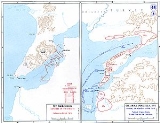
The invasion plan of April 25, 1915 was for the 29th Division to land at Helles on the tip of the peninsula and then advance upon the forts at Kilitbahir. The Anzacs were to land north of Gaba Tepe on the Aegean Aegean Sea

The Aegean Sea is an arm of the Mediterranean Sea [i], located between the Greek peninsula and Anatolia [i] ... 

 coast from where they could advance across the peninsula and prevent retreat from or reinforcement of Kilitbahir. The French made a diversionary landing at Kum Kale on the Asian shore. There was also a one-man diversion by Bernard Freyberg Bernard Freyberg, 1st Baron Freyberg

Lieutenant-General [i] Bernard Cyril Freyberg, 1st Baron Freyberg, VC [i], GCMG [i] ... 

 of the RND at Bulair.

Anzac


The Anzac covering force, the 3rd Brigade of the Australian 1st Division, began to go ashore shortly before dawn at 4.30 am on April 25. The intended landing zone was a broad front centered about a mile north of Gaba Tepe. For reasons that are debated to this day, the landing went awry and the boats concentrated about a mile and a half further north than intended in a shallow, nameless cove between Ari Burnu to the north and Hell Spit to the south. The cove today is known as Anzac Cove Anzac Cove

Anzac Cove is a small, cove [i] on the Gallipoli [i] peninsula in Turkey [i] made famous as the site of ... 

.

The Anzacs were confronted by a treacherous, confusing tangle of ravines and spurs that descended from the heights of the Sari Bayir range to the sea. The landing was only lightly opposed by scattered Turkish units until Mustafa Kemal, commanding the 19th Division and perceiving the threat posed by the landings, rushed reinforcements to the area in what became a race for the high ground.

The contest for the heights was decided on the main ridge line where the Anzacs and Turks fought over a knoll called Baby 700. The position changed hands a number of times on the first day before the Turks, having the advantage of the higher ground on Battleship Hill, took final possession which they never relinquished. Once the Anzac advance was checked, the Turks counter-attacked, trying to force the invaders back to the shore, but failed to dislodge them from the foothold they had gained. A trench Trench warfare

Trench warfare is a form of war [i] in which both opposing armies have static lines of fortification [i] ... 

 perimeter quickly developed and a bloody stalemate ensued until August.

Helles


The Helles landing was made by the 29th Division British 29th Division

The British 29th Division, known as the Incomparable Division, was a First World War [i] ... 

 under the command of Major-General Major General

Major General or Major-General is a military rank [i] used in many countries. ... 

 Aylmer Hunter-Weston Aylmer Hunter-Weston

Lieutenant General [i] Sir Aylmer Gould Hunter-Weston KCB [i] DSO [i] ... 

, on five beaches in an arc about the tip of the peninsula, designated from east to west as S, V, W, X and Y beach.

At the extremities of the arc, on S, X and Y beaches, there was little opposition but the opportunity was not exploited. The commander of the Y Beach landing was able to walk unopposed to within 500 metres of Krithia village First Battle of Krithia

The First Battle of Krithia was the first Allied advance of the Battle of Gallipoli [i] during World War I [i] ... 

, which was deserted. The British never got so close again. Y Beach was eventually evacuated the following day as Turkish reinforcements arrived.

The main landings were made at V Beach, beneath the old Seddülbahir fortress, and at W Beach, a short distance to the west on the other side of the Helles headland.

At V Beach the covering force from the Royal Munster Fusiliers Royal Munster Fusiliers

The Royal Munster Fusiliers consisted of two regular service and two reserve battalion [i]s prior to World War I [i] ... 

  and Royal Hampshires was landed from a converted collier, SS River Clyde SS River Clyde

The SS River Clyde was a 4,000 ton collier built in Glasgow [i] in 1905 [i] and named after the River Clyde [i] ... 

, which was run aground beneath the fortress so that the troops could disembark directly via ramps to the shore. The Royal Dublin Fusiliers The Royal Dublin Fusiliers

The Royal Dublin Fusiliers was an infantry regiment of the British Army [i]. ... 

 would land at V Beach from open boats. At W Beach the Lancashire Fusiliers also landed in open boats on a small beach overlooked by dunes and obstructed with barbed wire Barbed wire

Barbed wire is a type of fencing wire [i] constructed with sharp edges or points arranged at intervals a ... 

. On both beaches the Turkish defenders were in a position to inflict appalling casualties on the landing infantry. The troops emerging one by one from the sally ports on the River Clyde presented perfect targets to the machine guns in the Seddülbahir Sedd el Bahr

Sedd el Bahr is a village at Cape Helles [i] on the Gallipoli [i] peninsula in Turkey [i]. ... 

 fort. Out of the first 200 soldiers to disembark, only 21 men actually made it onto the beach.

As at Anzac, the Turkish defenders were too few to force the British off the beach. At W Beach, thereafter known as Lancashire Landing, the Lancashires were able to overwhelm the defences despite their dreadful losses, 600 killed or wounded out of a total strength of 1000. The battalions that landed at V Beach suffered about 70% casualties. Six awards of the Victoria Cross Victoria Cross

The Victoria Cross is the highest recognition for valour "in the face of the enemy" that can be awarded ... 

 were made amongst the Lancashires at W Beach. Six Victoria Crosses were also awarded amongst the infantry and sailors at the V Beach landing and a further three were awarded the following day as they finally fought their way off the beach. After the landings, there were so few of the Dublin and Munster Fusiliers left that they were amalgmated into one unit, "The Dubsters". Only one Dubliner officer survived the landing, overall of the 1,012 Dubliners who were landed, only 11 would survive the entire Gallipoli campaign unscathed.

The early battles


On the afternoon of April 27, Kemal launched a concerted attack to drive the Anzacs back to the beach. With the support of naval gunfire, the Turks were held off throughout the night.

On April 28, the British, now supported by the French on the right of the line, intended to capture Krithia in what became known as the First Battle of Krithia First Battle of Krithia

The First Battle of Krithia was the first Allied advance of the Battle of Gallipoli [i] during World War I [i] ... 

. The plan of attack was overly complex and poorly communicated to the commanders in the field. The troops of the 29th Division were still exhausted and unnerved by the battle for the beaches and for Seddülbahir village, captured after heavy fighting on the 26th. The attack ground to a halt around 6pm with a gain of some ground but the objective of Krithia village was not reached. After the battle, the Allied trenches lay about halfway between the Helles headland and Krithia village. With Turkish opposition stiffening by the day, the opportunity for the anticipated swift victory on the peninsula was disappearing. Helles, like Anzac, became a siege Siege

A siege is a military [i] blockade [i] and assault [i] of a city [i] or fortress [i] with the int ... 

. Strong Turkish counter-attacks on the nights of May 1 and May 3 were repulsed despite breaking through the French defences.

The first attempt at an offensive at Anzac took place on the evening of May 2 when New Zealand and Australian Division commander, General Godley, ordered the Australian 4th Brigade, commanded by General John Monash John Monash

Lieutenant-General Sir John Monash, GCMG [i], KCB [i], VD [i], Au ... 

, and the New Zealand Infantry Brigade, to attack from Russell's Top and Quinn's Post towards Baby 700. The troops advanced a short distance during the night and tried to dig in to hold their gains but were forced to retreat by the night of May 3, having suffered about 1000 casualties.

Believing Anzac to be secure, Hamilton moved two brigades, the Australian 2nd Infantry Brigade and the New Zealand Infantry Brigade, to the Helles front as reserves for the Second Battle of Krithia Second Battle of Krithia

The Second Battle of Krithia continued the Allies [i]' attempts to advance on the ... 

 starting on May 6. This was the first major assault at Helles and gained about a quarter of a mile on a wide front at the now customary enormous cost in casualties.

The Turks launched a major assault at Anzac on May 19 — 42,000 Turks attacked 10,000 Australians and New Zealanders — but the attack tragically miscarried. Lacking sufficient artillery and ammunition, the Turks relied on surprise and weight of numbers for success but their preparations were detected and the defenders were ready. When it was over the Turks had suffered about 10,000 casualties. In comparison, the Australian casualties were a mere 160 killed and 468 wounded. The Turkish losses were so severe that a truce Ceasefire

A ceasefire is a temporary stoppage of a war [i], or any armed conflict [i], where each side of the conf ... 

 was organized for May 24 in order to bury the scores of dead lying in no man's land.

In May the British naval artillery advantage was diminished following the torpedo Torpedo

A modern torpedo, historically called a locomotive torpedo, is a self-propelled projectile [i] tha ... 

ing of the battleships HMS Goliath on May 13, HMS Triumph on May 25 and HMS Majestic on May 27. After these losses much of the battleship support was withdrawn and those remaining would fire while under way, reducing their accuracy and effectiveness.

In the Third Battle of Krithia Third Battle of Krithia

The Third Battle of Krithia, fought on the Gallipoli [i] peninsula during World War I [i], was ... 

 on June 4 all thought of a decisive breakthrough was gone and the plans for battle had reverted to trench warfare with objectives being measured in hundreds of metres. Casualties ran to around 25% for both sides; the British suffering 4500 from an attacking force of 20,000.

In June, a fresh division, the 52nd Division, began to land at Helles in time to participate in the last of the major Helles battles, the Battle of Gully Ravine Battle of Gully Ravine

The Battle of Gully Ravine was a World War I [i] battle fought at Cape Helles on the Gallipoli [i] penin ... 

 which was launched on June 28. This battle advanced the British line along the left flank of the battlefield which resulted in a rare but limited victory for the Allies. Between July 1 and July 5 the Turks launched a series of desperate counter-attacks against the new British line but failed to regain the lost ground. Their casualties for the period were horrendous, estimated at in excess of 14,000.

One final British action was made at Helles on July 12 before the Allied main effort was shifted north to Anzac. Two fresh brigades from the 52nd Division were thrown into an attack in the centre of the line along Achi Baba Nullah and sustained 30% casualties without making any significant progress.

See Also: First Battle of Krithia First Battle of Krithia

The First Battle of Krithia was the first Allied advance of the Battle of Gallipoli [i] during World War I [i] ... 

 — Second Battle of Krithia Second Battle of Krithia

The Second Battle of Krithia continued the Allies [i]' attempts to advance on the ... 

 — Third Battle of Krithia Third Battle of Krithia

The Third Battle of Krithia, fought on the Gallipoli [i] peninsula during World War I [i], was ... 

 — Battle of Gully Ravine Battle of Gully Ravine

The Battle of Gully Ravine was a World War I [i] battle fought at Cape Helles on the Gallipoli [i] penin ... 


August offensive


The repeated failure of the Allies to capture Krithia or make any progress on the Helles front led Hamilton to pursue a new plan for the campaign which resulted in what is now called the Battle of Sari Bair Battle of Sari Bair

The Battle of Sari Bair, also known as the August Offensive, was the final attempt made by the British [i] ... 

. On the night of August 6 a fresh landing of two infantry divisions was to be made at Suvla Suvla

Suvla is a bay [i] on the Aegean [i] coast of the Gallipoli [i] peninsula in Turkey [i], sout ... 

, five miles north of Anzac. Meanwhile at Anzac a strong assault would be made on the Sari Bair range by breaking out into the rough and thinly defended terrain north of the Anzac perimeter.

The landing at Suvla Bay Landing at Suvla Bay

The landing at Suvla Bay was an amphibious landing [i] made at Suvla [i] on the Aegean [i] ... 

 was only lightly opposed but the British commander, Lieutenant-General Sir Frederick Stopford, had so diluted his early objectives that little more than the beach was seized. Once again the Turks were able to win the race for the high ground of the Anafarta Hills thereby rendering the Suvla front another case of static trench warfare Trench warfare

Trench warfare is a form of war [i] in which both opposing armies have static lines of fortification [i] ... 

.

The offensive was preceded on the evening of August 6 by a diversionary assaults at Helles and Anzac. At Helles, the diversion at Krithia Vineyard Battle of Krithia Vineyard

The Battle of Krithia Vineyard was intended as a minor British [i] action at Helles on the Gallipoli [i] ... 

 became another futile battle with no gains and heavy casualties for both sides. At Anzac, an attack on the Turkish trenches at Lone Pine by the infantry brigades of the Australian 1st Division was a rare victory for the Anzacs. However, the main assault aimed at the peaks of Chunuk Bair and Hill 971 was less successful.

The force striking for the nearer peak of Chunuk Bair comprised the New Zealand Infantry Brigade. It came within 500 metres of the peak by dawn on August 7 but was not able to seize the summit until the following morning. This delay had fatal consequences for another supporting attack on the morning of August 7; that of the Australian 3rd Light Horse Brigade Light Horse

The Australia [i]n Light Horse soldiers were mounted infantry [i] who served during the Second Boer War [i] ... 

 at the Nek Battle of the Nek

The Battle of the Nek was a small World War I [i] battle fought as part of the Gallipoli [i] c ... 

 which was to coincide with the New Zealanders attacking back down from Chunuk Bair against the rear of the Turkish defences. The New Zealanders held out on Chunuk Bair for two days before relief was provided by two New Army battalions from the Wiltshire and Loyal North Lancashire Regiments. A massive Turkish counter-attack, led in person by Mustafa Kemal, swept these two battalions from the heights.

Another planned attack on Hill 971 never took place. The attacking force of the Australian 4th Infantry Brigade , and an Indian Brigade, was defeated by the terrain and became lost during the night. All subsequent attempts to resume the attack were easily repulsed by the Turkish defenders at great cost to the Allies.

The Suvla landing was reinforced by the arrival of the British 53rd and 54th Divisions plus the dismounted yeomanry of the 2nd Mounted Division. The unfortunate 29th Division was also shifted from Helles to Suvla for one more push. The final British attempt to resuscitate the offensive came on August 21 with attacks at Scimitar Hill and Hill 60. Control of these hills would have united the Anzac and Suvla fronts but neither battle achieved success. When fighting at Hill 60 ceased on August 29, the battle for the Sari Bair heights, and indeed the battle for the peninsula, was effectively over.

See Also: Battle of Krithia Vineyard Battle of Krithia Vineyard

The Battle of Krithia Vineyard was intended as a minor British [i] action at Helles on the Gallipoli [i] ... 

 — Battle of Lone Pine Battle of Lone Pine

The Battle of Lone Pine, which took place during the Gallipoli [i] campaign, was the only succ ... 

 — Battle of Chunuk Bair Battle of Chunuk Bair

The Battle of Chunuk Bair was a World War I [i] battle fought between the Turkish [i] defenders a ... 

 — Battle of the Nek Battle of the Nek

The Battle of the Nek was a small World War I [i] battle fought as part of the Gallipoli [i] c ... 

 — Battle of Scimitar Hill Battle of Scimitar Hill

The Battle of Scimitar Hill(Yusufuk Tepe) was the last offensive mounted by the British [i] at Suvla [i] ... 

 — Battle of Hill 60

Evacuation


Following the failure of the August Offensive, the Gallipoli campaign entered a hiatus while the future direction was debated. The persistent lack of progress was finally making an impression in the United Kingdom as contrasting news of the true nature of the campaign was smuggled out by journalists like Keith Murdoch Keith Murdoch

Sir Keith Arthur Murdoch was an Australia [i]n journalist [i] and the father of Rupert Murdoch [i].
... 

 and Ellis Ashmead-Bartlett Ellis Ashmead-Bartlett

Ellis Ashmead-Bartlett was a British [i] war correspondent [i] during the First World War [i] ... 

 discrediting Hamilton's performance. Disaffected senior officers such as General Stopford also contributed to the general air of gloom. The prospect of evacuation was raised on October 11 but Hamilton resisted the suggestion, fearing the damage to British prestige. He was dismissed as commander shortly afterwards and replaced by Lieutenant-General Sir Charles Monro.

The situation was complicated by the entry of Bulgaria Bulgaria

Bulgaria , officially the Republic of Bulgaria , is a country in Southeastern Europe [i].... 

 into the war on the side of the Central Powers Central Powers

The Central Powers were the nations of Germany [i], Austria-Hungary [i], the Ottoman Empire [i] ... 

. On October 5 the British opened a second Mediterranean front at Salonika Thessaloniki

Thessaloniki, Thessalonica or Salonica , is Greece [i]'s second-largest city. ... 

 which would compete for reinforcements with Gallipoli. Also Germany would now have a direct land route to Turkey, enabling it to supply heavy siege artillery which would devastate the Allied trench network, especially on the confined front at Anzac.

Having reviewed the state of his command, Monro recommended evacuation. Kitchener disliked the notion of evacuating the peninsula and made a personal visit to consult with the commanders of the three corps; VIII Corps at Helles, IX Corps at Suvla and ANZAC. The decision to evacuate was made.

Evacuation of 14 divisions in winter in proximity to the enemy would be difficult and heavy losses were expected. The untenable nature of the Allied position was made apparent when a heavy storm struck on November 27 and lasted for three days. There followed a blizzard at Suvla in early December. The rain flooded trenches, drowning soldiers and washing the unburied corpses into the lines. The following snow killed more men from exposure.

Ironically the evacuation was the greatest Allied success of the campaign. Suvla and Anzac were to be evacuated in late December, the last troops leaving before dawn on December 20. Troop numbers had been progressively reduced since December 7 and cunning ruses were performed to fool the Turks and prevent them discovering the Allies that were departing. At Anzac, the troops would maintain utter silence for an hour or more until the curious Turks would venture out to inspect the trenches, whereupon the Anzacs would open fire. As the numbers in the trenches were thinned, rifles were rigged to fire by water dripped into a pan attached to the trigger.

Helles was retained in case the British wanted to resume the offensive. However, a decision to evacuate there too was made on December 27. The Turks were now warned of the likelihood of evacuation and mounted an attack on January 6, 1916 but were repulsed. The last British troops departed from Lancashire Landing on January 9.

Aftermath


It is tempting to suppose the Gallipoli campaign could have had a different outcome by asking "What if?" certain events had followed a different course, whether through luck or leadership.

What if...
  • Allied forces had been made available to act in coordination with the naval action in February, as the original plans had called for?
  • The British continued with the naval attacks beyond March 18 when the Turkish defences were virtually out of shells?
  • The unopposed Y Beach landing at Helles had been exploited on April 25?
  • The heavily opposed landings were evacuated to reinforce the unopposed landings?
  • The Anzac landing of April 25 was made on the intended beach?
  • The New Zealanders pressed the attack on Chunuk Bair when it was lightly defended on the morning of August 7?
  • A more capable commander than General Stopford had been in charge at Suvla?


The fact remains that the battle of Gallipoli was a finely balanced struggle with neither side able to exploit any slight advantage. When the Allies achieved a breakthrough, such as at Lone Pine or the second battle of Krithia, they lacked the reserves to continue the advance. Likewise when the Turks halted an Allied attack, their counter-attacks were unable to rout the enemy.

The Ottoman Empire had been dismissed by Tsar Tsar

Tsar , occasionally spelled Czar or Tzar and sometimes Csar or Zar in English [i] ... 

 Nicholas I of Russia Nicholas I of Russia

Nicholas I , July 6 [i] , 1796 [i]–March 2 [i] , 1855 [i]), was the Emperor [i] of Russia [i] fro... 

 as "the sick man of Europe" but after victory over the Allies at Gallipoli, Turkey's visions of the empire were renewed. In Mesopotamia Mesopotamia

Mesopotamia refers to the region [i] now occupied by modern Iraq [i], eastern Syria [i], and southeaster ... 

 the Turks surrounded a British expedition at Kut Al Amara Siege of Kut

The Siege of Kut-al-Amara was part of the Mesopotamian Campaign [i] in World War I [i].... 

, forcing their surrender in 1916. From southern Palestine Palestine

Palestine is one of several names for the geographic region between the Mediterranean Sea [i] and the ba ... 

 the Turks pushed into the Sinai Sinai Peninsula

The Sinai Peninsula or Sinai is a triangle-shaped peninsula [i] lying between the Mediterranean Sea [i] ... 

 with the aim of capturing the Suez Canal Suez Canal

The Suez Canal , west of the Sinai Peninsula [i], is a 163-km-long and, at its narrowest point, 300-m-w ... 

 and driving the British from Egypt Egypt

[i] country in [[North Africa]... 

. Defeat at the Battle of Romani Battle of Romani

The Battle of Romani took place near the Egyptian [i] town of Romani which lies 23 miles east of t ... 

 marked the end of that ambition and for the remainder of the war the British were on the offensive in the Middle East.

After the evacuation the Allied troops reformed in Egypt. The Anzacs underwent a major reorganization; the infantry were expanded and bound for the Western Front Western Front

Western Front was a term used during the First [i] and Second [i] World Wars to ... 

, the light horse Light Horse

The Australia [i]n Light Horse soldiers were mounted infantry [i] who served during the Second Boer War [i] ... 

 were reunited with their horses and formed into mounted divisions for operations in the Sinai and Palestine. At the Battle of Beersheba Battle of Beersheba

The Battle of Beersheba took place on 31 October [i] 1917 [i], as part of the Sinai and Palestine campaign [i] ... 

 they would finally achieve the decisive break-through victory that had eluded the Allies on Gallipoli.

Amongst the generals, Gallipoli marked the end for Hamilton and Stopford but Hunter-Weston was granted another opportunity to lead the VIII Corps on the first day of the Battle of the Somme. The competence of Australian brigade commanders, John Monash John Monash

Lieutenant-General Sir John Monash, GCMG [i], KCB [i], VD [i], Au ... 

 and Henry Chauvel Henry George Chauvel

General [i] Sir Henry George 'Harry' Chauvel, GCMG [i], KCB [i] was a general officer of the First Australian Imperial Force [i] ... 

, would be recognised with promotion to the command of divisions and ultimately corps Corps

A corps is either a large military unit [i] or formation [i], an administrative grouping of tr ... 

. Winston Churchill Winston Churchill

Sir Winston Leonard Spencer-Churchill, KG [i], OM [i], CH [i] ... 

 and the First Sea Lord First Sea Lord

The First Sea Lord is the professional head of the British [i] Royal Navy [i]. ... 

 John Fisher Jackie Fisher, 1st Baron Fisher

Admiral of the Fleet [i] John Arbuthnot "Jackie" Fisher, 1st Baron Fisher, GCB [i], OM [i] ... 

 both resigned as a result of the defeat, amid mutual recriminations. Lord Kitchener Herbert Kitchener, 1st Earl Kitchener

Horatio Herbert Kitchener, 1st Earl Kitchener, KG [i], KP [i], GCB [i]... 

 was too popular to be punished, but he never recovered his old reputation for invincibility and was increasingly sidelined by his colleagues until his death the following year. Gallipoli was also instrumental in the fall of the prime minister H. H. Asquith H. H. Asquith

Herbert Henry Asquith, 1st Earl of Oxford and Asquith, KG [i], PC [i] ... 

 in 1916.

The significance of the battle of Gallipoli is perhaps most strongly felt in Australia and New Zealand where it was the first great conflict experienced by those fledgling nations. Before Gallipoli the citizens of these countries were confident of the superiority of the British Empire and were proud and eager to offer their service. Gallipoli shook that confidence and three years on the Western Front would destroy it utterly.

On the Turkish side, the meteoric rise of Mustafa Kemal began at Gallipoli.
In 1934, Kemal, now Kemal Atatürk, president of the new Turkish Republic Turkey

Turkey, officially the Republic of Turkey, is a Eurasia [i]n country that stretches across the Anatolia [i] ... 

, wrote this tribute in remembrance of the Anzac soldiers:

Casualties

Gallipoli casualties
 DiedWoundedTotal
Australia8,70919,44128,150
New Zealand2,7214,8527,553
The United Kingdom21,25552,23073,485
France 10,00017,00027,000
India1,3583,4214,779
Newfoundland4993142
Total Allies44,07297,037141,109
Ottoman Empire86,692164,617251,309

In addition to the killed, those who died of wounds and wounded listed in the table, many soldiers became sick in the unsanitary environment of the peninsula, mainly from enteric fever, dysentery and diarrhoea. It is estimated that a further 145,000 British soldiers became casualties from illness during the campaign.

Amongst the dead of the battle was the brilliant young physicist Henry Moseley Henry Moseley

Henry Gwyn Jeffreys Moseley was an English [i] physicist [i]. ... 

. Also the poet Rupert Brooke Rupert Brooke

Rupert Chawner Brooke was a British [i] poet known for his idealistic War Sonnets wr ... 

, serving with the Royal Naval Division, died shortly before the invasion from a septic mosquito bite.

According to Turkish historian Cemalettin Taskiran and Istanbul Turkish Archive documents, the British used chemical weapons in the war and many Turkish soldiers were killed as a result of poisoning. Prof. Taskiran also claims that the French and British armies attacked the Ottoman hospitals during the war: "During the war, the International Red Cross Committee sent official complaints of violations to the concerned parties. The parties concerned, in this case the French and British authorities, sent their responses via the same international committee. In their responses, the British authorities did not deny these violations. They did not say definitively: “We did not carry out this kind of violations”. They said: “Violations such as this did not occur willingly but occurred accidentally. In battles, this kind of thing always happens”. The French authorities, on the other hand, did not accept these violations and they said: “These complaints are total slanders. But in battles, this kind of bombardment might happen. Hospitals must be set up far away from the battle area”."

The Commonwealth War Graves Commission Commonwealth War Graves Commission

The Commonwealth War Graves Commission, abbreviated to CWGC, is a joint governmental organisation ... 

  is responsible for developing and maintaining permanent cemeteries for all Commonwealth Commonwealth of Nations

The Commonwealth of Nations, usually known as the Commonwealth, is a voluntary association [i] of ... 

 forces — United Kingdom, Australia, New Zealand, India, Newfoundland Newfoundland

Newfoundland is a large island off the east coast of North America [i], and the most populous part o ... 

 and others. There are 31 CWGC cemeteries on the Gallipoli peninsula: six at Helles , four at Suvla and 21 at Anzac. For many of those killed or who died on hospital ships and were buried at sea, there is no known grave. These men's names are recorded on memorials for the missing. The main memorials are for the British at Cape Helles, for the Australians at Lone Pine and for the New Zealanders on Chunuk Bair.

There is only one French cemetery on the Gallipoli peninsula, located near Soroz Beach, which was the French base for the duration of the campaign.

There are no large Turkish military cemeteries on the peninsula, but there are numerous memorials, the main ones being the Çanakkale Martyrs' Memorial at Morto Bay, Cape Helles , the Turkish Soldier's Memorial on Chunuk Bair and the memorial and open-air mosque Mosque

A mosque is a place of worship [i] for followers of the Islam [i]ic faith. ... 

 for the 57th Regiment near Quinn's Post . There are a number of Turkish memorials and cemeteries on the Asian shore of the Dardanelles, demonstrating the greater emphasis Turkish history places on the victory of March 18 over the subsequent fighting on the peninsula.

See also: List of cemeteries and memorials at Gallipoli List of war cemeteries and memorials on the Gallipoli Peninsula

This is a list of all cemeteries and memorials erected following the Battle of Gallipoli [i] in 1915 [i] durin ... 


Trivia

  • After the evacuation, Mustafa Kemal Mustafa Kemal Atatürk

    ... 

     supposedly said, "We have avenged Troy," referring to the sack of that legendary city during the Trojan War Trojan War

    The Trojan War was a war waged, according to legend, against the city of Troy [i] in Asia Minor [i] , by ... 

    . Coincidentally one of the British Ships that took part was named HMS Agamemnon.
  • The song "Tom Traubert's Blues" by Tom Waits Tom Waits

    Thomas Alan Waits is an American singer-songwriter [i], composer [i], and actor [i].

... 

 is about an ANZAC soldier fighting at Gallipoli.
  • The song "And the Band Played Waltzing Matilda And The Band Played Waltzing Matilda

    "And The Band Played Waltzing Matilda" is a song, written by Eric Bogle [i] in 1972, that commemorates t ... 

    ", written by Eric Bogle, is also about this campaign.
  • The landings at Sedd el Bahr and Suvla are mentioned in the Irish song "The Foggy Dew"
  • David Niven David Niven

    James David Graham Niven , was an Academy Award [i]-winning English [i] ... 

    's father was among the many casualties.
  • English poet Rupert Brooke Rupert Brooke

    Rupert Chawner Brooke was a British [i] poet known for his idealistic War Sonnets wr ... 

     died on his way to the battle.
  • Following the landing at Suvla Bay, casualties among the opposing armies were particularly high, and the hot and humid weather made the stench of bodies particularly nauseating. A day's truce was arranged to facilitate the removal of the dead and wounded; this momentary contact led to a strange camaraderie between the armies, and courtesies not observed elsewhere in the war. Alan Moorehead records that one old Turkish batman was regularly permitted to hang his platoon's washing on the barbed wire without attacking fire; and that there was a 'constant traffic' of gifts being thrown across no-mans land, dates and sweets from the Turkish side, and cans of beef and cigarettes from the ANZAC side.

External links

  • Scanned PDF Portable Document Format

    Portable Document Format is a file format [i] proprietary [i] to Adobe Systems [i] for representing two ... 

     volumes from the Australian War Memorial Australian War Memorial

    The Australian War Memorial is Australia [i]'s national memorial [i] to the members of all ... 

     of the Official History of Australia in the War of 1914-1918:
  • , by Joseph Lievesley Beeston
  • Royal Engineers and the Gallipoli Expedition

References

  • Martin Gilbert, The First World War: A Complete History}}, Chapter 8, ISBN 0-8050-7617-4
  • Philip J. Haythornthwaite, Gallipoli 1915, Frontal Assault on Turkey; Osprey Campaign Series #8, Osprey Publishing, 1991.

See also

  • Gallipoli Gallipoli

    Gallipoli, called Gelibolu in modern Turkish [i], , is a town in northwestern Turkey [i] ... 

    - 1981 movie
  • Gallipoli Gallipoli

    Gallipoli, called Gelibolu in modern Turkish [i], , is a town in northwestern Turkey [i] ... 

    - 2005 documentary film
  • "And The Band Played Waltzing Matilda And The Band Played Waltzing Matilda

    "And The Band Played Waltzing Matilda" is a song, written by Eric Bogle [i] in 1972, that commemorates t ... 

    " - folk song