
Patrick Victor Martindale White (28 May 1912 – 30 September 1990), an Australian author, is widely regarded as an important English-language novelist of the 20th century. From 1935 until his death, he published 12 novels, two short-story collections and eight plays.
White's fiction employs humour, florid prose, shifting
narrative vantage pointsThe narrative mode is the set of methods the author of a literary, theatrical, cinematic, or musical story uses to convey the plot to the audience. Narration, the process of presenting the narrative, occurs because of the narrative mode...
and a stream of consciousness technique. In 1973, he was awarded the
Nobel Prize in LiteratureSince 1901, the Nobel Prize in Literature has been awarded annually to an author from any country who has, in the words from the will of Alfred Nobel, produced "in the field of literature the most outstanding work in an ideal direction"...
—and was the only Australian citizen to have been awarded the Literature prize until J. M. Coetzee became an Australian citizen in 2006.
The VivisectorThe Vivisector is the eighth published novel by Patrick White, winner of the 1973 Nobel Prize for Literature. First published in 1970, it details the lifelong creative journey of fictional artist/painter Hurtle Duffield...
, a novel about the life and times of a successful modernist painter, was shortlisted for the
Lost Man Booker PrizeThe Lost Man Booker Prize was a special edition of the Man Booker Prize awarded by a public vote in 2010 to a novel from 1970, described by The New York Times as "an act of literary reparation"...
in 2010.
Childhood and adolescence
White was born in
KnightsbridgeKnightsbridge is a road which gives its name to an exclusive district lying to the west of central London. The road runs along the south side of Hyde Park, west from Hyde Park Corner, spanning the City of Westminster and the Royal Borough of Kensington and Chelsea...
, London, to an English-Australian father and an English mother. His family later moved to Sydney, Australia when he was six months old. As a child he lived in one flat with his sister, nanny and a maid; while his parents lived in an adjoining flat.
At the age of four White developed asthma, a condition that had taken the life of his maternal grandfather. White's health was fragile throughout his childhood which, while it precluded his participation in many childhood activities, stimulated his imagination. He would perform private rites in the garden and would dance for his mother’s friends. He loved the theatre which he first visited at an early age.
At the age of ten White was sent to
Tudor House SchoolTudor house School, is a private, day and boarding, preparatory school for boys, located in Moss Vale, New South Wales, Australia.The school is Australia's only preparatory boarding school, marketing itself as "a school that understands boys and where the joy of boyhood experiences is...
, a boarding school in the New South Wales southern highlands, in an attempt to abate his asthma. It took him some time to adjust to the presence of other children. At boarding school he started to write plays. Even at this early age White wrote about noticeably adult themes. In 1924, the boarding school ran into financial trouble and the headmaster suggested that White be sent to
public school in England; a suggestion which his parents accepted.
White struggled to adjust to his new surroundings at
Cheltenham CollegeCheltenham College is a co-educational independent school, located in Cheltenham, Gloucestershire, England.One of the public schools of the Victorian period, it was opened in July 1841. An Anglican foundation, it is known for its classical, military and sporting traditions.The 1893 book Great...
. He later described it as "a four-year prison sentence". White withdrew socially and had a limited circle of acquaintances. Occasionally, he would holiday with his parents at European locations, but their relationship remained distant.
While in London White did make one close friend, Ronald Waterall, an older boy who shared similar interests. White’s biographer,
David MarrDavid Ewan Marr is an Australian journalist, author, and progressive political and social commentator. His areas of expertise include the law, Australian politics, censorship, the media and the arts...
, wrote that the two men would walk, arm-in-arm, to London shows; and stand around stage doors crumbing for a glimpse of their favourite stars, giving a practical demonstration of a chorus girl's high kick ... with appropriate vocal accompaniment. When Waterall left school, White withdrew again. He asked his parents if he could leave school to become an actor. The parents compromised and allowed him to finish school early on the condition that he came home to Australia to try life on the land.
Travelling the world
White spent two years working as a stockman at Bolaro, a 73 square kilometres (28.2 sq mi) station near
AdaminabyAdaminaby is a small town near the Snowy Mountains located north-west of Cooma, New South Wales, Australia, in the Snowy River Shire.The historic town, of about 234 people, is a trout fishing centre and winter sports destination situated at above sea level. It is one of the highest towns in...
on the edge of the
Snowy MountainsThe Snowy Mountains, known informally as "The Snowies", are the highest Australian mountain range and contain the Australian mainland's highest mountain, Mount Kosciuszko, which reaches 2,228 metres AHD, approximately 7310 feet....
in south-eastern Australia. His parents felt that he should work on the land rather than become a writer and hoped that his work as a
jackarooA Jackaroo is a young man working on a sheep or cattle station, to gain practical experience in the skills needed to become an owner, overseer, manager, etc. The word originated in Queensland, Australia in the Nineteenth Century and is still in use in Australia and New Zealand in the twenty-first...
would cause his artistic ambitions to fade. Although White grew to respect the land and his health improved, it was clear that he was not cut out for this life.
From 1932 to 1935, White lived in England, studying French and German literature at
King's CollegeKing's College is a constituent college of the University of Cambridge, England. The college's full name is "The King's College of our Lady and Saint Nicholas in Cambridge", but it is usually referred to simply as "King's" within the University....
within Cambridge University. White's homosexuality took a toll on his first term academic performance, in part because he developed a romantic attraction to a young man who had come to King's College to become an Anglican priest. White dared not speak of his feelings for fear of losing the friendship and, like many homosexual men of that period, feared that his sexuality would doom him to a lonely life. Then one night, the student priest, after an awkward liaison with two women, admitted to White that women meant nothing to him sexually. This became White’s first love affair.
During White's time at Cambridge he published a collection of poetry entitled
The Ploughman and Other Poems, and wrote a play named
Bread and Butter Women, which was later performed by an amateur group (which included his sister Suzanne) at the tiny
Bryant's PlayhouseBeryl Annear Bryant was an Australian stage actress and theatrical producer born in America who was active in the 1930s and 1940s. She was responsible for first bringing the plays of Patrick White to the stage...
in Sydney. After being admitted to the degree of Bachelor of Arts in 1935, White briefly settled in London where he lived in an area that was frequented by artists. Here, the young author thrived creatively for a time, writing several unpublished works and reworking
Happy Valley, a novel that he had written while jackarooing. In 1937, White’s father died, leaving him ten thousand pounds in inheritance. The fortune enabled him to write full-time in relative comfort. Two more plays followed before he succeeded in finding a publisher for
Happy Valley. The novel was received well in London, but poorly in Australia. He began writing another novel,
Nightside, but abandoned it before its completion after receiving negative comments—a decision that he later admitted regretting.
In 1936 White met the painter
Roy de MaistreRoy de Maistre CBE was an Australian artist of international fame. He is famous in Australian art for his early experimentation in "colour-music", and is recognised as the first Australian artist to use pure abstractionism. His later works were painted in a figurative style generally influenced by...
, 18 years his senior, who became an important influence in his life and work. The two men never became lovers, but remained firm friends. In Patrick White's own words "He became what I most needed, an intellectual and aesthetic mentor". They had many similarities. They were both homosexual; they both felt like outsiders in their own families; as a result they both had ambivalent feelings about their families and backgrounds, yet both maintained close and life-long links with their families, particularly their mothers. They also both appreciated the benefits of social standing and connections; and Christian symbolism and biblical themes are common in both artists' work. Patrick White dedicated his first novel 'Happy Valley' (1939) to de Maistre, and acknowledged de Maistre's influence on his writing. In 1947 de Maistre's painting
Figure in a Garden (The Aunt) was used as the cover for the first edition of White's
The Aunt's Story. White also bought many of de Maistre's paintings for himself. In 1974 White gave all his paintings by de Maistre to the Art Gallery of
New South WalesNew South Wales is a state of :Australia, located in the east of the country. It is bordered by Queensland, Victoria and South Australia to the north, south and west respectively. To the east, the state is bordered by the Tasman Sea, which forms part of the Pacific Ocean. New South Wales...
.
Towards the end of the 1930s, White spent time in the United States, including
Cape CodCape Cod, often referred to locally as simply the Cape, is a cape in the easternmost portion of the state of Massachusetts, in the Northeastern United States...
, Massachusetts, and New York City, where he wrote
The Living and the Dead. By the time World War II broke out, he had returned to London and joined the
Royal Air ForceThe Royal Air Force is the aerial warfare service branch of the British Armed Forces. Formed on 1 April 1918, it is the oldest independent air force in the world...
. He was accepted as an intelligence officer, and was posted to the Middle East. He served in Egypt, Palestine, and Greece before the war was over. While in the Middle East, he had an affair with a Greek army officer,
Manoly LascarisEmmanuel George "Manoly" Lascaris was the life partner of the Australian novelist and dramatist Patrick White. Lascaris was born in Cairo in 1912, the son of an American woman and her wealthy Greek-Egyptian husband. Lascaris met White while they both were servicemen in the Second World War...
, who was to become his life partner.
The growth of White's writing career
After the war White once again returned to Australia, buying an old house in
Castle HillCastle Hill is a suburb in the north-west of Sydney, in the state of New South Wales, Australia. Castle Hill is located 31 kilometres north-west of the Sydney central business district, in the Hills District of the Greater Western Sydney region...
, now a Sydney suburb but then semi-rural. Here he settled down with Lascaris, the Greek he had met during the war. They lived there for 18 years, selling flowers, vegetables, milk, and cream, as well as pedigreed puppies. During these years he started to make a reputation for himself as a writer, publishing
The Aunt's Story and
The Tree of Man in the US in 1955 and shortly after in the UK.
The Tree of Man was released to rave reviews in the US, but, in what was to become a typical pattern, was panned in Australia. White had doubts about whether to continue writing after his books were largely dismissed in Australia (three of them having been called ‘un-Australian’ by critics), but, in the end, decided to persevere. His first breakthrough in Australia came when his next novel,
VossVoss is the fifth published novel of Patrick White. It is based upon the life of the nineteenth-century Prussian explorer and naturalist Ludwig Leichhardt who disappeared whilst on an expedition into the Australian outback.-Plot summary:...
, won the inaugural Miles Franklin Literary Award.
In 1961, White published
Riders in the ChariotRiders in the Chariot is the sixth published novel by Australian Author Patrick White, Nobel Prize winner of 1973. It was published in 1961 and won the Miles Franklin Award in that year...
. This was to become both a bestseller and a prize-winner, garnering him a second Miles Franklin Award. In 1963, White and Lascaris decided to sell the house at Castle Hill that they had named "Dogwoods". A number of White's works from the 1960s depict the fictional town of Sarsaparilla, including his collection of short stories,
The Burnt OnesThe Burnt Ones is a collection of eleven short stories by Australian writer Patrick White, first published by Eyre and Spottiswoode in 1964. Penguin Books published it in 1968 with reprints in 1972 and 1974...
, and the play,
The Season at Sarsaparilla. By now, he had clearly established his reputation as one of the world's great authors, but remained an essentially private person, resisting opportunities for interviews and public appearances, although his circle of friends had widened significantly.
In 1968, White wrote
The Vivisector, a searing character portrait of an artist. Many people drew links to the Sydney painter John Passmore (1904 - 1984) and White's friend, the painter
Sidney NolanSir Sidney Robert Nolan OM, AC was one of Australia's best-known painters and printmakers.-Early life:Nolan was born in Carlton, a suburb of Melbourne, on 22 April 1917. He was the eldest of four children. His family later moved to St Kilda. Nolan attended the Brighton Road State School and...
, but White denied these connections. Patrick White was an art collector who had, as a young man, been deeply impressed by his friends
Roy De MaistreRoy de Maistre CBE was an Australian artist of international fame. He is famous in Australian art for his early experimentation in "colour-music", and is recognised as the first Australian artist to use pure abstractionism. His later works were painted in a figurative style generally influenced by...
and Francis Bacon, and later said he wished he had been an artist. White's elaborate, idiosyncratic prose was a writer's attempt to emulate painting. By the mid sixties he had also become interested in encouraging dozens of young and less established artists, such as
James CliffordJames Clifford was an Australian Modernist painter.He was born in Muswellbrook and in the 1960s moved to Sydney where he began exhibiting at Watters Gallery. He worked in various styles and became distinctive early on, combining hard edge abstraction with Art Nouveau and surreal elements, later...
, Erica McGilchrist, and
Lawrence DawsLawrence Daws is an Australian painter and printmaker, who works in the media of watercolour, drawing, screenprints, etchings and monotypes.In the 1980s he started making computer prints, and was probably the first artist to use this medium....
. White was later friends with
Brett WhiteleyBrett Whiteley, AO was an Australian artist. He is represented in the collections of all the large Australian galleries, and was twice winner of the Archibald Prize...
, the young star of Australian painting, in the 1970s. That friendship ended when White felt that Whiteley, a heroin addict, was deceitful and pushy about selling his paintings. A portait of White by
Louis KahanLouis Kahan AO was an Austrian-born Australian artist who won the Archibald Prize in 1962 with a portrait of Patrick White.-Biography:Louis Kahan was born in Vienna in 1905. He travelled from Vienna to Paris when he was 20...
won the 1962
Archibald PrizeThe Archibald Prize is regarded as the most important portraiture prize in Australia. It was first awarded in 1921 after a bequest from J. F. Archibald, the editor of The Bulletin who died in 1919...
.
White decided not to accept any more prizes for his work, and declined both the $10,000 Britannia Award and another Miles Franklin Award. White was approached by
Harry M. Miller-Early career:Born in New Zealand, Miller grew up in Grey Lynn, Auckland, and moved to Australia in 1963, where he established a company called Pan Pacific Productions with Keith and Dennis Wong, owners of the noted Sydney nightclub "Chequers"...
to work on a screenplay for
Voss, but nothing came of it. He became an active opponent of literary censorship and joined a number of other public figures in signing a statement of defiance against Australia’s decision to participate in the
Vietnam WarThe Vietnam War was a Cold War-era military conflict that occurred in Vietnam, Laos, and Cambodia from 1 November 1955 to the fall of Saigon on 30 April 1975. This war followed the First Indochina War and was fought between North Vietnam, supported by its communist allies, and the government of...
.
In 1973, White became the first (and to this day the only) Australian to receive the Nobel Prize for Literature, "for an epic and psychological narrative art, which has introduced a new continent into literature". His cause was said to have been championed by a Scandinavian diplomat resident in Australia White enlisted Sidney Nolan to travel to Stockholm to accept the prize on his behalf. The award had an immediate impact on his career, as his publisher doubled the print run for
The Eye of the StormThe Eye of the Storm is the ninth published novel by the Australian novelist and 1973 Nobel Prize-winner, Patrick White. It tells the story of Elizabeth Hunter, the powerful matriarch of her family, who still maintains a destructive iron grip on those who come to farewell her in her final moments...
and gave him a larger advance for his next novel. White used the money from the prize to establish a trust to fund the
Patrick White AwardThe Patrick White Award is an annual literary prize established by Patrick White. White used his 1973 Nobel Prize in Literature award to establish a trust for this prize....
, given annually to established creative writers who have received little public recognition. He was invited by the
House of RepresentativesThe House of Representatives is one of the two houses of the Parliament of Australia; it is the lower house; the upper house is the Senate. Members of Parliament serve for terms of approximately three years....
to be seated on the floor of the House in recognition of his achievement. White declined, explaining that his nature could not easily adapt itself to such a situation. The last time such an invitation had been extended was in 1928, to
Bert HinklerHerbert John Louis Hinkler AFC DSM , better known as Bert Hinkler, was a pioneer Australian aviator and inventor. He designed and built early aircraft before being the first person to fly solo from England to Australia, and the first person to fly solo across the Southern Atlantic Ocean...
.
White was made
Australian of the YearSince 1960 the Australian of the Year Award has been part of the celebrations surrounding Australia Day , during which time the award has grown steadily in significance to become Australia’s pre-eminent award. The Australian of the Year announcement has become a very prominent part of the annual...
for 1974, but in a typically rebellious fashion, his acceptance speech encouraged Australians to spend the day reflecting on the state of the country. Privately, he was less than enthusiastic about it. In a letter to Marshall Best on 27 January 1974, he wrote: "Something terrible happened to me last week. There is an organisation which chooses an Australian of the Year who has to appear at an official lunch in Melbourne Town Hall on Australia Day. This year I was picked on as they had run through all the swimmers, tennis players, yachtsmen".
The twilight years
White and Lascaris hosted many dinner parties at their
Centennial ParkCentennial Park is a large public, urban park that occupies 220 hectares in the Eastern Suburbs of Sydney in the state of New South Wales, Australia. Centennial Park is located 4 kilometres south-east of the Sydney central business district, in the City of Randwick...
home in a leafy part of the affluent Eastern suburbs of Sydney. In
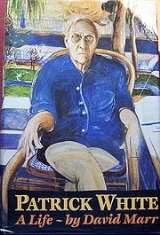
Patrick White, A Life, Marr portrays White as a genial host but one who easily fell out with friends.
White supported the conservative, business oriented
Liberal Party of AustraliaThe Liberal Party of Australia is an Australian political party.Founded a year after the 1943 federal election to replace the United Australia Party, the centre-right Liberal Party typically competes with the centre-left Australian Labor Party for political office...
until the election of
Gough WhitlamEdward Gough Whitlam, AC, QC , known as Gough Whitlam , served as the 21st Prime Minister of Australia. Whitlam led the Australian Labor Party to power at the 1972 election and retained government at the 1974 election, before being dismissed by Governor-General Sir John Kerr at the climax of the...
's Labor government and, following the 1975 Australian constitutional crisis, became particularly anti-royalist, making a rare appearance on national television to broadcast his views on the matter. White also publicly expressed his admiration for the historian
Manning ClarkCharles Manning Hope Clark, AC , an Australian historian, was the author of the best-known general history of Australia, his six-volume A History of Australia, published between 1962 and 1987...
, satirist
Barry HumphriesJohn Barry Humphries, AO, CBE is an Australian comedian, satirist, dadaist, artist, author and character actor, best known for his on-stage and television alter egos Dame Edna Everage, a Melbourne housewife and "gigastar", and Sir Les Patterson, Australia's foul-mouthed cultural attaché to the...
, and unionist
Jack MundeyJack Mundey is a distinguished Australian union and environmental activist. He came to prominence during the 1970s for leading the New South Wales Builders' Labourers Federation in the famous Green Bans, whereby the BLF led a successful campaign to protect the built and natural environment of...
.
During the 1970s, White’s health began to deteriorate—his teeth were crumbling, his eyesight was failing, and he had chronic lung problems. In 1979, his novel
The Twyborn AffairThe Twyborn Affair is a novel by Australian Nobel laureate Patrick White, first published in 1979. The three parts of the novel are set in a villa on the French Riviera before the First World War, a sheep station on the edge of Australia's Snowy Mountains in the inter-war period, and in London in...
was short-listed for the Booker Prize, but White requested that it be removed to give younger writers a chance to win. (The prize was won by
Penelope FitzgeraldPenelope Fitzgerald was a Booker Prize-winning English novelist, poet, essayist and biographer. In 2008, The Times included her in a list of "The 50 greatest British writers since 1945".-Early life:...
, who ironically was just four years younger than White.) Soon after, White announced that he had written his last novel, and that in the future, he would write only for radio or the stage.
Director
Jim SharmanJames "Jim" Sharman , the son of boxing tent entrepreneur Jimmy Sharman, is a director and writer for film and stage with over 70 productions to his credit...
introduced himself to White while walking down a Sydney street, Sharman asking White if he could make a film of
The Night the ProwlerThe Night the Prowler is a 1978 Australian film directed by Jim Sharman and written by Patrick White...
. White wrote the screenplay for the film.
In 1981, White published his autobiography,
Flaws in the Glass: a self-portrait, which explored issues about which he had publicly said little, such as his homosexuality, and his refusal to accept the Nobel Prize personally. On
Palm SundayPalm Sunday is a Christian moveable feast that falls on the Sunday before Easter. The feast commemorates Jesus' triumphal entry into Jerusalem, an event mentioned in all four Canonical Gospels. ....
, 1982, White addressed a crowd of 30,000 people, calling for a ban on uranium mining and for the destruction of nuclear weapons.
In 1986 White released one last novel,
Memoirs of Many in OneMemoirs of Many in One is a 1986 novel by Patrick White, in which White is taken to be editing the papers of a fictional Alex Gray.-Manuscript:...
, though it was published under the pen name "Alex Xenophon Demirjian Gray" and edited by Patrick White. In the same year,
Voss was turned into an opera. White refused to see it when it was first performed at the Adelaide Festival, because Queen Elizabeth II had been invited, and chose instead to see it later in Sydney. In 1987, White wrote
Three Uneasy Pieces, with his musings on ageing and society's efforts to achieve aesthetic perfection. When
David MarrDavid Ewan Marr is an Australian journalist, author, and progressive political and social commentator. His areas of expertise include the law, Australian politics, censorship, the media and the arts...
finished his biography of White in July 1990, his subject spent nine days going over the details with him.
Patrick White died in Sydney on 30 September 1990.
Legacy
Patrick White and
Christina SteadChristina Stead was an Australian novelist and short-story writer acclaimed for her satirical wit and penetrating psychological characterisations.-Biography:...
continue to be widely recognised as the foremost Australian novelists of the twentieth century. His writing tackles existential questions as well as myriad human flaws, weaknesses and hypocrisies, and it is full of fresh and original metaphor. Admittedly, White's style is also often very condensed and perhaps at first somewhat difficult to approach - such noted writers as
Robert Hughes-Politicians:*Robert Hughes, Baron Hughes of Woodside , British Labour politician, MP for Aberdeen North*Robert Gurth Hughes , British Conservative politician, MP for Harrow West-Sportsmen:*Robert Hughes , of Stamford FC...
and
David MaloufDavid George Joseph Malouf is an acclaimed Australian writer. He was awarded the Neustadt International Prize for Literature in 2000, his 1993 novel Remembering Babylon won the International IMPAC Dublin Literary Award in 1996, he won the inaugural Australia-Asia Literary Award in 2008, and he was...
have expressed their difficulties with some of White's writing. Nevertheless, Patrick White's greatness as a novelist remains undoubted.
In 2010 White received posthumous recognition for his novel
The Vivisector, which was shortlisted for the
Lost Man Booker PrizeThe Lost Man Booker Prize was a special edition of the Man Booker Prize awarded by a public vote in 2010 to a novel from 1970, described by The New York Times as "an act of literary reparation"...
for 1970.
In 2009, The Sydney Theatre Company staged White's play
The Season at Sarsaparilla. In 2011 Fred Schepisi's
filmThe Eye of the Storm is an Australian drama film directed by Fred Schepisi. It is an adaptation of Patrick White's novel of the same name. It stars Geoffrey Rush, Charlotte Rampling and Judy Davis...
of
The Eye of the StormThe Eye of the Storm is the ninth published novel by the Australian novelist and 1973 Nobel Prize-winner, Patrick White. It tells the story of Elizabeth Hunter, the powerful matriarch of her family, who still maintains a destructive iron grip on those who come to farewell her in her final moments...
was released with screenplay adaptation by Judy Morris, Geoffrey Rush playing the (White-like?) son Basil, Judy Davis as the daughter Dorothy, and Charlotte Rampling as the dying matriarch Elizabeth Hunter. This is the first screen realisation of a White novel, fittingly the one which played a key role in the Swedish panel's choice of White as Nobel prize winner.
Works
Novels
- Happy Valley (1939)
- The Living and the Dead
The Living and the Dead is a novel by Australian Nobel Prize laureate Patrick White, his second published book . It was written in the early stages of World War II whilst the author alternated between the United Kingdom and the United States....
(1941)
- The Aunt's Story
The Aunt's Story is the third published novel by the Australian novelist and 1973 Nobel Prize-winner, Patrick White. It tells the story of Theodora Goodman, a lonely middle-aged woman who travels to France after the death of her mother, and then to America, where she experiences what is either a...
(1948)
- The Tree of Man
The Tree of Man is the fourth published novel by the Australian novelist and 1973 Nobel Prize-winner, Patrick White. It is a domestic drama chronicling the lives of the Parker family and their changing fortunes over many decades...
(1955)
- Voss
Voss is the fifth published novel of Patrick White. It is based upon the life of the nineteenth-century Prussian explorer and naturalist Ludwig Leichhardt who disappeared whilst on an expedition into the Australian outback.-Plot summary:...
(1957)
- Riders in the Chariot
Riders in the Chariot is the sixth published novel by Australian Author Patrick White, Nobel Prize winner of 1973. It was published in 1961 and won the Miles Franklin Award in that year...
(1961)
- The Solid Mandala
The Solid Mandala, the seventh published novel by Australian author Patrick White, Nobel Prize winner of 1973, first published in 1966. It details the story of two brothers, Waldo and Arthur Brown, with a focus upon the facets of their symbiotic relationship...
(1966)
- The Vivisector
The Vivisector is the eighth published novel by Patrick White, winner of the 1973 Nobel Prize for Literature. First published in 1970, it details the lifelong creative journey of fictional artist/painter Hurtle Duffield...
(1970)
- The Eye of the Storm
The Eye of the Storm is the ninth published novel by the Australian novelist and 1973 Nobel Prize-winner, Patrick White. It tells the story of Elizabeth Hunter, the powerful matriarch of her family, who still maintains a destructive iron grip on those who come to farewell her in her final moments...
(1973)
- A Fringe of Leaves
A Fringe of Leaves is the tenth published novel by the Australian novelist and 1973 Nobel Prize-winner, Patrick White.-Plot:A young Cornish woman, Mrs Ellen Roxburgh, travels to the Australian colonies in the early 1830s with her much older husband, Austin, to visit the "black sheep" of the family,...
(1976)
- The Twyborn Affair
The Twyborn Affair is a novel by Australian Nobel laureate Patrick White, first published in 1979. The three parts of the novel are set in a villa on the French Riviera before the First World War, a sheep station on the edge of Australia's Snowy Mountains in the inter-war period, and in London in...
(1979)
- Memoirs of Many in One
Memoirs of Many in One is a 1986 novel by Patrick White, in which White is taken to be editing the papers of a fictional Alex Gray.-Manuscript:...
(1986)
- The Hanging Garden
The Hanging Garden is an unfinished and unpublished novel by Australian author and Nobel Prize winner Patrick White. The novel will be published in 2012 by an as yet unnamed publisher....
(2012) (Unfinished, posthumous)
Short story collections
- The Burnt Ones
The Burnt Ones is a collection of eleven short stories by Australian writer Patrick White, first published by Eyre and Spottiswoode in 1964. Penguin Books published it in 1968 with reprints in 1972 and 1974...
(1964)
- The Cockatoos (1974)
- Three Uneasy Pieces (1987)
Plays
- Bread and Butter Women (1935) Unpublished.
- The School for Friends (1935) Unpublished.
- Return to Abyssinia (1948) Unpublished.
- The Ham Funeral (1947) prem. Union Theatre, Adelaide, 1961.
- The Season at Sarsaparilla (1962)
- A Cheery Soul (1963)
- Night on Bald Mountain (1964)
- Big Toys (1977)
- Signal Driver: a Morality Play for the Times (1982)
- Netherwood (1983)
- Shepherd on the Rocks (1987)
Screenplay
- The Night the Prowler
The Night the Prowler is a 1978 Australian film directed by Jim Sharman and written by Patrick White...
(1978)
Autobiography
- Flaws in the Glass (1981)
Ancestry
External links
- Autobiography at the official Nobel Prize
The Nobel Prizes are annual international awards bestowed by Scandinavian committees in recognition of cultural and scientific advances. The will of the Swedish chemist Alfred Nobel, the inventor of dynamite, established the prizes in 1895...
website.
- Patrick White -- Existential Explorer—essay by Karin Hansson at the official Nobel Prize
The Nobel Prizes are annual international awards bestowed by Scandinavian committees in recognition of cultural and scientific advances. The will of the Swedish chemist Alfred Nobel, the inventor of dynamite, established the prizes in 1895...
website.
- Why Bother With Patrick White?—excerpts from White's novels, as well as a range of critical interpretations of his work and personal remembrances of White as a man, courtesy of the Australian Broadcasting Corporation
The Australian Broadcasting Corporation, commonly referred to as "the ABC" , is Australia's national public broadcaster...
.
- Patrick White reappraised from the Times Literary Supplement
- Patrick White: The final chapter from The Monthly
The Monthly is an Australian national magazine of politics, society and the arts, which is published eleven times per year on a monthly basis except the December/January issue. Founded in 2005, it is published by Melbourne property developer Morry Schwartz...
- Press release from the National Library of Australia
The National Library of Australia is the largest reference library of Australia, responsible under the terms of the National Library Act for "maintaining and developing a national collection of library material, including a comprehensive collection of library material relating to Australia and the...
(NLA) to announce the acquisition of a large collection of Patrick White's personal documents and manuscripts.
- Online catalogue of the documents and manuscripts acquired by the NLA.
- Detailed analysis of White's acclaimed novel Voss, by Len Webster.
- Patrick White on Picture Australia
- "Autobiography", Nobel prize