
Encyclopedia
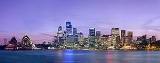
Sydney is the most populous city in
Australia with a
metropolitan area population of over 4.2 million people . Sydney is the state capital of
New South Wales and is located on the country's south-east coast.
The first European
colony in Australia, Sydney was established in 1788 at Sydney Cove by
Arthur Phillip who led the First Fleet from Britain. Built around
Port Jackson, which includes Sydney Harbour, the city of Sydney has been called the "Harbour City". It is Australia's largest
financial centre and is also an international tourist destination, notable for
its beaches and twin landmarks: the
Sydney Opera House and the
Harbour Bridge.
History
It has been speculated that the Sydney region has been occupied by
indigenous Australians for at least 30 000 years. At the time of the arrival of the First Fleet in 1788, 4000 - 8000 Aboriginal people lived in the region. There were three different language groups in the Sydney region; these were further refined into dialects spoken by smaller clans. The principal languages were Darug , Dharawal and
Guringai. Each clan had a territory; the location of that territory determined the resources available. Although
urbanisation has destroyed most evidence of these settlements , rock carvings still exist in several locations.
European interest in colonising Australia arose with the landing of British sea captain, Lieutenant
James Cook in
Botany Bay in 1770. Under instruction from the
British government, a convict settlement was founded by
Arthur Phillip in 1788. Phillip founded the colony at Sydney Cove on
Port Jackson. He named it after the British Home Secretary,
Thomas Townshend, Lord Sydney, in recognition of Sydney's role in issuing the charter authorising Phillip to establish a colony. In April 1789 a disease, thought to be
smallpox, decimated the indigenous population of Sydney; a conservative estimate says that 500 to 1000 Aboriginal people died in the area between
Broken and Botany Bays. There was violent resistance to British settlement, notably by the warrior Pemulwuy in the area around Botany Bay, and conflicts were common in the area surrounding the
Hawkesbury River. By 1820 there were only a few hundred Aborigines and
Governor Macquarie had begun initiatives to 'civilise, christianise and educate' the Aborigines by removing them from their clans.
Macquarie's tenure as
Governor of New South Wales was a period when Sydney was improved from its basic beginnings. Roads, bridges, wharves and public buildings were constructed by British and Irish convicts, and by 1822 the town had banks, markets, well-established thoroughfares and an organised constabulary. The 1830s and 1840s were periods of urban development, including the development of the first suburbs, as the town grew rapidly when ships began arriving from the
British Isles with immigrants looking to start a new life in a new country. On July 20 1842 the municipal council of Sydney was incorporated and the town was declared the first city in Australia, Charles H. Chambers was the first mayor. The first of several
gold rushes started in 1851, and the port of Sydney has since seen many waves of people arriving from around the world. Rapid suburban development began in the last quarter of the 19th century with the advent of steam powered tramways and railways. With industrialisation Sydney expanded rapidly, and by the early 20th century it had a population well in excess of one million. The
Great Depression hit Sydney badly. One of the highlights of the Depression era, however, was the completion of the Sydney Harbour Bridge in 1932.
Throughout the 20th century Sydney continued to expand with various new waves of
European and
Asian immigration, resulting in its highly cosmopolitan atmosphere. The majority of Sydneysiders are of British and Irish background. More recent arrivals have included Italians, Greeks, Jews, Lebanese, South Africans, South Asians , Sudanese, Turks, Macedonians, Croatians, Serbs, South Americans , Armenians, Eastern Europeans and East Asians .
Geography
Sydney is in a coastal basin bordered by the
Pacific Ocean to the east, the
Blue Mountains to the west, the
Hawkesbury River to the north and the Woronora Plateau to the south. Sydney lies on a submergent coastline, where the ocean level has risen to flood deep river valleys carved in the sandstone. One of these drowned valleys,
Port Jackson, better known as Sydney Harbour, is the largest
natural harbour in the world. There are more than 70 harbour and ocean beaches, including the famous
Bondi Beach, in the urban area. Sydney's urban area covers 1687 square kilometres as at 2001. The Sydney Statistical Division, used for census data, is the unofficial metropolitan area and covers 12,145 square kilometres . This area includes the
Central Coast and
Blue Mountains as well as broad swathes of national park and other unurbanised land.
Geographically, Sydney sprawls over two major regions: the Cumberland Plain, a relatively flat region lying to the south and west of the harbour, and the Hornsby Plateau, a sandstone plateau lying mainly to the north of the harbour, dissected by steep valleys. The oldest parts of the city are located in the flat areas south of the harbour; the North Shore was slower to develop because of its hilly topography, and was mostly a quiet
backwater until the
Sydney Harbour Bridge was opened in 1932, linking it to the rest of the city.
Climate
Sydney has an oceanic climate with warm summers and cool
winters, with rainfall spread throughout the year. The weather is moderated by proximity to the ocean, and more extreme temperatures are recorded in the inland western suburbs. The warmest month is January, with an average air temperature range on the coast of 18.6 °C–25.8 °C and an average of 14.6 days a year over 30
°C. The maximum recorded temperature was 45.3 °C on 14 January 1939 at the end of a 4 day nationwide
heat wave. The winter is mildly cool, with temperatures rarely dropping below 5 °C in coastal areas. The coldest month is July, with an average range of 8.0 °C–16.2 °C. The lowest recorded minimum was 2.1 °C. Rainfall is fairly evenly divided between summer and winter, but is slightly higher during the first half of the year, when easterly winds dominate.
The average annual rainfall, with moderate to low variability, is 1217.0
millimetres , falling on an average 138.0 days a year..
Snowfall last occurred in the Sydney City area in the 1830's.
Although the city does not suffer from
cyclones or significant
earthquakes, the El Niño Southern Oscillation plays an important role in determining Sydney's weather patterns: drought and bushfire on the one hand, and storms and flooding on the other, associated with the opposite phases of the oscillation. Many areas of the city bordering bushland have experienced
bushfires, notably in 1994 and 2002 — these tend to occur during the spring and summer. The city is also prone to severe
hail storms and wind storms. One such storm occurred in Sydney's eastern and city suburbs on the evening of 14 April 1999, producing massive hailstones of at least 9 centimetres in diameter and resulting in insurance losses of around $1.5 billion in less than one hour. The city is also prone to
flash flooding from enormous amounts of rain caused by East Coast Lows . The most notable event was the great Sydney flood which occurred on 6 August 1986 and dumped a record 327.6 millimetres on the city in 24 hours. This caused major traffic chaos and damage in many parts of the metropolitan area.
Recent research by a Macquarie University atmospheric scientist suggests that land clearing in western Sydney has contributed to major changes in the city's climate.
Climate Table
| | Jan | Feb | Mar | Apr | May | Jun | Jul | Aug | Sep | Oct | Nov | Dec | Year |
|---|
| Mean daily maximum temperature | 25.8 | 25.7 | 24.7 | 22.4 | 19.3 | 16.9 | 16.2 | 17.7 | 19.9 | 22.0 | 23.6 | 25.1 | 21.6 |
|---|
| Mean daily minimum temperature | 18.6 | 18.7 | 17.5 | 14.7 | 11.5 | 9.2 | 8.0 | 8.9 | 11.0 | 13.5 | 15.5 | 17.5 | 13.7 |
|---|
| Mean total rainfall | 103.3 | 117.4 | 131.2 | 127.2 | 123.3 | 128.1 | 98.1 | 81.5 | 68.7 | 76.9 | 83.1 | 78.1 | 1217.0 |
|---|
| Mean number of rain days | 12.1 | 12.3 | 13.3 | 12.0 | 12.0 | 11.4 | 10.3 | 9.9 | 10.3 | 11.5 | 11.4 | 11.5 | 138.0 |
|---|
| Source: |
: current temperatures and four day outlook, Source: NSW Govt
Urban structure
The extensive area covered by urban Sydney is formally divided into more than 300 suburbs , and administered as 38 local government areas. There is no city-wide government, but the Government of New South Wales and its agencies have extensive responsibilities in providing metropolitan services. The
City of Sydney itself covers a fairly small area comprising the central business district and its neighbouring inner-city suburbs. In addition, there are a number of regional descriptions which are used informally to conveniently describe large sections of the urban area. However it should be noted that there are many suburbs which are not conveniently covered by any of the following informal regional categories. The regions are
Eastern Suburbs,
Hills District,
Inner West,
Lower North Shore,
Northern Beaches,
North Shore,
Southern Sydney,
South-eastern Sydney,
South-western Sydney,
Sutherland Shire and
Western Sydney.
Sydney's central business district extends southwards for about 2 kilometres from Sydney Cove, the point of the first European settlement. Densely concentrated
skyscrapers and other buildings including historic sandstone buildings such as the
Sydney Town Hall and
Queen Victoria Building are interspersed by several parks such as Wynyard and
Hyde Park. The Sydney CBD is bounded on the east side by a chain of parkland that extends from
Hyde Park through
the Domain and
Royal Botanic Gardens to Farm Cove on the harbour. The west side is bounded by
Darling Harbour, a popular tourist and nightlife precinct while
Central station marks the southern end of the CBD.
George Street serves as the Sydney CBD's main north-south thoroughfare.
Although the CBD dominated the city's business and cultural life in the early days, other business/cultural districts have developed in a radial pattern since
World War II. As a result, the proportion of white-collar jobs located in the CBD declined from more than 60 per cent at the end of World War II to less than 30 per cent in 2004. Together with the commercial district of
North Sydney, joined to the CBD by the Harbour Bridge, the most significant outer business districts are
Parramatta in the central-west, Blacktown in the west, Bondi Junction in the east, Liverpool in the southwest,
Chatswood to the north, and
Hurstville to the south.
Governance
Historically, Sydney was governed by Cumberland County . Today there is no overall governing body for the Sydney metropolitan area. Local affairs for the metropolitan area are run by bodies known as local government areas . These areas all have elected councils and are responsible for a range of functions delegated to them by the New South Wales State Government.
The
City of Sydney includes the central business area and some adjoining inner suburbs, and has in recent years been expanded through amalgamation with adjoining local government areas, such as South Sydney. It is led by the elected Lord Mayor of Sydney and a council. The Lord Mayor, however, is sometimes treated as a representative of the whole city, for example during the Olympics.
The 38 LGAs in Sydney are:
...
...
...
...
Most citywide government activities are controlled by the state government. These include public transport, main roads, traffic control, policing, education above preschool level, and planning of major infrastructure projects. Because a large proportion of New South Wales' population lives in Sydney, state governments have traditionally been reluctant to allow the development of citywide governmental bodies, which would tend to rival the state government. For this reason, Sydney has always been a focus for the politics of both State and
Federal Parliaments. For example, the boundaries of the City of Sydney LGA have been significantly altered by state governments on at least four occasions since 1945, with expected advantageous effect to the governing party in the
New South Wales Parliament at the time.
Economy
The largest economic sectors in Sydney, measured by numbers of people employed, include property and business services, retail, manufacturing, and health and community services. Since the 1980s, jobs have moved from manufacturing to the services and information sectors.
Sydney is the largest corporate and financial centre in Australia and is also an important financial centre in the Asia Pacific. The
Australian Stock Exchange and the Reserve Bank of Australia are located in Sydney, as are the headquarters of 90 banks and more than half of Australia's top companies, and the regional headquarters for around 500 multinational corporations. Fox Studios Australia has large movie studios in the city.
The Sydney Futures Exchange is one of the Asia Pacific's largest financial futures and options exchanges, with 64.3 million contracts traded during 2005. In global terms it is the 12th largest futures market in the world and the 19th largest including options. With the increasing commercial role of Sydney's many medical laboratories and research centres, science and research is another strong growth sector .
Tourism plays an important role in Sydney's economy, with 7.8 million domestic visitors and 2.5 million international visitors in 2004.
As of September 2003, the unemployment rate in Sydney was 5.3%. According to
The Economist is a weekly news and international affairs publication of The Economist Newspaper Ltd ...
Intelligence Unit's Worldwide cost of living survey, Sydney is the sixteenth most expensive city in the world, while a UBS survey ranks Sydney as 26th in the world in terms of net earnings.
As of December 2005, Sydney has the highest median
house price of any Australian capital city at
$485 000. A report published by the OECD in November 2005, shows that Australia has the Western World's highest housing prices when measured against rental yields.
Sydney has been classified as a "Beta"
global city by the Globalization and World Cities Study Group and Network.. It is predicted to become an "Alpha"
global city along with
San Francisco within 20-25 years.
Demographics
3,455,110 people lived in Sydney's urban area as at 2001 with a population density of 345.7 persons per square kilometre, Inner Sydney being the most densely populated place in Australia with 4023 persons per square kilometre. The statistical division is larger than the urban area, as it allows for predicted growth. A resident of Sydney is commonly referred to as a Sydneysider
In the 2001 census, the most common self-described ancestries identified for Sydney residents were
Australian,
English and
Irish. The Census also recorded that 1% of Sydney's population identified as being of
indigenous origin and 31.2% were born overseas. The three major sources of immigrants are the
United Kingdom,
China and
New Zealand. Significant numbers of immigrants also came from
Vietnam,
Lebanon,
Italy,
India and the
Philippines. Most Sydneysiders are native speakers of
English; many have a second language, the most common being
Chinese languages,
Arabic and Greek.
Sydney hosts many different festivals including the Sydney Festival, a celebration involving both indoor and free outdoor performances throughout January; the
Big Day Out, a travelling rock music festival which originated in Sydney; the
Gay and Lesbian Mardi Gras along
Oxford Street; the Sydney Film Festival and many other smaller festivals such as Tropfest and
Archibald Prize, a competition organised by the Art Gallery of New South Wales.
Australian rock bands which formed in Sydney include
Midnight Oil,
INXS,
Radio Birdman, indie rockers
The Clouds and The Crystal Set, electronic music pioneers
Severed Heads, Single Gun Theory and
Itch-E and Scratch-E. Jazz groups such as the Sydney-based The Necks have performed at The Basement and the Harbourside Brasserie.
Sydney has several museums. The biggest are the
Australian Museum , the
Powerhouse Museum , the
Art Gallery of New South Wales, the
Museum of Contemporary Art and the
Australian National Maritime Museum.
Sydney is well endowed with
open spaces, and has many natural areas even within the city centre. Within the
Sydney central business district are the
Chinese Garden of Friendship and
Hyde Park, and the
Royal Botanical Gardens