
Encyclopedia
Global warming is the observed increase in the
average temperature of the
Earth's atmosphere and
oceans in recent decades.
The Earth's average near-surface atmospheric temperature rose 0.6 ± 0.2 °
Celsius in the 20th century. The prevailing scientific opinion on climate change is that "most of the warming observed over the last 50 years is
attributable to human activities".
The increased amounts of
carbon dioxide and other
greenhouse gases are the primary causes of the human-induced component of warming. They are released by the burning of
fossil fuels, land clearing and
agriculture, etc. and lead to an increase in the
greenhouse effect. The first speculation that a
greenhouse effect might occur was by the
Svante Arrhenius in 1897, although it did not become a topic of popular debate until some 90 years later.
The measure of the response to increased GHGs, and other anthropogenic and natural climate forcings, is climate sensitivity. It is found by observational and
model studies. This sensitivity is usually expressed in terms of the temperature response expected from a doubling of CO
2 in the atmosphere. The current literature estimates sensitivity in the range 1.5–4.5 °C . Models referenced by the
Intergovernmental Panel on Climate Change project that global temperatures may increase between 1.4 and 5.8 °C between 1990 and 2100. The uncertainty in this range results from both the difficulty of estimating the volume of future greenhouse gas emissions and uncertainty about climate sensitivity.
An increase in global temperatures can in turn cause other changes, including a
rising sea level and changes in the amount and pattern of precipitation. These changes may increase the frequency and intensity of extreme weather events, such as
floods,
droughts,
heat waves,
hurricanes, and
tornados. Other consequences include higher or lower agricultural yields,
glacial retreat, reduced summer streamflows, species
extinctions and increases in the ranges of disease vectors. Warming is expected to affect the number and magnitude of these events; however, it is difficult to connect particular events to global warming. Although most studies focus on the period up to 2100, warming is expected to continue past then, since CO
2 has an estimated 50 to 200 year long average atmospheric lifetime .
Only a small minority of climate scientists discount the role that humanity's actions have played in recent warming. However, the uncertainty is more significant regarding how much climate change should be expected in the future, and there is a hotly contested
political and public debate over what, if anything, should be done to
reduce or reverse future warming, and how to deal with the predicted consequences.
Nomenclature
The term "global warming" is a specific case of the more general term "
climate change" . In principle, "global warming" is neutral as to the causes, but in common usage, "global warming" generally implies a human influence. However, the
UNFCCC uses "climate change" for human-caused change, and "climate variability" for other changes . Some organizations use the term "anthropogenic climate change" for human-induced changes.
Historical warming of the Earth
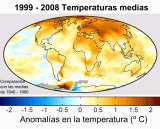
Relative to the period 1860–1900, global temperatures on both land and sea have increased by 0.75 °C , according to the
instrumental temperature record. Since 1979, land temperatures have increased about twice as fast as ocean temperatures
Based on estimates by
NASA's
Goddard Institute for Space Studies, 2005 was the warmest year since reliable, widespread instrumental measurements became available in the late 1800s, exceeding the previous record set in 1998 by a few hundredths of a degree Celsius. Similar estimates prepared by the
World Meteorological Organization and the
UK Climatic Research Unit concluded that 2005 was still only the second warmest year, behind 1998 .
Depending on the time frame, a number of
temperature records are available. These are based on different data sets, with different degrees of precision and reliability. An approximately global
instrumental temperature record begins in about 1860; contamination from the
urban heat island effect is believed to be small and well controlled for. A longer-term perspective is available from various proxy records for recent millennia; see
temperature record of the past 1000 years for a discussion of these records and their differences. The
attribution of recent climate change is clearest for the most recent period of the last 50 years, for which the most detailed data are available.
Satellite temperature measurements of the tropospheric temperature date from 1979.
Causes
The climate system varies both through natural, "internal" processes as well as in response to variations in external "forcing" from both human and non-human causes, including
solar activity,
volcanic emissions, and
greenhouse gases. Climatologists agree that the earth has warmed recently. The detailed
causes of this change remain an active field of research, but the scientific consensus identifies greenhouse gases as the primary cause of the recent warming. This conclusion can be controversial, especially outside the scientific community.
Adding
carbon dioxide or
methane to Earth's atmosphere, with no other changes, will make the planet's surface warmer; greenhouse gases create a natural
greenhouse effect without which temperatures on Earth would be an estimated 30 °C lower, and the Earth uninhabitable. It is therefore not correct to say that there is a debate between those who "believe in" and "oppose" the theory that adding carbon dioxide or methane to the Earth's atmosphere will, absent any mitigating actions or effects, result in warmer surface temperatures on Earth. Rather, the debate is about what the net effect of the addition of carbon dioxide and methane will be, when allowing for compounding or mitigating factors.
One example of an important feedback process is ice-albedo feedback. The increased CO
2 in the atmosphere warms the Earth's surface and leads to melting of ice near the poles. As the ice melts, land or open water takes its place. Both land and open water are less reflective than ice, and so absorb more solar radiation. This causes more warming, which in turn causes more melting, and the cycle continues.
Due to the thermal inertia of the earth's oceans and slow responses of other indirect effects, the Earth's current climate is not in equilibrium with the forcing imposed by increased greenhouse gases. Climate commitment studies indicate that, even if
greenhouse gases were stabilized at present day levels, a further warming of perhaps 0.5 °C to 1.0 °C would still occur.
Greenhouse gases in the atmosphere
Greenhouse gases are transparent to shortwave radiation from the sun. However, they absorb some of the longer infrared radiation emitted as
black body radiation from the Earth, making it more difficult for the Earth to cool. How much they warm the world by is shown in their global warming potential.
The atmospheric concentrations of carbon dioxide and methane have increased by 31% and 149% respectively above pre-industrial levels since 1750. This is considerably higher than at any time during the last 650,000 years, the period for which reliable data has been extracted from
ice cores. From less direct geological evidence it is believed that carbon dioxide values this high were last attained 40 million years ago. About three-quarters of the anthropogenic emissions of carbon dioxide to the atmosphere during the past 20 years is due to
fossil fuel burning. The rest of the anthropogenic emissions is predominantly due to land-use change, especially
deforestation .
The longest continuous instrumental measurement of carbon dioxide mixing ratios began in 1958 at
Mauna Loa. Since then, the annually averaged value has increased monotonically by approximately 21% from the initial reading of 315 ppmv, as shown by the
Keeling curve, to over 380 ppmv in 2006 . The monthly CO
2 measurements display small seasonal oscillations in an overall yearly uptrend, with the maximum reached during the northern hemisphere's late spring .
Methane, the primary constituent of
natural gas, enters the atmosphere both from biological production and leaks from natural gas pipelines and other infrastructure. Some biological sources are natural, such as termites, but others have been increased or created by agricultural activities, such as the cultivation of
rice paddies . Recent evidence suggests that forests may also be a source , and if so this would be an additional contribution to the
natural greenhouse effect, and not to the
anthropogenic greenhouse effect .
Future carbon dioxide levels are expected to continue rising due to ongoing fossil fuel usage, though the actual trajectory will depend on uncertain economic, sociological, technological, and natural developments. The IPCC Special Report on Emissions Scenarios gives a wide range of future carbon dioxide scenarios , ranging from 541 to 970 parts per million by the year 2100. Fossil fuel reserves are sufficient to reach this level and continue emissions past 2100, if coal and tar sands are extensively used.
Globally, the majority of anthropogenic
greenhouse gas emissions arise from fuel combustion. The remainder is accounted for largely by "fugitive fuel" , emissions from industrial processes , and agriculture: these contributed 5.8%, 5.2% and 3.3% respectively in 1990. Current figures are broadly comparable. Around 17% of emissions are accounted for by the combustion of fuel for the generation of electricity. A small percentage of emissions come from natural and anthropogenic biological sources, with approximately 6.3% derived from agriculturally produced methane and nitrous oxide.
Positive feedback effects, such as the expected release of
methane from the melting of
permafrost peat bogs in
Siberia , may lead to significant additional sources of greenhouse gas emissions. . Note that the anthropogenic emissions of other pollutants—notably sulfate aerosols—exert a cooling effect; this partially accounts for the plateau/cooling seen in the temperature record in the middle of the twentieth century , though this may also be due to intervening natural cycles.
Alternative theories
Various alternative hypotheses have been proposed to explain the observed increase in global temperatures, including but not limited to:
- The warming is within the range of natural variation.
- The warming is a consequence of coming out of a prior cool period — the Little Ice Age.
- The warming is primarily a result of variances in solar irradiance.
- The observance actually reflects the Urban Heat Island, as most readings are done in heavily populated areas.
However, the strong scientific support for man-made global warming implies that such alternative opinions are not widely held. In the journal
Science, an essay by Naomi Oreskes considered the abstracts of all 928 scientific articles in the ISI citation database identified with the keyword "global climate change". Dr. Oreskes concluded that none of these abstracts attempts to refute the position that man-made emissions of greenhouse gases are a substantial contributor to recent warming. .
Solar variation theory
Modeling studies reported in the IPCC Third Assessment Report did not find that changes in solar forcing were needed in order to explain the climate record for the last four or five decades . These studies found that volcanic and solar forcings may account for half of the temperature variations prior to 1950, but the net effect of such natural forcings has been roughly neutral since then . In particular, the change in climate forcing from greenhouse gases since 1750 was estimated to be eight times larger than the change in forcing due to
over the same period .
Since the TAR, some studies have suggested that changes in irradiance since pre-industrial times are less by a factor of 3 to 4 than in the reconstructions used in the TAR . Other researchers believe that the impact of solar forcing is being underestimated and propose that solar forcing accounts for 16% or 36% of recent greenhouse warming. Others have proposed that feedback from clouds or other processes enhance the direct effect of solar variation, which if true would also suggest that the impact of solar variability was being underestimated. In general the level of scientific understanding of the contribution of variations in solar irradiance to historical climate changes is "very low" .
The present level of solar activity is historically high. Solanki et al. suggest that solar activity for the last 60 to 70 years may be at its highest level in 8,000 years; Muscheler et al. disagree, suggesting that other comparably high levels of activity have occurred several times in the last few thousand years . Solanki concluded based on their analysis that there is a 92% probability that solar activity will decrease over the next 50 years. In addition, researchers at Duke University have found that 10–30% of the warming over the last two decades may be due to increased solar output . In a review of existing literature, Foukal et al. determined both that the variations in solar output were too small to have contributed appreciably to global warming since the mid-1970s and that there was no evidence of a net increase in brightness during this period.
Predicted effects
The predicted effects of global warming are many and various, both for the
environment and for
human life. These effects include
sea level rise, impacts on agriculture, reductions in the ozone layer, increased intensity and frequency of extreme weather events, and the spread of disease. In some cases, the effects may already be manifest, although it is difficult to attribute specific natural phenomena to long-term global warming. In particular, the relationship between global warming and hurricanes is still being debated. http://hurricane.atmos.colostate.edu/forecasts/2005/dec2005/] A draft statement by the
World Meteorological Organization acknowledges the differing viewpoints on this issue .
The extent and likelihood of these consequences is a matter of considerable
controversy. A summary of possible effects and recent understanding can be found in the report of the
IPCC Working Group II . Some scientists believe global warming is already causing death and disease across the world through flooding, environmental destruction, heat waves and other extreme weather events.
Effects on ecosystems
Both primary and secondary effects of global warming — such as higher temperatures, lessened snow cover, rising sea levels, and weather changes — may influence not only human activities but also ecosystems. Some species may be forced out of their habitats because of changing conditions, while others may flourish. Similarly, changes in timing of life patterns, such as annual migration dates, may alter regional predator-prey balance. The effect of advanced spring arrival dates in Scandinavia of birds that overwinter in subsaharan Africa has been ascribed to evolutionary adaptation of the species to climactic warming .
Ocean pH is lowering as a result of increased carbon dioxide levels. Lowering of ocean pH along with changing water temperature and ocean depth will have a direct impact on coral reefs.
Another suggested mechanism whereby a warming trend may be amplified involves the thawing of
tundra, which can release significant amounts of the potent greenhouse gas methane that is trapped in
permafrost and ice
clathrate compounds .
Impact on glaciers
Global warming has led to negative
glacier mass balance, causing
glacier retreat around the world. Oerlemans showed a net decline in 142 of the 144 mountain glaciers with records from 1900 to 1980. Since 1980 global glacier retreat has increased significantly. Similarly, Dyurgerov and Meier averaged glacier data across large scale regions and found that every region had a net decline from 1960 to 2002, though a few local regions have shown increases. Some glaciers that are in disequilibrium with present climate have already disappeared and increasing temperatures are expected to cause continued retreat in the majority of alpine glaciers around the world. Upwards of 90% of glaciers reported to the World Glacier Monitoring Service have retreated since 1995 .
Of particular concern is the potential for failure of the
Hindu Kush and
Himalayan glacial melts. The melt of these glaciers is a large and reliable source of water for
China,
India, and much of
Asia, and these waters form a principal dry-season water source. Increased melting would cause greater flow for several decades, after which "some areas of the most populated region on Earth are likely to 'run out of water'"
Miniature Rock Glaciers
Rock glaciers - a cache of ice under a pile of boulders - are among other water signs such as drying meadows and warming lakes that
scientists are studying in the Sierras in the
western United States. Connie Millar searches for the rock glaciers in the
Yosemite area of the Sierra crest. She hypothesizes that rock glaciers will be predictors of how ecosystems change with rising temperatures. Millar is leading an effort to co-ordinate the work of many scientists to see how the pieces of the Global Warming puzzle may fit.
Destabilization of ocean currents
There is also some speculation that global warming could, via a shutdown or slowdown of the
thermohaline circulation, trigger localized cooling in the North Atlantic and lead to cooling, or lesser warming, in that region. This would affect in particular areas like
Scandinavia and Britain that are warmed by the North Atlantic drift.
Environmental refugees
Even a relatively small rise in sea level would make some densely settled coastal plains uninhabitable and create a significant
refugee problem. If the sea level were to rise in excess of 4 meters almost every coastal city in the world would be severely affected, with the potential for major impacts on world-wide trade and economy. Presently, the
IPCC predicts
sea level rise of less than 1 meter through 2100, but they also warn that global warming during that time may lead to irreversible changes in the Earth's glacial system and ultimately melt enough ice to raise sea level many meters over the next millennia. It is estimated that around 200 million people could be affected by sea level rise, especially in
Vietnam,
Bangladesh,
China,
India,
Thailand,
Philippines,
Indonesia and
Egypt.
An example of the ambiguous nature of environmental refugees is the emigration from the island nation of
Tuvalu, which has an average elevation of approximately one meter above sea level. Tuvalu already has an ad hoc agreement with
New Zealand to allow phased relocation and many residents have been leaving the islands. However, it is far from clear that rising sea levels from global warming are a substantial factor - best estimates are that sea level has been rising there at approximately 1–2 millimeters per year , but that shorter timescale factors—
ENSO, or
tides—have far larger temporary effects .
Spread of disease
One of the largest known outbreaks of
Vibrio parahaemolyticus is a curved, rod-shaped, Gram-negative [i] bacterium [i] found in saltwater [i] ...
gastroenteritis has been attributed to generally rising ocean temperature where infected
oysters were harvested in
Prince William Sound,
Alaska in 2005. Before this, the northernmost reported risk of such infection was in
British Columbia, 1000 km to the south .
Global warming may extend the range of vectors conveying infectious diseases such as
malaria. A warmer environment boosts the reproduction rate of
mosquitoes and the number of blood meals they take, prolongs their breeding season, and shortens the maturation period for the microbes they disperse. Global warming has been implicated in the recent spread to the north
Mediterranean region of bluetongue disease in
domesticated ruminants associated with
mite bites .
Hantavirus infection,
Crimean-Congo hemorrhagic fever, tularemia and
rabies increased in wide areas of
Russia during 2004–2005. This was associated with a population explosion of
rodents and their
predators but may be partially blamed on breakdowns in governmental vaccination and rodent control programs. Similarly, despite the disappearance of malaria in most temperate regions, the indigenous mosquitoes that transmitted it were never eliminated and remain common in some areas. Thus, although temperature is important in the transmission dynamics of malaria, many other factors are influential .
Financial effects
Financial institutions, including the world's two largest insurance companies,
Munich Re and
Swiss Re, warned in a 2002 study that "the increasing frequency of severe climatic events, coupled with social trends" could cost almost
US$150 billion each year in the next decade. These costs would, through increased costs related to insurance and disaster relief, burden customers, tax payers, and industry alike.
According to the , limiting carbon emissions could avoid 80% of the projected additional annual cost of tropical cyclones by the 2080s. According to Choi and Fisher each 1% increase in annual precipitation could enlarge catastrophe loss by as much as 2.8%.
The United Nations' Environmental Program recently announced that severe weather around the world has made 2005 the most costly year on record , although there is "no way to prove that [a given hurricane] either was, or was not, affected by global warming" . Preliminary estimates presented by the German insurance foundation
Munich Re put the economic losses at more than US$200 billion, with insured losses running at more than US$70 billion.
Biomass production
The creation of
biomass by plants is influenced by the availability of water,
nutrients, and carbon dioxide. Part of this biomass is used as the energy source for nearly all other life forms, including feed-stock for domestic animals, and fruits and grains for human consumption. It also includes timber for construction purposes.
A rise in atmospheric carbon dioxide can increase the efficiency of the
metabolism of most plants, potentially allowing them to create more biomass. A rising temperature can also increase the growing season in colder regions. It is sometimes argued that these effects can create a greener, richer planet, with more available biomass. However, there are many other factors involved, and it is currently unclear if plants really benefit from global warming. Plant growth can be limited by a number of factors, including soil fertility, water, temperature, and carbon dioxide concentration.
IPCC models currently predict a possible modest increase in plant productivity. However, there are several negative impacts: decreases in productivity may occur at above-optimal temperatures; greater variation in temperature is likely to decrease wheat yields; in experiments,
grain and
forage quality declines if CO
2 and temperature are increased; and the reductions in soil moisture in summer, which are likely to occur, would have a negative impact on productivity.
Satellite data show that the productivity of the northern hemisphere
did indeed increase from 1982 to 1991
.
However, more recent studies
,
found that from 1991 to 2002, widespread droughts had actually caused
a decrease in summer photosynthesis in the mid and high latitudes of
the northern hemisphere.
Opening up of the Northwest Passage in summer
Melting
Arctic ice may open the
Northwest Passage in summer in approximately ten years, which would cut 5,000 nautical miles from shipping routes between Europe and Asia. This would be of particular relevance for supertankers which are too big to fit through the
Panama Canal and currently have to go around the tip of South America. According to the Canadian Ice Service, the amount of ice in Canada's eastern Arctic Archipelago decreased by 15% between 1969 and 2004 .
A similar opening is possible in the Arctic north of Siberia, allowing much faster East Asian to Europe transport.
Negative impacts of the melting of ice include a potential increase in the rate of global warming, as that ice reflects more sunlight than the open water which is replacing it. There are also
ecological effects of melting polar ice: for example,
polar bears use sea ice to reach their prey, and swim to another
ice floe when one breaks up. Ice is now becoming further separated, and dead polar bears are being found in the water, believed to have drowned. More recently, observed cannibalistic behavior in polar bears has been suggested by some scientists to be the result of food shortages brought on by global warming .
Mitigation
The likelihood that global temperatures will continue to significantly increase has led others to propose means to mitigate global warming. Mitigation covers all actions aimed at reducing the negative effects or the likelihood of global warming.
There are five categories of actions that can be taken to mitigate global warming:
- Reduction of energy use
- Shifting from carbon-based fossil fuels to alternative energy sources
- Carbon capture and storage
- Carbon sequestration
- Planetary engineering to cool the earth
Strategies for mitigation of global warming include
development of new technologies,
wind power,
nuclear power,
solar power,
renewable energy,
biodiesel,
electric or
hybrid automobiles,
fuel cells,
energy conservation, carbon taxes,
enhancing natural carbon dioxide sinks, carbon offsets, population control and carbon capture and storage. Some environmentalist groups encourage
individual action against global warming, often aimed at the consumer, and there has been business action on climate change.
The world's primary international agreement on combating climate change is the
Kyoto Protocol. The Kyoto Protocol is an amendment to the
United Nations Framework Convention on Climate Change . Countries that ratify this protocol commit to reduce their emissions of carbon dioxide and five other greenhouse gases, or engage in emissions trading if they maintain or increase emissions of these gases.
Although the combination of scientific consensus and economic incentives were enough to persuade the
governments of more than 150 countries to ratify the Kyoto Protocol , there is a continuing debate about just how much greenhouse gas emissions warm the planet. Some politicians, including President of the United States
George W. Bush , Prime Minister of Australia
John Howard have argued that the cost of
mitigating global warming is too large to be justified.
However, some segments of the business community have accepted both the reality of global warming and its attribution to anthropogenic causes, as well as the need for actions such as carbon emissions trading and carbon taxes.
Adaptation strategies accept some warming as a foregone conclusion and focus on preventing or reducing undesirable consequences. Examples of such strategies include defense against rising sea levels or ensuring
food security.
Climate models


Scientists have studied global warming with computer models of the climate . For a climate model to be accepted by the scientific community as being valid it must first be shown that it does a good job of simulating known climate variations, such as the difference between summer and winter, the North Atlantic Oscillation, or El Niño. Once models which fail these tests are rejected, the remaining models all predict that the net effect of adding greenhouse gases will be a warmer climate in the future. However, the amount of predicted warming varies by model, and there still remains a considerable range of climate sensitivity predicted by the models which survive these tests; one of the most important sources of this uncertainty is believed to be different ways of handling clouds. Part of the technical summary of the IPCC TAR includes a recognition of the need to quantify this uncertainty: "In climate research and modeling, we should recognize that we are dealing with a coupled non-linear system, and therefore that the prediction o