

Australian megafauna

Encyclopedia
Animal
Animals are a major group of multicellular, eukaryotic organisms of the kingdom Animalia or Metazoa. Their body plan eventually becomes fixed as they develop, although some undergo a process of metamorphosis later on in their life. Most animals are motile, meaning they can move spontaneously and...
species
Species
In biology, a species is one of the basic units of biological classification and a taxonomic rank. A species is often defined as a group of organisms capable of interbreeding and producing fertile offspring. While in many cases this definition is adequate, more precise or differing measures are...
in Australia
Australia (continent)
Australia is the world's smallest continent, comprising the mainland of Australia and proximate islands including Tasmania, New Guinea, the Aru Islands and Raja Ampat Islands...
, often defined as species with body mass estimates of greater than 30 kilograms, or equal to or greater than 30% greater body mass than their closest living relatives. Many of these species became extinct during the Pleistocene
Pleistocene
The Pleistocene is the epoch from 2,588,000 to 11,700 years BP that spans the world's recent period of repeated glaciations. The name pleistocene is derived from the Greek and ....
(16,100±100 - 50,000 years before present).
The cause of the extinction is an active and contentious field of research. It is hypothesised that with the arrival of humans (around 48,000-60,000 years ago), hunting and the use of fire
Fire-stick farming
Fire-stick farming is a term coined by Australian archaeologist Rhys Jones in 1969 to describe the practice of Indigenous Australians where fire was used regularly to burn vegetation to facilitate hunting and to change the composition of plant and animal species in an area.Fire-stick farming had...
to manage their environment may have contributed to the extinction of the megafauna
Megafauna
In terrestrial zoology, megafauna are "giant", "very large" or "large" animals. The most common thresholds used are or...
. Increased aridity during peak glaciation (about 18,000 years ago) may have also contributed to the extinction of the megafauna. Some proponents claim a change in the climate alone caused extinction of the megafauna, but these arguments have to account for the fact that megafaunal species comfortably survived two million years of climatic oscillations, including a number of arid
Arid
A region is said to be arid when it is characterized by a severe lack of available water, to the extent of hindering or even preventing the growth and development of plant and animal life...
glacial periods, before their sudden extinction.
New evidence based on accurate optically stimulated luminescence
Optical dating
Optical dating is a method of determining how long ago minerals were last exposed to daylight. It is useful to geologists and archaeologists who want to know when such an event occurred....
and uranium-thorium dating
Uranium-thorium dating
Uranium-thorium dating, also called thorium-230 dating, uranium-series disequilibrium dating or uranium-series dating, is a radiometric dating technique commonly used to determine the age of calcium carbonate materials such as speleothem or coral...
of megafaunal remains suggests that humans were the ultimate cause of the extinction of megafauna in Australia. The dates derived show that all forms of megafauna became extinct in the same rapid timeframe — approximately 46,000 years ago — the period of time in which humans first arrived in Australia. Analysis of oxygen and carbon isotopes from teeth of megafauna indicate the regional climates at the time of extinction were similar to arid regional climates of today, and that the megafauna were well adapted to arid climates. The dates derived have been interpreted as suggesting that the main mechanism for extinction was human burning of a landscape that was then much less fire-adapted; oxygen and carbon isotopes of teeth indicate sudden, drastic, non-climate-related changes in vegetation and in the diet of surviving marsupial species. However, humans appear to have rapidly eliminated the megafauna of Tasmania
Tasmania
Tasmania is an Australian island and state. It is south of the continent, separated by Bass Strait. The state includes the island of Tasmania—the 26th largest island in the world—and the surrounding islands. The state has a population of 507,626 , of whom almost half reside in the greater Hobart...
about 41,000 years ago (following formation of a land bridge to Australia about 43,000 years ago as ice age sea levels declined) without using fire to modify the environment there, implying that at least in this case hunting was the most important factor. It has also been suggested that the vegetational changes that occurred on the mainland were a consequence, rather than a cause, of the elimination of the megafauna.
There are similarities between prehistoric Australian megafauna and some mythical creatures from the aboriginal dreamtime (Mackness 2009).
Living Australian megafauna
The term "megafauna" is usually applied to large animals (over 100 kg) that went extinct in the Pleistocene, roughly 60,000 years ago. In Australia, however, the megafauna were never as large as those found on other continents and so a more lenient criteria of over 40 kg is often appliedMammals
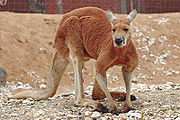
- Red KangarooRed KangarooThe Red Kangaroo is the largest of all kangaroos, the largest mammal native to Australia, and the largest surviving marsupial. It is found across mainland Australia, avoiding only the more fertile areas in the south, the east coast, and the northern rainforests.-Description:This species is a very...
(Macropus rufus) This species is a very large kangaroo with short, red-brown fur, fading to pale buff below and on the limbs. It has long, pointed earlobes and a squared-off muzzle. Females are smaller than males and are blue-grey with a brown tinge, pale grey below, although arid zone females are coloured more like males. It has two appendages with small claws (much like arms), two muscular legs, which are used for jumping, and a tail, which is often used like a third leg for balance.
- Red Kangaroos' legs work much like a rubber band. The male Red Kangaroo can leap in full force approximately 30 feet (9.14 m) in one leap. Males grow up to 1.8m (6ft) tall and weigh up to 85 kg (187lbs). Females grow up to 1.1m (3.6ft) tall and weigh up to 35kg (77lbs). Tails can be up to 1m (3ft) along.
- Eastern Grey KangarooEastern Grey KangarooThe Eastern Grey Kangaroo is a marsupial found in southern and eastern Australia, with a population of several million. It is also known as the Great Grey Kangaroo and the Forester Kangaroo...
(Macropus giganteus) is a marsupialMarsupialMarsupials are an infraclass of mammals, characterized by giving birth to relatively undeveloped young. Close to 70% of the 334 extant species occur in Australia, New Guinea, and nearby islands, with the remaining 100 found in the Americas, primarily in South America, but with thirteen in Central...
found in southern and eastern AustraliaAustraliaAustralia , officially the Commonwealth of Australia, is a country in the Southern Hemisphere comprising the mainland of the Australian continent, the island of Tasmania, and numerous smaller islands in the Indian and Pacific Oceans. It is the world's sixth-largest country by total area...
, with a population of several million. Although a big Eastern Grey male typically weighs around 66 kg (145 lbPound (mass)The pound or pound-mass is a unit of mass used in the Imperial, United States customary and other systems of measurement...
) and stands almost 2 m (6 ft.) tall, the scientific name, Macropus giganteus (gigantic large-foot), is misleading, as the Red KangarooRed KangarooThe Red Kangaroo is the largest of all kangaroos, the largest mammal native to Australia, and the largest surviving marsupial. It is found across mainland Australia, avoiding only the more fertile areas in the south, the east coast, and the northern rainforests.-Description:This species is a very...
of the semi-arid inland is larger.
- Antilopine KangarooAntilopine KangarooThe Antilopine Kangaroo sometimes called the Antilopine Wallaroo or the Antilopine Wallaby, is a species of macropod found in northern Australia: in Cape York Peninsula in Queensland, the Top End of the Northern Territory, and the Kimberley region of Western Australia...
(Macropus antilopinus), sometimes called the Antilopine Wallaroo or the Antilopine Wallaby, is a species of macropod found in northern AustraliaAustraliaAustralia , officially the Commonwealth of Australia, is a country in the Southern Hemisphere comprising the mainland of the Australian continent, the island of Tasmania, and numerous smaller islands in the Indian and Pacific Oceans. It is the world's sixth-largest country by total area...
: in Cape York PeninsulaCape York PeninsulaCape York Peninsula is a large remote peninsula located in Far North Queensland at the tip of the state of Queensland, Australia, the largest unspoilt wilderness in northern Australia and one of the last remaining wilderness areas on Earth...
in QueenslandQueenslandQueensland is a state of Australia, occupying the north-eastern section of the mainland continent. It is bordered by the Northern Territory, South Australia and New South Wales to the west, south-west and south respectively. To the east, Queensland is bordered by the Coral Sea and Pacific Ocean...
, the Top EndTop EndThe Top End of northern Australia is the second northernmost point on the continent. It covers a rather vaguely-defined area of perhaps 400,000 square kilometres behind the northern coast from the Northern Territory capital of Darwin across to Arnhem Land with the Indian Ocean on the west, the...
of the Northern TerritoryNorthern TerritoryThe Northern Territory is a federal territory of Australia, occupying much of the centre of the mainland continent, as well as the central northern regions...
, and the KimberleyKimberley region of Western AustraliaThe Kimberley is one of the nine regions of Western Australia. It is located in the northern part of Western Australia, bordered on the west by the Indian Ocean, on the north by the Timor Sea, on the south by the Great Sandy and Tanami Deserts, and on the east by the Northern Territory.The region...
region of Western AustraliaWestern AustraliaWestern Australia is a state of Australia, occupying the entire western third of the Australian continent. It is bounded by the Indian Ocean to the north and west, the Great Australian Bight and Indian Ocean to the south, the Northern Territory to the north-east and South Australia to the south-east...
. It is a locally common, gregarious grazer.
- Eastern WallarooEastern WallarooThe Eastern Wallaroo also known as the Common Wallaroo or the Hill Wallaroo is part of the Wallaroo family . It is a large, variable species of macropod ....
(Macropus robustus), also called the Hill Wallaroo, is generally found in a variety of habitats; forests, deserts, and grasslands. They can weigh as much as 15–47 kg (33-105 lb) and grow over 4 feet long.
- Common WombatCommon WombatThe common wombat , also known as the coarse-haired wombat or bare-nosed wombat, is a marsupial, one of three species of wombats and the only one in the genus Vombatus. The common wombat grows to an average of long and a weight of .- Taxonomy :The common wombat was first described by George Shaw...
(Vombatus ursinus), among the three species of wombatWombatWombats are Australian marsupials; they are short-legged, muscular quadrupeds, approximately in length with a short, stubby tail. They are adaptable in their habitat tolerances, and are found in forested, mountainous, and heathland areas of south-eastern Australia, including Tasmania, as well as...
, this variety can get to be 25–40 kg (55-88 lb). Common wombats thrive in Eastern Australia and Tasmania, and prefer temperate forests and highland regions.
- Southern Hairy-nosed WombatSouthern Hairy-nosed WombatThe Southern Hairy-nosed Wombat is one of three species of wombats. It is found in scattered areas of semi-arid scrub and mallee from the eastern Nullarbor Plain to the New South Wales border area. It is the smallest of all three wombat species. The young often do not survive dry seasons...
(Lasiorhinus latifrons), among the three species of wombat, they only get to be 19–32 kg (42-71 lb). They are much stockier then the Common Wombat and have much shorter limbs.
- DingoDingoThe Australian Dingo or Warrigal is a free-roaming wild dog unique to the continent of Australia, mainly found in the outback. Its original ancestors are thought to have arrived with humans from southeast Asia thousands of years ago, when dogs were still relatively undomesticated and closer to...
(Canis lupus dingo), a subspecies of wolf (to be precise a variant of the domestic dog) that was introduced into the continent around 4000 years ago most likely by Asian seafarers and later returned to the wild. The average weight of a dingo is about 13–20 kg, although heavier dogs can be found. Most are found in mainland Australia, yet many can be found in ThailandThailandThailand , officially the Kingdom of Thailand , formerly known as Siam , is a country located at the centre of the Indochina peninsula and Southeast Asia. It is bordered to the north by Burma and Laos, to the east by Laos and Cambodia, to the south by the Gulf of Thailand and Malaysia, and to the...
.
Birds

- EmuEmuThe Emu Dromaius novaehollandiae) is the largest bird native to Australia and the only extant member of the genus Dromaius. It is the second-largest extant bird in the world by height, after its ratite relative, the ostrich. There are three subspecies of Emus in Australia...
The emu was first described under the name of the New Holland Cassowary in Arthur Phillip's Voyage to Botany Bay, published in 1789.[4] The species was named by ornithologist John Latham, who collaborated on Phillip's book and provided the first descriptions of and names for many Australian bird species; its name is Latin for "fast-footed New Hollander". The etymology of the common name Emu is uncertain, but is thought to have come from an Arabic word for large bird that was later used by Portuguese explorers to describe the related Cassowary in New Guinea.[5] In Victoria, some terms for the emu were Barrimal in the Djadja wurrung language, myoure in Gunai, and courn in Jardwadjali.[6]
In his original 1816 description of the emu, Vieillot used two generic names; first Dromiceius, then Dromaius a few pages later. It has been a point of contention ever since which is correct; the latter is more correctly formed, but the convention in taxonomy is that the first name given stands, unless it is clearly a typographical error.[7] Most modern publications, including those of the Australian government,[8] use Dromaius, with Dromiceius mentioned as an alternative spelling.
- CassowaryCassowaryThe cassowaries are ratites, very large flightless birds in the genus Casuarius native to the tropical forests of New Guinea, nearby islands and northeastern Australia. There are three extant species recognized today...
The Northern and Dwarf Cassowaries are not well known. All cassowaries are usually shy, secretive birds of the deep forest, adept at disappearing long before a human knows they are there. Even the more accessible Southern Cassowary of the far north QueenslandQueenslandQueensland is a state of Australia, occupying the north-eastern section of the mainland continent. It is bordered by the Northern Territory, South Australia and New South Wales to the west, south-west and south respectively. To the east, Queensland is bordered by the Coral Sea and Pacific Ocean...
rain forests is not well understood.
Reptiles
- GoannaGoannaGoanna is the name used to refer to any number of Australian monitor lizards of the genus Varanus, as well as to certain species from Southeast Asia.There are around 30 species of goanna, 25 of which are found in Australia...
Tooth
Teeth are small, calcified, whitish structures found in the jaws of many vertebrates that are used to break down food. Some animals, particularly carnivores, also use teeth for hunting or for defensive purposes. The roots of teeth are embedded in the Mandible bone or the Maxillary bone and are...
and claw
Claw
A claw is a curved, pointed appendage, found at the end of a toe or finger in most mammals, birds, and some reptiles. However, the word "claw" is also often used in reference to an invertebrate. Somewhat similar fine hooked structures are found in arthropods such as beetles and spiders, at the end...
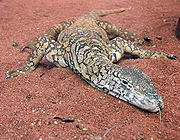
s. The largest is the Perentie
Perentie
The Perentie is the largest monitor lizard or goanna native to Australia, and fourth largest lizard on earth, after the Komodo Dragon, crocodile monitor and the water monitor...
(Varanus giganteus), which can grow over 2 m in length. They prey on all manner of small animals; insect
Insect
Insects are a class of living creatures within the arthropods that have a chitinous exoskeleton, a three-part body , three pairs of jointed legs, compound eyes, and two antennae...
s, lizards, snake
Snake
Snakes are elongate, legless, carnivorous reptiles of the suborder Serpentes that can be distinguished from legless lizards by their lack of eyelids and external ears. Like all squamates, snakes are ectothermic, amniote vertebrates covered in overlapping scales...
s, mammal
Mammal
Mammals are members of a class of air-breathing vertebrate animals characterised by the possession of endothermy, hair, three middle ear bones, and mammary glands functional in mothers with young...
s, bird
Bird
Birds are feathered, winged, bipedal, endothermic , egg-laying, vertebrate animals. Around 10,000 living species and 188 families makes them the most speciose class of tetrapod vertebrates. They inhabit ecosystems across the globe, from the Arctic to the Antarctic. Extant birds range in size from...
s, and eggs
Egg (food)
Eggs are laid by females of many different species, including birds, reptiles, amphibians, and fish, and have probably been eaten by mankind for millennia. Bird and reptile eggs consist of a protective eggshell, albumen , and vitellus , contained within various thin membranes...
. Meals are often eaten whole, and thus the size of their meals depends on the size of the animal itself. However, the Perentie has been observed killing a young kangaroo
Kangaroo
A kangaroo is a marsupial from the family Macropodidae . In common use the term is used to describe the largest species from this family, especially those of the genus Macropus, Red Kangaroo, Antilopine Kangaroo, Eastern Grey Kangaroo and Western Grey Kangaroo. Kangaroos are endemic to the country...
, and then biting out chunks of flesh like a dog
Dog
The domestic dog is a domesticated form of the gray wolf, a member of the Canidae family of the order Carnivora. The term is used for both feral and pet varieties. The dog may have been the first animal to be domesticated, and has been the most widely kept working, hunting, and companion animal in...
. Goannas have even been blamed for the death of sheep by farmers, though most likely erroneously, as goannas are also eaters of carrion
Carrion
Carrion refers to the carcass of a dead animal. Carrion is an important food source for large carnivores and omnivores in most ecosystems. Examples of carrion-eaters include vultures, hawks, eagles, hyenas, Virginia Opossum, Tasmanian Devils, coyotes, Komodo dragons, and burying beetles...
and are attracted to rotting meat.
Not all goannas are gargantuan. Pygmy goannas may be smaller than a man's arm. The smallest of these, the short-tailed monitor
Short-tailed monitor
The short-tailed monitor, or the pygmy goanna, is the smallest living monitor lizard, and may be the smallest species of monitor that has ever existed with a maximum length of 25 cm...
(Varanus brevicuda) reaches only 20 cm in length. They survive on smaller prey such as insects and mice.
- Saltwater CrocodileSaltwater CrocodileThe saltwater crocodile, also known as estuarine or Indo-Pacific crocodile, is the largest of all living reptiles...
A healthy adult male saltwater crocodile is typically 4.8 to 7 metres (15.75 to 21.6 ft) long, and weighs up to 770 kg (1697 lb), with many exceptions being much larger than this. Many large sizes have been reported [2], [1] Females are much smaller than males, with typical female body lengths in the range of 2.5–3 meters. A 28 foot (8.5 m) individual was reportedly shot on the Norman River of Queensland in 1957 and a cast was made of this animal (which can be viewed and is quite the popular tourist attraction), but due to the time since the occurrence and lack of rock hard evidence (other than the plaster) it is not considered "official". The saltwater crocodile has fewer armor plates on its neck than other crocodilians, and its broad body contrasts with most other lean crocodiles, leading to early unverified assumptions the reptile was an alligator.[2]Crocodylus porosus (Schneider, 1801), by Adam Britton from the Crocodilian Species List. The Salt water crocodile is the largest extant native animal in Australia that spends any portion of its time on land.
- Crocodylus johnsoni (Freshwater Crocodile)
Bony fish
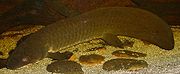
- Queensland LungfishQueensland LungfishThe Queensland lungfish, Neoceratodus forsteri is the sole surviving member of the family Ceratodontidae and order Ceratodontiformes. It is one of only six extant lungfish species in the world...
Fossil records of this group date back 380 million years, around the time when the higher vertebrate classes were beginning to evolve. Fossils of lungfish almost identical to this species have been uncovered in northern New South Wales, indicating that Neoceratodus has remained virtually unchanged for well over 100 million years, making it one of the oldest living vertebrate genera on the planet.
It is one of six extant representatives of the ancient air-breathing Dipnoi (lungfishes) that flourished during the Devonian period (c. 413-365 million years ago) and is the most primitive surviving member of this lineage The five other freshwater lungfish species, four in Africa and one in South America, are very different morphologically to N. forsteri. The Queensland lungfish can live for several days out of the water, if it is kept moist, but will not survive total water depletion, unlike its African counterparts.[1]
- Gulf saratogaGulf saratogaThe gulf saratoga, Scleropages jardinii, is a freshwater bony fish native to Australia and New Guinea, one of two species of fishes sometimes known as Australian arowanas, the other being the saratoga...
Scleropages jardinii is a freshwater bony fish native to Australia, one of two species of fishes sometimes known as Australian arowanas, the other being the saratoga (S. leichardti). It has numerous other common names, including northern saratoga, Australian bonytongue, toga and barramundi (not to be confused with the barramundi perch, Lates calcarifer). It is a member of the subfamily Osteoglossinae, a (basal) teleost group. Its scientific name is sometimes spelled S. jardini.
Cartilaginous fish
- Southern shovelnose raySouthern shovelnose rayThe southern shovelnose ray, western shovelnose ray, or yellow shovelnose ray is a species of fish in the Rhinobatidae family. It is endemic to Australia. Its natural habitats are open seas and shallow seas....
The southern shovelnose ray, western shovelnose ray, or yellow shovelnose ray (Aptychotrema vincentiana) is a species of fish in the Rhinobatidae family. It is endemic to Australia. Its natural habitats are open seas and shallow seas.
Mollusks
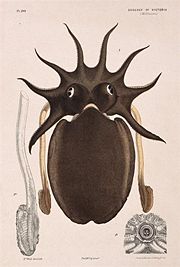
- Australian Giant CuttlefishAustralian Giant CuttlefishSepia apama, also known as the Australian Giant Cuttlefish, is the world's largest cuttlefish species, growing to 50 cm in mantle length and over 10.5 kg in weight. Using cells known as chromatophores, the cuttlefish can put on spectacular displays, changing colour in an instant.S...
Sepia apama, is the world's largest cuttlefish species, growing to 50 cm in mantle length and over 10.5 kg (23 lb) in weight.[1]
S. apama is native to the southern coast of Australia, from Brisbane in Queensland to Shark Bay in Western Australia. It occurs on rocky reefs, seagrass beds, and sand and mud seafloor to a depth of 100 m.[2]
- Southern Sand OctopusSouthern Sand OctopusOctopus kaurna, also known as the southern sand octopus, is an octopus native to the waters around the Great Australian Bight and Tasmania. It has an arm span of up to with long, unusually thin tentacles joined at the base by webbing and studded with small suckers...
is an octopus native to the waters around the Great Australian Bight and Tasmania [2]. It has an arm span of up to 50 centimetres (20 in) with long, unusually thin tentacles joined at the base by webbing and studded with small suckers. Like most octopuses, it can change shape and colour, and is often hard to spot as it spends day buried in the sand, preferring to venture out for food at night.
Extinct Australian megafauna
The following is an incomplete list of extinct Australian megafauna (monotremes, marsupials, birds and reptiles) in the format:- Latin name, (common name, period alive), and a brief description.
Monotremes
Monotremes are arranged by size with the largest at the top.- Zaglossus hackettiZaglossus hackettiZaglossus hacketti is an extinct species of long-beaked echidna from Western Australia that is dated from the Pleistocene. It is known only from a few bones found in Western Australia. It was the size of a sheep, weighing probably up to 100 kg . This makes it the largest monotreme to have ever...
was a sheep-sized echidnaEchidnaEchidnas , also known as spiny anteaters, belong to the family Tachyglossidae in the monotreme order of egg-laying mammals. There are four extant species, which, together with the platypus, are the only surviving members of that order and are the only extant mammals that lay eggs...
uncovered in Mammoth Cave in Western AustraliaWestern AustraliaWestern Australia is a state of Australia, occupying the entire western third of the Australian continent. It is bounded by the Indian Ocean to the north and west, the Great Australian Bight and Indian Ocean to the south, the Northern Territory to the north-east and South Australia to the south-east...
, and is the largest monotremeMonotremeMonotremes are mammals that lay eggs instead of giving birth to live young like marsupials and placental mammals...
so far uncovered. - ObdurodonObdurodonObdurodon is an extinct monotreme genus containing three species. Obdurodon differed from modern platypuses in that it had molar teeth .-Obdurodon dicksoni:...
dicksoni was a platypus up to 60 cm in total length, fossils of which were found at RiversleighRiversleighRiversleigh, in North West Queensland, is Australia's most famous fossil site. The 100 km² area has fossil remains of ancient mammals, birds and reptiles of Oligocene and Miocene age...
. - MegalibgwiliaMegalibgwiliaMegalibgwilia is a genus of echidna known only from Australian fossils that incorporates the oldest known echidna species. It lived during the Pleistocene, becoming extinct about 50,000 years ago....
ramsayi was a large, long-beaked echidna with powerful forelimbs for digging. Its diet would probably have included worms and grubs rather than ants. - MegalibgwiliaMegalibgwiliaMegalibgwilia is a genus of echidna known only from Australian fossils that incorporates the oldest known echidna species. It lived during the Pleistocene, becoming extinct about 50,000 years ago....
robusta was a long-beaked echidna.
Marsupials
Marsupials are arranged by size with largest at the top.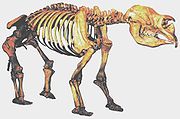
1,000-2,000 kilograms
- DiprotodonDiprotodonDiprotodon, meaning "two forward teeth", sometimes known as the Giant Wombat or the Rhinoceros Wombat, was the largest known marsupial that ever lived...
optatum was the largest species of diprotodontidDiprotodontidaeDiprotodontidae is an extinct family of large, actively mobile marsupial, endemic to what would be Australia, during the Oligocene through Pleistocene periods from 28.4 mya—11,000 years ago, existing for approximately .-References:...
. Approximately three metres long, two metres high at the shoulder and weighing up to two tonnes, it resembled a giant wombatWombatWombats are Australian marsupials; they are short-legged, muscular quadrupeds, approximately in length with a short, stubby tail. They are adaptable in their habitat tolerances, and are found in forested, mountainous, and heathland areas of south-eastern Australia, including Tasmania, as well as...
. It is the largest marsupialMarsupialMarsupials are an infraclass of mammals, characterized by giving birth to relatively undeveloped young. Close to 70% of the 334 extant species occur in Australia, New Guinea, and nearby islands, with the remaining 100 found in the Americas, primarily in South America, but with thirteen in Central...
currently known. - ZygomaturusZygomaturusZygomaturus is an extinct giant marsupial from Australia during the Pleistocene. It had a heavy body and thick legs and is believed to be similar to the modern Pygmy Hippopotamus in both size and build. The genus moved on all fours. It lived in the wet coastal margins of Australia and became...
trilobus was a smaller (bullock-sized, about two metres long by one metre high) diprotodontid that may have had a short trunk. It appears to have lived in wetlands, using two fork-like incisors to shovel up reeds and sedges for food. - PalorchestesPalorchestesPalorchestes is an extinct genus of terrestrial herbivorous marsupial of the family Palorchestidae. The genus was endemic to Australia, living from the Late Miocene subepoch through the Pleistocene epoch , and thought to be in existence for approximately .-Description:One species, Palorchestes...
azael (the Marsupial Tapir) was a diprotodontoid similar in size to Zygomaturus, with long claws and a longish trunk. It lived in the PleistocenePleistoceneThe Pleistocene is the epoch from 2,588,000 to 11,700 years BP that spans the world's recent period of repeated glaciations. The name pleistocene is derived from the Greek and ....
(Mackness 2009).
100-1,000 kilograms
- EuoweniaEuoweniaEuowenia is an extinct genus of Diprotodontia from the Pliocene. It is known only from three locations on mainland Australia, Chinchilla iin Queensland, Menindee in New South Wales and the Tirari formation on the Wruburton River in the Lake Eyre basin....
grata - EuryzygomaEuryzygomaEuryzygoma is an extinct genus of marsupial.- References :*"Australia's Lost World: Prehistoric Animals of Riversleigh" by Michael Archer, Suzanne J. Hand, and Henk Godthelp...
dunense - PhascolonusPhascolonusPhascolonus was a genus of prehistoric Australian marsupial in the wombat family. The largest species, Phascolonus gigas weighed as much as 200 kg. Phascolonus existed alongside with an even larger marsupial, Diprotodon, which weighed as much as two tons and was distantly related to wombats...
gigas - Ramsayia magna
- Procoptodon goliahProcoptodonProcoptodon was a genus of giant short-faced kangaroo living in Australia during the Pleistocene epoch. P. goliah, the largest known kangaroo that ever existed, stood approximately 2 meters tall. They weighed about ....
(the Giant Short-faced Kangaroo) is the largest kangarooKangarooA kangaroo is a marsupial from the family Macropodidae . In common use the term is used to describe the largest species from this family, especially those of the genus Macropus, Red Kangaroo, Antilopine Kangaroo, Eastern Grey Kangaroo and Western Grey Kangaroo. Kangaroos are endemic to the country...
to have ever lived. It grew 2–3 metres (7–10 feet) tall, and weighed up to 230 kilograms. It had a flat shortened face with jaw and teeth adapted for chewing tough semi-arid vegetation, and forward-looking eyes providing stereoscopic vision. Procoptodon was one of seventeen species in three genera in the sthenurineSthenurinaeSthenurinae is a sub-family within the marsupial family Macropodidae, meaning 'short faced kangaroos'. No members of this subfamily remain extant today, with all becoming extinct by the late Pleistocene. Procoptodon goliah, the largest macropodid known to have existed, was a sthenurine...
subfamily, of whom all are extinct. Sthenurines inhabited open woodlands in central Northern Australia as the tropical rainforests were beginning to retreat. All sthenurines had an extremely developed, almost hoof-like, fourth toe on the hindlimbs, with other toes vestigial. Additionally, elastic ligaments between the toe bones gave this group improved spring and speed compared to modern kangaroos. Sthenurine forelimbs were long with two extra-long fingers and claws compared with the relatively small, stiff arms of modern macropods. These may have been used for pulling branches nearer for eating and for quadrupedQuadrupedQuadrupedalism is a form of land animal locomotion using four limbs or legs. An animal or machine that usually moves in a quadrupedal manner is known as a quadruped, meaning "four feet"...
al movement for short distances. - ProcoptodonProcoptodonProcoptodon was a genus of giant short-faced kangaroo living in Australia during the Pleistocene epoch. P. goliah, the largest known kangaroo that ever existed, stood approximately 2 meters tall. They weighed about ....
rapha, P. pusio and P. texasensis - ProtemnodonProtemnodonProtemnodon is a genus of megafaunal macropods that existed in Australia, Tasmania and Papua New Guinea in the Pleistocene. Based on fossil evidence it is thought that Protemnodon was physically similar to wallabies but far larger; Protemnodon hopei was the smallest in the genus weighing about 45...
a form of giant wallaby with 4 species. - PalorchestesPalorchestesPalorchestes is an extinct genus of terrestrial herbivorous marsupial of the family Palorchestidae. The genus was endemic to Australia, living from the Late Miocene subepoch through the Pleistocene epoch , and thought to be in existence for approximately .-Description:One species, Palorchestes...
parvus - MacropusMacropusMacropus is a marsupial genus that belongs to the family Macropodidae, it has 14 species which are further divided into 3 subgenera. The genus includes all terrestrial kangaroos, wallaroos and several species of wallaby. The term itself is derived from the Ancient Greek makros "long" and pous...
pearsoni and M. ferragus
10-100 kilograms
- Simosthenurus pales
- SthenurusSthenurusSthenurus is an extinct genus of kangaroo. With a length of about 3 m , some species were twice as large as modern extant species. Sthenurus was related to the better-known Procoptodon.-Fossil habitats:...
tindalei and S. atlas - Phascolarctos stirtoni was a koalaKoalaThe koala is an arboreal herbivorous marsupial native to Australia, and the only extant representative of the family Phascolarctidae....
similar to the modern form, but one third larger. - Phascolomys medius
- LasiorhinusLasiorhinusLasiorhinus is the genus containing the two hairy-nosed wombats, which are found in Australia. The species are:* Northern Hairy-nosed Wombat, Lasiorhinus krefftii* Southern Hairy-nosed Wombat, Lasiorhinus latifrons...
angustioens - ThylacineThylacineThe thylacine or ,also ;binomial name: Thylacinus cynocephalus, Greek for "dog-headed pouched one") was the largest known carnivorous marsupial of modern times. It is commonly known as the Tasmanian tiger or the Tasmanian wolf...
(Tasmanian Tiger) - Congruus congruus a wallaby from Naracoorte.
- Troposodon minor
- Sthenurus oreas
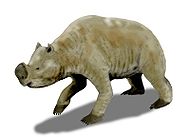
- SimosthenurusSimosthenurusSimosthenurus is a genus of megafaunal macropods that existed in Australia in the Pleistocene. The members of the genus are large, Simosthenurus occidentalis weighed over 118 kilograms....
occidentalis (another sthenurine) was about as tall as a modern Eastern Grey KangarooEastern Grey KangarooThe Eastern Grey Kangaroo is a marsupial found in southern and eastern Australia, with a population of several million. It is also known as the Great Grey Kangaroo and the Forester Kangaroo...
, but much more robust. It is one of the nine species of leaf-eating kangaroos identified in fossils found in the Naracoorte Caves National ParkNaracoorte Caves National ParkNaracoorte Caves is a national park near Naracoorte in the Limestone Coast tourism region in the south-east of South Australia . It was officially recognised in 1994 for its extensive fossil record when the site was inscribed on the World Heritage List, along with Riversleigh...
.
- Simothenurus brownei
- PropleopusPropleopusPropleopus is an extinct genus of marsupial. Two species are known, P. chillagoensis from the Plio-Pleistocene and P. oscillans from the Pleistocene. In contrast to most other kangaroos, and similar to its small extant relative, the Musky Rat-kangaroo, it was probably omnivorous.-References:*John...
oscillans (the Carnivorous Kangaroo), from the Miocene and Pliocene epochs, was a large (~70 kilogram) rat-kangaroo with large shearing and stout grinding teeth that indicate it may have been an opportunistic carnivore able to eat insects, vertebrates (possibly carrion), fruits, and soft leaves. Grew to about 1.5 – 3 metres in height. - Simothenurus maddocki
- Sthenurus andersoni
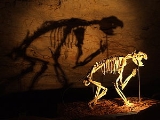
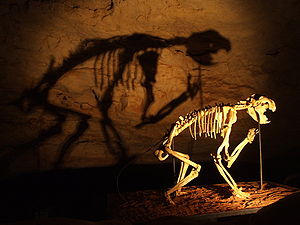
- Thylacoleo carnifex, (the Marsupial LionMarsupial LionThe Marsupial Lion is an extinct species of carnivorous marsupial mammal that lived in Australia from the early to the late Pleistocene...
), was the size of a leopardLeopardThe leopard , Panthera pardus, is a member of the Felidae family and the smallest of the four "big cats" in the genus Panthera, the other three being the tiger, lion, and jaguar. The leopard was once distributed across eastern and southern Asia and Africa, from Siberia to South Africa, but its...
, and had a cat-like skull with large slicing pre-molars. It had a retractable thumb-claw and massive forelimbs. It was almost certainly carnivorous and a tree-dweller. - Vombatus hacketti
- Macropus thor
- Macropus piltonensis
- Macropus rama
- Simothenurus gilli
- Warrendja wakefieldi a wombat from Naracoorte.
- SarcophilusSarcophilusSarcophilus is a genus of carnivorous marsupial best known for its only living member, the Tasmanian Devil.There are three species of Sarcophilus. S. laniarius and S. moornaensis are only known from fossils from the Pleistocene. S. laniarius was larger than the contemporary, and only surviving,...
harrisii laniarius was a large form of the Tasmanian DevilTasmanian DevilThe Tasmanian devil is a carnivorous marsupial of the family Dasyuridae, now found in the wild only on the Australian island state of Tasmania. The size of a small dog, it became the largest carnivorous marsupial in the world following the extinction of the thylacine in 1936...
.
Birds
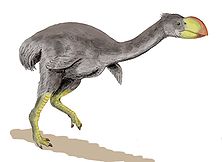
- Family DromornithidaeDromornithidaeDromornithidae — the dromornithids — were a family of large, flightless Australian birds of the Oligocene through Pleistocene epochs. All are now extinct. They were long classified in the order Struthioniformes, but are now usually classified as a family of Anseriformes1...
: this group of birds was more closely related to waterfowl than modern ratiteRatiteA ratite is any of a diverse group of large, flightless birds of Gondwanan origin, most of them now extinct. Unlike other flightless birds, the ratites have no keel on their sternum—hence the name from the Latin ratis...
s.- Dromornis stirtoni, (Stirton's Thunder Bird, Miocene epoch) was a flightless bird three metres tall that weighed about 500 kilograms. It is one of the largest birds so far discovered. It inhabited subtropical open woodlands and may have been carnivorous. It was heavier than the moaMoaThe moa were eleven species of flightless birds endemic to New Zealand. The two largest species, Dinornis robustus and Dinornis novaezelandiae, reached about in height with neck outstretched, and weighed about ....
and taller than AepyornisAepyornisAepyornis is a genus of aepyornithid, one of two genera of ratite birds endemic to Madagascar known as elephant birds. This animal was the world's largest bird until its extinction, about 1000 years ago.-Description:...
. - BullockornisBullockornisBullockornis, nicknamed the Demon Duck of Doom, is an extinct flightless bird that appeared to have lived in the Middle Miocene, approximately 15 million years ago, in what is now Australia....
planei (the 'Demon Duck of Doom') was another huge member of the Dromornithidae. It was up to 2.5 metres tall and weighed up to 250 kilograms, and was probably carnivorous. - GenyornisGenyornisGenyornis was a monotypic genus of large, flightless bird that lived in Australia until 50±5 thousand years ago. Many species became extinct in Australia around that time, coinciding with the arrival of humans....
newtoni (the Mihirung) was related to Dromornis, and was about the height of an ostrich. It was the last survivor of the Dromornithidae. It had a large lower jaw and was probably omnivorous.
- Dromornis stirtoni, (Stirton's Thunder Bird, Miocene epoch) was a flightless bird three metres tall that weighed about 500 kilograms. It is one of the largest birds so far discovered. It inhabited subtropical open woodlands and may have been carnivorous. It was heavier than the moa
- Leipoa gallinacea (formerly Progura) was a giant malleefowlMalleefowlThe Malleefowl is a stocky ground-dwelling Australian bird about the size of a domestic chicken...
.
Reptiles
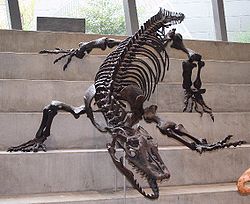
- Varanus priscus (formerly Megalania prisca) was a giant, carnivorous goannaGoannaGoanna is the name used to refer to any number of Australian monitor lizards of the genus Varanus, as well as to certain species from Southeast Asia.There are around 30 species of goanna, 25 of which are found in Australia...
that might have grown to as long as 7 metres (23 feet), and weighed up to 1,940 kilograms (Molnar, 2004). - Wonambi naracoortensis was a non-venomous snakeSnakeSnakes are elongate, legless, carnivorous reptiles of the suborder Serpentes that can be distinguished from legless lizards by their lack of eyelids and external ears. Like all squamates, snakes are ectothermic, amniote vertebrates covered in overlapping scales...
of five to six metres in length, an ambush predator at waterholes which killed its prey by constriction. - QuinkanaQuinkanaQuinkana is an extinct genus of mekosuchine crocodile that lived in Australia from ~24 million years ago to ~40,000 years ago. By the Pleistocene Quinkana had become one of the top terrestrial predators of Australia, possessing long legs and ziphodont teeth .Ziphodont teeth tend to arise in...
sp., was a terrestrial crocodileCrocodileA crocodile is any species belonging to the family Crocodylidae . The term can also be used more loosely to include all extant members of the order Crocodilia: i.e...
which grew from five to possibly 7 metres in length. It had long legs positioned underneath its body, and chased down mammals, birds and other reptiles for food. Its teeth were blade-like for cutting rather than pointed for gripping as with water dwelling crocodiles. It belonged to the mekosuchine subfamily (all now extinct). It was discovered at Bluff DownsBluff Downs fossil siteThe Bluff Downs fossil site is a paleontological site of Pliocene age in northern Queensland, Australia. The fossil site lies on the banks of Allingham Creek on the pastoral property of Bluff Downs Station.-Fossil fauna:...
in QueenslandQueenslandQueensland is a state of Australia, occupying the north-eastern section of the mainland continent. It is bordered by the Northern Territory, South Australia and New South Wales to the west, south-west and south respectively. To the east, Queensland is bordered by the Coral Sea and Pacific Ocean...
. - LiasisLiasisLiasis is a genus of non-venomous pythons found in Indonesia, New Guinea and Australia. Currently, 3 extant species are recognized and one fossil species L. dubudingala -Geographic range:...
sp., (Bluff Downs Giant PythonBluff Downs Giant PythonThe Bluff Downs Giant Python is an extinct genus of snake from Queensland, Australia, that lived during the Pliocene.The Bluff Downs Giant Python hunted mammals, birds and reptiles in the woodlands and vine thickets bordering Australian watercourses during Pliocene times...
), lived during the Pliocene epoch, grew up to ten metres long, and is the largest Australian snake known. It hunted mammals, birds and reptiles in riparian woodlands. It is most similar to the extant Olive PythonLiasis olivaceusLiasis olivaceus is a non-venomous python species found in Australia. Two subspecies are currently recognized, including the nominate subspecies described here.-Description:...
(Liasis olivacea). - MeiolaniaMeiolaniaMeiolania is an extinct genus of cryptodire turtle from the Oligocene to Holocene, with the last relict populations at New Caledonia which survived until 2,000 years ago....
was a genus of huge terrestrial cryptodireCryptodiraCryptodira is the taxonomic suborder of Testudines that includes most living tortoises and turtles. Cryptodira differ from Pleurodira in that they lower their necks and pull the heads straight back into the shells; instead of folding their necks sideways along the body under the shells' margins...
turtleTurtleTurtles are reptiles of the order Testudines , characterised by a special bony or cartilaginous shell developed from their ribs that acts as a shield...
measuring 2.5 m (8 ft 4 inches) in length, with a horned head and spiked tail.