

CAC Boomerang

Encyclopedia
The CAC Boomerang was a World War II
fighter aircraft designed and manufactured in Australia
between 1942 and 1945. The Commonwealth Aircraft Corporation
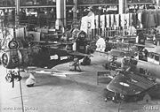
produced Boomerangs under the production contract numbers CA-12, CA-13, CA-14 and CA-19, with aircraft supplied under each subsequent contract incorporating modifications and improvements. The Boomerang is significant as the first combat aircraft designed and built in Australia.
began on 7 December 1941 with surprise attacks by the Empire of Japan
on Pearl Harbor
, Thailand
, Malaya
, and the Philippines. Within a few months, Japanese forces had conquered vast areas of the Pacific
and South East Asia. During these campaigns, the ill-prepared Allied air forces in the Pacific suffered devastating losses.
Because of political and cultural ties between the United Kingdom
and Australia, British manufacturers were the main source of RAAF aircraft. However, the British aircraft industry had long been hard-pressed to meet the needs of the RAF. Although United States
companies had enormous aircraft manufacturing capacity, their output was now intended first and foremost for US air units. Even if aircraft built overseas did become available, they would be shipped long distances in wartime conditions, with consequent delays and losses. CAC came into its own: work re-commenced on an existing bomber design, the Woomera
, and CAC also examined the possibility of designing and building fighters.
The main challenge was the fact that fighter aircraft had never been built in Australia. Only two military aircraft were in production at the time: the Bristol Beaufort
twin-engined bomber and the CAC Wirraway
, a single-engined armed trainer. While it was not a suitable basis for a fighter design, the Beaufort used 1,200 horsepower (890 kW) Pratt & Whitney Twin Wasp engines, made under license at the CAC plant in Lidcombe
, Sydney
. As this was the engine that powered the Grumman Wildcats
used by the US Navy, the Twin Wasp was a logical choice for an Australian design. The Wirraway provided a starting point for the Boomerang's airframe.
Like the latest fighters at the time, planning for the Boomerang included automatic cannons
. As no such weapons were manufactured locally, a British-made Hispano-Suiza 20 mm
which an Australian airman had collected as a souvenir in the Middle East was reverse engineered
.
.jpg) Lawrence Wackett
Lawrence Wackett
, general manager and former chief designer of CAC, recruited designer Fred David, a recently-arrived Austria
n Jewish refugee. As he was technically an enemy alien
, David had been interned
by Australian immigration officials. He was well-suited to the CAC project, since he had previously worked for Heinkel
in pre-Nazi Germany
, as well as Mitsubishi
and Aichi
in Japan. As a result, David had an excellent understanding of advanced fighter designs, including the Mitsubishi A6M ("Zero")
and the Heinkel He 112
. Design work began on 21 December 1941, at the CAC factory in Fishermans Bend
, Melbourne
.
The Boomerang was a small fighter, designed with an emphasis on manoeuvrability. It had an overall length of just 7.7 metres (25.5 ft) and an 11 m (36 ft) wingspan. Although the original intention had been to use as many Wirraway components as possible, the final design was quite different, with shorter wings, a shorter, wood-sheathed, aluminium-framed fuselage, increased strength for combat stresses and a new centre section.
On 2 February 1942, before the debut flight of the Boomerangs prototype, the RAAF ordered 105 CA-12 (Mark I) variants. The prototype took to the air on 29 May.
Test flights found that the CA-12 handled well. It was very well-armed, with two 20 mm cannon and four .303 calibre
(7.7 mm) machine guns, all mounted in the short, thick wings. The Boomerang was also generously equipped with armour plating to protect the pilot. However, general performance was mediocre. Although lively at low level, performance fell away rapidly over 15,000 ft (4,600 m), and at the maximum speed of 265 knots (490 km/h) was not sufficient to make it an effective counter to the Zero. In addition, the best European fighters were reaching almost 350 knots (650 km/h), and even relatively sluggish fighters like the Wildcat
and the Kittyhawk were much faster than the Boomerang.
In early 1942, CAC began work to address the CA-12's deficiencies in speed, climb and ceiling. A new variant, the CA-14, was designed around an order for 145 U.S.-built, 1,700 hp (1,268 kW) Wright Cyclone R-2600
engines. However, the Wright engines ordered were not delivered as scheduled, and in mid-1942 Wackett authorised use of the 1,850 hp (1,380 kW) Pratt & Whitney R-2800
, which was available from the CAC factory in Lidcombe. However, the significantly greater weight of this powerplant led to an unacceptable risk of undercarriage failure. (The R-2800 engine would later be the basis of design work on the Boomerang's successor, the CAC CA-15
, also known as the "Kangaroo".)
CAC eventually returned to the Twin Wasp, to which was added a General Electric B-2 turbo-supercharger
mounted inside the rear part of the fuselage, new propellor gear, a gear
ed cooling fan (influenced by reports on Focke-Wulf Fw 190
s captured in Europe) and a larger, squared-off tailfin and rudder. By July 1943, the significantly re-worked CA-14 prototype, now known as the CA-14A, had a top speed which was 25–30% better than the CA-12, and an operational ceiling which was 4,000 ft (1,200 m) higher. Overall, it compared favourably with the Spitfire Mk V and early Thunderbolt
s and Mustang
s. By this time, however, British-built Spitfires had filled the interceptor role and Mustangs had been ordered, to fill the bomber escort, air superiority and close air support roles. Consequently, production Boomerangs were never fitted with superchargers.
Boomerangs that reached frontline RAAF units were delivered under three different CAC production contract numbers: CA-12, CA-13 and CA-19, incorporating various minor improvements and modifications. A total of 250 aircraft of these marques were built:
105 CA-12s, 95 CA-13s and 49 CA-19s The CA-13 and CA-19 are sometimes known collectively as the Boomerang Mark II.
The sole CA-14A was used for research by No. 1 Aircraft Performance Unit RAAF, and was also seconded to the Bureau of Meteorology for a period after the war ended.
.jpg)
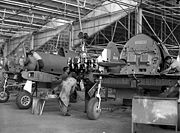 Following the devastating first air raids on Darwin on 19 February 1942, the need for interceptors became more pressing. Despite the Boomerang's astonishingly short development phase — especially since the Australian aviation industry had never built fighters before, let alone designed them — by the time the Boomerang entered service, sufficient Curtiss P-40
Kittyhawks had arrived from the United States. In January 1943, these were replaced in the air defence role over Darwin by No. 1 (Fighter) Wing RAAF, which had returned from Europe, equipped with the Spitfire Mk Vc
.
Two of the first three operational Boomerang units, No. 83 Squadron
and No. 85 Squadron
, were used for home defence. No. 84 Squadron
was deployed to Horn Island in Torres Strait
and Dutch New Guinea (West Papua), in an attempt to address the continuing shortage of fighters in this area. The squadron was only modestly successful however. The Boomerang's low top speed and poor high altitude performance meant that No. 84 Squadron could drive off enemy attacks but rarely get close enough to Japanese aircraft to bring their guns to bear. On the only occasion when a Boomerang did close with a Japanese aircraft, its guns jammed. Fortunately, there were not many air raids in this area, and after using Boomerangs for eight months No. 84 Squadron upgraded to the Kittyhawk.
The Boomerang found its real use as a close support
aircraft. In contrast to Europe or North Africa, the ground war in the jungles of the south-west Pacific was, in broad terms, a series of small unit actions fought at very close quarters by widely dispersed forces with no clear front lines. It was here that the Boomerang found its niche: as close to the troops on the ground as possible.
It had the range to go wherever it was needed (usually the aircraft were based close to the area of ground operations), heavy armament by the standards of the day and, because it was easier to fly than most fighters, the pilot could get in close to the objective and have time to concentrate on the ground forces. Sprightly low-level handling helped avoid ground fire and rough terrain and the unusually extensive armour plating protected pilots. In addition, the aircraft's simple wood and aluminium airframe proved capable of absorbing battle damage. Nonetheless, several of the aircraft were shot down, including two accidental kills by US units, and more were damaged during landing accidents, as the Boomerang was prone to ground looping
.
No. 4 Squadron
and No. 5 Squadron
flew Boomerangs in New Guinea, the Solomon Islands Campaign
and Borneo Campaign
, also in the close support role, with marked success. Flying in pairs (one to observe the ground, the other to observe the air around them), their tasks included bombing, strafing, close infantry support and artillery spotting. When attacking larger enemy formations Boomerangs often operated in conjunction with larger aircraft. In this role the Boomerang would get in close to confirm the identity of the target and mark it with a 20 lb (9 kg) smoke bomb with the "cooperating" aircraft delivering the major ordnance from a safer distance. The partnership between 5 Squadron Boomerangs and Royal New Zealand Air Force
Corsair
fighter bombers during the Bougainville Campaign was said to be particularly effective.
The other user of Boomerangs in New Guinea was No. 8 Communications Unit, which used the aircraft to assist with air sea rescue operations.
CA-13 (Mark II)
CA-14
CA-14A
CA-19
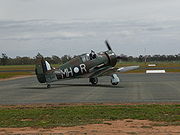 Three Boomerangs remain airworthy today, all in Australia:
A full-scale, airworthy replica with many original parts is based in the United States. Several others are under restoration to fly in both Australia and the USA. This includes A46-90 which is currently being restored to airworthy status.
.jpg)
World War II
World War II, or the Second World War , was a global conflict lasting from 1939 to 1945, involving most of the world's nations—including all of the great powers—eventually forming two opposing military alliances: the Allies and the Axis...
fighter aircraft designed and manufactured in Australia
Australia
Australia , officially the Commonwealth of Australia, is a country in the Southern Hemisphere comprising the mainland of the Australian continent, the island of Tasmania, and numerous smaller islands in the Indian and Pacific Oceans. It is the world's sixth-largest country by total area...
between 1942 and 1945. The Commonwealth Aircraft Corporation
Commonwealth Aircraft Corporation
The Commonwealth Aircraft Corporation was an Australian aircraft manufacturer. The CAC was established in 1936, to provide Australia with the capability to produce military aircraft and engines.-History:...
produced Boomerangs under the production contract numbers CA-12, CA-13, CA-14 and CA-19, with aircraft supplied under each subsequent contract incorporating modifications and improvements. The Boomerang is significant as the first combat aircraft designed and built in Australia.
Background
The Pacific WarPacific War
The Pacific War, also sometimes called the Asia-Pacific War refers broadly to the parts of World War II that took place in the Pacific Ocean, its islands, and in East Asia, then called the Far East...
began on 7 December 1941 with surprise attacks by the Empire of Japan
Empire of Japan
The Empire of Japan is the name of the state of Japan that existed from the Meiji Restoration on 3 January 1868 to the enactment of the post-World War II Constitution of...
on Pearl Harbor
Attack on Pearl Harbor
The attack on Pearl Harbor was a surprise military strike conducted by the Imperial Japanese Navy against the United States naval base at Pearl Harbor, Hawaii, on the morning of December 7, 1941...
, Thailand
Japanese Invasion of Thailand
The Japanese invasion of Thailand occurred on December 8, 1941. It was fought between Thailand and the Empire of Japan. Despite fierce fighting in Southern Thailand, Thai resistance lasted only a few hours before ending in a ceasefire.-Background:...
, Malaya
Battle of Malaya
The Malayan Campaign was a campaign fought by Allied and Japanese forces in Malaya, from 8 December 1941 – 31 January 1942 during the Second World War. The campaign was dominated by land battles between British Commonwealth army units, and the Imperial Japanese Army...
, and the Philippines. Within a few months, Japanese forces had conquered vast areas of the Pacific
Pacific Ocean
The Pacific Ocean is the largest of the Earth's oceanic divisions. It extends from the Arctic in the north to the Southern Ocean in the south, bounded by Asia and Australia in the west, and the Americas in the east.At 165.2 million square kilometres in area, this largest division of the World...
and South East Asia. During these campaigns, the ill-prepared Allied air forces in the Pacific suffered devastating losses.
Because of political and cultural ties between the United Kingdom
United Kingdom
The United Kingdom of Great Britain and Northern IrelandIn the United Kingdom and Dependencies, other languages have been officially recognised as legitimate autochthonous languages under the European Charter for Regional or Minority Languages...
and Australia, British manufacturers were the main source of RAAF aircraft. However, the British aircraft industry had long been hard-pressed to meet the needs of the RAF. Although United States
United States
The United States of America is a federal constitutional republic comprising fifty states and a federal district...
companies had enormous aircraft manufacturing capacity, their output was now intended first and foremost for US air units. Even if aircraft built overseas did become available, they would be shipped long distances in wartime conditions, with consequent delays and losses. CAC came into its own: work re-commenced on an existing bomber design, the Woomera
CAC Woomera
|-See also:-References:NotesBibliography* Ewer, Peter. Wounded Eagle: the bombing of Darwin and Australi's air defence scandal. Sydney: New Holland, 2009. ISBN 9781741108255...
, and CAC also examined the possibility of designing and building fighters.
The main challenge was the fact that fighter aircraft had never been built in Australia. Only two military aircraft were in production at the time: the Bristol Beaufort
Bristol Beaufort
The Bristol Beaufort was a British twin-engined torpedo bomber designed by the Bristol Aeroplane Company, and developed from experience gained designing and building the earlier Blenheim light bomber....
twin-engined bomber and the CAC Wirraway
CAC Wirraway
The Wirraway was a training and general purpose military aircraft manufactured in Australia by the Commonwealth Aircraft Corporation between 1939 and 1946...
, a single-engined armed trainer. While it was not a suitable basis for a fighter design, the Beaufort used 1,200 horsepower (890 kW) Pratt & Whitney Twin Wasp engines, made under license at the CAC plant in Lidcombe
Lidcombe, New South Wales
Lidcombe is a suburb in western Sydney, in the state of New South Wales Australia. Lidcombe is located 14 kilometres west of the Sydney central business district, in the local government area of Auburn Council....
, Sydney
Sydney
Sydney is the most populous city in Australia and the state capital of New South Wales. Sydney is located on Australia's south-east coast of the Tasman Sea. As of June 2010, the greater metropolitan area had an approximate population of 4.6 million people...
. As this was the engine that powered the Grumman Wildcats
F4F Wildcat
The Grumman F4F Wildcat was an American carrier-based fighter aircraft that began service with both the United States Navy and the British Royal Navy in 1940...
used by the US Navy, the Twin Wasp was a logical choice for an Australian design. The Wirraway provided a starting point for the Boomerang's airframe.
Like the latest fighters at the time, planning for the Boomerang included automatic cannons
Autocannon
An autocannon or automatic cannon is a rapid-fire projectile weapon firing a shell as opposed to the bullet fired by a machine gun. Autocannons often have a larger caliber than a machine gun . Usually, autocannons are smaller than a field gun or other artillery, and are mechanically loaded for a...
. As no such weapons were manufactured locally, a British-made Hispano-Suiza 20 mm
Hispano-Suiza HS.404
The Hispano-Suiza HS.404 was an autocannon widely used as both an aircraft and land weapon in the 20th century by British, American, French, and numerous other military services. The cannon is also referred to as Birkigt type 404, after its designer. Firing a 20 mm caliber projectile, it delivered...
which an Australian airman had collected as a souvenir in the Middle East was reverse engineered
Reverse engineering
Reverse engineering is the process of discovering the technological principles of a device, object, or system through analysis of its structure, function, and operation...
.
Development
Lawrence Wackett
Sir Lawrence James Wackett KBE, DFC, AFC is widely regarded as "father of the Australian aircraft industry". He has been described as "one of the towering figures in the history of Australian aviation covering, as he did, virtually all aspects of activities: pilot, designer of airframes and...
, general manager and former chief designer of CAC, recruited designer Fred David, a recently-arrived Austria
Austria
Austria , officially the Republic of Austria , is a landlocked country of roughly 8.4 million people in Central Europe. It is bordered by the Czech Republic and Germany to the north, Slovakia and Hungary to the east, Slovenia and Italy to the south, and Switzerland and Liechtenstein to the...
n Jewish refugee. As he was technically an enemy alien
Enemy alien
In law, an enemy alien is a citizen of a country which is in a state of conflict with the land in which he or she is located. Usually, but not always, the countries are in a state of declared war.-United Kingdom:...
, David had been interned
Internment
Internment is the imprisonment or confinement of people, commonly in large groups, without trial. The Oxford English Dictionary gives the meaning as: "The action of 'interning'; confinement within the limits of a country or place." Most modern usage is about individuals, and there is a distinction...
by Australian immigration officials. He was well-suited to the CAC project, since he had previously worked for Heinkel
Heinkel
Heinkel Flugzeugwerke was a German aircraft manufacturing company founded by and named after Ernst Heinkel. It is noted for producing bomber aircraft for the Luftwaffe in World War II and for important contributions to high-speed flight.-History:...
in pre-Nazi Germany
Germany
Germany , officially the Federal Republic of Germany , is a federal parliamentary republic in Europe. The country consists of 16 states while the capital and largest city is Berlin. Germany covers an area of 357,021 km2 and has a largely temperate seasonal climate...
, as well as Mitsubishi
Mitsubishi
The Mitsubishi Group , Mitsubishi Group of Companies, or Mitsubishi Companies is a Japanese multinational conglomerate company that consists of a range of autonomous businesses which share the Mitsubishi brand, trademark and legacy...
and Aichi
Aichi D3A
The , Allied reporting name "Val") was a World War II carrier-borne dive bomber of the Imperial Japanese Navy . It was the primary dive bomber in the Imperial Japanese Navy, and participated in almost all actions, including Pearl Harbor....
in Japan. As a result, David had an excellent understanding of advanced fighter designs, including the Mitsubishi A6M ("Zero")
A6M Zero
The Mitsubishi A6M Zero was a long-range fighter aircraft operated by the Imperial Japanese Navy Air Service from 1940 to 1945. The A6M was designated as the , and also designated as the Mitsubishi A6M Rei-sen and Mitsubishi Navy 12-shi Carrier Fighter. The A6M was usually referred to by the...
and the Heinkel He 112
Heinkel He 112
The Heinkel He 112 was a fighter aircraft designed by Walter and Siegfried Günter. It was one of four aircraft designed to compete for the Luftwaffes 1933 fighter contract, which was eventually won by the Messerschmitt Bf 109...
. Design work began on 21 December 1941, at the CAC factory in Fishermans Bend
Port Melbourne, Victoria
Port Melbourne is a suburb of Melbourne, Victoria, Australia, 5 km southwest of Melbourne's central business district. Its Local Government areas are the cities of Port Phillip and Melbourne. At the 2006 Census, Port Melbourne had a population of 13,293....
, Melbourne
Melbourne
Melbourne is the capital and most populous city in the state of Victoria, and the second most populous city in Australia. The Melbourne City Centre is the hub of the greater metropolitan area and the Census statistical division—of which "Melbourne" is the common name. As of June 2009, the greater...
.
The Boomerang was a small fighter, designed with an emphasis on manoeuvrability. It had an overall length of just 7.7 metres (25.5 ft) and an 11 m (36 ft) wingspan. Although the original intention had been to use as many Wirraway components as possible, the final design was quite different, with shorter wings, a shorter, wood-sheathed, aluminium-framed fuselage, increased strength for combat stresses and a new centre section.
On 2 February 1942, before the debut flight of the Boomerangs prototype, the RAAF ordered 105 CA-12 (Mark I) variants. The prototype took to the air on 29 May.
Test flights found that the CA-12 handled well. It was very well-armed, with two 20 mm cannon and four .303 calibre
.303 British
.303 British, or 7.7x56mmR, is a .311 inch calibre rifle and machine gun cartridge first developed in Britain as a blackpowder round put into service in December 1888 for the Lee-Metford rifle, later adapted to use smokeless powders...
(7.7 mm) machine guns, all mounted in the short, thick wings. The Boomerang was also generously equipped with armour plating to protect the pilot. However, general performance was mediocre. Although lively at low level, performance fell away rapidly over 15,000 ft (4,600 m), and at the maximum speed of 265 knots (490 km/h) was not sufficient to make it an effective counter to the Zero. In addition, the best European fighters were reaching almost 350 knots (650 km/h), and even relatively sluggish fighters like the Wildcat
F4F Wildcat
The Grumman F4F Wildcat was an American carrier-based fighter aircraft that began service with both the United States Navy and the British Royal Navy in 1940...
and the Kittyhawk were much faster than the Boomerang.
In early 1942, CAC began work to address the CA-12's deficiencies in speed, climb and ceiling. A new variant, the CA-14, was designed around an order for 145 U.S.-built, 1,700 hp (1,268 kW) Wright Cyclone R-2600
Wright R-2600
|-See also:-Bibliography:* Jane's Fighting Aircraft of World War II. London. Studio Editions Ltd, 1998. ISBN 0-517-67964-7-External links:...
engines. However, the Wright engines ordered were not delivered as scheduled, and in mid-1942 Wackett authorised use of the 1,850 hp (1,380 kW) Pratt & Whitney R-2800
Pratt & Whitney R-2800
The Pratt & Whitney R-2800 Double Wasp is a two-row, 18-cylinder, air-cooled radial aircraft engine with a displacement of 2,804 in³ , and is part of the long-lived Wasp family....
, which was available from the CAC factory in Lidcombe. However, the significantly greater weight of this powerplant led to an unacceptable risk of undercarriage failure. (The R-2800 engine would later be the basis of design work on the Boomerang's successor, the CAC CA-15
CAC CA-15
-See also:-References:NotesBibliography* Crick, Darren. adf-serials.com, 2003.* Donald, David. "Commonwealth CA-15: The 'Kangaroo' Fighter". Wings of Fame, Volume 4, 1996, pp. 118–121. London: Aerospace Publishing. ISBN 1-874023-71-9. ISSN 1361-2034.* Francillon, René J. The Royal Australian Air...
, also known as the "Kangaroo".)
CAC eventually returned to the Twin Wasp, to which was added a General Electric B-2 turbo-supercharger
Turbocharger
A turbocharger, or turbo , from the Greek "τύρβη" is a centrifugal compressor powered by a turbine that is driven by an engine's exhaust gases. Its benefit lies with the compressor increasing the mass of air entering the engine , thereby resulting in greater performance...
mounted inside the rear part of the fuselage, new propellor gear, a gear
Gear
A gear is a rotating machine part having cut teeth, or cogs, which mesh with another toothed part in order to transmit torque. Two or more gears working in tandem are called a transmission and can produce a mechanical advantage through a gear ratio and thus may be considered a simple machine....
ed cooling fan (influenced by reports on Focke-Wulf Fw 190
Focke-Wulf Fw 190
The Focke-Wulf Fw 190 Würger was a German Second World War single-seat, single-engine fighter aircraft designed by Kurt Tank in the late 1930s. Powered by a radial engine, the 190 had ample power and was able to lift larger loads than its well-known counterpart, the Messerschmitt Bf 109...
s captured in Europe) and a larger, squared-off tailfin and rudder. By July 1943, the significantly re-worked CA-14 prototype, now known as the CA-14A, had a top speed which was 25–30% better than the CA-12, and an operational ceiling which was 4,000 ft (1,200 m) higher. Overall, it compared favourably with the Spitfire Mk V and early Thunderbolt
P-47 Thunderbolt
Republic Aviation's P-47 Thunderbolt, also known as the "Jug", was the largest, heaviest, and most expensive fighter aircraft in history to be powered by a single reciprocating engine. It was heavily armed with eight .50-caliber machine guns, four per wing. When fully loaded, the P-47 weighed up to...
s and Mustang
P-51 Mustang
The North American Aviation P-51 Mustang was an American long-range, single-seat fighter and fighter-bomber used during World War II, the Korean War and in several other conflicts...
s. By this time, however, British-built Spitfires had filled the interceptor role and Mustangs had been ordered, to fill the bomber escort, air superiority and close air support roles. Consequently, production Boomerangs were never fitted with superchargers.
Boomerangs that reached frontline RAAF units were delivered under three different CAC production contract numbers: CA-12, CA-13 and CA-19, incorporating various minor improvements and modifications. A total of 250 aircraft of these marques were built:
105 CA-12s, 95 CA-13s and 49 CA-19s The CA-13 and CA-19 are sometimes known collectively as the Boomerang Mark II.
The sole CA-14A was used for research by No. 1 Aircraft Performance Unit RAAF, and was also seconded to the Bureau of Meteorology for a period after the war ended.
Operational history
Curtiss P-40
The Curtiss P-40 Warhawk was an American single-engine, single-seat, all-metal fighter and ground attack aircraft that first flew in 1938. The P-40 design was a modification of the previous Curtiss P-36 Hawk which reduced development time and enabled a rapid entry into production and operational...
Kittyhawks had arrived from the United States. In January 1943, these were replaced in the air defence role over Darwin by No. 1 (Fighter) Wing RAAF, which had returned from Europe, equipped with the Spitfire Mk Vc
Supermarine Spitfire
The Supermarine Spitfire is a British single-seat fighter aircraft that was used by the Royal Air Force and many other Allied countries throughout the Second World War. The Spitfire continued to be used as a front line fighter and in secondary roles into the 1950s...
.
Two of the first three operational Boomerang units, No. 83 Squadron
No. 83 Squadron RAAF
No. 83 Squadron was a Royal Australian Air Force fighter squadron of World War II. It was formed in 1943 as a 'home defence' squadron and provided air defence to several locations in Queensland, the Northern Territory and New South Wales before being disbanded in 1945.-Squadron history:No. 83...
and No. 85 Squadron
No. 85 Squadron RAAF
No 85 Squadron was a Royal Australian Air Force fighter squadron which provided air defence to Western Australia during World War II. It was formed in 1943 and disbanded in 1945. The squadron did not see combat during the war, although it attempted to intercept Japanese aircraft on several...
, were used for home defence. No. 84 Squadron
No. 84 Squadron RAAF
No. 84 Squadron was a Royal Australian Air Force fighter squadron of World War II.-History:No. 84 Squadron was formed at RAAF Base Richmond on 5 February 1943 and was the first RAAF Squadron to be equipped with the Australian-designed Boomerang fighter. In April 1943 No...
was deployed to Horn Island in Torres Strait
Torres Strait
The Torres Strait is a body of water which lies between Australia and the Melanesian island of New Guinea. It is approximately wide at its narrowest extent. To the south is Cape York Peninsula, the northernmost continental extremity of the Australian state of Queensland...
and Dutch New Guinea (West Papua), in an attempt to address the continuing shortage of fighters in this area. The squadron was only modestly successful however. The Boomerang's low top speed and poor high altitude performance meant that No. 84 Squadron could drive off enemy attacks but rarely get close enough to Japanese aircraft to bring their guns to bear. On the only occasion when a Boomerang did close with a Japanese aircraft, its guns jammed. Fortunately, there were not many air raids in this area, and after using Boomerangs for eight months No. 84 Squadron upgraded to the Kittyhawk.
The Boomerang found its real use as a close support
Close air support
In military tactics, close air support is defined as air action by fixed or rotary winged aircraft against hostile targets that are close to friendly forces, and which requires detailed integration of each air mission with fire and movement of these forces.The determining factor for CAS is...
aircraft. In contrast to Europe or North Africa, the ground war in the jungles of the south-west Pacific was, in broad terms, a series of small unit actions fought at very close quarters by widely dispersed forces with no clear front lines. It was here that the Boomerang found its niche: as close to the troops on the ground as possible.
It had the range to go wherever it was needed (usually the aircraft were based close to the area of ground operations), heavy armament by the standards of the day and, because it was easier to fly than most fighters, the pilot could get in close to the objective and have time to concentrate on the ground forces. Sprightly low-level handling helped avoid ground fire and rough terrain and the unusually extensive armour plating protected pilots. In addition, the aircraft's simple wood and aluminium airframe proved capable of absorbing battle damage. Nonetheless, several of the aircraft were shot down, including two accidental kills by US units, and more were damaged during landing accidents, as the Boomerang was prone to ground looping
Ground loop (aviation)
In aviation, a ground loop is a rapid rotation of a fixed-wing aircraft in the horizontal plane while on the ground. Aerodynamic forces may cause the advancing wing to rise, which may then cause the other wingtip to touch the ground...
.
No. 4 Squadron
No. 4 Squadron RAAF
No. 4 Squadron is a Royal Australian Air Force squadron responsible for training forward air controllers. The squadron was previously a fighter and army co-operation unit active in both World War I and World War II.-World War I:...
and No. 5 Squadron
No. 5 Squadron RAAF
No. 5 Squadron was a Royal Australian Air Force training, army co-operation and helicopter squadron. The Squadron was first formed in 1917 and was disbanded in December 1989.-Squadron history:...
flew Boomerangs in New Guinea, the Solomon Islands Campaign
Solomon Islands campaign
The Solomon Islands campaign was a major campaign of the Pacific War of World War II. The campaign began with Japanese landings and occupation of several areas in the British Solomon Islands and Bougainville, in the Territory of New Guinea, during the first six months of 1942...
and Borneo Campaign
Borneo campaign (1945)
The Borneo Campaign of 1945 was the last major Allied campaign in the South West Pacific Area, during World War II. In a series of amphibious assaults between 1 May and 21 July, the Australian I Corps, under General Leslie Morshead, attacked Japanese forces occupying the island. Allied naval and...
, also in the close support role, with marked success. Flying in pairs (one to observe the ground, the other to observe the air around them), their tasks included bombing, strafing, close infantry support and artillery spotting. When attacking larger enemy formations Boomerangs often operated in conjunction with larger aircraft. In this role the Boomerang would get in close to confirm the identity of the target and mark it with a 20 lb (9 kg) smoke bomb with the "cooperating" aircraft delivering the major ordnance from a safer distance. The partnership between 5 Squadron Boomerangs and Royal New Zealand Air Force
Royal New Zealand Air Force
The Royal New Zealand Air Force is the air arm of the New Zealand Defence Force...
Corsair
F4U Corsair
The Vought F4U Corsair was a carrier-capable fighter aircraft that saw service primarily in World War II and the Korean War. Demand for the aircraft soon overwhelmed Vought's manufacturing capability, resulting in production by Goodyear and Brewster: Goodyear-built Corsairs were designated FG and...
fighter bombers during the Bougainville Campaign was said to be particularly effective.
The other user of Boomerangs in New Guinea was No. 8 Communications Unit, which used the aircraft to assist with air sea rescue operations.
Variants
CA-12 (Mark I)- The first single-seat fighter version, 105 built.
CA-13 (Mark II)
- Improved version of the CA-12, 95 built.
CA-14
- One aircraft fitted with a turbo-supercharged engine, did not enter production. Serial number A46-1001.
CA-14A
- The CA-14 prototype was later modified to have a square tail and rudder
CA-19
- Tactical reconnaissance variant with a single vertical camera in the fuselage, 49 built. Serial numbers: A46-201 to A46-249.
Operators
- Royal Australian Air ForceRoyal Australian Air ForceThe Royal Australian Air Force is the air force branch of the Australian Defence Force. The RAAF was formed in March 1921. It continues the traditions of the Australian Flying Corps , which was formed on 22 October 1912. The RAAF has taken part in many of the 20th century's major conflicts...
- No. 2 Operational Training UnitNo. 2 Operational Conversion Unit RAAFNo. 2 Operational Conversion Unit is a Royal Australian Air Force training unit located at RAAF Base Williamtown. 2OCU's main role is to train pilots to operate the F/A-18 Hornet. New RAAF pilots enter 2OCU for training after first qualifying to fly jet fighters in No. 76 Squadron...
(October 1942–1945) - No. 4 SquadronNo. 4 Squadron RAAFNo. 4 Squadron is a Royal Australian Air Force squadron responsible for training forward air controllers. The squadron was previously a fighter and army co-operation unit active in both World War I and World War II.-World War I:...
(August 1943 – August 1945). Code letters: QE - No. 5 SquadronNo. 5 Squadron RAAFNo. 5 Squadron was a Royal Australian Air Force training, army co-operation and helicopter squadron. The Squadron was first formed in 1917 and was disbanded in December 1989.-Squadron history:...
(November 1943 – August 1946). Code letters: BF - No. 83 SquadronNo. 83 Squadron RAAFNo. 83 Squadron was a Royal Australian Air Force fighter squadron of World War II. It was formed in 1943 as a 'home defence' squadron and provided air defence to several locations in Queensland, the Northern Territory and New South Wales before being disbanded in 1945.-Squadron history:No. 83...
(September 1943 – August 1945). Code letters: MH - No. 84 SquadronNo. 84 Squadron RAAFNo. 84 Squadron was a Royal Australian Air Force fighter squadron of World War II.-History:No. 84 Squadron was formed at RAAF Base Richmond on 5 February 1943 and was the first RAAF Squadron to be equipped with the Australian-designed Boomerang fighter. In April 1943 No...
(April 1943 – October 1943). Code letters: LB - No. 85 SquadronNo. 85 Squadron RAAFNo 85 Squadron was a Royal Australian Air Force fighter squadron which provided air defence to Western Australia during World War II. It was formed in 1943 and disbanded in 1945. The squadron did not see combat during the war, although it attempted to intercept Japanese aircraft on several...
(May 1943 – January 1945). Code letters: SH - No. 8 Communications Unit (February 1944 – August 1944). Code letters: ZA
- No. 2 Operational Training Unit
Survivors
- A46-122 CA-13 "Suzy Q" (VH-MHR) with the Temora Aviation MuseumTemora Aviation MuseumThe Temora Aviation Museum is an Australian aerospace museum located in Temora, New South Wales. The Museum was established in late 1999, based on the collection of warbird aircraft owned by David Lowy...
- A46-206 CA-19 "Milingimbi Ghost" which was formerly with Lynette Zuccoli at Toowoomba, QueenslandToowoomba, QueenslandToowoomba is a city in Southern Queensland, Australia. It is located west of Queensland's capital city, Brisbane. With an estimated district population of 128,600, Toowoomba is Australia's second largest inland city and its largest non-capital inland city...
until donated to the Museum of Australian Army Flying at the Army Aviation baseOakey Army Aviation CentreOakey Army Aviation Centre is situated approximately 3 km from the town centre of Oakey in Queensland, Australia. It provides a training establishment for Australian Army Aviation, and also hosts a Singapore Armed Forces Helicopter Squadron, namely the 126 Squadron.-History:The base has a...
located at the nearby town of OakeyOakey, QueenslandOakey is a rural town situated in the Darling Downs region of Queensland, Australia. It is situated west of the state capital, Brisbane, and west of the regional city of Toowoomba. At the 2006 census, Oakey had a population of 3,657.-History:...
is now on static display.
- A46-63 a CA-12 from 1943 first flew again on 26 June 2009 as VH-XBL. The restoration includes the provision of a passenger seat.
A full-scale, airworthy replica with many original parts is based in the United States. Several others are under restoration to fly in both Australia and the USA. This includes A46-90 which is currently being restored to airworthy status.
Specifications (CA-12)