
All Topics  
United Nations Security Council

 
United Nations Security Council

   Email Print
   Bookmark   Link


United Nations Security Council


The United Nations Security Council (UNSC) is one of the principal organs charged with the maintenance of international peace and security
International security

International security consists of the measures taken by nations and international organizations, such as the United Nations, to ensure mutual survival and safety....
. Its powers, outlined in the United Nations Charter
United Nations Charter

The United Nations Charter is the treaty that forms and establishes the international organization called the United Nations. It was signed at the United Nations Conference on International Organization in San Francisco, California, United States, on June 26, 1945, by 50 of the 51 original member countries ....
, include the establishment of peacekeeping
Peacekeeping

Peacekeeping, as defined by the United Nations, is "a way to help countries torn by conflict create conditions for sustainable peace." It is distinguished from both peacebuilding and peacemaking....
 operations, the establishment of international sanctions
International sanctions

International sanctions are actions taken by countries against others for political reasons, either unilaterally or multilaterally.There are three types of sanctions....
, and the authorization of military action
War

...
. Its powers are exercised through United Nations Security Council Resolution
United Nations Security Council Resolution

A United Nations Security Council Resolution is a United Nations resolution voted on by the fifteen members of the United Nations Security Council; the United Nations organization charged with "primary responsibility for the maintenance of...
s.

The Security Council held its first session on 17 January 1946 at Church House, London
London

London is the capital of both England and the United Kingdom, and the most populous municipality in the European Union. An important settlement for two millennia, History of London goes back to its founding by the Roman Empire....
.

Since its first meeting, the Council, which exists in continuous session, has traveled widely, holding meetings in many cities, such as Paris
Paris

Paris is the Capital of France and the country's largest city. It is situated on the river Seine, in northern France, at the heart of the ?le-de-France Regions of France ....
 and Addis Ababa
Addis Ababa

Addis Ababa is the capital city of Ethiopia and the African Union and its predecessor, the Organisation of African Unity. It is also the largest city in Ethiopia....
, then at its current home
United Nations headquarters

The United Nations Headquarters is a distinctive complex in New York City that has served as the headquarters of the United Nations since its completion in 1950....
 in New York City
New York City

The City of New York is the List of United States cities by population in the United States, while the New York metropolitan area ranks among the List of urban areas by population....
.

There are 15 members of the Security Council, consisting of permanent members and elected members.


Discussion
Ask a question about 'United Nations Security Council'
Start a new discussion about 'United Nations Security Council'
Answer questions from other users
Full Discussion Forum


Recent Posts


Timeline

1953   United Nations Security Council nominates Dag Hammarskjöld as United Nations Secretary General

1966   The United Kingdom asks the UN Security Council for authority to use force to stop oil tankers that violate the embargo against Rhodesia. Authority is given April 10.

1970   The United Nations Security Council demands that no government recognize Rhodesia.

1971   The People's Republic of China is given the Republic of China's seat on the United Nations Security Council (see China and the United Nations).

1982   United Nations Security Council votes to demand that Israel withdraw its troops from Lebanon.

1982   The United Nations Security Council votes to censure Israel because its troops are still in Lebanon.

1990   Gulf War: The United Nations Security Council orders a global trade embargo against Iraq in response to Iraq's invasion of Kuwait.

1990   Gulf War: The United Nations Security Council passes UN Security Council Resolution 678, authorizing military intervention in Iraq if that nation does not withdraw its forces from Kuwait and free all foreign hostages by Tuesday, January 15, 1991.

1991   The United Nations Security Council votes unanimously to condemn Israel's treatment of the Palestinians.

1991   The United Nations Security Council unanimously adopts a resolution opening the way to the establishment of peacekeeping operations in Yugoslavia.


Encyclopedia


The United Nations Security Council (UNSC) is one of the principal organs charged with the maintenance of international peace and security
International security

International security consists of the measures taken by nations and international organizations, such as the United Nations, to ensure mutual survival and safety....
. Its powers, outlined in the United Nations Charter
United Nations Charter

The United Nations Charter is the treaty that forms and establishes the international organization called the United Nations. It was signed at the United Nations Conference on International Organization in San Francisco, California, United States, on June 26, 1945, by 50 of the 51 original member countries ....
, include the establishment of peacekeeping
Peacekeeping

Peacekeeping, as defined by the United Nations, is "a way to help countries torn by conflict create conditions for sustainable peace." It is distinguished from both peacebuilding and peacemaking....
 operations, the establishment of international sanctions
International sanctions

International sanctions are actions taken by countries against others for political reasons, either unilaterally or multilaterally.There are three types of sanctions....
, and the authorization of military action
War

...
. Its powers are exercised through United Nations Security Council Resolution
United Nations Security Council Resolution

A United Nations Security Council Resolution is a United Nations resolution voted on by the fifteen members of the United Nations Security Council; the United Nations organization charged with "primary responsibility for the maintenance of...
s.

The Security Council held its first session on 17 January 1946 at Church House, London
London

London is the capital of both England and the United Kingdom, and the most populous municipality in the European Union. An important settlement for two millennia, History of London goes back to its founding by the Roman Empire....
.

Since its first meeting, the Council, which exists in continuous session, has traveled widely, holding meetings in many cities, such as Paris
Paris

Paris is the Capital of France and the country's largest city. It is situated on the river Seine, in northern France, at the heart of the ?le-de-France Regions of France ....
 and Addis Ababa
Addis Ababa

Addis Ababa is the capital city of Ethiopia and the African Union and its predecessor, the Organisation of African Unity. It is also the largest city in Ethiopia....
, then at its current home
United Nations headquarters

The United Nations Headquarters is a distinctive complex in New York City that has served as the headquarters of the United Nations since its completion in 1950....
 in New York City
New York City

The City of New York is the List of United States cities by population in the United States, while the New York metropolitan area ranks among the List of urban areas by population....
.

There are 15 members of the Security Council, consisting of permanent members and elected members. This basic structure is set out in Chapter V of the UN Charter.

Security Council members must always be present at UN headquarters in New York so that the Security Council can meet at any time. This requirement of the United Nations Charter was adopted to address a weakness of the League of Nations
League of Nations

The League of Nations was an inter-governmental organization founded as a result of the Treaty of Versailles in 1919?1920. At its greatest extent from 28 September 1934 to 23 February 1935, it had 58 members....
 since that organization was often unable to respond quickly to a crisis.

Permanent members


The Security Council's five permanent members have the power to veto
United Nations Security Council veto power

The United Nations Security Council 'power of veto refers to the veto power wielded solely by the five permanent members of the United Nations United Nations Security Council, enabling them to prevent the adoption of any 'substantive' draft Council resolution, regardless of the level of international support for the draft....
 any substantive resolution:

Russian Federation
Russia

Russia , or the Russian Federation , is a list of countries spanning more than one continent country extending over much of northern Eurasia....


The five permanent members were drawn from the victorious powers of World War II
World War II

World War II, or the Second World War , was a global military conflict which involved a Participants in World War II, including all of the great powers, organised into two opposing military alliances: the Allies of World War II and the Axis powers....
, and at the UN's founding in 1946, the Security Council consisted of France
France

France , officially the French Republic , is a country whose Metropolitan France is located in Western Europe and that also comprises various Overseas departments and territories of France....
, the Republic of China
Republic of China

The Republic of China , also known as Nationalist China is a country in East Asia that has evolved from a single-party state with full global recognition into a multi-party democratic state with Political status of Taiwan....
, the United Kingdom
United Kingdom

The United Kingdom of Great Britain and Northern Ireland, commonly known as the United Kingdom , the UK or Britain,is a sovereign state located off the northwestern coast of continental Europe....
, the United States
United States

The United States of America is a Federal government constitutional republic comprising U.S. state and a federal district. The country is situated mostly in central North America, where its Contiguous United States and Washington, D.C., the Capital districts and territories, lie between the Pacific Ocean and Atlantic Oceans, Borders of the U...
 and the USSR. There have been two seat changes since then, although not reflected in Article 23 of the Charter of the United Nations as it has not been accordingly amended:

  • China's seat was originally filled by the Republic of China
    Republic of China

    The Republic of China , also known as Nationalist China is a country in East Asia that has evolved from a single-party state with full global recognition into a multi-party democratic state with Political status of Taiwan....
    , but due to the stalemate of the Chinese Civil War
    Chinese Civil War

    The Chinese Civil War or , which lasted from April 1927 to May 1950, was a civil war in China between the Kuomintang and the Chinese Communist Party ....
     in 1949, there have been two state
    State

    A state is a political Social contract with effective sovereignty over a geographic area and representing a population. These may be nation states, State or multinational states....
    s claiming to represent China
    China

    China is a Culture of China, an ancient civilization, and, depending on perspective, a national or multinational entity extending over a large area in East Asia....
     since then, and both officially claim each other's territory
    Territory

    A territory is a defined area , considered to be a possession of a person, organization, institution, animal, state or country subdivision. The word can mean:...
    . In 1971, the People's Republic of China
    People's Republic of China

    The People's Republic of China , commonly known as China, is the largest country in East Asia and the List of countries by population in the world with over 1.3 billion people, approximately a fifth of the world's population....
     was awarded China's seat in the United Nations
    China and the United Nations

    China's seat in the United Nations and membership of the United Nations Security Council has been occupied by the People's Republic of China since October 25, 1971....
     by UN General Assembly Resolution 2758
    UN General Assembly Resolution 2758

    United Nations General Assembly Resolution 2758 of 25 October 1971 recognized the representatives of the People's Republic of China as "the only legitimate representative of China to the United Nations" and expelled the representatives of Chiang Kai-shek "from the place which they unlawfully occupy at the United Nations"....
    , and the Republic of China (which had lost mainland China
    Mainland China

    Mainland China, Continental China, the Chinese mainland or simply the mainland, is a geopolitical term refers to the area under the jurisdiction of the People's Republic of China , excluding Hong Kong and Macau, which run on One Country, Two Systems....
     in the war and has been based in Taiwan
    Taiwan

    Taiwan is an island in East Asia. "Taiwan" is also commonly used to refer to the country governed by the Republic of China and to the ROC itself, which governs the island of Taiwan, Orchid Island and Green Island, Taiwan in the Pacific Ocean off the Taiwan coast, the Penghu islands in the Taiwan Strait, and Kinmen and the Matsu Islands...
     ever since) soon lost membership in all UN organizations.


  • Russia
    Russia

    Russia , or the Russian Federation , is a list of countries spanning more than one continent country extending over much of northern Eurasia....
    , being the legal successor state
    Succession of states

    Succession of states is a political philosophy in international relations regarding the recognition and acceptance of a newly created state by other states, based on a perceived historical relationship the new state has with a prior state....
     to the Soviet Union
    Soviet Union

    The Union of Soviet Socialist Republics was a Constitution of the Soviet Union socialist state that existed in Eurasia from 1922 to 1991.The name is a translation of the , romanization of Russian Soyuz Sovetskikh Sotsialisticheskikh Respublik, abbreviated ????, SSSR....
     after the latter's collapse in 1991, acquired
    Russia's membership in the United Nations

    Russia's membership in the United Nations after the dissolution of the Soviet Union in 1991, was the succession of the Soviet Union's seat, including its permanent membership on the UN Security Council....
     the originally-Soviet seat
    Soviet Union and the United Nations

    The Soviet Union took an active role in the United Nations and other major international and regional organizations. At the behest of the United States, the Soviet Union took a role in the establishment of the UN in 1945....
    , including the Soviet Union's former representation in the Security Council.


Before the establishment of the Security Council, the USSR and the UK were against China's position in it, however the USA insisted that China should be in the council. Franklin D. Roosevelt
Franklin D. Roosevelt

Franklin Delano Roosevelt , often referred to by his initials FDR, was the List of Presidents of the United States President of the United States....
 admitted that China was less powerful at the time of the establishment, but considering China's four hundred million population, he preferred a rising friend rather than a rising enemy in the future, and hoped that this would make the council more universal.

The five permanent members of the Security Council are the only nations recognized as possessing nuclear weapons under the Nuclear Non-Proliferation Treaty
Nuclear Non-Proliferation Treaty

The Treaty on the Non-Proliferation of Nuclear Weapons, also Nuclear Non-Proliferation Treaty is a treaty to limit the spread of nuclear weapons, opened for signature on July 1, 1968....
, although some countries with nuclear weapons have not signed the treaty. This nuclear status is not the result of their Security Council membership, though it is sometimes used as a modern-day justification for their continued presence on the body. India
India

India, officially the Republic of India , is a country in South Asia. It is the List of countries and outlying territories by total area country by geographical area, the List of countries by population country, and the most populous liberal democracy in the world....
, Pakistan
Pakistan

Pakistan , officially the Islamic Republic of Pakistan, is a country located in South Asia and borders Central Asia and the Middle East. It has a 1,046 kilometre coastline along the Arabian Sea and Gulf of Oman in the south, and is bordered by Afghanistan and Iran in the west, India in the east and People's Republic of China in th...
 and North Korea
North Korea

North Korea, officially the Democratic People's Republic of Korea , is a state in East Asia, occupying the northern half of the Korean Peninsula....
 possess nuclear weapons outside of the anti-proliferation framework established by the Treaty. Despite an apparent admission by then Prime Minister Ehud Olmert
Ehud Olmert

Ehud Olmert is the incumbent Prime Minister of Israel. Olmert was the Mayor of Jerusalem of Jerusalem from 1993 to 2003. In 2003 he was elected to the Knesset and became a minister and Deputy leaders of Israel#Acting Prime Minister in the government of Prime Minister Ariel Sharon....
,Israel
Israel

Israel officially the State of Israel , is a country in the Middle East located on the eastern shore of the Mediterranean Sea. It borders Lebanon in the north, Syria in the northeast, Jordan in the east, and Egypt on the southwest, and contains geographically diverse features within its relatively small area....
 has neither confirmed nor denied
Policy of deliberate ambiguity

A policy of deliberate ambiguity is the practice by a country of being intentionally ambiguous on certain aspects of its foreign policy or whether it possesses certain Weapon of mass destruction....
 officially having nuclear weapons, but is widely believed to possess them
Nuclear weapons and Israel

Israel is widely believed to be the List of states with nuclear weapons in the world to develop nuclear weapons and to be one of four nuclear-armed countries not recognized as a nuclear weapons states by the Nuclear Non-Proliferation Treaty , the others being India, Pakistan and North Korea....
.

The Permanent Representatives of the U.N. Security Council permanent members are Wang Guangya
Wang Guangya

Wang Guangya is a Chinese diplomat who is China's Vice Minister of Foreign Affairs and Permanent Representative of the People's Republic of China to the United Nations....
, Jean-Maurice Ripert, Vitaly Churkin
Vitaly I. Churkin

Vitaly Ivanovich Churkin is the current Permanent Representative of the Russian Federation to the United Nations. He replaced Andrey I. Denisov on May 1 2006, when he presented his credentials to the then Secretary-General of the United Nations, Kofi Annan....
, John Sawers
John Sawers

Sir John Sawers , Order of St Michael and St George is a United Kingdom diplomat. He is the current Permanent Representatives from the United Kingdom to the United Nations since August 2007....
 and Susan Rice.

Elected members

Ten other members are elected by the General Assembly for two-year terms starting on 1 January, with five replaced each year. The members are chosen by regional groups and confirmed by the United Nations General Assembly
United Nations General Assembly

The United Nations General Assembly is one of the five principal United Nations System and the only one in which all member nations have equal representation....
. The Africa
Africa

Africa is the world's second-largest and second most-populous continent, after Asia. At about 30.2 million km? including adjacent islands, it covers 6% of the Earth's total surface area and 20.4% of the total land area....
n bloc chooses three members; the Latin America and the Caribbean, Asia
Asia

Asia is the world's largest and most populous continent. It covers 8.6% of the Earth's total surface area and, with over 4 billion people, it contains more than 60% of the world's current human population....
n, and Western European and Others
Western European and Others Group

Sorry, no overview for this topic
 blocs choose two members each; and the Eastern Europe
Eastern Europe

Eastern Europe is a term that applies to the geopolitical region encompassing the easternmost part of the Europe. Throughout history and to a lesser extent today, parts of Eastern Europe has been distinguishable from Western Europe and other regions due to cultural, religious, economic, and historical reasons, even though there i...
an bloc chooses one member. Also, one of these members is an Arab
Arab world

The Arab World refers to Arabic-speaking countries stretching from the Atlantic Ocean in the west to the Arabian Sea in the east, and from the Mediterranean Sea in the north to the Horn of Africa and the Indian Ocean in the southeast....
 country, alternately from the Asia
Asia

Asia is the world's largest and most populous continent. It covers 8.6% of the Earth's total surface area and, with over 4 billion people, it contains more than 60% of the world's current human population....
n or Africa
Africa

Africa is the world's second-largest and second most-populous continent, after Asia. At about 30.2 million km? including adjacent islands, it covers 6% of the Earth's total surface area and 20.4% of the total land area....
n bloc.

The current elected members, with the regions they were elected to represent and their Permanent Representatives, are:
1 January 2008 – 31 December 2009
CountryRegional bloc(s)Ambassador
Burkina Faso
Burkina Faso

Burkina Faso , also known by its short-form name Burkina, is a landlocked nation in West Africa. It is surrounded by six countries: Mali to the north, Niger to the east, Benin to the south east, Togo and Ghana to the south, and C?te d'Ivoire to the south west....
AfricaMichel Kafando
Michel Kafando

Michel Kafando is the Permanent Representative for Burkina Faso to the United Nations. He is currently in his second term, and presented his credentials to the Secretary-General of the United Nations on 5 April 1998....
Costa Rica
Costa Rica

Costa Rica, officially the Republic of Costa Rica is a country in Central America, bordered by Nicaragua to the north, Panama to the east and south, the Pacific Ocean to the west and south and the Caribbean Sea to the east....
Latin America and CaribbeanJorge Urbina
Jorge Urbina

Jorge Urbina, born on 2 May 1946, is the Permanent Representative to the United Nations for Costa Rica. He assumed the position in October 2006....
Croatia
Croatia

Croatia , officially the Republic of Croatia , is a Central European country at the crossroads of Pannonian Plain, Balkans, and the Mediterranean Sea....
Eastern EuropeNeven Jurica
Neven Jurica

Neven Jurica, , is the Permanent Representative to the United Nations for Croatia. He took office in February 2008. Jurica is married with two children....
Libya
Libya

Libya , officially the Great Socialist People's Libyan Arab Jamahiriya , is a country located in North Africa. Bordering the Mediterranean Sea to the north, Libya lies between Egypt to the east, Sudan to the southeast, Chad and Niger to the south, and Algeria and Tunisia to the west....
Africa (Arab)Jadallah Azzuz at-Talhi
Jadallah Azzuz at-Talhi

Jadallah Azzuz at-Talhi Libya's UN ambassador and the security council chair January 2008. Was General Secretary of the People's Committee in Libya for two terms the first term from 1 March, 1979 to 16 February, 1984 and the second term from 3 March, 1986 to 1 March, 1987 ....
Vietnam
Vietnam

Vietnam , officially the Socialist Republic of Vietnam , is the easternmost country on the Indochina Peninsula in Southeast Asia. It is bordered by People's Republic of China to the north, Laos to the northwest, Cambodia to the southwest, and the South China Sea to the east....
AsiaLê Luong Minh
Lê Luong Minh

L? Luong Minh is a Vietnamese politician and diplomat.Since February 17, 2004 he has been Vietnam's UN ambassador in New York City; he has held this office from 1995 to 1997 for the UN institutions in Geneva and as a deputy in New York City from 1997 to 1999....
1 January 2009 – 31 December 2010
CountryRegional bloc(s)Ambassador
Austria
Austria

Austria , officially the Republic of Austria , is a landlocked country in Central Europe. It borders both Germany and the Czech Republic to the north, Slovakia and Hungary to the east, Slovenia and Italy to the south, and Switzerland and Liechtenstein to the west....
Western Europe and OtherThomas Mayr-Harting
Japan
Japan

Japan is an island country in East Asia. Located in the Pacific Ocean, it lies to the east of the Sea of Japan, People's Republic of China, North Korea, South Korea and Russia, stretching from the Sea of Okhotsk in the north to the East China Sea and Taiwan in the south....
AsiaTBA
Mexico
Mexico

The United Mexican States , commonly known as Mexico , is a federalism constitutionalism republic in North America. It is bordered on the north by the United States; on the south and west by the Pacific Ocean; on the southeast by Guatemala, Belize, and the Caribbean Sea; and on the east by the Gulf of Mexico....
Latin America and CaribbeanClaude Heller
Claude Heller

Claude Heller Rouassant is the current Ambassador for Mexico to the United Nations and the Security Council. He has been Mexico's Ambassador to France, Cuba, Austria and Switzerland....
Turkey
Turkey

Turkey , known officially as the Republic of Turkey , is a Eurasian country that stretches across the Anatolian peninsula in southwest Asia and Thrace in the Balkans region of Southern Europe....
Western Europe and OtherBaki Ilkin
Baki Ilkin

Baki Ilkin is a Turkish diplomat and ambassador who is currently serving as the Representative of the Republic of Turkey to the United Nations....
Uganda
Uganda

The Republic of Uganda is a landlocked country in East Africa. It is bordered on the east by Kenya, on the north by Sudan, on the west by the Democratic Republic of the Congo, on the southwest by Rwanda, and on the south by Tanzania....
AfricaTBA


President of the Security Council

The role of president of the Security Council involves setting the agenda, presiding at its meetings and overseeing any crisis. The President is authorized to issue both presidential statements (subject to consensus among Council members) and notes, which are used to make declarations of intent that the full Security Council can then pursue. The Presidency rotates monthly in alphabetical order of the Security Council member nations' names in English and is currently held by Libya
Libya

Libya , officially the Great Socialist People's Libyan Arab Jamahiriya , is a country located in North Africa. Bordering the Mediterranean Sea to the north, Libya lies between Egypt to the east, Sudan to the southeast, Chad and Niger to the south, and Algeria and Tunisia to the west....
.

Veto power

Under Article 27
United Nations Security Council veto power

The United Nations Security Council 'power of veto refers to the veto power wielded solely by the five permanent members of the United Nations United Nations Security Council, enabling them to prevent the adoption of any 'substantive' draft Council resolution, regardless of the level of international support for the draft....
 of the UN Charter, Security Council decisions on all substantive matters require the affirmative votes of nine members. A negative vote, or veto
Veto

A veto, Latin for "I forbid", is used to denote that a certain party has the right to stop unilaterally a piece of legislation. In practice, the veto can be absolute or limited ...
, by a permanent member
United Nations Security Council

The United Nations Security Council is one of the principal organs charged with the maintenance of international security. Its powers, outlined in the United Nations Charter, include the establishment of peacekeeping operations, the establishment of international sanctions, and the authorization of war....
 prevents adoption of a proposal, even if it has received the required number of affirmative votes (9). Abstention is not regarded as a veto despite the wording of the Charter. Since the Security Council's inception, China (ROC/PRC) has used its veto 6 times; France 18 times; Russia/USSR 123 times; the United Kingdom 32 times; and the United States 82 times. The majority of Russian/Soviet vetoes were in the first ten years of the Council's existence. Since 1984, China (ROC/PRC) has vetoed three resolutions; France three; Russia/USSR four; the United Kingdom ten; and the United States 43.

Procedural matters are not subject to a veto, so the veto cannot be used to avoid discussion of an issue.

Status of non-members

A state that is a member of the UN, but not of the Security Council, may participate in Security Council discussions in matters by which the Council agrees that the country's interests are particularly affected. In recent years, the Council has interpreted this loosely, allowing many countries to take part in its discussions. Non-members are routinely invited to take part when they are parties to disputes being considered by the Council.

Role of the Security Council

Under Chapter Six of the Charter
United Nations Charter

The United Nations Charter is the treaty that forms and establishes the international organization called the United Nations. It was signed at the United Nations Conference on International Organization in San Francisco, California, United States, on June 26, 1945, by 50 of the 51 original member countries ....
, "Pacific Settlement of Disputes", the Security Council "may investigate any dispute, or any situation which might lead to international friction or give rise to a dispute". The Council may "recommend appropriate procedures or methods of adjustment" if it determines that the situation might endanger international peace and security. These recommendations are not binding on UN members.

Under Chapter Seven
Chapter VII of the United Nations Charter

Chapter VII of the United Nations United Nations Charter sets out the United Nations Security Council's powers to maintain peace. It allows the Council to "determine the existence of any threat to the peace, breach of the peace, or act of aggression" and to take military and nonmilitary action to "restore international peace and security"....
, the Council has broader power to decide what measures are to be taken in situations involving "threats to the peace, breaches of the peace, or acts of aggression". In such situations, the Council is not limited to recommendations but may take action, including the use of armed force "to maintain or restore international peace and security". This was the basis for UN armed action in Korea
Korea

Korea is a geographic area composed of two sovereign countries, a civilization, and a former state situated on the Korean Peninsula in East Asia....
 in 1950 during the Korean War
Korean War

The Korean War refers to a period of military conflict between North Korea and South Korea regimes, with major hostilities lasting from June 25, 1950 until the armistice signed on July 27, 1953....
 and the use of coalition forces in Iraq and Kuwait
Kuwait

The State of Kuwait is a sovereign Arab emirate on the coast of the Persian Gulf, enclosed by Saudi Arabia to the south and Iraq to the north and west....
 in 1991. Decisions taken under Chapter Seven, such as economic sanctions
Economic sanctions

Economic sanctions are Domestic policy penalties applied by one country on another for a variety of reasons. Economic sanctions include, but are not limited to, tariffs, trade barriers, import duties, and import or export quotas....
, are binding on UN members.

Powell Anthrax Vial
The UN's role in international collective security is defined by the UN Charter, which gives the Security Council the power to:

  • Investigate any situation threatening international peace;
  • Recommend procedures for peaceful resolution of a dispute;
  • Call upon other member nations to completely or partially interrupt economic relations as well as sea, air, postal, and radio communications, or to sever diplomatic relations;
  • Enforce its decisions militarily, or by any means necessary;
  • Avoid conflict and maintain focus on cooperation.
  • They also recommend the new Secretary-General to the General Assembly
The Rome Statute
Rome Statute of the International Criminal Court

The Rome Statute of the International Criminal Court is the treaty that established the International Criminal Court . It was adopted at a diplomatic conference in Rome on 17 July 1998 and it entered into force on 1 July 2002....
 of the International Criminal Court
International Criminal Court

The International Criminal Court , Cour p?nale internationale in french language, is a permanent tribunal to prosecute individuals for genocide, crime against humanity, war crimes, and the crime of aggression ....
 recognizes that the Security Council has authority
Authority

In government, authority is often used interchangeably with the term "power ". However, their meanings differ: while "power" refers to the ability to achieve certain ends, "authority" refers to a claim of legitimacy , the justification and right to exercise that power....
 to refer cases to the Court, where the Court could not otherwise exercise jurisdiction. The Council exercised this power for the first time in March 2005, when it referred to the Court “the situation prevailing in Darfur
Darfur

Darfur is a region in Sudan. An independent sultanate for several hundred years, it was incorporated into Sudan by History of the Anglo-Egyptian co-dominium....
 since 1 July 2002”; since Sudan
Sudan

Sudan is a country in northeastern Africa. It is the largest in the African continent and the Arab World, and List of countries and outlying territories by total area by area....
 is not a party to the Rome Statute, the Court could not otherwise have exercised jurisdiction.

Responsibility to protect
UN Security Council Resolution 1674, adopted by the United Nations Security Council on 28 April 2006, "reaffirms the provisions of paragraphs 138 and 139 of the 2005 World Summit Outcome Document regarding the responsibility to protect populations from genocide, war crimes, ethnic cleansing and crimes against humanity". The resolution
United Nations Security Council Resolution

A United Nations Security Council Resolution is a United Nations resolution voted on by the fifteen members of the United Nations Security Council; the United Nations organization charged with "primary responsibility for the maintenance of...
 commits the Council to action to protect civilians in armed conflict.

Resolutions

Security Council Resolutions
United Nations Security Council Resolution

A United Nations Security Council Resolution is a United Nations resolution voted on by the fifteen members of the United Nations Security Council; the United Nations organization charged with "primary responsibility for the maintenance of...
 are legally binding if they are made under Chapter VII
Chapter VII of the United Nations Charter

Chapter VII of the United Nations United Nations Charter sets out the United Nations Security Council's powers to maintain peace. It allows the Council to "determine the existence of any threat to the peace, breach of the peace, or act of aggression" and to take military and nonmilitary action to "restore international peace and security"....
 (Action with Respect to Threats to the Peace, Breaches of the Peace, and Acts of Aggression) of the Charter.

Resolutions made under Chapter VI (Pacific Settlement of Disputes), however, have no enforcement mechanisms and are generally considered to have no binding force under international law. In 1971, however, a majority of the then International Court of Justice
International Court of Justice

The International Court of Justice is the primary judicial organ of the United Nations. It is based in the Peace Palace in The Hague, Netherlands....
 (ICJ) members asserted in the non-binding Namibia advisory opinion
Advisory opinion

An advisory opinion is an opinion issued by a court that does not have the effect of resolving a specific legal case, but merely advises on the constitutionality or interpretation of a law....
 that all UN Security Council resolutions are legally binding. Moreover, in the preliminary rulings of the "Lockerbie" cases the ICJ held that the provisions of the Montreal Convention could be preempted by Security Council resolutions pursuant to Article 25 and Article 103 of the UN Charter. This assertion by the ICJ has been countered by Erika De Wet and others. De Wet argues that Chapter VI resolutions cannot be binding. Her reasoning, in part states:
Allowing the Security Council to adopt binding measures under Chapter VI would undermine the structural division of competencies foreseen by Chapters VI and VII, respectively. The whole aim of separating these chapters is to distinguish between voluntary and binding measures. Whereas the pacific settlement of disputes provided by the former is underpinned by the consent of the parties, binding measures in terms of Chapter VII are characterised by the absence of such consent. A further indication of the non-binding nature of measures taken in terms of Chapter VI is the obligation on members of the Security Council who are parties to a dispute, to refrain from voting when resolutions under Chapter VI are adopted. No similar obligation exists with respect to binding resolutions adopted under Chapter VII... If one applies this reasoning to the Namibia opinion, the decisive point is that none of the Articles under Chapter VI facilitate the adoption of the type of binding measures that were adopted by the Security Council in Resolution 276(1970)... Resolution 260(1970) was indeed adopted in terms of Chapter VII, even though the ICJ went to some length to give the opposite impression.


In practice, the Security Council does not consider its decisions outside Chapter VII to be binding.

Those resolutions made outside these two Chapters dealing with the internal governance of the organization (such as the admission of new Member States) are legally binding where the Charter gives the Security Council power to make them.

If the council cannot reach consensus or a passing vote on a resolution, they may choose to produce a non-binding presidential statement
Presidential Statement

A Presidential Statement is released often created when the United Nations Security Council cannot reach consensus or are prevented from passing a United Nations Security Council Resolution by a permanent member's veto, or threat thereof....
 instead of a Resolution. These are adopted by consensus. They are meant to apply political pressure — a warning that the council is paying attention and further action may follow.

Press statements typically accompany both resolutions and presidential statements, carrying the text of the document adopted by the body and also some explanatory text. They may also be released independently, after a significant meeting.

Criticism of the Security Council

There has been criticism that the five permanent members of the United Nations Security Council, who are all nuclear powers, have created an exclusive nuclear club whose powers are unchecked. Unlike the General Assembly
United Nations General Assembly

The United Nations General Assembly is one of the five principal United Nations System and the only one in which all member nations have equal representation....
, the United Nations Security Council does not have true international representation. This has led to accusations that the UNSC only addresses the strategic interests and political motives of the permanent members, especially in humanitarian interventions: for example, protecting the oil-rich Kuwaitis
Kuwait

The State of Kuwait is a sovereign Arab emirate on the coast of the Persian Gulf, enclosed by Saudi Arabia to the south and Iraq to the north and west....
 in 1991 but poorly protecting resource-poor Rwandans
Rwanda

The Republic of Rwanda is a small landlocked country in the Great Lakes region of east-central Africa, bordered by Uganda, Burundi, the Democratic Republic of the Congo and Tanzania....
 in 1994. Any nation may be elected to serve a temporary term on the Security Council, but critics have suggested that this is inadequate. Rather, they argue, the number of permanent members should be expanded to include non-nuclear powers, which would democratize the organization. Still other nations have advocated abolishing the concept of permanency altogether; under the government of Paul Martin
Paul Martin

Paul Edgar Philippe Martin, Queen's Privy Council for Canada was the 21st Prime Minister of Canada, as well as leader of the Liberal Party of Canada....
, Canada
Canada

Canada is a country occupying most of northern North America, extending from the Atlantic Ocean in the east to the Pacific Ocean in the west and northward into the Arctic Ocean....
  advocated this approach.

Another criticism of the Security Council involves the veto
Veto

A veto, Latin for "I forbid", is used to denote that a certain party has the right to stop unilaterally a piece of legislation. In practice, the veto can be absolute or limited ...
 power of the five permanent nations. As it stands, a veto from any of the permanent members can halt any possible action the Council may take. One nation's objection, rather than the opinions of a majority of nations, may cripple any possible UN armed or diplomatic response to a crisis. For instance, John J. Mearsheimer claimed that "since 1982, the US has vetoed 32 Security Council resolutions critical of Israel
Israel

Israel officially the State of Israel , is a country in the Middle East located on the eastern shore of the Mediterranean Sea. It borders Lebanon in the north, Syria in the northeast, Jordan in the east, and Egypt on the southwest, and contains geographically diverse features within its relatively small area....
, more than the total number of vetoes cast by all the other Security Council members." The practice of the permanent members meeting privately and then presenting their resolutions to the full council as a fait accompli has also drawn fire; according to Erskine Childers
Erskine Childers (UN)

Erskine Barton Childers was a writer, BBC correspondent and United Nations senior civil servant. He was the eldest son of Erskine Hamilton Childers and Ruth Ellen Dow Childers....
, "the vast majority of members -- North as well as South -- have made very clear...their distaste for the way three Western powers behave in the Council, like a private club of hereditary elite-members who secretly come to decisions and then emerge to tell the grubby elected members that they may now rubber-stamp those decisions."

Other critics and even proponents of the Security Council question its effectiveness and relevance because in most high-profile cases, there are essentially no consequences for violating a Security Council resolution. The most prominent and dramatic example of this is the Darfur crisis, in which Arab
Arab

An Arab is a person who Identity as such on linguistic or cultural grounds. The plural form, Arabs , refers to the Ethnocultural group at large....
 Janjaweed
Janjaweed

The Janjaweed is a blanket term used to describe mostly armed gunmen in Darfur, western Sudan, and now eastern Chad. Using the United Nations definition, the Janjaweed comprised nomadic Arabic-speaking African tribes , the core of whom are from the Abbala background with significant Lambo recruitment from the Baggara people....
 militias, supported by the Sudanese government, committed repeated acts of ethnic cleansing
Ethnic cleansing

Ethnic cleansing is a euphemism referring to the persecution through imprisonment, expulsion, or killing of members of an ethnic minority by a majority to achieve ethnic homogeneity in majority-controlled territory....
 and genocide
Genocide

Genocide is the deliberate and systematic destruction, in whole or in part, of an ethnic, racial, religious, or national group.While precise genocide definitions, a legal definition is found in the 1948 United Nations Convention on the Prevention and Punishment of the Crime of Genocide ....
 against the indigenous population. Thus far, an estimated 300,000 civilians have been killed in what is the largest case of mass murder in the history of the region, yet the UN has continuously failed to act against this severe and ongoing human rights
Human rights

Human rights refer to the "basic rights and freedom to which all humans are entitled." Examples of rights and freedoms which have come to be commonly thought of as human rights include civil and political rights, such as the right to life and liberty, freedom of speech, and equality before the law; and social, cultural and economic rights, i...
 issue. Another such case occurred in the Srebrenica massacre
Srebrenica massacre

The Srebrenica Massacre, also known as the Srebrenica Genocide, was the July 1995 killing of an estimated 8,000 Bosniaks men and boys in the area of Srebrenica in Bosnia and Herzegovina, by units of the Army of Republika Srpska command responsibility of Ratko Mladic during the Bosnian War....
 where Serbian troops committed genocide against Bosnian Muslims in the largest case of mass murder on the European continent since World War II
World War II

World War II, or the Second World War , was a global military conflict which involved a Participants in World War II, including all of the great powers, organised into two opposing military alliances: the Allies of World War II and the Axis powers....
. Srebrenica
Srebrenica

Srebrenica is a town and municipality in the east of Bosnia and Herzegovina, in the Republika Srpska Political divisions of Bosnia and Herzegovina....
 had been declared a UN "safe area" and was even protected by 400 armed Dutch peacekeepers, but the UN forces did nothing to prevent the massacre.

Other critics object to the idea that the UN is a democratic organization, saying that it represents the interests of the governments of the nations who form it and not necessarily the individuals within those nations. World federalist Dieter Heinrich points out that the powerful Security Council system does not have distinctions between the legislative, executive
Executive

Executive may refer to:* Executive , a branch of government authority, along with the legislative and judiciary.* Executive order, an edict issued by a member of the executive branch of a government...
, and judiciary
Judiciary

In law, the judiciary is the system of courts which administer justice in the name of the Sovereignty or state, a mechanism for the dispute resolution....
 branches: the UN Charter gives all three powers to the Security Council.

Another concern is that the five permanent members of the UN Security Council are five of the top ten largest arms dealing countries in the world.

Membership reform


There has been discussion of increasing the number of permanent members. The countries who have made the strongest demands for permanent seats are Brazil
Brazil

Brazil , officially the Federative Republic of Brazil , is a country in South America. It is the List of countries and outlying territories by total area country by geographical area, occupying nearly half of South America, the List of countries by population country, and the fourth most populous democracy in the world....
, Germany
Germany

Germany , officially the Federal Republic of Germany , is a country in Central Europe. It is bordered to the north by the North Sea, Denmark, and the Baltic Sea; to the east by Poland and the Czech Republic; to the south by Austria and Switzerland; and to the west by France, Luxembourg, Belgium, and the Netherlands....
, India
India

India, officially the Republic of India , is a country in South Asia. It is the List of countries and outlying territories by total area country by geographical area, the List of countries by population country, and the most populous liberal democracy in the world....
 and Japan
Japan

Japan is an island country in East Asia. Located in the Pacific Ocean, it lies to the east of the Sea of Japan, People's Republic of China, North Korea, South Korea and Russia, stretching from the Sea of Okhotsk in the north to the East China Sea and Taiwan in the south....
. Indeed, Japan and Germany are the UN's second and third largest funders respectively, while Brazil, the largest Latin American nation, and India, the world's largest democracy and second most populous country, are two of the largest contributors of troops to UN-mandated peace-keeping missions. This project has found opposition in a group of countries called Uniting for Consensus.

Former UN Secretary-General Kofi Annan
Kofi Annan

Kofi Atta Annan, Order of St Michael and St George is a Ghanaian diplomat who served as the seventh United Nations Secretary-General of the United Nations from 1 January 1997 to 1 January 2007....
 asked a team of advisors to come up with recommendations for reforming the United Nations by the end of 2004. One proposed measure is to increase the number of permanent members by five, which, in most proposals, would include Brazil
Brazil

Brazil , officially the Federative Republic of Brazil , is a country in South America. It is the List of countries and outlying territories by total area country by geographical area, occupying nearly half of South America, the List of countries by population country, and the fourth most populous democracy in the world....
, Germany
Germany

Germany , officially the Federal Republic of Germany , is a country in Central Europe. It is bordered to the north by the North Sea, Denmark, and the Baltic Sea; to the east by Poland and the Czech Republic; to the south by Austria and Switzerland; and to the west by France, Luxembourg, Belgium, and the Netherlands....
, India
India

India, officially the Republic of India , is a country in South Asia. It is the List of countries and outlying territories by total area country by geographical area, the List of countries by population country, and the most populous liberal democracy in the world....
, Japan
Japan

Japan is an island country in East Asia. Located in the Pacific Ocean, it lies to the east of the Sea of Japan, People's Republic of China, North Korea, South Korea and Russia, stretching from the Sea of Okhotsk in the north to the East China Sea and Taiwan in the south....
 (known as the G4 nations
G4 nations

The G4 is an alliance among Brazil, Germany, India, and Japan for the purpose of supporting each other?s bid for permanent seats on the United Nations United Nations Security Council....
), one seat from Africa
Africa

Africa is the world's second-largest and second most-populous continent, after Asia. At about 30.2 million km? including adjacent islands, it covers 6% of the Earth's total surface area and 20.4% of the total land area....
 (most likely between Egypt
Egypt

Egypt is a country mainly in North Africa, with the Sinai Peninsula forming a land bridge in Western Asia. Covering an area of about , Egypt borders the Mediterranean Sea to the north, the Gaza Strip and Israel to the northeast, the Red Sea to the east, Sudan to the south and Libya to the west....
, Nigeria
Nigeria

Nigeria, officially the Federal Republic of Nigeria, is a federation constitutional republic comprising States of Nigeria and one Federal Capital Territory, Nigeria....
 or South Africa
South Africa

The Republic of South Africa, also known by Official names of South Africa, is a country located at the southern tip of the continent of Africa....
) and/or one seat from the Arab League
Arab League

The Arab League , officially called the League of Arab States , is a regional organization of Arab states in Southwest Asia, and North Africa and Horn of Africa....
. On 21 September 2004, the G4 nations issued a joint statement mutually backing each other's claim to permanent status, together with two African countries. Currently the proposal has to be accepted by two-thirds of the General Assembly (128 votes).

Chamber

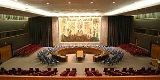
The designated Security Council Chamber in the United Nations Conference Building, designed by the Norwegian architect Arnstein Arneberg, was the specific gift of Norway
Norway

Norway , officially the Kingdom of Norway, is a constitutional monarchy in Northern Europe that occupies the western portion of the Scandinavian Peninsula....
. The mural painted by the Norwegian artist Per Krogh depicts a phoenix
Phoenix (mythology)

The phoenix is a Mythologyical sacred fire bird which originated in the Sub-continent of India in ancient mythologies mentioned in the Ancient Egyptian religion and later the Sanchuniathon and the Greek Mythology....
 rising from its ashes, symbolic of the world reborn after World War II. In the blue and gold silk tapestry on the walls and in the draperies of the windows overlooking the East River appear the anchor of faith, the wheat stems of hope, and the heart of charity.

See also

  • Reform of the United Nations Security Council
    Reform of the United Nations Security Council

    Reform of the United Nations Security Council encompasses a variety of proposals, including procedural reforms, such as eliminating United Nations Security Council veto power held by the five permanent members, and expansion of United Nations Security Council....
  • United Nations Security Council veto power
    United Nations Security Council veto power

    The United Nations Security Council 'power of veto refers to the veto power wielded solely by the five permanent members of the United Nations United Nations Security Council, enabling them to prevent the adoption of any 'substantive' draft Council resolution, regardless of the level of international support for the draft....
  • Reform of the United Nations
    Reform of the United Nations

    Since the late 1990s there have been many calls for reform of the United Nations . However, there is little clarity or consensus about what reform might mean in practice....
  • Military Staff Committee
    Military Staff Committee

    The Military Staff Committee is the United Nations United Nations Security Council subsidiary body whose role, as defined by the United Nations Charter, is to plan UN military operations and assist in the regulation of armaments....
    , a sub-organ of the Security Council
  • United Nations Security Council Counter-Terrorism Committee, a standing committee of the Security Council


External links

  • — official site
  • — timely, accurate and objective information and analysis on the Council's activities
  • Hans Köchler
    Hans Köchler

    Hans K?chler is a Professor of Philosophy at the University of Innsbruck, Austria, and president of the International Progress Organization, a non-governmental organization in consultative status with the United Nations....
    ,
  • — tracking developments
  • — UK Government site