

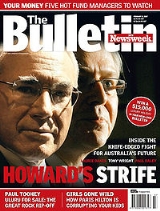
The Bulletin

Encyclopedia
The Bulletin was an Australia
n weekly magazine
that was published in Sydney from 1880 until January 2008. It was influential in Australian culture and politics from about 1890 until World War I
, the period when it was identified with the "Bulletin school" of Australian literature. Its influence thereafter declined steadily. In the 1960s it was revived as a modern newsmagazine. The final issue was published on 23 January 2008.
, and the first edition appeared on 31 January 1880. It was intended to be a journal of political and business commentary, with some literary content. Its politics were nationalist
, anti-imperialist
, protectionist
, insular, racist
, republican
, anti-clerical
and masculist - but not socialist
. It mercilessly ridiculed colonial governors, capitalists
, snobs and social climbers, the clergy
, feminists
and prohibition
ists. It upheld trade unionism, Australian independence, advanced democracy
and White Australia
. It ran savagely racist cartoons attacking Chinese, Indians, Japanese and Jews, and mocking Indigenous Australians
. The paper's masthead slogan, "Australia for the White Man," became a national political credo.
 This mix of radicalism
and xenophobia
was popular in the frontier districts of late 19th century Australia, and The Bulletin soon became known as "the bushman's bible," with a circulation reaching 80,000 by 1900. Archibald's masterstroke was to open The Bulletin 's pages to contributions from its readers in 1886, running pages of poetry, short stories and cartoons contributed by miners, shearers and timber-workers from all over Australia. Some of this material was of high quality, and over the years many of Australia's leading literary lights had their start in The Bulletin 's pages. At the same time, The Bulletin ran well-informed political and business news.
The Bulletin 's literary editor, Alfred Stephens
, was the main inspiration for the "Bulletin school." Among the better-known contributors were the writers Henry Lawson
, Banjo Paterson
, Bernard O'Dowd
, Joseph Furphy
, Miles Franklin
, Harrison Owen
, Robert Kaleski
and Vance and Nettie Palmer
, the cartoonists Livingston Hopkins
("Hop"), David Low, Phil May, D. H. Souter
, Norman "Heth" Hetherington
, and the illustrator and novelist Norman Lindsay
.
Archibald retired in 1907, and thereafter The Bulletin became steadily more conservative, and by World War I had become openly Empire
-loyalist. This marked its break with the political left and the end of its real influence, although it retained its place in Australian literary life well into the 1920s. In 1927, managing director William Macleod
sold his stake in the magazine to Samuel Prior, long term financial editor, senior editor and, since buying Archibald's shares some years earlier, major shareholder. Macleod had earlier invited Prior's third child, Henry, to manage the magazine. The Prior family owned and operated The Bulletin Newspaper company for the following decades, introducing new ventures such as the Wild Cat Monthly in 1923, the Australian Woman's Mirror in 1924, and, in a joint venture with Norman Lindsay designed to publish Australian writers, the Endeavour Press in 1932. Ultimately, however, the magazine gradually declined, losing circulation steadily. Its pre-war attitudes came to seem increasingly reactionary, and its cult of the bushman increasingly anachronistic in what was already an urbanised country. By the 1940s The Bulletin was regarded as a sad relic, filled with racist and antisemitic bile, and with political commentary so right-wing as to seem almost comic.
, who installed Donald Horne
as editor. The paper was radically modernised, most of the writers were replaced, and "Australia for the White Man" disappeared from the masthead. Under the Packer family The Bulletin remained politically conservative, but rejoined the political and journalistic mainstream, as a well-edited magazine (modelled on Time) of political and business news and commentary, with occasional forays into literature as a gesture to its past.
The Packer family tolerated the magazine's unprofitability for the prestige of publishing Australia's oldest magazine. They published it "in conjunction with" Newsweek
, which was usually found as a separate section within the magazine.
Online, The Bulletin (http://bulletin.ninemsn.com.au) existed in another form, publishing articles from the magazine as well as content exclusive to the web, photo galleries, an archive of past covers and a blogging site known as The Bullring.
The Bulletin Magazine also founded the Smart 100 Award. The Smart 100 identified, with the help of respected judges in each field, the smartest, most innovative and most creative people working in the areas of business, ICT, science, art, sport, society, education, health, environment and agriculture.
On 24 January 2008, ACP Magazines announced they had ceased publishing the magazine. Reasons given included that circulation had declined to 57,000 compared with sales figures in the order of 100,000 during the 1990s and that despite some of ACP's best resources being poured into the magazine including a dynamic ad sales team the magazine was no longer profitable. The loss in readership was attributed to readers preferring the internet for current affairs.
Australia
Australia , officially the Commonwealth of Australia, is a country in the Southern Hemisphere comprising the mainland of the Australian continent, the island of Tasmania, and numerous smaller islands in the Indian and Pacific Oceans. It is the world's sixth-largest country by total area...
n weekly magazine
Magazine
Magazines, periodicals, glossies or serials are publications, generally published on a regular schedule, containing a variety of articles. They are generally financed by advertising, by a purchase price, by pre-paid magazine subscriptions, or all three...
that was published in Sydney from 1880 until January 2008. It was influential in Australian culture and politics from about 1890 until World War I
World War I
World War I , which was predominantly called the World War or the Great War from its occurrence until 1939, and the First World War or World War I thereafter, was a major war centred in Europe that began on 28 July 1914 and lasted until 11 November 1918...
, the period when it was identified with the "Bulletin school" of Australian literature. Its influence thereafter declined steadily. In the 1960s it was revived as a modern newsmagazine. The final issue was published on 23 January 2008.
Early history
The Bulletin was founded by two Sydney journalists, J.F. Archibald and John HaynesJohn Haynes (Australian journalist)
John Haynes was a parliamentarian in New South Wales, Australia for five months short of thirty years, and co-founder , with J. F. Archibald, of The Bulletin....
, and the first edition appeared on 31 January 1880. It was intended to be a journal of political and business commentary, with some literary content. Its politics were nationalist
Nationalism
Nationalism is a political ideology that involves a strong identification of a group of individuals with a political entity defined in national terms, i.e. a nation. In the 'modernist' image of the nation, it is nationalism that creates national identity. There are various definitions for what...
, anti-imperialist
Imperialism
Imperialism, as defined by Dictionary of Human Geography, is "the creation and/or maintenance of an unequal economic, cultural, and territorial relationships, usually between states and often in the form of an empire, based on domination and subordination." The imperialism of the last 500 years,...
, protectionist
Protectionism
Protectionism is the economic policy of restraining trade between states through methods such as tariffs on imported goods, restrictive quotas, and a variety of other government regulations designed to allow "fair competition" between imports and goods and services produced domestically.This...
, insular, racist
Racism
Racism is the belief that inherent different traits in human racial groups justify discrimination. In the modern English language, the term "racism" is used predominantly as a pejorative epithet. It is applied especially to the practice or advocacy of racial discrimination of a pernicious nature...
, republican
Republicanism
Republicanism is the ideology of governing a nation as a republic, where the head of state is appointed by means other than heredity, often elections. The exact meaning of republicanism varies depending on the cultural and historical context...
, anti-clerical
Anti-clericalism
Anti-clericalism is a historical movement that opposes religious institutional power and influence, real or alleged, in all aspects of public and political life, and the involvement of religion in the everyday life of the citizen...
and masculist - but not socialist
Socialism
Socialism is an economic system characterized by social ownership of the means of production and cooperative management of the economy; or a political philosophy advocating such a system. "Social ownership" may refer to any one of, or a combination of, the following: cooperative enterprises,...
. It mercilessly ridiculed colonial governors, capitalists
Capitalism
Capitalism is an economic system that became dominant in the Western world following the demise of feudalism. There is no consensus on the precise definition nor on how the term should be used as a historical category...
, snobs and social climbers, the clergy
Clergy
Clergy is the generic term used to describe the formal religious leadership within a given religion. A clergyman, churchman or cleric is a member of the clergy, especially one who is a priest, preacher, pastor, or other religious professional....
, feminists
Feminism
Feminism is a collection of movements aimed at defining, establishing, and defending equal political, economic, and social rights and equal opportunities for women. Its concepts overlap with those of women's rights...
and prohibition
Prohibition
Prohibition of alcohol, often referred to simply as prohibition, is the practice of prohibiting the manufacture, transportation, import, export, sale, and consumption of alcohol and alcoholic beverages. The term can also apply to the periods in the histories of the countries during which the...
ists. It upheld trade unionism, Australian independence, advanced democracy
Democracy
Democracy is generally defined as a form of government in which all adult citizens have an equal say in the decisions that affect their lives. Ideally, this includes equal participation in the proposal, development and passage of legislation into law...
and White Australia
White Australia policy
The White Australia policy comprises various historical policies that intentionally restricted "non-white" immigration to Australia. From origins at Federation in 1901, the polices were progressively dismantled between 1949-1973....
. It ran savagely racist cartoons attacking Chinese, Indians, Japanese and Jews, and mocking Indigenous Australians
Indigenous Australians
Indigenous Australians are the original inhabitants of the Australian continent and nearby islands. The Aboriginal Indigenous Australians migrated from the Indian continent around 75,000 to 100,000 years ago....
. The paper's masthead slogan, "Australia for the White Man," became a national political credo.
Radicalization
Radicalization is the process in which an individual changes from passiveness or activism to become more revolutionary, militant or extremist. Radicalization is often associated with youth, adversity, alienation, social exclusion, poverty, or the perception of injustice to self or others.-...
and xenophobia
Xenophobia
Xenophobia is defined as "an unreasonable fear of foreigners or strangers or of that which is foreign or strange". It comes from the Greek words ξένος , meaning "stranger," "foreigner" and φόβος , meaning "fear."...
was popular in the frontier districts of late 19th century Australia, and The Bulletin soon became known as "the bushman's bible," with a circulation reaching 80,000 by 1900. Archibald's masterstroke was to open The Bulletin 's pages to contributions from its readers in 1886, running pages of poetry, short stories and cartoons contributed by miners, shearers and timber-workers from all over Australia. Some of this material was of high quality, and over the years many of Australia's leading literary lights had their start in The Bulletin 's pages. At the same time, The Bulletin ran well-informed political and business news.
The Bulletin 's literary editor, Alfred Stephens
Alfred Stephens
Alfred George Stephens was an Australian writer and literary critic, notably for The Bulletin. He was appointed to that position by its owner, J. F. Archibald in 1894.-Early Life and Journalism:...
, was the main inspiration for the "Bulletin school." Among the better-known contributors were the writers Henry Lawson
Henry Lawson
Henry Lawson was an Australian writer and poet. Along with his contemporary Banjo Paterson, Lawson is among the best-known Australian poets and fiction writers of the colonial period and is often called Australia's "greatest writer"...
, Banjo Paterson
Banjo Paterson
Andrew Barton "Banjo" Paterson, OBE was an Australian bush poet, journalist and author. He wrote many ballads and poems about Australian life, focusing particularly on the rural and outback areas, including the district around Binalong, New South Wales where he spent much of his childhood...
, Bernard O'Dowd
Bernard O'Dowd
Bernard Patrick O'Dowd was an Australian activist, educator, poet, journalist, and author of several law books and poetry books. O'Dowd worked as an assistant-librarian and later Chief Parliamentary Draughtsman in the Supreme Court at Melbourne for 48 years;he was also a co-publisher and writer...
, Joseph Furphy
Joseph Furphy
Joseph Furphy , is widely regarded as the "Father of the Australian novel". He mostly wrote under the pseudonym Tom Collins, and is best known for his novel Such is Life , regarded as an Australian classic.-Biography:Furphy was born at Yering Station in Yering, Victoria...
, Miles Franklin
Miles Franklin
Stella Maria Sarah Miles Franklin, known as Miles Franklin was an Australian writer and feminist who is best known for her novel My Brilliant Career, published in 1901...
, Harrison Owen
Harrison Owen
Albert John Owen , known as Harrison Owen, was an Australian playwright, novelist, poet, and journalist.-Career:Owen became a prolific contributor of poetry and local news articles to The Bulletin from 1912 to 1919. From the basis of his earlier work, the chief of editing for the Melbourne Herald...
, Robert Kaleski
Robert Kaleski
Robert Kaleski was a self-taught writer, bushman, environmentalist and canine authority living in New South Wales at the turn of the nineteenth century...
and Vance and Nettie Palmer
Vance and Nettie Palmer
Vance and Nettie Palmer were two of Australia's best-known literary figures from the 1920s to the 1950s. Edward Vivian "Vance" Palmer was a novelist, dramatist, essayist and critic. Janet Gertrude "Nettie" Palmer was a poet, essayist and Australia's leading literary critic...
, the cartoonists Livingston Hopkins
Livingston Hopkins
Livingston York Yourtee "Hop" Hopkins was an American cartoonist who became a major Australian cartoonist during the time of the Federation of Australia.- Early life in the USA :...
("Hop"), David Low, Phil May, D. H. Souter
David Henry Souter
David Henry Souter was an Australian artist and journalist.Souter was born in Aberdeen, Scotland, the son of David Henry Souter, an engineer, and his wife Ann Smith, née Grant...
, Norman "Heth" Hetherington
Norman Hetherington
Norman Frederick Hetherington OAM was an Australian artist, etcher, cartoonist , puppeteer, and puppet designer....
, and the illustrator and novelist Norman Lindsay
Norman Lindsay
Norman Alfred William Lindsay was an Australian artist, sculptor, writer, editorial cartoonist, scale modeler, and boxer. He was born in Creswick, Victoria....
.
Archibald retired in 1907, and thereafter The Bulletin became steadily more conservative, and by World War I had become openly Empire
British Empire
The British Empire comprised the dominions, colonies, protectorates, mandates and other territories ruled or administered by the United Kingdom. It originated with the overseas colonies and trading posts established by England in the late 16th and early 17th centuries. At its height, it was the...
-loyalist. This marked its break with the political left and the end of its real influence, although it retained its place in Australian literary life well into the 1920s. In 1927, managing director William Macleod
William Macleod
William Macleod , was an Australian artist and a partner in The Bulletin.-Early life:Macleod was born in London. His father was of a Scottish Highlands family and his mother Cornish/German...
sold his stake in the magazine to Samuel Prior, long term financial editor, senior editor and, since buying Archibald's shares some years earlier, major shareholder. Macleod had earlier invited Prior's third child, Henry, to manage the magazine. The Prior family owned and operated The Bulletin Newspaper company for the following decades, introducing new ventures such as the Wild Cat Monthly in 1923, the Australian Woman's Mirror in 1924, and, in a joint venture with Norman Lindsay designed to publish Australian writers, the Endeavour Press in 1932. Ultimately, however, the magazine gradually declined, losing circulation steadily. Its pre-war attitudes came to seem increasingly reactionary, and its cult of the bushman increasingly anachronistic in what was already an urbanised country. By the 1940s The Bulletin was regarded as a sad relic, filled with racist and antisemitic bile, and with political commentary so right-wing as to seem almost comic.
Modern era
In 1961 The Bulletin was sold to the press magnate Sir Frank PackerFrank Packer
Sir Douglas Frank Hewson Packer, KBE , was an Australian media proprietor who controlled Australian Consolidated Press and the Nine Network.-Biography:...
, who installed Donald Horne
Donald Horne
Professor Donald Horne was an Australian journalist, writer, social critic, and academic who became one of Australia's best known public intellectuals....
as editor. The paper was radically modernised, most of the writers were replaced, and "Australia for the White Man" disappeared from the masthead. Under the Packer family The Bulletin remained politically conservative, but rejoined the political and journalistic mainstream, as a well-edited magazine (modelled on Time) of political and business news and commentary, with occasional forays into literature as a gesture to its past.
The Packer family tolerated the magazine's unprofitability for the prestige of publishing Australia's oldest magazine. They published it "in conjunction with" Newsweek
Newsweek
Newsweek is an American weekly news magazine published in New York City. It is distributed throughout the United States and internationally. It is the second-largest news weekly magazine in the U.S., having trailed Time in circulation and advertising revenue for most of its existence...
, which was usually found as a separate section within the magazine.
Online, The Bulletin (http://bulletin.ninemsn.com.au) existed in another form, publishing articles from the magazine as well as content exclusive to the web, photo galleries, an archive of past covers and a blogging site known as The Bullring.
The Bulletin Magazine also founded the Smart 100 Award. The Smart 100 identified, with the help of respected judges in each field, the smartest, most innovative and most creative people working in the areas of business, ICT, science, art, sport, society, education, health, environment and agriculture.
On 24 January 2008, ACP Magazines announced they had ceased publishing the magazine. Reasons given included that circulation had declined to 57,000 compared with sales figures in the order of 100,000 during the 1990s and that despite some of ACP's best resources being poured into the magazine including a dynamic ad sales team the magazine was no longer profitable. The loss in readership was attributed to readers preferring the internet for current affairs.
Columnists and bloggers
Regular columnists and bloggers on the magazine's website included:- Patrick CookPatrick CookPatrick St. John Cook is an Australian cartoonist who is probably best known for his output in The Bulletin, Australia's weekly news magazine...
- Ellen FanningEllen FanningEllen Fanning is an Australian journalist and was the last host of the Nine Network's Sunday television program.She was born in Brisbane, Queensland, and attended All Hallows' School, in Brisbane. She later graduated with a communications degree at the Queensland University of...
- Laurie OakesLaurie OakesLaurie Oakes is an Australian political journalist, commentator, and media personality. Since 1966, he has worked in the Canberra Press Gallery, covering the Parliament of Australia and federal elections....
- Leo SchofieldLeo SchofieldLeo Schofield AM is an Australian restaurant critic, advertising professional and arts festival director....
- Paul Daley
- Julie-Anne Davies
- Roy Eccleston
- Katherine Fleming
- Chris Hammer
- Adam ShandAdam ShandAdam Shand is best known for his leadership and advocacy work as part of the Personal Telco Project.Shand founded Personal Telco in November 2000 which subsequently grew into one of the largest community wireless projects in the United States....
- Rebecca Urban