


Operation Compass

Encyclopedia
Allies of World War II
The Allies of World War II were the countries that opposed the Axis powers during the Second World War . Former Axis states contributing to the Allied victory are not considered Allied states...
military operation of the Western Desert Campaign
Western Desert Campaign
The Western Desert Campaign, also known as the Desert War, was the initial stage of the North African Campaign during the Second World War. The campaign was heavily influenced by the availability of supplies and transport. The ability of the Allied forces, operating from besieged Malta, to...
during World War II
World War II
World War II, or the Second World War , was a global conflict lasting from 1939 to 1945, involving most of the world's nations—including all of the great powers—eventually forming two opposing military alliances: the Allies and the Axis...
. British
United Kingdom
The United Kingdom of Great Britain and Northern IrelandIn the United Kingdom and Dependencies, other languages have been officially recognised as legitimate autochthonous languages under the European Charter for Regional or Minority Languages...
and Commonwealth
Commonwealth of Nations
The Commonwealth of Nations, normally referred to as the Commonwealth and formerly known as the British Commonwealth, is an intergovernmental organisation of fifty-four independent member states...
forces attacked Italian
Italy
Italy , officially the Italian Republic languages]] under the European Charter for Regional or Minority Languages. In each of these, Italy's official name is as follows:;;;;;;;;), is a unitary parliamentary republic in South-Central Europe. To the north it borders France, Switzerland, Austria and...
forces in western Egypt
Egypt
Egypt , officially the Arab Republic of Egypt, Arabic: , is a country mainly in North Africa, with the Sinai Peninsula forming a land bridge in Southwest Asia. Egypt is thus a transcontinental country, and a major power in Africa, the Mediterranean Basin, the Middle East and the Muslim world...
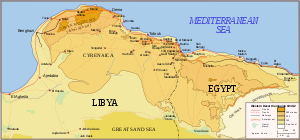
and eastern Libya
Libya
Libya is an African country in the Maghreb region of North Africa bordered by the Mediterranean Sea to the north, Egypt to the east, Sudan to the southeast, Chad and Niger to the south, and Algeria and Tunisia to the west....
in December 1940 to February 1941. The attack was a complete success. Allied forces advanced from inside Egypt to central Libya, captured 115,000 Italian prisoners, and destroyed thousands of tank
Tank
A tank is a tracked, armoured fighting vehicle designed for front-line combat which combines operational mobility, tactical offensive, and defensive capabilities...
s, artillery pieces, and aircraft
Aircraft
An aircraft is a vehicle that is able to fly by gaining support from the air, or, in general, the atmosphere of a planet. An aircraft counters the force of gravity by using either static lift or by using the dynamic lift of an airfoil, or in a few cases the downward thrust from jet engines.Although...
, while suffering very few casualties.
First skirmishes
Italy declared war on Britain and FranceFrance
The French Republic , The French Republic , The French Republic , (commonly known as France , is a unitary semi-presidential republic in Western Europe with several overseas territories and islands located on other continents and in the Indian, Pacific, and Atlantic oceans. Metropolitan France...
on 10 June 1940. During the next several months there were raids and skirmishes between Italian forces in Libya and British and Commonwealth forces in Egypt.
The Italian advance into Egypt
Marshal Italo BalboItalo Balbo
Italo Balbo was an Italian Blackshirt leader who served as Italy's Marshal of the Air Force , Governor-General of Libya, Commander-in-Chief of Italian North Africa , and the "heir apparent" to Italian dictator Benito Mussolini.After serving in...
was Governor-General
Governor-General
A Governor-General, is a vice-regal person of a monarch in an independent realm or a major colonial circonscription. Depending on the political arrangement of the territory, a Governor General can be a governor of high rank, or a principal governor ranking above "ordinary" governors.- Current uses...
and military commander of Italian North Africa
Italian North Africa
Italian North Africa was the aggregate of territories and colonies controlled by Italy in North Africa from 1911 until World War II...
(Libya). Italian dictator Benito Mussolini
Benito Mussolini
Benito Amilcare Andrea Mussolini was an Italian politician who led the National Fascist Party and is credited with being one of the key figures in the creation of Fascism....
urged Balbo to attack the British in Egypt. Mussolini's aim was to capture the Suez Canal
Suez Canal
The Suez Canal , also known by the nickname "The Highway to India", is an artificial sea-level waterway in Egypt, connecting the Mediterranean Sea and the Red Sea. Opened in November 1869 after 10 years of construction work, it allows water transportation between Europe and Asia without navigation...
and link up with Italian East Africa
Italian East Africa
Italian East Africa was an Italian colonial administrative subdivision established in 1936, resulting from the merger of the Ethiopian Empire with the old colonies of Italian Somaliland and Italian Eritrea. In August 1940, British Somaliland was conquered and annexed to Italian East Africa...
. But for many reasons, Balbo was reluctant.
After Balbo's death in a mysterious "friendly fire" accident on 28 June, Mussolini urged his replacement, General Rodolfo Graziani
Rodolfo Graziani
Rodolfo Graziani, 1st Marquis of Neghelli , was an officer in the Italian Regio Esercito who led military expeditions in Africa before and during World War II.-Rise to prominence:...
, to attack. Like Balbo, Graziani too was reluctant, stating that the water supply was inadequate. On 8 August 1940 he said to Foreign Minister Ciano
Galeazzo Ciano
Gian Galeazzo Ciano, 2nd Count of Cortellazzo and Buccari was an Italian Minister of Foreign Affairs and Benito Mussolini's son-in-law. In early 1944 Count Ciano was shot by firing squad at the behest of his father-in-law, Mussolini under pressure from Nazi Germany.-Early life:Ciano was born in...
"We move toward a defeat which, in the desert, must inevitably develop into a rapid and total disaster."
Graziani ultimately followed Mussolini's orders. On 13 September 1940, elements of the Italian Tenth Army advanced into Egypt in "Operation E
Italian invasion of Egypt
The Italian Invasion of Egypt was an Italian offensive action against British, Commonwealth and Free French forces during the Western Desert Campaign of the Second World War. Initially, the goal of the offensive was to seize the Suez Canal. To accomplish this, Italian forces from Libya would have...
".
As the Italians advanced, the small British force at Sollum withdrew to the main defensive positions east of Mersa Matruh. The Italian advance was harassed by the 7th Support Group
7th Support Group (United Kingdom)
.The 7th Support Group was a brigade size formation within the British 7th Armoured Division.-History:The 7th Support Group provided whatever support the division's armoured brigades needed for the operation in hand...
, a mobile element of the 7th Armoured Division.
After recapturing Fort Capuzzo
Fort Capuzzo
Fort Capuzzo was a fort in the Italiancolony of Libya, near the Libyan-Egyptian border. It is famous for its role during the World War II.Within a week of Italy's 10 June 1940 declaration of war upon Britain, the British Army's 11th Hussars captured Fort Capuzzo...
, progress was slow. The Italians advanced approximately 95 kilometres (59 mi) in three days. On 16 September, the advance stopped at the town of Maktila, 16 kilometres (9.9 mi) beyond Sidi Barrani
Sidi Barrani
Sidi Barrani is a town in Egypt, near the Mediterranean Sea, about east of the border with Libya, and around from Tobruk, Libya.Probably named after Sidi Mohammed el Barrani, a Senussi fighter in the early 1900s, the village is mainly a Bedouin community...
. The Italians then dug in, fortified their positions, and awaited reinforcements and supplies. They created a line of fortified camps around Sidi Barrani which ran from Maktila, 24 kilometres (14.9 mi) east on the coast, southward through Tummar East, Tummar West, and Nibeiwa, to Sofafi on the escarpment to the south-west.
Virginio Gayda, Italian newspaper editor and mouthpiece for Mussolini's fascist regime, wrote "Nothing can save Britain now." However, the British Royal Navy
Royal Navy
The Royal Navy is the naval warfare service branch of the British Armed Forces. Founded in the 16th century, it is the oldest service branch and is known as the Senior Service...
had transferred assets, including the aircraft carrier
Aircraft carrier
An aircraft carrier is a warship designed with a primary mission of deploying and recovering aircraft, acting as a seagoing airbase. Aircraft carriers thus allow a naval force to project air power worldwide without having to depend on local bases for staging aircraft operations...
HMS Illustrious
HMS Illustrious (R87)
HMS Illustrious , the fourth Illustrious of the British Royal Navy, was an aircraft carrier which saw service in World War II, the lead ship of the Illustrious-class of carriers which also included Victorious, Formidable, and Indomitable.-Construction:Illustrious was built by Vickers-Armstrongs at...
to the Mediterranean to reinforce the British Mediterranean Fleet, making provisioning of North Africa problematic for the Italians.
The Germans offered units to the Italians in summer 1940 to attack Egypt, but Benito Mussolini
Benito Mussolini
Benito Amilcare Andrea Mussolini was an Italian politician who led the National Fascist Party and is credited with being one of the key figures in the creation of Fascism....
rejected it in October in a meeting with Adolf Hitler
Adolf Hitler
Adolf Hitler was an Austrian-born German politician and the leader of the National Socialist German Workers Party , commonly referred to as the Nazi Party). He was Chancellor of Germany from 1933 to 1945, and head of state from 1934 to 1945...
.
Opposing forces
When war was declared, the Italian Fifth Army commanded by General Italo GariboldiItalo Gariboldi
Italo Gariboldi was a senior officer in the Italian Royal Army before and during World War II. He was also a recipient of the Knight's Cross of the Iron Cross...
was located towards the west in Tripolitania
Tripolitania
Tripolitania or Tripolitana is a historic region and former province of Libya.Tripolitania was a separate Italian colony from 1927 to 1934...
and the Italian Tenth Army commanded by General Mario Berti
Mario Berti
Mario Berti was an Italian officer during World War I and General in the Spanish Civil War and World War II.-Personal life.:Mario Berti was born in La Spezia, which is located in modern day Liguria. He was born into an upper-middle class family...
was located towards the east in Cyrenaica
Cyrenaica
Cyrenaica is the eastern coastal region of Libya.Also known as Pentapolis in antiquity, it was part of the Creta et Cyrenaica province during the Roman period, later divided in Libia Pentapolis and Libia Sicca...
. Once the French in Tunisia no longer posed a threat to Tripolitania
Tripolitania
Tripolitania or Tripolitana is a historic region and former province of Libya.Tripolitania was a separate Italian colony from 1927 to 1934...
, the assets of the Fifth Army were used more and more to supplement the needs of the Tenth Army. When Balbo was killed, Marshall Rodolfo Graziani
Rodolfo Graziani
Rodolfo Graziani, 1st Marquis of Neghelli , was an officer in the Italian Regio Esercito who led military expeditions in Africa before and during World War II.-Rise to prominence:...
took his place as Governor-General of Libya. Graziani expressed doubts about the capabilities of his larger but largely un-mechanized force to defeat the British, who, though smaller in numbers, were largely motorised.
After being reinforced at the expense of the Fifth Army, the Tenth Army controlled the equivalent of four army corps. The XX Corps had the Italian 60 Infantry Division Sabratha
Italian 60 Infantry Division Sabratha
The Italian 60th "Sabratha" Infantry Division was an Italian division during World War II."Sabratha" was mobilized in October 1939 for service in Libya. In September 1940, the division took part in the invasion of Egypt. In December, during Operation Compass, the division was destroyed near...
. The XXI Corps had the 1st "23 March" Blackshirt Division, the 2nd "28 October" Blackshirt Division
2nd Blackshirt Division (28 October) (Italy)
The 2nd Blackshirt Division 28 Ottobre was an Italian Camicie Nere militia unit formed for the Second Italo-Abyssinian War.It was named 28 ottobre in honor of the Fascist March on Rome ....
and the 63 Infantry Division Cirene
63 Infantry Division Cirene
The 63 Infantry Division Cirene was a Infantry Division of the Italian Army during World War II. The Cirene Division was sent to Libya in October 1939...
. The XXII Corps had the 61 Infantry Division Sirte
61 Infantry Division Sirte
The 61 Infantry Division Sirte was a Infantry Division of the Italian Army during World War II. The Sirte Division was sent to Libya in October 1939 . In September 1940, it was part of the Italian XXII Corps that took part in the Italian invasion of Egypt and was destroyed at Tobruk during the...
. The XXIII Corps had the 4th "3 January" Blackshirt Division
4th Blackshirt Division (3 January) (Italy)
The 4th CCNN Division "3 Gennaio" was one of seven Black Shirt Divisions that were organized and fought in the Second Italo-Abyssinian War...
and the 64 Infantry Division Catanzaro
64 Infantry Division Catanzaro
The 64 Infantry Division Catanzaro was a Infantry Division of the Italian Army during World War II. The Catanzaro Division was sent to Libya in October 1939, and took part in the Italian invasion of Egypt in September 1940...
. The newly created "Group of Libyan Divisions" (Gruppo Divisioni Libiche) had the "Maletti Group
Maletti Group
The Maletti Group was an ad hoc "mechanized" unit formed by the Italian Royal Army in Italian North Africa during the initial stages of the Western Desert Campaign of World War II...
", the 1 Libyan Division Sibelle
1 Libyan Division Sibelle
The 1 Libyan Division Sibelle was a Infantry Division of the Italian Army during World War II.-History:Originally called in the 1920s with the name Italian Libyan Colonial Division...
commanded by Major-General Luigi Sibelle, and the 2 Libyan Division Pescatori
2 Libyan Division Pescatori
The 2 Libyan Division Pescatori was a Infantry Division of the Italian Army during World War II. In December 1940, it was in Libya part of the Italian XXIII Corps a together with the 1 Blackshirt Division 23 Marzo and 2 Blackshirt Division 28 Ottobre, took part in the Italian invasion of Egypt and...
commanded by Major-General Armando Pescatori.
The only unit Berti had that was not an infantry division was the partially motorized and lightly armoured "Maletti Group." This group was commanded by its namesake General
General
A general officer is an officer of high military rank, usually in the army, and in some nations, the air force. The term is widely used by many nations of the world, and when a country uses a different term, there is an equivalent title given....
Pietro Maletti
Pietro Maletti
Pietro Maletti was an Italian military officer who participated in World War I, the subjugation of Italian North Africa, the Italo-Abyssinian War, and World War II...
and comprised some 2,500 Libyan colonial infantry and seventy tanks. Maletti Group's tanks were evenly divided between the lightly armoured and machine gun-armed Fiat L3s tankette
Tankette
A tankette is a tracked combat vehicle resembling a small tank roughly the size of a car, mainly intended for light infantry support or reconnaissance. Colloquially it may also simply mean a "small tank"....
s and the slightly heavier M11/39 medium tank
Fiat M11/39
The Fiat-Ansaldo M11/39 was an Italian Medium Tank first produced prior to World War II. The M11/39 saw service in Africa and Italy . The official Italian designation was Carro Armato M11/39...
. The M11/39 featured a hull-mounted 37 mm gun as its main armament. This gun was difficult to bring to bear on targets because of its limited traverse. The medium tank was also relatively poorly armoured and was mechanically unreliable.
Initially the British Middle East Command
Middle East Command
The Middle East Command was a British Army Command established prior to the Second World War in Egypt. Its primary role was to command British land forces and co-ordinate with the relevant naval and air commands to defend British interests in the Middle East and eastern Mediterranean region.The...
under General
General
A general officer is an officer of high military rank, usually in the army, and in some nations, the air force. The term is widely used by many nations of the world, and when a country uses a different term, there is an equivalent title given....
Archibald Wavell only had about 30,000 troops stationed in Egypt to defend against the approximately 150,000 Italian troops stationed in Cyrenaica. Lieutenant-General Richard O'Connor
Richard O'Connor
General Sir Richard Nugent O'Connor KT, GCB, DSO & Bar, MC, ADC was a British Army general who commanded the Western Desert Force in the early years of World War II...
commanded the Western Desert Force
Western Desert Force
The Western Desert Force, during World War II, was a British Commonwealth army formation stationed in Egypt.On 17 June 1940, the headquarters of the British 6th Infantry Division was designated as the Western Desert Force. The unit consisted of the 7th Armoured Division and the Indian 4th Infantry...
. Major-General Noel Beresford-Peirse
Noel Beresford-Peirse
Lieutenant-General Sir Noel Monson de la Poer Beresford-Peirse KBE, CB, DSO was a British Army officer.-Family background:...
commanded the 4th Indian Infantry Division and Major-General Sir Michael O'Moore Creagh
Michael O'Moore Creagh
Major-General Sir Michael O'Moore Creagh KBE MC, was a British soldier who served in both the First and Second World Wars. He commanded the 7th Armoured Division, the Desert Rats, between 1939 and 1941.-Early life:...
commanded the 7th Armoured Division (the "Desert Rats"). From 14 December, troops of the 6th Australian Infantry Division, commanded by Major-General Iven Mackay
Iven Giffard Mackay
Lieutenant General Sir Iven Giffard Mackay KBE, CMG, DSO & Bar, VD was a senior Australian soldier who served in both World Wars. A graduate of the University of Sydney, Mackay taught physics there from 1910 until 1914, when he joined the Australian Imperial Force...
, replaced the Indian troops.
In comparison to the Italian tanks, the British were able to field some faster Cruiser tank
Cruiser tank
The cruiser tank was a British tank concept of the inter-war period. This concept was the driving force behind several tank designs which saw action during the Second World War....
s (the Mk I
Cruiser Mk I
The Tank, Cruiser, Mk I was a British cruiser tank of the interwar period. It was the first cruiser tank: a fast tank designed to bypass the main enemy lines and engage the enemy's lines of communication, along with enemy tanks...
, Mk II
Cruiser Mk II
The Tank, Cruiser, Mk II , was developed alongside the A9, and was intended to be a heavier, infantry tank version of that type. In practice it was not deemed suitable for the infantry tank role and was classified as a "heavy cruiser"....
, and Mk III
Cruiser Mk III
The Tank, Cruiser, Mk III was a British cruiser tank of the Second World War. It was the first British cruiser tank to use the Christie suspension system which gave higher speeds and better cross-country performance, previous models of cruiser tanks having used triple wheeled bogie...
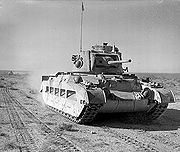
) which were more than a match to the M11/39s. The British also had a limited number of heavy Matilda
Matilda tank
The Infantry Tank Mark II known as the Matilda II was a British infantry tank of the Second World War. It was also identified from its General Staff Specification A12....
Infantry tank
Infantry tank
The infantry tank was a concept developed by the British and French in the years leading up to World War II. Infantry tanks were tanks designed to support the infantry in the attack. To achieve this they were generally heavily armoured compared to the cruiser tanks, to allow them to operate in...
s that, while slow, were strongly armoured and well armed. The armour of the Matilda tanks could not be pierced by any of the Italian anti-tank or field guns available at the time.
At the onset, aircraft available to both sides in the desert tended to be older biplanes. The Italians had Fiat CR.32
Fiat CR.32
The Fiat CR.32 was an Italian biplane fighter used in the Spanish Civil War and World War II. This nimble little Fiat was compact, robust and highly manoeuvrable and gave impressive displays all over Europe in the hands of the Pattuglie Acrobatiche. The CR.32 fought in North and East Africa, in...
s and Fiat CR.42
Fiat CR.42
The Fiat CR.42 Falco was a single-seat sesquiplane fighter which served primarily in Italy's Regia Aeronautica before and during World War II. The aircraft was produced by the Turin firm, and entered service, in smaller numbers, with the air forces of Belgium, Sweden and Hungary...
s while the British had Gloster Gladiator
Gloster Gladiator
The Gloster Gladiator was a British-built biplane fighter. It was used by the Royal Air Force and the Royal Navy and was exported to a number of other air forces during the late 1930s. It was the RAF's last biplane fighter aircraft and was rendered obsolete by newer monoplane designs even as it...
s.
British plans
Following the Italian advance, Wavell ordered the commander British Troops Egypt, Lieutenant-General Sir Henry Maitland Wilson to plan a limited operation to push the Italians back. Wavell had noted that the Italian defensive positions were dispersed with the fortified camps separated by large distances which meant they could not provide mutual support. Operation Compass, for administrative reasons, was originally planned as a five-day raid but was extended after its initial success. Wavell was confident of his smaller force's capabilities and on 28 November wrote to Wilson expressing a belief that an opportunity might occur for converting the enemy's defeat into an outstanding victory:The British plan was for 7th Armoured Division's Support Group
7th Support Group (United Kingdom)
.The 7th Support Group was a brigade size formation within the British 7th Armoured Division.-History:The 7th Support Group provided whatever support the division's armoured brigades needed for the operation in hand...
to observe the Italian camps at Sofafi to prevent any intervention from them while the rest of the armoured division and 4th Indian Division passed through the gap between Sofafi and Nibeiwa. A brigade from the Indian Division supported by Infantry tanks of 7th Royal Tank Regiment
7th Royal Tank Regiment
The 7th Royal Tank Regiment was an armoured regiment of the British Army until 1959.-History:The 7th Royal Tank Regiment was part of the Royal Tank Regiment, itself part of the Royal Armoured Corps...
(7th RTR) would then attack Nibeiwa from the west while the Armoured Division protected their northern flank. Once Nibeiwa was captured a second Indian brigade, again supported by 7th RTR would attack the Tummars. Meanwhile the Matruh Garrison Force (3rd battalion Coldstream Guards
Coldstream Guards
Her Majesty's Coldstream Regiment of Foot Guards, also known officially as the Coldstream Guards , is a regiment of the British Army, part of the Guards Division or Household Division....
plus some artillery) would contain the enemy camp at Maktila on the coast and the Royal Navy would bombard Maktila and Sidi Barrani. Assuming a successful outcome, in the second phase Sidi Barrani would be attacked on the second day by the Indian Division and a westward exploitation would follow.
Preparations were made in the strictest secrecy. Only a few officers knew during the training exercise held on 25 and 26 November that the objectives marked out on ground near Matruh were replicas of Nibeiwa and Tummar and that the exercise was in fact a rehearsal. The troops were also told that a second exercise was to follow. Many of the troops involved in Operation Compass were not informed that the operation was not an exercise until 7 December as they arrived at their start positions.
Battle of Marmarica/Battle of the Camps
The opening stage of Operation Compass was known by the Italians as the "Battle of the Marmarica". The British knew it as the "Battle of the Camps". The "Battle of the Marmarica" name was derived from the name of the coastal plain where the battle was fought. The "Battle of the Camps" name was derived from the individual Italian camps set up in a defensive line outside of Sidi Barrani.On the nights of 7 December and 8 December 1940 the Western Desert Force
Western Desert Force
The Western Desert Force, during World War II, was a British Commonwealth army formation stationed in Egypt.On 17 June 1940, the headquarters of the British 6th Infantry Division was designated as the Western Desert Force. The unit consisted of the 7th Armoured Division and the Indian 4th Infantry...
under the command of Major-General Richard O'Connor
Richard O'Connor
General Sir Richard Nugent O'Connor KT, GCB, DSO & Bar, MC, ADC was a British Army general who commanded the Western Desert Force in the early years of World War II...
and comprising British 7th Armoured Division
British 7th Armoured Division
The 7th Armoured Division was a British armoured division which saw service during the Second World War where its exploits made it famous as the Desert Rats....
and Indian 4th Infantry Division
Indian 4th Infantry Division
The Indian 4th Infantry Division, also known as the Red Eagle Division, is an infantry division of the Indian Army.The division was formed in Egypt in 1939 and was the first Indian formation to go overseas during the Second World War. As with all formations in the Indian Army prior to independence,...
reinforced by British 16th Infantry Brigade
British 16th Infantry Brigade
The British 16th Infantry Brigade was a British Army formation based in Palestine at the beginning of the Second World War as part of the British 8th Infantry Division. It was later part of the British 6th Infantry Division which was redesignated as the British 70th Infantry Division on 10 October...
advanced a total of 113 kilometres (70.2 mi) to their start positions for the attack. The RAF made attacks on Italian airfields destroying or damaging 29 aircraft on the ground. Selby Force, a mixed force of 1,800 under Brigadier A. R. Selby, moved up from Matruh and having stationed a brigade of dummy tanks in the desert as a decoy for the Italian airforce, had by dawn on 9 December taken position a few kilometers south east of Maktila. In the meantime Maktila had been bombarded by the monitor
Monitor (warship)
A monitor was a class of relatively small warship which was neither fast nor strongly armoured but carried disproportionately large guns. They were used by some navies from the 1860s until the end of World War II, and saw their final use by the United States Navy during the Vietnam War.The monitors...
HMS Terror
HMS Terror (I03)
HMS Terror was an Erebus-class monitor built for the Royal Navy in 1915-16 at the Harland and Wolff shipyard in Govan, Scotland.The Erebus-class monitors were of displacement, long, with a maximum speed of produced by reciprocating engines with two shafts, and a crew of 223. The ship's main...
and the gunboat
Insect class gunboat
The Insect class patrol boats were a class of small, but well-armed Royal Navy ships designed for use in shallow rivers or inshore. They were intended for use on the Danube...
HMS Aphis, while Sidi Barrani had been shelled by the gunboat HMS Ladybird
HMS Ladybird (1916)
HMS Ladybird was an Insect-class gunboat of the Royal Navy, launched in 1916. This class are also referred to as "Large China Gunboats"....
. In the afternoon of December 8 an Italian reconnaissance airplane notified the Italian command in Benghazi
Benghazi
Benghazi is the second largest city in Libya, the main city of the Cyrenaica region , and the former provisional capital of the National Transitional Council. The wider metropolitan area is also a district of Libya...
about the preparations for an imminent attack on Maktila and Nibeiwa, but General Maletti
Pietro Maletti
Pietro Maletti was an Italian military officer who participated in World War I, the subjugation of Italian North Africa, the Italo-Abyssinian War, and World War II...
was not (the historian Indro Montanelli
Indro Montanelli
Indro Montanelli was an Italian journalist and historian, known for his new approach to writing history in books such as History of the Greeks and History of Rome....
later defined this action as "sabotage").
On 9 December, the disposition of the forward Italian fortified positions in Egypt were as follows: The 1st Libyan Colonial Infantry Division was located at Maktila. The 2nd Libyan Colonial Infantry Division was located at Tummar. The "Maletti Group
Maletti Group
The Maletti Group was an ad hoc "mechanized" unit formed by the Italian Royal Army in Italian North Africa during the initial stages of the Western Desert Campaign of World War II...
" was located at Nibiewa. The 4th "3 January" Blackshirt Division
4th Blackshirt Division (3 January) (Italy)
The 4th CCNN Division "3 Gennaio" was one of seven Black Shirt Divisions that were organized and fought in the Second Italo-Abyssinian War...
and the Headquarters for the "Libyan Corps" were at Sidi Barrani. The 63 Infantry Division Cirene
63 Infantry Division Cirene
The 63 Infantry Division Cirene was a Infantry Division of the Italian Army during World War II. The Cirene Division was sent to Libya in October 1939...
and the Headquarters for the XXI Corps were located at Sofafi. The 64 Infantry Division Catanzaro
64 Infantry Division Catanzaro
The 64 Infantry Division Catanzaro was a Infantry Division of the Italian Army during World War II. The Catanzaro Division was sent to Libya in October 1939, and took part in the Italian invasion of Egypt in September 1940...
was located at Buq Buq. The Headquarters for the XXIII Corps and the 2nd "28 October" Blackshirt Division were located in Sollum and in the Halfaya Pass area respectively. The 62 Infantry Division Marmarica
62 Infantry Division Marmarica
The 62 Infantry Division Marmarica was a Infantry Division of the Italian Army during World War II. The Marmarica Division was sent to Libya in October 1939. It took part in the Italian invasion of Egypt in September 1940...
was located at Sidi Omar to the south of Sollum."
The commander of the Italian Tenth Army, General Mario Berti, was on sick leave when the British launched their attack against his forces in Egypt. In his place was General Italo Gariboldi
Italo Gariboldi
Italo Gariboldi was a senior officer in the Italian Royal Army before and during World War II. He was also a recipient of the Knight's Cross of the Iron Cross...
. Gariboldi, the 1st "23 March" Blackshirt Division, and the Headquarters for the Tenth Army were located far from the front lines in Bardia. By the time Berti arrived back in Libya to resume command, so had the British.
Nibeiwa
Maletti Group
The Maletti Group was an ad hoc "mechanized" unit formed by the Italian Royal Army in Italian North Africa during the initial stages of the Western Desert Campaign of World War II...
from the east. At 07.00 the main divisional artillery started to register targets and by 07.15 a full concentration had started. At that moment 11th Indian Infantry Brigade, with 7 RTR
7th Royal Tank Regiment
The 7th Royal Tank Regiment was an armoured regiment of the British Army until 1959.-History:The 7th Royal Tank Regiment was part of the Royal Tank Regiment, itself part of the Royal Armoured Corps...
under command, attacked Nibeiwa from the north west which reconnaissance had established as the weakest sector. By 08.30, after some fierce fighting, Nibeiwa was taken; General Maletti was killed and 2,000 prisoners taken.
The destruction of the Maletti Group is described by Walker in Iron Hulls, Iron Hearts:
Large quantities of supplies were also taken intact while O'Connor's casualties amounted to eight officers and forty-eight men. Major-General Noel Beresford-Peirse
Noel Beresford-Peirse
Lieutenant-General Sir Noel Monson de la Poer Beresford-Peirse KBE, CB, DSO was a British Army officer.-Family background:...
, commander of 4th Indian Division, ordered his 5th Indian Infantry Brigade to move up with supporting field artillery and take positions for the attack on the Tummars.
The Tummars
The attack commenced on Tummar West at 13.50, after 7 RTR had refueled and re-armed and artillery had softened the defences up for an hour. Here too a north west approach was made and the tanks broke through the perimeter without too much difficulty and were followed twenty minutes later by the infantry. However, the defenders put up stronger opposition than at Nibeiwa but by 16.00 Tummar West was overrun, except for extreme north east corner. The tanks shifted their point of attack to Tummar East, the greater part of which was captured by nightfall. Meanwhile 7th Armoured Division's 4th Armoured Brigade, while performing flank defence, had advanced to Azziziya where the garrison of 400 surrendered. Light patrols of the 7th Hussars pushed forward to cut the Sidi Barrani to Buq Buq road while armoured cars of the 11th Hussars ranged further west. The tanks of 7th Armoured Brigade was held in reserve.Maktila
Unaware of the situation at the Tummars, Selby decided nevertheless to send units forward to seal off the western exits from Maktila. During that night, however, the 1st Libyan Division was able to filter through and make good its escape.Sidi Barrani
On 10 December 16 Infantry Brigade was brought forward from 4th Indian Division reserve and with elements of 11th Indian Brigade under command was sent forward in lorries to attack Sidi Barrani. Moving forward that morning across exposed ground the force took some casualties but with support from artillery and 7 RTR it was in position barring the south and south western exits to Sidi Barrani by 13.30. At 16.00, supported by the whole of the division's artillery, the attack, again with the support of 7th RTR, went in. The town was captured by nightfall and the remains of the two Libyan Divisions and the 4th Blackshirt Division were trapped between 16th Infantry Brigade and Selby Force. On 11 December Selby Force supported by some tanks attacked and secured the surrender of the 1st Libyan Division. By evening the 4th Blackshirts had also ceased resisting.Buq Buq
On 11 December 7 Armoured Brigade was ordered out of reserve and relieved 4th Armoured Brigade in the Buq Buq area to clear it of remaining opposition and made large captures of men and guns.Sofafi
On 11 December a patrol from 7th Support Group entered Rabia to find it empty. The Cirene Division had withdrawn from there and Sofafi overnight. An order to the withdrawing 4th Armoured Brigade to cut them off west of Sofafi arrived too late and they were able to make their way along the top of the escarpment to link with Italian forces at Halfya.Exploitation
Over the next few days the British 4th Armoured Brigade, on top of the escarpment, and 7th Armoured Brigade, on the coast, endeavoured to pursue vigorously. They encountered acute supply problems exacerbated by the large number of prisoners (twenty times the number planned for) and found it extremely difficult to advance.Italian forces crowded into the coast route while retreating from Sidi Barrani and Buq Buq were easy targets for the Terror and the two gunboats which bombarded the Sollum area all day and most of the night of 11 December By late 12 December the only remaining Italian positions in Egypt were at the approaches to Sollum and a force in the region of Sidi Omar.
73 Italian tanks and 237 artillery pieces were destroyed or captured and approximately 38,300 Italian and Libyan soldiers killed or captured. The British had suffered fewer than 700 casualties. The British and Indian forces having licked their wounds then moved quickly west along the Via della Vittoria
Via della Vittoria
The Via della Vittoria was a military road between Bardia in Italian Libya and Sidi Barrani in western Egypt.- Characteristics :The "Via della Vittoria" , was a road built by Italian engineers during World War II, between June and December 1940...
, through Halfaya Pass
Halfaya Pass
Halfaya Pass is located in Egypt, near the border with Libya. A high escarpment extends south eastwards from the Egyptian-Libyan border at the coast at as-Salum , with the scarp slope facing into Egypt...
, and again captured Fort Capuzzo
Fort Capuzzo
Fort Capuzzo was a fort in the Italiancolony of Libya, near the Libyan-Egyptian border. It is famous for its role during the World War II.Within a week of Italy's 10 June 1940 declaration of war upon Britain, the British Army's 11th Hussars captured Fort Capuzzo...
in Libya
Libya
Libya is an African country in the Maghreb region of North Africa bordered by the Mediterranean Sea to the north, Egypt to the east, Sudan to the southeast, Chad and Niger to the south, and Algeria and Tunisia to the west....
.
Section commander Nazzareno Ganino, 86th Infantry Regiment, 60th "Sabratha" Infantry Division
Italian 60 Infantry Division Sabratha
The Italian 60th "Sabratha" Infantry Division was an Italian division during World War II."Sabratha" was mobilized in October 1939 for service in Libya. In September 1940, the division took part in the invasion of Egypt. In December, during Operation Compass, the division was destroyed near...
later described the patrol actions of the period:
British redeploy Indian Division to the Sudan
O'Connor wanted to continue attacking. He wanted to get at least as far as BenghaziBenghazi
Benghazi is the second largest city in Libya, the main city of the Cyrenaica region , and the former provisional capital of the National Transitional Council. The wider metropolitan area is also a district of Libya...
. However, on 11 December General Wavell whose command stretched down into Africa, had ordered the Indian 4th Infantry Division
Indian 4th Infantry Division
The Indian 4th Infantry Division, also known as the Red Eagle Division, is an infantry division of the Indian Army.The division was formed in Egypt in 1939 and was the first Indian formation to go overseas during the Second World War. As with all formations in the Indian Army prior to independence,...
to withdraw to take part in an offensive against Italian forces
East African Campaign (World War II)
The East African Campaign was a series of battles fought in East Africa during World War II by the British Empire, the British Commonwealth of Nations and several allies against the forces of Italy from June 1940 to November 1941....
in Italian East Africa
Italian East Africa
Italian East Africa was an Italian colonial administrative subdivision established in 1936, resulting from the merger of the Ethiopian Empire with the old colonies of Italian Somaliland and Italian Eritrea. In August 1940, British Somaliland was conquered and annexed to Italian East Africa...
. O'Connor would state, "[This] came as a complete and very unpleasant surprise . . . It put 'paid' to the question of immediate exploitation . . . ". The Australian 6th Division
Australian 6th Division
The 6th Division of the Australian Army was a unit in the Second Australian Imperial Force during World War II. It served in the North African campaign, the Greek campaign and the New Guinea campaign, including the crucial battles of the Kokoda Track, among others...
replaced the Indian troops from 14 December. The Australians had barely finished training, were missing their armoured regiment, and as yet had only one artillery regiment equipped with the new 25 pounder field guns.
British advance resumes
Exploitation continued nevertheless by the two armoured brigades and the Support Group of 7th Armoured Division with the infantry of 16th Infantry Brigade (which had not gone with the Indian division to the Sudan) following up. By 15 December Sollum and Halfya had been captured as well as Fort Capuzzo while all Italian forces had been cleared from Egypt. 7th Armoured Division were concentrated south-west of Bardia awaiting the arrival of 6th Australian Division to make the attack on Bardia. By this time the Western Desert Force had taken 38,000 prisoners and captured 400 artillery pieces and 50 tanks while suffering casualties of 133 killed, 387 wounded and 8 missing.Bardia

Generale di Corpo d'Armata
Generale di Corpo d'Armata, or "Tenente Generale" is an Italian military rank equivalent to Lieutenant General in the forces of some English speaking countries....
Annibale Bergonzoli
Annibale Bergonzoli
Annibale Bergonzoli , nicknamed "barba elettrica", "Electric Whiskers", was an Italian Lieutenant General during the Spanish Civil War and World War II. He commanded the defences of Bardia, Libya, after the short offensive into Egypt made by Rodolfo Graziani...
's XXIII Corps faced the British from within the strong defences of Bardia
Bardia
Bardia is a geographic region in the Democratic Republic of Nepal.Bardia comprises a portion of the Terai, or lowland hills and valleys of southern Nepal. The Terai is over 1,000 feet in elevation, and extends all along the Indian border...
. Mussolini wrote to Bergonzoli: "I have given you a difficult task but one suited to your courage and experience as an old and intrepid soldier—the task of defending the fortress of Bardia to the last. I am certain that 'Electric Beard' and his brave soldiers will stand at whatever cost, faithful to the last." Bergonzoli replied: "I am aware of the honour and I have today repeated to my troops your message — simple and unequivocal. In Bardia we are and here we stay." Graziani daily recorded his apprehension. He bemoaned the situation and his fate, accused Marshal
Marshal
Marshal , is a word used in several official titles of various branches of society. The word is an ancient loan word from Old French, cf...
Pietro Badoglio
Pietro Badoglio
Pietro Badoglio, 1st Duke of Addis Abeba, 1st Marquess of Sabotino was an Italian soldier and politician...
(Supreme Chief of the Italian General Staff) of treachery, and he demanded mass intervention by German aircraft. While Bergonzoli prepared the defences of Bardia, Graziani began the evacuation of colonists from between Tobruk and Derna. On 23 December, Graziani replaced Berti with General
General
A general officer is an officer of high military rank, usually in the army, and in some nations, the air force. The term is widely used by many nations of the world, and when a country uses a different term, there is an equivalent title given....
Giuseppe Tellera
Giuseppe Tellera
Giuseppe Tellera was a General in the Italian Army during World War II.Giuseppe Tellera was a Lt. General in the Italian Army during the North African Campaign fought against the British and Commonwealth forces in world war II...
as commander of the 10th Army.
Bergonzoli had approximately 40,000 defenders under his command. The Italian divisions defending the perimeter of Bardia included remnants of the 62nd "Marmarica" Infantry Division, remnants of the 63rd "Cirene" Infantry Division, the 1st "23 March" Blackshirt Division, and the 2nd "28 October" Blackshirt Division. These divisions guarded an 29 kilometres (18 mi) perimeter which had a permanent anti-tank ditch, extensive wire fence, and a double row of concrete strong points. As a "mobile reserve" there were a dozen medium tanks and over one hundred L3 tankettes
L3/35
The L3/35 or Carro Veloce CV-35 was an Italian tank used before and during World War II. Although designated a light tank by the Italian Army, its turretless configuration, weight and firepower make it closer to contemporary tankettes....
. While the L3s were generally worthless, the medium tanks for the first time included a few M13/40 with the turret-mounted 47 mm anti-tank gun as its main armament. This was a vast improvement over the hull-mounted 37 mm gun of the M11/39s. Bergonzoli also had the remnants of the 64 Infantry Division Catanzaro and some "fortess troops" in Bardia itself. Unfortunately for Bergonzoli, he had little more than a month's supply of water.
XIII Corps (United Kingdom)
XIII Corps was a British infantry corps during World War I and World War II.-World War I:XIII Corps was formed in France on 15 November 1915 under Lieutenant-General Walter Congreve to be part of Fourth Army. It was first seriously engaged during the Battle of the Somme in 1916. On the First day on...
, O'Connor resumed his offensive. On 3 January 1941, General Mackay's Australian 6th Division assaulted Bardia. Its Australian 16th Infantry Brigade attacked at dawn from the west, where the defences were known to be weak. Sapper
Sapper
A sapper, pioneer or combat engineer is a combatant soldier who performs a wide variety of combat engineering duties, typically including, but not limited to, bridge-building, laying or clearing minefields, demolitions, field defences, general construction and building, as well as road and airfield...
s blew gaps in the barbed wire
Barbed wire
Barbed wire, also known as barb wire , is a type of fencing wire constructed with sharp edges or points arranged at intervals along the strand. It is used to construct inexpensive fences and is used atop walls surrounding secured property...
with Bangalore torpedo
Bangalore torpedo
A Bangalore torpedo is an explosive charge placed on the end of a long, extendible tube. It is used by combat engineers to clear obstacles that would otherwise require them to approach directly, possibly under fire...
es and filled in and broke down the sides of the anti-tank ditch with picks
Pickaxe
A pickaxe or pick is a hand tool with a hard head attached perpendicular to the handle.Some people make the distinction that a pickaxe has a head with a pointed end and a flat end, and a pick has both ends pointed, or only one end; but most people use the words to mean the same thing.The head is...
and shovel
Shovel
A shovel is a tool for digging, lifting, and moving bulk materials, such as soil, coal, gravel, snow, sand, or ore. Shovels are extremely common tools that are used extensively in agriculture, construction, and gardening....
s. This allowed the infantry and 23 Matilda II tanks of the 7th Royal Tank Regiment
7th Royal Tank Regiment
The 7th Royal Tank Regiment was an armoured regiment of the British Army until 1959.-History:The 7th Royal Tank Regiment was part of the Royal Tank Regiment, itself part of the Royal Armoured Corps...
to enter the fortress and capture all their objectives, along with 8,000 prisoners. In the second phase of the operation, the Australian 17th Infantry Brigade exploited the breach made in the perimeter, and pressed south as far as a secondary line of defences known as the Switch Line. On the second day, the 16th Infantry Brigade captured the township of Bardia, cutting the fortress in two. Thousands of prisoners were taken, and the Italian garrison now held out only in the northern and southernmost parts of the fortress. On the third day, the 19th Infantry Brigade
19th Brigade (Australia)
The 19th Brigade was a formation of the Australian Army during World War II as part of the 6th Division. Formed in April 1940 as a result of the reorganisation of the Second Australian Imperial Force when the infantry brigades composition was reduced from four to three battalions. The fourth...
advanced south from Bardia, supported by artillery and the Matilda tanks, now reduced in number to just six. Its advance allowed the 17th Infantry Brigade to make progress as well, and the two brigades reduced the southern sector of the fortress. Meanwhile, the Italian garrisons in the north surrendered to the 16th Infantry Brigade and the Support Group of the British 7th Armoured Division outside the fortress. In all, some 36,000 Italian prisoners were taken. Bergonzolli escaped and was able to stay just ahead of the Allied forces as they then advanced to Tobruk along the coast road, the Via Balbia
Via Balbia
The Libyan Coastal Highway is a highway that is the only major road that runs along the entire east-west length of the Libyan Mediterranean coastline...
.
Tobruk
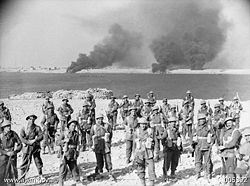
There were approximately 25,000 Italian defenders at Tobruk under the overall command of General Petassi Manella, commander of the XXII Corps. Besides "fortress troops," the defenders comprised the 61st "Sirte" Infantry Division, sixty-two tankettes, twenty-five medium tanks, and some two-hundred guns. The perimeter was about forty-eight kilometers long and was fortified with a combination of anti-tank ditch, wire, and a double row of strongpoints. In many ways the defenses at Tobruk were a replica of the defenses at Bardia.
The Allied infantry force comprised the 16th, 17th and 19th Brigades of Australian 6th Division under Major-General Iven Mackay
Iven Giffard Mackay
Lieutenant General Sir Iven Giffard Mackay KBE, CMG, DSO & Bar, VD was a senior Australian soldier who served in both World Wars. A graduate of the University of Sydney, Mackay taught physics there from 1910 until 1914, when he joined the Australian Imperial Force...
supported by the 16 remaining Infantry tanks of 7 RTR and the machine-gun battalions of the Northumberland Regiment and Cheshire Regiment
Cheshire Regiment
The Cheshire Regiment was an infantry regiment of the British Army, part of the Prince of Wales' Division.The regiment was created in 1881 as part of the Childers reforms by the linking of the 22nd Regiment of Foot and the militia and rifle volunteers of Cheshire...
. 7th Armoured Division with its unit of Free French Marines were to play the same containing role they had at Bardia. Given the lack of tank numbers, heavy artillery bombardment was used to soften the Italian defenses. With their Browning machine guns, and four bombs each, the Vickers Wellington
Vickers Wellington
The Vickers Wellington was a British twin-engine, long range medium bomber designed in the mid-1930s at Brooklands in Weybridge, Surrey, by Vickers-Armstrongs' Chief Designer, R. K. Pierson. It was widely used as a night bomber in the early years of the Second World War, before being displaced as a...
and Blenheim bombers also played an important part in the softening up of defenses of the Tobruk garrison.
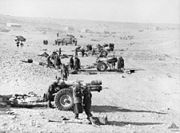
During the night 19th Brigade HQ attempted to negotiate a ceasefire with the commander of the Italian XXII Corps and garrison in Tobruk. It was hoped they would succeed, but a telephone call from the Italian supreme command put paid to their efforts. Mussolini himself had spoken personally to General Manella, forbidding him to surrender, and informing him that squadrons of Italian bombers were on their way as reinforcements. Later that night Italian SM.79s
Savoia-Marchetti SM.79
The Savoia-Marchetti SM.79 Sparviero was a three-engined Italian medium bomber with a wood and metal structure. Originally designed as a fast passenger aircraft, this low-wing monoplane, in the years 1937–39, set 26 world records that qualified it for some time as the fastest medium bomber in the...
carried out a surprise low-level attack, which bombed some 8,000 prisoners who had been gathered inside a fenced enclosure, killing and wounding hundreds of their men. This bombing broke the will of many among those still prepared to fight.
In the end, General Manella surrendered some 12 hours after the fighting began. But Manella refused to order the surrender of his forces. This meant that it took a further day to clean up any resistance.
Next day, the capture of the remaining outposts from R1 to S11 was completed and assisted strongly by Infantry tanks of the Support Group and the 2nd Rifle Brigade and 1st King's Royal Rifle Corps
King's Royal Rifle Corps
The King's Royal Rifle Corps was a British Army infantry regiment, originally raised in colonial North America as the Royal Americans, and recruited from American colonists. Later ranked as the 60th Regiment of Foot, the regiment served for more than 200 years throughout the British Empire...
which had arrived as reinforcements that morning. Meanwhile, the 7th Armoured Division which had also entered the perimeter from the Derna road that morning stood by to advance into the town if required.
On the afternoon of 22 January, Brigadier-General Vincenzo della Mura and the remaining 17,000 defenders surrendered. General della Mura was the commander of the 61 Infantry Division Sirte. The Italians had lost 25,000 killed, wounded and captured. The Australians by comparison had 400 killed, wounded and captured.
Derna
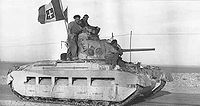
Special Armored Brigade
The Special Armored Brigade , also known as "Babini Group", or Raggruppamento Babini) was an ad hoc armored unit formed by the Italian Royal Army in Italian North Africa during the initial stages of the Western Desert Campaign of World War II.The group was formed in late 1940 and was destroyed at...
" (Brigata Corazzato Speciale, or BCS) consisting of fifty-five M13/40 tanks, artillery pieces, and supported by infantry formations specializing in the anti-tank role and sappers equipped with anti-tank mines. In hardly more than a month, the Italians dispatched this volunteer force under General Valentino Babini to North Africa. The M13s in the BCS were a vast improvement to the M11s. They had a better turret-mounted 47 mm tank gun
Cannone da 47/32 M35
The Cannone da 47/32 M35 was an Austrian artillery piece produced under license in Italy during World War II. It was used both as an infantry gun and an anti-tank gun....
which was more than able to pierce the armour of the British light and cruiser tanks. However, other than command vehicles, Italian tanks were not equipped with radios. Communicating for most Italian tankers required the use of signal flags.
Bambini's tank force included the 3rd Battalion and the 5th Battalion from the 131st "Centauro" Armoured Division and should have amounted to at least one-hundred-and-twenty M13s. But eighty-two tanks had just arrived at Benghazi
Benghazi
Benghazi is the second largest city in Libya, the main city of the Cyrenaica region , and the former provisional capital of the National Transitional Council. The wider metropolitan area is also a district of Libya...
and required ten days of "acclimatization" prior to operation.
Following the fall of Tobruk, HQ British Troops Egypt was removed from the existing unwieldy line of command so that O'Connor reported directly to Wavell at Middle East Command. O'Connor continued the advance towards Derna with the Australian 6th Division while sending 7th Armoured Division south of the Jebel Akhdar
Jebel Akhdar (Libya)
The Jebel Akhdar is a heavily forested, fertile upland area in northeastern Libya. It is located in the modern Shabiyahs or Districts of Derna, Jabal al Akhdar, and Marj.-Geography:...
mountains towards Mechili
Mechili
Mechili is a small village in Cyrenaica, Libya and the former site of a turkish fort. It’s nearly east of Benghazi, and west of Timimi.-Geography:Because of its location in the desert, Mechili suffered in the past from isolation...
. On 24 January the 4th Armoured Brigade engaged armoured elements of BCS on the Derna - Mechili track. While the British managed to destroy nine Italian tanks in the battle, they themselves lost one cruiser and six light tanks. The 2/11th Battalion first made contact with infantry of the BCS at the Derna airfield on 25 January and progress was difficult against particularly determined resistance. In the Derna-Giovanni Berta
Al Qubah
Quba or Qoba was one of the 32 districts of Libya. In 2007 it became part of the Derna District. The population of the former district was approximately 93,000.In the north, Al Qubah had a shoreline on the Mediterranean Sea...
area, held by the 60th "Sabratha" Infantry Division and infantry elements of the BCS, there were fierce exchanges with Italian counterattacks taking place around Wadi Derna. On 27 January, an Australian battalion beat off a strong daylight attack from a force of at least a thousand Italians. That same day, concealed soldiers of the BCS ambushed a column of armoured vehicles of the 6th Cavalry Regiment and took three of the survivors prisoner. The advance of other units further to the south of the Wadi Derna eventually threatened the BCS with encirclement and it disengaged on the night of 28 January. Derna, a town of 10,000 residents itself was captured on 26 January. Precise casualty figures for the fighting for Derna and Giovanni Berta have not been compiled but at least 15 Australians were killed fighting the BCS and "Sabratha" Division. The Italians lost a good part of the 60th "Sabratha" Infantry Division in the fighting.
Battle of Beda Fomm
The rapid British advance caused the Italians to make a decision to evacuate CyrenaicaCyrenaica
Cyrenaica is the eastern coastal region of Libya.Also known as Pentapolis in antiquity, it was part of the Creta et Cyrenaica province during the Roman period, later divided in Libia Pentapolis and Libia Sicca...
. In late January 1941, the British learned that the Italians were evacuating Cyrenaica
Cyrenaica
Cyrenaica is the eastern coastal region of Libya.Also known as Pentapolis in antiquity, it was part of the Creta et Cyrenaica province during the Roman period, later divided in Libia Pentapolis and Libia Sicca...
along the main coastal road from Benghazi. The British 7th Armoured Division
British 7th Armoured Division
The 7th Armoured Division was a British armoured division which saw service during the Second World War where its exploits made it famous as the Desert Rats....
under Major General Sir Michael O'Moore Creagh
Michael O'Moore Creagh
Major-General Sir Michael O'Moore Creagh KBE MC, was a British soldier who served in both the First and Second World Wars. He commanded the 7th Armoured Division, the Desert Rats, between 1939 and 1941.-Early life:...
was dispatched to intercept the remnants of the fleeing Italian Tenth Army
Italian Tenth Army
The Italian Tenth Army was one of two Italian armies in Italian North Africa during World War II. The Tenth Army in Cyrenaica faced the British in the neutral Kingdom of Egypt...
.
Creagh's division was to travel via Msus and Antelat (the bottom of the semicircle), while the Australian 6th Division
Australian 6th Division
The 6th Division of the Australian Army was a unit in the Second Australian Imperial Force during World War II. It served in the North African campaign, the Greek campaign and the New Guinea campaign, including the crucial battles of the Kokoda Track, among others...
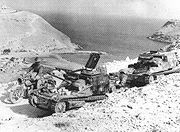
chased the Italians along the coast road round the north of the Jebel Akhdar mountains (the curve of the semicircle). The poor terrain was hard going for the tanks, and Creagh took the bold decision to send a flying column
Flying column
A flying column is a small, independent, military land unit capable of rapid mobility and usually composed of all arms. It is often an ad hoc unit, formed during the course of operations....
on wheels only (christened "Combe Force
Combe Force
Combe Force, or Combeforce, was an ad hoc flying column formed by the British Army for a specific purpose during the latter stages of Operation Compass. Combe Force was formed to cut across the open desert of Cyrenaica and cut off the retreating Italian Army which was traveling along the coastal...
") south-west across the virtually unmapped Libyan Desert. Combe Force, under its namesake Lieutenant-Colonel John Combe
John Frederick Boyce Combe
Major-General John Frederick Boyce Combe CB DSO & Bar was a British Army officer before and during World War II. He was twice awarded the DSO for his service in the Western Desert Campaign before being captured in April 1941 and spending nearly two and a half years as a prisoner of war in Italy...
of the 11th Hussars
11th Hussars
The 11th Hussars was a cavalry regiment of the British Army.-History:The regiment was founded in 1715 as Colonel Philip Honeywood's Regiment of Dragoons and was known by the name of its Colonel until 1751 when it became the 11th Regiment of Dragoons...
, consisted of an armoured car squadron from each of 11th Hussars and King's Dragoon Guards, 2nd Rifle Brigade, a Royal Air Force
Royal Air Force
The Royal Air Force is the aerial warfare service branch of the British Armed Forces. Formed on 1 April 1918, it is the oldest independent air force in the world...
armoured car squadron, anti-tank guns from 3rd Regiment Royal Horse Artillery
3rd Regiment Royal Horse Artillery
3rd Regiment Royal Horse Artillery is a regiment of the Royal Horse Artillery in the British Army. They are currently based in Caen Barracks, Hohne, Germany.-Current role:...
(RHA
Royal Horse Artillery
The regiments of the Royal Horse Artillery , dating from 1793, are part of the Royal Regiment of Artillery of the British Army...
), 'C' battery 4 RHA, and the 106th battery RHA with nine portee
Portee
A portee is a truck that carries a gun on its bed, such that the gun is not affixed permanently to the vehicle, can be quickly unloaded, and can be fired from the truck....
-mounted 37 mm anti-tank guns. The force totalled about 2,000 men.
In the afternoon of 5 February 1941, Combe Force arrived at the Benghazi – Tripoli road and set up road blocks near Sidi Saleh, some 32 kilometres (19.9 mi) north of Ajedabia and 48 kilometres (29.8 mi) southwest of Antelat. The leading elements of the Italian Tenth Army
Italian Tenth Army
The Italian Tenth Army was one of two Italian armies in Italian North Africa during World War II. The Tenth Army in Cyrenaica faced the British in the neutral Kingdom of Egypt...
arrived 30 minutes later and were blocked. By the evening 4th Armoured Brigade had reached Beda Fomm, overlooking the coastal road some 16 kilometres (9.9 mi) to the north of them while 7th Armoured Support Group took a more northerly route to threaten the retreating Italian Tenth Army's flank and rear and prevent a breakout across the desert. The following day, the Italian army had concentrated and attacked. The fighting was intense and, as the day progressed, increasingly desperate.
Through 6 February, the riflemen, tanks, and guns of Combe Force
Combe Force
Combe Force, or Combeforce, was an ad hoc flying column formed by the British Army for a specific purpose during the latter stages of Operation Compass. Combe Force was formed to cut across the open desert of Cyrenaica and cut off the retreating Italian Army which was traveling along the coastal...
managed to hold off about 20,000 Italian soldiers supported by sixty M13/40
Fiat M13/40
The Fiat-Ansaldo M13/40 was an Italian medium tank , designed to replace the Fiat L3, the Fiat L6/40 and the Fiat M11/39 in the Italian Army at the start of World War II...
medium tanks and two hundred guns. Initially, Bambini's "Special Armoured Brigade
Special Armored Brigade
The Special Armored Brigade , also known as "Babini Group", or Raggruppamento Babini) was an ad hoc armored unit formed by the Italian Royal Army in Italian North Africa during the initial stages of the Western Desert Campaign of World War II.The group was formed in late 1940 and was destroyed at...
" (Brigata Corazzato Speciale, or BCS) was in the vicinity of Benghazi. The BCS was part of the rear guard and included approximately one-hundred tanks. But, because at least thirty tanks were kept back at Benghazi for rear guard purposes, the BCS was limited to sixty tanks to make the crucial break through at Beda Fomm.
The fighting was close and often hand-to-hand. At one point, a regimental sergeant major
Regimental Sergeant Major
Regimental Sergeant Major is an appointment held by warrant officers class 1 in the British Army, the British Royal Marines and in the armies of many Commonwealth nations, including Australia and New Zealand; and by chief warrant officers in the Canadian Forces...
captured an Italian light tank by hitting the commander over the head with a rifle-butt.
The final Italian effort came in the morning of 7 February when the last twenty Italian medium tanks broke through the thin cordon of riflemen and anti-tank guns. Hoever even this breakthrough was ultimately stopped by the fire of British field guns located just a few yards from regimental HQ. After this final failure, with the rest of the British 7th Armoured Division
British 7th Armoured Division
The 7th Armoured Division was a British armoured division which saw service during the Second World War where its exploits made it famous as the Desert Rats....
arriving, and the Australian 6th Division
Australian 6th Division
The 6th Division of the Australian Army was a unit in the Second Australian Imperial Force during World War II. It served in the North African campaign, the Greek campaign and the New Guinea campaign, including the crucial battles of the Kokoda Track, among others...
bearing down on them from the Benghazi, the Italians surrendered. Among the dead was the commander of the 10th Army, Tellera. Among the prisoners captured was Babini and the elusive Bergonzoli.
By mid-morning on 7 February, O'Connor wrote: "I think this may be termed a complete victory as none of the enemy escaped." Later, after surveying the shambles of what was left of the Italian 10th Army at Beda Fomm, O'Connor sent his celebrated message to Wavell: "Fox killed in the open." He dispatched the 11th Hussars westwards to Agedabia and then on to El Agheila
El Agheila
El Agheila is a coastal city at the bottom of the Gulf of Sidra in far western Cyrenaica, Libya. In 1988 it was placed in Ajdabiya District; between 1995 and 2001 the district name is not known; however, it was again placed into Ajdabiya District in 2001...
to round up any stragglers and to keep in contact with a quickly departing enemy.
Battle of the oasis
General Wavell's advance had cut off a garrison of approximately 800 Italians and 1,200 colonial troops at Giarabub (marked as Jarabub on the map) under the command of Lieutenant-Colonel Castagna. Giarabub was an oasis 257.5 kilometres (160 mi) to the south of Bardia and 85.5 kilometres (53.1 mi) from the border. Although the colonial troops surrendered quickly, the regular troops held firm and were still in place in mid-March. Although cut off, the garrison was supplied by air and the 6th Australian Division's divisional mechanised cavalry unit which was observing the oasis did not have the strength to attack the position.In late March Wavell needed the oasis clear to allow him to withdraw the divisional cavalry regiment to join the rest of the division to travel to Greece. The cavalry was joined by 2/9th Australian Infantry battalion and an attack launched under the leadership of Brigadier Wootten. On 21 March, the final attack on Giararub lasted for about two days and once again the Australians and Italians took heavy casualties but the Australians prevailed although 2/9th Battalion lost 17 killed and 77 wounded. It was estimated that 250 casualties had been caused to the Italian battalion under the weight of artillery softening up fire, hand to hand combat and the British air strikes.
Aftermath
After ten weeks, the Italian Tenth ArmyItalian Tenth Army
The Italian Tenth Army was one of two Italian armies in Italian North Africa during World War II. The Tenth Army in Cyrenaica faced the British in the neutral Kingdom of Egypt...
was no more. The Allied forces had advanced 800 km, destroyed or captured about 400 tanks and 1290 artillery pieces, and captured 130,000 Libyan and Italian prisoners of war besides a vast quantity of other war material. Their prisoners included 22 generals. The Italian general staff on the other hand records 960 guns of all types lost. The British and Commonwealth forces suffered 494 dead and 1,225 wounded. The issue of Life Magazine that went out on 10 February 1941 included a story entitled: "Mussolini Takes a Bad Licking in Africa."
On 9 February 1941, as the British advance reached El Agheila
El Agheila
El Agheila is a coastal city at the bottom of the Gulf of Sidra in far western Cyrenaica, Libya. In 1988 it was placed in Ajdabiya District; between 1995 and 2001 the district name is not known; however, it was again placed into Ajdabiya District in 2001...
, Churchill ordered that it be stopped and troops be dispatched to defend Greece. The Greeks were already in a war with the Italians
Greco-Italian War
The Greco-Italian War was a conflict between Italy and Greece which lasted from 28 October 1940 to 23 April 1941. It marked the beginning of the Balkans Campaign of World War II...
and a German attack
Battle of Greece
The Battle of Greece is the common name for the invasion and conquest of Greece by Nazi Germany in April 1941. Greece was supported by British Commonwealth forces, while the Germans' Axis allies Italy and Bulgaria played secondary roles...
was soon expected.
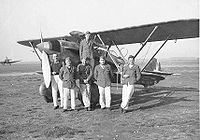
Cyrenaica
Cyrenaica is the eastern coastal region of Libya.Also known as Pentapolis in antiquity, it was part of the Creta et Cyrenaica province during the Roman period, later divided in Libia Pentapolis and Libia Sicca...
, Italy still had the 5th Army and its four divisions in Tripolitania
Tripolitania
Tripolitania or Tripolitana is a historic region and former province of Libya.Tripolitania was a separate Italian colony from 1927 to 1934...
. In readiness for additional British advances, the Italians reinforced the Sirte, Tmed Hassan, and Buerat strongholds. The 17th "Pavia" Infantry Division
Italian 17 Infantry Division Pavia
17 Motorised Division Pavia or 17 Divisione Autotrasportabile Pavia was a North African type infantry Division of the Italian Army during World War II. The Pavia was formed in October 1939 and sent to Libya. It was never completely motorised but despite this limitation, it was considered to...
, the 25th "Bologna" Infantry Division
Italian 25 Infantry Division Bologna
The 25 Semi-Motorised Division Bologna was an Semi-Motorised Infantry division of the Italian Army during World War II. It was stationed in Tripolitania and was sent to Libya for the Italian invasion of Egypt...
, the 27th "Brescia" Infantry Division
27th Truck-Moveable Division (Brescia)
The 27 Motorised Division "Brescia" was a Motorised Infantry Division organized from the 27 Infantry Division Sila prior to the start of World War II. It was made up of draftees from Calabria....
, and the 55th "Savona" Infantry Division had contributed much equipment and most of the better artillery to the divisions lost in Cyrenaica but reinforcements continued to arrive from Italy. Several of the infantry divisions in Tripolitania were "motorized" in theory, but much of the motor transport had been contributed to the 10th Army.
Among the recently arrived units were the reformed 60th "Sabratha" Infantry Division
Italian 60 Infantry Division Sabratha
The Italian 60th "Sabratha" Infantry Division was an Italian division during World War II."Sabratha" was mobilized in October 1939 for service in Libya. In September 1940, the division took part in the invasion of Egypt. In December, during Operation Compass, the division was destroyed near...
(the original being lost at Derna), the 102nd "Trento" Motorised Division
Italian 102 Motorised Division Trento
The 102nd Motorised Division Trento was a motorised infantry division of the Italian Army during World War II. It was formed in 1939 and kept in reserve in Italy until it was moved to North Africa in February 1941. It took part in Axis attacks across North Africa, following the Allied Operation...
and the 132nd "Ariete" Armored Division
Italian 132nd Armored Division Ariete
The Ariete Armoured Division was an armoured division of the Italian Army during World War II. It was formed in 1939 as the second armoured division in the Italian Army after the 131 Armoured Division Centauro. The division fought in the North African Campaign until being destroyed during the...
(minus the armour lost at Beda Fomm). This brought the total of Italian soldiers in Tripolitania to about 150,000. The Italians had already lost almost as many soldiers in Cyrenaica and most of the better equipment and armour available, but fresh equipment and armour continued to arrive from Italy.
On 11 January 1941, HMS Illustrious
HMS Illustrious (R87)
HMS Illustrious , the fourth Illustrious of the British Royal Navy, was an aircraft carrier which saw service in World War II, the lead ship of the Illustrious-class of carriers which also included Victorious, Formidable, and Indomitable.-Construction:Illustrious was built by Vickers-Armstrongs at...
had suffered a crippling dive-bomber attack from Italian Stukas (called Picchiatello in Italian service). This loss allowed the first troops of the German Africa Corps (Deutsches Afrikakorps, DAK) to begin arriving in Tripolitania
Tripolitania
Tripolitania or Tripolitana is a historic region and former province of Libya.Tripolitania was a separate Italian colony from 1927 to 1934...
. On 11 February, as part of Operation Sunflower
Operation Sonnenblume
Operation Sonnenblume was the deployment of German troops to North Africa in February 1941, during the Second World War...
(Unternehmen Sonnenblume
Operation Sonnenblume
Operation Sonnenblume was the deployment of German troops to North Africa in February 1941, during the Second World War...
), elements of DAK started to arrive. With the arrival of DAK, commanded by General Erwin Rommel
Erwin Rommel
Erwin Johannes Eugen Rommel , popularly known as the Desert Fox , was a German Field Marshal of World War II. He won the respect of both his own troops and the enemies he fought....
, the desert war would take a completely different turn.
On 25 March 1941, General Italo Gariboldi
Italo Gariboldi
Italo Gariboldi was a senior officer in the Italian Royal Army before and during World War II. He was also a recipient of the Knight's Cross of the Iron Cross...
replaced Marshal Rodolfo Graziani
Rodolfo Graziani
Rodolfo Graziani, 1st Marquis of Neghelli , was an officer in the Italian Regio Esercito who led military expeditions in Africa before and during World War II.-Rise to prominence:...
. Graziani had requested to be relieved and was granted his request. By 19 July, Gariboldi himself was relieved because of his alleged lack of cooperation with Rommel.
Towards the end of April, the Italian divisional commaders reviewed the Italo-German forces. A German officer shouted: "At the beginning of Italian-German cooperation on African soil, we swear to make the greatest effort for a joint victory for Great Germany and Great Italy. Long live Great Italy! Long live Great Germany!" The assembled troops roared: "We swear it!"
Given other setbacks suffered during the early war years, the Allied troops of Operation Compass were highly publicized and became known as "Wavell's Thirty Thousand," which was used as the title of a 1942 British documentary chronicling the campaign.
Quotes
- Bonner FellersBonner FellersBonner Frank Fellers , was a U.S. Army officer who served during World War II as military attaché and psychological warfare director. He was a considered a protégé of General Douglas MacArthur.-World War II:...
: "General Wavell told me they were going to do manoeuvres, so I went up as an observer, and God dammit — it was the works." - An anonymous Coldstream GuardsColdstream GuardsHer Majesty's Coldstream Regiment of Foot Guards, also known officially as the Coldstream Guards , is a regiment of the British Army, part of the Guards Division or Household Division....
officerOfficer (armed forces)An officer is a member of an armed force or uniformed service who holds a position of authority. Commissioned officers derive authority directly from a sovereign power and, as such, hold a commission charging them with the duties and responsibilities of a specific office or position...
describing prisoners taken: "We have about 5 acres of officers and 200 acres of other ranks." (About 20, 000 and 810, 000 square meters respectively.) - Anthony EdenAnthony EdenRobert Anthony Eden, 1st Earl of Avon, KG, MC, PC was a British Conservative politician, who was Prime Minister from 1955 to 1957...
: (after the battle of Bardia) "Never has so much been surrendered by so many to so few." - Rodolfo GrazianiRodolfo GrazianiRodolfo Graziani, 1st Marquis of Neghelli , was an officer in the Italian Regio Esercito who led military expeditions in Africa before and during World War II.-Rise to prominence:...
: (writing to Mussolini after the defeat) "In this theatre of operations a single armoured division is more important than an entire [infantry] army." - Adolf HitlerAdolf HitlerAdolf Hitler was an Austrian-born German politician and the leader of the National Socialist German Workers Party , commonly referred to as the Nazi Party). He was Chancellor of Germany from 1933 to 1945, and head of state from 1934 to 1945...
: (said with amusement to his generals) "Failure has had the healthy effect of once more compressing Italian claims to within the natural boundaries of Italian capabilities."
See also
- North African Campaign timelineNorth African Campaign timeline- 1940:* 10 June: The Kingdom of Italy declares war upon France and the United Kingdom* 14 June: British forces cross from Egypt into Libya and capture Fort Capuzzo* 16 June: The first tank battle of the North African Campaign takes place, the "Battle of Girba"...
- Military history of Italy during World War IIMilitary history of Italy during World War IIDuring World War II , the Kingdom of Italy had a varied and tumultuous military history. Defeated in Greece, France, East Africa and North Africa, the Italian invasion of British Somaliland was one of the only successful Italian campaigns of World War II accomplished without German support.In...