

Parliament of Australia

Encyclopedia
The Parliament of Australia, also known as the Commonwealth Parliament or Federal Parliament, is the legislative branch
of the government of Australia
. It is bicameral, largely modelled in the Westminster tradition
, but with some influences from the United States Congress
. Under Section 1 of the Constitution of Australia
, Parliament consists of three components: the Queen, the Senate
, and the House of Representatives
. The Queen is usually represented by the Governor-General
. The Australian Parliament is the world's sixth oldest continuous democracy.
The upper house
, the Senate, consists of 76 members: twelve for each state
, and two for each mainland territory
. Senators are elected using a form of proportional voting
. The lower house
, the House of Representatives, currently consists of 150 members, who represent districts known as electoral divisions (commonly referred to as "electorates" or "seats"). The number of members is not fixed, but can vary with boundary changes resulting from electoral redistributions, which are required on a regular basis. The most recent overall increase in the size of the House, which came into effect at the 1984 election, increased the number of members from 125 to 148. It reduced to 147 at the 1993 election, returned to 148 at the 1996 election, and has been 150 since the 2001 election. Each division elects one member using compulsory preferential voting
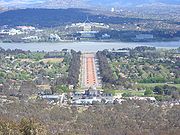
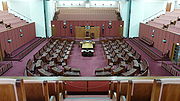
. The two Houses meet in separate chambers
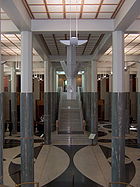
of Parliament House
on Capital Hill
in Canberra
.
The present Parliament, as elected at the 2010 election, is the 43rd Federal Parliament since Federation. It is the first hung parliament
in the House of Representatives since the 1940 election
, with Labor
and the Coalition
winning 72 seats each of 150 total. Six crossbenchers hold the balance of power
: Greens
MP Adam Bandt
and independent MPs Andrew Wilkie
, Rob Oakeshott
and Tony Windsor
declared their support for Labor on confidence and supply
, independent MP Bob Katter
and National Party of Western Australia
MP Tony Crook
declared their support for the Coalition on confidence and supply. The resulting 76–74 margin entitled Labor to form a minority government
. The Labor government increased their parliamentary majority on 24 November 2011 from 75–74 to 76–73 when the Coalition's Peter Slipper
became Speaker of the Australian House of Representatives
, replacing Labor's Harry Jenkins
. In the 76-seat Senate
, where no party tends to have a majority of seats, the Greens gained the sole balance of power with a total of nine seats, previously holding a shared balance of power with the Family First Party
and independent Nick Xenophon
. Labor holding 31 seats, they require an additional eight non-Labor votes to pass legislation. The Coalition holds 34 seats, while the two remaining seats are occupied by Xenophon and Democratic Labor Party
Senator John Madigan
.
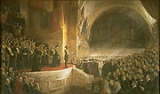
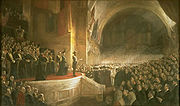 The Commonwealth Parliament was opened on 9 May 1901 in Melbourne
by The Prince George, Duke of Cornwall and York, later King George V
. The only building in Melbourne large enough to house the 14,000 guests was the Royal Exhibition Building
. Thereafter, from 1901 to 1927, the Parliament met in Parliament House, Melbourne
, which it borrowed from the Parliament of Victoria
(which sat in the Royal Exhibition Building). On 9 May 1927 Parliament moved to the new national capital at Canberra
, where it met in what is now called Old Parliament House
. Intended to be temporary, this building in fact housed the Parliament for more than 60 years. The new and permanent Parliament House
was opened on 9 May 1988 by Queen Elizabeth II.
 Under Section 1 of the Constitution, the Queen of Australia
is one of the components of Parliament. The constitutional functions of the Crown are given to the Governor-General
, whom the Monarch appoints on the advice of the Prime Minister
. Specifically, the Constitution gives the Governor-General the power to assent to legislation
, refuse to assent, or to reserve a bill for the Queen's judgement. However, by convention, the Governor-General does not exercise these powers other than in accordance with the advice of the Prime Minister.
The upper house of the Australian Parliament is the Senate
, which consists of 76 members. Like the United States Senate
, on which it was modelled, the Australian Senate includes an equal number of Senators from each state, regardless of population. Unlike it however the Australian Senate was directly elected from the start when the new Australian Constitution was assented to in 9th of July 1900. The Australian Senate was thus the first upper chamber in the world to be directly elected in a time when upper houses were either indirectly elected or unelected. The U.S. Senate was directly elected from 1914 following the 17th Amendment to the U.S. Constitution.
The Constitution allows Parliament to determine the number of Senators by legislation, provided that the six original states are equally represented. Furthermore, the Constitution provides that each original state is entitled to at least six senators. However, neither of these provisions applies to any newly admitted states, or to territories. Pursuant to an Act of Parliament passed in 1973, senators are elected to represent the territories (excluding Norfolk Island
). Currently, the two Northern Territory
Senators represent the residents of the Northern Territory as well as the Australian external territories of Christmas Island
and the Cocos (Keeling) Islands
. The two Australian Capital Territory
Senators represent the Australian Capital Territory and the Jervis Bay Territory
.
Until 1949, each state elected the constitutional minimum of six Senators. This number increased to ten from the 1949 election
, and was increased again to twelve (the present number) from the 1984 election.
Parliament may determine the number of members of the House of Representatives. However the Constitution provides that this number must be "as nearly as practicable, twice the number of Senators"; this requirement is commonly called the "nexus provision." Hence, the House presently consists of 150 members. Each state is allocated seats based on its population; however, each original state, regardless of size, is guaranteed at least five seats. The Constitution does not guarantee representation for the territories. Parliament granted a seat to the Northern Territory in 1922, and to the Australian Capital Territory in 1948; these territorial representatives, however, had only limited voting rights until 1968.
From 1901 to 1949, the House consisted of either 74 or 75 members (the Senate had 36). Between 1949 and 1984, it had between 121 and 127 members (the Senate had 60 until 1975, when it increased to 64). In 1977, the High Court
ordered that the size of the House be reduced from 127 to 124 members in order to comply with the nexus provision. In 1984, both the Senate and the House were enlarged; since then the House has had between 148 and 150 members (the Senate has 76).
A number of people have been members of both the Senate and the House of Representatives at different times in their parliamentary career (see People who have served in both Houses of the Australian Parliament
for details.)
Individuals with foreign citizenship are prohibited from sitting in either house of the parliament by Section 44 of the Constitution of Australia. In the landmark case Sue v Hill
the High Court of Australia
ruled that the United Kingdom is a foreign power for purposes of this section despite the fact that at the time of the drafting of the Constitution all Australians were British subjects.
 Each of the two Houses elects a presiding officer. The presiding officer of the Senate is called the President
; that of the House is the Speaker
. Elections for these positions are by secret ballot. Both offices are conventionally filled by members of the governing party, but the presiding officers are expected to oversee debate and enforce the rules in an impartial manner.
The Constitution authorises Parliament to set the quorum
for each chamber. The quorum of the Senate is one-quarter of the total membership (nineteen); that of the House of Representatives is one-fifth of the total membership (thirty). In theory, if a quorum is not present, then a House may not continue to meet. In practice, members usually agree not to notice that a quorum is not present, so that debates on routine bills can continue without other members having to be present. Sometimes the Opposition will "call a quorum
" as a tactic to annoy the Government or delay proceedings, particularly when the Opposition feels it has been unfairly treated in the House. It is the responsibility of the Government whips
to ensure that when a quorum is called, enough Government members are present to make up a quorum.
Both Houses may determine motions by voice vote
: the presiding officer puts the question, and, after listening to shouts of "Aye" and "No" from the members, announces the result. The announcement of the presiding officer settles the question, unless at least two members demand a "division
," or a recorded vote. In that case the bells are rung throughout Parliament House summoning Senators or Members to the chamber. During a division, members who favour the motion move to the right side of the chamber, whereas those opposed move to the left. They are then counted by the "tellers" (Government and Opposition whips), and the motion is passed or defeated accordingly. In the Senate, in order not to deprive a state of a vote in what is supposed to be a states' house, the President is permitted a vote along with other Senators (however, that right is rarely exercised); in the case of a tie, the President does not have a casting vote and the motion fails. In the House of Representatives, the Speaker does not vote, except in the case of a tie (see casting vote
).
In the event of conflict between the two Houses over the final form of legislation, the Constitution provides for a simultaneous dissolution of both Houses – known as a double dissolution
. If the conflict continues after such an election, the governor-general may convene a joint sitting of both Houses to consider the disputed legislation. This has occurred only once, after the election
following the 1974 double dissolution. However, there are other occasions when the two houses meet as one: see Joint meetings of the Australian Parliament
.
 The principal function of the Parliament is to pass laws, or legislation. Any Senator or Member may introduce a proposed law (a bill), except for a money bill (a bill proposing an expenditure or levying a tax), which must be introduced in the House of Representatives. In practice, the great majority of bills are introduced by ministers. Bills introduced by other Members are called private members' bills. All bills must be passed by both Houses to become law. The Senate has the same legislative powers as the House, except that it may not amend money bills, only pass or reject them. The enacting formula for Acts of Parliament is simply "The Parliament of Australia enacts:".
The Parliament performs other functions besides legislation. It can discuss urgency motions or matters of public importance
: these provide a forum for debates on public policy matters. Senators and Members can move motions of censure against the government or against individual ministers. On most sitting days in both Houses there is a session called Question Time
at which Senators and Members address questions to the Prime Minister and other ministers. Senators and Members can also present petitions from their constituents. Both Houses have an extensive system of committees in which draft bills are debated, evidence is taken and public servants are questioned. There are also joint committees, composed of members from both Houses.
This provision was included in the Constitution (section 64) to enable the inaugural Ministry, led by Edmund Barton
, to be appointed on 1 January 1901, even though the first federal elections were not scheduled to be held until 29 and 30 March.
The provision also came into effect after the disappearance and presumed death of the Liberal Prime Minister Harold Holt
in December 1967. The Liberal Party elected John Gorton
, then a Senator, as its new leader, and he was sworn in as Prime Minister on 10 January 1968 (following an interim ministry led by John McEwen
). On 1 February, Gorton resigned from the Senate to stand for the by-election
in Holt's former House of Representatives electorate of Higgins
. For 24 days (1 to 24 February) he was Prime Minister while a member of neither house of parliament.
On a number of occasions when Ministers have retired from their seats prior to an election, or stood but lost their own seats in the election, they have retained their Ministerial offices until the next government is sworn in.
: they cannot be sued for anything they say in Parliament about each other or about persons outside the Parliament. This privilege extends to reporting in the media of anything a Senator or Member says in Parliament. The proceedings of parliamentary committees, wherever they meet, are also covered by privilege, and this extends to witnesses before such committees.
There is a legal offence called contempt of Parliament
. A person who speaks or acts in a manner contemptuous of the Parliament or its members can be tried and, if convicted, imprisoned. The Parliament used to have the power to hear such cases itself, and did so in the Browne–Fitzpatrick privilege case, 1955
. This power has now been delegated to the courts. There have been few convictions. In May 2007, Harriet Swift, an anti-logging activist from New South Wales was convicted and reprimanded for contempt of Parliament, after she wrote fictitious press releases and letters purporting to be Federal MP Gary Nairn
as an April Fools' Day
prank.
. Since August 1994 they have been broadcast on ABC NewsRadio
, a government-owned channel set up specifically for this function. It operates 24 hours a day and broadcasts other news items when parliament is not sitting.
The first televised parliamentary event was the historic 1974 Joint Sitting. Regular free-to-air television broadcasts of Question Time began in August 1990 from the Senate and February 1991 from the House of Representatives. One chamber's Question Time is televised live, and the other chamber's Question Time is recorded and broadcast later that day. Other free-to-air televised broadcasts include: the Treasurer's Budget speech and the Leader of the Opposition's reply to the Budget two days later; the opening of Parliament by the Queen; the swearing-in of Governors-General
; and addresses to the Parliament by visiting heads of state.
Access to free extensive daily proceedings is now available live on the Internet
.
Legislature
A legislature is a kind of deliberative assembly with the power to pass, amend, and repeal laws. The law created by a legislature is called legislation or statutory law. In addition to enacting laws, legislatures usually have exclusive authority to raise or lower taxes and adopt the budget and...
of the government of Australia
Australia
Australia , officially the Commonwealth of Australia, is a country in the Southern Hemisphere comprising the mainland of the Australian continent, the island of Tasmania, and numerous smaller islands in the Indian and Pacific Oceans. It is the world's sixth-largest country by total area...
. It is bicameral, largely modelled in the Westminster tradition
Westminster System
The Westminster system is a democratic parliamentary system of government modelled after the politics of the United Kingdom. This term comes from the Palace of Westminster, the seat of the Parliament of the United Kingdom....
, but with some influences from the United States Congress
United States Congress
The United States Congress is the bicameral legislature of the federal government of the United States, consisting of the Senate and the House of Representatives. The Congress meets in the United States Capitol in Washington, D.C....
. Under Section 1 of the Constitution of Australia
Constitution of Australia
The Constitution of Australia is the supreme law under which the Australian Commonwealth Government operates. It consists of several documents. The most important is the Constitution of the Commonwealth of Australia...
, Parliament consists of three components: the Queen, the Senate
Australian Senate
The Senate is the upper house of the bicameral Parliament of Australia, the lower house being the House of Representatives. Senators are popularly elected under a system of proportional representation. Senators are elected for a term that is usually six years; after a double dissolution, however,...
, and the House of Representatives
Australian House of Representatives
The House of Representatives is one of the two houses of the Parliament of Australia; it is the lower house; the upper house is the Senate. Members of Parliament serve for terms of approximately three years....
. The Queen is usually represented by the Governor-General
Governor-General of Australia
The Governor-General of the Commonwealth of Australia is the representative in Australia at federal/national level of the Australian monarch . He or she exercises the supreme executive power of the Commonwealth...
. The Australian Parliament is the world's sixth oldest continuous democracy.
The upper house
Upper house
An upper house, often called a senate, is one of two chambers of a bicameral legislature, the other chamber being the lower house; a legislature composed of only one house is described as unicameral.- Possible specific characteristics :...
, the Senate, consists of 76 members: twelve for each state
States and territories of Australia
The Commonwealth of Australia is a union of six states and various territories. The Australian mainland is made up of five states and three territories, with the sixth state of Tasmania being made up of islands. In addition there are six island territories, known as external territories, and a...
, and two for each mainland territory
States and territories of Australia
The Commonwealth of Australia is a union of six states and various territories. The Australian mainland is made up of five states and three territories, with the sixth state of Tasmania being made up of islands. In addition there are six island territories, known as external territories, and a...
. Senators are elected using a form of proportional voting
Single transferable vote
The single transferable vote is a voting system designed to achieve proportional representation through preferential voting. Under STV, an elector's vote is initially allocated to his or her most preferred candidate, and then, after candidates have been either elected or eliminated, any surplus or...
. The lower house
Lower house
A lower house is one of two chambers of a bicameral legislature, the other chamber being the upper house.Despite its official position "below" the upper house, in many legislatures worldwide the lower house has come to wield more power...
, the House of Representatives, currently consists of 150 members, who represent districts known as electoral divisions (commonly referred to as "electorates" or "seats"). The number of members is not fixed, but can vary with boundary changes resulting from electoral redistributions, which are required on a regular basis. The most recent overall increase in the size of the House, which came into effect at the 1984 election, increased the number of members from 125 to 148. It reduced to 147 at the 1993 election, returned to 148 at the 1996 election, and has been 150 since the 2001 election. Each division elects one member using compulsory preferential voting
Australian electoral system
The Australian electoral system has evolved over nearly 150 years of continuous democratic government, and has a number of distinctive features including compulsory voting, preferential voting and the use of proportional voting to elect the upper house, the Australian Senate.- Compulsory voting...
. The two Houses meet in separate chambers
Chambers of parliament
Many parliaments or other legislatures consist of two chambers : an elected lower house, and an upper house or Senate which may be appointed or elected by a different mechanism from the lower house. This style of two houses is called bicameral...
of Parliament House
Parliament House, Canberra
Parliament House is the meeting facility of the Parliament of Australia located in Canberra, the capital of Australia. The building was designed by Mitchell/Giurgola Architects and opened on 1988 by Elizabeth II, Queen of Australia...
on Capital Hill
Capital Hill, Australian Capital Territory
Capital Hill , is the location of Parliament House, Canberra, at the south apex of the land axis of the Parliamentary Triangle....
in Canberra
Canberra
Canberra is the capital city of Australia. With a population of over 345,000, it is Australia's largest inland city and the eighth-largest city overall. The city is located at the northern end of the Australian Capital Territory , south-west of Sydney, and north-east of Melbourne...
.
The present Parliament, as elected at the 2010 election, is the 43rd Federal Parliament since Federation. It is the first hung parliament
Hung parliament
In a two-party parliamentary system of government, a hung parliament occurs when neither major political party has an absolute majority of seats in the parliament . It is also less commonly known as a balanced parliament or a legislature under no overall control...
in the House of Representatives since the 1940 election
Australian federal election, 1940
Federal elections were held in Australia on 21 September 1940. All 74 seats in the House of Representatives, and 19 of the 36 seats in the Senate were up for election...
, with Labor
Australian Labor Party
The Australian Labor Party is an Australian political party. It has been the governing party of the Commonwealth of Australia since the 2007 federal election. Julia Gillard is the party's federal parliamentary leader and Prime Minister of Australia...
and the Coalition
Coalition (Australia)
The Coalition in Australian politics refers to a group of centre-right parties that has existed in the form of a coalition agreement since 1922...
winning 72 seats each of 150 total. Six crossbenchers hold the balance of power
Balance of power (parliament)
In parliamentary politics, the term balance of power sometimes describes the pragmatic mechanism exercised by a minor political party or other grouping whose guaranteed support may enable an otherwise minority government to obtain and hold office...
: Greens
Australian Greens
The Australian Greens, commonly known as The Greens, is an Australian green political party.The party was formed in 1992; however, its origins can be traced to the early environmental movement in Australia and the formation of the United Tasmania Group , the first Green party in the world, which...
MP Adam Bandt
Adam Bandt
Adam Paul Bandt is an Australian politician and former industrial lawyer. Bandt was elected to the Australian House of Representatives in the 2010 Australian federal election for the Division of Melbourne...
and independent MPs Andrew Wilkie
Andrew Wilkie
Andrew Damien Wilkie is an Australian politician and independent federal member for Denison...
, Rob Oakeshott
Rob Oakeshott
Robert James Murray "Rob" Oakeshott is an Australian politician. He is the independent Member of the House of Representatives for the Division of Lyne in New South Wales, which he won in the 2008 by-election following the resignation of former Nationals leader and Howard minister Mark Vaile...
and Tony Windsor
Tony Windsor
Antony Harold Curties "Tony" Windsor , an Australian politician, is an independent member of the House of Representatives since 2001, representing the Division of New England, New South Wales...
declared their support for Labor on confidence and supply
Confidence and supply
In a parliamentary democracy confidence and supply are required for a government to hold power. A confidence and supply agreement is an agreement that a minor party or independent member of parliament will support the government in motions of confidence and appropriation votes by voting in favour...
, independent MP Bob Katter
Bob Katter
Robert Carl "Bob" Katter is an Australian federal politician, a member of the Australian House of Representatives since March 1993 for the Division of Kennedy, and the leader of Katter's Australian Party...
and National Party of Western Australia
National Party of Western Australia
The National Party of Western Australia is a political party in Western Australia. It is affiliated with the National Party of Australia but maintains a separate structure and identity....
MP Tony Crook
Tony Crook (politician)
Anthony John "Tony" Crook is an Australian politician. He has been the member of the Australian House of Representatives seat of O'Connor for the National Party of Western Australia since the 2010 federal election...
declared their support for the Coalition on confidence and supply. The resulting 76–74 margin entitled Labor to form a minority government
Minority government
A minority government or a minority cabinet is a cabinet of a parliamentary system formed when a political party or coalition of parties does not have a majority of overall seats in the parliament but is sworn into government to break a Hung Parliament election result. It is also known as a...
. The Labor government increased their parliamentary majority on 24 November 2011 from 75–74 to 76–73 when the Coalition's Peter Slipper
Peter Slipper
Peter Neil Slipper , Australian politician, has served as the 27th Speaker of the Australian House of Representatives since November 2011, after serving as Deputy Speaker following the 2010 election...
became Speaker of the Australian House of Representatives
Speaker of the Australian House of Representatives
The Speaker of the House of Representatives is the presiding officer of the House of Representatives, the lower house of the Parliament of Australia. The presiding officer in the upper house is the President of the Senate....
, replacing Labor's Harry Jenkins
Harry Jenkins
Henry Alfred "Harry" Jenkins , an Australian politician, is a member of the House of Representatives, representing the Division of Scullin, Victoria, since the 1986 by-election for the Australian Labor Party...
. In the 76-seat Senate
Australian Senate
The Senate is the upper house of the bicameral Parliament of Australia, the lower house being the House of Representatives. Senators are popularly elected under a system of proportional representation. Senators are elected for a term that is usually six years; after a double dissolution, however,...
, where no party tends to have a majority of seats, the Greens gained the sole balance of power with a total of nine seats, previously holding a shared balance of power with the Family First Party
Family First Party
The Family First Party is a socially conservative minor political party in Australia. It has two members in the South Australian Legislative Council...
and independent Nick Xenophon
Nick Xenophon
Nicholas "Nick" Xenophon is a South Australian barrister, anti-gambling campaigner and politician. He attended Prince Alfred College, and studied law at the University of Adelaide, attaining his Bachelor of Laws in 1981. Xenophon established and became principal of his own law firm, Xenophon & Co....
. Labor holding 31 seats, they require an additional eight non-Labor votes to pass legislation. The Coalition holds 34 seats, while the two remaining seats are occupied by Xenophon and Democratic Labor Party
Democratic Labor Party
The Democratic Labor Party is a political party in Australia that espouses social conservatism and opposes neo-liberalism. The first "DLP" Senator in decades, party vice-president John Madigan was elected to the Australian Senate with 2.3 percent of the primary vote in Victoria at the 2010 federal...
Senator John Madigan
John Madigan (Australian politician)
John Joseph Madigan is an Australian politician. He is a member of the Democratic Labor Party , elected to the Australian Senate with 2.3 percent of the primary vote in Victoria at the 2010 federal election, serving a six-year term since July 2011.-Early life:Born into a Catholic family, Madigan...
.
History
Melbourne
Melbourne is the capital and most populous city in the state of Victoria, and the second most populous city in Australia. The Melbourne City Centre is the hub of the greater metropolitan area and the Census statistical division—of which "Melbourne" is the common name. As of June 2009, the greater...
by The Prince George, Duke of Cornwall and York, later King George V
George V of the United Kingdom
George V was King of the United Kingdom and the British Dominions, and Emperor of India, from 6 May 1910 through the First World War until his death in 1936....
. The only building in Melbourne large enough to house the 14,000 guests was the Royal Exhibition Building
Royal Exhibition Building
The Royal Exhibition Building is a World Heritage Site-listed building in Melbourne, Australia, completed in 1880. It is located at 9 Nicholson Street in the Carlton Gardens, flanked by Victoria, Nicholson, Carlton and Rathdowne Streets, at the north-eastern edge of the central business district...
. Thereafter, from 1901 to 1927, the Parliament met in Parliament House, Melbourne
Parliament House, Melbourne
Parliament House in Melbourne, located at Spring Street in East Melbourne at the edge of the Melbourne city centre, has been the seat of the Parliament of Victoria, Australia, since 1855 .- History :In 1851, even before the colony of Victoria acquired full parliamentary self-government, Governor...
, which it borrowed from the Parliament of Victoria
Parliament of Victoria
The Parliament of Victoria is the bicameral legislature of the Australian state of Victoria. It follows a Westminster-derived parliamentary system and consists of The Queen, represented by the Governor of Victoria; the Legislative Council ; and the Legislative Assembly...
(which sat in the Royal Exhibition Building). On 9 May 1927 Parliament moved to the new national capital at Canberra
Canberra
Canberra is the capital city of Australia. With a population of over 345,000, it is Australia's largest inland city and the eighth-largest city overall. The city is located at the northern end of the Australian Capital Territory , south-west of Sydney, and north-east of Melbourne...
, where it met in what is now called Old Parliament House
Old Parliament House, Canberra
Old Parliament House, known formerly as the Provisional Parliament House, was the house of the Parliament of Australia from 1927 to 1988. The building began operation on 9 May 1927 as a temporary base for the Commonwealth Parliament after its relocation from Melbourne to the new capital, Canberra,...
. Intended to be temporary, this building in fact housed the Parliament for more than 60 years. The new and permanent Parliament House
Parliament House, Canberra
Parliament House is the meeting facility of the Parliament of Australia located in Canberra, the capital of Australia. The building was designed by Mitchell/Giurgola Architects and opened on 1988 by Elizabeth II, Queen of Australia...
was opened on 9 May 1988 by Queen Elizabeth II.
Composition
Monarchy in Australia
The Monarchy of Australia is a form of government in which a hereditary monarch is the sovereign of Australia. The monarchy is a constitutional one modelled on the Westminster style of parliamentary government, incorporating features unique to the Constitution of Australia.The present monarch is...
is one of the components of Parliament. The constitutional functions of the Crown are given to the Governor-General
Governor-General of Australia
The Governor-General of the Commonwealth of Australia is the representative in Australia at federal/national level of the Australian monarch . He or she exercises the supreme executive power of the Commonwealth...
, whom the Monarch appoints on the advice of the Prime Minister
Prime Minister of Australia
The Prime Minister of the Commonwealth of Australia is the highest minister of the Crown, leader of the Cabinet and Head of Her Majesty's Australian Government, holding office on commission from the Governor-General of Australia. The office of Prime Minister is, in practice, the most powerful...
. Specifically, the Constitution gives the Governor-General the power to assent to legislation
Royal Assent
The granting of royal assent refers to the method by which any constitutional monarch formally approves and promulgates an act of his or her nation's parliament, thus making it a law...
, refuse to assent, or to reserve a bill for the Queen's judgement. However, by convention, the Governor-General does not exercise these powers other than in accordance with the advice of the Prime Minister.
The upper house of the Australian Parliament is the Senate
Australian Senate
The Senate is the upper house of the bicameral Parliament of Australia, the lower house being the House of Representatives. Senators are popularly elected under a system of proportional representation. Senators are elected for a term that is usually six years; after a double dissolution, however,...
, which consists of 76 members. Like the United States Senate
United States Senate
The United States Senate is the upper house of the bicameral legislature of the United States, and together with the United States House of Representatives comprises the United States Congress. The composition and powers of the Senate are established in Article One of the U.S. Constitution. Each...
, on which it was modelled, the Australian Senate includes an equal number of Senators from each state, regardless of population. Unlike it however the Australian Senate was directly elected from the start when the new Australian Constitution was assented to in 9th of July 1900. The Australian Senate was thus the first upper chamber in the world to be directly elected in a time when upper houses were either indirectly elected or unelected. The U.S. Senate was directly elected from 1914 following the 17th Amendment to the U.S. Constitution.
The Constitution allows Parliament to determine the number of Senators by legislation, provided that the six original states are equally represented. Furthermore, the Constitution provides that each original state is entitled to at least six senators. However, neither of these provisions applies to any newly admitted states, or to territories. Pursuant to an Act of Parliament passed in 1973, senators are elected to represent the territories (excluding Norfolk Island
Norfolk Island
Norfolk Island is a small island in the Pacific Ocean located between Australia, New Zealand and New Caledonia. The island is part of the Commonwealth of Australia, but it enjoys a large degree of self-governance...
). Currently, the two Northern Territory
Northern Territory
The Northern Territory is a federal territory of Australia, occupying much of the centre of the mainland continent, as well as the central northern regions...
Senators represent the residents of the Northern Territory as well as the Australian external territories of Christmas Island
Christmas Island
The Territory of Christmas Island is a territory of Australia in the Indian Ocean. It is located northwest of the Western Australian city of Perth, south of the Indonesian capital, Jakarta, and ENE of the Cocos Islands....
and the Cocos (Keeling) Islands
Cocos (Keeling) Islands
The Territory of the Cocos Islands, also called Cocos Islands and Keeling Islands, is a territory of Australia, located in the Indian Ocean, southwest of Christmas Island and approximately midway between Australia and Sri Lanka....
. The two Australian Capital Territory
Australian Capital Territory
The Australian Capital Territory, often abbreviated ACT, is the capital territory of the Commonwealth of Australia and is the smallest self-governing internal territory...
Senators represent the Australian Capital Territory and the Jervis Bay Territory
Jervis Bay Territory
The Jervis Bay Territory is a territory of the Commonwealth of Australia. It was surrendered by the state of New South Wales to the Commonwealth Government in 1915 so that the Federal capital at Canberra would have "access to the sea"....
.
Until 1949, each state elected the constitutional minimum of six Senators. This number increased to ten from the 1949 election
Australian federal election, 1949
Federal elections were held in Australia on 10 December 1949. All 121 seats in the House of Representatives, and 42 of the 60 seats in the Senate were up for election, where the single transferable vote was introduced...
, and was increased again to twelve (the present number) from the 1984 election.
Parliament may determine the number of members of the House of Representatives. However the Constitution provides that this number must be "as nearly as practicable, twice the number of Senators"; this requirement is commonly called the "nexus provision." Hence, the House presently consists of 150 members. Each state is allocated seats based on its population; however, each original state, regardless of size, is guaranteed at least five seats. The Constitution does not guarantee representation for the territories. Parliament granted a seat to the Northern Territory in 1922, and to the Australian Capital Territory in 1948; these territorial representatives, however, had only limited voting rights until 1968.
From 1901 to 1949, the House consisted of either 74 or 75 members (the Senate had 36). Between 1949 and 1984, it had between 121 and 127 members (the Senate had 60 until 1975, when it increased to 64). In 1977, the High Court
High Court of Australia
The High Court of Australia is the supreme court in the Australian court hierarchy and the final court of appeal in Australia. It has both original and appellate jurisdiction, has the power of judicial review over laws passed by the Parliament of Australia and the parliaments of the States, and...
ordered that the size of the House be reduced from 127 to 124 members in order to comply with the nexus provision. In 1984, both the Senate and the House were enlarged; since then the House has had between 148 and 150 members (the Senate has 76).
A number of people have been members of both the Senate and the House of Representatives at different times in their parliamentary career (see People who have served in both Houses of the Australian Parliament
People who have served in both Houses of the Australian Parliament
This is a list of Members of the Australian Parliament who have served in both the Senate and the House of Representatives.Section 43 of the Constitution of Australia says: "A member of either House of the Parliament shall be incapable of being chosen or of sitting as a member of the other...
for details.)
Individuals with foreign citizenship are prohibited from sitting in either house of the parliament by Section 44 of the Constitution of Australia. In the landmark case Sue v Hill
Sue v Hill
Sue v Hill was an Australian court case decided in the High Court of Australia on 23 June 1999. It concerned a dispute over the apparent return of a candidate, Heather Hill, to the Australian Senate in the 1998 federal election...
the High Court of Australia
High Court of Australia
The High Court of Australia is the supreme court in the Australian court hierarchy and the final court of appeal in Australia. It has both original and appellate jurisdiction, has the power of judicial review over laws passed by the Parliament of Australia and the parliaments of the States, and...
ruled that the United Kingdom is a foreign power for purposes of this section despite the fact that at the time of the drafting of the Constitution all Australians were British subjects.
Procedure
President of the Australian Senate
The President of the Australian Senate is the presiding officer of the Australian Senate, the upper house of the Parliament of Australia. The presiding officer of the lower house is the Speaker of the House of Representatives....
; that of the House is the Speaker
Speaker of the Australian House of Representatives
The Speaker of the House of Representatives is the presiding officer of the House of Representatives, the lower house of the Parliament of Australia. The presiding officer in the upper house is the President of the Senate....
. Elections for these positions are by secret ballot. Both offices are conventionally filled by members of the governing party, but the presiding officers are expected to oversee debate and enforce the rules in an impartial manner.
The Constitution authorises Parliament to set the quorum
Quorum
A quorum is the minimum number of members of a deliberative assembly necessary to conduct the business of that group...
for each chamber. The quorum of the Senate is one-quarter of the total membership (nineteen); that of the House of Representatives is one-fifth of the total membership (thirty). In theory, if a quorum is not present, then a House may not continue to meet. In practice, members usually agree not to notice that a quorum is not present, so that debates on routine bills can continue without other members having to be present. Sometimes the Opposition will "call a quorum
Quorum call
A quorum call or call to quorum is a parliamentary procedure used to summon absent members of a deliberative body if a quorum is not present. Since attendance at debates is not mandatory in most legislatures, it is often the case that a quorum of members is not present while debate is ongoing...
" as a tactic to annoy the Government or delay proceedings, particularly when the Opposition feels it has been unfairly treated in the House. It is the responsibility of the Government whips
Whip (politics)
A whip is an official in a political party whose primary purpose is to ensure party discipline in a legislature. Whips are a party's "enforcers", who typically offer inducements and threaten punishments for party members to ensure that they vote according to the official party policy...
to ensure that when a quorum is called, enough Government members are present to make up a quorum.
Both Houses may determine motions by voice vote
Voice vote
A voice vote is a voting method used by deliberative assemblies in which a vote is taken on a topic or motion by responding verbally....
: the presiding officer puts the question, and, after listening to shouts of "Aye" and "No" from the members, announces the result. The announcement of the presiding officer settles the question, unless at least two members demand a "division
Division (vote)
In parliamentary procedure, a division of the assembly is a voting method in which the members of the assembly take a rising vote or go to different parts of the chamber, literally dividing into groups indicating a vote in favour of or in opposition to a motion on the floor...
," or a recorded vote. In that case the bells are rung throughout Parliament House summoning Senators or Members to the chamber. During a division, members who favour the motion move to the right side of the chamber, whereas those opposed move to the left. They are then counted by the "tellers" (Government and Opposition whips), and the motion is passed or defeated accordingly. In the Senate, in order not to deprive a state of a vote in what is supposed to be a states' house, the President is permitted a vote along with other Senators (however, that right is rarely exercised); in the case of a tie, the President does not have a casting vote and the motion fails. In the House of Representatives, the Speaker does not vote, except in the case of a tie (see casting vote
Casting vote
A casting vote is a vote given to the presiding officer of a council or legislative body to resolve a deadlock and which can be exercised only when such a deadlock exists...
).
In the event of conflict between the two Houses over the final form of legislation, the Constitution provides for a simultaneous dissolution of both Houses – known as a double dissolution
Double dissolution
A double dissolution is a procedure permitted under the Australian Constitution to resolve deadlocks between the House of Representatives and the Senate....
. If the conflict continues after such an election, the governor-general may convene a joint sitting of both Houses to consider the disputed legislation. This has occurred only once, after the election
Australian federal election, 1974
Federal elections were held in Australia on 18 May 1974. All 127 seats in the House of Representatives, and all 60 seats in the Senate were up for election, due to a double dissolution...
following the 1974 double dissolution. However, there are other occasions when the two houses meet as one: see Joint meetings of the Australian Parliament
Joint meetings of the Australian Parliament
This article is about Joint meetings of the Australian Parliament.Australia has a bicameral federal parliament, consisting of the Senate and the House of Representatives...
.
Functions
The Parliament performs other functions besides legislation. It can discuss urgency motions or matters of public importance
Matter of public importance
A matter of public importance is a term used in the Australian Parliament where a subject is put forward for debate by the parliament. It can be put forward by a Senator in the Senate or a member of the House of Representatives...
: these provide a forum for debates on public policy matters. Senators and Members can move motions of censure against the government or against individual ministers. On most sitting days in both Houses there is a session called Question Time
Question Time
Question time in a parliament occurs when members of the parliament ask questions of government ministers , which they are obliged to answer. It usually occurs daily while parliament is sitting, though it can be cancelled in exceptional circumstances...
at which Senators and Members address questions to the Prime Minister and other ministers. Senators and Members can also present petitions from their constituents. Both Houses have an extensive system of committees in which draft bills are debated, evidence is taken and public servants are questioned. There are also joint committees, composed of members from both Houses.
Relationship with the Government
A minister is not required to be a Senator or Member of the House of Representatives at the time of their appointment, but their office is forfeited if they do not become a member of either house within three months of their appointment.This provision was included in the Constitution (section 64) to enable the inaugural Ministry, led by Edmund Barton
Edmund Barton
Sir Edmund Barton, GCMG, KC , Australian politician and judge, was the first Prime Minister of Australia and a founding justice of the High Court of Australia....
, to be appointed on 1 January 1901, even though the first federal elections were not scheduled to be held until 29 and 30 March.
The provision also came into effect after the disappearance and presumed death of the Liberal Prime Minister Harold Holt
Harold Holt
Harold Edward Holt, CH was an Australian politician and the 17th Prime Minister of Australia.His term as Prime Minister was brought to an early and dramatic end in December 1967 when he disappeared while swimming at Cheviot Beach near Portsea, Victoria, and was presumed drowned.Holt spent 32 years...
in December 1967. The Liberal Party elected John Gorton
John Gorton
Sir John Grey Gorton, GCMG, AC, CH , Australian politician, was the 19th Prime Minister of Australia.-Early life:...
, then a Senator, as its new leader, and he was sworn in as Prime Minister on 10 January 1968 (following an interim ministry led by John McEwen
John McEwen
Sir John "Black Jack" McEwen, GCMG, CH , was an Australian politician and the 18th Prime Minister of Australia...
). On 1 February, Gorton resigned from the Senate to stand for the by-election
By-election
A by-election is an election held to fill a political office that has become vacant between regularly scheduled elections....
in Holt's former House of Representatives electorate of Higgins
Division of Higgins
The Division of Higgins is an Australian Electoral Division in Victoria.The division was created in 1949 and is named after Justice H. B. Higgins , who was a Victorian Member of the legislative assembly , president of the Carlton Football Club , Australian Member of Parliament , and justice of the...
. For 24 days (1 to 24 February) he was Prime Minister while a member of neither house of parliament.
On a number of occasions when Ministers have retired from their seats prior to an election, or stood but lost their own seats in the election, they have retained their Ministerial offices until the next government is sworn in.
Privileges
Members of the Australian Parliament do not have legal immunity: they can be arrested and tried for any offence. They do, however, have Parliamentary privilegeParliamentary privilege
Parliamentary privilege is a legal immunity enjoyed by members of certain legislatures, in which legislators are granted protection against civil or criminal liability for actions done or statements made related to one's duties as a legislator. It is common in countries whose constitutions are...
: they cannot be sued for anything they say in Parliament about each other or about persons outside the Parliament. This privilege extends to reporting in the media of anything a Senator or Member says in Parliament. The proceedings of parliamentary committees, wherever they meet, are also covered by privilege, and this extends to witnesses before such committees.
There is a legal offence called contempt of Parliament
Contempt of Parliament
In some countries, contempt of parliament is the offence of obstructing the legislature in the carrying out of its functions, or of hindering any legislator in the performance of his or her duties. The offence is known by various other names in jurisdictions in which the legislature is not called...
. A person who speaks or acts in a manner contemptuous of the Parliament or its members can be tried and, if convicted, imprisoned. The Parliament used to have the power to hear such cases itself, and did so in the Browne–Fitzpatrick privilege case, 1955
Browne–Fitzpatrick privilege case, 1955
R v Richards; Ex parte Fitzpatrick and Browne 92 CLR 171, was a legal case which eventually limited the right of privilege of the Australian Parliament....
. This power has now been delegated to the courts. There have been few convictions. In May 2007, Harriet Swift, an anti-logging activist from New South Wales was convicted and reprimanded for contempt of Parliament, after she wrote fictitious press releases and letters purporting to be Federal MP Gary Nairn
Gary Nairn
Gary Roy Nairn is a former Australian politician.Nairn was born in Sydney, New South Wales, and was educated at the University of New South Wales. He was a surveyor in private practice and managing director of a surveying and mapping consultancy before entering politics. He moved to the Northern...
as an April Fools' Day
April Fools' Day
April Fools' Day is celebrated in different countries around the world on April 1 every year. Sometimes referred to as All Fools' Day, April 1 is not a national holiday, but is widely recognized and celebrated as a day when many people play all kinds of jokes and foolishness...
prank.
Broadcasting
Radio broadcasts of Parliamentary proceedings began on 10 July 1946. They were originally broadcast on ABC RadioABC Radio and Regional Content
ABC Radio and Regional Content is the division of the Australian Broadcasting Corporation responsible for radio output and regional content.-Origins:...
. Since August 1994 they have been broadcast on ABC NewsRadio
ABC NewsRadio
ABC NewsRadio is an Australian Broadcasting Corporation radio service devoted to delivering live and 24-hour news updates and information. The service is available on a number of broadcasts right around Australia, including AM/FM radio, some pay-TV platforms and online via the Internet.Originally...
, a government-owned channel set up specifically for this function. It operates 24 hours a day and broadcasts other news items when parliament is not sitting.
The first televised parliamentary event was the historic 1974 Joint Sitting. Regular free-to-air television broadcasts of Question Time began in August 1990 from the Senate and February 1991 from the House of Representatives. One chamber's Question Time is televised live, and the other chamber's Question Time is recorded and broadcast later that day. Other free-to-air televised broadcasts include: the Treasurer's Budget speech and the Leader of the Opposition's reply to the Budget two days later; the opening of Parliament by the Queen; the swearing-in of Governors-General
Governor-General of Australia
The Governor-General of the Commonwealth of Australia is the representative in Australia at federal/national level of the Australian monarch . He or she exercises the supreme executive power of the Commonwealth...
; and addresses to the Parliament by visiting heads of state.
Access to free extensive daily proceedings is now available live on the Internet
Internet
The Internet is a global system of interconnected computer networks that use the standard Internet protocol suite to serve billions of users worldwide...
.
See also
- Chronology of Australian federal parliamentsChronology of Australian federal parliamentsThe following is a Chronology of the Federal Parliaments of Australia.The sequence of parliaments is determined by the opening and dissolution of the House of Representatives. The Senate is not normally dissolved at all, except at a double dissolution, when the entire parliament is...
- Father of the Australian House of Representatives
- Father of the Australian ParliamentFather of the Australian ParliamentThis is a list of Fathers of the Australian Parliament.The Father of the Parliament is the more senior of the Father of the Senate and the Father of the House of Representatives...
- Father of the Australian Senate
- Joint meetings of the Australian ParliamentJoint meetings of the Australian ParliamentThis article is about Joint meetings of the Australian Parliament.Australia has a bicameral federal parliament, consisting of the Senate and the House of Representatives...
- List of official openings by Elizabeth II in Australia
- Members of the Australian House of Representatives, 2010–2013Members of the Australian House of Representatives, 2010–2013This is a list of members of the Australian House of Representatives of the 43rd Parliament of Australia .-See also:*Australian House of Representatives*Australian electoral system*Australian federal election, 2010...
- Members of the Australian Senate, 2008–2011
- Members of the Parliament of Australia who have served for at least 30 yearsMembers of the Parliament of Australia who have served for at least 30 yearsThis is a list of Members of the Parliament of Australia who have served for at least 30 years.Their service does not need to be continuous; broken terms are aggregated.All these periods of service were spent in one House exclusively...
Further reading
- Gavin SouterGavin SouterGavin Geoffrey Souter AO is an Australian journalist and historian.He was born in Sydney and educated at Kempsey High School, and Scots College in Warwick, Queensland and then graduated BA from the University of Sydney...
, Acts of Parliament: A narrative history of Australia's federal legislature (1988)
External links
- The Parliament of Australia's website
- The Australian Constitution at ComLawComLawComLaw is an Australian government web site run by the Attorney-General's Department providing online copies of Commonwealth legislation and related documents. The website was redesigned and re-released early in 2011....
- Australian Parliament – live broadcasting