
All Topics  
International Court of Justice

 
International Court of Justice

   Email Print
   Bookmark   Link


International Court of Justice


ICJ redirects here, see also International Commission of Jurists
International Commission of Jurists

The International Commission of Jurists is an international human rights non-governmental organisation. The Commission itself is a standing group of 60 eminent jurists , including members of the senior judiciary in Australia, Canada, and South Africa and the former UN High Commissioner for Human Rights and President of Ireland: Mary Robinson...


The International Court of Justice (known colloquially as the World Court or ICJ; ) is the primary judicial organ of the United Nations
United Nations

The United Nations is an international organization whose stated aims are to facilitate cooperation in international law, international security, economic development, Social change, human rights and achieving world peace....
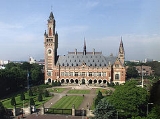
. It is based in the Peace Palace
Peace Palace

The Peace Palace , situated in The Hague, Netherlands, is often called the seat of international law because it houses the International Court of Justice , the Permanent Court of Arbitration, the Hague Academy of International Law, and the extensive Peace Palace Library....
 in The Hague
The Hague

The Hague is the third largest city in the Netherlands after Amsterdam and Rotterdam, with a population of 475,904 and an area of approximately 100 km?....
, Netherlands
Netherlands

The Netherlands is a country that is part of the Kingdom of the Netherlands. It is a parliamentary democratic constitutional monarchy. The Netherlands is located in North-West Europe, and bordered by the North Sea to the north and west, Belgium to the south, and Germany to the east....
. Its main functions are to settle legal
LAW

LAW may refer to:* Anti-tank warfare, e.g. the US Army M72 LAW or the British Army LAW 80*Palestinian Society for the Protection of Human Rights ...
 disputes submitted to it by member state
State

A state is a political Social contract with effective sovereignty over a geographic area and representing a population. These may be nation states, State or multinational states....
s and to give advisory opinions on legal questions submitted to it by duly authorized international organs, agencies, and the UN General Assembly.


Discussion
Ask a question about 'International Court of Justice'
Start a new discussion about 'International Court of Justice'
Answer questions from other users
Full Discussion Forum


Encyclopedia


ICJ redirects here, see also International Commission of Jurists
International Commission of Jurists

The International Commission of Jurists is an international human rights non-governmental organisation. The Commission itself is a standing group of 60 eminent jurists , including members of the senior judiciary in Australia, Canada, and South Africa and the former UN High Commissioner for Human Rights and President of Ireland: Mary Robinson...


The International Court of Justice (known colloquially as the World Court or ICJ; ) is the primary judicial organ of the United Nations
United Nations

The United Nations is an international organization whose stated aims are to facilitate cooperation in international law, international security, economic development, Social change, human rights and achieving world peace....
. It is based in the Peace Palace
Peace Palace

The Peace Palace , situated in The Hague, Netherlands, is often called the seat of international law because it houses the International Court of Justice , the Permanent Court of Arbitration, the Hague Academy of International Law, and the extensive Peace Palace Library....
 in The Hague
The Hague

The Hague is the third largest city in the Netherlands after Amsterdam and Rotterdam, with a population of 475,904 and an area of approximately 100 km?....
, Netherlands
Netherlands

The Netherlands is a country that is part of the Kingdom of the Netherlands. It is a parliamentary democratic constitutional monarchy. The Netherlands is located in North-West Europe, and bordered by the North Sea to the north and west, Belgium to the south, and Germany to the east....
. Its main functions are to settle legal
LAW

LAW may refer to:* Anti-tank warfare, e.g. the US Army M72 LAW or the British Army LAW 80*Palestinian Society for the Protection of Human Rights ...
 disputes submitted to it by member state
State

A state is a political Social contract with effective sovereignty over a geographic area and representing a population. These may be nation states, State or multinational states....
s and to give advisory opinions on legal questions submitted to it by duly authorized international organs, agencies, and the UN General Assembly. The ICJ should not be confused with the International Criminal Court
International Criminal Court

The International Criminal Court , Cour p?nale internationale in french language, is a permanent tribunal to prosecute individuals for genocide, crime against humanity, war crimes, and the crime of aggression ....
, which also potentially has "global" jurisdiction.

Activities

Established in 1945 by the UN Charter
United Nations Charter

The United Nations Charter is the treaty that forms and establishes the international organization called the United Nations. It was signed at the United Nations Conference on International Organization in San Francisco, California, United States, on June 26, 1945, by 50 of the 51 original member countries ....
, the Court began work in 1946 as the successor to the Permanent Court of International Justice
Permanent Court of International Justice

The Permanent Court of International Justice, sometimes called the World Court, was the international court of the League of Nations, established in 1922....
. The Statute of the International Court of Justice
Statute of the International Court of Justice

The Statute of the International Court of Justice is an integral part of the United Nations Charter, as specified by Chapter XIV of the United Nations Charter....
, similar to that of its predecessor, is the main constitutional document constituting and regulating the Court.

The Court's workload is characterised by a wide range of judicial activity. The ICJ has dealt with relatively few cases
Case law

Case law is the general term for the principles and rules of law set forth in judge legal opinion from courts of law. Case law incorporates courts' decisions from individual legal case and encompasses courts' interpretations of statutes, constitution provisions, administrative law regulations and, in some cases, law originating solely f...
 in its history, but there has clearly been an increased willingness to use the Court since the 1980s, especially among developing countries
Developing country

A developing country is a country that has often low standards of democracy, industrialisation, Social work, and Human rights for its citizens....
. The United States
United States

The United States of America is a Federal government constitutional republic comprising U.S. state and a federal district. The country is situated mostly in central North America, where its Contiguous United States and Washington, D.C., the Capital districts and territories, lie between the Pacific Ocean and Atlantic Oceans, Borders of the U...
 withdrew from compulsory jurisdiction in 1986, and so accepts the court's jurisdiction only on a case-to-case basis. Chapter XIV of the United Nations Charter
Chapter XIV of the United Nations Charter

Chapter XIV of the United Nations Charter deals with the International Court of Justice. Most provisions related to the World Court are contained in the Statute of the International Court of Justice, which is annexed to the Charter....
 authorizes the UN Security Council to enforce World Court rulings, but such enforcement is subject to the veto power of the five permanent members of the Council. Presently there are twelve cases on the World Court's docket.

Composition

Public Hearing At the Icj
The ICJ is composed of fifteen judges elected to nine year terms by the UN General Assembly
United Nations General Assembly

The United Nations General Assembly is one of the five principal United Nations System and the only one in which all member nations have equal representation....
 and the UN Security Council from a list of persons nominated by the national groups in the Permanent Court of Arbitration
Permanent Court of Arbitration

The Permanent Court of Arbitration , is an international organization based in The Hague in the Netherlands.It was established in 1899 as one of the acts of the first Hague Peace Conference, which makes it the oldest institution for international dispute resolution....
. The election process is set out in Articles 4–12 of the ICJ statute. Judges serve for nine year terms and may be re-elected for up to two further terms. Elections take place every three years, with one-third of the judges retiring (and possibly standing for re-election) each time, in order to ensure continuity within the court.

Should a judge die in office, the practice has generally been to elect a judge of the same nationality
Nationality

Nationality is a the relationship between a person and their state of origin, culture, association, affiliation and/or loyalty. Nationality affords the state jurisdiction over the person and affords the person the protection of the state....
 to complete the term. No two may be nationals of the same country. According to Article 9, the membership of the Court is supposed to represent the "main forms of civilization and of the principal legal systems of the world". Essentially, this has meant common law
Common law

Common law refers to law and the corresponding Legal systems of the world developed through legal opinion of courts and similar tribunals , rather than through statute law or Executive ....
, civil law
Civil law (legal system)

Civil law is a most prevalent legal system in the modern world and the oldest in human history. It is based on a code, or "a systematic collection of interrelated articles written in a terse, staccato style." The two other major legal systems in the world are common law and Islamic law....
 and socialist law
Socialist law

Socialist law is the official name of the legal system used in Communist states. It is based on the civil law system, with major modifications and additions from Marxism-Leninism ideology....
 (now post-communist law). Since the 1960s four of the five permanent members of the Security Council (France
France

France , officially the French Republic , is a country whose Metropolitan France is located in Western Europe and that also comprises various Overseas departments and territories of France....
, Russia
Russia

Russia , or the Russian Federation , is a list of countries spanning more than one continent country extending over much of northern Eurasia....
, the United Kingdom
United Kingdom

The United Kingdom of Great Britain and Northern Ireland, commonly known as the United Kingdom , the UK or Britain,is a sovereign state located off the northwestern coast of continental Europe....
, and the United States
United States

The United States of America is a Federal government constitutional republic comprising U.S. state and a federal district. The country is situated mostly in central North America, where its Contiguous United States and Washington, D.C., the Capital districts and territories, lie between the Pacific Ocean and Atlantic Oceans, Borders of the U...
) have always had a judge on the Court. The exception was China (the Republic of China
Republic of China

The Republic of China , also known as Nationalist China is a country in East Asia that has evolved from a single-party state with full global recognition into a multi-party democratic state with Political status of Taiwan....
 until 1971, the People's Republic of China
People's Republic of China

The People's Republic of China , commonly known as China, is the largest country in East Asia and the List of countries by population in the world with over 1.3 billion people, approximately a fifth of the world's population....
 from 1971 onwards), which did not have a judge on the Court from 1967–1985, because it did not put forward a candidate. The rule on a geopolitical composition of the bench exists despite the fact that there is no provision for it in the Statute of the ICJ.

Article 2 of the Statute provides that all judges should be "elected regardless of their nationality among persons of high moral
Moral

A moral is a message conveyed or a lesson to be learned from a story or event. The moral may be left to the hearer, reader or viewer to determine for themselves, or may be explicitly encapsulated in a maxim....
 character", who are either qualified for the highest judicial office in their home states or known as lawyers with sufficient competence in international law. Judicial independence is dealt specifically with in Articles 16-18. Judges of the ICJ are not able to hold any other post, nor act as counsel
Counsel

A counsel or a counsellor gives advice, more particularly in law matters.The legal system in England uses the term counsel as an approximate synonym for a Barristers in England and Wales ', and may apply it to mean either a single person who pleadings a cause, or collectively, the body of barristers engaged in a Legal case....
. In practice the Members of the Court have their own interpretation of these rules. This allows them to be involved in outside arbitration and hold professional posts as long as there is no conflict of interest. A judge can be dismissed only by a unanimous
Unanimity

Unanimity is complete agreement by everyone. When unanimous, everybody is of same mind and acting together as one. Many groups consider unanimous decisions a sign of agreement, solidarity, and unity....
 vote of other members of the Court. Despite these provisions, the independence of ICJ judges has been questioned. For example, during the Nicaragua Case, the USA
United States

The United States of America is a Federal government constitutional republic comprising U.S. state and a federal district. The country is situated mostly in central North America, where its Contiguous United States and Washington, D.C., the Capital districts and territories, lie between the Pacific Ocean and Atlantic Oceans, Borders of the U...
 issued a communiqué suggesting that it could not present sensitive material to the Court because of the presence of judges from Eastern bloc
Eastern bloc

During the Cold War, the terms Eastern Bloc, Communist Bloc or Soviet Bloc were used to refer to European annexed or expanded Soviet Socialist Republics of the USSR and Satellite state states, including members of the Soviet-dominated organizations Comecon and the Warsaw Pact....
 states.

Judges may deliver joint judgments or give their own separate opinions. Decisions and Advisory Opinion
Advisory opinion

An advisory opinion is an opinion issued by a court that does not have the effect of resolving a specific legal case, but merely advises on the constitutionality or interpretation of a law....
s are by majority and, in the event of an equal division, the President's vote becomes decisive. Judges may also deliver separate dissenting opinions.

Ad hoc judges

Article 31 of the statute sets out a procedure whereby ad hoc
Ad hoc

Ad hoc is a List of Latin phrases which means "for this [purpose]". It generally signifies a solution designed for a specific problem or task, non-generalisable and which cannot be adapted to other purposes....
 judges sit on contentious cases before the Court. This system allows any party to a contentious case to nominate a judge of their choice (usually of their nationality), if a judge of their nationality is not already on the bench. Ad hoc judges participate fully in the case and the deliberations, along with the permanent bench. Thus, it is possible that as many as seventeen judges may sit on one case.

This system may seem strange when compared with domestic court processes, but its purpose is to encourage states to submit cases to the Court. For example, if a state knows it will have a judicial officer who can participate in deliberation and offer other judges local knowledge and an understanding of the state's perspective, that state may be more willing to submit to the Court's jurisdiction. Although this system does not sit well with the judicial nature of the body, it is usually of little practical consequence. Ad hoc judges usually (but not always) vote in favour of the state that appointed them and thus cancel each other out.

Chambers

Generally, the Court sits as full bench, but in the last fifteen years it has on occasion sat as a chamber. Articles 26-29 of the statute allow the Court to form smaller chambers, usually 3 or 5 judges, to hear cases. Two types of chambers are contemplated by Article 26: firstly, chambers for special categories of cases, and second, the formation of ad hoc chambers to hear particular disputes. In 1993 a special chamber was established, under Article 26(1) of the ICJ statute, to deal specifically with environmental
Environment (biophysical)

The biophysical environment is the symbiosis between the physics environment and the biological life forms within the environment, and include all variables that comprise the Earth's biosphere....
 matters (although this chamber has never been used).

Ad hoc chambers are more frequently convened. For example, chambers were used to hear the Gulf of Maine Case (USA
United States

The United States of America is a Federal government constitutional republic comprising U.S. state and a federal district. The country is situated mostly in central North America, where its Contiguous United States and Washington, D.C., the Capital districts and territories, lie between the Pacific Ocean and Atlantic Oceans, Borders of the U...
 v Canada
Canada

Canada is a country occupying most of northern North America, extending from the Atlantic Ocean in the east to the Pacific Ocean in the west and northward into the Arctic Ocean....
). In that case, the parties made clear they would withdraw the case unless the Court appointed judges to the chamber who were acceptable to the parties. Judgments of chambers may have less authority than full Court judgments, or may diminish the proper interpretation of universal international law informed by a variety of cultural and legal perspectives. On the other hand, the use of chambers might encourage greater recourse to the Court and thus enhance international dispute resolution
Dispute resolution

Dispute resolution is the process of resolving disputes between party ....
.

Current composition

As of 6 February 2009, the composition of the Court is as follows:

Name Country Position Elected Term End
Hisashi Owada
Hisashi Owada

Hisashi Owada , a former Japan diplomat, is a judge on the International Court of Justice. Owada also serves as president of the Japan Institute of International Affairs and advisor to the Japanese Ministry of Foreign Affairs ....
 
Japan
Japan

Japan is an island country in East Asia. Located in the Pacific Ocean, it lies to the east of the Sea of Japan, People's Republic of China, North Korea, South Korea and Russia, stretching from the Sea of Okhotsk in the north to the East China Sea and Taiwan in the south....
 
President 2003 2012
Peter Tomka
Peter Tomka

Peter Tomka , is a Slovaks diplomat and has served as a Judge on the International Court of Justice since 2003....
 
Slovakia
Slovakia

Slovakia . It was amended in September 1998 to allow direct election of the president and again in February 2001 due to EU admission requirements....
 
Vice-President 2003 2012
Shi Jiuyong
Shi Jiuyong

Shi Jiuyong is a judge at the International Court of Justice, the principal judicial organ of the United Nations located in The Hague, Netherlands....
China
People's Republic of China

The People's Republic of China , commonly known as China, is the largest country in East Asia and the List of countries by population in the world with over 1.3 billion people, approximately a fifth of the world's population....
 
Member 1994, 2003 2012
Abdul G. Koroma
Abdul G. Koroma

Abdul G. Koroma is a judge at the International Court of Justice, having been a member of the court since 6 February 1994.He was educated at Kiev State University where he took LLM , and at King's College London, where he took a Masters in International Law....
Sierra Leone
Sierra Leone

Sierra Leone, officially the Republic of Sierra Leone, is a country in West Africa. It is bordered by Guinea in the northeast, Liberia in the southeast, and the Atlantic Ocean in the southwest....
 
Member 1994, 2003 2012
Awn Shawkat Al-Khasawneh

Judge Awn Shawkat Al-khasawneh was born in Amman, Jordan on February 22, 1950. He is Vice-President of the International Court of Justice, and was re-elected on November 6, 2008, as member thereof....
 
Jordan
Jordan

Jordan , officially the Hashemite Kingdom of Jordan, is an Arab country in Southwest Asia spanning the southern part of the Syrian Desert down to the Gulf of Aqaba....
 
Member 2000, 2009 2018
Thomas Buergenthal
Thomas Buergenthal

Thomas Buergenthal is an United States judge on the International Court of Justice....
United States
United States

The United States of America is a Federal government constitutional republic comprising U.S. state and a federal district. The country is situated mostly in central North America, where its Contiguous United States and Washington, D.C., the Capital districts and territories, lie between the Pacific Ocean and Atlantic Oceans, Borders of the U...
 
Member 2000, 2006 2015
Bruno Simma
Bruno Simma

Bruno Simma , German jurist, is currently a Judge on the International Court of Justice, having been appointed to that post in 2003. Prior to joining the Court, he had served on the United Nations International Law Commission since 1996....
 
Germany
Germany

Germany , officially the Federal Republic of Germany , is a country in Central Europe. It is bordered to the north by the North Sea, Denmark, and the Baltic Sea; to the east by Poland and the Czech Republic; to the south by Austria and Switzerland; and to the west by France, Luxembourg, Belgium, and the Netherlands....
 
Member 2003 2012
Ronny Abraham
Ronny Abraham

Ronny Abraham was elected to the International Court of Justice, to fill the vacancy created by the resignation of judge and former President Gilbert Guillaume....
 
France
France

France , officially the French Republic , is a country whose Metropolitan France is located in Western Europe and that also comprises various Overseas departments and territories of France....
 
Member 2005, 2009 2018
Sir Kenneth Keith
Kenneth Keith

Sir Kenneth James Keith Order of New Zealand Order of British Empire Queen's Counsel is a New Zealand Judge appointed to the International Court of Justice in November 2005....
 
New Zealand
New Zealand

New Zealand is an island country in the south-western Pacific Ocean comprising two main landmasses , and numerous Islands of New Zealand, most notably Stewart Island/Rakiura and the Chatham Islands....
 
Member 2006 2015
Bernardo Sepúlveda Amor

Bernardo Sep?lveda Amor is a Mexico jurist, politician, and diplomat.He was born in Mexico City, where he studied law at the National Autonomous University of Mexico ....
 
Mexico
Mexico

The United Mexican States , commonly known as Mexico , is a federalism constitutionalism republic in North America. It is bordered on the north by the United States; on the south and west by the Pacific Ocean; on the southeast by Guatemala, Belize, and the Caribbean Sea; and on the east by the Gulf of Mexico....
 
Member 2006 2015
Mohamed Bennouna Morocco
Morocco

Morocco , officially the Kingdom of Morocco , is a country located in North Africa with a population of nearly 34 million and an area just under 447,000 km2....
 
Member 2006 2015
Leonid Skotnikov
Leonid Skotnikov

Leonid Skotnikov is a Russian judge currently serving on the United Nations International Court of Justice in the The Hague, Netherlands....
 
Russia
Russia

Russia , or the Russian Federation , is a list of countries spanning more than one continent country extending over much of northern Eurasia....
 
Member 2006 2015
Antônio Augusto Cançado Trindade Brazil
Brazil

Brazil , officially the Federative Republic of Brazil , is a country in South America. It is the List of countries and outlying territories by total area country by geographical area, occupying nearly half of South America, the List of countries by population country, and the fourth most populous democracy in the world....
 
Member 2009 2018
Abdulqawi Yusuf
Abdulqawi Yusuf

Dr. Abdulqawi Ahmed Yusuf, a Somali national, is a prominent public international lawyer and judge who is currently a judge at the International Court of Justice since February 6th 2009....
 
Somalia
Somalia

Somalia , officially the Republic of Somalia and formerly known as the Somali Democratic Republic, is a country located in the Horn of Africa....
 
Member 2009 2018
Christopher John Greenwood United Kingdom
United Kingdom

The United Kingdom of Great Britain and Northern Ireland, commonly known as the United Kingdom , the UK or Britain,is a sovereign state located off the northwestern coast of continental Europe....
 
Member 2009 2018


Results of the last election of 6 November 2008:

  • Re-elected were France
    France

    France , officially the French Republic , is a country whose Metropolitan France is located in Western Europe and that also comprises various Overseas departments and territories of France....
    's Ronny Abraham
    Ronny Abraham

    Ronny Abraham was elected to the International Court of Justice, to fill the vacancy created by the resignation of judge and former President Gilbert Guillaume....
     and Awn Shawkat Al-Khasawneh
    Awn Shawkat Al-Khasawneh

    Judge Awn Shawkat Al-khasawneh was born in Amman, Jordan on February 22, 1950. He is Vice-President of the International Court of Justice, and was re-elected on November 6, 2008, as member thereof....
     (terms expire on 5 February 2009), while UK's Christopher Greenwood
    Christopher Greenwood

    Sir Christopher John Greenwood Order of St Michael and St George Queen's Counsel is a duly elected member of the International Court of Justice....
    , Brazil
    Brazil

    Brazil , officially the Federative Republic of Brazil , is a country in South America. It is the List of countries and outlying territories by total area country by geographical area, occupying nearly half of South America, the List of countries by population country, and the fourth most populous democracy in the world....
    ’s Antônio Augusto Cançado Trindade and Somalia
    Somalia

    Somalia , officially the Republic of Somalia and formerly known as the Somali Democratic Republic, is a country located in the Horn of Africa....
    's Abdulqawi Yusuf
    Abdulqawi Yusuf

    Dr. Abdulqawi Ahmed Yusuf, a Somali national, is a prominent public international lawyer and judge who is currently a judge at the International Court of Justice since February 6th 2009....
      (terms begin on 6 February 2009) were newly elected.


  • The declared candidates Sayeman Bula-Bula (Democratic Republic of the Congo), Miriam Defensor-Santiago
    Miriam Defensor-Santiago

    Miriam Defensor-Santiago is a Filipina politician, and a Senate of the Philippines, with a focus on Constitutional Law. She is popularly known as Miriam....
     (Philippines
    Philippines

    The Philippines, officially known as the Republic of the Philippines, is a country in Southeast Asia with Manila as its capital city. It comprises 7,107 islands in the western Pacific Ocean....
    ) and Maurice Kamto (Cameroon) lost in the final voting. The 3 new judges replaced UK's Rosalyn Higgins
    Rosalyn Higgins

    Dame Rosalyn Higgins, Lady Higgins, Order of the British Empire, Queen's Counsel is the former President of the International Court of Justice....
     (as ICJ President), Gonzalo Parra Aranguren
    Gonzalo Parra Aranguren

    Gonzalo Parra Aranguren, born in Caracas, Venezuela, on 5 December 1928, is a judge at the International Court of Justice of the United Nations in The Hague, Netherlands....
     of Venezuela and Madagascar
    Madagascar

    Madagascar, or Republic of Madagascar , is an island nation in the Indian Ocean off the southeastern coast of Africa. The main island, also called Madagascar, is the List of islands by area, and is home to 5% of the world's plant and animal species, of which more than 80% are Endemism to Madagascar....
    ’s Raymond Ranjeva
    Raymond Ranjeva

    Raymond Ranjeva , is a judge on the International Court of Justice.He holds the following degrees: Bachelor's degree in law , University of Madagascar, Antananarivo; dipl?me from Madagascar National School of Administration ; trainee in the Judicial Division of the Conseil d'Etat, Paris ; dipl?me d'?tudes sup?rieures de sciences politique...
     (terms all expire on 5 February 2009).


Jurisdiction


As stated in Article 93 of the UN Charter, all 192 UN members are automatically parties
Party (law)

A 'party' is a person or group of persons that compose a single entity which can be identified as one for the purposes of the law.Courts use various terms to identify the role of a particular party in civil litigation, usually identifying the party that brings a lawsuit as the plaintiff, or, in older American cases, the party of the first p...
 to the Court's statute. Non-UN members may also become parties to the Court's statute under the Article 93(2) procedure. For example, before becoming member nations, Switzerland
Switzerland

Switzerland is a landlocked Swiss Alps country of roughly 7.7 million people in Western Europe with an area of 41,285 km?. Switzerland is a federal republic consisting of 26 states called Cantons of Switzerland....
 used this procedure in 1948 to become a party; Nauru
Nauru

Nauru , officially the Republic of Nauru and formerly known as Pleasant Island, is an island nation in the Micronesian Pacific Ocean....
 also became a party in 1988. Once a state is a party to the Court's statute, it is entitled to participate in cases before the Court. However, being a party to the statute does not automatically give the Court jurisdiction over disputes involving those parties. The issue of jurisdiction
Jurisdiction

In law, jurisdiction is the practical authority granted to a formally constituted legal body or to a political leader to deal with and make pronouncements on legal matters and, by implication, to administer justice within a defined area of responsibility....
 is considered in the two types of ICJ cases: contentious issues and advisory opinions.

Contentious issues (adversarial proceedings)

In contentious cases (adversial proceedings seeking to settle a dispute), the ICJ produces a binding ruling between states that agree to submit to the ruling of the court. Only state
State

A state is a political Social contract with effective sovereignty over a geographic area and representing a population. These may be nation states, State or multinational states....
s may be parties in contentious cases. Individual
Individual

As vernacular, individual refers to a person or to any specific object in a collection. In the 15th century and earlier, and also today within the fields of statistics and metaphysics, individual means "indivisible", typically describing any numerically singular thing, but sometimes meaning "a person." ....
s, corporation
Corporation

A corporation is a legal entity separate from the persons that form it. It is a legal entity owned by individual stockholders. In British tradition it is the term designating a body corporate, where it can be either a corporation sole or a corporation aggregate ....
s, parts of a federal state, NGOs, UN organs and self-determination
Self-determination

Self-determination is defined as free choice of one?s own acts without external compulsion, and especially as the freedom of the people of a given territory to determine their own political status or independence from their current state....
 groups are excluded from direct participation in cases, although the Court may receive information from public international organisations. This does not preclude non-state interests from being the subject of proceedings if one state brings the case against another. For example, a state may, in case of "diplomatic protection", bring a case on behalf of one of its nationals or corporations.

Jurisdiction is often a crucial question for the Court in contentious cases. (See Procedure
International Court of Justice

The International Court of Justice is the primary judicial organ of the United Nations. It is based in the Peace Palace in The Hague, Netherlands....
 below.) The key principle is that the ICJ has jurisdiction only on the basis of consent. Article 36 outlines four bases on which the Court's jurisdiction may be founded.

  • First, 36(1) provides that parties may refer cases to the Court (jurisdiction founded on "special agreement" or "compromis"). This method is based on explicit consent rather than true compulsory jurisdiction. It is, perhaps, the most effective basis for the Court's jurisdiction because the parties concerned have a desire for the dispute to be resolved by the Court and are thus more likely to comply with the Court's judgment.
  • Second, 36(1) also gives the Court jurisdiction over "matters specifically provided for ... in treaties and conventions in force". Most modern treaties
    Treaty

    A Treaty is an agreement under international law entered into by actors in international law, namely states and international organizations. A Treaty may also be known as: agreement, protocol, covenant, convention, exchange of letters, etc....
     will contain a compromissory clause, providing for dispute resolution by the ICJ. Cases founded on compromissory clauses have not been as effective as cases founded on special agreement, since a state may have no interest in having the matter examined by the Court and may refuse to comply with a judgment. For example, during the Iran hostage crisis
    Iran hostage crisis

    The Iran hostage crisis was a diplomacy crisis between Iran and the United States where 52 U.S. diplomats were held hostage for 444 days from November 4, 1979 to January 20, 1981, after a group of Islamism students took over the American embassy in support of the Iranian revolution....
    , Iran
    Iran

    Iran , officially the Islamic Republic of Iran and formerly known internationally as Persian Empire until 1935, is a country in Central Eurasia, located on the northeastern shore of the Persian Gulf and the southern shore of the Caspian Sea....
     refused to participate in a case brought by the US based on a compromissory clause contained in the Vienna Convention on Diplomatic Relations
    Vienna Convention on Diplomatic Relations

    The Vienna Conventions on Diplomatic Relations is an international treaty on diplomacy intercourse and the privileges and Diplomatic immunity of a diplomatic mission....
    , nor did it comply with the judgment. Since the 1970s, the use of such clauses has declined. Many modern treaties set out their own dispute resolution regime, often based on forms of arbitration
    Arbitration

    Arbitration, a form of alternative dispute resolution , is a law technique for the resolution of disputes outside the courts, wherein the parties to a dispute refer it to one or more persons , by whose decision they agree to be bound....
    .
  • Third, Article 36(2) allows states to make optional clause declarations accepting the Court's jurisdiction. The label "compulsory" which is sometimes placed on Article 36(2) jurisdiction is misleading since declarations by states are voluntary. Furthermore, many declarations contain reservations, such as exclusion from jurisdiction certain types of disputes ("ratione materia"). The principle of reciprocity
    Reciprocity

    Reciprocity may refer to:*Ethic of reciprocity, the "Golden Rule" principle in ethics and religion*Norm of reciprocity, social norm of in-kind responses to the behavior of others ...
     may further limit jurisdiction. As of October 2006, sixty-seven states had a declaration in force. Of the permanent Security Council members, only the United Kingdom
    United Kingdom

    The United Kingdom of Great Britain and Northern Ireland, commonly known as the United Kingdom , the UK or Britain,is a sovereign state located off the northwestern coast of continental Europe....
     has a declaration. In the Court's early years, most declarations were made by industrialised countries. Since the Nicaragua Case, declarations made by developing countries have increased, reflecting a growing confidence in the Court since the 1980s. Industrialised countries however have sometimes increased exclusions or removed their declarations in recent years. Examples include the USA, as mentioned previously and Australia
    Australia

    Australia, officially the Commonwealth of Australia, is a country in the southern hemisphere comprising the Australia of the world's smallest continent, the major island of Tasmania, and numerous list of islands of Australia in the Indian Ocean and Pacific Oceans....
     who modified their declaration in 2002 to exclude disputes on maritime boundaries (most likely to prevent an impending challenge from East Timor
    East Timor

    East Timor, also known as Timor-Leste is a country in Southeast Asia. It comprises the eastern half of the island of Timor, the nearby islands of Atauro Island and Jaco , and Oecussi-Ambeno, an exclave on the northwestern side of the island, within Indonesian West Timor....
     who gained their independence two months later).
  • Finally, 36(5) provides for jurisdiction on the basis of declarations made under the Permanent Court of International Justice
    Permanent Court of International Justice

    The Permanent Court of International Justice, sometimes called the World Court, was the international court of the League of Nations, established in 1922....
    's statute. Article 37 of the Statute similarly transfers jurisdiction under any compromissory clause in a treaty that gave jurisdiction to the PCIJ.
  • In addition, the Court may have jurisdiction on the basis of tacit consent (forum prorogatum). In the absence of clear jurisdiction under Article 36, jurisdiction will be established if the respondent accepts ICJ jurisdiction explicitly or simply pleads on the merits
    On the merits

    On the merits refers to a legal decision based on the facts in evidence and the law pertaining to those facts, because the judge considers technical and procedural defenses to be overcome or irrelevant....
    . The notion arose in the Corfu Channel Case (UK v Albania) (1949) in which the Court held that a letter from Albania
    Albania

    Albania , officially the Republic of Albania , is a country in Balkans. It is bordered by Greece to the south-east, Montenegro to the north, Kosovo to the northeast, and the Republic of Macedonia to the east....
     stating that it submitted to the jurisdiction of the ICJ was sufficient to grant the court jurisdiction.


Advisory opinion

An advisory opinion
Advisory opinion

An advisory opinion is an opinion issued by a court that does not have the effect of resolving a specific legal case, but merely advises on the constitutionality or interpretation of a law....
 is a function of the Court open only to specified United Nations bodies and agencies. On receiving a request, the Court decides which States and organizations might provide useful information and gives them an opportunity to present written or oral statements. Advisory Opinions were intended as a means by which UN agencies could seek the Court's help in deciding complex legal issues that might fall under their respective mandates. In principle, the Court's advisory opinions are only consultative in character, though they are influential and widely respected. Whilst certain instruments or regulations can provide in advance that the advisory opinion shall be specifically binding on particular agencies or states, they are inherently non-binding under the Statute of the Court. This non-binding character does not mean that advisory opinions are without legal effect, because the legal reasoning embodied in them reflects the Court's authoritative views on important issues of international law and, in arriving at them, the Court follows essentially the same rules and procedures that govern its binding judgments delivered in contentious cases submitted to it by sovereign states. An advisory opinion derives its status and authority from the fact that it is the official pronouncement of the principal judicial organ of the United Nations.

Advisory Opinions have often been controversial, either because the questions asked are controversial, or because the case was pursued as an indirect "backdoor" way of bringing what is really a contentious case before the Court. Examples of advisory opinions can be found in the section advisory opinions
List of International Court of Justice cases

This is a list of cases and advisory opinions brought to the International Court of Justice since its creation in 1946. Only nation-states have standing to bring forward claims....
 in the List of International Court of Justice cases
List of International Court of Justice cases

This is a list of cases and advisory opinions brought to the International Court of Justice since its creation in 1946. Only nation-states have standing to bring forward claims....
 article. One such well-known advisory opinion is the Nuclear Weapons Case.

The ICJ and the Security Council

Article 94 establishes the duty of all UN members to comply with decisions of the Court involving them. If parties do not comply, the issue may be taken before the Security Council for enforcement action. There are obvious problems with such a method of enforcement. If the judgment is against one of the permanent five members of the Security Council or its allies, any resolution on enforcement would then be vetoed. This occurred, for example, after the Nicaragua case, when Nicaragua
Nicaragua

Nicaragua officially the Republic of Nicaragua , is a representative democracy republic. It is the largest state in Central America with an area of 130,000 km2, about the size of the state of New York....
 brought the issue of the U.S.'s non-compliance with the Court's decision before the Security Council. Furthermore, if the Security Council refuses to enforce a judgment against any other state, there is no method of forcing the state to comply.

The relationship between the ICJ and the Security Council, and the separation of their powers, was considered by the Court in 1992 in the Pan Am case
Pan Am Flight 103 bombing trial

The Pan Am Flight 103 bombing trial began on May 3, 2000, which was 11 years, four months and 13 days after the blowing up of Pan Am Flight 103 on December 21, 1988....
. The Court had to consider an application from Libya
Libya

Libya , officially the Great Socialist People's Libyan Arab Jamahiriya , is a country located in North Africa. Bordering the Mediterranean Sea to the north, Libya lies between Egypt to the east, Sudan to the southeast, Chad and Niger to the south, and Algeria and Tunisia to the west....
 for the order of provisional measures to protect its rights, which, it alleged, were being infringed by the threat of economic sanctions by the United Kingdom
United Kingdom

The United Kingdom of Great Britain and Northern Ireland, commonly known as the United Kingdom , the UK or Britain,is a sovereign state located off the northwestern coast of continental Europe....
 and United States
United States

The United States of America is a Federal government constitutional republic comprising U.S. state and a federal district. The country is situated mostly in central North America, where its Contiguous United States and Washington, D.C., the Capital districts and territories, lie between the Pacific Ocean and Atlantic Oceans, Borders of the U...
. The problem was that these sanctions had been authorised by the Security Council, which resulted with a potential conflict between the Chapter VII functions of the Security Council and the judicial function of the Court. The Court decided, by eleven votes to five, that it could not order the requested provisional measures because the rights claimed by Libya, even if legitimate under the Montreal Convention
Montreal Convention

The Montreal Convention, formally the Convention for the Unification of Certain Rules for International Carriage, is a treaty adopted by a Diplomatic meeting of ICAO member states in 1999....
, prima facie
Prima facie

Prima facie is a little List of Latin phrases meaning "on its first appearance", or "by first instance". Literally the phrase translates as first face, "prima" first, "facie" face....
 could not be regarded as appropriate since the action was ordered by the Security Council. In accordance with Article 103 of the UN Charter, obligations under the Charter took precedence over other treaty obligations. Nevertheless the Court declared the application admissible in 1998. A decision on the merits has not been given since the parties (United Kingdom, United States and Libya) settled the case out of court in 2003.

There was a marked reluctance on the part of a majority of the Court to become involved in a dispute in such a way as to bring it potentially into conflict with the Council. The Court stated in the Nicaragua case that there is no necessary inconsistency between action by the Security Council and adjudication by the ICJ. However, where there is room for conflict, the balance appears to be in favour of the Security Council.

Should either party fail "to perform the obligations incumbent upon it under a judgment rendered by the Court", the Security Council may be called upon to "make recommendations or decide upon measures" if the Security Council deems such actions necessary. In practice, the Court's powers have been limited by the unwillingness of the losing party to abide by the Court's ruling, and by the Security Council's unwillingness to impose consequences. However, in theory, "so far as the parties to the case are concerned, a judgment of the Court is binding, final and without appeal," and "by signing the Charter, a State Member of the United Nations undertakes to comply with any decision of the International Court of Justice in a case to which it is a party."

For example, the United States
United States

The United States of America is a Federal government constitutional republic comprising U.S. state and a federal district. The country is situated mostly in central North America, where its Contiguous United States and Washington, D.C., the Capital districts and territories, lie between the Pacific Ocean and Atlantic Oceans, Borders of the U...
 had previously accepted the Court's compulsory jurisdiction upon its creation in 1946, but in Nicaragua v. United States withdrew its acceptance following the Court's judgment in 1984 that called on the U.S. to "cease and to refrain" from the "unlawful use of force" against the government of Nicaragua
Nicaragua

Nicaragua officially the Republic of Nicaragua , is a representative democracy republic. It is the largest state in Central America with an area of 130,000 km2, about the size of the state of New York....
. The Court ruled (with only the American judge dissenting) that the United States
United States

The United States of America is a Federal government constitutional republic comprising U.S. state and a federal district. The country is situated mostly in central North America, where its Contiguous United States and Washington, D.C., the Capital districts and territories, lie between the Pacific Ocean and Atlantic Oceans, Borders of the U...
 was "in breach of its obligation under the Treaty of Friendship with Nicaragua not to use force against Nicaragua" and ordered the United States to pay war reparations (see note 2).

Examples of contentious cases include:

  • A complaint by the United States
    United States

    The United States of America is a Federal government constitutional republic comprising U.S. state and a federal district. The country is situated mostly in central North America, where its Contiguous United States and Washington, D.C., the Capital districts and territories, lie between the Pacific Ocean and Atlantic Oceans, Borders of the U...
     in 1980 that Iran
    Iran

    Iran , officially the Islamic Republic of Iran and formerly known internationally as Persian Empire until 1935, is a country in Central Eurasia, located on the northeastern shore of the Persian Gulf and the southern shore of the Caspian Sea....
     was detaining American diplomats in Tehran
    Tehran

    Tehran is the capital and largest city of Iran, and the administrative center of Tehran Province. Tehran is a sprawling city at the foot of the Alborz mountain range with an immense network of highways unparalleled in Western Asia....
     in violation of international law.
  • A dispute between Tunisia
    Tunisia

    Tunisia , officially the Tunisian Republic , is a country located in North Africa. It is bordered by Algeria to the west and Libya to the southeast....
     and Libya
    Libya

    Libya , officially the Great Socialist People's Libyan Arab Jamahiriya , is a country located in North Africa. Bordering the Mediterranean Sea to the north, Libya lies between Egypt to the east, Sudan to the southeast, Chad and Niger to the south, and Algeria and Tunisia to the west....
     over the delimitation of the continental shelf between them.
  • A dispute over the course of the maritime boundary dividing the U.S. and Canada
    Canada

    Canada is a country occupying most of northern North America, extending from the Atlantic Ocean in the east to the Pacific Ocean in the west and northward into the Arctic Ocean....
     in the Gulf of Maine
    Gulf of Maine

    The Gulf of Maine is a large Headlands and bays of the Atlantic Ocean on the northeastern coast of North America.It is delineated by Cape Cod at the eastern tip of Massachusetts in the southwest and Cape Sable Island at the southern tip of Nova Scotia in the northeast....
     area.
  • A complaint by the Federal Republic of Yugoslavia
    Federal Republic of Yugoslavia

    The Federal Republic of Yugoslavia or FRY was a federal state consisting of the republics of Republic of Serbia and Republic of Montenegro from the former Socialist Federal Republic of Yugoslavia , created after the other four republics broke away from Yugoslavia amid rising ethnic tensions....
     against the member states of the North Atlantic Treaty Organisation regarding their actions in the Kosovo War
    Kosovo War

    Kosovo War occurred after the Rambouillet Agreement failed in February 1999. The term Kosovo War or Kosovo Conflict is used to describe two sequential and at times parallel armed conflicts in Kosovo:...
    . This was denied on 15 December 2004 due to lack of jurisdiction, because the FRY was not a party to the ICJ statute at the time it made the application.


Generally, the Court has been most successful resolving border delineation and the use of oceans and waterways. While the Court has, in some instances, resolved claims by one State espoused on behalf of its nationals, the Court has generally refrained from hearing contentious cases that are political in nature, due in part to its lack of enforcement mechanism and its lack of compulsory jurisdiction. The Court has generally found it did not have jurisdiction to hear cases involving the use of force.

Law applied


When deciding cases, the Court applies international law as summarised in Article 38. Article 38 of the ICJ Statute provides that in arriving at its decisions the Court shall apply international conventions, international custom, and the "general principles of law recognized by civilized nations". It may also refer to academic writing ("the teachings of the most highly qualified publicists of the various nations") and previous judicial decisions to help interpret the law, although the Court is not formally bound by its previous decisions under the doctrine of stare decisis
Stare decisis

Stare decisis is the legal principle under which judges are obligated to follow the precedents established in prior decisions.In the United States, which uses a common law system in its federal courts and most of its state courts, the United States Court of Appeals for the Ninth Circuit has stated:...
. Article 59 makes clear that the common law
Common law

Common law refers to law and the corresponding Legal systems of the world developed through legal opinion of courts and similar tribunals , rather than through statute law or Executive ....
 notion of precedent
Precedent

In common law Legal systems of the world, a precedent or authority is a legal case establishing a principle or rule that a court or other judicial body adopts when deciding subsequent cases with similar issues or facts....
 or stare decisis
Stare decisis

Stare decisis is the legal principle under which judges are obligated to follow the precedents established in prior decisions.In the United States, which uses a common law system in its federal courts and most of its state courts, the United States Court of Appeals for the Ninth Circuit has stated:...
 does not apply to the decisions of the ICJ. The Court's decision binds only the parties to that particular controversy. Under 38(1)(d), however, the Court may consider its own previous decisions. In reality, the ICJ rarely departs from its own previous decisions and treats them as precedent in a way similar to superior court
Superior court

In common law systems, a superior court is a court of general competence which typically has unlimited jurisdiction with regard to civil and criminal legal cases....
s in common law systems. Additionally, international lawyers commonly operate as though ICJ judgments had precedential value.

If the parties agree, they may also grant the Court the liberty to decide ex aequo et bono
Ex aequo et bono

Ex aequo et bono is a List of legal Latin terms. In the context of arbitration, it refers to the power of the arbitrators to dispense with consideration of the law and consider solely what they consider to be fair and equitable in the case at hand....
 ("in justice and fairness"), granting the ICJ the freedom to make an equitable decision based on what is fair under the circumstances. This provision has not been used in the Court's history. So far the International Court of Justice has dealt with about 130 cases.

Procedure

The ICJ is vested with the power to make its own rules. Court procedure is set out in Rules of Court of the International Court of Justice 1978 (as amended on 29 September 2005).

Cases before the ICJ will follow a standard pattern. The case is lodged by the applicant who files a written memorial setting out the basis of the Court's jurisdiction and the merits of its claim. The respondent may accept the Court's jurisdiction and file its own memorial on the merits of the case.

Preliminary objections

A respondent who does not wish to submit to the jurisdiction of the Court may raise Preliminary Objections. Any such objections must be ruled upon before the Court can address the merits of the applicant's claim. Often a separate public hearing is held on the Preliminary Objections and the Court will render a judgment. Respondents normally file Preliminary Objections to the jurisdiction of the Court and/or the admissibility
Admissibility

Admissibility may refer to:* Admissible evidence, evidence which may be introduced in a court of law.* Admissible decision rule, in decision theory, a rule which is never dominated....
 of the case. Inadmissibility refers to a range of arguments about factors the Court should take into account in deciding jurisdiction; for example, that the issue is not justiciable or that it is not a "legal dispute".

In addition, objections may be made because all necessary parties are not before the Court. If the case necessarily requires the Court to rule on the rights and obligations of a state that has not consented to the Court's jurisdiction, the Court will not proceed to issue a judgment on the merits.

If the Court decides it has jurisdiction and the case is admissible, the respondent will then be required to file a Memorial addressing the merits of the applicant's claim. Once all written arguments are filed, the Court will hold a public hearing on the merits.

Once a case has been filed, any party (but usually the Applicant) may seek an order from the Court to protect the status quo pending the hearing of the case. Such orders are known as Provisional (or Interim) Measures and are analogous to interlocutory injunction
Injunction

An injunction is an equitable remedy in the form of a court order, whereby a party is required to do, or to refrain from doing, certain acts. The party that fails to adhere to the injunction faces civil or criminal penalties and may have to pay damages or accept sanctions for failing to follow the court's order....
s in United States law. Article 41 of the statute allows the Court to make such orders. The Court must be satisfied to have prima facie
Prima facie

Prima facie is a little List of Latin phrases meaning "on its first appearance", or "by first instance". Literally the phrase translates as first face, "prima" first, "facie" face....
 jurisdiction to hear the merits of the case before granting provisional measures.

Applications to intervene

In cases where a third state's interests are affected, that state may be permitted to intervene in the case, and participate as a full party. Under Article 62, a state "with an interest of a legal nature" may apply; however, it is within the Court's discretion whether or not to allow the intervention. Intervention applications are rare - the first successful application occurred in 1990.

Judgment and remedies


Once deliberation has taken place, the Court will issue a majority opinion. Individual judges may issue separate opinions (if they agree with the outcome reached in the judgment of the court but differ in their reasoning) or dissenting opinions (if they disagree with the majority). No appeal is possible, though any party may ask for the court to clarify if there is a dispute as to the meaning or scope of the court's judgment.

Criticisms


The International Court has been criticised with respect to its rulings, its procedures, and its authority. As with United Nations criticisms
United Nations

The United Nations is an international organization whose stated aims are to facilitate cooperation in international law, international security, economic development, Social change, human rights and achieving world peace....
 as a whole, many of these criticisms refer more to the general authority assigned to the body by member states through its charter than to specific problems with the composition of judges or their rulings. Major criticisms include:

  • "Compulsory" jurisdiction is limited to cases where both parties have agreed to submit to its decision, and, as such, instances of aggression tend to be automatically escalated to and adjudicated by the Security Council.
  • Organizations, private enterprises, and individuals cannot have their cases taken to the International Court, such as to appeal a national supreme court's ruling. U.N. agencies likewise cannot bring up a case except in advisory opinions (a process initiated by the court and non-binding).
  • Other existing international thematic courts, such as the ICC
    International Criminal Court

    The International Criminal Court , Cour p?nale internationale in french language, is a permanent tribunal to prosecute individuals for genocide, crime against humanity, war crimes, and the crime of aggression ....
    , are not under the umbrella of the International Court.
  • The International Court does not enjoy a full separation of powers
    Separation of powers

    Separation of powers, a term ascribed to France Age of Enlightenment political philosopher Charles de Secondat, baron de Montesquieu, is a model for the governance of democracy states, having its origins in an ancient idea of mixed government....
    , with permanent members of the Security Council being able to veto enforcement of even cases to which they consented in advance to be bound.


Building

The Court shares its building with the Hague Academy of International Law
Hague Academy of International Law

The Hague Academy of International Law is a center for high-level education in both public and private international law housed in the Peace Palace in The Hague, Netherlands....
, a private centre for the study of international law and with the Permanent Court of Arbitration
Permanent Court of Arbitration

The Permanent Court of Arbitration , is an international organization based in The Hague in the Netherlands.It was established in 1899 as one of the acts of the first Hague Peace Conference, which makes it the oldest institution for international dispute resolution....
. Several of the Court's current judges are either alumni or former faculty members of the Hague Academy.

See also

  • List of International Court of Justice cases
    List of International Court of Justice cases

    This is a list of cases and advisory opinions brought to the International Court of Justice since its creation in 1946. Only nation-states have standing to bring forward claims....
  • List of treaties that confer jurisdiction on the ICJ
  • UN Economic and Social Council
  • UN Secretariat
  • UN Trusteeship Council
  • International Criminal Tribunal for the former Yugoslavia
    International Criminal Tribunal for the former Yugoslavia

    The International Tribunal for the Prosecution of Persons Responsible for Serious Violations of International Humanitarian Law Committed in the Territory of the Former Yugoslavia since 1991, more commonly referred to as the International Criminal Tribunal for the former Yugoslavia or ICTY, is a body of the United Nations establis...
  • International Criminal Tribunal for Rwanda
    International Criminal Tribunal for Rwanda

    The International Criminal Tribunal for Rwanda , or the Tribunal p?nal international pour le Rwanda , is an international court established in November 1994 by the United Nations Security Council in order to judge those people responsible for the Rwandan genocide and other serious violations of the international law performed in the te...
  • International Criminal Court
    International Criminal Court

    The International Criminal Court , Cour p?nale internationale in french language, is a permanent tribunal to prosecute individuals for genocide, crime against humanity, war crimes, and the crime of aggression ....
  • Mundialization
    Mundialization

    The word mundialisation or mundialization is the English language version of the French language word "mondialisation", which today refers in French to what is referred to in English as "globalisation"....
  • World citizen
    World citizen

    World citizen is a term with a variety of meanings, often referring to a person who disapproves of traditional geopolitical divisions derived from national citizenship....


Further reading

  • Rosenne S, Rosenne's the world court: what it is and how it works 6th ed (Leiden: Martinus Nijhoff, 2003).


External links

  • , Official site
  • ruled upon by the ICJ since its creation in 1946
  • : Academic gateway to The Hague organisations concerning international peace, justice and security.