

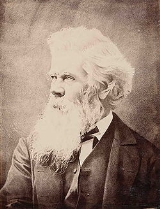
Henry Parkes

Encyclopedia
Sir Henry Parkes, GCMG
(27 May 1815 – 27 April 1896) was an Australian statesman, the "Father of Federation." As the earliest advocate of a Federal Council of the colonies of Australia, a precursor to the Federation of Australia
, he was the most prominent of the Australian Founding Fathers.
Parkes was described during his lifetime by The Times
as "the most commanding figure in Australian politics". Alfred Deakin
described him as "though not rich or versatile, his personality was massive, durable and imposing, resting upon elementary qualities of human nature elevated by a strong mind. He was cast in the mould of a great man and though he suffered from numerous pettinesses, spites and failings, he was in himself a large-brained self-educated Titan whose natural field was found in Parliament and whose resources of character and intellect enabled him in his later years to overshadow all his contemporaries".
Parkes was tall, with rugged facial features, a leonine mane of hair and a commanding personality. He was a persuasive orator, too, who eschewed flights of rhetoric and spoke as a plain man to plain men, with great effect, in spite of occasional difficulties in controlling his aspirates. He had no schooling worthy of the name but had read widely. It has been said of him that he lacked gracious manners and was too conscious of his intellectual superiority, but his kindly reception in the UK by the likes of Thomas Carlyle
and Alfred, Lord Tennyson suggests that he was not without charm. He was interested in early Australian literary men, having been a friend of both Harpur
and Kendall
. He was a bad manager of his own affairs; what he had he spent, and he died penniless.
Yet he evidently knew a good financier when he saw one, for he had able treasurers serving in each of his cabinets, and their financial administration was sound. He was vain and temperamental, and frequently resigned his parliamentary seat only to seek election again soon afterwards. He was not a socialist but he had strong views about the rights of the people and for most of his parliamentary life was a great leader of them. In his later years, however, he seems to have been worn down by the strong conservative opposition he encountered, and he was responsible for a smaller body of social-reform legislation than might have been expected. Early to recognise the need for Australian Federation, when he saw that it had really become possible to achieve, he fought strongly for it, at a time when many leading politicians in New South Wales were fearful of its effect on their colony. The indomitable character which had raised him from farm labourer to premier, and his recognition of the altruistic broader view that was required in a great movement such as Federation, had an immense effect when the cause's fate was in doubt, and weighted the scale in its favour.
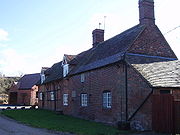 Parkes was born in Canley
, Warwickshire (now a suburb of Coventry
), England and christened
in the nearby village of Stoneleigh
. His father, Thomas Parkes, was a small-scale tenant farmer. Of his mother, little is known, although when she died in 1842, Parkes would say of her that he felt as if a portion of this world's beauty was lost to him forever. He received little schooling, and at an early age was working on a rope-walk for four pence a day. His next work was in a brickyard, and later on he tells us he "was breaking stones on the Queen's highway with hardly enough clothing to protect me from the cold". He was then apprenticed to John Holding, a bone and ivory turner at Birmingham
, and probably about the year 1832 joined the Birmingham political union. Between that year and 1838 he was associated with the political movements that were then endeavouring to better the conditions endured by the working classes.
He was steadily educating himself, too, by reading assiduously, including the works of the British poets. In 1835, he addressed some verses, afterwards included in his first volume of poems, to Clarinda Varney, the daughter of a local butler. On 11 July 1836 he married Clarinda Varney and went to live in a single room. Parkes commenced business on his own account in Birmingham and had a bitter struggle to make ends meet.
, Parkes and his wife emigrated to New South Wales
on an assisted passage. They travelled aboard the Strathfieldsaye, which arrived at Sydney
on 25 July 1839. Another child had been born two days before. During his first fortnight in Sydney, Parkes looked vainly for work. He and his wife had only a few shillings when they arrived, and they existed for a time by selling their belongings. Parkes' luck changed when one of the colony's wealthiest settlers, Sir John Jamison
, gave him a labourer's job. He worked on Sir John's impressive Regentville estate, near Penrith
, for a wage of £25 a year and a ration and a half of food. This ration consisted mainly of rice, flour and sugar, for the meat was sometimes unfit to eat. After spending six months at Regentville, he returned to Sydney and obtained work at low wages, first in an ironmongery store and then with a firm of engineers and brass-founders.
About a year after his arrival in Sydney, Parkes was hired by the New South Wales Customs
Department as a Tide Waiter, and given the task of inspecting merchant vessels to guard against the smuggling of contraband. He had been recommended for this responsible post by Sir John Jamison's son-in-law, William John Gibbes, who was manager of Regentville and the offspring of the Collector of Customs for New South Wales, Colonel John George Nathaniel Gibbes.
Parkes' financial position improved due to his stable new government job, even though he was still burdened with a backlog of undischarged debts. He nonetheless abandoned the security of his employment with the Customs Department at the beginning of 1846, submitting his resignation after a disagreement with Colonel Gibbes over a press leak that concerned the alleged behaviour of one of Parkes' co-workers. Irrespective of this rupture, Parkes would continue to remain on friendly terms with the Colonel and his descendants for the rest of his life. (Colonel Gibbes' grandson, Frederick Jamison Gibbes, entered the NSW Parliament in the 1880s; and although he often disagreed with Parkes on matters of economic policy, he did by and large support Parkes' push for the federation of the rival Australian colonies into an homogenous nation.)
Parkes seems to have had few close personal friends during the early 1840s. Yet, when his volume of verse, Stolen Moments, was published in Sydney in 1842, the list of subscribers included many of the most distinguished people in the colony (including Colonel Gibbes, to whom the poetry book was dedicated). It was about this time that he met the poet Charles Harpur
and the newspaperman William Duncan
, then editor of the Weekly Register; he mentions in his Fifty Years of Australian History that these two men became his "chief advisers in matters of intellectual resource".
After his departure from the Customs Service, Parkes embarked on a varied career in the private sector. He did business from premises in Kent Street as an ivory and bone turner but afterwards moved to a shop in Hunter Street where he kept for sale to the public a stock of writing-desks, dressing-cases, fancy baskets, ornaments and toys. At one stage, he owned several newspapers, including The People's Advocate and New South Wales Vindicator
and the Empire
. His lack of business acumen quickly became apparent, however, and Parkes went bankrupt after running up debts totalling £48,500.
He remained a steadfast supporter of Australian culture despite these financial setbacks, and he often published poetry in his newspapers.
was sworn in, consisting partly of nominated and partly of elected members, and the powers of the governor were much restricted as a consequence.
The third big question on people's lips was the colony's land laws. The struggle to make them fairer was to last for many years.
Parkes, meanwhile, began writing for the Atlas and the People's Advocate; but it was not until 1848 that he first began to speak out in public on important issues of community concern. In that year, Robert Lowe, 1st Viscount Sherbrooke
, was a candidate for the constituency of Sydney, standing as a champion of the anti-transportation
cause. Parkes became a member of Lowe's election committee, was appointed one of his secretaries, and wrote the address to the voters which helped to secure Lowe's return. This marks the beginning of Parkes's political career.
In 1849, Parkes was active at a meeting got up to petition both houses of parliament for a reduction of the suffrage qualifications. He made his first political speech, and advocated universal suffrage, which was not to become a reality for many years. Parkes thought his own speech a very weak performance. As a result of the petition, the qualification to vote was reduced to £10 household and £100 freehold.
The transportation question again came to the fore when the convict ship Hashemy arrived in the colony on 8 June 1849. Despite pouring rain, a huge public rally was held at Sydney's Circular Quay, protesting against the continuance of transportation to New South Wales, and the agitation was kept up until success was achieved in 1852, when an end was put to the practice by the British Government. Parkes could derive satisfaction from the fact that he had spoken ardently against transportation at the various public meetings that had been organised by its opponents, and he had further aided the anti-transportation cause by writing articles in the press.
During December 1850, Parkes founded the Empire newspaper. At first a broadsheet only published weekly, it soon became a daily. Parkes as editor was strong in his loyalty to the British Empire; but he felt that an honest and independent journal which was not be blind to the faults of the establishment could do useful work in the colony. It so happened that the Governor of New South Wales, Sir Charles Augustus FitzRoy
, had neither the ability nor the industry of his immediate predecessors, and the Empire did not hesitate to point out his shortcomings, and those of the officials surrounding him. Parkes as editor and proprietor became a figure of great importance, and while he had control of the publication he worked unceasingly, writing articles, procuring news, and managing the business side of the enterprise (never his strong suit).
In the pages of his paper, he fought for constitutional reform and spoke strenuously against the views of the leading politician William Charles Wentworth. In 1853, Wentworth had obtained the appointment of a sub-committee which brought forward a scheme for a new constitution for New South Wales that had the introduction of responsible government as its centrepiece. The ensuing bill was hotly debated in the colonial legislature in August of that year and carried by 33 votes to eight. Long years later, Parkes averred that, "in the heated opposition to the objectionable parts of Mr Wentworth's scheme, no sufficient attention was given to its great merits".
In any event, Parkes began his political career quietly. He was with the minority faction in the Legislative Council, and he and his political allies could afford to bide their time until the new constitution came into force. His workload at the Empire office was extremely heavy, and in December 1855 he announced his intention of retiring from parliament. He was persuaded to alter his mind, and a month later he stood as a liberal candidate for Sydney (City)
in the New South Wales Legislative Assembly
.
Around the end of 1856, he resigned his seat. Considering the short period he had been in parliament the response was remarkable. The press and public men of the period united in deploring his loss, and more than one effort was made to start a testimonial for him, but he resolutely declined to accept one. It is clear that his sincerity and power had made a great impression on the community. He put all his energies into an attempt to save his paper. there was no limit to the number of hours he worked in each day, but he was unsuccessful. The liabilities of the paper amounted to fully £50,000 and, though his friends rallied round him and tried to ease the situation by advancing the sum required to pay off a mortgage of £11,000 in 1858, the position became hopeless.
Early in that year, Parkes had entered the Legislative Assembly again, this time as member for the North Riding of Cumberland
. An interesting sidelight on his growing reputation is the fact that before this election (Sir) Charles Gavan Duffy
wrote to a friend in Sydney, urging the desirability of Parkes' being elected. With remarkable prescience, he said: "I am confident that 10 years hence, and I do not doubt that 10 generations hence, the name which will best personify the national spirit of New South Wales in this era will be the name of Henry Parkes".
Parkes sat in this parliament for about six months but then resigned at the end of August 1858 on account of his insolvency. His liabilities were estimated at £50,000 and his assets at £48,500. On the literary side the Empire was an excellent paper, but only a man of great business acumen could have made a financial success of it at this period. The issuing of a certificate of insolvency was bitterly opposed and the proceedings were long drawn out. It is evident that Parkes had resorted to the usual shifts of a man in financial difficulties, but it was shown that, in some cases at least, he had acted under the advice of his banker, and he was ultimately exonerated by the chief commissioner in insolvency of any fraudulent intent.
on 10 June 1859. He stood as an independent candidate but in the list of candidates elected he was described by the Sydney Morning Herald as a "radical". He was generally in favour of Sir John Robertson's land policy, of the extension of education, and of free trade. He was not a bigoted freetrader as he was as strongly in favour of developing manufactures as he was of encouraging agriculture. He was a strong supporter of free trade
, immigration programmes and education reforms. He introduced laws that gave the Government the power to employ teachers and create public schools, abolished government funding to religious schools
and improved prison
s.
Parkes also believed in immigration, and his well-known powers as an orator led to his being sent to England with W. B. Dalley
as commissioners of emigration at a salary of £1000 a year each in May 1861. Parkes left his wife and five, soon to become six, children in poverty, on a rented farm at Werrington
. Their duties were confined to diffusing information, and Parkes spoke at about 60 meetings at towns in the west and north of England and in Scotland. He felt that he had done good work, but it was difficult to say how much effect his words had. During the 14 months he was in England he met many interesting people, and became in particular friendly with Carlyle and his wife. He returned to Australia in January 1863.
In August he opposed J. B. Darvall at East Maitland
and was defeated; but in the following year,, was elected for Kiama
. In January 1866 the premier, Charles Cowper
, resigned in consequence of an amendment moved by Parkes having been carried. Strictly speaking the governor should have asked Parkes whether he could form a government, but Sir James Martin
was sent for and Parkes was given the position of colonial secretary. This ministry remained in office for nearly three years, from January 1866 to October 1868. An important piece of legislation carried through was the Public Schools Act 1866, introduced by Parkes, of which an essential part was that no man or woman would be allowed to act as a teacher who had not been properly trained in teaching. Provision was also made for the training of teachers, and the act marked a great advance in educational methods. A council of education was formed, and for the first four years after the passing of the act Parkes filled the office of president. In spite of the fears of some of the religious bodies the act worked well, and many new schools were established all over the colony. Parkes also initiated the introduction of nurses from England trained by Florence Nightingale
.
In 1867 to 1868 Alfred, Duke of Edinburgh (Queen Victoria's second oldest son) visited the Australian colonies. On 12 March 1868 the Duke, while attending a picnic at Clontarf near Sydney, was shot in the back by one Henry James O'Farrell
. The assassin was Irish, and at the time claimed he was a Fenian
. The wound while painful was not fatal. However the Colonial Government over-reacted, and despite the Duke's requests for lienency it executed O'Farrell. O'Farrell had, in the meantime, admitted he was not really a member of the Fenians, but by the time of the execution other acts of violence connected with the Fenians (most notably the murder of D'Arcy McGee
in Canada) spurred anti-Fenian and anti-Irish Catholic feelings. Parkes, in what may have been the most egregious blunder of his career, pushed this anti-Fenianism full throttle. For awhile his claims of a vast Fenian conspiracy in New South Wales was believed, but when nothing further occurred public opinion began to reverse and he was attacked. As a result his political position weakened dreadfully.
He resigned from the Martin ministry in September 1868, and for the next three and a half years was out of office. In the first year of the Robertson government he moved a want-of-confidence motion which was defeated by four votes. Parkes continued to be one of the most conspicuous figures in the house, and at the 1869 election was returned at the head of the poll for East Sydney. A much larger proportion of assisted Irish immigrants than English or Scotch had been arriving in the colony for many years and Parkes felt there was an element of danger in this. He stated that he had no feeling against the Irish or their religion, but his protestations were without avail and the Irish section of the community became hostile to him. Whatever may have been the merits of the question it would appear that in this matter Parkes put convictions before policy.
In 1870 Henry Parkes was again in financial difficulties and was obliged to resign his seat. He had been in business as a merchant in a comparatively large way, and when declared insolvent he had liabilities of £32,000 and assets of £13,300. He was at once re-elected for Kiama, but an extremely hostile article in the Sydney Morning Herald led to his resigning again. The suggestion had been made that his presence in the assembly while in the insolvency court might influence the officials. It was not until December 1871 that a seat could be found for him and he was then elected at a by-election for Mudgee
. The Martin-Robertson ministry had involved itself in a petty squabble with the colony of Victoria
over a question of border duties, and Parkes effectively threw ridicule on the proceedings. When parliament met the government was defeated and a dissolution was granted. In the general election which followed Parkes was generally recognized as the leader of the people's party, and the ministry was defeated at the polls. When parliament assembled Parkes was elected leader of the opposition, representing East Sydney. The acting-governor had sent for William Forster before parliament met, but he was unable to form a ministry, and in May 1872 Parkes formed his first ministry which was to last for nearly three years.
Parkes had always been a free-trader and no doubt his convictions were strengthened when in England by contact with Cobden and other leading free traders. During his first administration he so reduced the duties in New South Wales that practically it became a free trade colony. Generally there was a forward policy. Railway and telegraph lines were much extended, and at the same time there was some reduction in taxation.
In 1873 the retirement of Sir Alfred Stephen
, the Chief Justice, led to an incident which raised much feeling against Parkes. It seems clear that Parkes at first encouraged his Attorney-General, E. Butler, to believe that he would be appointed Chief Justice of New South Wales. Opposition developed in many quarters and Parkes gradually realised that Sir James Martin was generally considered to be the most suitable man available, and offered him the position. When the announcement of his appointment was made on 11 November 1873, Butler took the opportunity to make a statement, read publicly the correspondence between Parkes and himself, and resigned his seat in the cabinet. However much Parkes may have been to blame for his early encouragement of the aspirations of his colleague, there appears to be no truth in the suggestion then made that he had, by appointing Martin, found means of getting rid of a formidable political opponent.
The ministry went on its way though unable to pass bills to make the Upper House elective and to amend the electoral law. The council was jealous of its position and succeeded in maintaining it for the time being. Two or three unsuccessful attempts were made to oust the government without success, but in February 1875, Governor Robinson
's decision to release of the bushranger
Frank Gardiner
led to the defeat of the ministry. Subsequent discussions between Robinson, Parkes and the Colonial Office
clarified the governor's responsibilities in pardoning prisoners.
When Parkes was defeated Robertson came into power, and for the next two years little was done of real importance. Parkes became tired of his position as leader of the opposition and resigned early in 1877. In March the Robertson ministry was defeated and Parkes formed one which lasted five months. The parties were equally divided and business was sometimes at a standstill. Parkes said of this ministry that it had "as smooth a time as the toad under the harrow". Robertson returned to the Premiership from August to December 1877, including an election in October.
Parkes was returned for Canterbury
. James Squire Farnell then formed a stop-gap ministry which existed for a year from December 1877 to December 1878. In the middle of this year Parkes made a tour of the western districts of the colony speaking at many country centres. This gave him many opportunities of criticizing the government then in power. At the end of the year it was defeated, but the situation was still obscure, because the parties led by Robertson and Parkes were nearly equal.
Robertson tried to form a government but failed, and tired of the unsatisfactory position which he was confronted with, resigned his seat in the Legislative Assembly. He was then approached by Parkes, and a government was formed with Robertson as vice-president of the Executive Council and representative of the government in the Upper House. The combination was unexpected, as each leader had frequently denounced the other; but everyone was glad to escape from the confusion of the preceding years, and the ministry did good work in its four years of office. It amended the electoral law, brought in a new education act, improved the water-supply and sewerage systems, appointed stipendiary magistrates, regulated the liability of employers with regard to injuries to workmen, and made law other useful acts. In the 1880 election Parkes was returned for St Leonards
. When the Parkes Government left office in there was a large surplus in the New South Wales Treasury. Towards the end of 1881 Parkes was in bad health. He still kept up his habit of working long hours, and except for week-end visits to his house in the mountains he had no relaxation. It was suggested that a grant should be made by Parliament to enable him to go away on a voyage, but he declined to allow this to be brought forward. He also vetoed a suggestion that a substantial testimonial should be presented to him by his friends.
Parkes decided to visit England at his own expense, and at a banquet given by the citizens just before sailing, he drew a picture of what he hoped to do in the coming to years. He was never able to carry it out but at least he had the vision to see what was needed. He stayed in America for about six weeks on his way to Europe and did his best to make Australia better known. In England he was received as an honoured guest, and while everywhere he insisted on the desirability of preserving the ties between England and her colonies, he asked always that they should be allowed to work out their own salvation; "the softer the cords" he said "the stronger will be the union between us". Among the friends he made in England was Tennyson
, and Lord Leigh, being aware that Parkes had been born at Stoneleigh, invited him to stay at Stoneleigh Abbey. Parkes was much interested to see again the farmhouse in which he was born and the church in which he was christened. On his way home he visited Melbourne
where he was given a banquet on 15 August 1882. Two days later he was back in Sydney.
, was found for him but he took little interest in politics for some time. He went to England as representative of a Sydney financial company and did not return until August 1884, having been absent 14 months. In November, he resigned his seat and announced his retirement from politics.
He was now in his seventieth year. He opened an office in Pitt Street
as representative of the financial association which had sent him to England, and remained in this position until 1887. He could not, however, keep long away from politics. At the beginning of 1885 W. B. Dalley, while acting-premier, offered a contingent of troops to go to the Sudan
and the offer was accepted. Parkes strongly disapproved and, though public opinion was against him, on 31 March he won Argyle
. When he took his seat in September objection was taken to claims of parliamentary corruption he had made when resigning from Parliament in 1894, and Sir Alexander Stuart
moved a resolution affirming that the words he had used were a gross libel on the house. His motion was carried by four votes and Parkes was quite unrepentant, but the ministry did not dare go any farther. One of the supporters of the ministry moved that Parkes should be expelled but only obtained the support of his seconder.
In October 1885 parliament was dissolved, the government was reconstructed and George Dibbs
became Premier of New South Wales. At the election Parkes stood against Dibbs at St Leonards, and defeated him by 476 votes. It was, however, pointed out that this success was due not a little to Parkes's advocacy of a bridge across the harbour, and a railway line going inland from North Shore. The ministry was defeated and was succeeded by a Robertson ministry which lasted only two months. The next ministry, under Sir Patrick Jennings, had a life of nine months but was defeated in January 1887. In the meantime Robertson had retired from politics and Parkes, as leader of the opposition, formed a ministry and obtained a dissolution. He fought a strenuous campaign pointing out that in the four years since he was last in office the public debt had more than doubled and the surplus of £2,000,000 had become a deficit of £2,500,000. He proposed to do away with the recent increase in duties, to bring in an amended land act, and to create a body to control the railways free of political influence. Parkes had made enemies in various directions, but generally his personal popularity was great. His speeches, not always free from personal attacks, were received with enthusiasm, and his party was returned with a two to one majority. When parliament met free trade was soon restored and there was a well-meant but abortive inquiry into the state of the civil service.
The question of Chinese immigration was much before the public in Australia, and Parkes was opposed to their coming, but not as his biographer asserts because he considered them to be an inferior race. Indeed, some years before he had said of them: "They are a superior set of people . . . a nation of an old and deep-rooted civilization. . . . It is because I believe the Chinese to be a powerful race capable of taking a great hold upon the country, and because I want to preserve the type of my own nation . . . that I am and always have been opposed to the influx of Chinese." In spite of some discouragement from the British Government he succeeded in passing an act of parliament which raised the entrance tax to £100 per head.
Though Parkes was personally opposed to it, a payment of members act was passed, and two important and valuable measures, the Government Railways Act and the Public Works Act both became law. The government, however, was defeated on allegations that W. M. Fehon, whom he had appointed a rail commissioner, was corrupt. Parkes wife had died in February 1888. A year later he married Eleanor Dixon, which was considered hasty.
At the ensuing election Parkes was returned with a small majority and formed his fifth administration, which began in March 1889 and lasted until October 1891. As far back as 1867 Parkes at an intercolonial conference had said: "I think the time has arrived when these colonies should be united by some federal bond of connexion." Shortly afterwards a bill to establish the proposed federal council was introduced by him and passed through both the New South Wales houses. This was afterwards shelved by the action of the Secretary of State for the Colonies. Various other conferences were held in the next 20 years at which the question came up, in which Parkes took a leading part, but in October 1884 he was blowing cold and suggesting that it would be "better to let the idea of federation mature in men's minds", and New South Wales then stood out of the proposed federal council scheme.
 In October 1889 a report on the defences of Australia suggested among other things the federation of the forces of all the Australian colonies and a uniform gauge for railways. Parkes had come to the conclusion that the time had come for a new federal movement.
He now felt more confidence in the movement and on 15 October 1889 telegraphed to the premiers of the other colonies suggesting a conference.
On 24 October 1889, at the Tenterfield School of Arts
, Parkes delivered the Tenterfield Oration
. The oration was seen as a clarion call to federalists and he called for a convention "to devise the constitution which would be necessary for bringing into existence a federal government with a federal parliament for the conduct of national undertaking".
Parkes convened the 1890 Federation Conference of February 1890 and may be considered the first real step towards Federation. In May he moved resolutions in the assembly approving of the proceedings of the conference that had just been held in Melbourne, and appointing himself and three other members delegates to the Sydney 1891 National Australasian Convention. On 18 May he broke his leg and was laid up for some time. It was 14 weeks before he was able to be assisted to his seat in the house. When the convention met on 2 March 1891 Parkes was appointed president "not only as the Premier of the colony where the convention sat, but also as the immediate author of the present movement". The next business was the debating of a series of resolutions proposed by Parkes as a preliminary interchange of ideas and a laying down of guiding principles. It was at this convention that the first draft of a bill to constitute the Commonwealth of Australia was framed. Parkes proposed the name of Commonwealth of Australia for the new nation.
When it was about to be submitted to the New South Wales assembly Reid
on the address-in-reply moved an amendment hostile to the bill. Parkes then announced that in view of Reid's amendment he proposed to put the federal bill third on the list. Dibbs
moved a vote of no confidence, defeated only on the casting vote of the speaker, and Parkes resigned on 22 October 1891.
 Parkes was now in his 77th year and his political career had practically ended. He was never to be in office again, and it was a blow to him that when he notified his supporters that he did not desire the position of the leader of the opposition, Reid was elected to lead his party. After that Parkes became practically an independent member. In 1895 he opposed Reid at the general election for Sydney-King
and was unsuccessful by 140 votes. He had fought Reid because he felt that the question of federation was being neglected by the government, but Reid was too popular in his constituency to be defeated. Parkes's second wife died in the course of the election and he had many other anxieties. In 1887 a sum of £9000 had been collected by his friends and placed in the hands of trustees for investment. From this fund he had been receiving an income of over £500 a year, but the financial crisis of 1893 reduced this to little more than £200. Parkes was obliged to sell his collection of autograph letters and many other things that he valued, to provide for his household. A movement was made in December 1895 to obtain a grant for him from the government but nothing had been done when he fell ill in April 1896 and died in poverty on the twenty-seventh of that month.
While the last ten years of his life were his most influential politically, Parkes faced immense personal turmoil following the death of his first wife, Clarinda Varney. He remarried quickly to Eleanor Dixon and they had two more children. Dixon soon died and Parkes remarried yet again, this time to Julia Lynch. Towards the end of his life he lived in Kenilworth, a Gothic mansion in Johnston Street, Annandale
, a Sydney suburb. He died of natural causes while living there. on 27 April 1896, five years before Australia became a federation on 1 January 1901, having established the political directions for the new country. Parkes had left directions that his funeral should be as simple as possible, but though a state funeral was declined, a very large number of people attended when he was placed by the side of his first wife at Faulconbridge, in the grounds of his former home in the Blue Mountains. His portrait by the artist Julian Ashton
is in a public collection in Sydney.
Julia Lynch survived Parkes, together with five daughters and one son of the first marriage, and five sons and one daughter by the second. His eldest son, Varney Parkes, entered parliament and was postmaster-general in the Reid ministry from August 1898 to September 1899. The children of the second marriage were faithfully brought up by Julia Lady Parkes and one of them, Cobden Parkes, born in 1892, eventually became the New South Wales Government Architect.
in 1877 and Knight Grand Cross of the same order in 1888.
His image appears on the Australian one-dollar coin of 1996; and on the Centenary of Federation
commemoration Australian $5 note
issued in 2001.
The suburb of Parkes
and the roads Parkes Way
and Parkes Place, in Canberra
is named after him as well as the rural town of Parkes
, in central New South Wales.
He is also commemorated in Canley
, Coventry
by the naming of a road (Sir Henry Parkes Road) and a primary school (Sir Henry Parkes Primary School). Canley railway station
also commemorates the link with Sir Henry Parkes with Australian-themed decor.
 Parkes's literary work includes six volumes of verse, Stolen Moments (1842), Murmurs of the Stream (1857), Studies in Rhyme (1870), The Beauteous Terrorist and Other Poems (1885), Fragmentary Thoughts (1889), Sonnets and Other Verses (1895). It has been the general practice to laugh at Parkes's poetic efforts, and it is true that his work could sometimes be almost unbelievably bad. Yet though he had no real claims to be a poet he wrote some weak, sincere verse which has occasionally been included in Australian anthologies. His prose work includes Australian Views of England (1869), and his autobiographical Fifty Years in the Making of Australian History (1892), extremely interesting in places but necessarily giving a partial view of his own work. A collection of his Speeches on Various Occasions, delivered between 1848 and 1874, was published in 1876, and another collection dealing mostly with federation appeared in 1890 under the title of The Federal Government of Australasia. In 1896, shortly after his death, An Emigrant's Home Letters, a small collection of Parkes's letters to his family in England between 1838 and 1843, was published at Sydney, edited by his daughter, Annie T. Parkes.
Order of St Michael and St George
The Most Distinguished Order of Saint Michael and Saint George is an order of chivalry founded on 28 April 1818 by George, Prince Regent, later George IV of the United Kingdom, while he was acting as Prince Regent for his father, George III....
(27 May 1815 – 27 April 1896) was an Australian statesman, the "Father of Federation." As the earliest advocate of a Federal Council of the colonies of Australia, a precursor to the Federation of Australia
Federation of Australia
The Federation of Australia was the process by which the six separate British self-governing colonies of New South Wales, Queensland, South Australia, Tasmania, Victoria and Western Australia formed one nation...
, he was the most prominent of the Australian Founding Fathers.
Parkes was described during his lifetime by The Times
The Times
The Times is a British daily national newspaper, first published in London in 1785 under the title The Daily Universal Register . The Times and its sister paper The Sunday Times are published by Times Newspapers Limited, a subsidiary since 1981 of News International...
as "the most commanding figure in Australian politics". Alfred Deakin
Alfred Deakin
Alfred Deakin , Australian politician, was a leader of the movement for Australian federation and later the second Prime Minister of Australia. In the last quarter of the 19th century, Deakin was a major contributor to the establishment of liberal reforms in the colony of Victoria, including the...
described him as "though not rich or versatile, his personality was massive, durable and imposing, resting upon elementary qualities of human nature elevated by a strong mind. He was cast in the mould of a great man and though he suffered from numerous pettinesses, spites and failings, he was in himself a large-brained self-educated Titan whose natural field was found in Parliament and whose resources of character and intellect enabled him in his later years to overshadow all his contemporaries".
Parkes was tall, with rugged facial features, a leonine mane of hair and a commanding personality. He was a persuasive orator, too, who eschewed flights of rhetoric and spoke as a plain man to plain men, with great effect, in spite of occasional difficulties in controlling his aspirates. He had no schooling worthy of the name but had read widely. It has been said of him that he lacked gracious manners and was too conscious of his intellectual superiority, but his kindly reception in the UK by the likes of Thomas Carlyle
Thomas Carlyle
Thomas Carlyle was a Scottish satirical writer, essayist, historian and teacher during the Victorian era.He called economics "the dismal science", wrote articles for the Edinburgh Encyclopedia, and became a controversial social commentator.Coming from a strict Calvinist family, Carlyle was...
and Alfred, Lord Tennyson suggests that he was not without charm. He was interested in early Australian literary men, having been a friend of both Harpur
Charles Harpur
Charles Harpur was an Australian poet.-Early life:Harpur was born at Windsor, New South Wales, the third child of Joseph Harpur — originally from Kinsale, County Cork, Ireland, parish clerk and master of the Windsor district school — and Sarah, née Chidley Harpur received his elementary education...
and Kendall
Henry Kendall (poet)
Thomas Henry Kendall was a nineteenth century Australian poet.-Biography:Kendall was born near Ulladulla, New South Wales. He was registered as Thomas Henry Kendall, but never appears to have used his first name. His three volumes of verse were all published under the name of "Henry Kendall". His...
. He was a bad manager of his own affairs; what he had he spent, and he died penniless.
Yet he evidently knew a good financier when he saw one, for he had able treasurers serving in each of his cabinets, and their financial administration was sound. He was vain and temperamental, and frequently resigned his parliamentary seat only to seek election again soon afterwards. He was not a socialist but he had strong views about the rights of the people and for most of his parliamentary life was a great leader of them. In his later years, however, he seems to have been worn down by the strong conservative opposition he encountered, and he was responsible for a smaller body of social-reform legislation than might have been expected. Early to recognise the need for Australian Federation, when he saw that it had really become possible to achieve, he fought strongly for it, at a time when many leading politicians in New South Wales were fearful of its effect on their colony. The indomitable character which had raised him from farm labourer to premier, and his recognition of the altruistic broader view that was required in a great movement such as Federation, had an immense effect when the cause's fate was in doubt, and weighted the scale in its favour.
Early years
Canley
Canley is a suburban neighbourhood located in southwest Coventry, England. Canley became part of Coventry as a result of successive encroachment of the latter's boundaries between 1928 and 1932, having historically been part of the Stoneleigh parish....
, Warwickshire (now a suburb of Coventry
Coventry
Coventry is a city and metropolitan borough in the county of West Midlands in England. Coventry is the 9th largest city in England and the 11th largest in the United Kingdom. It is also the second largest city in the English Midlands, after Birmingham, with a population of 300,848, although...
), England and christened
Infant baptism
Infant baptism is the practice of baptising infants or young children. In theological discussions, the practice is sometimes referred to as paedobaptism or pedobaptism from the Greek pais meaning "child." The practice is sometimes contrasted with what is called "believer's baptism", or...
in the nearby village of Stoneleigh
Stoneleigh, Warwickshire
Stoneleigh is a small village in Warwickshire, England on the River Sowe, about 5 miles south of Coventry and 5 miles north of Leamington Spa. The village is situated about northeast of the confluence of the River Sowe and the River Avon.Stoneleigh does not have a public house...
. His father, Thomas Parkes, was a small-scale tenant farmer. Of his mother, little is known, although when she died in 1842, Parkes would say of her that he felt as if a portion of this world's beauty was lost to him forever. He received little schooling, and at an early age was working on a rope-walk for four pence a day. His next work was in a brickyard, and later on he tells us he "was breaking stones on the Queen's highway with hardly enough clothing to protect me from the cold". He was then apprenticed to John Holding, a bone and ivory turner at Birmingham
Birmingham
Birmingham is a city and metropolitan borough in the West Midlands of England. It is the most populous British city outside the capital London, with a population of 1,036,900 , and lies at the heart of the West Midlands conurbation, the second most populous urban area in the United Kingdom with a...
, and probably about the year 1832 joined the Birmingham political union. Between that year and 1838 he was associated with the political movements that were then endeavouring to better the conditions endured by the working classes.
He was steadily educating himself, too, by reading assiduously, including the works of the British poets. In 1835, he addressed some verses, afterwards included in his first volume of poems, to Clarinda Varney, the daughter of a local butler. On 11 July 1836 he married Clarinda Varney and went to live in a single room. Parkes commenced business on his own account in Birmingham and had a bitter struggle to make ends meet.
Immigration to Australia
Following the death of their two children at an early age and a few unsuccessful weeks spent dwelling in LondonLondon
London is the capital city of :England and the :United Kingdom, the largest metropolitan area in the United Kingdom, and the largest urban zone in the European Union by most measures. Located on the River Thames, London has been a major settlement for two millennia, its history going back to its...
, Parkes and his wife emigrated to New South Wales
New South Wales
New South Wales is a state of :Australia, located in the east of the country. It is bordered by Queensland, Victoria and South Australia to the north, south and west respectively. To the east, the state is bordered by the Tasman Sea, which forms part of the Pacific Ocean. New South Wales...
on an assisted passage. They travelled aboard the Strathfieldsaye, which arrived at Sydney
Sydney
Sydney is the most populous city in Australia and the state capital of New South Wales. Sydney is located on Australia's south-east coast of the Tasman Sea. As of June 2010, the greater metropolitan area had an approximate population of 4.6 million people...
on 25 July 1839. Another child had been born two days before. During his first fortnight in Sydney, Parkes looked vainly for work. He and his wife had only a few shillings when they arrived, and they existed for a time by selling their belongings. Parkes' luck changed when one of the colony's wealthiest settlers, Sir John Jamison
John Jamison
Sir John Jamison was an important Australian physician, pastoralist, banker, politician, constitutional reformer and public figure....
, gave him a labourer's job. He worked on Sir John's impressive Regentville estate, near Penrith
Penrith, New South Wales
Penrith is a suburb in western Sydney, in the state of New South Wales, Australia. Penrith is located west of the Sydney central business district and is the administrative centre for the local government area of the City of Penrith...
, for a wage of £25 a year and a ration and a half of food. This ration consisted mainly of rice, flour and sugar, for the meat was sometimes unfit to eat. After spending six months at Regentville, he returned to Sydney and obtained work at low wages, first in an ironmongery store and then with a firm of engineers and brass-founders.
About a year after his arrival in Sydney, Parkes was hired by the New South Wales Customs
Customs
Customs is an authority or agency in a country responsible for collecting and safeguarding customs duties and for controlling the flow of goods including animals, transports, personal effects and hazardous items in and out of a country...
Department as a Tide Waiter, and given the task of inspecting merchant vessels to guard against the smuggling of contraband. He had been recommended for this responsible post by Sir John Jamison's son-in-law, William John Gibbes, who was manager of Regentville and the offspring of the Collector of Customs for New South Wales, Colonel John George Nathaniel Gibbes.
Parkes' financial position improved due to his stable new government job, even though he was still burdened with a backlog of undischarged debts. He nonetheless abandoned the security of his employment with the Customs Department at the beginning of 1846, submitting his resignation after a disagreement with Colonel Gibbes over a press leak that concerned the alleged behaviour of one of Parkes' co-workers. Irrespective of this rupture, Parkes would continue to remain on friendly terms with the Colonel and his descendants for the rest of his life. (Colonel Gibbes' grandson, Frederick Jamison Gibbes, entered the NSW Parliament in the 1880s; and although he often disagreed with Parkes on matters of economic policy, he did by and large support Parkes' push for the federation of the rival Australian colonies into an homogenous nation.)
Parkes seems to have had few close personal friends during the early 1840s. Yet, when his volume of verse, Stolen Moments, was published in Sydney in 1842, the list of subscribers included many of the most distinguished people in the colony (including Colonel Gibbes, to whom the poetry book was dedicated). It was about this time that he met the poet Charles Harpur
Charles Harpur
Charles Harpur was an Australian poet.-Early life:Harpur was born at Windsor, New South Wales, the third child of Joseph Harpur — originally from Kinsale, County Cork, Ireland, parish clerk and master of the Windsor district school — and Sarah, née Chidley Harpur received his elementary education...
and the newspaperman William Duncan
William Duncan
William Duncan may refer to:*William fitz Duncan , Scottish prince and general*William Duncan , English-born Anglican missionary*William Addison Duncan , U.S. Representative from Pennsylvania...
, then editor of the Weekly Register; he mentions in his Fifty Years of Australian History that these two men became his "chief advisers in matters of intellectual resource".
After his departure from the Customs Service, Parkes embarked on a varied career in the private sector. He did business from premises in Kent Street as an ivory and bone turner but afterwards moved to a shop in Hunter Street where he kept for sale to the public a stock of writing-desks, dressing-cases, fancy baskets, ornaments and toys. At one stage, he owned several newspapers, including The People's Advocate and New South Wales Vindicator
The People's Advocate and New South Wales Vindicator
The People's Advocate and New South Wales Vindicator was a Sydney newspaper published between December 1848 and 1856.The People's Advocate was established by Edward John Hawksley, an English Catholic Radical, who wrote the majority of the paper's content, and by the Sydney printer Francis...
and the Empire
Empire (newspaper)
The Empire was a newspaper published in Sydney, Australia. It was published from 28 December 1850 to 14 February 1875, except for the period from 28 August 1858 to 23 May 1859, when publication was suspended....
. His lack of business acumen quickly became apparent, however, and Parkes went bankrupt after running up debts totalling £48,500.
He remained a steadfast supporter of Australian culture despite these financial setbacks, and he often published poetry in his newspapers.
Campaign for self-government
Parkes started to take a keen interest in the public proceedings of the colony and the burning question of the day, namely, the stoppage of convict transportation. Self-government was another important question of the day, the first step towards this objective having occurred in 1843, when an enlarged Legislative CouncilNew South Wales Legislative Council
The New South Wales Legislative Council, or upper house, is one of the two chambers of the parliament of New South Wales in Australia. The other is the Legislative Assembly. Both sit at Parliament House in the state capital, Sydney. The Assembly is referred to as the lower house and the Council as...
was sworn in, consisting partly of nominated and partly of elected members, and the powers of the governor were much restricted as a consequence.
The third big question on people's lips was the colony's land laws. The struggle to make them fairer was to last for many years.
Parkes, meanwhile, began writing for the Atlas and the People's Advocate; but it was not until 1848 that he first began to speak out in public on important issues of community concern. In that year, Robert Lowe, 1st Viscount Sherbrooke
Robert Lowe, 1st Viscount Sherbrooke
Robert Lowe, 1st Viscount Sherbrooke PC , British and Australian statesman, was a pivotal but often forgotten figure who shaped British politics in the latter half of the 19th century. He held office under William Ewart Gladstone as Chancellor of the Exchequer between 1868 and 1873 and as Home...
, was a candidate for the constituency of Sydney, standing as a champion of the anti-transportation
Convictism in Australia
During the late 18th and 19th centuries, large numbers of convicts were transported to the various Australian penal colonies by the British government. One of the primary reasons for the British settlement of Australia was the establishment of a penal colony to alleviate pressure on their...
cause. Parkes became a member of Lowe's election committee, was appointed one of his secretaries, and wrote the address to the voters which helped to secure Lowe's return. This marks the beginning of Parkes's political career.
In 1849, Parkes was active at a meeting got up to petition both houses of parliament for a reduction of the suffrage qualifications. He made his first political speech, and advocated universal suffrage, which was not to become a reality for many years. Parkes thought his own speech a very weak performance. As a result of the petition, the qualification to vote was reduced to £10 household and £100 freehold.
The transportation question again came to the fore when the convict ship Hashemy arrived in the colony on 8 June 1849. Despite pouring rain, a huge public rally was held at Sydney's Circular Quay, protesting against the continuance of transportation to New South Wales, and the agitation was kept up until success was achieved in 1852, when an end was put to the practice by the British Government. Parkes could derive satisfaction from the fact that he had spoken ardently against transportation at the various public meetings that had been organised by its opponents, and he had further aided the anti-transportation cause by writing articles in the press.
During December 1850, Parkes founded the Empire newspaper. At first a broadsheet only published weekly, it soon became a daily. Parkes as editor was strong in his loyalty to the British Empire; but he felt that an honest and independent journal which was not be blind to the faults of the establishment could do useful work in the colony. It so happened that the Governor of New South Wales, Sir Charles Augustus FitzRoy
Charles Augustus FitzRoy
Sir Charles Augustus FitzRoy, KCH, KCB was a British military officer, politician and member of the aristocracy, who held governorships in several British colonies during the 19th century.-Family and peerage:...
, had neither the ability nor the industry of his immediate predecessors, and the Empire did not hesitate to point out his shortcomings, and those of the officials surrounding him. Parkes as editor and proprietor became a figure of great importance, and while he had control of the publication he worked unceasingly, writing articles, procuring news, and managing the business side of the enterprise (never his strong suit).
In the pages of his paper, he fought for constitutional reform and spoke strenuously against the views of the leading politician William Charles Wentworth. In 1853, Wentworth had obtained the appointment of a sub-committee which brought forward a scheme for a new constitution for New South Wales that had the introduction of responsible government as its centrepiece. The ensuing bill was hotly debated in the colonial legislature in August of that year and carried by 33 votes to eight. Long years later, Parkes averred that, "in the heated opposition to the objectionable parts of Mr Wentworth's scheme, no sufficient attention was given to its great merits".
Election to Legislative Council
Wentworth went to England to support the bill in its passage through the British Parliament in 1854, and resigned his seat as a representative of the Sydney constituency. Charles Kemp and Parkes were nominated for the vacancy, and the latter was successful by 1427 votes to 779. Parkes in his election speeches had advocated the extension of the power of the people, increased facilities for education and a bold railway policy.In any event, Parkes began his political career quietly. He was with the minority faction in the Legislative Council, and he and his political allies could afford to bide their time until the new constitution came into force. His workload at the Empire office was extremely heavy, and in December 1855 he announced his intention of retiring from parliament. He was persuaded to alter his mind, and a month later he stood as a liberal candidate for Sydney (City)
Electoral district of Sydney
Sydney is an electoral district of the Legislative Assembly of the Australian state of New South Wales in Inner Sydney. It includes the commercial centre of the Sydney CBD; the suburbs and localities of Barangaroo, Broadway, Chinatown, Chippendale, Darling Harbour, Dawes Point, Elizabeth Bay,...
in the New South Wales Legislative Assembly
New South Wales Legislative Assembly
The Legislative Assembly, or lower house, is one of the two chambers of the Parliament of New South Wales, an Australian state. The other chamber is the Legislative Council. Both the Assembly and Council sit at Parliament House in the state capital, Sydney...
.
Legislative Assembly
The first parliament under responsible government commenced on 22 May 1856 but, for some months, little effective work was done. Ministry after ministry was formed, only to disappear within a few weeks due to factional instability. Parkes was once offered office but declined as he felt he would be deserting his friends. The Empire was not paying its way in spite of its reputation, and if it were to be saved Parkes would have to give his whole time to it.Around the end of 1856, he resigned his seat. Considering the short period he had been in parliament the response was remarkable. The press and public men of the period united in deploring his loss, and more than one effort was made to start a testimonial for him, but he resolutely declined to accept one. It is clear that his sincerity and power had made a great impression on the community. He put all his energies into an attempt to save his paper. there was no limit to the number of hours he worked in each day, but he was unsuccessful. The liabilities of the paper amounted to fully £50,000 and, though his friends rallied round him and tried to ease the situation by advancing the sum required to pay off a mortgage of £11,000 in 1858, the position became hopeless.
Early in that year, Parkes had entered the Legislative Assembly again, this time as member for the North Riding of Cumberland
Electoral district of Cumberland (North Riding)
Cumberland was an electoral district of the Legislative Assembly in the Australian state of New South Wales from 1856 to 1859, in Cumberland County, which includes Sydney...
. An interesting sidelight on his growing reputation is the fact that before this election (Sir) Charles Gavan Duffy
Charles Gavan Duffy
Additional Reading*, Allen & Unwin, 1973.*John Mitchel, A Cause Too Many, Aidan Hegarty, Camlane Press.*Thomas Davis, The Thinker and Teacher, Arthur Griffith, M.H. Gill & Son 1922....
wrote to a friend in Sydney, urging the desirability of Parkes' being elected. With remarkable prescience, he said: "I am confident that 10 years hence, and I do not doubt that 10 generations hence, the name which will best personify the national spirit of New South Wales in this era will be the name of Henry Parkes".
Parkes sat in this parliament for about six months but then resigned at the end of August 1858 on account of his insolvency. His liabilities were estimated at £50,000 and his assets at £48,500. On the literary side the Empire was an excellent paper, but only a man of great business acumen could have made a financial success of it at this period. The issuing of a certificate of insolvency was bitterly opposed and the proceedings were long drawn out. It is evident that Parkes had resorted to the usual shifts of a man in financial difficulties, but it was shown that, in some cases at least, he had acted under the advice of his banker, and he was ultimately exonerated by the chief commissioner in insolvency of any fraudulent intent.
Third Parliament
Relieved of his heavy work on the Empire, which was continued in other hands, Parkes stood for parliament and was elected for East SydneyElectoral district of East Sydney
East Sydney was an electoral district for the Legislative Assembly in the Australian State of New South Wales created in 1859 from part of the electoral district of Sydney, covering the eastern part of the current Sydney central business district, Woolloomooloo, Potts Point, Elizabeth Bay and...
on 10 June 1859. He stood as an independent candidate but in the list of candidates elected he was described by the Sydney Morning Herald as a "radical". He was generally in favour of Sir John Robertson's land policy, of the extension of education, and of free trade. He was not a bigoted freetrader as he was as strongly in favour of developing manufactures as he was of encouraging agriculture. He was a strong supporter of free trade
Free trade
Under a free trade policy, prices emerge from supply and demand, and are the sole determinant of resource allocation. 'Free' trade differs from other forms of trade policy where the allocation of goods and services among trading countries are determined by price strategies that may differ from...
, immigration programmes and education reforms. He introduced laws that gave the Government the power to employ teachers and create public schools, abolished government funding to religious schools
Religious education
In secular usage, religious education is the teaching of a particular religion and its varied aspects —its beliefs, doctrines, rituals, customs, rites, and personal roles...
and improved prison
Prison
A prison is a place in which people are physically confined and, usually, deprived of a range of personal freedoms. Imprisonment or incarceration is a legal penalty that may be imposed by the state for the commission of a crime...
s.
Parkes also believed in immigration, and his well-known powers as an orator led to his being sent to England with W. B. Dalley
William Bede Dalley
William Bede Dalley was an Australian politician and barrister and the first Australian appointed to the Privy Council of the United Kingdom...
as commissioners of emigration at a salary of £1000 a year each in May 1861. Parkes left his wife and five, soon to become six, children in poverty, on a rented farm at Werrington
Werrington, New South Wales
Werrington is a suburb of Sydney, in the state of New South Wales, Australia. Werrington is located 48.5 kilometres west of the Sydney central business district, in the local government area of the City of Penrith and is part of the Greater Western Sydney region.-Aboriginal culture:Prior to...
. Their duties were confined to diffusing information, and Parkes spoke at about 60 meetings at towns in the west and north of England and in Scotland. He felt that he had done good work, but it was difficult to say how much effect his words had. During the 14 months he was in England he met many interesting people, and became in particular friendly with Carlyle and his wife. He returned to Australia in January 1863.
In August he opposed J. B. Darvall at East Maitland
Electoral district of East Maitland
East Maitland was an electoral district of the Legislative Assembly in the Australian state of New South Wales from 1859 to 1904.-Members for East Maitland:...
and was defeated; but in the following year,, was elected for Kiama
Electoral district of Kiama
Kiama is an electoral district of the Legislative Assembly in the Australian state of New South Wales. It is represented by Gareth Ward of the Liberal Party of Australia. This electorate is named after the Municipality of Kiama in the Illawarra, which is at the centre...
. In January 1866 the premier, Charles Cowper
Charles Cowper
Sir Charles Cowper, KCMG was an Australian politician and the Premier of New South Wales on five different occasions from 1856 to 1870....
, resigned in consequence of an amendment moved by Parkes having been carried. Strictly speaking the governor should have asked Parkes whether he could form a government, but Sir James Martin
James Martin (Australian politician)
Sir James Martin, KCB, QC was three times Premier of New South Wales, and Chief Justice of the Supreme Court of New South Wales from 1873 to 1886.-Early career:...
was sent for and Parkes was given the position of colonial secretary. This ministry remained in office for nearly three years, from January 1866 to October 1868. An important piece of legislation carried through was the Public Schools Act 1866, introduced by Parkes, of which an essential part was that no man or woman would be allowed to act as a teacher who had not been properly trained in teaching. Provision was also made for the training of teachers, and the act marked a great advance in educational methods. A council of education was formed, and for the first four years after the passing of the act Parkes filled the office of president. In spite of the fears of some of the religious bodies the act worked well, and many new schools were established all over the colony. Parkes also initiated the introduction of nurses from England trained by Florence Nightingale
Florence Nightingale
Florence Nightingale OM, RRC was a celebrated English nurse, writer and statistician. She came to prominence for her pioneering work in nursing during the Crimean War, where she tended to wounded soldiers. She was dubbed "The Lady with the Lamp" after her habit of making rounds at night...
.
In 1867 to 1868 Alfred, Duke of Edinburgh (Queen Victoria's second oldest son) visited the Australian colonies. On 12 March 1868 the Duke, while attending a picnic at Clontarf near Sydney, was shot in the back by one Henry James O'Farrell
Henry James O'Farrell
Henry James O'Farrell is infamously recorded as the first person to attempt a political assassination in Australia. In 1868, he shot and wounded HRH The Prince Alfred, Duke of Edinburgh the second son and fourth child of Queen Victoria.-Biography:...
. The assassin was Irish, and at the time claimed he was a Fenian
Fenian
The Fenians , both the Fenian Brotherhood and Irish Republican Brotherhood , were fraternal organisations dedicated to the establishment of an independent Irish Republic in the 19th and early 20th century. The name "Fenians" was first applied by John O'Mahony to the members of the Irish republican...
. The wound while painful was not fatal. However the Colonial Government over-reacted, and despite the Duke's requests for lienency it executed O'Farrell. O'Farrell had, in the meantime, admitted he was not really a member of the Fenians, but by the time of the execution other acts of violence connected with the Fenians (most notably the murder of D'Arcy McGee
D'Arcy McGee
Thomas D'Arcy Etienne Hughes McGee, PC, was an Irish Nationalist, Catholic spokesman, journalist, and a Father of Canadian confederation. He fought for the development of Irish and Canadian national identities that would transcend their component groups...
in Canada) spurred anti-Fenian and anti-Irish Catholic feelings. Parkes, in what may have been the most egregious blunder of his career, pushed this anti-Fenianism full throttle. For awhile his claims of a vast Fenian conspiracy in New South Wales was believed, but when nothing further occurred public opinion began to reverse and he was attacked. As a result his political position weakened dreadfully.
He resigned from the Martin ministry in September 1868, and for the next three and a half years was out of office. In the first year of the Robertson government he moved a want-of-confidence motion which was defeated by four votes. Parkes continued to be one of the most conspicuous figures in the house, and at the 1869 election was returned at the head of the poll for East Sydney. A much larger proportion of assisted Irish immigrants than English or Scotch had been arriving in the colony for many years and Parkes felt there was an element of danger in this. He stated that he had no feeling against the Irish or their religion, but his protestations were without avail and the Irish section of the community became hostile to him. Whatever may have been the merits of the question it would appear that in this matter Parkes put convictions before policy.
Resignation, re-election and first premiership
In 1870 Henry Parkes was again in financial difficulties and was obliged to resign his seat. He had been in business as a merchant in a comparatively large way, and when declared insolvent he had liabilities of £32,000 and assets of £13,300. He was at once re-elected for Kiama, but an extremely hostile article in the Sydney Morning Herald led to his resigning again. The suggestion had been made that his presence in the assembly while in the insolvency court might influence the officials. It was not until December 1871 that a seat could be found for him and he was then elected at a by-election for Mudgee
Electoral district of Mudgee
Mudgee was an electoral district of the Legislative Assembly in the Australian state of New South Wales first created in 1859, partly replacing Wellington and Bligh and named after and including Mudgee. Following the abolition of Goldfields West in 1880, it elected three members simultaneously,...
. The Martin-Robertson ministry had involved itself in a petty squabble with the colony of Victoria
Victoria (Australia)
Victoria is the second most populous state in Australia. Geographically the smallest mainland state, Victoria is bordered by New South Wales, South Australia, and Tasmania on Boundary Islet to the north, west and south respectively....
over a question of border duties, and Parkes effectively threw ridicule on the proceedings. When parliament met the government was defeated and a dissolution was granted. In the general election which followed Parkes was generally recognized as the leader of the people's party, and the ministry was defeated at the polls. When parliament assembled Parkes was elected leader of the opposition, representing East Sydney. The acting-governor had sent for William Forster before parliament met, but he was unable to form a ministry, and in May 1872 Parkes formed his first ministry which was to last for nearly three years.
Parkes had always been a free-trader and no doubt his convictions were strengthened when in England by contact with Cobden and other leading free traders. During his first administration he so reduced the duties in New South Wales that practically it became a free trade colony. Generally there was a forward policy. Railway and telegraph lines were much extended, and at the same time there was some reduction in taxation.
In 1873 the retirement of Sir Alfred Stephen
Alfred Stephen
Sir Alfred Stephen was an Australian judge and chief justice of New South Wales.Stephen was born at St Christopher in the West Indies. His father, John Stephen , was related to Henry John Stephen, Sir James Stephen and Sir James FitzJames Stephen, all men of great distinction in England...
, the Chief Justice, led to an incident which raised much feeling against Parkes. It seems clear that Parkes at first encouraged his Attorney-General, E. Butler, to believe that he would be appointed Chief Justice of New South Wales. Opposition developed in many quarters and Parkes gradually realised that Sir James Martin was generally considered to be the most suitable man available, and offered him the position. When the announcement of his appointment was made on 11 November 1873, Butler took the opportunity to make a statement, read publicly the correspondence between Parkes and himself, and resigned his seat in the cabinet. However much Parkes may have been to blame for his early encouragement of the aspirations of his colleague, there appears to be no truth in the suggestion then made that he had, by appointing Martin, found means of getting rid of a formidable political opponent.
The ministry went on its way though unable to pass bills to make the Upper House elective and to amend the electoral law. The council was jealous of its position and succeeded in maintaining it for the time being. Two or three unsuccessful attempts were made to oust the government without success, but in February 1875, Governor Robinson
Hercules Robinson, 1st Baron Rosmead
Hercules George Robert Robinson, 1st Baron Rosmead, GCMG, PC was a British colonial administrator who became the 5th Governor of Hong Kong...
's decision to release of the bushranger
Bushranger
Bushrangers, or bush rangers, originally referred to runaway convicts in the early years of the British settlement of Australia who had the survival skills necessary to use the Australian bush as a refuge to hide from the authorities...
Frank Gardiner
Frank Gardiner
Frank Gardiner was a noted Australian bushranger of the 19th century. He was born in Scotland about 1827 and migrated from to Australia as a child with his parents in 1834,. His real name was Francis Christie, though he often used one of several other aliases including Gardiner, Clarke or Christie...
led to the defeat of the ministry. Subsequent discussions between Robinson, Parkes and the Colonial Office
Secretary of State for the Colonies
The Secretary of State for the Colonies or Colonial Secretary was the British Cabinet minister in charge of managing the United Kingdom's various colonial dependencies....
clarified the governor's responsibilities in pardoning prisoners.
Second premiership
When Parkes was defeated Robertson came into power, and for the next two years little was done of real importance. Parkes became tired of his position as leader of the opposition and resigned early in 1877. In March the Robertson ministry was defeated and Parkes formed one which lasted five months. The parties were equally divided and business was sometimes at a standstill. Parkes said of this ministry that it had "as smooth a time as the toad under the harrow". Robertson returned to the Premiership from August to December 1877, including an election in October.
Parkes was returned for Canterbury
Electoral district of Canterbury
Canterbury is an electoral district of the Legislative Assembly in the Australian state of New South Wales. It is represented by Linda Burney of the Australian Labor Party.-History:...
. James Squire Farnell then formed a stop-gap ministry which existed for a year from December 1877 to December 1878. In the middle of this year Parkes made a tour of the western districts of the colony speaking at many country centres. This gave him many opportunities of criticizing the government then in power. At the end of the year it was defeated, but the situation was still obscure, because the parties led by Robertson and Parkes were nearly equal.
Third premiership
Robertson tried to form a government but failed, and tired of the unsatisfactory position which he was confronted with, resigned his seat in the Legislative Assembly. He was then approached by Parkes, and a government was formed with Robertson as vice-president of the Executive Council and representative of the government in the Upper House. The combination was unexpected, as each leader had frequently denounced the other; but everyone was glad to escape from the confusion of the preceding years, and the ministry did good work in its four years of office. It amended the electoral law, brought in a new education act, improved the water-supply and sewerage systems, appointed stipendiary magistrates, regulated the liability of employers with regard to injuries to workmen, and made law other useful acts. In the 1880 election Parkes was returned for St Leonards
Electoral district of St Leonards
St Leonards was an electoral district of the Legislative Assembly in the Australian state of New South Wales, originally created in 1859, partly replacing Sydney Hamlets, and named after the Sydney suburb of St Leonards. It extended from North Sydney to Broken Bay, including the Northern Beaches...
. When the Parkes Government left office in there was a large surplus in the New South Wales Treasury. Towards the end of 1881 Parkes was in bad health. He still kept up his habit of working long hours, and except for week-end visits to his house in the mountains he had no relaxation. It was suggested that a grant should be made by Parliament to enable him to go away on a voyage, but he declined to allow this to be brought forward. He also vetoed a suggestion that a substantial testimonial should be presented to him by his friends.
Parkes decided to visit England at his own expense, and at a banquet given by the citizens just before sailing, he drew a picture of what he hoped to do in the coming to years. He was never able to carry it out but at least he had the vision to see what was needed. He stayed in America for about six weeks on his way to Europe and did his best to make Australia better known. In England he was received as an honoured guest, and while everywhere he insisted on the desirability of preserving the ties between England and her colonies, he asked always that they should be allowed to work out their own salvation; "the softer the cords" he said "the stronger will be the union between us". Among the friends he made in England was Tennyson
Alfred Tennyson, 1st Baron Tennyson
Alfred Tennyson, 1st Baron Tennyson, FRS was Poet Laureate of the United Kingdom during much of Queen Victoria's reign and remains one of the most popular poets in the English language....
, and Lord Leigh, being aware that Parkes had been born at Stoneleigh, invited him to stay at Stoneleigh Abbey. Parkes was much interested to see again the farmhouse in which he was born and the church in which he was christened. On his way home he visited Melbourne
Melbourne
Melbourne is the capital and most populous city in the state of Victoria, and the second most populous city in Australia. The Melbourne City Centre is the hub of the greater metropolitan area and the Census statistical division—of which "Melbourne" is the common name. As of June 2009, the greater...
where he was given a banquet on 15 August 1882. Two days later he was back in Sydney.
Electoral defeat
When Parkes returned the government was apparently in no danger, but there was a general feeling that an amendment of the land laws was necessary. Far too much of the land was falling into the hands of the large graziers and dummying was a common practice. As far back as 1877 Parkes had realized that the land laws were not working well, and Robertson's bill only proposed comparatively unimportant amendments. Robertson, however, was a strong man in the cabinet and Parkes unwisely took the line of least resistance. The ministry was defeated, a dissolution was obtained, and at the election the party was not only defeated, Parkes lost his own seat at East Sydney. Another constituency, TenterfieldElectoral district of Tenterfield
Tenterfield was an electoral district of the Legislative Assembly in the Australian state of New South Wales, originally created in 1859, partly replacing New England and Macleay, and named after, and including, Tenterfield. In 1920, with the introduction of proportional representation, it was...
, was found for him but he took little interest in politics for some time. He went to England as representative of a Sydney financial company and did not return until August 1884, having been absent 14 months. In November, he resigned his seat and announced his retirement from politics.
He was now in his seventieth year. He opened an office in Pitt Street
Pitt Street, Sydney
Pitt Street is a major street in central Sydney, New South Wales, Australia. The street runs through the entire city centre from Circular Quay in the north to Waterloo, although today's street is in two disjointed sections after a substantial stretch of it was removed to make way for Sydney's...
as representative of the financial association which had sent him to England, and remained in this position until 1887. He could not, however, keep long away from politics. At the beginning of 1885 W. B. Dalley, while acting-premier, offered a contingent of troops to go to the Sudan
History of Sudan (1884-1898)
Developments in Sudan during the late 19th century cannot be understood without reference to the British position in Egypt. In 1869, the Suez Canal opened and quickly became Britain's economic lifeline to India and the Far East. To defend this waterway, Britain sought a greater role in Egyptian...
and the offer was accepted. Parkes strongly disapproved and, though public opinion was against him, on 31 March he won Argyle
Electoral district of Argyle
Argyle was an electoral district for the Legislative Assembly in the Australian State of New South Wales from 1856 to 1904, including Argyle County surrounding Goulburn...
. When he took his seat in September objection was taken to claims of parliamentary corruption he had made when resigning from Parliament in 1894, and Sir Alexander Stuart
Alexander Stuart
Alexander Stuart may refer to:*Alexander Stuart , scientist, winner of the Copley Medal*Alexander Hugh Holmes Stuart , United States Secretary of the Interior between 1850 and 1853...
moved a resolution affirming that the words he had used were a gross libel on the house. His motion was carried by four votes and Parkes was quite unrepentant, but the ministry did not dare go any farther. One of the supporters of the ministry moved that Parkes should be expelled but only obtained the support of his seconder.
Fourth premiership
In October 1885 parliament was dissolved, the government was reconstructed and George Dibbs
George Dibbs
Sir George Richard Dibbs KCMG was an Australian politician who was Premier of New South Wales on three occasions.-Early years:Dibbs was born in Sydney, son of Captain John Dibbs, who disappeared in the same year...
became Premier of New South Wales. At the election Parkes stood against Dibbs at St Leonards, and defeated him by 476 votes. It was, however, pointed out that this success was due not a little to Parkes's advocacy of a bridge across the harbour, and a railway line going inland from North Shore. The ministry was defeated and was succeeded by a Robertson ministry which lasted only two months. The next ministry, under Sir Patrick Jennings, had a life of nine months but was defeated in January 1887. In the meantime Robertson had retired from politics and Parkes, as leader of the opposition, formed a ministry and obtained a dissolution. He fought a strenuous campaign pointing out that in the four years since he was last in office the public debt had more than doubled and the surplus of £2,000,000 had become a deficit of £2,500,000. He proposed to do away with the recent increase in duties, to bring in an amended land act, and to create a body to control the railways free of political influence. Parkes had made enemies in various directions, but generally his personal popularity was great. His speeches, not always free from personal attacks, were received with enthusiasm, and his party was returned with a two to one majority. When parliament met free trade was soon restored and there was a well-meant but abortive inquiry into the state of the civil service.
The question of Chinese immigration was much before the public in Australia, and Parkes was opposed to their coming, but not as his biographer asserts because he considered them to be an inferior race. Indeed, some years before he had said of them: "They are a superior set of people . . . a nation of an old and deep-rooted civilization. . . . It is because I believe the Chinese to be a powerful race capable of taking a great hold upon the country, and because I want to preserve the type of my own nation . . . that I am and always have been opposed to the influx of Chinese." In spite of some discouragement from the British Government he succeeded in passing an act of parliament which raised the entrance tax to £100 per head.
Though Parkes was personally opposed to it, a payment of members act was passed, and two important and valuable measures, the Government Railways Act and the Public Works Act both became law. The government, however, was defeated on allegations that W. M. Fehon, whom he had appointed a rail commissioner, was corrupt. Parkes wife had died in February 1888. A year later he married Eleanor Dixon, which was considered hasty.
Fifth premiership and Federation
At the ensuing election Parkes was returned with a small majority and formed his fifth administration, which began in March 1889 and lasted until October 1891. As far back as 1867 Parkes at an intercolonial conference had said: "I think the time has arrived when these colonies should be united by some federal bond of connexion." Shortly afterwards a bill to establish the proposed federal council was introduced by him and passed through both the New South Wales houses. This was afterwards shelved by the action of the Secretary of State for the Colonies. Various other conferences were held in the next 20 years at which the question came up, in which Parkes took a leading part, but in October 1884 he was blowing cold and suggesting that it would be "better to let the idea of federation mature in men's minds", and New South Wales then stood out of the proposed federal council scheme.
He now felt more confidence in the movement and on 15 October 1889 telegraphed to the premiers of the other colonies suggesting a conference.
On 24 October 1889, at the Tenterfield School of Arts
Tenterfield School of Arts
The Tenterfield School of Arts is a hall in the town of Tenterfield in New South Wales, Australia. It is notable as the place where Sir Henry Parkes delivered the Tenterfield Oration, a speech proposing that the six separate British colonies in Australia should unite into a single federation.The...
, Parkes delivered the Tenterfield Oration
Tenterfield Oration
The Tenterfield Oration was a speech given by Sir Henry Parkes at the Tenterfield School of Arts, New South Wales, Australia on 24 October 1889 asking for the Federation of the six Australian colonies, which were at the time self-governed but under the distant central authority of the British...
. The oration was seen as a clarion call to federalists and he called for a convention "to devise the constitution which would be necessary for bringing into existence a federal government with a federal parliament for the conduct of national undertaking".
Parkes convened the 1890 Federation Conference of February 1890 and may be considered the first real step towards Federation. In May he moved resolutions in the assembly approving of the proceedings of the conference that had just been held in Melbourne, and appointing himself and three other members delegates to the Sydney 1891 National Australasian Convention. On 18 May he broke his leg and was laid up for some time. It was 14 weeks before he was able to be assisted to his seat in the house. When the convention met on 2 March 1891 Parkes was appointed president "not only as the Premier of the colony where the convention sat, but also as the immediate author of the present movement". The next business was the debating of a series of resolutions proposed by Parkes as a preliminary interchange of ideas and a laying down of guiding principles. It was at this convention that the first draft of a bill to constitute the Commonwealth of Australia was framed. Parkes proposed the name of Commonwealth of Australia for the new nation.
When it was about to be submitted to the New South Wales assembly Reid
George Reid (Australian politician)
Sir George Houstoun Reid, GCB, GCMG, KC was an Australian politician, Premier of New South Wales and the fourth Prime Minister of Australia....
on the address-in-reply moved an amendment hostile to the bill. Parkes then announced that in view of Reid's amendment he proposed to put the federal bill third on the list. Dibbs
George Dibbs
Sir George Richard Dibbs KCMG was an Australian politician who was Premier of New South Wales on three occasions.-Early years:Dibbs was born in Sydney, son of Captain John Dibbs, who disappeared in the same year...
moved a vote of no confidence, defeated only on the casting vote of the speaker, and Parkes resigned on 22 October 1891.
Retirement
Electoral district of Sydney-King
Sydney-King was an electoral district of the Legislative Assembly in the Australian state of New South Wales, created in 1894 in central Sydney from part of the electoral district of East Sydney and named after Governor King. It was initially east of George Street, north of Liverpool Street and...
and was unsuccessful by 140 votes. He had fought Reid because he felt that the question of federation was being neglected by the government, but Reid was too popular in his constituency to be defeated. Parkes's second wife died in the course of the election and he had many other anxieties. In 1887 a sum of £9000 had been collected by his friends and placed in the hands of trustees for investment. From this fund he had been receiving an income of over £500 a year, but the financial crisis of 1893 reduced this to little more than £200. Parkes was obliged to sell his collection of autograph letters and many other things that he valued, to provide for his household. A movement was made in December 1895 to obtain a grant for him from the government but nothing had been done when he fell ill in April 1896 and died in poverty on the twenty-seventh of that month.
While the last ten years of his life were his most influential politically, Parkes faced immense personal turmoil following the death of his first wife, Clarinda Varney. He remarried quickly to Eleanor Dixon and they had two more children. Dixon soon died and Parkes remarried yet again, this time to Julia Lynch. Towards the end of his life he lived in Kenilworth, a Gothic mansion in Johnston Street, Annandale
Annandale, New South Wales
Annandale is a suburb of Inner West Sydney in the state of New South Wales, Australia. Annandale is located within 3-5 kilometres west of the Sydney central business district and is part of the local government area of the Municipality of Leichhardt. Annandale's northern end lies on Rozelle Bay,...
, a Sydney suburb. He died of natural causes while living there. on 27 April 1896, five years before Australia became a federation on 1 January 1901, having established the political directions for the new country. Parkes had left directions that his funeral should be as simple as possible, but though a state funeral was declined, a very large number of people attended when he was placed by the side of his first wife at Faulconbridge, in the grounds of his former home in the Blue Mountains. His portrait by the artist Julian Ashton
Julian Ashton
Julian Rossi Ashton was an Australian artist and teacher, known for his support of the Heidelberg School and for his influential art school in Sydney....
is in a public collection in Sydney.
Julia Lynch survived Parkes, together with five daughters and one son of the first marriage, and five sons and one daughter by the second. His eldest son, Varney Parkes, entered parliament and was postmaster-general in the Reid ministry from August 1898 to September 1899. The children of the second marriage were faithfully brought up by Julia Lady Parkes and one of them, Cobden Parkes, born in 1892, eventually became the New South Wales Government Architect.
Honours
Parkes was created Knight Commander of the Order of St Michael and St GeorgeOrder of St Michael and St George
The Most Distinguished Order of Saint Michael and Saint George is an order of chivalry founded on 28 April 1818 by George, Prince Regent, later George IV of the United Kingdom, while he was acting as Prince Regent for his father, George III....
in 1877 and Knight Grand Cross of the same order in 1888.
His image appears on the Australian one-dollar coin of 1996; and on the Centenary of Federation
Federation of Australia
The Federation of Australia was the process by which the six separate British self-governing colonies of New South Wales, Queensland, South Australia, Tasmania, Victoria and Western Australia formed one nation...
commemoration Australian $5 note
Banknotes of the Australian dollar
The banknotes of the Australian dollar were first issued on 14 February 1966, when Australia adopted decimal currency.- Former series :The $5 note was not issued until 1967...
issued in 2001.
The suburb of Parkes
Parkes, Australian Capital Territory
Parkes is an inner suburb of Canberra, Australian Capital Territory, Australia. Located south of the Canberra CBD, Parkes contains the Parliamentary Triangle area. On Census night 2006, Parkes had a population of 4 people....
and the roads Parkes Way
Parkes Way, Canberra
Parkes Way is a road in Canberra, Australia, which runs east-west between Kings Avenue and the Glenloch Interchange. At Glenloch Interchange it intersects with William Hovell Drive, Tuggeranong Parkway and Caswell Drive.The road is a freeway from Glenloch Interchange to the Commonwealth Avenue...
and Parkes Place, in Canberra
Canberra
Canberra is the capital city of Australia. With a population of over 345,000, it is Australia's largest inland city and the eighth-largest city overall. The city is located at the northern end of the Australian Capital Territory , south-west of Sydney, and north-east of Melbourne...
is named after him as well as the rural town of Parkes
Parkes, New South Wales
- Transport :Parkes has a local bus service provided by Western Road Liners, which acquired Harris Bus Lines in March 2006. The Indian Pacific also stops twice a week, as well as the Broken Hill Outback Xplorer service, run by CountryLink, which heads to Broken Hill on Mondays and Sydney on...
, in central New South Wales.
He is also commemorated in Canley
Canley
Canley is a suburban neighbourhood located in southwest Coventry, England. Canley became part of Coventry as a result of successive encroachment of the latter's boundaries between 1928 and 1932, having historically been part of the Stoneleigh parish....
, Coventry
Coventry
Coventry is a city and metropolitan borough in the county of West Midlands in England. Coventry is the 9th largest city in England and the 11th largest in the United Kingdom. It is also the second largest city in the English Midlands, after Birmingham, with a population of 300,848, although...
by the naming of a road (Sir Henry Parkes Road) and a primary school (Sir Henry Parkes Primary School). Canley railway station
Canley railway station
Canley railway station is situated in Canley, Coventry in the West Midlands of England. The station, and all trains serving it, are operated by London Midland.-History:The Station was previously known as Canley Halt railway station....
also commemorates the link with Sir Henry Parkes with Australian-themed decor.
Literary works
See also
- Chief Secretary’s BuildingChief Secretary’s BuildingThe Chief Secretary’s Building is an historic Sydney landmark located at 121 Macquarie Street, 65 Bridge Street and 44-50 Phillip Street....
- The office building Parkes worked in, and helped design and furnish - First Parkes ministry (1872–1875)Parkes ministry (1872–1875)The Parkes ministry or First Parkes ministry was the fourteenth ministry of the Colony of New South Wales, and the first of five occasions of being led by the Premier, the Honourable Henry Parkes....
- Second Parkes ministry (1877)Parkes ministry (1877)The Parkes ministry or Second Parkes ministry was the sixteenth ministry of the Colony of New South Wales, and was led by the Premier, the Honourable Henry Parkes...
- Third Parkes ministry (1878–1883)Parkes ministry (1878–1883)The Parkes ministry or Third Parkes ministry was the nineteenth ministry of the Colony of New South Wales, and was led by the seventh Premier, the Honourable Henry Parkes...
- Fourth Parkes ministry (1887–1889)Parkes ministry (1887-1889)The Parkes ministry or Fourth Parkes ministry was the 24th ministry of the Colony of New South Wales, and was led by the seventh Premier, the Honourable Sir Henry Parkes, KCMG...
- Fifth Parkes ministry (1889–1891)Parkes ministry (1889-1891)The Parkes ministry or Fifth Parkes ministry was the 26th ministry of the Colony of New South Wales, and was led by the seventh Premier, the Honourable Sir Henry Parkes, GCMG...
Further reading
- Martin, A.W. Henry Parkes: a Biography (Melbourne University Press, 1980), The most comprehensive biography online edition at ACLS E-Books
- McKinlay, Brian The First Royal Tour, 1867-1868, (London: Robert Hale & Co., c1970, 1971), 200p. ISBN 0 7091 1910 0
- Travers, Robert The Phantom Fenians of New South Wales, (Kangaroo Press, 1986), 176p. ISBN 0 86417 061 0
Primary sources
- Parkes, Henry. Fifty Years in the Making of Australian History (1892), memoir online
- Parkes, Henry, and Annie T. Parkes. An Emigrant's Home Letters (1896) 164 pages online edition
- Parkes, Henry. Speeches on Various Occasions Connected with the Public Affairs of New South Wales (1876) 464 pages; online edition
- Parkes, Henry. The Federal Government of Australasia: Speeches.... (1890) 189 pages; online edition
External links
- Parkes, Henry (Sir) (1815-1896) National Library of Australia, Trove, People and Organisation record for Henry Parkes
- National Library of Australia
- Discovering Democracy
- historical feature- Sir Henry Parkes
- Parkes Foundation website