
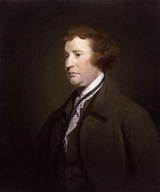
Edmund Burke PC (12 January
[NS
] 1729–9 July 1797) was an
IrishThe Irish people are an ethnic group who originate in Ireland, an island in northwestern Europe. Ireland has been populated for around 9,000 years , with the Irish people's earliest ancestors recorded having legends of being descended from groups such as the Nemedians, Fomorians, Fir Bolg, Tuatha...
statesman, author, orator, political theorist and philosopher who, after moving to England, served for many years in the
House of Commons of Great BritainThe House of Commons of Great Britain was the lower house of the Parliament of Great Britain between 1707 and 1801. In 1707, as a result of the Acts of Union of that year, it replaced the House of Commons of England and the third estate of the Parliament of Scotland, as one of the most significant...
as a member of the Whig party.
He is mainly remembered for his support of the cause of the
American RevolutionThe American Revolution was the political upheaval during the last half of the 18th century in which thirteen colonies in North America joined together to break free from the British Empire, combining to become the United States of America...
aries, and for his later opposition to the
French RevolutionThe French Revolution , sometimes distinguished as the 'Great French Revolution' , was a period of radical social and political upheaval in France and Europe. The absolute monarchy that had ruled France for centuries collapsed in three years...
. The latter led to his becoming the leading figure within the conservative faction of the Whig party, which he dubbed the "Old Whigs", in opposition to the pro–French Revolution "New Whigs", led by
Charles James FoxCharles James Fox PC , styled The Honourable from 1762, was a prominent British Whig statesman whose parliamentary career spanned thirty-eight years of the late 18th and early 19th centuries and who was particularly noted for being the arch-rival of William Pitt the Younger...
.
Burke was praised by both conservatives and liberals in the 19th century. Since the 20th century, he has generally been viewed as the philosophical founder of modern
ConservatismConservatism is a political and social philosophy that promotes the maintenance of traditional institutions and supports, at the most, minimal and gradual change in society. Some conservatives seek to preserve things as they are, emphasizing stability and continuity, while others oppose modernism...
, as well as a representative of
classical liberalismClassical liberalism is the philosophy committed to the ideal of limited government, constitutionalism, rule of law, due process, and liberty of individuals including freedom of religion, speech, press, assembly, and free markets....
.
Early life
Burke was born in
Dublin, Ireland, to a prosperous solicitor father (Richard; d. 1761) of the
Church of IrelandThe Church of Ireland is an autonomous province of the Anglican Communion. The church operates in all parts of Ireland and is the second largest religious body on the island after the Roman Catholic Church...
. It is unclear if this is the same Richard Burke who converted from Catholicism. His mother Mary (c. 1702–1770), whose maiden name was Nagle, belonged to the Roman Catholic Church and came from an impoverished but genteel
County CorkCounty Cork is a county in Ireland. It is located in the South-West Region and is also part of the province of Munster. It is named after the city of Cork . Cork County Council is the local authority for the county...
family. (The
name de BúrcaBurke is an English variant of the English and Irish surname originating from the Anglo-Normans.In Old English, the name means "fortified hill". Variants include Bourke, de Burgo, Burgh, and De Burgh. Many Irish and English emigrants to Quebec and other francophone regions of Canada chose to change...
, anglicised as Burke, is the
Irish languageIrish , also known as Irish Gaelic, is a Goidelic language of the Indo-European language family, originating in Ireland and historically spoken by the Irish people. Irish is now spoken as a first language by a minority of Irish people, as well as being a second language of a larger proportion of...
version of the Norman name de Burgo or de Burgh, the name of a family that settled in Ireland following the
Norman invasion of IrelandThe Norman invasion of Ireland was a two-stage process, which began on 1 May 1169 when a force of loosely associated Norman knights landed near Bannow, County Wexford...
by
Henry II of EnglandHenry II ruled as King of England , Count of Anjou, Count of Maine, Duke of Normandy, Duke of Aquitaine, Duke of Gascony, Count of Nantes, Lord of Ireland and, at various times, controlled parts of Wales, Scotland and western France. Henry, the great-grandson of William the Conqueror, was the...
in 1172.)
Burke was raised in his father's faith and remained throughout his life a practising
AnglicanAnglicanism is a tradition within Christianity comprising churches with historical connections to the Church of England or similar beliefs, worship and church structures. The word Anglican originates in ecclesia anglicana, a medieval Latin phrase dating to at least 1246 that means the English...
, unlike his sister Juliana who was brought up as and remained a Roman Catholic. His political enemies were later repeatedly to accuse him of having been educated at the
JesuitThe Society of Jesus is a Catholic male religious order that follows the teachings of the Catholic Church. The members are called Jesuits, and are also known colloquially as "God's Army" and as "The Company," these being references to founder Ignatius of Loyola's military background and a...
seminary of
St. OmerSaint-Omer , a commune and sub-prefecture of the Pas-de-Calais department west-northwest of Lille on the railway to Calais. The town is named after Saint Audomar, who brought Christianity to the area....
's and of harbouring secret Catholic sympathies at a time when membership of the Catholic Church would disqualify him from public office (
see Penal Laws in IrelandThe term Penal Laws in Ireland were a series of laws imposed under English and later British rule that sought to discriminate against Roman Catholics and Protestant dissenters in favour of members of the established Church of Ireland....
). As Burke told Mrs. Crewe:
Mr. Burke's Enemies often endeavoured to convince the World that he had been bred up in the Catholic Faith, & that his Family were of it, & that he himself had been educated at St. Omer—but this was false, as his father was a regular practitioner of the Law at Dublin, which he could not be unless of the Established Church: & it so happened that though Mr. B— was twice at Paris, he never happened to go through the Town of St. Omer.
Once an MP, Burke was required to take the oath of allegiance and abjuration, the oath of supremacy, and declare against
transubstantiationIn Roman Catholic theology, transubstantiation means the change, in the Eucharist, of the substance of wheat bread and grape wine into the substance of the Body and Blood, respectively, of Jesus, while all that is accessible to the senses remains as before.The Eastern Orthodox...
. No Catholic is known to have done so in the 18th century. Although never denying his Irishness, Burke often described himself as "an Englishman". This was in an age "before 'Celtic nationalism' sought to make Irishness and Englishness incompatible".
As a child he sometimes spent time away from the unhealthy air of Dublin with his mother's family in the Blackwater Valley. He received his early education at a
QuakerThe Religious Society of Friends, or Friends Church, is a Christian movement which stresses the doctrine of the priesthood of all believers. Members are known as Friends, or popularly as Quakers. It is made of independent organisations, which have split from one another due to doctrinal differences...
school in
Ballitore, some 30 miles (48.3 km) from Dublin, and remained in correspondence with his schoolmate
Mary LeadbeaterMary Leadbeater was an Irish author and diarist.Leadbeater was born in Ballitore, County Kildare, Ireland. She was the daughter of Richard Shackleton by his second wife, Elizabeth Carleton, and granddaughter of Abraham Shackleton, schoolmaster of Edmund Burke. Her parents were quakers...
, the daughter of the school's owner, throughout his life.
In 1744 he went to
Trinity College, DublinTrinity College, Dublin , formally known as the College of the Holy and Undivided Trinity of Queen Elizabeth near Dublin, was founded in 1592 by letters patent from Queen Elizabeth I as the "mother of a university", Extracts from Letters Patent of Elizabeth I, 1592: "...we...found and...
. In 1747, he set up a Debating Club, known as Edmund Burke's Club, which in 1770 merged with the Historical Club to form the
College Historical SocietyThe College Historical Society is one of two main debating societies at Trinity College, Dublin in Dublin, Ireland. It was established within the college in 1770, but traces its origins to the society founded by the philosopher Edmund Burke in Dublin in 1747...
, now the oldest undergraduate society in the world. The minutes of the meetings of Burke's club remain in the collection of the Historical Society. He graduated in 1748. Burke's father wished him to study for the law, and with this object he went to London in 1750. He entered the
Middle TempleThe Honourable Society of the Middle Temple, commonly known as Middle Temple, is one of the four Inns of Court exclusively entitled to call their members to the English Bar as barristers; the others being the Inner Temple, Gray's Inn and Lincoln's Inn...
, but soon gave up legal study to travel in Continental Europe. After giving up law, he attempted to earn a livelihood through writing.
Writing
The late
Lord BolingbrokeHenry St John, 1st Viscount Bolingbroke was an English politician, government official and political philosopher. He was a leader of the Tories, and supported the Church of England politically despite his atheism. In 1715 he supported the Jacobite rebellion of 1715 which sought to overthrow the...
's
Letters on the Study and Use of History was published in 1752 and his collected works appeared in 1754. This provoked Burke into writing his first published work,
A Vindication of Natural Society: A View of the Miseries and Evils Arising to MankindA Vindication of Natural Society: A View of the Miseries and Evils Arising to Mankind is a work by Edmund Burke published in 1756. It is a satire of Lord Bolingbroke's deism. Burke confronted Bolingbroke not in the sphere of religion but civil society and government, arguing that his arguments...
, appearing in Spring 1756. Burke imitated Lord Bolingbroke's style and ideas in a
reductio ad absurdumIn logic, proof by contradiction is a form of proof that establishes the truth or validity of a proposition by showing that the proposition's being false would imply a contradiction...
of his arguments for atheistic rationalism, demonstrating their absurdity.
Burke claimed that Bolingbroke's arguments against revealed religion could apply to all social and civil institutions.
Lord ChesterfieldPhilip Dormer Stanhope, 4th Earl of Chesterfield PC KG was a British statesman and man of letters.A Whig, Lord Stanhope, as he was known until his father's death in 1726, was born in London. After being educated at Trinity Hall, Cambridge, he went on the Grand Tour of the continent...
and
Bishop WarburtonWilliam Warburton was an English critic and churchman, Bishop of Gloucester from 1759.-Life:He was born at Newark, where his father, who belonged to an old Cheshire family, was town clerk. William was educated at Oakham and Newark grammar schools, and in 1714 he was articled to Mr Kirke, an...
(and others) initially thought that the work was genuinely by Bolingbroke rather than a satire. All the reviews of the work were positive, with critics especially appreciative of Burke's quality of writing. Some reviewers failed to notice the ironic nature of the book, which led to Burke writing in the preface to the second edition (1757) that it was a satire.
Richard Hurd believed that Burke's imitation was near-perfect and that this defeated his purpose: an ironist "should take care by a constant exaggeration to make the
ridicule shine through the Imitation. Whereas this
Vindication is everywhere enforc'd, not only in the language, and on the principles of L. Bol., but with so apparent, or rather so real an earnestness, that half his purpose is sacrificed to the other". A minority of scholars have taken the position that Burke did in fact write the
Vindication in earnest, later disowning it only for political reasons.
In 1757 Burke published a treatise on aesthetics,
A Philosophical Enquiry into the Origin of Our Ideas of the Sublime and BeautifulA Philosophical Enquiry into the Origin of Our Ideas of the Sublime and Beautiful is a 1757 treatise on aesthetics written by Edmund Burke. It attracted the attention of prominent Continental thinkers such as Denis Diderot and Immanuel Kant....
, which attracted the attention of prominent Continental thinkers such as
Denis DiderotDenis Diderot was a French philosopher, art critic, and writer. He was a prominent person during the Enlightenment and is best known for serving as co-founder and chief editor of and contributor to the Encyclopédie....
and
Immanuel KantImmanuel Kant was a German philosopher from Königsberg , researching, lecturing and writing on philosophy and anthropology at the end of the 18th Century Enlightenment....
. It was his only purely philosophical work, and when asked by Sir Joshua Reynolds and Dr. Laurence to expand it thirty years later, Burke replied that he was no longer fit for abstract speculation (Burke had written it before he was 19).
On 25 February 1757 Burke signed a contract with
Robert DodsleyRobert Dodsley was an English bookseller and miscellaneous writer.-Life:He was born near Mansfield, Nottinghamshire, where his father was master of the free school....
to write a "history of England from the time of Julius Caesar to the end of the reign of Queen Anne", its length being eighty quarto sheets (640 pages), under 400,000 words. It was to be submitted for publication by Christmas 1758. Burke actually completed to the year 1216, and never published the work. It was not published until 1812 in Burke's collected works under the title of
An Essay Towards an Abridgement of the English History, after Burke's death. G. M. Young did not value Burke's history and claimed that it was "demonstrably a translation from the French". Lord Acton, on commenting on the story that Burke stopped his history because
David HumeDavid Hume was a Scottish philosopher, historian, economist, and essayist, known especially for his philosophical empiricism and skepticism. He was one of the most important figures in the history of Western philosophy and the Scottish Enlightenment...
published his, said "it is ever to be regretted that the reverse did not occur".
The following year, with Dodsley, he created the influential
Annual RegisterThe Annual Register is a long-established reference work, written and published each year, which records and analyses the year’s major events, developments and trends throughout the world...
, a publication in which various authors evaluated the international political events of the previous year. The extent to which Burke personally contributed to the
Annual Register is contested. Robert Murray in his biography of Burke quotes the
Register as evidence of Burke's opinions, yet Philip Magnus in his biography does not directly cite it as a reference. Burke remained its chief editor until at least 1789 and there is no evidence that any other writer contributed to it before 1766.
On 12 March 1757 he married Jane Mary Nugent (1734–1812), daughter of a Catholic physician who had treated him at Bath. Their son
RichardRichard Burke was a barrister and Member of Parliament in England. He was born in Battersea, the son of Edmund Burke and Jane Mary Nugent. He was educated at Westminster School and Christ Church, Oxford, and was called to the bar at the Middle Temple in 1780...
was born on 9 February 1758. Another son, Christopher, died in infancy.
At about this same time, Burke was introduced to
William Gerard HamiltonWilliam Gerard Hamilton , English statesman and Irish politician, popularly known as "Single Speech Hamilton," was born in London, the son of a Scottish bencher of Lincoln's Inn....
(known as "Single-speech Hamilton"). When Hamilton was appointed
Chief Secretary for IrelandThe Chief Secretary for Ireland was a key political office in the British administration in Ireland. Nominally subordinate to the Lord Lieutenant, from the late 18th century until the end of British rule he was effectively the government minister with responsibility for governing Ireland; usually...
, Burke accompanied him to Dublin as his private secretary, a position he maintained for three years. In 1765 Burke became private secretary to liberal Whig statesman
Charles Watson-WentworthCharles Watson-Wentworth, 2nd Marquess of Rockingham, KG, PC , styled The Hon. Charles Watson-Wentworth before 1733, Viscount Higham between 1733 and 1746, Earl of Malton between 1746 and 1750 and The Earl Malton in 1750, was a British Whig statesman, most notable for his two terms as Prime...
, the
Marquess of RockinghamMarquess of Rockingham was a title in the Peerage of Great Britain. It was created in 1746 for Thomas Watson-Wentworth, 1st Earl of Malton. The Watson family descended from Lewis Watson, Member of Parliament for Lincoln. He was created a Baronet, of Rockingham Castle in the County of Northampton,...
, at the time Prime Minister of Great Britain, who remained Burke's close friend and associate until his premature death in 1782. Burke was a Freemason.
Member of Parliament
In December 1765 Burke entered the
British ParliamentThe Parliament of Great Britain was formed in 1707 following the ratification of the Acts of Union by both the Parliament of England and Parliament of Scotland...
as a member of the House of Commons for
WendoverWendover was a borough constituency of the House of Commons of the Parliament of England then of the Parliament of Great Britain from 1707 to 1800 and of the Parliament of the United Kingdom from 1801 to 1832...
, a pocket borough in the control of Lord Fermanagh, later 2nd
Earl VerneyEarl Verney, in the Province of Leinster, was a title in the Peerage of Ireland. Sir Ralph Verney sat as a Member of Parliament for Aylesbury, for Great Bedwyn and for Buckingham. In 1661 he was created a Baronet, of Middle Claydon in the County of Buckingham, in the Baronetage of England. His son...
, a close political ally of Rockingham. After Burke's
maiden speechA maiden speech is the first speech given by a newly elected or appointed member of a legislature or parliament.Traditions surrounding maiden speeches vary from country to country...
,
William Pitt the ElderWilliam Pitt, 1st Earl of Chatham PC was a British Whig statesman who led Britain during the Seven Years' War...
said Burke had "spoken in such a manner as to stop the mouths of all Europe" and that the Commons should congratulate itself on acquiring such a member.
The first great subject in which Burke interested himself was the controversy with the American colonies, which soon developed into war and ultimate separation; in 1769 he published, in reply to
GrenvilliteGeorge Grenville was a British Whig statesman who rose to the position of Prime Minister of Great Britain. Grenville was born into an influential political family and first entered Parliament in 1741 as an MP for Buckingham...
pamphlet
The Present State of the Nation, his pamphlet on
Observations on a Late State of the Nation. Surveying the finances of France, Burke predicts "some extraordinary convulsion in that whole system".
In the same year he purchased Gregories—a 600 acres (2.4 km²) estate near
BeaconsfieldBeaconsfield is a market town and civil parish operating as a town council within the South Bucks district in Buckinghamshire, England. It lies northwest of Charing Cross in Central London, and south-east of the county town of Aylesbury...
—with mostly borrowed money. Although it contained an art collection that included works by
Titian Tiziano Vecelli or Tiziano Vecellio Tiziano Vecelli or Tiziano Vecellio Tiziano Vecelli or Tiziano Vecellio (c. 1488/1490 – 27 August 1576 better known as Titian was an Italian painter, the most important member of the 16th-century Venetian school. He was born in Pieve di Cadore, near...
, Gregories nevertheless was a heavy financial burden in the following decades. Burke was never able to fully pay for the estate. His speeches and writings had now made him famous, and among other effects had brought about the suggestion that he was the author of the
Letters of Junius.
At about this time, he joined the circle of leading intellectuals and artists in London with
Samuel JohnsonSamuel Johnson , often referred to as Dr. Johnson, was an English author who made lasting contributions to English literature as a poet, essayist, moralist, literary critic, biographer, editor and lexicographer...
as its central luminary, and also included
David GarrickDavid Garrick was an English actor, playwright, theatre manager and producer who influenced nearly all aspects of theatrical practice throughout the 18th century and was a pupil and friend of Dr Samuel Johnson...
,
Oliver GoldsmithOliver Goldsmith was an Irish writer, poet and physician known for his novel The Vicar of Wakefield , his pastoral poem The Deserted Village , and his plays The Good-Natur'd Man and She Stoops to Conquer...
, and
Joshua ReynoldsSir Joshua Reynolds RA FRS FRSA was an influential 18th-century English painter, specialising in portraits and promoting the "Grand Style" in painting which depended on idealization of the imperfect. He was one of the founders and first President of the Royal Academy...
.
Edward GibbonEdward Gibbon was an English historian and Member of Parliament...
described him as, 'the most eloquent and rational madman that I ever knew.'
Burke took a leading role in the debate over the constitutional limits to the executive authority of the King. He argued strongly against unrestrained royal power and for the role of
political partiesA political party is a political organization that typically seeks to influence government policy, usually by nominating their own candidates and trying to seat them in political office. Parties participate in electoral campaigns, educational outreach or protest actions...
in maintaining a principled opposition capable of preventing abuses, either by the monarch or by specific factions within the government. His most important publication in this regard was his
Thoughts on the Cause of the Present Discontents of 23 April 1770. Burke identified the "discontents" as stemming from the "secret influence" of a neo-Tory group he calls the "king's friends", whose system "comprehending the exterior and interior Administrations, is commonly called, in the technical language of the Court,
Double Cabinet". Britain needed a party with "...an unshaken adherence to principle, and attachment to connexion, against every allurement of interest". Party divisions "...whether operating for good or evil, are things inseparable from free government".
During 1771 Burke wrote a Bill that would have, if passed, given juries the right to determine what was libel. Burke spoke in favour of the Bill but it was opposed by some, including Charles James Fox, and was not passed. Fox, when introducing
his own BillThe Libel Act 1792 was an Act of the Parliament of Great Britain. At the urging of the Whig politician Charles James Fox, the Act restored to juries the right to decide what was libel and whether a defendant was guilty, rather than leaving it solely to the judge...
in 1791, repeated almost verbatim the text of Burke's Bill without acknowledgement. Burke was also prominent in securing the right to publish debates held in Parliament.
Speaking in a parliamentary debate on the prohibition on the export of grain on 16 November 1770, Burke argued in favour of a free market in corn: "There are no such things as a high, & a low price that is encouraging, & discouraging; there is nothing but a natural price, which grain brings at an universal market." In 1772 Burke was instrumental in passing the
Repeal of Certain Laws Act 1772The Repeal of Certain Laws Act 1772 was an Act of the Parliament of Great Britain. It repealed statutes against forestallers and engrossers, including the Forestallers Act 1551....
, which repealed various old laws against dealers and forestallers in corn.
In the
Annual Register for 1772 (published in July 1773) Burke condemned the
Partition of PolandThe First Partition of Poland or First Partition of the Polish-Lithuanian Commonwealth took place in 1772 as the first of three partitions that ended the existence of the Polish-Lithuanian Commonwealth by 1795. Growth in the Russian Empire's power, threatening the Kingdom of Prussia and the...
. He saw it as "the first very great breach in the modern political system of Europe" and upsetting the balance of power in Europe.
In 1774 he was elected member for
BristolBristol was a two member constituency, used to elect members to the House of Commons in the Parliaments of England , Great Britain and the United Kingdom . The constituency existed until Bristol was divided into single member constituencies in 1885.-Boundaries:The historic port city of Bristol, is...
, at the time "England's second city" and a large constituency with a genuine electoral contest.
In May 1778 Burke supported a motion in Parliament to revise the restrictions on Irish trade. However his constituents in Bristol, a great trading city, urged Burke to oppose free trade with Ireland. Burke resisted these demands and said: "If, from this conduct, I shall forfeit their suffrages at an ensuing election, it will stand on record an example to future representatives of the Commons of England, that one man at least had dared to resist the desires of his constituents when his judgment assured him they were wrong".
Burke published
Two Letters to Gentlemen of Bristol on the Bills relative to the Trade of Ireland, in which he espoused "some of the chief principles of commerce; such as the advantage of free intercourse between all parts of the same kingdom...the evils attending restriction and monopoly...and that the gain of others is not necessarily our loss, but on the contrary an advantage by causing a greater demand for such wares as we have for sale".
Burke also supported Sir George Savile's attempts to repeal some of the penal laws against Catholics.
This support for unpopular causes, notably free trade with Ireland and
Catholic emancipationCatholic emancipation or Catholic relief was a process in Great Britain and Ireland in the late 18th century and early 19th century which involved reducing and removing many of the restrictions on Roman Catholics which had been introduced by the Act of Uniformity, the Test Acts and the penal laws...
, led to Burke losing his seat in 1780. He also called capital punishment "the Butchery which we call justice" in 1776 and in 1780 Burke condemned the use of the
pilloryThe pillory was a device made of a wooden or metal framework erected on a post, with holes for securing the head and hands, formerly used for punishment by public humiliation and often further physical abuse, sometimes lethal...
for two men convicted for attempting to practice sodomy.
For the remainder of his parliamentary career, Burke sat for
MaltonMalton, also called New Malton, was a constituency of the House of Commons of the Parliament of England in 1295 and 1298, and again from 1640, then of the Parliament of Great Britain from 1707 to 1800 and of the Parliament of the United Kingdom from 1801 to 1885...
, another pocket borough controlled by
the Marquess of RockinghamCharles Watson-Wentworth, 2nd Marquess of Rockingham, KG, PC , styled The Hon. Charles Watson-Wentworth before 1733, Viscount Higham between 1733 and 1746, Earl of Malton between 1746 and 1750 and The Earl Malton in 1750, was a British Whig statesman, most notable for his two terms as Prime...
.
American War of Independence
Burke expressed his support for the grievances of the American colonies under the government of King George III and his appointed representatives. On 19 April 1774 Burke made a
speech"On American Taxation" was a speech given by Edmund Burke in the British House of Commons on April 19, 1774, advocating the full repeal of the Townshend Revenue Act of 1767. Parliament had previously repealed five of the six duties of this revenue tax on the American colonies, but the tax on tea...
(published in January 1775) on a motion to repeal the tea duty:
Again and again, revert to your old principles—seek peace and ensue it; leave America, if she has taxable matter in her, to tax herself. I am not here going into the distinctions of rights, nor attempting to mark their boundaries. I do not enter into these metaphysical distinctions; I hate the very sound of them. Leave the Americans as they anciently stood, and these distinctions, born of our unhappy contest, will die along with it.... Be content to bind America by laws of trade; you have always done it.... Do not burthen them with taxes.... But if intemperately, unwisely, fatally, you sophisticate and poison the very source of government by urging subtle deductions, and consequences odious to those you govern, from the unlimited and illimitable nature of supreme sovereignty, you will teach them by these means to call that sovereignty itself in question.... If that sovereignty and their freedom cannot be reconciled, which will they take? They will cast your sovereignty in your face. No body of men will be argued into slavery. Sir, let the gentlemen on the other side...tell me, what one character of liberty the Americans have, and what one brand of slavery they are free from, if they are bound in their property and industry by all the restraints you can imagine on commerce, and at the same time are made pack-horses of every tax you choose to impose, without the least share in granting them. When they bear the burthens of unlimited monopoly, will you bring them to bear the burthens of unlimited revenue too? The Englishman in America will feel that this is slavery; that it is legal slavery, will be no compensation either to his feelings or to his understandings.
In the House of Commons on 22 March 1775 Burke delivered a speech (published in May 1775) on reconciliation with America. Burke appealed for peace as preferable to civil war and reminded the House of America's growing population, its industry and its wealth. He warned against the notion that the Americans would back down in the face of force, as the Americans were descended largely from Englishmen:
...the people of the colonies are descendants of Englishmen.... They are therefore not only devoted to liberty, but to liberty according to English ideas and on English principles. The people are Protestants... a persuasion not only favourable to liberty, but built upon it.... My hold of the colonies is in the close affection which grows from common names, from kindred blood, from similar privileges, and equal protection. These are ties which, though light as air, are as strong as links of iron. Let the colonies always keep the idea of their civil rights associated with your government,—they will cling and grapple to you, and no force under heaven will be of power to tear them from their allegiance. But let it be once understood that your government may be one thing and their privileges another, that these two things may exist without any mutual relation,—the cement is gone, the cohesion is loosened, and everything hastens to decay and dissolution. As long as you have the wisdom to keep the sovereign authority of this country as the sanctuary of liberty, the sacred temple consecrated to our common faith, wherever the chosen race and sons of England worship freedom, they will turn their faces towards you. The more they multiply, the more friends you will have; the more ardently they love liberty, the more perfect will be their obedience. Slavery they can have anywhere. It is a weed that grows in every soil. They may have it from Spain, they may have it from Prussia. But, until you become lost to all feeling of your true interest and your natural dignity, freedom they can have from none but you.
One of the reasons why this speech was so admired was the passage on
Lord BathurstAllen Bathurst, 1st Earl Bathurst PC , known as the Lord Bathurst from 1712 to 1772, was a British politician....
(1684–1775). Burke imagines an angel in 1704 prophesying to Bathurst the future greatness of England and also of America: "Young man, There is America—which at this day serves little more than to amuse you with stories of savage men, and uncouth manners; yet shall, before you taste of death, shew itself equal to the whole of that commerce which now attracts the envy of the world". Samuel Johnson was so irritated at hearing it continually praised that he made a parody of it, where the devil appears to a young Whig and predicts that
WhiggismWhiggism, sometimes spelled Whigism, is a historical political philosophy that grew out of the Parliamentarian faction in the Wars of the Three Kingdoms. The whigs' key policy positions were the supremacy of Parliament , toleration for Protestant dissenters, and opposition to a Catholic on the...
will in short time poison even the paradise of America.
The administration of
Lord NorthFrederick North, 2nd Earl of Guilford, KG, PC , more often known by his courtesy title, Lord North, which he used from 1752 until 1790, was Prime Minister of Great Britain from 1770 to 1782. He led Great Britain through most of the American War of Independence...
(1770–1782) tried to defeat the colonists' rebellion by military force. British and American forces clashed in 1775 and in 1776 came the
American Declaration of IndependenceThe Declaration of Independence was a statement adopted by the Continental Congress on July 4, 1776, which announced that the thirteen American colonies then at war with Great Britain regarded themselves as independent states, and no longer a part of the British Empire. John Adams put forth a...
. Burke was appalled by celebrations in Britain of the defeat of the Americans at New York and Pennsylvania. He claimed the English national character was being changed by this authoritarianism. Burke wrote: "As to the good people of England, they seem to partake every day more and more of the Character of that administration which they have been induced to tolerate. I am satisfied, that within a few years there has been a great Change in the National Character. We seem no longer that eager, inquisitive, jealous, fiery people, which we have been formerly".
In Burke's view the British government was fighting "the American English" ("our English Brethren in the Colonies"), with a German-descended King employing "the hireling sword of German boors and vassals" to destroy the colonists' English liberties. On American independence, Burke wrote: "I do not know how to wish success to those whose Victory is to separate from us a large and noble part of our Empire. Still less do I wish success to injustice, oppression and absurdity".
In 1780 during the
Gordon RiotsThe Gordon Riots of 1780 were an anti-Catholic protest against the Papists Act 1778.The Popery Act 1698 had imposed a number of penalties and disabilities on Roman Catholics in England; the 1778 act eliminated some of these. An initial peaceful protest led on to widespread rioting and looting and...
, Burke was a particular target for the rioters, and his home had to be placed under armed guard by the military.
Paymaster of the Forces
The fall of North led to Rockingham being recalled to power in March 1782. Burke became
Paymaster of the ForcesThe Paymaster of the Forces was a position in the British government. The office, which was established 1661 after the Restoration, was responsible for part of the financing of the British Army. The first to hold the office was Sir Stephen Fox. Before his time it had been the custom to appoint...
and a
Privy CouncillorHer Majesty's Most Honourable Privy Council, usually known simply as the Privy Council, is a formal body of advisers to the Sovereign in the United Kingdom...
, but without a seat in the Cabinet. Rockingham's unexpected death in July of 1782 and his replacement as Prime Minister by Shelburne put an end to his administration after only a few months. However Burke did manage to pass two Acts.
The
Paymaster General Act 1782The Paymaster General Act 1782 was an Act of the Parliament of Great Britain. The Act abolished the practice of the heads of subordinate Treasuries keeping large sums of public money for long periods, during which they employed them for their own profit. It was repealed by the Paymaster-General...
ended the post as a lucrative sinecure. Previously, Paymasters had been able to draw on money from the Treasury at their discretion. Now they were to put the money they had requested to withdraw from the Treasury into the Bank of England, from where it was to be withdrawn for specific purposes. The Treasury would receive monthly statements of the Paymaster's balance at the Bank. This Act was repealed by Shelburne's administration but the Act that replaced it repeated verbatim almost the whole text of Burke's Act.
The
Civil List and Secret Service Money Act 1782The Civil List and Secret Service Money Act 1782 was an Act of the Parliament of Great Britain. The power over the expenditure in the King's household was transferred to the Treasury, and branches of which were regulated. No pension over £300 was to be granted if the total pension list amounted to...
was a watered down version of Burke's original intentions as outlined in his famous
Speech on Economical Reform of 11 February 1780. However he managed to abolish 134 offices in the royal household and civil administration. The third
Secretary of StateIn the United Kingdom, a Secretary of State is a Cabinet Minister in charge of a Government Department ....
and the
Board of TradeThe Board of Trade is a committee of the Privy Council of the United Kingdom, originating as a committee of inquiry in the 17th century and evolving gradually into a government department with a diverse range of functions...
were abolished and pensions were limited and regulated. The Act was projected to save £72,368 a year.
In February 1783 Burke resumed the post of Paymaster of the Forces when Shelburne's government fell and was replaced by a coalition headed by North and including Charles James Fox. The coalition fell in 1783, and was succeeded by the long Tory administration of
William Pitt the YoungerWilliam Pitt the Younger was a British politician of the late 18th and early 19th centuries. He became the youngest Prime Minister in 1783 at the age of 24 . He left office in 1801, but was Prime Minister again from 1804 until his death in 1806...
, which lasted until 1801. Burke, who had supported Fox and North, was accordingly in opposition for the remainder of his political life.
Democracy
In 1774 Burke's
Speech to the Electors at Bristol at the Conclusion of the Poll was noted for its defence of the principles of
representativeIn politics, representation describes how some individuals stand in for others or a group of others, for a certain time period. Representation usually refers to representative democracies, where elected officials nominally speak for their constituents in the legislature...
government against the notion that elected officials should merely be delegates:
... it ought to be the happiness and glory of a representative to live in the strictest union, the closest correspondence, and the most unreserved communication with his constituents. Their wishes ought to have great weight with him; their opinion, high respect; their business, unremitted attention. It is his duty to sacrifice his repose, his pleasures, his satisfactions, to theirs; and above all, ever, and in all cases, to prefer their interest to his own. But his unbiased opinion, his mature judgment, his enlightened conscience, he ought not to sacrifice to you, to any man, or to any set of men living. These he does not derive from your pleasure; no, nor from the law and the constitution. They are a trust from Providence, for the abuse of which he is deeply answerable. Your representative owes you, not his industry only, but his judgment; and he betrays, instead of serving you, if he sacrifices it to your opinion.
A political scientist Hanna Pitkin points out that Burke linked the district's interest with the proper behaviour of its elected official, explaining, "Burke conceives of broad, relatively fixed interest, few in number and clearly defined, of which any group or locality has just one. These interests are largely economic or associated with particular localities whose livelihood they characterize, in his over-all prosperity they involve."
Burke was a leading skeptic with respect to democracy. While admitting that theoretically in some cases it might be desirable, he insisted a democratic government in Britain in his day would not only be inept but also oppressive. He opposed democracy for three basic reasons. First, government required a degree of intelligence and breadth of knowledge of the sort that was very uncommon among the common people. Second he thought that common people had dangerous and angry passions that could be easily aroused by demagogues if they had the vote; he feared the authoritarian impulses that could be empowered by these passions would undermine cherished traditions and established religion, leading to violence and confiscation of property. Thirdly, Burke warned that democracy would
tyrannize unpopular minoritiesThe phrase "tyranny of the majority" , used in discussing systems of democracy and majority rule, is a criticism of the scenario in which decisions made by a majority under that system would place that majority's interests so far above a dissenting individual's interest that the individual would be...
who needed the protection of the upper classes.
India and the impeachment of Warren Hastings
Burke pursued for years the impeachment against
Warren HastingsWarren Hastings PC was the first Governor-General of India, from 1773 to 1785. He was famously accused of corruption in an impeachment in 1787, but was acquitted in 1795. He was made a Privy Councillor in 1814.-Early life:...
, the former Governor General of Bengal, in 1786. His interaction with the British dominion of India began well before the impeachment trial. Previous to the impeachment, Parliament dealt with the Indian issue for two decades, this trial was the pinnacle of years of unrest and deliberation. In 1781 Burke was first able to delve into the issues surrounding the East India Company when he was appointed Chairman of the Commons' Select Committee on East Indian Affair—from that point until the end of the trial; India was Burke's primary concern. This committee was charged "to investigate alleged injustices in Bengal, the war with Hyder Ali, and other Indian difficulties". While Burke and the committee focused their attention on these matters, a second 'secret' committee was formed to assess the same issues. Both committee reports were written by Burke and led to the reassurance to the Indian princes that Britain would not wage war on them and the demand for the EIC to recall Hastings. This is Burke's first call for real, significant change of the imperial practices. When addressing the whole House of Commons in regards to the committee's report, Burke would describe the Indian issue as one that "began 'in commerce' but 'ended in empire.'"
On 28 February 1785 he made his great speech on
The Nabob of Arcot's Debts, where he condemned the damage he believed the
East India CompanyThe East India Company was an early English joint-stock company that was formed initially for pursuing trade with the East Indies, but that ended up trading mainly with the Indian subcontinent and China...
had done to
IndiaIndia , officially the Republic of India , is a country in South Asia. It is the seventh-largest country by geographical area, the second-most populous country with over 1.2 billion people, and the most populous democracy in the world...
. In the province of the
CarnaticThe Carnatic coast is the region of South India lying between the Eastern Ghats and the Coromandel Coast, in the modern Indian states of Tamil Nadu, south eastern Karnataka and southern Andhra Pradesh....
the Indians had constructed a system of reservoirs to make the soil fertile in a naturally dry region, and centred their society on the husbandry of water:
These are the monuments of real kings, who were the fathers of their people; testators to a posterity which they embraced as their own. These are the grand sepulchres built by ambition; but by the ambition of an insatiable benevolence, which, not contented with reigning in the dispensation of happiness during the contracted term of human life, had strained, with all the reachings and graspings of a vivacious mind, to extend the dominion of their bounty beyond the limits of nature, and to perpetuate themselves through generations of generations, the guardians, the protectors, the nourishers of mankind.
Burke held that the advent of British dominion, and in particular the conduct of the East India Company had destroyed much that was good in these traditions and that, as a consequence of this, and the lack of new customs to replace them, the Indians were suffering. He set about establishing a set of British expectations, whose moral foundation would, in his opinion, warrant the empire.
On 4 April 1786 Burke presenting the Commons with the
Article of Charge of High Crimes and Misdemeanors against Hastings. The trial, which did not begin until 14 February 1788, would be the "first major public discursive event of its kind in England", bringing the morality and duty of imperialism to the forefront of the public's perception. Burke was already known for his eloquent rhetorical skills and his involvement in the trial only enhanced its popularity and significance. For the members of London's fashionable society, the trial was a spectacle, and was not centered around Hastings' alleged misconduct and crimes as had been Burke's intent. Burke's indictment, fuelled by emotional indignation, called Hastings the 'captain-general of iniquity'; who never dined without 'creating a famine'; his heart was 'gangrened to the core' and he resembled both a 'spider of Hell' and a 'ravenous vulture devouring the carcases of the dead'. The indictment was such a
philippicA philippic is a fiery, damning speech, or tirade, delivered to condemn a particular political actor. The term originates with Demosthenes, who delivered several attacks on Philip II of Macedon in the 4th century BC....
that, whereas it had previously seemed that Hastings would be found guilty, it actually provoked public sympathy; however, although Hastings was acquitted, the trial served to establish the principle that the Empire ought to be a moral undertaking rather than a wholesale looting by either the East India Company or its servants.
French Revolution: 1688 versus 1789
Burke did not initially condemn the
French RevolutionThe French Revolution , sometimes distinguished as the 'Great French Revolution' , was a period of radical social and political upheaval in France and Europe. The absolute monarchy that had ruled France for centuries collapsed in three years...
. In a letter of 9 August 1789, Burke wrote: "England gazing with astonishment at a French struggle for Liberty and not knowing whether to blame or to applaud! The thing indeed, though I thought I saw something like it in progress for several years, has still something in it paradoxical and Mysterious. The spirit it is impossible not to admire; but the old Parisian ferocity has broken out in a shocking manner". The events of 5–6 October 1789, in which a mob of Parisian women marched on Versailles to compel
King Louis XVILouis XVI was a Bourbon monarch who ruled as King of France and Navarre until 1791, and then as King of the French from 1791 to 1792, before being executed in 1793....
to return to Paris, turned Burke against it. In a letter to his son Richard on 10 October he said: "This day I heard from Laurence who has sent me papers confirming the portentous state of France—where the Elements which compose Human Society seem all to be dissolved, and a world of Monsters to be produced in the place of it—where Mirabeau presides as the Grand Anarch; and the late Grand Monarch makes a figure as ridiculous as pitiable". On 4 November Charles-Jean-François Depont wrote to Burke, requesting that he endorse the Revolution. Burke replied that any critical language of it by him should be taken "as no more than the expression of doubt" but added: "You may have subverted Monarchy, but not recover'd freedom". In the same month he described France as "a country undone". Burke's first public condemnation of the Revolution occurred on the debate in Parliament on the Army Estimates on 9 February 1790, provoked by praise of the Revolution by Pitt and Fox:
Since the House had been prorogued in the summer much work was done in France. The French had shewn themselves the ablest architects of ruin that had hitherto existed in the world. In that very short space of time they had completely pulled down to the ground, their monarchy; their church; their nobility; their law; their revenue; their army; their navy; their commerce; their arts; and their manufactures...[there was a danger of] an imitation of the excesses of an irrational, unprincipled, proscribing, confiscating, plundering, ferocious, bloody and tyrannical democracy...[in religion] the danger of their example is no longer from intolerance, but from Atheism; a foul, unnatural vice, foe to all the dignity and consolation of mankind; which seems in France, for a long time, to have been embodied into a faction, accredited, and almost avowed.
In January 1790 Burke read Dr.
Richard PriceRichard Price was a British moral philosopher and preacher in the tradition of English Dissenters, and a political pamphleteer, active in radical, republican, and liberal causes such as the American Revolution. He fostered connections between a large number of people, including writers of the...
's sermon of 4 November 1789 to the
Revolution SocietyThe London Revolution Society was formed 1788 to commemorate the Glorious Revolution of 1688 and the landing of William III, and was one of several radical societies in Britain in the 1790s...
, called
A Discourse On the Love of our Country. The Revolution Society was founded to commemorate the
Glorious RevolutionThe Glorious Revolution, also called the Revolution of 1688, is the overthrow of King James II of England by a union of English Parliamentarians with the Dutch stadtholder William III of Orange-Nassau...
of 1688. In this sermon Price espoused the philosophy of universal "rights of men". Price argued that love of our country "does not imply any conviction of the superior value of it to other countries, or any particular preference of its laws and constitution of government". Instead, Englishmen should see themselves "more as citizens of the world than as members of any particular community". The debate between Price and Burke was "the classic moment at which two fundamentally different conceptions of national identity were presented to the English public". Price claimed that the principles of the Glorious Revolution included "the right to choose our own governors, to cashier them for misconduct, and to frame a government for ourselves". Immediately after reading Price's sermon, Burke wrote a draft of what eventually became the
Reflections on the Revolution in FranceReflections on the Revolution in France , by Edmund Burke, is one of the best-known intellectual attacks against the French Revolution...
. On 13 February 1790, a notice in the press said that Burke would shortly publish a pamphlet on the Revolution and its British supporters, however he spent the year revising and expanding it. On 1 November he finally published the
Reflections and it was an immediate best-seller. Priced at five shillings, it was more expensive than most political pamphlets but by the end of 1790 it had gone through ten printings and sold approximately 17,500 copies. A French translation appeared on 29 November and on 30 November the translator, Pierre-Gaëton Dupont, wrote to Burke saying 2,500 copies had already been sold. The French translation ran to ten printings by June 1791.
What the Glorious Revolution had meant was important to Burke and his contemporaries, as it had been for the last one hundred years in British politics. In the
Reflections, Burke argued against Price's interpretation of the Glorious Revolution and instead gave a classic Whig defence of it. Burke argued against the idea of abstract, metaphysical rights of men and instead advocated national tradition:
The Revolution was made to preserve our antient indisputable laws and liberties, and that antient constitution of government which is our only security for law and liberty.... The very idea of the fabrication of a new government, is enough to fill us with disgust and horror. We wished at the period of the Revolution, and do now wish, to derive all we possess as an inheritance from our forefathers. Upon that body and stock of inheritance we have taken care not to inoculate any cyon [scion] alien to the nature of the original plant.... Our oldest reformation is that of Magna ChartaMagna Carta is an English charter, originally issued in the year 1215 and reissued later in the 13th century in modified versions, which included the most direct challenges to the monarch's authority to date. The charter first passed into law in 1225...
. You will see that Sir Edward CokeSir Edward Coke SL PC was an English barrister, judge and politician considered to be the greatest jurist of the Elizabethan and Jacobean eras. Born into a middle class family, Coke was educated at Trinity College, Cambridge before leaving to study at the Inner Temple, where he was called to the...
, that great oracle of our law, and indeed all the great men who follow him, to BlackstoneSir William Blackstone KC SL was an English jurist, judge and Tory politician of the eighteenth century. He is most noted for writing the Commentaries on the Laws of England. Born into a middle class family in London, Blackstone was educated at Charterhouse School before matriculating at Pembroke...
, are industrious to prove the pedigree of our liberties. They endeavour to prove that the ancient charter... were nothing more than a re-affirmance of the still more ancient standing law of the kingdom.... In the famous law... called the Petition of RightIn English law, a petition of right was a remedy available to subjects to recover property from the Crown.Before the Crown Proceedings Act 1947, the British Crown could not be sued in contract...
, the parliament says to the king, "Your subjects have inherited this freedom", claiming their franchises not on abstract principles "as the rights of men", but as the rights of Englishmen, and as a patrimony derived from their forefathers.
Burke put forward that "We fear God, we look up with awe to kings; with affection to parliaments; with duty to magistrates; with reverence to priests; and with respect to nobility. Why? Because when such ideas are brought before our minds, it is
natural to be so affected". Burke defended prejudice on the grounds that it is "the general bank and capital of nations, and of ages" and superior to individual reason, which is small in comparison. "Prejudice", Burke claimed, "is of ready application in the emergency; it previously engages the mind in a steady course of wisdom and virtue, and does not leave the man hesitating in the moment of decision, skeptical, puzzled, and unresolved. Prejudice renders a man's virtue his habit". Burke criticised
social contractThe social contract is an intellectual device intended to explain the appropriate relationship between individuals and their governments. Social contract arguments assert that individuals unite into political societies by a process of mutual consent, agreeing to abide by common rules and accept...
theory by claiming that society is indeed a contract, but "a partnership not only between those who are living, but between those who are living, those who are dead, and those who are to be born".
The most famous passage of the
Reflections was his description of the events of 5–6 October 1789 and
Marie AntoinetteMarie Antoinette ; 2 November 1755 – 16 October 1793) was an Archduchess of Austria and the Queen of France and of Navarre. She was the fifteenth and penultimate child of Holy Roman Empress Maria Theresa and Holy Roman Emperor Francis I....
's part in them. Burke's account differs little from modern historians who have used primary sources. His use of flowery language to describe it, however, provoked both praise and criticism.
Philip FrancisSir Philip Francis was an Irish-born British politician and pamphleteer, the possible author of the Letters of Junius, and the chief antagonist of Warren Hastings. His accusations against the latter led to the Impeachment of Warren Hastings by Parliament.-Early life:Born in Dublin, he was the only...
wrote to Burke saying that what he wrote of Marie Antoinette was "pure foppery".
Edward GibbonEdward Gibbon was an English historian and Member of Parliament...
however reacted differently: "I adore his chivalry". Burke was informed by an Englishman who had talked with the Duchesse de Biron that when Marie Antoinette was reading the passage she burst into tears and took considerable time to finish reading it. Price had rejoiced that the French king had been "led in triumph" during the October Days but to Burke this symbolised the opposing revolutionary sentiment of the Jacobins and the natural sentiments of those like himself who regarded the ungallant assault on Marie Antoinette with horror, as a cowardly attack on a defenceless woman.
Louis XVI translated the
Reflections "from end to end" into French. Fellow Whig MPs
Richard SheridanRichard Brinsley Butler Sheridan was an Irish-born playwright and poet and long-term owner of the London Theatre Royal, Drury Lane. For thirty-two years he was also a Whig Member of the British House of Commons for Stafford , Westminster and Ilchester...
and
Charles James FoxCharles James Fox PC , styled The Honourable from 1762, was a prominent British Whig statesman whose parliamentary career spanned thirty-eight years of the late 18th and early 19th centuries and who was particularly noted for being the arch-rival of William Pitt the Younger...
disagreed with Burke and split with him. Fox thought the
Reflections to be "in very bad taste" and "favouring Tory principles". Other Whigs such as the
Duke of PortlandWilliam Henry Cavendish-Bentinck, 3rd Duke of Portland, KG, PC was a British Whig and Tory statesman, Chancellor of the University of Oxford and Prime Minister. He was known before 1762 by the courtesy title Marquess of Titchfield. He held a title of every degree of British nobility—Duke,...
and
Earl FitzwilliamWilliam Wentworth-Fitzwilliam, 4th Earl Fitzwilliam PC , styled Viscount Milton until 1756, was a British Whig statesman of the late 18th and early 19th centuries. In 1782 he inherited his uncle Charles Watson-Wentworth, 2nd Marquess of Rockingham's estates, making him one of the richest people in...
privately agreed with Burke but did not wish for a public breach with their Whig colleagues. Burke wrote on 29 November 1790: "I have received from the Duke of Portland, Lord Fitzwilliam, the
Duke of DevonshireWilliam Cavendish, 5th Duke of Devonshire, KG was a British aristocrat and politician. He was the eldest son of the William Cavendish, 4th Duke of Devonshire by his wife the heiress Lady Charlotte Boyle, suo jure Baroness Clifford of Lanesborough, who brought in considerable money and estates to...
,
Lord John CavendishLord John Cavendish PC was a British politician.-Background:Cavendish was the youngest son of William Cavendish, 3rd Duke of Devonshire, and his wife Catherine, daughter of John Hoskins. Prime Minister William Cavendish, 4th Duke of Devonshire, Lord George Cavendish and Field Marshal Lord...
MontaguFrederick Montagu PC, FRS was a British Whig MP.Montagu was educated at Eton and Trinity College, Cambridge. He was MP for Northampton from 1759 to 1768, and for Higham Ferrers from 1768 to 1790. He was in favour of tolerance for Dissenters and the removal of adherence to the Thirty-Nine Articles...
and a long et cetera of the old Stamina of the Whiggs a most full approbation of the principles of that work and a kind indulgence to the execution". The Duke of Portland said in 1791 that when anyone criticised the
Reflections to him he informed them that he had recommended the book to his sons as containing the true Whig creed. In the opinion of
Paul LangfordProfessor Paul Langford is a British historian, currently Rector of Lincoln College, Oxford.Educated at Monmouth School and Hertford College, Oxford, he was elected to a Junior Research Fellowship in modern history at Lincoln College in 1969, becoming a tutorial fellow in 1970...
, Burke crossed something of a Rubicon when he attended a levee on 3 February 1791 to meet the King, later described by Jane Burke:
On his coming to Town for the Winter, as he generally does, he went to the Levee with the Duke of Portland, who went with Lord WilliamLieutenant-General Lord William Henry Cavendish-Bentinck GCB, GCH, PC , known as Lord William Bentinck, was a British soldier and statesman...
to kiss hands on his going into the GuardsHer Majesty's Coldstream Regiment of Foot Guards, also known officially as the Coldstream Guards , is a regiment of the British Army, part of the Guards Division or Household Division....
—while Lord William was kissing hands, The King was talking to The Duke, but his Eyes were fixed on [Burke] who was standing in the Crowd, and when He said His say to The Duke, without waiting for [Burke]'s coming up in his turn, The King went up to him, and, after the usual questions of how long have you been in Town and the weather, He said you have been very much employed of late, and very much confined. [Burke] said, no, Sir, not more than usual—You have and very well employed too, but there are none so deaf as those that w'ont hear, and none so blind as those that w'ont see—[Burke] made a low bow, Sir, I certainly now understand you, but was afraid my vanity or presumption might have led me to imagine what Your Majesty has said referred to what I have done—You cannot be vain—You have been of use to us all, it is a general opinion, is it not so Lord Stair? who was standing near. It is said Lord Stair;—Your Majesty's adopting it, Sir, will make the opinion general, said [Burke]—I know it is the general opinion, and I know that there is no Man who calls himself a Gentleman that must not think himself obliged to you, for you have supported the cause of the Gentlemen—You know the tone at Court is a whisper, but The King said all this loud, so as to be heard by every one at Court.
Burke's
Reflections sparked a
pamphlet warThe Revolution Controversy was a British debate over the French Revolution, lasting from 1789 through 1795. A pamphlet war began in earnest after the publication of Edmund Burke's Reflections on the Revolution in France , which surprisingly supported the French aristocracy...
.
Thomas PaineThomas "Tom" Paine was an English author, pamphleteer, radical, inventor, intellectual, revolutionary, and one of the Founding Fathers of the United States...
penned
The Rights of Man in 1791 as a response to Burke;
Mary WollstonecraftMary Wollstonecraft was an eighteenth-century British writer, philosopher, and advocate of women's rights. During her brief career, she wrote novels, treatises, a travel narrative, a history of the French Revolution, a conduct book, and a children's book...
published
A Vindication of the Rights of MenA Vindication of the Rights of Men, in a Letter to the Right Honourable Edmund Burke; Occasioned by His Reflections on the Revolution in France is a political pamphlet, written by the 18th-century British feminist Mary Wollstonecraft, which attacks aristocracy and advocates republicanism...
and
James MackintoshSir James Mackintosh was a Scottish jurist, politician and historian. His studies and sympathies embraced many interests. He was trained as a doctor and barrister, and worked also as a journalist, judge, administrator, professor, philosopher and politician.-Early life:Mackintosh was born at...
wrote
Vindiciae Gallicae. Mackintosh was the first to see the
Reflections as "the manifesto of a Counter Revolution". Mackintosh later agreed with Burke's views, remarking in December 1796 after meeting him, that Burke was "minutely and accurately informed, to a wonderful exactness, with respect to every fact relating to the French Revolution". Mackintosh later said: "Burke was one of the first thinkers as well as one of the greatest orators of his time. He is without parallel in any age, excepting perhaps Lord Bacon and Cicero; and his works contain an ampler store of political and moral wisdom than can be found in any other writer whatever".
In November 1790 a member of the National Assembly of France, François-Louis-Thibault de Menonville, wrote to Burke, praising the
Reflections and requesting more "very refreshing mental food" that he could publish. This Burke did in April 1791 when he published
A Letter to a Member of the National Assembly. Burke called for external forces to reverse the Revolution and included an attack on the late French philosopher
Jean-Jacques RousseauJean-Jacques Rousseau was a Genevan philosopher, writer, and composer of 18th-century Romanticism. His political philosophy influenced the French Revolution as well as the overall development of modern political, sociological and educational thought.His novel Émile: or, On Education is a treatise...
, as a personality cult had developed in revolutionary France. Although Burke conceded that Rousseau sometimes shows "a considerable insight into human nature" he was mostly critical. Although he did not meet Rousseau on his visit to Britain in 1766–7 he was a friend of
David HumeDavid Hume was a Scottish philosopher, historian, economist, and essayist, known especially for his philosophical empiricism and skepticism. He was one of the most important figures in the history of Western philosophy and the Scottish Enlightenment...
, with whom Rousseau had stayed. Burke said Rousseau "entertained no principle either to influence of his heart, or to guide his understanding, but
vanity", which he "was possessed to a degree little short of madness". He also cited Rousseau's
ConfessionsConfessions is an autobiographical book by Jean-Jacques Rousseau. In modern times, it is often published with the title The Confessions of Jean-Jacques Rousseau in order to distinguish it from St. Augustine of Hippo's Confessions...
as evidence that Rousseau had a life of "obscure and vulgar vices" that was not "chequered, or spotted here and there, with virtues, or even distinguished by a single good action". Burke contrasted Rousseau's theory of universal benevolence and his sending his children to a foundling hospital: "a lover of his kind, but a hater of his kindred".
These events, and disagreements that rose from them within the Whig party, led to its breakup and to the rupture of Burke's friendship with Fox. In debate in Parliament on Britain's relations with Russia, Fox praised the principles of the Revolution, though Burke was not able to reply at this time as he was "overpowered by continued cries of question from his own side of the House". When Parliament was debating the Quebec Bill for a constitution for Canada, Fox praised the Revolution and criticised some of Burke's arguments, such as hereditary power. On 6 May 1791, during another debate in Parliament on the Quebec Bill, Burke used the opportunity to answer Fox and condemn the new French Constitution and "the horrible consequences flowing from the French idea of the rights of man". Burke asserted that those ideas were the antithesis of both the British and the American constitutions. Burke was interrupted, and Fox intervened to say that Burke should be allowed to carry on with his speech. However a vote of censure was moved against Burke for noticing the affairs of France, which was moved by
Lord SheffieldJohn Baker-Holroyd, 1st Earl of Sheffield was an English politician who came from a Yorkshire family, a branch of which had settled in the Kingdom of Ireland.- Biography :...
and seconded by Fox. Pitt made a speech praising Burke, and Fox made a speech both rebuking and complimenting Burke. He questioned the sincerity of Burke, who seemed to have forgotten the lessons he had taught him, quoting from Burke's speeches of fourteen and fifteen years before. Burke replied:
It certainly was indiscreet at any period, but especially at his time of life, to parade enemies, or give his friends occasion to desert him; yet if his firm and steady adherence to the British constitution placed him in such a dilemma, he would risk all, and, as public duty and public experience taught him, with his last words exclaim, "Fly from the French Constitution".
At this point Fox whispered that there was "no loss of friendship". "I regret to say there is", Burke said, "I have indeed made a great sacrifice; I have done my duty though I have lost my friend. There is something in the detested French constitution that envenoms every thing it touches". This provoked a reply from Fox, yet he was unable to give his speech for some time since he was overcome with tears and emotion, he appealed to Burke to remember their inalienable friendship but also repeated his criticisms of Burke and uttered "unusually bitter sarcasms". This only aggravated the rupture between the two men. Burke demonstrated his separation from the party on 5 June 1791 by writing to Fitzwilliam, declining money from him.
Burke was dismayed that some Whigs, instead of reaffirming the principles of the Whig party he laid out in the
Reflections, had rejected them in favour of "French principles" and criticised Burke for abandoning Whig principles. Burke wanted to demonstrate his fidelity to Whig principles and feared that acquiescence to Fox and his followers would allow the Whig party to become a vehicle for Jacobinism. Burke knew that many members of the Whig party did not share Fox's views and wanted to provoke them into condemning the French Revolution. Burke wrote that he wanted to represent the whole Whig party "as tolerating, and by a toleration, countenancing those proceedings" so that he could "stimulate them to a public declaration of what every one of their acquaintance privately knows to be...their sentiments". Therefore on 3 August 1791 Burke published his
Appeal from the New to the Old Whigs, in which he renewed his criticism of the radical revolutionary programmes inspired by the French Revolution and attacked the Whigs who supported them as holding principles contrary to those traditionally held by the Whig party. Burke owned two copies of what has been called "that practical compendium of Whig political theory",
The Tryal of Dr. Henry SacheverellHenry Sacheverell was an English High Church clergyman and politician.-Early life:The son of Joshua Sacheverell, rector of St Peter's, Marlborough,...
(1710). Burke wrote of the trial: "It rarely happens to a party to have the opportunity of a clear, authentic, recorded, declaration of their political tenets upon the subject of a great constitutional event like that of the [Glorious] Revolution". Writing in the third person, Burke asserted in his
Appeal:
...that the foundations laid down by the Commons, on the trial of Doctor Sacheverel, for justifying the revolution of 1688, are the very same laid down in Mr. Burke's Reflections; that is to say,—a breach of the original contract, implied and expressed in the constitution of this country, as a scheme of government fundamentally and inviolably fixed in King, Lords and Commons.—That the fundamental subversion of this antient constitution, by one of its parts, having been attempted, and in effect accomplished, justified the Revolution. That it was justified only upon the necessity of the case; as the only means left for the recovery of that antient constitution, formed by the original contract of the British state; as well as for the future preservation of the same government. These are the points to be proved.
Burke then provided quotations from Paine's
Rights of Man to demonstrate what the New Whigs believed. Burke's belief that Foxite principles corresponded to Paine's was genuine. Finally, Burke denied that a majority of "the people" had, or ought to have, the final say in politics and alter society at their pleasure. People had rights but also duties, and these duties were not voluntary. Also, the people could not overthrow morality derived from God.
Although Whig grandees like Portland and Fitzwilliam privately agreed with Burke's
Appeal, they wished he had used more moderate language. Fitzwilliam saw the
Appeal as containing "the doctrines I have sworn by, long and long since".
Francis BassetFrancis Basset, 1st Baron de Dunstanville and Basset FRS was an English nobleman and politician. He was the first son of Francis Basset and Margaret St...
, a backbench Whig MP, wrote to Burke: "...though for reasons which I will not now detail I did not then deliver my sentiments, I most perfectly differ from Mr Fox & from the great Body of opposition on the French Revolution". Burke sent a copy of the
Appeal to the King and the King requested a friend to communicate to Burke that he had read it "with great Satisfaction". Burke wrote of its reception: "Not one word from one of our party. They are secretly galled. They agree with me to a title; but they dare not speak out for fear of hurting Fox. ... They leave me to myself; they see that I can do myself justice".
Charles BurneyCharles Burney FRS was an English music historian and father of authors Frances Burney and Sarah Burney.-Life and career:...
viewed it as "a most admirable book—the best & most useful on political subjects that I have ever seen" but believed the differences in the Whig party between Burke and Fox should not be publicly aired.
Eventually most of the Whigs sided with Burke and voted their support for the conservative government of Pitt, which, in response to France's declaration of war against Britain, declared war on the revolutionary government of France in 1793.
In December 1791 Burke sent government ministers his
Thoughts on French Affairs where he put forward three main points: no counter-revolution in France would come about by purely domestic causes; the longer the revolutionary government exists the stronger it becomes; and the revolutionary government's interest and aim is to disturb all the other governments of Europe. Burke, as a Whig, did not wish to see an absolute monarchy again in France after the extirpation of Jacobinism. Writing to an
émigré in 1791, Burke expressed his views against a restoration of the
ancien régime:
When such a complete convulsion has shaken the State, and hardly left any thing whatsoever, either in civil arrangements, or in the Characters and disposition of mens minds, exactly where it was, whatever shall be settled although in the former persons and upon old forms, will be in some measure a new thing and will labour under something of the weakness as well as other inconveniences of a Change. My poor opinion is that you mean to establish what you call 'L'ancien Regime,' If any one means that system of Court Intrigue miscalled a Government as it stood, at Versailles before the present confusions as the thing to be established, that I believe will be found absolutely impossible; and if you consider the Nature, as well of persons, as of affairs, I flatter myself you must be of my opinion. That was tho' not so violent a State of Anarchy as well as the present. If it were even possible to lay things down exactly as they stood, before the series of experimental politicks began, I am quite sure that they could not long continue in that situation. In one Sense of L'Ancien Regime I am clear that nothing else can reasonably be done.
Burke delivered a speech on the debate of the
Aliens BillThe Aliens Act 1793 was an Act of the Parliament of Great Britain regulating immigration into the country. The Act, inspired by a sharp increase in refugees from the French Revolution seeking asylum in Great Britain, required that aliens be recorded upon arrival and to register with the local...
on 28 December 1792. He supported the Bill as it would exclude "murderous atheists, who would pull down church and state; religion and God; morality and happiness". The peroration included a reference to a French order for 3,000 daggers. Burke revealed a dagger he had concealed in his coat and threw it to the floor: "This is what you are to gain by an alliance with France". Burke picked up the dagger and continued:
When they smile, I see blood trickling down their faces; I see their insidious purposes; I see that the object of all their cajoling is—blood! I now warn my countrymen to beware of these execrable philosophers, whose only object it is to destroy every thing that is good here, and to establish immorality and murder by precept and example—'Hic niger est hunc tu Romane caveto' ['Such a man is evil; beware of him, Roman'. Horace, Satires I. 4. 85.].
Burke supported the war against revolutionary France, seeing Britain as fighting on the side of the royalists and
émigres in a civil war, rather than fighting against the whole nation of France. Burke also supported the royalist uprising in
La VendéeThe Vendée is a department in the Pays-de-la-Loire region in west central France, on the Atlantic Ocean. The name Vendée is taken from the Vendée river which runs through the south-eastern part of the department.-History:...
, describing it on 4 November 1793 in a letter to
William WindhamWilliam Windham PC, PC was a British Whig statesman.-Early life:Windham was a member of an ancient Norfolk family and a great-great-grandson of Sir John Wyndham. He was the son of William Windham, Sr. of Felbrigg Hall and his second wife, Sarah Lukin...
, as "the sole affair I have much heart in". Burke wrote to
Henry DundasHenry Dundas, 1st Viscount Melville PC and Baron Dunira was a Scottish lawyer and politician. He was the first Secretary of State for War and the last person to be impeached in the United Kingdom....
on 7 October urging him to send reinforcements there, as he viewed it as the only theatre in the war that might lead to a march on Paris. However Dundas did not follow Burke's advice. Burke believed the government was not taking the uprising seriously enough, a view reinforced by a letter he had received from the
Comte d'ArtoisCharles X was known for most of his life as the Comte d'Artois before he reigned as King of France and of Navarre from 16 September 1824 until 2 August 1830. A younger brother to Kings Louis XVI and Louis XVIII, he supported the latter in exile and eventually succeeded him...
, dated 23 October, requesting that he intercede on behalf of the royalists to the government. Burke was forced to reply on 6 November: "I am not in His Majesty's Service; or at all consulted in his Affairs". Burke published his
Remarks on the Policy of the Allies with Respect to France, begun in October, where he said: "I am sure every thing has shewn us that in this war with France, one Frenchman is worth twenty foreigners. La Vendee is a proof of this".
On 20 June 1794 Burke received a vote of thanks from the Commons for his services in the Hastings trial and immediately resigned his seat, being replaced by his son Richard. However a terrible blow fell upon Burke in the loss of Richard in August 1794, to whom he was tenderly attached, and in whom he saw signs of promise, which were not patent to others, and which in fact appear to have been non-existent. The King, whose favour he had gained by his attitude on the French Revolution, wished to make him
Lord BeaconsfieldThe title Earl of Beaconsfield in the peerage of the United Kingdom was created in 1876 for Prime Minister Benjamin Disraeli, a favourite of Queen Victoria. Victoria favoured Disraeli's Tory policies over those of his Liberal rival, William Ewart Gladstone. Disraeli had also promoted the Royal...
, but the death of his son had deprived such an honour of all its attractions, and the only reward he would accept was a pension of £2,500. Even this modest reward was attacked by the
Duke of BedfordJohn Russell, 6th Duke of Bedford KG, PC, LLD, FSA , known as Lord John Russell until 1802, was a British Whig politician and notably served as Lord Lieutenant of Ireland in the Ministry of All the Talents...
and the
Earl of LauderdaleJames Maitland, 8th Earl of Lauderdale KT PC was Keeper of the Great Seal of Scotland, and a representative peer for Scotland in the House of Lords.-Early years:...
, to whom Burke replied in the
Letter to a Noble Lord (1796). Burke wrote: "It cannot at this time be too often repeated; line upon line; precept upon precept; until it comes into the currency of a proverb,
To innovate is not to reform". He argued that he was rewarded on merit but the Duke of Bedford received his rewards from inheritance alone, his ancestor being the original pensioner: "Mine was from a mild and benevolent sovereign; his from Henry the Eighth". Burke also hinted at what would happen to such people if their revolutionary ideas were implemented, and included a description of the British constitution:
But as to our country and our race, as long as the well compacted structure of our church and state, the sanctuary, the holy of holies of that ancient law, defended by reverence, defended by power, a fortress at once and a temple, shall stand inviolate on the brow of the British Sion—as long as the British Monarchy, not more limited than fenced by the orders of the State, shall, like the proud Keep of Windsor, rising in the majesty of proportion, and girt with the double belt of its kindred and coeval towers, as long as this awful structure shall oversee and guard the subjected land—so long as the mounds and dykes of the low, fat, Bedford level will have nothing to fear from all the pickaxes of all the levellers of France.
Burke's last publications were the
Letters on a Regicide PeaceLetters on a Regicide Peace or Letters... on the Proposals for Peace with the Regicide Directory of France were a series of four letters written by Edmund Burke during the 1790s in opposition to Prime Minister William Pitt's seeking of peace with the revolutionary French Directorate...
(October 1796), called forth by the Pitt government's negotiations for peace with France. Burke regarded this as appeasement, injurious to national dignity and honour. In the Second Letter, Burke wrote of the revolutionary French government: "Individuality is left out of their scheme of government. The state is all in all. Everything is referred to the production of force; afterwards, everything is trusted to the use of it. It is military in its principle, in its maxims, in its spirit, and in all its movements. The state has dominion and conquest for its sole objects—dominion over minds by proselytism, over bodies by arms". This has been seen as the first time someone explained the modern
totalitarianTotalitarianism is a political system where the state recognizes no limits to its authority and strives to regulate every aspect of public and private life wherever feasible...
state. Burke regarded the war with France as ideological, against an "armed doctrine". He wished that France would not be partitioned due to the effect this would have on the balance of power in Europe, and that the war was not against France but against the revolutionaries governing her. Burke said: "It is not France extending a foreign empire over other nations: it is a sect aiming at universal empire, and beginning with the conquest of France".
Later life
In November 1795 there was a debate in Parliament on the high price of corn and Burke wrote a memorandum to Pitt on the subject. In December Samuel Whitbread MP introduced a bill giving magistrates the power to fix minimum wages and Fox said he would vote for it. This debate probably led Burke to editing his memorandum as there appeared a notice that Burke would soon publish a letter on the subject to the Secretary of the Board of Agriculture (Arthur Young), but he failed to complete it. These fragments were inserted into the memorandum after his death and published posthumously in 1800 as
Thoughts and Details on ScarcityThoughts and Details on Scarcity, Originally Presented to the Right Hon. William Pitt, in the month of November, 1795 is a memorandum written by the Whig MP Edmund Burke to the Prime Minister of Great Britain William Pitt the Younger...
. In it, Burke expounded "some of the doctrines of political economists bearing upon agriculture as a trade". Burke criticised policies such as maximum prices and state regulation of wages, and set out what the limits of government should be:
That the State ought to confine itself to what regards the State, or the creatures of the State, namely, the exterior establishment of its religion; its magistracy; its revenue; its military force by sea and land; the corporations that owe their existence to its fiat; in a word, to every thing that is truly and properly public, to the public peace, to the public safety, to the public order, to the public prosperity.
The economist
Adam SmithAdam Smith was a Scottish social philosopher and a pioneer of political economy. One of the key figures of the Scottish Enlightenment, Smith is the author of The Theory of Moral Sentiments and An Inquiry into the Nature and Causes of the Wealth of Nations...
remarked that Burke was "the only man I ever knew who thinks on economic subjects exactly as I do, without any previous communications having passed between us".
Writing to a friend in May 1795, Burke surveyed the causes of discontent: "I think I can hardly overrate the malignity of the principles of Protestant ascendency, as they affect Ireland; or of Indianism, as they affect these countries, and as they affect Asia; or of Jacobinism, as they affect all Europe, and the state of human society itself. The last is the greatest evil". However by March 1796 Burke had changed his mind: "Our Government and our Laws are beset by two different Enemies, which are sapping its foundations, Indianism, and Jacobinism. In some Cases they act separately, in some they act in conjunction: But of this I am sure; that the first is the worst by far, and the hardest to deal with; and for this amongst other reasons, that it weakens discredits, and ruins that force, which ought to be employed with the greatest Credit and Energy against the other; and that it furnishes Jacobinism with its strongest arms against all
formal Government".
For more than a year before his death Burke knew that his stomach was "irrecoverably ruind". After hearing that Burke was nearing death, Fox wrote to Mrs. Burke enquiring after him. Fox received the reply the next day:
Mrs. Burke presents her compliments to Mr. Fox, and thanks him for his obliging inquiries. Mrs. Burke communicated his letter to Mr. Burke, and by his desire has to inform Mr. Fox that it has cost Mr. Burke the most heart-felt pain to obey the stern voice of his duty in rending asunder a long friendship, but that he deemed this sacrifice necessary; that his principles continue the same; and that in whatever of life may yet remain to him, he conceives that he must live for others and not for himself. Mr. Burke is convinced that the principles which he has endeavoured to maintain are necessary to the welfare and dignity of his country, and that these principles can be enforced only by the general persuasion of his sincerity.
Burke died in
BeaconsfieldBeaconsfield is a market town and civil parish operating as a town council within the South Bucks district in Buckinghamshire, England. It lies northwest of Charing Cross in Central London, and south-east of the county town of Aylesbury...
, Buckinghamshire on 9 July 1797. He was buried in Beaconsfield alongside his son and brother. His wife survived him by nearly fifteen years.
Legacy
In the English-speaking world, Burke is regarded by most political experts as the father of modern anglo-conservatism. His
liberal conservatismLiberal conservatism also known as progressive conservatism is a variant of political conservatism which incorporates liberal elements. As "conservatism" and "liberalism" have had different meanings over time and across countries, the term "liberal conservatism" has been used in quite different...
, which opposed governing based on abstract ideas, and preferred 'organic' reform, can be contrasted with the autocratic conservatism of Continental figures such as
Joseph de MaistreJoseph-Marie, comte de Maistre was a French-speaking Savoyard philosopher, writer, lawyer, and diplomat. He defended hierarchical societies and a monarchical State in the period immediately following the French Revolution...
.
Burke's ideas placing property at the base of human development and the development of society were radical and new at the time. Burke believed that property was essential to human life. Because of his conviction that people desire to be ruled and controlled, the division of property formed the basis for social structure, helping develop control within a property-based hierarchy. He viewed the social changes brought on by property as the natural order of events that should be taking place as the human race progressed. With the division of property and the class system, he also believed that it kept the monarch in check to the needs of the classes beneath the monarch. Since property largely aligned or defined divisions of social class, class too was seen as natural—part of a social agreement that the setting of persons into different classes is the mutual benefit of all subjects.
His support for Irish Catholics and Indians often led him to be criticised by Tories. His opposition to British imperialism in Ireland and India and his opposition to French imperialism and radicalism in Europe, made it difficult for Whig or Tory to wholly accept Burke as their own. In the 19th century Burke was praised by both liberals and conservatives. Burke's friend Philip Francis wrote that Burke "was a man who truly & prophetically foresaw all the consequences which would rise from the adoption of the French principles" but because Burke wrote with so much passion people were doubtful of his arguments. William Windham spoke from the same bench in the House of Commons as Burke had done when he had separated from Fox and an observer said Windham spoke "like the ghost of Burke" when he made a speech against peace with France in 1801.
William HazlittWilliam Hazlitt was an English writer, remembered for his humanistic essays and literary criticism, and as a grammarian and philosopher. He is now considered one of the great critics and essayists of the English language, placed in the company of Samuel Johnson and George Orwell. Yet his work is...
, a political opponent of Burke, regarded him as amongst his three favourite writers (the others being Junius and Rousseau), and made it "a test of the sense and candour of any one belonging to the opposite party, whether he allowed Burke to be a great man".
William WordsworthWilliam Wordsworth was a major English Romantic poet who, with Samuel Taylor Coleridge, helped to launch the Romantic Age in English literature with the 1798 joint publication Lyrical Ballads....
was originally a supporter of the French Revolution and attacked Burke in 'A Letter to the Bishop of Llandaff' (1793) but by the early 19th century he had changed his mind and came to admire Burke. In his
Two Addresses to the Freeholders of Westmorland Wordsworth called Burke "the most sagacious Politician of his age" whose predictions "time has verified". He later revised his poem
The PreludeThe Prelude; or, Growth of a Poet's Mind is an autobiographical, "philosophical" poem in blank verse by the English poet William Wordsworth. Wordsworth wrote the first version of the poem when he was 28, and worked over the rest of it for his long life without publishing it...
to include praise of Burke ("Genius of Burke! forgive the pen seduced/By specious wonders") and portrayed him as an old oak.
Samuel Taylor ColeridgeSamuel Taylor Coleridge was an English poet, Romantic, literary critic and philosopher who, with his friend William Wordsworth, was a founder of the Romantic Movement in England and a member of the Lake Poets. He is probably best known for his poems The Rime of the Ancient Mariner and Kubla...
came to have a similar conversion: he had criticised Burke in
The WatchmanThe Watchman was a short-lived periodical established and edited by Samuel Taylor Coleridge in 1796.The first number was promised for 5 February 1796 but actually appeared on 1 March. It ceased publication with its tenth number...
but in his
Friend (1809–10) Coleridge defended Burke from charges of inconsistency. Later, in his
Biographia LiterariaBiographia Literaria, or in full Biographia Literaria; or Biographical Sketches of MY LITERARY LIFE and OPINIONS, is an autobiography in discourse by Samuel Taylor Coleridge, which he published in 1817. The work is long and seemingly loosely structured, and although there are autobiographical...
(1817) Coleridge hails Burke as a prophet and praises Burke for referring "habitually to
principles. He was a
scientific statesman; and therefore a
seer". Henry Brougham wrote of Burke: "... all his predictions, save one momentary expression, had been more than fulfilled: anarchy and bloodshed had borne sway in France; conquest and convulsion had desolated Europe...the providence of mortals is not often able to penetrate so far as this into futurity".
George CanningGeorge Canning PC, FRS was a British statesman and politician who served as Foreign Secretary and briefly Prime Minister.-Early life: 1770–1793:...
believed that Burke's
Reflections "has been justified by the course of subsequent events; and almost every prophecy has been strictly fulfilled". In 1823 Canning wrote that he took Burke's "last works and words [as] the manual of my politics". The Conservative Prime Minister Benjamin Disraeli "was deeply penetrated with the spirit and sentiment of Burke's later writings". The Liberal Prime Minister
William Ewart GladstoneWilliam Ewart Gladstone FRS FSS was a British Liberal statesman. In a career lasting over sixty years, he served as Prime Minister four separate times , more than any other person. Gladstone was also Britain's oldest Prime Minister, 84 years old when he resigned for the last time...
considered Burke "a magazine of wisdom on Ireland and America" and in his diary recorded: "Made many extracts from Burke—
sometimes almost divine". The Radical MP and anti-Corn Law activist
Richard CobdenRichard Cobden was a British manufacturer and Radical and Liberal statesman, associated with John Bright in the formation of the Anti-Corn Law League as well as with the Cobden-Chevalier Treaty...
often praised Burke's
Thoughts and Details on Scarcity. The Liberal historian
Lord ActonJohn Emerich Edward Dalberg-Acton, 1st Baron Acton, KCVO, DL , known as Sir John Dalberg-Acton, 8th Bt from 1837 to 1869 and usually referred to simply as Lord Acton, was an English Catholic historian, politician, and writer...
considered Burke one of the three greatest liberals, along with William Gladstone and
Thomas Babington MacaulayThomas Babington Macaulay, 1st Baron Macaulay PC was a British poet, historian and Whig politician. He wrote extensively as an essayist and reviewer, and on British history...
. Macaulay recorded in his diary: "I have now finished reading again most of Burke's works. Admirable! The greatest man since
MiltonJohn Milton was an English poet, polemicist, a scholarly man of letters, and a civil servant for the Commonwealth of England under Oliver Cromwell...
". The Gladstonian Liberal MP John Morley published two books on Burke (including a biography) and was influenced by Burke, including his views on prejudice. The Cobdenite Radical
Francis HirstFrancis Wrigley Hirst was a British journalist, writer and editor of The Economist magazine. He was a Liberal in party terms and a classical liberal in ideology.-Early life:...
thought Burke deserved "a place among English libertarians, even though of all lovers of liberty and of all reformers he was the most conservative, the least abstract, always anxious to preserve and renovate rather than to innovate. In politics he resembled the modern architect who would restore an old house instead of pulling it down to construct a new one on the site". Burke's
Reflections on the Revolution in FranceReflections on the Revolution in France , by Edmund Burke, is one of the best-known intellectual attacks against the French Revolution...
was controversial at the time of its publication, but after his death, it was to become his best-known and most influential work, and a manifesto of conservative thought.
Two contrasting assessments of Burke were offered long after his death by
Karl MarxKarl Heinrich Marx was a German philosopher, economist, sociologist, historian, journalist, and revolutionary socialist. His ideas played a significant role in the development of social science and the socialist political movement...
and
Winston ChurchillSir Winston Leonard Spencer-Churchill, was a predominantly Conservative British politician and statesman known for his leadership of the United Kingdom during the Second World War. He is widely regarded as one of the greatest wartime leaders of the century and served as Prime Minister twice...
. In
Das KapitalDas Kapital, Kritik der politischen Ökonomie , by Karl Marx, is a critical analysis of capitalism as political economy, meant to reveal the economic laws of the capitalist mode of production, and how it was the precursor of the socialist mode of production.- Themes :In Capital: Critique of...
Marx wrote:
The sycophant—who in the pay of the English oligarchy played the romantic laudator temporis acti against the French Revolution just as, in the pay of the North American colonies at the beginning of the American troubles, he had played the liberal against the English oligarchy—was an out-and-out vulgar bourgeois. "The laws of commerce are the laws of Nature, and therefore the laws of God." (E. Burke, l.c., pp. 31, 32) No wonder that, true to the laws of God and Nature, he always sold himself in the best market.
and Winston Churchill in "Consistency in Politics" wrote:
On the one hand [Burke] is revealed as a foremost apostle of Liberty, on the other as the redoubtable champion of Authority. But a charge of political inconsistency applied to this life appears a mean and petty thing. History easily discerns the reasons and forces which actuated him, and the immense changes in the problems he was facing which evoked from the same profound mind and sincere spirit these entirely contrary manifestations. His soul revolted against tyranny, whether it appeared in the aspect of a domineering Monarch and a corrupt Court and Parliamentary system, or whether, mouthing the watch-words of a non-existent liberty, it towered up against him in the dictation of a brutal mob and wicked sect. No one can read the Burke of Liberty and the Burke of Authority without feeling that here was the same man pursuing the same ends, seeking the same ideals of society and Government, and defending them from assaults, now from one extreme, now from the other.
The historian
Piers BrendonPiers Brendon is a British writer, known for historical and biographical works. He was educated at Shrewsbury School, Shropshire, and Magdalene College, Cambridge, where he read History. He earned his Ph.D for his thesis, Hurrell Froude and the Oxford Movement, which was published, with much...
asserts that Burke laid the moral foundations for the
British EmpireThe British Empire comprised the dominions, colonies, protectorates, mandates and other territories ruled or administered by the United Kingdom. It originated with the overseas colonies and trading posts established by England in the late 16th and early 17th centuries. At its height, it was the...
, epitomised in the trial of
Warren HastingsWarren Hastings PC was the first Governor-General of India, from 1773 to 1785. He was famously accused of corruption in an impeachment in 1787, but was acquitted in 1795. He was made a Privy Councillor in 1814.-Early life:...
, that was ultimately to be its undoing: when Burke stated that "The British Empire must be governed on a plan of freedom, for it will be governed by no other", this was "...an ideological bacillus that would prove fatal. This was Edmund Burke's paternalistic doctrine that colonial government was a trust. It was to be so exercised for the benefit of subject people that they would eventually attain their birthright—freedom". As a consequence of this opinion, Burke objected to the opium trade, which he called a "smuggling adventure" and condemned "the great Disgrace of the British character in India".
When good men do nothing
The statement that "The only thing necessary for the triumph of evil is for good men to do nothing" is often attributed to Burke. Burke never said this but, in 1770, he wrote in
Thoughts on the Cause of the Present Discontents that "when bad men combine, the good must associate; else they will fall, one by one, an unpitied sacrifice in a contemptible struggle."
Primary sources
- J. C. D. Clark
Jonathan Charles Douglas Clark is a British historian of both British and American history. He received his undergraduate degreee at Downing College, Cambridge. Having previously held posts at Peterhouse, Cambridge and All Souls College, Oxford into 1996, he has since held the Joyce C...
(ed.), Reflections on the Revolution in France. A Critical Edition (Stanford University Press, 2001).
- Burke's Politics (1949), edited by R. Hoffman and P. Levack
- Burke, Edmund, The Writings and Speeches of Edmund Burke (9 vol 1981– ) vol 1 online; vol 2 online; vol 6 India: The Launching of the Hastings Impeachment, 1786–1788 online; vol 8 online; vol 9 online;
External links