
|
|
|
|
South Australia
|
| |
|
| |
South Australia is a state of Australia in the southern central part of the country. It covers some of the most arid parts of the continent; with a total land area of , it is the fourth largest of Australia's six states and two territories. It is bordered to the west by Western Australia, to the north by the Northern Territory and Queensland, to the east by Queensland, New South Wales and Victoria, and along the south by the Great Australian Bight and the Southern Ocean. With nearly 1.6 million people, the state comprises less than 10% of the Australian population and ranks fifth in population among the states and territories. The majority of its people reside in the state capital, Adelaide, with most of the remainder settled in fertile areas along the south-eastern coast and River Murray.
The state's origins were unique in Australia as a freely-settled, planned British province rather than a convict settlement.

Discussion
Ask a question about 'South Australia'
Start a new discussion about 'South Australia'
Answer questions from other users
|
Timeline
|
|
1627 A Dutch ship makes the first recorded sighting of the coast of South Australia.
1836 Proclamation of the colony of South Australia, now celebrated in the state of South Australia as Proclamation Day.
1870 The Port Adelaide Football Club play their first match of Australian rules football at Buck's Flat, Glanville, South Australia.
1894 Women in South Australia become the first in Australia to gain the right to vote and to be elected to Parliament.
1901 The British colonies of New South Wales, Queensland, South Australia, Tasmania, Victoria and Western Australia federate as the Commonwealth of Australia. Edmund Barton becomes first Prime Minister.
1905 Australian Conservative leader Richard Butler takes office as Premier of South Australia
1966 Beaumont children disappearance - Three children disappear on their way to Glenelg Beach, South Australia, never to be seen again.
1975 South Australia becomes first Australian state to decriminalize homosexual acts between consenting adults
1983 The Ash Wednesday bushfires in Victoria and South Australia claim the lives of 76 people in one of Australia's worst fires ever.
|

Encyclopedia
South Australia is a state of Australia in the southern central part of the country. It covers some of the most arid parts of the continent; with a total land area of , it is the fourth largest of Australia's six states and two territories. It is bordered to the west by Western Australia, to the north by the Northern Territory and Queensland, to the east by Queensland, New South Wales and Victoria, and along the south by the Great Australian Bight and the Southern Ocean. With nearly 1.6 million people, the state comprises less than 10% of the Australian population and ranks fifth in population among the states and territories. The majority of its people reside in the state capital, Adelaide, with most of the remainder settled in fertile areas along the south-eastern coast and River Murray.
The state's origins were unique in Australia as a freely-settled, planned British province rather than a convict settlement. Official settlement began on 28 December 1836, when the state was proclaimed at The Old Gum Tree by Governor John Hindmarsh. The first city/town to be established was Kingscote, Kangaroo Island, established in 1836. The guiding principle behind settlement was that of systematic colonisation, a theory espoused by Edward Gibbon Wakefield that was later employed by the New Zealand Company. The aim was to establish the province as a centre of civilisation for free immigrants, promising civil liberties and religious tolerance. Although its history is marked by economic hardship, South Australia has remained politically innovative and culturally vibrant. Today, the state is known as a state of festivals and of fine wine.
The state's economy centres on the agricultural, manufacturing and mining industries and has an increasingly significant finance sector as well.
HistoryThe first recorded European sighting of the South Australian coast was in 1627 when the Dutch ship the Gulden Zeepaert, skippered by Francois Thijssen, examined the coastline. Thijssen named his discovery "Pieter Nuyts Land", after the highest ranking individual on board. The coastline of South Australia was first mapped by Matthew Flinders and Nicolas Baudin in 1802. Baudin referred to the land as "Terre Napoléon".
In 1834, the British Parliament passed the South Australia Act 1834, which enabled the province of South Australia to be established. The act stated that would be allotted to the colony and it would be convict-free. The plan for the colony was that it would be the ideal embodiment of the best qualities of British society, that is, no religious discrimination or unemployment.
Settlement of nine vessels and 636 people was temporarily made at Kingscote on Kangaroo Island, until the official site of the colony was selected where Adelaide is currently located. The first immigrants arrived at Holdfast Bay (near the present day Glenelg) in November 1836, and the colony was proclaimed on 28 December 1836, now known as Proclamation Day. South Australia is the only Australian state to be settled entirely by free settlers.
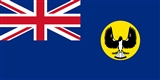
The current flag of South Australia was adopted on 13 January 1904, and is a British blue ensign defaced with the state badge. The badge is described as a Piping Shrike with wings outstretched on a yellow disc. The state badge is believed to have been designed by Robert Craig of the Adelaide School of Arts.
South Australia granted restricted women's suffrage in 1861, and in 1894 became the second place in the world to grant universal suffrage (after New Zealand) where women had the dual rights to vote and to stand for election.
GeographyThe terrain consists largely of arid and semi-arid rangelands, with several low mountain ranges in which the most important mountains are the Mt Lofty-Flinders Ranges system which extends north about from Cape Jervis to the northern end of Lake Torrens and salt lakes. The highest point in the state is not in those ranges, but Mount Woodroffe at in the Musgrave Ranges in the extreme northwest of the state. The western portion of the state consists of the sparsely-inhabited Nullarbor Plain fronting the cliffs of the Great Australian Bight.
The principal industries and exports of South Australia are wheat, wine and wool. More than half of Australia's wines are produced here.
South Australia has boundaries with every other Australian state and territory except the Australian Capital Territory and Tasmania. The area now known as the Northern Territory was annexed to South Australia in 1863, however it was handed over to the federal government in 1911 and became a separate territory. South Australia's south coast is flanked by the Southern Ocean.
ClimateIts mean temperature range is in January and in July. Daily temperatures in parts of the state in January and February can be up to .
The highest maximum temperature was recorded as at Oodnadatta on 2 January 1960, which is the highest official temperature recorded in Australia. The lowest minimum temperature was at Yongala on 20 July 1976
EconomyThe manufacturing industry plays a very important role in South Australia's economy, generating 15% of the state's Gross State Product (GSP) and playing a large part in exports. The manufacturing industry consists of automotive (44% of total Australian production, 2006) and component manufacturing, pharmaceuticals, defence technology (2.1% of GSP, 2002-2003) and electronic systems (3.0% of GSP in 2006). South Australia's economy relies on exports more than any other state in Australia. Export earnings stand at AUD$10 billion worth per year and grew by 8.8% from 2002 to 2003.
Production of South Australian food and drink (including agriculture, horticulture, aquaculture, fisheries and manufacturing) is a $10 billion industry.
South Australia's economic growth has lagged behind the rest of Australia for some time (2.1% from 2002 to 2003), but performance seems to be improving. South Australia's credit rating was upgraded to AAA+, having lost it in the State Bank collapse. South Australia's Gross State Product was AUD$48.9 billion starting 2004, making it AUD$32,996 per capita. Exports for 2006 were valued at $9.0bn with imports at $6.2bn. Private Residential Building Approvals experienced 80% growth over the year of 2006.
South Australia's economy includes the following major industries: meat and meat preparations, wheat, wine, wool and sheepskins, machinery,metal and metal manufactures, fish and crustaceans, road vehicles and parts, and petroleum products. Other industries, such as education and defence technology, are of growing importance.
South Australia receives the least amount of federal funding for its local road network than any other state on a per capita or per kilometre basis.
GovernmentSouth Australia is a constitutional monarchy with the Queen of Australia as Sovereign, and the Governor of South Australia as the head of state. It is a state of the Commonwealth of Australia. Its bicameral parliament consists of a House of Assembly (lower house) and a Legislative Council (upper house), with legislative elections held every four years. The current Premier of South Australia is Mike Rann, a member of the Australian Labor Party.
Initially, the Governor of South Australia held almost total power, derived from the Letters Patent of the Imperial Government to create the colony. He was only accountable to the British Colonial Office, and thus democracy did not exist in the colony. A new body was created to advise the governor on the administration of South Australia in 1843 called the Legislative Council. It consisted of three representatives of the British Government and four colonists appointed by the governor. The governor retained total executive power.
In 1851, the Imperial Parliament enacted the Australian Colonies Government Act which allowed for the election of representatives to each of the colonial legislatures and the drafting of a Constitution to properly create representative and responsible Government in South Australia and later that year, wealthy male colonists were allowed to vote for 16 members on a new 24 seat Legislative Council. Eight members continued to be appointed by the governor.
The main responsibility of this body was to draft a Constitution for South Australia. The body drafted the most democratic constitution ever before seen in the British Empire and provided for manhood suffrage. It created the bicameral Parliament of South Australia and the two houses of parliament. For the first time in the colony, the executive was elected by the people and the colony used the Westminster system where the government is the party or coalition that exerts a majority in the House of Assembly. In 1894, South Australia was the first Australian colony to allow women to vote and it had the first Parliament in the world to allow women to be elected as members. Catherine Helen Spence was the first woman in Australia to be a candidate for political office when she nominated to be one of South Australia's delegates to the constitutional conventions that drafted the Constitution. South Australia became an original state of the Commonwealth of Australia on 1 January 1901.
EducationEducation is compulsory for all children until age 16, however, the majority of students stay on to complete their South Australian Certificate of Education (SACE). School education is the responsibility of the South Australian government, but the public and private education systems are funded jointly by it and the Commonwealth Government. The South Australian Government provides, to schools on a per student basis, 89 percent of the total Government funding while the Commonwealth contributes 11 percent. Since the early 1970s it has been an ongoing controversy that 68 percent of Commonwealth funding (increasing to 75% by 2008) goes to private schools that are attended by 32% of the states students.
From 1 January 2009, the school leaving age will be raised to 17.
There are three universities in South Australia: University of Adelaide, Flinders University and University of South Australia . All are based in Adelaide, and Mount Gambier. Carnegie Mellon University's Heinz School and "Entertainment Technology Center" have campuses in Adelaide.
Tertiary vocational education is provided by TAFE South Australia colleges throughout the state.
SportAustralian rules football is the most popular sport in South Australia. The state has the highest participation rate of people taking part in Australian Football, with over 2.2% of the population aged 18 years and over participating in the sport. South Australia fields two teams, the Adelaide Crows and Port Adelaide Power in the Australian Football League national competition. The Adelaide Crows have a membership base of 50,000, higher than any of the other 15 teams in the competition. Both teams regularly draw large crowds. The South Australian National Football League, which owns the dedicated Australian Football stadium AAMI Stadium, is a popular local league comprising nine teams.
South Australia's soccer team in the new A-League is Adelaide United. Basketball also has a big following in South Australia with the Adelaide 36ers playing out an 8,070 seat stadium in Findon and winning four championships in the last 20 years in the National Basketball League (Australia). South Australia also has a cricket team, the Southern Redbacks, who play at Adelaide Oval in North Adelaide during the summer; however they have not won a title since 1996. The Redbacks currently have four players who hold a contract with Cricket Australia.
Fifty-nine percent of children take part in organised sports. For boys, soccer has the highest participation rate (22%) followed by swimming (16%). For girls netball is most popular (18%) followed by swimming (16%).
Notable places Regions:
Rivers:
|
Lakes:
Islands:
|
Main Highways:
|
See also
External links - Locals reflect on South Australian culture.
- Community resources
|
| |
|
|