

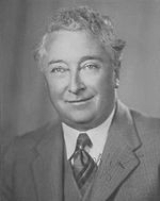
United Australia Party

Encyclopedia
The United Australia Party (UAP) was an Australia
n political party that was founded in 1931 and dissolved in 1945. It was the political successor to the Nationalist Party of Australia
(1917–1931) and predecessor to the Liberal Party of Australia
(1945). The party governed Australia for much of the 1930s, through Australia's recovery from the Great Depression
under Joseph Lyons
and into the early stages of the World War II
under Robert Menzies
.
 During the formation and early success of the United Australia Party, Australia was grappling with the immense challenges of the Great Depression.
Founding leader Joseph Lyons
began his political career as an Australian Labor Party
politician and served as Premier of Tasmania. Lyons was elected to the Australian Federal Parliament in 1929 and served in Prime Minister James Scullin
's Labor Cabinet. Lyons became acting Treasurer in 1930 and helped negotiate the government's strategies for dealing with the Great Depression
. With Scullin temporarily absent in London, Lyons and acting Prime Minister James Fenton
clashed with the Labor Cabinet and Caucus over economic policy, and grappled with the differing proposals of the Premier's Plan, Lang Labor
, the Commonwealth Bank and British adviser Otto Niemeyer
. While Health Minister Frank Anstey supported Premier of New South Wales Jack Lang's bid to default on debt repayments, Lyons advocated orthodox fiscal management. When Labor reinstated the more radical Ted Theodore
as Treasurer in 1931, Lyons and Fenton resigned from Cabinet.
. The stance of Labor ministers Joseph Lyons and James Fenton against the economic policies of the Scullin Labor Government and its Treasurer, Ted Theodore had attracted the support of prominent Australian conservatives, known as "the Group", whose number included future prime minister Robert Menzies. In parliament on 13 March 1931, though still a member of the ALP, Lyons supported a no confidence motion against the Scullin Labor government. The United Australia Party was then formed from a coalition of citizens’ groups and with the support of the Nationalist Party of Australia. Lyons quit the ALP to become parliamentary leader of the newly established United Australia Party, with John Latham, Nationalist Leader of the Opposition, becoming the new party's deputy leader.
The new party was formed when Labor Cabinet ministers Joseph Lyons and James Fenton, along with three other MPs on the right-wing of the Labor Party, left the Australian Labor Party in protest at the economic policies of the Scullin Government. The Nationalist opposition (hitherto led by John Latham), the five Labor dissidents (who had formed the All for Australia League), and former Prime Minister Billy Hughes
' Australian Party
(a group of former Nationalists who had been expelled for crossing the floor and bringing down Stanley Bruce
's Nationalist government in 1929), all united to form the new party. Lyons was chosen as the new party's leader, and thus became Leader of the Opposition).
Claiming that the Scullin government was incapable of managing the economy, it offered traditional deflationary economic policies in response to Australia's economic crisis. Though the bulk of its parliamentary membership were middle and upper-class ex-Nationalists, the presence of ex-Labor MPs with working-class backgrounds, most obviously the party leader, Lyons, allowed the party to present a convincing image of national unity transcending class barriers. Its slogan was "All for Australia and the Empire".
A further split, this time of left-wing NSW Labor MPs who supported the unorthodox economic policies of NSW Premier Jack Lang
, cost the Scullin government its parliamentary majority. In November 1931, Lang Labor dissidents chose to challenge the Scullin Labor government and align with the United Australia Party Opposition to pass a ‘no confidence’, forcing an early election. At the consquent election on 19 December, Labor lost all but 14 of its seats, and the United Australia Party commenced its first term in government in January 1932.
. After 1934 the UAP lost its majority in its own right, governing in the traditional conservative coalition
with the Country Party
of Earle Page
. The government followed the conservative economic policies it had promised in opposition, and benefited politically from the gradual worldwide economic recovery as the 1930s went on.
, intervened on the basis that Lang had acted illegally in breach of the state Audit Act and sacked the Lang Government, who then suffered a landslide loss at the consequent 1932 state election.
Australia entered the Depression with a debt crisis and a credit crisis. According to author Anne Henderson
of the Sydney Institute
, Lyons held a steadfast belief in "the need to balance budgets, lower costs to business and restore confidence" and the Lyons period gave Australia "stability and eventual growth" between the drama of the Depression and the outbreak of the Second World War. A lowering of wages was enforced and industry tariff protections maintained, which together with cheaper raw materials during the 1930s saw a shift from agriculture to manufacturing as the chief employer of the Australian economy - a shift which was consolidated by increased investment by the commonwealth government into defence and armaments manufacture. Lyons saw restoration of Australia's exports as the key to economic recovery. A devalued Australian currency assisted in restoring a favourable balance of trade. Tarriffs had been a point of difference between the Country Party and United Australia Party. The CP opposed high tariffs because they increased costs for farmers, while the UAP had support among manufacturers who supported tariffs. Lyons was therefore happy to be perceived as "protectionist". Australia agreed to give tariff preference to British Empire goods, following the 1932 Imperial economic conference. The Lyons Government lowered interest rates to stimulate expenditure. Another point of difference was the issue of establishing national unemployment insurance. Debate on this issue became strained with the Country Party opposing the plan. On this issue, the UAP deputy leader Robert Menzies and Country Party leader Earle Page would have a public falling out.
in Europe and militant Japan
in Asia. The UAP largely supported the western powers in their policy of appeasement, however veteran UAP minister Billy Hughes was an exception and he embarrassed the government with his 1935 book book Australia and the War Today which exposed a lack of preparation in Australia for what Hughes correctly supposed to be a coming war
. Hughes was force to resign, but the Lyons government tripled its defence budget.
. She had a busy official role from 1932 to 1939 and, following her husband's death, stood for Parliament herself, becoming Australia's first female Member of the House of Representatives, and later first woman in Cabinet, joining the Menzies Cabinet in 1951.
Nevertheless, by 1939, serious leadership ructions had begun to emerge in the UAP. The ambitious Deputy Leader Robert Menzies
sought to keep Lyons to his promise to resign in his favour. Menzies did not have widespread support, and was particularly disliked by the Country Party and its leader Earle Page
.
On 7 April 1939, with the storm clouds of the Second World War
gathering in Europe and the Pacific, Joseph Lyons became the first Prime Minister of Australia to die in office. Driving from Canberra to Sydney, en route to his home in Tasmania for Easter, he suffered a heart attack, dying soon after in hospital in Sydney, on Good Friday. The UAP's Deputy leader, Robert Menzies, had resigned in March, citing the coalition's failure to implement a plan for national insurance as the cause for his resignation. In the absence of a UAP deputy, the Governor-General, Lord Gowrie
, appointed Country Party leader Earl Page as his temporary replacement, pending the selection of Lyons' successor by the UAP.
Billy Hughes was narrowly defeated by Robert Menzies for the leadership of the United Australia Party and Menzies was sworn in as Prime Minister for the first time on 26 April 1939. Page refused to serve under Menzies and the UAP entered a period of minority government.
was sworn in as Prime Minister of Australia for the first time on 26 April 1939, following the death of Joseph Lyons. He led a minority United Australia Party government – Country Party leader Earle Page
had temporarily served as Prime Minister after the death of Lyons, but he refused to serve in a government led by Menzies, and withdrew the support of the Country Party from coalition with the UAP.
In addition to the office of Prime Minister, Menzies served as Treasurer. The First Menzies Ministry
included the ageing former Prime Minister Billy Hughes and the young future Prime Minister Harold Holt
. Menzies tried and failed to have the issue of national insurance examined by a committee of parliamentarians. Though no longer in formal coalition, his government survived because the Country Party preferred a UAP government to that of a Labor government.
Troubled by Britain's failure to increase defences at Singapore, Menzies was cautious in committing troops to Europe, nevertheless in 1940–41, Australian forces played prominent roles in the fighting in the Mediterranean theatre
.
A special War Cabinet was created;– initially composed of Menzies and five senior ministers (RG Casey
, GA Street, Senator McLeay, HS Gullet and World War I
Prime Minister Billy Hughes). In January 1940, Menzies dispatched potential leadership rival Richard Casey
to Washington as Australia's first "Minister to the United States". In a consequent by-election, the UAP suffered a heavy defeat and Menzies re-entered coalition negotiations with the Country Party. In March 1940, troubled negotiations were concluded with the Country Party to re-enter Coalition with the UAP. The replacement of Earl Page as leader by Archie Cameron
allowed Menzies to reach accommodation. A new Coalition ministry was formed including a number of country party members.
With the 1940 election looming, Menzies lost his Chief of the General Staff and three loyal ministers in a Royal Australian Airforce crash at Canberra airport. The Labor Party meanwhile experienced a split along pro and anti Communist lines over policy towards the Soviet Union for its co-operation with Nazi Germany in the invasion of Poland. The Communist Party of Australia
(CPA) opposed and sought to disrupt Australia's war effort. Menzies banned the CPA after the fall of France in 1940, but by 1941 Stalin was forced to join the allied cause when Hitler reneged on the Pact and invaded the USSR. The USSR came to bear the brunt of the carnage of Hitler's war machine and the Communist Party in Australia lost its early war stigma as a result.
At the general election in September 1940, there was a large swing to Labor and the UAP-Country Party coalition lost its majority, continuing in office only because of the support of two independent MPs, Arthur Coles
and Alexander Wilson
. The UAP–Country Party coalition and the Labor parties won 36 seats each. Menzies proposed an all party unity government to break the impasse, but the Labor Party refused to join. Curtin agreed instead to take a seat on a newly created Advisory War Council in October 1940. New Country Party leader Arthur Fadden
became Treasurer and Menzies unhappily conceded to allow Earle Page back into his ministry.
In January 1941, Menzies flew to Britain to discuss the weakness of Singapore's defences and sat with Winston Churchill
's British War Cabinet. En route he inspected Singapore's defences – finding the alarmingly inadequate – and visited Australian troops in the Mid-East. He at times clashed with Churchill in the War Cabinet, and was unable to achieve significant assurances for increased commitment to Singapore's defences, but undertook morale boosting excursions to war affected cities and factories and was well received by the British press and generally raised awareness in Britain of Australia's contribution to its war effort. He Returned to Australia via Canada and the United States - addressing the Canadian parliament and lobbying President Roosevelt for more arms production. After four months, Menzies returned to Australia to face a lack of enthusiasm for his global travels and a war-time minority government under ever increasing strain.
In Menzies's absence, John Curtin had co-operated with Deputy Prime Minister Arthur Fadden of the Country Party in preparing Australia for the expected Pacific War
. With the threat of Japan imminent and with the Australian army suffering badly in the Greek
and Crete
campaigns, Menzies re-organised his ministry and announced multiple multi-party committees to advise on war and economic policy. Government critics however called for an all-party government.
, leader of the Country Party, to be his his successor as Prime Minister of Australia, while the The United Australia Party elected veteran World War I Prime Minister Billy Hughes to replace Menzies as party leader. Hughes also became and Attorney-General and Minister for the Navy . With Menzies out and the aged Hughes seen as a stop-gap leader UAP members jostled for position as the coalition entered a brief 40 day period of governance: Fadden was Prime Minister from 29 August to 7 October 1941.
There was a dispute within the UAP and Country Party immediately after going into Opposition about who should be the official Leader of the Opposition. Menzies, as leader of the UAP, the larger opposition party, thought it should be him, but the majority of the UAP MPs thought Fadden and the Country Party should keep overall leadership of the conservative forces. Contemptuous of his party's timidity, Menzies resigned the leadership, and Billy Hughes, the frail 79-year old former Prime Minister, became party leader and deputy Leader of the Opposition under Fadden.
Australia marked two years of war on 7 September 1941 with a day of prayer, on which Prime Minister Fadden broadcast to the nation an exhortation to be united in the ‘supreme task of defeating the forces of evil in the world". With the Pacific on the brink of war, Opposition leader John Curtin offered friendship and co-operation to Fadden, but refused to join in an an all-party wartime national government.
On 3 October, the independents, Arthur Coles and Alex Wilson, voted with the Opposition in the House of Representatives to reject Fadden’s budget and the government fell. To date, the UAP is the last Australian governing party to have been defeated as a result of losing the confidence of the House of Representatives. Curtin was sworn in as Prime Minister on 7 October 1941. Eight weeks later, Japan attacked Pearl Harbor
.
, the Fadden-Hughes Coalition suffered a massive defeat.
After this election defeat Menzies returned to the UAP leadership, but the party and its organisation now seemed moribund. UAP branches tended to become inactive between elections, and its politicians were seen as compromised by their reliance on large donations from business and financial organisations.
Menzies was convinced that the UAP was no longer viable, and a new anti-Labor party needed to be formed to replace it. The UAP was absorbed into the new Liberal Party of Australia
(with Menzies as leader) at the founding of the latter organisation on 31 August 1945. The Liberal Party of Australia went on to become the dominant centre-right party in Australian politics. After an initial loss to Labor at the 1946 election
, Menzies led the Liberals to victory at the 1949 election
against the incumbent Labor government led by Ben Chifley
, and the Coalition stayed in office for a record 23 years.
Australia
Australia , officially the Commonwealth of Australia, is a country in the Southern Hemisphere comprising the mainland of the Australian continent, the island of Tasmania, and numerous smaller islands in the Indian and Pacific Oceans. It is the world's sixth-largest country by total area...
n political party that was founded in 1931 and dissolved in 1945. It was the political successor to the Nationalist Party of Australia
Nationalist Party of Australia
The Nationalist Party of Australia was an Australian political party. It was formed on 17 February 1917 from a merger between the conservative Commonwealth Liberal Party and the National Labor Party, the name given to the pro-conscription defectors from the Australian Labor Party led by Prime...
(1917–1931) and predecessor to the Liberal Party of Australia
Liberal Party of Australia
The Liberal Party of Australia is an Australian political party.Founded a year after the 1943 federal election to replace the United Australia Party, the centre-right Liberal Party typically competes with the centre-left Australian Labor Party for political office...
(1945). The party governed Australia for much of the 1930s, through Australia's recovery from the Great Depression
Great Depression
The Great Depression was a severe worldwide economic depression in the decade preceding World War II. The timing of the Great Depression varied across nations, but in most countries it started in about 1929 and lasted until the late 1930s or early 1940s...
under Joseph Lyons
Joseph Lyons
Joseph Aloysius Lyons, CH was an Australian politician. He was Labor Premier of Tasmania from 1923 to 1928 and a Minister in the James Scullin government from 1929 until his resignation from the Labor Party in March 1931...
and into the early stages of the World War II
World War II
World War II, or the Second World War , was a global conflict lasting from 1939 to 1945, involving most of the world's nations—including all of the great powers—eventually forming two opposing military alliances: the Allies and the Axis...
under Robert Menzies
Robert Menzies
Sir Robert Gordon Menzies, , Australian politician, was the 12th and longest-serving Prime Minister of Australia....
.
Background
Founding leader Joseph Lyons
Joseph Lyons
Joseph Aloysius Lyons, CH was an Australian politician. He was Labor Premier of Tasmania from 1923 to 1928 and a Minister in the James Scullin government from 1929 until his resignation from the Labor Party in March 1931...
began his political career as an Australian Labor Party
Australian Labor Party
The Australian Labor Party is an Australian political party. It has been the governing party of the Commonwealth of Australia since the 2007 federal election. Julia Gillard is the party's federal parliamentary leader and Prime Minister of Australia...
politician and served as Premier of Tasmania. Lyons was elected to the Australian Federal Parliament in 1929 and served in Prime Minister James Scullin
James Scullin
James Henry Scullin , Australian Labor politician and the ninth Prime Minister of Australia. Two days after he was sworn in as Prime Minister, the Wall Street Crash of 1929 occurred, marking the beginning of the Great Depression and subsequent Great Depression in Australia.-Early life:Scullin was...
's Labor Cabinet. Lyons became acting Treasurer in 1930 and helped negotiate the government's strategies for dealing with the Great Depression
Great Depression
The Great Depression was a severe worldwide economic depression in the decade preceding World War II. The timing of the Great Depression varied across nations, but in most countries it started in about 1929 and lasted until the late 1930s or early 1940s...
. With Scullin temporarily absent in London, Lyons and acting Prime Minister James Fenton
James Fenton (Australian politician)
James Edward Fenton CMG was an Australian politician. He is notable for having been appointed a cabinet minister by two governments of different political complexions, but resigning from both governments on matters of principle.Born at Nette Yallock, near Avoca, Victoria, Fenton was educated at a...
clashed with the Labor Cabinet and Caucus over economic policy, and grappled with the differing proposals of the Premier's Plan, Lang Labor
Jack Lang
Jack Lang may refer to:*Jack Lang *Jack Lang *Jack Lang , former American football player*Jack Lang , American sportswriter...
, the Commonwealth Bank and British adviser Otto Niemeyer
Otto Niemeyer
Sir Otto Ernst Niemeyer, GBE, KCB was financial controller at the Treasury and a director at the Bank of England. He was also treasurer of the National Association of Mental Health post World War II...
. While Health Minister Frank Anstey supported Premier of New South Wales Jack Lang's bid to default on debt repayments, Lyons advocated orthodox fiscal management. When Labor reinstated the more radical Ted Theodore
Ted Theodore
Edward Granville Theodore was an Australian politician. He was Premier of Queensland 1919–25, a federal politician representing a New South Wales seat 1927–31, and Federal Treasurer 1929–30.-Early life:...
as Treasurer in 1931, Lyons and Fenton resigned from Cabinet.
Foundation
The UAP was formed in 1931 by Labor dissidents and a conservative coalition as a response to the more radical economic proposals of Labor Party members to deal with the Great Depression in AustraliaGreat Depression in Australia
Australia suffered badly during the period of the Great Depression of the 1930s. The Depression began with the Wall Street Crash of October, 1929 and rapidly spread worldwide. As in other nations, Australia suffered years of high unemployment, poverty, low profits, deflation, plunging incomes, and...
. The stance of Labor ministers Joseph Lyons and James Fenton against the economic policies of the Scullin Labor Government and its Treasurer, Ted Theodore had attracted the support of prominent Australian conservatives, known as "the Group", whose number included future prime minister Robert Menzies. In parliament on 13 March 1931, though still a member of the ALP, Lyons supported a no confidence motion against the Scullin Labor government. The United Australia Party was then formed from a coalition of citizens’ groups and with the support of the Nationalist Party of Australia. Lyons quit the ALP to become parliamentary leader of the newly established United Australia Party, with John Latham, Nationalist Leader of the Opposition, becoming the new party's deputy leader.
The new party was formed when Labor Cabinet ministers Joseph Lyons and James Fenton, along with three other MPs on the right-wing of the Labor Party, left the Australian Labor Party in protest at the economic policies of the Scullin Government. The Nationalist opposition (hitherto led by John Latham), the five Labor dissidents (who had formed the All for Australia League), and former Prime Minister Billy Hughes
Billy Hughes
William Morris "Billy" Hughes, CH, KC, MHR , Australian politician, was the seventh Prime Minister of Australia from 1915 to 1923....
' Australian Party
Australian Party
The Australian Party can refer to a number of political parties in Australia's history, most recently to the party started by Queensland independent MP Bob Katter known as Katter's Australian Party...
(a group of former Nationalists who had been expelled for crossing the floor and bringing down Stanley Bruce
Stanley Bruce
Stanley Melbourne Bruce, 1st Viscount Bruce of Melbourne, CH, MC, FRS, PC , was an Australian politician and diplomat, and the eighth Prime Minister of Australia. He was the second Australian granted an hereditary peerage of the United Kingdom, but the first whose peerage was formally created...
's Nationalist government in 1929), all united to form the new party. Lyons was chosen as the new party's leader, and thus became Leader of the Opposition).
Claiming that the Scullin government was incapable of managing the economy, it offered traditional deflationary economic policies in response to Australia's economic crisis. Though the bulk of its parliamentary membership were middle and upper-class ex-Nationalists, the presence of ex-Labor MPs with working-class backgrounds, most obviously the party leader, Lyons, allowed the party to present a convincing image of national unity transcending class barriers. Its slogan was "All for Australia and the Empire".
A further split, this time of left-wing NSW Labor MPs who supported the unorthodox economic policies of NSW Premier Jack Lang
Jack Lang (Australian politician)
John Thomas Lang , usually referred to as J.T. Lang during his career, and familiarly known as "Jack" and nicknamed "The Big Fella" was an Australian politician who was Premier of New South Wales for two terms...
, cost the Scullin government its parliamentary majority. In November 1931, Lang Labor dissidents chose to challenge the Scullin Labor government and align with the United Australia Party Opposition to pass a ‘no confidence’, forcing an early election. At the consquent election on 19 December, Labor lost all but 14 of its seats, and the United Australia Party commenced its first term in government in January 1932.
Lyons Government
With the Labor Party split between Scullin's supporters and Langites, and with a very popular leader (Lyons had a genial manner and the common touch), the UAP won the subsequent parliamentary elections in December 1931 in a massive landslide, winning a majority in its own right, and Lyons became Prime MinisterPrime Minister of Australia
The Prime Minister of the Commonwealth of Australia is the highest minister of the Crown, leader of the Cabinet and Head of Her Majesty's Australian Government, holding office on commission from the Governor-General of Australia. The office of Prime Minister is, in practice, the most powerful...
. After 1934 the UAP lost its majority in its own right, governing in the traditional conservative coalition
Coalition (Australia)
The Coalition in Australian politics refers to a group of centre-right parties that has existed in the form of a coalition agreement since 1922...
with the Country Party
National Party of Australia
The National Party of Australia is an Australian political party.Traditionally representing graziers, farmers and rural voters generally, it began as the The Country Party, but adopted the name The National Country Party in 1975, changed to The National Party of Australia in 1982. The party is...
of Earle Page
Earle Page
Sir Earle Christmas Grafton Page, GCMG, CH was the 11th Prime Minister of Australia, and is to date the second-longest serving federal parliamentarian in Australian history, with 41 years, 361 days in Parliament.-Early life:...
. The government followed the conservative economic policies it had promised in opposition, and benefited politically from the gradual worldwide economic recovery as the 1930s went on.
Response to Depression
Lyons favoured the tough economic measures of the "Premiers' Plan", pursued an orthodox fiscal policy and refused to accept NSW Premier Jack Lang's proposals to default on overseas debt repayments. A dramatic episode in Australian history followed Lyons' first electoral victory when NSW Premier Jack Lang refused to pay interest on overseas State debts. The Lyons government stepped in and paid the debts and then passed the Financial Agreement Enforcement Act to recover the money it had paid. In an effort to frustrate this move, Lang ordered State departments to pay all receipts directly to the Treasury instead of into Government bank accounts. The New South Wales Governor, Sir Philip GamePhilip Game
Air Vice-Marshal Sir Philip Woolcott Game GCB, GCVO, GBE, KCMG, DSO was a British Royal Air Force commander, who later served as Governor of New South Wales and Commissioner of Police of the Metropolis...
, intervened on the basis that Lang had acted illegally in breach of the state Audit Act and sacked the Lang Government, who then suffered a landslide loss at the consequent 1932 state election.
Australia entered the Depression with a debt crisis and a credit crisis. According to author Anne Henderson
Anne Henderson
Anne Henderson is an Australian writer, best known as the Deputy Director of The Sydney Institute and editor of The Sydney Papers....
of the Sydney Institute
Sydney Institute
The Sydney Institute, founded in 1989, is a privately funded, conservative, Australian current affairs forum. The Sydney Institute took over the resources of the Sydney Institute of Public Affairs which ceased activity in the late 1980s...
, Lyons held a steadfast belief in "the need to balance budgets, lower costs to business and restore confidence" and the Lyons period gave Australia "stability and eventual growth" between the drama of the Depression and the outbreak of the Second World War. A lowering of wages was enforced and industry tariff protections maintained, which together with cheaper raw materials during the 1930s saw a shift from agriculture to manufacturing as the chief employer of the Australian economy - a shift which was consolidated by increased investment by the commonwealth government into defence and armaments manufacture. Lyons saw restoration of Australia's exports as the key to economic recovery. A devalued Australian currency assisted in restoring a favourable balance of trade. Tarriffs had been a point of difference between the Country Party and United Australia Party. The CP opposed high tariffs because they increased costs for farmers, while the UAP had support among manufacturers who supported tariffs. Lyons was therefore happy to be perceived as "protectionist". Australia agreed to give tariff preference to British Empire goods, following the 1932 Imperial economic conference. The Lyons Government lowered interest rates to stimulate expenditure. Another point of difference was the issue of establishing national unemployment insurance. Debate on this issue became strained with the Country Party opposing the plan. On this issue, the UAP deputy leader Robert Menzies and Country Party leader Earle Page would have a public falling out.
Preparation for war
Defence issues became increasingly dominant in public affairs with the rise of fascismFascism
Fascism is a radical authoritarian nationalist political ideology. Fascists seek to rejuvenate their nation based on commitment to the national community as an organic entity, in which individuals are bound together in national identity by suprapersonal connections of ancestry, culture, and blood...
in Europe and militant Japan
Empire of Japan
The Empire of Japan is the name of the state of Japan that existed from the Meiji Restoration on 3 January 1868 to the enactment of the post-World War II Constitution of...
in Asia. The UAP largely supported the western powers in their policy of appeasement, however veteran UAP minister Billy Hughes was an exception and he embarrassed the government with his 1935 book book Australia and the War Today which exposed a lack of preparation in Australia for what Hughes correctly supposed to be a coming war
World War II
World War II, or the Second World War , was a global conflict lasting from 1939 to 1945, involving most of the world's nations—including all of the great powers—eventually forming two opposing military alliances: the Allies and the Axis...
. Hughes was force to resign, but the Lyons government tripled its defence budget.
Lyons prime ministership
According to author Brian Carroll, Lyons had been underestimated when he assumed office in 1932 and as leader he demonstrated: "a combination of honesty, native shrewdness, tact, administrative ability, common sense, good luck and good humour that kept him in the job longer than any previous Prime Minister except Hughes". Lyons was assisted in his campaigning by his politically active wife, Enid LyonsEnid Lyons
Dame Enid Muriel Lyons, AD, GBE was an Australian politician and the first woman to be elected to the Australian House of Representatives as well as the first woman appointed to the federal Cabinet...
. She had a busy official role from 1932 to 1939 and, following her husband's death, stood for Parliament herself, becoming Australia's first female Member of the House of Representatives, and later first woman in Cabinet, joining the Menzies Cabinet in 1951.
Nevertheless, by 1939, serious leadership ructions had begun to emerge in the UAP. The ambitious Deputy Leader Robert Menzies
Robert Menzies
Sir Robert Gordon Menzies, , Australian politician, was the 12th and longest-serving Prime Minister of Australia....
sought to keep Lyons to his promise to resign in his favour. Menzies did not have widespread support, and was particularly disliked by the Country Party and its leader Earle Page
Earle Page
Sir Earle Christmas Grafton Page, GCMG, CH was the 11th Prime Minister of Australia, and is to date the second-longest serving federal parliamentarian in Australian history, with 41 years, 361 days in Parliament.-Early life:...
.
On 7 April 1939, with the storm clouds of the Second World War
World War II
World War II, or the Second World War , was a global conflict lasting from 1939 to 1945, involving most of the world's nations—including all of the great powers—eventually forming two opposing military alliances: the Allies and the Axis...
gathering in Europe and the Pacific, Joseph Lyons became the first Prime Minister of Australia to die in office. Driving from Canberra to Sydney, en route to his home in Tasmania for Easter, he suffered a heart attack, dying soon after in hospital in Sydney, on Good Friday. The UAP's Deputy leader, Robert Menzies, had resigned in March, citing the coalition's failure to implement a plan for national insurance as the cause for his resignation. In the absence of a UAP deputy, the Governor-General, Lord Gowrie
Lord Gowrie
Lord Gowrie may refer* Alexander Hore-Ruthven, 1st Earl of Gowrie* William Ruthven, 1st Earl of Gowrie...
, appointed Country Party leader Earl Page as his temporary replacement, pending the selection of Lyons' successor by the UAP.
Billy Hughes was narrowly defeated by Robert Menzies for the leadership of the United Australia Party and Menzies was sworn in as Prime Minister for the first time on 26 April 1939. Page refused to serve under Menzies and the UAP entered a period of minority government.
Menzies Government
Robert MenziesRobert Menzies
Sir Robert Gordon Menzies, , Australian politician, was the 12th and longest-serving Prime Minister of Australia....
was sworn in as Prime Minister of Australia for the first time on 26 April 1939, following the death of Joseph Lyons. He led a minority United Australia Party government – Country Party leader Earle Page
Earle Page
Sir Earle Christmas Grafton Page, GCMG, CH was the 11th Prime Minister of Australia, and is to date the second-longest serving federal parliamentarian in Australian history, with 41 years, 361 days in Parliament.-Early life:...
had temporarily served as Prime Minister after the death of Lyons, but he refused to serve in a government led by Menzies, and withdrew the support of the Country Party from coalition with the UAP.
In addition to the office of Prime Minister, Menzies served as Treasurer. The First Menzies Ministry
First Menzies Ministry
The First Menzies Ministry was the twenty-sixth Australian Commonwealth ministry, and ran from 26 April 1939 to 14 March 1940.United Australia Party*Rt Hon Robert Menzies, KC MP: Prime Minister, Treasurer...
included the ageing former Prime Minister Billy Hughes and the young future Prime Minister Harold Holt
Harold Holt
Harold Edward Holt, CH was an Australian politician and the 17th Prime Minister of Australia.His term as Prime Minister was brought to an early and dramatic end in December 1967 when he disappeared while swimming at Cheviot Beach near Portsea, Victoria, and was presumed drowned.Holt spent 32 years...
. Menzies tried and failed to have the issue of national insurance examined by a committee of parliamentarians. Though no longer in formal coalition, his government survived because the Country Party preferred a UAP government to that of a Labor government.
World War II
The growing threat of war dominated politics through 1939. Menzies supported British policy against Hitler's Germany (negotiate for peace, but prepare for war) and – fearing Japanese intentions in the Pacific – established independent embassies in Tokyo and Washington in order to receive independent advice about developments. Menzies announced Australia's entry into World War Two on 3 September 1939 as a consequence of Nazi Germany's invasion of Poland. Australia was ill-prepared for war. A National Security Act was passed, the recruitment of a volunteer military force for service at home and abroad was announced, the 2nd Australian Imperial Force, and a citizen militia was organised for local defence.Troubled by Britain's failure to increase defences at Singapore, Menzies was cautious in committing troops to Europe, nevertheless in 1940–41, Australian forces played prominent roles in the fighting in the Mediterranean theatre
Mediterranean Theatre of World War II
The African, Mediterranean and Middle East theatres encompassed the naval, land, and air campaigns fought between the Allied and Axis forces in the Mediterranean Basin, the Middle East and Africa...
.
A special War Cabinet was created;– initially composed of Menzies and five senior ministers (RG Casey
Richard Casey, Baron Casey
Richard Gardiner Casey, Baron Casey KG GCMG CH DSO MC KStJ PC was an Australian politician, diplomat and the 16th Governor-General of Australia.-Early life:...
, GA Street, Senator McLeay, HS Gullet and World War I
World War I
World War I , which was predominantly called the World War or the Great War from its occurrence until 1939, and the First World War or World War I thereafter, was a major war centred in Europe that began on 28 July 1914 and lasted until 11 November 1918...
Prime Minister Billy Hughes). In January 1940, Menzies dispatched potential leadership rival Richard Casey
Richard Casey
Richard Casey may refer to:*Richard Casey, Baron Casey , Australian politician and diplomat*Richard C. Casey , U.S. District Judge for the Southern District of New York...
to Washington as Australia's first "Minister to the United States". In a consequent by-election, the UAP suffered a heavy defeat and Menzies re-entered coalition negotiations with the Country Party. In March 1940, troubled negotiations were concluded with the Country Party to re-enter Coalition with the UAP. The replacement of Earl Page as leader by Archie Cameron
Archie Cameron
Archie Galbraith Cameron , was an Australian politician. He was Leader of the Country Party 1939-40, and Speaker of the House of Representatives 1950-56.-Biography:...
allowed Menzies to reach accommodation. A new Coalition ministry was formed including a number of country party members.
With the 1940 election looming, Menzies lost his Chief of the General Staff and three loyal ministers in a Royal Australian Airforce crash at Canberra airport. The Labor Party meanwhile experienced a split along pro and anti Communist lines over policy towards the Soviet Union for its co-operation with Nazi Germany in the invasion of Poland. The Communist Party of Australia
Communist Party of Australia
The Communist Party of Australia was founded in 1920 and dissolved in 1991; it was succeeded by the Socialist Party of Australia, which then renamed itself, becoming the current Communist Party of Australia. The CPA achieved its greatest political strength in the 1940s and faced an attempted...
(CPA) opposed and sought to disrupt Australia's war effort. Menzies banned the CPA after the fall of France in 1940, but by 1941 Stalin was forced to join the allied cause when Hitler reneged on the Pact and invaded the USSR. The USSR came to bear the brunt of the carnage of Hitler's war machine and the Communist Party in Australia lost its early war stigma as a result.
At the general election in September 1940, there was a large swing to Labor and the UAP-Country Party coalition lost its majority, continuing in office only because of the support of two independent MPs, Arthur Coles
Arthur Coles
Sir Arthur William Coles was a prominent Australian businessman and philanthropist.With his brothers Coles founded the Coles Variety Stores in the 1920s, which were to become one of the two largest supermarket chains in Australia now known as Coles Group...
and Alexander Wilson
Alexander Wilson (Australian politician)
Alexander Wilson was an Australian wheat farmer and politician.-Biography:Born in County Down, Ireland, he was educated at Belfast and migrated to Australia in 1908, becoming a farmer at Ultima, Victoria. He was prominent as a leader of Victorian wheatgrowers...
. The UAP–Country Party coalition and the Labor parties won 36 seats each. Menzies proposed an all party unity government to break the impasse, but the Labor Party refused to join. Curtin agreed instead to take a seat on a newly created Advisory War Council in October 1940. New Country Party leader Arthur Fadden
Arthur Fadden
Sir Arthur William Fadden, GCMG was an Australian politician and, briefly, the 13th Prime Minister of Australia.-Introduction:...
became Treasurer and Menzies unhappily conceded to allow Earle Page back into his ministry.
In January 1941, Menzies flew to Britain to discuss the weakness of Singapore's defences and sat with Winston Churchill
Winston Churchill
Sir Winston Leonard Spencer-Churchill, was a predominantly Conservative British politician and statesman known for his leadership of the United Kingdom during the Second World War. He is widely regarded as one of the greatest wartime leaders of the century and served as Prime Minister twice...
's British War Cabinet. En route he inspected Singapore's defences – finding the alarmingly inadequate – and visited Australian troops in the Mid-East. He at times clashed with Churchill in the War Cabinet, and was unable to achieve significant assurances for increased commitment to Singapore's defences, but undertook morale boosting excursions to war affected cities and factories and was well received by the British press and generally raised awareness in Britain of Australia's contribution to its war effort. He Returned to Australia via Canada and the United States - addressing the Canadian parliament and lobbying President Roosevelt for more arms production. After four months, Menzies returned to Australia to face a lack of enthusiasm for his global travels and a war-time minority government under ever increasing strain.
In Menzies's absence, John Curtin had co-operated with Deputy Prime Minister Arthur Fadden of the Country Party in preparing Australia for the expected Pacific War
Pacific War
The Pacific War, also sometimes called the Asia-Pacific War refers broadly to the parts of World War II that took place in the Pacific Ocean, its islands, and in East Asia, then called the Far East...
. With the threat of Japan imminent and with the Australian army suffering badly in the Greek
Battle of Greece
The Battle of Greece is the common name for the invasion and conquest of Greece by Nazi Germany in April 1941. Greece was supported by British Commonwealth forces, while the Germans' Axis allies Italy and Bulgaria played secondary roles...
and Crete
Battle of Crete
The Battle of Crete was a battle during World War II on the Greek island of Crete. It began on the morning of 20 May 1941, when Nazi Germany launched an airborne invasion of Crete under the code-name Unternehmen Merkur...
campaigns, Menzies re-organised his ministry and announced multiple multi-party committees to advise on war and economic policy. Government critics however called for an all-party government.
Menzies resignation
In August, Cabinet decided that Menzies should travel back to Britain to represent Australia in the War Cabinet – but this time the Labor caucus refused to support the plan. Menzies announced to his Cabinet that he thought he should resign and advise the Governor General to invite John Curtin to form Government. The Cabinet instead insisted he approach Curtin again to form a war cabinet. Unable to secure Curtin's support, and with an unworkable parliamentary majority, Menzies faced continuing problems with the administration of the war effort and the undermining of his leadership by members of his own coalition. Menzies resigned as Prime Minister and leader of the UAP on 29 August 1941.Fadden Government
Menzies resigned on 28 August 1941 and a joint United Australia Party–Country Party meeting chose Arthur FaddenArthur Fadden
Sir Arthur William Fadden, GCMG was an Australian politician and, briefly, the 13th Prime Minister of Australia.-Introduction:...
, leader of the Country Party, to be his his successor as Prime Minister of Australia, while the The United Australia Party elected veteran World War I Prime Minister Billy Hughes to replace Menzies as party leader. Hughes also became and Attorney-General and Minister for the Navy . With Menzies out and the aged Hughes seen as a stop-gap leader UAP members jostled for position as the coalition entered a brief 40 day period of governance: Fadden was Prime Minister from 29 August to 7 October 1941.
There was a dispute within the UAP and Country Party immediately after going into Opposition about who should be the official Leader of the Opposition. Menzies, as leader of the UAP, the larger opposition party, thought it should be him, but the majority of the UAP MPs thought Fadden and the Country Party should keep overall leadership of the conservative forces. Contemptuous of his party's timidity, Menzies resigned the leadership, and Billy Hughes, the frail 79-year old former Prime Minister, became party leader and deputy Leader of the Opposition under Fadden.
Australia marked two years of war on 7 September 1941 with a day of prayer, on which Prime Minister Fadden broadcast to the nation an exhortation to be united in the ‘supreme task of defeating the forces of evil in the world". With the Pacific on the brink of war, Opposition leader John Curtin offered friendship and co-operation to Fadden, but refused to join in an an all-party wartime national government.
On 3 October, the independents, Arthur Coles and Alex Wilson, voted with the Opposition in the House of Representatives to reject Fadden’s budget and the government fell. To date, the UAP is the last Australian governing party to have been defeated as a result of losing the confidence of the House of Representatives. Curtin was sworn in as Prime Minister on 7 October 1941. Eight weeks later, Japan attacked Pearl Harbor
Attack on Pearl Harbor
The attack on Pearl Harbor was a surprise military strike conducted by the Imperial Japanese Navy against the United States naval base at Pearl Harbor, Hawaii, on the morning of December 7, 1941...
.
Demise of the party
Curtin proved a popular leader, rallying the nation in the face of the danger of invasion by the Japanese after Japan's entry into the war in December 1941. The Labor government seemed more effective than its predecessor, and the UAP and the Country Party, in opposition, made little political mileage against it. In the 1943 federal electionAustralian federal election, 1943
Federal elections were held in Australia on 21 August 1943. All 74 seats in the House of Representatives, and 19 of the 36 seats in the Senate were up for election. The incumbent Australian Labor Party led by Prime Minister of Australia John Curtin easily defeated the opposition Country Party led...
, the Fadden-Hughes Coalition suffered a massive defeat.
After this election defeat Menzies returned to the UAP leadership, but the party and its organisation now seemed moribund. UAP branches tended to become inactive between elections, and its politicians were seen as compromised by their reliance on large donations from business and financial organisations.
Menzies was convinced that the UAP was no longer viable, and a new anti-Labor party needed to be formed to replace it. The UAP was absorbed into the new Liberal Party of Australia
Liberal Party of Australia
The Liberal Party of Australia is an Australian political party.Founded a year after the 1943 federal election to replace the United Australia Party, the centre-right Liberal Party typically competes with the centre-left Australian Labor Party for political office...
(with Menzies as leader) at the founding of the latter organisation on 31 August 1945. The Liberal Party of Australia went on to become the dominant centre-right party in Australian politics. After an initial loss to Labor at the 1946 election
Australian federal election, 1946
Federal elections were held in Australia on 28 September 1946. All 74 seats in the House of Representatives, and 19 of the 36 seats in the Senate were up for election...
, Menzies led the Liberals to victory at the 1949 election
Australian federal election, 1949
Federal elections were held in Australia on 10 December 1949. All 121 seats in the House of Representatives, and 42 of the 60 seats in the Senate were up for election, where the single transferable vote was introduced...
against the incumbent Labor government led by Ben Chifley
Ben Chifley
Joseph Benedict Chifley , Australian politician, was the 16th Prime Minister of Australia. He took over the Australian Labor Party leadership and Prime Ministership after the death of John Curtin in 1945, and went on to retain government at the 1946 election, before being defeated at the 1949...
, and the Coalition stayed in office for a record 23 years.
Leaders
- Joseph LyonsJoseph LyonsJoseph Aloysius Lyons, CH was an Australian politician. He was Labor Premier of Tasmania from 1923 to 1928 and a Minister in the James Scullin government from 1929 until his resignation from the Labor Party in March 1931...
1931-1939 - Robert MenziesRobert MenziesSir Robert Gordon Menzies, , Australian politician, was the 12th and longest-serving Prime Minister of Australia....
1939-1941 - Billy HughesBilly HughesWilliam Morris "Billy" Hughes, CH, KC, MHR , Australian politician, was the seventh Prime Minister of Australia from 1915 to 1923....
1941-1943 - Robert MenziesRobert MenziesSir Robert Gordon Menzies, , Australian politician, was the 12th and longest-serving Prime Minister of Australia....
1943-1945