


Australian Army

Encyclopedia
The Australian Army is Australia's military land force. It is part of the Australian Defence Force
(ADF) along with the Royal Australian Navy
and the Royal Australian Air Force
. While the Chief of Defence (CDF) commands the Australian Defence Force (ADF), the Army is commanded by the Chief of Army (CA). The CA is therefore subordinate to the CDF, but is also directly responsible to the Minister for Defence. Although Australian soldiers have been involved in a number of minor and major conflicts throughout its history, only in World War II
has Australian territory come under direct attack.
The Australian Army's mission is to provide a potent, versatile, and updated Army to promote the security of Australia and protect its people. Further, the Army's key doctrine publication, The Fundamentals of Land Warfare, states that "the Army’s mission is to win the land battle".
.jpg) During its history the Australian Army has fought a large number of major wars, including: Second Boer War
During its history the Australian Army has fought a large number of major wars, including: Second Boer War
(1899–1902), First World War (1914–1918), the Second World War (1939–1945), Korea War (1950–1953), Malayan Emergency
(1950–1960), Indonesia-Malaysia Confrontation
(1962–1966), Vietnam War
(1962–1973) and more recently in Afghanistan
(2001 – Present) and Iraq
(2003 – Present). However, since 1947 it has also been involved in many peacekeeping operations, usually under the auspices of the United Nations
. The largest one began in 1999 in East Timor. Other notable operations include peacekeeping on Bougainville
and in the Solomon Islands
, which are still ongoing to this day. Humanitarian relief after 2004 Indian Ocean earthquake
in Aceh
Province, Indonesia
, Operation Sumatra Assist
, ended on 24 March 2005.
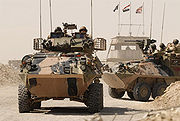
takes responsibility for the majority of the regular army, while 2nd Division under the command of Forces Command is the main home defence formation, containing Army Reserve units. Only the 1st Division's headquarters is deployable, however, as the 2nd Division's headquarters only performs administrative functions. The Australian Army has not deployed a divisional sized formation since 1945 and does not expect to do so in the future.
is a command formation of equal status to the other commands in the ADF. It is a brigade sized formation responsible for all of Australia's special forces
assets.
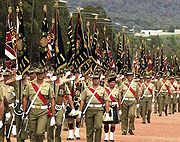
 Infantry, and some other combat units of the Australian Army carry flags called the Queen's colour and the Regimental Colour, known as 'the Colours'. Armoured units carry Guidons – flags smaller than Colours traditionally carried by Cavalry, Lancer, Light Horse and Mounted Infantry units. Artillery units' Guns are considered to be their Colours, and on parade are provided with the same respect. Non-combat units (combat service support corps) do not have Colours, as Colours are battle flags and so are only available to combat units. As a substitute, many have Standards or Banners. Units awarded battle honours have them emblazoned on their Colours, Standards and Guidons. They are a link to the Unit's past and a memorial to the fallen. Artillery do not have Battle Honours; their single Honour is "Ubique" which means "Everywhere".
The Army is the guardian of the National Flag
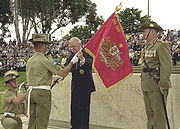
and as such, unlike the Royal Australian Air Force, does not have a flag or Colours. The Army, instead, has a banner, known as the Army Banner. To commemorate the centenary of the Army, the Governor General Sir William Deane, presented the Army with a new Banner at a parade in front of the Australian War Memorial
on 10 March 2001. The Banner was presented to the Regimental Sergeant Major of the Army, WO1 Peter Rosemond.
The Army banner bears the Australian Coat of Arms
on the obverse, with the dates "1901–2001" in gold in the upper hoist. The reverse bears the 'rising sun' badge of the Australian Army, flanked by seven campaign honours on small gold-edged scrolls: South Africa
, World War I
, World War II
, Korea
, Malaya-Borneo
, South Vietnam
, and Peacekeeping. The banner is trimmed with gold fringe, has gold and crimson cords and tassels, and is mounted on a pike with the usual British royal crest finial.
, and carry mostly the same actual insignia
. For officer
s the ranks are identical except for the shoulder title "Australia". The Non-Commissioned Officer
insignia
are the same up until Warrant Officer
ranks, where they are stylised for Australia (for example, using the Australian, rather than the British coat of arms).
in Sydney. The Australian Army's three regular brigades are based at Robertson Barracks
near Darwin
, Lavarack Barracks
in Townsville and Gallipoli Barracks in Brisbane
. The Deployable Joint Force Headquarters is also located at Gallipoli Barracks.
Other important Army bases include the Army Aviation Centre
near Oakey, Queensland
, Holsworthy Barracks
near Sydney, Lone Pine Barracks
in Singleton, New South Wales
and Woodside Barracks
near Adelaide
, South Australia
. The SASR
is based at Campbell Barracks
Swanbourne
, a suburb of Perth, Western Australia
.
Puckapunyal
north of Melbourne
, Victoria
houses the Australian Army's Combined Arms Training Centre, Land Warfare Development Centre, and three of the five principal Combat Arms schools. Further barracks include Steele Barracks
in Sydney, Keswick Barracks
in Adelaide, and Irwin Barracks at Karrakatta
in Perth. Dozens of Army Reserve
depots are located across Australia.
Australian Defence Force
The Australian Defence Force is the military organisation responsible for the defence of Australia. It consists of the Royal Australian Navy , Australian Army, Royal Australian Air Force and a number of 'tri-service' units...
(ADF) along with the Royal Australian Navy
Royal Australian Navy
The Royal Australian Navy is the naval branch of the Australian Defence Force. Following the Federation of Australia in 1901, the ships and resources of the separate colonial navies were integrated into a national force: the Commonwealth Naval Forces...
and the Royal Australian Air Force
Royal Australian Air Force
The Royal Australian Air Force is the air force branch of the Australian Defence Force. The RAAF was formed in March 1921. It continues the traditions of the Australian Flying Corps , which was formed on 22 October 1912. The RAAF has taken part in many of the 20th century's major conflicts...
. While the Chief of Defence (CDF) commands the Australian Defence Force (ADF), the Army is commanded by the Chief of Army (CA). The CA is therefore subordinate to the CDF, but is also directly responsible to the Minister for Defence. Although Australian soldiers have been involved in a number of minor and major conflicts throughout its history, only in World War II
World War II
World War II, or the Second World War , was a global conflict lasting from 1939 to 1945, involving most of the world's nations—including all of the great powers—eventually forming two opposing military alliances: the Allies and the Axis...
has Australian territory come under direct attack.
The Australian Army's mission is to provide a potent, versatile, and updated Army to promote the security of Australia and protect its people. Further, the Army's key doctrine publication, The Fundamentals of Land Warfare, states that "the Army’s mission is to win the land battle".
History
The history of the Australian Army can be divided into two periods:- 1901–1947, when limits were set on the size of the Regular Army, the vast majority of peacetime soldiers were in Reserve units of the Citizens Military Force (also known as the CMF or Militia), and Australian Imperial ForceAustralian Imperial ForceThe Australian Imperial Force was the name given to all-volunteer Australian Army forces dispatched to fight overseas during World War I and World War II.* First Australian Imperial Force * Second Australian Imperial Force...
s were formed to serve overseas, and - Post-1947, when a standing peacetime regular infantryInfantryInfantrymen are soldiers who are specifically trained for the role of fighting on foot to engage the enemy face to face and have historically borne the brunt of the casualties of combat in wars. As the oldest branch of combat arms, they are the backbone of armies...
force was formed and the CMF (known as the Army Reserve after 1980) began to decline in importance.
Second Boer War
The Second Boer War was fought from 11 October 1899 until 31 May 1902 between the British Empire and the Afrikaans-speaking Dutch settlers of two independent Boer republics, the South African Republic and the Orange Free State...
(1899–1902), First World War (1914–1918), the Second World War (1939–1945), Korea War (1950–1953), Malayan Emergency
Malayan Emergency
The Malayan Emergency was a guerrilla war fought between Commonwealth armed forces and the Malayan National Liberation Army , the military arm of the Malayan Communist Party, from 1948 to 1960....
(1950–1960), Indonesia-Malaysia Confrontation
Indonesia-Malaysia confrontation
Indonesia–Malaysia confrontation during 1962–1966 was Indonesia’s political and armed opposition to the creation of Malaysia. It is also known by its Indonesian/Malay name Konfrontasi...
(1962–1966), Vietnam War
Vietnam War
The Vietnam War was a Cold War-era military conflict that occurred in Vietnam, Laos, and Cambodia from 1 November 1955 to the fall of Saigon on 30 April 1975. This war followed the First Indochina War and was fought between North Vietnam, supported by its communist allies, and the government of...
(1962–1973) and more recently in Afghanistan
War in Afghanistan (2001–present)
The War in Afghanistan began on October 7, 2001, as the armed forces of the United States of America, the United Kingdom, Australia, and the Afghan United Front launched Operation Enduring Freedom...
(2001 – Present) and Iraq
Iraq
Iraq ; officially the Republic of Iraq is a country in Western Asia spanning most of the northwestern end of the Zagros mountain range, the eastern part of the Syrian Desert and the northern part of the Arabian Desert....
(2003 – Present). However, since 1947 it has also been involved in many peacekeeping operations, usually under the auspices of the United Nations
United Nations
The United Nations is an international organization whose stated aims are facilitating cooperation in international law, international security, economic development, social progress, human rights, and achievement of world peace...
. The largest one began in 1999 in East Timor. Other notable operations include peacekeeping on Bougainville
Bougainville Province
The Autonomous Region of Bougainville, previously known as North Solomons, is an autonomous region in Papua New Guinea. The largest island is Bougainville Island , and the province also includes the island of Buka and assorted outlying islands including the Carterets...
and in the Solomon Islands
Solomon Islands
Solomon Islands is a sovereign state in Oceania, east of Papua New Guinea, consisting of nearly one thousand islands. It covers a land mass of . The capital, Honiara, is located on the island of Guadalcanal...
, which are still ongoing to this day. Humanitarian relief after 2004 Indian Ocean earthquake
2004 Indian Ocean earthquake
The 2004 Indian Ocean earthquake was an undersea megathrust earthquake that occurred at 00:58:53 UTC on Sunday, December 26, 2004, with an epicentre off the west coast of Sumatra, Indonesia. The quake itself is known by the scientific community as the Sumatra-Andaman earthquake...
in Aceh
Aceh
Aceh is a special region of Indonesia, located on the northern tip of the island of Sumatra. Its full name is Daerah Istimewa Aceh , Nanggroë Aceh Darussalam and Aceh . Past spellings of its name include Acheh, Atjeh and Achin...
Province, Indonesia
Indonesia
Indonesia , officially the Republic of Indonesia , is a country in Southeast Asia and Oceania. Indonesia is an archipelago comprising approximately 13,000 islands. It has 33 provinces with over 238 million people, and is the world's fourth most populous country. Indonesia is a republic, with an...
, Operation Sumatra Assist
Operation Sumatra Assist
Operation Sumatra Assist was the Australian Defence Force's contribution to disaster relief in Indonesia following the 2004 Indian Ocean earthquake. ADF personnel were deployed within hours of the earthquake. They served mainly in Aceh province of Indonesia...
, ended on 24 March 2005.
Current deployments
The Australian Army currently has significant forces deployed on three major operations:- Operation SlipperOperation SlipperOperation Slipper is the Australian Defence Force contribution to the war in Afghanistan. The operation commenced in late 2001 and is ongoing...
– Australia's commitment to the War on TerrorWar on TerrorThe War on Terror is a term commonly applied to an international military campaign led by the United States and the United Kingdom with the support of other North Atlantic Treaty Organisation as well as non-NATO countries...
. The army contribution is primarily concentrated in AfghanistanAfghanistanAfghanistan , officially the Islamic Republic of Afghanistan, is a landlocked country located in the centre of Asia, forming South Asia, Central Asia and the Middle East. With a population of about 29 million, it has an area of , making it the 42nd most populous and 41st largest nation in the world...
, including the Mentoring Task Force attached to the US-led Combat Team Oruzgan in Oruzgan ProvinceOruzgan ProvinceOrūzgān or Urōzgān , also spelled Uruzgan or Rōzgān , is one of the thirty-four provinces of Afghanistan. It is in the center of the country, though the area is culturally and tribally linked to Kandahar in the south. Its capital is Tarin Kowt...
, consisting of an infantry battalion with attached cavalry, engineer and artillery force elements. Other forces include the Special Operations Task Group which includes SASR and Commando force elements operating in Oruzgan and Kandahar provinces.
- Operation AstuteOperation AstuteOperation Astute is an Australian-led military deployment to East Timor to quell unrest and return stability in the 2006 East Timor crisis. It is currently headed by Brigadier Bill Sowry, and commenced on 25 May 2006 under the command of Brigadier Michael Slater...
– Approximately 400 Australian personnel and 140 New Zealand personnel are deployed to East Timor as part of the ISF that is working in support of the Government of East Timor and the United Nations to maintain peace and stability. - Operation Anode – Australia's commitment to the Regional Assistance Mission to Solomon Islands (RAMSI) Consists of a 160-strong Combined Task Force. The ADF contributes around 80 to 120 troops to this Task Force
- Operation MazurkaOperation MazurkaOperation Mazurka is the Australian Defence Force's contribution to the Multinational Force and Observers , an international peacekeeping force, based in the Sinai Peninsula, overseeing the terms of the Israel-Egypt Peace Treaty....
– Australia's commitment to Multinational Force and Observers (MFO). From 1982–1986, the RAAF provided rotary wing aviation support. Since 1994 the Australian Army has maintained a presence within the organisation. Currently 25 personnel rotate twice a year, being employed in key HQ, operations and logistics positions. - Operation PaladinOperation PaladinOperation Paladin is Australia's contribution to the UN Truce Supervision Organisation that was established in 1948 to supervise the truce agreed at the conclusion of the first Arab/Israeli War....
– is the Army's longest ongoing operation, where Australian personnel have served since 1956. Operation Paladin is Australia's contribution to the UN Truce Supervision Organisation that was established in 1948 to supervise the truce agreed at the conclusion of the first Arab/Israeli War.
Current organisation
The 1st Division1st Division (Australia)
The 1st Division is the main formation of the Australian Army and contains the majority of the army's regular forces. Its headquarters is in Enoggera, a suburb of Brisbane...
takes responsibility for the majority of the regular army, while 2nd Division under the command of Forces Command is the main home defence formation, containing Army Reserve units. Only the 1st Division's headquarters is deployable, however, as the 2nd Division's headquarters only performs administrative functions. The Australian Army has not deployed a divisional sized formation since 1945 and does not expect to do so in the future.
1st Division
1st Division is currently based on regular Army Brigades containing a total of 10 deployable BattlegroupsBattlegroup (army)
A battlegroup , or task force in modern military theory, is the basic building block of an army's fighting force. A battlegroup is formed around an infantry battalion or armoured regiment, which is usually commanded by a Lieutenant Colonel...
- 1 BrigadeAustralian 1st Brigade1st Brigade is a formation of the Australian Army intended as its primary mechanised formation. Raised for service initially in 1914 for service during World War I, the brigade fought at Gallipoli and on the Western Front before being disbanded in mid-1919. In 1921, the 1st Brigade was re-raised as...
– Mechanised Brigade based in Darwin. - 1 Armoured Regiment (M1A1 Abrams AIMM1 AbramsThe M1 Abrams is a third-generation main battle tank produced in the United States. It is named after General Creighton Abrams, former Army Chief of Staff and Commander of US military forces in Vietnam from 1968 to 1972. The M1 is a well armed, heavily armored, and highly mobile tank designed for...
) - 1 Armoured Reconnaissance Regiment (ASLAVASLAVThe Australian Service Light Armoured Vehicle , is an Australian version of the Light Armoured Vehicle designed and manufactured by General Dynamics Land Systems Canada for the U.S. Marines. The initial design was the MOWAG Piranha 8x8, however the vehicle was re-designed to meet North American...
) - 2 Mechanised Infantry Battalions (M113AS3/4)
- 1 Medium Artillery Regiment (M198 HowitzerM198 howitzerThe M198 howitzer is a medium-sized, towed artillery piece, developed for service with the United States Army and Marine Corps. It was commissioned to be a lightweight replacement for the WWII era M114 155mm howitzer. It was designed and prototyped at the Rock Island Arsenal in 1969 with firing...
) - 1 Reconnaissance Squadron (Aviation) (Tiger ARH)
- 3 BrigadeAustralian 3rd BrigadeThe 3rd Brigade is a combined arms brigade of the Australian Army, based around the 1st, 2nd and 3rd Battalions of the Royal Australian Regiment . It was originally formed in 1914 for service during World War I, taking part in the fighting at Gallipoli and on the Western Front in Europe...
– Light Infantry Brigade based in Townsville - 1 Armoured Personnel Carrier Squadron (Bushmaster IMVBushmaster IMVThe Bushmaster Protected Mobility Vehicle or Infantry Mobility Vehicle is an Australian-built wheeled armoured vehicle. It was originally designed by Irish company Timoney Technology Ltd under a licence agreement with Perry Engineering in Adelaide; that licence was sold, with permission granted by...
) - 2 Light Infantry Battalions
- 1 Parachute Infantry Battalion
- 1 Field Artillery Regiment (M777)
- 7 BrigadeAustralian 7th Brigade7th Brigade is a combined arms formation or brigade of the Australian Army. The Brigade was first raised in 1915 as part of the First Australian Imperial Force and saw action at Gallipoli and on the Western Front during World War I. Following the end of the war the brigade was disbanded before...
– Motorised Brigade based in Brisbane. - 1 Armoured Cavalry Regiment (ASLAVASLAVThe Australian Service Light Armoured Vehicle , is an Australian version of the Light Armoured Vehicle designed and manufactured by General Dynamics Land Systems Canada for the U.S. Marines. The initial design was the MOWAG Piranha 8x8, however the vehicle was re-designed to meet North American...
) - 2 Motorised Infantry Battalions (Bushmaster IMVBushmaster IMVThe Bushmaster Protected Mobility Vehicle or Infantry Mobility Vehicle is an Australian-built wheeled armoured vehicle. It was originally designed by Irish company Timoney Technology Ltd under a licence agreement with Perry Engineering in Adelaide; that licence was sold, with permission granted by...
) - 1 Field Artillery Regiment (M777)
Special Forces
Special Operations CommandSpecial Operations Command (Australia)
The Special Operations Command is a command within the Australian Defence Force . Special Operations Command was established in May 2003, to unite all of the ADF special forces units. As of 2007 Special Operations Command is fully operational. Australia's Special Operations Command is of...
is a command formation of equal status to the other commands in the ADF. It is a brigade sized formation responsible for all of Australia's special forces
Special forces
Special forces, or special operations forces are terms used to describe elite military tactical teams trained to perform high-risk dangerous missions that conventional units cannot perform...
assets.
- 1 Special Air Service RegimentAustralian Special Air Service RegimentThe Special Air Service Regiment, officially abbreviated SASR but commonly known as the SAS, is a special forces unit of the Australian Army...
- 2 Commando RegimentsAustralian commandosThe name commando has been applied to a variety of Australian special forces and light infantry units that have been formed since 1941–42. The first Australian "commando" units were formed during the Second World War, where they mainly performed reconnaissance and long-range patrol roles during...
- 1 Incident Response Regiment
- 1 Aviation Squadron (Blackhawk)
2nd Division
2nd Division is the main home defence formation, consisting mainly of reserve forces, with its HQ located in Sydney. It is divided into 6 brigades.- 4 BrigadeAustralian 4th BrigadeThe 4th Brigade is a brigade-level formation of the Australian Army. Originally formed in September 1914 for service during World War I, elements of the brigade served at Gallipoli and in the trenches on the Western Front before being disbanded in 1919. In 1921, the brigade was re-raised as a unit...
– based in Victoria. - 5 Brigade5th Brigade (Australia)5th Brigade is a brigade of the Australian Army. It is a Reserve combined arms formation based in New South Wales and forms part of the 2nd Division.-History:...
– based in New South Wales. - 8 Brigade – based in New South Wales.
- 9 BrigadeAustralian 9th BrigadeThe 9th Brigade is an Reserve formation of the Australian Army headquartered at Keswick Barracks in Keswick, South Australia, with elements located in Tasmania, South Australia, New South Wales and the Northern Territory.-History:...
– based in South Australia and Tasmania. - 11 Brigade11th Brigade (Australia)The Australian 11th Brigade is an Australian Army brigade which currently comprises most Australian Army Reserve units located in Queensland. The Brigade was first formed in early 1916 as part of the 3rd Division and saw action during World War I and World War II.-Brigade Structure:*Headquarters...
– based in Queensland. - 13 Brigade – based in Western Australia.
Colours, standards and guidons
The Army is the guardian of the National Flag
Flag of Australia
The flag of Australia is a defaced Blue Ensign: a blue field with the Union Flag in the canton , and a large white seven-pointed star known as the Commonwealth Star in the lower hoist quarter...
and as such, unlike the Royal Australian Air Force, does not have a flag or Colours. The Army, instead, has a banner, known as the Army Banner. To commemorate the centenary of the Army, the Governor General Sir William Deane, presented the Army with a new Banner at a parade in front of the Australian War Memorial
Australian War Memorial
The Australian War Memorial is Australia's national memorial to the members of all its armed forces and supporting organisations who have died or participated in the wars of the Commonwealth of Australia...
on 10 March 2001. The Banner was presented to the Regimental Sergeant Major of the Army, WO1 Peter Rosemond.
The Army banner bears the Australian Coat of Arms
Coat of arms of Australia
The coat of arms of Australia is the official symbol of Australia. The initial coat of arms was granted by King Edward VII on 7 May 1908, and the current version was granted by King George V on 19 September 1912, although the 1908 version continued to be used in some contexts, notably appearing on...
on the obverse, with the dates "1901–2001" in gold in the upper hoist. The reverse bears the 'rising sun' badge of the Australian Army, flanked by seven campaign honours on small gold-edged scrolls: South Africa
Second Boer War
The Second Boer War was fought from 11 October 1899 until 31 May 1902 between the British Empire and the Afrikaans-speaking Dutch settlers of two independent Boer republics, the South African Republic and the Orange Free State...
, World War I
World War I
World War I , which was predominantly called the World War or the Great War from its occurrence until 1939, and the First World War or World War I thereafter, was a major war centred in Europe that began on 28 July 1914 and lasted until 11 November 1918...
, World War II
World War II
World War II, or the Second World War , was a global conflict lasting from 1939 to 1945, involving most of the world's nations—including all of the great powers—eventually forming two opposing military alliances: the Allies and the Axis...
, Korea
Korean War
The Korean War was a conventional war between South Korea, supported by the United Nations, and North Korea, supported by the People's Republic of China , with military material aid from the Soviet Union...
, Malaya-Borneo
Malayan Emergency
The Malayan Emergency was a guerrilla war fought between Commonwealth armed forces and the Malayan National Liberation Army , the military arm of the Malayan Communist Party, from 1948 to 1960....
, South Vietnam
Vietnam War
The Vietnam War was a Cold War-era military conflict that occurred in Vietnam, Laos, and Cambodia from 1 November 1955 to the fall of Saigon on 30 April 1975. This war followed the First Indochina War and was fought between North Vietnam, supported by its communist allies, and the government of...
, and Peacekeeping. The banner is trimmed with gold fringe, has gold and crimson cords and tassels, and is mounted on a pike with the usual British royal crest finial.
Strength
In the 2010–11 financial year the Army had an average strength of 47,135 personnel: 30,235 permanent (regular) and 16,900 active reservists (part-time). In addition there are another 12,496 members of the Standby Reserve. The regular Army is targeted to expand to 31,000 personnel by 2014–15.Rank and insignia
The ranks of the Australian Army are based on the ranks of the British ArmyBritish Army
The British Army is the land warfare branch of Her Majesty's Armed Forces in the United Kingdom. It came into being with the unification of the Kingdom of England and Scotland into the Kingdom of Great Britain in 1707. The new British Army incorporated Regiments that had already existed in England...
, and carry mostly the same actual insignia
Australian Army officer rank insignia
Australian Army officers receive a commission that is personally signed by the Governor-General of Australia, acting for the Monarch, currently Queen Elizabeth II, of Australia...
. For officer
Officer (armed forces)
An officer is a member of an armed force or uniformed service who holds a position of authority. Commissioned officers derive authority directly from a sovereign power and, as such, hold a commission charging them with the duties and responsibilities of a specific office or position...
s the ranks are identical except for the shoulder title "Australia". The Non-Commissioned Officer
Non-commissioned officer
A non-commissioned officer , called a sub-officer in some countries, is a military officer who has not been given a commission...
insignia
Australian Army enlisted rank insignia
Like the British Army, the Australian Army does not use the term 'enlisted' to describe its non-commissioned ranks. Instead, personnel who are not Commissioned Officers are referred to as Other Ranks. These are soldiers, Non-Commissioned Officers and Warrant Officers . Warrant Officers are...
are the same up until Warrant Officer
Warrant Officer
A warrant officer is an officer in a military organization who is designated an officer by a warrant, as distinguished from a commissioned officer who is designated an officer by a commission, or from non-commissioned officer who is designated an officer by virtue of seniority.The rank was first...
ranks, where they are stylised for Australia (for example, using the Australian, rather than the British coat of arms).
Equipment
| Small arms Small arms Small arms is a term of art used by armed forces to denote infantry weapons an individual soldier may carry. The description is usually limited to revolvers, pistols, submachine guns, carbines, assault rifles, battle rifles, multiple barrel firearms, sniper rifles, squad automatic weapons, light... |
F88 Austeyr (service rifle Service rifle The service rifle of a given army or armed force is that which it issues as standard to its soldiers. In modern forces, this is typically a highly versatile and rugged assault rifle suitable for use in nearly all theatres and environments... ), F89 Minimi (support weapon Squad automatic weapon A squad automatic weapon is a weapon used to give infantry squads or sections a portable source of automatic firepower. Weapons used in this role are selective-fire rifles, usually fitted with a bipod and heavier barrel to perform as Light machine guns... ), Browning Hi-Power Browning Hi-Power The Browning Hi-Power is a single-action, 9 mm semi-automatic handgun. It is based on a design by American firearms inventor John Browning, and completed by Dieudonné Saive at Fabrique Nationale of Herstal, Belgium. Browning died in 1926, several years before the design was finalized... (sidearm Service pistol A service pistol is any handgun issued to military personnel.Typically service pistols are revolvers or semi-automatic pistols issued to officers, non-commissioned officers and rear-echelon support personnel for self defense, though service pistols may also be issued to special forces as a backup... ), MAG-58 FN MAG The FN MAG is a Belgian 7.62 mm general-purpose machine gun, designed in the early 1950s at Fabrique Nationale by Ernest Vervier. It has been used by more than 80 countries, and it has been made under licence in countries such as Argentina, Egypt, India, Singapore, the United Kingdom and the... (general purpose machine gun General purpose machine gun A general-purpose machine gun is a multi-purpose weapon: it is a machine gun firing a full-power rifle cartridge and which can be used in a variety of roles, from a bipod- or tripod-mounted infantry support weapon to a helicopter door gun or a vehicle-mounted support weapon... ), SR-25 SR-25 The SR-25 is a semi-automatic sniper rifle designed by Eugene Stoner and manufactured by Knight's Armament Company. The SR-25 uses a rotating bolt and a direct impingement gas system. It is loosely based on Stoner's AR-10, rebuilt in its original 7.62×51mm NATO caliber... (sniper rifle Sniper rifle In military and law enforcement terminology, a sniper rifle is a precision-rifle used to ensure more accurate placement of bullets at longer ranges than other small arms. A typical sniper rifle is built for optimal levels of accuracy, fitted with a telescopic sight and chambered for a military... ), SR-98 (sniper rifle) |
| Special forces Special forces Special forces, or special operations forces are terms used to describe elite military tactical teams trained to perform high-risk dangerous missions that conventional units cannot perform... |
M4 carbine M4 carbine The M4 carbine is a family of firearms tracing its lineage back to earlier carbine versions of the M16, all based on the original AR-15 designed by Eugene Stoner and made by ArmaLite. It is a shorter and lighter variant of the M16A2 assault rifle, with 80% parts commonality.It is a gas-operated,... , Heckler & Koch USP Heckler & Koch USP The USP is a semi-automatic pistol developed in Germany by Heckler & Koch GmbH of Oberndorf am Neckar as a replacement for the P7 series of handguns.-History:... , SR-25 SR-25 The SR-25 is a semi-automatic sniper rifle designed by Eugene Stoner and manufactured by Knight's Armament Company. The SR-25 uses a rotating bolt and a direct impingement gas system. It is loosely based on Stoner's AR-10, rebuilt in its original 7.62×51mm NATO caliber... , F89 Minimi, MP5, SR-98 |
| Main battle tank Main battle tank A main battle tank , also known as a battle tank or universal tank, is a tank that fills the heavy direct fire role of many modern armies. They were originally conceived to replace the light, medium, heavy and super-heavy tanks. Development was spurred onwards in the Cold War with the development... s |
59 M1A1 Abrams AIM M1 Abrams The M1 Abrams is a third-generation main battle tank produced in the United States. It is named after General Creighton Abrams, former Army Chief of Staff and Commander of US military forces in Vietnam from 1968 to 1972. The M1 is a well armed, heavily armored, and highly mobile tank designed for... (TUSK under acquisition) |
| Infantry fighting vehicle Infantry fighting vehicle An infantry fighting vehicle , also known as a mechanized infantry combat vehicle , is a type of armoured fighting vehicle used to carry infantry into battle and provide fire support for them... s |
257 ASLAV ASLAV The Australian Service Light Armoured Vehicle , is an Australian version of the Light Armoured Vehicle designed and manufactured by General Dynamics Land Systems Canada for the U.S. Marines. The initial design was the MOWAG Piranha 8x8, however the vehicle was re-designed to meet North American... |
| Armoured Personnel Carrier Armoured personnel carrier An armoured personnel carrier is an armoured fighting vehicle designed to transport infantry to the battlefield.APCs are usually armed with only a machine gun although variants carry recoilless rifles, anti-tank guided missiles , or mortars... s |
766 M113 M113 armored personnel carrier The M113 is a fully tracked armored personnel carrier that has formed the backbone of the United States Army's mechanized infantry units from the time of its first fielding in Vietnam in April 1962. The M113 was the most widely used armored vehicle of the U.S... (431 being upgraded to M113AS3/4 standard, balance to be mothballed and used to support upgrade program) |
| Infantry Mobility Vehicle Motorised infantry In NATO and most other western countries, motorised infantry is infantry which is transported by trucks or other motor vehicles. It is distinguished from mechanized infantry, which is carried in armoured personnel carriers, infantry combat vehicles, or infantry fighting vehicles... s |
838 Bushmaster IMV Bushmaster IMV The Bushmaster Protected Mobility Vehicle or Infantry Mobility Vehicle is an Australian-built wheeled armoured vehicle. It was originally designed by Irish company Timoney Technology Ltd under a licence agreement with Perry Engineering in Adelaide; that licence was sold, with permission granted by... s |
| Light Utility Vehicle Light Utility Vehicle Light utility vehicle is a general term for small, jeep-like military trucks for tactical use. They are generally short, relatively light compared to other trucks and cars, unarmored with 4-wheel drive and short body overhangs for all-terrain mobility and at least 4 passenger capacity... s |
1,200 G-Wagon 4x4 and 6x6, 10,000 Land Rover Land Rover Land Rover is a British car manufacturer with its headquarters in Gaydon, Warwickshire, United Kingdom which specialises in four-wheel-drive vehicles. It is owned by the Indian company Tata Motors, forming part of their Jaguar Land Rover group... FFR and GS, 1,295 Unimog Unimog Unimog is a range of multi-purpose auto four wheel drive medium trucks produced by Mercedes-Benz, a division of Daimler AG. The name Unimog is pronounced in German and is an acronym for the German "UNIversal-MOtor-Gerät", Gerät being the German word for machine or device... 1700L |
| Artillery Artillery Originally applied to any group of infantry primarily armed with projectile weapons, artillery has over time become limited in meaning to refer only to those engines of war that operate by projection of munitions far beyond the range of effect of personal weapons... |
112 L118/L119 Hamel Guns, 120 M2A2 M101 howitzer The 105 mm M2A1 howitzer was the standard light field howitzer for the United States in World War II, seeing action in both European and Pacific theaters. Entering production in 1941, it quickly entered the war against the Imperial Japanese Army in the Pacific, where it gained a reputation... Howitzer, 36 M198 M198 howitzer The M198 howitzer is a medium-sized, towed artillery piece, developed for service with the United States Army and Marine Corps. It was commissioned to be a lightweight replacement for the WWII era M114 155mm howitzer. It was designed and prototyped at the Rock Island Arsenal in 1969 with firing... Howitzer, 35 M777A2 M777 howitzer The M777 howitzer is a towed 155 mm artillery piece, successor to the M198 howitzer in the United States Marine Corps and United States Army. The M777 is also used by the Canadian Army, and has been in action in Afghanistan since February 2006 along with the associated GPS-guided Excalibur... Howitzer, 36 RBS-70 ground to air missile launchers. |
| Radar Radar Radar is an object-detection system which uses radio waves to determine the range, altitude, direction, or speed of objects. It can be used to detect aircraft, ships, spacecraft, guided missiles, motor vehicles, weather formations, and terrain. The radar dish or antenna transmits pulses of radio... |
AN/TPQ-36 Firefinder radar AN/TPQ-36 Firefinder radar AN/TPQ-36 Firefinder is a mobile radar system manufactured by Northrop Grumman and ThalesRaytheonSystems . The system is a "weapon-locating radar", designed to detect and track incoming artillery and rocket fire to determine the point of origin for counterbattery fire... , AMSTAR Ground Surveliance RADAR |
| Unmanned Aerial Vehicles | Insitu Aerosonde Insitu Aerosonde The Aerosonde is a small unmanned aerial vehicle designed to collect weather data, including temperature, atmospheric pressure, humidity, and wind measurements, over oceans and remote areas. The Aerosonde was developed by Insitu, and is now manufactured by Aerosonde Ltd, which is a strategic... , Elbit Systems Skylark Elbit Skylark Elbit Systems Skylark I and Skylark II are small unmanned aerial vehicles developed by Elbit Systems.-Skylark I:Skylark I is a miniature unmanned aerial vehicle. It is designed as a manpacked system for tactical surveillance and reconnaissance. Skylark is launched by hand. The payload consists of... and Boeing ScanEagle |
| Aircraft | Origin | Type | Versions | Number in service | Notes | |
|---|---|---|---|---|---|---|
| Helicopters | ||||||
| OH-58 Kiowa OH-58 Kiowa The Bell OH-58 Kiowa is a family of single-engine, single-rotor, military helicopters used for observation, utility, and direct fire support. Bell Helicopter manufactured the OH-58 for the United States Army based on the 206A JetRanger helicopter. The OH-58 has been in continuous use by the U.S... |
OH-58A Scout helicopter | 206B | 27 of 56 still in service | To be replaced by the Eurocopter Tiger Eurocopter Tiger The Eurocopter Tiger is an attack helicopter manufactured by Eurocopter. In Germany it is known as the Tiger; in France and Spain it is called the Tigre.-Origins:... . |
||
| Boeing CH-47 Chinook | Transport helicopter | CH-47D | 5 | 1 Lost in Afghanistan Afghanistan Afghanistan , officially the Islamic Republic of Afghanistan, is a landlocked country located in the centre of Asia, forming South Asia, Central Asia and the Middle East. With a population of about 29 million, it has an area of , making it the 42nd most populous and 41st largest nation in the world... in May, 2011. 7 CH-47F are on order to replace the current CH-47D's. |
||
| Eurocopter Tiger Eurocopter Tiger The Eurocopter Tiger is an attack helicopter manufactured by Eurocopter. In Germany it is known as the Tiger; in France and Spain it is called the Tigre.-Origins:... |
Attack helicopter | Tiger ARH | 22 | Delivery completed early July, 2011 | ||
| Sikorsky S-70 Blackhawk Sikorsky S-70 The Sikorsky S-70 is a medium transport/utility helicopter family manufactured by Sikorsky Aircraft. It was developed for the U.S. Army in the 1970s, winning a competition to be designated the UH-60 Blackhawk and spawning a large family in U.S. military service... |
Utility helicopter | S-70A-9 | 35 | To be eventually replaced by the MRH 90 | ||
| MRH 90 NHI NH90 The NHIndustries NH90 is a medium sized, twin-engine, multi-role military helicopter manufactured by NHIndustries. The first prototype had its maiden flight in December 1995... |
Utility helicopter | TTH: Tactical Transport Helicopter | 13 | As of 2011, used for testing and training purposes. Total of 46 on order (including 6 for Royal Australian Navy Royal Australian Navy The Royal Australian Navy is the naval branch of the Australian Defence Force. Following the Federation of Australia in 1901, the ships and resources of the separate colonial navies were integrated into a national force: the Commonwealth Naval Forces... ) |
||
Army bases
The Army's operational headquarters, Land Command, is located at Victoria BarracksVictoria Barracks, Sydney
Victoria Barracks is an Australian Army base in Sydney, New South Wales, Australia. Victoria Barracks is located in the suburb of Paddington, between Oxford Street and Moore Park Road...
in Sydney. The Australian Army's three regular brigades are based at Robertson Barracks
Robertson Barracks
For the Robertson Barracks, Norfolk, England see RAF Swanton MorleyRobertson Barracks is a major Australian Army base located in the outer Darwin, Northern Territory suburb of Holtze in the Municipality of Litchfield. The barracks was built during the 1990s. The Barracks are home to the 1st Brigade...
near Darwin
Darwin, Northern Territory
Darwin is the capital city of the Northern Territory, Australia. Situated on the Timor Sea, Darwin has a population of 127,500, making it by far the largest and most populated city in the sparsely populated Northern Territory, but the least populous of all Australia's capital cities...
, Lavarack Barracks
Lavarack Barracks
Lavarack Barracks is a major Australian Army base located in Townsville, Queensland. Lavarack Barracks is currently home to the Army's 3rd Brigade and 11th Brigade. Elements of the 3rd Brigade based at the Barracks include the Combat Signals Regiment, 3rd Combat Services Support Battalion and the...
in Townsville and Gallipoli Barracks in Brisbane
Brisbane
Brisbane is the capital and most populous city in the Australian state of Queensland and the third most populous city in Australia. Brisbane's metropolitan area has a population of over 2 million, and the South East Queensland urban conurbation, centred around Brisbane, encompasses a population of...
. The Deployable Joint Force Headquarters is also located at Gallipoli Barracks.
Other important Army bases include the Army Aviation Centre
Oakey Army Aviation Centre
Oakey Army Aviation Centre is situated approximately 3 km from the town centre of Oakey in Queensland, Australia. It provides a training establishment for Australian Army Aviation, and also hosts a Singapore Armed Forces Helicopter Squadron, namely the 126 Squadron.-History:The base has a...
near Oakey, Queensland
Oakey, Queensland
Oakey is a rural town situated in the Darling Downs region of Queensland, Australia. It is situated west of the state capital, Brisbane, and west of the regional city of Toowoomba. At the 2006 census, Oakey had a population of 3,657.-History:...
, Holsworthy Barracks
Holsworthy Barracks
Holsworthy Barracks is located in the outer south-western Sydney suburb of Holsworthy. It is part of the Holsworthy military reserve, which has been a training area and artillery range for the Australian Army since World War I. Following World War II it became a major base for the permanent...
near Sydney, Lone Pine Barracks
Lone Pine Barracks
Lone Pine Barracks is an Australian Army base located in New South Wales, south of Singleton. The barracks is home to the Australian Army School of Infantry, Special Forces Training Centre, Defence Support Group Singleton and other regular support services. The Royal Australian Infantry Corps...
in Singleton, New South Wales
Singleton, New South Wales
-Industry & Commerce:Major industries near Singleton include coal mining, energy generation, light industry, vineyards, horse breeding and cattle production. Dairying was once a mainstay in the area, but has declined....
and Woodside Barracks
Woodside Barracks
Woodside Barracks is an Australian Army base located in South Australia at Woodside.-History:The base was established in 1927, and known as Woodside Camp. It consisted of 162 hectares and was located east of Adelaide, South Australia. The camp was used for the training of light horse and infantry...
near Adelaide
Adelaide
Adelaide is the capital city of South Australia and the fifth-largest city in Australia. Adelaide has an estimated population of more than 1.2 million...
, South Australia
South Australia
South Australia is a state of Australia in the southern central part of the country. It covers some of the most arid parts of the continent; with a total land area of , it is the fourth largest of Australia's six states and two territories.South Australia shares borders with all of the mainland...
. The SASR
Australian Special Air Service Regiment
The Special Air Service Regiment, officially abbreviated SASR but commonly known as the SAS, is a special forces unit of the Australian Army...
is based at Campbell Barracks
Campbell Barracks (Australia)
Campbell Barracks is an Australian Army base located in Swanbourne, a coastal suburb of Perth, Western Australia. The Australian Special Air Service Regiment has been based at Campbell Barracks since the Regiment was first established as an independent company in 1957...
Swanbourne
Swanbourne, Western Australia
-Facilities:Swanbourne includes the 18-hole Cottesloe Golf Club and Swanbourne Beach. Swanbourne is also well-known for having the only nudist beach in Perth. The beach, situated on army land and thus not subject to local council authority, is immediately north of the officially named Swanbourne...
, a suburb of Perth, Western Australia
Perth, Western Australia
Perth is the capital and largest city of the Australian state of Western Australia and the fourth most populous city in Australia. The Perth metropolitan area has an estimated population of almost 1,700,000....
.
Puckapunyal
Puckapunyal
Puckapunyal is an Australian Army training facility and base 10 km west of Seymour, in central Victoria, south-eastern Australia.-Description:Puckapunyal is a small restricted-access town inhabited mainly by about 280...
north of Melbourne
Melbourne
Melbourne is the capital and most populous city in the state of Victoria, and the second most populous city in Australia. The Melbourne City Centre is the hub of the greater metropolitan area and the Census statistical division—of which "Melbourne" is the common name. As of June 2009, the greater...
, Victoria
Victoria (Australia)
Victoria is the second most populous state in Australia. Geographically the smallest mainland state, Victoria is bordered by New South Wales, South Australia, and Tasmania on Boundary Islet to the north, west and south respectively....
houses the Australian Army's Combined Arms Training Centre, Land Warfare Development Centre, and three of the five principal Combat Arms schools. Further barracks include Steele Barracks
Steele Barracks (Moorebank)
Steele Barracks is an Australian Army base in the Sydney suburb of Moorebank in New South Wales, near Liverpool. It is the home of the Royal Australian Engineers School of Military Engineering , as well as the RAE Museum, and the RAE Golf Club...
in Sydney, Keswick Barracks
Keswick Barracks
Keswick Barracks is a barracks of the Australian Army in Keswick, South Australia. It is home to the 9th Brigade, 10th/27th Battalion, Royal South Australia Regiment, the 48th Field Battery, and 3rd Health Support Battalion....
in Adelaide, and Irwin Barracks at Karrakatta
Karrakatta, Western Australia
Karrakatta is a suburb of Perth, Western Australia, located within the City of Nedlands and 7 km west of the CBD. Its postcode is 6010. Karrakatta is composed of two distinct areas. The largest is Karrakatta Cemetery, which began service in 1899, with a small industrial area on the south...
in Perth. Dozens of Army Reserve
Australian Army Reserve
The Australian Army Reserve is a collective name given to the reserve units of the Australian Army. Since the Federation of Australia in 1901, the reserve military force has been known by many names, including the Citizens Forces, the Citizen Military Forces, the Militia and, unofficially, the...
depots are located across Australia.
See also
- Australian Defence Force ranks and insigniaAustralian Defence Force ranks and insigniaThis article lists the ranks of officers and enlisted personnel in the Australian Defence Force 's three service branches. The ADF comprises the:*Royal Australian Navy *Australian Army*Royal Australian Air Force...
- List of Australian military memorials
- Conscription in AustraliaConscription in AustraliaConscription in Australia, or mandatory military service also known as National Service, has a controversial history dating back to the first years of nationhood...
- Australian military slang