


Letters patent

Encyclopedia
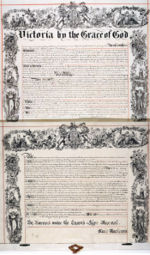
Legal instrument
Legal instrument is a legal term of art that is used for any formally executed written document that can be formally attributed to its author, records and formally expresses a legally enforceable act, process, or contractual duty, obligation, or right, and therefore evidences that act, process, or...
in the form of a published written order issued by a monarch
Monarch
A monarch is the person who heads a monarchy. This is a form of government in which a state or polity is ruled or controlled by an individual who typically inherits the throne by birth and occasionally rules for life or until abdication...
or president
President
A president is a leader of an organization, company, trade union, university, or country.Etymologically, a president is one who presides, who sits in leadership...
, generally granting an office, right, monopoly
Government-granted monopoly
In economics, a government-granted monopoly is a form of coercive monopoly by which a government grants exclusive privilege to a private individual or firm to be the sole provider of a good or service; potential competitors are excluded from the market by law, regulation, or other mechanisms of...
, title, or status to a person or corporation
Corporation
A corporation is created under the laws of a state as a separate legal entity that has privileges and liabilities that are distinct from those of its members. There are many different forms of corporations, most of which are used to conduct business. Early corporations were established by charter...
. They are so named from the Latin verb pateo, to lie open, exposed, accessible, being called in full litterae patentes.
Letters patent can be used for the creation of corporation
Corporation
A corporation is created under the laws of a state as a separate legal entity that has privileges and liabilities that are distinct from those of its members. There are many different forms of corporations, most of which are used to conduct business. Early corporations were established by charter...
s or government offices, or for the granting of city status or a coats of arms
Heraldry
Heraldry is the profession, study, or art of creating, granting, and blazoning arms and ruling on questions of rank or protocol, as exercised by an officer of arms. Heraldry comes from Anglo-Norman herald, from the Germanic compound harja-waldaz, "army commander"...
. A particular form of letters patent has evolved into the modern design patent
Patent
A patent is a form of intellectual property. It consists of a set of exclusive rights granted by a sovereign state to an inventor or their assignee for a limited period of time in exchange for the public disclosure of an invention....
granting exclusive rights in an invention
Invention
An invention is a novel composition, device, or process. An invention may be derived from a pre-existing model or idea, or it could be independently conceived, in which case it may be a radical breakthrough. In addition, there is cultural invention, which is an innovative set of useful social...
. Clearly in this case it is essential that the written grant should be in the form of a public document so other inventors can consult it to avoid infringement.
The opposite of letters patent are letters close
Letters close
Letters close are a type of legal document which is a closed letter issued by a monarch or government granting a right, monopoly, title, or status to someone or some entity such as a corporation. These letters are personal in nature and were delivered folded sealed so that only the recipient can...
, which are personal in nature and sealed so that only the recipient can read their contents.
Usage
Letters patent are a form of open or public proclamation and a vestigial exercise of extra-parliamentary power by a monarch or president. Prior to the establishment of parliament, the monarch ruled absolutely by the issuing of his personal written orders, open or closed.They can thus be contrasted with the Act of Parliament
Act of Parliament
An Act of Parliament is a statute enacted as primary legislation by a national or sub-national parliament. In the Republic of Ireland the term Act of the Oireachtas is used, and in the United States the term Act of Congress is used.In Commonwealth countries, the term is used both in a narrow...
, which is in effect a written order by parliament, approved by the monarch whose signature gives it force. No explicit government approval is contained within letters patent, only the seal or signature of the monarch.
Clearly today parliament tolerates only a very narrow exercise of the royal prerogative by issuance of letters patent, and such documents are issued with prior informal government approval, or indeed are now generated by government itself with the monarch's seal affixed as a mere formality. In their original form they were simply written instructions or orders from the king, whose order was law, which were made public to re-inforce their effect.
For the sake of good governance it is clearly of little use if the king appoints a person to a position of authority if he does not at the same time inform those over whom such authority is to be exercised of the validity of the appointment. Litterae in Latin meant "that which is written" or "writing", in the sense of letters of the alphabet placed together in meaningful sequence on a writing surface, not a specific format of composition as the modern word "letter" suggests. Thus letters patent does not equate to an open letter
Open letter
An open letter is a letter that is intended to be read by a wide audience, or a letter intended for an individual, but that is nonetheless widely distributed intentionally....
but rather to any form of document, deed, contract, letter, despatch, edict, decree, epistle etc. made public. A record of all the letters patent issued by English monarchs since 1202 is contained in the Patent Rolls
Patent Rolls
The Patent Rolls are primary sources for English history, a record of the King of England's correspondence, starting in 1202....
, part of the state archives of Great Britain.
Letters patent in the United Kingdom
In the United KingdomUnited Kingdom
The United Kingdom of Great Britain and Northern IrelandIn the United Kingdom and Dependencies, other languages have been officially recognised as legitimate autochthonous languages under the European Charter for Regional or Minority Languages...
and countries formerly under that country's influence, letters patent are issued under the prerogative powers of the head of state ("royal prerogative
Royal Prerogative
The royal prerogative is a body of customary authority, privilege, and immunity, recognized in common law and, sometimes, in civil law jurisdictions possessing a monarchy as belonging to the sovereign alone. It is the means by which some of the executive powers of government, possessed by and...
"). They constitute a rare, if significant, form of legislation
Legislation
Legislation is law which has been promulgated by a legislature or other governing body, or the process of making it...
without the consent of the parliament
Parliament
A parliament is a legislature, especially in those countries whose system of government is based on the Westminster system modeled after that of the United Kingdom. The name is derived from the French , the action of parler : a parlement is a discussion. The term came to mean a meeting at which...
. Letters patent may also be used to grant assent
Royal Assent
The granting of royal assent refers to the method by which any constitutional monarch formally approves and promulgates an act of his or her nation's parliament, thus making it a law...
to legislation.
Letters patent in the United States
In the United StatesUnited States
The United States of America is a federal constitutional republic comprising fifty states and a federal district...
, the forgery
Forgery
Forgery is the process of making, adapting, or imitating objects, statistics, or documents with the intent to deceive. Copies, studio replicas, and reproductions are not considered forgeries, though they may later become forgeries through knowing and willful misrepresentations. Forging money or...
of letters patent granted by the President
President of the United States
The President of the United States of America is the head of state and head of government of the United States. The president leads the executive branch of the federal government and is the commander-in-chief of the United States Armed Forces....
is a crime
Crime
Crime is the breach of rules or laws for which some governing authority can ultimately prescribe a conviction...
subject to fine, imprisonment
Imprisonment
Imprisonment is a legal term.The book Termes de la Ley contains the following definition:This passage was approved by Atkin and Duke LJJ in Meering v Grahame White Aviation Co....
up to ten years or both . Without letters patent, a person is unable to assume an appointed office. Such an issue prompted the Marbury v. Madison
Marbury v. Madison
Marbury v. Madison, is a landmark case in United States law and in the history of law worldwide. It formed the basis for the exercise of judicial review in the United States under Article III of the Constitution. It was also the first time in Western history a court invalidated a law by declaring...
suit, where William Marbury
William Marbury
William Marbury was one of the famous "Midnight Judges". Due to President John Adams's work in the night before he was to leave office, Marbury was to be appointed a Justice of the Peace in the District of Columbia. He was appointed there to give the Federalists a stronghold in the judicial...
and three others petitioned the United States Supreme Court to order James Madison
James Madison
James Madison, Jr. was an American statesman and political theorist. He was the fourth President of the United States and is hailed as the “Father of the Constitution” for being the primary author of the United States Constitution and at first an opponent of, and then a key author of the United...
to deliver their letters for appointments made under the previous administration.
Form of Royal Proclamations post 1992
The use of letters patent in making royal proclamations has been reduced by order of a statutory instrumentStatutory Instrument
A Statutory Instrument is the principal form in which delegated or secondary legislation is made in Great Britain.Statutory Instruments are governed by the Statutory Instruments Act 1946. They replaced Statutory Rules and Orders, made under the Rules Publication Act 1893, in 1948.Most delegated...
(number 1730) issued by Queen Elizabeth II at the Court at Buckingham Palace, the 15th day of July 1992 in the prescence of the privy council
Privy council
A privy council is a body that advises the head of state of a nation, typically, but not always, in the context of a monarchic government. The word "privy" means "private" or "secret"; thus, a privy council was originally a committee of the monarch's closest advisors to give confidential advice on...
. It is known as "The Crown Office (Forms and Proclamations Rules) Order 1992" and was laid before parliament on 23rd July 1992. It was issued in exercise of the powers conferred on the monarch by section 3 of the Crown Office Act 1877. Section 3 of this statutory instrument is entitled "Publication of Royal Proclamations" and states:
"It shall be sufficient for Royal Proclamations to be published in the London, Edinburgh and Belfast Gazettes; but if the Lord President of the Council, thinking it expedient, directs that copies of such proclamations shall in addition be sent to such High Sheriffs, Sheriffs, Lord Mayors and Mayors in England and Wales and to such Sheriffs Principal in Scotland as he thinks fit, the contents of such proclamations shall thereupon be made known in the manner accustomed".
Here "the manner accustomed" refers to a traditional letters patent.
Proforma British Letters Patent
The form of letters patent for creating peerages has been fixed by the same statutory instrumentStatutory Instrument
A Statutory Instrument is the principal form in which delegated or secondary legislation is made in Great Britain.Statutory Instruments are governed by the Statutory Instruments Act 1946. They replaced Statutory Rules and Orders, made under the Rules Publication Act 1893, in 1948.Most delegated...
(number 1730) issued by Queen Elizabeth II at the Court at Buckingham Palace, the 15th day of July 1992 in the prescence of the privy council
Privy council
A privy council is a body that advises the head of state of a nation, typically, but not always, in the context of a monarchic government. The word "privy" means "private" or "secret"; thus, a privy council was originally a committee of the monarch's closest advisors to give confidential advice on...
. It is known as "The Crown Office (Forms and Proclamations Rules) Order 1992" and was laid before parliament on 23rd July 1992. It was issued in exercise of the powers conferred on her by section 3 of the Crown Office Act 1877. The schedule in part 3 lays down 9 pro-formas (A-I) for creating various ranks of the peerage, lords of appeal and baronets as follows:
Letters Patent creating Dukes
“ELIZABETH THE SECOND by the Grace of God of the United Kingdom of Great Britain and Northern Ireland and of Our other Realms and Territories Queen Head of the Commonwealth Defender of the Faith To all Lords Spiritual and Temporal and all other Our Subjects whatsoever to whom these Presents shall come Greeting Know Ye that We of Our especial grace certain knowledge and mere motion do by these Presents advance create and prefer Our to the state degree style dignity title and honour of DUKE OF xxx. And for Us Our heirs and successors do appoint give and grant unto him the said name state degree style dignity title and honour of Duke of and by these Presents do dignify invest and ennoble him by girding him with a sword and putting a cap of honour and a coronet of gold on his head and by giving into his hand a rod of gold [or, if the grant is to a woman, “dignify invest and really ennoble her with such name state degree title and honour of Duchess of ”] to have and to hold the said name state degree style dignity title and honour of Duke of unto him and the heirs male of his body lawfully begotten and to be begotten. Willing and by these Presents granting for Us Our heirs and successors that he and his heirs male aforesaid and every of them successively may have hold and possess a seat place and voice in the Parliaments and Public Assemblies and Councils of Us Our heirs and successors within Our United Kingdom amongst the Dukes And also that he and his heirs male aforesaid successively may enjoy and use all the rights privileges pre-eminences immunities and advantages to the degree of a Duke duly and of right belonging which Dukes of Our United Kingdom have heretofore used and enjoyed or as they do at present use and enjoy. In Witness whereof We have caused these Our Letters to be made Patent. WITNESS Ourself at Westminster the day of in the year of Our Reign”Letters Patent creating Marquesses
“ELIZABETH THE SECOND by the Grace of God of the United Kingdom of Great Britain and Northern Ireland and of Our other Realms and Territories Queen Head of the Commonwealth Defender of the Faith To all Lords Spiritual and Temporal and all other Our Subjects whatsoever to whom these Presents shall come Greeting Know Ye that We of Our especial grace certain knowledge and mere motion do by these Presents advance create and prefer Our to the state degree style dignity title and honour of MARQUESS OF xxx. And for Us Our heirs and successors do appoint give and grant unto him the said name state degree style dignity title and honour of Marquess of and by these Presents do dignify invest and ennoble him by girding him with a sword and putting a cap of honour and a coronet of gold on his head and by giving into his hand a rod of gold [or, if the grant is to a woman,”to dignify invest and really ennoble her with such name state degree title and honour of Marchioness of “] to have and to hold the said name state degree style dignity title and honour of Marquess of unto him and the heirs male of his body lawfully begotten and to be begotten. Willing and by these Presents granting for Us Our heirs and successors that he and his heirs male aforesaid and every of them successively may have hold and possess a seat place and voice in the Parliaments and Public Assemblies and Councils of Us Our heirs and successors within Our United Kingdom amongest the Marquesses And also that he his heirs male aforesaid successively may enjoy and use all the rights privileges pre-eminences immunities and advantages to the degree of a Marquess duly and of right belonging which Marquesses of Our United Kingdom have heretofore used and enjoyed or as they do at present use and enjoy. In Witness whereof We have caused these Our Letters to be made Patent. WITNESS Ourself at Westminster the day of in the year of Our Reign”Letters Patent creating Earls
“ELIZABETH THE SECOND by the Grace of God of the United Kingdom of Great Britain and Northern Ireland and of Our other Realms and Territories Queen Head of the Commonwealth Defender of the Faith To all Lords Spiritual and Temporal and all other Our Subjects whatsoever to whom these Presents shall come Greeting Know Ye that We of Our especial grace certain knowledge and mere motion do by these Presents advance create and prefer Our to the state degree style dignity title and honour of EARL xxx. And for Us Our heirs and successors do appoint give and grant unto him the said name state degree style dignity title and honour of Earl and by these Presents do dignify invest and ennoble him by girding him with a sword and putting a cap of honour and a coronet of gold on his head [or, if the grant is to a woman,”to dignify invest and really ennoble her with such name state degree title and honour of Countess of “] to have and to hold the said name degree style dignity title and honour of Earl unto him and the heirs male of his body lawfully begotten and to be begotten. Willing and by these Presents granting for Us Our heirs and successors that he and his heirs male aforesaid and every of them successively may have hold and possess a seat place and voice in the Parliaments and Public Assemblies and Councils of Us Our heirs and successors within Our United Kingdom amongst the Earls And also that he and his heirs male aforesaid successively may enjoy and use all the rights privileges pre-eminences immunities and advantages to the degree of an Earl duly and of right belonging which Earls of Our United Kingdom have heretofore used and enjoyed or as they do at present use and enjoy. In Witness whereof We have cause these Our Letters to be made Patent. WITNESS Ourself at Westminster the day of in the year of Our Reign”Letters Patent creating Viscounts
“ELIZABETH THE SECOND by the Grace of God of the United Kingdom of Great Britain and Northern Ireland and of Our other Realms and Territories Queen Head of the Commonwealth Defender of the Faith To all Lords Spiritual and Temporal and all other Our Subjects whatsoever to whom these Presents shall come Greeting Know Ye that We of Our especial grace certain knowledge and mere motion do by these Presents advance create and prefer Our to the state degree style dignity title and honour of VISCOUNT of xxx in xxx. And for Us Our heirs and successors do appoint give and grant unto him the said name state degree style dignity title and honour of Viscount to have and to hold unto him and the heirs male of his body lawfully begotten and to be begotten.Willing and by these Presents granting for Us Our heirs and successors that he and his heirs male aforesaid and every of them successively may have hold and possess a seat place and voice in the Parliaments and Public Assemblies and Councils of Us Our heirs and successors within Our United Kingdom amongst the Viscounts And also that he and his heirs male aforesaid successively may enjoy and use all the rights privileges pre-eminences immunities and advantages to the degree of a Viscount duly and of right belonging which Viscounts of Our United Kingdom have heretofore used and enjoyed or as they do at present use and enjoy. In Witness whereof We have caused these Our Letters to be made Patent. WITNESS Ourself at Westminster the day of in the year of Our Reign”
Letters Patent creating Barons
“ELIZABETH THE SECOND by the Grace of God of the United Kingdom of Great Britain and Northern Ireland and of Our other Realms and Territories Queen Head of the Commonwealth Defender of the Faith To all Lords Spiritual and Temporal and all other Our Subjects whatsoever to whom these Presents shall come Greeting Know Ye that We of Our especial grace certain knowledge and mere motion do by these Presents advance create and prefer Our to the state degree style dignity title and honour of BARON of xxx in xxx. And for Us Our heirs and successors do appoint give and grant unto him the said name state degree style dignity title and honour of Baron to have and to hold unto him and the heirs male of his body lawfully begotten and to be begotten. Willing and by these Presents granting for Us Our heirs and successors that he and his heirs male aforesaid and every of them successively may have hold and possess a seat place and voice in the Parliaments and Public Assemblies and Councils of Us Our heirs and successors within Our United Kingdom amongst the Barons And also that he and his heirs male aforesaid successively may enjoy and use all the rights privileges pre-eminences immunities and advantages to the degree of a Baron duly and of right belonging which Barons of Our United Kingdom have heretofore used and enjoyed or as they do at present use and enjoy. In Witness whereof We have caused these Our Letters to be made Patent. WITNESS Ourself at Westminster the day of in the year of Our Reign”Letters Patent creating Life Barons
“ELIZABETH THE SECOND by the Grace of God of the United Kingdom of Great Britain and Northern Ireland and of Our other Realms and Territories Queen Head of the Commonwealth Defender of the Faith To all Lords Spiritual and Temporal and all other Our Subjects whatsoever to whom these Presents shall come Greeting Know Ye that We of Our especial grace certain knowledge and mere motion in pursuance of the Life Peerages Act 1958 and of all other powers in that behalf Us enabling do by these Presents advance create and prefer Our to the state degree style dignity title and honour of BARON of xxx in xxx. And for Us Our heirs and successors do appoint give and grant unto him the said name state degree style dignity title and honour of Baron to have and to hold unto him for his life. Willing and by these Presents granting of Us Our heirs and successors that he may have hold and possess a seat place and voice in the Parliaments and Public Assemblies and Councils of Us Our heirs and successors within Our United Kingdom amongst the Barons And also that he may enjoy and use all the rights privileges pre-eminences immunities and advantages to the degree of a Baron duly and of right belonging which Barons of Our United Kingdom have heretofore used and enjoyed or as they do at present use and enjoy. In Witness whereof We have caused these Our Letters to be made Patent. WITNESS Ourself at Westminster the day of in the year of Our Reign”Letters Patent creating Life Baronesses
“ELIZABETH THE SECOND by the Grace of God of the United Kingdom of Great Britain and Northern Ireland and of Our other Realms and Territories Queen Head of the Commonwealth Defender of the Faith To all Lords Spiritual and Temporal and all other Our Subjects whatsoever to whom these Presents shall come Greeting Know Ye that We of Our especial grace certain knowledge and mere motion in pursuance of the Life Peerages Act 1958 and of all other powers in that behalf Us enabling do by these Presents advance create and prefer Our to the state degree style dignity title and honour of BARONESS of xxx in xxx. And for Us Our heirs and successors do appoint give and grant unto her the said name state degree style dignity title and honour of Baroness to have and to hold unto her for her life. Willing and by these Presents granting for Us Our heirs and successors that she may have hold and possess a seat place and voice in the Parliaments and Public Assemblies and Councils of Us Our heirs and successors within Our United Kingdom amongst the Barons And also that she may enjoy and use all the rights privileges pre-eminences immunities and advantages to the degree of a Baron duly and of right belonging which Barons of Our United Kingdom have heretofore used and enjoyed or as they do at present use and enjoy.In Witness whereof We have caused these Our Letters to be made Patent.WITNESS Ourself at Westminster the day of in the year of Our Reign”
Letters Patent creating Lords of Appeal in Ordinary
“ELIZABETH THE SECOND by the Grace of God of the United Kingdom of Great Britain and Northern Ireland and of Our other Realms and Territories Queen Head of the Commonwealth Defender of the Faith To all to whom these Presents shall come Greeting Whereas Our has resigned his Office of a Lord of Appeal in Ordinary and the same is now vacant Now Know Ye that We of Our especial grace have in pursuance of the Appellate Jurisdiction Act 1876 as amended by subsequent enactments nominated and appointed and by these Presents Do nominate and appoint Our to be a LORD OF APPEAL IN ORDINARY by the style of BARON To hold the said Office so long as he shall well behave himself therein subject to the provisions in the said Act mentioned with all wages profits privileges rank and precedence whatsoever to the said Office belonging or in anywise appertaining and to hold the said style of Baron unto him the said during his life. In Witness whereof We have caused these Our Letters to be made Patent. WITNESS Ourself at Westminster the day of in the year of Our Reign”Letters Patent creating Baronets
“ELIZABETH THE SECOND by the Grace of God of the United Kingdom of Great Britain and Northern Ireland and of Our other Realms and Territories Queen Head of the Commonwealth Defender of the Faith To all to whom these Presents shall come Greeting Know Ye that We of Our especial grace certain knowledge and mere motion do by these Presents erect appoint and create Our to the dignity state and degree of a BARONET And for Us Our heirs and successors do appoint give and grant unto him the name dignity state degree style and title of Baronet to have and to hold unto him and the heirs male of his body lawfully begotten and to be begotten Willing and by these Presents granting for Us Our heirs and successors that he and his heirs male aforesaid may enjoy and use all the rights privileges precedences and advantages to the degree of a Baronet duly and of right belonging which Baronets of Our United Kingdom have heretofore used and enjoyed or as they do at present use and enjoy. In Witness whereof We have caused these Our Letters to be made Patent. WITNESS Ourself at Westminster the day of in the year of Our Reign”See also
- Commissioning scrollCommissioning scrollA commission is a physical document issued to certify the appointment of a commissioned officer by a sovereign power.The more specific terms commissioning parchment or commissioning scroll are often used to avoid ambiguity, due to "commission" being a homonym which directs the individual in...
- Letter of marqueLetter of marqueIn the days of fighting sail, a Letter of Marque and Reprisal was a government licence authorizing a person to attack and capture enemy vessels, and bring them before admiralty courts for condemnation and sale...
- Letters closeLetters closeLetters close are a type of legal document which is a closed letter issued by a monarch or government granting a right, monopoly, title, or status to someone or some entity such as a corporation. These letters are personal in nature and were delivered folded sealed so that only the recipient can...
- Lettre de cachetLettre de cachetLettres de cachet were letters signed by the king of France, countersigned by one of his ministers, and closed with the royal seal, or cachet...
- Patent of TolerationPatent of tolerationThe Patent of Toleration was an edict issued in 1781 by the Holy Roman Emperor, Joseph II of Austria. The Patent extended religious freedom to non-Catholic Christians living in Habsburg lands, including Lutherans, Calvinists, and the Greek Orthodox. Specifically, these members of minority faiths...
- Royal CharterRoyal CharterA royal charter is a formal document issued by a monarch as letters patent, granting a right or power to an individual or a body corporate. They were, and are still, used to establish significant organizations such as cities or universities. Charters should be distinguished from warrants and...
- Statute of Monopolies 1623Statute of Monopolies 1623The Statute of Monopolies was an Act of the Parliament of England notable as the first statutory expression of English patent law. Patents evolved from letters patent, issued by the monarch to grant monopolies over particular industries to skilled individuals with new techniques...
, an attempt to rein in the abuse of letters patent in England - Land patentLand patentA land patent is a land grant made patent by the sovereign lord over the land in question. To make a such a grant “patent”, such a sovereign lord must document the land grant, securely sign and seal the document and openly publish the same to the public for all to see...
, in the United States - PatentPatentA patent is a form of intellectual property. It consists of a set of exclusive rights granted by a sovereign state to an inventor or their assignee for a limited period of time in exchange for the public disclosure of an invention....
, granting rights for an invention