
|
|
|
|
White Australia policy
|
| |
|
| |
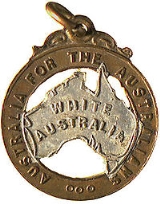
The White Australia policy is a term used to describe a collection of historical policies that intentionally restricted non-white immigration to Australia from 1901 to 1973.
The chief architect of the policy, Alfred Deakin, conceded that the Japanese and Chinese might be a threat to the newly formed federation and it was this belief that led to legislation to ensure they would be kept out:
"It is not the bad qualities, but the good qualities of these alien races that make them so dangerous to us.

Discussion
Ask a question about 'White Australia policy'
Start a new discussion about 'White Australia policy'
Answer questions from other users
|
Recent Posts

Encyclopedia
The White Australia policy is a term used to describe a collection of historical policies that intentionally restricted non-white immigration to Australia from 1901 to 1973.
The chief architect of the policy, Alfred Deakin, conceded that the Japanese and Chinese might be a threat to the newly formed federation and it was this belief that led to legislation to ensure they would be kept out:
"It is not the bad qualities, but the good qualities of these alien races that make them so dangerous to us. It is their inexhaustible energy, their power of applying themselves to new tasks, their endurance and low standard of living that make them such competitors."
The happening of the inauguration of White Australia as government policy is generally taken to be the passage of the Immigration Restriction Act in 1901, one of the first Acts of the new national parliament upon federation, the bill had support from the labour movement. The policy was dismantled in stages by successive Liberal governments after the conclusion of World War II, with the encouragement of first non-British and later non-white immigration. From 1973 on, the White Australia policy was for all practical purposes defunct, and in 1975 the Australian government passed the Racial Discrimination Act, which made racially-based selection criteria illegal.
Restrictions on immigration had preceded federation, beginning with anti-Chinese legislation enacted by individual Australian colonies during the Australian goldrushes of the 1850s.
Immigration policy prior to Federation
Gold Rush era
In the discovery of gold in Australia in 1851 led to an influx of immigrants from all around the world. Over the next 20 years, 40,000 Chinese men and 11 women (mostly Cantonese) migrated to the gold-fields because of wanting a new start in life by trying to find gold. Competition on the gold-fields led to significant conflict between groups.
This tension eventually led to a series of protests and riots, including the Lambing Flat Riots between 1860 and 1861. Governor Hotham, on 16 November 1854, appointed a Royal Commission on Victorian gold-fields problems and grievances. This led to restrictions being placed on Chinese immigration and residency taxes levied from Chinese residents in Victoria from 1855 with New South Wales following suit in 1861. These restrictions remained in force until the early 1870s.
The growth of the sugar industry in Queensland in the 1870s led to searching for labourers prepared to work in a tropical environment. During this time, thousands of "Kanakas" (Pacific Islanders) were brought into Australia as indentured workers. This and related practices of bringing in non-white labour to be cheaply employed was commonly termed "blackbirding" and refers to the recruitment of people through trickery and kidnappings to work on plantations, particularly the sugar cane plantations of Queensland (Australia) and Fiji. In the 1870s and 1880s, the trade union movement began a series of protests against foreign labour. Their arguments were that Asians and Chinese took jobs away from white men, worked for "substandard" wages, lowered working conditions and refused unionisation.
Objections to immigration restrictions for non-whites came largely from wealthy land owners in rural areas. It was argued that without Asiatics to work in the tropical areas of the Northern Territory and Queensland, the area would have to be abandoned. Despite these objections to restricting immigration, between 1875-1888 all Australian colonies enacted legislation which excluded all further Chinese immigration. Asian immigrants already residing in the Australian colonies were not expelled and retained precisely the same rights as their Anglo and Celtic compatriots insofar as citizenship.
Agreements were made to further increase these restrictions in 1895 following an Inter-colonial Premier's Conference where all colonies agreed to extend entry restrictions to all non-white races. However, in attempting to enact this legislation, the Governors of New South Wales, South Australia and Tasmania reserved the bills, due to a treaty with Japan, and they did not become law. Instead, the Natal Act of 1897 was introduced, restricting "undesirable persons" rather than any specific race.
The British government in London was not pleased with legislation that discriminated against certain subjects of its Empire, but decided not to disallow the laws that were passed. Colonial Secretary Joseph Chamberlain explained in 1897:
- "We quite sympathise with the determination...of these colonies...that there should not bre an influx of people alien in civilisation, alien in religion, alien in customs, whose influx, moreover, would seriously interfere with the legitimate rights of the existing labouring population."
From Federation to World War II
Federation Convention and Australia's first government
Immigration was a prominent topic in the lead up to Australian Federation. At the Federation Convention, Western Australian premier and future federal cabinet member, John Forrest, summarised the prevailing feeling:
[It is] of no use to shut our eyes to the fact that there is a great feeling all over Australia against the introduction of coloured persons. It goes without saying that we do not like to talk about it, but it is so.
The government following Federation in 1901 was formed by the Protectionist Party with the support of the Australian Labor Party. The support of the Labour Party was contingent upon restricting non-white immigration, reflecting the attitudes of the Australian Worker's Union and other labour organisations at the time, upon whose support the Labour Party was founded.
Immigration Restriction Act 1901
The new Federal Parliament, as one of its first pieces of legislation, passed the Immigration Restriction Act 1901 to "place certain restrictions on immigration and... for the removal... of prohibited immigrants". The Act drew on similar legislation in South Africa. Edmund Barton, the prime minister, argued in support of the Bill with the following statement: "The doctrine of the equality of man was never intended to apply to the equality of the Englishman and the Chinaman."
Early drafts of the Act explicitly banned non-Europeans from migrating to Australia but objections from the British government, which feared that such a measure would offend British subjects in India and Britain's allies in Japan, caused the Barton government to remove this wording. Instead, a "dictation test" was introduced as a device for excluding unwanted immigrants. Immigration officials were given the power to exclude any person who failed to pass a 50-word dictation test. At first this was to be in any European language, but was later changed to include any language.
In the British Empire South Africa, Canada, and New Zealand also had racially restrictive immigration policies in the 19th and early 20th centuries. Most Chinese immigration to the U.S. became illegal in 1882.
In 1902 the Australian parliament passed the Pacific Island Labourers Act. The result of this legislation was that 7,500 Pacific Islanders (called "Kanakas") working mostly on plantations in Queensland were deported and entry into Australia by Pacific Islanders after 1904 was prohibited..
The Paris Peace Conference
At the 1919 Paris Peace Conference following World War I, Japan sought to include a racial equality clause in the Covenant of the League of Nations. Japanese policy reflected their desire to remove or to ease the immigration restrictions against Japanese (especially in the United States and Canada), which Japan regarded as a humiliation and affront to its prestige.
Australia was one of few countries which had race as a dominant political ideology at the time. As such, Australian Prime Minister Billy Hughes vehemently opposed Japan's racial equality proposition. Hughes recognised that such a clause would be a threat to White Australia and made it clear to British Prime Minister David Lloyd George that he would leave the conference if the clause was adopted. When the proposal failed, Hughes reported in the Australian parliament:
"The White Australia is yours. You may do with it what you please, but at any rate, the soldiers have achieved the victory and my colleagues and I have brought that great principle back to you from the conference, as safe as it was on the day when it was first adopted."
Stanley Bruce
Australian Prime Minister Stanley Bruce was a supporter of the White Australia Policy, and made it an issue in his campaign for the 1925 Australian Federal election.
Abolition of the Policy
World War II
Between the Great Depression starting in 1929 and the end of World War II in 1945, global conditions kept immigration to very low levels. At the start of the war, Prime Minister John Curtin (ALP) reinforced the message of the White Australia Policy by saying: "This country shall remain forever the home of the descendants of those people who came here in peace in order to establish in the South Seas an outpost of the British race."
However, by the end of World War II, Australia's vulnerability during the war in the Pacific and small population led to policies summarised by the slogan, "Populate or Perish." An ethnocentric slogan that meant "Fill with whites, lest we be filled with yellows". During the war, many non-white refugees, including Malays, Indonesians, and Filipinos, had settled in Australia, but Immigration Minister Arthur Calwell controversially sought to have them all deported. However in 1948, Iranian Bahá'ís seeking to emigrate to Australia were classified as "Asiatic" by the policy, and were denied entry and the policy largely remained in place until the 1960s and was lifted in 1973. In 1949, Calwell's successor Harold Holt allowed the remaining 800 non-white refugees to apply for residency, and also allowed Japanese "war brides" to settle in Australia.
Relaxation of restrictions
Australian policy began to shift towards significantly increasing immigration. Legislative changes over the next few decades continuously opened up immigration in Australia.
- 1947 The Australian Government relaxed the Immigration Restriction Act allowing Non-Europeans the right to settle permanently in Australia for business reasons.
- 1950 Colombo Plan, students from Asian countries were admitted to study at Australian universities.
- 1957 Non-Europeans with 15 years' residence in Australia were allowed to become citizens.
- 1958 The Revised Migration Act of 1958 abolished the dictation test and introduced a simpler system for entry.
- 1959 Australians were permitted to sponsor Asian spouses for citizenship.
- 1964 Conditions of entry for people of Non-European stock were relaxed.
After a review of the European policy in March 1966, Immigration Minister Hubert Opperman announced applications for migration would be accepted from well-qualified people on the basis of their suitability as settlers, their ability to integrate readily and their possession of qualifications positively useful to Australia. At the same time, the Holt Liberal government decided a number of "temporary resident" non-Europeans, who were not required to leave Australia, could become permanent residents and citizens after five years (the same as for Europeans).
As a result, annual non-European settler arrivals rose from 746 in 1966 to 2,696 in 1971, while annual part-European settler arrivals rose from 1,498 to 6,054.
End of the White Australia Policy
The legal end of the White Australia policy is usually placed in the year 1973, when the Whitlam Labour government implemented a series of amendments preventing the enforcement of racial aspects of the immigration law. These amendments:
- Legislated that all migrants, regardless of origin, be eligible to obtain citizenship after three years of permanent residence.
- Ratified all international agreements relating to immigration and race.
- Issued policy to totally disregard race as a factor in selecting migrants.
The 1975 Racial Discrimination Act made the use of racial criteria for any official purpose illegal.
It was not until the Fraser Liberal government's review of immigration law in 1978 that all selection of prospective migrants based on country of origin was entirely removed from official policy. Currently, a large number of Australia's immigrants are from countries such as China and India, though the United Kingdom and New Zealand respectively remain the two largest single sources of immigrants.
In 1981 the Minister for Immigration announced a Special Humanitarian Assistance (SHP) Program for Iranians to seek refuge in Australia and by 1988 some 2500 Bahá'ís and many more others had arrived in Australia through either SHP or Refugee Programs. See Iranian Australian and Bahá'í Faith in Australia. The last selective immigration policy, offering relocation assistance to British nationals, was finally removed in 1982.
Legacy
Contemporary demographics
The 2001 Australian census results indicate that many Australians claim some European heritage: English 37%, Irish 11%, Italian 5%, German 4.3%, Scottish 3%, Greek 2%, Dutch 1.5%, Polish 0.9%. Australians of some non-European origin form a significant but still relatively small part of the population: Chinese 3.2%, Indian 0.9%, Lebanese 0.9%, Vietnamese 0.9%. 2.2% identified themselves as Indigenous Australians. 39% of the population gave their ancestry as "Australian". The Australian census does not classify people according to race, only ethnic ancestry. (Note that subjects were permitted to select more than one answer for this census question.)
15% of the population now speaks a language other than English at home. The most commonly spoken languages are Italian, Greek, Cantonese and Arabic.
Political and social legacy
Discrimination on the basis of race or ethnicity was legally sanctioned until 1975. Australia's new official policy on racial diversity is: "to build on our success as a culturally diverse, accepting and open society, united through a shared future". The White Australia Policy continues to be mentioned in modern contexts, although few politicians ever mention the policy, except when denouncing their opposition. As Leader of the Opposition, John Howard, argued for restricting Asian immigration in 1988, as part of his One Australia policy, later admitting that his comments cost him his job at the time:
At their peak, Pauline Hanson's One Nation party received 9% of the national election vote. Pauline Hanson was widely accused of taking Australia back to the days of the White Australia Policy, particularly through reference to Arthur Calwell, one of the policy's strongest supporters:
On 24 May 2007, Pauline Hanson, with her new Pauline's United Australia Party, continues her call for a freeze on immigration and provided comments about African migrants carrying disease into Australia. Topics related to racism and immigration in Australia are still regularly connected by the media to the White Australia Policy. Some examples of issues and events where this connection has been made include:
reconciliation with Aborigines; mandatory detention and the "Pacific Solution"; the 2005 Cronulla riots. Former opposition Labor party leader Mark Latham, in his book The Latham Diaries, described the ANZUS alliance as a legacy of the White Australia policy.
In 2007, the Howard Government introduced a citizenship test to include a tougher English language test, and a test on "Australian" values. The actual questions of such citizenship test have not been publicly released, and its future is in question given the ALP victory in the 2007 election.
In fact, Australian government policy from earlier years is viewed by some as the original impetus for the Apartheid system in South Africa.
See also
Further reading
- Wulf D. Hund (2006): White Australia oder der Krieg der Historiker. In: Blätter für deutsche und internationale Politik, 3.
- Laksiri Jayasuriya, David Walker, Jan Gothard (Eds.) (2003): Legacies of White Australia. Crawley, University of Western Australia Press.* (old but still very useful)*
External links
(scan of the Act and information)
-
- - A shipboard diary kept by able seaman Newton Barton on one of his voyages to recruit South Sea Islanders for the Queensland cane fields. Digitised and held by the State Library of Queensland.
|
| |
|
|