
All Topics  
Attack on Pearl Harbor

 
Attack On Pearl Harbor

   Email Print
   Bookmark   Link


Attack on Pearl Harbor


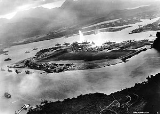
The attack on Pearl Harbor (or Hawaii Operation, as it was called by the Imperial General Headquarters
Imperial General Headquarters

The as part of the Supreme War Council was established in 1893 to coordinate efforts between the Imperial Japanese Army and Imperial Japanese Navy during wartime....
) was a surprise military strike
Military strike

A military strike is a limited attack on a specified target. Strikes are used, amongst other things, to render facilities inoperable , to assassin enemy leaders, and to limit supply to enemy troops....
 conducted by the Japanese
Empire of Japan

The Empire of Japan was a Japanese political entity that existed during the period from the Meiji Restoration in 1868 until its defeat in World War II in 1945....
 navy
Imperial Japanese Navy

The origins of the Imperial Japanese Navy trace back to early interactions with nations on the Asia, beginning in the early history of Japan#Feudal Japan and reaching a peak of activity during the 16th and 17th centuries at a time of cultural diffusion with European power during the Age of Discovery....
 against the United States
United States

The United States of America is a Federal government constitutional republic comprising U.S. state and a federal district. The country is situated mostly in central North America, where its Contiguous United States and Washington, D.C., the Capital districts and territories, lie between the Pacific Ocean and Atlantic Oceans, Borders of the U...
' naval base at Pearl Harbor
Pearl Harbor

Pearl Harbor is a harbor on the island of Oahu, Hawaii, west of Honolulu, Hawaii. Much of the harbor and surrounding lands is a United States Navy deep-water naval base....
, Hawaii
Hawaii

File:Pahoehoe and Aa flows at Hawaii.jpgThe State of Hawaii is a U.S. state in the United States, located on an archipelago in the central Pacific Ocean southwest of the continental United States, southeast of Japan, and northeast of Australia....
, on the morning of Sunday, December 7, 1941, later resulting in the United States becoming militarily involved in World War II
World War II

World War II, or the Second World War , was a global military conflict which involved a Participants in World War II, including all of the great powers, organised into two opposing military alliances: the Allies of World War II and the Axis powers....
. It was intended as a preventive
Preventive war

A preventive war or preventative war is a war initiated under the belief that future conflict is inevitable, though not imminent. Preventive war aims to forestall a shift in the balance of power by strategically attacking before the balance of power has a chance to shift in the direction of the adversary....
 action to keep the U.S. Pacific Fleet from influencing the war Japan was planning to wage in Southeast Asia
Southeast Asia

Southeast Asia or Southeastern Asia is a subregion of Asia, consisting of the countries that are geographically south of China, east of India and north of Australia....
 against Britain
United Kingdom

The United Kingdom of Great Britain and Northern Ireland, commonly known as the United Kingdom , the UK or Britain,is a sovereign state located off the northwestern coast of continental Europe....
, the Netherlands
Netherlands

The Netherlands is a country that is part of the Kingdom of the Netherlands. It is a parliamentary democratic constitutional monarchy. The Netherlands is located in North-West Europe, and bordered by the North Sea to the north and west, Belgium to the south, and Germany to the east....
, and the United States.


Discussion
Ask a question about 'Attack on Pearl Harbor'
Start a new discussion about 'Attack on Pearl Harbor'
Answer questions from other users
Full Discussion Forum


Recent Posts


Encyclopedia


The attack on Pearl Harbor (or Hawaii Operation, as it was called by the Imperial General Headquarters
Imperial General Headquarters

The as part of the Supreme War Council was established in 1893 to coordinate efforts between the Imperial Japanese Army and Imperial Japanese Navy during wartime....
) was a surprise military strike
Military strike

A military strike is a limited attack on a specified target. Strikes are used, amongst other things, to render facilities inoperable , to assassin enemy leaders, and to limit supply to enemy troops....
 conducted by the Japanese
Empire of Japan

The Empire of Japan was a Japanese political entity that existed during the period from the Meiji Restoration in 1868 until its defeat in World War II in 1945....
 navy
Imperial Japanese Navy

The origins of the Imperial Japanese Navy trace back to early interactions with nations on the Asia, beginning in the early history of Japan#Feudal Japan and reaching a peak of activity during the 16th and 17th centuries at a time of cultural diffusion with European power during the Age of Discovery....
 against the United States
United States

The United States of America is a Federal government constitutional republic comprising U.S. state and a federal district. The country is situated mostly in central North America, where its Contiguous United States and Washington, D.C., the Capital districts and territories, lie between the Pacific Ocean and Atlantic Oceans, Borders of the U...
' naval base at Pearl Harbor
Pearl Harbor

Pearl Harbor is a harbor on the island of Oahu, Hawaii, west of Honolulu, Hawaii. Much of the harbor and surrounding lands is a United States Navy deep-water naval base....
, Hawaii
Hawaii

File:Pahoehoe and Aa flows at Hawaii.jpgThe State of Hawaii is a U.S. state in the United States, located on an archipelago in the central Pacific Ocean southwest of the continental United States, southeast of Japan, and northeast of Australia....
, on the morning of Sunday, December 7, 1941, later resulting in the United States becoming militarily involved in World War II
World War II

World War II, or the Second World War , was a global military conflict which involved a Participants in World War II, including all of the great powers, organised into two opposing military alliances: the Allies of World War II and the Axis powers....
. It was intended as a preventive
Preventive war

A preventive war or preventative war is a war initiated under the belief that future conflict is inevitable, though not imminent. Preventive war aims to forestall a shift in the balance of power by strategically attacking before the balance of power has a chance to shift in the direction of the adversary....
 action to keep the U.S. Pacific Fleet from influencing the war Japan was planning to wage in Southeast Asia
Southeast Asia

Southeast Asia or Southeastern Asia is a subregion of Asia, consisting of the countries that are geographically south of China, east of India and north of Australia....
 against Britain
United Kingdom

The United Kingdom of Great Britain and Northern Ireland, commonly known as the United Kingdom , the UK or Britain,is a sovereign state located off the northwestern coast of continental Europe....
, the Netherlands
Netherlands

The Netherlands is a country that is part of the Kingdom of the Netherlands. It is a parliamentary democratic constitutional monarchy. The Netherlands is located in North-West Europe, and bordered by the North Sea to the north and west, Belgium to the south, and Germany to the east....
, and the United States. The attack consisted of two aerial attack waves totaling 353 aircraft, launched from six Japanese aircraft carrier
Aircraft carrier

An aircraft carrier is a warship designed with a primary mission of deploying and recovering aircraft, acting as a seagoing airbase. Aircraft carriers thus allow a navy force to project air power great distances without having to depend on local bases for staging aircraft operations....
s.

The attack sank four U.S. Navy battleship
Battleship

A battleship is a large, heavily armour warship with a main artillery battery consisting of the largest calibre of guns. Battleships were larger, better armed, and better armored than cruisers and destroyers....
s (two of which were raised and returned to service late in the war) and damaged four more. The Japanese also sank or damaged three cruiser
Cruiser

A cruiser is a large type of warship, which had its prime period from the late 19th century to the end of the Cold War. The first cruisers were intended for individual raiding and protection missions on the seas....
s, three destroyer
Destroyer

In navy terminology, a destroyer is a fast and maneuverable yet long-endurance warship intended to escort larger vessels in a Naval fleet, convoy or battle group and defend them against smaller, short-range but powerful attackers ....
s, and one minelayer
Minelayer

Minelaying is the act of deploying explosive mines. Historically this has been carried out by ships, submarines and aircraft. Additionally, the term Minelayer refers specifically to a naval ship used for deploying naval mines....
, destroyed 188 aircraft, and caused personnel losses of 2,402 killed and 1,282 wounded. The power station, shipyard, maintenance, and fuel and torpedo storage facilities, as well as the submarine piers and headquarters building (also home of the intelligence section
Station HYPO

Station HYPO, also known as Fleet Radio Unit Pacific was the United States Navy SIGINT and cryptography intelligence unit in Hawaii during World War II....
) were not hit. Japanese losses were minimal, at 29 aircraft and four midget submarine
Midget submarine

A midget submarine is any submarine under 150 tons, typically operated by one or two but up to 6 or 8 crew, with no on-board living accommodation....
s, with 65 servicemen killed or wounded.

The attack was a major engagement of World War II. It occurred before a formal declaration of war
Declaration of war

A declaration of war is a formal performative speech act or signing of a document by an authorised party of a government in order to initiate a state of war between two or more nations....
 and before the last part of a 14-part message was delivered to the State Department
United States Department of State

The United States Department of State, often referred to as the State Department, is the United States Cabinet-level foreign affairs agency of the United States Federal government of the United States, similar to foreign ministries, foreign offices, ministries of external relations, etc....
 in Washington, D.C.
Washington, D.C.

Washington, D.C. , formally the District of Columbia and commonly referred to as Washington, the District, or simply D.C., is the Capital of the United States, founded on July 16, 1790....
 The Japanese Embassy in Washington had been instructed to deliver it immediately prior to the scheduled time of the attack in Hawaii. The attack, and especially the 'surprise' nature of it, were both factors in changing U.S. public opinion from the isolationist
Isolationism

Isolationism is a foreign policy which combines a non-interventionism military policy and a political policy of economic nationalism . In other words, it asserts both of the following:...
 position of the mid-1930s to support for direct participation in the war. Germany's prompt declaration of war, unforced by any treaty commitment to Japan, quickly brought the US into the European Theatre
European Theatre of World War II

The European Theatre of Operations was a huge area of heavy fighting across Europe; during World War II, from Nazi Germany Invasion of Poland on September 1, 1939 until the end of World War II in Europe with the German unconditional surrender on May 8, 1945 ....
 as well. The lack by Japan of any formal declaration prior to the attack led President
List of Presidents of the United States

File:WhiteHouseSouthFacade.JPGThe President of the United States is the head of state and the head of government of the United States. As chief of the executive branch and head of the Federal government of the United States as a whole, the presidency is the highest political office in the United States by influence and recognition....
 Franklin D. Roosevelt
Franklin D. Roosevelt

Franklin Delano Roosevelt , often referred to by his initials FDR, was the List of Presidents of the United States President of the United States....
 to proclaim "December 7th, 1941 — a date which will live in infamy".

Background to conflict


The strike was intended to neutralize the U.S. Pacific Fleet, and hence protect Japan's advance into Malaya
British Malaya

British Malaya loosely described a set of states on the Malay Peninsula that were colonized by the United Kingdom from the 18th and the 19th until the 20th century....
 and the Dutch East Indies
Dutch East Indies

The Dutch East Indies, or Netherlands East Indies, was the Dutch colony that became modern Indonesia following World War II.It was formed from the nationalised colony of the former Dutch East India Company that came under the administration of the Netherlands in 1800....
, where Japan sought access to natural resources such as oil
Petroleum

Petroleum or crude oil is a naturally occurring, flammable liquid found in rock formations in the Earth consisting of a complex mixture of hydrocarbons of various molecular weights, plus other organic compounds....
 and rubber. Both the U.S. and Japan held long-standing contingency plans for war in the Pacific which were continuously updated as tensions between the two countries steadily increased during the 1930s, with the Japanese expansion into Manchuria
Manchuria

Manchuria is a historical name given to a vast geographic region in northeast Asia. Depending on the definition of its extent, Manchuria either falls entirely within People's Republic of China, or is divided between China and Russia....
 and French Indochina
French Indochina

French Indochina was the part of the French colonial empire in Indochina in southeast Asia. A federation of the three Vietnamese regions, Tonkin, Annam, and Cochinchina, as well as Cambodia, was formed in 1887....
 greeted by steadily increased levels of embargoes and sanctions from the United States and other nations.

In 1940, under the authority granted by the Export Control Act
Export Control Act

The Export Control Act of 1940 was one in a series of legislative efforts by the United States government and specifically the administration of President Franklin D....
, the U.S. halted shipments of airplanes, parts, machine tools, and aviation gasoline, which was perceived by Japan as an unfriendly act. The U.S. did not stop oil exports to Japan at that time in part because prevailing sentiment in Washington was that such an action would be an extreme step, given Japanese dependence on U.S. oil, and likely to be considered a provocation by Japan.

Japanese planning staff studied the 1940 British attack on the Italian fleet
Battle of Taranto

The naval Battle of Taranto took place on the night of 11 November 1940 – 12 November 1940 during World War II. The Royal Navy launched the first all-aircraft naval attack in history, flying a small number of aircraft from an aircraft carrier in the Mediterranean Sea and attacking the Italy fleet at harbour in Taranto....
 at Taranto
Taranto

Taranto is a coastal city in Puglia, Southern Italy. It is the capital of the Province of Taranto and is an important commercial port as well as the main Italian naval base....
 intensively. It was of great use to them when planning their attack on US naval forces in Pearl Harbor.

Following Japanese expansion into French Indochina after the fall of France, the U.S. ceased oil exports to Japan in the Summer of 1941, in part because of new American restrictions on domestic oil consumption. President
President of the United States

The President of the United States is the head of state and head of government of the United States and is the highest political official in the United States by influence and recognition....
 Franklin D. Roosevelt
Franklin D. Roosevelt

Franklin Delano Roosevelt , often referred to by his initials FDR, was the List of Presidents of the United States President of the United States....
 had earlier moved the Pacific Fleet to Hawaii
Hawaii

File:Pahoehoe and Aa flows at Hawaii.jpgThe State of Hawaii is a U.S. state in the United States, located on an archipelago in the central Pacific Ocean southwest of the continental United States, southeast of Japan, and northeast of Australia....
 and ordered a military buildup in the Philippines
Philippines

The Philippines, officially known as the Republic of the Philippines, is a country in Southeast Asia with Manila as its capital city. It comprises 7,107 islands in the western Pacific Ocean....
 in the hope of discouraging Japanese aggression in the Far East. As the Japanese high command was (mistakenly) certain any attack on the United Kingdom's Southeast Asian colonies would bring the U.S. into the war, a preventive strike appeared to be the only way for Japan to avoid U.S. naval interference. An invasion of the Philippines was also considered to be necessary by Japanese war plans, while for the U.S., reconquest of the islands had been a given of War Plan Orange
War Plan Orange

War Plan Orange refers to a series of United States Joint Chiefs of Staff war plans for dealing with a possible war with Japan during the interwar years....
 in the interwar years.

War between Japan and the United States had been a possibility each nation had been aware of (and developed contingency plans for) since the 1920s, though tensions did not begin to grow seriously until Japan's 1931 invasion of Manchuria. Over the next decade, Japan continued to expand into China, leading to all out war
Second Sino-Japanese War

The Second Sino-Japanese War was the largest Asian war in the twentieth century. From 1937 to 1941, it was fought between the Republic of China and the Empire of Japan....
 in 1937. In 1940, Japan invaded French Indochina in both an effort to control supplies reaching China, and as a first step to improve her access to resources in Southeast Asia. This move prompted an American embargo on oil exports to Japan, which in turn caused the Japanese to initiate their planned takeover of oil production in the Dutch East Indies. Furthermore, the transfer of the U.S. Pacific Fleet from its previous base in San Diego to its new base in Pearl Harbor was seen by the Japanese military as the U.S. readying itself for a potential conflict between the two countries.

Preliminary planning for an attack on Pearl Harbor to protect the move into the "Southern Resource Area" (the Japanese term for the East Indies and Southeast Asia generally) had begun in very early 1941, under the auspices of Admiral Yamamoto, then commanding Japan's Combined Fleet
Combined Fleet

The was the main ocean-going component of the Imperial Japanese Navy, analogous to the German High Seas Fleet. Before World War II, the Combined Fleet was not a standing force, but a temporary force formed for the duration of a conflict or major naval maneuvers from various units normally under separate commands in peacetime....
. He won assent to formal planning and training for an attack from the Imperial Japanese Navy General Staff
Imperial Japanese Navy General Staff

The was the highest organ within the Imperial Japanese Navy. In charge of planning and operations, it was headed by an Admiral headquartered in Tokyo....
 only after much contention with Naval Headquarters, including a threat to resign his command. Full-scale planning was underway by early spring 1941, primarily by Captain Minoru Genda
Minoru Genda

Minoru Genda was a well-known Japanese military aviator and politician. He is best known for planning the Pearl Harbor attack.Early life...
. Over the next several months, pilots trained, equipment was adapted, and intelligence collected. Despite these preparations, actual approval of the attack plan was not issued by Emperor Showa until November 5, after the third of four Imperial Conferences to consider the matter. Final authorization was not given by the emperor until December 1, after a majority of Japanese leaders advised him the "Hull Note
Hull note

The Hull note - so-named for Secretary of State Cordell Hull - delivered on November 26, 1941, was the final proposal delivered to Japan by the United States before the start of war between the two nations....
" would "destroy the fruits of the China incident, endanger Manchukuo
Manchukuo

Manchukuo was a puppet state in Manchuria and eastern Inner Mongolia. The region was the Qing Dynasty's historical homeland, created by former Qing Dynasty officials with help from Imperial Japan in 1932....
 and undermine Japanese control of Korea." By late 1941 U.S. Pacific bases and facilities had been placed on alert on multiple occasions, with hostilities between the U.S. and Japan expected by many observers. U.S. officials doubted Pearl Harbor would be the first target in any war with Japan, instead expecting the Philippines to be attacked first due to the threat it posed to sea lanes to the south and the erroneous belief that Japan was not capable of mounting more than one major naval operation at a time.

There has been ongoing controversy due to allegations made by conspiracy theorists, military historians and former armed forces
Armed forces

The armed forces of a country are its government-sponsored defense, fighting forces, and organizations. They exist to further the foreign and domestic policies of their governing body, and to defend that body and the nation it represents from external and internal aggressors....
 personnel that some members of the Roosevelt administration
Roosevelt Administration

There have been two Presidents of the United States with the surname "Roosevelt":*Theodore Roosevelt Administration, the 26th President of the United States, 1901 - 1909...
 had advance knowledge
Pearl Harbor advance-knowledge debate

The Pearl Harbor advance-knowledge debate is a dispute over what, if any, advance knowledge United States officials had of Japan's December 7, 1941 attack on Pearl Harbor....
 of the attack, and that this was purposefully ignored in order to gain public and Congressional
United States Congress

The United States Congress is the Bicameralism legislature of the Federal government of the United States of the United States of America, consisting of two houses, the United States Senate and the United States House of Representatives....
 support for America entering the war on the side of the British Empire and her allies.

Objectives

The attack had several major aims. First, it was supposed to destroy American fleet units, thereby preventing the Pacific Fleet from interfering with Japanese conquest of the Dutch East Indies. Second, it was a means to buy time for Japan to consolidate her position and increase her naval strength, before the shipbuilding of the Vinson-Walsh Act
Two-Ocean Navy Act

The Two-Ocean Navy Act, was an United States Act of Congress passed on July 19, 1940, to increase the size of the United States Navy by 70%, making it the largest naval procurement bill in U.S....
 erased any chance of victory. Finally, it was intended as a blow against American morale, which might discourage further fighting and enable Japan to conquer Southeast Asia without interference.

Making battleships the main target was a means of striking at morale, since they were the prestige ships of any navy at the time. Because both Japanese and American strategic thinking and doctrine was derived from the work of Captain Alfred Mahan
Alfred Thayer Mahan

Alfred Thayer Mahan was a United States Navy flag officer, Geostrategy, and educator. His ideas on the importance of sea power influenced navies around the world, and helped prompt naval buildups before World War I....
, which held battleships were decisive in naval warfare, it was also a means of striking at the fighting power of the Pacific Fleet; if it succeeded, it meant the ultimate Pacific battle ("decisive battle", in Japanese Navy thinking), which would inevitably be fought by battleships, would be postponed, if not prevented entirely. With that in mind, Yamamoto intended the Pacific Fleet should be sought and attacked "wherever it might be found in the Pacific". A 14 November 1941 tabletop exercise suggested alert defenders could sink two carriers and damage two more, even with providential weather, which amounted to all the strength Naval General Staff had wanted to allocate to the operation. Nevertheless, Yamamoto pressed ahead.

Japanese confidence in their ability to achieve a short, victorious war also meant other targets in the harbor, especially the Navy Yard, oil tank farms, and Submarine Base, could safely be ignored, since the war would be over before the influence of these facilities would be felt.

Approach and attack


Pearlharborcarrierchart
On November 26, 1941, a Japanese task force (the Kido Butai, or Striking Force) of six aircraft carriers departed northern Japan en route to a position to northwest of Hawaii, intending to launch its aircraft to attack Pearl Harbor. In all, 405 aircraft were intended to be used: 360 for the two attack waves, 48 on defensive combat air patrol
Combat air patrol

Combat air patrol is a type of flying mission for fighter aircraft.A combat air patrol is an aircraft patrol provided over an objective area, over the force protected, over the critical area of a combat zone, or over an air defense area, for the purpose of intercepting and destroying hostile aircraft before they reach their target....
 (CAP), including nine fighters from the first wave.

The first wave was to be the primary attack, while the second wave was to finish whatever tasks remained. The first wave contained the bulk of the weapons to attack capital ships, mainly torpedo
Torpedo

Note: Prior to 1900, in naval usage "torpedo" could also refer to what today is called a naval mine. For that usage, see naval mine.The modern torpedo is a self-propelled explosive projectile weapon, launched above or below the water surface, propelled underwater toward a target, and designed to detonate on contact or in proximity t...
es. The aircrews were ordered to select the highest value targets (battleships and aircraft carrier
Aircraft carrier

An aircraft carrier is a warship designed with a primary mission of deploying and recovering aircraft, acting as a seagoing airbase. Aircraft carriers thus allow a navy force to project air power great distances without having to depend on local bases for staging aircraft operations....
s) or, if either were not present, any other high value ships (cruisers and destroyers). Dive bomber
Dive bomber

A dive bomber is a bomber aircraft that dives directly at its targets in order to provide greater accuracy and limit the exposure to and effectiveness of Anti-aircraft warfare fire....
s were to attack ground targets. Fighters were ordered to strafe and destroy as many parked aircraft as possible to ensure they did not get into the air to counterattack the bombers, especially in the first wave. When the fighters' fuel got low they were to refuel at the aircraft carriers and return to combat. Fighters were to serve CAP duties where needed, especially over US airfields.

Before the attack commenced, two reconnaissance aircraft launched from cruisers were sent to scout over Oahu and report on enemy fleet composition and location. Another four scout planes patrolled the area between the Kido Butai and Niihau
Niihau

Niihau or Niihau is the smallest of the inhabited Hawaiian Islands in the U.S. state of Hawaii, having an area of . Known as the "Forbidden Isle", Niihau lies 17.5 miles across the Hawaiian islands channels, southwest of Kauai, and the crescent-shaped island of Lehua is positioned 0.7 miles north of Niihau....
, in order to prevent the task force from being caught by a surprise counterattack.

Submarines

Fleet submarines I-16, I-18, I-20, I-22, and I-24 each embarked a Type A
Ko-hyoteki class submarine

The class was a class of Japanese midget submarines used during World War II. They had hull numbers but no names. For simplicity, they are most often referred to by the hull number of the mother submarine....
 midget submarine
Midget submarine

A midget submarine is any submarine under 150 tons, typically operated by one or two but up to 6 or 8 crew, with no on-board living accommodation....
 for transport to the waters off Oahu. The five I-boats left Kure Naval District
Kure Naval District

was the second of four main administrative districts of the pre-war Imperial Japanese Navy. Its territory included the Inland Sea of Japan and the Pacific Ocean coasts of southern Honshu from Wakayama prefecture to Yamaguchi prefectures, eastern and northern Kyushu and Shikoku....
 on November 25, 1941, coming to 10 nm (19 km) off the mouth of Pearl Harbor and launched their charges, at about 01:00 December 7. At 03:42 Hawaiian Time, the minesweeper
Minesweeper (ship)

A minesweeper is a small naval warship designed to counter the threat posed by naval mines. Minesweepers generally detect then neutralize mines in advance of other naval operations....
 USS Condor
USS Condor (AMc-14)

The USS Condor was constructed as New Example in 1937 at Tacoma, Washington; Acquired by the U.S. Navy, 28 October 1940 for conversion to a coastal Minesweeper ; Commissioned as USS Condor , 18 April 1941....
 spotted a midget submarine periscope southwest of the Pearl Harbor entrance buoy and alerted destroyer USS Ward
USS Ward (DD-139)

USS Ward was a 1247-ton Wickes class destroyer destroyer in the United States Navy during World War I, later APD-16 in World War II....
. That midget probably entered Pearl Harbor, but Ward sank another at 06:37. A midget on the north side of Ford Island missed Curtiss
USS Curtiss (AV-4)

USS Curtiss was launched 20 April 1940 by New York Shipbuilding Corp., Camden, N.J.; sponsored by Mrs. H. S. Wheeler; and commissioned 15 November 1940, Commander S....
 with her first torpedo and missed the attacking Monaghan
USS Monaghan (DD-354)

USS Monaghan was the last ship built of the Farragut class destroyer destroyers. She was named for Ensign John R. Monaghan.The Monaghan was laid down 21 November 1933 at Boston Navy Yard, and launched 9 January 1935....
 with her other one before being sunk by Monaghan at 08:43.

A third midget submarine grounded twice, once outside the harbor entrance and again on the east side of Oahu, where it was captured on December 8. Ensign Kazuo Sakamaki
Kazuo Sakamaki

Kazuo Sakamaki was a Japanese naval officer, and the first prisoner of war of World War II captured by US forces.Sakamaki was one of ten sailors who volunteered to Attack on Pearl Harbor in a Ko-hyoteki class submarine midget submarine on 7 December 1941....
 swam ashore from her and became the first Japanese prisoner of war
Prisoner of war

A prisoner of war is a combatant who is held in continuing custody by an enemy power during or immediately after an armed conflict....
. A fourth had been damaged by a depth charge attack and abandoned by its crew before it could fire its torpedoes. A United States Naval Institute
United States Naval Institute

The United States Naval Institute , based at the United States Naval Academy in Annapolis, Maryland, is a private, Non-profit organization, Professional body military association that seeks to offer independent, nonpartisan forums for debate of national defense issues....
 analysis of photographs from the attack conducted in 1999 indicated a midget may have successfully fired a torpedo into USS West Virginia
USS West Virginia (BB-48)

USS West Virginia , a , was the second ship of the United States Navy named in honor of West Virginia.Her keel was laid down on 12 April 1920 by the Northrop Grumman Newport News and Drydock Company of Newport News, Virginia....
. Japanese forces received a radio communications from a midget submarine at 00:41 December 8 claiming damage to one or more large war vessels inside Pearl Harbor. That submarine's final disposition is unknown.

Japanese declaration of war

While the attack ultimately took place before a formal declaration of war by Japan, Admiral Yamamoto originally stipulated the attack should not commence until thirty minutes after Japan had informed the United States she considered the peace negotiations at an end. In this way, the Japanese tried both to uphold the conventions of war as well as achieving surprise. Despite these intentions, the attack had already begun when the 5,000-word notification was delivered. Tokyo transmitted the message to the Japanese embassy (in two blocks), which ultimately took too long transcribing the message to deliver it in time, while U.S. codebreakers had already deciphered and translated most of it hours before the Japanese embassy was scheduled to deliver it. While sometimes described as a declaration of war, "this dispatch neither declared war nor severed diplomatic relations". The declaration of war was printed in the front page of Japanese newspapers in the evening edition on December 8.

First wave


The first attack wave of 183 planes was launched north of Oahu, commanded by Captain
Captain (naval)

Captain is the name most often given in English-speaking navy to the rank corresponding to command of the largest ships. The Naval officer ranks#NATO Rank Codes is OF-5, equivalent to an army full colonel....
 Mitsuo Fuchida
Mitsuo Fuchida

Mitsuo Fuchida was a Naval ranks of the Japanese Empire during World War II in the Imperial Japanese Navy Air Service and a Imperial Japanese Navy flying acer World War II ended with Japan's defeat, he became a Christian and considered himself an Evangelism until the end of his life....
. Six planes failed to launch due to technical difficulties. It included:
  • 1st Group (targets: battleships and aircraft carriers)
    • 50 Nakajima B5N
      Nakajima B5N

      The Nakajima B5N was the Imperial Japanese Navy's standard torpedo bomber for much of World War II.While the B5N was substantially faster and more capable than its Allied counterparts, the TBD Devastator and Fairey Swordfish, it was close to obsolescence by 1941....
       bombers armed with 800 kg
      Kilogram

      The kilogram or kilogrammeThe spelling kilogram is used by the International Committee for Weights and Measures and the U.S....
       (1760 lb
      Pound (mass)

      The pound or pound-mass is a Units of measurement of massused in the Imperial unit, United States customary units and other systems of measurement....
      ) armor piercing bombs, organised in four sections
    • 40 B5N bombers armed with Type 91 torpedo
      Type 91 torpedo

      The Type 91 was a 450 mm diameter torpedo of the Imperial Japanese Navy. Designed primarily to be launched from an aircraft, it was also used by midget submarines....
      es, also in four sections
  • 2nd Group — (targets: Ford Island
    Ford Island

    Ford Island is located in the middle of Pearl Harbor, Hawaii. It is connected to the main island by the Ford Island Bridge. Before the bridge was built, Ford Island could only be reached by a Ferry which ran at hourly intervals for cars and foot passengers....
     and Wheeler Field)
    • 54 Aichi D3A
      Aichi D3A

      The Aichi D3A was a World War II dive bomber produced by the Aichi company in Japan. It was the primary aircraft carrier-borne dive bomber in the Imperial Japanese Navy in the early stages of the war, and participated in almost all actions, including Attack on Pearl Harbor....
       dive bombers armed with general purpose bombs
  • 3rd Group — (targets: aircraft at Ford Island, Hickam Field, Wheeler Field, Barber’s Point, Kaneohe)
    • 45 Mitsubishi A6M
      A6M Zero

      The Mitsubishi A6M Zero was a lightweight fighter aircraft operated by the Imperial Japanese Navy Air Service from 1940 to 1945. The origin of its official designation was that "A" signified a carrier-based fighter, "6" for the sixth such model built for the Imperial Navy, and "M" for the manufacturer, Mitsubishi....
       fighters for air control and strafing


As the first wave approached Oahu a U.S. Army SCR-270
SCR-270 radar

The SCR-270 was one of the first operational early warning radars. It was the U.S. Army's primary long-distance radar throughout World War II and was deployed around the world....
 radar
Radar

Radar is a system that uses electromagnetic radiation waves to identify the range, altitude, direction, or speed of both moving and fixed objects such as aircraft, ships, motor vehicles, weather formations, and terrain....
 at Opana Point
Opana Radar Site

The Opana Radar Site is a National Historic Landmark that commemorates the first operational use of radar by the United States in wartime, during the attack on Pearl Harbor....
 near the island's northern tip (a post not yet operational, having been in training mode for months) detected them and called in a warning. Although the operators reported a target echo larger than anything they had ever seen, an untrained officer at the new and only partially activated Intercept Center, Lieutenant Kermit A. Tyler, presumed the scheduled arrival of six B-17 bombers was the source. The direction from which the aircraft were coming was close (only a few degrees separated the two inbound courses), while the operators had never seen a formation as large on radar; they neglected to tell Tyler of its size, while Tyler, for security reasons, could not tell them the B-17s were due (even though it was widely known).

Several U.S. aircraft were shot down as the first wave approached land, and one at least radioed a somewhat incoherent warning. Other warnings from ships off the harbor entrance were still being processed or awaiting confirmation when the attacking planes began bombing and strafing. Nevertheless it is not clear any warnings would have had much effect even if they had been interpreted correctly and much more promptly. The results the Japanese achieved in the Philippines
Philippines

The Philippines, officially known as the Republic of the Philippines, is a country in Southeast Asia with Manila as its capital city. It comprises 7,107 islands in the western Pacific Ocean....
 were essentially the same as at Pearl Harbor, though MacArthur
Douglas MacArthur

General of the Army Douglas MacArthur, Order of the Bath was an United States General officer, United Nations general and Field Marshal of the Philippine Army....
 had almost nine hours warning that the Japanese had already attacked at Pearl and specific orders to commence operations before they actually struck his command.

The air portion of the attack on Pearl Harbor began at 7:48 a.m. Hawaiian Time (3:18 a.m. December 8 Japanese Standard Time, as kept by ships of the Kido Butai), with the attack on Kaneohe. A total of 353 Japanese planes in two waves reached Oahu. Slow, vulnerable torpedo bombers led the first wave, exploiting the first moments of surprise to attack the most important ships present (the battleships), while dive bombers attacked U.S. air bases across Oahu, starting with Hickam Field, the largest, and Wheeler Field, the main U.S. Army Air Force fighter base. The 171 planes in the second wave attacked the Air Corps' Bellows Field near Kaneohe on the windward side of the island, and Ford Island
Ford Island

Ford Island is located in the middle of Pearl Harbor, Hawaii. It is connected to the main island by the Ford Island Bridge. Before the bridge was built, Ford Island could only be reached by a Ferry which ran at hourly intervals for cars and foot passengers....
. The only aerial opposition came from a handful of P-36 Hawk
P-36 Hawk

The Curtiss Aeroplane and Motor Company P-36 Hawk, also known as Curtiss Hawk Model 75, was a U.S.-built fighter aircraft of the 1930s. A contemporary of the Hawker Hurricane and Messerschmitt Bf 109, it was one of the first fighters of the new generation ? sleek monoplanes with extensive use of metal in construction and powerful piston...
s and P-40 Warhawks.

Men aboard U.S. ships awoke to the sounds of alarms, bombs exploding, and gunfire prompting bleary eyed men into dressing as they ran to General Quarters stations. (The famous message, "Air raid Pearl Harbor. This is not drill.", was sent from the headquarters of Patrol Wing Two, the first senior Hawaiian command to respond.) The defenders were very unprepared. Ammunition lockers were locked, aircraft parked wingtip to wingtip in the open to deter sabotage, guns unmanned (none of the Navy's 5"/38s and only a quarter of its machine guns, and only four of 31 Army batteries got in action). Despite this and low alert status, many American military personnel responded effectively during the battle. Ensign Joe Taussig got his ship, USS Nevada
USS Nevada (BB-36)

USS Nevada , the second United States Navy ship to be named after the Nevada, was the lead ship of the two Nevada class battleships; her sister ship was ....
, underway from dead cold during the attack. One of the destroyers, USS Aylwin
USS Aylwin (DD-355)

USS Aylwin , a Farragut class destroyer destroyer, was the third ship of the United States Navy to be named for Lieutenant John Cushing Aylwin ....
, got underway with only four officers aboard, all Ensigns, none with more than a year's sea duty; she operated at sea for four days before her commanding officer managed to get aboard. Captain Mervyn Bennion, commanding USS West Virginia
USS West Virginia (BB-48)

USS West Virginia , a , was the second ship of the United States Navy named in honor of West Virginia.Her keel was laid down on 12 April 1920 by the Northrop Grumman Newport News and Drydock Company of Newport News, Virginia....
 (Kimmel's flagship), led his men until he was cut down by fragments from a bomb hit to USS Tennessee
USS Tennessee (BB-43)

USS Tennessee , the lead ship of Tennessee class battleship of battleship, was the third ship of the United States Navy named in honor of Tennessee....
, moored alongside.

Gallantry was widespread. In all, 14 officers and sailors were awarded the Medal of Honor
Medal of Honor

The Medal of Honor is the highest Awards and decorations of the United States military awarded by the United States government. It is bestowed on a member of the United States armed forces who distinguishes himself "conspicuously by gallantry and intrepidity at the risk of his life above and beyond the call of duty while engaged in an action...
. A special military award
Awards and decorations of the United States military

Awards and decorations of the United States Military are military decorations which recognize service and personal accomplishments while a member of the United States armed forces....
, the Pearl Harbor Commemorative Medal
Pearl Harbor Commemorative Medal

The Pearl Harbor Commemorative Medal, also known as the Pearl Harbor Survivor?s Medal, is a Awards and decorations of the United States military of the United States military which was established by the United States Congress in 1991....
, was later authorized for all military veterans of the attack.

Second wave composition


The second wave consisted of 171 planes: 54 B5Ns, 81 D3As, and 36 A6Ms, commanded by Lieutenant-Commander Shigekazu Shimazaki
Shigekazu Shimazaki

, was a career officer in the Imperial Japanese Navy Air Service during World War II....
. Four planes failed to launch because of technical difficulties. This wave and its targets comprised:
  • 1st Group — 54 B5Ns armed with and general purpose bombs
    • 27 B5Ns — aircraft and hangars on Kaneohe, Ford Island, and Barbers Point
    • 27 B5N — hangars and aircraft on Hickam Field
  • 2nd Group (targets: aircraft carriers and cruisers)
    • 81 D3As armed with general purpose bombs, in four sections
  • 3rd Group — (targets: aircraft at Ford Island, Hickham Field, Wheeler Field, Barber’s Point, Kaneohe)
    • 36 A6Ms for defense and strafing
The second wave was divided into three groups. One was tasked to attack Kaneohe, the rest Pearl Harbor proper. The separate sections arrived at the attack point almost simultaneously, from several directions.

Ninety minutes after it began, the attack was over. 2,386 Americans died (55 were civilians, most killed by unexploded American anti-aircraft shells landing in civilian areas), a further 1,139 wounded. Eighteen ships were sunk, including five battleships.

Of the American fatalities, nearly half of the total were due to the explosion of USS Arizona
USS Arizona (BB-39)

The USS Arizona was a Pennsylvania class battleship battleship of the United States Navy. The vessel was the first to be named Arizona specifically in honour of the 48th state....
's forward magazine
Gunpowder magazine

A gunpowder magazine is a Magazine designed to store the explosive gunpowder in wooden barrels for safety. Very few survive in the United Kingdom, as gunpowder is no longer manufactured there....
 after it was hit by a modified 40 cm (16in) shell.

Already damaged by a torpedo and on fire forward, Nevada attempted to exit the harbor. She was targeted by many Japanese bombers as she got under way, sustaining more hits from 250 lb (113 kg) bombs as she was deliberately beached to avoid blocking the harbor entrance.

USS California
USS California (BB-44)

USS California , a Tennessee class battleship, was the fifth ship of the United States Navy named in honor of California. Beginning as the flagship of the U.S....
 was hit by two bombs and two torpedoes. The crew might have kept her afloat, but were ordered to abandon ship just as they were raising power for the pumps. Burning oil from Arizona and West Virginia drifted down on her, and probably made the situation look worse than it was. The disarmed target ship USS Utah
USS Utah (BB-31)

USS Utah was an aging battleship that was attacked and sunk in Pearl Harbor on 7 December 1941. A Florida class battleship battleship, she was the only ship of the United States Navy to be named for the U.S....
 was holed twice by torpedoes. USS West Virginia
USS West Virginia (BB-48)

USS West Virginia , a , was the second ship of the United States Navy named in honor of West Virginia.Her keel was laid down on 12 April 1920 by the Northrop Grumman Newport News and Drydock Company of Newport News, Virginia....
 was hit by seven torpedoes, the seventh tearing away her rudder. USS Oklahoma
USS Oklahoma (BB-37)

USS Oklahoma , the only ship of the United States Navy to ever be named for the Oklahoma, was a World War I-era battleship and the second of two ships in Nevada-class battleship; her sister ship was ....
 was hit by four torpedoes, the last two above her belt armor, which caused her to capsize
Capsize

The common definition for capsized refers to when a boat or ship is tipped over until disabled. The act of reversing a capsized vessel is called righting....
. USS Maryland
USS Maryland (BB-46)

USS Maryland , a , was the third ship of the United States Navy to be named in honor of Maryland.Her keel was laid down 24 April 1917 by Northrop Grumman Newport News Company of Northrop Grumman Newport News....
 was hit by two of the converted 40 cm shells, but neither caused serious damage.

Although the Japanese concentrated on battleships (the largest vessels present), they did not ignore other targets. The light cruiser USS Helena
USS Helena (CL-50)

USS Helena was a St. Louis class cruiser light cruiser of the United States Navy, damaged in the attack on Pearl Harbor, and subsequently active in the Pacific War until she was sunk at the battle of Kula Gulf in 1943....
 was torpedoed, and the concussion from the blast capsized the neighboring minelayer USS Oglala
USS Oglala (CM-4)

USS Oglala was a minelayer in the United States Navy. She was named for a sub-tribe of Lakota people, residing in the Black Hills of South Dakota....
. Two destroyers in dry dock were destroyed when bombs penetrated their fuel bunker
Bunker

A military bunker is a hardened shelter, often buried partly or fully underground, designed to protect the inhabitants from falling bombs or other attacks....
s. The leaking fuel caught fire; flooding the dry dock in an effort to fight fire made the burning oil rise, and so the ships were burned out. The light cruiser USS Raleigh
USS Raleigh (CL-7)

USS Raleigh was an Omaha class cruiser light cruiser of the United States Navy. She was the third Navy ship named for the city of Raleigh, North Carolina....
 was holed by a torpedo. The light cruiser USS Honolulu
USS Honolulu (CL-48)

USS Honolulu of the United States Navy was a Brooklyn class cruiser light cruiser active in the Pacific War ...
 was damaged but remained in service. The destroyer USS Cassin
USS Cassin (DD-372)

was a Mahan class destroyer destroyer in the United States Navy during World War II. She was the second Navy ship named for Stephen Cassin.Cassin was launched 28 October 1935 by Philadelphia Navy Yard , and commissioned 21 August 1936, Lieutenant Commander Albert G....
 capsized, and destroyer USS Downes
USS Downes (DD-375)

USS Downes was a in the United States Navy during World War II. She was the second Navy ship named for John Downes .Pre-war service...
 was heavily damaged. The repair vessel USS Vestal
USS Vestal (AR-4)

USS Vestal was a Collier , later refitted as a fleet repair ship. The Vestal served between 1909 and 1946 in both World Wars I and II and received two battle stars for her World War II service....
, moored alongside Arizona, was heavily damaged and beached. The seaplane tender USS Curtiss
USS Curtiss (AV-4)

USS Curtiss was launched 20 April 1940 by New York Shipbuilding Corp., Camden, N.J.; sponsored by Mrs. H. S. Wheeler; and commissioned 15 November 1940, Commander S....
 was also damaged. USS Shaw
USS Shaw (DD-373)

USS Shaw , a Mahan class destroyer destroyer, was the second ship of the United States Navy to be named for Captain John Shaw , a Naval officer....
 was badly damaged when two bombs penetrated her forward magazine.

Of the 402 American aircraft in Hawaii, 188 were destroyed and 159 damaged, 155 of them on the ground. Almost none were actually ready to take off to defend the base. Of 33 PBYs in Hawaii, 24 were destroyed, and six others damaged beyond repair. (The three on patrol returned undamaged.) Friendly fire brought down some U.S. planes on top of that, including five from an inbound flight from USS Enterprise
USS Enterprise (CV-6)

USS Enterprise , the "Big E", was the sixth aircraft carrier of the United States Navy and the seventh U.S. Navy ship to bear that name. Launched in 1936, she was a ship of the Yorktown class aircraft carrier, and one of only three American carriers commissioned prior to World War II to survive the war ....
. Japanese attacks on barracks killed additional personnel.

Fifty-five Japanese airmen and nine submariners were killed in the action, and one was captured. Of Japan's 414 available planes, 29 were lost during the battle (nine in the first attack wave, 20 in the second), with another 74 damaged by antiaircraft fire from the ground.

Possible third wave


Several Japanese junior officers, including Mitsuo Fuchida
Mitsuo Fuchida

Mitsuo Fuchida was a Naval ranks of the Japanese Empire during World War II in the Imperial Japanese Navy Air Service and a Imperial Japanese Navy flying acer World War II ended with Japan's defeat, he became a Christian and considered himself an Evangelism until the end of his life....
 and Minoru Genda
Minoru Genda

Minoru Genda was a well-known Japanese military aviator and politician. He is best known for planning the Pearl Harbor attack.Early life...
, the chief architect of the attack, urged Nagumo to carry out a third strike in order to destroy as much of Pearl Harbor's fuel and torpedo storage, maintenance, and dry dock facilities as possible. Military historians have suggested the destruction of these would have hampered the U.S. Pacific Fleet far more seriously than loss of its battleships. If they had been wiped out, "serious [American] operations in the Pacific would have been postponed for more than a year." Nagumo, however, decided to withdraw for several reasons:

  • American anti-aircraft performance had improved considerably during the second strike, and two thirds of Japan's losses were incurred during the second wave. Nagumo felt if he launched a third strike, he would be risking three quarters of the Combined Fleet's strength to wipe out the remaining targets (which included the facilities) while suffering higher aircraft losses.
  • The location of the American carriers remained unknown. In addition, the Admiral was concerned his force was now within range of American land-based bombers. Nagumo was uncertain whether the U.S. had enough surviving planes remaining on Hawaii to launch an attack against his carriers.
  • A third wave would have required substantial preparation and turnaround time, and would have meant returning planes would have had to land at night. At the time, no navy had developed night carrier techniques, so this was a substantial risk.
  • The task force's fuel situation did not permit him to remain in waters north of Pearl Harbor much longer, since he was at the very limits of logistical support. To do so risked running unacceptably low on fuel, perhaps even having to abandon destroyers en route home.
  • He believed the second strike had essentially satisfied the main objective of his mission — the neutralization of the Pacific Fleet — and did not wish to risk further losses. Moreover, it was Japanese Navy practice to prefer the conservation of strength over the total destruction of the enemy.


At a conference aboard Yamato the following morning, Yamamoto initially supported Nagumo. In retrospect, sparing the vital dockyards, maintenance shops, and oil depots meant the U.S. could respond relatively quickly to Japanese activities in the Pacific. Yamamoto later regretted Nagumo's decision to withdraw and categorically stated it had been a great mistake not to order a third strike.

Gallery

Image:Jap Zero leaves Akagi-Pearl Harbor.jpg|A Japanese Mitsubishi A6M2 "Zero" fighter airplane of the second wave takes off from the aircraft carrier Akagi
Japanese aircraft carrier Akagi

The Akagi was an aircraft carrier serving with the Imperial Japanese Navy during World War II.The only ship in her class, Akagi played a major part in the Attack on Pearl Harbor, but was sunk along with three other large carriers by dive bombers from US carriers USS Enterprise and USS Yorktown in the Battle of Midway....
 on the morning of December 7, 1941. Image:Carrier shokaku.jpg|Zeroes of the second wave preparing to take off from Shokaku for Pearl Harbor Image:Jap plane leaves Shokaku-Pearl Harbor.jpg|A Japanese Nakajima B5N2 "Kate"
Nakajima B5N

The Nakajima B5N was the Imperial Japanese Navy's standard torpedo bomber for much of World War II.While the B5N was substantially faster and more capable than its Allied counterparts, the TBD Devastator and Fairey Swordfish, it was close to obsolescence by 1941....
 torpedo bomber takes off from Shokaku. Image:Jap_planes_preparing-Pearl_Harbor.jpg|Japanese Aichi D3A1 "Val"
Aichi D3A

The Aichi D3A was a World War II dive bomber produced by the Aichi company in Japan. It was the primary aircraft carrier-borne dive bomber in the Imperial Japanese Navy in the early stages of the war, and participated in almost all actions, including Attack on Pearl Harbor....
 dive bombers of the second wave preparing to take off. Aircraft carrier Soryu
Japanese aircraft carrier Soryu

Soryu was an aircraft carrier of the Imperial Japanese Navy. She took part in the attack on Pearl Harbor and was sunk at the battle of Midway....
 in the background. Image:USS California sinking-Pearl Harbor.jpg|Battleship USS California
USS California (BB-44)

USS California , a Tennessee class battleship, was the fifth ship of the United States Navy named in honor of California. Beginning as the flagship of the U.S....
 sinking Image:Pearlharborcolork13513.jpg|Battleship USS Arizona
USS Arizona (BB-39)

The USS Arizona was a Pennsylvania class battleship battleship of the United States Navy. The vessel was the first to be named Arizona specifically in honour of the 48th state....
 explodes. Image:USS SHAW exploding Pearl Harbor Nara 80-G-16871 2.jpg|Destroyer USS Shaw
USS Shaw (DD-373)

USS Shaw , a Mahan class destroyer destroyer, was the second ship of the United States Navy to be named for Captain John Shaw , a Naval officer....
 exploding after her forward magazine was detonated Image:USS Nevada attempts escape from Pearl 80G32558.jpg|Battleship USS Nevada
USS Nevada (BB-36)

USS Nevada , the second United States Navy ship to be named after the Nevada, was the lead ship of the two Nevada class battleships; her sister ship was ....
 attempting to escape from the harbor. Image:USS West Virginia;014824.jpg|Battleship USS West Virginia
USS West Virginia (BB-48)

USS West Virginia , a , was the second ship of the United States Navy named in honor of West Virginia.Her keel was laid down on 12 April 1920 by the Northrop Grumman Newport News and Drydock Company of Newport News, Virginia....
 took two aerial bombs (one dud) and seven torpedo hits; of the seven, at least five were from aircraft and one from a midget submarine Image:NARA 28-1277a.gif|A destroyed B-17 after the attack on Hickam Field. Image:PLanes_burning-Ford_Island-Pearl_Harbor.jpg|Hangar in Ford Island
Ford Island

Ford Island is located in the middle of Pearl Harbor, Hawaii. It is connected to the main island by the Ford Island Bridge. Before the bridge was built, Ford Island could only be reached by a Ferry which ran at hourly intervals for cars and foot passengers....
 burns Image:Pearl harbour.png|Aftermath: USS West Virginia
USS West Virginia

Three ships of the United States Navy have been named USS West Virginia in honor of West Virginia.*The first , was a Pennsylvania class cruiser....
 (severely damaged), USS Tennessee
USS Tennessee

Four ships of the United States Navy have been named USS Tennessee in honor of Tennessee.*The first was a wooden screw frigate built as Madawaska....
 (damaged), and the USS Arizona
USS Arizona

Arizona has been the name of three ships of the United States Navy. The first was commissioned when Arizona was part of the New Mexico Territory; the second when it was known as Arizona Territory....
 (sunk).


Salvage


After a systematic search for survivors, formal salvage operations began. Captain Homer N. Wallin
Homer N. Wallin

Vice Admiral Homer Norman Wallin was a Vice admiral in the United States Navy, best known for his salvage of ships sunk in the attack on Pearl Harbor....
, Material Officer for Commander, Battle Force, U.S. Pacific Fleet, was immediately retained to lead salvage operations.

Around Pearl Harbor, divers from the Navy (shore and tenders), the Naval Shipyard, and civilian contractors (Pacific Bridge and others) began work on the ships which could be refloated. They patched holes, cleared debris, and pumped water out of ships. Navy divers worked inside the damaged ships. Within six months, five battleships and two cruisers were patched or refloated so they could be sent to shipyards in Pearl and on the mainland for extensive repair.

Intensive salvage operations continued for another year, a total of some 20,000 hours under water. Oklahoma, while successfully raised, was never repaired. Arizona and the target ship Utah were too heavily damaged for salvage, though much of their armament and equipment was removed and put to use aboard other vessels. Today, the two hulks remain where they were sunk, with Arizona becoming a war memorial
USS Arizona Memorial

The USS Arizona Memorial, located at Pearl Harbor, marks the resting place of 1,102 of the 1,177 sailors killed on the USS Arizona during the Attack on Pearl Harbor on 7 December 1941 by Japanese imperial armed forces and commemorates the events of that day....
.

Aftermath


In the wake of the attack, 16 Congressional Medals of Honor, 51 Navy Crosses, 53 Silver Crosses, four Navy and Marine Corps Medals, one Distinguished Flying Cross, four Distinguished Service Crosses, one Distinguished Service Medal, and three Bronze Stars were awarded to the American servicemen who distinguished themselves in combat at Pearl Harbor.

Though the attack inflicted large-scale destruction on US vessels and aircraft, it did not affect Pearl Harbor's fuel storage, maintenance, and intelligence facilities.

The attack was an initial shock to all the Allies in the Pacific Theater. Further losses compounded the alarming setback. Three days later, the Prince of Wales and Repulse were sunk
Sinking of Prince of Wales and Repulse

The sinking of Prince of Wales and Repulse was a World War II naval warfare which illustrated the effectiveness of aerial warfare against navy forces that were not protected by air cover and the resulting importance of including an aircraft carrier in any major fleet action....
 off the coast of Malaya
Malaya

Malaya can refer to:...
, causing British Prime Minister Winston Churchill
Winston Churchill

Sir Winston Leonard Spencer-Churchill, Order of the Garter, Order of Merit, Order of the Companions of Honour, Territorial Decoration, Fellow of the Royal Society, Her Majesty's Most Honourable Privy Council, Queen's Privy Council for Canada was a Politics of the United Kingdom known chiefly for his leadership of the United King...
 later to recollect "In all the war I never received a more direct shock. As I turned and twisted in bed the full horror of the news sank in upon me. There were no British or American capital ships in the Indian Ocean or the Pacific except the American survivors of Pearl Harbor who were hastening back to California. Over this vast expanse of waters Japan was supreme and we everywhere were weak and naked".

Fortunately for the United States, the American aircraft carriers were untouched by the Japanese attack, otherwise the Pacific Fleet's ability to conduct offensive operations would have been crippled for a year or so (given no diversions from the Atlantic Fleet). As it was, the elimination of the battleships left the U.S. Navy with no choice but rely on its aircraft carriers and submarines — the very weapons with which the U.S. Navy halted and eventually reversed the Japanese advance. Five of the eight battleships were repaired and returned to service, but their slow speed limited their deployment, serving mainly in shore bombardment roles. A major flaw of Japanese strategic thinking was a belief the ultimate Pacific battle would be fought by battleships, in keeping with the doctrine of Captain Alfred Mahan. As a result, Yamamoto (and his successors) hoarded battleships for a "decisive battle" that never happened.

Ultimately, targets not on Genda's list, such as the submarine base and the old headquarters building, proved more important than any battleship. It was submarines that immobilized the Imperial Japanese Navy's heavy ships and brought Japan's economy to a standstill by crippling the transportation of oil and raw materials. Also, the basement of the Old Administration Building was the home of the cryptanalytic unit
Station HYPO

Station HYPO, also known as Fleet Radio Unit Pacific was the United States Navy SIGINT and cryptography intelligence unit in Hawaii during World War II....
 which contributed significantly to the Midway ambush and the Submarine Force's success.

Strategic Implications

Admiral Hara Tadaichi summed up the Japanese result by saying, "We won a great tactical victory at Pearl Harbor and thereby lost the war."

While the attack accomplished its intended objective, it turned out to be largely unnecessary. Unbeknownst to Isoroku Yamamoto
Isoroku Yamamoto

Admiral of the Fleet was the commander-in-chief of the Combined Fleet during World War II, a graduate of the Imperial Japanese Naval Academy and a student of the U.S....
, who conceived the original plan, the U.S. Navy had decided as far back as 1935 to abandon 'charging' across the Pacific towards the Philippines in response to an outbreak of war (in keeping with the evolution of Plan Orange). The U.S. instead adopted "Plan Dog" in 1940, which emphasized keeping the Imperial Japanese Navy
Imperial Japanese Navy

The origins of the Imperial Japanese Navy trace back to early interactions with nations on the Asia, beginning in the early history of Japan#Feudal Japan and reaching a peak of activity during the 16th and 17th centuries at a time of cultural diffusion with European power during the Age of Discovery....
 (IJN) out of the eastern Pacific and away from the shipping lanes to Australia while the U.S. concentrated on defeating Nazi Germany.

Media


Films and books


Fiction

  • The Final Countdown is a movie set around Pearl Harbor, in which the nuclear aircraft carrier
    Aircraft carrier

    An aircraft carrier is a warship designed with a primary mission of deploying and recovering aircraft, acting as a seagoing airbase. Aircraft carriers thus allow a navy force to project air power great distances without having to depend on local bases for staging aircraft operations....
    , , from 1980 is time-warped
    Time travel

    Time travel is the concept of moving between different moments in time in a manner analogous to moving between different points in space, either sending objects backwards in time to a moment before the present, or sending objects forward from the present to the future without the need to experience the intervening period ....
     back to December 6, 1941, one day before the attack on the base.
  • From Here to Eternity
    From Here to Eternity

    From Here to Eternity is a 1953 in film Academy Award winning drama film based on the From Here to Eternity by James Jones . It deals with the troubles of soldiers stationed on Hawaii in the months leading up to the attack on Pearl Harbor....
     by James Jones
    James Jones (author)

    James Ramon Jones was an United States author known for his explorations of World War II and its aftermath....
    . The attack on Pearl Harbor plays a crucial role for Robert E. Lee Prewitt.


Historical fiction

  • Tora! Tora! Tora!
    Tora! Tora! Tora!

    Tora! Tora! Tora! is a 1970 United States-Japanese film that dramatizes the Empire of Japan attack on Pearl Harbor, to the extent these facts were known at the time of production....
     is a movie about the Japanese attack on Pearl Harbor. Many consider this to be the most faithful movie re-telling of the attack as it deals with many aspects of the battle with attention to historical fact.
  • Pearl Harbor
    Pearl Harbor (film)

    Pearl Harbor is a 2001 in film war film directed by Michael Bay. It features a large ensemble cast, including Ben Affleck, Alec Baldwin, Jon Voight, Josh Hartnett, Kate Beckinsale, Cuba Gooding Jr., Dan Aykroyd, Jaime King, and Jennifer Garner....
     is the title of a 2001 film about the 1941 attack. The film is a love story rather than an accurate chronicle of the event, although some of the events portrayed actually took place. A number of the shipboard scenes were filmed on the in Corpus Christi, TX. The film is directed by Michael Bay
    Michael Bay

    Michael Benjamin Bay is an United States film director and film producer. Bay is best known for making large-budget action films, such as Transformers , Armageddon , The Rock , Pearl Harbor , Bad Boys , Bad Boys II and the upcoming Transformers: Revenge of the Fallen....
     and stars Ben Affleck
    Ben Affleck

    Ben Affleck is an United Statesn actor, film director and screenwriter. He became known in the mid 1990s, after his involvement in the film Mallrats , and has since become an Academy Award winner for his screenplay in Good Will Hunting in 1997....
    , Josh Hartnett
    Josh Hartnett

    Joshua Daniel Hartnett is an American actor. He came to fame after his first film role, in 1998's Halloween H20: 20 Years Later, and as Matt Eversmann in the true story Black Hawk Down , alongside Ewan McGregor, William Fichtner, and Eric Bana....
    , Cuba Gooding Jr. and Kate Beckinsale
    Kate Beckinsale

    Kathryn "Kate" Bailey Beckinsale is an England actress, known for her roles in the films Pearl Harbor , Underworld , Van Helsing , The Aviator , Underworld: Evolution and Click ....
    .


Non-fiction/historical

  • At Dawn We Slept: The Untold Story of Pearl Harbor by Gordon W. Prange is an extremely comprehensive account of the events leading up to the Pearl Harbor attack. It is a balanced account that gives both the perspective of the Japanese and United States. Prange spent 37 years researching the book by studying documents about Pearl Harbor and interviewing surviving participants to attempt the most exhaustive truth about what happened to bring the Japanese to attack the United States at Pearl Harbor, why the United States intelligence failed to predict the attack, and why a peace agreement was not attained. The Village said about At Dawn We Slept, "By far the most exhaustive and complete account we are likely to have of exactly what happened and how and why."


  • The Attack on Pearl Harbor: An Illustrated History by Larry Kimmett and Margaret Regis is a careful recreation of the "Day of Infamy
    Attack on Pearl Harbor

    The attack on Pearl Harbor was a surprise military strike conducted by the Empire of Japan Imperial Japanese Navy against the United States' naval base at Pearl Harbor, Hawaii, on the morning of Sunday, December 7, 1941, later resulting in the United States becoming militarily involved in World War II....
    " using maps, photos, unique illustrations, and an animated CD. From the early stages of Japanese planning, through the attack on Battleship Row
    Battleship Row

    Battleship Row was the grouping of eight US battleships in port at Attack on Pearl Harbor , when the Japanese attacked on December 7, 1941. These ships bore the brunt of the Japanese assault....
    , to the salvage of the U.S. Pacific fleet, this book provides a detailed overview of the attack.


  • Pearl Harbor Countdown: Admiral James O. Richardson by Skipper Steely is an insightful and detailed account of the events leading up to the Pearl Harbor disaster. Through his comprehensive treatment of the life and times of Admiral James O. Richardson, Steely explores four decades of American foreign policy, traditional military practice, U.S. intelligence, and the administrative side of the military, exposing the largely untold story of the events leading up to the Japanese attack.


Alternate history

  • Days of Infamy
    Days of Infamy

    Days of Infamy is a two-novel alternate history of the initial stages of the Pacific War by Harry Turtledove. The major difference is that the Empire of Japan not only attack on Pearl Harbor, but follows it up with the landing and occupation of Hawaii....
     is a novel by Harry Turtledove
    Harry Turtledove

    Harry Norman Turtledove is an United Statesn novelist, who has produced works in several genres including historical fiction, fantasy and science fiction....
     in which the Japanese attack on Hawaii is not limited to a strike on Pearl Harbor, but is instead a full-scale invasion and eventual occupation after U.S. forces are driven off the islands (something that one of the key planners of the attack, Commander Minoru Genda
    Minoru Genda

    Minoru Genda was a well-known Japanese military aviator and politician. He is best known for planning the Pearl Harbor attack.Early life...
     wanted but the higher-ups rejected). The many viewpoint characters (a Turtledove trademark) are drawn from Hawaiian civilians (both white and Japanese) as well as soldiers and sailors from both Japan and the USA. Turtledove has to date written one sequel, The End of the Beginning.
  • In the computer game Command & Conquer: Red Alert 2
    Command & Conquer: Red Alert 2

    Command & Conquer: Red Alert 2 is a 2.5D real-time strategy Video game by Westwood Studios, which was released for Microsoft Windows on September 28, 2000 as the follow up to Command & Conquer: Red Alert....
    , Pearl Harbor is the location of a Soviet
    Soviet Union

    The Union of Soviet Socialist Republics was a Constitution of the Soviet Union socialist state that existed in Eurasia from 1922 to 1991.The name is a translation of the , romanization of Russian Soyuz Sovetskikh Sotsialisticheskikh Respublik, abbreviated ????, SSSR....
     invasion during World War III
    World War III

    World War III denotes a successor to World War II that would be on a global scale, with common speculation that it would likely be nuclear war and devastating in nature....
    . In the first game of the Red Alert series, Adolph Hitler was removed from history by Einstein’s ‘Chronosphere’ system, preventing the Holocaust and presumably the 1941 attack on Pearl Harbor. A general in the game jokes, “as if someone could mount a successful attack there.” Interestingly enough, the Arizona Memorial was still included in the game, even though the ship would never have been destroyed during the game's alternate timeline.
  • The airstrike and Hawaii-invasion premise of Days of Infamy was earlier used in the first episode of the anime OVA series Konpeki no Kantai
    Konpeki no Kantai

    is a Japanese alternate-history OVA series produced by JC Staff. Based on a 1992 novel by Yoshio Aramaki, the series focuses on a technologically advanced Imperial Japanese Navy and a radically different Pacific War that was brought about by Admiral Isoroku Yamamoto's revival in the past due to unexplained circumstances....
    . In the episode, Japan carries out the attack in the wee hours of the morning, having perfected night carrier operations. The raid begins with a flare drop by pathfinders. The entire base (including the repair facilities) and a number of supply ships in the harbor are destroyed by daybreak. As for the main body of the Pacific Fleet, the Combined Fleet regroups and annihilates them while they return to Pearl Harbor. The episode, which is divided up into three stages in the series' game version, ends with Japanese troops landing at all islands in Hawai'i.


See also


  • Niihau Incident
    Niihau Incident

    The Niihau Incident occurred on December 7, 1941, when a Japanese A6M Zero pilot crash-landed on the Hawaiian island of Niihau after participating in the attack on Pearl Harbor....
  • Attacks on North America during World War II
    Attacks on North America during World War II

    Attacks on North America during World War II by the Axis Powers were rare, mainly due to the continent's geographical separation from the central Theater in Europe and Asia....
  • List of United States Navy losses in World War II
    List of United States Navy losses in World War II

    List of United States Navy and United States Coast Guard ships lost during World War II, from 7 December 1941 to 1 October 1945, sorted by type and name....
  • List of United States Navy ships present at Pearl Harbor, December 7, 1941
  • Pearl Harbor
    Pearl Harbor

    Pearl Harbor is a harbor on the island of Oahu, Hawaii, west of Honolulu, Hawaii. Much of the harbor and surrounding lands is a United States Navy deep-water naval base....
  • Pearl Harbor advance-knowledge debate
    Pearl Harbor advance-knowledge debate

    The Pearl Harbor advance-knowledge debate is a dispute over what, if any, advance knowledge United States officials had of Japan's December 7, 1941 attack on Pearl Harbor....
  • Pearl Harbor Survivors Association
    Pearl Harbor Survivors Association

    The Pearl Harbor Survivors Association, founded in 1958 and recognized by the United States Congress in 1985, is an organization whose members were at or in the vicinity of Pearl Harbor, Hawaii during the Japanese Attack on Pearl Harbor....
  • USS Arizona Memorial
    USS Arizona Memorial

    The USS Arizona Memorial, located at Pearl Harbor, marks the resting place of 1,102 of the 1,177 sailors killed on the USS Arizona during the Attack on Pearl Harbor on 7 December 1941 by Japanese imperial armed forces and commemorates the events of that day....
  • Day of Deceit: The Truth about FDR and Pearl Harbor
    Day of Deceit

    Day of Deceit: The Truth About FDR and Pearl Harbor is a book written by Robert Stinnett. First released in December 1999, the book interprets Freedom of Information Act material as a refutation to the official story that the 1941 attack on Pearl Harbor was a surprise....
  • Tora! Tora! Tora!
    Tora! Tora! Tora!

    Tora! Tora! Tora! is a 1970 United States-Japanese film that dramatizes the Empire of Japan attack on Pearl Harbor, to the extent these facts were known at the time of production....
  • In Defense of Internment
    In Defense of Internment

    In Defense of Internment: The Case for 'Racial Profiling' in World War II and the War on Terror is a 2004 book written by American political commentator Michelle Malkin....


Bibliography


Further reading


External links


Accounts

  • Official U.S. Army history of Pearl Harbor
  • Honolulu Star-Bulletin, Monday, September 13, 1999


Media


Historic documents