

Dutch East Indies

Encyclopedia
The Dutch East Indies was a Dutch colony that became modern Indonesia
following World War II
. It was formed from the nationalised colonies of the Dutch East India Company
, which came under the administration of the Netherlands
government in 1800.
During the 19th century, Dutch possessions and hegemony were expanded, reaching their greatest extent in the early 20th century, the territory of which later formed modern-day Indonesia. The colony was based on rigid racial and social structure with a Dutch elite living separate but linked to their native subjects.
Japan's World War II occupation
dismantled much of the Dutch colonial state and economy. Following the Japanese surrender in August 1945, Indonesian nationalists declared independence which they fought to secure during the subsequent Indonesian National Revolution
. The Netherlands formally recognized Indonesian sovereignty at the 1949 Dutch–Indonesian Round Table Conference with the exception of the Netherlands New Guinea
(Western New Guinea
), which was ceded to Indonesia in 1963 under the New York Agreement
.
's documents of the early 1620s.
The VOC was granted a charter to wage war, build fortresses, and make treaties across Asia. A capital was established at Batavia (now Jakarta
), which became the centre of the VOC's Asian trading network. To their original monopolies on nutmeg
, mace spice, cloves and cinnamon
, the company introduced non-indigenous cash crops like coffee
, tea
, cacao, tobacco
, rubber
, sugar
and opium
, and safeguarded their commercial interests by taking over surrounding territory. Smuggling, the ongoing expense of war, corruption and mismanagement lead to bankruptcy by the end of the 18th century. The company was formally dissolved in 1800 and its colonial possessions in the Indonesian archipelago (including much of Java, parts of Sumatra, much of Maluku
, and the hinterlands of ports such as Makasar, Manado
, and Kupang
) were nationalised under the Dutch Republic as the Dutch East Indies.
, Bali
, Lombok
and Borneo
. There were numerous wars and disturbances across the archipelago as various indigenous groups resisted efforts to establish a Dutch hegemony, which weakened Dutch control and tied up its military forces. Significant Indonesian piracy remained a problem for the Dutch until the mid-19th century. It was not until the early 20th century, that Dutch dominance was extended across what was to become the territory of modern-day Indonesia.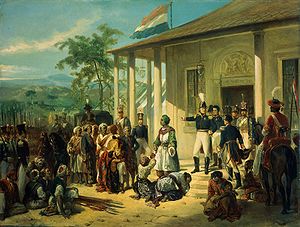 In 1806, with the Netherlands under French domination, Napoleon appointed his brother Louis Bonaparte
to the Dutch throne which led to the 1808 appointment of Marshall Herman Willem Daendels to Governor General of the Dutch East Indies. In 1811, British forces occupied several Dutch East Indies ports including Java and Thomas Stamford Raffles became Lieutenant Governor. Dutch control was restored in 1816. Under the 1824 Anglo-Dutch Treaty
, the Dutch secured British settlements in Indonesia, such as Bengkulu
in Sumatra
, in exchange for ceding control of their possessions in the Malay Peninsula
and Dutch India
. The resulting borders between British and Dutch possessions remain between Malaysia and Indonesia.
Since the establishment of the VOC in the seventeenth century, the expansion of Dutch territory had been founded on business. Graaf van den Bosch's Governor-generalship (1830–1835) confirmed profitability as the foundation of the Government and official policy was to restrict its attention to Java, Sumatra and Bangka
. However, from about 1840, Dutch national expansionism saw them wage a series of wars to enlarge and consolidate their possessions in the outer islands. Motivations included; the protection of areas already held; the intervention of Dutch officials ambitious for glory or promotion; and to establish Dutch claims throughout the archipelago to prevent intervention from other Western powers during the European push for colonial possessions
. As exploitation of Indonesian resources expanded off Java, most of the outer islands came under direct Dutch government control or influence.
The Dutch subjugated the Minangkabau of Sumatra in the Padri War
(1821–38) and the Java War
(1825–30) ended significant Javanese resistance. The Banjarmasin War (1859–1863) in southeast Kalimantan resulted in the defeat of the Sultan. After failed expeditions to conquer Bali in 1846
and 1848
, an 1849 intervention
brought northern Bali under Dutch control. The most prolonged militairy expedition was the Aceh War
in which a Dutch invasion in 1873 was met with indigenous guerrilla resistance and ended with an Acehnese surrender in 1912. Disturbances continued to break out on both Java and Sumatra
during the remainder of the 19th century, however, the island of Lombok
came under Dutch control
in 1894, and Batak
resistance in northern Sumatra was quashed in 1895. Towards the end of the nineteenth century, the balance of military power shifted towards the industrialising Dutch and against pre-industrial independent Indonesian states as the technology gap widened. Military leaders and Dutch politicians said they had a moral duty to free the Indonesian peoples from indigenous rulers who were oppressive, backward, or did not respect international law.
Although Indonesian rebellions broke out, direct colonial rule was extended throughout the rest of the archipelago from 1901 to 1910 and control taken from the remaining independent local rulers. Southwestern Sulawesi
was occupied in 1905–06, the island of Bali was subjugated with military conquests in 1906 and 1908
, as were the remaining independent kingdoms in Maluku, Sumatra, Kalimantan, and Nusa Tenggara. Other rulers including the Sultans of Tidore
in Maluku, Pontianak (Kalimantan), and Palembang
in Sumatra, requested Dutch protection from independent neighbours thereby avoiding Dutch military conquest and were able to negotiate better conditions under colonial rule. The Bird's Head Peninsula
(Western New Guinea
), was brought under Dutch administration in 1920. This final territorial range would form the territory of the Republic of Indonesia.
shipping line supported the unification of the colonial economy and brought inter-island shipping through to Batavia, rather than through Singapore, thus focussing more economic activity on Java.
Despite increasing returns from the Dutch system of land tax, Dutch finances had been severely affected by the cost of the Java
and Padri War
s, and the Dutch loss of Belgium in 1830 brought the Netherlands to the brink of bankruptcy. In 1830, a new Governor-General
, Johannes van den Bosch
, was appointed to make the Indies pay their way through Dutch exploitation of its resources. With the Dutch achieving political domination throughout Java for the first time in 1830, it was possible to introduce an agricultural policy of government-controlled forced cultivation. Termed cultuurstelsel (cultivation system) in Dutch and tanam paksa (forced plantation) in Indonesian, farmers were required to deliver, as a form of tax, fixed amounts of specified crops, such as sugar or coffee. Much of Java became a Dutch plantation and rose continually through the nineteenth century which were reinvested into the Netherlands saving it from bankruptcy. The Cultivation System, however, brought much economic hardship to Javanese peasants, who suffered famine and epidemics in the 1840s.
Critical public opinion in the Netherlands led to much of the Cultivation System's excesses being eliminated under the agrarian reforms of the "Liberal Period". From 1870, producers were no longer compelled to provide crops for exports, but the Indies were opened up to private enterprise. Dutch businessmen set up large, profitable plantations. Sugar production doubled between 1870 and 1885; new crops such as tea and cinchona flourished, and rubber was introduced, leading to dramatic increases in Dutch profits. Changes were not limited to Java, or agriculture; oil from Sumatra and Kalimantan
became a valuable resource for industrialising Europe. Dutch commercial interests expanded off Java to the outer islands with increasingly more territory coming under direct Dutch control or dominance in the latter half of the 19th century. However, the resulting scarcity of land for rice production, combined with dramatically increasing populations, especially in Java, led to further hardships.
The worldwide recession of the late 1880s and early 1890s saw the commodity prices on which the colony depended collapse. Journalists and civil servants observed that the majority of the Indies population were no better off than under the previous regulated Cultivation System economy and tens of thousands starved. Commodity prices recovered from the recession, leading to increased investment in the colony. The sugar, tin, copra and coffee trade on which the colony had been built thrived, and rubber, tobacco, tea and oil also became principal exports. Political reform increased the autonomy of the local colonial administration, moving away from central control from the Netherlands, whilst power was also diverged from the central Batavia government to more localised governing units.
Between 1800 and 1950 Dutch engineers built 67000 kilometres (41,632 mi) of roads, 7500 kilometres (4,660.3 mi) of railways, bridges, irrigation systems covering 1.4 million hectares (5,400 sq mi) of rice fields, several harbours, and 140 public drinking water systems. These Dutch constructed public works became the economic base of the colonial state.
.
The Dutch East Indies was a Dutch colony that became modern Indonesia
following World War II
. It was formed from the nationalised colonies of the Dutch East India Company
, which came under the administration of the Netherlands
government in 1800.
During the 19th century, Dutch possessions and hegemony were expanded, reaching their greatest extent in the early 20th century, the territory of which later formed modern-day Indonesia. The colony was based on rigid racial and social structure with a Dutch elite living separate but linked to their native subjects.
Japan's World War II occupation
dismantled much of the Dutch colonial state and economy. Following the Japanese surrender in August 1945, Indonesian nationalists declared independence which they fought to secure during the subsequent Indonesian National Revolution
. The Netherlands formally recognized Indonesian sovereignty at the 1949 Dutch–Indonesian Round Table Conference with the exception of the Netherlands New Guinea
(Western New Guinea
), which was ceded to Indonesia in 1963 under the New York Agreement
.
's documents of the early 1620s.
The VOC was granted a charter to wage war, build fortresses, and make treaties across Asia. A capital was established at Batavia (now Jakarta
), which became the centre of the VOC's Asian trading network. To their original monopolies on nutmeg
, mace spice, cloves and cinnamon
, the company introduced non-indigenous cash crops like coffee
, tea
, cacao, tobacco
, rubber
, sugar
and opium
, and safeguarded their commercial interests by taking over surrounding territory. Smuggling, the ongoing expense of war, corruption and mismanagement lead to bankruptcy by the end of the 18th century. The company was formally dissolved in 1800 and its colonial possessions in the Indonesian archipelago (including much of Java, parts of Sumatra, much of Maluku
, and the hinterlands of ports such as Makasar, Manado
, and Kupang
) were nationalised under the Dutch Republic as the Dutch East Indies.
, Bali
, Lombok
and Borneo
. There were numerous wars and disturbances across the archipelago as various indigenous groups resisted efforts to establish a Dutch hegemony, which weakened Dutch control and tied up its military forces. Significant Indonesian piracy remained a problem for the Dutch until the mid-19th century. It was not until the early 20th century, that Dutch dominance was extended across what was to become the territory of modern-day Indonesia.In 1806, with the Netherlands under French domination, Napoleon appointed his brother Louis Bonaparte
to the Dutch throne which led to the 1808 appointment of Marshall Herman Willem Daendels to Governor General of the Dutch East Indies. In 1811, British forces occupied several Dutch East Indies ports including Java and Thomas Stamford Raffles became Lieutenant Governor. Dutch control was restored in 1816. Under the 1824 Anglo-Dutch Treaty
, the Dutch secured British settlements in Indonesia, such as Bengkulu
in Sumatra
, in exchange for ceding control of their possessions in the Malay Peninsula
and Dutch India
. The resulting borders between British and Dutch possessions remain between Malaysia and Indonesia.
Since the establishment of the VOC in the seventeenth century, the expansion of Dutch territory had been founded on business. Graaf van den Bosch's Governor-generalship (1830–1835) confirmed profitability as the foundation of the Government and official policy was to restrict its attention to Java, Sumatra and Bangka
. However, from about 1840, Dutch national expansionism saw them wage a series of wars to enlarge and consolidate their possessions in the outer islands. Motivations included; the protection of areas already held; the intervention of Dutch officials ambitious for glory or promotion; and to establish Dutch claims throughout the archipelago to prevent intervention from other Western powers during the European push for colonial possessions
. As exploitation of Indonesian resources expanded off Java, most of the outer islands came under direct Dutch government control or influence.
The Dutch subjugated the Minangkabau of Sumatra in the Padri War
(1821–38) and the Java War
(1825–30) ended significant Javanese resistance. The Banjarmasin War (1859–1863) in southeast Kalimantan resulted in the defeat of the Sultan. After failed expeditions to conquer Bali in 1846
and 1848
, an 1849 intervention
brought northern Bali under Dutch control. The most prolonged militairy expedition was the Aceh War
in which a Dutch invasion in 1873 was met with indigenous guerrilla resistance and ended with an Acehnese surrender in 1912. Disturbances continued to break out on both Java and Sumatra
during the remainder of the 19th century, however, the island of Lombok
came under Dutch control
in 1894, and Batak
resistance in northern Sumatra was quashed in 1895. Towards the end of the nineteenth century, the balance of military power shifted towards the industrialising Dutch and against pre-industrial independent Indonesian states as the technology gap widened. Military leaders and Dutch politicians said they had a moral duty to free the Indonesian peoples from indigenous rulers who were oppressive, backward, or did not respect international law.
Although Indonesian rebellions broke out, direct colonial rule was extended throughout the rest of the archipelago from 1901 to 1910 and control taken from the remaining independent local rulers. Southwestern Sulawesi
was occupied in 1905–06, the island of Bali was subjugated with military conquests in 1906 and 1908
, as were the remaining independent kingdoms in Maluku, Sumatra, Kalimantan, and Nusa Tenggara. Other rulers including the Sultans of Tidore
in Maluku, Pontianak (Kalimantan), and Palembang
in Sumatra, requested Dutch protection from independent neighbours thereby avoiding Dutch military conquest and were able to negotiate better conditions under colonial rule. The Bird's Head Peninsula
(Western New Guinea
), was brought under Dutch administration in 1920. This final territorial range would form the territory of the Republic of Indonesia.
shipping line supported the unification of the colonial economy and brought inter-island shipping through to Batavia, rather than through Singapore, thus focussing more economic activity on Java.
Despite increasing returns from the Dutch system of land tax, Dutch finances had been severely affected by the cost of the Java
and Padri War
s, and the Dutch loss of Belgium in 1830 brought the Netherlands to the brink of bankruptcy. In 1830, a new Governor-General
, Johannes van den Bosch
, was appointed to make the Indies pay their way through Dutch exploitation of its resources. With the Dutch achieving political domination throughout Java for the first time in 1830, it was possible to introduce an agricultural policy of government-controlled forced cultivation. Termed cultuurstelsel (cultivation system) in Dutch and tanam paksa (forced plantation) in Indonesian, farmers were required to deliver, as a form of tax, fixed amounts of specified crops, such as sugar or coffee. Much of Java became a Dutch plantation and rose continually through the nineteenth century which were reinvested into the Netherlands saving it from bankruptcy. The Cultivation System, however, brought much economic hardship to Javanese peasants, who suffered famine and epidemics in the 1840s.
Critical public opinion in the Netherlands led to much of the Cultivation System's excesses being eliminated under the agrarian reforms of the "Liberal Period". From 1870, producers were no longer compelled to provide crops for exports, but the Indies were opened up to private enterprise. Dutch businessmen set up large, profitable plantations. Sugar production doubled between 1870 and 1885; new crops such as tea and cinchona flourished, and rubber was introduced, leading to dramatic increases in Dutch profits. Changes were not limited to Java, or agriculture; oil from Sumatra and Kalimantan
became a valuable resource for industrialising Europe. Dutch commercial interests expanded off Java to the outer islands with increasingly more territory coming under direct Dutch control or dominance in the latter half of the 19th century. However, the resulting scarcity of land for rice production, combined with dramatically increasing populations, especially in Java, led to further hardships.
The worldwide recession of the late 1880s and early 1890s saw the commodity prices on which the colony depended collapse. Journalists and civil servants observed that the majority of the Indies population were no better off than under the previous regulated Cultivation System economy and tens of thousands starved. Commodity prices recovered from the recession, leading to increased investment in the colony. The sugar, tin, copra and coffee trade on which the colony had been built thrived, and rubber, tobacco, tea and oil also became principal exports. Political reform increased the autonomy of the local colonial administration, moving away from central control from the Netherlands, whilst power was also diverged from the central Batavia government to more localised governing units.
Between 1800 and 1950 Dutch engineers built 67000 kilometres (41,632 mi) of roads, 7500 kilometres (4,660.3 mi) of railways, bridges, irrigation systems covering 1.4 million hectares (5,400 sq mi) of rice fields, several harbours, and 140 public drinking water systems. These Dutch constructed public works became the economic base of the colonial state.
.
The Dutch East Indies was a Dutch colony that became modern Indonesia
following World War II
. It was formed from the nationalised colonies of the Dutch East India Company
, which came under the administration of the Netherlands
government in 1800.
During the 19th century, Dutch possessions and hegemony were expanded, reaching their greatest extent in the early 20th century, the territory of which later formed modern-day Indonesia. The colony was based on rigid racial and social structure with a Dutch elite living separate but linked to their native subjects.
Japan's World War II occupation
dismantled much of the Dutch colonial state and economy. Following the Japanese surrender in August 1945, Indonesian nationalists declared independence which they fought to secure during the subsequent Indonesian National Revolution
. The Netherlands formally recognized Indonesian sovereignty at the 1949 Dutch–Indonesian Round Table Conference with the exception of the Netherlands New Guinea
(Western New Guinea
), which was ceded to Indonesia in 1963 under the New York Agreement
.
's documents of the early 1620s.
The VOC was granted a charter to wage war, build fortresses, and make treaties across Asia. A capital was established at Batavia (now Jakarta
), which became the centre of the VOC's Asian trading network. To their original monopolies on nutmeg
, mace spice, cloves and cinnamon
, the company introduced non-indigenous cash crops like coffee
, tea
, cacao, tobacco
, rubber
, sugar
and opium
, and safeguarded their commercial interests by taking over surrounding territory. Smuggling, the ongoing expense of war, corruption and mismanagement lead to bankruptcy by the end of the 18th century. The company was formally dissolved in 1800 and its colonial possessions in the Indonesian archipelago (including much of Java, parts of Sumatra, much of Maluku
, and the hinterlands of ports such as Makasar, Manado
, and Kupang
) were nationalised under the Dutch Republic as the Dutch East Indies.
, Bali
, Lombok
and Borneo
. There were numerous wars and disturbances across the archipelago as various indigenous groups resisted efforts to establish a Dutch hegemony, which weakened Dutch control and tied up its military forces. Significant Indonesian piracy remained a problem for the Dutch until the mid-19th century. It was not until the early 20th century, that Dutch dominance was extended across what was to become the territory of modern-day Indonesia.In 1806, with the Netherlands under French domination, Napoleon appointed his brother Louis Bonaparte
to the Dutch throne which led to the 1808 appointment of Marshall Herman Willem Daendels to Governor General of the Dutch East Indies. In 1811, British forces occupied several Dutch East Indies ports including Java and Thomas Stamford Raffles became Lieutenant Governor. Dutch control was restored in 1816. Under the 1824 Anglo-Dutch Treaty
, the Dutch secured British settlements in Indonesia, such as Bengkulu
in Sumatra
, in exchange for ceding control of their possessions in the Malay Peninsula
and Dutch India
. The resulting borders between British and Dutch possessions remain between Malaysia and Indonesia.
Since the establishment of the VOC in the seventeenth century, the expansion of Dutch territory had been founded on business. Graaf van den Bosch's Governor-generalship (1830–1835) confirmed profitability as the foundation of the Government and official policy was to restrict its attention to Java, Sumatra and Bangka
. However, from about 1840, Dutch national expansionism saw them wage a series of wars to enlarge and consolidate their possessions in the outer islands. Motivations included; the protection of areas already held; the intervention of Dutch officials ambitious for glory or promotion; and to establish Dutch claims throughout the archipelago to prevent intervention from other Western powers during the European push for colonial possessions
. As exploitation of Indonesian resources expanded off Java, most of the outer islands came under direct Dutch government control or influence.
The Dutch subjugated the Minangkabau of Sumatra in the Padri War
(1821–38) and the Java War
(1825–30) ended significant Javanese resistance. The Banjarmasin War (1859–1863) in southeast Kalimantan resulted in the defeat of the Sultan. After failed expeditions to conquer Bali in 1846
and 1848
, an 1849 intervention
brought northern Bali under Dutch control. The most prolonged militairy expedition was the Aceh War
in which a Dutch invasion in 1873 was met with indigenous guerrilla resistance and ended with an Acehnese surrender in 1912. Disturbances continued to break out on both Java and Sumatra
during the remainder of the 19th century, however, the island of Lombok
came under Dutch control
in 1894, and Batak
resistance in northern Sumatra was quashed in 1895. Towards the end of the nineteenth century, the balance of military power shifted towards the industrialising Dutch and against pre-industrial independent Indonesian states as the technology gap widened. Military leaders and Dutch politicians said they had a moral duty to free the Indonesian peoples from indigenous rulers who were oppressive, backward, or did not respect international law.
Although Indonesian rebellions broke out, direct colonial rule was extended throughout the rest of the archipelago from 1901 to 1910 and control taken from the remaining independent local rulers. Southwestern Sulawesi
was occupied in 1905–06, the island of Bali was subjugated with military conquests in 1906 and 1908
, as were the remaining independent kingdoms in Maluku, Sumatra, Kalimantan, and Nusa Tenggara. Other rulers including the Sultans of Tidore
in Maluku, Pontianak (Kalimantan), and Palembang
in Sumatra, requested Dutch protection from independent neighbours thereby avoiding Dutch military conquest and were able to negotiate better conditions under colonial rule. The Bird's Head Peninsula
(Western New Guinea
), was brought under Dutch administration in 1920. This final territorial range would form the territory of the Republic of Indonesia.
shipping line supported the unification of the colonial economy and brought inter-island shipping through to Batavia, rather than through Singapore, thus focussing more economic activity on Java.
Despite increasing returns from the Dutch system of land tax, Dutch finances had been severely affected by the cost of the Java
and Padri War
s, and the Dutch loss of Belgium in 1830 brought the Netherlands to the brink of bankruptcy. In 1830, a new Governor-General
, Johannes van den Bosch
, was appointed to make the Indies pay their way through Dutch exploitation of its resources. With the Dutch achieving political domination throughout Java for the first time in 1830, it was possible to introduce an agricultural policy of government-controlled forced cultivation. Termed cultuurstelsel (cultivation system) in Dutch and tanam paksa (forced plantation) in Indonesian, farmers were required to deliver, as a form of tax, fixed amounts of specified crops, such as sugar or coffee. Much of Java became a Dutch plantation and rose continually through the nineteenth century which were reinvested into the Netherlands saving it from bankruptcy. The Cultivation System, however, brought much economic hardship to Javanese peasants, who suffered famine and epidemics in the 1840s.
Critical public opinion in the Netherlands led to much of the Cultivation System's excesses being eliminated under the agrarian reforms of the "Liberal Period". From 1870, producers were no longer compelled to provide crops for exports, but the Indies were opened up to private enterprise. Dutch businessmen set up large, profitable plantations. Sugar production doubled between 1870 and 1885; new crops such as tea and cinchona flourished, and rubber was introduced, leading to dramatic increases in Dutch profits. Changes were not limited to Java, or agriculture; oil from Sumatra and Kalimantan
became a valuable resource for industrialising Europe. Dutch commercial interests expanded off Java to the outer islands with increasingly more territory coming under direct Dutch control or dominance in the latter half of the 19th century. However, the resulting scarcity of land for rice production, combined with dramatically increasing populations, especially in Java, led to further hardships.
The worldwide recession of the late 1880s and early 1890s saw the commodity prices on which the colony depended collapse. Journalists and civil servants observed that the majority of the Indies population were no better off than under the previous regulated Cultivation System economy and tens of thousands starved. Commodity prices recovered from the recession, leading to increased investment in the colony. The sugar, tin, copra and coffee trade on which the colony had been built thrived, and rubber, tobacco, tea and oil also became principal exports. Political reform increased the autonomy of the local colonial administration, moving away from central control from the Netherlands, whilst power was also diverged from the central Batavia government to more localised governing units.
Between 1800 and 1950 Dutch engineers built 67000 kilometres (41,632 mi) of roads, 7500 kilometres (4,660.3 mi) of railways, bridges, irrigation systems covering 1.4 million hectares (5,400 sq mi) of rice fields, several harbours, and 140 public drinking water systems. These Dutch constructed public works became the economic base of the colonial state.
.
As the Dutch secured the islands they eliminated slavery, widow burning, head-hunting, cannibalism, piracy, and internecine wars. Railways, steamships, postal and telegraph services, and various government agencies all served to introduce a degree of new uniformity across the colony. Immigration within the archipelago—particularly by ethnic Chinese, Bataks, Javanese, and Bugis—increased dramatically.
The Dutch colonialists formed a privileged upper social class of soldiers, administrators, managers, teachers and pioneers. They lived together with the "natives", but at the top of a rigid social and racial caste system. The Dutch East Indies had two legal classes of citizens; European and indigenous. A third class, Foreign Easterners, was added in 1920.
In 1901 the Dutch adopted what they called the Ethical Policy, under which the colonial government had a duty to further the welfare of the Indonesian people in health and education. Other new measures under the policy included irrigation programs, transmigration, communications, flood mitigation, industrialisation, and protection of native industry. Industrialisation
did not significantly affect the majority of Indonesians, and Indonesia remained an agricultural colony; by 1930, there were 17 cities with populations over 50,000 and their combined populations numbered 1.87 million of the colony's 60 million.
in Roman alphabet with "link" schools preparing bright Indonesian students for entry into the Dutch-language schools. Vocational schools and programs were set up by the Indies government to train indigenous Indonesians for specific roles in the colonial economy. Chinese and Arabs (termed "foreign orientals") could not enrol in either the vocational schools or primary schools.
Graduates of Dutch schools opened their own schools modelled on the Dutch school system, as did Christian missionaries, Theosophical Societies, and Indonesian cultural associations. This proliferation of schools was further boosted by new Muslim schools in the Western mould that also offered secular subjects. According to the 1930 census, 6% of Indonesians were literate, however, this figure recognised only graduates from Western schools and those who could read and write in a language in the Roman alphabet. It did not include graduates of non-Western schools or those who could read but not write Arabic, Malay or Dutch, or those who could write in non-Roman alphabets such as Batak, Javanese
, Chinese, or Arabic.
Some of higher education institutions were also established. In 1898 the Dutch East Indies government established a school to train medical doctors, named School tot Opleiding van Inlandsche Artsen (STOVIA). Many STOVIA graduates later played important roles in Indonesia's national movement
toward independence as well in developing medical education in Indonesia, such as Dr. Wahidin Soedirohoesodo that established Budi Utomo
political society. De Technische Hoogeschool te Bandung established in 1920 by the Dutch colonial administration to meet the needs of technical resources at its colony. One of Technische Hogeschool graduate is Sukarno
whom later would led Indonesian National Revolution
. In 1924, the colonial government again decided to open a new tertiary-level educational facility, the Rechts Hogeschool (RHS), to train civilian officers and servants. In 1927, STOVIA's status was changed to that of a full tertiary-level institution and its name was changed to Geneeskundige Hogeschool (GHS). The GHS occupied the same main building and used the same teaching hospital as the current Faculty of Medicine of University of Indonesia
. The old links between the Netherlands and Indonesia are still clearly visible in such technological areas as irrigation
design. To this day, the ideas of Dutch colonial irrigation engineers continue to exert a strong influence over Indonesian design practices.
Education reforms, and modest political reform, resulted in a small elite of highly educated indigenous Indonesians, who promoted the idea of an independent and unified "Indonesia" that would bring together disparate indigenous groups of the Dutch East Indies. A period termed the Indonesian National Revival, the first half of the 20th century saw the nationalist movement develop strongly, but also face Dutch oppression.
.
Since the VOC era, the highest Dutch authority in the colony resided with the 'Office of the Governor-General'. During the Dutch East Indies era the Governor-General functioned as chief executive president of colonial government and served as commander-in-chief
of the colonial (KNIL) army. Until 1903 all government officials and organisations were formal agents of the Governor-General and were entirely dependent on the central administration of the 'Office of the Governor-General' for their budgets. Until 1815 the Governor-General had the absolute right to ban, censor or restrict any publication in the colony. The so called Exorbitant powers of the Governor-General allowed him to exile anyone regarded as subversive and dangerous to peace and order, without involving any Court of Law.
Until 1848 the Governor-General was directly appointed by the Dutch monarch, and in later years via the Crown and on advise of the Dutch metropolitan cabinet. During two periods (1815–1835 and 1854–1925) the Governor-General ruled jointly with an advisory board called the Raad van Indie (Indies Council). Colonial policy and strategy were the responsibility of the Ministry of Colonies based in The Hague
. From 1815 to 1848 the Ministry was under direct authority of the Dutch King. In the 20th century the colony gradually developed as a state distinct from the Dutch metropole with treasury separated in 1903, public loans being contracted by the colony from 1913, and quasi diplomatic ties were established with Arabia to manage the Haji pelgrimage from the Dutch East Indies. In 1922 the colony came on equal footing with the Netherlands in the Dutch constitution, while remaining under the Ministry of Colonies.
A People's Council called the Volksraad
for the Dutch East Indies commenced in 1918. The Volksraad was limited to an advisory role and only a small portion of the indigenous population were able to vote for its members. The Council comprised 30 indigneous members, 25 European and 5 from Chinese and other populations, and was reconstituted every four years. In 1925 the Volksraad was made a semilegislative body; although decisions were still made by the Dutch government, the governor-general was expected to consult the Volksraad on major issues. The Volksraad was dissolved in 1941 during the Japanese occupation.
The Dutch government adapted the Dutch codes of law in its colony. The highest court of law, the Supreme Court in Batavia, dealt with appeals and monitored judges and courts throughout the colony. Six Councils of Justice (Raad van Justitie) dealt mostly with crime committed by people in the European legal class and only indirectly with the indigenous population. The Land Councils (Landraden) dealt with civil matters and less serious offences like estate divorces, and matrimonial disputes. The indigenous population was subject to their respective adat law and to indigenous regents and district courts, unless cases were escalated before Dutch judges. Following Indonesian independence, the Dutch legal system was adopted and gradually a national legal system based on Indonesian precepts of law and justice was established.
By 1920 the Dutch had established 350 prisons throughout the colony. The Meester Cornelis prison in Batavia incarcerated the most unruly inmates. In Sawah Loento prison on Sumatra prisoners had to perform manual labour in the coal mines. Separate prisons were built for juveniles (West Java) and for women. In the female Boeloe prison in Semarang inmates had the opportunity to learn a profession during their detention, such as sewing, weaving and making batik. This training was held in high esteem and helped re-socialise women once they were outside the correctional facility. In response to the communist uprising of 1926 the prison camp Boven-Digoel was established in New Guinea
. As off 1927 political prisoners, including indigenous Indonesians espousing Indonesian independence, were 'exiled' to the outer islands.
Politically, the highly centralised power structure, including the exorbitant powers of exile and censorship, established by the Dutch administration was carried over into the new Indonesian republic.
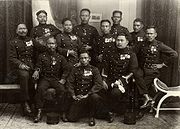
The Royal Dutch East Indies Army (KNIL) and the Royal Netherlands East Indies Army Air Force
(ML-KNIL) were established in 1830 and 1915 respectively. Naval forces of the Royal Netherlands Navy
were based in Surabaya
, but were never part of the KNIL. The KNIL was a separate branch of the Royal Netherlands Army
, commanded by the Governor-General and funded by the colonial budget. The KNIL was not allowed to recruit Dutch conscripts and had the nature of a 'Foreign Legion
' recruiting not only Dutch volunteers, but many other European nationalities (especially German, Belgian and Swiss mercenaries). While most officers were Europeans, the majority of soldiers were indigenous Indonesians, the largest contingent of which were Javanese and Sundanese
.
In the nineteenth and early twentieth centuries, the KNIL prosecuted the conquest of the Indonesian archipelago. Once the archipelago was considered "pacified" the KNIL was mainly involved with military police tasks. The nature of the KNIL changed in 1917 when the colonial government introduced obligatory military service
for all male conscripts in the European legal class and in 1922 a supplemental legal enactment introduced the creation of a ‘Home guard
’ (Dutch: Landstorm) for European conscripts older than 32. Petitions to establish military service for indigenous people were rejected. The KNIL hastily and inadequately attempted to transform into modern military force able to protect the Dutch East Indies from Imperial Japanese invasion. On the eve of the Japanese invasion in December 1941, Dutch regular troops in the East Indies comprised about 1,000 officers and 34,000 men, of whom 28,000 were indigenous. During the Dutch East Indies campaign
of 1941–42 the KNIL and the Allied forces were quickly defeated. All European soldiers, which in practice included all able bodied Indo-European males were interned by the Japanese as POW's. 25% of the POW's did not survive their internment.
Following World War II, a reconstituted KNIL joined with Dutch Army troops to re-establish colonial "law and order". Despite two successful military campaigns
in 1947 and 1948, Dutch efforts to re-establish their colony failed and the Netherlands recognised Indonesian sovereignty in December 1949. The KNIL was disbanded by 26 July 1950 with its indigenous personnel being given the option of demobilising or joining the Indonesian military. At the time of disbandment the KNIL numbered 65,000, of whom 26,000 were incorporated into the new Indonesian Army. The remainder were either demobilised or transferred to the Netherlands Army. Key officers in the Indonesian National Armed Forces that were former KNIL soldiers include: Suharto second president of Indonesia, Nasution supreme commander of the Indonesian army and E.Kawilarang
founder of the elite special forces Kopassus
.
or Portuguese Creole, the existing languages of trade were adopted. Prior to 1870, when Dutch colonial influence was largely restricted to Java, Malay was used in government schools and training programs such that graduates could communicate with groups from other regions who immigrated to Java. The colonial government sought to standardise Malay based on the version from Riau and Malacca, and dictionaries were commissioned for governmental communication and schools for indigenous peoples. In the early 20th century, Indonesia's independence leaders adopted a form of Malay from Riau, and called it Indonesian
. In the latter half of the nineteenth century, the rest of the archipelago, in which hundreds of language groups were used, was brought under Dutch control. In extending the native education program to these areas, the government stipulated this "standard Malay" as the language of the colony.
Dutch
was not made the official language of the colony and was not widely used by the indigenous Indonesian population. The majority of legally acknowledged Dutchmen were bi-lingual Indo Eurasians. Dutch was only used by a limited educated elite, and in 1942, around two percent of the total population in the Dutch East Indies spoke Dutch including over 1 million indigenous Indonesians. A number of Dutch loan words are used in present-day Indonesian, particularly technical terms (see List of Dutch loan words in Indonesian). These words generally had no alternative in Malay and were adopted into the Indonesian vocabulary giving a linguistic insight into which concepts are part of the Dutch colonial heritage. Hendrik Maier of the University of California says that about a fifth of contemporary Indonesian language
can be traced to Dutch.
Dutch language literature
has been inspired by both colonial and post-colonial Indies from the Dutch Golden Age
to the present day. It includes Dutch, Indo-European and Indonesian authors. Its subject matter thematically revolves around the Dutch colonial era, but also includes postcolonial discourse. Masterpieces of this genre include Multatuli
's Max Havelaar: Or The Coffee Auctions of the Dutch Trading Company
, Louis Couperus
's Hidden Force, E. du Perron's Country of Origin, and Maria Dermoût
's The Ten Thousand Things.
Most Dutch literature was written by Dutch and Indo-European authors, however, in the first half of the twentieth century under the Ethical Policy, indigenous Indonesian authors and intellectuals came to the Netherlands to study and work. They wrote Dutch language literary works and published literature in literary reviews such as Het Getij, De Gemeenschap, Links Richten and Forum. By exploring new literary themes and focusing on indigenous protagonists, they drew attention to indigenous culture and the indigenous plight. Examples include the Javanese prince and poet Noto Soeroto
, a writer and journalist, and the Dutch language writings of Soewarsih Djojopoespito, Chairil Anwar
, Kartini, Sutan Sjahrir
and Sukarno
. Much of the postcolonial discourse in Dutch Indies literature has been written by Indo-European authors led by the "avant garde visionary" Tjalie Robinson
, who is the best read Dutch author in contemporary Indonesia
and second generation Indo-European immigrants like Marion Bloem
.
, Mas Pirngadi, Abdullah Surisubroto, Wakidi, Basuki Abdullah
, Mas Soeryo Soebanto and Henk Ngantunk; and also Chinese painters: Lee Man Fong
, Oei Tiang Oen and Biau Tik Kwie. These painters usually exhibit their works in art galleries such as Bataviasche Kuntkringgebouw, Theosofie Vereeniging, Kunstzaal Kolff & Co and Hotel Des Indes
.
Theatre plays by playwrights such as Victor Ido
(1869–1948) were performed at the Shouwburg Weltevreden, now known as Gedung Kesenian Jakarta
. A less elite form of theatre, popular with both European and indigenous people, were the traveling Indo theatre shows known as Komedie Stamboel, made popular by Auguste Mahieu (1865–1903).
, Junghuhn
, Eijkman
and Wallace
. Many important art, culture and science institutions were established in Dutch East Indies. For example the Bataviaasch Genootschap van Kunsten en Wetenschappen, (Royal Batavian Society of Arts and Sciences
), the predecessor of the National Museum of Indonesia
, was established in 1778 with the aim to promote research and publish findings in the field of arts and sciences, especially history
, archaeology
, ethnography
and physics
. The Bogor Botanical Gardens
with Herbarium Bogoriense and Museum Zoologicum Bogoriense was a major center for botanical research established in 1817, with the aim to study the flora and fauna of the archipelago.
Through colonialism the Dutch introduced European dishes such as bread
, cheese
, barbecued steak
and pancake
. As the producer of cash crops; coffee
and tea were also popular in the colonial East Indies. Bread, butter
and margarine
, sandwiches filled with ham, cheese or fruit jam, poffertjes
, pannekoek and Dutch cheeses were commonly consumed by colonial Dutch and Indos during the colonial era. Some of the native upperclass ningrat (nobles) and a few educated native were exposed to European cuisine, and it was held with high esteem as the cuisine of upperclass elite of Dutch East Indies society. This lead to the adoption and fusion of European cuisine into Indonesian cuisine. Some dishes which were created during the colonial era are Dutch influenced: they include selat solo (solo salad), bistik jawa (Javanese beef steak), semur
(from Dutch smoor), sayur kacang merah (brenebon) and sop buntut
. Cakes and cookies also can trace their origin to Dutch influences; such as kue bolu (tart), pandan cake, lapis legit (spekkoek
), spiku (lapis Surabaya), klappertaart (coconut tart), and kaastangel (cheese cookies). Kue cubit
commonly found in front of schools and marketplaces are believed to be derived from poffertjes.
construction to Indonesia where previously timber and its by-products had been almost exclusively used. In the 17th and 18th centuries, Batavia was a fortified brick and masonry city. For almost two centuries, the colonialists did little to adapt their European architectural habits to the tropical climate. They built row houses which were poorly ventilated with small windows, which was thought as protection against tropical diseases coming from tropical air. Years later the Dutch learnt to adapt their architectural styles with local building features (long eaves, verandah
s, portico
s, large windows and ventilation openings), and the 19th century Indo-European hybrid villa
was one of the first colonial buildings to incorporate Indonesian architectural elements and adapt to the climate.
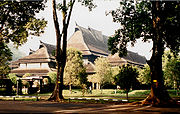 From the end of the 19th century, significant improvements to technology, communications and transportation brought new wealth to Java. Modernistic buildings, including train stations, business hotels, factories and office blocks, hospitals and education institutions, were influenced by international styles. The early 20th century trend was for modernist influences—such as art-deco—being expressed in essentially European buildings with Indonesian trim. Practical responses to the environment carried over from the earlier Indo-European hybrids, included overhanging eaves, larger windows and ventilation in the walls. The largest stock of colonial era buildings are in the large cities of Java, such as Bandung, Jakarta
, Semarang
, and Surabaya
. Notable architects and planners include Albert Aalbers
, Thomas Karsten
, Henri Maclaine Pont
, J. Gerber and C.P.W. Schoemaker
. In the first three decades of the 20th century, the Department of Public Works funded major public buildings and introduced a town planning program under which the main towns and cities in Java and Sumatra were rebuilt and extended.
A lack of development in the Great Depression
, the turmoil of the Second World War and the Indonesia's independence struggle
of the 1940s, and economic stagnation during the politically turbulent 1950s and 60s, meant that much colonial architecture has been preserved through to recent decades. Colonial homes were almost always the preserve of the wealthy Dutch, Indonesian and Chinese elites, however the styles were often rich and creative combinations of two cultures, so much so that the homes remain sought after into 21st century. Native architecture was arguably more influenced by the new European ideas than colonial architecture was influenced by Indonesian styles; and these Western elements continue to be a dominant influence on Indonesia's built environment today.
, Japanese forces invaded the Dutch East Indies as part of the Pacific War
. The rubber plantations and oil fields of the Dutch East Indies were considered crucial for the Japanese war effort. Allied forces were quickly overwhelmed by the Japanese and on 8 March 1942 the Royal Dutch East Indies Army surrendered in Java.
Fuelled by the Japanese Light of Asia war propaganda and the Indonesian National Awakening
, a vast majority of the indigenous Dutch East Indies population first welcomed the Japanese as liberators from the colonial Dutch empire, but this sentiment quickly changed as the occupation turned out to be the most oppressive and ruinous colonial regime in Indonesian history. The Japanese occupation
during World War II brought about the fall of the colonial state in Indonesia, as the Japanese removed as much of the Dutch government structure as they could, replacing it with their own regime. Although the top positions were held by the Japanese, the internment of all Dutch citizens meant that Indonesians filled many leadership and administrative positions. In contrast to Dutch repression of Indonesian nationalism, the Japanese allowed indigenous leaders to forge links amongst the masses, and they trained and armed the younger generations.
Following the Japanese surrender in August 1945, nationalist leaders Sukarno
and Hatta
declared Indonesian independence. A four and a half-year struggle
followed as the Dutch tried to re-establish their colony; although Dutch forces re-occupied most of Indonesia's territory a guerilla struggle ensued, and the majority of Indonesians, and ultimately international opinion, favoured Indonesian independence. In December 1949, the Netherlands formally recognised Indonesian sovereignty with the exception of the Netherlands New Guinea
(Western New Guinea
). Sukarno
's government campaigned for Indonesian control of the territory, and with pressure from the United States, the Netherlands agreed to the New York Agreement
which ceded the territory to Indonesian administration in May 1963.
of the 17th century, the Netherlands urbanised considerably, mostly financed by corporate revenue from the Asian trade monopolies. Social status was based on merchants' income, which reduced feudalism
and considerably changed the dynamics of Dutch society.
When the Dutch Royal Family was established in 1815, much of its wealth came from Colonial trade.
Universities such as the Royal Leiden University
founded in the 16th century have developed into leading knowledge centres about Southeast Asian and Indonesian studies. Leiden University has produced academics such as Colonial adviser Christiaan Snouck Hurgronje
who specialised in native oriental (Indonesian) affairs, and it still has academics who specialise in Indonesian languages and cultures. Leiden University
and in particular KITLV
are educational and scientific institutions that to this day share both an intellectual and historical interest in Indonesian studies. Other scientific institutions in the Netherlands include the Amsterdam Tropenmuseum
, an anthropological museum with massive collections of Indonesian art, culture, ethnography and anthropology.
The traditions of the KNIL are maintained by the Regiment Van Heutsz
of the modern Royal Netherlands Army
and the dedicated Bronbeek
Museum, a former home for retired KNIL soldiers, exists in Arnhem
to this day.
Many surviving colonial families and their descendants who moved back to the Netherlands after Independence lessening Dutch colonial presence tended to look back on the era with a sense of the power and prestige they had in the colony with such items as the 1970s book Tempo Doeloe (Old times) by author Rob Nieuwenhuys
, and other books and materials that became quite common in the 1970s and 1980s. Moreover since the 18th century Dutch literature has a large number of established authors, such as Louis Couperus
, the writer of "The Hidden Force", taking the colonial era as an important source of inspiration. In fact one of the great masterpieces of Dutch literature
is the book "Max Havelaar
" written by Multatuli
in 1860.
The majority of Dutchmen that repatriated to the Netherlands after and during the Indonesian revolution are Indo (Eurasian), native to the islands of the Dutch East Indies. This relatively large Eurasian population had developed over a period of 400 years and were classified by colonial law as belonging to the European legal community. In Dutch
they are referred to as 'Indische Nederlanders' (Indies Dutchmen) or Indo (short for Indo-European). Of the 296,200 so called Dutch 'repatriants' only 92,200 were expatriate Dutchmen born in the Netherlands.
Including their 2nd generation descendants, they are currently the largest foreign born group in the Netherlands. In 2008, the Dutch Census Buro for Statistics (CBS) registered 387,000 first and second generation Indos living in the Netherlands. Although considered fully assimilated into Dutch society, as the main ethnic minority in the Netherlands, these 'Repatriants' have played a pivotal role in introducing elements of Indonesian culture into Dutch mainstream culture. Practically each town in the Netherlands will have a 'Toko' (Dutch Indonesian Shop) or Indonesian restaurant and many 'Pasar Malam
' (Dutch Indonesian) fairs are organised throughout the year.
Many Indonesian dishes and foodstuffs have become commonplace in the Netherlands. Rijsttafel a colonial culinary concept and dishes such as Nasi goreng
and sateh
are still very popular in the Netherlands.
Indonesia
Indonesia , officially the Republic of Indonesia , is a country in Southeast Asia and Oceania. Indonesia is an archipelago comprising approximately 13,000 islands. It has 33 provinces with over 238 million people, and is the world's fourth most populous country. Indonesia is a republic, with an...
following World War II
World War II
World War II, or the Second World War , was a global conflict lasting from 1939 to 1945, involving most of the world's nations—including all of the great powers—eventually forming two opposing military alliances: the Allies and the Axis...
. It was formed from the nationalised colonies of the Dutch East India Company
Dutch East India Company
The Dutch East India Company was a chartered company established in 1602, when the States-General of the Netherlands granted it a 21-year monopoly to carry out colonial activities in Asia...
, which came under the administration of the Netherlands
Netherlands
The Netherlands is a constituent country of the Kingdom of the Netherlands, located mainly in North-West Europe and with several islands in the Caribbean. Mainland Netherlands borders the North Sea to the north and west, Belgium to the south, and Germany to the east, and shares maritime borders...
government in 1800.
During the 19th century, Dutch possessions and hegemony were expanded, reaching their greatest extent in the early 20th century, the territory of which later formed modern-day Indonesia. The colony was based on rigid racial and social structure with a Dutch elite living separate but linked to their native subjects.
Japan's World War II occupation
Japanese Occupation of Indonesia
The Japanese Empire occupied Indonesia, known then as the Dutch East Indies, during World War II from March 1942 until after the end of War in 1945...
dismantled much of the Dutch colonial state and economy. Following the Japanese surrender in August 1945, Indonesian nationalists declared independence which they fought to secure during the subsequent Indonesian National Revolution
Indonesian National Revolution
The Indonesian National Revolution or Indonesian War of Independence was an armed conflict and diplomatic struggle between Indonesia and the Dutch Empire, and an internal social revolution...
. The Netherlands formally recognized Indonesian sovereignty at the 1949 Dutch–Indonesian Round Table Conference with the exception of the Netherlands New Guinea
Netherlands New Guinea
Netherlands New Guinea refers to the West Papua region while it was an overseas territory of the Kingdom of the Netherlands from 1949 to 1962. Until 1949 it was a part of the Netherlands Indies. It was commonly known as Dutch New Guinea...
(Western New Guinea
Western New Guinea
West Papua informally refers to the Indonesian western half of the island of New Guinea and other smaller islands to its west. The region is officially administered as two provinces: Papua and West Papua. The eastern half of New Guinea is Papua New Guinea.The population of approximately 3 million...
), which was ceded to Indonesia in 1963 under the New York Agreement
New York Agreement
The Agreement between the Republic of Indonesia and the Kingdom of the Netherlands Concerning West New Guinea , also known as the New York Agreement, was a treaty signed between Indonesia and the Netherlands on the political status of West New Guinea...
.
Etymology
The word Indies comes from . The original name Dutch Indies was translated by the English as the Dutch East Indies, to keep it distinct from the Dutch West Indies. The name Dutch Indies is recorded in the Dutch East India CompanyDutch East India Company
The Dutch East India Company was a chartered company established in 1602, when the States-General of the Netherlands granted it a 21-year monopoly to carry out colonial activities in Asia...
's documents of the early 1620s.
Background
Centuries before Europeans arrived, the Indonesian archipelago supported various states including commercially orientated coastal training states and inland agrian states. The first Europeans to arrive were the Portuguese in the late fifteenth century and following disruption of Dutch access to spices in Europe, the first Dutch expedition set sail for the East Indies in 1595 to access spices directly from Asia. When it made a 400% profit on its return, other Dutch expeditions soon followed. Recognising the potential of the East Indies trade, the Dutch government amalgamated the competing companies into the United East India Company (VOC).The VOC was granted a charter to wage war, build fortresses, and make treaties across Asia. A capital was established at Batavia (now Jakarta
Jakarta
Jakarta is the capital and largest city of Indonesia. Officially known as the Special Capital Territory of Jakarta, it is located on the northwest coast of Java, has an area of , and a population of 9,580,000. Jakarta is the country's economic, cultural and political centre...
), which became the centre of the VOC's Asian trading network. To their original monopolies on nutmeg
Nutmeg
The nutmeg tree is any of several species of trees in genus Myristica. The most important commercial species is Myristica fragrans, an evergreen tree indigenous to the Banda Islands in the Moluccas of Indonesia...
, mace spice, cloves and cinnamon
Cinnamon
Cinnamon is a spice obtained from the inner bark of several trees from the genus Cinnamomum that is used in both sweet and savoury foods...
, the company introduced non-indigenous cash crops like coffee
Coffee
Coffee is a brewed beverage with a dark,init brooo acidic flavor prepared from the roasted seeds of the coffee plant, colloquially called coffee beans. The beans are found in coffee cherries, which grow on trees cultivated in over 70 countries, primarily in equatorial Latin America, Southeast Asia,...
, tea
Tea
Tea is an aromatic beverage prepared by adding cured leaves of the Camellia sinensis plant to hot water. The term also refers to the plant itself. After water, tea is the most widely consumed beverage in the world...
, cacao, tobacco
Tobacco
Tobacco is an agricultural product processed from the leaves of plants in the genus Nicotiana. It can be consumed, used as a pesticide and, in the form of nicotine tartrate, used in some medicines...
, rubber
Rubber
Natural rubber, also called India rubber or caoutchouc, is an elastomer that was originally derived from latex, a milky colloid produced by some plants. The plants would be ‘tapped’, that is, an incision made into the bark of the tree and the sticky, milk colored latex sap collected and refined...
, sugar
Sugar
Sugar is a class of edible crystalline carbohydrates, mainly sucrose, lactose, and fructose, characterized by a sweet flavor.Sucrose in its refined form primarily comes from sugar cane and sugar beet...
and opium
Opium
Opium is the dried latex obtained from the opium poppy . Opium contains up to 12% morphine, an alkaloid, which is frequently processed chemically to produce heroin for the illegal drug trade. The latex also includes codeine and non-narcotic alkaloids such as papaverine, thebaine and noscapine...
, and safeguarded their commercial interests by taking over surrounding territory. Smuggling, the ongoing expense of war, corruption and mismanagement lead to bankruptcy by the end of the 18th century. The company was formally dissolved in 1800 and its colonial possessions in the Indonesian archipelago (including much of Java, parts of Sumatra, much of Maluku
Maluku Islands
The Maluku Islands are an archipelago that is part of Indonesia, and part of the larger Maritime Southeast Asia region. Tectonically they are located on the Halmahera Plate within the Molucca Sea Collision Zone...
, and the hinterlands of ports such as Makasar, Manado
Manado
Manado is the capital of the North Sulawesi province of Indonesia. Manado is located at the Bay of Manado, and is surrounded by a mountainous area. The city has about 405,715 inhabitants, making it the second-largest city in Sulawesi after Makassar...
, and Kupang
Kupang
Not to be confused with Tanjung Kupang in JohoreKupang is the provincial capital of East Nusa Tenggara province in southeast Indonesia....
) were nationalised under the Dutch Republic as the Dutch East Indies.
Dutch conquests
From the arrival of the first Dutch ships in the late sixteenth century, to the declaration of independence in 1945, Dutch control over the Indonesian archipelago was always tenuous. Although Java was dominated by the Dutch, many areas remained independent throughout much of this time including AcehAceh
Aceh is a special region of Indonesia, located on the northern tip of the island of Sumatra. Its full name is Daerah Istimewa Aceh , Nanggroë Aceh Darussalam and Aceh . Past spellings of its name include Acheh, Atjeh and Achin...
, Bali
Bali
Bali is an Indonesian island located in the westernmost end of the Lesser Sunda Islands, lying between Java to the west and Lombok to the east...
, Lombok
Lombok
Lombok is an island in West Nusa Tenggara province, Indonesia. It forms part of the chain of the Lesser Sunda Islands, with the Lombok Strait separating it from Bali to the west and the Alas Strait between it and Sumbawa to the east...
and Borneo
Borneo
Borneo is the third largest island in the world and is located north of Java Island, Indonesia, at the geographic centre of Maritime Southeast Asia....
. There were numerous wars and disturbances across the archipelago as various indigenous groups resisted efforts to establish a Dutch hegemony, which weakened Dutch control and tied up its military forces. Significant Indonesian piracy remained a problem for the Dutch until the mid-19th century. It was not until the early 20th century, that Dutch dominance was extended across what was to become the territory of modern-day Indonesia.
Louis Bonaparte
Louis Napoléon Bonaparte, Prince Français, Comte de Saint-Leu , King of Holland , was the fifth surviving child and the fourth surviving son of Carlo Buonaparte and Letizia Ramolino...
to the Dutch throne which led to the 1808 appointment of Marshall Herman Willem Daendels to Governor General of the Dutch East Indies. In 1811, British forces occupied several Dutch East Indies ports including Java and Thomas Stamford Raffles became Lieutenant Governor. Dutch control was restored in 1816. Under the 1824 Anglo-Dutch Treaty
Anglo-Dutch Treaty of 1824
The Anglo-Dutch Treaty of 1824, also known as the Treaty of London, was a treaty signed between the United Kingdom and the Netherlands in London on 17 March 1824. The treaty was to resolve disputes arising from the execution of the Anglo-Dutch Treaty of 1814...
, the Dutch secured British settlements in Indonesia, such as Bengkulu
Bengkulu
Bengkulu is a province of Indonesia. It is on the southwest coast of the island of Sumatra, and borders the provinces of West Sumatra, Jambi, South Sumatra and Lampung. The capital and largest city is Bengkulu city. It was formerly the site of a British garrison, which they called Bencoolen...
in Sumatra
Sumatra
Sumatra is an island in western Indonesia, westernmost of the Sunda Islands. It is the largest island entirely in Indonesia , and the sixth largest island in the world at 473,481 km2 with a population of 50,365,538...
, in exchange for ceding control of their possessions in the Malay Peninsula
Malay Peninsula
The Malay Peninsula or Thai-Malay Peninsula is a peninsula in Southeast Asia. The land mass runs approximately north-south and, at its terminus, is the southern-most point of the Asian mainland...
and Dutch India
Dutch India
Dutch India is a term used to refer to the settlements and trading posts of the Dutch East India Company on the Indian subcontinent. It is only used as a geographical definition, as there has never been a political authority ruling all Dutch India...
. The resulting borders between British and Dutch possessions remain between Malaysia and Indonesia.
Since the establishment of the VOC in the seventeenth century, the expansion of Dutch territory had been founded on business. Graaf van den Bosch's Governor-generalship (1830–1835) confirmed profitability as the foundation of the Government and official policy was to restrict its attention to Java, Sumatra and Bangka
Bangka Island
Bangka is an island lying east of Sumatra, Indonesia. Population 626,955. Area: c.4,600 sq mi .There is an additional small island named Pulau Bangka in northern Sulawesi, Indonesia.-Geography:...
. However, from about 1840, Dutch national expansionism saw them wage a series of wars to enlarge and consolidate their possessions in the outer islands. Motivations included; the protection of areas already held; the intervention of Dutch officials ambitious for glory or promotion; and to establish Dutch claims throughout the archipelago to prevent intervention from other Western powers during the European push for colonial possessions
New Imperialism
New Imperialism refers to the colonial expansion adopted by Europe's powers and, later, Japan and the United States, during the 19th and early 20th centuries; expansion took place from the French conquest of Algeria until World War I: approximately 1830 to 1914...
. As exploitation of Indonesian resources expanded off Java, most of the outer islands came under direct Dutch government control or influence.
The Dutch subjugated the Minangkabau of Sumatra in the Padri War
Padri War
The Padri War was fought from 1803 until 1837 in West Sumatra between two rival muslim factions. The Dutch intervened from 1821 and helped the Adats defeat the Padri faction.-Background:...
(1821–38) and the Java War
Java War
The Java War or Diponegoro War was fought in Java between 1825 and 1830. It started as a rebellion led by Prince Diponegoro. The proximate cause was the Dutch decision to build a road across a piece of his property that contained his parents' tomb...
(1825–30) ended significant Javanese resistance. The Banjarmasin War (1859–1863) in southeast Kalimantan resulted in the defeat of the Sultan. After failed expeditions to conquer Bali in 1846
Dutch intervention in Northern Bali (1846)
The Dutch intervention in Northern Bali in 1846 was the first in a long series of Dutch military interventions on Bali island, until total control was achieved with the Dutch intervention in Bali in 1908...
and 1848
Dutch intervention in Northern Bali (1848)
The Dutch intervention in Northern Bali in 1848 was the second in a long series of Dutch military interventions on Bali island, until total control was achieved with the Dutch intervention in Bali in 1908...
, an 1849 intervention
Dutch intervention in Bali (1849)
The Dutch intervention in Bali in 1849 was a major Dutch military intervention in Northern and Southern Bali, following two failed interventions, the 1846 intervention and the 1848 intervention...
brought northern Bali under Dutch control. The most prolonged militairy expedition was the Aceh War
Aceh War
The Aceh War, also known as the Dutch War or the Infidel War , was an armed military conflict between the Sultanate of Aceh and the Netherlands which was triggered by discussions between representatives of Aceh and the U.S. in Singapore during early 1873...
in which a Dutch invasion in 1873 was met with indigenous guerrilla resistance and ended with an Acehnese surrender in 1912. Disturbances continued to break out on both Java and Sumatra
Sumatra
Sumatra is an island in western Indonesia, westernmost of the Sunda Islands. It is the largest island entirely in Indonesia , and the sixth largest island in the world at 473,481 km2 with a population of 50,365,538...
during the remainder of the 19th century, however, the island of Lombok
Lombok
Lombok is an island in West Nusa Tenggara province, Indonesia. It forms part of the chain of the Lesser Sunda Islands, with the Lombok Strait separating it from Bali to the west and the Alas Strait between it and Sumbawa to the east...
came under Dutch control
Dutch intervention in Lombok and Karangasem
The Dutch intervention in Lombok and Karangasem took place in 1894, and is part of the string of Dutch interventions in and around Bali, Dutch East Indies , that led to complete colonization of both Bali and Lombok by the early 20th century....
in 1894, and Batak
Batak (Indonesia)
Batak is a collective term used to identify a number of ethnic groups predominantly found in North Sumatra, Indonesia. The term is used to include the Toba, Karo, Pakpak, Simalungun, Angkola and Mandailing, each of which are distinct but related groups with distinct, albeit related, languages and...
resistance in northern Sumatra was quashed in 1895. Towards the end of the nineteenth century, the balance of military power shifted towards the industrialising Dutch and against pre-industrial independent Indonesian states as the technology gap widened. Military leaders and Dutch politicians said they had a moral duty to free the Indonesian peoples from indigenous rulers who were oppressive, backward, or did not respect international law.
Although Indonesian rebellions broke out, direct colonial rule was extended throughout the rest of the archipelago from 1901 to 1910 and control taken from the remaining independent local rulers. Southwestern Sulawesi
Sulawesi
Sulawesi is one of the four larger Sunda Islands of Indonesia and is situated between Borneo and the Maluku Islands. In Indonesia, only Sumatra, Borneo, and Papua are larger in territory, and only Java and Sumatra have larger Indonesian populations.- Etymology :The Portuguese were the first to...
was occupied in 1905–06, the island of Bali was subjugated with military conquests in 1906 and 1908
Dutch intervention in Bali (1908)
The Dutch intervention in Bali in 1908 marked the final phase of Dutch colonial control over the island of Bali in Indonesia. It was the seventh and last military intervention in Bali, following the Dutch intervention in Bali ....
, as were the remaining independent kingdoms in Maluku, Sumatra, Kalimantan, and Nusa Tenggara. Other rulers including the Sultans of Tidore
Sultanate of Tidore
Sultanate of Tidore was a sultanate in Southeast Asia, centered on the island of Tidore, a rival of Sultanate of Ternate for control of the spice trade.-History:...
in Maluku, Pontianak (Kalimantan), and Palembang
Palembang
Palembang is the capital city of the South Sumatra province in Indonesia. Palembang is one of the oldest cities in Indonesia, and has a history of being a capital of a maritime empire. Located on the Musi River banks on the east coast of southern Sumatra island, it has an area of 400.61 square...
in Sumatra, requested Dutch protection from independent neighbours thereby avoiding Dutch military conquest and were able to negotiate better conditions under colonial rule. The Bird's Head Peninsula
Bird's Head Peninsula
The Bird's Head Peninsula or Doberai Peninsula is a large peninsula that makes up the northwest portion of the Province of West Papua, Indonesia.-Location and geography:...
(Western New Guinea
Western New Guinea
West Papua informally refers to the Indonesian western half of the island of New Guinea and other smaller islands to its west. The region is officially administered as two provinces: Papua and West Papua. The eastern half of New Guinea is Papua New Guinea.The population of approximately 3 million...
), was brought under Dutch administration in 1920. This final territorial range would form the territory of the Republic of Indonesia.
Economic history
The colonial exploitation of Indonesia's wealth contributed to the industrialisation of the Netherlands, while simultaneously laying the foundation for the industrialisation of Indonesia. The Dutch introduced coffee, tea, cacao, tobacco and rubber and large expanses of Java became plantations cultivated by Javanese peasants, collected by Chinese intermediaries, and sold on overseas markets by European merchants. Before World War II, the Dutch East Indies produced most of the world's supply of quinine and pepper, over a third of its rubber, a quarter of its coconut products, and a fifth of its tea, sugar, coffee, and oil. The profit from the Dutch East Indies made the Netherlands one of the world's most significant colonial powers. The Koninklijke Paketvaart-MaatschappijKoninklijke Paketvaart-Maatschappij
Koninklijke Paketvaart-Maatschappij was a Dutch shipping company in the Dutch East Indies....
shipping line supported the unification of the colonial economy and brought inter-island shipping through to Batavia, rather than through Singapore, thus focussing more economic activity on Java.
Despite increasing returns from the Dutch system of land tax, Dutch finances had been severely affected by the cost of the Java
Java War
The Java War or Diponegoro War was fought in Java between 1825 and 1830. It started as a rebellion led by Prince Diponegoro. The proximate cause was the Dutch decision to build a road across a piece of his property that contained his parents' tomb...
and Padri War
Padri War
The Padri War was fought from 1803 until 1837 in West Sumatra between two rival muslim factions. The Dutch intervened from 1821 and helped the Adats defeat the Padri faction.-Background:...
s, and the Dutch loss of Belgium in 1830 brought the Netherlands to the brink of bankruptcy. In 1830, a new Governor-General
Governor-General of the Dutch East Indies
The Governor-General of the Dutch East Indies represented the Dutch rule in the Dutch East Indies between 1610 and Dutch recognition of the independence of Indonesia in 1949.The first Governors-General were appointed by the Dutch East India Company...
, Johannes van den Bosch
Johannes van den Bosch
Johannes, Count van den Bosch was a Dutch Lieutenant General and politician.-Biography:...
, was appointed to make the Indies pay their way through Dutch exploitation of its resources. With the Dutch achieving political domination throughout Java for the first time in 1830, it was possible to introduce an agricultural policy of government-controlled forced cultivation. Termed cultuurstelsel (cultivation system) in Dutch and tanam paksa (forced plantation) in Indonesian, farmers were required to deliver, as a form of tax, fixed amounts of specified crops, such as sugar or coffee. Much of Java became a Dutch plantation and rose continually through the nineteenth century which were reinvested into the Netherlands saving it from bankruptcy. The Cultivation System, however, brought much economic hardship to Javanese peasants, who suffered famine and epidemics in the 1840s.
Critical public opinion in the Netherlands led to much of the Cultivation System's excesses being eliminated under the agrarian reforms of the "Liberal Period". From 1870, producers were no longer compelled to provide crops for exports, but the Indies were opened up to private enterprise. Dutch businessmen set up large, profitable plantations. Sugar production doubled between 1870 and 1885; new crops such as tea and cinchona flourished, and rubber was introduced, leading to dramatic increases in Dutch profits. Changes were not limited to Java, or agriculture; oil from Sumatra and Kalimantan
Kalimantan
In English, the term Kalimantan refers to the Indonesian portion of the island of Borneo, while in Indonesian, the term "Kalimantan" refers to the whole island of Borneo....
became a valuable resource for industrialising Europe. Dutch commercial interests expanded off Java to the outer islands with increasingly more territory coming under direct Dutch control or dominance in the latter half of the 19th century. However, the resulting scarcity of land for rice production, combined with dramatically increasing populations, especially in Java, led to further hardships.
The worldwide recession of the late 1880s and early 1890s saw the commodity prices on which the colony depended collapse. Journalists and civil servants observed that the majority of the Indies population were no better off than under the previous regulated Cultivation System economy and tens of thousands starved. Commodity prices recovered from the recession, leading to increased investment in the colony. The sugar, tin, copra and coffee trade on which the colony had been built thrived, and rubber, tobacco, tea and oil also became principal exports. Political reform increased the autonomy of the local colonial administration, moving away from central control from the Netherlands, whilst power was also diverged from the central Batavia government to more localised governing units.
Between 1800 and 1950 Dutch engineers built 67000 kilometres (41,632 mi) of roads, 7500 kilometres (4,660.3 mi) of railways, bridges, irrigation systems covering 1.4 million hectares (5,400 sq mi) of rice fields, several harbours, and 140 public drinking water systems. These Dutch constructed public works became the economic base of the colonial state.
Social history
In 1898, the population of Java numbered twenty-eight million with another seven million on Indonesia's outer islands. The first half of 20th century saw large-scale immigration of Dutch and other Europeans to the colony, where they worked in either the government or private sectors. By 1930, there were more than 240,000 people with European legal status in the colony, making up less than 0.5% of the total population. Almost 75% of these Europeans were in fact native Eurasians known as Indo-EuropeansIndos in colonial history
Indos are a Eurasian people of mixed Indonesian and European descent. The pre-colonial evolution of this hybrid Eurasian community in the East Indies commenced during the arrival of Portuguese traders in the 16th century and continued with the arrival of Dutch traders in the 17th and 18th...
.
| Rank | Group | Number | Percentage |
|---|---|---|---|
| 1 | Indigenous islanders | 59,138,067 | 97.4% |
| 2 | Chinese | 1,233,214 | 2.0% |
| 3 | Europe Europe Europe is, by convention, one of the world's seven continents. Comprising the westernmost peninsula of Eurasia, Europe is generally 'divided' from Asia to its east by the watershed divides of the Ural and Caucasus Mountains, the Ural River, the Caspian and Black Seas, and the waterways connecting... an |
240,417 | 0.4% |
| 4 | Other foreign orientals | 115,535 | 0.2% |
| Total | 60,727,233 | 100% |
The Dutch East Indies was a Dutch colony that became modern Indonesia
Indonesia
Indonesia , officially the Republic of Indonesia , is a country in Southeast Asia and Oceania. Indonesia is an archipelago comprising approximately 13,000 islands. It has 33 provinces with over 238 million people, and is the world's fourth most populous country. Indonesia is a republic, with an...
following World War II
World War II
World War II, or the Second World War , was a global conflict lasting from 1939 to 1945, involving most of the world's nations—including all of the great powers—eventually forming two opposing military alliances: the Allies and the Axis...
. It was formed from the nationalised colonies of the Dutch East India Company
Dutch East India Company
The Dutch East India Company was a chartered company established in 1602, when the States-General of the Netherlands granted it a 21-year monopoly to carry out colonial activities in Asia...
, which came under the administration of the Netherlands
Netherlands
The Netherlands is a constituent country of the Kingdom of the Netherlands, located mainly in North-West Europe and with several islands in the Caribbean. Mainland Netherlands borders the North Sea to the north and west, Belgium to the south, and Germany to the east, and shares maritime borders...
government in 1800.
During the 19th century, Dutch possessions and hegemony were expanded, reaching their greatest extent in the early 20th century, the territory of which later formed modern-day Indonesia. The colony was based on rigid racial and social structure with a Dutch elite living separate but linked to their native subjects.
Japan's World War II occupation
Japanese Occupation of Indonesia
The Japanese Empire occupied Indonesia, known then as the Dutch East Indies, during World War II from March 1942 until after the end of War in 1945...
dismantled much of the Dutch colonial state and economy. Following the Japanese surrender in August 1945, Indonesian nationalists declared independence which they fought to secure during the subsequent Indonesian National Revolution
Indonesian National Revolution
The Indonesian National Revolution or Indonesian War of Independence was an armed conflict and diplomatic struggle between Indonesia and the Dutch Empire, and an internal social revolution...
. The Netherlands formally recognized Indonesian sovereignty at the 1949 Dutch–Indonesian Round Table Conference with the exception of the Netherlands New Guinea
Netherlands New Guinea
Netherlands New Guinea refers to the West Papua region while it was an overseas territory of the Kingdom of the Netherlands from 1949 to 1962. Until 1949 it was a part of the Netherlands Indies. It was commonly known as Dutch New Guinea...
(Western New Guinea
Western New Guinea
West Papua informally refers to the Indonesian western half of the island of New Guinea and other smaller islands to its west. The region is officially administered as two provinces: Papua and West Papua. The eastern half of New Guinea is Papua New Guinea.The population of approximately 3 million...
), which was ceded to Indonesia in 1963 under the New York Agreement
New York Agreement
The Agreement between the Republic of Indonesia and the Kingdom of the Netherlands Concerning West New Guinea , also known as the New York Agreement, was a treaty signed between Indonesia and the Netherlands on the political status of West New Guinea...
.
Etymology
The word Indies comes from . The original name Dutch Indies was translated by the English as the Dutch East Indies, to keep it distinct from the Dutch West Indies. The name Dutch Indies is recorded in the Dutch East India CompanyDutch East India Company
The Dutch East India Company was a chartered company established in 1602, when the States-General of the Netherlands granted it a 21-year monopoly to carry out colonial activities in Asia...
's documents of the early 1620s.
Background
Centuries before Europeans arrived, the Indonesian archipelago supported various states including commercially orientated coastal training states and inland agrian states. The first Europeans to arrive were the Portuguese in the late fifteenth century and following disruption of Dutch access to spices in Europe, the first Dutch expedition set sail for the East Indies in 1595 to access spices directly from Asia. When it made a 400% profit on its return, other Dutch expeditions soon followed. Recognising the potential of the East Indies trade, the Dutch government amalgamated the competing companies into the United East India Company (VOC).The VOC was granted a charter to wage war, build fortresses, and make treaties across Asia. A capital was established at Batavia (now Jakarta
Jakarta
Jakarta is the capital and largest city of Indonesia. Officially known as the Special Capital Territory of Jakarta, it is located on the northwest coast of Java, has an area of , and a population of 9,580,000. Jakarta is the country's economic, cultural and political centre...
), which became the centre of the VOC's Asian trading network. To their original monopolies on nutmeg
Nutmeg
The nutmeg tree is any of several species of trees in genus Myristica. The most important commercial species is Myristica fragrans, an evergreen tree indigenous to the Banda Islands in the Moluccas of Indonesia...
, mace spice, cloves and cinnamon
Cinnamon
Cinnamon is a spice obtained from the inner bark of several trees from the genus Cinnamomum that is used in both sweet and savoury foods...
, the company introduced non-indigenous cash crops like coffee
Coffee
Coffee is a brewed beverage with a dark,init brooo acidic flavor prepared from the roasted seeds of the coffee plant, colloquially called coffee beans. The beans are found in coffee cherries, which grow on trees cultivated in over 70 countries, primarily in equatorial Latin America, Southeast Asia,...
, tea
Tea
Tea is an aromatic beverage prepared by adding cured leaves of the Camellia sinensis plant to hot water. The term also refers to the plant itself. After water, tea is the most widely consumed beverage in the world...
, cacao, tobacco
Tobacco
Tobacco is an agricultural product processed from the leaves of plants in the genus Nicotiana. It can be consumed, used as a pesticide and, in the form of nicotine tartrate, used in some medicines...
, rubber
Rubber
Natural rubber, also called India rubber or caoutchouc, is an elastomer that was originally derived from latex, a milky colloid produced by some plants. The plants would be ‘tapped’, that is, an incision made into the bark of the tree and the sticky, milk colored latex sap collected and refined...
, sugar
Sugar
Sugar is a class of edible crystalline carbohydrates, mainly sucrose, lactose, and fructose, characterized by a sweet flavor.Sucrose in its refined form primarily comes from sugar cane and sugar beet...
and opium
Opium
Opium is the dried latex obtained from the opium poppy . Opium contains up to 12% morphine, an alkaloid, which is frequently processed chemically to produce heroin for the illegal drug trade. The latex also includes codeine and non-narcotic alkaloids such as papaverine, thebaine and noscapine...
, and safeguarded their commercial interests by taking over surrounding territory. Smuggling, the ongoing expense of war, corruption and mismanagement lead to bankruptcy by the end of the 18th century. The company was formally dissolved in 1800 and its colonial possessions in the Indonesian archipelago (including much of Java, parts of Sumatra, much of Maluku
Maluku Islands
The Maluku Islands are an archipelago that is part of Indonesia, and part of the larger Maritime Southeast Asia region. Tectonically they are located on the Halmahera Plate within the Molucca Sea Collision Zone...
, and the hinterlands of ports such as Makasar, Manado
Manado
Manado is the capital of the North Sulawesi province of Indonesia. Manado is located at the Bay of Manado, and is surrounded by a mountainous area. The city has about 405,715 inhabitants, making it the second-largest city in Sulawesi after Makassar...
, and Kupang
Kupang
Not to be confused with Tanjung Kupang in JohoreKupang is the provincial capital of East Nusa Tenggara province in southeast Indonesia....
) were nationalised under the Dutch Republic as the Dutch East Indies.
Dutch conquests
From the arrival of the first Dutch ships in the late sixteenth century, to the declaration of independence in 1945, Dutch control over the Indonesian archipelago was always tenuous. Although Java was dominated by the Dutch, many areas remained independent throughout much of this time including AcehAceh
Aceh is a special region of Indonesia, located on the northern tip of the island of Sumatra. Its full name is Daerah Istimewa Aceh , Nanggroë Aceh Darussalam and Aceh . Past spellings of its name include Acheh, Atjeh and Achin...
, Bali
Bali
Bali is an Indonesian island located in the westernmost end of the Lesser Sunda Islands, lying between Java to the west and Lombok to the east...
, Lombok
Lombok
Lombok is an island in West Nusa Tenggara province, Indonesia. It forms part of the chain of the Lesser Sunda Islands, with the Lombok Strait separating it from Bali to the west and the Alas Strait between it and Sumbawa to the east...
and Borneo
Borneo
Borneo is the third largest island in the world and is located north of Java Island, Indonesia, at the geographic centre of Maritime Southeast Asia....
. There were numerous wars and disturbances across the archipelago as various indigenous groups resisted efforts to establish a Dutch hegemony, which weakened Dutch control and tied up its military forces. Significant Indonesian piracy remained a problem for the Dutch until the mid-19th century. It was not until the early 20th century, that Dutch dominance was extended across what was to become the territory of modern-day Indonesia.
Louis Bonaparte
Louis Napoléon Bonaparte, Prince Français, Comte de Saint-Leu , King of Holland , was the fifth surviving child and the fourth surviving son of Carlo Buonaparte and Letizia Ramolino...
to the Dutch throne which led to the 1808 appointment of Marshall Herman Willem Daendels to Governor General of the Dutch East Indies. In 1811, British forces occupied several Dutch East Indies ports including Java and Thomas Stamford Raffles became Lieutenant Governor. Dutch control was restored in 1816. Under the 1824 Anglo-Dutch Treaty
Anglo-Dutch Treaty of 1824
The Anglo-Dutch Treaty of 1824, also known as the Treaty of London, was a treaty signed between the United Kingdom and the Netherlands in London on 17 March 1824. The treaty was to resolve disputes arising from the execution of the Anglo-Dutch Treaty of 1814...
, the Dutch secured British settlements in Indonesia, such as Bengkulu
Bengkulu
Bengkulu is a province of Indonesia. It is on the southwest coast of the island of Sumatra, and borders the provinces of West Sumatra, Jambi, South Sumatra and Lampung. The capital and largest city is Bengkulu city. It was formerly the site of a British garrison, which they called Bencoolen...
in Sumatra
Sumatra
Sumatra is an island in western Indonesia, westernmost of the Sunda Islands. It is the largest island entirely in Indonesia , and the sixth largest island in the world at 473,481 km2 with a population of 50,365,538...
, in exchange for ceding control of their possessions in the Malay Peninsula
Malay Peninsula
The Malay Peninsula or Thai-Malay Peninsula is a peninsula in Southeast Asia. The land mass runs approximately north-south and, at its terminus, is the southern-most point of the Asian mainland...
and Dutch India
Dutch India
Dutch India is a term used to refer to the settlements and trading posts of the Dutch East India Company on the Indian subcontinent. It is only used as a geographical definition, as there has never been a political authority ruling all Dutch India...
. The resulting borders between British and Dutch possessions remain between Malaysia and Indonesia.
Since the establishment of the VOC in the seventeenth century, the expansion of Dutch territory had been founded on business. Graaf van den Bosch's Governor-generalship (1830–1835) confirmed profitability as the foundation of the Government and official policy was to restrict its attention to Java, Sumatra and Bangka
Bangka Island
Bangka is an island lying east of Sumatra, Indonesia. Population 626,955. Area: c.4,600 sq mi .There is an additional small island named Pulau Bangka in northern Sulawesi, Indonesia.-Geography:...
. However, from about 1840, Dutch national expansionism saw them wage a series of wars to enlarge and consolidate their possessions in the outer islands. Motivations included; the protection of areas already held; the intervention of Dutch officials ambitious for glory or promotion; and to establish Dutch claims throughout the archipelago to prevent intervention from other Western powers during the European push for colonial possessions
New Imperialism
New Imperialism refers to the colonial expansion adopted by Europe's powers and, later, Japan and the United States, during the 19th and early 20th centuries; expansion took place from the French conquest of Algeria until World War I: approximately 1830 to 1914...
. As exploitation of Indonesian resources expanded off Java, most of the outer islands came under direct Dutch government control or influence.
The Dutch subjugated the Minangkabau of Sumatra in the Padri War
Padri War
The Padri War was fought from 1803 until 1837 in West Sumatra between two rival muslim factions. The Dutch intervened from 1821 and helped the Adats defeat the Padri faction.-Background:...
(1821–38) and the Java War
Java War
The Java War or Diponegoro War was fought in Java between 1825 and 1830. It started as a rebellion led by Prince Diponegoro. The proximate cause was the Dutch decision to build a road across a piece of his property that contained his parents' tomb...
(1825–30) ended significant Javanese resistance. The Banjarmasin War (1859–1863) in southeast Kalimantan resulted in the defeat of the Sultan. After failed expeditions to conquer Bali in 1846
Dutch intervention in Northern Bali (1846)
The Dutch intervention in Northern Bali in 1846 was the first in a long series of Dutch military interventions on Bali island, until total control was achieved with the Dutch intervention in Bali in 1908...
and 1848
Dutch intervention in Northern Bali (1848)
The Dutch intervention in Northern Bali in 1848 was the second in a long series of Dutch military interventions on Bali island, until total control was achieved with the Dutch intervention in Bali in 1908...
, an 1849 intervention
Dutch intervention in Bali (1849)
The Dutch intervention in Bali in 1849 was a major Dutch military intervention in Northern and Southern Bali, following two failed interventions, the 1846 intervention and the 1848 intervention...
brought northern Bali under Dutch control. The most prolonged militairy expedition was the Aceh War
Aceh War
The Aceh War, also known as the Dutch War or the Infidel War , was an armed military conflict between the Sultanate of Aceh and the Netherlands which was triggered by discussions between representatives of Aceh and the U.S. in Singapore during early 1873...
in which a Dutch invasion in 1873 was met with indigenous guerrilla resistance and ended with an Acehnese surrender in 1912. Disturbances continued to break out on both Java and Sumatra
Sumatra
Sumatra is an island in western Indonesia, westernmost of the Sunda Islands. It is the largest island entirely in Indonesia , and the sixth largest island in the world at 473,481 km2 with a population of 50,365,538...
during the remainder of the 19th century, however, the island of Lombok
Lombok
Lombok is an island in West Nusa Tenggara province, Indonesia. It forms part of the chain of the Lesser Sunda Islands, with the Lombok Strait separating it from Bali to the west and the Alas Strait between it and Sumbawa to the east...
came under Dutch control
Dutch intervention in Lombok and Karangasem
The Dutch intervention in Lombok and Karangasem took place in 1894, and is part of the string of Dutch interventions in and around Bali, Dutch East Indies , that led to complete colonization of both Bali and Lombok by the early 20th century....
in 1894, and Batak
Batak (Indonesia)
Batak is a collective term used to identify a number of ethnic groups predominantly found in North Sumatra, Indonesia. The term is used to include the Toba, Karo, Pakpak, Simalungun, Angkola and Mandailing, each of which are distinct but related groups with distinct, albeit related, languages and...
resistance in northern Sumatra was quashed in 1895. Towards the end of the nineteenth century, the balance of military power shifted towards the industrialising Dutch and against pre-industrial independent Indonesian states as the technology gap widened. Military leaders and Dutch politicians said they had a moral duty to free the Indonesian peoples from indigenous rulers who were oppressive, backward, or did not respect international law.
Although Indonesian rebellions broke out, direct colonial rule was extended throughout the rest of the archipelago from 1901 to 1910 and control taken from the remaining independent local rulers. Southwestern Sulawesi
Sulawesi
Sulawesi is one of the four larger Sunda Islands of Indonesia and is situated between Borneo and the Maluku Islands. In Indonesia, only Sumatra, Borneo, and Papua are larger in territory, and only Java and Sumatra have larger Indonesian populations.- Etymology :The Portuguese were the first to...
was occupied in 1905–06, the island of Bali was subjugated with military conquests in 1906 and 1908
Dutch intervention in Bali (1908)
The Dutch intervention in Bali in 1908 marked the final phase of Dutch colonial control over the island of Bali in Indonesia. It was the seventh and last military intervention in Bali, following the Dutch intervention in Bali ....
, as were the remaining independent kingdoms in Maluku, Sumatra, Kalimantan, and Nusa Tenggara. Other rulers including the Sultans of Tidore
Sultanate of Tidore
Sultanate of Tidore was a sultanate in Southeast Asia, centered on the island of Tidore, a rival of Sultanate of Ternate for control of the spice trade.-History:...
in Maluku, Pontianak (Kalimantan), and Palembang
Palembang
Palembang is the capital city of the South Sumatra province in Indonesia. Palembang is one of the oldest cities in Indonesia, and has a history of being a capital of a maritime empire. Located on the Musi River banks on the east coast of southern Sumatra island, it has an area of 400.61 square...
in Sumatra, requested Dutch protection from independent neighbours thereby avoiding Dutch military conquest and were able to negotiate better conditions under colonial rule. The Bird's Head Peninsula
Bird's Head Peninsula
The Bird's Head Peninsula or Doberai Peninsula is a large peninsula that makes up the northwest portion of the Province of West Papua, Indonesia.-Location and geography:...
(Western New Guinea
Western New Guinea
West Papua informally refers to the Indonesian western half of the island of New Guinea and other smaller islands to its west. The region is officially administered as two provinces: Papua and West Papua. The eastern half of New Guinea is Papua New Guinea.The population of approximately 3 million...
), was brought under Dutch administration in 1920. This final territorial range would form the territory of the Republic of Indonesia.
Economic history
The colonial exploitation of Indonesia's wealth contributed to the industrialisation of the Netherlands, while simultaneously laying the foundation for the industrialisation of Indonesia. The Dutch introduced coffee, tea, cacao, tobacco and rubber and large expanses of Java became plantations cultivated by Javanese peasants, collected by Chinese intermediaries, and sold on overseas markets by European merchants. Before World War II, the Dutch East Indies produced most of the world's supply of quinine and pepper, over a third of its rubber, a quarter of its coconut products, and a fifth of its tea, sugar, coffee, and oil. The profit from the Dutch East Indies made the Netherlands one of the world's most significant colonial powers. The Koninklijke Paketvaart-MaatschappijKoninklijke Paketvaart-Maatschappij
Koninklijke Paketvaart-Maatschappij was a Dutch shipping company in the Dutch East Indies....
shipping line supported the unification of the colonial economy and brought inter-island shipping through to Batavia, rather than through Singapore, thus focussing more economic activity on Java.
Despite increasing returns from the Dutch system of land tax, Dutch finances had been severely affected by the cost of the Java
Java War
The Java War or Diponegoro War was fought in Java between 1825 and 1830. It started as a rebellion led by Prince Diponegoro. The proximate cause was the Dutch decision to build a road across a piece of his property that contained his parents' tomb...
and Padri War
Padri War
The Padri War was fought from 1803 until 1837 in West Sumatra between two rival muslim factions. The Dutch intervened from 1821 and helped the Adats defeat the Padri faction.-Background:...
s, and the Dutch loss of Belgium in 1830 brought the Netherlands to the brink of bankruptcy. In 1830, a new Governor-General
Governor-General of the Dutch East Indies
The Governor-General of the Dutch East Indies represented the Dutch rule in the Dutch East Indies between 1610 and Dutch recognition of the independence of Indonesia in 1949.The first Governors-General were appointed by the Dutch East India Company...
, Johannes van den Bosch
Johannes van den Bosch
Johannes, Count van den Bosch was a Dutch Lieutenant General and politician.-Biography:...
, was appointed to make the Indies pay their way through Dutch exploitation of its resources. With the Dutch achieving political domination throughout Java for the first time in 1830, it was possible to introduce an agricultural policy of government-controlled forced cultivation. Termed cultuurstelsel (cultivation system) in Dutch and tanam paksa (forced plantation) in Indonesian, farmers were required to deliver, as a form of tax, fixed amounts of specified crops, such as sugar or coffee. Much of Java became a Dutch plantation and rose continually through the nineteenth century which were reinvested into the Netherlands saving it from bankruptcy. The Cultivation System, however, brought much economic hardship to Javanese peasants, who suffered famine and epidemics in the 1840s.
Critical public opinion in the Netherlands led to much of the Cultivation System's excesses being eliminated under the agrarian reforms of the "Liberal Period". From 1870, producers were no longer compelled to provide crops for exports, but the Indies were opened up to private enterprise. Dutch businessmen set up large, profitable plantations. Sugar production doubled between 1870 and 1885; new crops such as tea and cinchona flourished, and rubber was introduced, leading to dramatic increases in Dutch profits. Changes were not limited to Java, or agriculture; oil from Sumatra and Kalimantan
Kalimantan
In English, the term Kalimantan refers to the Indonesian portion of the island of Borneo, while in Indonesian, the term "Kalimantan" refers to the whole island of Borneo....
became a valuable resource for industrialising Europe. Dutch commercial interests expanded off Java to the outer islands with increasingly more territory coming under direct Dutch control or dominance in the latter half of the 19th century. However, the resulting scarcity of land for rice production, combined with dramatically increasing populations, especially in Java, led to further hardships.
The worldwide recession of the late 1880s and early 1890s saw the commodity prices on which the colony depended collapse. Journalists and civil servants observed that the majority of the Indies population were no better off than under the previous regulated Cultivation System economy and tens of thousands starved. Commodity prices recovered from the recession, leading to increased investment in the colony. The sugar, tin, copra and coffee trade on which the colony had been built thrived, and rubber, tobacco, tea and oil also became principal exports. Political reform increased the autonomy of the local colonial administration, moving away from central control from the Netherlands, whilst power was also diverged from the central Batavia government to more localised governing units.
Between 1800 and 1950 Dutch engineers built 67000 kilometres (41,632 mi) of roads, 7500 kilometres (4,660.3 mi) of railways, bridges, irrigation systems covering 1.4 million hectares (5,400 sq mi) of rice fields, several harbours, and 140 public drinking water systems. These Dutch constructed public works became the economic base of the colonial state.
Social history
In 1898, the population of Java numbered twenty-eight million with another seven million on Indonesia's outer islands. The first half of 20th century saw large-scale immigration of Dutch and other Europeans to the colony, where they worked in either the government or private sectors. By 1930, there were more than 240,000 people with European legal status in the colony, making up less than 0.5% of the total population. Almost 75% of these Europeans were in fact native Eurasians known as Indo-EuropeansIndos in colonial history
Indos are a Eurasian people of mixed Indonesian and European descent. The pre-colonial evolution of this hybrid Eurasian community in the East Indies commenced during the arrival of Portuguese traders in the 16th century and continued with the arrival of Dutch traders in the 17th and 18th...
.
| Rank | Group | Number | Percentage |
|---|---|---|---|
| 1 | Indigenous islanders | 59,138,067 | 97.4% |
| 2 | Chinese | 1,233,214 | 2.0% |
| 3 | Europe Europe Europe is, by convention, one of the world's seven continents. Comprising the westernmost peninsula of Eurasia, Europe is generally 'divided' from Asia to its east by the watershed divides of the Ural and Caucasus Mountains, the Ural River, the Caspian and Black Seas, and the waterways connecting... an |
240,417 | 0.4% |
| 4 | Other foreign orientals | 115,535 | 0.2% |
| Total | 60,727,233 | 100% |
The Dutch East Indies was a Dutch colony that became modern Indonesia
Indonesia
Indonesia , officially the Republic of Indonesia , is a country in Southeast Asia and Oceania. Indonesia is an archipelago comprising approximately 13,000 islands. It has 33 provinces with over 238 million people, and is the world's fourth most populous country. Indonesia is a republic, with an...
following World War II
World War II
World War II, or the Second World War , was a global conflict lasting from 1939 to 1945, involving most of the world's nations—including all of the great powers—eventually forming two opposing military alliances: the Allies and the Axis...
. It was formed from the nationalised colonies of the Dutch East India Company
Dutch East India Company
The Dutch East India Company was a chartered company established in 1602, when the States-General of the Netherlands granted it a 21-year monopoly to carry out colonial activities in Asia...
, which came under the administration of the Netherlands
Netherlands
The Netherlands is a constituent country of the Kingdom of the Netherlands, located mainly in North-West Europe and with several islands in the Caribbean. Mainland Netherlands borders the North Sea to the north and west, Belgium to the south, and Germany to the east, and shares maritime borders...
government in 1800.
During the 19th century, Dutch possessions and hegemony were expanded, reaching their greatest extent in the early 20th century, the territory of which later formed modern-day Indonesia. The colony was based on rigid racial and social structure with a Dutch elite living separate but linked to their native subjects.
Japan's World War II occupation
Japanese Occupation of Indonesia
The Japanese Empire occupied Indonesia, known then as the Dutch East Indies, during World War II from March 1942 until after the end of War in 1945...
dismantled much of the Dutch colonial state and economy. Following the Japanese surrender in August 1945, Indonesian nationalists declared independence which they fought to secure during the subsequent Indonesian National Revolution
Indonesian National Revolution
The Indonesian National Revolution or Indonesian War of Independence was an armed conflict and diplomatic struggle between Indonesia and the Dutch Empire, and an internal social revolution...
. The Netherlands formally recognized Indonesian sovereignty at the 1949 Dutch–Indonesian Round Table Conference with the exception of the Netherlands New Guinea
Netherlands New Guinea
Netherlands New Guinea refers to the West Papua region while it was an overseas territory of the Kingdom of the Netherlands from 1949 to 1962. Until 1949 it was a part of the Netherlands Indies. It was commonly known as Dutch New Guinea...
(Western New Guinea
Western New Guinea
West Papua informally refers to the Indonesian western half of the island of New Guinea and other smaller islands to its west. The region is officially administered as two provinces: Papua and West Papua. The eastern half of New Guinea is Papua New Guinea.The population of approximately 3 million...
), which was ceded to Indonesia in 1963 under the New York Agreement
New York Agreement
The Agreement between the Republic of Indonesia and the Kingdom of the Netherlands Concerning West New Guinea , also known as the New York Agreement, was a treaty signed between Indonesia and the Netherlands on the political status of West New Guinea...
.
Etymology
The word Indies comes from . The original name Dutch Indies was translated by the English as the Dutch East Indies, to keep it distinct from the Dutch West Indies. The name Dutch Indies is recorded in the Dutch East India CompanyDutch East India Company
The Dutch East India Company was a chartered company established in 1602, when the States-General of the Netherlands granted it a 21-year monopoly to carry out colonial activities in Asia...
's documents of the early 1620s.
Background
Centuries before Europeans arrived, the Indonesian archipelago supported various states including commercially orientated coastal training states and inland agrian states. The first Europeans to arrive were the Portuguese in the late fifteenth century and following disruption of Dutch access to spices in Europe, the first Dutch expedition set sail for the East Indies in 1595 to access spices directly from Asia. When it made a 400% profit on its return, other Dutch expeditions soon followed. Recognising the potential of the East Indies trade, the Dutch government amalgamated the competing companies into the United East India Company (VOC).The VOC was granted a charter to wage war, build fortresses, and make treaties across Asia. A capital was established at Batavia (now Jakarta
Jakarta
Jakarta is the capital and largest city of Indonesia. Officially known as the Special Capital Territory of Jakarta, it is located on the northwest coast of Java, has an area of , and a population of 9,580,000. Jakarta is the country's economic, cultural and political centre...
), which became the centre of the VOC's Asian trading network. To their original monopolies on nutmeg
Nutmeg
The nutmeg tree is any of several species of trees in genus Myristica. The most important commercial species is Myristica fragrans, an evergreen tree indigenous to the Banda Islands in the Moluccas of Indonesia...
, mace spice, cloves and cinnamon
Cinnamon
Cinnamon is a spice obtained from the inner bark of several trees from the genus Cinnamomum that is used in both sweet and savoury foods...
, the company introduced non-indigenous cash crops like coffee
Coffee
Coffee is a brewed beverage with a dark,init brooo acidic flavor prepared from the roasted seeds of the coffee plant, colloquially called coffee beans. The beans are found in coffee cherries, which grow on trees cultivated in over 70 countries, primarily in equatorial Latin America, Southeast Asia,...
, tea
Tea
Tea is an aromatic beverage prepared by adding cured leaves of the Camellia sinensis plant to hot water. The term also refers to the plant itself. After water, tea is the most widely consumed beverage in the world...
, cacao, tobacco
Tobacco
Tobacco is an agricultural product processed from the leaves of plants in the genus Nicotiana. It can be consumed, used as a pesticide and, in the form of nicotine tartrate, used in some medicines...
, rubber
Rubber
Natural rubber, also called India rubber or caoutchouc, is an elastomer that was originally derived from latex, a milky colloid produced by some plants. The plants would be ‘tapped’, that is, an incision made into the bark of the tree and the sticky, milk colored latex sap collected and refined...
, sugar
Sugar
Sugar is a class of edible crystalline carbohydrates, mainly sucrose, lactose, and fructose, characterized by a sweet flavor.Sucrose in its refined form primarily comes from sugar cane and sugar beet...
and opium
Opium
Opium is the dried latex obtained from the opium poppy . Opium contains up to 12% morphine, an alkaloid, which is frequently processed chemically to produce heroin for the illegal drug trade. The latex also includes codeine and non-narcotic alkaloids such as papaverine, thebaine and noscapine...
, and safeguarded their commercial interests by taking over surrounding territory. Smuggling, the ongoing expense of war, corruption and mismanagement lead to bankruptcy by the end of the 18th century. The company was formally dissolved in 1800 and its colonial possessions in the Indonesian archipelago (including much of Java, parts of Sumatra, much of Maluku
Maluku Islands
The Maluku Islands are an archipelago that is part of Indonesia, and part of the larger Maritime Southeast Asia region. Tectonically they are located on the Halmahera Plate within the Molucca Sea Collision Zone...
, and the hinterlands of ports such as Makasar, Manado
Manado
Manado is the capital of the North Sulawesi province of Indonesia. Manado is located at the Bay of Manado, and is surrounded by a mountainous area. The city has about 405,715 inhabitants, making it the second-largest city in Sulawesi after Makassar...
, and Kupang
Kupang
Not to be confused with Tanjung Kupang in JohoreKupang is the provincial capital of East Nusa Tenggara province in southeast Indonesia....
) were nationalised under the Dutch Republic as the Dutch East Indies.
Dutch conquests
From the arrival of the first Dutch ships in the late sixteenth century, to the declaration of independence in 1945, Dutch control over the Indonesian archipelago was always tenuous. Although Java was dominated by the Dutch, many areas remained independent throughout much of this time including AcehAceh
Aceh is a special region of Indonesia, located on the northern tip of the island of Sumatra. Its full name is Daerah Istimewa Aceh , Nanggroë Aceh Darussalam and Aceh . Past spellings of its name include Acheh, Atjeh and Achin...
, Bali
Bali
Bali is an Indonesian island located in the westernmost end of the Lesser Sunda Islands, lying between Java to the west and Lombok to the east...
, Lombok
Lombok
Lombok is an island in West Nusa Tenggara province, Indonesia. It forms part of the chain of the Lesser Sunda Islands, with the Lombok Strait separating it from Bali to the west and the Alas Strait between it and Sumbawa to the east...
and Borneo
Borneo
Borneo is the third largest island in the world and is located north of Java Island, Indonesia, at the geographic centre of Maritime Southeast Asia....
. There were numerous wars and disturbances across the archipelago as various indigenous groups resisted efforts to establish a Dutch hegemony, which weakened Dutch control and tied up its military forces. Significant Indonesian piracy remained a problem for the Dutch until the mid-19th century. It was not until the early 20th century, that Dutch dominance was extended across what was to become the territory of modern-day Indonesia.
Louis Bonaparte
Louis Napoléon Bonaparte, Prince Français, Comte de Saint-Leu , King of Holland , was the fifth surviving child and the fourth surviving son of Carlo Buonaparte and Letizia Ramolino...
to the Dutch throne which led to the 1808 appointment of Marshall Herman Willem Daendels to Governor General of the Dutch East Indies. In 1811, British forces occupied several Dutch East Indies ports including Java and Thomas Stamford Raffles became Lieutenant Governor. Dutch control was restored in 1816. Under the 1824 Anglo-Dutch Treaty
Anglo-Dutch Treaty of 1824
The Anglo-Dutch Treaty of 1824, also known as the Treaty of London, was a treaty signed between the United Kingdom and the Netherlands in London on 17 March 1824. The treaty was to resolve disputes arising from the execution of the Anglo-Dutch Treaty of 1814...
, the Dutch secured British settlements in Indonesia, such as Bengkulu
Bengkulu
Bengkulu is a province of Indonesia. It is on the southwest coast of the island of Sumatra, and borders the provinces of West Sumatra, Jambi, South Sumatra and Lampung. The capital and largest city is Bengkulu city. It was formerly the site of a British garrison, which they called Bencoolen...
in Sumatra
Sumatra
Sumatra is an island in western Indonesia, westernmost of the Sunda Islands. It is the largest island entirely in Indonesia , and the sixth largest island in the world at 473,481 km2 with a population of 50,365,538...
, in exchange for ceding control of their possessions in the Malay Peninsula
Malay Peninsula
The Malay Peninsula or Thai-Malay Peninsula is a peninsula in Southeast Asia. The land mass runs approximately north-south and, at its terminus, is the southern-most point of the Asian mainland...
and Dutch India
Dutch India
Dutch India is a term used to refer to the settlements and trading posts of the Dutch East India Company on the Indian subcontinent. It is only used as a geographical definition, as there has never been a political authority ruling all Dutch India...
. The resulting borders between British and Dutch possessions remain between Malaysia and Indonesia.
Since the establishment of the VOC in the seventeenth century, the expansion of Dutch territory had been founded on business. Graaf van den Bosch's Governor-generalship (1830–1835) confirmed profitability as the foundation of the Government and official policy was to restrict its attention to Java, Sumatra and Bangka
Bangka Island
Bangka is an island lying east of Sumatra, Indonesia. Population 626,955. Area: c.4,600 sq mi .There is an additional small island named Pulau Bangka in northern Sulawesi, Indonesia.-Geography:...
. However, from about 1840, Dutch national expansionism saw them wage a series of wars to enlarge and consolidate their possessions in the outer islands. Motivations included; the protection of areas already held; the intervention of Dutch officials ambitious for glory or promotion; and to establish Dutch claims throughout the archipelago to prevent intervention from other Western powers during the European push for colonial possessions
New Imperialism
New Imperialism refers to the colonial expansion adopted by Europe's powers and, later, Japan and the United States, during the 19th and early 20th centuries; expansion took place from the French conquest of Algeria until World War I: approximately 1830 to 1914...
. As exploitation of Indonesian resources expanded off Java, most of the outer islands came under direct Dutch government control or influence.
The Dutch subjugated the Minangkabau of Sumatra in the Padri War
Padri War
The Padri War was fought from 1803 until 1837 in West Sumatra between two rival muslim factions. The Dutch intervened from 1821 and helped the Adats defeat the Padri faction.-Background:...
(1821–38) and the Java War
Java War
The Java War or Diponegoro War was fought in Java between 1825 and 1830. It started as a rebellion led by Prince Diponegoro. The proximate cause was the Dutch decision to build a road across a piece of his property that contained his parents' tomb...
(1825–30) ended significant Javanese resistance. The Banjarmasin War (1859–1863) in southeast Kalimantan resulted in the defeat of the Sultan. After failed expeditions to conquer Bali in 1846
Dutch intervention in Northern Bali (1846)
The Dutch intervention in Northern Bali in 1846 was the first in a long series of Dutch military interventions on Bali island, until total control was achieved with the Dutch intervention in Bali in 1908...
and 1848
Dutch intervention in Northern Bali (1848)
The Dutch intervention in Northern Bali in 1848 was the second in a long series of Dutch military interventions on Bali island, until total control was achieved with the Dutch intervention in Bali in 1908...
, an 1849 intervention
Dutch intervention in Bali (1849)
The Dutch intervention in Bali in 1849 was a major Dutch military intervention in Northern and Southern Bali, following two failed interventions, the 1846 intervention and the 1848 intervention...
brought northern Bali under Dutch control. The most prolonged militairy expedition was the Aceh War
Aceh War
The Aceh War, also known as the Dutch War or the Infidel War , was an armed military conflict between the Sultanate of Aceh and the Netherlands which was triggered by discussions between representatives of Aceh and the U.S. in Singapore during early 1873...
in which a Dutch invasion in 1873 was met with indigenous guerrilla resistance and ended with an Acehnese surrender in 1912. Disturbances continued to break out on both Java and Sumatra
Sumatra
Sumatra is an island in western Indonesia, westernmost of the Sunda Islands. It is the largest island entirely in Indonesia , and the sixth largest island in the world at 473,481 km2 with a population of 50,365,538...
during the remainder of the 19th century, however, the island of Lombok
Lombok
Lombok is an island in West Nusa Tenggara province, Indonesia. It forms part of the chain of the Lesser Sunda Islands, with the Lombok Strait separating it from Bali to the west and the Alas Strait between it and Sumbawa to the east...
came under Dutch control
Dutch intervention in Lombok and Karangasem
The Dutch intervention in Lombok and Karangasem took place in 1894, and is part of the string of Dutch interventions in and around Bali, Dutch East Indies , that led to complete colonization of both Bali and Lombok by the early 20th century....
in 1894, and Batak
Batak (Indonesia)
Batak is a collective term used to identify a number of ethnic groups predominantly found in North Sumatra, Indonesia. The term is used to include the Toba, Karo, Pakpak, Simalungun, Angkola and Mandailing, each of which are distinct but related groups with distinct, albeit related, languages and...
resistance in northern Sumatra was quashed in 1895. Towards the end of the nineteenth century, the balance of military power shifted towards the industrialising Dutch and against pre-industrial independent Indonesian states as the technology gap widened. Military leaders and Dutch politicians said they had a moral duty to free the Indonesian peoples from indigenous rulers who were oppressive, backward, or did not respect international law.
Although Indonesian rebellions broke out, direct colonial rule was extended throughout the rest of the archipelago from 1901 to 1910 and control taken from the remaining independent local rulers. Southwestern Sulawesi
Sulawesi
Sulawesi is one of the four larger Sunda Islands of Indonesia and is situated between Borneo and the Maluku Islands. In Indonesia, only Sumatra, Borneo, and Papua are larger in territory, and only Java and Sumatra have larger Indonesian populations.- Etymology :The Portuguese were the first to...
was occupied in 1905–06, the island of Bali was subjugated with military conquests in 1906 and 1908
Dutch intervention in Bali (1908)
The Dutch intervention in Bali in 1908 marked the final phase of Dutch colonial control over the island of Bali in Indonesia. It was the seventh and last military intervention in Bali, following the Dutch intervention in Bali ....
, as were the remaining independent kingdoms in Maluku, Sumatra, Kalimantan, and Nusa Tenggara. Other rulers including the Sultans of Tidore
Sultanate of Tidore
Sultanate of Tidore was a sultanate in Southeast Asia, centered on the island of Tidore, a rival of Sultanate of Ternate for control of the spice trade.-History:...
in Maluku, Pontianak (Kalimantan), and Palembang
Palembang
Palembang is the capital city of the South Sumatra province in Indonesia. Palembang is one of the oldest cities in Indonesia, and has a history of being a capital of a maritime empire. Located on the Musi River banks on the east coast of southern Sumatra island, it has an area of 400.61 square...
in Sumatra, requested Dutch protection from independent neighbours thereby avoiding Dutch military conquest and were able to negotiate better conditions under colonial rule. The Bird's Head Peninsula
Bird's Head Peninsula
The Bird's Head Peninsula or Doberai Peninsula is a large peninsula that makes up the northwest portion of the Province of West Papua, Indonesia.-Location and geography:...
(Western New Guinea
Western New Guinea
West Papua informally refers to the Indonesian western half of the island of New Guinea and other smaller islands to its west. The region is officially administered as two provinces: Papua and West Papua. The eastern half of New Guinea is Papua New Guinea.The population of approximately 3 million...
), was brought under Dutch administration in 1920. This final territorial range would form the territory of the Republic of Indonesia.
Economic history
The colonial exploitation of Indonesia's wealth contributed to the industrialisation of the Netherlands, while simultaneously laying the foundation for the industrialisation of Indonesia. The Dutch introduced coffee, tea, cacao, tobacco and rubber and large expanses of Java became plantations cultivated by Javanese peasants, collected by Chinese intermediaries, and sold on overseas markets by European merchants. Before World War II, the Dutch East Indies produced most of the world's supply of quinine and pepper, over a third of its rubber, a quarter of its coconut products, and a fifth of its tea, sugar, coffee, and oil. The profit from the Dutch East Indies made the Netherlands one of the world's most significant colonial powers. The Koninklijke Paketvaart-MaatschappijKoninklijke Paketvaart-Maatschappij
Koninklijke Paketvaart-Maatschappij was a Dutch shipping company in the Dutch East Indies....
shipping line supported the unification of the colonial economy and brought inter-island shipping through to Batavia, rather than through Singapore, thus focussing more economic activity on Java.
Despite increasing returns from the Dutch system of land tax, Dutch finances had been severely affected by the cost of the Java
Java War
The Java War or Diponegoro War was fought in Java between 1825 and 1830. It started as a rebellion led by Prince Diponegoro. The proximate cause was the Dutch decision to build a road across a piece of his property that contained his parents' tomb...
and Padri War
Padri War
The Padri War was fought from 1803 until 1837 in West Sumatra between two rival muslim factions. The Dutch intervened from 1821 and helped the Adats defeat the Padri faction.-Background:...
s, and the Dutch loss of Belgium in 1830 brought the Netherlands to the brink of bankruptcy. In 1830, a new Governor-General
Governor-General of the Dutch East Indies
The Governor-General of the Dutch East Indies represented the Dutch rule in the Dutch East Indies between 1610 and Dutch recognition of the independence of Indonesia in 1949.The first Governors-General were appointed by the Dutch East India Company...
, Johannes van den Bosch
Johannes van den Bosch
Johannes, Count van den Bosch was a Dutch Lieutenant General and politician.-Biography:...
, was appointed to make the Indies pay their way through Dutch exploitation of its resources. With the Dutch achieving political domination throughout Java for the first time in 1830, it was possible to introduce an agricultural policy of government-controlled forced cultivation. Termed cultuurstelsel (cultivation system) in Dutch and tanam paksa (forced plantation) in Indonesian, farmers were required to deliver, as a form of tax, fixed amounts of specified crops, such as sugar or coffee. Much of Java became a Dutch plantation and rose continually through the nineteenth century which were reinvested into the Netherlands saving it from bankruptcy. The Cultivation System, however, brought much economic hardship to Javanese peasants, who suffered famine and epidemics in the 1840s.
Critical public opinion in the Netherlands led to much of the Cultivation System's excesses being eliminated under the agrarian reforms of the "Liberal Period". From 1870, producers were no longer compelled to provide crops for exports, but the Indies were opened up to private enterprise. Dutch businessmen set up large, profitable plantations. Sugar production doubled between 1870 and 1885; new crops such as tea and cinchona flourished, and rubber was introduced, leading to dramatic increases in Dutch profits. Changes were not limited to Java, or agriculture; oil from Sumatra and Kalimantan
Kalimantan
In English, the term Kalimantan refers to the Indonesian portion of the island of Borneo, while in Indonesian, the term "Kalimantan" refers to the whole island of Borneo....
became a valuable resource for industrialising Europe. Dutch commercial interests expanded off Java to the outer islands with increasingly more territory coming under direct Dutch control or dominance in the latter half of the 19th century. However, the resulting scarcity of land for rice production, combined with dramatically increasing populations, especially in Java, led to further hardships.
The worldwide recession of the late 1880s and early 1890s saw the commodity prices on which the colony depended collapse. Journalists and civil servants observed that the majority of the Indies population were no better off than under the previous regulated Cultivation System economy and tens of thousands starved. Commodity prices recovered from the recession, leading to increased investment in the colony. The sugar, tin, copra and coffee trade on which the colony had been built thrived, and rubber, tobacco, tea and oil also became principal exports. Political reform increased the autonomy of the local colonial administration, moving away from central control from the Netherlands, whilst power was also diverged from the central Batavia government to more localised governing units.
Between 1800 and 1950 Dutch engineers built 67000 kilometres (41,632 mi) of roads, 7500 kilometres (4,660.3 mi) of railways, bridges, irrigation systems covering 1.4 million hectares (5,400 sq mi) of rice fields, several harbours, and 140 public drinking water systems. These Dutch constructed public works became the economic base of the colonial state.
Social history
In 1898, the population of Java numbered twenty-eight million with another seven million on Indonesia's outer islands. The first half of 20th century saw large-scale immigration of Dutch and other Europeans to the colony, where they worked in either the government or private sectors. By 1930, there were more than 240,000 people with European legal status in the colony, making up less than 0.5% of the total population. Almost 75% of these Europeans were in fact native Eurasians known as Indo-EuropeansIndos in colonial history
Indos are a Eurasian people of mixed Indonesian and European descent. The pre-colonial evolution of this hybrid Eurasian community in the East Indies commenced during the arrival of Portuguese traders in the 16th century and continued with the arrival of Dutch traders in the 17th and 18th...
.
| Rank | Group | Number | Percentage |
|---|---|---|---|
| 1 | Indigenous islanders | 59,138,067 | 97.4% |
| 2 | Chinese | 1,233,214 | 2.0% |
| 3 | Europe Europe Europe is, by convention, one of the world's seven continents. Comprising the westernmost peninsula of Eurasia, Europe is generally 'divided' from Asia to its east by the watershed divides of the Ural and Caucasus Mountains, the Ural River, the Caspian and Black Seas, and the waterways connecting... an |
240,417 | 0.4% |
| 4 | Other foreign orientals | 115,535 | 0.2% |
| Total | 60,727,233 | 100% |
As the Dutch secured the islands they eliminated slavery, widow burning, head-hunting, cannibalism, piracy, and internecine wars. Railways, steamships, postal and telegraph services, and various government agencies all served to introduce a degree of new uniformity across the colony. Immigration within the archipelago—particularly by ethnic Chinese, Bataks, Javanese, and Bugis—increased dramatically.
The Dutch colonialists formed a privileged upper social class of soldiers, administrators, managers, teachers and pioneers. They lived together with the "natives", but at the top of a rigid social and racial caste system. The Dutch East Indies had two legal classes of citizens; European and indigenous. A third class, Foreign Easterners, was added in 1920.
In 1901 the Dutch adopted what they called the Ethical Policy, under which the colonial government had a duty to further the welfare of the Indonesian people in health and education. Other new measures under the policy included irrigation programs, transmigration, communications, flood mitigation, industrialisation, and protection of native industry. Industrialisation
Industrialisation
Industrialization is the process of social and economic change that transforms a human group from an agrarian society into an industrial one...
did not significantly affect the majority of Indonesians, and Indonesia remained an agricultural colony; by 1930, there were 17 cities with populations over 50,000 and their combined populations numbered 1.87 million of the colony's 60 million.
Education
The Dutch school system was extended to Indonesians with the most prestigious schools admitting Dutch children and those of the Indonesian upper class. A second tier of schooling was based on ethnicity with separate schools for Indonesians, Arabs, and Chinese being taught in Dutch and with a Dutch curriculum. Ordinary Indonesians were educated in MalayMalay language
Malay is a major language of the Austronesian family. It is the official language of Malaysia , Indonesia , Brunei and Singapore...
in Roman alphabet with "link" schools preparing bright Indonesian students for entry into the Dutch-language schools. Vocational schools and programs were set up by the Indies government to train indigenous Indonesians for specific roles in the colonial economy. Chinese and Arabs (termed "foreign orientals") could not enrol in either the vocational schools or primary schools.
Graduates of Dutch schools opened their own schools modelled on the Dutch school system, as did Christian missionaries, Theosophical Societies, and Indonesian cultural associations. This proliferation of schools was further boosted by new Muslim schools in the Western mould that also offered secular subjects. According to the 1930 census, 6% of Indonesians were literate, however, this figure recognised only graduates from Western schools and those who could read and write in a language in the Roman alphabet. It did not include graduates of non-Western schools or those who could read but not write Arabic, Malay or Dutch, or those who could write in non-Roman alphabets such as Batak, Javanese
Javanese language
Javanese language is the language of the Javanese people from the central and eastern parts of the island of Java, in Indonesia. In addition, there are also some pockets of Javanese speakers in the northern coast of western Java...
, Chinese, or Arabic.
Some of higher education institutions were also established. In 1898 the Dutch East Indies government established a school to train medical doctors, named School tot Opleiding van Inlandsche Artsen (STOVIA). Many STOVIA graduates later played important roles in Indonesia's national movement
Indonesian National Awakening
The Indonesian National Awakening is a term for the period in the first half of the twentieth century, during which people from many parts of the archipelago first began to develop a national consciousness as "Indonesians"....
toward independence as well in developing medical education in Indonesia, such as Dr. Wahidin Soedirohoesodo that established Budi Utomo
Budi Utomo
Budi Utomo , founded on May 20, 1908, was the first native political society in the Dutch East Indies...
political society. De Technische Hoogeschool te Bandung established in 1920 by the Dutch colonial administration to meet the needs of technical resources at its colony. One of Technische Hogeschool graduate is Sukarno
Sukarno
Sukarno, born Kusno Sosrodihardjo was the first President of Indonesia.Sukarno was the leader of his country's struggle for independence from the Netherlands and was Indonesia's first President from 1945 to 1967...
whom later would led Indonesian National Revolution
Indonesian National Revolution
The Indonesian National Revolution or Indonesian War of Independence was an armed conflict and diplomatic struggle between Indonesia and the Dutch Empire, and an internal social revolution...
. In 1924, the colonial government again decided to open a new tertiary-level educational facility, the Rechts Hogeschool (RHS), to train civilian officers and servants. In 1927, STOVIA's status was changed to that of a full tertiary-level institution and its name was changed to Geneeskundige Hogeschool (GHS). The GHS occupied the same main building and used the same teaching hospital as the current Faculty of Medicine of University of Indonesia
University of Indonesia
The Universitas Indonesia, is a state, comprehensive world class university located in Depok, West Java and Salemba, Jakarta, Indonesia. Universitas Indonesia is the oldest tertiary-level educational institution in Indonesia...
. The old links between the Netherlands and Indonesia are still clearly visible in such technological areas as irrigation
Irrigation
Irrigation may be defined as the science of artificial application of water to the land or soil. It is used to assist in the growing of agricultural crops, maintenance of landscapes, and revegetation of disturbed soils in dry areas and during periods of inadequate rainfall...
design. To this day, the ideas of Dutch colonial irrigation engineers continue to exert a strong influence over Indonesian design practices.
Education reforms, and modest political reform, resulted in a small elite of highly educated indigenous Indonesians, who promoted the idea of an independent and unified "Indonesia" that would bring together disparate indigenous groups of the Dutch East Indies. A period termed the Indonesian National Revival, the first half of the 20th century saw the nationalist movement develop strongly, but also face Dutch oppression.
Law and administration
Traditional rulers who survived displacement by the Dutch conquests were installed as regents and indigenous aristocracy became an indigenous civil service. While they lost real control, their wealth and splendour under the Dutch grew. They were placed under a hierarchy of Dutch officials; the Residents, the Assistant Residents, and District Officers. This indirect rule did not disturb the peasantry and was cost-effective for the Dutch; in 1900, only 250 European and 1,500 indigenous civil servants, and 16,000 Dutch officers and men and 26,000 hired native troops, were required to rule 35 million colonial subjects. From 1910, the Dutch created the most centralised state power in Southeast AsiaSoutheast Asia
Southeast Asia, South-East Asia, South East Asia or Southeastern Asia is a subregion of Asia, consisting of the countries that are geographically south of China, east of India, west of New Guinea and north of Australia. The region lies on the intersection of geological plates, with heavy seismic...
.
Since the VOC era, the highest Dutch authority in the colony resided with the 'Office of the Governor-General'. During the Dutch East Indies era the Governor-General functioned as chief executive president of colonial government and served as commander-in-chief
Commander-in-Chief
A commander-in-chief is the commander of a nation's military forces or significant element of those forces. In the latter case, the force element may be defined as those forces within a particular region or those forces which are associated by function. As a practical term it refers to the military...
of the colonial (KNIL) army. Until 1903 all government officials and organisations were formal agents of the Governor-General and were entirely dependent on the central administration of the 'Office of the Governor-General' for their budgets. Until 1815 the Governor-General had the absolute right to ban, censor or restrict any publication in the colony. The so called Exorbitant powers of the Governor-General allowed him to exile anyone regarded as subversive and dangerous to peace and order, without involving any Court of Law.
Until 1848 the Governor-General was directly appointed by the Dutch monarch, and in later years via the Crown and on advise of the Dutch metropolitan cabinet. During two periods (1815–1835 and 1854–1925) the Governor-General ruled jointly with an advisory board called the Raad van Indie (Indies Council). Colonial policy and strategy were the responsibility of the Ministry of Colonies based in The Hague
The Hague
The Hague is the capital city of the province of South Holland in the Netherlands. With a population of 500,000 inhabitants , it is the third largest city of the Netherlands, after Amsterdam and Rotterdam...
. From 1815 to 1848 the Ministry was under direct authority of the Dutch King. In the 20th century the colony gradually developed as a state distinct from the Dutch metropole with treasury separated in 1903, public loans being contracted by the colony from 1913, and quasi diplomatic ties were established with Arabia to manage the Haji pelgrimage from the Dutch East Indies. In 1922 the colony came on equal footing with the Netherlands in the Dutch constitution, while remaining under the Ministry of Colonies.
A People's Council called the Volksraad
Volksraad (Dutch East Indies)
A People's Council for the Dutch East Indies was provided for by law in 1916. But was procrastinated until the actual installation of the Council in 1918. It was a hesitant and slow attempt at democratisation of the Dutch East Indies. The power of the Volksraad was limited as it only had advisory...
for the Dutch East Indies commenced in 1918. The Volksraad was limited to an advisory role and only a small portion of the indigenous population were able to vote for its members. The Council comprised 30 indigneous members, 25 European and 5 from Chinese and other populations, and was reconstituted every four years. In 1925 the Volksraad was made a semilegislative body; although decisions were still made by the Dutch government, the governor-general was expected to consult the Volksraad on major issues. The Volksraad was dissolved in 1941 during the Japanese occupation.
The Dutch government adapted the Dutch codes of law in its colony. The highest court of law, the Supreme Court in Batavia, dealt with appeals and monitored judges and courts throughout the colony. Six Councils of Justice (Raad van Justitie) dealt mostly with crime committed by people in the European legal class and only indirectly with the indigenous population. The Land Councils (Landraden) dealt with civil matters and less serious offences like estate divorces, and matrimonial disputes. The indigenous population was subject to their respective adat law and to indigenous regents and district courts, unless cases were escalated before Dutch judges. Following Indonesian independence, the Dutch legal system was adopted and gradually a national legal system based on Indonesian precepts of law and justice was established.
By 1920 the Dutch had established 350 prisons throughout the colony. The Meester Cornelis prison in Batavia incarcerated the most unruly inmates. In Sawah Loento prison on Sumatra prisoners had to perform manual labour in the coal mines. Separate prisons were built for juveniles (West Java) and for women. In the female Boeloe prison in Semarang inmates had the opportunity to learn a profession during their detention, such as sewing, weaving and making batik. This training was held in high esteem and helped re-socialise women once they were outside the correctional facility. In response to the communist uprising of 1926 the prison camp Boven-Digoel was established in New Guinea
New Guinea
New Guinea is the world's second largest island, after Greenland, covering a land area of 786,000 km2. Located in the southwest Pacific Ocean, it lies geographically to the east of the Malay Archipelago, with which it is sometimes included as part of a greater Indo-Australian Archipelago...
. As off 1927 political prisoners, including indigenous Indonesians espousing Indonesian independence, were 'exiled' to the outer islands.
Politically, the highly centralised power structure, including the exorbitant powers of exile and censorship, established by the Dutch administration was carried over into the new Indonesian republic.
Royal Dutch East Indies Army
The Royal Dutch East Indies Army (KNIL) and the Royal Netherlands East Indies Army Air Force
Royal Netherlands East Indies Army Air Force
The Royal Netherlands East Indies Army Air Force was the air arm of the Royal Netherlands East Indies Army in the Dutch East Indies from 1939 until 1950...
(ML-KNIL) were established in 1830 and 1915 respectively. Naval forces of the Royal Netherlands Navy
Royal Netherlands Navy
The Koninklijke Marine is the navy of the Netherlands. In the mid-17th century the Dutch Navy was the most powerful navy in the world and it played an active role in the wars of the Dutch Republic and later those of the Batavian Republic and the Kingdom of the Netherlands...
were based in Surabaya
Surabaya
Surabaya is Indonesia's second-largest city with a population of over 2.7 million , and the capital of the province of East Java...
, but were never part of the KNIL. The KNIL was a separate branch of the Royal Netherlands Army
Royal Netherlands Army
The Royal Netherlands Army is the land forces element of the military of the Netherlands.-Short history:The Royal Netherlands Army was raised on 9 January 1814, but its origins date back to 1572, when the so-called Staatse Leger was raised...
, commanded by the Governor-General and funded by the colonial budget. The KNIL was not allowed to recruit Dutch conscripts and had the nature of a 'Foreign Legion
Foreign legion
Foreign legion or Foreign Legion is a title which has been used by a small number of military units composed of foreign volunteers.It usually refers to the French Foreign Legion, part of the French Army established in 1831.It can also refer to:...
' recruiting not only Dutch volunteers, but many other European nationalities (especially German, Belgian and Swiss mercenaries). While most officers were Europeans, the majority of soldiers were indigenous Indonesians, the largest contingent of which were Javanese and Sundanese
Sundanese people
The Sundanese are an ethnic group native to the western part of the Indonesian island of Java. They number approximately 31 million, and are the second most populous of all the nation's ethncities. The Sundanese are predominantly Muslim...
.
In the nineteenth and early twentieth centuries, the KNIL prosecuted the conquest of the Indonesian archipelago. Once the archipelago was considered "pacified" the KNIL was mainly involved with military police tasks. The nature of the KNIL changed in 1917 when the colonial government introduced obligatory military service
Military service
Military service, in its simplest sense, is service by an individual or group in an army or other militia, whether as a chosen job or as a result of an involuntary draft . Some nations require a specific amount of military service from every citizen...
for all male conscripts in the European legal class and in 1922 a supplemental legal enactment introduced the creation of a ‘Home guard
Home Guard
-Military:*British Home Guard*Combat Groups of the Working Class *Confederate Home Guard, during the American Civil War*Croatian Home Guard and Imperial Croatian Home Guard*Danish Home Guard...
’ (Dutch: Landstorm) for European conscripts older than 32. Petitions to establish military service for indigenous people were rejected. The KNIL hastily and inadequately attempted to transform into modern military force able to protect the Dutch East Indies from Imperial Japanese invasion. On the eve of the Japanese invasion in December 1941, Dutch regular troops in the East Indies comprised about 1,000 officers and 34,000 men, of whom 28,000 were indigenous. During the Dutch East Indies campaign
Dutch East Indies campaign
The Dutch East Indies campaign of 1941–1942 was the conquest of the Dutch East Indies by forces from the Empire of Japan in the early days of the Pacific Campaign of World War II. Forces from the Allies attempted unsuccessfully to defend the islands. Indonesia was targeted by the Japanese for its...
of 1941–42 the KNIL and the Allied forces were quickly defeated. All European soldiers, which in practice included all able bodied Indo-European males were interned by the Japanese as POW's. 25% of the POW's did not survive their internment.
Following World War II, a reconstituted KNIL joined with Dutch Army troops to re-establish colonial "law and order". Despite two successful military campaigns
Politionele acties
"Politionele Acties" refers to two major military offensives undertaken by the Netherlands on Java and Sumatra against the Republic of Indonesia during its struggle for independence in the Indonesian National Revolution...
in 1947 and 1948, Dutch efforts to re-establish their colony failed and the Netherlands recognised Indonesian sovereignty in December 1949. The KNIL was disbanded by 26 July 1950 with its indigenous personnel being given the option of demobilising or joining the Indonesian military. At the time of disbandment the KNIL numbered 65,000, of whom 26,000 were incorporated into the new Indonesian Army. The remainder were either demobilised or transferred to the Netherlands Army. Key officers in the Indonesian National Armed Forces that were former KNIL soldiers include: Suharto second president of Indonesia, Nasution supreme commander of the Indonesian army and E.Kawilarang
Alexander Evert Kawilarang
Alex Kawilarang is an Indonesian national hero, a freedom fighter and founder of the military unit 'Kesko TT' in 1952. This was the earliest name of the now famous Indonesian special forces unit called Kopassus...
founder of the elite special forces Kopassus
Kopassus
Kopassus is an Indonesian Army special forces group that conducts special operations missions for the Indonesian government, such as direct action, unconventional warfare, sabotage, counter-insurgency, counter-terrorism, and intelligence gathering.Kopassus was founded on April 16, 1952...
.
Language and literature
Across the archipelago, hundreds of native languages are used, and MalayMalay language
Malay is a major language of the Austronesian family. It is the official language of Malaysia , Indonesia , Brunei and Singapore...
or Portuguese Creole, the existing languages of trade were adopted. Prior to 1870, when Dutch colonial influence was largely restricted to Java, Malay was used in government schools and training programs such that graduates could communicate with groups from other regions who immigrated to Java. The colonial government sought to standardise Malay based on the version from Riau and Malacca, and dictionaries were commissioned for governmental communication and schools for indigenous peoples. In the early 20th century, Indonesia's independence leaders adopted a form of Malay from Riau, and called it Indonesian
Indonesian language
Indonesian is the official language of Indonesia. Indonesian is a normative form of the Riau Islands dialect of Malay, an Austronesian language which has been used as a lingua franca in the Indonesian archipelago for centuries....
. In the latter half of the nineteenth century, the rest of the archipelago, in which hundreds of language groups were used, was brought under Dutch control. In extending the native education program to these areas, the government stipulated this "standard Malay" as the language of the colony.
Dutch
Dutch language
Dutch is a West Germanic language and the native language of the majority of the population of the Netherlands, Belgium, and Suriname, the three member states of the Dutch Language Union. Most speakers live in the European Union, where it is a first language for about 23 million and a second...
was not made the official language of the colony and was not widely used by the indigenous Indonesian population. The majority of legally acknowledged Dutchmen were bi-lingual Indo Eurasians. Dutch was only used by a limited educated elite, and in 1942, around two percent of the total population in the Dutch East Indies spoke Dutch including over 1 million indigenous Indonesians. A number of Dutch loan words are used in present-day Indonesian, particularly technical terms (see List of Dutch loan words in Indonesian). These words generally had no alternative in Malay and were adopted into the Indonesian vocabulary giving a linguistic insight into which concepts are part of the Dutch colonial heritage. Hendrik Maier of the University of California says that about a fifth of contemporary Indonesian language
Indonesian language
Indonesian is the official language of Indonesia. Indonesian is a normative form of the Riau Islands dialect of Malay, an Austronesian language which has been used as a lingua franca in the Indonesian archipelago for centuries....
can be traced to Dutch.
Dutch language literature
Dutch Indies literature
Dutch Indies literature or Dutch East Indies literature is a section of Dutch literature encompassing Dutch language literature inspired by colonial and post-colonial Insulinde from the Dutch Golden Age to the present day. It includes Dutch, Indo-European and Indonesian authors...
has been inspired by both colonial and post-colonial Indies from the Dutch Golden Age
Dutch Golden Age
The Golden Age was a period in Dutch history, roughly spanning the 17th century, in which Dutch trade, science, military and art were among the most acclaimed in the world. The first half is characterised by the Eighty Years' War till 1648...
to the present day. It includes Dutch, Indo-European and Indonesian authors. Its subject matter thematically revolves around the Dutch colonial era, but also includes postcolonial discourse. Masterpieces of this genre include Multatuli
Multatuli
Eduard Douwes Dekker , better known by his pen name Multatuli , was a Dutch writer famous for his satirical novel, Max Havelaar , which denounced the abuses of colonialism in the Dutch East Indies .-Biography:Dekker was born in Amsterdam...
's Max Havelaar: Or The Coffee Auctions of the Dutch Trading Company
Max Havelaar
Max Havelaar: Or the Coffee Auctions of the Dutch Trading Company is a culturally and socially significant 1860 novel by Multatuli which was to play a key role in shaping and modifying Dutch colonial policy in the Dutch East Indies in the nineteenth and early twentieth century...
, Louis Couperus
Louis Couperus
Louis Marie-Anne Couperus was a Dutch novelist and poet during the Belle Époque. There is a wide variety of genres in his oeuvre, which contains poetry, fairy tales, psychological novels, and historical novels...
's Hidden Force, E. du Perron's Country of Origin, and Maria Dermoût
Maria Dermoût
Maria Dermoût , was an Indo novelist, considered one of the greats of Dutch literature and as such an important proponent of Dutch Indies literature...
's The Ten Thousand Things.
Most Dutch literature was written by Dutch and Indo-European authors, however, in the first half of the twentieth century under the Ethical Policy, indigenous Indonesian authors and intellectuals came to the Netherlands to study and work. They wrote Dutch language literary works and published literature in literary reviews such as Het Getij, De Gemeenschap, Links Richten and Forum. By exploring new literary themes and focusing on indigenous protagonists, they drew attention to indigenous culture and the indigenous plight. Examples include the Javanese prince and poet Noto Soeroto
Noto Soeroto
Noto Soeroto a Javanese prince from the Jogjakarta noble house of Paku Alaman was a poet and writer of Dutch Indies literature and journalist from the Dutch East Indies...
, a writer and journalist, and the Dutch language writings of Soewarsih Djojopoespito, Chairil Anwar
Chairil Anwar
Chairil Anwar was an Indonesian poet and member of the "1945 generation" of writers. He is estimated to have written 96 works, including 70 individual poems....
, Kartini, Sutan Sjahrir
Sutan Sjahrir
Sutan Sjahrir , an avant garde and idealistic Indonesian intellectual, was a revolutionary independence leader...
and Sukarno
Sukarno
Sukarno, born Kusno Sosrodihardjo was the first President of Indonesia.Sukarno was the leader of his country's struggle for independence from the Netherlands and was Indonesia's first President from 1945 to 1967...
. Much of the postcolonial discourse in Dutch Indies literature has been written by Indo-European authors led by the "avant garde visionary" Tjalie Robinson
Tjalie Robinson
Tjalie Robinson is the main alias of the Indo intellectual and writer Jan Boon also known as Vincent Mahieu. His father Cornelis Boon, a KNIL sergeant, was Dutch and his Indo-European mother Fela Robinson was part English and Javanese...
, who is the best read Dutch author in contemporary Indonesia
Indonesia
Indonesia , officially the Republic of Indonesia , is a country in Southeast Asia and Oceania. Indonesia is an archipelago comprising approximately 13,000 islands. It has 33 provinces with over 238 million people, and is the world's fourth most populous country. Indonesia is a republic, with an...
and second generation Indo-European immigrants like Marion Bloem
Marion Bloem
Marion Bloem is a Dutch writer and film maker of Indo descent, best known as author of the literary acclaimed book Geen gewoon Indisch meisje and director of the 2008 feature film Ver van familie .Bloem is a second generation Indo immigrant born into a family of four...
.
Art and Culture
The natural beauty of East Indies has inspired the works of artist and painters, that mostly capture the romantic scenes of colonial Indies. The term Mooi Indie (Dutch for "Beautiful Indies") was originally coined as the title of eleven reproductions of Du Chattel's watercolor paintings depicted the scene of East Indies published in Amsterdam in 1930. The term became famous in 1939 after S. Sudjojono use it to mocked the painters that merely depict all pretty things about Indies. Mooi Indie later would identified as the genre of painting occurred during colonial East Indies that capture the romantic depictions of the Indies as the main theme; mostly natural scene of mountain, volcano, rice paddy, river valley, village, with scene of natives servants, nobles, and sometimes bare-chested native women. Some of notable Mooi Indie painters are European artists: F.J. du Chattel, Manus Bauer, Nieuwkamp, Isaac Israel, PAJ Moojen, Carel Dake and Romualdo Locatelli; East Indies-born Dutch painters: Henry van Velthuijzen, Charles Sayers, Ernest Dezene, Leonard Eland and Jan Frank; Native painters: Raden SalehRaden Saleh
Raden Saleh Sjarif Boestaman is one of the best known painters from Indonesia and a pioneer of modern Indonesian art....
, Mas Pirngadi, Abdullah Surisubroto, Wakidi, Basuki Abdullah
Basuki Abdullah
Basuki Abdullah was an Indonesian painter. His work is characterized as realism and has been exhibited in the Indonesian National Gallery. He received formal training in The Hague. During the Japanese occupation of Indonesia he was an art teacher...
, Mas Soeryo Soebanto and Henk Ngantunk; and also Chinese painters: Lee Man Fong
Lee Man Fong
Lee Man Fong was a painter born in Guangzhou, China. His father, a merchant with ten children, brought him to Singapore. When his father died in 1930, Man Fong had to work hard to earn a living for his mother and siblings using his skill in painting ads and artwork. However, that was not enough...
, Oei Tiang Oen and Biau Tik Kwie. These painters usually exhibit their works in art galleries such as Bataviasche Kuntkringgebouw, Theosofie Vereeniging, Kunstzaal Kolff & Co and Hotel Des Indes
Hotel des Indes (Batavia)
Hotel des Indes was one of the oldest and most prestigious hotels in Asia. Located in Batavia , in the Dutch East Indies . The hotel had accommodated countless famous patrons throughout its existence from 1829 to 1971...
.
Theatre plays by playwrights such as Victor Ido
Victor Ido
Victor Ido is the main alias of the Indo Dutch language writer and journalist Hans van de Wall. Born in Surabaya, Dutch East Indies from a Dutch father and Indo mother...
(1869–1948) were performed at the Shouwburg Weltevreden, now known as Gedung Kesenian Jakarta
Gedung Kesenian Jakarta
Gedung Kesenian Jakarta , historically known as Schouwburg Weltevreden, is a concert hall in Jakarta, Indonesia, built during the Dutch colonial period.-History:...
. A less elite form of theatre, popular with both European and indigenous people, were the traveling Indo theatre shows known as Komedie Stamboel, made popular by Auguste Mahieu (1865–1903).
Science
The rich nature and culture of the Dutch East Indies attracted European intellectuals, scientists and researchers. Some notable scientists that conducted most of their important research in the East Indies archipelago are TeijsmannJohannes Elias Teijsmann
Johannes Elias Teijsmann was a botanist and plant collector. He was born in Arnhem, Netherlands.Teijsmann travelled to Java in 1830 as Gardener of Governor General van den Bosch. He was appointed the Curator of the Buitenzorg Botanic Gardens the following year, a post he held until 1869...
, Junghuhn
Franz Wilhelm Junghuhn
Friedrich Franz Wilhelm Junghuhn , was a German botanist. His father, Friedrich Junghuhn was a barber and a surgeon. His mother was Christine Marie Schiele. Junghuhn studied medicine in Halle and in Berlin from 1827 to 1831, meanwhile publishing a seminal paper on mushrooms in Limnaea...
, Eijkman
Christiaan Eijkman
Christiaan Eijkman was a Dutch physician and professor of physiology whose demonstration that beriberi is caused by poor diet led to the discovery of vitamins...
and Wallace
Alfred Russel Wallace
Alfred Russel Wallace, OM, FRS was a British naturalist, explorer, geographer, anthropologist and biologist...
. Many important art, culture and science institutions were established in Dutch East Indies. For example the Bataviaasch Genootschap van Kunsten en Wetenschappen, (Royal Batavian Society of Arts and Sciences
Royal Batavian Society of Arts and Sciences
The Royal Batavian Society of Arts and Sciences was a Dutch learned society in Batavia .The society was founded in 1778 by naturalist Jacob Cornelis Matthieu Radermacher as the Bataviaasch Genootschap der Konsten en Wetenschappen , and assumed its current name in 1910...
), the predecessor of the National Museum of Indonesia
National Museum of Indonesia
The National Museum of Indonesia , is an archeological, historical, ethnological, and geographical museum located in Jakarta. Popularly known as Elephant Building after the elephant statue in its forecourt. Its broad and fascinating collections covers all of Indonesia's territory and almost all of...
, was established in 1778 with the aim to promote research and publish findings in the field of arts and sciences, especially history
History
History is the discovery, collection, organization, and presentation of information about past events. History can also mean the period of time after writing was invented. Scholars who write about history are called historians...
, archaeology
Archaeology
Archaeology, or archeology , is the study of human society, primarily through the recovery and analysis of the material culture and environmental data that they have left behind, which includes artifacts, architecture, biofacts and cultural landscapes...
, ethnography
Ethnography
Ethnography is a qualitative method aimed to learn and understand cultural phenomena which reflect the knowledge and system of meanings guiding the life of a cultural group...
and physics
Physics
Physics is a natural science that involves the study of matter and its motion through spacetime, along with related concepts such as energy and force. More broadly, it is the general analysis of nature, conducted in order to understand how the universe behaves.Physics is one of the oldest academic...
. The Bogor Botanical Gardens
Bogor Botanical Gardens
The Bogor Botanical Gardens are located 60 km south of the capital of Jakarta in Bogor, Indonesia. The botanical gardens are situated in the city center of Bogor and adjoin the Istana Bogor...
with Herbarium Bogoriense and Museum Zoologicum Bogoriense was a major center for botanical research established in 1817, with the aim to study the flora and fauna of the archipelago.
Cuisine
The Dutch colonial families through their domestic helps and cooks were exposed to Indonesian cuisine, as the result they have developed a taste for native tropical spices and dishes. A notable Dutch East Indies colonial dish is rijsttafel, the rice table that consists of seven to forty popular dishes from across the colony. More an extravagant banquet than a dish, the Dutch colonials introduced the rice table not only so they could enjoy a wide array of dishes at a single setting but also to impress visitors with the exotic abundance of their colony.Through colonialism the Dutch introduced European dishes such as bread
Bread
Bread is a staple food prepared by cooking a dough of flour and water and often additional ingredients. Doughs are usually baked, but in some cuisines breads are steamed , fried , or baked on an unoiled frying pan . It may be leavened or unleavened...
, cheese
Cheese
Cheese is a generic term for a diverse group of milk-based food products. Cheese is produced throughout the world in wide-ranging flavors, textures, and forms....
, barbecued steak
Steak
A steak is a cut of meat . Most are cut perpendicular to the muscle fibers, improving the perceived tenderness of the meat. In North America, steaks are typically served grilled, pan-fried, or broiled. The more tender cuts from the loin and rib are cooked quickly, using dry heat, and served whole...
and pancake
Pancake
A pancake is a thin, flat, round cake prepared from a batter, and cooked on a hot griddle or frying pan. Most pancakes are quick breads; some use a yeast-raised or fermented batter. Most pancakes are cooked one side on a griddle and flipped partway through to cook the other side...
. As the producer of cash crops; coffee
Coffee
Coffee is a brewed beverage with a dark,init brooo acidic flavor prepared from the roasted seeds of the coffee plant, colloquially called coffee beans. The beans are found in coffee cherries, which grow on trees cultivated in over 70 countries, primarily in equatorial Latin America, Southeast Asia,...
and tea were also popular in the colonial East Indies. Bread, butter
Butter
Butter is a dairy product made by churning fresh or fermented cream or milk. It is generally used as a spread and a condiment, as well as in cooking applications, such as baking, sauce making, and pan frying...
and margarine
Margarine
Margarine , as a generic term, can indicate any of a wide range of butter substitutes, typically composed of vegetable oils. In many parts of the world, the market share of margarine and spreads has overtaken that of butter...
, sandwiches filled with ham, cheese or fruit jam, poffertjes
Poffertjes
Poffertjes are a traditional Dutch batter treat. Resembling small, fluffy pancakes, they are made with yeast and buckwheat flour. Unlike American pancakes, they have a light, spongey texture...
, pannekoek and Dutch cheeses were commonly consumed by colonial Dutch and Indos during the colonial era. Some of the native upperclass ningrat (nobles) and a few educated native were exposed to European cuisine, and it was held with high esteem as the cuisine of upperclass elite of Dutch East Indies society. This lead to the adoption and fusion of European cuisine into Indonesian cuisine. Some dishes which were created during the colonial era are Dutch influenced: they include selat solo (solo salad), bistik jawa (Javanese beef steak), semur
Semur (Indonesian stew)
Semur is a type of meat stew that is processed in thick brown gravy commonly found in Indonesian cuisine. The main material used in semur gravy is shallots, onions, garlic, kecap manis , nutmeg and cloves...
(from Dutch smoor), sayur kacang merah (brenebon) and sop buntut
Oxtail soup
Oxtail soup is made with beef tails. The use of the word "ox" in this context is a legacy of nomenclature; no specialized stock of beef animals are used...
. Cakes and cookies also can trace their origin to Dutch influences; such as kue bolu (tart), pandan cake, lapis legit (spekkoek
Spekkoek
Spekkoek or more popularly called lapis legit in Indonesia is a Dutch-Indonesian layered cake...
), spiku (lapis Surabaya), klappertaart (coconut tart), and kaastangel (cheese cookies). Kue cubit
Kue cubit
Kue cubit is a common snack food in many Indonesian cities. It is a cake, around in diameter. It can be found around the school by street sellers. Kue cubit uses flour, baking powder, sugar and milk as their primary ingredients...
commonly found in front of schools and marketplaces are believed to be derived from poffertjes.
Architecture
The 16th and 17th century arrival of European powers in Indonesia introduced masonryMasonry
Masonry is the building of structures from individual units laid in and bound together by mortar; the term masonry can also refer to the units themselves. The common materials of masonry construction are brick, stone, marble, granite, travertine, limestone; concrete block, glass block, stucco, and...
construction to Indonesia where previously timber and its by-products had been almost exclusively used. In the 17th and 18th centuries, Batavia was a fortified brick and masonry city. For almost two centuries, the colonialists did little to adapt their European architectural habits to the tropical climate. They built row houses which were poorly ventilated with small windows, which was thought as protection against tropical diseases coming from tropical air. Years later the Dutch learnt to adapt their architectural styles with local building features (long eaves, verandah
Verandah
A veranda or verandah is a roofed opened gallery or porch. It is also described as an open pillared gallery, generally roofed, built around a central structure...
s, portico
Portico
A portico is a porch leading to the entrance of a building, or extended as a colonnade, with a roof structure over a walkway, supported by columns or enclosed by walls...
s, large windows and ventilation openings), and the 19th century Indo-European hybrid villa
Indo-European house
The Indo-European house was a nineteenth century architectural style in the Dutch East Indies.They were among the first European colonial buildings in Indonesia to incorporate indigenous architectural elements and attempt adapting to the climate...
was one of the first colonial buildings to incorporate Indonesian architectural elements and adapt to the climate.
Jakarta
Jakarta is the capital and largest city of Indonesia. Officially known as the Special Capital Territory of Jakarta, it is located on the northwest coast of Java, has an area of , and a population of 9,580,000. Jakarta is the country's economic, cultural and political centre...
, Semarang
Semarang
- Economy :The western part of the city is home to many industrial parks and factories. The port of Semarang is located on the north coast and it is the main shipping port for the province of Central Java. Many small manufacturers are located in Semarang, producing goods such as textiles,...
, and Surabaya
Surabaya
Surabaya is Indonesia's second-largest city with a population of over 2.7 million , and the capital of the province of East Java...
. Notable architects and planners include Albert Aalbers
Albert Aalbers
Albert Frederik Aalbers was a Dutch architect who created elegant villas, hotels and office buildings in Bandung, Indonesia under Dutch colonial rule in the 1930s...
, Thomas Karsten
Thomas Karsten
Herman Thomas Karsten was a Dutch engineer who gave major contributions to architecture and town planning in Indonesia during Dutch colonial rule. Most significantly he integrated the practice of colonial urban environment with native elements; a radical approach to spatial planning for Indonesia...
, Henri Maclaine Pont
Henri Maclaine Pont
Henri Maclaine Pont was a Dutch architect and archaeologist active in Indonesia, acclaimed for his synthesis of Javanese and western architecture.-Biography:...
, J. Gerber and C.P.W. Schoemaker
Wolff Schoemaker
Charles Prosper Wolff Schoemaker was a Dutch architect who designed several distinguished Art Deco buildings in Bandung, Indonesia, including the Villa Isola and Hotel Preanger. He has been described as "the Frank Lloyd Wright of Indonesia," and Wright had a considerable influence on Schoemaker's...
. In the first three decades of the 20th century, the Department of Public Works funded major public buildings and introduced a town planning program under which the main towns and cities in Java and Sumatra were rebuilt and extended.
A lack of development in the Great Depression
Great Depression
The Great Depression was a severe worldwide economic depression in the decade preceding World War II. The timing of the Great Depression varied across nations, but in most countries it started in about 1929 and lasted until the late 1930s or early 1940s...
, the turmoil of the Second World War and the Indonesia's independence struggle
Indonesian National Revolution
The Indonesian National Revolution or Indonesian War of Independence was an armed conflict and diplomatic struggle between Indonesia and the Dutch Empire, and an internal social revolution...
of the 1940s, and economic stagnation during the politically turbulent 1950s and 60s, meant that much colonial architecture has been preserved through to recent decades. Colonial homes were almost always the preserve of the wealthy Dutch, Indonesian and Chinese elites, however the styles were often rich and creative combinations of two cultures, so much so that the homes remain sought after into 21st century. Native architecture was arguably more influenced by the new European ideas than colonial architecture was influenced by Indonesian styles; and these Western elements continue to be a dominant influence on Indonesia's built environment today.
Fall of the colonial state
On 10 January 1942, during the Dutch East Indies CampaignDutch East Indies campaign
The Dutch East Indies campaign of 1941–1942 was the conquest of the Dutch East Indies by forces from the Empire of Japan in the early days of the Pacific Campaign of World War II. Forces from the Allies attempted unsuccessfully to defend the islands. Indonesia was targeted by the Japanese for its...
, Japanese forces invaded the Dutch East Indies as part of the Pacific War
Pacific War
The Pacific War, also sometimes called the Asia-Pacific War refers broadly to the parts of World War II that took place in the Pacific Ocean, its islands, and in East Asia, then called the Far East...
. The rubber plantations and oil fields of the Dutch East Indies were considered crucial for the Japanese war effort. Allied forces were quickly overwhelmed by the Japanese and on 8 March 1942 the Royal Dutch East Indies Army surrendered in Java.
Fuelled by the Japanese Light of Asia war propaganda and the Indonesian National Awakening
Indonesian National Awakening
The Indonesian National Awakening is a term for the period in the first half of the twentieth century, during which people from many parts of the archipelago first began to develop a national consciousness as "Indonesians"....
, a vast majority of the indigenous Dutch East Indies population first welcomed the Japanese as liberators from the colonial Dutch empire, but this sentiment quickly changed as the occupation turned out to be the most oppressive and ruinous colonial regime in Indonesian history. The Japanese occupation
Japanese Occupation of Indonesia
The Japanese Empire occupied Indonesia, known then as the Dutch East Indies, during World War II from March 1942 until after the end of War in 1945...
during World War II brought about the fall of the colonial state in Indonesia, as the Japanese removed as much of the Dutch government structure as they could, replacing it with their own regime. Although the top positions were held by the Japanese, the internment of all Dutch citizens meant that Indonesians filled many leadership and administrative positions. In contrast to Dutch repression of Indonesian nationalism, the Japanese allowed indigenous leaders to forge links amongst the masses, and they trained and armed the younger generations.
Following the Japanese surrender in August 1945, nationalist leaders Sukarno
Sukarno
Sukarno, born Kusno Sosrodihardjo was the first President of Indonesia.Sukarno was the leader of his country's struggle for independence from the Netherlands and was Indonesia's first President from 1945 to 1967...
and Hatta
Mohammad Hatta
was born in Bukittinggi, West Sumatra, Dutch East Indies . He was Indonesia's first vice president, later also serving as the country's Prime Minister. Known as "The Proclamator", he and a number of Indonesians, including the first president of Indonesia, Sukarno, fought for the independence of...
declared Indonesian independence. A four and a half-year struggle
Indonesian National Revolution
The Indonesian National Revolution or Indonesian War of Independence was an armed conflict and diplomatic struggle between Indonesia and the Dutch Empire, and an internal social revolution...
followed as the Dutch tried to re-establish their colony; although Dutch forces re-occupied most of Indonesia's territory a guerilla struggle ensued, and the majority of Indonesians, and ultimately international opinion, favoured Indonesian independence. In December 1949, the Netherlands formally recognised Indonesian sovereignty with the exception of the Netherlands New Guinea
Netherlands New Guinea
Netherlands New Guinea refers to the West Papua region while it was an overseas territory of the Kingdom of the Netherlands from 1949 to 1962. Until 1949 it was a part of the Netherlands Indies. It was commonly known as Dutch New Guinea...
(Western New Guinea
Western New Guinea
West Papua informally refers to the Indonesian western half of the island of New Guinea and other smaller islands to its west. The region is officially administered as two provinces: Papua and West Papua. The eastern half of New Guinea is Papua New Guinea.The population of approximately 3 million...
). Sukarno
Sukarno
Sukarno, born Kusno Sosrodihardjo was the first President of Indonesia.Sukarno was the leader of his country's struggle for independence from the Netherlands and was Indonesia's first President from 1945 to 1967...
's government campaigned for Indonesian control of the territory, and with pressure from the United States, the Netherlands agreed to the New York Agreement
New York Agreement
The Agreement between the Republic of Indonesia and the Kingdom of the Netherlands Concerning West New Guinea , also known as the New York Agreement, was a treaty signed between Indonesia and the Netherlands on the political status of West New Guinea...
which ceded the territory to Indonesian administration in May 1963.
Colonial heritage in the Netherlands
In The Dutch Golden AgeDutch Golden Age
The Golden Age was a period in Dutch history, roughly spanning the 17th century, in which Dutch trade, science, military and art were among the most acclaimed in the world. The first half is characterised by the Eighty Years' War till 1648...
of the 17th century, the Netherlands urbanised considerably, mostly financed by corporate revenue from the Asian trade monopolies. Social status was based on merchants' income, which reduced feudalism
Feudalism
Feudalism was a set of legal and military customs in medieval Europe that flourished between the 9th and 15th centuries, which, broadly defined, was a system for ordering society around relationships derived from the holding of land in exchange for service or labour.Although derived from the...
and considerably changed the dynamics of Dutch society.
When the Dutch Royal Family was established in 1815, much of its wealth came from Colonial trade.
Universities such as the Royal Leiden University
Leiden University
Leiden University , located in the city of Leiden, is the oldest university in the Netherlands. The university was founded in 1575 by William, Prince of Orange, leader of the Dutch Revolt in the Eighty Years' War. The royal Dutch House of Orange-Nassau and Leiden University still have a close...
founded in the 16th century have developed into leading knowledge centres about Southeast Asian and Indonesian studies. Leiden University has produced academics such as Colonial adviser Christiaan Snouck Hurgronje
Christiaan Snouck Hurgronje
Christiaan Snouck Hurgronje was a Dutch scholar of Oriental cultures and languages and Advisor on Native Affairs to the colonial government of the Netherlands East Indies ....
who specialised in native oriental (Indonesian) affairs, and it still has academics who specialise in Indonesian languages and cultures. Leiden University
Leiden University
Leiden University , located in the city of Leiden, is the oldest university in the Netherlands. The university was founded in 1575 by William, Prince of Orange, leader of the Dutch Revolt in the Eighty Years' War. The royal Dutch House of Orange-Nassau and Leiden University still have a close...
and in particular KITLV
KITLV
The Royal Netherlands Institute of Southeast Asian and Caribbean Studies at Leiden was founded in 1851. Its objective is the advancement of the study of the anthropology, linguistics, social sciences, and history of Southeast Asia, the Pacific Area, and the Caribbean. Special emphasis is laid on...
are educational and scientific institutions that to this day share both an intellectual and historical interest in Indonesian studies. Other scientific institutions in the Netherlands include the Amsterdam Tropenmuseum
Tropenmuseum
The Tropenmuseum is an anthropological museum located in Amsterdam, the Netherlands, and established in 1864.One of the largest museums in Amsterdam, the museum accommodates eight permanent exhibitions and an ongoing series of temporary exhibitions, including both modern and traditional visual...
, an anthropological museum with massive collections of Indonesian art, culture, ethnography and anthropology.
The traditions of the KNIL are maintained by the Regiment Van Heutsz
Regiment Van Heutsz
The Regiment Van Heutsz is a line infantry regiment of the Royal Netherlands Army. The regiment was named after J.B. van Heutsz a former Governor-General of the Dutch East Indies, and was formed on July 1, 1950. It currently, in 2011, operates as 12 Air Assault Infantry Battalion as part of 11...
of the modern Royal Netherlands Army
Royal Netherlands Army
The Royal Netherlands Army is the land forces element of the military of the Netherlands.-Short history:The Royal Netherlands Army was raised on 9 January 1814, but its origins date back to 1572, when the so-called Staatse Leger was raised...
and the dedicated Bronbeek
Bronbeek
Bronbeek is a former Royal palace in Arnhem, the Netherlands. It is now a museum and a home for elderly soldiers.Bronbeek was built early in the 19th century. In 1845 the Dutch King William III bought it. He donated it to the Dutch state in 1859. William wanted it to be a home for disabled KNIL...
Museum, a former home for retired KNIL soldiers, exists in Arnhem
Arnhem
Arnhem is a city and municipality, situated in the eastern part of the Netherlands. It is the capital of the province of Gelderland and located near the river Nederrijn as well as near the St. Jansbeek, which was the source of the city's development. Arnhem has 146,095 residents as one of the...
to this day.
Many surviving colonial families and their descendants who moved back to the Netherlands after Independence lessening Dutch colonial presence tended to look back on the era with a sense of the power and prestige they had in the colony with such items as the 1970s book Tempo Doeloe (Old times) by author Rob Nieuwenhuys
Rob Nieuwenhuys
Rob Nieuwenhuys was a Dutch writer of Indo descent. The son of a 'Totok' Dutchman and an Indo-European mother, he and his younger brother Roelof, grew up in Batavia, where his father was the managing director of the renowned Hotel des Indes .His Indies childhood profoundly influenced his life...
, and other books and materials that became quite common in the 1970s and 1980s. Moreover since the 18th century Dutch literature has a large number of established authors, such as Louis Couperus
Louis Couperus
Louis Marie-Anne Couperus was a Dutch novelist and poet during the Belle Époque. There is a wide variety of genres in his oeuvre, which contains poetry, fairy tales, psychological novels, and historical novels...
, the writer of "The Hidden Force", taking the colonial era as an important source of inspiration. In fact one of the great masterpieces of Dutch literature
Dutch literature
Dutch literature comprises all writings of literary merit written through the ages in the Dutch language, a language which currently has around 23 million native speakers...
is the book "Max Havelaar
Max Havelaar
Max Havelaar: Or the Coffee Auctions of the Dutch Trading Company is a culturally and socially significant 1860 novel by Multatuli which was to play a key role in shaping and modifying Dutch colonial policy in the Dutch East Indies in the nineteenth and early twentieth century...
" written by Multatuli
Multatuli
Eduard Douwes Dekker , better known by his pen name Multatuli , was a Dutch writer famous for his satirical novel, Max Havelaar , which denounced the abuses of colonialism in the Dutch East Indies .-Biography:Dekker was born in Amsterdam...
in 1860.
The majority of Dutchmen that repatriated to the Netherlands after and during the Indonesian revolution are Indo (Eurasian), native to the islands of the Dutch East Indies. This relatively large Eurasian population had developed over a period of 400 years and were classified by colonial law as belonging to the European legal community. In Dutch
Dutch language
Dutch is a West Germanic language and the native language of the majority of the population of the Netherlands, Belgium, and Suriname, the three member states of the Dutch Language Union. Most speakers live in the European Union, where it is a first language for about 23 million and a second...
they are referred to as 'Indische Nederlanders' (Indies Dutchmen) or Indo (short for Indo-European). Of the 296,200 so called Dutch 'repatriants' only 92,200 were expatriate Dutchmen born in the Netherlands.
Including their 2nd generation descendants, they are currently the largest foreign born group in the Netherlands. In 2008, the Dutch Census Buro for Statistics (CBS) registered 387,000 first and second generation Indos living in the Netherlands. Although considered fully assimilated into Dutch society, as the main ethnic minority in the Netherlands, these 'Repatriants' have played a pivotal role in introducing elements of Indonesian culture into Dutch mainstream culture. Practically each town in the Netherlands will have a 'Toko' (Dutch Indonesian Shop) or Indonesian restaurant and many 'Pasar Malam
Pasar malam
Pasar malam is a Malay and Indonesian word that literally means "night market", "pasar" being related to "bazaar" in Persian. A pasar malam is a street market in Indonesia, Malaysia and Singapore that opens in the evening, usually in residential neighbourhoods.It brings together a collection of...
' (Dutch Indonesian) fairs are organised throughout the year.
Many Indonesian dishes and foodstuffs have become commonplace in the Netherlands. Rijsttafel a colonial culinary concept and dishes such as Nasi goreng
Nasi goreng
Nasi goreng, literally meaning "fried rice" in Indonesian, can refer simply to fried pre-cooked rice, a meal including stir fried rice in small amount of cooking oil or margarine, typically spiced with kecap manis , shallot, garlic, tamarind and chilli and accompanied with other ingredients,...
and sateh
Satay
Satay , or sate, is a dish of marinated, skewered and grilled meat, served with a sauce. Satay may consist of diced or sliced chicken, goat, mutton, beef, pork, fish, other meats, or tofu; the more authentic version uses skewers from the midrib of the coconut palm frond, although bamboo skewers are...
are still very popular in the Netherlands.
See also
- Dutch EmpireDutch EmpireThe Dutch Empire consisted of the overseas territories controlled by the Dutch Republic and later, the modern Netherlands from the 17th to the 20th century. The Dutch followed Portugal and Spain in establishing an overseas colonial empire, but based on military conquest of already-existing...
- History of IndonesiaHistory of IndonesiaThe History of Indonesia was shaped by its geographic position, its natural resources, the series of human migrations, contacts, economy and trade, conquests and politics. Indonesia is an archipelagic country of 17,508 islands stretching along the equator in South East Asia...
- Government NavyGovernment NavyThe Government Navy was a Dutch naval force which stemmed from the Colonial Navy in the former Dutch East Indies. It existed from 1861 to 1949 and operated in a civil-administrative role alongside the Royal Netherlands Navy....
- Freemasonry in the Dutch East Indies
- Dutch Indies literatureDutch Indies literatureDutch Indies literature or Dutch East Indies literature is a section of Dutch literature encompassing Dutch language literature inspired by colonial and post-colonial Insulinde from the Dutch Golden Age to the present day. It includes Dutch, Indo-European and Indonesian authors...
External links
- Historical Documents of the Dutch Parliament 1814–1995
- Parallel and Divergent Aspects of British Rule in the Raj, French Rule in Indochina, Dutch Rule in the Netherlands East Indies (Indonesia), and American Rule in the Philippines
- Yasuo Uemura, "The Sugar Estates in Besuki and the Depression" Hiroshima Interdisciplinary Studies in the Humanities, Vol.4 page.30-78
- Yasuo Uemura, "The Depression and the Sugar Industry in Surabaya" Hiroshima Interdisciplinary Studies in the Humanities, Vol.3 page.1-54
