

Chinese Civil War

Encyclopedia
The Chinese Civil War (1927-1949/1950) was a civil war
fought between the Kuomintang
(KMT or Chinese Nationalist Party), the governing party of the Republic of China
, and the Communist Party of China
(CPC) (also known as CCP - Chinese Communist Party), for the control of China
which eventually led to China's division into two Chinas
, Republic of China
(ROC) and People's Republic of China
(PRC). The war began in April 1927, amidst the Northern Expedition,, and essentially ended when major active battles ceased in 1949-1950. However there is debate on whether the war has officially ended. The conflict continues in the form of military threat
s and political and economic pressure, particularly over the political status of Taiwan
. The continued tension is described in cross-Strait relations
.
The war represented an ideological
split between the Nationalist KMT, and the Communist CPC. In mainland China today, the last three years of the war (1947–1949) are more commonly known as the War of Liberation. In Taiwan, the war was also known as the Counter-insurgency War against Communists (戡亂戰爭) before 1991.
The civil war continued intermittently until the Second Sino-Japanese War
interrupted it, resulting in the two parties forming a Second United Front. Japan's campaign was defeated in 1945, marking the end of World War II
, and China's full-scale civil war resumed in 1946. After a further four years, 1950 saw a cessation of major military hostilities—with the newly founded People's Republic of China controlling mainland China
(including Hainan Island
), and the Republic of China's jurisdiction being restricted to Taiwan
, Penghu, Kinmen
, Matsu
and several outlying islands.
To this day, since no armistice
or peace treaty
has ever been signed, the PRC still actively claims Taiwan as part of its territory and continues military threats to Taiwan, the ROC also has mutual claim on mainland China
, and both continues the fight over diplomatic recognition
, there is debate on whether the Civil War has legally ended. The war of weapons has given way to a war of words. Today, the war (such as it is) occurs on the political and economic fronts in the form of cross-Strait relations
. The People's Republic threatens the ROC with a military invasion if the ROC officially declares independence for Taiwan
by changing its name to and gaining international recognition as the Republic of Taiwan. Today, the de facto separate states
on the two sides of the Taiwan strait
have close economic ties.
, the last of the ruling Chinese dynasties, collapsed in 1911. China was left under the control of several major and lesser warlords in the Warlord era
. To defeat these warlords, who had seized control of much of Northern China
, the anti-monarchist and national unificationist Kuomintang
party and its leader Sun Yat-sen
, sought the help of foreign powers.
Sun Yat-sen's efforts to obtain aid from the Western democracies were ignored, however, and in 1921 he turned to the Soviet Union
. For political expediency, the Soviet leadership initiated a dual policy of support for both Sun and the newly established Communist Party of China
, which would eventually found the People's Republic of China
. Thus the struggle for power in China began between the KMT and the CPC.
In 1923, a joint statement by Sun and Soviet representative Adolph Joffe
in Shanghai
pledged Soviet assistance for China's unification. The Sun-Joffe Manifesto
was a declaration for cooperation among the Comintern
, KMT and the Communist Party of China
. Comintern
agent Mikhail Borodin
arrived in China in 1923 to aid in the reorganization and consolidation of the KMT along the lines of the Communist Party of the Soviet Union
. The CPC joined the KMT to form the First United Front
.
In 1923, Sun Yat-sen sent Chiang Kai-shek
, one of Sun's lieutenants from his Tongmeng Hui days, for several months' military and political study in Moscow
. By 1924, Chiang became the head of the Whampoa Military Academy
, and rose to prominence as Sun's successor as head of the KMT.
The Soviets provided much of the studying material, organization, and equipment including munitions for the academy. The Soviets also provided education in many of the techniques for mass mobilization. With this aid Sun Yat-sen was able to raise a dedicated "army of the party," with which he hoped to defeat the warlords militarily. CPC members were also present in the academy, and many of them became instructors, including Zhou Enlai
who was made a political instructor of the academy.
Communist members were allowed to join the KMT on an individual basis. The CPC itself was still small at the time, having a membership of 300 in 1922 and only 1,500 by 1925. The KMT in 1923 had 50,000 members.
 In early 1927; the KMT-CPC rivalry led to a split in the revolutionary ranks. The CPC and the left wing of the KMT had decided to move the seat of the KMT government from Guangzhou
to Wuhan
, where communist influence was strong. But Chiang and Li Zongren
, whose armies defeated warlord Sun Chuanfang
, moved eastward toward Jiangxi
. The leftists rejected Chiang's demand and Chiang denounced the leftists for betraying Sun Yat-sen's Three Principles of the People
by taking orders from the Soviet Union. According to Mao Zedong
, Chiang's tolerance of the CPC in the KMT camp decreased as his power increased.
On April 7, Chiang and several other KMT leaders held a meeting arguing that communist activities were socially and economically disruptive, and must be undone for the national revolution to proceed. As a result of this, on April 12, Chiang turned on the CPC in Shanghai. The KMT was purged of leftists by the arrest and execution of hundreds of CPC members. It was directed by General Bai Chongxi
. This was called the April 12 Incident
or Shanghai Massacre
by the CPC.
The massacre widened the rift between Chiang and Wang Jingwei
's Wuhan. Attempts were made by CPC to take cities such as Nanchang
, Changsha, Shantou
, and Guangzhou. An armed rural insurrection, known as the Autumn Harvest Uprising
was staged by peasants, miners and CPC members in Hunan
Province led by Mao Zedong
. The uprising was unsuccessful. There were now three capitals in China: the internationally recognized republic capital in Beijing
, the CPC and left-wing KMT at Wuhan
, and the right-wing KMT regime at Nanjing
, which would remain the KMT capital for the next decade.
The CPC had been expelled from Wuhan by their left-wing KMT allies, who in turn were toppled by Chiang Kai-shek. The KMT resumed the campaign against warlords
and captured Beijing in June 1928. Afterwards most of eastern China
was under the Nanjing central government's control, and the Nanjing government received prompt international recognition as the sole legitimate government of China. The KMT government announced in conformity with Sun Yat-sen, the formula for the three stages of revolution: military unification, political tutelage, and constitutional democracy.
on August 1, 1927. They combined the force with remnants of peasant
rebels, and established control over several areas in southern China. The Guangzhou commune was able to control Guangzhou for three days and a "soviet" was established. KMT armies continued to suppress the rebellions. This marked the beginning of the ten year's struggle, known in mainland China
as the "Ten Year's Civil War" . It lasted until the Xi'an Incident
when Chiang Kai-shek was forced to form the Second United Front
against the invading Japan
ese.
 In 1930 the Central Plains War
broke out as an internal conflict of the KMT. It was launched by Feng Yuxiang
, Yan Xishan
, and Wang Jingwei
. The attention was turned to root out remaining pockets of Communist activity in a series of encirclement campaigns
. There were a total of five campaigns. The first
and second
campaigns failed and the third
was aborted due to the Mukden Incident
. The fourth campaign
(1932–1933) achieved some early successes, but Chiang’s armies were badly mauled when they tried to penetrate into the heart of Mao’s Soviet Chinese Republic. During these campaigns, the KMT columns struck swiftly into Communist areas, but were easily engulfed by the vast countryside and were not able to consolidate their foothold.
Finally, in late 1934, Chiang launched a fifth campaign
that involved the systematic encirclement of the Jiangxi Soviet
region with fortified blockhouse
s. Unlike in previous campaigns in which they penetrated deeply in a single strike, this time the KMT troops patiently built blockhouses, each separated by five or so miles to surround the Communist areas and cut off their supplies and food source.
In October 1934, the CPC took advantage of gaps in the ring of blockhouses (manned by the troops of a warlord ally of Chiang Kai-shek's, rather than the KMT themselves) to escape Jiangxi
. The warlord armies were reluctant to challenge Communist forces for fear of wasting their own men, and did not pursue the CPC with much fervor. In addition, the main KMT forces were preoccupied with annihilating Zhang Guotao
's army, which was much larger than Mao's. The massive military retreat of Communist forces lasted a year and covered what Mao estimated as 12,500 km (25,000 Li
), and was known as the famous Long March
.
The march ended when the CPC reached the interior of Shaanxi
. Zhang Guotao
's army, which took a different route through northwest China, was largely destroyed by the forces of Chiang Kai-shek and his Chinese Muslim
ally, the Ma clique
. Along the way, the Communist army confiscated property and weapons from local warlords and landlords, while recruiting peasants and the poor, solidifying its appeal to the masses. Of the 90,000-100,000 people who began the Long March from the Soviet Chinese Republic, only around 7,000-8,000 made it to Shaanxi. The remnants of Zhang's forces eventually joined Mao in Shaanxi, but with his army destroyed, Zhang, even as a founding member of the CPC, was never able to challenge Mao's authority. Essentially, the great retreat made Mao the undisputed leader of the Communist Party of China.
 During the Japanese invasion and occupation of Manchuria, Chiang Kai-shek, who saw the CPC as a greater threat, refused to ally with the CPC to fight against the Japanese Imperial Army. On December 12, 1936, KMT Generals Zhang Xueliang
and Yang Hucheng
kidnapped Chiang Kai-shek and forced him to a truce with the CPC. The incident became known as the Xi'an Incident
. Both parties suspended fighting to form a Second United Front
to focus their energies and fighting against the Japanese. In 1937, Japanese airplanes bombed Chinese cities and well-equipped troops overran north and coastal China.
The alliance of CPC and KMT was in name only. Shunning conventional warfare
, the CPC engaged in guerrilla warfare
against the Japanese, while still CPC and KMPT troops engaged each other. The level of actual cooperation and coordination between the CPC and KMT during World War II
was at best minimal. In the midst of the Second United Front, the CPC and the KMT were still vying for territorial advantage in "Free China
" (i.e. areas not occupied by the Japanese or ruled by Japanese puppet governments
).
The situation came to a head in late 1940 and early 1941 when there were major clashes between the Communist and KMT forces. In December 1940, Chiang Kai-shek demanded that the CPC’s New Fourth Army
evacuate Anhui
and Jiangsu
Provinces. Under intense pressure, the New Fourth Army commanders complied. In 1941 the New Fourth Army Incident
led to several thousand deaths in the CPC. It also ended the Second united front formed earlier to fight the Japanese.
In general, developments in the Second Sino-Japanese War
were to the advantage of the CPC, as their guerilla war effort had won them much popular support within the Japanese-occupied areas. The KMT's resistance to the Japanese proved costly to Chiang Kai-shek. In 1944 the last major offensive, Operation Ichigo was launched by the Japanese against the KMT.
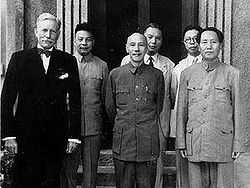 Atomic bombs were dropped
on Hiroshima
and Nagasaki in 1945. Under the terms of the Japanese unconditional surrender
dictated by the United States
, Japanese troops were ordered to surrender to KMT troops and not to the CPC present in some of the occupied areas. In Manchuria
, however, where the KMT had no forces, the Japanese surrendered to the Soviet Union
. Chiang Kai-Shek ordered the Japanese troops to remain at their post to receive the Kuomintang and not surrender their arms to the communists.
The first post-war peace negotiation was attended by both Chiang Kai-shek and Mao Zedong in Chongqing
from August 28, 1945 to October 10, 1945. Both sides stressed the importance of a peaceful reconstruction, but the conference did not produce any concrete result. Battles between the two sides continued even as the peace negotiation was in progress, until the agreement was reached in January 1946. However, large campaigns and full scale confrontations between the CPC and Chiang's own troops were temporarily avoided.
In the last month of World War II
in East Asia
, Soviet forces launched the mammoth Manchurian Strategic Offensive Operation to attack the Japanese in Manchuria and along the Chinese-Mongolian border. This operation destroyed the fighting capability of the Kwantung Army and left the USSR in occupation of all of Manchuria by the end of the war. Consequently, the 700,000 Japanese troops stationed in the region surrendered. Later in the year, Chiang Kai-shek realized that he lacked the resources to prevent a CPC takeover of Manchuria following the scheduled Soviet departure. He therefore made a deal with the Russians to delay their withdrawal until he had moved enough of his best-trained men and modern material into the region. KMT troops were then airlift
ed by the United States to occupy key cities in North China
, while the countryside was already dominated by the CPC. The Soviets spent the extra time systematically dismantling the extensive Manchurian industrial base (worth up to 2 billion dollars) and shipping it back to their war-ravaged country.
The truce fell apart in June 1946, when full scale war between CPC and KMT broke out on June 26. China then entered a state of civil war
that lasted more than three years.
In March 1946, despite repeated requests from Chiang, the Soviet Red Army under the command of general Malinovsky
continued to delay pulling out of Manchuria while he secretly told the CPC forces to move in behind them, because Stalin wanted Mao to have firm control of at least the northern part of Manchuria before the complete withdrawal of the Soviets, which led to full-scale war for the control of the Northeast. These favourable conditions also facilitated many changes inside the Communist leaders: the more hard-line and firmer force finally gained the upper hand and defeated the opportunists.
Although General Marshall
stated that he knew of no evidence that the CPC were being supplied by the Soviet Union, the CPC were able to capture a large number of weapons abandoned by the Japanese, including some tanks but it was not until large numbers of well trained KMT troops surrendered and joined the communist forces that the CPC were finally able to master the hardware. But despite the disadvantage in military hardware, the CPC's ultimate trump card was its land reform policy. The CPC continued to make the irresistible promise in the countryside to the massive number of landless and starving Chinese peasants that by fighting for the CPC they would be able to take farmland from their landlords. This strategy enabled the CPC to access an almost unlimited supply of manpower to use in combat as well as provide logistic support, despite suffering heavy casualties throughout many civil war campaigns. For example, during the Huaihai Campaign
alone the CPC were able to mobilize 5,430,000 peasants to fight against the KMT forces.
After the war with Japanese ended, Chiang Kai-shek
quickly moved KMT troops to newly liberated areas to prevent Communist forces from receiving the Japanese surrender. The United States airlifted many KMT troops from central China to the Northeast
(Manchuria
). President Truman was very clear about what he described as "using the Japanese to hold off the Communists". In his memoirs he writes:
Using the pretext of "receiving the Japanese surrender", business interests within the KMT government occupied most of the banks, factories and commercial properties, which had previously been seized by the Japanese Imperial Army. They also recruited troops at a brutal pace from the civilian population and hoarded supplies, preparing for a resumption of war with the Communists. These hasty and harsh preparations caused great hardship for the residents of cities such as Shanghai, where the unemployment rate rose dramatically to 37.5%.
The United States strongly supported the Kuomintang forces. Over 50,000 Marines were sent to guard strategic sites, and 100,000 US troops were sent to Shandong
. The US equipped and trained over 500,000 KMT troops, and transported KMT forces to occupy newly liberated zones, as well as to contain Communist controlled areas. American aid included substantial amounts of both new and surplus military supplies; additionally, loans worth hundreds of millions of dollars were made to the KMT. Within less than 2 years after the Sino-Japanese War, the KMT had received 4.43 billion dollars from the US - most of which was military aid.
and Communist historiography as the "War of Liberation" . On 20 July 1946, Chiang Kai-shek launched a large-scale assault on Communist territory with 113 brigades (1.6 million troops).; this marked the final phase of the Chinese Civil War.
Knowing their disadvantages in manpower and equipment, the CPC executed a "passive defense" strategy. They avoided the strong points of the KMT army, and were prepared to abandon territory in order to preserve their forces. They also attempted to wear out the KMT forces as much as possible. This tactic seemed to be successful; after a year, the power balance became more favorable to the CPC. They wiped out 1.12 million KMT troops, while their strength grew to about 2 million men.
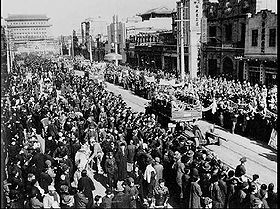 In March 1947, the KMT achieved a symbolic victory by seizing the CPC capital of Yan'an
. Soon after, the Communists counterattacked; on 30 June 1947, CPC troops crossed the Huanghe river and moved to Dabie Mountains area, restored and developed the Central Plain
. Concurrently, Communist forces in Northeastern China, North China
and East China
began to counter attack as well.
By late 1948 the CPC eventually captured the northern cities of Shenyang
and Changchun
and seized control of the Northeast after struggling through numerous set-backs while trying to take the cities, with the decisive Liaoshen Campaign
. The New First Army, regarded as the best KMT army, had to surrender after the CPC conducted a deadly 6-month siege of Changchun
that resulted in more than 150,000 civilian deaths from starvation.
The capture of large KMT formations provided them with the tanks, heavy artillery, and other combined-arms assets needed to prosecute offensive operations south of the Great Wall. By April 1948 the city of Luoyang
fell, cutting the KMT army off from Xi'an
. Following a fierce battle, the CPC captured Jinan
and Shandong province on September 24, 1948. The Huaihai Campaign
of late 1948 and early 1949 secured east-central China for the CPC. The outcome of these encounters were decisive for the military outcome of the civil war.
The Pingjin Campaign
resulted in the Communist conquest of northern China lasting 64 days from November 21, 1948, to January 31, 1949. The People's Liberation Army suffered heavy casualties from securing Zhangjiakou
, Tianjin
along with its port and garrison at Dagu
and Beiping. The CPC brought 890,000 troops from the Northeast to oppose some 600,000 KMT troops. There were 40,000 CPC casualties at Zhangjiakou
alone. They in turn killed, wounded or captured some 520,000 KMT during the campaign.
After the three decisive Liaoshen, Huaihai and Pingjin campaigns, the CPC wiped out 144 regular and 29 non-regular KMT divisions, including 1.54 million veteran KMT troops. This effectively smashed the backbone of the KMT army.
On 21 April, Communist forces crossed the Yangtze River
. On 23 April, they captured Nanjing, capital of the KMT's Republic of China
. In most cases, the surrounding countryside and small towns had come under Communist influence long before the cities. By late 1949, the People's Liberation Army was pursuing remnants of KMT forces southwards in southern China, and only Tibet
was left. The KMT government retreated from Nanjing
on April 23 successively to Canton (Guangzhou
) until October 15, Chongqing
until November 25, and Chengdu
before retreating to Taipei
on December 10.
In addition, the Ili Rebellion was a Soviet
backed revolt by the Second East Turkestan Republic
against the KMT from 1944-1949 as the Mongolians in the People's Republic were in a border dispute with the Republic of China. A Chinese Muslim Hui
cavalry regiment, the 14th Tungan Cavalry regiment, was sent by the Chinese government to attack Mongol and Soviet positions along the border during the Pei-ta-shan Incident.
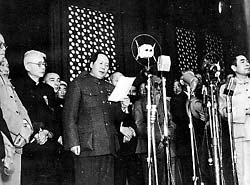 On October 1, 1949, Mao Zedong proclaimed the People's Republic of China
with its capital at Beiping, which was renamed Beijing
. Chiang Kai-shek and approximately 2 million Nationalist Chinese retreated from mainland China
to the island of Taiwan
. There remained only isolated pockets of resistance, notably in Sichuan
(ending soon after the fall of Chengdu
on December 10, 1949) and in the far south.
A PRC attempt to take the ROC controlled island of Kinmen
was thwarted in the Battle of Kuningtou
halting the PLA advance towards Taiwan. In December 1949, Chiang proclaimed Taipei
, Taiwan, the temporary capital of the Republic of China
and continued to assert his government as the sole legitimate authority in China.
The Communists' other amphibious operations of 1950 were more successful: they led to the Communist conquest of Hainan Island
in April 1950, capture of Wanshan Islands
off the Guangdong
coast (May–August 1950) and of Zhoushan Island
off Zhejiang
(May 1950).
in June 1950. At this point, allowing a total Communist victory over Chiang became politically impossible
in the United States, and President Harry S. Truman
ordered the United States Seventh Fleet
into the Taiwan strait
s to prevent the ROC and PRC from attacking each other.
In June 1949, the ROC declared a "closure" of all mainland China ports and its navy attempted to intercept all foreign ships. The closure covered from a point north of the mouth of Min river in Fujian province to the mouth of the Liao river
in Manchuria. Since mainland China's railroad network was underdeveloped, north-south trade depended heavily on sea lanes. ROC naval activity also caused severe hardship for mainland China fishermen.
After losing mainland China, a group of approximately 12,000 KMT soldiers escaped to Burma and continued launching guerrilla attacks into south China during the Kuomintang Islamic Insurgency in China (1950–1958)
. Their leader, General Li Mi
, was paid a salary by the ROC government and given the nominal title of Governor of Yunnan
. Initially, the United States supported these remnants and the Central Intelligence Agency
provided them with aid. After the Burmese government appealed to the United Nations
in 1953, the U.S. began pressuring the ROC to withdraw its loyalists. By the end of 1954, nearly 6,000 soldiers had left Burma and Li Mi declared his army disbanded. However, thousands remained, and the ROC continued to supply and command them, even secretly supplying reinforcements at times.
After the ROC complained to the United Nations
against the Soviet Union
supporting the PRC, the UN General Assembly Resolution 505
was adopted on February 1, 1952 to condemn the Soviet Union.
Though viewed as a military liability by the United States, the ROC viewed its remaining islands in Fujian as vital for any future campaign to defeat the PRC and retake mainland China. On September 3, 1954, the First Taiwan Strait crisis
began when the PLA
started shelling Quemoy and threatened to take the Dachen Islands. On January 20, 1955, the PLA
took nearby Yijiangshan Island
, with the entire ROC garrison of 720 troops killed or wounded defending the island. On January 24 of the same year, the United States Congress
passed the Formosa Resolution authorizing the President to defend the ROC's offshore islands. The First Taiwan Straits crisis ended in March 1955 when the PLA ceased its bombardment. The crisis was brought to a close during the Bandung conference
.
The Second Taiwan Strait Crisis
began on August 23, 1958 with air and naval engagements between the PRC and the ROC military forces, leading to intense artillery bombardment of Quemoy (by the PRC) and Amoy
(by the ROC), and ended on November of the same year. PLA patrol boats blockaded the islands from ROC supply ships. Though the United States rejected Chiang Kai-shek's proposal to bomb mainland China artillery batteries, it quickly moved to supply fighter jets and anti-aircraft missiles to the ROC. It also provided amphibious assault
ships to land supplies, as a sunken ROC naval vessel was blocking the harbor. On September 7, the United States escorted a convoy of ROC supply ships and the PRC refrained from firing. On October 25, the PRC announced an "even-day ceasefire" — the PLA would only shell Quemoy on odd-numbered days.
Despite the end of the hostilities, the two sides have never signed any agreement or treaty to officially end the war.
By 1984, PRC and ROC had public contacts with each other and cross-straits trade and investment has been growing ever since. Although the Taiwan strait
s remain a potential flash point, regular direct air links were established in 2009.
The Third Taiwan Strait Crisis
in 1995–96 escalated tensions between both sides when the PRC tested a series of missiles not far from Taiwan although, arguably, Beijing ran the test to shift the vote in favor of the KMT, already facing a challenge from the opposition Democratic Progressive Party which did not agree with the "One China Policy" shared by the CPC and KMT.
With the election in 2000 of the Democratic Progressive Party
candidate Chen Shui-bian
, a party other than the KMT gained the presidency for the first time in Taiwan. The new president did not share the Chinese nationalist ideology of the KMT and CPC. This led to tension between the two sides although trade and other ties such as the 2005 Pan-Blue visit
continued to increase.
Since the election of President Ma Ying-Jeou
(KMT) in 2008, significant warming of relations has resumed between Taipei and Beijing with high level exchanges between the ruling parties of both states such as the Chen-Chiang summit
series.
Rifles
Submachine Guns
Machine Guns
Heavy Machine Guns
Anti-Tank Weapons
Grenades
Misc
Civil war
A civil war is a war between organized groups within the same nation state or republic, or, less commonly, between two countries created from a formerly-united nation state....
fought between the Kuomintang
Kuomintang
The Kuomintang of China , sometimes romanized as Guomindang via the Pinyin transcription system or GMD for short, and translated as the Chinese Nationalist Party is a founding and ruling political party of the Republic of China . Its guiding ideology is the Three Principles of the People, espoused...
(KMT or Chinese Nationalist Party), the governing party of the Republic of China
Republic of China (1912–1949)
In 1911, after over two thousand years of imperial rule, a republic was established in China and the monarchy overthrown by a group of revolutionaries. The Qing Dynasty, having just experienced a century of instability, suffered from both internal rebellion and foreign imperialism...
, and the Communist Party of China
Communist Party of China
The Communist Party of China , also known as the Chinese Communist Party , is the founding and ruling political party of the People's Republic of China...
(CPC) (also known as CCP - Chinese Communist Party), for the control of China
China (disambiguation)
China, officially the People's Republic of China, is a large country in Asia.China may also refer to:-East Asia:* Republic of China, the country commonly known as "Taiwan"...
which eventually led to China's division into two Chinas
Two Chinas
The term Two Chinas refers to the two states with "China" in their official names: People's Republic of China , commonly known as "China", established in 1949, controlling mainland China and two special administrative regions, Hong Kong and Macau...
, Republic of China
Republic of China
The Republic of China , commonly known as Taiwan , is a unitary sovereign state located in East Asia. Originally based in mainland China, the Republic of China currently governs the island of Taiwan , which forms over 99% of its current territory, as well as Penghu, Kinmen, Matsu and other minor...
(ROC) and People's Republic of China
China
Chinese civilization may refer to:* China for more general discussion of the country.* Chinese culture* Greater China, the transnational community of ethnic Chinese.* History of China* Sinosphere, the area historically affected by Chinese culture...
(PRC). The war began in April 1927, amidst the Northern Expedition,, and essentially ended when major active battles ceased in 1949-1950. However there is debate on whether the war has officially ended. The conflict continues in the form of military threat
Military threat
A military threat, sometimes expressed as danger of military action, a military challenge, or a military risk, is a concept in military intelligence that identifies an imminent capability for use of military force in resolving diplomatic or economic disputes...
s and political and economic pressure, particularly over the political status of Taiwan
Political status of Taiwan
The controversy regarding the political status of Taiwan hinges on whether Taiwan, Penghu, Kinmen, and Matsu should remain effectively independent as territory of the Republic of China , become unified with the territories now governed by the People's Republic of China , or formally declare...
. The continued tension is described in cross-Strait relations
Cross-Strait relations
Cross-Strait relations refers to the relations between People's Republic of China and the Republic of China , which lie to the west and east, repectively, of the Taiwan Strait in the west Pacific Ocean....
.
The war represented an ideological
Ideology
An ideology is a set of ideas that constitutes one's goals, expectations, and actions. An ideology can be thought of as a comprehensive vision, as a way of looking at things , as in common sense and several philosophical tendencies , or a set of ideas proposed by the dominant class of a society to...
split between the Nationalist KMT, and the Communist CPC. In mainland China today, the last three years of the war (1947–1949) are more commonly known as the War of Liberation. In Taiwan, the war was also known as the Counter-insurgency War against Communists (戡亂戰爭) before 1991.
The civil war continued intermittently until the Second Sino-Japanese War
Second Sino-Japanese War
The Second Sino-Japanese War was a military conflict fought primarily between the Republic of China and the Empire of Japan. From 1937 to 1941, China fought Japan with some economic help from Germany , the Soviet Union and the United States...
interrupted it, resulting in the two parties forming a Second United Front. Japan's campaign was defeated in 1945, marking the end of World War II
World War II
World War II, or the Second World War , was a global conflict lasting from 1939 to 1945, involving most of the world's nations—including all of the great powers—eventually forming two opposing military alliances: the Allies and the Axis...
, and China's full-scale civil war resumed in 1946. After a further four years, 1950 saw a cessation of major military hostilities—with the newly founded People's Republic of China controlling mainland China
Mainland China
Mainland China, the Chinese mainland or simply the mainland, is a geopolitical term that refers to the area under the jurisdiction of the People's Republic of China . According to the Taipei-based Mainland Affairs Council, the term excludes the PRC Special Administrative Regions of Hong Kong and...
(including Hainan Island
Hainan
Hainan is the smallest province of the People's Republic of China . Although the province comprises some two hundred islands scattered among three archipelagos off the southern coast, of its land mass is Hainan Island , from which the province takes its name...
), and the Republic of China's jurisdiction being restricted to Taiwan
Taiwan
Taiwan , also known, especially in the past, as Formosa , is the largest island of the same-named island group of East Asia in the western Pacific Ocean and located off the southeastern coast of mainland China. The island forms over 99% of the current territory of the Republic of China following...
, Penghu, Kinmen
Kinmen
Kinmen , also known as Quemoy , is a small archipelago of several islands administered by the Republic of China : Greater Kinmen, Lesser Kinmen, and some islets. Administratively, it is Kinmen County of Fujian Province, ROC. The county is claimed by the People's Republic of China as part of its...
, Matsu
Matsu Islands
The Matsu Islands are a minor archipelago of 19 islands and islets in the Taiwan Strait administered as Lienchiang County , Fujian Province of the Republic of China . Only a small area of what is historically Lienchiang County is under the control of the ROC...
and several outlying islands.
To this day, since no armistice
Armistice
An armistice is a situation in a war where the warring parties agree to stop fighting. It is not necessarily the end of a war, but may be just a cessation of hostilities while an attempt is made to negotiate a lasting peace...
or peace treaty
Peace treaty
A peace treaty is an agreement between two or more hostile parties, usually countries or governments, that formally ends a state of war between the parties...
has ever been signed, the PRC still actively claims Taiwan as part of its territory and continues military threats to Taiwan, the ROC also has mutual claim on mainland China
Mainland China
Mainland China, the Chinese mainland or simply the mainland, is a geopolitical term that refers to the area under the jurisdiction of the People's Republic of China . According to the Taipei-based Mainland Affairs Council, the term excludes the PRC Special Administrative Regions of Hong Kong and...
, and both continues the fight over diplomatic recognition
Diplomatic recognition
Diplomatic recognition in international law is a unilateral political act with domestic and international legal consequences, whereby a state acknowledges an act or status of another state or government in control of a state...
, there is debate on whether the Civil War has legally ended. The war of weapons has given way to a war of words. Today, the war (such as it is) occurs on the political and economic fronts in the form of cross-Strait relations
Cross-Strait relations
Cross-Strait relations refers to the relations between People's Republic of China and the Republic of China , which lie to the west and east, repectively, of the Taiwan Strait in the west Pacific Ocean....
. The People's Republic threatens the ROC with a military invasion if the ROC officially declares independence for Taiwan
Taiwan independence
Taiwan independence is a political movement whose goals are primarily to formally establish the Republic of Taiwan by renaming or replacing the Republic of China , form a Taiwanese national identity, reject unification and One country, two systems with the People's Republic of China and a Chinese...
by changing its name to and gaining international recognition as the Republic of Taiwan. Today, the de facto separate states
Sovereign state
A sovereign state, or simply, state, is a state with a defined territory on which it exercises internal and external sovereignty, a permanent population, a government, and the capacity to enter into relations with other sovereign states. It is also normally understood to be a state which is neither...
on the two sides of the Taiwan strait
Taiwan Strait
The Taiwan Strait or Formosa Strait, formerly known as the Black Ditch, is a 180-km-wide strait separating Mainland China and Taiwan. The strait is part of the South China Sea and connects to East China Sea to the northeast...
have close economic ties.
Background
The Qing DynastyQing Dynasty
The Qing Dynasty was the last dynasty of China, ruling from 1644 to 1912 with a brief, abortive restoration in 1917. It was preceded by the Ming Dynasty and followed by the Republic of China....
, the last of the ruling Chinese dynasties, collapsed in 1911. China was left under the control of several major and lesser warlords in the Warlord era
Warlord era
The Chinese Warlord Era was the period in the history of the Republic of China, from 1916 to 1928, when the country was divided among military cliques, a division that continued until the fall of the Nationalist government in the mainland China regions of Sichuan, Shanxi, Qinghai, Ningxia,...
. To defeat these warlords, who had seized control of much of Northern China
Northern and southern China
Northern China and southern China are two approximate regions within China. The exact boundary between these two regions has never been precisely defined...
, the anti-monarchist and national unificationist Kuomintang
Kuomintang
The Kuomintang of China , sometimes romanized as Guomindang via the Pinyin transcription system or GMD for short, and translated as the Chinese Nationalist Party is a founding and ruling political party of the Republic of China . Its guiding ideology is the Three Principles of the People, espoused...
party and its leader Sun Yat-sen
Sun Yat-sen
Sun Yat-sen was a Chinese doctor, revolutionary and political leader. As the foremost pioneer of Nationalist China, Sun is frequently referred to as the "Father of the Nation" , a view agreed upon by both the People's Republic of China and the Republic of China...
, sought the help of foreign powers.
Sun Yat-sen's efforts to obtain aid from the Western democracies were ignored, however, and in 1921 he turned to the Soviet Union
Soviet Union
The Soviet Union , officially the Union of Soviet Socialist Republics , was a constitutionally socialist state that existed in Eurasia between 1922 and 1991....
. For political expediency, the Soviet leadership initiated a dual policy of support for both Sun and the newly established Communist Party of China
Communist Party of China
The Communist Party of China , also known as the Chinese Communist Party , is the founding and ruling political party of the People's Republic of China...
, which would eventually found the People's Republic of China
China
Chinese civilization may refer to:* China for more general discussion of the country.* Chinese culture* Greater China, the transnational community of ethnic Chinese.* History of China* Sinosphere, the area historically affected by Chinese culture...
. Thus the struggle for power in China began between the KMT and the CPC.
In 1923, a joint statement by Sun and Soviet representative Adolph Joffe
Adolph Joffe
Adolph Abramovich Joffe was a Communist revolutionary, a Bolshevik politician and a Soviet diplomat of Karaim descent.-Revolutionary career:...
in Shanghai
Shanghai
Shanghai is the largest city by population in China and the largest city proper in the world. It is one of the four province-level municipalities in the People's Republic of China, with a total population of over 23 million as of 2010...
pledged Soviet assistance for China's unification. The Sun-Joffe Manifesto
Sun-Joffe Manifesto
Sun-Joffe Manifesto or the Joint Manifesto of Sun and Joffe was an agreement signed between Sun Yat-sen and Adolph Joffe on January 26, 1923 for the cooperation of Republic of China Kuomintang and Soviet Union...
was a declaration for cooperation among the Comintern
Comintern
The Communist International, abbreviated as Comintern, also known as the Third International, was an international communist organization initiated in Moscow during March 1919...
, KMT and the Communist Party of China
Communist Party of China
The Communist Party of China , also known as the Chinese Communist Party , is the founding and ruling political party of the People's Republic of China...
. Comintern
Comintern
The Communist International, abbreviated as Comintern, also known as the Third International, was an international communist organization initiated in Moscow during March 1919...
agent Mikhail Borodin
Mikhail Borodin
Mikhail Markovich Borodin was the alias of Mikhail Gruzenberg, a Comintern agent and Soviet arms dealer....
arrived in China in 1923 to aid in the reorganization and consolidation of the KMT along the lines of the Communist Party of the Soviet Union
Communist Party of the Soviet Union
The Communist Party of the Soviet Union was the only legal, ruling political party in the Soviet Union and one of the largest communist organizations in the world...
. The CPC joined the KMT to form the First United Front
First United Front (China)
The First United Front of the Kuomintang and the Communist Party of China was formed in 1922 as an alliance to end warlordism in China. Together, they formed the National Revolutionary Army and set out in 1926 on the Northern Expedition...
.
In 1923, Sun Yat-sen sent Chiang Kai-shek
Chiang Kai-shek
Chiang Kai-shek was a political and military leader of 20th century China. He is known as Jiǎng Jièshí or Jiǎng Zhōngzhèng in Mandarin....
, one of Sun's lieutenants from his Tongmeng Hui days, for several months' military and political study in Moscow
Moscow
Moscow is the capital, the most populous city, and the most populous federal subject of Russia. The city is a major political, economic, cultural, scientific, religious, financial, educational, and transportation centre of Russia and the continent...
. By 1924, Chiang became the head of the Whampoa Military Academy
Whampoa Military Academy
The Nationalist Party of China Army Officer Academy , commonly known as the Whampoa Military Academy , was a military academy in the Republic of China that produced many prestigious commanders who fought in many of China's conflicts in the 20th century, notably the Northern Expedition, the Second...
, and rose to prominence as Sun's successor as head of the KMT.
The Soviets provided much of the studying material, organization, and equipment including munitions for the academy. The Soviets also provided education in many of the techniques for mass mobilization. With this aid Sun Yat-sen was able to raise a dedicated "army of the party," with which he hoped to defeat the warlords militarily. CPC members were also present in the academy, and many of them became instructors, including Zhou Enlai
Zhou Enlai
Zhou Enlai was the first Premier of the People's Republic of China, serving from October 1949 until his death in January 1976...
who was made a political instructor of the academy.
Communist members were allowed to join the KMT on an individual basis. The CPC itself was still small at the time, having a membership of 300 in 1922 and only 1,500 by 1925. The KMT in 1923 had 50,000 members.
Northern Expedition (1926–1928) and KMT-CPC split
Guangzhou
Guangzhou , known historically as Canton or Kwangchow, is the capital and largest city of the Guangdong province in the People's Republic of China. Located in southern China on the Pearl River, about north-northwest of Hong Kong, Guangzhou is a key national transportation hub and trading port...
to Wuhan
Wuhan
Wuhan is the capital of Hubei province, People's Republic of China, and is the most populous city in Central China. It lies at the east of the Jianghan Plain, and the intersection of the middle reaches of the Yangtze and Han rivers...
, where communist influence was strong. But Chiang and Li Zongren
Li Zongren
Li Zongren or Li Tsung-jen , courtesy name Delin , was a prominent Guangxi warlord and Kuomintang military commander during the Northern Expedition, Second Sino-Japanese War and Chinese Civil War...
, whose armies defeated warlord Sun Chuanfang
Sun Chuanfang
Sun Chuanfang aka the "Nanking Warlord" or leader of the "League of Five Provinces" was a Zhili clique warlord and protege of the "Jade Marshal" Wu Peifu .- Biography :Sun Chuanfang was born in Lichen, Shandong...
, moved eastward toward Jiangxi
Jiangxi
' is a southern province in the People's Republic of China. Spanning from the banks of the Yangtze River in the north into hillier areas in the south, it shares a border with Anhui to the north, Zhejiang to the northeast, Fujian to the east, Guangdong to the south, Hunan to the west, and Hubei to...
. The leftists rejected Chiang's demand and Chiang denounced the leftists for betraying Sun Yat-sen's Three Principles of the People
Three Principles of the People
The Three Principles of the People, also translated as Three People's Principles, or collectively San-min Doctrine, is a political philosophy developed by Sun Yat-sen as part of a philosophy to make China a free, prosperous, and powerful nation...
by taking orders from the Soviet Union. According to Mao Zedong
Mao Zedong
Mao Zedong, also transliterated as Mao Tse-tung , and commonly referred to as Chairman Mao , was a Chinese Communist revolutionary, guerrilla warfare strategist, Marxist political philosopher, and leader of the Chinese Revolution...
, Chiang's tolerance of the CPC in the KMT camp decreased as his power increased.
On April 7, Chiang and several other KMT leaders held a meeting arguing that communist activities were socially and economically disruptive, and must be undone for the national revolution to proceed. As a result of this, on April 12, Chiang turned on the CPC in Shanghai. The KMT was purged of leftists by the arrest and execution of hundreds of CPC members. It was directed by General Bai Chongxi
Bai Chongxi
Bai Chongxi , , also spelled Pai Chung-hsi, was a Chinese general in the National Revolutionary Army of the Republic of China and a prominent Chinese Nationalist Muslim leader. He was of Hui ethnicity and of the Muslim faith...
. This was called the April 12 Incident
April 12 Incident
The April 12 Incident of 1927 refers to the violent suppression of Chinese Communist Party organizations in Shanghai by the military forces of Chiang Kai-shek and conservative factions in the Kuomintang...
or Shanghai Massacre
Shanghai massacre of 1927
The April 12 Incident of 1927 refers to the violent suppression of Chinese Communist Party organizations in Shanghai by the military forces of Chiang Kai-shek and conservative factions in the Kuomintang...
by the CPC.
The massacre widened the rift between Chiang and Wang Jingwei
Wang Jingwei
Wang Jingwei , alternate name Wang Zhaoming, was a Chinese politician. He was initially known as a member of the left wing of the Kuomintang , but later became increasingly anti-Communist after his efforts to collaborate with the CCP ended in political failure...
's Wuhan. Attempts were made by CPC to take cities such as Nanchang
Nanchang
Nanchang is the capital of Jiangxi Province in southeastern China. It is located in the north-central portion of the province. As it is bounded on the west by the Jiuling Mountains, and on the east by Poyang Lake, it is famous for its scenery, rich history and cultural sites...
, Changsha, Shantou
Shantou
Shantou , historically known as Swatow or Suátao, is a prefecture-level city on the eastern coast of Guangdong province, People's Republic of China, with a total population of 5,391,028 as of 2010 and an administrative area of...
, and Guangzhou. An armed rural insurrection, known as the Autumn Harvest Uprising
Autumn Harvest Uprising
The Autumn Harvest Uprising was an insurrection that took place in Hunan province and Jiangxi province, China on September 7, 1927, led by Mao Zedong, who established a short-lived Hunan Soviet....
was staged by peasants, miners and CPC members in Hunan
Hunan
' is a province of South-Central China, located to the south of the middle reaches of the Yangtze River and south of Lake Dongting...
Province led by Mao Zedong
Mao Zedong
Mao Zedong, also transliterated as Mao Tse-tung , and commonly referred to as Chairman Mao , was a Chinese Communist revolutionary, guerrilla warfare strategist, Marxist political philosopher, and leader of the Chinese Revolution...
. The uprising was unsuccessful. There were now three capitals in China: the internationally recognized republic capital in Beijing
Beijing
Beijing , also known as Peking , is the capital of the People's Republic of China and one of the most populous cities in the world, with a population of 19,612,368 as of 2010. The city is the country's political, cultural, and educational center, and home to the headquarters for most of China's...
, the CPC and left-wing KMT at Wuhan
Wuhan
Wuhan is the capital of Hubei province, People's Republic of China, and is the most populous city in Central China. It lies at the east of the Jianghan Plain, and the intersection of the middle reaches of the Yangtze and Han rivers...
, and the right-wing KMT regime at Nanjing
Nanjing
' is the capital of Jiangsu province in China and has a prominent place in Chinese history and culture, having been the capital of China on several occasions...
, which would remain the KMT capital for the next decade.
The CPC had been expelled from Wuhan by their left-wing KMT allies, who in turn were toppled by Chiang Kai-shek. The KMT resumed the campaign against warlords
Warlord era
The Chinese Warlord Era was the period in the history of the Republic of China, from 1916 to 1928, when the country was divided among military cliques, a division that continued until the fall of the Nationalist government in the mainland China regions of Sichuan, Shanxi, Qinghai, Ningxia,...
and captured Beijing in June 1928. Afterwards most of eastern China
East China
East China is a geographical and a loosely-defined cultural region that covers the eastern coastal area of China.Although an intangible and loosely defined concept, for administrative and governmental purposes, the region is defined by the government of the People's Republic of China to include...
was under the Nanjing central government's control, and the Nanjing government received prompt international recognition as the sole legitimate government of China. The KMT government announced in conformity with Sun Yat-sen, the formula for the three stages of revolution: military unification, political tutelage, and constitutional democracy.
Encirclement Campaigns and the Long March (1927–1937)
During the 1920s, Communist Party of China activists retreated underground or to the countryside where they fomented a military revolt, beginning the Nanchang UprisingNanchang Uprising
The Nanchang Uprising was the first major Kuomintang-Communist engagement of the Chinese Civil War, in order to counter the anti-communist purges by the Nationalist Party of China....
on August 1, 1927. They combined the force with remnants of peasant
Peasant
A peasant is an agricultural worker who generally tend to be poor and homeless-Etymology:The word is derived from 15th century French païsant meaning one from the pays, or countryside, ultimately from the Latin pagus, or outlying administrative district.- Position in society :Peasants typically...
rebels, and established control over several areas in southern China. The Guangzhou commune was able to control Guangzhou for three days and a "soviet" was established. KMT armies continued to suppress the rebellions. This marked the beginning of the ten year's struggle, known in mainland China
Mainland China
Mainland China, the Chinese mainland or simply the mainland, is a geopolitical term that refers to the area under the jurisdiction of the People's Republic of China . According to the Taipei-based Mainland Affairs Council, the term excludes the PRC Special Administrative Regions of Hong Kong and...
as the "Ten Year's Civil War" . It lasted until the Xi'an Incident
Xi'an Incident
The Xi'an Incident of December 1936 is an important episode of Chinese modern history, taking place in the city of Xi'an during the Chinese Civil War between the ruling Kuomintang and the rebel Chinese Communist Party and just before the Second Sino-Japanese War...
when Chiang Kai-shek was forced to form the Second United Front
Second United Front (China)
The Second United Front was the alliance between the Kuomintang and Communist Party of China during the Second Sino-Japanese War or World War II, which suspended the Chinese Civil War from 1937 to 1946....
against the invading Japan
Japan
Japan is an island nation in East Asia. Located in the Pacific Ocean, it lies to the east of the Sea of Japan, China, North Korea, South Korea and Russia, stretching from the Sea of Okhotsk in the north to the East China Sea and Taiwan in the south...
ese.
Central Plains War
Central Plains War was a civil war within the factionalised Kuomintang that broke out in 1930. It was fought between the forces of Chiang Kai-shek and the coalition of three military commanders who had previously allied with Chiang: Yan Xishan, Feng Yuxiang, and Li Zongren...
broke out as an internal conflict of the KMT. It was launched by Feng Yuxiang
Feng Yuxiang
Feng Yuxiang was a warlord and leader in Republican China. He was also known as the Christian General for his zeal to convert his troops and the Betrayal General for his penchant to break with the establishment. In 1911, he was an officer in the ranks of Yuan Shikai's Beiyang Army but joined...
, Yan Xishan
Yan Xishan
Yan Xishan, was a Chinese warlord who served in the government of the Republic of China. Yan effectively controlled the province of Shanxi from the 1911 Xinhai Revolution to the 1949 Communist victory in the Chinese Civil War...
, and Wang Jingwei
Wang Jingwei
Wang Jingwei , alternate name Wang Zhaoming, was a Chinese politician. He was initially known as a member of the left wing of the Kuomintang , but later became increasingly anti-Communist after his efforts to collaborate with the CCP ended in political failure...
. The attention was turned to root out remaining pockets of Communist activity in a series of encirclement campaigns
Encirclement Campaigns
Encirclement Campaigns is a term used to describe several different campaigns launched by forces of the Chinese Nationalist Government against forces of the Communist Party of China during the Chinese Civil War. The campaigns were launched between the late 1920s to the mid-1930s with the goal of...
. There were a total of five campaigns. The first
First Encirclement Campaign
The First Encirclement Campaign is an abbreviated name used for several different encirclement campaigns launched by the Nationalist Government with the goal of destroying the developing Chinese Red Army and its communist bases in several separate locations in China during the early stage of...
and second
Second Encirclement Campaign
The Second Encirclement Campaign is an abbreviated name used for several different encirclement campaigns launched by the Nationalist Government with the goal of destroying the developing Chinese Red Army and its communist bases in several separate locations in China during the early stage of...
campaigns failed and the third
Third Encirclement Campaign
The Third Encirclement Campaigns is an abbreviated name used for several different encirclement campaigns launched by the Nationalist Government with the goal of destroying the developing Chinese Red Army and its communist bases in several separate locations in China during the early stage of...
was aborted due to the Mukden Incident
Mukden Incident
The Mukden Incident, also known as the Manchurian Incident, was a staged event that was engineered by Japanese military personnel as a pretext for invading the northern part of China known as Manchuria in 1931....
. The fourth campaign
Fourth Encirclement Campaign
The Fourth Encirclement Campaign is an abbreviated name used for several different encirclement campaigns launched by the Nationalist Government with the goal of destroying the developing Chinese Red Army and its communist bases. The battles took place in several separate locations in China during...
(1932–1933) achieved some early successes, but Chiang’s armies were badly mauled when they tried to penetrate into the heart of Mao’s Soviet Chinese Republic. During these campaigns, the KMT columns struck swiftly into Communist areas, but were easily engulfed by the vast countryside and were not able to consolidate their foothold.
Finally, in late 1934, Chiang launched a fifth campaign
Fifth Encirclement Campaign
The Fifth Encirclement Campaign is an abbreviated name used for several different encirclement campaigns launched by the Nationalist Government with the goal of destroying the developing Chinese Red Army and its communist bases in several separate locations in China during the early stage of...
that involved the systematic encirclement of the Jiangxi Soviet
Jiangxi Soviet
The Chinese Soviet Republic , also translated as the Soviet Republic of China or the China Soviet Republic, and often referred to in historical literature as the Jiangxi Soviet , was a state established in November 1931 by the future Communist Party of China leader Mao...
region with fortified blockhouse
Blockhouse
In military science, a blockhouse is a small, isolated fort in the form of a single building. It serves as a defensive strong point against any enemy that does not possess siege equipment or, in modern times, artillery...
s. Unlike in previous campaigns in which they penetrated deeply in a single strike, this time the KMT troops patiently built blockhouses, each separated by five or so miles to surround the Communist areas and cut off their supplies and food source.
In October 1934, the CPC took advantage of gaps in the ring of blockhouses (manned by the troops of a warlord ally of Chiang Kai-shek's, rather than the KMT themselves) to escape Jiangxi
Jiangxi
' is a southern province in the People's Republic of China. Spanning from the banks of the Yangtze River in the north into hillier areas in the south, it shares a border with Anhui to the north, Zhejiang to the northeast, Fujian to the east, Guangdong to the south, Hunan to the west, and Hubei to...
. The warlord armies were reluctant to challenge Communist forces for fear of wasting their own men, and did not pursue the CPC with much fervor. In addition, the main KMT forces were preoccupied with annihilating Zhang Guotao
Zhang Guotao
Zhang Guotao was a founding member and important leader of the Chinese Communist Party and bitter rival to Mao Zedong. During the 1920s he studied in the Soviet Union and became a key contact with the Comintern and organized the CCP labor movement in the United Front with the Guomindang...
's army, which was much larger than Mao's. The massive military retreat of Communist forces lasted a year and covered what Mao estimated as 12,500 km (25,000 Li
Li (unit)
The li is a traditional Chinese unit of distance, which has varied considerably over time but now has a standardized length of 500 meters or half a kilometer...
), and was known as the famous Long March
Long March
The Long March was a massive military retreat undertaken by the Red Army of the Communist Party of China, the forerunner of the People's Liberation Army, to evade the pursuit of the Kuomintang army. There was not one Long March, but a series of marches, as various Communist armies in the south...
.
The march ended when the CPC reached the interior of Shaanxi
Shaanxi
' is a province in the central part of Mainland China, and it includes portions of the Loess Plateau on the middle reaches of the Yellow River in addition to the Qinling Mountains across the southern part of this province...
. Zhang Guotao
Zhang Guotao
Zhang Guotao was a founding member and important leader of the Chinese Communist Party and bitter rival to Mao Zedong. During the 1920s he studied in the Soviet Union and became a key contact with the Comintern and organized the CCP labor movement in the United Front with the Guomindang...
's army, which took a different route through northwest China, was largely destroyed by the forces of Chiang Kai-shek and his Chinese Muslim
Hui people
The Hui people are an ethnic group in China, defined as Chinese speaking people descended from foreign Muslims. They are typically distinguished by their practice of Islam, however some also practice other religions, and many are direct descendants of Silk Road travelers.In modern People's...
ally, the Ma clique
Ma clique
The Ma clique or Ma family warlords is a collective name for a group of Muslim warlords in Northwestern China who ruled the Chinese provinces of Qinghai, Gansu and Ningxia from the 1910s until 1949. There were 3 families in the Ma clique , each of them respectively controlled 3 areas, Gansu,...
. Along the way, the Communist army confiscated property and weapons from local warlords and landlords, while recruiting peasants and the poor, solidifying its appeal to the masses. Of the 90,000-100,000 people who began the Long March from the Soviet Chinese Republic, only around 7,000-8,000 made it to Shaanxi. The remnants of Zhang's forces eventually joined Mao in Shaanxi, but with his army destroyed, Zhang, even as a founding member of the CPC, was never able to challenge Mao's authority. Essentially, the great retreat made Mao the undisputed leader of the Communist Party of China.
Second Sino-Japanese War (1937–1945)
Zhang Xueliang
Zhang Xueliang or Chang Hsüeh-liang , occasionally called Peter Hsueh Liang Chang in English, nicknamed the Young Marshal , was the effective ruler of Manchuria and much of North China after the assassination of his father, Zhang Zuolin, by the Japanese on 4 June 1928...
and Yang Hucheng
Yang Hucheng
Yang Hucheng was a Chinese warlord during the Warlord Era of Republican China and Kuomintang general during the Chinese Civil War....
kidnapped Chiang Kai-shek and forced him to a truce with the CPC. The incident became known as the Xi'an Incident
Xi'an Incident
The Xi'an Incident of December 1936 is an important episode of Chinese modern history, taking place in the city of Xi'an during the Chinese Civil War between the ruling Kuomintang and the rebel Chinese Communist Party and just before the Second Sino-Japanese War...
. Both parties suspended fighting to form a Second United Front
Second United Front (China)
The Second United Front was the alliance between the Kuomintang and Communist Party of China during the Second Sino-Japanese War or World War II, which suspended the Chinese Civil War from 1937 to 1946....
to focus their energies and fighting against the Japanese. In 1937, Japanese airplanes bombed Chinese cities and well-equipped troops overran north and coastal China.
The alliance of CPC and KMT was in name only. Shunning conventional warfare
Conventional warfare
Conventional warfare is a form of warfare conducted byusing conventional military weapons and battlefield tactics between two or more states in open confrontation. The forces on each side are well-defined, and fight using weapons that primarily target the opposing army...
, the CPC engaged in guerrilla warfare
Guerrilla warfare
Guerrilla warfare is a form of irregular warfare and refers to conflicts in which a small group of combatants including, but not limited to, armed civilians use military tactics, such as ambushes, sabotage, raids, the element of surprise, and extraordinary mobility to harass a larger and...
against the Japanese, while still CPC and KMPT troops engaged each other. The level of actual cooperation and coordination between the CPC and KMT during World War II
World War II
World War II, or the Second World War , was a global conflict lasting from 1939 to 1945, involving most of the world's nations—including all of the great powers—eventually forming two opposing military alliances: the Allies and the Axis...
was at best minimal. In the midst of the Second United Front, the CPC and the KMT were still vying for territorial advantage in "Free China
Free China (Second Sino-Japanese War)
The term Free China, in the context of the Second Sino-Japanese War, refers to those areas of China not under the control of the Imperial Japanese Army or any of its puppet governments, such as Manchukuo, the Mengjiang government in Suiyuan and Chahar, or the Provisional Government of the Republic...
" (i.e. areas not occupied by the Japanese or ruled by Japanese puppet governments
Manchukuo
Manchukuo or Manshū-koku was a puppet state in Manchuria and eastern Inner Mongolia, governed under a form of constitutional monarchy. The region was the historical homeland of the Manchus, who founded the Qing Empire in China...
).
The situation came to a head in late 1940 and early 1941 when there were major clashes between the Communist and KMT forces. In December 1940, Chiang Kai-shek demanded that the CPC’s New Fourth Army
New Fourth Army
The New Fourth Army was a unit of the National Revolutionary Army of the Republic of China established in 1937. In contrast to most of the National Revolutionary Army, it was controlled by the Communist Party of China and not by the ruling Kuomintang. The New Fourth Army and the Eighth Route Army...
evacuate Anhui
Anhui
Anhui is a province in the People's Republic of China. Located in eastern China across the basins of the Yangtze River and the Huai River, it borders Jiangsu to the east, Zhejiang to the southeast, Jiangxi to the south, Hubei to the southwest, Henan to the northwest, and Shandong for a tiny...
and Jiangsu
Jiangsu
' is a province of the People's Republic of China, located along the east coast of the country. The name comes from jiang, short for the city of Jiangning , and su, for the city of Suzhou. The abbreviation for this province is "苏" , the second character of its name...
Provinces. Under intense pressure, the New Fourth Army commanders complied. In 1941 the New Fourth Army Incident
New Fourth Army Incident
The New Fourth Army Incident , also known as the Wannan Incident , occurred in China in January 1941 during the Second Sino-Japanese War, during which the Chinese Civil War was in theory suspended, uniting the Communists and Nationalists against the Japanese...
led to several thousand deaths in the CPC. It also ended the Second united front formed earlier to fight the Japanese.
In general, developments in the Second Sino-Japanese War
Second Sino-Japanese War
The Second Sino-Japanese War was a military conflict fought primarily between the Republic of China and the Empire of Japan. From 1937 to 1941, China fought Japan with some economic help from Germany , the Soviet Union and the United States...
were to the advantage of the CPC, as their guerilla war effort had won them much popular support within the Japanese-occupied areas. The KMT's resistance to the Japanese proved costly to Chiang Kai-shek. In 1944 the last major offensive, Operation Ichigo was launched by the Japanese against the KMT.
Immediate post-war clashes (1945–1946)
Atomic bombings of Hiroshima and Nagasaki
During the final stages of World War II in 1945, the United States conducted two atomic bombings against the cities of Hiroshima and Nagasaki in Japan, the first on August 6, 1945, and the second on August 9, 1945. These two events are the only use of nuclear weapons in war to date.For six months...
on Hiroshima
Hiroshima
is the capital of Hiroshima Prefecture, and the largest city in the Chūgoku region of western Honshu, the largest island of Japan. It became best known as the first city in history to be destroyed by a nuclear weapon when the United States Army Air Forces dropped an atomic bomb on it at 8:15 A.M...
and Nagasaki in 1945. Under the terms of the Japanese unconditional surrender
Unconditional surrender
Unconditional surrender is a surrender without conditions, in which no guarantees are given to the surrendering party. In modern times unconditional surrenders most often include guarantees provided by international law. Announcing that only unconditional surrender is acceptable puts psychological...
dictated by the United States
United States
The United States of America is a federal constitutional republic comprising fifty states and a federal district...
, Japanese troops were ordered to surrender to KMT troops and not to the CPC present in some of the occupied areas. In Manchuria
Manchuria
Manchuria is a historical name given to a large geographic region in northeast Asia. Depending on the definition of its extent, Manchuria usually falls entirely within the People's Republic of China, or is sometimes divided between China and Russia. The region is commonly referred to as Northeast...
, however, where the KMT had no forces, the Japanese surrendered to the Soviet Union
Soviet Union
The Soviet Union , officially the Union of Soviet Socialist Republics , was a constitutionally socialist state that existed in Eurasia between 1922 and 1991....
. Chiang Kai-Shek ordered the Japanese troops to remain at their post to receive the Kuomintang and not surrender their arms to the communists.
The first post-war peace negotiation was attended by both Chiang Kai-shek and Mao Zedong in Chongqing
Chongqing
Chongqing is a major city in Southwest China and one of the five national central cities of China. Administratively, it is one of the PRC's four direct-controlled municipalities , and the only such municipality in inland China.The municipality was created on 14 March 1997, succeeding the...
from August 28, 1945 to October 10, 1945. Both sides stressed the importance of a peaceful reconstruction, but the conference did not produce any concrete result. Battles between the two sides continued even as the peace negotiation was in progress, until the agreement was reached in January 1946. However, large campaigns and full scale confrontations between the CPC and Chiang's own troops were temporarily avoided.
In the last month of World War II
World War II
World War II, or the Second World War , was a global conflict lasting from 1939 to 1945, involving most of the world's nations—including all of the great powers—eventually forming two opposing military alliances: the Allies and the Axis...
in East Asia
East Asia
East Asia or Eastern Asia is a subregion of Asia that can be defined in either geographical or cultural terms...
, Soviet forces launched the mammoth Manchurian Strategic Offensive Operation to attack the Japanese in Manchuria and along the Chinese-Mongolian border. This operation destroyed the fighting capability of the Kwantung Army and left the USSR in occupation of all of Manchuria by the end of the war. Consequently, the 700,000 Japanese troops stationed in the region surrendered. Later in the year, Chiang Kai-shek realized that he lacked the resources to prevent a CPC takeover of Manchuria following the scheduled Soviet departure. He therefore made a deal with the Russians to delay their withdrawal until he had moved enough of his best-trained men and modern material into the region. KMT troops were then airlift
Airlift
Airlift is the act of transporting people or cargo from point to point using aircraft.Airlift may also refer to:*Airlift , a suction device for moving sand and silt underwater-See also:...
ed by the United States to occupy key cities in North China
North China
thumb|250px|Northern [[People's Republic of China]] region.Northern China or North China is a geographical region of China. The heartland of North China is the North China Plain....
, while the countryside was already dominated by the CPC. The Soviets spent the extra time systematically dismantling the extensive Manchurian industrial base (worth up to 2 billion dollars) and shipping it back to their war-ravaged country.
The truce fell apart in June 1946, when full scale war between CPC and KMT broke out on June 26. China then entered a state of civil war
Civil war
A civil war is a war between organized groups within the same nation state or republic, or, less commonly, between two countries created from a formerly-united nation state....
that lasted more than three years.
Background and disposition of forces
By the end of the Second Sino-Japanese War, the balance of power in China's civil war had shifted in favor of the Communists. Their main force grew to 1.2 million troops, with a Militia of 2 million. Their "Liberated Zone" contained 19 base areas, including 1/4 of the country's territory and 1/3 of its population; this included many important towns and cities. Moreover, the Soviet Union turned over all of their captured Japanese weapons and a substantial amount of their own supplies to the Communists, who received Northeastern China from the Soviets as well.In March 1946, despite repeated requests from Chiang, the Soviet Red Army under the command of general Malinovsky
Rodion Malinovsky
Rodion Yakovlevich Malinovsky was a Soviet military commander in World War II and Defense Minister of the Soviet Union in the late 1950s and 1960s. He contributed to the major defeat of Nazi Germany at the Battle of Stalingrad and the Battle of Budapest...
continued to delay pulling out of Manchuria while he secretly told the CPC forces to move in behind them, because Stalin wanted Mao to have firm control of at least the northern part of Manchuria before the complete withdrawal of the Soviets, which led to full-scale war for the control of the Northeast. These favourable conditions also facilitated many changes inside the Communist leaders: the more hard-line and firmer force finally gained the upper hand and defeated the opportunists.
Although General Marshall
George Marshall
George Catlett Marshall was an American military leader, Chief of Staff of the Army, Secretary of State, and the third Secretary of Defense...
stated that he knew of no evidence that the CPC were being supplied by the Soviet Union, the CPC were able to capture a large number of weapons abandoned by the Japanese, including some tanks but it was not until large numbers of well trained KMT troops surrendered and joined the communist forces that the CPC were finally able to master the hardware. But despite the disadvantage in military hardware, the CPC's ultimate trump card was its land reform policy. The CPC continued to make the irresistible promise in the countryside to the massive number of landless and starving Chinese peasants that by fighting for the CPC they would be able to take farmland from their landlords. This strategy enabled the CPC to access an almost unlimited supply of manpower to use in combat as well as provide logistic support, despite suffering heavy casualties throughout many civil war campaigns. For example, during the Huaihai Campaign
Huaihai Campaign
Huaihai Campaign or Battle of Hsupeng was a military action during 1948 and 1949 that was the determining battle of the Chinese Civil War. It was one of the few conventional battles of the war. 550,000 troops of the Republic of China were surrounded in Xuzhou and destroyed by the communist...
alone the CPC were able to mobilize 5,430,000 peasants to fight against the KMT forces.
After the war with Japanese ended, Chiang Kai-shek
Chiang Kai-shek
Chiang Kai-shek was a political and military leader of 20th century China. He is known as Jiǎng Jièshí or Jiǎng Zhōngzhèng in Mandarin....
quickly moved KMT troops to newly liberated areas to prevent Communist forces from receiving the Japanese surrender. The United States airlifted many KMT troops from central China to the Northeast
Northeast China
Northeast China, historically known in English as Manchuria, is a geographical region of China, consisting of the three provinces of Liaoning, Jilin and Heilongjiang. The region is sometimes called the Three Northeast Provinces...
(Manchuria
Manchuria
Manchuria is a historical name given to a large geographic region in northeast Asia. Depending on the definition of its extent, Manchuria usually falls entirely within the People's Republic of China, or is sometimes divided between China and Russia. The region is commonly referred to as Northeast...
). President Truman was very clear about what he described as "using the Japanese to hold off the Communists". In his memoirs he writes:
Using the pretext of "receiving the Japanese surrender", business interests within the KMT government occupied most of the banks, factories and commercial properties, which had previously been seized by the Japanese Imperial Army. They also recruited troops at a brutal pace from the civilian population and hoarded supplies, preparing for a resumption of war with the Communists. These hasty and harsh preparations caused great hardship for the residents of cities such as Shanghai, where the unemployment rate rose dramatically to 37.5%.
The United States strongly supported the Kuomintang forces. Over 50,000 Marines were sent to guard strategic sites, and 100,000 US troops were sent to Shandong
Shandong
' is a Province located on the eastern coast of the People's Republic of China. Shandong has played a major role in Chinese history from the beginning of Chinese civilization along the lower reaches of the Yellow River and served as a pivotal cultural and religious site for Taoism, Chinese...
. The US equipped and trained over 500,000 KMT troops, and transported KMT forces to occupy newly liberated zones, as well as to contain Communist controlled areas. American aid included substantial amounts of both new and surplus military supplies; additionally, loans worth hundreds of millions of dollars were made to the KMT. Within less than 2 years after the Sino-Japanese War, the KMT had received 4.43 billion dollars from the US - most of which was military aid.
Outbreak of War
With the breakdown of talks, all-out war resumed. This stage is referred to in mainland ChinaMainland China
Mainland China, the Chinese mainland or simply the mainland, is a geopolitical term that refers to the area under the jurisdiction of the People's Republic of China . According to the Taipei-based Mainland Affairs Council, the term excludes the PRC Special Administrative Regions of Hong Kong and...
and Communist historiography as the "War of Liberation" . On 20 July 1946, Chiang Kai-shek launched a large-scale assault on Communist territory with 113 brigades (1.6 million troops).; this marked the final phase of the Chinese Civil War.
Knowing their disadvantages in manpower and equipment, the CPC executed a "passive defense" strategy. They avoided the strong points of the KMT army, and were prepared to abandon territory in order to preserve their forces. They also attempted to wear out the KMT forces as much as possible. This tactic seemed to be successful; after a year, the power balance became more favorable to the CPC. They wiped out 1.12 million KMT troops, while their strength grew to about 2 million men.
Yan'an
Yan'an , is a prefecture-level city in the Shanbei region of Shaanxi province in China, administering several counties, including Zhidan County , which served as the Chinese communist capital before the city of Yan'an proper took that role....
. Soon after, the Communists counterattacked; on 30 June 1947, CPC troops crossed the Huanghe river and moved to Dabie Mountains area, restored and developed the Central Plain
Central Plain (China)
Zhongyuan or the Central Plain of China refers to the area on the lower reaches of the Yellow River which formed the cradle of Chinese civilization. It forms part of the North China Plain....
. Concurrently, Communist forces in Northeastern China, North China
North China
thumb|250px|Northern [[People's Republic of China]] region.Northern China or North China is a geographical region of China. The heartland of North China is the North China Plain....
and East China
East China
East China is a geographical and a loosely-defined cultural region that covers the eastern coastal area of China.Although an intangible and loosely defined concept, for administrative and governmental purposes, the region is defined by the government of the People's Republic of China to include...
began to counter attack as well.
By late 1948 the CPC eventually captured the northern cities of Shenyang
Shenyang
Shenyang , or Mukden , is the capital and largest city of Liaoning Province in Northeast China. Currently holding sub-provincial administrative status, the city was once known as Shengjing or Fengtianfu...
and Changchun
Changchun
Changchun is the capital and largest city of Jilin province, located in the northeast of the People's Republic of China, in the center of the Songliao Plain. It is administered as a sub-provincial city with a population of 7,677,089 at the 2010 census under its jurisdiction, including counties and...
and seized control of the Northeast after struggling through numerous set-backs while trying to take the cities, with the decisive Liaoshen Campaign
Liaoshen Campaign
Liaoshen Campaign , literally the abbreviation of Liaoning-Shenyang Campaign, was part of the three major campaigns launched by the People's Liberation Army during the late stage of the Chinese Civil War. This engagement is known in the Nationalist government as the Battle of Liaoshi...
. The New First Army, regarded as the best KMT army, had to surrender after the CPC conducted a deadly 6-month siege of Changchun
Siege of Changchun
The Siege of Changchun was a siege operation launched by the People's Liberation Army during the Chinese Civil War against the city of Changchun, defended by the Nationalist forces...
that resulted in more than 150,000 civilian deaths from starvation.
The capture of large KMT formations provided them with the tanks, heavy artillery, and other combined-arms assets needed to prosecute offensive operations south of the Great Wall. By April 1948 the city of Luoyang
Luoyang
Luoyang is a prefecture-level city in western Henan province of Central China. It borders the provincial capital of Zhengzhou to the east, Pingdingshan to the southeast, Nanyang to the south, Sanmenxia to the west, Jiyuan to the north, and Jiaozuo to the northeast.Situated on the central plain of...
fell, cutting the KMT army off from Xi'an
Xi'an
Xi'an is the capital of the Shaanxi province, and a sub-provincial city in the People's Republic of China. One of the oldest cities in China, with more than 3,100 years of history, the city was known as Chang'an before the Ming Dynasty...
. Following a fierce battle, the CPC captured Jinan
Jinan
Jinan is the capital of Shandong province in Eastern China. The area of present-day Jinan has played an important role in the history of the region from the earliest beginnings of civilisation and has evolved into a major national administrative, economic, and transportation hub...
and Shandong province on September 24, 1948. The Huaihai Campaign
Huaihai Campaign
Huaihai Campaign or Battle of Hsupeng was a military action during 1948 and 1949 that was the determining battle of the Chinese Civil War. It was one of the few conventional battles of the war. 550,000 troops of the Republic of China were surrounded in Xuzhou and destroyed by the communist...
of late 1948 and early 1949 secured east-central China for the CPC. The outcome of these encounters were decisive for the military outcome of the civil war.
The Pingjin Campaign
Pingjin Campaign
Pingjin Campaign , known as the Battle of Pingjin to the Nationalist Government, was part of the three major campaigns launched by the People's Liberation Army during the late stage of the Chinese Civil War. It began on November 29, 1948, and ended on January 31, 1949, lasted a total of 64 days...
resulted in the Communist conquest of northern China lasting 64 days from November 21, 1948, to January 31, 1949. The People's Liberation Army suffered heavy casualties from securing Zhangjiakou
Zhangjiakou
Zhangjiakou, also known also by several other names, is a prefecture-level city in northwestern Hebei province of North China, adjacent to Beijing to the southeast. Its administrative area has a population of 4.35 million, and covers...
, Tianjin
Tianjin
' is a metropolis in northern China and one of the five national central cities of the People's Republic of China. It is governed as a direct-controlled municipality, one of four such designations, and is, thus, under direct administration of the central government...
along with its port and garrison at Dagu
Dagu
Dagu may refer to:* Dagu , a form of traditional Chinese storytelling* Dagu Fort, a Chinese fort that is now a visitor attraction* Dagu language, an Eastern Sudanic language of Darfur* Hong Dagu , Korean military commander...
and Beiping. The CPC brought 890,000 troops from the Northeast to oppose some 600,000 KMT troops. There were 40,000 CPC casualties at Zhangjiakou
Zhangjiakou
Zhangjiakou, also known also by several other names, is a prefecture-level city in northwestern Hebei province of North China, adjacent to Beijing to the southeast. Its administrative area has a population of 4.35 million, and covers...
alone. They in turn killed, wounded or captured some 520,000 KMT during the campaign.
After the three decisive Liaoshen, Huaihai and Pingjin campaigns, the CPC wiped out 144 regular and 29 non-regular KMT divisions, including 1.54 million veteran KMT troops. This effectively smashed the backbone of the KMT army.
On 21 April, Communist forces crossed the Yangtze River
Yangtze River
The Yangtze, Yangzi or Cháng Jiāng is the longest river in Asia, and the third-longest in the world. It flows for from the glaciers on the Tibetan Plateau in Qinghai eastward across southwest, central and eastern China before emptying into the East China Sea at Shanghai. It is also one of the...
. On 23 April, they captured Nanjing, capital of the KMT's Republic of China
Republic of China
The Republic of China , commonly known as Taiwan , is a unitary sovereign state located in East Asia. Originally based in mainland China, the Republic of China currently governs the island of Taiwan , which forms over 99% of its current territory, as well as Penghu, Kinmen, Matsu and other minor...
. In most cases, the surrounding countryside and small towns had come under Communist influence long before the cities. By late 1949, the People's Liberation Army was pursuing remnants of KMT forces southwards in southern China, and only Tibet
Tibet
Tibet is a plateau region in Asia, north-east of the Himalayas. It is the traditional homeland of the Tibetan people as well as some other ethnic groups such as Monpas, Qiang, and Lhobas, and is now also inhabited by considerable numbers of Han and Hui people...
was left. The KMT government retreated from Nanjing
Nanjing
' is the capital of Jiangsu province in China and has a prominent place in Chinese history and culture, having been the capital of China on several occasions...
on April 23 successively to Canton (Guangzhou
Guangzhou
Guangzhou , known historically as Canton or Kwangchow, is the capital and largest city of the Guangdong province in the People's Republic of China. Located in southern China on the Pearl River, about north-northwest of Hong Kong, Guangzhou is a key national transportation hub and trading port...
) until October 15, Chongqing
Chongqing
Chongqing is a major city in Southwest China and one of the five national central cities of China. Administratively, it is one of the PRC's four direct-controlled municipalities , and the only such municipality in inland China.The municipality was created on 14 March 1997, succeeding the...
until November 25, and Chengdu
Chengdu
Chengdu , formerly transliterated Chengtu, is the capital of Sichuan province in Southwest China. It holds sub-provincial administrative status...
before retreating to Taipei
Taipei
Taipei City is the capital of the Republic of China and the central city of the largest metropolitan area of Taiwan. Situated at the northern tip of the island, Taipei is located on the Tamsui River, and is about 25 km southwest of Keelung, its port on the Pacific Ocean...
on December 10.
In addition, the Ili Rebellion was a Soviet
Soviet Union
The Soviet Union , officially the Union of Soviet Socialist Republics , was a constitutionally socialist state that existed in Eurasia between 1922 and 1991....
backed revolt by the Second East Turkestan Republic
Second East Turkestan Republic
The Second East Turkestan Republic, usually known simply as the East Turkestan Republic , was a short-lived Soviet-backed Turkic people's republic which existed in the 1940s in three northern districts of Xinjiang province of the Republic of China, what is now the Xinjiang Uyghur Autonomous...
against the KMT from 1944-1949 as the Mongolians in the People's Republic were in a border dispute with the Republic of China. A Chinese Muslim Hui
Hui people
The Hui people are an ethnic group in China, defined as Chinese speaking people descended from foreign Muslims. They are typically distinguished by their practice of Islam, however some also practice other religions, and many are direct descendants of Silk Road travelers.In modern People's...
cavalry regiment, the 14th Tungan Cavalry regiment, was sent by the Chinese government to attack Mongol and Soviet positions along the border during the Pei-ta-shan Incident.
Establishment of the People's Republic and the Kuomintang retreat to Taiwan
People's Republic of China
China , officially the People's Republic of China , is the most populous country in the world, with over 1.3 billion citizens. Located in East Asia, the country covers approximately 9.6 million square kilometres...
with its capital at Beiping, which was renamed Beijing
Beijing
Beijing , also known as Peking , is the capital of the People's Republic of China and one of the most populous cities in the world, with a population of 19,612,368 as of 2010. The city is the country's political, cultural, and educational center, and home to the headquarters for most of China's...
. Chiang Kai-shek and approximately 2 million Nationalist Chinese retreated from mainland China
Mainland China
Mainland China, the Chinese mainland or simply the mainland, is a geopolitical term that refers to the area under the jurisdiction of the People's Republic of China . According to the Taipei-based Mainland Affairs Council, the term excludes the PRC Special Administrative Regions of Hong Kong and...
to the island of Taiwan
Taiwan
Taiwan , also known, especially in the past, as Formosa , is the largest island of the same-named island group of East Asia in the western Pacific Ocean and located off the southeastern coast of mainland China. The island forms over 99% of the current territory of the Republic of China following...
. There remained only isolated pockets of resistance, notably in Sichuan
Sichuan
' , known formerly in the West by its postal map spellings of Szechwan or Szechuan is a province in Southwest China with its capital in Chengdu...
(ending soon after the fall of Chengdu
Chengdu
Chengdu , formerly transliterated Chengtu, is the capital of Sichuan province in Southwest China. It holds sub-provincial administrative status...
on December 10, 1949) and in the far south.
A PRC attempt to take the ROC controlled island of Kinmen
Kinmen
Kinmen , also known as Quemoy , is a small archipelago of several islands administered by the Republic of China : Greater Kinmen, Lesser Kinmen, and some islets. Administratively, it is Kinmen County of Fujian Province, ROC. The county is claimed by the People's Republic of China as part of its...
was thwarted in the Battle of Kuningtou
Battle of Kuningtou
The Battle of Guningtou , also known as the Battle of Jinmen , was a battle fought over Kinmen in the Taiwan Strait during the Chinese Civil War in 1949...
halting the PLA advance towards Taiwan. In December 1949, Chiang proclaimed Taipei
Taipei
Taipei City is the capital of the Republic of China and the central city of the largest metropolitan area of Taiwan. Situated at the northern tip of the island, Taipei is located on the Tamsui River, and is about 25 km southwest of Keelung, its port on the Pacific Ocean...
, Taiwan, the temporary capital of the Republic of China
Republic of China
The Republic of China , commonly known as Taiwan , is a unitary sovereign state located in East Asia. Originally based in mainland China, the Republic of China currently governs the island of Taiwan , which forms over 99% of its current territory, as well as Penghu, Kinmen, Matsu and other minor...
and continued to assert his government as the sole legitimate authority in China.
The Communists' other amphibious operations of 1950 were more successful: they led to the Communist conquest of Hainan Island
Landing Operation on Hainan Island
Landing Operation on Hainan Island , also known as Hainan Island Campaign or Hainan Campaign for short, was a series of battles fought between the Kuomintang and the Communist Party of China during the Chinese Civil War in the post-World War II period, and resulted in a communist...
in April 1950, capture of Wanshan Islands
Wanshan Archipelago Campaign
The Wanshan Archipelago Campaign was a campaign fought between the communist and the nationalist forces during the Chinese Civil War for the control of Wanshan Archipelago , and resulted in communist victory...
off the Guangdong
Guangdong
Guangdong is a province on the South China Sea coast of the People's Republic of China. The province was previously often written with the alternative English name Kwangtung Province...
coast (May–August 1950) and of Zhoushan Island
Zhoushan Island
Zhoushan Island is the principal island of the namesake archipelago Zhoushan Islands, governed by Zhoushan City, Zhejiang Province, the People's Republic of China. Its name means "Boat Mountain", because its shape. It is the province's largest island, and third largest in mainland China...
off Zhejiang
Zhejiang
Zhejiang is an eastern coastal province of the People's Republic of China. The word Zhejiang was the old name of the Qiantang River, which passes through Hangzhou, the provincial capital...
(May 1950).
Relationship between the two sides since 1950
Most observers expected Chiang's government to eventually fall in response to a Communist invasion of Taiwan, and the United States initially showed no interest in supporting Chiang's government in its final stand. Things changed radically with the onset of the Korean WarKorean War
The Korean War was a conventional war between South Korea, supported by the United Nations, and North Korea, supported by the People's Republic of China , with military material aid from the Soviet Union...
in June 1950. At this point, allowing a total Communist victory over Chiang became politically impossible
Domino theory
The domino theory was a reason for war during the 1950s to 1980s, promoted at times by the government of the United States, that speculated that if one state in a region came under the influence of communism, then the surrounding countries would follow in a domino effect...
in the United States, and President Harry S. Truman
Harry S. Truman
Harry S. Truman was the 33rd President of the United States . As President Franklin D. Roosevelt's third vice president and the 34th Vice President of the United States , he succeeded to the presidency on April 12, 1945, when President Roosevelt died less than three months after beginning his...
ordered the United States Seventh Fleet
United States Seventh Fleet
The Seventh Fleet is the United States Navy's permanent forward projection force based in Yokosuka, Japan, with units positioned near Japan and South Korea. It is a component fleet force under the United States Pacific Fleet. At present, it is the largest of the forward-deployed U.S. fleets, with...
into the Taiwan strait
Taiwan Strait
The Taiwan Strait or Formosa Strait, formerly known as the Black Ditch, is a 180-km-wide strait separating Mainland China and Taiwan. The strait is part of the South China Sea and connects to East China Sea to the northeast...
s to prevent the ROC and PRC from attacking each other.
In June 1949, the ROC declared a "closure" of all mainland China ports and its navy attempted to intercept all foreign ships. The closure covered from a point north of the mouth of Min river in Fujian province to the mouth of the Liao river
Liao River
The Liao River is the principal river in northeast China . The province of Liaoning and the Liaodong Peninsula derive their names from the river....
in Manchuria. Since mainland China's railroad network was underdeveloped, north-south trade depended heavily on sea lanes. ROC naval activity also caused severe hardship for mainland China fishermen.
After losing mainland China, a group of approximately 12,000 KMT soldiers escaped to Burma and continued launching guerrilla attacks into south China during the Kuomintang Islamic Insurgency in China (1950–1958)
Kuomintang Islamic Insurgency in China (1950–1958)
The Kuomintang Islamic Insurgency in China refers to a continuation of the Chinese Civil War by Muslim Kuomintang National Revolutionary Army forces in Northwest China, in the provinces of Gansu, Qinghai, Ningxia, Xinjiang, and another insurgency in Yunnan....
. Their leader, General Li Mi
Li Mi (ROC general)
Li Mi , was a high-ranking Nationalist general who participated in the anti-Communist Encirclement Campaigns, Second Sino-Japanese War and Chinese Civil War. He was one of the few Kuomintang commanders to achieve notable victories against both Chinese Communist forces and the Imperial Japanese Army...
, was paid a salary by the ROC government and given the nominal title of Governor of Yunnan
Yunnan
Yunnan is a province of the People's Republic of China, located in the far southwest of the country spanning approximately and with a population of 45.7 million . The capital of the province is Kunming. The province borders Burma, Laos, and Vietnam.Yunnan is situated in a mountainous area, with...
. Initially, the United States supported these remnants and the Central Intelligence Agency
Central Intelligence Agency
The Central Intelligence Agency is a civilian intelligence agency of the United States government. It is an executive agency and reports directly to the Director of National Intelligence, responsible for providing national security intelligence assessment to senior United States policymakers...
provided them with aid. After the Burmese government appealed to the United Nations
United Nations
The United Nations is an international organization whose stated aims are facilitating cooperation in international law, international security, economic development, social progress, human rights, and achievement of world peace...
in 1953, the U.S. began pressuring the ROC to withdraw its loyalists. By the end of 1954, nearly 6,000 soldiers had left Burma and Li Mi declared his army disbanded. However, thousands remained, and the ROC continued to supply and command them, even secretly supplying reinforcements at times.
After the ROC complained to the United Nations
United Nations
The United Nations is an international organization whose stated aims are facilitating cooperation in international law, international security, economic development, social progress, human rights, and achievement of world peace...
against the Soviet Union
Soviet Union
The Soviet Union , officially the Union of Soviet Socialist Republics , was a constitutionally socialist state that existed in Eurasia between 1922 and 1991....
supporting the PRC, the UN General Assembly Resolution 505
UN General Assembly Resolution 505
The UN General Assembly Resolution 505 is titled Threats to the political independence and territorial integrity of China and to the peace of the Far East, resulting from Soviet violations of the Sino-Soviet Treaty of Friendship and Alliance of August 14, 1945 and from Soviet violations of the...
was adopted on February 1, 1952 to condemn the Soviet Union.
Though viewed as a military liability by the United States, the ROC viewed its remaining islands in Fujian as vital for any future campaign to defeat the PRC and retake mainland China. On September 3, 1954, the First Taiwan Strait crisis
First Taiwan Strait Crisis
The First Taiwan Strait Crisis was a short armed conflict that took place between the governments of the People's Republic of China and the Republic of China . The PRC seized the Yijiangshan Islands, forcing the ROC to abandon the Tachen Islands...
began when the PLA
People's Liberation Army
The People's Liberation Army is the unified military organization of all land, sea, strategic missile and air forces of the People's Republic of China. The PLA was established on August 1, 1927 — celebrated annually as "PLA Day" — as the military arm of the Communist Party of China...
started shelling Quemoy and threatened to take the Dachen Islands. On January 20, 1955, the PLA
People's Liberation Army
The People's Liberation Army is the unified military organization of all land, sea, strategic missile and air forces of the People's Republic of China. The PLA was established on August 1, 1927 — celebrated annually as "PLA Day" — as the military arm of the Communist Party of China...
took nearby Yijiangshan Island
Yijiangshan Island
The Yijiangshan Islands are two small islands eight miles from the Tachen group, located between Shanghai and Keelung in the Taiwan Strait.During the first Taiwan Strait crisis it was captured on January 20, 1955 by the People's Liberation Army from Republic of China Nationalist forces in the...
, with the entire ROC garrison of 720 troops killed or wounded defending the island. On January 24 of the same year, the United States Congress
United States Congress
The United States Congress is the bicameral legislature of the federal government of the United States, consisting of the Senate and the House of Representatives. The Congress meets in the United States Capitol in Washington, D.C....
passed the Formosa Resolution authorizing the President to defend the ROC's offshore islands. The First Taiwan Straits crisis ended in March 1955 when the PLA ceased its bombardment. The crisis was brought to a close during the Bandung conference
Asian-African Conference
The first large-scale Asian–African or Afro–Asian Conference—also known as the Bandung Conference—was a meeting of Asian and African states, most of which were newly independent, which took place on April 18–24, 1955 in Bandung, Indonesia...
.
The Second Taiwan Strait Crisis
Second Taiwan Strait Crisis
The Second Taiwan Strait Crisis, also called the 1958 Taiwan Strait Crisis, was a conflict that took place between the People's Republic of China and the Republic of China governments in which the PRC shelled the islands of Matsu and Quemoy in the Taiwan Strait in an attempt to seize them from...
began on August 23, 1958 with air and naval engagements between the PRC and the ROC military forces, leading to intense artillery bombardment of Quemoy (by the PRC) and Amoy
Xiamen
Xiamen , also known as Amoy , is a major city on the southeast coast of the People's Republic of China. It is administered as a sub-provincial city of Fujian province with an area of and population of 3.53 million...
(by the ROC), and ended on November of the same year. PLA patrol boats blockaded the islands from ROC supply ships. Though the United States rejected Chiang Kai-shek's proposal to bomb mainland China artillery batteries, it quickly moved to supply fighter jets and anti-aircraft missiles to the ROC. It also provided amphibious assault
Amphibious warfare
Amphibious warfare is the use of naval firepower, logistics and strategy to project military power ashore. In previous eras it stood as the primary method of delivering troops to non-contiguous enemy-held terrain...
ships to land supplies, as a sunken ROC naval vessel was blocking the harbor. On September 7, the United States escorted a convoy of ROC supply ships and the PRC refrained from firing. On October 25, the PRC announced an "even-day ceasefire" — the PLA would only shell Quemoy on odd-numbered days.
Despite the end of the hostilities, the two sides have never signed any agreement or treaty to officially end the war.
By 1984, PRC and ROC had public contacts with each other and cross-straits trade and investment has been growing ever since. Although the Taiwan strait
Taiwan Strait
The Taiwan Strait or Formosa Strait, formerly known as the Black Ditch, is a 180-km-wide strait separating Mainland China and Taiwan. The strait is part of the South China Sea and connects to East China Sea to the northeast...
s remain a potential flash point, regular direct air links were established in 2009.
The Third Taiwan Strait Crisis
Third Taiwan Strait Crisis
The Third Taiwan Strait Crisis, also called the 1995–1996 Taiwan Strait Crisis or the 1996 Taiwan Strait Crisis, was the effect of a series of missile tests conducted by the People's Republic of China in the waters surrounding Taiwan including the Taiwan Strait from July 21, 1995 to March 23, 1996...
in 1995–96 escalated tensions between both sides when the PRC tested a series of missiles not far from Taiwan although, arguably, Beijing ran the test to shift the vote in favor of the KMT, already facing a challenge from the opposition Democratic Progressive Party which did not agree with the "One China Policy" shared by the CPC and KMT.
With the election in 2000 of the Democratic Progressive Party
Democratic Progressive Party
The Democratic Progressive Party is a political party in Taiwan, and the dominant party in the Pan-Green Coalition. Founded in 1986, DPP is the first meaningful opposition party in Taiwan. It has traditionally been associated with strong advocacy of human rights and a distinct Taiwanese identity,...
candidate Chen Shui-bian
Chen Shui-bian
Chen Shui-bian is a former Taiwanese politician who was the 10th and 11th-term President of the Republic of China from 2000 to 2008. Chen, whose Democratic Progressive Party has traditionally been supportive of Taiwan independence, ended more than fifty years of Kuomintang rule in Taiwan...
, a party other than the KMT gained the presidency for the first time in Taiwan. The new president did not share the Chinese nationalist ideology of the KMT and CPC. This led to tension between the two sides although trade and other ties such as the 2005 Pan-Blue visit
2005 Pan-Blue visits to mainland China
The 2005 Pan-Blue visits to mainland China were a series of groundbreaking visits by delegations of the Kuomintang to mainland China. They were hailed as the highest level of exchange between the Communist Party of China and the Kuomintang since Chiang Kai-shek and Mao Zedong met in Chongqing,...
continued to increase.
Since the election of President Ma Ying-Jeou
Ma Ying-jeou
Ma Ying-jeou is the 12th term and current President of the Republic of China , commonly known as Taiwan, and the Chairman of the Kuomintang Party, also known as the Chinese Nationalist Party. He formerly served as Justice Minister from 1993 to 1996, Mayor of Taipei from 1998 to 2006, and Chairman...
(KMT) in 2008, significant warming of relations has resumed between Taipei and Beijing with high level exchanges between the ruling parties of both states such as the Chen-Chiang summit
Chen-Chiang summit
Chen-Chiang summit or sometimes Chiang-Chen summit are a series of meetings between the Straits Exchange Foundation of the Kuomintang and the Association for Relations Across the Taiwan Straits of the Communist Party of China. The summit deals with Cross-Strait relations...
series.
Chinese Nationalist Party (Kuomintang)
- Chiang Kai-shekChiang Kai-shekChiang Kai-shek was a political and military leader of 20th century China. He is known as Jiǎng Jièshí or Jiǎng Zhōngzhèng in Mandarin....
(Commander-in-chiefCommander-in-ChiefA commander-in-chief is the commander of a nation's military forces or significant element of those forces. In the latter case, the force element may be defined as those forces within a particular region or those forces which are associated by function. As a practical term it refers to the military...
) - Chen ChengChen ChengChen Cheng , was a Chinese political and military leader, and one of the main National Revolutionary Army commanders during the Second Sino-Japanese War and the Chinese Civil War. After moving to Taiwan at the end of the Civil War, he served as the Governor of Taiwan Province, Vice President and...
- Yee Kuang Han
- Fu ZuoyiFu ZuoyiFu Zuoyi was a Chinese military leader. He began his military career in the service of Yan Xishan, and he was widely praised for his defense of Suiyuan from the Japanese. During the final stages of the Chinese Civil War, Fu surrendered the large and strategic garrison around Beiping to Communist...
- Li ZongrenLi ZongrenLi Zongren or Li Tsung-jen , courtesy name Delin , was a prominent Guangxi warlord and Kuomintang military commander during the Northern Expedition, Second Sino-Japanese War and Chinese Civil War...
- Liu ChihLiu ChihLiu Chih was a prominent Kuomintang military and political leader in the Republic of China.-Biography:...
- Sun Li-jenSun Li-jenSun Li-jen was a Kuomintang General, best known for his leadership in the Second Sino-Japanese War and the Chinese Civil War. His achievements earned him the laudatory nickname "Rommel of the East". His New 1st Army was reputed as the "1st [Best] Army under heaven" and credited with defeating...
- Du YumingDu YumingDu Yuming was a Kuomintang field commander active in the Sino-Japanese War theatre of World War II and in the Chinese Civil War from 1945 to 1949....
- Wang Sheng
- Xue YueXue YueXue Yue was a Chinese Nationalist military general, nicknamed by Claire Lee Chennault of the Flying Tigers as the Patton of Asia.-Early Life and Career:...
- Bai ChongxiBai ChongxiBai Chongxi , , also spelled Pai Chung-hsi, was a Chinese general in the National Revolutionary Army of the Republic of China and a prominent Chinese Nationalist Muslim leader. He was of Hui ethnicity and of the Muslim faith...
Chinese Communist Party
- Mao ZedongMao ZedongMao Zedong, also transliterated as Mao Tse-tung , and commonly referred to as Chairman Mao , was a Chinese Communist revolutionary, guerrilla warfare strategist, Marxist political philosopher, and leader of the Chinese Revolution...
(Commander-in-chief) - Zhu DeZhu DeZhu De was a Chinese militarist, politician, revolutionary, and one of the pioneers of the Chinese Communist Party. After the founding of the People's Republic of China, in 1955 Zhu became one of the Ten Marshals of the People's Liberation Army, of which he is regarded as the founder.-Early...
- Zhou EnlaiZhou EnlaiZhou Enlai was the first Premier of the People's Republic of China, serving from October 1949 until his death in January 1976...
- Lin BiaoLin BiaoLin Biao was a major Chinese Communist military leader who was pivotal in the communist victory in the Chinese Civil War, especially in Northeastern China...
- Peng DehuaiPeng DehuaiPeng Dehuai was a prominent military leader of the Communist Party of China, and China's Defence Minister from 1954 to 1959. Peng was an important commander during the Second Sino-Japanese War, the Chinese civil war and was also the commander-in-chief of People's Volunteer Army in the Korean War...
- Chen YiChen Yi (communist)Chen Yi was a Chinese communist military commander and politician. He served as the 2nd Mayor of Shanghai and the 2nd Foreign Minister of China.-Biography:Chen was born in Lezhi, near Chengdu, Sichuan, into a moderately wealthy magistrate's family....
- Liu BochengLiu BochengLiu Bocheng was a Chinese Communist military commander and Marshal of the People's Liberation Army.Liu is known as one of the "Three and A Half" Strategists of China in modern history...
- Nie RongzhenNie RongzhenNie Rongzhen was a prominent Chinese Communist military leader, and one of ten Marshals in the People's Liberation Army of China. He was the last surviving PLA officer with the rank of Marshal.-Biography:...
Warlords
- Zhang ZuolinZhang ZuolinZhang Zuolin was the warlord of Manchuria from 1916 to 1928 . He successfully invaded China proper in October 1924 in the Second Zhili-Fengtian War. He gained control of Peking, including China's internationally recognized government, in April 1926...
(also known as Ch'ang Tso-Lin), killed in a train bombing by the Japanese, his son Zhang Xueliang took over his lands. - Zhang XueliangZhang XueliangZhang Xueliang or Chang Hsüeh-liang , occasionally called Peter Hsueh Liang Chang in English, nicknamed the Young Marshal , was the effective ruler of Manchuria and much of North China after the assassination of his father, Zhang Zuolin, by the Japanese on 4 June 1928...
, son of Zhang Zuolin, in the Xian Incident, he and Yang Hu Cheng forced Chiang Kai-shekChiang Kai-shekChiang Kai-shek was a political and military leader of 20th century China. He is known as Jiǎng Jièshí or Jiǎng Zhōngzhèng in Mandarin....
to end his war against the Communists and ally with them against the Japanese. He was then jailed by Chiang until 1989. - Feng YuxiangFeng YuxiangFeng Yuxiang was a warlord and leader in Republican China. He was also known as the Christian General for his zeal to convert his troops and the Betrayal General for his penchant to break with the establishment. In 1911, he was an officer in the ranks of Yuan Shikai's Beiyang Army but joined...
, changed his support to KMT in 1925, then fought them in 1930 Central Plains WarCentral Plains WarCentral Plains War was a civil war within the factionalised Kuomintang that broke out in 1930. It was fought between the forces of Chiang Kai-shek and the coalition of three military commanders who had previously allied with Chiang: Yan Xishan, Feng Yuxiang, and Li Zongren...
and lost. Organized the Chahar People's Anti-Japanese ArmyChahar People's Anti-Japanese ArmyThe Chahar People's Anti-Japanese Army consisted mostly of former Northwestern Army units under Feng Yuxiang, troops from Fang Zhenwu's Resisting Japan and Saving China Army, remnants of the provincial forces from Jehol, Anti-Japanese volunteers from Manchuria and local forces from Chahar and Suiyuan...
in cooperation with north China Communists and changed again to CPC in 1945 and visited the USSR. - Yan XishanYan XishanYan Xishan, was a Chinese warlord who served in the government of the Republic of China. Yan effectively controlled the province of Shanxi from the 1911 Xinhai Revolution to the 1949 Communist victory in the Chinese Civil War...
, ruled ShanxiShanxi' is a province in Northern China. Its one-character abbreviation is "晋" , after the state of Jin that existed here during the Spring and Autumn Period....
Province until 1948. - Ma cliqueMa cliqueThe Ma clique or Ma family warlords is a collective name for a group of Muslim warlords in Northwestern China who ruled the Chinese provinces of Qinghai, Gansu and Ningxia from the 1910s until 1949. There were 3 families in the Ma clique , each of them respectively controlled 3 areas, Gansu,...
, a family of warlords who ruled Qinghai, Gansu and Ningxia from the 1910s until 1949. - Chen JitangChen JitangChen Jitang , also spelled Chen Chi-tang, was born into a Hakka family in Fangcheng, Guangxi, China. He joined the Chinese Revolutionary Alliance in 1908 and began serving in the Guangdong Army in 1920, rising from battalion to brigade commander...
governed the province of Guangdong where he made significant contributions in terms of modernization and education. He later became part of Chiang's Nationalist Government and finished his life as the "Strategic Adviser of the President" in Taiwan, where he died in 1954.
List of Chinese Civil War weapons
Handguns- Mauser C96Mauser C96The Mauser C96 is a semi-automatic pistol that was originally produced by German arms manufacturer Mauser from 1896 to 1937...
(Chinese copy), Nationalists, warlords, Communists - Browning Hi-PowerBrowning Hi-PowerThe Browning Hi-Power is a single-action, 9 mm semi-automatic handgun. It is based on a design by American firearms inventor John Browning, and completed by Dieudonné Saive at Fabrique Nationale of Herstal, Belgium. Browning died in 1926, several years before the design was finalized...
, Nationalists, Communists - Luger P08, Nationalists
- Nambu Type 14Nambu pistolwas a semi-automatic pistol used by the Imperial Japanese Army and Navy during the First and Second World Wars. The pistol had two variants, the Type A , and the Type 14 .-History:...
, Nationalists, Communists - Type 26Type 26 revolverwas the first modern pistol adopted by the Imperial Japanese Army. It was developed at the Koishikawa Arsenal and is named for its year of adoption in the Japanese dating system...
, Nationalists, Communists - Nambu Type 94, Nationalists, Communists
- Nagant M1895Nagant M1895The Nagant M1895 Revolver is a seven-shot, gas-seal revolver designed and produced by Belgian industrialist Léon Nagant for the Russian Empire. The Nagant M1895 was chambered for a proprietary cartridge, 7.62x38R, and featured an unusual "gas-seal" system in which the cylinder moved forward when...
, Communists - Tokarev TT-30/TT-33TT-33The TT-30 is a Russian semi-automatic pistol. It was developed in the early 1930s by Fedor Tokarev as a service pistol for the Soviet military to replace the Nagant M1895 revolver that had been in use since tsarist times, though it never fully replaced the M1895.-Development:In 1930, the...
, Communists - Colt M1911/A1 (U.S Lend Lease), Nationalists
Rifles
- Type 24 rifleChiang Kai-shek rifleThe Type Zhongzheng rifle , also known as the Chiang Kai-shek/Jiang Jieshi Rifle and Type 24 after the Chinese Generalissimo Chiang Kai-Shek, was a Chinese-made copy of the German Mauser Gewehr 98, the forerunner of the Karabiner 98k. Pre-production of the Chiang Kai-Shek rifle started in August...
, Nationalists, warlords, Communists - ZH-29ZH-29The ZH-29 was a semi-automatic rifle developed in Czechoslovakia during the late 1920s and used by Chinese military forces. The ZH-29 is one of the first successful self loading rifles in service.-Overview:...
rifle, Nationalists - Hanyang Type 88Hanyang 88The Type 88, sometimes known as "Hanyang 88", was a Chinese rifle that was issued to the National Revolutionary Army during the Second Sino-Japanese War. The name derived from the Hanyang Arsenal factory that made this rifle. The rifle had a bayonet attachment to use in close combat after a charge...
, Nationalists, warlords, Communists - Gewehr 98Gewehr 98The Gewehr 98 is a German bolt action Mauser rifle firing the 8x57mm cartridge from a 5 round internal clip-loaded magazine that was the German service rifle from 1898 to 1935, when it was replaced by the Karabiner 98k. It was hence the main rifle of the German infantry during World War I...
, Nationalists, warlords, Communists - Mauser Karabiner 98 kurzKarabiner 98kThe Karabiner 98 Kurz was a bolt action rifle chambered for the 8x57mm IS/7.92×57mm IS cartridge that was adopted as the standard service rifle in 1935 by the German Wehrmacht. It was one of the final developments in the long line of Mauser military rifles...
, Nationalists - vz. 24Vz. 24The vz. 24 rifle is a rifle designed and produced in Czechoslovakia from 1924 to 1942. It was developed from the Mauser Gewehr 98 line, though is not a clone of any specific Mauser model. The fit and finish are of the highest quality....
, Nationalists, Communists - Type 38 RifleType 38 rifleThe is a bolt-action rifle. For a time it was the standard rifle of the Japanese infantry. It was known also as the Type 38 Year Meiji Carbine in Japan. An earlier, similar weapon was the Type 30 Year Meiji Rifle, which was also used alongside it. Both of these weapons were also known as the...
, Nationalists, Communists - Type 2 RifleParachutist's Rifle Type 2The Type 2 was a Japanese bolt-action rifle. The Rifle was commonly used with paratroopers. The rifle was a variant of the Type 99 rifle and could be disassembled to fit into a paratroopers kit. The rifles most famous appearance was in The Manchurian Candidate, when Raymond Shaw was brainwashed...
, Nationalists, Communists - Type 38 Cavalry RifleType 38 Cavalry RifleThe Japanese was a short barreled version of the bolt-action Type 38 rifle, it was used by the Japanese cavalry, engineers and artillery troops during World War II. It entered service in 1905. The rifle was very accurate. The rifle barrel was 310 mm shorter than the standard rifle...
, Nationalists, Communists - Type 99 RifleType 99 RifleThe was a bolt-action rifle of the Arisaka design used by the Imperial Japanese Army during World War II.-History:During the Second Sino-Japanese War in the 1930s, the Japanese soon found that the 8×57mm IS cartridge the Chinese used was superior to the 6.5×50mm cartridge of the Type 38 rifle,...
, Nationalists, Communists - Type 97 Sniper RifleType 97 Sniper Rifleis a Japanese bolt-action rifle, based on the Type 38 Rifle. Following the standard practice of the time, it was adapted from an existing infantry rifle. The only difference between this rifle and the original Type 38 is that it had a lightened stock, a single-action hammer, a 2.5 power telescopic...
, Nationalists, Communists - Type 44 Cavalry RifleType 44 Cavalry RifleThe Type 44 Cavalry Rifle is a Japanese bolt-action rifle. This rifle is also often referred to as a Type 44 Carbine. It was a development of the Arisaka Type 38 Cavalry Rifle, the main difference being the bayonet is a needle type and it can be folded backwards and locks underneath the barrel...
, Nationalists, Communists - Mosin-Nagant M1891/30, M1938, M1944Mosin-NagantThe Mosin–Nagant is a bolt-action, internal magazine-fed, military rifle invented under the government commission by Russian and Belgian inventors, and used by the armed forces of the Russian Empire, the Soviet Union and various other nations....
, Communists - Tokarev SVT-38, SVT-40SVT40The Samozaryadnaya Vintovka Tokareva, Obrazets 1940 goda is a Soviet semi-automatic battle rifle which saw widespread service during and after World War II....
, Communists - M1 GarandM1 GarandThe M1 Garand , was the first semi-automatic rifle to be generally issued to the infantry of any nation. Called "the greatest battle implement ever devised" by General George S...
(U.S Lend Lease), Nationalists - M1 CarbineM1 CarbineThe M1 carbine is a lightweight, easy to use semi-automatic carbine that became a standard firearm for the U.S. military during World War II, the Korean War and the Vietnam War, and was produced in several variants. It was widely used by U.S...
(U.S Lend Lease), Nationalists - M1903 Springfield (U.S Lend Lease), Nationalists
- M1941 Johnson rifle (U.S Lend Lease), Nationalists
- M1917 Enfield rifle (U.S Lend Lease), Nationalists
- Mondragón F-08Mondragón (rifle)The Mondragón was the world's first semi-automatic rifle and automatic rifle, and was designed by Mexican general Manuel Mondragón.Mondragón began his work in 1882 and patented the weapon in 1887...
, Nationalist, Communists - Lee-Enfield SMLE Rifle No.4 Mk.1Lee-EnfieldThe Lee-Enfield bolt-action, magazine-fed, repeating rifle was the main firearm used by the military forces of the British Empire and Commonwealth during the first half of the 20th century...
, Nationalists
Submachine Guns
- MP18MP18The MP18.1 manufactured by Theodor Bergmann Waffenbau Abteilung was the first practical submachine gun used in combat. It was introduced into service in 1918 by the German Army during World War I as the primary weapon of the Stosstruppen, assault groups specialized in trench combat...
(Chinese copy), Nationalists, warlords, Communists - SIG MKMSSIG MKMSThe SIG MKMS was sub-machine gun designed by Schweizerische_Industrie_Gesellschaft company in Neuhausen during the early 1930s and was first introduced in 1933. It was designed for the military and to increase firepower it had a larger capacity magazine as well as a longer barrel, one that would...
, warlords - Thompson M1928, M1928A1, M1, M1A1Thompson submachine gunThe Thompson is an American submachine gun, invented by John T. Thompson in 1919, that became infamous during the Prohibition era. It was a common sight in the media of the time, being used by both law enforcement officers and criminals...
(U.S Lend Lease, later local produced Chinese copies), Nationalists - PPSh-41PPSh-41The PPSh-41 was a Soviet submachine gun designed by Georgi Shpagin as an inexpensive, simplified alternative to the PPD-40. Intended for use by minimally-trained conscript soldiers, the PPSh was a magazine-fed selective-fire submachine gun using an open-bolt, blowback action...
, Communists - PPS-43, Communists
- M3/A1 'Grease Gun'M3 submachine gunThe M3 was an American .45-caliber submachine gun adopted for U.S. Army service on 12 December 1942, as the United States Submachine Gun, Cal. .45, M3. The M3 was designed as a more cost-effective alternative to the Thompson, optimized for mass production...
(U.S Lend Lease), Nationalists, Communists - M50 Reising submachine gun (U.S Lend Lease), Nationalists
- StenStenThe STEN was a family of British 9 mm submachine guns used extensively by British and Commonwealth forces throughout World War II and the Korean War...
, Nationalists, Communists - Type 100 submachine gunType 100 submachine gunThe was a Japanese submachine gun used during World War II, and the only submachine gun produced by Japan in any quantity. It was made in two basic variants referred to by American and British observers as the Type 100/40 and the Type 100/44, the latter also known as the Type 100...
, Nationalists, Communists
Machine Guns
- ZB vz.26ZB vz.26The ZB vz. 26 was a Czechoslovak light machine gun developed in the 1920s, which went on to enter service with several countries. It saw its major use during World War II, and spawned the related ZB vz. 27, vz. 30, and vz. 33. The ZB vz. 26 influenced many other light machine gun designs including...
(purchashed in large quantity from CzechoslovakiaCzechoslovakiaCzechoslovakia or Czecho-Slovakia was a sovereign state in Central Europe which existed from October 1918, when it declared its independence from the Austro-Hungarian Empire, until 1992...
), Nationalists, warlords, Communists - Madsen machine gunMadsen machine gunThe Madsen was a light machine gun developed by Julius A. Rasmussen and Theodor Schoubue and proposed for adoption by Captain Vilhelm Herman Oluf Madsen, the Danish Minister of War and adopted by the Danish Army in 1902...
(Multi-caliber), warlords, Nationalists, Communists - MG 34MG 34The Maschinengewehr 34, or MG 34, is a German air-cooled machine gun that was first produced and accepted into service in 1934, and first issued to units in 1935. It accepts the 8x57mm IS cartridge....
, Nationalists, warlords, Communists - Type 11 Light Machine GunType 11 Light Machine GunThe was a light machine gun used by the Imperial Japanese Army in the interwar period and during World War II.-History:Combat experience in the Russo-Japanese War of 1904-1905 had convinced the Japanese army of the utility of machine guns to provide covering fire for advancing infantry...
, Nationalists, Communists - Type 96 Light Machine GunType 96 Light Machine GunThe was a light machine gun used by the Imperial Japanese Army in the interwar period and in World War II. - History and development :Combat experience in the Manchurian Incident of 1931 and subsequent actions in Manchuria and northern China reaffirmed the Japanese army of the utility of machine...
, Nationalists, Communists - Type 97 Light Machine GunType 97 Light Machine GunThe was the standard machine gun used in tanks and armored vehicles of the Imperial Japanese Army during World War II, and also as a light machine gun by infantry forces.-Development:...
, Nationalists, Communists - Type 99 Light Machine GunType 99 Light Machine GunThe was a light machine gun used by the Imperial Japanese Army in World War II. -History and development:The Type 96 Light Machine Gun, an improvement over the previous Type 11 Light Machine Gun was introduced into combat service in 1936, and quickly proved to be a versatile weapon to provide...
, Nationalists, Communists - M1918 Browning Automatic Rifle (U.S Lend Lease), Nationalists
- FN BAR, Nationalists
- Bren light machine gun, Nationalists
- Lahti-Saloranta M/26Lahti-Saloranta M/26The Lahti-Saloranta M/26 is a light machine gun which was designed by Aimo Lahti and Arvo Saloranta in 1926. The weapon was able to fire in both full automatic and semi-automatic modes...
, Nationalists - DP-28 Light Machine GunDegtyarev light machine gunThe Пулемёт Дегтярёвa Пехотный or DP was a light machine gun firing the 7.62x54mmR cartridge that was used by the Soviet Union starting in 1928. It was cheap and easy to manufacture - early models had fewer than 80 parts and could be built by unskilled labour. The DP was especially able to...
, Communists - Browning M1919 Medium Machine GunM1919 Browning machine gunThe M1919 Browning is a .30 caliber medium machine gun that was widely used during the 20th century. It was used as a light infantry, coaxial, mounted, aircraft, and anti-aircraft machine gun by the U.S. and many other countries, especially during World War II, the Korean War, and the Vietnam War...
(U.S Lend Lease), Nationalists
Heavy Machine Guns
- Chinese Type 24 Heavy Machine Gun (Chinese copy of MG 08), Nationalists, warlords, Communists
- MG08,Nationalists,Warlords,Communists
- Browning M1917A1 Heavy Machine Gun (Chinese copy), Nationalists
- Browning M2 Heavy Machine Gun (U.S Lend Lease), Nationalists
- Type 92 Heavy Machine GunType 92 Heavy Machine Gunentered service in 1932 and was the standard Japanese heavy machine gun used during World War II. It was used extensively by the Imperial Japanese Army and Collaborationist forces. Captured weapons were also used extensively by Chinese National Revolutionary Army troops and the North Korean army...
, Nationalists, Communists - Type 1 Heavy Machine GunType 1 Heavy Machine Gunwas a heavy machine gun used by the Imperial Japanese Army during the Second World War starting from 1941. It was sometimes used as a light anti-aircraft gun during the war in the Pacific. It is essentially a smaller, lighter version of the Type 92 Heavy Machine Gun. It employs the same principles...
, Nationalists, Communists - Type 3 Heavy Machine GunType 3 Heavy Machine Gun, also known as the Taishō 14 Machine Gun, was a Japanese air-cooled heavy machine gun, based on the design of the Hotchkiss M1914. Although the Hotchkiss used 8mm cartridges, from 1914 Japan produced the Type 3 under license from Hotchkiss using the 6.5x50mm Arisaka ammunition.It used an ammo...
, Nationalists, Communists - DShK 1938 Heavy Machine GunDShKThe DShK 1938 is a Soviet heavy machine gun firing the 12.7x108mm cartridge. The weapon was also used as a heavy infantry machine gun, in which case it was frequently deployed with a two-wheeled mounting and a single-sheet armour-plate shield...
, Communists - Maxim PM1910 Machine GunRussian M1910 MaximThe PM M1910 was a heavy machine gun used by the Russian Army during World War I and the Red Army during World War II. It was adopted in 1910 and was derived from Hiram Maxim's Maxim gun, chambered for the standard Russian 7.62x54mmR rifle cartridge...
, Communists - SG-43 Goryunov, Communists
Anti-Tank Weapons
- PaK 36PaK 36The Pak 36 was a German anti-tank gun that fired a 3.7 cm calibre shell. It was the main anti-tank weapon of Wehrmacht infantry units until 1942...
, Nationalists, Communists - PTRD-41 Bolt-action Anti-Tank RiflePTRDThe PTRD-41 was an anti-tank rifle produced and used from early 1941 by the Soviet Red Army during World War II. It was a single-shot weapon which fired a 14.5x114mm round...
, Communists - PTRS-41 Semi-Automatic Anti-Tank RiflePTRS-41The PTRS-41 is the semi-automatic cousin of the PTRD anti-tank rifle.-Design:The PTRS-41 was produced and used by the Soviet Union during World War II. In the years between the World Wars, Soviet Union began experimenting with different types of armour-piercing anti-tank cartridges...
, Communists - Rocket Launcher, M1/A1 "Bazooka"BazookaBazooka is the common name for a man-portable recoilless rocket antitank weapon, widely fielded by the U.S. Army. Also referred to as the "Stovepipe", the innovative bazooka was amongst the first-generation of rocket propelled anti-tank weapons used in infantry combat...
(U.S Lend Lease), Nationalists - ZiS-2ZiS-2The ZiS-2 was a Soviet 57-mm anti-tank gun used during World War II. The ZiS-4 was a version of the gun meant to be installed in tanks. ZiS stands for Zavod imeni Stalina , the official title of Artillery Factory No...
, Communists - ZiS-3ZiS-3The 76-mm divisional gun M1942 was a Soviet 76.2 mm divisional field gun used during World War II. ZiS was a factory designation and stood for Zavod imeni Stalina , the honorific title of Artillery Factory No...
, Communists
Grenades
- Model 24 grenadeModel 24 grenadeThe Model 24 Stielhandgranate was the standard hand grenade of the German Army from the end of World War I until the end of World War II. The very distinctive appearance led to its being called a "stick grenade", or a "potato masher" in British Army slang, and is today one of the most easily...
(Chinese copies) Communists, warlords, Nationalists - F1 Fragmentation Hand Grenade, Communists
- RGD-33 Fragmentation Hand GrenadeRGD-33 GrenadeThe Soviet RGD-33 is an anti-personnel fragmentation stick grenade developed in 1933. It was designed to replace the aging Model 1914 grenade and was used during World War II....
, Communists - Mk.2 Fragmentation Hand GrenadeMk 2 grenadeThe Mk 2 defensive hand grenade is a fragmentation hand grenade used by the U.S. armed forces during World War II and in later conflicts including the Vietnam War. The Mk II was standardized in 1920 replacing the Mk I of 1917. It was phased out gradually, the U.S. Navy being the last users...
(U.S Lend Lease), Nationalists
Misc
- DadaoDadaoThe dadao one of the varieties of dao or Chinese saber, is also known as the Chinese great sword. Based on agricultural knives, dadao have broad blades generally between two and three feet long, long hilts meant for "hand and a half" or two-handed use, and generally a weight-forward balance...
, Nationalists, Communists
External links
- Chronology of Civil War in China
- "Armored Car Like Oil Tanker Used by Chinese" Popular Mechanics, March 1930 article and photo of armoured train of Chinese Civil War
- THE CONCEPT OF OPERATIONS FOR THE HUAI-HAI CAMPAIGN
- bjorge huai.pdf
- Chinese Civil War 1945–1950
- Postal Stamps of the Chinese Post-Civil War Era
- Topographic maps of China Series L500, U.S. Army Map Service, 1954-