
All Topics  
Tasmanian Devil

 
Tasmanian Devil

   Email Print
   Bookmark   Link


Tasmanian Devil


The Tasmanian Devil (Sarcophilus harrisii) is a carnivorous
Carnivore

A carnivore , meaning 'meat eater' , is any animal with a diet consisting mainly of meat, whether it comes from animals living or dead .In a more general sense, an animal may be considered a carnivore if it prefers feeding on animal matter over plant matter....
 marsupial
Marsupial

Marsupials are an infraclass of mammals, characterized by a distinctive Pouch , in which females carry their young through early infancy....
 now found in the wild only in the Australia
Australia

Australia, officially the Commonwealth of Australia, is a country in the southern hemisphere comprising the Australia of the world's smallest continent, the major island of Tasmania, and numerous list of islands of Australia in the Indian Ocean and Pacific Oceans....
n island state
States and territories of Australia

The Australia is made up of six states and two major mainland territories. There are also lesser territories that are under the administration of the federal government....
 of Tasmania
Tasmania

Tasmania is an Australian island and States and territories of Australia of the same name. It is located south of the eastern side of the continent, being separated from it by Bass Strait....
. The Tasmanian Devil is the only extant member of the genus
Genus

A genus is a low-level taxonomic rank used in the classification of living and fossil organisms. The taxonomic ranks are domain , kingdom , phylum, class , order , family , genus, and species....
 Sarcophilus
Sarcophilus

Sarcophilus is a genus of Dasyuridae best known for its only living member, the Tasmanian Devil.There are three species of Sarcophilus....
. The size of a small dog
Dog

The dog is a domesticated subspecies of the Gray Wolf, a member of the Canidae family of the order Carnivora. The term is used for both feral and pet varieties....
, but stocky and muscular, the Tasmanian Devil is now the largest carnivorous marsupial in the world after the extinction
Extinction

In biology and ecology, extinction is the death of every member of a species or group of taxon. The moment of extinction is generally considered to be the death of the last individual of that species ....
 of the Thylacine
Thylacine

The Thylacine was the largest known carnivore marsupial of Holocene. Native to continental Australia, Tasmania and New Guinea, it is thought to have become extinct in the 20th century....
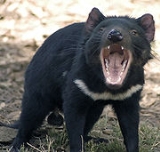
 in 1936. It is characterised by its black fur, offensive odor when stressed, extremely loud and disturbing screech, and ferocity when feeding.


Discussion
Ask a question about 'Tasmanian Devil'
Start a new discussion about 'Tasmanian Devil'
Answer questions from other users
Full Discussion Forum


Recent Posts


Encyclopedia


The Tasmanian Devil (Sarcophilus harrisii) is a carnivorous
Carnivore

A carnivore , meaning 'meat eater' , is any animal with a diet consisting mainly of meat, whether it comes from animals living or dead .In a more general sense, an animal may be considered a carnivore if it prefers feeding on animal matter over plant matter....
 marsupial
Marsupial

Marsupials are an infraclass of mammals, characterized by a distinctive Pouch , in which females carry their young through early infancy....
 now found in the wild only in the Australia
Australia

Australia, officially the Commonwealth of Australia, is a country in the southern hemisphere comprising the Australia of the world's smallest continent, the major island of Tasmania, and numerous list of islands of Australia in the Indian Ocean and Pacific Oceans....
n island state
States and territories of Australia

The Australia is made up of six states and two major mainland territories. There are also lesser territories that are under the administration of the federal government....
 of Tasmania
Tasmania

Tasmania is an Australian island and States and territories of Australia of the same name. It is located south of the eastern side of the continent, being separated from it by Bass Strait....
. The Tasmanian Devil is the only extant member of the genus
Genus

A genus is a low-level taxonomic rank used in the classification of living and fossil organisms. The taxonomic ranks are domain , kingdom , phylum, class , order , family , genus, and species....
 Sarcophilus
Sarcophilus

Sarcophilus is a genus of Dasyuridae best known for its only living member, the Tasmanian Devil.There are three species of Sarcophilus....
. The size of a small dog
Dog

The dog is a domesticated subspecies of the Gray Wolf, a member of the Canidae family of the order Carnivora. The term is used for both feral and pet varieties....
, but stocky and muscular, the Tasmanian Devil is now the largest carnivorous marsupial in the world after the extinction
Extinction

In biology and ecology, extinction is the death of every member of a species or group of taxon. The moment of extinction is generally considered to be the death of the last individual of that species ....
 of the Thylacine
Thylacine

The Thylacine was the largest known carnivore marsupial of Holocene. Native to continental Australia, Tasmania and New Guinea, it is thought to have become extinct in the 20th century....
 in 1936. It is characterised by its black fur, offensive odor when stressed, extremely loud and disturbing screech, and ferocity when feeding. It is known to both hunt prey and scavenge carrion
Carrion

Carrion refers to the carcass of a dead animal. Carrion is an important food source for large carnivores and omnivores in most ecosystems. Examples of carrion-eaters, or scavengers, include Hyenas, Vultures, Virginia Opossum, Tasmanian Devils, Black Bears, Komodo Dragons, Bald Eagles, Raccoons and Blue-tongued lizards....
 and although it is usually solitary, it sometimes eats with other devils.

The Tasmanian Devil became extirpated on the Australian mainland about 400 years before European settlement in 1788. Because they were seen as a threat to livestock
Livestock

Livestock is the term used to refer to a domesticated animal intentionally reared in an agricultural setting to produce things such as food or fibre, or for its labour....
 in Tasmania, devils were hunted until 1941, when they became officially protected. Since the late 1990s devil facial tumour disease
Devil facial tumour disease

Devil facial tumour disease is an aggressive non-viral transmittable parasitic cancer that affects Tasmanian Devils. The first "official case" was described in 1996, in Australia....
 has reduced the devil population significantly and now threatens the survival of the species, which in May 2008 was declared to be endangered
Endangered species

An endangered species is a population of an organism which is at risk of becoming extinct because it is either few in numbers, or threatened by changing environmental or predation parameters....
. Programs are currently being undertaken by the Tasmanian government
Government of Tasmania

The form of the Government of Tasmania is prescribed in its Constitution, which dates from 1856, although it has been amended many times since then....
 to reduce the impact of the disease.

Taxonomy


Naturalist George Harris
George Prideaux Robert Harris

George Prideaux Robert Harris was a deputy surveyor and naturalist in Tasmania, Australia from 1803. He described many of the marsupials native to the Island, including the Tasmanian Devil and the Thylacine....
 wrote the first published description of the Tasmanian Devil in 1807, naming it Didelphis ursina. In 1838 the devil was renamed Dasyurus laniarius by Richard Owen
Richard Owen

Sir Richard Owen Order of the Bath was an English people biologist, comparative anatomy and paleontology.Owen is probably best remembered today for coining the word Dinosauria and for his outspoken opposition to Charles Darwin's theory of evolution by natural selection....
, before being moved to the genus Sarcophilus in 1841 and named Sarcophilus harrisii, or "Harris's meat-lover", by Pierre Boitard
Pierre Boitard

Pierre Boitard was a France botanist and geologist. As well as describing and classifying the Tasmanian Devil, he is notable for his fictional natural history Paris avant les hommes , published posthumously in 1861, which described a prehistoric ape-like human ancestor living in the region of Paris.He also wrote "Curiosites D'Histoire Na...
. A later revision of the devil's taxonomy, published in 1987, attempted to change the species name to Sarcophilus laniarius based on mainland fossil records of only a few animals. However, this was not accepted by the taxonomic community at large and the name S. harrisii has been retained and S. laniarius relegated to fossil species. Phylogenetic
Phylogenetics

In biology, phylogenetics is the study of evolutionary relatedness among various groups of organisms , which is discovered through molecular sequencing data and morphological data matrices....
 analysis shows that the devil is most closely related to quoll
Quoll

Quolls or native cats are carnivorous marsupials, native to Australia and Papua New Guinea. Adults are between 25 and 75 Centimeter long, with hairy tails about 20-35 cm long....
s, and more distantly to the extinct Thylacine
Thylacine

The Thylacine was the largest known carnivore marsupial of Holocene. Native to continental Australia, Tasmania and New Guinea, it is thought to have become extinct in the 20th century....
 (Tasmanian Tiger).

Physical description

The Tasmanian Devil is the largest surviving carnivorous marsupial
Marsupial

Marsupials are an infraclass of mammals, characterized by a distinctive Pouch , in which females carry their young through early infancy....
 in Australia
Australia

Australia, officially the Commonwealth of Australia, is a country in the southern hemisphere comprising the Australia of the world's smallest continent, the major island of Tasmania, and numerous list of islands of Australia in the Indian Ocean and Pacific Oceans....
. It has a squat and thick build, with a large head and a tail which is about half its body length. The devil stores body fat in its tail, so unhealthy devils often have thin tails. Unusual for a marsupial, its forelegs are slightly longer than its hind legs. Devils can run up to per hour for short distances. The fur is usually black, although irregular white patches on the chest and rump are common. Males are usually larger than females, having an average head and body length of , with a tail, and an average weight
Body weight

Although many people prefer the less-ambiguous term body mass, the term body weight is overwhelmingly used in daily English speech and in biological and medical science contexts to describe the mass of an organism's body....
 of . Females have an average head and body length of , with a tail, and an average weight of . The average life expectancy
Life expectancy

Life expectancy is the average number of years of life remaining at a given age. It is the average expected lifespan of an individual. Life expectancy is heavily dependent on the criteria used to select the group....
 of a Tasmanian Devil in the wild is estimated at six years, although they may live longer in captivity.

The devil has long whiskers
Vibrissae

Vibrissae , or whiskers, are specialized hairs, usually employed for tactile sensation, but can also refer to the stiff feathers near the mouths of some birds....
 on its face and in clumps on the top of the head. These help the devil locate prey when foraging in the dark, and aid in detecting when other devils are close during feeding. When agitated, the devil can produce a strong odour, its pungency rivaling even the skunk
Skunk

Skunks are mammals best known for their ability to excrete a strong, foul-smelling #Anal scent glands. General appearance ranges from species to species from black and white to brown or cream colored....
. Hearing is its dominant sense, and it also has an excellent sense of smell. Since devils hunt at night, their vision seems to be strongest in black and white. In these conditions they can detect moving objects readily, but have difficulty seeing stationary objects. An analysis of mammalian bite force relative to the body size shows that the devil has the strongest bite of any living mammal
Mammal

Mammals are a class of vertebrate animals whose name is derived from their distinctive feature, mammary glands, with which they feed their young....
 (over ). The power of the jaw
Jaw

The jaw is either of the two opposable structures forming, or near the entrance to the mouth.The term jaws is also broadly applied to the whole of the structures constituting the vault of the mouth and serving to open and close it and is part of the body plan of most animals....
 is in part due to its comparatively large head. A Tasmanian Devil also has one set of teeth that grows slowly throughout its life.

Reproduction

Tasmanina Devil Development
Females start to breed when they reach sexual maturity, typically in their second year. At this point, they become fertile once a year, producing multiple ova
Ovum

An ovum is a haploid female reproductive cell or gamete. Both animals and embryophytes have ova. The term ovule is used for the young ovum of an animal, as well as the plant structure that carries the female gametophyte and egg cell and develops into a seed after fertilization....
 while in heat. Mating occurs in March, in sheltered locations during both day and night. Males fight over females in the breeding season, and female devils will mate with the dominant male. Devils are not monogamous
Monogamy

Monogamy is the state of having only one husband, wife, or sexual partner at any one time. The word monogamy comes from the Greek word monos "?????", which means one or alone, and the Greek word gamos "?????", which means marriage or union....
, and females will mate with several males if not guarded after mating. Gestation
Gestation

Gestation is the carrying of an embryo or fetus inside a female viviparous animal. Mammals during mammalian pregnancy can have one or more gestations at the same time ....
 lasts 21 days, and devils give birth to 20-30 young, each weighing approximately 0.18–0.24 grams. When the young are born, competition is fierce as they move from the vagina to the pouch. Once inside the pouch, they each remain attached to a nipple for the next 100 days. The female Tasmanian Devil's pouch, like that of the wombat
Wombat

Wombats are Australian marsupials; they are short-legged, muscular quadrupeds, approximately in length with a very short tail. They are found in forested, mountainous, and heathland areas of south-eastern Australia and Tasmania....
, opens to the rear, so it is physically difficult for the female to interact with young inside the pouch. Despite the large litter at birth, the female has only four nipples, so there are never more than four babies nursing in the pouch; and the older a female devils gets, the smaller her litters will become. On average, more females survive than males.

Inside the pouch, the nourished young develop quickly. At 15 days the external parts of the ear are visible. Eyelids are apparent at 16 days, whiskers at 17 days, and the lips at 20 days. The young start to grow fur at 49 days and have a full coat by 90 days. Their eyes open shortly after their fur coat develops—between 87 and 93 days—and their mouths can relax their hold of the nipple at 100 days. They leave the pouch 105 days after birth, appearing as small copies of the parent and weighing approximately . Unlike kangaroo
Kangaroo

A kangaroo is a marsupial from the family Macropodidae . In common use the term is used to describe the largest species from this family, the Red Kangaroo, the Antilopine Kangaroo, and the Eastern Grey Kangaroo and Western Grey Kangaroo of the Macropus genus....
 joeys
Joey (marsupial)

A joey is any infant marsupial.Marsupials have an extremely short gestation period , and the joey is 'born' basically in a Fetus state. The blind, furless, miniature newborn, the size of a jelly bean, crawls across its mother's fur to make its way into the pouch , where it latches onto a teat for food....
, young devils do not return to the pouch; instead, they remain in the den for another three months, first venturing outside the den between October and December before becoming independent in January. Female devils are occupied with raising their young for all but approximately six weeks of the year.

Ecology and behaviour

Tasmanian Devil Resting
Tasmanian Devils are widespread and fairly common throughout Tasmania. Found in all habitats on the island, including the outskirts of urban areas, they particularly like dry sclerophyll
Sclerophyll

Sclerophyll is a type of vegetation that has hard leaf and short internodes . The word comes from the Greek sclero and phyllon . Sclerophyllous plants occur in all parts of the world but are most typical of Australia....
 forests and coastal woodlands. The Tasmanian Devil is a nocturnal
Nocturnal animal

As an animal behavior, nocturnality describes sleeping during the daytime and being active at night - the opposite of the diurnal animal human lifestyle, and that of those animals with which we are most familiar....
 and crepuscular
Crepuscular

Crepuscular is a term used to describe some animals that are primarily active during twilight, that is at dawn and at dusk. The word is derived from the Latin word crepusculum, meaning "twilight"....
 hunter, spending the days in dense bush or in a hole. Young devils can climb trees, but this becomes more difficult as they grow larger. Devils can also swim. They are predominantly solitary animals and do not form packs. They occupy territories of 8–20 km˛, which can overlap considerably amongst different animals.

Devil Eating Roadkill
Tasmanian Devils can take prey up to the size of a small wallaby
Wallaby

A wallaby is any of about thirty species of macropod . It is an informal designation generally used for any macropod that is smaller than a kangaroo or wallaroo that has not been given some other name....
, but in practice they are opportunistic, and eat carrion
Carrion

Carrion refers to the carcass of a dead animal. Carrion is an important food source for large carnivores and omnivores in most ecosystems. Examples of carrion-eaters, or scavengers, include Hyenas, Vultures, Virginia Opossum, Tasmanian Devils, Black Bears, Komodo Dragons, Bald Eagles, Raccoons and Blue-tongued lizards....
 more often than they hunt live prey. Although the devil favours wombats, it will eat all small native mammals, domestic mammals (including sheep), birds, fish, insects, frogs and reptiles. Their diet is largely varied and depends on the food available. On average, they eat about 15% of their body weight each day; however, they can eat up to 40% of their body weight in 30 minutes if the opportunity arises. Tasmanian Devils eliminate all traces of a carcass, devouring the bones and fur in addition to the meat and internal organs. In this respect, the devil has earned the gratitude of Tasmanian farmers, as the speed at which they clean a carcass helps prevent the spread of insects that might otherwise harm livestock.

Although they hunt alone, eating is a social event for the Tasmanian Devil. Much of the noise attributed to the animal is a result of raucous communal eating, at which up to 12 individuals can gather, and can often be heard several kilometers away. A study of feeding devils identified 20 physical postures, including their characteristic vicious yawn, and the 11 different vocal sounds that devils use to communicate as they feed. They usually establish dominance by sound and physical posturing, although fighting does occur. Adult males are the most aggressive, and scarring is common from fighting over food and mates.

Conservation status

For some time, Tasmania was the last refuge of large marsupial carnivores. All of the larger carnivorous marsupials became extinct in mainland Australia
Australia

Australia, officially the Commonwealth of Australia, is a country in the southern hemisphere comprising the Australia of the world's smallest continent, the major island of Tasmania, and numerous list of islands of Australia in the Indian Ocean and Pacific Oceans....
 shortly after humans arrived. Only the smallest and most adaptable survived. Fossil evidence from western Victoria
Victoria (Australia)

File:Map Victoria Aboriginal tribes .jpgVictoria is a States and territories of Australia located in the southeastern corner of Australia. It is the smallest mainland state in area but the most Population density and urbanised....
 shows that Tasmanian Devils retained a place on the Australian mainland until around 600 years ago (about 400 years before European colonisation). Their extinction is attributed to predation by dingo
Dingo

|- style = "text-align:center"|style="background: pink;" |Breed standards |- style = "text-align:center"||}The Dingo also known as Warrigal, Maliki, Mirigung, Decker Dog, Boololomo, Repeti, or Australian Native Dog, is a feral dog which mostly lives independently from humans....
es and hunting by indigenous Australians. In dingo-free Tasmania, carnivorous marsupials were still active when Europeans arrived. The extermination of the Thylacine
Thylacine

The Thylacine was the largest known carnivore marsupial of Holocene. Native to continental Australia, Tasmania and New Guinea, it is thought to have become extinct in the 20th century....
 after the arrival of the Europeans is well known, but the Tasmanian Devil was threatened as well.

The first Tasmanian settlers ate Tasmanian Devil, which they described as tasting like veal. As it was believed devils would hunt and kill livestock, a bounty scheme to remove the devil from rural properties was introduced as early as 1830. Over the next 100 years, trapping and poisoning brought them to the brink of extinction. After the death of the last Thylacine in 1936, the threat to the devils was recognized. The Tasmanian Devil was protected by law in 1941, and the population slowly recovered.

At least two major population declines, possibly due to a disease epidemic, have occurred in recorded history: in 1909 and 1950. The Tasmanian Devil's current population is reported by Tasmania's Department of Primary Industries and Water as being in the range of 10,000 to 100,000 individuals, with 20,000 to 50,000 mature individuals being likely. Senior Scientist for the Devil Facial Tumour Disease program Hamish McCallum offers a more conservative estimate of at least 20,000 individuals and at most 75,000.

Devil facial tumour disease

First seen in 1995, devil facial tumour disease
Devil facial tumour disease

Devil facial tumour disease is an aggressive non-viral transmittable parasitic cancer that affects Tasmanian Devils. The first "official case" was described in 1996, in Australia....
 (DFTD) has ravaged Tasmania's wild devils, and estimates of the impact range from 20% to as much as a 50% decline in the devil population with over 65% of the State affected. Affected high-density populations suffer up to 100% mortality in 12–18 months. The species was listed as vulnerable under the Tasmanian Threatened Species Protection Act 1995 and the Australian Environment Protection and Biodiversity Conservation Act 1999
Environment Protection and Biodiversity Conservation Act 1999

The Environment Protection and Biodiversity Conservation Act 1999 is an Statute of the Parliament of Australia that provides a framework for protection of the Australian environment, including its biodiversity and its natural and culturally significant places....
 in 2006 which means that it is at risk of extinction in the "medium term". The IUCN does not regard the species as threatened; when this species was last evaluated for the IUCN in 1996, it was listed as lower risk/least concern.

Wild Tasmanian Devil populations are being monitored to track the spread of the disease and to identify changes in disease prevalence. Field monitoring involves trapping devils within a defined area to check for the presence of the disease and determine the number of affected animals. The same area is visited repeatedly to characterise the spread of the disease over time. So far, it has been established that the short-term effects of the disease in an area can be severe. Long-term monitoring at replicated sites will be essential to assess whether these effects remain, or whether populations can recover. Field workers are also testing the effectiveness of disease suppression by trapping and removing diseased devils. It is hoped that the removal of diseased devils from wild populations should decrease disease prevalence and allow more devils to survive beyond their juvenile years and breed.

The cancer's origin is a mystery, but studies indicate that the animals pass it on from one to another; i.e. the cancer is contagious. Short of a cure, scientists are removing the sick animals and quarantining healthy devils in case the wild population dies out. Because Tasmanian devils have extremely low levels of genetic diversity and a chromosomal mutation unique among carnivorous mammals, they are more prone to the infectious cancer.

Two "insurance" populations of disease-free devils are being established at an urban facility in the Hobart
Hobart

Hobart is the List of Australian capital cities and most populous city of the Australian island state of Tasmania. Founded in 1803 as a penal colony, Hobart is Australia's second oldest capital city after Sydney....
 suburb of Taroona and on Maria Island
Maria Island

Maria Island is a mountainous island off the east coast of Tasmania. The entire island is a National Park. Maria Island National Park has a total area of 115.50 km? which includes a marine area of 18.78 km?, off the island's north-west coast....
 off the east coast of Tasmania. Captive breeding
Captive breeding

Captive breedingis the process of breeding rare species or endangered species in human controlled environments with restricted settings, such as wildlife preserves, zoos and other conservation biology facilities; sometimes the process is construed to include release of individual organisms to the wild, when there is sufficient natural habit...
 in mainland zoos is also a possibility. The decline in devil numbers is also seen as an ecological problem, since its presence in the Tasmanian forest ecosystem
Ecosystem

An ecosystem is a natural unit consisting of all plants, animals and micro-organisms in an area functioning together with all of the non-living physical factors of the environment....
 is believed to have prevented the establishment of the Red Fox
Red Fox

The Red Fox is a mammal of the order Carnivora. In the British Isles, where there are no longer any other native wild canids, it is referred to simply as "the fox"....
, illegally introduced to Tasmania in 2001. Foxes are a problematic invasive species
Invasive species

Invasive species is a phrase with several definitions. The first definition expresses the phrase in terms of non-indigenous species that adversely affect the habitats they invade economically, environmentally or ecologically....
 in all other Australian States
States and territories of Australia

The Australia is made up of six states and two major mainland territories. There are also lesser territories that are under the administration of the federal government....
, and the establishment of foxes in Tasmania would hinder the recovery of the Tasmanian Devil.

Recent research from the University of Sydney
University of Sydney

The University of Sydney is the List of oldest universities in continuous operation in Australia. It was established in Sydney in 1850. It is a member of Australia's "Group of Eight " universities that are highly ranked in terms of their research performance....
 has shown that the infectious facial cancer may be able to spread because of vanishingly low genetic diversity
Genetic diversity

Genetic diversity is a level of biodiversity that refers to the total number of Genetics characteristics in the genetic makeup of a species. It is distinguished from genetic variability, which describes the tendency of genetic characteristics to vary....
 in devil immune genes (MHC class I
MHC class I

There are two primary classes of major histocompatibility complex molecules, class I and MHC class II. MHC class I molecules are found on almost every nucleated cell of the body....
 and II
MHC class II

MHC Class II molecules are found only on a few specialized cell types, including macrophages, dendritic cells and B cells, all of which are professional antigen-presenting cells ....
) — raising questions about how well small, and potentially inbred, populations of animals are able to survive.

Cultural references

The Tasmanian Devil is an iconic animal within Australia; it is the symbol of the Tasmanian National Parks and Wildlife Service, and the former Tasmanian Australian rules football
Australian rules football

Australian football, or simply known as football, footy, Aussie rules or as AFL, is a team sport played between two teams of 18 players with a football in the shape of a prolate spheroid....
 team which played in the Victorian Football League
Victorian Football League

The Victorian Football League, formerly known as the Victorian Football Association is the premier league in Victoria. It is also known as the VFA/VFL, is the second-oldest Australian rules football league, formed in 1877, replacing the loose affiliation of clubs that had been the hallmark of the Australian Rules Football - Early...
 was known as the Devils
Tasmanian Devils Football Club

The Tasmania Football Club, nicknamed The Devils, is a former Australian rules football club in the Victorian Football League in Australia....
. The defunct Hobart Devils
Hobart Devils

The Hobart Devils were an Australian basketball team that played in Hobart, Tasmania, in the National Basketball League . The team was the only representative from the state of Tasmania for the majority of its tenure, but was one of three teams that had their NBL licenses revoked by the league directors in 1996 due to financial difficulties....
 basketball
Basketball

Basketball is a team sport in which two teams of five active players each try to score points against one another by propelling a basketball through a 10 feet  high hoop under organized rules....
 team in the NBL
National Basketball League (Australia)

The National Basketball League is Australia's top-level professional basketball competition.The league commenced in 1979 NBL Season, playing a winter season and did so until the completion of the 20th season in 1998 NBL Season....
 was also named after the animal. The devil was one of six native Australian animals to appear on commemorative Australian two hundred dollar coins
Australian coins

Australian coins refers to the coins which are or were in use as Australian currency. During the early days of the colonies that formed Australia, foreign currency was used, but in 1910, a decade after federation, Australian coins were introduced....
 issued between 1989 and 1994. Tasmanian Devils are popular with domestic and international tourists. Because of their unique personality the Tasmanian Devil has been the subject of numerous documentaries
Documentary film

Documentary film is a broad category of visual expression that is based on the attempt, in one fashion or another, to "document" reality. Although "documentary film" originally referred to movies shot on film stock, it has subsequently expanded to include video and new media productions that can be either direct-to-video or made for a televis...
 and non-fiction children's books. The most recent Australian documentary on the Tasmanian Devil, Terrors of Tasmania, directed and produced by David Parer
David Parer

David Parer is an award-winning Australian natural history film maker.Parer was conscription into the Royal Australian Army to go to the Vietnam War in 1970, but he entered a Masters program to study physics in the Antarctica....
 and Elizabeth Parer-Cook, was released in 2005. The documentary follows a female devil called Manganinnie through breeding season and the birth and rearing of her young. The documentary also looks at the effect of devil facial tumor disease and the conservation measures being taken to ensure survival of the Tasmanian Devil. The documentary has screened on television in Australia and in the United States
United States

The United States of America is a Federal government constitutional republic comprising U.S. state and a federal district. The country is situated mostly in central North America, where its Contiguous United States and Washington, D.C., the Capital districts and territories, lie between the Pacific Ocean and Atlantic Oceans, Borders of the U...
 on the National Geographic Channel
National Geographic Channel

National Geographic Channel, also commercially abbreviated as Nat Geo, is a subscription television channel that airs non-fiction television programs produced by the National Geographic Society....
.

Restrictions on the export of the Tasmanian Devil means that devils can normally only be seen kept in captivity in Australia. The last known overseas devil died at the Fort Wayne Children's Zoo
Fort Wayne Children's Zoo

The Fort Wayne Children's Zoo is located in Fort Wayne, Indiana, United States. The zoo has been in operation since its 1965 opening in Fort Wayne's Franke Park....
 in 2004. However, the Tasmanian Government has sent a pair of devils to the Copenhagen Zoo
Copenhagen Zoo

Copenhagen Zoo is one of the oldest zoos in Europe. It was founded by the ornithologist Niels Kj?rb?lling in 1859. He was given the summer garden of "Prinsess Vilhelmines Have" by the chief directorate of Copenhagen....
, following the birth of the first son
Prince Christian of Denmark

Prince Christian of Denmark, Count of Monpezat is a member of the Danish Royal Family. He is the son of Frederik, Crown Prince of Denmark and his wife, the Australian born Mary, Crown Princess of Denmark....
 of Frederik, Crown Prince of Denmark
Frederik, Crown Prince of Denmark

Frederik, Crown Prince of Denmark is the heir apparent to the List of Danish monarchs. Frederik is the elder son of Margrethe II of Denmark and Henrik, Prince Consort of Denmark....
 and his Tasmanian wife Mary
Mary, Crown Princess of Denmark

Mary, Crown Princess of Denmark is the wife of Frederik, Crown Prince of Denmark, who is the heir apparent to the Danish Danish throne....
 in October 2005. These are the only devils that can be seen outside Australia.

The Tasmanian Devil is probably best known internationally as the inspiration for the Looney Tunes
Looney Tunes

Looney Tunes is a Warner Bros. animated cartoon series which ran in many movie theatres from 1930 to 1969. It preceded the Merrie Melodies series and is Warner Bros.'s first animated theatrical series....
 cartoon character The Tasmanian Devil
Tasmanian Devil (Looney Tunes)

The Tasmanian Devil, often referred to as "Taz", is an animation character featured in the Warner Bros. Looney Tunes series of cartoons....
, or "Taz". While the cartoon incarnation does resemble a stylized Devil (prominent canines, large head, short legs) the behavioral similarities between the two seem to be limited, consisting mainly of a noisy comportment, voracious appetite, and shy demeanor. Researchers have also named a genetic-mutant mouse
Mouse

A mouse is a small animal that belongs to one of numerous species of rodents. The best known mouse species is the House Mouse . It is also a popular pet....
 "the Tasmanian devil". The mutant mouse is defective in the development of sensory-hair cells of the ear, leading the mutant to abnormal behaviours including head-tossing and circling, more like the cartoon "Taz" than the actual Tasmanian Devil.

See also

  • Fauna of Australia
    Fauna of Australia

    The fauna of Australia consists of a huge variety of unique animals; some 83% of mammals, 89% of reptiles, 90% of fish and insects and 93% of amphibians that inhabit the continent are Endemism to Australia....
  • Threatened fauna of Australia


External links

  • vocalisation, movie, faq
  • Do Tasmanian Devils still exist in mainland Australia?
  • the history of the DFTD, by David Quammen