
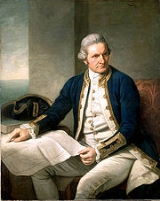
Encyclopedia
Captain
James Cook,
FRS,
RN was an
English explorer, navigator and cartographer. He made three voyages to the
Pacific Ocean, accurately charting many areas and recording several islands and coastlines on
European
maps for the first time. His most notable accomplishments were the
British discovery and claiming of the east coast of
Australia; the European discovery of the
Hawaiian Islands; and the first recorded
circumnavigation and mapping of
Newfoundland and
New Zealand. Cook died in
Hawaii in a with Hawaiians during his third exploratory voyage in the Pacific in 1779.
Early life
James Cook was born in relatively humble circumstances at Marton in
North Yorkshire, which today is within the town of
Middlesbrough. Cook was one of five children born to a local woman and a
Scottish immigrant farm labourer, Grace and James Sr. As a child, Cook moved with his family to Airey Holme farm at Great Ayton, where he was educated at the local school , his studies financed by his father's employer. At 13 he began work with his father, who managed the farm.
In 1745, when he was 16, Cook left home to be apprenticed in a
grocery/haberdashery in the fishing village of
Staithes. According to legend, Cook first felt the lure of the
sea while gazing out the shop window.
After a year and a half in Staithes, the shop's owner found James unsuited to the trade. Mr Sanderson took James to the nearby port town of
Whitby and introduced him to John and Henry Walker. John and Henry were prominent local ship-owners and
Quakers, and were in the coal trade business. Cook was taken on as a merchant navy apprentice in their small fleet of vessels plying coal along the English coast. His first assignment was aboard the collier
Freelove, and he spent several years on this, and various other coasters sailing between
the Tyne and
London.
For this new apprenticeship, Cook applied himself to the study of
algebra,
trigonometry,
navigation, and
astronomy, skills he would need one day to command his own ship.
His three-year apprenticeship completed, Cook began working on trading ships in the
Baltic Sea. He soon progressed through the merchant navy ranks, starting with his 1752 promotion to Mate aboard the collier
brig Friendship. In 1755 he was offered command of this vessel, but within the month he volunteered for service in the British
Royal Navy.
In 1755, the Kingdom of Great Britain was re-arming for what was to become the
Seven Years' War. Cook saw that his career could advance more quickly in military service. However, this required starting over in the naval hierarchy, and on June 17 he began as able seaman aboard HMS
Eagle under the command of Captain
Hugh Palliser. He was very quickly promoted to Master's Mate.
Family life
Cook married Elizabeth Batts, the daughter of one of his mentors, on December 21, 1762. The couple would eventually have six children : James , Nathaniel , Elizabeth , Joseph , George and Hugh . When not at sea, James Cook settled in the
East End of London. He attended St. Paul's Church, Shadwell, where his son James was baptised.
Start of Royal Navy career
During the
Seven Years' War, he participated in the siege of
Quebec City before the
Battle of the Plains of Abraham in 1759. He showed a talent for
surveying and
cartography and was responsible for mapping much of the entrance to the
Saint Lawrence River during the siege, allowing
General Wolfe to make his famous stealth attack on the
Plains of Abraham.
Cook's
surveying skills were put to good use in the 1760s, mapping the jagged coast of
Newfoundland. Cook surveyed the northwest stretch in 1763 and 1764, the south coast between the Burin Peninsula and Cape Ray in 1765 and 1766, and the west coast in 1767. Cook’s five seasons in Newfoundland produced the first large-scale and accurate maps of the island’s coasts; they also gave Cook his mastery of practical surveying, achieved under often adverse conditions, and brought him to the attention of the
Admiralty and
Royal Society at a crucial moment both in his personal career and in the direction of British overseas discovery.
Cook's huge achievements can be attributed to a combination of excellent seamanship, his superior surveying and cartographic skills, courage in exploring dangerous locations to confirm the facts , ability to lead men in adverse conditions, and boldness both with regard to the extent of his explorations and his willingness to exceed the instructions given to him by the Admiralty.
First voyage
In 1766, the
Royal Society hired Cook to travel to the
Pacific Ocean to observe and record a
transit of Venus across the
Sun. Cook was commissioned as a
Lieutenant and given command of
HM Bark Endeavour. He sailed from England in 1768, rounded
Cape Horn and continued westward across the Pacific to arrive at
Tahiti on April 13, 1769, where the observations were to be made. The transit was scheduled to occur on June 3, and in the meantime he commissioned the building of a small
fort and
observatory.
The
astronomer appointed to the task was Charles Green, assistant to the recently-appointed Astronomer Royal,
Nevil Maskelyne. The primary purpose of the observation was to obtain measurements which could be used to more accurately calculate the distance of
Venus from the Sun. If this could be achieved, then the distances of the other known planets could be worked out based on their relative orbits. On the day of the transit observation, Cook recorded:
"Saturday 3 rd This day prov'd as favourable to our purpose as we could wish, not a Clowd was to be seen the Whole day and the Air was perfectly clear, so that we had every advantage we could desire in Observing the whole of the passage of the Planet Venus over the Suns disk: we very distinctly saw an Atmosphere or dusky shade round the body of the Planet which very much disturbed the times of the contacts particularly the two internal ones. D r Solander observed as well as M r Green and my self, and we differ'd from one another in observeing the times of the Contacts much more than could be expected..."
Disappointingly, the separate measurements of Green, Cook and Solander varied more than the anticipated margin of error. Their instrumentation was adequate by the standards of the time, but the resolution still could not eliminate the errors. When their results were later compared to those of the other observations of the same event made elsewhere for the exercise, the net result was not as conclusive or accurate as had been hoped.
Once the observations were completed, Cook then departed in order to execute the second purpose of his voyage: namely, to search the south Pacific for signs of the postulated southern
continent of
Terra Australis, acting on from the
Commissioners for executing the office of the Lord High Admiral of Great Britain. The Royal Society, and especially Alexander Dalrymple, believed that it must exist, however Cook had his own personal doubts on the subject. With the help of a Tahitian named Tupaia, who had extensive knowledge of Pacific
geography, Cook managed to reach
New Zealand on 6 October, 1769, becoming only the second
European in history to do so . Cook mapped the complete New Zealand coastline, making only some minor errors . He also discovered
Cook Strait, which separates the
North Island from the South Island, and which Tasman had not seen.
He then set course westwards, intending to strike for Van Diemen's Land in order to establish whether or not it formed part of the fabled southern continent. However, they were forced to maintain a more northerly course owing to prevailing gales, and sailed onwards until one afternoon when land was sighted, which Cook named Point Hicks. Cook calculated that Van Diemen's Land ought to lie due south of their position, but having found the coastline trending to the southwest, recorded his doubt that this landmass was connected to it. This point was on the southeastern coast of the
Australian continent, and in doing so his expedition became the first recorded Europeans to have encountered its eastern coastline. In his journal, Cook recorded the event thus:
"the Southermost Point of land we had in sight which bore from us W1/4S I judged to lay in the Latitude of 38°..0' S° and in the Longitude of 211°..07' W t from the Meridion of Greenwich. I have named it Point Hicks, because Leuit t Hicks was the first who discover'd this land".
The ship's log recorded that land was sighted at 6 a.m. Thursday April 19, 1770. Cook's log used the nautical date, which, during the eighteenth century, assigned the same date to all ship's events from noon-to-noon, first p.m. and then a.m. That nautical date began twelve hours before the midnight beginning of the like-named civil date. Furthermore, Cook did not adjust his nautical date to account for circumnavigation of the globe until he had traveled a full 360° relative to the longitude of his home British port, either toward the east or west. Because he traveled west on his first voyage, this a.m. nautical date was the morning of a civil date fourteen hours slow relative to his home port . Because the southeast coast of Australia is now regarded as being ten hours fast relative to Britain , 24 hours later, that date is now called Friday, April 20.
The landmark of this sighting is generally reckoned to be a point lying about half-way between the present-day towns of
Orbost and
Mallacoota on the southeastern coast of the state of Victoria. A later survey done in 1843 ignored or overlooked Cook's earlier naming of the point, giving it the name Cape Everard. On the 200th anniversary of the sighting, the name was officially changed back to Point Hicks.
The
Endeavour continued northwards along the coastline, keeping the land in sight and Cook charting and naming landmarks as he went. A little over a week later, they came across an extensive but shallow inlet, and upon entering it moored off a low headland fronted by sand dunes. It was here, on April 29, that Cook and crew made their first landfall on the continent, at a place now known as Kurnell. This date does not need adjustment because it occurred during the afternoon on April 29 in the ship's log, but was the afternoon of the civil date of April 28 14 hours west of port, which is now a civil date 10 hours east of port, 24 hours later, hence a modern civil date of April 29. At first Cook bestowed the name
Stingaree Bay to the inlet after the many such creatures found there; this was later changed to
Botanist Bay and finally
Botany Bay after the unique specimens retrieved by the botanists
Joseph Banks,
Daniel Solander and Herman Spöring.
This first landing site was later to be promoted as a suitable candidate for situating a settlement and
British colonial outpost. However, almost eighteen years after this first landing, when Captain
Arthur Phillip and the First Fleet arrived in early 1788 to establish an outpost and penal colony, they found that the bay and surrounds did not live up to the promising picture which had been painted. Instead, Phillip shortly thereafter gave orders to relocate to a harbour a few kilometres to the north, which Cook had named
Port Jackson but had not further explored. It was in this harbour at a place Phillip named Sydney Cove that the settlement of
Sydney was established. The settlement was for some time afterwards still referred to generally as Botany Bay. The expedition's scientific members commenced the first European scientific documentation of
Australian fauna and
flora.
At Cook's original landing contact was made with the local
Australian Aborigine inhabitants. As the ships sailed into the harbour, they noticed aborigines on both of the headlands. At about 2 p.m. they put the anchor down near a group of six to eight huts. Two aborigines, a younger and an older man, came down to the boat. They ignored gifts from Cook. A musket was fired over their heads, which wounded the older man slightly, and he ran towards the huts. He came back with other men and threw spears at Cook's men, although they did no harm. They were chased off after two more rounds were fired. The adults had left, but Cook found several Aboriginal children in the huts, and left some beads with them as a gesture of friendship.
Cook continued northwards, charting along the coastline. A mishap occurred when the
Endeavour ran aground on a shoal of the
Great Barrier Reef, on June 11, 1770. The ship was seriously damaged and his voyage was delayed almost seven weeks while repairs were carried out on the beach . While there,
Joseph Banks, Herman Spöring and
Daniel Solander made their first major collections of Australian flora. The crew's encounters with the local Aboriginal people were mainly peaceable; from the group encountered here the name "
kangaroo" was to be entered into the
English language, coming from the local
Guugu Yimidhirr word for a kind of
Grey Kangaroo,
gangurru .
Once repairs were complete the voyage continued, eventually passing by the northern-most point of
Cape York Peninsula and then sailing through
Torres Strait between Australia and
New Guinea, earlier navigated by Luis Vaez de Torres in 1604.
At that point in the voyage, Cook had lost not a single man to
scurvy, a remarkable and practically unheard-of achievement in
18th century long-distance sea-faring. Adhering to Royal Navy policy introduced in 1747, Cook persuaded his men to eat foods such as
citrus fruits and
sauerkraut. At that time it was known that poor diet caused scurvy but not specifically that a
Vitamin C deficiency was the culprit.
The means by which he persuaded his crew, described
here, are illustrative of Cook's leadership qualities.
Cook then visited the island of Savu, staying for three days before continuing on to
Batavia, the capital of the
Dutch East Indies, to put in for repairs. Batavia was known for its outbreaks of
malaria, and before they returned home in 1771, many in Cook's crew would succumb to the disease and other ailments such as dysentery, including the Tahitian Tupaia, Banks's
Finnish secretary and a fellow scientist Herman Spöring, astronomer Charles Green, and the illustrator
Sydney Parkinson. Cook had named the Spöring Island on the coast of
New Zealand to honor Herman Spöring and his work on the voyage.
The
Endeavour, his ship on this first voyage, would later lend its name to the
Space Shuttle Endeavour, as well as the Endeavour River.
Cook's journals were published upon his return, and he became something of a hero among the scientific community. Among the general public, however, the aristocratic
botanist Joseph Banks was a bigger hero. Banks even attempted to take command of Cook's second voyage, but removed himself from the voyage before it began.
Second voyage
Shortly after his return, Cook was promoted from Lieutenant to
Commander . Then once again he was commissioned by the Royal Society to search for the mythical
Terra Australis. On his first voyage, Cook had demonstrated by circumnavigating New Zealand that it was not attached to a larger landmass to the south; and although by charting almost the entire eastern coastline of Australia he had shown it to be continental in size, the
Terra Australis being sought was supposed to lie further to the south. Despite this evidence to the contrary Dalrymple and others of the Royal Society still believed that this massive southern continent should exist.
Cook commanded
HMS Resolution on this voyage, while Tobias Furneaux commanded its companion ship, HMS
Adventure. Cook's expedition
circumnavigated the globe at a very high southern
latitude, becoming one of the first to cross the
Antarctic Circle on January 17, 1773, reaching 71°10' south. He also discovered
South Georgia and the
South Sandwich Islands. In the Antarctic fog, the
Resolution and
Adventure became separated. Furneaux made his way to New Zealand, where he lost some of his men following a fight with the
Maori, and eventually sailed back to Britain, while Cook continued to explore the Antarctic.
Cook almost discovered the mainland of
Antarctica, but turned back north towards Tahiti to resupply his ship. He then resumed his southward course in a second fruitless attempt to find the supposed continent. On this leg of the voyage he brought with him a young Tahitian named Omai, who proved to be somewhat less knowledgeable about the Pacific than Tupaia had been on the first voyage. On his return voyage, in 1774 he landed at the
Friendly Islands,
Easter Island,
Norfolk Island,
New Caledonia and
Vanuatu. His reports upon his return home put to rest the popular myth of
Terra Australis.
Another accomplishment of the second voyage was the successful employment of the K1 chronometer which facilitated accurate measurement of longitude.
Upon his return, Cook was promoted to the naval rank of Captain and given an honorary retirement from the Royal Navy . But Cook could not be kept away from the sea. A third voyage was planned to find the
Northwest Passage. Cook would travel to the Pacific and hoped to travel east to the Atlantic, while a simultaneous voyage would travel the opposite way.
Third voyage
On his last voyage, Cook once again commanded HMS
Resolution, while Captain Charles Clerke commanded HMS
Discovery. Ostensibly the voyage was planned to return Omai to Tahiti; this is what the general public believed, as he had become a favourite curiosity in London. After returning Omai, Cook travelled north and in 1778 became the first European to visit the
Hawaiian Islands, which, in passing and after initial landfall in January 1778 at
Waimea harbor,
Kauai, he named the "Sandwich Islands" after the 4th
Earl of Sandwich, the acting
First Lord of the Admiralty.
From there, he travelled east to explore the west coast of
North America, eventually landing near the
First Nations village at Yuquot in
Nootka Sound on
Vancouver Island, although he unknowingly sailed past the
Strait of Juan de Fuca. He explored and mapped the coast from
California all the way to the
Bering Strait, on the way discovering what came to be known as
Cook Inlet in
Alaska.
The Bering Strait proved to be impassable, although he made several attempts to sail through it. Cook became increasingly frustrated on this voyage, and perhaps began to suffer from a stomach ailment; it is speculated that this led to irrational behaviour towards his crew, such as forcing them to eat
walrus meat — which they found inedible. .
Cook returned to Hawaii in 1779. After sailing around the archipelago for some eight weeks, Cook finally made landfall at
Kealakekua Bay, on what is now the
'Big Island' of
Hawaii. There is some discussion by recent historians that Cook's arrival coincided by quirk of fate with a season of worship for the Polynesian god Lono, . Indeed the form of Cook's ship HMS
Resolution resembled certain significant artifacts that formed part of the season of worship. Similarly, Cook's clockwise route around the islands before making landfall resembled the processions that took place in a clockwise direction around the island during the Lono festivals. For these reasons the arrival, it is thought, led to Cook's initial deification by the natives, who treated him with great reverence as possibly an incarnation of Lono himself. This interpretation of the natives' reaction, though, has been called into question.
Eventually, after a month's stay, Cook got undersail again to resume his exploration of the Northern Pacific. However, shortly after leaving the Big Island, the foremast on the
Resolution broke requiring the ships' return to Kealakekua Bay for repairs. The return to the islands by Cook's expedition was unexpected on the part of the Hawaiians and as the season of Lono had recently ended, tensions rose and a number of quarrels broke out between the two camps. On February 14 at Kealakekua Bay, some Hawaiians stole one of Cook's small boats. Normally, as thefts were quite common in Tahiti and the other islands, Cook would have taken hostages until the stolen articles were returned. Indeed, he planned to take hostage the Chief of Hawaii, Kalaniopu'u. However, his stomach ailment and increasingly irrational behaviour led to an altercation with a large crowd of Hawaiians gathered on the beach when Cook went ashore to retrieve the goods. The villagers, angered by his strict insistence on getting back a pair of tongs, and hearing that another British search party had killed one of their chiefs, began to attack with spears and stones. In the ensuing skirmish, shots were fired at the Hawaiians but their woven war shields protected them, and Cook's men had to retreat to the beach. As Cook turned his back to help launch the boats, he was struck on the head by the villagers and then stabbed to death as he fell on his face in the surf. The Hawaiians dragged his body away.
It is thought that Cook's return to Hawaii outside the season of worship for Lono -- which was synonymous with 'peace' -- and thus in the season of 'war' may have upset the equilibrium and fostered an atmosphere of resentment and aggression from the local population. Coupled with a jaded grasp of native diplomacy and a burgeoning but limited understanding of local politics, Cook may have inadvertently contributed to the tensions that ultimately conspired in his demise.
The esteem in which the Captain was nevertheless held by the natives resulted in his body being retained by their chiefs and elders and the flesh cut and roasted from his bones. Indeed some of Cook's remains, disclosing some corroborating evidence to this effect, were eventually returned to the British for a formal
burial at sea following an appeal by the crew.
Clerke took over the expedition and made a fina