


New South Wales Corps

Encyclopedia
The New South Wales Corps (aka The Rum Corps) was formed in England in 1789 as a permanent regiment to relieve the marines who had accompanied the First Fleet
to Australia
. The regiment, led by Major Francis Grose
, consisted of three companies. Due to the remoteness and unpopularity of the posting they were composed of officers on half pay, troublemakers, soldiers paroled from military prisons and those with few prospects, who were gambling on making a life for themselves in the new colony. The regiment began arriving as guards on the Second Fleet
in 1790. Major Grose arrived in Sydney in 1792 to take command and assume role of Lieutenant-Governor of the colony. A fourth company was raised from those marines wishing to remain in NSW under Captain George Johnston
, who had been Governor Phillip
's aide-de-camp.
returned to England for respite in December 1792, Major Francis Grose
was left in charge. Grose immediately abandoned Phillip’s plans for governing the colony. A staunch military man, he established military rule and set out to secure the authority of the Corps. He abolished the civilian courts and transferred the magistrates to the authority of Captain Foveaux. After the poor crops of 1793 he cut the rations of the convicts but not those of the Corps, overturning Phillip’s policy of equal rations for all.
To improve agricultural production and make the colony more self-sufficient, Grose turned away from collective farming
and made generous land grants to officers of the Corps. They were also provided with government-fed and clothed convicts as farm labour, whose products they would sell to the government store.
Due to poor health Grose returned to England in December 1794 and Captain William Paterson
assumed command until a replacement, Governor Hunter, arrived in September 1795. Paterson had obtained his commission with the backing of Sir Joseph Banks
because he was interested in natural history and would explore and collect samples for Banks and the Royal Society. He was an honest man, but fairly weak and while he did try to introduce some reforms he was unable to stop the officers of the NSW Corps consolidating their wealth and power.
Governor Hunter
attempted unsuccessfully to use the troops of the Corps to guard imported rum and stop the officers from buying it up. Attempts to stop the importation were also thwarted by the failure of other governments to co-operate and by the Corps's officers chartering of a Danish ship to bring in a large shipment of rum from India. Hunter also tried to start up a public store with goods from England to provide competition and stabilise the price of goods, but Hunter was not a good businessman and supplies were too erratic. Hunter requested greater control by authorities in England and an excise duty on rum. He also issued an order restricting the amount of convict labour that officers could use, but again had no means to enforce it. Hunter was opposed strongly by officers of the Corps, and pamphlets and letters against him were circulated. John Macarthur
wrote a letter accusing Hunter of ineffectiveness and trading in rum. Hunter was required by the Colonial Office to answer the charges, and soon after was recalled for being ineffective. Back in England Hunter lobbied unsuccessfully for reform and the recall of the NSW Corps.
In 1799 Paterson, now a Lieutenant Colonel, returned from England with orders to stamp out the trading in rum by officers of the Corps. In 1800 he charged Major Johnston, who had also served as Hunter’s aide-de-camp, with giving a sergeant part payment in rum at an exorbitant rate. Johnston claimed he was being unfairly persecuted and demanded that he be sent to England for trial. The English courts decided that colonial affairs were not a matter for them and, as all the evidence and witnesses were in Sydney, that any trial should be held there. They also decided that, as proper court martial could not be constituted in Sydney, no further action should be taken against Johnston. Governor King, realising that every officer apart from Paterson was trading in rum, allowed Johnston to resume his duties.
Governor King
continued Hunter’s efforts to prevent the Corps trading in rum. He had the power to levy an excise duty on alcohol, and the Transit Board now required all ships to lodge a bond which was forfeit for disobeying the Governor’s orders, which included the prohibition of the landing of more than 500 gallons of rum. King also encouraged private importers and traders, opened a public brewery in 1804, and introduced a schedule of values for Indian copper and Spanish pieces of eight which were used as currency; there was still a serious problem keeping the coin in the colony despite it being valued higher than its face value. King’s actions were not wholly effective but they still antagonised officers of the Corps, and like Hunter he was the subject of pamphlets and attacks. King tried, unsuccessfully, to court-martial the officers responsible. He had since May 1803 been requesting a replacement, and eventually William Bligh
was appointed in 1805.
Although the economy had developed and diversified somewhat by 1806, Governor Bligh arrived determined to bring the Corps, and especially John Macarthur
, to heel and stop their trading in rum. This led to the Rum Rebellion
and the deposing of Bligh, and the eventual recall of the NSW Corps. Lieutenant-Colonel Foveaux allowed the Corps to trade in rum during the interregnum, despite protests from settlers, believing that freer trade would reduce the problems.
Governor Lachlan Macquarie
was able to control the rum trade better, introducing and enforcing a licensing system. However, he was still forced to pay for public works projects in rum due to the lack of currency. The construction of Sydney Hospital was entirely funded by granting a monopoly on the import of rum to the contractors and using troops to prohibit the landing of rum anywhere but at the hospital dock. This was a Public-Private Partnership that increased the price of rum and was highly unpopular, putting an end to such deals for some time.
In 1813 Macquarie finally managed to established a stable currency in coin that could be retained in the colony. He bought Spanish Dollars from America and punched the middle out to make the Holey Dollar
, worth 5 shillings, with the middle bit or dump being used as a 15 penny piece. In 1819 the British Government legalised the commercial distillation of spirit ,and trafficking in rum gradually ceased to be an issue.
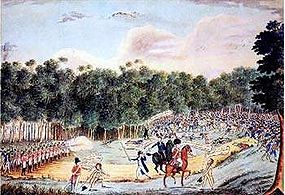 The military behaviour of the body of NSW Corps was better than might have been expected. In 1802 King praised them stating, "the utmost order and regularity has uniformly prevailed amongst the non-commissioned officers and privates."
The Corps only saw action once in NSW, at the Battle of Vinegar Hill (named after a revolt in Ireland
). Late on the 4 March 1804, 266 Irish rebels revolted on a government farm at Castle Hill, armed themselves with muskets and pikes, and planned to sack Parramatta. Major Johnston led 29 soldiers of the NSW Corps on a forced march overnight to Parramatta and then the following day, with 50 militia, they pursued the rebels who were now heading to Windsor. After catching the rebels, Johnston took the ringleaders hostage when they refused to surrender, and the troops quickly put down the revolt. Governor King highly commended Major Johnston for his actions. At midnight on 4 March, Captain Daniel Woodriff of HMS Calcutta
landed 150 of his crew to assist the New South Wales Corps and Governor King. On March 17, Woodriff and his crew departed for England.
In England, most of the returnees went to Veteran or Garrison battalions, most officers ending up in the 8th Royal Veteran Battalion. The regiment was reconstituted with new recruits and then served in various posts throughout the United Kingdom: Horsham
in 1811 and Guernsey
in 1812. In 1812 the Regiment was posted to Bermuda and then Nova Scotia. In the British-American War
(known in North America as the War of 1812
) they took part in seaborne raids along the US Atlantic coast and other actions against the Americans, and were involved in the British occupation of northern Maine. Detachments of the 102nd remained on both sides of the border between the British colony of New Brunswick
and the US State of Maine
after the war's end in December 1814 at Moose Island, modern day Eastport, Maine, USA. A vivid description of its garrisoning duty on Moose Island can be found in David Zimmerman's Coastal Fort; to a lesser extent in Joshua Smith's Borderland Smuggling.
After the end of the wars against Napoleonic France and the United States, the British Army disbanded many units for the sake of economy. The 102nd Regiment was renumbered as the 100th Regiment of Foot in 1816. The 100th were the last British troops to occupy the United States; the last detachments returned to Chatham Barracks in England, where the regiment was disbanded on March 24, 1818.
The government, at a loss with what to do with the disbanded veterans, some of whom remembered NSW fondly, offered them the chance to reform the NSW Corps as a garrison unit. They arrived in Sydney in July 1826 where they were placed under the command of Colonel Dumaresq. In 1829 the Royal New South Wales Veterans Companies, or Veterans Corps, had about 150 men serving at various posts in NSW, Norfolk Island and Tasmania. It was finally disbanded on 1 April 1833.
Throughout its life the regiment acquired a number of nicknames related to its service in New South Wales
: Botany Bay Rangers, Rum Puncheon Corps or Rum Corps, Condemned Regiment.
102nd Regiment of Foot
First Fleet
The First Fleet is the name given to the eleven ships which sailed from Great Britain on 13 May 1787 with about 1,487 people, including 778 convicts , to establish the first European colony in Australia, in the region which Captain Cook had named New South Wales. The fleet was led by Captain ...
to Australia
Australia
Australia , officially the Commonwealth of Australia, is a country in the Southern Hemisphere comprising the mainland of the Australian continent, the island of Tasmania, and numerous smaller islands in the Indian and Pacific Oceans. It is the world's sixth-largest country by total area...
. The regiment, led by Major Francis Grose
Francis Grose (Lieutenant-Governor)
Lieutenant-General Francis Grose was a soldier and Lieutenant Governor of New South Wales.-Early life:Grose was born in Greenland, Middlesex, England around 1758. He was the eldest son of Francis Grose the well-known English antiquary, and Catherine Jordan...
, consisted of three companies. Due to the remoteness and unpopularity of the posting they were composed of officers on half pay, troublemakers, soldiers paroled from military prisons and those with few prospects, who were gambling on making a life for themselves in the new colony. The regiment began arriving as guards on the Second Fleet
Second Fleet
The Second Fleet or 2nd fleet may be:* Second Fleet , the second convict party sent to Port Jackson in 1790* IJN 2nd Fleet, Imperial Japanese Navy* United States Second Fleet, United States Navy* Legio II Adiutrix...
in 1790. Major Grose arrived in Sydney in 1792 to take command and assume role of Lieutenant-Governor of the colony. A fourth company was raised from those marines wishing to remain in NSW under Captain George Johnston
George Johnston (New South Wales)
Lieutenant-Colonel George Johnston was briefly Lieutenant-Governor of New South Wales, Australia after leading the rebellion later known as the Rum Rebellion....
, who had been Governor Phillip
Arthur Phillip
Admiral Arthur Phillip RN was a British admiral and colonial administrator. Phillip was appointed Governor of New South Wales, the first European colony on the Australian continent, and was the founder of the settlement which is now the city of Sydney.-Early life and naval career:Arthur Phillip...
's aide-de-camp.
Administration of NSW
When Governor PhillipArthur Phillip
Admiral Arthur Phillip RN was a British admiral and colonial administrator. Phillip was appointed Governor of New South Wales, the first European colony on the Australian continent, and was the founder of the settlement which is now the city of Sydney.-Early life and naval career:Arthur Phillip...
returned to England for respite in December 1792, Major Francis Grose
Francis Grose
Francis Grose was an English antiquary, draughtsman, and lexicographer. He was born at his father's house in Broad Street, St-Peter-le-Poer, London, son of a Swiss immigrant and jeweller, Francis Jacob Grose , and his wife, Anne , daughter of Thomas Bennett of Greenford in Middlesex...
was left in charge. Grose immediately abandoned Phillip’s plans for governing the colony. A staunch military man, he established military rule and set out to secure the authority of the Corps. He abolished the civilian courts and transferred the magistrates to the authority of Captain Foveaux. After the poor crops of 1793 he cut the rations of the convicts but not those of the Corps, overturning Phillip’s policy of equal rations for all.
To improve agricultural production and make the colony more self-sufficient, Grose turned away from collective farming
Collective farming
Collective farming and communal farming are types of agricultural production in which the holdings of several farmers are run as a joint enterprise...
and made generous land grants to officers of the Corps. They were also provided with government-fed and clothed convicts as farm labour, whose products they would sell to the government store.
Due to poor health Grose returned to England in December 1794 and Captain William Paterson
William Paterson (explorer)
Colonel William Paterson, FRS was a Scottish soldier, explorer, Lieutenant governor and botanist best known for leading early settlement in Tasmania. This botanist is denoted by the author abbreviation Paterson when citing a botanical name.-Early years:A native of Montrose, Scotland, Paterson was...
assumed command until a replacement, Governor Hunter, arrived in September 1795. Paterson had obtained his commission with the backing of Sir Joseph Banks
Joseph Banks
Sir Joseph Banks, 1st Baronet, GCB, PRS was an English naturalist, botanist and patron of the natural sciences. He took part in Captain James Cook's first great voyage . Banks is credited with the introduction to the Western world of eucalyptus, acacia, mimosa and the genus named after him,...
because he was interested in natural history and would explore and collect samples for Banks and the Royal Society. He was an honest man, but fairly weak and while he did try to introduce some reforms he was unable to stop the officers of the NSW Corps consolidating their wealth and power.
The Corps and rum trafficking in NSW
Grose had also relaxed Phillip's prohibition on trading of rum (sometimes a generic term for any form of spirit, usually made from wheat), usually from Bengal. The colony, like many British Territories at the time, was short of coin, and rum soon became the medium of trade. The officers of the Corps were able to use their position and wealth to buy up all the imported rum and then exchange it for goods and labour at very favourable rates, thus earning the Corps the nickname The Rum Corps. By 1793 stills were being imported and grain was being used to make rum, exacerbating the shortage of grain.Governor Hunter
John Hunter (New South Wales)
Vice-Admiral John Hunter, RN was a British naval officer, explorer, naturalist and colonial administrator who succeeded Arthur Phillip as the second governor of New South Wales, Australia from 1795 to 1800.-Overview:...
attempted unsuccessfully to use the troops of the Corps to guard imported rum and stop the officers from buying it up. Attempts to stop the importation were also thwarted by the failure of other governments to co-operate and by the Corps's officers chartering of a Danish ship to bring in a large shipment of rum from India. Hunter also tried to start up a public store with goods from England to provide competition and stabilise the price of goods, but Hunter was not a good businessman and supplies were too erratic. Hunter requested greater control by authorities in England and an excise duty on rum. He also issued an order restricting the amount of convict labour that officers could use, but again had no means to enforce it. Hunter was opposed strongly by officers of the Corps, and pamphlets and letters against him were circulated. John Macarthur
John Macarthur (wool pioneer)
John Macarthur was a British army officer, entrepreneur, politician, architect and pioneer of settlement in Australia. Macarthur is recognised as the pioneer of the wool industry that was to boom in Australia in the early 19th century and become a trademark of the nation...
wrote a letter accusing Hunter of ineffectiveness and trading in rum. Hunter was required by the Colonial Office to answer the charges, and soon after was recalled for being ineffective. Back in England Hunter lobbied unsuccessfully for reform and the recall of the NSW Corps.
In 1799 Paterson, now a Lieutenant Colonel, returned from England with orders to stamp out the trading in rum by officers of the Corps. In 1800 he charged Major Johnston, who had also served as Hunter’s aide-de-camp, with giving a sergeant part payment in rum at an exorbitant rate. Johnston claimed he was being unfairly persecuted and demanded that he be sent to England for trial. The English courts decided that colonial affairs were not a matter for them and, as all the evidence and witnesses were in Sydney, that any trial should be held there. They also decided that, as proper court martial could not be constituted in Sydney, no further action should be taken against Johnston. Governor King, realising that every officer apart from Paterson was trading in rum, allowed Johnston to resume his duties.
Governor King
Philip Gidley King
Captain Philip Gidley King RN was a British naval officer and colonial administrator. He is best known as the official founder of the first European settlement on Norfolk Island and as the third Governor of New South Wales.-Early years and establishment of Norfolk Island settlement:King was born...
continued Hunter’s efforts to prevent the Corps trading in rum. He had the power to levy an excise duty on alcohol, and the Transit Board now required all ships to lodge a bond which was forfeit for disobeying the Governor’s orders, which included the prohibition of the landing of more than 500 gallons of rum. King also encouraged private importers and traders, opened a public brewery in 1804, and introduced a schedule of values for Indian copper and Spanish pieces of eight which were used as currency; there was still a serious problem keeping the coin in the colony despite it being valued higher than its face value. King’s actions were not wholly effective but they still antagonised officers of the Corps, and like Hunter he was the subject of pamphlets and attacks. King tried, unsuccessfully, to court-martial the officers responsible. He had since May 1803 been requesting a replacement, and eventually William Bligh
William Bligh
Vice Admiral William Bligh FRS RN was an officer of the British Royal Navy and a colonial administrator. A notorious mutiny occurred during his command of HMAV Bounty in 1789; Bligh and his loyal men made a remarkable voyage to Timor, after being set adrift in the Bounty's launch by the mutineers...
was appointed in 1805.
Although the economy had developed and diversified somewhat by 1806, Governor Bligh arrived determined to bring the Corps, and especially John Macarthur
John Macarthur (wool pioneer)
John Macarthur was a British army officer, entrepreneur, politician, architect and pioneer of settlement in Australia. Macarthur is recognised as the pioneer of the wool industry that was to boom in Australia in the early 19th century and become a trademark of the nation...
, to heel and stop their trading in rum. This led to the Rum Rebellion
Rum Rebellion
The Rum Rebellion of 1808 was the only successful armed takeover of government in Australia's history. The Governor of New South Wales, William Bligh, was deposed by the New South Wales Corps under the command of Major George Johnston, working closely with John Macarthur, on 26 January 1808, 20...
and the deposing of Bligh, and the eventual recall of the NSW Corps. Lieutenant-Colonel Foveaux allowed the Corps to trade in rum during the interregnum, despite protests from settlers, believing that freer trade would reduce the problems.
Governor Lachlan Macquarie
Lachlan Macquarie
Major-General Lachlan Macquarie CB , was a British military officer and colonial administrator. He served as the last autocratic Governor of New South Wales, Australia from 1810 to 1821 and had a leading role in the social, economic and architectural development of the colony...
was able to control the rum trade better, introducing and enforcing a licensing system. However, he was still forced to pay for public works projects in rum due to the lack of currency. The construction of Sydney Hospital was entirely funded by granting a monopoly on the import of rum to the contractors and using troops to prohibit the landing of rum anywhere but at the hospital dock. This was a Public-Private Partnership that increased the price of rum and was highly unpopular, putting an end to such deals for some time.
In 1813 Macquarie finally managed to established a stable currency in coin that could be retained in the colony. He bought Spanish Dollars from America and punched the middle out to make the Holey Dollar
Holey dollar
Holey dollar is the name given to coins used in the early history of two British settlements: Prince Edward Island and New South Wales. The middle was punched out of Spanish dollars, creating two parts: a small coin, known as a "dump" in Australia, and a "holey dollar".-Prince Edward Island :From...
, worth 5 shillings, with the middle bit or dump being used as a 15 penny piece. In 1819 the British Government legalised the commercial distillation of spirit ,and trafficking in rum gradually ceased to be an issue.
The Battle of Vinegar Hill
The Corps only saw action once in NSW, at the Battle of Vinegar Hill (named after a revolt in Ireland
Battle of Vinegar Hill
The Battle of Vinegar Hill was an engagement during the Irish Rebellion of 1798 on 21 June 1798 when over 15,000 British soldiers launched an attack on Vinegar Hill outside Enniscorthy, County Wexford, the largest camp and headquarters of the Wexford United Irish rebels...
). Late on the 4 March 1804, 266 Irish rebels revolted on a government farm at Castle Hill, armed themselves with muskets and pikes, and planned to sack Parramatta. Major Johnston led 29 soldiers of the NSW Corps on a forced march overnight to Parramatta and then the following day, with 50 militia, they pursued the rebels who were now heading to Windsor. After catching the rebels, Johnston took the ringleaders hostage when they refused to surrender, and the troops quickly put down the revolt. Governor King highly commended Major Johnston for his actions. At midnight on 4 March, Captain Daniel Woodriff of HMS Calcutta
HMS Calcutta (1795)
HMS Calcutta was an East Indiaman converted to a Royal Navy 56-gun fourth rate. This ship of the line served for a time as an armed transport. She also transported convicts to Australia in a voyage that became a circumnavigation of the world. The French 74-gun Magnanime captured Calcutta in 1805...
landed 150 of his crew to assist the New South Wales Corps and Governor King. On March 17, Woodriff and his crew departed for England.
102nd Regiment
In 1809, after the Rum Rebellion, the NSW Corps was formed into the 102nd Regiment of Foot and recalled. A few of its officers and long-serving privates were transferred to bring Macquarie’s 73rd regiment up to near full strength; around 100 veterans and invalids were retained for garrison duty in NSW. Though of little real use, the unit survived till 1823. Some officers were allowed to retire and farm their land; however, the bulk of the troops were sent back to England. Colonel Paterson, formerly Captain Paterson, died in South Africa on the way.In England, most of the returnees went to Veteran or Garrison battalions, most officers ending up in the 8th Royal Veteran Battalion. The regiment was reconstituted with new recruits and then served in various posts throughout the United Kingdom: Horsham
Horsham
Horsham is a market town with a population of 55,657 on the upper reaches of the River Arun in the centre of the Weald, West Sussex, in the historic County of Sussex, England. The town is south south-west of London, north-west of Brighton and north-east of the county town of Chichester...
in 1811 and Guernsey
Guernsey
Guernsey, officially the Bailiwick of Guernsey is a British Crown dependency in the English Channel off the coast of Normandy.The Bailiwick, as a governing entity, embraces not only all 10 parishes on the Island of Guernsey, but also the islands of Herm, Jethou, Burhou, and Lihou and their islet...
in 1812. In 1812 the Regiment was posted to Bermuda and then Nova Scotia. In the British-American War
War of 1812
The War of 1812 was a military conflict fought between the forces of the United States of America and those of the British Empire. The Americans declared war in 1812 for several reasons, including trade restrictions because of Britain's ongoing war with France, impressment of American merchant...
(known in North America as the War of 1812
War of 1812
The War of 1812 was a military conflict fought between the forces of the United States of America and those of the British Empire. The Americans declared war in 1812 for several reasons, including trade restrictions because of Britain's ongoing war with France, impressment of American merchant...
) they took part in seaborne raids along the US Atlantic coast and other actions against the Americans, and were involved in the British occupation of northern Maine. Detachments of the 102nd remained on both sides of the border between the British colony of New Brunswick
New Brunswick
New Brunswick is one of Canada's three Maritime provinces and is the only province in the federation that is constitutionally bilingual . The provincial capital is Fredericton and Saint John is the most populous city. Greater Moncton is the largest Census Metropolitan Area...
and the US State of Maine
Maine
Maine is a state in the New England region of the northeastern United States, bordered by the Atlantic Ocean to the east and south, New Hampshire to the west, and the Canadian provinces of Quebec to the northwest and New Brunswick to the northeast. Maine is both the northernmost and easternmost...
after the war's end in December 1814 at Moose Island, modern day Eastport, Maine, USA. A vivid description of its garrisoning duty on Moose Island can be found in David Zimmerman's Coastal Fort; to a lesser extent in Joshua Smith's Borderland Smuggling.
After the end of the wars against Napoleonic France and the United States, the British Army disbanded many units for the sake of economy. The 102nd Regiment was renumbered as the 100th Regiment of Foot in 1816. The 100th were the last British troops to occupy the United States; the last detachments returned to Chatham Barracks in England, where the regiment was disbanded on March 24, 1818.
The government, at a loss with what to do with the disbanded veterans, some of whom remembered NSW fondly, offered them the chance to reform the NSW Corps as a garrison unit. They arrived in Sydney in July 1826 where they were placed under the command of Colonel Dumaresq. In 1829 the Royal New South Wales Veterans Companies, or Veterans Corps, had about 150 men serving at various posts in NSW, Norfolk Island and Tasmania. It was finally disbanded on 1 April 1833.
Throughout its life the regiment acquired a number of nicknames related to its service in New South Wales
New South Wales
New South Wales is a state of :Australia, located in the east of the country. It is bordered by Queensland, Victoria and South Australia to the north, south and west respectively. To the east, the state is bordered by the Tasman Sea, which forms part of the Pacific Ocean. New South Wales...
: Botany Bay Rangers, Rum Puncheon Corps or Rum Corps, Condemned Regiment.
Commanding officers
NSW Corps- Major Francis GroseFrancis Grose (Lieutenant-Governor)Lieutenant-General Francis Grose was a soldier and Lieutenant Governor of New South Wales.-Early life:Grose was born in Greenland, Middlesex, England around 1758. He was the eldest son of Francis Grose the well-known English antiquary, and Catherine Jordan...
(1789–1794) - Lieutenant Colonel William PatersonWilliam Paterson (explorer)Colonel William Paterson, FRS was a Scottish soldier, explorer, Lieutenant governor and botanist best known for leading early settlement in Tasmania. This botanist is denoted by the author abbreviation Paterson when citing a botanical name.-Early years:A native of Montrose, Scotland, Paterson was...
(1794–1809)
102nd Regiment of Foot
- Lieutenant Colonel William PatersonWilliam Paterson (explorer)Colonel William Paterson, FRS was a Scottish soldier, explorer, Lieutenant governor and botanist best known for leading early settlement in Tasmania. This botanist is denoted by the author abbreviation Paterson when citing a botanical name.-Early years:A native of Montrose, Scotland, Paterson was...
(1809–1810) - Major George JohnstonGeorge Johnston (New South Wales)Lieutenant-Colonel George Johnston was briefly Lieutenant-Governor of New South Wales, Australia after leading the rebellion later known as the Rum Rebellion....
(1810–1811)
See also
- Rum RebellionRum RebellionThe Rum Rebellion of 1808 was the only successful armed takeover of government in Australia's history. The Governor of New South Wales, William Bligh, was deposed by the New South Wales Corps under the command of Major George Johnston, working closely with John Macarthur, on 26 January 1808, 20...
- Colonial forces of AustraliaColonial forces of AustraliaUntil Australia became a Federation in 1901, each of the six colonial governments was responsible for the defence of their own colony. From 1788 until 1870 this was done with British regular forces. In all, 25 British regiments served in the Australian colonies...
- New South Wales Corps of Marines Re-enactment
Further reading
- David Zimmerman, Coastal Fort: A History of Fort Sullivan Eastport, Maine. Border history fathom series, no. 3. Eastport, Moose Island, Me: Research Committee, Border Historical Society, 1984.
- Joshua M. Smith, Borderland Smuggling: Patriots, Loyalists and Illicit Trade in the Northeast, 1783–1820, University Press of Florida, 2006.