


history. The Governor
of New South Wales
, William Bligh
, was deposed by the New South Wales Corps
under the command of Major George Johnston
, working closely with John Macarthur
, on 26 January 1808, 20 years to the day after Arthur Phillip
founded European settlement in Australia. Afterwards, the colony was ruled by the military, with the senior military officer stationed in Sydney acting as the Lieutenant-Governor of the colony until the arrival from Britain of Major-General Lachlan Macquarie
as the new Governor at the beginning of 1810.
Appointment as Governor
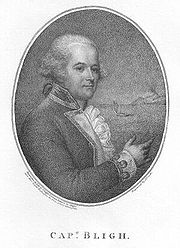
William Bligh, well-known for his overthrow in the mutiny on the Bounty, was a naval officer and the fourth Governor of New South Wales. He succeeded Governor Philip Gidley King
in 1805, having been offered the position by Sir Joseph Banks
. It is likely that he was selected by the British Government as governor because of his reputation as a hard man. He stood a good chance of reining in the maverick New South Wales Corps, something which his predecessors had not been able to do. Bligh left for Sydney with his daughter, Mary Putland, and her husband (who died in January 1808, immediately prior to the Rum Rebellion). Bligh's wife remained in England.
Even before his arrival, Bligh's style of governance led to problems with his subordinates. The Admiralty
gave command of the storeship Porpoise
and the convoy to the lower ranked Captain Joseph Short and Bligh took command of a transport ship. This led to quarrels which eventually resulted in Captain Short firing across Bligh's bow in order to force Bligh to obey his signals. When this failed, Short tried to give an order to Lieutenant Putland, Bligh's son-in-law, to stand by to fire on Bligh's ship. Bligh boarded the Porpoise and seized control of the convoy.
When they arrived in Sydney, Bligh, backed up by statements from two of Short's officers, had Short stripped of the captaincy of the Porpoise – which he gave to his son-in-law – cancelled the 600 acres (2.4 km²) land grant Short had been promised as payment for the voyage and shipped him back to England for court martial, at which Short was acquitted. The president of the court, Sir Isaac Coffin
, wrote to the Admiralty and made several serious accusations against Bligh, including that he had influenced the officers to testify against Short. Bligh's wife obtained a statement from one of the officers denying this and Banks and other supporters of Bligh lobbied successfully against his recall as Governor.
Arrival in Sydney
Soon after his arrival at Sydney, in August 1806, Bligh was given an address of welcome signed by Major Johnston for the military, by Richard Atkins for the civilian officers, and by John Macarthurfor the free settlers. However, not long after, he also received addresses from the free and freed settlers of Sydney and the Hawkesbury River
region, with a total of 369 signatures, many made only with a cross, complaining that Macarthur did not represent them, as they blamed him for withholding sheep so as to raise the price of mutton.
One of Bligh's first actions was to use the colony's stores and herds to provide relief to farmers who had been severely affected by flooding on the Hawkesbury River, a situation which had disrupted the barter economy in the colony. Supplies were divided up according to those most in need and provisions were made for loans to be drawn from the store based on capacity to repay. This earned Bligh the gratitude of the farmers but the enmity of traders in the Corps who had been profiting greatly from the situation.
Bligh, under instructions from the Colonial Office
, attempted to normalise trading conditions in the colony by prohibiting the use of spirits as payment for commodities. Bligh communicated his policy to the Colonial Office in 1807, with the advice that his policy would be met with resistance. Robert Stewart, Viscount Castlereagh
, Secretary of State for War and the Colonies
wrote back to Bligh, his instructions being received on 31 December 1807. The instructions were to stop the barter of spirits and H.V. Evatt concludes in his history of the Rebellion that ... "Bligh was authorised to prevent free importation, to preserve the trade under his entire control, to enforce all penalties against illegal import, and to establish regulations at his discretion for the sale of spirits".
Evatt argues that the enmity of the monopolists within the colony stemmed from this and other policies which counteracted the power of the rich and promoted the welfare of the poor settlers. Bligh ceased the practice of handing out large land grants to the powerful in the colony; during his term he granted just over 1,600 hectares of land, half of it to his daughter and himself.
Bligh also upset some people by allowing a group of Irish convicts to be tried for revolt, by a court that included their accusers, and then when six out of the eight were acquitted, he kept them under arrest anyway. He dismissed D'Arcy Wentworth
from his position of Assistant Surgeon to the Colony without explanation, and sentenced three merchants to a month's imprisonment and a fine for writing a letter which he considered offensive. Bligh also dismissed Thomas Jamison
from the magistracy, describing him in 1807 as being "inimical" to good government. Jamison was the highly capable (if crafty) Surgeon-General of New South Wales. He had accumulated significant personal wealth as a maritime trader and was a friend and business partner of Macarthur's. Jamison never forgave Bligh for sacking him as a magistrate and interfering with his private business activities, and he supported Bligh's later deposition.
In October 1807 Major George Johnston wrote a formal letter of complaint to the Commander-in-Chief of the British Army
, stating that Bligh was abusive and interfering with the troops of the New South Wales Corps. It is clear that Bligh had made enemies of some of the most influential people in the colony. He also antagonised some of the less wealthy when he ordered those who had leases on government land within Sydney to remove their houses.
Enmity between Bligh and Macarthur
Macarthur had arrived with the New South Wales Corps in 1790 as a lieutenant, and by 1805 he had substantial farming and commercial interests in the colony. He had quarrelled with Bligh's predecessor governors and had fought three duels: Duffy, in his biography of Macarthur, sees the key to his character and actions in his acute sense of the code of honour.Bligh and MacArthur's interests clashed in a number of ways. Bligh stopped Macarthur from cheaply distributing large quantities of rum into the Corps. He also halted Macarthur's allegedly illegal importation of still
s. Macarthur's interest in an area of land granted to him by Governor King conflicted with Bligh's town-planning interests. Macarthur and Bligh were also engaged in other disagreements, including a conflict over landing regulations. In June 1807, a convict had stowed away and escaped Sydney on one of Macarthur's vessels, and in December 1807, when that vessel returned to Sydney, the bond held to ensure compliance by shipping was deemed to be forfeited.
Bligh had the Judge-Advocate, Richard Atkins, issue an order for John Macarthur to appear on the matter of the bond on the 15th of December 1807. Macarthur disobeyed the order and was arrested and bailed to appear for trial at the next sitting of the Sydney Criminal Court on 25 January 1808. The court was constituted of Atkins and six officers of the NSW Corps.
Macarthur objected to Atkins being fit to sit in judgement of him because he was his debtor and inveterate enemy. Atkins rejected this, but "Macarthur's protest had the support of the other six members of the court, all officers of the Corps. Without the Judge-Advocate, the trial could not take place and the court dissolved".
Bligh accused the six officers of what amounted to mutiny and summoned Major George Johnston to come and deal with the matter. Johnston replied that he was ill, as he had wrecked his gig
on the evening of the 24th on his way back home to Annandale
after dining with officers of the Corps. This was possibly Australia's first recorded drunk-driving accident.
The overthrow of Governor Bligh
On the morning of 26 January 1808 Bligh again ordered that Macarthur be arrested and also ordered the return of court papers, which were now in the hands of officers of the Corps. The Corps responded with a request for a new Judge-Advocate and the release of Macarthur on bail. Bligh summoned the officers to Government Houseto answer charges made by the judge and he informed Major Johnston that he considered the action of the officers of the Corps to be treasonable.
Johnston, instead, had gone to the jail and issued an order releasing Macarthur, who then drafted a petition calling for Johnston to arrest Bligh and take charge of the colony. This petition was signed by the officers of the Corps and other prominent citizens but, according to Evatt, most signatures had probably been added only after Bligh was safely under house arrest. Johnston then consulted with the officers and issued an order stating that Bligh was "charged by the respectable inhabitants of crimes that render you unfit to exercise the supreme authority another moment in this colony; and in that charge all officers under my command have joined." Johnston went on to call for Bligh to resign and submit to arrest.
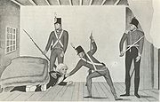
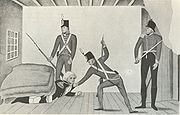
At 6:00 pm the Corps, with full band and colours, marched to Government House to arrest Bligh. They were hindered by Bligh's daughter and her parasol but Captain Thomas Laycock finally found Bligh, in full dress uniform, behind his bed where he claimed he was hiding papers. Bligh was painted as a coward for this but Duffy argues that if Bligh was hiding it would have been to escape and thwart the coup. In his book Captain Bligh's Other Mutiny Stephen Dando-Collins
agrees, and goes so far as to suggest that Bligh was attempting to travel to Hawkesbury and lead the garrison there against Johnston. During 1808 Bligh was confined to Government House. He refused to leave for England until lawfully relieved of his duty.
Johnston appointed Charles Grimes
, the Surveyor-General, as Judge-Advocate and ordered Macarthur and the six officers be tried; they were found not guilty. Macarthur was then appointed as Colonial Secretary and effectively ran the business affairs of the colony. Another prominent opponent of Bligh, Macarthur's ally Thomas Jamison, was made the colony's Naval Officer (the equivalent of Collector of Customs
and Excise
). Jamison was also reinstated as a magistrate, which enabled him and his fellow legal officers to scrutinise Bligh's personal papers for evidence of wrong-doing by the deposed governor. In June 1809 Jamison sailed to London to bolster his business interests and give evidence against Bligh in any legal prosecutions that might be brought against the mutineers. Jamison died in London at the beginning of 1811, however, so he did not have an opportunity to testify at Johnston's court martial, which was not conducted until June of that year (see below).
A new governor is appointed
Following Bligh's overthrow Johnston had notified his superior officer, Colonel William Paterson, who was in Tasmania establishing a settlement at Port Dalrymple (now Launceston
), of events. Paterson was reluctant to get involved until clear orders arrived from England. When he learned in March that Lieutenant-Colonel Joseph Foveaux
was returning to Sydney with orders to become acting Lieutenant-Governor, Paterson left Foveaux to deal with the prevailing situation.
Foveaux arrived in July and took over the colony, which annoyed Macarthur. Since a decision was expected from England, and feeling that Bligh's behaviour had been insufferable, Foveaux left Bligh under house arrest and turned his attention to improving the colony's roads, bridges and public buildings, which he felt had been badly neglected. When there was still no word from England, he summoned Paterson to Sydney in January 1809 to sort out matters.
Paterson sent Johnston and Macarthur to England for trial, and confined Bligh to the barracks until he signed a contract agreeing to return to England. Paterson, whose health was failing, then retired to Government House at Parramatta and left Foveaux to run the colony.
In January 1809 Bligh was given the control of HMS Porpoise on condition that he return to England. However, Bligh sailed to Hobart
, Tasmania
, seeking the support of the Tasmanian Lieutenant-Governor David Collins
to retake control of the colony. Collins did not support him and on Paterson's orders Bligh remained cut off on board the Porpoise moored in Hobart until January 1810.
The Colonial Office finally decided that sending naval governors to rule the colony was untenable. Instead the NSW Corps, now known as the 102nd Regiment of Foot, was to be recalled to England and replaced with the 73rd Regiment of Foot
, whose commanding officer would take over as Governor. Bligh was to be reinstated for 24 hours, then recalled to England, Johnston sent to England for court martial, and Macarthur tried in Sydney. Major-General Lachlan Macquarie
was put in charge of the mission after Major-General Miles Nightingall fell ill before departure. Macquarie took over as Governor with an elaborate ceremony on 1 January 1810.
Aftermath
Governor Macquarie reinstated all the officials who had been sacked by Johnston and Macarthur and cancelled all land and stock grants that had been made since Bligh's deposition, though to calm things down he made grants that he thought appropriate and prevented any revenge.When Bligh received the news of Macquarie's arrival, he sailed from Hobart to Sydney, arriving on 17 January 1810 to collect evidence for the forthcoming court martial of Major George Johnston. He departed for the trial in England on 12 May, arriving on 25 October 1810 aboard the Hindostan.
Having informally heard arguments from both sides, the government authorities in England were not impressed by either Macarthur and Johnston's accusations against Bligh, or by Bligh's ill-tempered letters accusing key figures in the colony of unacceptable conduct. Johnston was court-martialled, found guilty and cashiered, the lowest penalty possible. He was then able to return as a free citizen to his estate, Annandale, in Sydney. Macarthur was not tried but was refused permission to return to NSW until 1817, since he would not admit his wrongdoing.
Bligh's promotion to rear admiral
was held up until the end of Johnston's trial. Afterward it was backdated to 31 July 1810 and Bligh took up a position that had been kept for him. He continued his naval career in the Admiralty in unspectacular fashion and died in 1817.
Macquarie had been impressed with Foveaux's administration. He put Foveaux's name forward to succeed Collins as Lieutenant-Governor of Tasmania because he could think of no one more fitting, and considered that he could not have acted otherwise with regard to Bligh. However, when Foveaux returned to England in 1810 he was court-martialled for assenting to Bligh being deposed and imprisoned; Macquarie's recommendation was ignored. Foveaux was taken back into active service in 1811 and promoted Lieutenant-Colonel of the Greek Light Infantry; he pursued an uneventful military career after that, rising to the rank of Lieutenant-General.
Causes
Michael Duffy, a journalist writing in 2006, says
The Rum Rebellion has slipped into historical oblivion because it is widely misunderstood. It is popular belief that the autocratic Bligh was removed because he threatened the huge profits that were being made from trading in spirits by the officers of the NSW Corps and by businessmen such as John Macarthur. This view suggests it was nothing more than a squabble between equally unsavoury parties.The conflict had greater depth than that of a mere squabble, however. Essentially it was the culmination of a long-running tussle for power between the government and private entrepreneurs, a fight over the future and the nature of the colony. The early governors wanted to keep NSW as a large-scale open prison, with a primitive economy based on yeomen ex-convicts and run by government fiat.
Duffy goes on to say that the Rebellion was not thought of at the time as being about Rum:
... almost no one at the time of the rebellion thought it was about rum. Bligh tried briefly to give it that spin, to smear his opponents, but there was no evidence for it and he moved on.Many years later, in 1855, an English Quaker named William Howitt
William HowittWilliam Howitt , was an English author.He was born at Heanor, Derbyshire. His parents were Quakers, and he was educated at the Friends public school at Ackworth, Yorkshire. His younger brothers were Richard and Godrey whom he helped tutor. In 1814 he published a poem on the Influence of Nature and...
published a popular history of Australia. Like many teetotallers, he was keen to blame alcohol for all the problems in the world. Howitt took Bligh's side and invented the phrase Rum Rebellion, and it has stuck ever since.
Some historians reject the idea that the conflict concerned Bligh's policy: deposing him because of his policy would have been pointless as the new Governor would simply continue the policy. They see the main cause to have been Bligh's attitude towards the gentry of NSW, and his failure to accept them as his social equals.
The Biography of Early Australia dismisses Macarthur's complaints as ridiculous and quotes Evatt as saying that legally Macarthur was guilty of two out of the three charges brought against him including sedition. Both consider that Bligh was wholly justified in his actions because he was the legitimate authority. In addition, imprisoning people and threatening to do the same to the court when they failed to yield to the will of said authority would seem to be legally problematic. Duffy states that had Johnston arrived when summoned on 25 January the Rum Rebellion probably would never have happened.