
All Topics  
Lyndon B. Johnson

 
Lyndon B. Johnson

   Email Print
   Bookmark   Link


Lyndon B. Johnson


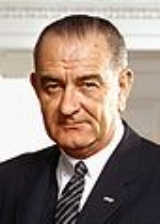
Lyndon Baines Johnson (August 27, 1908 – January 22, 1973), often referred to as LBJ, was the 36th
List of Presidents of the United States

File:WhiteHouseSouthFacade.JPGThe President of the United States is the head of state and the head of government of the United States. As chief of the executive branch and head of the Federal government of the United States as a whole, the presidency is the highest political office in the United States by influence and recognition....
 President of the United States
President of the United States

The President of the United States is the head of state and head of government of the United States and is the highest political official in the United States by influence and recognition....
 (1963–1969) and 37th
List of Vice Presidents of the United States

This List of Vice Presidents of the United States from John Adams to Joe Biden. It includes the home state of each Vice President of the United States as well as when he took office, left office and the political party to which he belonged....
 Vice President of the United States
Vice President of the United States

The Vice President of the United States is the holder of a public office in the United States of America created by the Constitution of the United States....
 (1961–1963).

Johnson, a Democrat, succeeded
United States presidential line of succession

The United States presidential line of succession defines who may become or act as President of the United States upon the incapacity, death, resignation, or removal from office of a sitting president or a President-elect of the United States....
 to the presidency following the assassination of President John F. Kennedy
John F. Kennedy assassination

The assassination of John F. Kennedy, the List of Presidents of the United States President of the United States of the United States, took place on Friday, November 22, 1963, in Dallas, Texas, Texas, at 12:30 p.m....
, completed Kennedy's term and was elected President in his own right in a landslide victory in the 1964 Presidential election
United States presidential election, 1964

The United States presidential election of 1964 was the sixth-most lopsided presidential election in the history of the United States behind the elections of United States presidential election, 1936, United States presidential election, 1984, United States presidential election, 1972, United States presidential election, 1864, and United Sta...
. Johnson was a major leader of the Democratic Party
History of the United States Democratic Party

The history of the Democratic Party of the United States is an account of the oldest political party in the United States and arguably the oldest democratic party in the world....
 and as President was responsible for designing the "Great Society
Great Society

The Great Society was a set of domestic programs proposed or enacted in the United States on the initiative of President of the United States Lyndon B....
" legislation that included civil rights laws, Medicare
Medicare (United States)

Medicare is a social insurance program administered by the United States government, providing health insurance coverage to people who are aged 65 and over, or who meet other special criteria....
 (government-funded health care for the elderly), Medicaid
Medicaid

Medicaid is the United States American health care system program for eligible individuals and families with low incomes and resources. It is a means-tested program that is jointly funded by the states and federal government, and is managed by the states....
 (government-funded health care for the poor), aid to education, and the "War on Poverty
War on Poverty

The War on Poverty is the name for legislation first introduced by President of the United States Lyndon B. Johnson during his State of the Union address on January 8, 1964....
." Simultaneously, he escalated the American involvement in the Vietnam War
Vietnam War

The Vietnam War, also known as the Second Indochina Wars, the Vietnam Conflict, or often in Vietnam the American War occurred in Vietnam, Laos and Cambodia from 1959 to April 30, 1975....
 from 16,000 American soldiers in 1963 to 500,000 in early 1968.

Johnson served as a United States Representative from Texas
Texas

Texas is a U.S. state located in the South Central United States, nicknamed the Lone Star State. Texas is the second largest U.S. state in both area and population, spanning , and with a growing population of 24.3 million residents....
, from 1937–1949 and as United States Senator (as his grandfather foretold when LBJ was just an infant) from 1949–1961, including six years as United States Senate Majority Leader
Party leaders of the United States Senate

The Senate Majority and Minority Leaders are two United States Senators who are elected by the political party conferences that hold the majority and the minority respectively....
, two as Senate Minority Leader and two as Senate Majority Whip
Assistant party leaders of the United States Senate

The Assistant Majority and Minority Leaders of the United States Senate are the second-ranking members of their parties in the United States Senate....
.


Discussion
Ask a question about 'Lyndon B. Johnson'
Start a new discussion about 'Lyndon B. Johnson'
Answer questions from other users
Full Discussion Forum


Recent Posts


Timeline

1961   The funeral of longtime House Speaker Sam Rayburn is held in Washington, DC. Two former Presidents (Truman, Eisenhower) and one future one (Lyndon B. Johnson) join President Kennedy in paying their respects.

1963   John F. Kennedy assassination: In Dallas, Texas, U.S. President John F. Kennedy is assassinated, Texas Governor John B. Connally is seriously wounded, and Vice President Lyndon B. Johnson is sworn in as the 36th President of the United States.

1964   7000 residents of New Hanover Island, at the time part of Australia, refuse to pay taxes and found a fund to purchase Lyndon B. Johnson.

1964   Vietnam War: The United States Congress passes the Gulf of Tonkin Resolution, giving U.S. President Lyndon B. Johnson broad war powers to deal with North Vietnamese attacks on U.S. forces.

1965   U.S. President Lyndon B. Johnson proclaims his "Great Society" during his State of the Union Address.

1965   Lyndon B. Johnson is sworn in for his own full term as U.S. President.

1965   U.S. troops are sent to the Dominican Republic by President Lyndon B. Johnson, "for the stated purpose of protecting US citizens and preventing an alleged Communist takeover of the country", thus thwarting the possibility of "another Cuba".

1965   Vietnam War: U.S. President Lyndon B. Johnson announces his order to increase the number of United States troops in South Vietnam from 75,000 to 125,000.

1965   War on Poverty: U.S. President Lyndon B. Johnson signs the Social Security Act of 1965 into law, establishing Medicare and Medicaid.

1965   U.S. President Lyndon B. Johnson signs the Voting Rights Act of 1965 into law.


Quotations


I do not find it easy to send the flower of our youth, our finest young men, into battle.

News Conference (28 July 1965)

Its probably better to have him inside the tent pissing out, than outside the tent pissing in.

On FBI Director J. Edgar Hoover, as quoted in The New York Times (31 October 1971)


Encyclopedia


Lyndon Baines Johnson (August 27, 1908 – January 22, 1973), often referred to as LBJ, was the 36th
List of Presidents of the United States

File:WhiteHouseSouthFacade.JPGThe President of the United States is the head of state and the head of government of the United States. As chief of the executive branch and head of the Federal government of the United States as a whole, the presidency is the highest political office in the United States by influence and recognition....
 President of the United States
President of the United States

The President of the United States is the head of state and head of government of the United States and is the highest political official in the United States by influence and recognition....
 (1963–1969) and 37th
List of Vice Presidents of the United States

This List of Vice Presidents of the United States from John Adams to Joe Biden. It includes the home state of each Vice President of the United States as well as when he took office, left office and the political party to which he belonged....
 Vice President of the United States
Vice President of the United States

The Vice President of the United States is the holder of a public office in the United States of America created by the Constitution of the United States....
 (1961–1963).

Johnson, a Democrat, succeeded
United States presidential line of succession

The United States presidential line of succession defines who may become or act as President of the United States upon the incapacity, death, resignation, or removal from office of a sitting president or a President-elect of the United States....
 to the presidency following the assassination of President John F. Kennedy
John F. Kennedy assassination

The assassination of John F. Kennedy, the List of Presidents of the United States President of the United States of the United States, took place on Friday, November 22, 1963, in Dallas, Texas, Texas, at 12:30 p.m....
, completed Kennedy's term and was elected President in his own right in a landslide victory in the 1964 Presidential election
United States presidential election, 1964

The United States presidential election of 1964 was the sixth-most lopsided presidential election in the history of the United States behind the elections of United States presidential election, 1936, United States presidential election, 1984, United States presidential election, 1972, United States presidential election, 1864, and United Sta...
. Johnson was a major leader of the Democratic Party
History of the United States Democratic Party

The history of the Democratic Party of the United States is an account of the oldest political party in the United States and arguably the oldest democratic party in the world....
 and as President was responsible for designing the "Great Society
Great Society

The Great Society was a set of domestic programs proposed or enacted in the United States on the initiative of President of the United States Lyndon B....
" legislation that included civil rights laws, Medicare
Medicare (United States)

Medicare is a social insurance program administered by the United States government, providing health insurance coverage to people who are aged 65 and over, or who meet other special criteria....
 (government-funded health care for the elderly), Medicaid
Medicaid

Medicaid is the United States American health care system program for eligible individuals and families with low incomes and resources. It is a means-tested program that is jointly funded by the states and federal government, and is managed by the states....
 (government-funded health care for the poor), aid to education, and the "War on Poverty
War on Poverty

The War on Poverty is the name for legislation first introduced by President of the United States Lyndon B. Johnson during his State of the Union address on January 8, 1964....
." Simultaneously, he escalated the American involvement in the Vietnam War
Vietnam War

The Vietnam War, also known as the Second Indochina Wars, the Vietnam Conflict, or often in Vietnam the American War occurred in Vietnam, Laos and Cambodia from 1959 to April 30, 1975....
 from 16,000 American soldiers in 1963 to 500,000 in early 1968.

Johnson served as a United States Representative from Texas
Texas

Texas is a U.S. state located in the South Central United States, nicknamed the Lone Star State. Texas is the second largest U.S. state in both area and population, spanning , and with a growing population of 24.3 million residents....
, from 1937–1949 and as United States Senator (as his grandfather foretold when LBJ was just an infant) from 1949–1961, including six years as United States Senate Majority Leader
Party leaders of the United States Senate

The Senate Majority and Minority Leaders are two United States Senators who are elected by the political party conferences that hold the majority and the minority respectively....
, two as Senate Minority Leader and two as Senate Majority Whip
Assistant party leaders of the United States Senate

The Assistant Majority and Minority Leaders of the United States Senate are the second-ranking members of their parties in the United States Senate....
. After campaigning unsuccessfully for the Democratic nomination in 1960, Johnson was selected by John F. Kennedy
John F. Kennedy

John Fitzgerald "Jack" Kennedy , often referred to by his initials JFK, was the List of Presidents of the United States President of the United States, serving from 1961 until John F....
 to be his running-mate for the 1960 presidential election. Johnson's popularity as President steadily declined after the 1966
United States House election, 1966

The U.S. House election, 1966 was an election for the United States House of Representatives in 1966 which occurred in the middle of President of the United States Lyndon Johnson's second term....
 Congressional elections, and his reelection bid in the 1968
United States presidential election, 1968

The United States presidential election of 1968 was a wrenching national experience, conducted against a backdrop that included the assassination of civil rights leader Martin Luther King, Jr....
 United States presidential election collapsed as a result of turmoil within the Democratic party related to opposition to the Vietnam War. He withdrew from the race to concentrate on peacemaking. Johnson was renowned for his domineering personality and the "Johnson treatment," his arm-twisting of powerful politicians.

Johnson died after suffering his third heart attack, on January 22, 1973.

Early years

Johnson was maternally descended from a pioneer Baptist
Baptist

A Baptist is a member of a Christian denomination characterized by the rejection of infant baptism in favor of believer's baptism by Baptism#Immersion....
 clergyman, George Washington Baines
George Washington Baines

George Washington Baines, Sr. , a maternal great-grandfather of U.S. President Lyndon Baines Johnson , was a Baptist clergyman in Arkansas, Louisiana, and Texas who served briefly as natural science professor and president of Baylor University at its first location in Independence, Texas in Washington County, Texas, Texas....
, who pastored some eight churches in Texas
Texas

Texas is a U.S. state located in the South Central United States, nicknamed the Lone Star State. Texas is the second largest U.S. state in both area and population, spanning , and with a growing population of 24.3 million residents....
 as well as others in Arkansas
Arkansas

Arkansas is a U.S. state located in the Southern United States of the United States. Arkansas shares a border with six states, with its eastern border largely defined by the Mississippi River....
 and Louisiana
Louisiana

The State of Louisiana is a U.S. state located in the U.S. Southern States of the United States of America. Its capital is Baton Rouge and largest city is New Orleans....
. Baines was also the president of Baylor University
Baylor University

Baylor University is a private university, Baptist-affiliated research university located in Waco, Texas. It is the largest Baptist university in the world by enrollment....
 during the American Civil War
American Civil War

The American Civil War , also known as the War Between the States and several Naming the American Civil War, was a civil war in the United States....
. George Baines was the grandfather of Johnson's mother, Rebekah Baines Johnson.

Johnson's grandfather Samuel Ealy Johnson, Sr.
Samuel Ealy Johnson, Sr.

Samuel Ealy Johnson, Sr., was a cattleman, and a soldier....
 was raised as a Baptist. Subsequently, in his early adulthood, he became a member of the Christian Church (Disciples of Christ)
Christian Church (Disciples of Christ)

The Christian Church is a Mainline Protestant denomination in North America. It is often referred to as The Christian Church, Disciples of Christ, or more simply as The Disciples....
. In his later years he became a Christadelphian
Christadelphians

Christadelphians are a Christianity group that developed in the United Kingdom and North America in the 19th century. The name was coined by John Thomas , who was the group's founder....
. According to Lady Bird Johnson
Lady Bird Johnson

Claudia Alta "Lady Bird" Taylor Johnson was First Lady of the United States from 1963 to 1969, having been the wife of President of the United States Lyndon B....
, Johnson's father also joined the Christadelphian Church toward the end of his life. Later, as a politician LBJ was influenced in his attitude towards the Jews by the religious beliefs that his family
Family

Family denotes a group of people affiliated by a common ancestry, affinity or co-residence. Although the concept of consanguinity originally referred to relations by "blood," some cultural anthropology have argued that one must understand the idea of "blood" metaphorically, and that many societies understand 'family' through other concepts r...
, especially his grandfather
Grandparent

Grandparents are the father or mother of a person's own father or mother, being respectively a grandfather and a grandmother . Everyone has a maximum of four genetic grandparents, eight genetic great-grandparents, sixteen genetic great-great-grandparents, etc....
, had shared with him (see Operation Texas
Operation Texas

Operation Texas was an undercover Covert operation to relocate European Jews to Texas, USA, away from Nazi Persecution_of_Jews#Nazism.In 1938, Lyndon Baines Johnson , then a Congressman and later the 36th President of the United States of America, worked covertly to establish a refuge in Texas for European Jews fleeing Nazi occupied Germany...
).

Johnson was born near Stonewall, Texas
Stonewall, Texas

Stonewall is a census-designated place in Gillespie County, Texas, Texas, United States. The population was 469 at the 2000 census. It was named for Stonewall Jackson, by Israel P....
, on August 27, 1908, in a small farmhouse
FarmHouse

FarmHouse Fraternity International, Inc. is an all-male international social fraternities and sororities founded at the University of Missouri?Columbia on April 15th, 1905....
 in a poor area on the Pedernales River
Pedernales River

The Pedernales River is a tributary of the Colorado River , approximately long, in central Texas in the United States. It drains an area of the Edwards Plateau, flowing west to east across the Texas Hill Country west of Austin, Texas....
. His parents, Samuel Ealy Johnson, Jr. and the former Rebekah Baines, had three girls and two boys: LBJ and his brother, Sam Houston Johnson
Sam Houston Johnson

Samuel Houston Johnson was the younger brother of President Lyndon B. Johnson.He was notorious for getting drunk and then talking to the press....
 (1914–1978), and sisters Rebekah (1910–1978), Josefa (1912–1961), and Lucia (1916–1997). The nearby small town of Johnson City
Johnson City, Texas

Johnson City is a city in Blanco County, Texas, Texas, United States. The population was 1,191 at the 2000 census. It is the county seat of Blanco County, Texas....
, Texas
Texas

Texas is a U.S. state located in the South Central United States, nicknamed the Lone Star State. Texas is the second largest U.S. state in both area and population, spanning , and with a growing population of 24.3 million residents....
 was named after LBJ's father's cousin, James Polk Johnson, whose forebears had moved west from Georgia
Georgia (U.S. state)

Georgia is a U.S. state in the United States and was one of the original Thirteen Colonies that revolted against United Kingdom rule in the American Revolution....
. The Johnsons were originally of Scots-Irish
Scots-Irish

Scotch-Irish or Scots-Irish may refer to;* Ulster Scots people, an ethnic group in Ireland which ultimately traces its roots back to settlers from Scotland....
 ancestry. In school, Johnson was an awkward, talkative youth and was elected president of his 11th-grade class. He graduated from Johnson City High School in 1924. In 1925, he worked as an elevator operator in downtown San Bernardino
San Bernardino, California

San Bernardino is the county seat of San Bernardino County, California, United States. San Bernardino's estimated population, as of 2006, is 205,010....
, California
California

California is a U.S. state on the West Coast of the United States of the United States, along the Pacific Ocean. It is bordered by Oregon to the north, Nevada to the east, Arizona to the southeast, and to the south the Mexico state of Baja California....
.

In 1926, Johnson enrolled in Southwest Texas State
Texas State University–San Marcos

Texas State University?San Marcos, often referred to as Texas State University or Texas State is a doctoral degree granting university located in San Marcos, Texas, Texas, United States....
 Teachers' College (now Texas State University-San Marcos). He worked his way through school, participated in debate and campus politics, edited the school newspaper, dropped out of school in 1927 and returned one year later, graduating in 1930. The college years refined his skills of persuasion and political organization. In 1927 Johnson taught mostly Mexican children at the Welhausen School in Cotulla
Cotulla, Texas

Cotulla is a city in and the county seat of La Salle County, Texas, Texas, United States. The population was 3,614 at the 2000 United States Census....
, some ninety miles south of San Antonio
San Antonio, Texas

San Antonio is the second-largest city in the state of Texas and the List of United States cities by population. Located in , the city is a cultural and geographical gateway into the ....
 in La Salle County
La Salle County, Texas

La Salle County is a county located in the U.S. state of Texas. In 2000, its population was 5,866. Its county seat is Cotulla, Texas. La Salle County is named for Ren? Robert Cavelier, Sieur de La Salle, a 17th-century France explorer....
. In 1930 he taught in Pearsall High School in Pearsall, Texas
Pearsall, Texas

Pearsall is a city in and the county seat of Frio County, Texas, Texas, United States. The population was 7,157 at the 2000 United States Census....
 and afterwards took a position as teacher of public speaking at Sam Houston High School in Houston. When he returned to San Marcos in 1965, after having signed the Higher Education Act
Higher Education Act

The Higher Education Act may refer to an Act of either the Congress of the United States or of the Parliament of the United Kingdom.*The Higher Education Act of 1965, an Act of the Congress of the United States which was supposed to strengthen the resources of colleges and universities, and to provide financial aid to students....
, Johnson looked back:
"I shall never forget the faces of the boys and the girls in that little Welhausen Mexican School, and I remember even yet the pain of realizing and knowing then that college was closed to practically every one of those children because they were too poor. And I think it was then that I made up my mind that this nation could never rest while the door to knowledge remained closed to any American."


Early political career

Johnson briefly taught public speaking and debate in a Houston high school, then entered politics. Johnson's father had served five terms in the Texas legislature
Texas Legislature

The Texas Legislature is the state legislature of the U.S. state of Texas. The legislature is a bicameral body composed of the upper house Texas Senate with 31 members, and the lower house Texas House of Representatives with 150 members....
 and was a close friend of one of Texas's rising political figures, Congressman Sam Rayburn
Sam Rayburn

Samuel Taliaferro Rayburn was a Democratic Party politician from Bonham, Texas. "Mr. Sam", as he was widely known, served as the Speaker of the United States House of Representatives for seventeen years, and is regarded by some historians as the most effective Speaker in history....
. In 1930, Johnson campaigned for Texas State Senator Welly Hopkins in his run for Congress. Hopkins recommended him to Congressman Richard M. Kleberg
Richard M. Kleberg

Richard Mifflin Kleberg, Sr. was a seven-term member of the United States House of Representatives from Texas's 14th congressional district over the period 1931-1945 and an heir to the King Ranch in South Texas....
, who appointed Johnson as Kleberg's legislative secretary. LBJ was elected speaker of the "Little Congress," a group of Congressional aides, where he cultivated Congressmen, newspapermen and lobbyists. Johnson's friends soon included aides to President Franklin D. Roosevelt
Franklin D. Roosevelt

Franklin Delano Roosevelt , often referred to by his initials FDR, was the List of Presidents of the United States President of the United States....
, as well as fellow Texans such as Vice President John Nance Garner
John Nance Garner

John Nance Garner IV nicknamed "Cactus Jack" was the 44th Speaker of the United States House of Representatives and the List of Vice Presidents of the United States Vice President of the United States ....
. He became a surrogate son to Sam Rayburn.

Fdr Lbj
Johnson married Claudia Alta Taylor
Lady Bird Johnson

Claudia Alta "Lady Bird" Taylor Johnson was First Lady of the United States from 1963 to 1969, having been the wife of President of the United States Lyndon B....
 (already nicknamed "Lady Bird") of Karnack
Karnack, Texas

Karnack is a rural unincorporated area in northeastern Harrison County, Texas near Caddo Lake in the East Texas of the U.S. state of Texas. The population was 775 at the United States Census, 2000....
, Texas
Texas

Texas is a U.S. state located in the South Central United States, nicknamed the Lone Star State. Texas is the second largest U.S. state in both area and population, spanning , and with a growing population of 24.3 million residents....
 on November 17, 1934 after having attended Georgetown University Law School for several months. They had two daughters, Lynda Bird, born in 1944, and Luci Baines
Luci Baines Johnson

Luci Baines Johnson Turpin, formerly Nugent, is the younger daughter of U.S. President Lyndon Johnson and his wife, the former Lady Bird Johnson ....
, born in 1947. Johnson enjoyed giving people and animals his own initials; his daughters' given names are examples, as was his dog, Little Beagle Johnson.

In 1935, he was appointed head of the Texas National Youth Administration
National Youth Administration

The National Youth Administration was a New Deal agency in the United States. It operated from 1935 to 1943 as part of the Works Progress Administration....
, which enabled him to use the government to create education and job opportunities for young people. He resigned two years later to run for Congress. Johnson was a notoriously tough boss throughout his career, often demanding long workdays and work on weekends, and Johnson himself worked as hard as any member of his staff.

House years

In 1937 Johnson successfully contested a special election for Texas's 10th congressional district
Texas's 10th congressional district

Texas District 10 of the United States House of Representatives is a congressional district that serves the northwestern portion of the Greater Houston region stretching to the Austin, Texas area of Texas....
, which covered Austin
Austin, Texas

Austin is the capital of the U.S. state of Texas and the county seat of Travis County, Texas. Situated in Central Texas and part of the Southwestern United States, it is the fourth-largest city in Texas and the 16th-largest in the United States....
 and the surrounding hill country. He ran on a New Deal
New Deal

The New Deal was the name that United States President of the United States Franklin D. Roosevelt gave to a sequence of central economic planning and economic stimulus programs he initiated between 1933 and 1938 with the goal of giving aid to the unemployed, reform of business and financial practices, and recovery of the Economy of the Unite...
 platform and was effectively aided by his wife. He served in the House from April 10, 1937 to January 3, 1949.

President Roosevelt found Johnson to be a welcome ally and conduit for information, particularly with regards to issues concerning internal politics in Texas (Operation Texas
Operation Texas

Operation Texas was an undercover Covert operation to relocate European Jews to Texas, USA, away from Nazi Persecution_of_Jews#Nazism.In 1938, Lyndon Baines Johnson , then a Congressman and later the 36th President of the United States of America, worked covertly to establish a refuge in Texas for European Jews fleeing Nazi occupied Germany...
) and the machinations of Vice President Garner
John Nance Garner

John Nance Garner IV nicknamed "Cactus Jack" was the 44th Speaker of the United States House of Representatives and the List of Vice Presidents of the United States Vice President of the United States ....
 and Speaker of the House
Speaker of the House

Speaker of the House is a politics term referring to a number of people:*In the United Kingdom and Canada, the Speaker of the House of Commons is the individual elected to preside over the elected House of Commons....
 Sam Rayburn
Sam Rayburn

Samuel Taliaferro Rayburn was a Democratic Party politician from Bonham, Texas. "Mr. Sam", as he was widely known, served as the Speaker of the United States House of Representatives for seventeen years, and is regarded by some historians as the most effective Speaker in history....
. Johnson was immediately appointed to the Naval Affairs Committee. He worked for rural electrification and other improvements for his district. Johnson steered the projects towards contractors that he personally knew, such as the Brown
Kellogg, Brown and Root

KBR, Inc. is an United States engineering and construction company, formerly a subsidiary of Halliburton, based in Houston. After Halliburton acquired Dresser Industries in 1998, Dresser's engineering subsidiary, The M....
 Brothers, Herman and George, who would finance much of Johnson's future career. In 1941, he ran for the U.S. Senate in a special election against the sitting Governor of Texas, radio personality W. Lee "Pappy" O'Daniel
W. Lee O'Daniel

Wilbert Lee "Pappy" O'Daniel was a radio personality and a Democratic Party politician from Texas.O'Daniel was born in Malta, Ohio, and as a young child moved to Reno County, Kansas....
 in an election marked by massive fraud on the part of both campaigns. Johnson was not expected to win against the popular governor, but he ran a strong race and was declared the winner in unofficial returns — ultimately losing due to controversial official returns.

War record

After America entered the war in December 1941, Johnson, still in Congress, became a commissioned officer in the Navy Reserves, then asked Undersecretary of the Navy James Forrestal
James Forrestal

James Vincent Forrestal was a United States Secretary of the Navy and the first United States United States Secretary of Defense.Forrestal was a supporter of naval carrier battle group centered on aircraft carriers....
 for a combat assignment. Instead he was sent to inspect the shipyard facilities in Texas and on the West Coast. In the spring of 1942, President Roosevelt needed his own reports on what conditions were like in the Southwest Pacific
South West Pacific theatre of World War II

The South West Pacific was one of two Theater s of World War II in the Pacific region, between 1942 and 1945. The South West Pacific theatre included the Philippines, the Dutch East Indies , Borneo, Australia, the Australian Territory of New Guinea , the western part of the Solomon Islands and some neighbouring territories....
. Roosevelt felt information that flowed up the military chain of command needed to be supplemented by a highly trusted political aide. From a suggestion by Forrestal, President Roosevelt assigned Johnson to a three-man survey team of the Southwest Pacific.

Johnson reported to General Douglas MacArthur
Douglas MacArthur

General of the Army Douglas MacArthur, Order of the Bath was an United States General officer, United Nations general and Field Marshal of the Philippine Army....
 in Australia. Johnson and two Army officers went to the 22nd Bomb Group
22nd Bomb Group (Red Raiders) 5th Army Air Force

The United States 22nd Bomb Group was established on 1 February 1940 under the command of the First Air Force in response to England's declaration of war against Germany....
 base, which was assigned the high risk mission of bombing the Japanese airbase
Airbase

An airbase is a military base that provides basing and support of military aircraft. They are different to civilian airports in that they do not provide for large volume of passenger transits, and cargo handling is not processed by the Customs and immigration facilities....
 at Lae
Lae

Lae , the capital of Morobe Province, is the second largest city in Papua New Guinea. It is located at the start of the Highlands Highway which is the main land transport corridor from the Highlands region to the coast....
 in New Guinea
New Guinea

New Guinea, located just north of Australia, is the List of islands by area, having become separated from the Australian mainland when the area now known as the Torres Strait flooded after the last glacial period....
. A colonel took Johnson's original seat on one bomber, and it was shot down with no survivors. Reports vary on what happened to the B-26 Marauder
B-26 Marauder

The Martin B-26 Marauder was a World War II twin-engine medium bomber built by the Glenn L. Martin Company.The first US medium bomber used in the Pacific War in early 1942, it was also used in the Mediterranean Theatre of World War II and in Western Front ....
 carrying Johnson. Some accounts say it was also attacked by Japanese fighters but survived, while others, including other members of the flight crew, claim it turned back due to generator trouble before reaching the objective and before encountering enemy aircraft and never came under fire, which is supported by official flight records. Other airplanes that continued to the target did come under fire near the target at about the same time that Johnson's plane was recorded as having landed back at the original airbase. MacArthur awarded LBJ the Silver Star
Silver Star

The Silver Star is the third highest Awards and decorations of the United States military that can be awarded to a member of any branch of the United States Armed Forces....
, the military's third-highest medal, although it is notable that no other members of the flight crew were awarded medals, and it is unclear what Johnson could have done in his role purely as an "observer" to deserve the medal, even if his aircraft had seen combat.

Johnson's biographer, Robert Caro
Robert Caro

Robert Allan Caro is a biographer most noted for his studies of Politics of the United States political figures Robert Moses and Lyndon B. Johnson....
, stated, "The most you can say about Lyndon Johnson and his Silver Star is that it is surely one of the most undeserved Silver Stars in history, because if you accept everything that he said, he was still in action for no more than 13 minutes and only as an observer. Men who flew many missions, brave men, never got a Silver Star."

Johnson reported back to Roosevelt, to the Navy leaders, and to Congress that conditions were deplorable and unacceptable. He argued the South West Pacific urgently needed a higher priority and a larger share of war supplies. The warplanes sent there, for example, were "far inferior" to Japanese planes, and morale was bad. He told Forrestal that the Pacific Fleet had a "critical" need for 6,800 additional experienced men. Johnson prepared a twelve-point program to upgrade the effort in the region, stressing "greater cooperation and coordination within the various commands and between the different war theaters." Congress responded by making Johnson chairman of a high-powered subcommittee of the Naval Affairs committee. With a mission similar to that of the Truman Committee in the Senate, he probed into the peacetime "business as usual" inefficiencies that permeated the naval war and demanded that admirals shape up and get the job done. However, Johnson went too far when he proposed a bill that would crack down on the draft exemptions of shipyard workers if they were absent from work too often. Organized labor blocked the bill and denounced Johnson. Still, Johnson's mission had a substantial impact because it led to upgrading the South Pacific theater and aided the overall war effort immensely. Johnson’s biographer concludes, "The mission was a temporary exposure to danger calculated to satisfy Johnson's personal and political wishes, but it also represented a genuine effort on his part, however misplaced, to improve the lot of America's fighting men."

Senate years


1948 contested election

In 1948, Johnson again ran for the Senate and won. This election was highly controversial: a three-way Democratic Party primary
Primary election

A primary election , also referred to simply as a primary, is an election in which voters in a jurisdiction select candidates for a subsequent election....
 saw Johnson facing a well-known former governor, Coke Stevenson; and a third candidate. Johnson drew crowds to fairgrounds with his rented helicopter dubbed "The Flying Windmill". He raised money to flood the state with campaign circulars, and won over conservatives by voting for the Taft-Hartley act curbing unions and by criticizing unions on the stump. Stevenson came in first, but lacked a majority, so a runoff was held. Johnson campaigned even harder, while Stevenson's efforts were poor. The runoff count took a week as the two candidates see-sawed for the lead. The Democratic State Central Committee handled the count (not the state, because it was a party primary), and it finally announced Johnson won by eighty-seven votes. The committee voted 29-28 to certify Johnson's nomination, with the last vote cast on Johnson's behalf by the Temple
Temple, Texas

Temple is a city in Bell County, Texas, Texas, United States. Adjacent to the county seat , Temple lies in the region referred to as Central Texas....
 publisher Frank W. Mayborn, who rushed back to Texas from a business trip in Nashville, Tennessee
Nashville, Tennessee

Nashville is the Capital of the U.S. state of Tennessee and the county seat of Davidson County, Tennessee. It is the second most populous city in the state after Memphis, Tennessee....
. There were many allegations of fraud on both sides. Thus one writer alleges that Johnson's campaign manager, John B. Connally, was connected with 202 ballot
Ballot

A ballot is a device used to record choices made by voters. Each voter uses one ballot, and ballots are not shared. In the simplest elections, a ballot may be a simple scrap of paper on which each voter writes in the name of a candidate, but governmental elections use pre-printed to protect the secret ballot....
s in Precinct 13 in Jim Wells County
Jim Wells County, Texas

Jim Wells County is a county located in the U.S. state of Texas. As of 2000, the population was 39,326. Its county seat is Alice, Texas. The county is named for James Babbage Wells Jr., a political boss in southern Texas....
 that had curiously been cast in alphabetical order and all just at the close of polling. Robert Caro
Robert Caro

Robert Allan Caro is a biographer most noted for his studies of Politics of the United States political figures Robert Moses and Lyndon B. Johnson....
 argued in his 1989 book that Johnson had rigged the election in Jim Wells County, and other counties in South Texas, as well as rigging 10,000 ballots in Bexar County alone. A judge, Luis Salas, said in 1977 that he had certified 202 fraudulent ballots for Johnson.

The state Democratic convention upheld Johnson. Stevenson went to court, but — with timely help from his friend Abe Fortas
Abe Fortas

Abraham Fortas was a Supreme Court of the United States Associate Justice of the Supreme Court of the United States. He served in that role from October 4, 1965 until May 14, 1969, when he resigned under pressure....
 — Johnson prevailed. Johnson was elected senator in November, and went to Washington, D.C.
Washington, D.C.

Washington, D.C. , formally the District of Columbia and commonly referred to as Washington, the District, or simply D.C., is the Capital of the United States, founded on July 16, 1790....
 tagged with the ironic label "Landslide Lyndon," which he often used deprecatingly to refer to himself.

Freshman senator

Once in the Senate, Johnson was known among his colleagues for his highly successful "courtships" of older senators, especially Senator Richard Russell
Richard Russell, Jr.

Richard Brevard Russell, Jr. was an United States Democratic Party politician who was a long-time United States Senate from the state of Georgia ....
, patrician leader of the Conservative coalition
Conservative coalition

The Conservative coalition, in the United States of America, was an unofficial United States Congress coalition in United States politics bringing together the conservative majority of the Republican Party and the conservative, mostly Southern United States, minority of the Democratic Party ....
 and arguably the most powerful man in the Senate. Johnson proceeded to gain Russell's favor in the same way that he had "courted" Speaker Sam Rayburn and gained his crucial support in the House.

Johnson was appointed to the Senate Armed Services Committee, and later in 1950, he helped create the Preparedness Investigating Subcommittee. Johnson became its chairman and conducted investigations of defense costs and efficiency. These investigations tended to dig out old forgotten investigations and demand actions that were already being taken by the Truman
Harry S. Truman

Harry S. Truman was the List of Presidents of the United States President of the United States . As the List of Vice Presidents of the United States Vice President of the United States, he succeeded Franklin D....
 Administration, although it can be said that the committee's investigations caused the changes. However, Johnson's brilliant handling of the press, the efficiency with which his committee issued new reports, and the fact that he ensured every report was endorsed unanimously by the committee all brought him headlines and national attention.

Johnson used his political influence in the Senate to receive broadcast licenses from the Federal Communications Commission
Federal Communications Commission

The Federal Communications Commission is an Independent agencies of the United States government, created, directed, and empowered by United States Congress statute , and with the majority of its commissioners appointed by the current President of the United States....
 in his wife's name.

In 1951, Johnson was chosen as Senate Majority Whip under a new Majority Leader, Ernest McFarland
Ernest McFarland

Ernest William McFarland , an United States politician and, with Warren Atherton, is considered one of the "Fathers of the G.I. Bill". He is the only Arizonan to serve in the highest office in all three branches of Arizona government--two at the state level, one at the federal level....
 of Arizona
Arizona

The State of Arizona is a U.S. state located in the Southwestern United States of the United States. The capital and largest city is Phoenix, Arizona....
, and served from 1951 to 1953.

Senate Democratic leader

]] In the 1952 general election
United States Senate election, 1952

The U.S. Senate election, 1952 was an election for the United States Senate whichcoincided with the U.S. presidential election, 1952 of Dwight D....
 Republicans
Republican Party (United States)

The Republican Party is one of the two major party contemporary political parties in the United States, along with the Democratic Party . It is often called the Grand Old Party or the GOP....
 won a majority in both House and Senate. Among defeated Democrats that year was McFarland, who lost to then-little known Barry Goldwater
Barry Goldwater

Barry Morris Goldwater was a five-term United States Senate from Arizona and the History of the United States Republican Party's nominee for President of the United States in the U.S....
, Johnson's future presidential opponent.

In January 1953, Johnson was chosen by his fellow Democrats to be the minority leader. Thus, he became the least senior Senator ever elected to this position, and one of the least senior party leaders in the history of the Senate. The whip is usually first in line to replace party leader (e.g., most recently whip Harry Reid
Harry Reid

Harry Mason Reid is the Senior Senator United States Senate from Nevada and a member of the Democratic Party , as well as the U.S. Senate Majority Leader for the 110th Congress....
 became Senate Minority Leader after Tom Daschle
Tom Daschle

Thomas Andrew Daschle is a former U.S. Senator from South Dakota and former U.S. Party leaders of the United States Senate. He is a member of the United States Democratic Party....
's defeat).

One of his first actions was to eliminate the seniority system in appointment to a committee, while retaining it in terms of chairmanships. In the 1954 election
United States Senate election, 1954

The U.S. Senate election of 1954 was a midterm election in the first term of Dwight D. Eisenhower's presidency. Eisenhower's United States Republican Party party lost a net of two seats to the United States Democratic Party opposition....
, Johnson was re-elected to the Senate, and since the Democrats won the majority in the Senate, Johnson became majority leader. William Knowland was elected minority leader. LBJ's duties were to schedule legislation and help pass measures favored by the Democrats. He, Rayburn and President Dwight D. Eisenhower
Dwight D. Eisenhower

Dwight David ?Ike? Eisenhower was the List of Presidents of the United States President of the United States from 1953 until 1961 and a General of the Army in the United States Army....
 worked smoothly together in passing Eisenhower's domestic and foreign agenda. As Majority Leader, Johnson was responsible for passage of the Civil Rights Act of 1957
Civil Rights Act of 1957

The Civil Rights Act of 1957, primarily a Voting rights in the United States bill, was the first civil rights legislation enacted by Congress in the United States since Reconstruction era of the United States....
, the first civil rights legislation passed by the Senate since Reconstruction.
Lbj Green
Historians Caro and Dallek consider Lyndon Johnson the most effective Senate majority leader in history. He was unusually proficient at gathering information. One biographer suggests he was "the greatest intelligence gatherer Washington has ever known", discovering exactly where every Senator stood, his philosophy and prejudices, his strengths and weaknesses, and what it took to win him over. Robert Baker claimed that Johnson would occasionally send senators on NATO trips in order to avoid their dissenting votes. Central to Johnson's control was "The Treatment", described by two journalists:
The Treatment could last ten minutes or four hours. It came, enveloping its target, at the LBJ Ranch swimming pool, in one of LBJ's offices, in the Senate cloakroom, on the floor of the Senate itself — wherever Johnson might find a fellow Senator within his reach.


Its tone could be supplication, accusation, cajolery, exuberance, scorn, tears, complaint and the hint of threat. It was all of these together. It ran the gamut of human emotions. Its velocity was breathtaking, and it was all in one direction. Interjections from the target were rare. Johnson anticipated them before they could be spoken. He moved in close, his face a scant millimeter from his target, his eyes widening and narrowing, his eyebrows rising and falling. From his pockets poured clippings, memos, statistics. Mimicry, humor, and the genius of analogy made The Treatment an almost hypnotic experience and rendered the target stunned and helpless.


Vice Presidency

Johnson's success in the Senate made him a possible Democratic presidential candidate. He was the "favorite son
Favorite son

A favorite son is a politics term that can refer to two different types of politicians:*A politician whose electoral appeal derives from his or her regional appeal, rather than his or her political views....
" candidate of the Texas delegation at the Party's national convention in 1956. In 1960, after the failure of the "Stop Kennedy" coalition he had formed with Adlai Stevenson
Adlai Stevenson

Adlai Ewing Stevenson II was an United States, noted for his intellectual demeanor, eloquent oratory, and promotion of liberal causes in the History of the United States Democrat Party....
, Stuart Symington
Stuart Symington

William Stuart Symington was a businessman and political figure from Missouri. He served as the first United States Secretary of the Air Force and was a United States Democratic Party United States Senator from Missouri ....
, and Hubert Humphrey
Hubert Humphrey

Hubert Horatio Humphrey, Jr. was the List of Vice Presidents of the United States Vice President of the United States, serving under President Lyndon B....
, Johnson received 409 votes on the only ballot at the Democratic convention, which nominated John F. Kennedy.

Tip O'Neill
Tip O'Neill

Thomas Phillip "Tip" O'Neill, Jr. was an Politics of the United States. O'Neill was an outspoken Democratic Party and influence member of the United States Congress, serving in the United States House of Representatives for 34 years and representing two congressional districts of Massachusetts....
, then a representative from Kennedy's home state of Massachusetts
Massachusetts

The Commonwealth of Massachusetts is a U.S. state located in the New England region of the Northeastern United States United States. It borders Rhode Island and Connecticut to the south, New York to the west, and Vermont and New Hampshire to the north....
, recalled that Johnson approached him at the convention and said, "Tip, I'd like to have you with me on the second ballot." O'Neill, understanding the influence of the Kennedy name, replied, "Senator, there's not going to be any second ballot."

During the convention, Kennedy designated Johnson as his choice for Vice President. Some later reports (such as Arthur M. Schlesinger, Jr.'s) say that Kennedy offered the position to Johnson as a courtesy and did not expect him to accept. Others (such as W. Marvin Watson
W. Marvin Watson

William Marvin Watson was an advisor to U.S. President Lyndon B. Johnson and was United States Postmaster General in 1968 and early 1969....
) say that the Kennedy campaign was desperate to win the 1960 election against Richard Nixon
Richard Nixon

Richard Milhous Nixon was the List of Presidents of the United States President of the United States and the only president to resign the office....
 and Henry Cabot Lodge, Jr.
Henry Cabot Lodge, Jr.

Henry Cabot Lodge, Jr. was a Republican United States Senate from Massachusetts and a Ambassadors from the United States to the United Nations, Vietnam and the Vatican ....
, and needed Johnson on the ticket to help carry Southern states
Southern United States

The Southern United States—commonly referred to as the American South, Dixie, or simply the South—constitutes a large distinctive region in the southeastern and south-central United States....
.

According to other sources, Kennedy did not want Johnson to be his running-mate and Vice President, and did not even want to ask him. JFK's reported choice was Symington. Johnson, however, decided to seek the Vice Presidency and with Speaker Rayburn's help pressured Kennedy to give him a spot.

At the same time as his Vice Presidential run, Johnson also sought a third term in the U.S. Senate. According to Robert Caro, "On November 5, 1960, Lyndon Johnson won election for both the vice presidency of the United States, on the Kennedy-Johnson ticket, and for a third term as Senator (he had Texas law changed to allow him to run for both offices). When he won the vice presidency, he made arrangements to resign from the Senate, as he was required to do under federal law, as soon as it convened on January 3, 1961." (In 1988, Lloyd Bentsen
Lloyd Bentsen

Lloyd Millard Bentsen, Jr. , was a four-term United States Senate from Texas and the Democratic Party nominee for Vice President of the United States in U.S....
, the Vice Presidential running mate of Democratic
Democratic Party (United States)

The Democratic Party is one of two major party contemporary political parties in the United States, along with the Republican Party . It is the oldest political party in continuous operation in the United States and it is one of the oldest parties in the world....
 presidential candidate Michael Dukakis
Michael Dukakis

Michael Stanley Dukakis is an American Democratic Party politician, former Governor of Massachusetts, and was the Democratic Party United States presidential election, 1988....
, and also a Senator
United States Senate

The United States Senate is the upper house of the Bicameralism United States Congress, the lower house being the United States House of Representatives....
 from Texas
Texas

Texas is a U.S. state located in the South Central United States, nicknamed the Lone Star State. Texas is the second largest U.S. state in both area and population, spanning , and with a growing population of 24.3 million residents....
, took advantage of "Lyndon's law," and was able to retain his seat in the Senate
United States Senate

The United States Senate is the upper house of the Bicameralism United States Congress, the lower house being the United States House of Representatives....
 despite Dukakis' loss to George H. W. Bush
George H. W. Bush

George Herbert Walker Bush served as the List of Presidents of the United States President of the United States from 1989 to 1993. Bush held a variety of political positions prior to his presidency, including Vice President of the United States in the administration of Ronald Reagan and Director of Central Intelligence under Gerald R....
. The same went for Senator
United States Senate

The United States Senate is the upper house of the Bicameralism United States Congress, the lower house being the United States House of Representatives....
 Joe Lieberman
Joe Lieberman

Joseph Isadore "Joe" Lieberman is the Junior senator United States Senate from Connecticut. Lieberman was first elected to the United States Senate in 1988, and was United States Senate elections, 2006 on November 7, 2006....
 of Connecticut
Connecticut

Connecticut is a U.S. state located in the New England region of the northeastern United States. The state borders New York to the west and south , Massachusetts to the north, and Rhode Island to the east....
 in 2000 after Al Gore
Al Gore

Albert Arnold "Al" Gore, Jr. is an United States environmentalism activist who served as the List of Vice Presidents of the United States Vice President of the United States from 1993 to 2001 under President of the United States Bill Clinton....
 lost to George W. Bush
George W. Bush

George Walker Bush served as the List of Presidents of the United States President of the United States from 2001 to 2009. He was the 46th List of Governors of Texas from 1995 to 2000 before being United States presidential inauguration as President on January 20, 2001....
. In 2008, Joseph Biden was elected Vice President and was re-elected U.S. Senator, like Johnson had done in 1960.)

Johnson was re-elected Senator with 1,306,605 votes (58%) to Republican John Tower
John Tower

John Goodwin Tower was the first Republican Party United States Senate from Texas since Reconstruction era of the United States. He served from 1961 until his retirement in January 1985, after which time he was the chairman of the Ronald Reagan-appointed Tower Commission that investigated the Iran-Contra Affair....
's 927,653 (41.1%). Fellow Democrat William A. Blakley
William A. Blakley

William Arvis "Dollar Bill" Blakley was an United States United States Senate and businessman from the U.S. state of Texas. He served two incomplete terms as Senator, the first in 1957, the second in 1961....
 was appointed to replace Johnson as Senator, but Blakley lost a special election in May 1961 to Tower.

After the election, Johnson found himself powerless. Despite Kennedy's efforts to have Johnson busy, informed, and at the White House often, his advisors and even some of his family were dismissive to the Texan. Kennedy appointed him to nominal jobs such as head of the President's Committee on Equal Employment Opportunities, through which he worked with African American
African American

African Americans or Black Americans are citizens or residents of the United States who have origins in any of the Black people populations of Africa....
s and other minorities. Though Kennedy probably intended this to remain a nominal position, Taylor Branch
Taylor Branch

Taylor Branch is an American author and historian best known for his award-winning trilogy of books chronicling the life of Martin Luther King, Jr....
 in Pillar of Fire contends that Johnson served to force the Kennedy administration's actions for civil rights further and faster than Kennedy intended to go. Branch notes the irony of Johnson, who the Kennedy family hoped would appeal to conservative southern voters, being the advocate for civil rights
Civil rights

Civil and political rights are a class of rights ensuring things such as the protection of peoples' physical integrity; procedural fairness in law; protection from discrimination based on sexism, religious intolerance, Racism, Homophobia, etc; individual freedom of freedom of belief, freedom of speech, freedom of association, and freedom...
. In particular he notes Johnson's Memorial Day
Memorial Day

Memorial Day is a United States Federal holiday observed on the last Monday of May . Formerly known as Decoration Day, it commemorates U.S....
 1963 speech at Gettysburg, Pennsylvania
Gettysburg, Pennsylvania

Gettysburg is a city located in the state of Pennsylvania, USA. Although known primarily as an attraction because of its proximity to the Gettysburg Battlefield, site of the Battle of Gettysburg, the town is also known for its institutions of higher learning, namely the Lutheran Theological Seminary at Gettysburg, founded in 1826, and Gettys...
 as being a catalyst, that led to much more action than otherwise would have occurred.

Johnson took on numerous minor diplomatic missions, which gave him limited insights into global issues. He was allowed to observe Cabinet and National Security Council
United States National Security Council

The White House National Security Council in the United States is the principal forum used by the President of the United States for considering national security and Foreign relations of the United States matters with his senior National Security Advisor s and United States Cabinet officials and is part of the Executive Office of the Presid...
 meetings. Kennedy did give Johnson control over all presidential appointments involving Texas, and he was appointed chairman of the President's Ad Hoc Committee for Science. When, in April 1961, the Soviets beat the U.S. with the first manned spaceflight
Spaceflight

Spaceflight is the use of space technology to achieve the flight of spacecraft into and through outer space.Spaceflight is used in space exploration, and also in commercial activities like space tourism and telecommunications satellite....
, Kennedy tasked Johnson with coming up with a 'scientific bonanza' that would prove world leadership. Johnson knew that Project Apollo
Project Apollo

The Apollo program was a human spaceflight program undertaken by NASA during the years 1961?1975 with the goal of conducting manned moon landing missions....
 and an enlarged NASA
NASA

The National Aeronautics and Space Administration is an agency of the Federal government of the United States, responsible for the nation's public list of space agencies....
 were feasible, so he steered the recommendation towards a program for landing an American on the moon
Moon

The Moon is Earth's only natural satellite and the List of natural satellites by diameter satellite in the Solar System. The average centre-to-centre distance from the Earth to the Moon is km, about thirty times the diameter of the Earth....
.

Presidency 1963–1969


Assassination of President John F. Kennedy

Lyndon B
Two hours and eight minutes after President Kennedy was assassinated
John F. Kennedy assassination

The assassination of John F. Kennedy, the List of Presidents of the United States President of the United States of the United States, took place on Friday, November 22, 1963, in Dallas, Texas, Texas, at 12:30 p.m....
 in a motorcade at Dealey Plaza
Dealey Plaza

Dealey Plaza , in the historic West End, Dallas district of Downtown Dallas Dallas, Texas, Texas , is the infamous location of the John F. Kennedy assassination on November 22, 1963....
, Dallas, Texas, Johnson was sworn in as President on Air Force One
Air Force One

Air Force One is the air traffic control call sign of any United States Air Force aircraft carrying the President of the United States. Since 1990, the presidential fleet has consisted of two specifically configured, highly customized Boeing 747-200#747-200 series aircraft ? Tail Code "28000" and "29000" ? with Air Force designation "Boeing...
 in Dallas
Dallas, Texas

Dallas is the third largest city in the state of Texas and the List of United States cities by population in the United States.The city, with a population of over 1.3 million, is the main economic center of the 12-county Dallas/Fort Worth Metroplex which contains 6.1 million people, and is the fourth-largest United States metropolitan area...
 at Love Field Airport on November 22, 1963. He was sworn in by Federal Judge Sarah T. Hughes
Sarah T. Hughes

Sarah Tilghman Hughes was an Law of the United States and United States federal judge who Oath of office of the President of the United States Lyndon B....
, a family friend, making him the first President sworn in by a woman. He is also the only President to have been sworn in on Texas soil. Johnson did not swear on a Bible, as there were none on Air Force One; a Roman Catholic missal
Missal

A missal is a liturgical book containing all instructions and texts necessary for the celebration of Mass throughout the year....
 was found in Kennedy's desk and was used for the swearing-in ceremony.

Johnson created a panel headed by Chief Justice Earl Warren
Earl Warren

Earl Warren was the 14th Chief Justice of the United States and the only person ever elected three times as Governor of California. Prior to holding these positions, Warren served as a district attorney for Alameda County, California and California Attorney General....
, known as the Warren Commission
Warren Commission

The President's Commission on the Assassination of President Kennedy, known unofficially as the Warren Commission, was established on November 29, 1963, by Lyndon B....
, to investigate Kennedy's assassination
John F. Kennedy assassination

The assassination of John F. Kennedy, the List of Presidents of the United States President of the United States of the United States, took place on Friday, November 22, 1963, in Dallas, Texas, Texas, at 12:30 p.m....
. The commission conducted hearings and concluded that Lee Harvey Oswald
Lee Harvey Oswald

Lee Harvey Oswald was, according to three United States government investigations, the John F. Kennedy assassination of President of the United States John F....
 acted alone in the assassination. Not everyone agreed with the Warren Commission, however, and numerous public and private investigations continued for decades after Johnson left office. The wave of national grief following the assassination gave enormous momentum to Johnson's promise to carry out Kennedy's programs, although he didn't carry them out as much as he had promised. He retained the senior Kennedy appointees, some for the full term of his presidency. Even the late President's brother, Attorney General
Attorney General

In most common law jurisdictions, the attorney general, or attorney-general, is the main legal advisor to the government, and in some jurisdictions he or she may in addition have executive responsibility for law enforcement or responsibility for public prosecutions....
 Robert F. Kennedy
Robert F. Kennedy

Robert Francis "Bobby" Kennedy , also called RFK, was an United States politician. He was United States Attorney General from 1961 to 1964 and a United States Senator from New York from 1965 until his Robert F....
, with whom Johnson had a notoriously difficult relationship, remained in office until leaving in 1964 to run for the Senate.

1964 presidential election

On September 7, 1964, Johnson's campaign managers for the 1964 presidential election
United States presidential election, 1964

The United States presidential election of 1964 was the sixth-most lopsided presidential election in the history of the United States behind the elections of United States presidential election, 1936, United States presidential election, 1984, United States presidential election, 1972, United States presidential election, 1864, and United Sta...
 broadcast the "Daisy ad
Daisy (television commercial)

"Daisy," sometimes known as "Daisy Girl" or "Peace, Little Girl," was a controversial political campaign television advertisement. Though aired only once , during a September 7, 1964, telecast of David and Bathsheba on The NBC Monday Movie, it was a factor in President Lyndon B....
." It portrayed a little girl picking petals from a daisy
Daisy

Daisy may refer to:...
, counting up to ten. Then a baritone voice took over, counted down from ten to zero and a nuclear bomb exploded. The message was that Barry Goldwater
Barry Goldwater

Barry Morris Goldwater was a five-term United States Senate from Arizona and the History of the United States Republican Party's nominee for President of the United States in the U.S....
 meant nuclear war. Although it was soon pulled off the air, it escalated into a very heated election. Johnson won the presidency by a sweeping landslide, winning with 61% of the vote and the then-widest popular margin in the 20th century — more than 15 million votes (this was later surpassed by incumbent President Nixon's defeat of Senator McGovern
George McGovern

George Stanley McGovern, is a former United States United States House of Representatives, United States Senate, and Democratic Party President of the United States nominee....
 in 1972).. Percentage-wise, Johnson's popular vote margin of over 22 percentage points is a record that stands to this day.

In the summer of 1964, the Mississippi Freedom Democratic Party
Mississippi Freedom Democratic Party

The Mississippi Freedom Democratic Party was an American political party created in the U.S. state of Mississippi in 1964, during the American Civil Rights Movement ....
 (MFDP) was organized with the purpose of challenging Mississippi's all-white and anti-civil rights delegation to the Democratic National Convention of that year as not representative of all Mississippians. At the national convention
1964 Democratic National Convention

The 1964 National Convention of the Democratic Party of the United States took place at the Boardwalk Hall in Atlantic City, New Jersey, August 24 - August 27, 1964....
 in Atlantic City
Atlantic City, New Jersey

Atlantic City is a City in Atlantic County, New Jersey, New Jersey, United States. Famous for its boardwalk, casino, sandy beaches, shopping centers, spectacular view of the Atlantic Ocean, and as the inspiration for the board game Monopoly , Atlantic City is a resort community located on Absecon Island on the coast of the Atlantic Ocean....
, New Jersey
New Jersey

New Jersey is a state in the Mid-Atlantic States and Northeastern United States regions of the United States. It is bordered on the north by New York, on the east by the Hudson River and the Atlantic Ocean, on the southwest by Delaware, and on the west by Pennsylvania....
 the MFDP claimed the seats for delegates for Mississippi, not on the grounds of the Party rules, but because the official Mississippi delegation had been elected by a primary conducted under Jim Crow laws
Jim Crow laws

The Jim Crow laws were state and local laws in the United States enacted between 1876 and 1965. They mandated de jure Racial segregation in the United States in all public facilities, with a "separate but equal" status for black Americans and members of other non-white racial groups....
 in which blacks were excluded because of poll taxes, literacy tests, and even violence against black voters. The national Party’s liberal leaders supported a compromise in which the white delegation and the MFDP would have an even division of the seats; Johnson was concerned that, while the regular Democrats of Mississippi would probably vote for Goldwater anyway, if the Democratic Party rejected the regular Democrats, he would lose the Democratic Party political structure that he needed to win in the South. Eventually, Hubert Humphrey
Hubert Humphrey

Hubert Horatio Humphrey, Jr. was the List of Vice Presidents of the United States Vice President of the United States, serving under President Lyndon B....
, Walter Reuther
Walter Reuther

Walter Philip Reuther was an American Labor unions in the United States leader, who made the United Automobile Workers a major force not only in the auto industry but also in the Democratic Party in the mid 20th century....
 and black civil rights leaders (including Roy Wilkins
Roy Wilkins

File:Roy Wilkins at the White House, 30 April, 1968.jpgRoy Wilkin was a prominent African-American Civil Rights Movement activist in the United States from the 1930s to the 1970s....
, Martin Luther King, and Bayard Rustin
Bayard Rustin

Bayard Rustin was an United States civil rights activist, important largely behind the scenes in the American Civil Rights Movement of the 1960s and American Civil Rights Movement , and one of the organizers of the 1963 March on Washington for Jobs and Freedom....
) worked out a compromise with MFDP leaders: the MFDP would receive two non-voting seats on the floor of the Convention; the regular Mississippi delegation would be required to pledge to support the party ticket; and no future Democratic convention would accept a delegation chosen by a discriminatory poll. When the leaders took the proposal back to the 64 members who had made the bus trip to Atlantic City, they voted it down. As MFDP Vice Chair Fannie Lou Hamer
Fannie Lou Hamer

Fannie Lou Hamer was a beautiful United States voting rights Activism and American Civil Rights Movement leader.She was instrumental in organizing Mississippi Freedom Summer for the Student Nonviolent Coordinating Committee , and later became the Vice-Chair of the Mississippi Freedom Democratic Party, attending the 1964 Democratic Nationa...
 said, "We didn't come all the way up here to compromise for no more than we’d gotten here. We didn't come all this way for no two seats, 'cause all of us is tired." The failure of the compromise effort allowed the rest of the Democratic Party to conclude that the MFDP was simply being unreasonable, and they lost a great deal of their liberal support. After that, the convention went smoothly for LBJ without a searing battle over civil rights. Despite the landslide victory, Johnson, who carried the South as a whole in the election, lost the Deep South
Deep South

The Deep South is a descriptive category of cultural and geographic subregions in the Southern United States. Historically, it is differentiated from the "Upper South" as being the states which were most dependent on plantation type agriculture during the antebellum period....
 states of Louisiana
Louisiana

The State of Louisiana is a U.S. state located in the U.S. Southern States of the United States of America. Its capital is Baton Rouge and largest city is New Orleans....
, Alabama, Mississippi, Georgia
Georgia (U.S. state)

Georgia is a U.S. state in the United States and was one of the original Thirteen Colonies that revolted against United Kingdom rule in the American Revolution....
 and South Carolina
South Carolina

South Carolina is a U.S. state in the Southern United States of the United States. It borders Georgia to the south and North Carolina to the north....
, the first time a Democratic candidate had done so since Reconstruction.

Civil rights

In 1954 the civil rights movement began when the U.S. supreme court put an end to racial segregated public schools." Chief of Justice Earl Warren added:" Separate educational facilities are inherently unequal." This legislation initiated the boycotting of segregated buses in Alabama. Martin Luther King Jr. joined Chief Warren by becoming the leader of the racial equality movement.

In conjunction with the civil rights movement, Johnson overcame southern resistance and convinced Congress to pass the Civil Rights Act of 1964
Civil Rights Act of 1964

The Civil Rights Act of 1964 was a landmark piece of legislation in the United States that outlawed racial segregation in schools, public places, and employment....
, which outlawed most forms of racial segregation. Johnson signed it into law on July 2, 1964. Legend has it that, as he put down his pen, Johnson told an aide, "We have lost the South for a generation," anticipating a coming backlash from Southern whites against Johnson's Democratic Party.

The southern African Americans were the worst oppressed minority in the United States. It goes without saying that voting was the most demanded right, however it was also the most ignored.In 1965, he achieved passage of a second civil rights bill, the Voting Rights Act
Voting Rights Act

The National Voting Rights Act of 1965 outlawed discriminatory voting practices that had been responsible for the widespread disenfranchisement of African Americans in the United States....
, which outlawed discrimination in voting, thus allowing millions of southern blacks to vote for the first time. During that year, "seven of the eleven southern states of the former confederacy" were granted this right. The voting right was given to the following states: " Alabama, Georgia, Louisiana, Mississippi, South Carolina, Virginia and North Carolina." Texas, home to the majority of the African American population at the time, was only this right in 1975.

After the murder of civil rights worker Viola Liuzzo
Viola Liuzzo

Viola Fauver Gregg Liuzzo was a civil rights activist from the U.S. state of Michigan and mother of five, who was murdered by Ku Klux Klan members after the 1965 Selma to Montgomery marches in Alabama....
, Johnson went on television to announce the arrest of four Ku Klux Klan
Ku Klux Klan

Ku Klux Klan is the name of several past and present secret domestic militant organizations in the United States, originating in the southern states and eventually having national scope, that are best known for advocating white supremacy and acting as terrorists while hidden behind conical hats, masks and white robes....
smen implicated in her death. He angrily denounced the Klan as a "hooded society of bigots", and warned them to "return to a decent society before it's too late." He turned the themes of Christian redemption to push for civil rights, thereby mobilizing support from churches North and South. At the Howard University
Howard University

Howard University is a private university, coeducational, nonsectarian, Historically black colleges and universities university located in Washington, D.C., United States....
 commencement address on June 4, 1965, he said that both the government and the nation needed to help achieve goals: In 1967, Johnson nominated civil rights attorney Thurgood Marshall
Thurgood Marshall

'Thurgood Marshall' was an United States jurist and the first African American to serve on the Supreme Court of the United States. Before becoming a judge, he was a lawyer who was best remembered for his high success rate in arguing before the Supreme Court and for the victory in Brown v....
 to be the first African American
African American

African Americans or Black Americans are citizens or residents of the United States who have origins in any of the Black people populations of Africa....
 Associate Justice of the Supreme Court.

Great Society

The Great Society
Great Society

The Great Society was a set of domestic programs proposed or enacted in the United States on the initiative of President of the United States Lyndon B....
 program, with its name coined from one of Johnson's speeches, became Johnson's agenda for Congress in January 1965: aid to education, attack on disease, Medicare, urban renewal
Urban renewal

File:Melbourne docklands urban renewal.jpgUrban renewal is a program of land re-development in areas of moderate to high density urban land use....
, beautification, conservation, development of depressed regions, a wide-scale fight against poverty, control and prevention of crime, and removal of obstacles to the right to vote. Congress, at times augmenting or amending, enacted many of Johnson's recommendations.

Federal funding for education
Johnson had a lifelong commitment to the belief that education was the cure for both ignorance
Ignorance

Ignorance is the state in which a person lacks knowledge, sophistication or intelligence. The word 'Ignorant' is an adjective describing a person in that state....
 and poverty, and was an essential component of the American Dream
American Dream

The American Dream is the freedom that allows all Citizenship and most residents of the United States to pursue their goals in life through hard work and free choice ....
, especially for minorities who endured poor facilities and tight-fisted budgets from local taxes. He made education a top priority of the Great Society, with an emphasis on helping poor children. After the 1964 landslide brought in many new liberal Congressmen, he had the votes for the
Elementary and Secondary Education Act

The Elementary and Secondary Education Act is a United States federal statute enacted April 11, 1965. The Act is an extensive statute which funds primary and secondary education....
(ESEA) of 1965. For the first time, large amounts of federal money went to public schools. In practice ESEA meant helping all public school districts, with more money going to districts that had large proportions of students from poor families (which included all the big cities). However, for the first time private schools (most of them Catholic schools in the inner cities) received services, such as library funding, comprising about 12% of the ESEA budget. As Dallek reports, researchers soon found that poverty had more to do with family background and neighborhood conditions than the quantity of education a child received. Early studies suggested initial improvements for poor kids helped by ESEA reading and math programs, but later assessments indicated that benefits faded quickly and left students little better off than those not in the programs. Johnson’s second major education program was the Higher Education Act of 1965
Higher Education Act of 1965

The Higher Education Act of 1965 was legislation signed into United States law on November 8, 1965 as part of President Lyndon Johnson's Great Society domestic agenda....
, which focused on funding for lower income students, including grants, work-study money, and government loans. He set up the National Endowment for the Humanities
National Endowment for the Humanities

The National Endowment for the Humanities is an independent federal agency of the United States established by the National Foundation on the Arts and the Humanities Act of 1965 dedicated to supporting research, education, preservation, and public programs in the humanities....
 and the National Endowment for the Arts
National Endowment for the Arts

The National Endowment for the Arts is a United States federally funded and donation assisted program that offers support and funding for projects exhibiting artistic excellence....
, to support humanists and artists (as the WPA
Works Progress Administration

The Works Progress Administration was the largest New Deal agency, employing millions of people and affecting almost every locality in the United States, especially rural and western mountain populations....
 once did). Although ESEA solidified Johnson's support among K-12 teachers' unions, neither the Higher Education Act nor the Endowments mollified the college professors and students growing increasingly uneasy with the war in Vietnam
Vietnam

Vietnam , officially the Socialist Republic of Vietnam , is the easternmost country on the Indochina Peninsula in Southeast Asia. It is bordered by People's Republic of China to the north, Laos to the northwest, Cambodia to the southwest, and the South China Sea to the east....
.

"War on poverty"
In 1964, upon Johnson's request, Congress passed a tax-reduction law and the Economic Opportunity Act, which was in association with the war on poverty
War on Poverty

The War on Poverty is the name for legislation first introduced by President of the United States Lyndon B. Johnson during his State of the Union address on January 8, 1964....
.

Medicare and Medicaid
Millions of elderly people were aided by the 1965 Medicare amendment to the Social Security Act. Johnson gave the first two Medicare cards to former President Harry S. Truman
Harry S. Truman

Harry S. Truman was the List of Presidents of the United States President of the United States . As the List of Vice Presidents of the United States Vice President of the United States, he succeeded Franklin D....
 and his wife Bess
Bess Truman

Elizabeth Virginia Wallace Truman , widely known as Bess Truman, was the wife of Harry S. Truman and First Lady of the United States from 1945 to 1953....
 after signing the medicare bill at the Truman Library. Lower income people received medical care funded by the government through the Medicaid program.

Space race
NASA
NASA

The National Aeronautics and Space Administration is an agency of the Federal government of the United States, responsible for the nation's public list of space agencies....
 made new explorations in the space program Johnson had championed since its start. When three astronauts successfully orbited the moon in December 1968, Johnson congratulated them: "You've taken ... all of us, all over the world, into a new era."

Urban riots

Major riots in black ghetto
Ghetto

A ghetto is described as a "portion of a city in which members of a minority group live especially because of social, legal, or economic pressure."...
s caused a series of "long hot summers." They started with a violent disturbance in Harlem
Harlem

Harlem is a Neighbourhood in the New York City borough of Manhattan, long known as a major African-American residential, cultural, and business center....
 in 1964 and the Watts district
Watts Riots

The term Watts Riots of 1965 refers to a large-scale race riot which lasted 6 days in the Watts, Los Angeles, California List of districts and neighborhoods of Los Angeles of Los Angeles, California, in August 1965....
 of Los Angeles in 1965, and extended to 1970. The biggest wave came in April 1968, when riots occurred in over a hundred cities in the wake of the assassination of Martin Luther King. Newark burned
1967 Newark riots

The 1967 Newark Riots were a major civil disturbance that occurred in the city of Newark, New Jersey between July 12 and July 17 1967. The six days of rioting, looting, and destruction left 26 dead and hundreds injured....
 in 1967, where six days of rioting left 26 dead, 1500 injured, and the inner city a burned out shell. In Detroit in 1967
12th Street riot

The Detroit 1967 race riot was a civil disturbance in Detroit, Michigan, United States, that began in the early morning hours of Sunday, July 23, 1967....
, Governor George Romney
George W. Romney

George Wilcken Romney was an United States businessman and a politician. He was chairman of American Motors from 1954 to 1962. He then served as the 43rd Governor of Michigan of Michigan from 1963 to 1969 and then the 3rd United States Secretary of Housing and Urban Development from 1969 to 1973....
 sent in 7400 national guard troops to quell fire bombings, looting, and attacks on white-owned businesses and on police. Johnson finally sent in federal troops with tanks and machine guns. Detroit continued to burn for three more days until finally 43 were dead, 2250 were injured, 4000 were arrested; property damage ranged into the hundreds of millions; much of inner Detroit was never rebuilt. Johnson called for even more billions to be spent in the cities and another federal civil rights law regarding housing, but his political capital had been spent, and his Great Society programs lost support. Johnson's popularity plummeted as a massive white political backlash took shape, reinforcing the sense Johnson had lost control of the streets of major cities as well as his party.

Johnson created the Kerner Commission
Kerner Commission

The Kerner Commission was the popular name given to the National Advisory Commission on Civil Disorders, chaired by Illinois governor Otto Kerner, Jr....
 to study the problem of urban riots, headed by Illinois Governor Otto Kerner
Otto Kerner

Otto Kerner is the name of two political figures from Illinois*Otto Kerner, Sr. , Attorney General of Illinois and judge on the United States Court of Appeals for the Seventh Circuit ...
.

Backlash against Johnson: 1966–67

Johnson's problems began to mount in 1966. The press had sensed a "Credibility gap
Credibility gap

Credibility gap is a political term that came into wide use during the 1960s and 1970s. At the time, it was most frequently used to describe public skepticism about the Johnson administration's statements and policies on the Vietnam War....
" between what Johnson was saying in press conferences and what was happening on the ground in Vietnam, which led to much less favorable coverage of Johnson.

By year's end, the Democratic governor of Missouri
Missouri

Missouri is a U.S. state in the Midwestern United States of the United States bordered by Iowa, Illinois, Kentucky, Tennessee, Arkansas, Oklahoma, Kansas and Nebraska....
 warned that Johnson would lose the state by 100,000 votes, despite a half-million margin in 1964. "Frustration over Vietnam; too much federal spending and... taxation; no great public support for your Great Society programs; and ... public disenchantment with the civil rights programs" had eroded the President's standing, the governor reported. There were bright spots, however. In January 1967, Johnson boasted that wages were the highest in history, unemployment was at a 13-year low, and corporate profits and farm incomes were greater than ever; however, a 4.5% jump in consumer
Consumer

Consumer is a broad label that refers to any individuals or household that use Good generated within the economic system. The concept of a consumer is used in different contexts, so that the usage and significance of the term may vary....
 prices was worrisome, as well as the rise in interest rate
Interest rate

An interest rate is the price a borrower pays for the use of money they do not own, for instance a small company might borrow from a bank to kick start their business, and the return a lender receives for deferring the use of funds, by lending it to the borrower....
s. Johnson asked for a temporary 6% surcharge in income tax
Income tax

An income tax is a tax levied on the financial income of people, corporations, or other legal entities. Various income tax systems exist, with varying degrees of tax incidence....
es to cover the mounting deficit caused by increased spending. Johnson's approval ratings stayed below 50%; by January 1967, the number of his strong supporters had plunged to 16%, from 25% four months before. He ran about even with Republican George Romney
George W. Romney

George Wilcken Romney was an United States businessman and a politician. He was chairman of American Motors from 1954 to 1962. He then served as the 43rd Governor of Michigan of Michigan from 1963 to 1969 and then the 3rd United States Secretary of Housing and Urban Development from 1969 to 1973....
 in trial matchups that spring. Asked to explain why he was unpopular, Johnson responded, "I am a dominating personality, and when I get things done I don't always please all the people." Johnson also blamed the press, saying they showed "complete irresponsibility and lie and misstate facts and have no one to be answerable to." He also blamed "the preachers, liberals and professors" who had turned against him. In the congressional elections of 1966
United States House election, 1966

The U.S. House election, 1966 was an election for the United States House of Representatives in 1966 which occurred in the middle of President of the United States Lyndon Johnson's second term....
, the Republicans gained three seats in the Senate and 47 in the House, reinvigorating the Conservative coalition
Conservative coalition

The Conservative coalition, in the United States of America, was an unofficial United States Congress coalition in United States politics bringing together the conservative majority of the Republican Party and the conservative, mostly Southern United States, minority of the Democratic Party ....
 and making it impossible for Johnson to pass any additional Great Society legislation.

Vietnam War

Johnson increasingly focused on the American military effort in Vietnam. He firmly believed in the Domino Theory
Domino theory

The domino theory was a foreign policy theory, promoted by the government of the United States, that speculated that if one land in a region came under the influence of communism, then the surrounding countries would follow in a domino effect....
 and that his containment
Containment

Containment was a United States government policy uniting military, economic, and diplomatic strategies to contain any further spread of Communism in the world after World War II, with the goal of thereby enhancing America?s security and influence abroad by preventing a "domino effect"....
 policy required America to make a serious effort to stop all Communist expansion. At Kennedy's death, there were 16,000 American military advisors in Vietnam. Johnson expanded their numbers and roles following the Gulf of Tonkin Incident
Gulf of Tonkin Incident

The Gulf of Tonkin Incident is the name given to two separate incidents involving naval forces of the Democratic Republic of Vietnam and the United States in the waters of the Gulf of Tonkin....
 (less than three weeks after the Republican Convention of 1964, which had nominated Barry Goldwater
Barry Goldwater

Barry Morris Goldwater was a five-term United States Senate from Arizona and the History of the United States Republican Party's nominee for President of the United States in the U.S....
 for President).
Rwrsep64lbj
The Gulf of Tonkin Resolution
Gulf of Tonkin Resolution

The Gulf of Tonkin Resolution was addressed by President Lyndon B. Johnson as a joint resolution of the United States Congress passed on August 10, 1964 in direct response to a reported minor naval engagement known as the Gulf of Tonkin Incident....
, which gave the President the exclusive right to use military force without consulting the Senate, was based on a false pretext, as he later admitted. It was Johnson who began America's direct involvement in the ground war in Vietnam. By 1968, over 550,000 American soldiers were inside Vietnam; in 1967 and 1968 they were being killed at the rate of over 1,000 a month. Politically, Johnson closely watched the public opinion polls. His goal was not to adjust his policies to follow opinion, but rather to adjust opinion to support his policies. Until the Tet Offensive of 1968, he systematically downplayed the war: few speeches, no rallies or parades or advertising campaigns. He feared that publicity would charge up the hawks who wanted victory, and weaken both his containment policy and his higher priorities in domestic issues. Jacobs and Shapiro conclude, "Although Johnson held a core of support for his position, the president was unable to move Americans who held hawkish and dovish positions." Polls showed that beginning in 1965, the public was consistently 40-50% hawkish and 10-25% dovish. Johnson's aides told him, "Both hawks and doves [are frustrated with the war] ... and take it out on you."

Additionally, domestic issues were driving his polls down steadily from spring 1966 onward. A few analysts have theorized that "Vietnam had no independent impact on President Johnson's popularity at all after other effects, including a general overall downward trend in popularity, had been taken into account." The war did, however, grow less popular and continued to split the Democratic Party. The Republican Party was not completely pro or anti-war, and Nixon managed to get support from both groups by running on a reduction in troop levels with an eye toward eventually ending the campaign.

He often privately cursed the Vietnam War, and in a conversation with Robert McNamara
Robert McNamara

Robert Strange McNamara is an United States business executive and the 8th United States Secretary of Defense. McNamara served as Defense Secretary during the Vietnam War from 1961 to 1968....
, Johnson assailed "the bunch of commies" running the
New York Times for their articles against the war effort. Johnson believed that America could not afford to lose and risk appearing weak in the eyes of the world. In a discussion about the war with former President Dwight Eisenhower, Johnson said he was "trying to win it just as fast as I can in every way that I know how" and later stated that he needed "all the help I can get." Johnson escalated the war effort continuously from 1964 to 1968, and the number of American deaths rose. In two weeks in May 1968 alone American deaths numbered 1,800 with total casualties at 18,000. Alluding to the Domino Theory
Domino theory

The domino theory was a foreign policy theory, promoted by the government of the United States, that speculated that if one land in a region came under the influence of communism, then the surrounding countries would follow in a domino effect....
, he said, "If we allow Vietnam to fall, tomorrow we’ll be fighting in Hawaii, and next week in San Francisco." When reporters repeatedly pressed Johnson in late 1967 on why he was so committed to the war, Johnson exposed an old war wound to them and said, That is why.

After the Tet offensive of January 1968, his presidency was dominated by the Vietnam War more than ever. As casualties mounted and success seemed further away than ever, Johnson's popularity plummeted. College students and others protested, burned draft
Conscription in the United States

Conscription in the United States has been employed several times, usually during war but also during the nominal peace of the Cold War. The United States discontinued the draft in 1973, moving to an all-volunteer United States Military, thus there is currently no mandatory conscription....
 cards, and chanted, "Hey, hey, LBJ, how many kids did you kill today?" Johnson could scarcely travel anywhere without facing protests, and was not allowed by the Secret Service to attend the 1968 Democratic National Convention
1968 Democratic National Convention

The 1968 Democratic National Convention of the USA Democratic Party was held at the International Amphitheatre in Chicago, from August 26 to August 29, 1968....
, where hundreds of thousands of hippies, yippies, Black Panthers
Black Panther Party

The Black Panther Party was an African-American organization established to promote Black Power and Right of self-defense through acts of social agitation....
 and other opponents of Johnson's policies both in Vietnam and in the ghettoes converged to protest. Thus by 1968, the public was polarized, with the "hawks" rejecting Johnson's refusal to win the war, and the "doves" rejecting his continuation of containment. Support for Johnson's middle position continued to shrink until he finally rejected containment and sought a peace settlement. By late summer, however, he realized that Nixon was closer to his position than Humphrey. However, he continued to support Humphrey publicly in the election, and personally despised Nixon. One of Johnson's well known quotes was "the Democratic party at its worst, is still better than the Republican party at its best".

Israel

In a 1993 interview for the Johnson Presidential Library
Lyndon Baines Johnson Library and Museum

The Lyndon Baines Johnson Library and Museum is one of 12 Presidential library administered by the National Archives and Records Administration....
 oral history archives, Johnson's Secretary of Defense
United States Secretary of Defense

File:USSecDefflag.PNGThe United States Secretary of Defense is the head of the United States Department of Defense , concerned with the Military of the United States and Military of the United States....
 Robert McNamara
Robert McNamara

Robert Strange McNamara is an United States business executive and the 8th United States Secretary of Defense. McNamara served as Defense Secretary during the Vietnam War from 1961 to 1968....
 revealed that a carrier battle group
Carrier battle group

A carrier battle group consists of an aircraft carrier and its escorts....
, the U.S. 6th Fleet, on a training exercise near Gibraltar
Gibraltar

Gibraltar is a British overseas territory located near the southernmost tip of the Iberian Peninsula overlooking the Strait of Gibraltar. The territory shares a border with Spain to the north....
 was re-positioned towards the eastern Mediterranean to be able to defend Israel during the build-up to the Six Day War of June 1967. The administration "thought the situation was so tense in Israel that perhaps the Syrians, fearing Israel would attack them, or the Russians supporting the Syrians might wish to redress the balance of power and might attack Israel". The Soviets learned of this deployment, which they regarded as offensive in nature, and in a hotline message from Soviet Premier Alexei Kosygin threatened the United States with war.

The Soviet Union supported its Arab allies. In May 1967, the Soviets started a surge deployment of their naval forces into the East Mediterranean. Early in the crisis they began to shadow the US and British carriers with destroyers and intelligence collecting vessels. The Soviet naval squadron in the Mediterranean was sufficiently strong to act as a major restraint on the U.S. Navy. In a 1983 interview with the
Boston Globe, McNamara claimed that "We damn near had war". He said Kosygin was angry that "we had turned around a carrier in the Mediterranean".

Pardons

During his presidency, Johnson issued 1187 pardons and commutations. In general, he granted over 20% of requests and denied the rest.

1968 presidential election

Entering the 1968 election campaign, initially, no prominent Democratic candidate was prepared to run against a sitting president of the Democratic party. Only Senator
United States Senate

The United States Senate is the upper house of the Bicameralism United States Congress, the lower house being the United States House of Representatives....
 Eugene McCarthy
Eugene McCarthy

Eugene Joseph "Gene" McCarthy was an American politician, poet, and a long-time member of the Congress of the United States from Minnesota. He served in the United States House of Representatives from 1949 to 1959 and the United States Senate from 1959 to 1971....
 of Minnesota
Minnesota

Minnesota is a U.S. state in the Midwestern United States of the United States. The twelfth largest state by area in the U.S., it is the twenty-first most populous, with just over five million residents....
 challenged Johnson as an anti-war candidate in the New Hampshire
New Hampshire

New Hampshire is a U.S. state in the New England region of the Northeastern United States United States of America. The state was named after the southern English Counties of England of Hampshire....
 primary
Primary election

A primary election , also referred to simply as a primary, is an election in which voters in a jurisdiction select candidates for a subsequent election....
, hoping to pressure the Democrats to oppose the war. On March 12, McCarthy won 42% of the primary vote to Johnson's 49%, an amazingly strong showing for such a challenger. Four days later, Sen. Robert F. Kennedy
Robert F. Kennedy

Robert Francis "Bobby" Kennedy , also called RFK, was an United States politician. He was United States Attorney General from 1961 to 1964 and a United States Senator from New York from 1965 until his Robert F....
 of New York entered the race. Internal polling by Johnson's campaign in Wisconsin
Wisconsin

Wisconsin is one of the fifty U.S. state in the United States of America, located in the north central part of the United States. It borders two of the five Great Lakes and four U.S....
, the next state to hold a primary election, showed the President trailing badly. Johnson did not leave the White House to campaign.

Johnson had lost control of the Democratic Party, which was splitting into four factions, each of which despised the other three. The first consisted of Johnson (and Humphrey), labor unions, and local party bosses (led by Chicago Mayor Richard J. Daley
Richard J. Daley

Richard Joseph Daley served for 21 years as the undisputed Democratic Political boss of Chicago and is considered by historians to be the "last of the big city bosses." He played a major role in the History of the United States Democratic Party, especially with his support of John F....
). The second group consisted of students and intellectuals who were vociferously against the war and rallied behind McCarthy. The third group was Catholics and African Americans; they rallied behind Robert Kennedy. The fourth group was traditional white Southerners, who rallied behind George C. Wallace and the American Independent Party
American Independent Party

The American Independent Party is a political party that was a vehicle for the 1968 presidential campaign of Governor of Alabama George C. Wallace, a leading advocate of mandatory racial segregation....
. Vietnam was one of many issues that splintered the party, and Johnson could see no way to win Vietnam and no way to unite the party long enough for him to win re-election.

In addition, Johnson was concerned that he might not make it through another term. Therefore, at the end of a March 31 speech, he shocked the nation when he announced he would not run for re-election: "I shall not seek, and I will not accept the nomination of my party for another term as your President." He did rally the party bosses and unions to give Humphrey the nomination. In what was termed the October surprise, Johnson announced to the nation on October 31, 1968, that he had ordered a complete cessation of "all air, naval and artillery bombardment of North Vietnam
North Vietnam

The Democratic Republic of Vietnam , or less commonly, Vietnamese Democratic Republic was an effective state all over Vietnam from 1945 until the partition of Vietnam in 1954....
", effective November 1, should the Hanoi
Hanoi

Hanoi , estimated population 3,398,889 , is the Capital of Vietnam. From 1010 until 1802, with a few brief interruptions, it was the political centre of an independent Vietnam....
 Government be willing to negotiate and citing progress with the Paris peace talks
Paris Peace Accords

The Paris Peace Accords of 1973, intended to establish peace in Vietnam and an end to the Vietnam Conflict, ended direct U.S. military involvement and temporarily stopped the fighting between north and south....
.

LBJ was not disqualified from running for a second full term under the provisions of the 22nd Amendment; he had served less than 24 months of President Kennedy's term. Had he stayed in the race and won and served out the new term, he would have been president for 9 years and 2 months, second only to Franklin Delano Roosevelt. Coincidentally, Johnson died just two days after the end of this hypothetical second full term.

Administration and Cabinet

(All of the cabinet members when Johnson became President in 1963 had been serving under John F. Kennedy previously.)
Lyndon B
The Johnson Cabinet
OFFICENAMETERM
 
President
President of the United States

The President of the United States is the head of state and head of government of the United States and is the highest political official in the United States by influence and recognition....
Lyndon B. Johnson1963–1969
Vice President
Vice President of the United States

The Vice President of the United States is the holder of a public office in the United States of America created by the Constitution of the United States....
None1963–1965
 Hubert Humphrey
Hubert Humphrey

Hubert Horatio Humphrey, Jr. was the List of Vice Presidents of the United States Vice President of the United States, serving under President Lyndon B....
1965–1969
 
State
United States Secretary of State

The United States Secretary of State is the head of the United States Department of State, concerned with foreign affairs. The Secretary is a member of the President's United States Cabinet and the highest-ranking cabinet secretary both in United States presidential line of succession and United States order of precedence....
Dean Rusk
Dean Rusk

David Dean Rusk was the United States Secretary of State from 1961 to 1969 under presidents John F. Kennedy and Lyndon B. Johnson. He was the second-longest serving Secretary of State, behind Cordell Hull....
1963–1969
Treasury
United States Secretary of the Treasury

The United States Secretary of the Treasury is the head of the United States Department of the Treasury, concerned with finance and monetary matters, and, until 2003, some issues of national security and defense....
C. Douglas Dillon
C. Douglas Dillon

Clarence Douglas Dillon son of Clarence Dillon and Anne McEldin Douglass Dillon, was U.S. Ambassador Extraordinary and Plenipotentiary to France and 57th Secretary of the United States Department of the Treasury ....
1963–1965
 Henry H. Fowler
Henry H. Fowler

Henry Hammill Fowler was an United States lawyer and politician.Born in Roanoke, Virginia, he graduated from Roanoke College in 1929 and received his law degree from Yale Law in 1932....
1965–1968
 Joseph W. Barr
Joseph W. Barr

Joseph Walker Barr was an United States businessman and politician.Born in Vincennes, Indiana, he graduated from DePauw University in 1939, where he was a member of Phi Kappa Psi Fraternity, and earned a master's degree in economics from Harvard University in Cambridge, Massachusetts, in 1941....
1968–1969
Defense
United States Secretary of Defense

File:USSecDefflag.PNGThe United States Secretary of Defense is the head of the United States Department of Defense , concerned with the Military of the United States and Military of the United States....
Robert McNamara
Robert McNamara

Robert Strange McNamara is an United States business executive and the 8th United States Secretary of Defense. McNamara served as Defense Secretary during the Vietnam War from 1961 to 1968....
1963–1968
 Clark M. Clifford1968–1969
JusticeRobert F. Kennedy
Robert F. Kennedy

Robert Francis "Bobby" Kennedy , also called RFK, was an United States politician. He was United States Attorney General from 1961 to 1964 and a United States Senator from New York from 1965 until his Robert F....
1963–1964
 Nicholas deB. Katzenbach1964–1966
 Ramsey Clark
Ramsey Clark

William Ramsey Clark is a lawyer and former United States Attorney General. He worked for the United States Department of Justice, which included service as the 66th United States Attorney General under President Lyndon B....
1966–1969
Postmaster GeneralJohn A. Gronouski
John A. Gronouski

John Austin Gronouski was the Wisconsin state commissioner of taxation and the United States Postmaster General....
1963–1965
 Larry O'Brien
Larry O'Brien

Lawrence Francis "Larry" O'Brien, Jr. was one of the Democratic Party 's leading electoral strategists when, for more than two decades, he helped reshape American politics....
1965–1968
 W. Marvin Watson
W. Marvin Watson

William Marvin Watson was an advisor to U.S. President Lyndon B. Johnson and was United States Postmaster General in 1968 and early 1969....
1968–1969
Interior
United States Secretary of the Interior

The United States Secretary of the Interior is the head of the United States Department of the Interior.The US Department of the Interior should not be confused with the concept of Interior Ministry as used in other countries....
Stewart Lee Udall1963–1969
Agriculture
United States Secretary of Agriculture

The United States Secretary of Agriculture is the head of the United States Department of Agriculture. The current secretary is Tom Vilsack, who was confirmed by the U.S....
Orville Lothrop Freeman1963–1969
Commerce
United States Secretary of Commerce

The United States Secretary of Commerce is the head of the United States Department of Commerce concerned with business and industry; the Department states its mission to be "to foster, promote, and develop the foreign and domestic commerce." Until 1913 there was one United States Secretary of Commerce and Labor, uniting this department with...
Luther Hartwell Hodges1963–1965
 John Thomas Connor
John Thomas Connor

John T. "Jack" Connor was United States Secretary of Commerce from January 18, 1965 to January 31, 1967.Born in Syracuse, New York, John T Connor was a lawyer in New York who in 1942 became a researcher for the Office of Scientific Research and Development which helped to find cures for many diseases and illnesses....
1965–1967
 Alexander Buel Trowbridge
Alexander Buel Trowbridge

Alexander Buel Trowbridge III was the United States Secretary of Commerce from June 14, 1967 to March 1, 1968 in the administration of Lyndon Johnson....
1967–1968
 Cyrus Rowlett Smith1968–1969
Labor
United States Secretary of Labor

The United States Secretary of Labor is the head of the United States Department of Labor who exercises control over the department and enforces and suggests laws involving unions, the workplace and all other issues involving any form of business-person controversies....
W. Willard Wirtz
W. Willard Wirtz

William Willard Wirtz is a former United States of America independent agencies of the United States government, Cabinet of the United States, attorney, and law professor....
1963–1969
HEWAnthony Celebrezze1963–1965
 John William Gardner1965–1968
 Wilbur Joseph Cohen1968–1969
HUD
United States Secretary of Housing and Urban Development

The United States Secretary of Housing and Urban Development is the head of the United States Department of Housing and Urban Development, concerned with urban housing matters. The Secretary is a member of the President of the United States United States Cabinet....
Robert Clifton Weaver1966–1968
 Robert Coldwell Wood
Robert Coldwell Wood

Robert Coldwell Wood was a United States political scientist, Administration , and professor of political science at MIT. He led the U.S. Department of Housing and Urban Development, the Massachusetts Bay Transportation Authority, the University of Massachusetts and the Boston Public Schools...
1969
Transportation
United States Secretary of Transportation

The United States Secretary of Transportation is the head of the United States Department of Transportation. The Secretary is a member of the President of the United States United States Cabinet....
Alan Stephenson Boyd

Alan Stephenson Boyd is an United States Lawyer and transportation executive who led several large corporations and also served the U.S. Government in various transportation-related positions....
1967–1969


Judicial appointments


Supreme Court
Johnson appointed the following Justices to the Supreme Court of the United States
Supreme Court of the United States

The Supreme Court of the United States is the highest judicial body in the United States, and leads the federal United States federal courts. It consists of the Chief Justice of the United States and eight Associate Justice of the Supreme Court of the United States, who are nominated by the President of the United States and confirmed with th...
:

  • Abe Fortas
    Abe Fortas

    Abraham Fortas was a Supreme Court of the United States Associate Justice of the Supreme Court of the United States. He served in that role from October 4, 1965 until May 14, 1969, when he resigned under pressure....
    –1965
    • Fortas was also nominated to be Chief Justice of the United States
      Chief Justice of the United States

      The Chief Justice of the United States is the head of the United States federal courts and the chief judge of the Supreme Court of the United States....
       in 1968, but he was filibustered by senators and never was voted upon by the full Senate.
  • Thurgood Marshall
    Thurgood Marshall

    'Thurgood Marshall' was an United States jurist and the first African American to serve on the Supreme Court of the United States. Before becoming a judge, he was a lawyer who was best remembered for his high success rate in arguing before the Supreme Court and for the victory in Brown v....
    –1967
    • Marshall was the first African-American to be appointed to the Supreme Court.


Other courts
In addition to his Supreme Court appointments, Johnson appointed 40 judges to the United States Courts of Appeals, and 126 judges to the United States district courts. Johnson also had a small number of judicial appointment controversies
Lyndon B. Johnson judicial appointment controversies

During President Lyndon B. Johnson's presidency, federal judicial appointments played a central role. Johnson appointed two individuals to the Supreme Court of the United States in just over five years as president....
, with one appellate and three district court nominees not being confirmed by the United States Senate
United States Senate

The United States Senate is the upper house of the Bicameralism United States Congress, the lower house being the United States House of Representatives....
 before Johnson's presidency ended.

Scandals and controversies

During 1973 testimony before Congress, the CEO of America's largest cooperative of milk producers said that while Johnson was President, his cooperative had leased Johnson's private jet at a "plush" price, which Johnson wanted to continue once he was out of office.

Johnson continued the wiretapping of Martin Luther King, Jr.
Martin Luther King, Jr.

Martin Luther King, Jr. was an United States pastor, activist and prominent leader in the African-American African-American Civil Rights Movement ....
 that had been previously authorized by the Kennedy administration under Attorney General Robert Kennedy. As a result of listening to the FBI's tapes, remarks on King's lifestyle were made by several prominent officials, including Johnson, who once said that King was a “hypocritical preacher.” Johnson also authorized the tapping of phone conversations of Vietnamese friends of a Nixon associate.

In Latin America
Latin America

Latin America is a region of the Americas where Romance languages ? particularly Spanish language and Portuguese language, and variably French language ? are primarily spoken....
, Johnson also supported direcly and indirectly the deposition of the left-wing democratically-elected presidents of Dominican Republic
Dominican Republic

The Dominican Republic is a nation on the island of Hispaniola, part of the Greater Antilles archipelago in the Caribbean region. The western third of the island is occupied by the nation of Haiti, making Hispaniola one of two Caribbean islands that are List of divided islands, Saint Martin being the other....
 (Juan Bosch
Juan Bosch

Juan Emilio Bosch Gavi?o was a politician, historian, short story writer, essayist, educator, and the first cleanly elected president of the Dominican Republic for a brief time in 1963....
) and Brazil
Brazil

Brazil , officially the Federative Republic of Brazil , is a country in South America. It is the List of countries and outlying territories by total area country by geographical area, occupying nearly half of South America, the List of countries by population country, and the fourth most populous democracy in the world....
 (João Goulart
João Goulart

Jo?o Belchior Marques Goulart was a Brazilian politician and the 24th president of Brazil until a 1964 Brazilian coup d'?tat deposed him on March 31, 1964....
), beginning the era of US unconditional support to anti-communist, right-wing, militaristic and authoritarian Latin American regimes that would be mantained unchanged until the accession of Jimmy Carter
Jimmy Carter

James Earl "Jimmy" Carter, Jr. served as the List of Presidents of the United States President of the United States from 1977 to 1981 and was the recipient of the 2002 Nobel Peace Prize....
 to the presidency in 1977.

Post-presidency

After leaving the presidency in 1969, Johnson went home to his ranch in Johnson City, Texas. In 1971, he published his memoirs,
The Vantage Point. That year, the Lyndon Baines Johnson Library and Museum
Lyndon Baines Johnson Library and Museum

The Lyndon Baines Johnson Library and Museum is one of 12 Presidential library administered by the National Archives and Records Administration....
 opened near the campus of The University of Texas at Austin
University of Texas at Austin

The University of Texas at Austin is a public university research university located in Austin, Texas, Texas, United States, and is the flagship#University campuses institution of University of Texas System....
. He donated his Texas ranch in his will to the public to form the Lyndon B. Johnson National Historical Park
Lyndon B. Johnson National Historical Park

Lyndon B. Johnson National Historical Park is a United States National Historical Park in central Texas about 50 miles west of Austin, Texas in the Texas Hill Country....
, with the provision that the ranch "remain a working ranch and not become a sterile relic of the past".

Death and funeral


Lyndon Baines Johnson died at 4:39 p.m. on January 22, 1973, two days after Nixon's second Inaugural, on the same day that a ceasefire had been signed in Vietnam, from a third heart attack
Myocardial infarction

Myocardial infarction , commonly known as a heart attack, occurs when the Blood flow to part of the heart is interrupted. This is most commonly due to occlusion of a coronary artery following the rupture of a Vulnerable plaque, which is an unstable collection of lipids and white blood cells in the wall of an artery....
 at his ranch. His health had been affected by years of drinking
Alcoholism

Alcoholism is a term with multiple and sometimes conflicting definitions to describe the detrimental effects of alcohol intake.In common and historic usage, alcoholism refers to any condition that results in the continued consumption of alcoholic beverages despite health problems and negative social consequences....
, heavy
Chain smoking

Chain smoking is the practice of lighting a new cigarette for personal consumption immediately after one that is finished, sometimes using the finished cigarette to light the next one....
 smoking
Tobacco smoking

Tobacco smoking is the inhalation of smoke from burned dried or cured leaves of the tobacco plant, most often in the form of a cigarette. People may smoke casually for pleasure, habitually to satisfy an addiction to the nicotine present in tobacco and to the act of smoking, or in response to social pressure....
 and stress
Stress (medicine)

Stress is a biological term which refers to the consequences of the failure of a human or animal body to respond appropriately to emotional or body threats to the organism, whether actual or imagined....
; the former president had severe heart disease
Heart disease

Heart disease is an umbrella term for a variety for different diseases affecting the heart. As of 2007, it is the leading cause of death in the United States, England, Canada and Wales, killing one person every 34 seconds in the United States alone....
. He had suffered a second heart attack in April 1972, but had been unable to quit smoking. He was found dead by Secret Service agents, in his bed, with a telephone in his hand. (
The Age
The Age

The Age is a broadsheet daily newspaper, which has been published in Melbourne, Australia since 1854. The Age was founded by three Melbourne businessmen, the brothers John Cooke and Henry Cooke who had arrived from New Zealand in the 1840s, and Walter Powell....
, 23 January, 1973, pg 1)

Johnson was honored with a state funeral
State funeral

A state funeral is a public funeral ceremony held to honour heads of state or other important people of national significance. They usually include much pomp and ceremony....
 in which Texas Congressman J. J. Pickle and former Secretary of State Dean Rusk
Dean Rusk

David Dean Rusk was the United States Secretary of State from 1961 to 1969 under presidents John F. Kennedy and Lyndon B. Johnson. He was the second-longest serving Secretary of State, behind Cordell Hull....
 eulogized
Eulogy

A eulogy is a Speech or writing in praise of a person or thing, especially one recently deceased or retired. The word is derived from the Greek word e?????a , meaning praise ....
 him at the Capitol
United States Capitol

The United States Capitol serves as the seat of government for the United States Congress, the legislature of the federal government of the United States....
. The final services took place on January 25. The funeral was held at the National City Christian Church
National City Christian Church

National City Christian Church, located on Thomas Circle in Washington, D.C., is the "National Cathedral" for the Christian Church , often abbreviated as the Disciples of Christ or Christian Church....
 in Washington, D.C., where he had often worshiped as president. The service was presided over by President Richard Nixon and attended by foreign dignitaries such as former Japanese prime minister Eisaku Sato
Eisaku Sato

was a Japanese politician and the 61st, 62nd and 63rd Prime Minister of Japan, elected on November 9, 1964, and re-elected on February 17, 1967, and January 14, 1970, serving until July 7, 1972....
, who served as Japanese prime minister during Johnson's presidency. Eulogies were given by the Rev. Dr. George Davis, the church's pastor, and W. Marvin Watson
W. Marvin Watson

William Marvin Watson was an advisor to U.S. President Lyndon B. Johnson and was United States Postmaster General in 1968 and early 1969....
, former postmaster general. Nixon did not speak, though he attended, as is customary for presidents during state funerals, but the eulogists turned to him and lauded him for his tributes, as Rusk did the day before.

Johnson was buried in his family cemetery (which can be viewed today by visitors to the Lyndon B. Johnson National Park in Stonewall, Texas), a few yards from the house in which he was born. Eulogies were given by John Connally
John Connally

John Bowden Connally, Jr. was an influential Politics of the United States, serving as Governor of Texas, and Secretary of the Navy and Secretary of the Treasury under Presidents John F....
 and the Rev. Billy Graham, the minister who officiated the burial rites. The state funeral, the last until Ronald Reagan
Death and state funeral of Ronald Reagan

The 40th President of the United States, Ronald Reagan, died on June 5, 2004, after suffering from Alzheimer's disease for nearly a decade. A seven-day state funeral followed, spanning June 5 to 11th....
's in 2004, capped off an unexpectedly busy week in Washington, as the Military District of Washington (MDW) dealt with their second major task in less than a week. Colonel J. Edward Melanson Jr., MDW public affairs chief, reacted: "We're finding out we're made of rubber." The week began with Nixon's second inauguration. The MDW and the Armed Forces Inaugural Committee
Joint Task Force-Armed Forces Inaugural Committee

File:US-ArmedForcesInauguralCommittee-Insignia.jpgThe Armed Forces Inaugural Committee coordinates the United States Armed Forces participation in the ten-day period of United States presidential inauguration ceremonies....
 canceled the remainder of the ceremonies surrounding the inauguration to allow for a full state funeral, as Johnson died only two days after the inauguration.

Legacy

The Manned Spacecraft Center in Houston
Houston, Texas

Houston is the fourth-largest city in the United States of America and the largest city within the state of Texas. As of the 2007 U.S. Census estimate, the city has a population of 2.2 million within an area of 600 square miles ....
, Texas
Texas

Texas is a U.S. state located in the South Central United States, nicknamed the Lone Star State. Texas is the second largest U.S. state in both area and population, spanning , and with a growing population of 24.3 million residents....
, was renamed the Lyndon B. Johnson Space Center
Lyndon B. Johnson Space Center

The Lyndon B. Johnson Space Center is the National Aeronautics and Space Administration's center for human spaceflight activities. The center consists of a complex of 100 buildings constructed on located in southeast Houston, Texas....
, and Texas created a legal state holiday to be observed on August 27 to mark LBJ's birthday. It is known as Lyndon Baines Johnson Day
Lyndon Baines Johnson Day

Lyndon Baines Johnson Day is a legal state holiday in Texas. It falls every year on August 27, to mark the birthday of U.S. President Lyndon Baines Johnson....
. The Lyndon Baines Johnson Memorial Grove on the Potomac
Lyndon Baines Johnson Memorial Grove on the Potomac

Lyndon Baines Johnson Memorial Grove on the Potomac is located on Columbia Island in Washington, D.C. The United States presidential memorial honors the 36th President of the United States, Lyndon B....
 was dedicated on September 27, 1974.

The LBJ School of Public Affairs was named in his honor, as is the Lyndon B. Johnson National Grassland
Lyndon B. Johnson National Grassland

Lyndon B. Johnson National Grassland is a National Grassland located in the northern part of the U.S. state of Texas near Decatur, Texas and within an hour's drive from Fort Worth, Texas....
.

Interstate 635
Interstate 635 (Texas)

Interstate 635 or the Lyndon B. Johnson Freeway is a partial loop around Dallas, Texas, Texas between Interstate 20 in Balch Springs, Texas and State Highway 121 at the north entrance of the Dallas-Fort Worth International Airport in Grapevine, Texas....
 in Dallas is named the LBJ Freeway.

Johnson was awarded the Presidential Medal of Freedom
Presidential Medal of Freedom

The Presidential Medal of Freedom is a decoration bestowed by the President of the United States and is, along with theequivalent Congressional Gold Medal bestowed by an act of United States Congress, the highest Civilian decorations of the United States in the United States....
 posthumously in 1980.

On March 23, 2007, President George W. Bush
George W. Bush

George Walker Bush served as the List of Presidents of the United States President of the United States from 2001 to 2009. He was the 46th List of Governors of Texas from 1995 to 2000 before being United States presidential inauguration as President on January 20, 2001....
 signed legislation naming the United States Department of Education
United States Department of Education

The United States Department of Education is a United States Cabinet-level department of the United States government of the United States. Created by the Department of Education Organization Act , it was signed into law by President Jimmy Carter on October 17, 1979 and began operating on May 4, 1980....
 headquarters after President Johnson.

Runway 17R/35L at Austin-Bergstrom International Airport
Austin-Bergstrom International Airport

Austin-Bergstrom International Airport is a mixed-use commercial airport located five miles southeast of the central business district of Austin, Texas, Texas, United States....
 is known as the LBJ Runway.

2008 was the celebration of the LBJ Centennial featuring special programs, events, and parties across Texas and in Washington, D.C. LBJ would have been 100 years old on August 27, 2008.

Major legislation signed

  • 1964: Civil Rights Act of 1964
    Civil Rights Act of 1964

    The Civil Rights Act of 1964 was a landmark piece of legislation in the United States that outlawed racial segregation in schools, public places, and employment....
  • 1964: Urban Mass Transportation Act of 1964
    Urban Mass Transportation Act of 1964

    The Urban Mass Transportation Act of 1964 provided $375 million for large-scale urban public or private rail projects in the form of matching funds to cities and states....
  • 1964: Wilderness Act
    Wilderness Act

    The Wilderness Act of 1964 was written by Howard Zahniser of The Wilderness Society . It created the legal definition of wilderness in the United States, and protected some 9 million acres of federal land....
  • 1964: Nurse Training Act
  • 1964: Food Stamp Act of 1964
    Food Stamp Program

    The US Supplemental Nutrition Assistance Program, historically and commonly known as the Food Stamp Program, is a federal assistance program that provides food to low and no income people living in the United States....
  • 1964: Economic Opportunity Act
    Economic Opportunity Act of 1964

    Signed by Lyndon B. Johnson on August 20 1964, the Economic Opportunity Act of 1964 was central to Johnson's Great Society campaign and its War on Poverty....
  • 1965: Higher Education Act of 1965
    Higher Education Act of 1965

    The Higher Education Act of 1965 was legislation signed into United States law on November 8, 1965 as part of President Lyndon Johnson's Great Society domestic agenda....
  • 1965: Social Security Act of 1965
    Social Security Act of 1965

    The Social Security Act of 1965 resulted in the passing of two bills: Medicare and Medicaid. The act provided federal health insurance for the elderly and for poor families....
  • 1965: Voting Rights Act
    Voting Rights Act

    The National Voting Rights Act of 1965 outlawed discriminatory voting practices that had been responsible for the widespread disenfranchisement of African Americans in the United States....
  • 1965: Immigration and Nationality Services Act of 1965
    Immigration and Nationality Services Act of 1965

    The Immigration and Nationality Act of 1965 abolished the national-origin quotas that had been in place in the United States since the Immigration Act of 1924....
  • 1967: Age Discrimination in Employment Act
    Age Discrimination in Employment Act

    The Age Discrimination in Employment Act of 1967, Pub. L. No. 90-202, 81 Stat. 602 , codified as Chapter 14 of Title 29 of the United States Code, through , prohibits employment discrimination against persons 40 years of ageing or older in the United States ....


  • 1967: Public Broadcasting Act of 1967
    Public Broadcasting Act of 1967

    The Public Broadcasting Act of 1967 set up public broadcasting in the United States, establishing the Corporation for Public Broadcasting, and eventually the Public Broadcasting Service and National Public Radio ....
  • 1968: Bilingual Education Act
    Bilingual Education Act

    The Bilingual Education Act of 1968 was the first piece of United States federal legislation in regards to minority language speakers. The bill was introduced in 1967 by Texas senator Ralph Yarborough....
  • 1968: Fair housing
    Fair housing

    In the United States, the fair housing policies date largely from the 1960s. Originally, the terms fair housing and open housing came from a political movement of the time to outlaw discrimination in the rental or purchase of homes and a broad range of other housing-related transactions, such as advertising, mortgage lending, homeown...
  • 1968: Gun Control Act of 1968
    Gun Control Act of 1968

    The Gun Control Act of 1968, Pub. L. No. 90-618, 82 Stat. 1213 is a federal law in the United States that broadly regulates the firearms industry and firearms owners....


In popular culture


Music

  • Referenced in the anti-war song Superbird by Country Joe & the Fish, and "Lyndon Johnson Told the Nation" by Tom Paxton
    Tom Paxton

    Thomas Richard Paxton is an United States folk music singer and singer-songwriter who has been writing, performing and recording music for over forty years....
     .
  • A snippet of an LBJ speech is used for the opening of "Killing Floor
    Killing Floor

    "Killing Floor" is a song written and recorded by Howlin' Wolf in 1964. It was released on the album, The Real Folk Blues in 1966. This song has been performed live by many blues and rock guitar artists, including Jimi Hendrix, Led Zeppelin, Byther Smith and Albert King....
    " by the Electric Flag
    Electric Flag

    The Electric Flag was a blues rock music soul music group, led by guitarist Mike Bloomfield, keyboardist Barry Goldberg and drummer Buddy Miles, and featuring other well-known musicians such as vocalist Nick Gravenites and bassist Harvey Brooks....
    .
  • English band Enjoy Destroy named a song LBJ with the chorus containing the slogan, Hey,hey, LBJ, how many kids did you kill today?
  • Steven Stucky
    Steven Stucky

    Steven Stucky is a Pulitzer Prize for Music-winning United States composer.Stucky was born in Hutchinson, Kansas. At age 9, he moved with his family to Abilene, Texas, where as a teenager he studied music in the public schools and, privately, viola with Herbert Preston, conducting with Leo Scheer, and composition with Macon Sumerlin....
    's work
    August 4, 1964 to be premiered in celebration of the 100th anniversary of President Lyndon B. Johnson's birth. The piece focuses on two events that came to a head on August 4, 1964, events that defined LBJ's presidency and defined that time for many Americans — the discovery of the bodies of three slain civil rights workers and the bombing of North Vietnam.


Video games

  • Appears as a character in Metal Gear Solid 3: Snake Eater
    Metal Gear Solid 3: Snake Eater

    is a stealth game video game directed by Hideo Kojima. Snake Eater was video game developer by Konami Computer Entertainment Japan and video game publisher by Konami for the PlayStation 2, and was released on November 17, 2004 in North America; December 16, 2004 in Japan; March 4, 2005 in Europe; and on March 17, 2005 in Australia....
    . He is voiced by Richard McGonagle
    Richard McGonagle

    Richard Francis McGonagle is an American actor, appearing in an episode of Star Trek: The Next Generation and two episodes of Star Trek: Voyager....


Television

  • In the popular television series Seinfeld
    Seinfeld

    Seinfeld is an Emmy Award and Golden Globe Award-winning Television in the United States Situation comedy that originally aired on NBC from July 5, 1989, to May 14, 1998, lasting nine seasons, and is now in Broadcast syndication....
    , Lyndon B. Johnson was considered by George Castanza to be the ugliest president of all time.


Movies

  • LBJ (1968): subject of Cuban propaganda film
    Propaganda film

    A propaganda film is a film, either a documentary film-style production or a fictional screenplay, that is produced to convince the viewer of a certain political point or influence the opinions or behavior of people, often by providing deliberately misleading, propaganda content....
    .
  • The Private Files of J. Edgar Hoover (1977): played by Andrew Duggan
    Andrew Duggan

    Andrew Duggan was a tall and authoritative character actor who appeared in 70 movies including The Incredible Mr. Limpet as Harlock with Don Knotts , and over 140 television shows between 1949 and 1987....
    .
  • King (1978, TV): played by Warren Kemmerling.
  • Hair
    Hair (film)

    Hair is a 1979 film adaptation of the 1968 Broadway Hair about a Vietnam war military draft who meets and befriends a tribe of long-haired hippies on his way to the army induction center....
    (1979): The song "Initials/LBJ" mentions Johnson in the lyrics repeatedly.
  • Kennedy (1983, TV): played by Nesbitt Blaisdell.
  • The Right Stuff (1983): played by Donald Moffat
    Donald Moffat

    Donald Moffat is an England-born United States actor....
    .
  • Robert Kennedy & His Times
    Robert Kennedy & His Times

    Robert Kennedy & His Times is a 1985 in film United States television miniseries Film director by Marvin J. Chomsky. The film was released in three parts and depicts the life of Robert F....
    (1985, TV): played by G.D. Spradlin.
  • J. Edgar Hoover (1987, TV): played by Rip Torn
    Rip Torn

    Rip Torn is an American Academy Award-nominated television and film actor, who is known for his role as Artie on the HBO comedy series The Larry Sanders Show....
    .
  • LBJ: The Early Years
    LBJ: The Early Years

    LBJ: The Early Years was a television movie that appeared on the National Broadcasting Corporation network in February 1987, depicting the life of former President of the United States Lyndon B....
    (1987, TV): played by Randy Quaid
    Randy Quaid

    Randall Rudy "Randy" Quaid is a Golden Globe Award-winning and Academy Award-, Emmy Award-, and BAFTA Award-nominated American actor and comedian....
    .
  • JFK
    JFK (film)

    JFK is an Cinema of the United States directed by Oliver Stone and released on December 20, 1991 in film. It examines the events leading to the John F....
    (1991): played by Tom Howard
    Tom Howard

    Tom Howard is an United States professional wrestling, mixed martial artist, kickboxer and actor. He is best known for his Green Beret role in K-1 and Pro Wrestling ZERO1-MAX in Japan....
     and John William Galt. (voice)
  • Forrest Gump (1994): archive footage, voice-over by John William Galt.
  • Thirteen Days
    Thirteen Days (film)

    Thirteen Days is a 2000 in film Historical drama film directed by Roger Donaldson about the Cuban Missile Crisis of 1962, seen from the perspective of the United States political leadership....
    (2000): played by Walter Adrian.
  • Path to War
    Path to War

    Path to War is a 2002 TV movie, produced by HBO that deals directly with the Vietnam War as seen through the eyes of President Lyndon Johnson and his cabinet members....
    (2002): played by Michael Gambon
    Michael Gambon

    Michael John Gambon, Order of the British Empire is a British Academy Television Awards-winning Irish people-born United Kingdom actor who has worked in theatre, television and film....
    .
  • RFK
    RFK (film)

    RFK is an United States TV movie directed by Robert Dornhelm released in 2002. It takes place through the eyes of Robert F. Kennedy after his brother John F....
    (2002): played by James Cromwell
    James Cromwell

    James Oliver Cromwell is an American film and television actor. He has been nominated for an Academy Awards, three Emmy Awards, and four Screen Actors Guild Awards during his career....
    .


Electoral history


See also

  • History of the United States (1945–1964)
    History of the United States (1945–1964)

    The history of the United States from 1945 through 1964 covers the early Cold War and the African-American Civil Rights Movement .The period of History of the United States is seen as a period of active foreign policy designed to rescue Europe from the devastation of World War II and from Communism....
  • History of the United States (1964–1980)
    History of the United States (1964–1980)

    The history of the United States from 1964 through 1980 includes the continuation of the African-American Civil Rights Movement ; the Vietnam War and protests against it; the continuation of the Cold War, with its Space Race to put a man on the Moon....
  • Lyndon Baines Johnson Library and Museum
    Lyndon Baines Johnson Library and Museum

    The Lyndon Baines Johnson Library and Museum is one of 12 Presidential library administered by the National Archives and Records Administration....
     on the campus of the University of Texas in Austin
  • Lyndon B. Johnson School of Public Affairs
    Lyndon B. Johnson School of Public Affairs

    The Lyndon B. Johnson School of Public Affairs is a public policy school and a graduate college of University of Texas at Austin founded in 1970 to prepare graduate students for leadership positions in government and the private and nonprofit sectors, organize research to promote effective public policy and management, provide continuing edu...
  • List of facilities named after Lyndon Johnson


External links

  • , hosted by the