

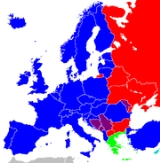
Languages of Europe

Encyclopedia
Most of the language
s of Europe
belong to Indo-European
language family
. These are divided into a number of branches, including Romance
, Germanic
, Balto-Slavic
, Greek
, and others. The Uralic languages
also have a significant presence in Europe, including the national languages Hungarian
, Finnish
, and Estonian
. The Turkic
and Mongolic
families also have several European members, while the North Caucasian
and Kartvelian families are important in the southeastern extremity of geographical Europe. The Basque language
of the western Pyrenees
is an isolate
unrelated to any other group, while Maltese
is the only Semitic language in Europe with national language status.
In addition to current languages, there are many languages once used in Europe which are now extinct
; see List of extinct languages of Europe. Other languages are nearly extinct; see List of endangered languages in Europe. This article also does not include languages spoken by relatively recently-arrived migrant communities.
descended from Proto-Indo-European
, believed to have been spoken thousands of years ago. Indo-European languages are spoken throughout Europe, but particularly dominate Western Europe
.
has two major dialects, Gheg
and Tosk
. It is spoken in Albania
, the Republic of Macedonia
, Kosovo
, and parts of Montenegro
, Serbia
, Turkey
, southern Italy
(Arbëresh
), and Greece
(Arvanitika
). Emigrants speak it in many other countries.
has two major dialects, Western Armenian
and Eastern Armenian
. It is spoken in Armenia
, where it has sole official status, and is also spoken in neighboring Georgia
, Iran
, and Azerbaijan
. It is also spoken in Turkey
by a very small minority (Western Armenian and Homshetsi
), and by small minorities in many other countries where members of the widely dispersed Armenian diaspora
reside.
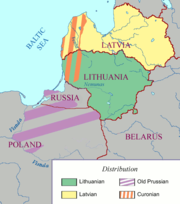 The Baltic languages
are spoken in Lithuania
(Lithuanian
, Samogitian
) and Latvia
(Latvian
, Latgalian
). Samogitian and Latgalian are usually considered to be dialects of Lithuanian and Latvian respectively.
New Curonian
is nearly extinct: it was spoken in the Curonian Spit
which is now divided between Lithuania and the Kaliningrad Oblast
. There are also several extinct Baltic languages, including Prussian
and Sudovian
.
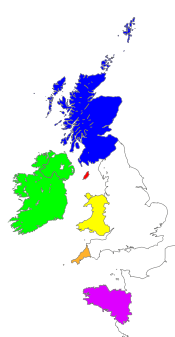 The modern Celtic languages
are divided into
Continental Celtic languages
became extinct in the first millennium AD, but had previously been spoken across Europe from Iberia and Gaul to Asia Minor.
make up the predominant language family in northwestern Europe, reaching from Iceland
to Sweden
and from England
and Ireland
to Austria
. There are two extant major sub-divisions: West Germanic
and North Germanic
. A third group, East Germanic
, is now extinct; the only known surviving East Germanic texts are written in the Gothic language
.
: Anglo-Frisian
, Low Franconian
(now primarily modern Dutch
) and Low German (Saxon)
; the latter two include the pluricentric
German
varieties including Standard German
.
The Anglo-Frisian language family
has two major groups:
German
is spoken throughout Germany
, Austria
, Liechtenstein
, the East Cantons of Belgium and much of Switzerland
(including the northeast areas bordering on Germany and Austria).
There are several groups of German dialects:
are spoken in Scandinavian countries
and include Danish
(Denmark
, Greenland
and the Faroe Islands
), Norwegian
(Norway
), Swedish (Sweden
and parts of Finland
), Elfdalian or Övdalian (in a small part of central Sweden), Faroese
(Faroe Islands
), and Icelandic
(Iceland
).
have two major groupings, Indo-Aryan languages
including Romany (or Gypsy), and Iranian languages
, which include Kurdish
and Ossetian
.
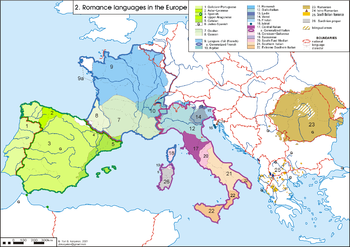 The Romance languages
descended from the Vulgar Latin
spoken across most of the lands of the Roman Empire
. Some of the Romance languages are official in the European Union
and the Latin Union
and the more prominent ones are studied in many educational institutions worldwide. Three of the Romance languages (Spanish
, French
, and Portuguese
) are spoken by a combined roughly one billion speakers worldwide. Many other Romance languages and their local varieties are spoken throughout Europe, and some are recognized as regional languages.
The list below is a brief summary of the Romance languages commonly encountered in Europe.
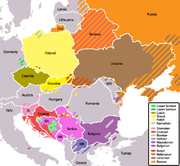 Slavic languages
are spoken in large areas of Central Europe
, Southern Europe
and Eastern Europe
including Russia
.
and the ancestral language
of the Basque people
who inhabit the Basque Country, a region in the western Pyrenees
mountains mostly in northeastern Spain
and partly in southwestern France
of about 3,000,000 inhabitants, where it is spoken fluently by about 750,000 and understood by more than 1,500,000.
Basque is directly related to ancient Aquitanian
, and it is likely that an early form of the Basque language was present in Western Europe before the arrival of the Indo-European languages in the area. The language may have been spoken since Paleolithic times
.
Basque is also spoken by immigrants in Australia
, Costa Rica
, Mexico
, the Philippines
and the United States
, especially in Nevada
, Idaho
and California
.
and the related languages of Svan
, Mingrelian, and Laz
. Proto-Kartvelian is believed to be a common ancestor language of all Kartvelian languages, with the earliest split occurring in the second millennium BC or earlier when Svan
was separated. Megrelian and Laz split from Georgian roughly a thousand years later, roughly at the beginning of the first millennium BC (e.g. Klimov, T. Gamkrelidze, G. Machavariani).
The group is considered as isolated, and although for simplicity it is at times grouped with North Caucasian languages, no linguistic relationship exists between the two language groups.
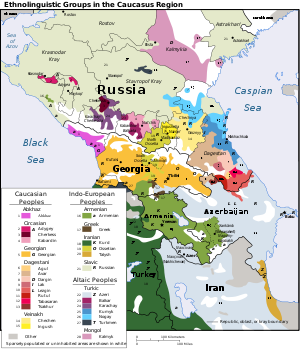
(sometimes called simply Caucasic as opposed to Kartvelian, and to avoid confusion with the concept of the "Caucasian race
") is a blanket term for two language phyla
spoken chiefly in the north Caucasus
and Turkey
: the Northwest Caucasian
family (including the Circassian
and Abkhaz
, spoken in Abkhazia
) and the Northeast Caucasian
family spoken mainly in the border area of the southern Russian Federation (including Dagestan
, Chechnya
, and Ingushetia
).
Many linguists, notably Sergei Starostin
and Sergei Nikolayev, believe that the two groups sprang from a common ancestor about 5,000 years ago. However this view is difficult to evaluate, and remains controversial.
, Finnish
, and Hungarian
. See this classification for a detailed list.
language family
is claimed to consist of five branches (Turkic
, Mongolian, Tungusic
, Korean
and Japanese
) that show similarities in vocabulary, morphological and syntactic structure, and certain phonological features. On the basis of systematic sound correspondences, they are generally considered to be genetically related.
The most prominent Turkic language in Europe is Turkish
.
The Mongolic languages
originated in Asia, and most did not proliferate west to Europe. Kalmyk
is spoken in the Republic of Kalmykia, part of the Russian Federation, and is thus the only native Mongolic language spoken in Europe.
(also known as Cypriot Arabic) is a variety of Arabic
spoken by Maronites in Cyprus
. Most speakers live in Nicosia
, but others are in the communities of Kormakiti and Lemesos
. Brought to the island by Maronites fleeing Lebanon
over 700 years ago, this variety of Arabic has been influenced by Greek
in both phonology
and vocabulary
, while retaining certain unusually archaic features in other respects.
, educational and often conversational contexts since the entry of the Jews
into Europe at some uncertainly known time in late antiquity
. Its restoration as the official language of Israel
has accelerated its secular use. It also has been used in educational and liturgical contexts by some segments of the Christian
population. Hebrew has its own consonantal alphabet
, in which the vowels may be marked by diacritic
al marks termed pointing
in English and dagesh and mappiq in Hebrew. The Hebrew alphabet was also used to write Yiddish
, a West Germanic language, and Ladino, a Romance language, formerly spoken by Jews in northern and southern Europe respectively, but now nearly extinct in Europe itself.
is a Semitic language with Romance and Germanic influences, spoken in Malta
. It is based on Sicilian Arabic, with influences from Italian
(particularly Sicilian
), French
, and more recently, English
. It is unique in being the only Semitic language written in the Latin alphabet
in its standard form
. It is the smallest official language of the EU
in terms of speakers, and the only official Semitic language within the EU.
in Florence, 1617 Fruchtbringende Gesellschaft in Weimar, 1635 Académie française
in Paris, 1713 Real Academia Española
in Madrid). Language became increasingly linked to nation as opposed to culture, and was also used to promote religious and ethnic identity (e.g. different Bible translations in the same language for Catholics and Protestants).
The first languages for which standardisation was promoted included Italian ("questione della lingua": Modern Tuscan/Florentine vs. Old Tuscan/Florentine vs. Venetian > Modern Florentine + archaic Tuscan + Upper Italian), French (the standard is based on Parisian), English (the standard is based on the London dialect) and (High) German (based on the dialects of the chancellery of Meissen in Saxony, Middle German and the chancellery of Prague in Bohemia ("Common German")). But several other nations also began to develop a standard variety in the 16th century.
.jpg)
The main scripts used in Europe today are the Latin and Cyrillic, but with Greek having its own script. All of the aforementioned are alphabets.
was derived from the Phoenician
and Latin was derived from the Greek via the Old Italic alphabet
.
In the Early Middle Ages, Ogham
was used in Ireland and runes (derived the Old Italic script) in Scandinavia. Both were replaced in general use by the Latin alphabet by the Late Middle Ages. The Cyrillic script was derived from the Greek with the first texts appearing around 940 AD.
Around 1900, there were two variants of the Latin alphabet
used in Europe: Antiqua and Fraktur
. Fraktur was used most for German, Estonian, Latvian, Norwegian and Danish whereas Antiqua was used for Italian, Spanish, French, Portuguese, English, Romanian, Swedish and Finnish. The Fraktur variant was banned by Hitler in 1941, having been described as "Schwabacher
Jewish letters". Other scripts have historically been in use in Europe, including Arabic during the era of the Ottoman Empire, Phoenician, from which modern Latin letters descend, Ancient Egyptian hieroglyphs on Egyptian artefacts traded during Antiquity, and various runic systems used in Northern Europe preceding Christianisation.
s, each with its own ethnic identity
, based among other cultural factors on its language. For example, the Latini speaking Latin
in Latium
. A number of tribes with a common language might combine into a nation
; for example, the Galli living in Gallia
comprised many loosely confederated tribes, such as the Parisii, whose settlement became Paris, but they all spoke the Gallic language. Later, multi-ethnic political states formed, such as Rome, in which one language (Latin) dominated and was official or quasi-official. Over the centuries these formerly tribal states acquired different ethnic groups because of changes in political boundaries or due to immigration (voluntary or otherwise).
Linguistic conflict has been important in European history. Historical attitudes towards linguistic diversity are illustrated by two French laws: the Ordonnance de Villers-Cotterêts
(1539), which said that every document in France should be written in French (i.e. neither in Latin nor in Occitan) and the Loi Toubon
(1994), which aimed to eliminate Anglicisms from official documents. States and populations within a state have often resorted to war to settle their differences. Attempts have been made to prevent such hostilities: one such initiative was the Council of Europe
, founded in 1949, whose membership is open to European nations. It offers quasi-constitutional policies and institutions designed to intervene in ethnic conflict in favor of basic human rights. Its European Charter for Regional or Minority Languages
defines "regional or minority languages" as those spoken by "numerically smaller" populations of nationals and which are "different from the official language(s) of the state." Dialects of official languages and the "language of migrants" are excluded. The document affirms the right of minority-language speakers to use their language fully and freely. The Council of Europe is committed to protecting linguistic diversity.
Currently all European countries except France
, Andorra
and Turkey
have signed the Framework Convention for the Protection of National Minorities
, while Greece
, Iceland
and Luxembourg
have signed it, but have not ratified it. This framework entered into force in 1998.
(EU) designates one or more languages as "official and working" with regard to any member state if they are the official languages of that state. The decision as to whether they are and their use by the EU as such is entirely up to the laws and policies of the member states. In the case of multiple official languages the member state must designate which one is to be the working language.
As the EU is an entirely voluntary association established by treaty — a member state may withdraw at any time — each member retains its sovereignty in deciding what use to make of its own languages; it must agree to legislate any EU acceptance criteria before membership. The EU designation as official and working is only an agreement concerning the languages to be used in transacting official business between the member state and the EU, especially in the translation of documents passed between the EU and the member state. The EU does not attempt in any way to govern language use in a member state.
Currently the EU has designated by agreement with the member states 23 languages as "official and working:" Bulgarian, Czech, Danish, Dutch, English, Estonian, Finnish, French, German, Greek, Hungarian, Irish, Italian, Latvian, Lithuanian, Maltese, Polish, Portuguese, Romanian, Slovak, Slovenian, Spanish and Swedish. This designation provides member states with two "entitlements:" the member state may communicate with the EU in the designated one of those languages and view "EU regulations and other legislative documents" in that language.
: Learning, Teaching, Assessment (CEFR)," is an educational standard defining "the competencies necessary for communication" and related knowledge for the benefit of educators in setting up educational programs. That document defines three general levels of knowledge: A Basic User, B Independent User and C Proficient User. The ability to speak the language falls under competencies B and C ranging from "can keep going comprehensibly" to "can express him/herself at length with a natural, effortless, unhesitating flow."
These distinctions were simplified in a 2005 independent survey requested by the Directorate General for Education and Culture of the EU of the extent to which the major languages of Europe were spoken in the member states of the EU. The results were published in a 2006 document, "Europeans and Their Languages", or "Eurobarometer 243," which is disavowed as official by the European Commission, but does supply some scientific data concerning language use in the EU. In this study statistically relevant samples of the population in each country were asked to fill out a survey form concerning the languages that they spoke with sufficient competency "to be able to have a Some of the results showing the distribution of major languages are shown in the maps below. The darkest colors report the highest proportion of speakers. Only EU members were studied. Thus data on Russian speakers were gathered, but Russia is not an EU member and so Russian does not appear in Russia on the maps. It does appear as spoken to the greatest extent in the Baltic countries, which are EU members that were formerly under Soviet rule; followed by former Eastern bloc countries such as Poland, the Czech Republic, and the eastern portions of Germany (former socialist East Germany).
Language
Language may refer either to the specifically human capacity for acquiring and using complex systems of communication, or to a specific instance of such a system of complex communication...
s of Europe
Europe
Europe is, by convention, one of the world's seven continents. Comprising the westernmost peninsula of Eurasia, Europe is generally 'divided' from Asia to its east by the watershed divides of the Ural and Caucasus Mountains, the Ural River, the Caspian and Black Seas, and the waterways connecting...
belong to Indo-European
Indo-European languages
The Indo-European languages are a family of several hundred related languages and dialects, including most major current languages of Europe, the Iranian plateau, and South Asia and also historically predominant in Anatolia...
language family
Language family
A language family is a group of languages related through descent from a common ancestor, called the proto-language of that family. The term 'family' comes from the tree model of language origination in historical linguistics, which makes use of a metaphor comparing languages to people in a...
. These are divided into a number of branches, including Romance
Romance languages
The Romance languages are a branch of the Indo-European language family, more precisely of the Italic languages subfamily, comprising all the languages that descend from Vulgar Latin, the language of ancient Rome...
, Germanic
Germanic languages
The Germanic languages constitute a sub-branch of the Indo-European language family. The common ancestor of all of the languages in this branch is called Proto-Germanic , which was spoken in approximately the mid-1st millennium BC in Iron Age northern Europe...
, Balto-Slavic
Balto-Slavic languages
The Balto-Slavic language group traditionally comprises Baltic and Slavic languages, belonging to the Indo-European family of languages. Baltic and Slavic languages share several linguistic traits not found in any other Indo-European branch, which points to the period of common development...
, Greek
Greek language
Greek is an independent branch of the Indo-European family of languages. Native to the southern Balkans, it has the longest documented history of any Indo-European language, spanning 34 centuries of written records. Its writing system has been the Greek alphabet for the majority of its history;...
, and others. The Uralic languages
Uralic languages
The Uralic languages constitute a language family of some three dozen languages spoken by approximately 25 million people. The healthiest Uralic languages in terms of the number of native speakers are Hungarian, Finnish, Estonian, Mari and Udmurt...
also have a significant presence in Europe, including the national languages Hungarian
Hungarian language
Hungarian is a Uralic language, part of the Ugric group. With some 14 million speakers, it is one of the most widely spoken non-Indo-European languages in Europe....
, Finnish
Finnish language
Finnish is the language spoken by the majority of the population in Finland Primarily for use by restaurant menus and by ethnic Finns outside Finland. It is one of the two official languages of Finland and an official minority language in Sweden. In Sweden, both standard Finnish and Meänkieli, a...
, and Estonian
Estonian language
Estonian is the official language of Estonia, spoken by about 1.1 million people in Estonia and tens of thousands in various émigré communities...
. The Turkic
Turkic languages
The Turkic languages constitute a language family of at least thirty five languages, spoken by Turkic peoples across a vast area from Eastern Europe and the Mediterranean to Siberia and Western China, and are considered to be part of the proposed Altaic language family.Turkic languages are spoken...
and Mongolic
Mongolic languages
The Mongolic languages are a group of languages spoken in East-Central Asia, mostly in Mongolia and surrounding areas plus in Kalmykia. The best-known member of this language family, Mongolian, is the primary language of most of the residents of Mongolia and the Mongolian residents of Inner...
families also have several European members, while the North Caucasian
North Caucasian languages
North Caucasian languages is a blanket term for two language phyla spoken chiefly in the north Caucasus and Turkey: the Northwest Caucasian family and the Northeast Caucasian family North Caucasian languages (sometimes called simply Caucasic as opposed to Kartvelian, and to avoid confusion with...
and Kartvelian families are important in the southeastern extremity of geographical Europe. The Basque language
Basque language
Basque is the ancestral language of the Basque people, who inhabit the Basque Country, a region spanning an area in northeastern Spain and southwestern France. It is spoken by 25.7% of Basques in all territories...
of the western Pyrenees
Pyrenees
The Pyrenees is a range of mountains in southwest Europe that forms a natural border between France and Spain...
is an isolate
Language isolate
A language isolate, in the absolute sense, is a natural language with no demonstrable genealogical relationship with other languages; that is, one that has not been demonstrated to descend from an ancestor common with any other language. They are in effect language families consisting of a single...
unrelated to any other group, while Maltese
Maltese language
Maltese is the national language of Malta, and a co-official language of the country alongside English,while also serving as an official language of the European Union, the only Semitic language so distinguished. Maltese is descended from Siculo-Arabic...
is the only Semitic language in Europe with national language status.
In addition to current languages, there are many languages once used in Europe which are now extinct
Extinct language
An extinct language is a language that no longer has any speakers., or that is no longer in current use. Extinct languages are sometimes contrasted with dead languages, which are still known and used in special contexts in written form, but not as ordinary spoken languages for everyday communication...
; see List of extinct languages of Europe. Other languages are nearly extinct; see List of endangered languages in Europe. This article also does not include languages spoken by relatively recently-arrived migrant communities.
Indo-European languages
The Indo-European language familyIndo-European languages
The Indo-European languages are a family of several hundred related languages and dialects, including most major current languages of Europe, the Iranian plateau, and South Asia and also historically predominant in Anatolia...
descended from Proto-Indo-European
Proto-Indo-European language
The Proto-Indo-European language is the reconstructed common ancestor of the Indo-European languages, spoken by the Proto-Indo-Europeans...
, believed to have been spoken thousands of years ago. Indo-European languages are spoken throughout Europe, but particularly dominate Western Europe
Western Europe
Western Europe is a loose term for the collection of countries in the western most region of the European continents, though this definition is context-dependent and carries cultural and political connotations. One definition describes Western Europe as a geographic entity—the region lying in the...
.
Albanian
AlbanianAlbanian language
Albanian is an Indo-European language spoken by approximately 7.6 million people, primarily in Albania and Kosovo but also in other areas of the Balkans in which there is an Albanian population, including western Macedonia, southern Montenegro, southern Serbia and northwestern Greece...
has two major dialects, Gheg
Gheg Albanian
Gheg is one of the two major varieties of Albanian. The other one is Tosk, on which standard Albanian is based. The dividing line between these two varieties is the Shkumbin River, which winds its way through central Albania....
and Tosk
Tosk Albanian
Tosk is the southern dialect of the Albanian language. The line of demarcation between Tosk and Gheg is the Shkumbin River. Tosk is the basis of the standard Albanian language.- Tosks :...
. It is spoken in Albania
Albania
Albania , officially known as the Republic of Albania , is a country in Southeastern Europe, in the Balkans region. It is bordered by Montenegro to the northwest, Kosovo to the northeast, the Republic of Macedonia to the east and Greece to the south and southeast. It has a coast on the Adriatic Sea...
, the Republic of Macedonia
Republic of Macedonia
Macedonia , officially the Republic of Macedonia , is a country located in the central Balkan peninsula in Southeast Europe. It is one of the successor states of the former Yugoslavia, from which it declared independence in 1991...
, Kosovo
Kosovo
Kosovo is a region in southeastern Europe. Part of the Ottoman Empire for more than five centuries, later the Autonomous Province of Kosovo and Metohija within Serbia...
, and parts of Montenegro
Montenegro
Montenegro Montenegrin: Crna Gora Црна Гора , meaning "Black Mountain") is a country located in Southeastern Europe. It has a coast on the Adriatic Sea to the south-west and is bordered by Croatia to the west, Bosnia and Herzegovina to the northwest, Serbia to the northeast and Albania to the...
, Serbia
Serbia
Serbia , officially the Republic of Serbia , is a landlocked country located at the crossroads of Central and Southeast Europe, covering the southern part of the Carpathian basin and the central part of the Balkans...
, Turkey
Turkey
Turkey , known officially as the Republic of Turkey , is a Eurasian country located in Western Asia and in East Thrace in Southeastern Europe...
, southern Italy
Italy
Italy , officially the Italian Republic languages]] under the European Charter for Regional or Minority Languages. In each of these, Italy's official name is as follows:;;;;;;;;), is a unitary parliamentary republic in South-Central Europe. To the north it borders France, Switzerland, Austria and...
(Arbëresh
Arbëresh language
Arbëreshë, also known as Arbërisht, is an ethnolect spoken by the Arbëreshë, the group of Albanian-speaking minorities in Italy.-Classification:...
), and Greece
Greece
Greece , officially the Hellenic Republic , and historically Hellas or the Republic of Greece in English, is a country in southeastern Europe....
(Arvanitika
Arvanitika
Arvanitika also known Arvanitic is the variety of Albanian traditionally spoken by the Arvanites, a population group in Greece...
). Emigrants speak it in many other countries.
Armenian
ArmenianArmenian language
The Armenian language is an Indo-European language spoken by the Armenian people. It is the official language of the Republic of Armenia as well as in the region of Nagorno-Karabakh. The language is also widely spoken by Armenian communities in the Armenian diaspora...
has two major dialects, Western Armenian
Western Armenian language
Western Armenian is one of the two standardized forms of modern Armenian, the other being Eastern Armenian. The two standard forms form a pluricentric language. For historical reasons explained below, generally speaking, Western Armenian is used outside the Republic of Armenia, while Eastern...
and Eastern Armenian
Eastern Armenian language
Eastern Armenian is one of the two standardized forms of modern Armenian , the other being Western Armenian. The two standards form pluricentric language....
. It is spoken in Armenia
Armenia
Armenia , officially the Republic of Armenia , is a landlocked mountainous country in the Caucasus region of Eurasia...
, where it has sole official status, and is also spoken in neighboring Georgia
Georgia (country)
Georgia is a sovereign state in the Caucasus region of Eurasia. Located at the crossroads of Western Asia and Eastern Europe, it is bounded to the west by the Black Sea, to the north by Russia, to the southwest by Turkey, to the south by Armenia, and to the southeast by Azerbaijan. The capital of...
, Iran
Iran
Iran , officially the Islamic Republic of Iran , is a country in Southern and Western Asia. The name "Iran" has been in use natively since the Sassanian era and came into use internationally in 1935, before which the country was known to the Western world as Persia...
, and Azerbaijan
Azerbaijan
Azerbaijan , officially the Republic of Azerbaijan is the largest country in the Caucasus region of Eurasia. Located at the crossroads of Western Asia and Eastern Europe, it is bounded by the Caspian Sea to the east, Russia to the north, Georgia to the northwest, Armenia to the west, and Iran to...
. It is also spoken in Turkey
Turkey
Turkey , known officially as the Republic of Turkey , is a Eurasian country located in Western Asia and in East Thrace in Southeastern Europe...
by a very small minority (Western Armenian and Homshetsi
Homshetsi dialect
Homshetsi is an archaic Western Armenian dialect spoken by the Eastern group and the Northern group of Hamshenis , an ethnic group living in northeastern Turkey, Abkhazia and Russia.It is practically a dialect and mutually intelligible with Armenian...
), and by small minorities in many other countries where members of the widely dispersed Armenian diaspora
Armenian diaspora
The Armenian diaspora refers to the Armenian communities outside the Republic of Armenia and self proclaimed de facto independent Nagorno-Karabakh Republic...
reside.
Baltic languages
Baltic languages
The Baltic languages are a group of related languages belonging to the Balto-Slavic branch of the Indo-European language family and spoken mainly in areas extending east and southeast of the Baltic Sea in Northern Europe...
are spoken in Lithuania
Lithuania
Lithuania , officially the Republic of Lithuania is a country in Northern Europe, the biggest of the three Baltic states. It is situated along the southeastern shore of the Baltic Sea, whereby to the west lie Sweden and Denmark...
(Lithuanian
Lithuanian language
Lithuanian is the official state language of Lithuania and is recognized as one of the official languages of the European Union. There are about 2.96 million native Lithuanian speakers in Lithuania and about 170,000 abroad. Lithuanian is a Baltic language, closely related to Latvian, although they...
, Samogitian
Samogitian language
Samogitian is a dialect of the Lithuanian language spoken mostly in Samogitia . Attempts have been made to standardize it...
) and Latvia
Latvia
Latvia , officially the Republic of Latvia , is a country in the Baltic region of Northern Europe. It is bordered to the north by Estonia , to the south by Lithuania , to the east by the Russian Federation , to the southeast by Belarus and shares maritime borders to the west with Sweden...
(Latvian
Latvian language
Latvian is the official state language of Latvia. It is also sometimes referred to as Lettish. There are about 1.4 million native Latvian speakers in Latvia and about 150,000 abroad. The Latvian language has a relatively large number of non-native speakers, atypical for a small language...
, Latgalian
Latgalian language
Latgalian language can mean one of the following:#It was a language spoken by Latgalians in a great part of the area which is now Latvia. Latgalian was a member of the Baltic group of the Indo-European language family. Historically the Latvian language is derived from Latgalian Latgalian language...
). Samogitian and Latgalian are usually considered to be dialects of Lithuanian and Latvian respectively.
New Curonian
Curonian language
The Curonian language or Old Curonian is an extinct language spoken by the Curonian tribe, who lived mainly on the Courland peninsula and along the nearby Baltic shores....
is nearly extinct: it was spoken in the Curonian Spit
Curonian Spit
The Curonian Spit is a 98 km long, thin, curved sand-dune spit that separates the Curonian Lagoon from the Baltic Sea coast. Its southern portion lies within Kaliningrad Oblast, Russia and its northern within southwestern Lithuania...
which is now divided between Lithuania and the Kaliningrad Oblast
Kaliningrad Oblast
Kaliningrad Oblast is a federal subject of Russia situated on the Baltic coast. It has a population of The oblast forms the westernmost part of the Russian Federation, but it has no land connection to the rest of Russia. Since its creation it has been an exclave of the Russian SFSR and then the...
. There are also several extinct Baltic languages, including Prussian
Old Prussian language
Prussian is an extinct Baltic language, once spoken by the inhabitants of the original territory of Prussia in an area of what later became East Prussia and eastern parts of...
and Sudovian
Sudovian language
Sudovian is an extinct western Baltic language of Northeastern Europe. Closely related to the Old Prussian language, it was formerly spoken southwest of the Nemunas river in what is now Lithuania, east of Galindia and north of Yotvingia, and by exiles in East Prussia.-History:Sudovia and...
.
Celtic
Celtic languages
The Celtic languages are descended from Proto-Celtic, or "Common Celtic"; a branch of the greater Indo-European language family...
are divided into
- the Brythonic familyBrythonic languagesThe Brythonic or Brittonic languages form one of the two branches of the Insular Celtic language family, the other being Goidelic. The name Brythonic was derived by Welsh Celticist John Rhys from the Welsh word Brython, meaning an indigenous Briton as opposed to an Anglo-Saxon or Gael...
: WelshWelsh languageWelsh is a member of the Brythonic branch of the Celtic languages spoken natively in Wales, by some along the Welsh border in England, and in Y Wladfa...
, spoken primarily in WalesWalesWales is a country that is part of the United Kingdom and the island of Great Britain, bordered by England to its east and the Atlantic Ocean and Irish Sea to its west. It has a population of three million, and a total area of 20,779 km²...
, BretonBreton languageBreton is a Celtic language spoken in Brittany , France. Breton is a Brythonic language, descended from the Celtic British language brought from Great Britain to Armorica by migrating Britons during the Early Middle Ages. Like the other Brythonic languages, Welsh and Cornish, it is classified as...
(BrittanyBrittanyBrittany is a cultural and administrative region in the north-west of France. Previously a kingdom and then a duchy, Brittany was united to the Kingdom of France in 1532 as a province. Brittany has also been referred to as Less, Lesser or Little Britain...
, in northwestern FranceFranceThe French Republic , The French Republic , The French Republic , (commonly known as France , is a unitary semi-presidential republic in Western Europe with several overseas territories and islands located on other continents and in the Indian, Pacific, and Atlantic oceans. Metropolitan France...
), and CornishCornish languageCornish is a Brythonic Celtic language and a recognised minority language of the United Kingdom. Along with Welsh and Breton, it is directly descended from the ancient British language spoken throughout much of Britain before the English language came to dominate...
(CornwallCornwallCornwall is a unitary authority and ceremonial county of England, within the United Kingdom. It is bordered to the north and west by the Celtic Sea, to the south by the English Channel, and to the east by the county of Devon, over the River Tamar. Cornwall has a population of , and covers an area of...
, in south west EnglandEnglandEngland is a country that is part of the United Kingdom. It shares land borders with Scotland to the north and Wales to the west; the Irish Sea is to the north west, the Celtic Sea to the south west, with the North Sea to the east and the English Channel to the south separating it from continental...
), and
- the Goidelic (Gaelic) familyGoidelic languagesThe Goidelic languages or Gaelic languages are one of the two branches of the Insular Celtic languages, the other consisting of the Brythonic languages. Goidelic languages historically formed a dialect continuum stretching from the south of Ireland through the Isle of Man to the north of Scotland...
: IrishIrish languageIrish , also known as Irish Gaelic, is a Goidelic language of the Indo-European language family, originating in Ireland and historically spoken by the Irish people. Irish is now spoken as a first language by a minority of Irish people, as well as being a second language of a larger proportion of...
(spoken primarily in IrelandIrelandIreland is an island to the northwest of continental Europe. It is the third-largest island in Europe and the twentieth-largest island on Earth...
), Scottish GaelicScottish Gaelic languageScottish Gaelic is a Celtic language native to Scotland. A member of the Goidelic branch of the Celtic languages, Scottish Gaelic, like Modern Irish and Manx, developed out of Middle Irish, and thus descends ultimately from Primitive Irish....
(ScotlandScotlandScotland is a country that is part of the United Kingdom. Occupying the northern third of the island of Great Britain, it shares a border with England to the south and is bounded by the North Sea to the east, the Atlantic Ocean to the north and west, and the North Channel and Irish Sea to the...
), and Manx GaelicManx languageManx , also known as Manx Gaelic, and as the Manks language, is a Goidelic language of the Indo-European language family, historically spoken by the Manx people. Only a small minority of the Island's population is fluent in the language, but a larger minority has some knowledge of it...
(Isle of ManIsle of ManThe Isle of Man , otherwise known simply as Mann , is a self-governing British Crown Dependency, located in the Irish Sea between the islands of Great Britain and Ireland, within the British Isles. The head of state is Queen Elizabeth II, who holds the title of Lord of Mann. The Lord of Mann is...
, an island in the Irish SeaIrish SeaThe Irish Sea separates the islands of Ireland and Great Britain. It is connected to the Celtic Sea in the south by St George's Channel, and to the Atlantic Ocean in the north by the North Channel. Anglesey is the largest island within the Irish Sea, followed by the Isle of Man...
).
Continental Celtic languages
Continental Celtic languages
The Continental Celtic languages are the Celtic languages, now extinct, that were spoken on the continent of Europe, as distinguished from the Insular Celtic languages of Britain and Ireland. The Continental Celtic languages were spoken by the people known to Roman and Greek writers as Keltoi,...
became extinct in the first millennium AD, but had previously been spoken across Europe from Iberia and Gaul to Asia Minor.
Germanic
The Germanic languagesGermanic languages
The Germanic languages constitute a sub-branch of the Indo-European language family. The common ancestor of all of the languages in this branch is called Proto-Germanic , which was spoken in approximately the mid-1st millennium BC in Iron Age northern Europe...
make up the predominant language family in northwestern Europe, reaching from Iceland
Iceland
Iceland , described as the Republic of Iceland, is a Nordic and European island country in the North Atlantic Ocean, on the Mid-Atlantic Ridge. Iceland also refers to the main island of the country, which contains almost all the population and almost all the land area. The country has a population...
to Sweden
Sweden
Sweden , officially the Kingdom of Sweden , is a Nordic country on the Scandinavian Peninsula in Northern Europe. Sweden borders with Norway and Finland and is connected to Denmark by a bridge-tunnel across the Öresund....
and from England
England
England is a country that is part of the United Kingdom. It shares land borders with Scotland to the north and Wales to the west; the Irish Sea is to the north west, the Celtic Sea to the south west, with the North Sea to the east and the English Channel to the south separating it from continental...
and Ireland
Ireland
Ireland is an island to the northwest of continental Europe. It is the third-largest island in Europe and the twentieth-largest island on Earth...
to Austria
Austria
Austria , officially the Republic of Austria , is a landlocked country of roughly 8.4 million people in Central Europe. It is bordered by the Czech Republic and Germany to the north, Slovakia and Hungary to the east, Slovenia and Italy to the south, and Switzerland and Liechtenstein to the...
. There are two extant major sub-divisions: West Germanic
West Germanic languages
The West Germanic languages constitute the largest of the three traditional branches of the Germanic family of languages and include languages such as German, English, Dutch, Afrikaans, the Frisian languages, and Yiddish...
and North Germanic
North Germanic languages
The North Germanic languages or Scandinavian languages, the languages of Scandinavians, make up one of the three branches of the Germanic languages, a sub-family of the Indo-European languages, along with the West Germanic languages and the extinct East Germanic languages...
. A third group, East Germanic
East Germanic languages
The East Germanic languages are a group of extinct Indo-European languages in the Germanic family. The only East Germanic language of which texts are known is Gothic; other languages that are assumed to be East Germanic include Vandalic, Burgundian, and Crimean Gothic...
, is now extinct; the only known surviving East Germanic texts are written in the Gothic language
Gothic language
Gothic is an extinct Germanic language that was spoken by the Goths. It is known primarily from the Codex Argenteus, a 6th-century copy of a 4th-century Bible translation, and is the only East Germanic language with a sizable Text corpus...
.
West Germanic
There are three major groupings of West Germanic languagesWest Germanic languages
The West Germanic languages constitute the largest of the three traditional branches of the Germanic family of languages and include languages such as German, English, Dutch, Afrikaans, the Frisian languages, and Yiddish...
: Anglo-Frisian
Anglo-Frisian languages
The Anglo-Frisian languages form a group of West Germanic languages consisting of Old English, Old Frisian, and their descendants...
, Low Franconian
Low Franconian languages
Low Franconian, Low Frankish, or Istvaeonic, is a group of several West Germanic languages spoken in the Netherlands, northern Belgium , in the northern department of France, in western Germany , as well as in Suriname, South Africa and Namibia that originally descended from Old Frankish.- The...
(now primarily modern Dutch
Dutch language
Dutch is a West Germanic language and the native language of the majority of the population of the Netherlands, Belgium, and Suriname, the three member states of the Dutch Language Union. Most speakers live in the European Union, where it is a first language for about 23 million and a second...
) and Low German (Saxon)
Low German
Low German or Low Saxon is an Ingvaeonic West Germanic language spoken mainly in northern Germany and the eastern part of the Netherlands...
; the latter two include the pluricentric
Pluricentric language
A pluricentric language is a language with several standard versions, both in spoken and in written forms. This situation usually arises when language and the national identity of its native speakers do not, or did not, coincide.-English:...
German
German language
German is a West Germanic language, related to and classified alongside English and Dutch. With an estimated 90 – 98 million native speakers, German is one of the world's major languages and is the most widely-spoken first language in the European Union....
varieties including Standard German
Standard German
Standard German is the standard variety of the German language used as a written language, in formal contexts, and for communication between different dialect areas...
.
Anglo-Frisian
The Anglo-Frisian language family
Anglo-Frisian languages
The Anglo-Frisian languages form a group of West Germanic languages consisting of Old English, Old Frisian, and their descendants...
has two major groups:
- The English languages descended from the Old English languageOld English languageOld English or Anglo-Saxon is an early form of the English language that was spoken and written by the Anglo-Saxons and their descendants in parts of what are now England and southeastern Scotland between at least the mid-5th century and the mid-12th century...
of the Anglo-SaxonsAnglo-SaxonsAnglo-Saxon is a term used by historians to designate the Germanic tribes who invaded and settled the south and east of Great Britain beginning in the early 5th century AD, and the period from their creation of the English nation to the Norman conquest. The Anglo-Saxon Era denotes the period of...
and include:- EnglishEnglish languageEnglish is a West Germanic language that arose in the Anglo-Saxon kingdoms of England and spread into what was to become south-east Scotland under the influence of the Anglian medieval kingdom of Northumbria...
, spoken in EnglandEnglandEngland is a country that is part of the United Kingdom. It shares land borders with Scotland to the north and Wales to the west; the Irish Sea is to the north west, the Celtic Sea to the south west, with the North Sea to the east and the English Channel to the south separating it from continental...
and throughout the United KingdomUnited KingdomThe United Kingdom of Great Britain and Northern IrelandIn the United Kingdom and Dependencies, other languages have been officially recognised as legitimate autochthonous languages under the European Charter for Regional or Minority Languages...
, and also in English-speaking EuropeEnglish-speaking EuropeThe English language in Europe, as a native language, is mainly spoken in the United Kingdom and Ireland. Outside of these states, it has a special status in Jersey and Guernsey , Gibraltar , Malta and Cyprus... - Modern ScotsScots languageScots is the Germanic language variety spoken in Lowland Scotland and parts of Ulster . It is sometimes called Lowland Scots to distinguish it from Scottish Gaelic, the Celtic language variety spoken in most of the western Highlands and in the Hebrides.Since there are no universally accepted...
, spoken in ScotlandScotlandScotland is a country that is part of the United Kingdom. Occupying the northern third of the island of Great Britain, it shares a border with England to the south and is bounded by the North Sea to the east, the Atlantic Ocean to the north and west, and the North Channel and Irish Sea to the...
and UlsterUlsterUlster is one of the four provinces of Ireland, located in the north of the island. In ancient Ireland, it was one of the fifths ruled by a "king of over-kings" . Following the Norman invasion of Ireland, the ancient kingdoms were shired into a number of counties for administrative and judicial...
- English
- The Frisian languages are spoken by about 500,000 FrisiansFrisiansThe Frisians are a Germanic ethnic group native to the coastal parts of the Netherlands and Germany. They are concentrated in the Dutch provinces of Friesland and Groningen and, in Germany, East Frisia and North Frisia, that was a part of Denmark until 1864. They inhabit an area known as Frisia...
, who live on the southern coast of the North SeaNorth SeaIn the southwest, beyond the Straits of Dover, the North Sea becomes the English Channel connecting to the Atlantic Ocean. In the east, it connects to the Baltic Sea via the Skagerrak and Kattegat, narrow straits that separate Denmark from Norway and Sweden respectively...
in the NetherlandsNetherlandsThe Netherlands is a constituent country of the Kingdom of the Netherlands, located mainly in North-West Europe and with several islands in the Caribbean. Mainland Netherlands borders the North Sea to the north and west, Belgium to the south, and Germany to the east, and shares maritime borders...
and GermanyGermanyGermany , officially the Federal Republic of Germany , is a federal parliamentary republic in Europe. The country consists of 16 states while the capital and largest city is Berlin. Germany covers an area of 357,021 km2 and has a largely temperate seasonal climate...
, and include West FrisianWest Frisian languageWest Frisian is a language spoken mostly in the province of Friesland in the north of the Netherlands. West Frisian is the name by which this language is usually known outside the Netherlands, to distinguish it from the closely related Frisian languages of Saterland Frisian and North Frisian,...
, Saterlandic, and North FrisianNorth Frisian languageNorth Frisian is a minority language of Germany, spoken by about 10,000 people in North Frisia. The language is part of the larger group of the West Germanic Frisian languages.-Classification:...
.
German
German
German language
German is a West Germanic language, related to and classified alongside English and Dutch. With an estimated 90 – 98 million native speakers, German is one of the world's major languages and is the most widely-spoken first language in the European Union....
is spoken throughout Germany
Germany
Germany , officially the Federal Republic of Germany , is a federal parliamentary republic in Europe. The country consists of 16 states while the capital and largest city is Berlin. Germany covers an area of 357,021 km2 and has a largely temperate seasonal climate...
, Austria
Austria
Austria , officially the Republic of Austria , is a landlocked country of roughly 8.4 million people in Central Europe. It is bordered by the Czech Republic and Germany to the north, Slovakia and Hungary to the east, Slovenia and Italy to the south, and Switzerland and Liechtenstein to the...
, Liechtenstein
Liechtenstein
The Principality of Liechtenstein is a doubly landlocked alpine country in Central Europe, bordered by Switzerland to the west and south and by Austria to the east. Its area is just over , and it has an estimated population of 35,000. Its capital is Vaduz. The biggest town is Schaan...
, the East Cantons of Belgium and much of Switzerland
Switzerland
Switzerland name of one of the Swiss cantons. ; ; ; or ), in its full name the Swiss Confederation , is a federal republic consisting of 26 cantons, with Bern as the seat of the federal authorities. The country is situated in Western Europe,Or Central Europe depending on the definition....
(including the northeast areas bordering on Germany and Austria).
There are several groups of German dialects:
- High German include several dialect families:
- Standard GermanGerman languageGerman is a West Germanic language, related to and classified alongside English and Dutch. With an estimated 90 – 98 million native speakers, German is one of the world's major languages and is the most widely-spoken first language in the European Union....
(High German) - Central GermanCentral GermanCentral German is a group of High German dialects spoken from the Rhineland in the west to the former eastern territories of Germany.-History:...
dialects are spoken in central Germany and include LuxembourgishLuxembourgish languageLuxembourgish is a High German language spoken mainly in Luxembourg. About 320,000 people worldwide speak Luxembourgish.-Language family:...
. - High Franconian is a family of transitional dialects between Central and Upper High German.
- Upper GermanUpper GermanUpper German is a family of High German dialects spoken primarily in southern Germany, Austria, Switzerland and Northern Italy.-Family tree:Upper German can be generally classified as Alemannic or Austro-Bavarian...
including Austro-BavarianAustro-BavarianBavarian , also Austro-Bavarian, is a major group of Upper German varieties spoken in the south east of the German language area.-History and origin:...
and Swiss GermanSwiss GermanSwiss German is any of the Alemannic dialects spoken in Switzerland and in some Alpine communities in Northern Italy. Occasionally, the Alemannic dialects spoken in other countries are grouped together with Swiss German as well, especially the dialects of Liechtenstein and Austrian Vorarlberg...
.
- Standard German
Low Franconian
- DutchDutch languageDutch is a West Germanic language and the native language of the majority of the population of the Netherlands, Belgium, and Suriname, the three member states of the Dutch Language Union. Most speakers live in the European Union, where it is a first language for about 23 million and a second...
is spoken throughout the NetherlandsNetherlandsThe Netherlands is a constituent country of the Kingdom of the Netherlands, located mainly in North-West Europe and with several islands in the Caribbean. Mainland Netherlands borders the North Sea to the north and west, Belgium to the south, and Germany to the east, and shares maritime borders...
, northern BelgiumBelgiumBelgium , officially the Kingdom of Belgium, is a federal state in Western Europe. It is a founding member of the European Union and hosts the EU's headquarters, and those of several other major international organisations such as NATO.Belgium is also a member of, or affiliated to, many...
, as well as the Nord-Pas de CalaisNord-Pas de CalaisNord-Pas de Calais , Nord for short, is one of the 27 regions of France. It consists of the departments of Nord and Pas-de-Calais, in the north and has a border with Belgium. Most of the region was once part of the Southern Netherlands, within the Low Countries, and gradually became part of France...
region of FranceFranceThe French Republic , The French Republic , The French Republic , (commonly known as France , is a unitary semi-presidential republic in Western Europe with several overseas territories and islands located on other continents and in the Indian, Pacific, and Atlantic oceans. Metropolitan France...
and around DüsseldorfDüsseldorfDüsseldorf is the capital city of the German state of North Rhine-Westphalia and centre of the Rhine-Ruhr metropolitan region.Düsseldorf is an important international business and financial centre and renowned for its fashion and trade fairs. Located centrally within the European Megalopolis, the...
in Germany. In Belgian and French contexts, the language is sometimes referred to as FlemishFlemishFlemish can refer to anything related to Flanders, and may refer directly to the following articles:*Flemish, an informal, though linguistically incorrect, name of any kind of the Dutch language as spoken in Belgium....
. Dutch dialectsDutch dialectsDutch dialects are primarily the dialects that are both cognate with the Dutch language and are spoken in the same language area as the Dutch standard language. Dutch dialects are remarkably diverse and are found in the Netherlands and northern Belgium....
are varied and cut across national borders. - AfrikaansAfrikaansAfrikaans is a West Germanic language, spoken natively in South Africa and Namibia. It is a daughter language of Dutch, originating in its 17th century dialects, collectively referred to as Cape Dutch .Afrikaans is a daughter language of Dutch; see , , , , , .Afrikaans was historically called Cape...
is spoken by South-African emigrant communities in Europe, most notably in the Netherlands, Belgium and the United Kingdom.
North Germanic
The North Germanic languagesNorth Germanic languages
The North Germanic languages or Scandinavian languages, the languages of Scandinavians, make up one of the three branches of the Germanic languages, a sub-family of the Indo-European languages, along with the West Germanic languages and the extinct East Germanic languages...
are spoken in Scandinavian countries
Scandinavia
Scandinavia is a cultural, historical and ethno-linguistic region in northern Europe that includes the three kingdoms of Denmark, Norway and Sweden, characterized by their common ethno-cultural heritage and language. Modern Norway and Sweden proper are situated on the Scandinavian Peninsula,...
and include Danish
Danish language
Danish is a North Germanic language spoken by around six million people, principally in the country of Denmark. It is also spoken by 50,000 Germans of Danish ethnicity in the northern parts of Schleswig-Holstein, Germany, where it holds the status of minority language...
(Denmark
Denmark
Denmark is a Scandinavian country in Northern Europe. The countries of Denmark and Greenland, as well as the Faroe Islands, constitute the Kingdom of Denmark . It is the southernmost of the Nordic countries, southwest of Sweden and south of Norway, and bordered to the south by Germany. Denmark...
, Greenland
Greenland
Greenland is an autonomous country within the Kingdom of Denmark, located between the Arctic and Atlantic Oceans, east of the Canadian Arctic Archipelago. Though physiographically a part of the continent of North America, Greenland has been politically and culturally associated with Europe for...
and the Faroe Islands
Faroe Islands
The Faroe Islands are an island group situated between the Norwegian Sea and the North Atlantic Ocean, approximately halfway between Scotland and Iceland. The Faroe Islands are a self-governing territory within the Kingdom of Denmark, along with Denmark proper and Greenland...
), Norwegian
Norwegian language
Norwegian is a North Germanic language spoken primarily in Norway, where it is the official language. Together with Swedish and Danish, Norwegian forms a continuum of more or less mutually intelligible local and regional variants .These Scandinavian languages together with the Faroese language...
(Norway
Norway
Norway , officially the Kingdom of Norway, is a Nordic unitary constitutional monarchy whose territory comprises the western portion of the Scandinavian Peninsula, Jan Mayen, and the Arctic archipelago of Svalbard and Bouvet Island. Norway has a total area of and a population of about 4.9 million...
), Swedish (Sweden
Sweden
Sweden , officially the Kingdom of Sweden , is a Nordic country on the Scandinavian Peninsula in Northern Europe. Sweden borders with Norway and Finland and is connected to Denmark by a bridge-tunnel across the Öresund....
and parts of Finland
Finland
Finland , officially the Republic of Finland, is a Nordic country situated in the Fennoscandian region of Northern Europe. It is bordered by Sweden in the west, Norway in the north and Russia in the east, while Estonia lies to its south across the Gulf of Finland.Around 5.4 million people reside...
), Elfdalian or Övdalian (in a small part of central Sweden), Faroese
Faroese language
Faroese , is an Insular Nordic language spoken by 48,000 people in the Faroe Islands and about 25,000 Faroese people in Denmark and elsewhere...
(Faroe Islands
Faroe Islands
The Faroe Islands are an island group situated between the Norwegian Sea and the North Atlantic Ocean, approximately halfway between Scotland and Iceland. The Faroe Islands are a self-governing territory within the Kingdom of Denmark, along with Denmark proper and Greenland...
), and Icelandic
Icelandic language
Icelandic is a North Germanic language, the main language of Iceland. Its closest relative is Faroese.Icelandic is an Indo-European language belonging to the North Germanic or Nordic branch of the Germanic languages. Historically, it was the westernmost of the Indo-European languages prior to the...
(Iceland
Iceland
Iceland , described as the Republic of Iceland, is a Nordic and European island country in the North Atlantic Ocean, on the Mid-Atlantic Ridge. Iceland also refers to the main island of the country, which contains almost all the population and almost all the land area. The country has a population...
).
Greek
- GreekGreek languageGreek is an independent branch of the Indo-European family of languages. Native to the southern Balkans, it has the longest documented history of any Indo-European language, spanning 34 centuries of written records. Its writing system has been the Greek alphabet for the majority of its history;...
is the official language of GreeceGreeceGreece , officially the Hellenic Republic , and historically Hellas or the Republic of Greece in English, is a country in southeastern Europe....
and CyprusCyprusCyprus , officially the Republic of Cyprus , is a Eurasian island country, member of the European Union, in the Eastern Mediterranean, east of Greece, south of Turkey, west of Syria and north of Egypt. It is the third largest island in the Mediterranean Sea.The earliest known human activity on the...
, and there are Greek-speaking enclaves in AlbaniaAlbaniaAlbania , officially known as the Republic of Albania , is a country in Southeastern Europe, in the Balkans region. It is bordered by Montenegro to the northwest, Kosovo to the northeast, the Republic of Macedonia to the east and Greece to the south and southeast. It has a coast on the Adriatic Sea...
, BulgariaBulgariaBulgaria , officially the Republic of Bulgaria , is a parliamentary democracy within a unitary constitutional republic in Southeast Europe. The country borders Romania to the north, Serbia and Macedonia to the west, Greece and Turkey to the south, as well as the Black Sea to the east...
, ItalyItalyItaly , officially the Italian Republic languages]] under the European Charter for Regional or Minority Languages. In each of these, Italy's official name is as follows:;;;;;;;;), is a unitary parliamentary republic in South-Central Europe. To the north it borders France, Switzerland, Austria and...
, the Republic of MacedoniaRepublic of MacedoniaMacedonia , officially the Republic of Macedonia , is a country located in the central Balkan peninsula in Southeast Europe. It is one of the successor states of the former Yugoslavia, from which it declared independence in 1991...
, RomaniaRomaniaRomania is a country located at the crossroads of Central and Southeastern Europe, on the Lower Danube, within and outside the Carpathian arch, bordering on the Black Sea...
, GeorgiaGeorgia (country)Georgia is a sovereign state in the Caucasus region of Eurasia. Located at the crossroads of Western Asia and Eastern Europe, it is bounded to the west by the Black Sea, to the north by Russia, to the southwest by Turkey, to the south by Armenia, and to the southeast by Azerbaijan. The capital of...
, UkraineUkraineUkraine is a country in Eastern Europe. It has an area of 603,628 km², making it the second largest contiguous country on the European continent, after Russia...
, LebanonLebanonLebanon , officially the Republic of LebanonRepublic of Lebanon is the most common term used by Lebanese government agencies. The term Lebanese Republic, a literal translation of the official Arabic and French names that is not used in today's world. Arabic is the most common language spoken among...
, EgyptEgyptEgypt , officially the Arab Republic of Egypt, Arabic: , is a country mainly in North Africa, with the Sinai Peninsula forming a land bridge in Southwest Asia. Egypt is thus a transcontinental country, and a major power in Africa, the Mediterranean Basin, the Middle East and the Muslim world...
, IsraelIsraelThe State of Israel is a parliamentary republic located in the Middle East, along the eastern shore of the Mediterranean Sea...
, JordanJordanJordan , officially the Hashemite Kingdom of Jordan , Al-Mamlaka al-Urduniyya al-Hashemiyya) is a kingdom on the East Bank of the River Jordan. The country borders Saudi Arabia to the east and south-east, Iraq to the north-east, Syria to the north and the West Bank and Israel to the west, sharing...
and TurkeyTurkeyTurkey , known officially as the Republic of Turkey , is a Eurasian country located in Western Asia and in East Thrace in Southeastern Europe...
, and in Greek communitiesGreek diasporaThe Greek diaspora, also known as Hellenic Diaspora or Diaspora of Hellenism, is a term used to refer to the communities of Greek people living outside the traditional Greek homelands, but more commonly in southeast Europe and Asia Minor...
around the world. Dialects of modern Greek that originate from Attic GreekAttic GreekAttic Greek is the prestige dialect of Ancient Greek that was spoken in Attica, which includes Athens. Of the ancient dialects, it is the most similar to later Greek, and is the standard form of the language studied in courses of "Ancient Greek". It is sometimes included in Ionic.- Origin and range...
(through KoineKoine GreekKoine Greek is the universal dialect of the Greek language spoken throughout post-Classical antiquity , developing from the Attic dialect, with admixture of elements especially from Ionic....
and then Medieval GreekMedieval GreekMedieval Greek, also known as Byzantine Greek, is the stage of the Greek language between the beginning of the Middle Ages around 600 and the Ottoman conquest of the city of Constantinople in 1453. The latter date marked the end of the Middle Ages in Southeast Europe...
) are CappadocianCappadocian Greek languageCappadocian , also known as Cappadocian Greek or Asia Minor Greek, is a mixed language formerly spoken in Cappadocia . In the population exchange between Greece and Turkey in the 1920s, Cappadocian speakers were forced to emigrate to Greece, where they were resettled in various locations,...
, Pontic, CretanCretan GreekCretan Greek is a dialect of the Greek language, spoken by more than half a million people in Crete and many thousands in the diaspora....
, CypriotCypriot GreekThe Cypriot dialect of Modern Greek, known as Kypriaka , Cypriot Greek is spoken by 750,000 people in Cyprus and diaspora Greek Cypriots.Cypriot Greek is distinct enough that it can be classified as a distinct dialect of the Standard Greek....
, KatharevousaKatharevousaKatharevousa , is a form of the Greek language conceived in the early 19th century as a compromise between Ancient Greek and the Modern Greek of the time, with a vocabulary largely based on ancient forms, but a much-simplified grammar. Originally, it was widely used both for literary and official...
, and Yevanic. - GrikoGriko languageGriko, sometimes spelled Grico, is a form of the Greek language which is spoken by the Griko people in southern Italy. The Greeks consider it as a Modern Greek dialect and often call it Katoitaliotika or Grekanika...
is debatably a DoricDoric GreekDoric or Dorian was a dialect of ancient Greek. Its variants were spoken in the southern and eastern Peloponnese, Crete, Rhodes, some islands in the southern Aegean Sea, some cities on the coasts of Asia Minor, Southern Italy, Sicily, Epirus and Macedon. Together with Northwest Greek, it forms the...
dialect of the Greek Language. It is spoken in the lower CalabriaCalabriaCalabria , in antiquity known as Bruttium, is a region in southern Italy, south of Naples, located at the "toe" of the Italian Peninsula. The capital city of Calabria is Catanzaro....
region and in the SalentoSalentoSalento is the south-eastern extremity of the Apulia region of Italy. It is a sub-peninsula of the main Italian Peninsula, sometimes described as the "heel" of the Italian "boot"...
region of Southern ItalyItalyItaly , officially the Italian Republic languages]] under the European Charter for Regional or Minority Languages. In each of these, Italy's official name is as follows:;;;;;;;;), is a unitary parliamentary republic in South-Central Europe. To the north it borders France, Switzerland, Austria and...
. - TsakonianTsakonian languageTsakonian, Tsaconian, Tzakonian or Tsakonic is a Hellenic language, spoken in the Tsakonian region of the Peloponnese, Greece....
is a Doric dialect of the Greek language spoken in the lower ArcadiaArcadiaArcadia is one of the regional units of Greece. It is part of the administrative region of Peloponnese. It is situated in the central and eastern part of the Peloponnese peninsula. It takes its name from the mythological character Arcas. In Greek mythology, it was the home of the god Pan...
region of the PeloponnesePeloponneseThe Peloponnese, Peloponnesos or Peloponnesus , is a large peninsula , located in a region of southern Greece, forming the part of the country south of the Gulf of Corinth...
around the village of LeonidioLeonidioLeonidio is a town and a former municipality in Arcadia, Peloponnese, Greece. Since the 2011 local government reform it is part of the municipality South Kynouria, of which it is a municipal unit...
.
Indo-Iranian languages
The Indo-Iranian languagesIndo-Iranian languages
The Indo-Iranian language group constitutes the easternmost extant branch of the Indo-European family of languages. It consists of three language groups: the Indo-Aryan, Iranian and Nuristani...
have two major groupings, Indo-Aryan languages
Indo-Aryan languages
The Indo-Aryan languages constitutes a branch of the Indo-Iranian languages, itself a branch of the Indo-European language family...
including Romany (or Gypsy), and Iranian languages
Iranian languages
The Iranian languages form a subfamily of the Indo-Iranian languages which in turn is a subgroup of Indo-European language family. They have been and are spoken by Iranian peoples....
, which include Kurdish
Kurdish language
Kurdish is a dialect continuum spoken by the Kurds in western Asia. It is part of the Iranian branch of the Indo-Iranian group of Indo-European languages....
and Ossetian
Ossetic language
Ossetian , also sometimes called Ossete, is an East Iranian language spoken in Ossetia, a region on the slopes of the Caucasus Mountains....
.
Romance languages
Romance languages
The Romance languages are a branch of the Indo-European language family, more precisely of the Italic languages subfamily, comprising all the languages that descend from Vulgar Latin, the language of ancient Rome...
descended from the Vulgar Latin
Vulgar Latin
Vulgar Latin is any of the nonstandard forms of Latin from which the Romance languages developed. Because of its nonstandard nature, it had no official orthography. All written works used Classical Latin, with very few exceptions...
spoken across most of the lands of the Roman Empire
Roman Empire
The Roman Empire was the post-Republican period of the ancient Roman civilization, characterised by an autocratic form of government and large territorial holdings in Europe and around the Mediterranean....
. Some of the Romance languages are official in the European Union
European Union
The European Union is an economic and political union of 27 independent member states which are located primarily in Europe. The EU traces its origins from the European Coal and Steel Community and the European Economic Community , formed by six countries in 1958...
and the Latin Union
Latin Union
The Latin Union is an international organization of nations that use Romance languages, with the aim of protecting, projecting, and promoting the common cultural heritage and unifying identities of the Latin, and Latin-influenced, world. It was created in 1954 in Madrid, Spain, and has existed as a...
and the more prominent ones are studied in many educational institutions worldwide. Three of the Romance languages (Spanish
Spanish language
Spanish , also known as Castilian , is a Romance language in the Ibero-Romance group that evolved from several languages and dialects in central-northern Iberia around the 9th century and gradually spread with the expansion of the Kingdom of Castile into central and southern Iberia during the...
, French
French language
French is a Romance language spoken as a first language in France, the Romandy region in Switzerland, Wallonia and Brussels in Belgium, Monaco, the regions of Quebec and Acadia in Canada, and by various communities elsewhere. Second-language speakers of French are distributed throughout many parts...
, and Portuguese
Portuguese language
Portuguese is a Romance language that arose in the medieval Kingdom of Galicia, nowadays Galicia and Northern Portugal. The southern part of the Kingdom of Galicia became independent as the County of Portugal in 1095...
) are spoken by a combined roughly one billion speakers worldwide. Many other Romance languages and their local varieties are spoken throughout Europe, and some are recognized as regional languages.
The list below is a brief summary of the Romance languages commonly encountered in Europe.
- AragoneseAragonese languageAragonese is a Romance language now spoken in a number of local varieties by between 10,000 and 30,000 people over the valleys of the Aragón River, Sobrarbe and Ribagorza in Aragon, Spain...
is recognized, but not official, in AragonAragonAragon is a modern autonomous community in Spain, coextensive with the medieval Kingdom of Aragon. Located in northeastern Spain, the Aragonese autonomous community comprises three provinces : Huesca, Zaragoza, and Teruel. Its capital is Zaragoza...
(Spain). - AsturianAsturian languageAsturian is a Romance language of the West Iberian group, Astur-Leonese Subgroup, spoken in the Spanish Region of Asturias by the Asturian people...
is recognized, but not official, in the Spanish region of AsturiasAsturiasThe Principality of Asturias is an autonomous community of the Kingdom of Spain, coextensive with the former Kingdom of Asturias in the Middle Ages...
.LeoneseLeonese languageThe Leonese language is the endonym term used to refer to all vernacular Romance dialects of the Astur-Leonese linguistic group in the Spanish provinces of León and Zamora; Astur-Leonese also includes the dialects...
is recognized in Castile and León (Spain).MirandeseMirandese languageThe Mirandese language is a Romance language belonging to the Astur-Leonese linguistic group, sparsely spoken in a small area of northeastern Portugal, in the municipalities of Miranda do Douro, Mogadouro and Vimioso...
is officially recognized by the Portuguese Parliament. - CatalanCatalan languageCatalan is a Romance language, the national and only official language of Andorra and a co-official language in the Spanish autonomous communities of Catalonia, the Balearic Islands and Valencian Community, where it is known as Valencian , as well as in the city of Alghero, on the Italian island...
is official in AndorraAndorraAndorra , officially the Principality of Andorra , also called the Principality of the Valleys of Andorra, , is a small landlocked country in southwestern Europe, located in the eastern Pyrenees mountains and bordered by Spain and France. It is the sixth smallest nation in Europe having an area of...
; co-official in the Spanish regions of CataloniaCataloniaCatalonia is an autonomous community in northeastern Spain, with the official status of a "nationality" of Spain. Catalonia comprises four provinces: Barcelona, Girona, Lleida, and Tarragona. Its capital and largest city is Barcelona. Catalonia covers an area of 32,114 km² and has an...
, Valencian CommunityValencian CommunityThe Valencian Community is an autonomous community of Spain located in central and south-eastern Iberian Peninsula. Its capital and largest city is Valencia...
(as ValencianValencianValencian is the traditional and official name of the Catalan language in the Valencian Community. There are dialectical differences from standard Catalan, and under the Valencian Statute of Autonomy, the Acadèmia Valenciana de la Llengua has been established as its regulator...
) and Balearic IslandsBalearic IslandsThe Balearic Islands are an archipelago of Spain in the western Mediterranean Sea, near the eastern coast of the Iberian Peninsula.The four largest islands are: Majorca, Minorca, Ibiza and Formentera. The archipelago forms an autonomous community and a province of Spain with Palma as the capital...
; and recognized, but not official, in La FranjaLa FranjaLa Franja is a term that refers to the Catalan-speaking territories of Aragon bordering Catalonia, in Spain. It literally means "the strip" and can also more properly be called Franja d'Aragó or Franja de Ponent in Catalan ....
of AragonAragonAragon is a modern autonomous community in Spain, coextensive with the medieval Kingdom of Aragon. Located in northeastern Spain, the Aragonese autonomous community comprises three provinces : Huesca, Zaragoza, and Teruel. Its capital is Zaragoza...
. It is also natively spoken in Northern CataloniaNorthern CataloniaNorthern Catalonia is a term that is sometimes used, particularly in Catalan writings, to refer to the territory ceded to France by Spain through the signing of the Treaty of the Pyrenees in 1659...
, FranceFranceThe French Republic , The French Republic , The French Republic , (commonly known as France , is a unitary semi-presidential republic in Western Europe with several overseas territories and islands located on other continents and in the Indian, Pacific, and Atlantic oceans. Metropolitan France...
, in the Languedoc-RoussillonLanguedoc-RoussillonLanguedoc-Roussillon is one of the 27 regions of France. It comprises five departments, and borders the other French regions of Provence-Alpes-Côte d'Azur, Rhône-Alpes, Auvergne, Midi-Pyrénées on the one side, and Spain, Andorra and the Mediterranean sea on the other side.-Geography:The region is...
region (Llengadoc-Rosselló) and in the city of AlgheroAlgheroAlghero , is a town of about 44,000 inhabitants in Italy. It lies in the province of Sassari in northwestern Sardinia, next to the sea.-History:The area of today's Alghero has been settled since pre-historic times...
, SardiniaSardiniaSardinia is the second-largest island in the Mediterranean Sea . It is an autonomous region of Italy, and the nearest land masses are the French island of Corsica, the Italian Peninsula, Sicily, Tunisia and the Spanish Balearic Islands.The name Sardinia is from the pre-Roman noun *sard[],...
, ItalyItalyItaly , officially the Italian Republic languages]] under the European Charter for Regional or Minority Languages. In each of these, Italy's official name is as follows:;;;;;;;;), is a unitary parliamentary republic in South-Central Europe. To the north it borders France, Switzerland, Austria and...
(as AlguereseAlguereseAlgherese is the variant of the Catalan language spoken in the city of Alghero , in the northwest of Sardinia....
). - CorsicanCorsican languageCorsican is a Italo-Dalmatian Romance language spoken and written on the islands of Corsica and northern Sardinia . Corsican is the traditional native language of the Corsican people, and was long the vernacular language alongside the Italian, official language in Corsica until 1859, which was...
is spoken on the French island of CorsicaCorsicaCorsica is an island in the Mediterranean Sea. It is located west of Italy, southeast of the French mainland, and north of the island of Sardinia....
and is much more closely related to the Italian or Central Italian regional languages (its origins are in PisaPisaPisa is a city in Tuscany, Central Italy, on the right bank of the mouth of the River Arno on the Tyrrhenian Sea. It is the capital city of the Province of Pisa...
n dialect, it is spoken in the northern coast of Sardinia as well, and it transitions smoothly to Tuscan Italian through the islands between Corsica and the peninsula. Unlike other French minority languages, it has a healthy outlook, but still suffers from a lack of promotion. - Franco-ProvençalFranco-Provençal languageFranco-Provençal , Arpitan, or Romand is a Romance language with several distinct dialects that form a linguistic sub-group separate from Langue d'Oïl and Langue d'Oc. The name Franco-Provençal was given to the language by G.I...
, sometimes called "Arpitan," protected by statutes in the Aosta Valley Autonomous Region of Italy, also spoken alpine valleys of the province of TurinProvince of TurinThe Province of Turin is a province in the Piedmont region of Italy. Its capital is the city of Turin.It has an area of 6,830 km², and a total population of 2,277,686 . There are 315 comuni in the province – the most of any province in Italy...
, two communities in province of FoggiaProvince of FoggiaThe Province of Foggia is a province in the Apulia region of Italy.This province is also known as Capitanata, originally Catapanata, because during the Middle Ages it was governed by a catapan, as part of the Catapanate of Italy...
, Romandy region of western Switzerland, and in east central France (i.e., between standard French and Occitan domains). It is in serious danger of extinction. - FrenchFrench languageFrench is a Romance language spoken as a first language in France, the Romandy region in Switzerland, Wallonia and Brussels in Belgium, Monaco, the regions of Quebec and Acadia in Canada, and by various communities elsewhere. Second-language speakers of French are distributed throughout many parts...
is official in FranceFranceThe French Republic , The French Republic , The French Republic , (commonly known as France , is a unitary semi-presidential republic in Western Europe with several overseas territories and islands located on other continents and in the Indian, Pacific, and Atlantic oceans. Metropolitan France...
, BelgiumBelgiumBelgium , officially the Kingdom of Belgium, is a federal state in Western Europe. It is a founding member of the European Union and hosts the EU's headquarters, and those of several other major international organisations such as NATO.Belgium is also a member of, or affiliated to, many...
, LuxembourgLuxembourgLuxembourg , officially the Grand Duchy of Luxembourg , is a landlocked country in western Europe, bordered by Belgium, France, and Germany. It has two principal regions: the Oesling in the North as part of the Ardennes massif, and the Gutland in the south...
, MonacoMonacoMonaco , officially the Principality of Monaco , is a sovereign city state on the French Riviera. It is bordered on three sides by its neighbour, France, and its centre is about from Italy. Its area is with a population of 35,986 as of 2011 and is the most densely populated country in the...
, SwitzerlandSwitzerlandSwitzerland name of one of the Swiss cantons. ; ; ; or ), in its full name the Swiss Confederation , is a federal republic consisting of 26 cantons, with Bern as the seat of the federal authorities. The country is situated in Western Europe,Or Central Europe depending on the definition....
and the Channel IslandsChannel IslandsThe Channel Islands are an archipelago of British Crown Dependencies in the English Channel, off the French coast of Normandy. They include two separate bailiwicks: the Bailiwick of Guernsey and the Bailiwick of Jersey...
. It is also official in CanadaCanadaCanada is a North American country consisting of ten provinces and three territories. Located in the northern part of the continent, it extends from the Atlantic Ocean in the east to the Pacific Ocean in the west, and northward into the Arctic Ocean...
, in many African countries and in overseas departments and territories of FranceOverseas departments and territories of FranceThe French Overseas Departments and Territories consist broadly of French-administered territories outside of the European continent. These territories have varying legal status and different levels of autonomy, although all have representation in the Parliament of France , and consequently the...
. NormanNorman languageNorman is a Romance language and one of the Oïl languages. Norman can be classified as one of the northern Oïl languages along with Picard and Walloon...
has been debatedly referred to as a language in its own right or a dialect of standard French with its own regional character. Its use is recognized in the Channel IslandsChannel IslandsThe Channel Islands are an archipelago of British Crown Dependencies in the English Channel, off the French coast of Normandy. They include two separate bailiwicks: the Bailiwick of Guernsey and the Bailiwick of Jersey...
, remnants of the historical Duchy of NormandyDuchy of NormandyThe Duchy of Normandy stems from various Danish, Norwegian, Hiberno-Norse, Orkney Viking and Anglo-Danish invasions of France in the 9th century...
, and since 2008 it is among the regional languages recognised in the French constitutionConstitution of FranceThe current Constitution of France was adopted on 4 October 1958. It is typically called the Constitution of the Fifth Republic, and replaced that of the Fourth Republic dating from 1946. Charles de Gaulle was the main driving force in introducing the new constitution and inaugurating the Fifth...
. PicardPicard languagePicard is a language closely related to French, and as such is one of the larger group of Romance languages. It is spoken in two regions in the far north of France – Nord-Pas-de-Calais and Picardy – and in parts of the Belgian region of Wallonia, the district of Tournai and a part of...
is spoken in two regions in the far north of FranceFranceThe French Republic , The French Republic , The French Republic , (commonly known as France , is a unitary semi-presidential republic in Western Europe with several overseas territories and islands located on other continents and in the Indian, Pacific, and Atlantic oceans. Metropolitan France...
– Nord-Pas-de-Calais and PicardyPicardyThis article is about the historical French province. For other uses, see Picardy .Picardy is a historical province of France, in the north of France...
– and in parts of the BelgianBelgiumBelgium , officially the Kingdom of Belgium, is a federal state in Western Europe. It is a founding member of the European Union and hosts the EU's headquarters, and those of several other major international organisations such as NATO.Belgium is also a member of, or affiliated to, many...
region of Wallonia. Belgium's French Community gave full official recognition to Picard as a regional language. - GalicianGalician languageGalician is a language of the Western Ibero-Romance branch, spoken in Galicia, an autonomous community located in northwestern Spain, where it is co-official with Castilian Spanish, as well as in border zones of the neighbouring territories of Asturias and Castile and León.Modern Galician and...
, akin to Portuguese, is co-official in Galicia, SpainSpainSpain , officially the Kingdom of Spain languages]] under the European Charter for Regional or Minority Languages. In each of these, Spain's official name is as follows:;;;;;;), is a country and member state of the European Union located in southwestern Europe on the Iberian Peninsula...
. It is also spoken by Galician diaspora (more than local population). - ItalianItalian languageItalian is a Romance language spoken mainly in Europe: Italy, Switzerland, San Marino, Vatican City, by minorities in Malta, Monaco, Croatia, Slovenia, France, Libya, Eritrea, and Somalia, and by immigrant communities in the Americas and Australia...
is official in ItalyItalyItaly , officially the Italian Republic languages]] under the European Charter for Regional or Minority Languages. In each of these, Italy's official name is as follows:;;;;;;;;), is a unitary parliamentary republic in South-Central Europe. To the north it borders France, Switzerland, Austria and...
, San MarinoSan MarinoSan Marino, officially the Republic of San Marino , is a state situated on the Italian Peninsula on the eastern side of the Apennine Mountains. It is an enclave surrounded by Italy. Its size is just over with an estimated population of over 30,000. Its capital is the City of San Marino...
, SwitzerlandSwitzerlandSwitzerland name of one of the Swiss cantons. ; ; ; or ), in its full name the Swiss Confederation , is a federal republic consisting of 26 cantons, with Bern as the seat of the federal authorities. The country is situated in Western Europe,Or Central Europe depending on the definition....
, Vatican CityVatican CityVatican City , or Vatican City State, in Italian officially Stato della Città del Vaticano , which translates literally as State of the City of the Vatican, is a landlocked sovereign city-state whose territory consists of a walled enclave within the city of Rome, Italy. It has an area of...
and IstriaIstriaIstria , formerly Histria , is the largest peninsula in the Adriatic Sea. The peninsula is located at the head of the Adriatic between the Gulf of Trieste and the Bay of Kvarner...
(in CroatiaCroatiaCroatia , officially the Republic of Croatia , is a unitary democratic parliamentary republic in Europe at the crossroads of the Mitteleuropa, the Balkans, and the Mediterranean. Its capital and largest city is Zagreb. The country is divided into 20 counties and the city of Zagreb. Croatia covers ...
and SloveniaSloveniaSlovenia , officially the Republic of Slovenia , is a country in Central and Southeastern Europe touching the Alps and bordering the Mediterranean. Slovenia borders Italy to the west, Croatia to the south and east, Hungary to the northeast, and Austria to the north, and also has a small portion of...
). - LatinLatinLatin is an Italic language originally spoken in Latium and Ancient Rome. It, along with most European languages, is a descendant of the ancient Proto-Indo-European language. Although it is considered a dead language, a number of scholars and members of the Christian clergy speak it fluently, and...
is usually classified as an Italic language of which the Romance languages are a subgroup. It is extinct as a spoken language, but it is widely used as a liturgical language by the Roman Catholic ChurchRoman Catholic ChurchThe Catholic Church, also known as the Roman Catholic Church, is the world's largest Christian church, with over a billion members. Led by the Pope, it defines its mission as spreading the gospel of Jesus Christ, administering the sacraments and exercising charity...
and studied in many educational institutions. It is also the official language of Vatican CityVatican CityVatican City , or Vatican City State, in Italian officially Stato della Città del Vaticano , which translates literally as State of the City of the Vatican, is a landlocked sovereign city-state whose territory consists of a walled enclave within the city of Rome, Italy. It has an area of...
. Latin was the main language of literature, sciences and arts for many centuries and greatly influenced all European languages. - PiedmontesePiedmontese languagePiedmontese is a Romance language spoken by over 2 million people in Piedmont, northwest Italy. It is geographically and linguistically included in the Northern Italian group . It is part of the wider western group of Romance languages, including French, Occitan, and Catalan.Many European and...
, Western LombardWestern LombardWestern Lombard is a Romance language spoken in Italy, in the Lombard provinces of Milan, Monza, Varese, Como, Lecco, Sondrio, a small part of Cremona , Lodi and Pavia, and the Piedmont provinces of Novara, Verbano-Cusio-Ossola and a small part of Vercelli , and Switzerland...
and Emiliano-RomagnoloEmiliano-RomagnoloEmiliano-Romagnolo is a Romance language mostly spoken in Emilia-Romagna, Italy and San Marino. It belongs to the Northern Italian group within Romance languages , which is included in the wider group of western Romance languages...
form a mutually intelligible dialect continuum in Northern Italy, sometimes known as Northern Italian. - Occitan is spoken principally in FranceFranceThe French Republic , The French Republic , The French Republic , (commonly known as France , is a unitary semi-presidential republic in Western Europe with several overseas territories and islands located on other continents and in the Indian, Pacific, and Atlantic oceans. Metropolitan France...
, but is only officially recognized in SpainSpainSpain , officially the Kingdom of Spain languages]] under the European Charter for Regional or Minority Languages. In each of these, Spain's official name is as follows:;;;;;;), is a country and member state of the European Union located in southwestern Europe on the Iberian Peninsula...
as one of the three official languages of CataloniaCataloniaCatalonia is an autonomous community in northeastern Spain, with the official status of a "nationality" of Spain. Catalonia comprises four provinces: Barcelona, Girona, Lleida, and Tarragona. Its capital and largest city is Barcelona. Catalonia covers an area of 32,114 km² and has an...
(termed there AraneseAranese languageAranese is a standardized form of the Pyrenean Gascon variety of the Occitan language spoken in the Val d'Aran, in north western Catalonia on the border between Spain and France, where it is one of the three official languages besides Catalan and Spanish...
), and in ItalyItalyItaly , officially the Italian Republic languages]] under the European Charter for Regional or Minority Languages. In each of these, Italy's official name is as follows:;;;;;;;;), is a unitary parliamentary republic in South-Central Europe. To the north it borders France, Switzerland, Austria and...
as a minority language. Its use was severely reduced due to the once de jure and currently de facto promotion of French.. - PortuguesePortuguese languagePortuguese is a Romance language that arose in the medieval Kingdom of Galicia, nowadays Galicia and Northern Portugal. The southern part of the Kingdom of Galicia became independent as the County of Portugal in 1095...
is official in Portugal. It is also official in BrazilBrazilBrazil , officially the Federative Republic of Brazil , is the largest country in South America. It is the world's fifth largest country, both by geographical area and by population with over 192 million people...
and several former Portuguese coloniesPortuguese EmpireThe Portuguese Empire , also known as the Portuguese Overseas Empire or the Portuguese Colonial Empire , was the first global empire in history...
in AfricaAfricaAfrica is the world's second largest and second most populous continent, after Asia. At about 30.2 million km² including adjacent islands, it covers 6% of the Earth's total surface area and 20.4% of the total land area...
and Eastern Asia (see Geographic distribution of PortugueseGeographic distribution of PortuguesePortuguese is the official and first language of Angola, Brazil, Cape Verde, Guinea-Bissau, Mozambique, Portugal and São Tomé and Príncipe. It is also one of the official languages of East Timor , Macau and the Gabonese-Equatoguinean city of Cocobeach .Uruguay gave Portuguese an equal status to...
and Community of Portuguese Language Countries). - RomanianRomanian languageRomanian Romanian Romanian (or Daco-Romanian; obsolete spellings Rumanian, Roumanian; self-designation: română, limba română ("the Romanian language") or românește (lit. "in Romanian") is a Romance language spoken by around 24 to 28 million people, primarily in Romania and Moldova...
is official in RomaniaRomaniaRomania is a country located at the crossroads of Central and Southeastern Europe, on the Lower Danube, within and outside the Carpathian arch, bordering on the Black Sea...
, MoldovaMoldovaMoldova , officially the Republic of Moldova is a landlocked state in Eastern Europe, located between Romania to the West and Ukraine to the North, East and South. It declared itself an independent state with the same boundaries as the preceding Moldavian Soviet Socialist Republic in 1991, as part...
(as MoldovanMoldovan languageMoldovan is one of the names of the Romanian language as spoken in the Republic of Moldova, where it is official. The spoken language of Moldova is closer to the dialects of Romanian spoken in northeastern Romania, and the two countries share the same literary standard...
), and VojvodinaVojvodinaVojvodina, officially called Autonomous Province of Vojvodina is an autonomous province of Serbia. Its capital and largest city is Novi Sad...
(SerbiaSerbiaSerbia , officially the Republic of Serbia , is a landlocked country located at the crossroads of Central and Southeast Europe, covering the southern part of the Carpathian basin and the central part of the Balkans...
). - Romansh is an official language of SwitzerlandSwitzerlandSwitzerland name of one of the Swiss cantons. ; ; ; or ), in its full name the Swiss Confederation , is a federal republic consisting of 26 cantons, with Bern as the seat of the federal authorities. The country is situated in Western Europe,Or Central Europe depending on the definition....
. - SardinianSardinian languageSardinian is a Romance language spoken and written on most of the island of Sardinia . It is considered the most conservative of the Romance languages in terms of phonology and is noted for its Paleosardinian substratum....
is co-official in the Sardinia Autonomous RegionSardiniaSardinia is the second-largest island in the Mediterranean Sea . It is an autonomous region of Italy, and the nearest land masses are the French island of Corsica, the Italian Peninsula, Sicily, Tunisia and the Spanish Balearic Islands.The name Sardinia is from the pre-Roman noun *sard[],...
, of ItalyItalyItaly , officially the Italian Republic languages]] under the European Charter for Regional or Minority Languages. In each of these, Italy's official name is as follows:;;;;;;;;), is a unitary parliamentary republic in South-Central Europe. To the north it borders France, Switzerland, Austria and...
. It is also spoken by Sardinian diaspora. It is considered the most conservativeConservative (language)In linguistics, a conservative form, variety, or modality is one that has changed relatively little over its history, or which is relatively resistant to change...
of the Romance languagesRomance languagesThe Romance languages are a branch of the Indo-European language family, more precisely of the Italic languages subfamily, comprising all the languages that descend from Vulgar Latin, the language of ancient Rome...
in terms of phonologyPhonologyPhonology is, broadly speaking, the subdiscipline of linguistics concerned with the sounds of language. That is, it is the systematic use of sound to encode meaning in any spoken human language, or the field of linguistics studying this use...
. - SicilianSicilian languageSicilian is a Romance language. Its dialects make up the Extreme-Southern Italian language group, which are spoken on the island of Sicily and its satellite islands; in southern and central Calabria ; in the southern parts of Apulia, the Salento ; and Campania, on the Italian mainland, where it is...
is spoken primarily in SicilySicilySicily is a region of Italy, and is the largest island in the Mediterranean Sea. Along with the surrounding minor islands, it constitutes an autonomous region of Italy, the Regione Autonoma Siciliana Sicily has a rich and unique culture, especially with regard to the arts, music, literature,...
, ItalyItalyItaly , officially the Italian Republic languages]] under the European Charter for Regional or Minority Languages. In each of these, Italy's official name is as follows:;;;;;;;;), is a unitary parliamentary republic in South-Central Europe. To the north it borders France, Switzerland, Austria and...
. With its dialects, spoken in Southern CalabriaCalabriaCalabria , in antiquity known as Bruttium, is a region in southern Italy, south of Naples, located at the "toe" of the Italian Peninsula. The capital city of Calabria is Catanzaro....
and Southern-east ApuliaApuliaApulia is a region in Southern Italy bordering the Adriatic Sea in the east, the Ionian Sea to the southeast, and the Strait of Òtranto and Gulf of Taranto in the south. Its most southern portion, known as Salento peninsula, forms a high heel on the "boot" of Italy. The region comprises , and...
, it is referred also as Extreme-Southern Italian language group. - SpanishSpanish languageSpanish , also known as Castilian , is a Romance language in the Ibero-Romance group that evolved from several languages and dialects in central-northern Iberia around the 9th century and gradually spread with the expansion of the Kingdom of Castile into central and southern Iberia during the...
(also termed Castilian) is official in SpainSpainSpain , officially the Kingdom of Spain languages]] under the European Charter for Regional or Minority Languages. In each of these, Spain's official name is as follows:;;;;;;), is a country and member state of the European Union located in southwestern Europe on the Iberian Peninsula...
. It is also official in most Latin AmericaLatin AmericaLatin America is a region of the Americas where Romance languages – particularly Spanish and Portuguese, and variably French – are primarily spoken. Latin America has an area of approximately 21,069,500 km² , almost 3.9% of the Earth's surface or 14.1% of its land surface area...
n countries with the notable exception of Brazil.
Slavic
Slavic languages
The Slavic languages , a group of closely related languages of the Slavic peoples and a subgroup of Indo-European languages, have speakers in most of Eastern Europe, in much of the Balkans, in parts of Central Europe, and in the northern part of Asia.-Branches:Scholars traditionally divide Slavic...
are spoken in large areas of Central Europe
Central Europe
Central Europe or alternatively Middle Europe is a region of the European continent lying between the variously defined areas of Eastern and Western Europe...
, Southern Europe
Southern Europe
The term Southern Europe, at its most general definition, is used to mean "all countries in the south of Europe". However, the concept, at different times, has had different meanings, providing additional political, linguistic and cultural context to the definition in addition to the typical...
and Eastern Europe
Eastern Europe
Eastern Europe is the eastern part of Europe. The term has widely disparate geopolitical, geographical, cultural and socioeconomic readings, which makes it highly context-dependent and even volatile, and there are "almost as many definitions of Eastern Europe as there are scholars of the region"...
including Russia
Russia
Russia or , officially known as both Russia and the Russian Federation , is a country in northern Eurasia. It is a federal semi-presidential republic, comprising 83 federal subjects...
.
- East Slavic languagesEast Slavic languagesThe East Slavic languages constitute one of three regional subgroups of Slavic languages, currently spoken in Eastern Europe. It is the group with the largest numbers of speakers, far out-numbering the Western and Southern Slavic groups. Current East Slavic languages are Belarusian, Russian,...
include RussianRussian languageRussian is a Slavic language used primarily in Russia, Belarus, Uzbekistan, Kazakhstan, Tajikistan and Kyrgyzstan. It is an unofficial but widely spoken language in Ukraine, Moldova, Latvia, Turkmenistan and Estonia and, to a lesser extent, the other countries that were once constituent republics...
, UkrainianUkrainian languageUkrainian is a language of the East Slavic subgroup of the Slavic languages. It is the official state language of Ukraine. Written Ukrainian uses a variant of the Cyrillic alphabet....
, BelarusianBelarusian languageThe Belarusian language , sometimes referred to as White Russian or White Ruthenian, is the language of the Belarusian people...
, RusynRusyn languageRusyn , also known in English as Ruthenian, is an East Slavic language variety spoken by the Rusyns of Central Europe. Some linguists treat it as a distinct language and it has its own ISO 639-3 code; others treat it as a dialect of Ukrainian...
, and Pannonian-Rusyn (Rusnak).
- West Slavic languagesWest Slavic languagesThe West Slavic languages are a subdivision of the Slavic language group that includes Czech, Polish, Slovak, Kashubian and Sorbian.Classification:* Indo-European** Balto-Slavic*** Slavic**** West Slavic***** Czech-Slovak languages****** Czech...
include CzechCzech languageCzech is a West Slavic language with about 12 million native speakers; it is the majority language in the Czech Republic and spoken by Czechs worldwide. The language was known as Bohemian in English until the late 19th century...
, KashubianKashubian languageKashubian or Cassubian is one of the Lechitic languages, a subgroup of the Slavic languages....
, PolishPolish languagePolish is a language of the Lechitic subgroup of West Slavic languages, used throughout Poland and by Polish minorities in other countries...
, SlovakSlovak languageSlovak , is an Indo-European language that belongs to the West Slavic languages .Slovak is the official language of Slovakia, where it is spoken by 5 million people...
, and Sorbian. Some dialects of Polish were recognised as separate languages. i.e. Silesian language.
- South Slavic languagesSouth Slavic languagesThe South Slavic languages comprise one of three branches of the Slavic languages. There are approximately 30 million speakers, mainly in the Balkans. These are separated geographically from speakers of the other two Slavic branches by a belt of German, Hungarian and Romanian speakers...
include BosnianBosnian languageBosnian is a South Slavic language, spoken by Bosniaks. As a standardized form of the Shtokavian dialect, it is one of the three official languages of Bosnia and Herzegovina....
, BulgarianBulgarian languageBulgarian is an Indo-European language, a member of the Slavic linguistic group.Bulgarian, along with the closely related Macedonian language, demonstrates several linguistic characteristics that set it apart from all other Slavic languages such as the elimination of case declension, the...
, CroatianCroatian languageCroatian is the collective name for the standard language and dialects spoken by Croats, principally in Croatia, Bosnia and Herzegovina, the Serbian province of Vojvodina and other neighbouring countries...
, MacedonianMacedonian languageMacedonian is a South Slavic language spoken as a first language by approximately 2–3 million people principally in the region of Macedonia but also in the Macedonian diaspora...
, MontenegrinMontenegrin languageMontenegrin is a name used for the Serbo-Croatian language as spoken by Montenegrins; it also refers to an incipient standardized form of the Shtokavian dialect of Serbo-Croatian used as the official language of Montenegro...
, Old Church SlavonicOld Church SlavonicOld Church Slavonic or Old Church Slavic was the first literary Slavic language, first developed by the 9th century Byzantine Greek missionaries Saints Cyril and Methodius who were credited with standardizing the language and using it for translating the Bible and other Ancient Greek...
(a liturgical language), Romano-SerbianRomano-Serbian languageThe Romano-Serbian language is a mixed language resulting from language contact between Serbian Serbo-Croatian and Romani in Serbia and distinct from the Vlax Romani dialects spoken in Serbia....
(a mixed languageMixed languageA mixed language is a language that arises through the fusion of two source languages, normally in situations of thorough bilingualism, so that it is not possible to classify the resulting language as belonging to either of the language families that were its source...
), SerbianSerbian languageSerbian is a form of Serbo-Croatian, a South Slavic language, spoken by Serbs in Serbia, Bosnia and Herzegovina, Montenegro, Croatia and neighbouring countries....
, and Slovene.
Basque
The Basque language (or Euskara) is a language isolateLanguage isolate
A language isolate, in the absolute sense, is a natural language with no demonstrable genealogical relationship with other languages; that is, one that has not been demonstrated to descend from an ancestor common with any other language. They are in effect language families consisting of a single...
and the ancestral language
Language
Language may refer either to the specifically human capacity for acquiring and using complex systems of communication, or to a specific instance of such a system of complex communication...
of the Basque people
Basque people
The Basques as an ethnic group, primarily inhabit an area traditionally known as the Basque Country , a region that is located around the western end of the Pyrenees on the coast of the Bay of Biscay and straddles parts of north-central Spain and south-western France.The Basques are known in the...
who inhabit the Basque Country, a region in the western Pyrenees
Pyrenees
The Pyrenees is a range of mountains in southwest Europe that forms a natural border between France and Spain...
mountains mostly in northeastern Spain
Spain
Spain , officially the Kingdom of Spain languages]] under the European Charter for Regional or Minority Languages. In each of these, Spain's official name is as follows:;;;;;;), is a country and member state of the European Union located in southwestern Europe on the Iberian Peninsula...
and partly in southwestern France
France
The French Republic , The French Republic , The French Republic , (commonly known as France , is a unitary semi-presidential republic in Western Europe with several overseas territories and islands located on other continents and in the Indian, Pacific, and Atlantic oceans. Metropolitan France...
of about 3,000,000 inhabitants, where it is spoken fluently by about 750,000 and understood by more than 1,500,000.
Basque is directly related to ancient Aquitanian
Aquitanian language
The Aquitanian language was spoken in ancient Aquitaine before the Roman conquest and, probably much later, until the Early Middle Ages....
, and it is likely that an early form of the Basque language was present in Western Europe before the arrival of the Indo-European languages in the area. The language may have been spoken since Paleolithic times
Paleolithic Europe
Paleolithic Europe refers to the Paleolithic period of Europe, a prehistoric era distinguished by the development of the first stone tools and which covers roughly 99% of human technological history...
.
Basque is also spoken by immigrants in Australia
Australia
Australia , officially the Commonwealth of Australia, is a country in the Southern Hemisphere comprising the mainland of the Australian continent, the island of Tasmania, and numerous smaller islands in the Indian and Pacific Oceans. It is the world's sixth-largest country by total area...
, Costa Rica
Costa Rica
Costa Rica , officially the Republic of Costa Rica is a multilingual, multiethnic and multicultural country in Central America, bordered by Nicaragua to the north, Panama to the southeast, the Pacific Ocean to the west and the Caribbean Sea to the east....
, Mexico
Mexico
The United Mexican States , commonly known as Mexico , is a federal constitutional republic in North America. It is bordered on the north by the United States; on the south and west by the Pacific Ocean; on the southeast by Guatemala, Belize, and the Caribbean Sea; and on the east by the Gulf of...
, the Philippines
Philippines
The Philippines , officially known as the Republic of the Philippines , is a country in Southeast Asia in the western Pacific Ocean. To its north across the Luzon Strait lies Taiwan. West across the South China Sea sits Vietnam...
and the United States
United States
The United States of America is a federal constitutional republic comprising fifty states and a federal district...
, especially in Nevada
Nevada
Nevada is a state in the western, mountain west, and southwestern regions of the United States. With an area of and a population of about 2.7 million, it is the 7th-largest and 35th-most populous state. Over two-thirds of Nevada's people live in the Las Vegas metropolitan area, which contains its...
, Idaho
Idaho
Idaho is a state in the Rocky Mountain area of the United States. The state's largest city and capital is Boise. Residents are called "Idahoans". Idaho was admitted to the Union on July 3, 1890, as the 43rd state....
and California
California
California is a state located on the West Coast of the United States. It is by far the most populous U.S. state, and the third-largest by land area...
.
Kartvelian languages
The Kartvelian language group consists of GeorgianGeorgian language
Georgian is the native language of the Georgians and the official language of Georgia, a country in the Caucasus.Georgian is the primary language of about 4 million people in Georgia itself, and of another 500,000 abroad...
and the related languages of Svan
Svan
Svan may refer to:*Svan people, an ethnographic group of the Georgian people*Svan language*Svaneti, a region of Georgia*Lusaghbyur, Shirak, Armenia, formerly called Svan*Anaco Airport, ICAO code*Gunde Svan, former Swedish top-level cross-country skier...
, Mingrelian, and Laz
Laz
Laz may refer to the Laz people, who live by the Black Sea, or to their language. As a given name, Laz may be a diminutive for Lazar, Lazarus, Lazaro, or Lazaros...
. Proto-Kartvelian is believed to be a common ancestor language of all Kartvelian languages, with the earliest split occurring in the second millennium BC or earlier when Svan
Svan
Svan may refer to:*Svan people, an ethnographic group of the Georgian people*Svan language*Svaneti, a region of Georgia*Lusaghbyur, Shirak, Armenia, formerly called Svan*Anaco Airport, ICAO code*Gunde Svan, former Swedish top-level cross-country skier...
was separated. Megrelian and Laz split from Georgian roughly a thousand years later, roughly at the beginning of the first millennium BC (e.g. Klimov, T. Gamkrelidze, G. Machavariani).
The group is considered as isolated, and although for simplicity it is at times grouped with North Caucasian languages, no linguistic relationship exists between the two language groups.
North Caucasian
North Caucasian languagesNorth Caucasian languages
North Caucasian languages is a blanket term for two language phyla spoken chiefly in the north Caucasus and Turkey: the Northwest Caucasian family and the Northeast Caucasian family North Caucasian languages (sometimes called simply Caucasic as opposed to Kartvelian, and to avoid confusion with...
(sometimes called simply Caucasic as opposed to Kartvelian, and to avoid confusion with the concept of the "Caucasian race
Caucasian race
The term Caucasian race has been used to denote the general physical type of some or all of the populations of Europe, North Africa, the Horn of Africa, Western Asia , Central Asia and South Asia...
") is a blanket term for two language phyla
Language family
A language family is a group of languages related through descent from a common ancestor, called the proto-language of that family. The term 'family' comes from the tree model of language origination in historical linguistics, which makes use of a metaphor comparing languages to people in a...
spoken chiefly in the north Caucasus
Caucasus
The Caucasus, also Caucas or Caucasia , is a geopolitical region at the border of Europe and Asia, and situated between the Black and the Caspian sea...
and Turkey
Turkey
Turkey , known officially as the Republic of Turkey , is a Eurasian country located in Western Asia and in East Thrace in Southeastern Europe...
: the Northwest Caucasian
Northwest Caucasian languages
The Northwest Caucasian languages, also called Abkhazo-Adyghean, or sometimes Pontic as opposed to Caspian for the Northeast Caucasian languages, are a group of languages spoken in the Caucasus region, chiefly in Russia , the disputed territory of Abkhazia, and Turkey, with smaller communities...
family (including the Circassian
Adyghe language
Adyghe language , also known as West Circassian , is one of the two official languages of the Republic of Adygea in the Russian Federation, the other being Russian. It is spoken by various tribes of the Adyghe people: Abzekh, Adamey, Bzhedugh; Hatukuay, Kemirgoy, Makhosh; Natekuay, Shapsigh; Zhane,...
and Abkhaz
Abkhaz language
Abkhaz is a Northwest Caucasian language spoken mainly by the Abkhaz people. It is the official language of Abkhazia where around 100,000 people speak it. Furthermore, it is spoken by thousands of members of the Abkhazian diaspora in Turkey, Georgia's autonomous republic of Adjara, Syria, Jordan...
, spoken in Abkhazia
Abkhazia
Abkhazia is a disputed political entity on the eastern coast of the Black Sea and the south-western flank of the Caucasus.Abkhazia considers itself an independent state, called the Republic of Abkhazia or Apsny...
) and the Northeast Caucasian
Northeast Caucasian languages
The Northeast Caucasian languages constitute a language family spoken in the Russian republics of Dagestan, Chechnya, Ingushetia, northern Azerbaijan, and in northeastern Georgia, as well as in diaspora populations in Russia, Turkey, and the Middle East...
family spoken mainly in the border area of the southern Russian Federation (including Dagestan
Dagestan
The Republic of Dagestan is a federal subject of Russia, located in the North Caucasus region. Its capital and the largest city is Makhachkala, located at the center of Dagestan on the Caspian Sea...
, Chechnya
Chechnya
The Chechen Republic , commonly referred to as Chechnya , also spelled Chechnia or Chechenia, sometimes referred to as Ichkeria , is a federal subject of Russia . It is located in the southeastern part of Europe in the Northern Caucasus mountains. The capital of the republic is the city of Grozny...
, and Ingushetia
Ingushetia
The Republic of Ingushetia is a federal subject of Russia , located in the North Caucasus region with its capital at Magas. In terms of area, the republic is the smallest of Russia's federal subjects except for the two federal cities, Moscow and Saint Petersburg...
).
Many linguists, notably Sergei Starostin
Sergei Starostin
Dr. Sergei Anatolyevich Starostin was a Russian historical linguist and scholar, best known for his work with hypothetical proto-languages, including his work on the reconstruction of the Proto-Borean language, the controversial theory of Altaic languages and the formulation of the Dené–Caucasian...
and Sergei Nikolayev, believe that the two groups sprang from a common ancestor about 5,000 years ago. However this view is difficult to evaluate, and remains controversial.
Uralic
Europe has a number of Uralic languages and language families, including EstonianEstonian language
Estonian is the official language of Estonia, spoken by about 1.1 million people in Estonia and tens of thousands in various émigré communities...
, Finnish
Finnish language
Finnish is the language spoken by the majority of the population in Finland Primarily for use by restaurant menus and by ethnic Finns outside Finland. It is one of the two official languages of Finland and an official minority language in Sweden. In Sweden, both standard Finnish and Meänkieli, a...
, and Hungarian
Hungarian language
Hungarian is a Uralic language, part of the Ugric group. With some 14 million speakers, it is one of the most widely spoken non-Indo-European languages in Europe....
. See this classification for a detailed list.
Altaic
The proposed but controversial AltaicAltaic languages
Altaic is a proposed language family that includes the Turkic, Mongolic, Tungusic, and Japonic language families and the Korean language isolate. These languages are spoken in a wide arc stretching from northeast Asia through Central Asia to Anatolia and eastern Europe...
language family
Language family
A language family is a group of languages related through descent from a common ancestor, called the proto-language of that family. The term 'family' comes from the tree model of language origination in historical linguistics, which makes use of a metaphor comparing languages to people in a...
is claimed to consist of five branches (Turkic
Turkic languages
The Turkic languages constitute a language family of at least thirty five languages, spoken by Turkic peoples across a vast area from Eastern Europe and the Mediterranean to Siberia and Western China, and are considered to be part of the proposed Altaic language family.Turkic languages are spoken...
, Mongolian, Tungusic
Tungusic languages
The Tungusic languages form a language family spoken in Eastern Siberia and Manchuria by Tungusic peoples. Many Tungusic languages are endangered, and the long-term future of the family is uncertain...
, Korean
Korean language
Korean is the official language of the country Korea, in both South and North. It is also one of the two official languages in the Yanbian Korean Autonomous Prefecture in People's Republic of China. There are about 78 million Korean speakers worldwide. In the 15th century, a national writing...
and Japanese
Japanese language
is a language spoken by over 130 million people in Japan and in Japanese emigrant communities. It is a member of the Japonic language family, which has a number of proposed relationships with other languages, none of which has gained wide acceptance among historical linguists .Japanese is an...
) that show similarities in vocabulary, morphological and syntactic structure, and certain phonological features. On the basis of systematic sound correspondences, they are generally considered to be genetically related.
The most prominent Turkic language in Europe is Turkish
Turkish language
Turkish is a language spoken as a native language by over 83 million people worldwide, making it the most commonly spoken of the Turkic languages. Its speakers are located predominantly in Turkey and Northern Cyprus with smaller groups in Iraq, Greece, Bulgaria, the Republic of Macedonia, Kosovo,...
.
The Mongolic languages
Mongolic languages
The Mongolic languages are a group of languages spoken in East-Central Asia, mostly in Mongolia and surrounding areas plus in Kalmykia. The best-known member of this language family, Mongolian, is the primary language of most of the residents of Mongolia and the Mongolian residents of Inner...
originated in Asia, and most did not proliferate west to Europe. Kalmyk
Kalmyk language
The Kalmyk language , or Russian Oirat, is the native speech of the Kalmyk people of the Republic of Kalmykia, a federal subject of the Russian Federation. In Russia, it is the normative form of the Oirat language , which belongs to the Mongolic language family...
is spoken in the Republic of Kalmykia, part of the Russian Federation, and is thus the only native Mongolic language spoken in Europe.
Cypriot Maronite Arabic
Cypriot Maronite ArabicCypriot Maronite Arabic
Cypriot Arabic, known as Cypriot Maronite Arabic, is a variety of Arabic spoken by the Maronite community of Cyprus. Most speakers are situated in the capital, Nicosia, while others are located in Kormakitis and Limassol...
(also known as Cypriot Arabic) is a variety of Arabic
Varieties of Arabic
The Arabic language is a Semitic language characterized by a wide number of linguistic varieties within its five regional forms. The largest divisions occur between the spoken languages of different regions. The Arabic of North Africa, for example, is often incomprehensible to an Arabic speaker...
spoken by Maronites in Cyprus
Cyprus
Cyprus , officially the Republic of Cyprus , is a Eurasian island country, member of the European Union, in the Eastern Mediterranean, east of Greece, south of Turkey, west of Syria and north of Egypt. It is the third largest island in the Mediterranean Sea.The earliest known human activity on the...
. Most speakers live in Nicosia
Nicosia
Nicosia from , known locally as Lefkosia , is the capital and largest city in Cyprus, as well as its main business center. Nicosia is the only divided capital in the world, with the southern and the northern portions divided by a Green Line...
, but others are in the communities of Kormakiti and Lemesos
Limassol
Limassol is the second-largest city in Cyprus, with a population of 228,000 . It is the largest city in geographical size, and the biggest municipality on the island. The city is located on Akrotiri Bay, on the island's southern coast and it is the capital of Limassol District.Limassol is the...
. Brought to the island by Maronites fleeing Lebanon
Lebanon
Lebanon , officially the Republic of LebanonRepublic of Lebanon is the most common term used by Lebanese government agencies. The term Lebanese Republic, a literal translation of the official Arabic and French names that is not used in today's world. Arabic is the most common language spoken among...
over 700 years ago, this variety of Arabic has been influenced by Greek
Greek language
Greek is an independent branch of the Indo-European family of languages. Native to the southern Balkans, it has the longest documented history of any Indo-European language, spanning 34 centuries of written records. Its writing system has been the Greek alphabet for the majority of its history;...
in both phonology
Phonology
Phonology is, broadly speaking, the subdiscipline of linguistics concerned with the sounds of language. That is, it is the systematic use of sound to encode meaning in any spoken human language, or the field of linguistics studying this use...
and vocabulary
Vocabulary
A person's vocabulary is the set of words within a language that are familiar to that person. A vocabulary usually develops with age, and serves as a useful and fundamental tool for communication and acquiring knowledge...
, while retaining certain unusually archaic features in other respects.
Hebrew
Hebrew has been written and spoken by the Jewish communities of all of Europe in liturgicalLiturgy
Liturgy is either the customary public worship done by a specific religious group, according to its particular traditions or a more precise term that distinguishes between those religious groups who believe their ritual requires the "people" to do the "work" of responding to the priest, and those...
, educational and often conversational contexts since the entry of the Jews
Jews
The Jews , also known as the Jewish people, are a nation and ethnoreligious group originating in the Israelites or Hebrews of the Ancient Near East. The Jewish ethnicity, nationality, and religion are strongly interrelated, as Judaism is the traditional faith of the Jewish nation...
into Europe at some uncertainly known time in late antiquity
Late Antiquity
Late Antiquity is a periodization used by historians to describe the time of transition from Classical Antiquity to the Middle Ages, in both mainland Europe and the Mediterranean world. Precise boundaries for the period are a matter of debate, but noted historian of the period Peter Brown proposed...
. Its restoration as the official language of Israel
Israel
The State of Israel is a parliamentary republic located in the Middle East, along the eastern shore of the Mediterranean Sea...
has accelerated its secular use. It also has been used in educational and liturgical contexts by some segments of the Christian
Christian
A Christian is a person who adheres to Christianity, an Abrahamic, monotheistic religion based on the life and teachings of Jesus of Nazareth as recorded in the Canonical gospels and the letters of the New Testament...
population. Hebrew has its own consonantal alphabet
Abjad
An abjad is a type of writing system in which each symbol always or usually stands for a consonant; the reader must supply the appropriate vowel....
, in which the vowels may be marked by diacritic
Diacritic
A diacritic is a glyph added to a letter, or basic glyph. The term derives from the Greek διακριτικός . Diacritic is both an adjective and a noun, whereas diacritical is only an adjective. Some diacritical marks, such as the acute and grave are often called accents...
al marks termed pointing
Pointing
Pointing may refer to:* Pointing, the hand gesture * Pointing, the external part of the mortar between bricks in walling * The position accuracy of the optical axis of a directional antenna...
in English and dagesh and mappiq in Hebrew. The Hebrew alphabet was also used to write Yiddish
Yiddish language
Yiddish is a High German language of Ashkenazi Jewish origin, spoken throughout the world. It developed as a fusion of German dialects with Hebrew, Aramaic, Slavic languages and traces of Romance languages...
, a West Germanic language, and Ladino, a Romance language, formerly spoken by Jews in northern and southern Europe respectively, but now nearly extinct in Europe itself.
Maltese
MalteseMaltese language
Maltese is the national language of Malta, and a co-official language of the country alongside English,while also serving as an official language of the European Union, the only Semitic language so distinguished. Maltese is descended from Siculo-Arabic...
is a Semitic language with Romance and Germanic influences, spoken in Malta
Malta
Malta , officially known as the Republic of Malta , is a Southern European country consisting of an archipelago situated in the centre of the Mediterranean, south of Sicily, east of Tunisia and north of Libya, with Gibraltar to the west and Alexandria to the east.Malta covers just over in...
. It is based on Sicilian Arabic, with influences from Italian
Italian language
Italian is a Romance language spoken mainly in Europe: Italy, Switzerland, San Marino, Vatican City, by minorities in Malta, Monaco, Croatia, Slovenia, France, Libya, Eritrea, and Somalia, and by immigrant communities in the Americas and Australia...
(particularly Sicilian
Sicilian language
Sicilian is a Romance language. Its dialects make up the Extreme-Southern Italian language group, which are spoken on the island of Sicily and its satellite islands; in southern and central Calabria ; in the southern parts of Apulia, the Salento ; and Campania, on the Italian mainland, where it is...
), French
French language
French is a Romance language spoken as a first language in France, the Romandy region in Switzerland, Wallonia and Brussels in Belgium, Monaco, the regions of Quebec and Acadia in Canada, and by various communities elsewhere. Second-language speakers of French are distributed throughout many parts...
, and more recently, English
English language
English is a West Germanic language that arose in the Anglo-Saxon kingdoms of England and spread into what was to become south-east Scotland under the influence of the Anglian medieval kingdom of Northumbria...
. It is unique in being the only Semitic language written in the Latin alphabet
Latin alphabet
The Latin alphabet, also called the Roman alphabet, is the most recognized alphabet used in the world today. It evolved from a western variety of the Greek alphabet called the Cumaean alphabet, which was adopted and modified by the Etruscans who ruled early Rome...
in its standard form
Standard language
A standard language is a language variety used by a group of people in their public discourse. Alternatively, varieties become standard by undergoing a process of standardization, during which it is organized for description in grammars and dictionaries and encoded in such reference works...
. It is the smallest official language of the EU
European Union
The European Union is an economic and political union of 27 independent member states which are located primarily in Europe. The EU traces its origins from the European Coal and Steel Community and the European Economic Community , formed by six countries in 1958...
in terms of speakers, and the only official Semitic language within the EU.
Linguae Francae—past and present
Europe has had a number of languages that were considered linguae francae over some ranges for some periods according to some historians. Typically in the rise of a national language the new language becomes a lingua franca to peoples in the range of the future nation until the consolidation and unification phases. If the nation becomes internationally influential, its language may become a lingua franca among nations that speak their own national languages. Europe has had no lingua franca ranging over its entire territory spoken by all or most of its populations during any historical period. Some linguae francae of past and present over some of its regions for some of its populations are:- Classical Greek and then Koine GreekKoine GreekKoine Greek is the universal dialect of the Greek language spoken throughout post-Classical antiquity , developing from the Attic dialect, with admixture of elements especially from Ionic....
in the Mediterranean BasinMediterranean SeaThe Mediterranean Sea is a sea connected to the Atlantic Ocean surrounded by the Mediterranean region and almost completely enclosed by land: on the north by Anatolia and Europe, on the south by North Africa, and on the east by the Levant...
from the Athenian empire to the eastern Roman Empire, being replaced by Modern GreekModern GreekModern Greek refers to the varieties of the Greek language spoken in the modern era. The beginning of the "modern" period of the language is often symbolically assigned to the fall of the Byzantine Empire in 1453, even though that date marks no clear linguistic boundary and many characteristic...
. - Koine GreekKoine GreekKoine Greek is the universal dialect of the Greek language spoken throughout post-Classical antiquity , developing from the Attic dialect, with admixture of elements especially from Ionic....
and Modern GreekModern GreekModern Greek refers to the varieties of the Greek language spoken in the modern era. The beginning of the "modern" period of the language is often symbolically assigned to the fall of the Byzantine Empire in 1453, even though that date marks no clear linguistic boundary and many characteristic...
, in the Eastern Roman or Byzantine EmpireByzantine EmpireThe Byzantine Empire was the Eastern Roman Empire during the periods of Late Antiquity and the Middle Ages, centred on the capital of Constantinople. Known simply as the Roman Empire or Romania to its inhabitants and neighbours, the Empire was the direct continuation of the Ancient Roman State...
and other parts of the Balkans south of the imaginary Jireček LineJirecek LineThe Jireček Line is an imaginary line through the ancient Balkans that divided the influences of the Latin and Greek languages until the 4th century...
. - Vulgar LatinVulgar LatinVulgar Latin is any of the nonstandard forms of Latin from which the Romance languages developed. Because of its nonstandard nature, it had no official orthography. All written works used Classical Latin, with very few exceptions...
and Late LatinLate LatinLate Latin is the scholarly name for the written Latin of Late Antiquity. The English dictionary definition of Late Latin dates this period from the 3rd to the 6th centuries AD extending in Spain to the 7th. This somewhat ambiguously defined period fits between Classical Latin and Medieval Latin...
among the uneducated and educated populations respectively of the Roman empireRoman EmpireThe Roman Empire was the post-Republican period of the ancient Roman civilization, characterised by an autocratic form of government and large territorial holdings in Europe and around the Mediterranean....
and the states that followed it in the same range no later than 900 AD; medieval LatinMedieval LatinMedieval Latin was the form of Latin used in the Middle Ages, primarily as a medium of scholarly exchange and as the liturgical language of the medieval Roman Catholic Church, but also as a language of science, literature, law, and administration. Despite the clerical origin of many of its authors,...
and Renaissance Latin among the educated populations of western, northern, central and part of eastern Europe until the rise of the national languages in that range, beginning with the first language academy in Italy in 1582/83; new LatinNew LatinThe term New Latin, or Neo-Latin, is used to describe the Latin language used in original works created between c. 1500 and c. 1900. Among other uses, Latin during this period was employed in scholarly and scientific publications...
written only in scholarly and scientific contexts by a small minority of the educated population at scattered locations over all of Europe; ecclesiastical LatinEcclesiastical LatinEcclesiastical Latin is the Latin used by the Latin Rite of the Catholic Church in all periods for ecclesiastical purposes...
, in spoken and written contexts of liturgy and church administration only, over the range of the Roman Catholic ChurchRoman Catholic ChurchThe Catholic Church, also known as the Roman Catholic Church, is the world's largest Christian church, with over a billion members. Led by the Pope, it defines its mission as spreading the gospel of Jesus Christ, administering the sacraments and exercising charity...
. - Lingua FrancaMediterranean Lingua FrancaThe Mediterranean Lingua Franca or Sabir was a pidgin language used as a lingua franca in the Mediterranean Basin from the 11th to the 19th century.-History:...
or Sabir, the original of the name, a Romance-based pidginPidginA pidgin , or pidgin language, is a simplified language that develops as a means of communication between two or more groups that do not have a language in common. It is most commonly employed in situations such as trade, or where both groups speak languages different from the language of the...
language of mixed origins used by maritime commercial interests around the Mediterranean in the Middle Ages and early Modern Age. - SpanishSpanish languageSpanish , also known as Castilian , is a Romance language in the Ibero-Romance group that evolved from several languages and dialects in central-northern Iberia around the 9th century and gradually spread with the expansion of the Kingdom of Castile into central and southern Iberia during the...
as Castilian in Spain and New SpainNew SpainNew Spain, formally called the Viceroyalty of New Spain , was a viceroyalty of the Spanish colonial empire, comprising primarily territories in what was known then as 'América Septentrional' or North America. Its capital was Mexico City, formerly Tenochtitlan, capital of the Aztec Empire...
from the times of the Catholic Monarchs and ColumbusChristopher ColumbusChristopher Columbus was an explorer, colonizer, and navigator, born in the Republic of Genoa, in northwestern Italy. Under the auspices of the Catholic Monarchs of Spain, he completed four voyages across the Atlantic Ocean that led to general European awareness of the American continents in the...
, ca. 1492; that is, after the ReconquistaReconquistaThe Reconquista was a period of almost 800 years in the Middle Ages during which several Christian kingdoms succeeded in retaking the Muslim-controlled areas of the Iberian Peninsula broadly known as Al-Andalus...
, until established as a national language in the times of Louis XIV, ca. 1648; subsequently multinational in all nations in or formerly in the Spanish EmpireSpanish EmpireThe Spanish Empire comprised territories and colonies administered directly by Spain in Europe, in America, Africa, Asia and Oceania. It originated during the Age of Exploration and was therefore one of the first global empires. At the time of Habsburgs, Spain reached the peak of its world power....
. - Old FrenchOld FrenchOld French was the Romance dialect continuum spoken in territories that span roughly the northern half of modern France and parts of modern Belgium and Switzerland from the 9th century to the 14th century...
in continental western European countries and in the Crusader statesCrusader statesThe Crusader states were a number of mostly 12th- and 13th-century feudal states created by Western European crusaders in Asia Minor, Greece and the Holy Land , and during the Northern Crusades in the eastern Baltic area...
. - FrenchFrench languageFrench is a Romance language spoken as a first language in France, the Romandy region in Switzerland, Wallonia and Brussels in Belgium, Monaco, the regions of Quebec and Acadia in Canada, and by various communities elsewhere. Second-language speakers of French are distributed throughout many parts...
from the golden age under Cardinal Richelieu and Louis XIV ca. 1648; i.e. after the Thirty Years' WarThirty Years' WarThe Thirty Years' War was fought primarily in what is now Germany, and at various points involved most countries in Europe. It was one of the most destructive conflicts in European history....
, in France and the French colonial empireFrench colonial empireThe French colonial empire was the set of territories outside Europe that were under French rule primarily from the 17th century to the late 1960s. In the 19th and 20th centuries, the colonial empire of France was the second-largest in the world behind the British Empire. The French colonial empire...
, until established as the national language during the French RevolutionFrench RevolutionThe French Revolution , sometimes distinguished as the 'Great French Revolution' , was a period of radical social and political upheaval in France and Europe. The absolute monarchy that had ruled France for centuries collapsed in three years...
of 1789 and subsequently multinational in all nations in or formerly in the various French EmpiresFrench colonial empireThe French colonial empire was the set of territories outside Europe that were under French rule primarily from the 17th century to the late 1960s. In the 19th and 20th centuries, the colonial empire of France was the second-largest in the world behind the British Empire. The French colonial empire...
. - EnglishEnglish languageEnglish is a West Germanic language that arose in the Anglo-Saxon kingdoms of England and spread into what was to become south-east Scotland under the influence of the Anglian medieval kingdom of Northumbria...
in the British IslesBritish IslesThe British Isles are a group of islands off the northwest coast of continental Europe that include the islands of Great Britain and Ireland and over six thousand smaller isles. There are two sovereign states located on the islands: the United Kingdom of Great Britain and Northern Ireland and...
until its consolidation as a national language in the RenaissanceRenaissanceThe Renaissance was a cultural movement that spanned roughly the 14th to the 17th century, beginning in Italy in the Late Middle Ages and later spreading to the rest of Europe. The term is also used more loosely to refer to the historical era, but since the changes of the Renaissance were not...
and the rise of Modern EnglishModern EnglishModern English is the form of the English language spoken since the Great Vowel Shift in England, completed in roughly 1550.Despite some differences in vocabulary, texts from the early 17th century, such as the works of William Shakespeare and the King James Bible, are considered to be in Modern...
; subsequently internationally under the various states in or formerly in the British EmpireBritish EmpireThe British Empire comprised the dominions, colonies, protectorates, mandates and other territories ruled or administered by the United Kingdom. It originated with the overseas colonies and trading posts established by England in the late 16th and early 17th centuries. At its height, it was the...
; globally since the victories of the predominantly English speaking countries (United StatesUnited StatesThe United States of America is a federal constitutional republic comprising fifty states and a federal district...
, United KingdomUnited KingdomThe United Kingdom of Great Britain and Northern IrelandIn the United Kingdom and Dependencies, other languages have been officially recognised as legitimate autochthonous languages under the European Charter for Regional or Minority Languages...
, CanadaCanadaCanada is a North American country consisting of ten provinces and three territories. Located in the northern part of the continent, it extends from the Atlantic Ocean in the east to the Pacific Ocean in the west, and northward into the Arctic Ocean...
, AustraliaAustraliaAustralia , officially the Commonwealth of Australia, is a country in the Southern Hemisphere comprising the mainland of the Australian continent, the island of Tasmania, and numerous smaller islands in the Indian and Pacific Oceans. It is the world's sixth-largest country by total area...
, New ZealandNew ZealandNew Zealand is an island country in the south-western Pacific Ocean comprising two main landmasses and numerous smaller islands. The country is situated some east of Australia across the Tasman Sea, and roughly south of the Pacific island nations of New Caledonia, Fiji, and Tonga...
, and others) and their allies in the two world wars ending in 1918 (World War IWorld War IWorld War I , which was predominantly called the World War or the Great War from its occurrence until 1939, and the First World War or World War I thereafter, was a major war centred in Europe that began on 28 July 1914 and lasted until 11 November 1918...
) and 1945 (WW IIWorld War IWorld War I , which was predominantly called the World War or the Great War from its occurrence until 1939, and the First World War or World War I thereafter, was a major war centred in Europe that began on 28 July 1914 and lasted until 11 November 1918...
) and the subsequent rise of the United States as a superpowerSuperpowerA superpower is a state with a dominant position in the international system which has the ability to influence events and its own interests and project power on a worldwide scale to protect those interests...
and major cultural influence. - Middle Low GermanMiddle Low GermanMiddle Low German is a language that is the descendant of Old Saxon and is the ancestor of modern Low German. It served as the international lingua franca of the Hanseatic League...
(14th–16th century, during the heyday of the Hanseatic LeagueHanseatic LeagueThe Hanseatic League was an economic alliance of trading cities and their merchant guilds that dominated trade along the coast of Northern Europe...
). - GermanGerman languageGerman is a West Germanic language, related to and classified alongside English and Dutch. With an estimated 90 – 98 million native speakers, German is one of the world's major languages and is the most widely-spoken first language in the European Union....
in Northern, Central, and Eastern Europe. - CzechCzech languageCzech is a West Slavic language with about 12 million native speakers; it is the majority language in the Czech Republic and spoken by Czechs worldwide. The language was known as Bohemian in English until the late 19th century...
, mainly during the reign of Holy Roman EmperorHoly Roman EmpireThe Holy Roman Empire was a realm that existed from 962 to 1806 in Central Europe.It was ruled by the Holy Roman Emperor. Its character changed during the Middle Ages and the Early Modern period, when the power of the emperor gradually weakened in favour of the princes...
Charles IVCharles IV, Holy Roman EmperorCharles IV , born Wenceslaus , was the second king of Bohemia from the House of Luxembourg, and the first king of Bohemia to also become Holy Roman Emperor....
but also during other periods of Bohemian control over the HRE. - PolishPolish languagePolish is a language of the Lechitic subgroup of West Slavic languages, used throughout Poland and by Polish minorities in other countries...
, due to the the Polish-Lithuanian CommonwealthPolish-Lithuanian CommonwealthThe Polish–Lithuanian Commonwealth was a dualistic state of Poland and Lithuania ruled by a common monarch. It was the largest and one of the most populous countries of 16th- and 17th‑century Europe with some and a multi-ethnic population of 11 million at its peak in the early 17th century...
. - RussianRussian languageRussian is a Slavic language used primarily in Russia, Belarus, Uzbekistan, Kazakhstan, Tajikistan and Kyrgyzstan. It is an unofficial but widely spoken language in Ukraine, Moldova, Latvia, Turkmenistan and Estonia and, to a lesser extent, the other countries that were once constituent republics...
in Eastern EuropeEastern EuropeEastern Europe is the eastern part of Europe. The term has widely disparate geopolitical, geographical, cultural and socioeconomic readings, which makes it highly context-dependent and even volatile, and there are "almost as many definitions of Eastern Europe as there are scholars of the region"...
and Central AsiaCentral AsiaCentral Asia is a core region of the Asian continent from the Caspian Sea in the west, China in the east, Afghanistan in the south, and Russia in the north...
from the Second World War to the break-up of the Soviet UnionSoviet UnionThe Soviet Union , officially the Union of Soviet Socialist Republics , was a constitutionally socialist state that existed in Eurasia between 1922 and 1991....
and the Warsaw PactWarsaw PactThe Warsaw Treaty Organization of Friendship, Cooperation, and Mutual Assistance , or more commonly referred to as the Warsaw Pact, was a mutual defense treaty subscribed to by eight communist states in Eastern Europe...
.
First dictionaries and grammars
The earliest dictionaries were glossaries, i.e. more or less structured lists of lexical pairs (in alphabetical order or according to conceptual fields). The Latin-German (Latin-Bavarian) Abrogans was among the first. A new wave of lexicography can be seen from the late 15th century onwards (after the introduction of the printing press, with the growing interest in standardizing languages).Language and identity, standardization processes
In the Middle Ages the two most important defining elements of Europe were Christianitas and Latinitas. Thus language—at least the supranational language—played an elementary role. The concept of the nation state became increasingly important. Nations adopted particular dialects as their national language. This, together with improved communications, led to official efforts to standardise the national language, and a number of language academies were established (e.g. 1582 Accademia della CruscaAccademia della Crusca
The Accademia della Crusca is an Italian society for scholars and Italian linguists and philologists established in Florence. After the Accademia Cosentina, it is the oldest Italian academy still in existence...
in Florence, 1617 Fruchtbringende Gesellschaft in Weimar, 1635 Académie française
Académie française
L'Académie française , also called the French Academy, is the pre-eminent French learned body on matters pertaining to the French language. The Académie was officially established in 1635 by Cardinal Richelieu, the chief minister to King Louis XIII. Suppressed in 1793 during the French Revolution,...
in Paris, 1713 Real Academia Española
Real Academia Española
The Royal Spanish Academy is the official royal institution responsible for regulating the Spanish language. It is based in Madrid, Spain, but is affiliated with national language academies in twenty-one other hispanophone nations through the Association of Spanish Language Academies...
in Madrid). Language became increasingly linked to nation as opposed to culture, and was also used to promote religious and ethnic identity (e.g. different Bible translations in the same language for Catholics and Protestants).
The first languages for which standardisation was promoted included Italian ("questione della lingua": Modern Tuscan/Florentine vs. Old Tuscan/Florentine vs. Venetian > Modern Florentine + archaic Tuscan + Upper Italian), French (the standard is based on Parisian), English (the standard is based on the London dialect) and (High) German (based on the dialects of the chancellery of Meissen in Saxony, Middle German and the chancellery of Prague in Bohemia ("Common German")). But several other nations also began to develop a standard variety in the 16th century.
Scripts
The main scripts used in Europe today are the Latin and Cyrillic, but with Greek having its own script. All of the aforementioned are alphabets.
History
The Greek alphabetGreek alphabet
The Greek alphabet is the script that has been used to write the Greek language since at least 730 BC . The alphabet in its classical and modern form consists of 24 letters ordered in sequence from alpha to omega...
was derived from the Phoenician
Phoenician alphabet
The Phoenician alphabet, called by convention the Proto-Canaanite alphabet for inscriptions older than around 1050 BC, was a non-pictographic consonantal alphabet, or abjad. It was used for the writing of Phoenician, a Northern Semitic language, used by the civilization of Phoenicia...
and Latin was derived from the Greek via the Old Italic alphabet
Old Italic alphabet
Old Italic refers to several now extinct alphabet systems used on the Italian Peninsula in ancient times for various Indo-European languages and non-Indo-European languages...
.
In the Early Middle Ages, Ogham
Ogham
Ogham is an Early Medieval alphabet used primarily to write the Old Irish language, and occasionally the Brythonic language. Ogham is sometimes called the "Celtic Tree Alphabet", based on a High Medieval Bríatharogam tradition ascribing names of trees to the individual letters.There are roughly...
was used in Ireland and runes (derived the Old Italic script) in Scandinavia. Both were replaced in general use by the Latin alphabet by the Late Middle Ages. The Cyrillic script was derived from the Greek with the first texts appearing around 940 AD.
Around 1900, there were two variants of the Latin alphabet
Latin alphabet
The Latin alphabet, also called the Roman alphabet, is the most recognized alphabet used in the world today. It evolved from a western variety of the Greek alphabet called the Cumaean alphabet, which was adopted and modified by the Etruscans who ruled early Rome...
used in Europe: Antiqua and Fraktur
Fraktur
Fraktur is a calligraphic hand and any of several blackletter typefaces derived from this hand. The word derives from the past participle fractus of Latin frangere...
. Fraktur was used most for German, Estonian, Latvian, Norwegian and Danish whereas Antiqua was used for Italian, Spanish, French, Portuguese, English, Romanian, Swedish and Finnish. The Fraktur variant was banned by Hitler in 1941, having been described as "Schwabacher
Schwabacher
The German word Schwabacher refers to a specific blackletter typeface. The term derives from the town of Schwabach.-Characteristics:The small-letter g and the capital-letter H have particularly distinctive forms.-History:...
Jewish letters". Other scripts have historically been in use in Europe, including Arabic during the era of the Ottoman Empire, Phoenician, from which modern Latin letters descend, Ancient Egyptian hieroglyphs on Egyptian artefacts traded during Antiquity, and various runic systems used in Northern Europe preceding Christianisation.
Language and the Council of Europe
The most ancient historical social structure of Europe is that of politically independent tribeTribe
A tribe, viewed historically or developmentally, consists of a social group existing before the development of, or outside of, states.Many anthropologists use the term tribal society to refer to societies organized largely on the basis of kinship, especially corporate descent groups .Some theorists...
s, each with its own ethnic identity
Ethnic group
An ethnic group is a group of people whose members identify with each other, through a common heritage, often consisting of a common language, a common culture and/or an ideology that stresses common ancestry or endogamy...
, based among other cultural factors on its language. For example, the Latini speaking Latin
Latin
Latin is an Italic language originally spoken in Latium and Ancient Rome. It, along with most European languages, is a descendant of the ancient Proto-Indo-European language. Although it is considered a dead language, a number of scholars and members of the Christian clergy speak it fluently, and...
in Latium
Latium
Lazio is one of the 20 administrative regions of Italy, situated in the central peninsular section of the country. With about 5.7 million residents and a GDP of more than 170 billion euros, Lazio is the third most populated and the second richest region of Italy...
. A number of tribes with a common language might combine into a nation
Nation
A nation may refer to a community of people who share a common language, culture, ethnicity, descent, and/or history. In this definition, a nation has no physical borders. However, it can also refer to people who share a common territory and government irrespective of their ethnic make-up...
; for example, the Galli living in Gallia
Gallia
Gallia may refer to:*Gaul , the region of Western Europe occupied by present-day France, Belgium and other neighbouring countries...
comprised many loosely confederated tribes, such as the Parisii, whose settlement became Paris, but they all spoke the Gallic language. Later, multi-ethnic political states formed, such as Rome, in which one language (Latin) dominated and was official or quasi-official. Over the centuries these formerly tribal states acquired different ethnic groups because of changes in political boundaries or due to immigration (voluntary or otherwise).
Linguistic conflict has been important in European history. Historical attitudes towards linguistic diversity are illustrated by two French laws: the Ordonnance de Villers-Cotterêts
Ordinance of Villers-Cotterêts
The Ordinance of Villers-Cotterêts is an extensive piece of reform legislation signed into law by Francis I of France on August 10, 1539 in the city of Villers-Cotterêts....
(1539), which said that every document in France should be written in French (i.e. neither in Latin nor in Occitan) and the Loi Toubon
Toubon Law
The Toubon Law , is a law of the French government mandating the use of the French language in official government publications, in all advertisements, in all workplaces, in commercial contracts, in some other commercial communication contexts, in all government-financed schools, and some other...
(1994), which aimed to eliminate Anglicisms from official documents. States and populations within a state have often resorted to war to settle their differences. Attempts have been made to prevent such hostilities: one such initiative was the Council of Europe
Council of Europe
The Council of Europe is an international organisation promoting co-operation between all countries of Europe in the areas of legal standards, human rights, democratic development, the rule of law and cultural co-operation...
, founded in 1949, whose membership is open to European nations. It offers quasi-constitutional policies and institutions designed to intervene in ethnic conflict in favor of basic human rights. Its European Charter for Regional or Minority Languages
European Charter for Regional or Minority Languages
The European Charter for Regional or Minority Languages is a European treaty adopted in 1992 under the auspices of the Council of Europe to protect and promote historical regional and minority languages in Europe...
defines "regional or minority languages" as those spoken by "numerically smaller" populations of nationals and which are "different from the official language(s) of the state." Dialects of official languages and the "language of migrants" are excluded. The document affirms the right of minority-language speakers to use their language fully and freely. The Council of Europe is committed to protecting linguistic diversity.
Currently all European countries except France
France
The French Republic , The French Republic , The French Republic , (commonly known as France , is a unitary semi-presidential republic in Western Europe with several overseas territories and islands located on other continents and in the Indian, Pacific, and Atlantic oceans. Metropolitan France...
, Andorra
Andorra
Andorra , officially the Principality of Andorra , also called the Principality of the Valleys of Andorra, , is a small landlocked country in southwestern Europe, located in the eastern Pyrenees mountains and bordered by Spain and France. It is the sixth smallest nation in Europe having an area of...
and Turkey
Turkey
Turkey , known officially as the Republic of Turkey , is a Eurasian country located in Western Asia and in East Thrace in Southeastern Europe...
have signed the Framework Convention for the Protection of National Minorities
Framework Convention for the Protection of National Minorities
The Framework Convention for the Protection of National Minorities was signed on February 1995 by 22 member States of the Council of Europe ....
, while Greece
Greece
Greece , officially the Hellenic Republic , and historically Hellas or the Republic of Greece in English, is a country in southeastern Europe....
, Iceland
Iceland
Iceland , described as the Republic of Iceland, is a Nordic and European island country in the North Atlantic Ocean, on the Mid-Atlantic Ridge. Iceland also refers to the main island of the country, which contains almost all the population and almost all the land area. The country has a population...
and Luxembourg
Luxembourg
Luxembourg , officially the Grand Duchy of Luxembourg , is a landlocked country in western Europe, bordered by Belgium, France, and Germany. It has two principal regions: the Oesling in the North as part of the Ardennes massif, and the Gutland in the south...
have signed it, but have not ratified it. This framework entered into force in 1998.
Official status
The European UnionEuropean Union
The European Union is an economic and political union of 27 independent member states which are located primarily in Europe. The EU traces its origins from the European Coal and Steel Community and the European Economic Community , formed by six countries in 1958...
(EU) designates one or more languages as "official and working" with regard to any member state if they are the official languages of that state. The decision as to whether they are and their use by the EU as such is entirely up to the laws and policies of the member states. In the case of multiple official languages the member state must designate which one is to be the working language.
As the EU is an entirely voluntary association established by treaty — a member state may withdraw at any time — each member retains its sovereignty in deciding what use to make of its own languages; it must agree to legislate any EU acceptance criteria before membership. The EU designation as official and working is only an agreement concerning the languages to be used in transacting official business between the member state and the EU, especially in the translation of documents passed between the EU and the member state. The EU does not attempt in any way to govern language use in a member state.
Currently the EU has designated by agreement with the member states 23 languages as "official and working:" Bulgarian, Czech, Danish, Dutch, English, Estonian, Finnish, French, German, Greek, Hungarian, Irish, Italian, Latvian, Lithuanian, Maltese, Polish, Portuguese, Romanian, Slovak, Slovenian, Spanish and Swedish. This designation provides member states with two "entitlements:" the member state may communicate with the EU in the designated one of those languages and view "EU regulations and other legislative documents" in that language.
Proficiency
The European Union and the Council of Europe have been collaborating in a number of tasks, among which is the education of member populations in languages for "the promotion of plurilingualism" among EU member states, The joint document, "Common European Framework of Reference for LanguagesCommon European Framework of Reference for Languages
The Common European Framework of Reference for Languages: Learning, Teaching, Assessment, abbreviated as CEFR, is a guideline used to describe achievements of learners of foreign languages across Europe and, increasingly, in other countries...
: Learning, Teaching, Assessment (CEFR)," is an educational standard defining "the competencies necessary for communication" and related knowledge for the benefit of educators in setting up educational programs. That document defines three general levels of knowledge: A Basic User, B Independent User and C Proficient User. The ability to speak the language falls under competencies B and C ranging from "can keep going comprehensibly" to "can express him/herself at length with a natural, effortless, unhesitating flow."
These distinctions were simplified in a 2005 independent survey requested by the Directorate General for Education and Culture of the EU of the extent to which the major languages of Europe were spoken in the member states of the EU. The results were published in a 2006 document, "Europeans and Their Languages", or "Eurobarometer 243," which is disavowed as official by the European Commission, but does supply some scientific data concerning language use in the EU. In this study statistically relevant samples of the population in each country were asked to fill out a survey form concerning the languages that they spoke with sufficient competency "to be able to have a Some of the results showing the distribution of major languages are shown in the maps below. The darkest colors report the highest proportion of speakers. Only EU members were studied. Thus data on Russian speakers were gathered, but Russia is not an EU member and so Russian does not appear in Russia on the maps. It does appear as spoken to the greatest extent in the Baltic countries, which are EU members that were formerly under Soviet rule; followed by former Eastern bloc countries such as Poland, the Czech Republic, and the eastern portions of Germany (former socialist East Germany).
See also
- Demography of Europe
- Ethnic groups in Europe
- EurolinguisticsEurolinguisticsEurolinguistics is a comparatively young branch of linguistics which deals with questions on the languages of Europe. However, Europe is not defined in a unanimous way. There are three different definitions of Europe....
- Languages of the European UnionLanguages of the European UnionThe languages of the European Union are languages used by people within the member states of the European Union. They include the twenty-three official languages of the European Union along with a range of others...
- List of endangered languages in Europe
- List of extinct languages of Europe
- Multilingual countries and regions of Europe
- Travellingua