

Scottish Gaelic language

Encyclopedia
Scottish Gaelic is a Celtic language native to Scotland
. A member of the Goidelic branch of the Celtic languages, Scottish Gaelic, like Modern Irish and Manx
, developed out of Middle Irish, and thus descends ultimately from Primitive Irish.
The 2001 UK Census showed that a total of 58,652 (1.2% of the Scottish population aged over three years old) in Scotland had some Gaelic ability at that time, with the Outer Hebrides
being the main stronghold of the language. The census results indicate a decline of 7,300 Gaelic speakers from 1991. Despite this decline, revival efforts exist and the number of younger speakers of the language has increased.
Scottish Gaelic is not an official language of the European Union
, or of the United Kingdom
, which does not have any de jure official languages. However, it is classed as an autochthonous language under the European Charter for Regional or Minority Languages
, which the UK government has ratified. In addition, the Gaelic Language (Scotland) Act 2005
gave official recognition to the language and established an official language development body ‒ Bòrd na Gàidhlig
.
Outside of Scotland, dialects of the language known as Canadian Gaelic exist in Canada
on Cape Breton Island
and isolated areas of the Nova Scotia
mainland. This variety has around 2000 speakers, amounting to 1.3% of the population of Cape Breton Island.
Scottish Gaelic should not be confused with Scots
, which refers to the Anglic language variety traditionally spoken in the Lowlands of Scotland
. Prior to the 15th century, the Anglic speech of the Lowlands was known as Inglis ("English"), with Gaelic being called Scottis ("Scottish"). From the late 15th century, however, it became increasingly common to refer to Scottish Gaelic as Erse ("Irish") to disassociate it from Scotland, and the Lowland vernacular as Scottis. Today, Scottish Gaelic is recognised as a separate language from Irish, so the word Erse in reference to Scottish Gaelic is no longer used and considered offensive.
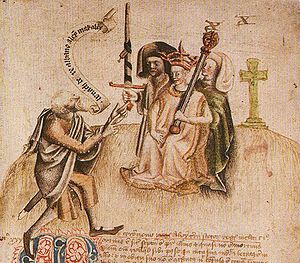 The Gaelic language was introduced to Scotland by settlers from Ireland
, probably in the 4th century.
Scottish Gaelic itself developed after the 12th century, along with the other modern Goidelic languages
. Scottish Gaelic and its predecessors became the language of the majority of Scotland
after it replaced Cumbric
, Pictish
and in considerable areas Old English. There is no definitive date indicating how long Gaelic has been spoken in today's Scotland, though it has been proposed that it was spoken in its ancient form in Argyll
before the Roman period. No consensus has been reached on this question; however, the consolidation of the kingdom of Dál Riata
around the 4th century, linking the ancient province of Ulster
in the north of Ireland
and western Scotland, accelerated the expansion of the language, as did the success of the Gaelic-speaking church establishment, started by St Columba, and place-name evidence shows that Gaelic was spoken in the Rhinns of Galloway by the 5th or 6th century. The language was maintained by the trade empire of the Lordship of the Isles
, which continued to control parts of Ulster until the 16th century.
north of the River Forth
, and until the late 15th century was known in the Scots' English language
as Scottis, and in England as Scottish. Gaelic began to decline in parts of mainland Scotland from the beginning of the 15th century, accompanying its decline in status as a national language, and eventually the highland-lowland line began to emerge.
From around the early 16th century, Scottish-English speakers gave the Gaelic language the name Erse (meaning Irish in Scottish-English), and thereafter it was invariably the collection of Middle English
dialects spoken within the Kingdom of Scotland
, that they referred to as Scottis (see Scots language
). This in itself was ironic, as it was at this time that Gaelic was developing its distinct and characteristic Scottish forms of the modern period.
Scottish Gaelic was called "Erse" partly because educated Gaelic speakers in Ireland and Scotland all used the literary dialect (sometimes called Classical Gaelic) so that there was little or no difference in usage. When Classical Gaelic stopped being used in schools in both countries, colloquial usage began to predominate, and the languages diverged.
s for many years. The language preserves knowledge of and adherence to pre-feudal 'tribal' laws and customs (as represented, for example, by the expressions tuatha and dùthchas). The language suffered particularly as Highlanders and their traditions were persecuted after the Battle of Culloden
in 1746, and during the Highland Clearances
, but pre-feudal attitudes were still evident in the complaints and claims of the Highland Land League
of the late 19th century. This political movement was successful in getting members elected to the Parliament of the United Kingdom
. The Land League was dissipated as a parliamentary force by the 1886 Crofters' Act and by the way the Liberal Party
was seen to become supportive of Land League objectives.
An Irish Gaelic translation of the Bible
dating from the Elizabethan period was in use until the Bible was translated into Scottish Gaelic. Author David Ross notes in his 2002 history of Scotland that a Scottish Gaelic version of the Bible was published in London in 1690 by the Rev. Robert Kirk, minister of Aberfoyle; however it was not widely circulated. The first well-known translation of the Bible into Scottish Gaelic was made in 1767 when Dr James Stuart of Killin and Dugald Buchanan of Rannoch produced a translation of the New Testament. Very few European languages have made the transition to a modern literary language without an early modern translation of the Bible. The lack of a well-known translation until the late 18th century may have contributed to the decline of Scottish Gaelic. In the 21st Century, Scottish Gaelic literature
has seen development and challenges within the area of prose fiction publication.
Phrases such as Alba gu bràth may be used today as a catch-phrase or rallying cry.
was spoken in Galloway and seems to have been the last dialect of Gaelic to have been spoken in Lowland Scotland, surviving until the Modern Period. By the 18th century, Lowland Gaelic had been largely replaced by Lowland Scots
across much of Lowland Scotland, while the Brythonic language
had disappeared. According to a reference in The Carrick Covenanters by James Crichton, the last place in the Lowlands where Scottish Gaelic was still spoken was the village of Barr
in Carrick
(only a few miles inland to the east of Girvan
, but at one time very isolated). Crichton gives neither date nor details.
For further discussion on the subject of Gaelic in the South of Scotland, see articles Gàidhlig Ghallghallaibh agus Alba-a-Deas ("Gaelic of Galloway and Southern Scotland") and Gàidhlig ann an Siorramachd Inbhir-Àir ("Gaelic in Ayrshire") by Garbhan MacAoidh, published in GAIRM Numbers 101 and 106.
There is, however, no evidence of a linguistic border following the topographical north-south differences. Similarly, there is no evidence from placenames of significant linguistic differences between, for example, Argyll
and Galloway
. Dialects on both sides of the Straits of Moyle
(the North Channel
) linking Scottish Gaelic with Irish are now extinct.
Today, the closest tied Irish dialect with Highland Gaelic is Ulster Irish
, spoken in County Donegal – most notably the Gaoth Dobhair
Gaeltacht
. Written Ulster Irish as well as common grammatical and vocabulary traits reflects more archaic Classical Gaelic still providing more of a solid link between the two languages than with Official Standard Irish, based on the dialects of southern provinces. However, to claim that Ulster Irish is a perfect intermediate between the Irish and Scottish forms of Gaelic still remains perhaps an over-exaggerated statement.
What is known as Scottish Gaelic today seems to have evolved from the Gaelic spoken in The Outer Hebrides and on Skye. Generally speaking, the Gaelic spoken across The Western Isles (with perhaps exception to that of Arran and Kintyre) is similar enough to be classed as one major dialect group, although there is still regional variation, for example the pronunciation of the slender 'r' as [ð] in Lewis, where the Gaelic has a unique Nordic accent, and is described as being 'toned'.
Gaelic in Eastern Scotland is now largely defunct, although the dialects which were spoken in the east tended to preserve a more archaic tone, which had been lost further west. For example, Gaelic speakers in East Sutherland prefer to say Cà 'd robh tu m' oidhche a-raoir? (where were you about last night), rather than the more common càit an robh thu (oidhche) a-raoir?.
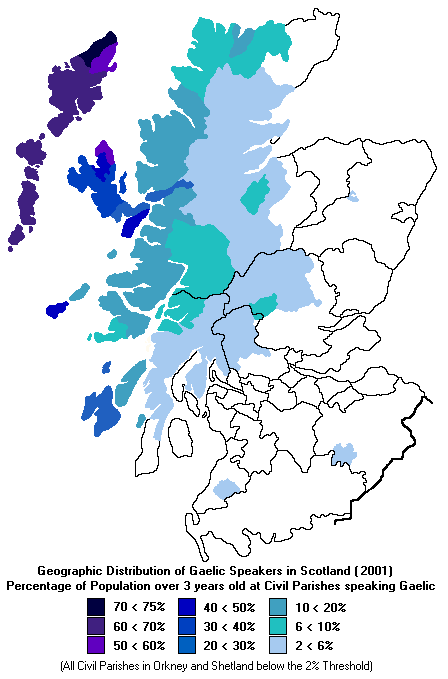 The 2001 UK Census showed a total of 58,652 Gaelic speakers in Scotland
(1.2% of population over three years old). Compared to the 1991 Census, there has been a diminution of approximately 7,300 people (11% of the total), meaning that Gaelic decline (language shift
) in Scotland is continuing, albeit at a far slower rate.
Considering the data related to Civil Parish
es (which permit a continuous study of Gaelic status since the 19th century), two new circumstances have taken place, which are related to this decline:
The main stronghold of the language continues to be the Outer Hebrides (Na h-Eileanan Siar), where the overall proportion of speakers remains at 61.1% and all parishes return values over 50%. The Parish of Kilmuir in Northern Skye is also over this threshold of 50%.
Outside of the Outer Hebrides the only areas with significant percentages of Gaelic speakers are the islands of Tiree
(with 47.8%), Skye
(with 36.8%), Raasay
(with 36.1%) and Lismore
(with 28.8%) in the Inner Hebrides
.
Regardless of this, the weight of Gaelic in Scotland is now much reduced. From a total of almost 900 Civil Parishes in Scotland:
Outside the main Gaelic-speaking areas a relatively high proportion of Gaelic-speaking people are, in effect, socially isolated from other Gaelic-speakers and as a result they have few opportunities to use the language. As with most Celtic languages, complete monolingualism is virtually non-existent except among native-speaking children under school age in traditional Gàidhealtachd regions.
In 2010, the census of pupils in Scotland showed that 606 pupils in publicly-funded schools had Gaelic as the main language at home.
, was written in a carved writing called Ogham
. Ogham consisted of marks made above or below a horizontal line. With the advent of Christianity in the 5th century the Latin alphabet
was introduced to Ireland. The Goidelic languages
have historically been part of a dialect continuum
stretching from the south of Ireland, the Isle of Man, to the north of Scotland.
The modern Scottish Gaelic alphabet has 18 letter
s:
The letter h, now mostly used to indicate lenition
of a consonant
, was in general not used in the oldest orthography
, as lenition was instead indicated with a dot over the lenited consonant
. The letters of the alphabet were traditionally named after trees (see Scottish Gaelic alphabet
), but this custom has fallen out of use.
Long vowels are either marked with a grave accent
(à, è, ì, ò, ù) or are indicated through digraphs
(e.g. ao is [ɯː]) or conditioned by certain consonant evironments (e.g. a u preceding a non-intervocalic nn is [uː]). Traditional spelling systems also use the acute accent
on the letters á, é and ó to denote a change in vowel quality rather than length, but reform from within the Scottish schools system has abandoned these in parts of Gaelic speaking society.
Certain early sources used only an acute accent along the lines of Irish, particularly in the 18th century sources such as in the writings of Alex. MacDonald (1741–51) and the earliest editions (1768–90) of Donnchadh Bán Mac an tSaoir.
was used as a literary language in Scotland until the 18th century. Orthographic divergence between Scottish Gaelic and Irish is the result of more recent orthographic reforms resulting in a pluricentric language
situation.
The 1767 New Testament
historically set the standard for Scottish Gaelic. Around the time of World War II
, Irish spelling was reformed and the Official Standard or Caighdeán Oifigiúil introduced. Further reform in 1957 eliminated some of the silent letters which are still used in Scottish Gaelic. The 1981 Scottish Examination Board
recommendations for Scottish Gaelic, the Gaelic Orthographic Conventions, were adopted by most publishers and agencies, although they remain controversial among some academics, most notably Ronald Black.
The quality of consonants is indicated in writing by the vowel
s surrounding them. So-called "slender" consonants are palatalised
while "broad" consonants are neutral or velarised
. The vowels e and i are classified as slender, and a, o, and u as broad. The spelling rule known as caol ri caol agus leathann ri leathann ("slender to slender and broad to broad") requires that a word-medial consonant or consonant group followed by a written i or e be also preceded by an i or e; and similarly if followed by a, o or u be also preceded by an a, o, or u. Consonant quality (palatalised or non-palatalised) is then indicated by the vowels written adjacent to a consonant, and the spelling rule gives the benefit of removing possible uncertainty about consonant quality at the expense of adding additional purely graphic vowels that may not be pronounced. For example, compare the t in slàinte [s̪lˠ̪aːɲtʲə] with the t in bàta [paːʰt̪ə].
The rule has no effect on the pronunciation of vowels. For example, plurals in Gaelic are often formed with the suffix -an, for example, bròg [prɔːk] (shoe) / brògan [prɔːkən] (shoes). But because of the spelling rule, the suffix is spelled -ean (but pronounced the same) after a slender consonant, as in taigh [tʰɤj] (house) / taighean [tʰɛhən] (houses) where the written e is purely a graphic vowel inserted to conform with the spelling rule because an i precedes the gh.
In changes promoted by the Scottish Examination Board
from 1976 onwards, certain modifications were made to this rule. For example, the suffix
of the past participle is always spelled -te, even after a broad consonant, as in togte "raised" (rather than the traditional togta).
 Where pairs of vowels occur in writing, it is sometimes unclear which vowel is to be pronounced and which vowel has been introduced to satisfy this spelling rule.
Unstressed vowels omitted in speech can be omitted in informal writing. For example:
Once Gaelic orthographic rules have been learned, the pronunciation of the written language is in general quite predictable. However learners must be careful not to try to apply English sound-to-letter correspondences to written Gaelic, otherwise mispronunciations will result. Gaelic personal names such as Seònaid [ˈʃɔːnɛdʲ] are especially likely to be mispronounced by English speakers.
Scots English orthographic
rules have also been used at various times in Gaelic writing. Notable examples of Gaelic verse composed in this manner are the Book of the Dean of Lismore
and the Fernaig manuscript
.
s ([i e ɛ a o ɔ u ɤ ɯ]) that can be either long or short. There are also two reduced vowels ([ə ɪ]) which only occur short. Although some vowels are strongly nasal, instances of distinctive nasality are rare. There are about nine diphthong
s and a few triphthong
s.
Most consonants have both palatal and non-palatal counterparts, including a very rich system of liquid
s, nasal
s and trill
s (i.e. 3 contrasting l sounds, 3 contrasting n sounds and 3 contrasting r sounds). The historically voiced stops [b d̪ ɡ] have lost their voicing, so the phonemic contrast today is between unaspirated [p t̪ k] and aspirated [pʰ t̪ʰ kʰ]. In many dialects, these stops may however gain voicing through secondary articulation through a preceding nasal, for examples doras [t̪ɔɾəs̪] "door" but an doras "the door" as [ən̪ˠ d̪ɔɾəs̪] or [ə n̪ˠɔɾəs̪].
In some fixed phrases, these changes are shown permanently, as the link with the base words has been lost, as in an-dràsta "now", from an tràth-sa "this time/period".
In medial and final position, the aspirated stops are preaspirated
rather than aspirated.
. With the advent of devolution, however, Scottish matters have begun to receive greater attention, and the Gaelic Language (Scotland) Act was enacted by the Scottish Parliament
on 21 April 2005.
The key provisions of the Act are:
Following a consultation period, in which the government received many submissions, the majority of which asked that the bill be strengthened, a revised bill was published with the main improvement that the guidance of the Bòrd is now statutory (rather than advisory).
In the committee stages in the Scottish Parliament, there was much debate over whether Gaelic should be given 'equal validity' with English. Due to Executive concerns about resourcing implications if this wording was used, the Education Committee settled on the concept of 'equal respect'. It is not clear what the legal force of this wording is.
The Act was passed by the Scottish Parliament unanimously, with support from all sectors of the Scottish political spectrum on the 21st of April 2005.
Some commentators, such as Éamonn Ó Gribín (2006) argue that the Gaelic Act falls
so far short of the status accorded Welsh that one would be foolish or naïve to believe
that any substantial change will occur in the fortunes of the language as a result of
Bòrd na Gàidhlig’s efforts.
Under the provisions of the 2005 Act, it will ultimately fall to BnG to secure the status of the Gaelic language as an official language
of Scotland.
On 10 December 2008 to celebrate the 60th Anniversary of the Universal Declaration of Human Rights
, the Scottish Human Rights Commission
had the UDHR translated into Gaelic for the first time http://www.scottishhumanrights.com/news/latestnews/article/shrc60.
The Education (Scotland) Act 1872, which completely ignored Gaelic, and led to generations of Gaels being forbidden to speak their native language in the classroom, is now recognised as having dealt a major blow to the language. People still living can recall being beaten for speaking Gaelic in school.
The first modern solely Gaelic-medium secondary school, Sgoil Ghàidhlig Ghlaschu ("Glasgow Gaelic School"), was opened at Woodside in Glasgow
in 2006 (61 partially Gaelic-medium primary schools and approximately a dozen Gaelic-medium secondary schools also exist). According to Bòrd na Gàidhlig, a total of 2,092 primary pupils were enrolled in Gaelic-medium primary education in 2008–09, as opposed to 24 in 1985.
In Nova Scotia
, Canada, there are somewhere between 500 and 1,000 native speakers, most of whom are now elderly. In May 2004, the Provincial government announced the funding of an initiative to support the language and its culture within the province.
Maxville Public School in Maxville, Glengarry
, Ontario
, Canada offers Scottish Gaelic lessons weekly.
In Prince Edward Island
, Canada, the Colonel Gray High School is now offering two courses in Gaelic, an introductory and an advanced course; both language and history are taught in these classes. This is the first recorded time that Gaelic has ever been taught as an official course on Prince Edward Island.
The UK government has ratified the European Charter for Regional or Minority Languages
in respect of Gaelic. Along with Irish and Welsh, Gaelic is designated under Part III of the Charter, which requires the UK Government to take a range of concrete measures in the fields of education, justice, public administration, broadcasting and culture.
The Columba Initiative
, also known as colmcille (formerly Iomairt Cholm Cille), is a body that seeks to promote links between speakers of Scottish Gaelic and Irish.
However, given there are no longer any monolingual Gaelic speakers, following an appeal in the court case of Taylor v Haughney (1982), involving the status of Gaelic in judicial proceedings, the High Court
ruled against a general right to use Gaelic in court proceedings.
officials. The deal was signed by Britain's representative to the EU, Sir Kim Darroch
, and the Scottish government. This does not give Scottish Gaelic official status
in the EU, but gives it the right to be a means of formal communications in the EU's institutions. The Scottish government
will have to pay for the translation from Gaelic to other European languages
. The deal was received positively in Scotland; Secretary of State for Scotland Jim Murphy
said the move was a strong sign of the UK government's support for Gaelic. He said that "Allowing Gaelic speakers to communicate with European institutions in their mother tongue is a progressive step forward and one which should be welcomed". Culture Minister Mike Russell said that "this is a significant step forward for the recognition of Gaelic both at home and abroad and I look forward to addressing the council in Gaelic very soon. Seeing Gaelic spoken in such a forum raises the profile of the language as we drive forward our commitment to creating a new generation of Gaelic speakers in Scotland."
Gaelic has long suffered from its lack of use in educational and administrative contexts and has even been suppressed in the past
but it has achieved a degree of official recognition with the passage of the Gaelic Language (Scotland) Act 2005
.
Machine-readable British passport
s include some Scottish Gaelic phrases that differ slightly from Irish passport
s. "Pas" (Irish
for passport) is given as "Cead-siubhail", "An tAontas Eorpach" (Irish for European Union
) is Aonadh Eórpach, and Northern Ireland is "Èireann a Tuath" (in Irish, Tuaisceart Éireann).
operates a Gaelic language radio station Radio nan Gàidheal
as well as a television channel, BBC Alba. Launched on 19 September 2008, BBC Alba is widely available in the UK (on Freeview, Freesat, Sky and Virgin Media). It also broadcasts across Europe on the Astra 2 satellites. The channel is being operated in partnership between BBC Scotland and MG Alba – a new organisation funded by the Scottish Government, which works to promote the Gaelic language in broadcasting. The ITV franchise in central Scotland, STV Central
produces a number of Scottish Gaelic programmes for both BBC Alba and its own main channel.
Until BBC Alba was broadcast on Freeview, viewers were able to receive the channel TeleG, which broadcast for an hour every evening. Upon BBC Alba's launch on Freeview, it took the channel number than was previously assigned to TeleG.
There are also television programmes in the language on other BBC channels and on the independent commercial channels
, usually subtitled in English. The ITV
franchise in the north of Scotland, STV North
(formerly Grampian Television) produces some non-news programming in Scottish Gaelic.
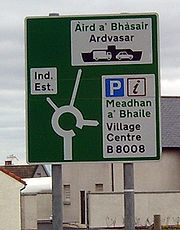
 Bilingual road signs, street names, business and advertisement signage (in both Gaelic and English) are gradually being introduced throughout Gaelic-speaking regions in the Highlands, Islands and Argyll. In many cases, this has simply meant re-adopting the traditional spelling of a name (such as Ràtagan or Loch Ailleart rather than the anglicised forms Ratagan or Lochailort respectively).
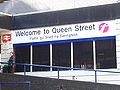
Bilingual railway station signs are now more frequent than they used to be. Practically all of the stations in the highland area use both English and Gaelic, however the spreading of bilingual station signs is becoming ever-more frequent in the lowlands of Scotland.
While this has been welcomed by many supporters of the language as a means of raising its profile, securing its future as a 'living language' (i.e. allowing people to use it to navigate from A to B in place of English) and creating a sense of place, recently revealed roadsigns for Castletown in Caithness in the Highlands indicate The Highland Council's intention to introduce bilingual signage into all areas of the Highlands have caused some controversy.
The Ordnance Survey
has acted in recent years to correct many of the mistakes that appear on maps. They announced in 2004 that they intended to make amends for a century of Gaelic ignorance and set up a committee to determine the correct forms of Gaelic place names for their maps.
is home to between 500 and 1,000 native Gaelic speakers, most of whom are now elderly, and all of whom being direct decendents of the 18th and 19th Century Highland Clearances
. In May 2004, the provincial government announced the funding of an initiative to support the language and its culture within the province, however Gaelic holds no official status under federal, provincial, or municipal law. But, as in Scotland, bilingual street signs also are in place in areas of Northern Eastern Nova Scotia and in Cape Breton. Nova Scotia also has the 'Comhairle na Gàidhlig' (The Gaelic Council of Nova Scotia), a non-profit society dedicated to the maintenance and promotion of the Gaelic language and culture in Maritime Canada.
Maxville Public School in Maxville, Glengarry
, Ontario
, Canada offers Scottish Gaelic lessons weekly.
In Prince Edward Island
, the Colonel Gray High School now offers both an introductory and an advanced course in Gaelic; both language and history are taught in these classes. This is the first recorded time that Gaelic has ever been taught as an official course on Prince Edward Island.
The province of British Columbia
is host to the 'Comunn Gàidhlig Bhancoubhair' (The Gaelic Society of Vancouver), the Vancouver Gaelic Choir, the Victoria Gaelic Choir, as well as the annual Gaelic festival 'Mòd Vancouver'. The city of Vancouver
's Scottish Cultural Centre also holds seasonal Scottish Gaelic evening classes.
, Harris and North Uist
have a Presbyterian
majority (largely Church of Scotland
– Eaglais na h-Alba in Gaelic, Free Church of Scotland
and Free Presbyterian Church of Scotland
.) The isles of South Uist
and Barra
have a Catholic majority. All these churches have Gaelic-speaking congregations throughout the Western Isles.
There are Gaelic-speaking congregations in the Church of Scotland
, mainly in the Highlands and Islands, but also in Edinburgh and Glasgow. Notable city congregations with regular services in Gaelic are St Columba's Church, Glasgow
and Greyfriars Tolbooth & Highland Kirk, Edinburgh. Leabhar Sheirbheisean – a shorter Gaelic version of the English-language Book of Common Order – was published in 1996 by the Church of Scotland.
The relationship between the Church and Gaelic has not always been an easy one. The widespread use of English in worship has often been suggested as one of the historic reasons for the decline of Gaelic. Whilst the Church of Scotland is supportive today, there is, however, an increasing difficulty in being able to find Gaelic-speaking ministers. The Free Church also recently announced plans to reduce their Gaelic provision by abolishing Gaelic-language communion services, citing both a lack of ministers and a desire to have their congregations united at communion time.
, the shinty
society, who have a bilingual logo.
In the mid-1990s, the Celtic League
started a campaign to have the word "Alba
" on the Scottish football and rugby union
tops. Since 2005, the SFA
have supported the use of Scottish Gaelic on their teams's strip in recognition of the language's revival in Scotland. However, the SRU
is still being lobbied to have "Alba" on the national rugby strip.
Some sports coverage, albeit at a small level, takes place in Scottish Gaelic broadcasting.
Some names have come into Gaelic from Old Norse, for example: Somhairle ( < Somarliðr), Tormod (< Þórmóðr), Torcuil (< Þórkell, Þórketill), Ìomhair (Ívarr). These are conventionally rendered in English as Sorley (or, historically, Somerled), Norman, Torquil, and Iver (or Evander).
Some traditional Gaelic names have become so well-known, that English versions of them are used outside Gaelic-speaking areas. Also, Gaelic has its own version of European-wide names which also have English forms. Names which fall into one or other of these classes are : Ailean, Aonghas, Dòmhnall, Donnchadh, Coinneach, Murchadh (Alan, Angus, Donald, Duncan, Kenneth, Murdo). Iain (John), Alasdair (Alexander), Uilleam (William), Catrìona (Catherine), Raibert (Robert), Cairistìona (Christina), Anna (Ann), Màiri (Mary), Seumas (James), Pàdraig (Patrick) and Tómas (Thomas). The well-known name Hamish, and the recently established Mhairi come from the Gaelic for, respectively, James, and Mary, but derive from the form of the names as they appear in the vocative case
: Seumas (James) (nom.) → Sheumais (voc.), and, Màiri (Mary) (nom.) → Mhàiri (voc.).
At this stage (2005), it is clear that some native Gaelic-speakers are willing to break with tradition. Recently, children in Gaelic-speaking communities have started to be named with names that are used within the wider English-speaking world, but do not have an equivalent in Gaelic. What effect that practice (if it becomes popular) might have on the language remains to be seen. Opinion on this practice is divided; whilst some would argue that they are thereby weakening their link with their linguistic and cultural heritage, others take the opposing view that Gaelic, as with any other language, must retain a degree of flexibility and adaptability if it is to survive in the modern world at all.
Several colours give rise to common Scottish surnames: bàn (Bain – white), ruadh (Roy – red), dubh (Dow – black), donn (Dunn – brown), buidhe (Bowie – yellow).
. There are a large number of borrowings from Latin
, (muinntir, Didòmhnaich), ancient Greek
, especially in the religious domain (eaglais, Bìoball from Ekklesia and Biblia), Norse (eilean, sgeir), Hebrew
(Sàbaid, Aba), French
(seòmar) and Lowland Scots
(aidh, bramar).
In common with other Indo-European languages
, the neologisms which are coined for modern concepts are typically based on Greek
or Latin
, although written
in Gaelic orthography; television, for instance, becomes telebhisean (cian-dhealbh could also be used), and computer becomes coimpiùtar (aireamhadair, bocsa-fiosa or bocsa-sgrìobhaidh could also be used). Although native speakers frequently use an English word for which there is a perfectly good Gaelic equivalent, they will, without thinking, simply adopt the English word and use it, applying the rules of Gaelic grammar, as the situation requires. With verbs, for instance, they will simply add the verbal suffix (-eadh, or, in Lewis
, -igeadh, as in, "Tha mi a' watcheadh (Lewis, "watchigeadh") an telly" (I am watching the television), instead of "Tha mi a' coimhead air a' chian-dhealbh". This was remarked upon by the minister who compiled the account covering the parish of Stornoway in the New Statistical Account of Scotland, published over 170 years ago. It has even gone so far as the verb Backdatigeadh. However, as Gaelic medium education grows in popularity, a newer generation of literate Gaels is becoming more familiar with modern Gaelic vocabulary.
Going in the other direction, Scottish Gaelic has influenced the Scots language
(gob) and English, particularly Scottish Standard English. Loanwords include: whisky, slogan, brogue, jilt, clan, strontium (from Strontian
), trousers
, as well as familiar elements of Scottish geography like ben (beinn), glen (gleann) and loch
. Irish
has also influenced Lowland Scots and English in Scotland, but it is not always easy to distinguish its influence from that of Scottish Gaelic. See List of English words of Scottish Gaelic origin
Source: An Etymological Dictionary
of the Gaelic Language, Alexander MacBain
.
offer two streams of Gaelic examination across all levels of the syllabus: Gaelic for learners (equivalent to the modern foreign languages syllabus) and Gaelic for native speakers (equivalent to the English syllabus).
An Comunn Gàidhealach
performs assessment of spoken Gaelic, resulting in the issue of a Bronze Card, Silver Card or Gold Card. Syllabus details are available on An Comunn's website. These are not widely recognised as qualifications, but are required for those taking part in certain competitions at the annual mods
.
St. Francis Xavier University
, the Gaelic College of Celtic Arts and Crafts
and Cape Breton University
(formerly University College Of Cape Breton) in Nova Scotia
, Canada
also offer a Celtic Studies degrees and/or Gaelic language programs.
. A number of other colleges offer the one year certificate course, which is also available on-line (pending accreditation).
Lews Castle College
's Benbecula campus offers an independent 1 year course in Gaelic and Traditional Music (FE, SQF level 5/6).
Scotland
Scotland is a country that is part of the United Kingdom. Occupying the northern third of the island of Great Britain, it shares a border with England to the south and is bounded by the North Sea to the east, the Atlantic Ocean to the north and west, and the North Channel and Irish Sea to the...
. A member of the Goidelic branch of the Celtic languages, Scottish Gaelic, like Modern Irish and Manx
Manx language
Manx , also known as Manx Gaelic, and as the Manks language, is a Goidelic language of the Indo-European language family, historically spoken by the Manx people. Only a small minority of the Island's population is fluent in the language, but a larger minority has some knowledge of it...
, developed out of Middle Irish, and thus descends ultimately from Primitive Irish.
The 2001 UK Census showed that a total of 58,652 (1.2% of the Scottish population aged over three years old) in Scotland had some Gaelic ability at that time, with the Outer Hebrides
Outer Hebrides
The Outer Hebrides also known as the Western Isles and the Long Island, is an island chain off the west coast of Scotland. The islands are geographically contiguous with Comhairle nan Eilean Siar, one of the 32 unitary council areas of Scotland...
being the main stronghold of the language. The census results indicate a decline of 7,300 Gaelic speakers from 1991. Despite this decline, revival efforts exist and the number of younger speakers of the language has increased.
Scottish Gaelic is not an official language of the European Union
European Union
The European Union is an economic and political union of 27 independent member states which are located primarily in Europe. The EU traces its origins from the European Coal and Steel Community and the European Economic Community , formed by six countries in 1958...
, or of the United Kingdom
United Kingdom
The United Kingdom of Great Britain and Northern IrelandIn the United Kingdom and Dependencies, other languages have been officially recognised as legitimate autochthonous languages under the European Charter for Regional or Minority Languages...
, which does not have any de jure official languages. However, it is classed as an autochthonous language under the European Charter for Regional or Minority Languages
European Charter for Regional or Minority Languages
The European Charter for Regional or Minority Languages is a European treaty adopted in 1992 under the auspices of the Council of Europe to protect and promote historical regional and minority languages in Europe...
, which the UK government has ratified. In addition, the Gaelic Language (Scotland) Act 2005
Gaelic Language (Scotland) Act 2005
The Gaelic Language Act 2005 passed by the Scottish Parliament in 2005 is the first piece of legislation to give formal recognition to the Scottish Gaelic language....
gave official recognition to the language and established an official language development body ‒ Bòrd na Gàidhlig
Bòrd na Gàidhlig
Bòrd na Gàidhlig is a quango appointed by the Scottish Government with responsibility for Scottish Gaelic...
.
Outside of Scotland, dialects of the language known as Canadian Gaelic exist in Canada
Canada
Canada is a North American country consisting of ten provinces and three territories. Located in the northern part of the continent, it extends from the Atlantic Ocean in the east to the Pacific Ocean in the west, and northward into the Arctic Ocean...
on Cape Breton Island
Cape Breton Island
Cape Breton Island is an island on the Atlantic coast of North America. It likely corresponds to the word Breton, the French demonym for Brittany....
and isolated areas of the Nova Scotia
Nova Scotia
Nova Scotia is one of Canada's three Maritime provinces and is the most populous province in Atlantic Canada. The name of the province is Latin for "New Scotland," but "Nova Scotia" is the recognized, English-language name of the province. The provincial capital is Halifax. Nova Scotia is the...
mainland. This variety has around 2000 speakers, amounting to 1.3% of the population of Cape Breton Island.
Nomenclature
Aside from Scottish Gaelic or Scots Gaelic the language may also be referred to simply as Gaelic. In Scotland, the word Gaelic in reference to Scottish Gaelic specifically is pronounced ˈgalɪk, while outside Scotland it is often pronounced ˈɡeɪlɨk.Scottish Gaelic should not be confused with Scots
Scots language
Scots is the Germanic language variety spoken in Lowland Scotland and parts of Ulster . It is sometimes called Lowland Scots to distinguish it from Scottish Gaelic, the Celtic language variety spoken in most of the western Highlands and in the Hebrides.Since there are no universally accepted...
, which refers to the Anglic language variety traditionally spoken in the Lowlands of Scotland
Scottish Lowlands
The Scottish Lowlands is a name given to the Southern half of Scotland.The area is called a' Ghalldachd in Scottish Gaelic, and the Lawlands ....
. Prior to the 15th century, the Anglic speech of the Lowlands was known as Inglis ("English"), with Gaelic being called Scottis ("Scottish"). From the late 15th century, however, it became increasingly common to refer to Scottish Gaelic as Erse ("Irish") to disassociate it from Scotland, and the Lowland vernacular as Scottis. Today, Scottish Gaelic is recognised as a separate language from Irish, so the word Erse in reference to Scottish Gaelic is no longer used and considered offensive.
History
Ireland
Ireland is an island to the northwest of continental Europe. It is the third-largest island in Europe and the twentieth-largest island on Earth...
, probably in the 4th century.
Scottish Gaelic itself developed after the 12th century, along with the other modern Goidelic languages
Goidelic languages
The Goidelic languages or Gaelic languages are one of the two branches of the Insular Celtic languages, the other consisting of the Brythonic languages. Goidelic languages historically formed a dialect continuum stretching from the south of Ireland through the Isle of Man to the north of Scotland...
. Scottish Gaelic and its predecessors became the language of the majority of Scotland
Scotland
Scotland is a country that is part of the United Kingdom. Occupying the northern third of the island of Great Britain, it shares a border with England to the south and is bounded by the North Sea to the east, the Atlantic Ocean to the north and west, and the North Channel and Irish Sea to the...
after it replaced Cumbric
Cumbric language
Cumbric was a variety of the Celtic British language spoken during the Early Middle Ages in the Hen Ogledd or "Old North", or what is now northern England and southern Lowland Scotland, the area anciently known as Cumbria. It was closely related to Old Welsh and the other Brythonic languages...
, Pictish
Pictish language
Pictish is a term used for the extinct language or languages thought to have been spoken by the Picts, the people of northern and central Scotland in the Early Middle Ages...
and in considerable areas Old English. There is no definitive date indicating how long Gaelic has been spoken in today's Scotland, though it has been proposed that it was spoken in its ancient form in Argyll
Argyll
Argyll , archaically Argyle , is a region of western Scotland corresponding with most of the part of ancient Dál Riata that was located on the island of Great Britain, and in a historical context can be used to mean the entire western coast between the Mull of Kintyre and Cape Wrath...
before the Roman period. No consensus has been reached on this question; however, the consolidation of the kingdom of Dál Riata
Dál Riata
Dál Riata was a Gaelic overkingdom on the western coast of Scotland with some territory on the northeast coast of Ireland...
around the 4th century, linking the ancient province of Ulster
Ulster
Ulster is one of the four provinces of Ireland, located in the north of the island. In ancient Ireland, it was one of the fifths ruled by a "king of over-kings" . Following the Norman invasion of Ireland, the ancient kingdoms were shired into a number of counties for administrative and judicial...
in the north of Ireland
Ireland
Ireland is an island to the northwest of continental Europe. It is the third-largest island in Europe and the twentieth-largest island on Earth...
and western Scotland, accelerated the expansion of the language, as did the success of the Gaelic-speaking church establishment, started by St Columba, and place-name evidence shows that Gaelic was spoken in the Rhinns of Galloway by the 5th or 6th century. The language was maintained by the trade empire of the Lordship of the Isles
Lord of the Isles
The designation Lord of the Isles is today a title of Scottish nobility with historical roots that go back beyond the Kingdom of Scotland. It emerged from a series of hybrid Viking/Gaelic rulers of the west coast and islands of Scotland in the Middle Ages, who wielded sea-power with fleets of...
, which continued to control parts of Ulster until the 16th century.
From the Middle Ages to the end of Classical Gaelic education
The Gaelic language eventually displaced PictishPictish language
Pictish is a term used for the extinct language or languages thought to have been spoken by the Picts, the people of northern and central Scotland in the Early Middle Ages...
north of the River Forth
River Forth
The River Forth , long, is the major river draining the eastern part of the central belt of Scotland.The Forth rises in Loch Ard in the Trossachs, a mountainous area some west of Stirling...
, and until the late 15th century was known in the Scots' English language
English language
English is a West Germanic language that arose in the Anglo-Saxon kingdoms of England and spread into what was to become south-east Scotland under the influence of the Anglian medieval kingdom of Northumbria...
as Scottis, and in England as Scottish. Gaelic began to decline in parts of mainland Scotland from the beginning of the 15th century, accompanying its decline in status as a national language, and eventually the highland-lowland line began to emerge.
From around the early 16th century, Scottish-English speakers gave the Gaelic language the name Erse (meaning Irish in Scottish-English), and thereafter it was invariably the collection of Middle English
Middle English
Middle English is the stage in the history of the English language during the High and Late Middle Ages, or roughly during the four centuries between the late 11th and the late 15th century....
dialects spoken within the Kingdom of Scotland
Kingdom of Scotland
The Kingdom of Scotland was a Sovereign state in North-West Europe that existed from 843 until 1707. It occupied the northern third of the island of Great Britain and shared a land border to the south with the Kingdom of England...
, that they referred to as Scottis (see Scots language
Scots language
Scots is the Germanic language variety spoken in Lowland Scotland and parts of Ulster . It is sometimes called Lowland Scots to distinguish it from Scottish Gaelic, the Celtic language variety spoken in most of the western Highlands and in the Hebrides.Since there are no universally accepted...
). This in itself was ironic, as it was at this time that Gaelic was developing its distinct and characteristic Scottish forms of the modern period.
Scottish Gaelic was called "Erse" partly because educated Gaelic speakers in Ireland and Scotland all used the literary dialect (sometimes called Classical Gaelic) so that there was little or no difference in usage. When Classical Gaelic stopped being used in schools in both countries, colloquial usage began to predominate, and the languages diverged.
The Modern Era
Scottish Gaelic has a rich oral and written tradition, referred to as beul-aithris in Scottish Gaelic, having been the language of the bardic culture of the Highland clanScottish clan
Scottish clans , give a sense of identity and shared descent to people in Scotland and to their relations throughout the world, with a formal structure of Clan Chiefs recognised by the court of the Lord Lyon, King of Arms which acts as an authority concerning matters of heraldry and Coat of Arms...
s for many years. The language preserves knowledge of and adherence to pre-feudal 'tribal' laws and customs (as represented, for example, by the expressions tuatha and dùthchas). The language suffered particularly as Highlanders and their traditions were persecuted after the Battle of Culloden
Battle of Culloden
The Battle of Culloden was the final confrontation of the 1745 Jacobite Rising. Taking place on 16 April 1746, the battle pitted the Jacobite forces of Charles Edward Stuart against an army commanded by William Augustus, Duke of Cumberland, loyal to the British government...
in 1746, and during the Highland Clearances
Highland Clearances
The Highland Clearances were forced displacements of the population of the Scottish Highlands during the 18th and 19th centuries. They led to mass emigration to the sea coast, the Scottish Lowlands, and the North American colonies...
, but pre-feudal attitudes were still evident in the complaints and claims of the Highland Land League
Highland Land League
The first Highland Land League emerged as a distinct political force in Scotland during the 1880s, with its power base in the country's Highlands and Islands. It was known also as the Highland Land Law Reform Association and the Crofters' Party...
of the late 19th century. This political movement was successful in getting members elected to the Parliament of the United Kingdom
Parliament of the United Kingdom
The Parliament of the United Kingdom of Great Britain and Northern Ireland is the supreme legislative body in the United Kingdom, British Crown dependencies and British overseas territories, located in London...
. The Land League was dissipated as a parliamentary force by the 1886 Crofters' Act and by the way the Liberal Party
Liberal Party (UK)
The Liberal Party was one of the two major political parties of the United Kingdom during the 19th and early 20th centuries. It was a third party of negligible importance throughout the latter half of the 20th Century, before merging with the Social Democratic Party in 1988 to form the present day...
was seen to become supportive of Land League objectives.
An Irish Gaelic translation of the Bible
Bible
The Bible refers to any one of the collections of the primary religious texts of Judaism and Christianity. There is no common version of the Bible, as the individual books , their contents and their order vary among denominations...
dating from the Elizabethan period was in use until the Bible was translated into Scottish Gaelic. Author David Ross notes in his 2002 history of Scotland that a Scottish Gaelic version of the Bible was published in London in 1690 by the Rev. Robert Kirk, minister of Aberfoyle; however it was not widely circulated. The first well-known translation of the Bible into Scottish Gaelic was made in 1767 when Dr James Stuart of Killin and Dugald Buchanan of Rannoch produced a translation of the New Testament. Very few European languages have made the transition to a modern literary language without an early modern translation of the Bible. The lack of a well-known translation until the late 18th century may have contributed to the decline of Scottish Gaelic. In the 21st Century, Scottish Gaelic literature
Scottish Gaelic literature
Scottish Gaelic literature refers to literature composed in the Scottish Gaelic language, a member of the Goidelic branch of Celtic languages, along with Irish and Manx.-Before 1200:...
has seen development and challenges within the area of prose fiction publication.
Phrases such as Alba gu bràth may be used today as a catch-phrase or rallying cry.
Defunct dialects
Scottish Gaelic may be more correctly known as Highland Gaelic to distinguish it from the now defunct dialects of Lowland Gaelic. Of these Galwegian GaelicGalwegian Gaelic
Galwegian Gaelic is an extinct dialect of Scottish Gaelic formerly spoken in southwest Scotland. It was spoken by the independent kings of Galloway in their time, and by the people of Galloway and Carrick until the early modern period. It was once spoken in Annandale and Strathnith...
was spoken in Galloway and seems to have been the last dialect of Gaelic to have been spoken in Lowland Scotland, surviving until the Modern Period. By the 18th century, Lowland Gaelic had been largely replaced by Lowland Scots
Scots language
Scots is the Germanic language variety spoken in Lowland Scotland and parts of Ulster . It is sometimes called Lowland Scots to distinguish it from Scottish Gaelic, the Celtic language variety spoken in most of the western Highlands and in the Hebrides.Since there are no universally accepted...
across much of Lowland Scotland, while the Brythonic language
British language
The British language was an ancient Celtic language spoken in Britain.British language may also refer to:* Any of the Languages of the United Kingdom.*The Welsh language or the Brythonic languages more generally* British English...
had disappeared. According to a reference in The Carrick Covenanters by James Crichton, the last place in the Lowlands where Scottish Gaelic was still spoken was the village of Barr
Barr, Ayrshire
Barr is a picturesque village in the South West of Ayrshire, Scotland, located approximately from the town of Girvan. There are various opinions as to the origins of the name. The most likely are either Gaelic meaning 'a meeting of water' or Brythonic meaning 'round'...
in Carrick
Carrick, Scotland
Carrick is a former comital district of Scotland which today forms part of South Ayrshire.-History:The word Carrick comes from the Gaelic word Carraig, meaning rock or rocky place. Maybole was the historic capital of Carrick. The county was eventually combined into Ayrshire which was divided...
(only a few miles inland to the east of Girvan
Girvan
Girvan is a burgh in Carrick, South Ayrshire, Scotland, with a population of about 8000 people. Originally a fishing port, it is now also a seaside resort with beaches and cliffs. Girvan dates back to 1668 when is became a municipal burgh incorporated by by charter...
, but at one time very isolated). Crichton gives neither date nor details.
For further discussion on the subject of Gaelic in the South of Scotland, see articles Gàidhlig Ghallghallaibh agus Alba-a-Deas ("Gaelic of Galloway and Southern Scotland") and Gàidhlig ann an Siorramachd Inbhir-Àir ("Gaelic in Ayrshire") by Garbhan MacAoidh, published in GAIRM Numbers 101 and 106.
There is, however, no evidence of a linguistic border following the topographical north-south differences. Similarly, there is no evidence from placenames of significant linguistic differences between, for example, Argyll
Argyll
Argyll , archaically Argyle , is a region of western Scotland corresponding with most of the part of ancient Dál Riata that was located on the island of Great Britain, and in a historical context can be used to mean the entire western coast between the Mull of Kintyre and Cape Wrath...
and Galloway
Galloway
Galloway is an area in southwestern Scotland. It usually refers to the former counties of Wigtownshire and Kirkcudbrightshire...
. Dialects on both sides of the Straits of Moyle
Straits of Moyle
The Straits of Moyle or Sea of Moyle is the name given to the narrowest expanse of sea in the North Channel between northeastern Ireland and southwestern Scotland...
(the North Channel
North Channel (British Isles)
The North Channel is the strait which separates eastern Northern Ireland from southwestern Scotland...
) linking Scottish Gaelic with Irish are now extinct.
Today, the closest tied Irish dialect with Highland Gaelic is Ulster Irish
Ulster Irish
Ulster Irish is the dialect of the Irish language spoken in the Province of Ulster. The largest Gaeltacht region today is in County Donegal, so that the term Donegal Irish is often used synonymously. Nevertheless, records of the language as it was spoken in other counties do exist, and help provide...
, spoken in County Donegal – most notably the Gaoth Dobhair
Gweedore
Gweedore is an Irish-speaking district located on the Atlantic coast of County Donegal, part of the Province of Ulster in Ireland. Gweedore stretches some 16 miles from Meenaclady in the north to Crolly in the south and around 9 miles from Dunlewey in the east to Magheraclogher in the west, and...
Gaeltacht
Gaeltacht
is the Irish language word meaning an Irish-speaking region. In Ireland, the Gaeltacht, or an Ghaeltacht, refers individually to any, or collectively to all, of the districts where the government recognises that the Irish language is the predominant language, that is, the vernacular spoken at home...
. Written Ulster Irish as well as common grammatical and vocabulary traits reflects more archaic Classical Gaelic still providing more of a solid link between the two languages than with Official Standard Irish, based on the dialects of southern provinces. However, to claim that Ulster Irish is a perfect intermediate between the Irish and Scottish forms of Gaelic still remains perhaps an over-exaggerated statement.
What is known as Scottish Gaelic today seems to have evolved from the Gaelic spoken in The Outer Hebrides and on Skye. Generally speaking, the Gaelic spoken across The Western Isles (with perhaps exception to that of Arran and Kintyre) is similar enough to be classed as one major dialect group, although there is still regional variation, for example the pronunciation of the slender 'r' as [ð] in Lewis, where the Gaelic has a unique Nordic accent, and is described as being 'toned'.
Gaelic in Eastern Scotland is now largely defunct, although the dialects which were spoken in the east tended to preserve a more archaic tone, which had been lost further west. For example, Gaelic speakers in East Sutherland prefer to say Cà 'd robh tu m' oidhche a-raoir? (where were you about last night), rather than the more common càit an robh thu (oidhche) a-raoir?.
Current distribution in Scotland
Scotland
Scotland is a country that is part of the United Kingdom. Occupying the northern third of the island of Great Britain, it shares a border with England to the south and is bounded by the North Sea to the east, the Atlantic Ocean to the north and west, and the North Channel and Irish Sea to the...
(1.2% of population over three years old). Compared to the 1991 Census, there has been a diminution of approximately 7,300 people (11% of the total), meaning that Gaelic decline (language shift
Language shift
Language shift, sometimes referred to as language transfer or language replacement or assimilation, is the progressive process whereby a speech community of a language shifts to speaking another language. The rate of assimilation is the percentage of individuals with a given mother tongue who speak...
) in Scotland is continuing, albeit at a far slower rate.
Considering the data related to Civil Parish
Civil parish
In England, a civil parish is a territorial designation and, where they are found, the lowest tier of local government below districts and counties...
es (which permit a continuous study of Gaelic status since the 19th century), two new circumstances have taken place, which are related to this decline:
- No parish in Scotland has a proportion of Gaelic speakers greater than 75% any more (the highest value corresponds to BarvasBarvasBarvas is a settlement, community and civil parish on the Isle of Lewis in Scotland.It developed around a road junction. North is the road to Ness; west takes the traveller to Carloway and the West Side; south runs the road to Stornoway...
, Lewis and HarrisLewis and HarrisLewis and Harris in the Outer Hebrides make up the largest island in Scotland. This is the largest single island of the British Isles after Great Britain and Ireland.-Geography:...
, with 74.7%). - No parish in Mainland Scotland has a proportion of Gaelic speakers greater than 25% any more (the highest value corresponds to Lochalsh, HighlandHighland (council area)Highland is a council area in the Scottish Highlands and is the largest local government area in both Scotland and the United Kingdom as a whole. It shares borders with the council areas of Moray, Aberdeenshire, Perth and Kinross, and Argyll and Bute. Their councils, and those of Angus and...
, with 20.1%).
The main stronghold of the language continues to be the Outer Hebrides (Na h-Eileanan Siar), where the overall proportion of speakers remains at 61.1% and all parishes return values over 50%. The Parish of Kilmuir in Northern Skye is also over this threshold of 50%.
Outside of the Outer Hebrides the only areas with significant percentages of Gaelic speakers are the islands of Tiree
Tiree
-History:Tiree is known for the 1st century BC Dùn Mòr broch, for the prehistoric carved Ringing Stone and for the birds of the Ceann a' Mhara headland....
(with 47.8%), Skye
Skye
Skye or the Isle of Skye is the largest and most northerly island in the Inner Hebrides of Scotland. The island's peninsulas radiate out from a mountainous centre dominated by the Cuillin hills...
(with 36.8%), Raasay
Raasay
Raasay is an island between the Isle of Skye and the mainland of Scotland. It is separated from Skye by the Sound of Raasay and from Applecross by the Inner Sound. It is most famous for being the birthplace of the poet Sorley MacLean, an important figure in the Scottish literary renaissance...
(with 36.1%) and Lismore
Lismore, Scotland
Lismore is a partially Gaelic speaking island in the Inner Hebrides of Scotland. This fertile, low-lying island was once a major centre of Celtic Christianity, with a monastery founded by Saint Moluag and the seat of the Bishop of Argyll.-Geography:...
(with 28.8%) in the Inner Hebrides
Inner Hebrides
The Inner Hebrides is an archipelago off the west coast of Scotland, to the south east of the Outer Hebrides. Together these two island chains form the Hebrides, which enjoy a mild oceanic climate. There are 36 inhabited islands and a further 43 uninhabited Inner Hebrides with an area greater than...
.
Regardless of this, the weight of Gaelic in Scotland is now much reduced. From a total of almost 900 Civil Parishes in Scotland:
- 9 of them have a proportion of Gaelic speakers greater than 50%.
- 20 of them have a proportion of Gaelic speakers greater than 25%.
- 39 of them have a proportion of Gaelic speakers greater than 10%.
Outside the main Gaelic-speaking areas a relatively high proportion of Gaelic-speaking people are, in effect, socially isolated from other Gaelic-speakers and as a result they have few opportunities to use the language. As with most Celtic languages, complete monolingualism is virtually non-existent except among native-speaking children under school age in traditional Gàidhealtachd regions.
In 2010, the census of pupils in Scotland showed that 606 pupils in publicly-funded schools had Gaelic as the main language at home.
Writing system
Alphabet
Prehistoric (or Ogham) Irish, the precursor to Old Irish, in turn the precursor to Modern Irish, Scottish Gaelic and ManxManx language
Manx , also known as Manx Gaelic, and as the Manks language, is a Goidelic language of the Indo-European language family, historically spoken by the Manx people. Only a small minority of the Island's population is fluent in the language, but a larger minority has some knowledge of it...
, was written in a carved writing called Ogham
Ogham
Ogham is an Early Medieval alphabet used primarily to write the Old Irish language, and occasionally the Brythonic language. Ogham is sometimes called the "Celtic Tree Alphabet", based on a High Medieval Bríatharogam tradition ascribing names of trees to the individual letters.There are roughly...
. Ogham consisted of marks made above or below a horizontal line. With the advent of Christianity in the 5th century the Latin alphabet
Latin alphabet
The Latin alphabet, also called the Roman alphabet, is the most recognized alphabet used in the world today. It evolved from a western variety of the Greek alphabet called the Cumaean alphabet, which was adopted and modified by the Etruscans who ruled early Rome...
was introduced to Ireland. The Goidelic languages
Goidelic languages
The Goidelic languages or Gaelic languages are one of the two branches of the Insular Celtic languages, the other consisting of the Brythonic languages. Goidelic languages historically formed a dialect continuum stretching from the south of Ireland through the Isle of Man to the north of Scotland...
have historically been part of a dialect continuum
Dialect continuum
A dialect continuum, or dialect area, was defined by Leonard Bloomfield as a range of dialects spoken across some geographical area that differ only slightly between neighboring areas, but as one travels in any direction, these differences accumulate such that speakers from opposite ends of the...
stretching from the south of Ireland, the Isle of Man, to the north of Scotland.
The modern Scottish Gaelic alphabet has 18 letter
Letter (alphabet)
A letter is a grapheme in an alphabetic system of writing, such as the Greek alphabet and its descendants. Letters compose phonemes and each phoneme represents a phone in the spoken form of the language....
s:
- A, B, C, D, E, F, G, H, I, L, M, N, O, P, R, S, T, U.
The letter h, now mostly used to indicate lenition
Lenition
In linguistics, lenition is a kind of sound change that alters consonants, making them "weaker" in some way. The word lenition itself means "softening" or "weakening" . Lenition can happen both synchronically and diachronically...
of a consonant
Consonant
In articulatory phonetics, a consonant is a speech sound that is articulated with complete or partial closure of the vocal tract. Examples are , pronounced with the lips; , pronounced with the front of the tongue; , pronounced with the back of the tongue; , pronounced in the throat; and ,...
, was in general not used in the oldest orthography
Orthography
The orthography of a language specifies a standardized way of using a specific writing system to write the language. Where more than one writing system is used for a language, for example Kurdish, Uyghur, Serbian or Inuktitut, there can be more than one orthography...
, as lenition was instead indicated with a dot over the lenited consonant
Dot (diacritic)
When used as a diacritic mark, the term dot is usually reserved for the Interpunct , or to the glyphs 'combining dot above' and 'combining dot below'...
. The letters of the alphabet were traditionally named after trees (see Scottish Gaelic alphabet
Scottish Gaelic alphabet
The Scottish Gaelic alphabet contains 18 letters, five of which are vowels. The letters are :The five vowels also appear with grave accents, the absence or presence of which can change the meaning of a word drastically as in bàta versus bata :The acute accent is also used on some vowels:Since the...
), but this custom has fallen out of use.
Long vowels are either marked with a grave accent
Grave accent
The grave accent is a diacritical mark used in written Breton, Catalan, Corsican, Dutch, French, Greek , Italian, Mohawk, Norwegian, Occitan, Portuguese, Scottish Gaelic, Vietnamese, Welsh, Romansh, and other languages.-Greek:The grave accent was first used in the polytonic orthography of Ancient...
(à, è, ì, ò, ù) or are indicated through digraphs
Digraph (orthography)
A digraph or digram is a pair of characters used to write one phoneme or a sequence of phonemes that does not correspond to the normal values of the two characters combined...
(e.g. ao is [ɯː]) or conditioned by certain consonant evironments (e.g. a u preceding a non-intervocalic nn is [uː]). Traditional spelling systems also use the acute accent
Acute accent
The acute accent is a diacritic used in many modern written languages with alphabets based on the Latin, Cyrillic, and Greek scripts.-Apex:An early precursor of the acute accent was the apex, used in Latin inscriptions to mark long vowels.-Greek:...
on the letters á, é and ó to denote a change in vowel quality rather than length, but reform from within the Scottish schools system has abandoned these in parts of Gaelic speaking society.
Certain early sources used only an acute accent along the lines of Irish, particularly in the 18th century sources such as in the writings of Alex. MacDonald (1741–51) and the earliest editions (1768–90) of Donnchadh Bán Mac an tSaoir.
Orthography
Classical GaelicClassical Gaelic
Classical Gaelic is the term used in Scotland for the shared literary form that was in use in Scotland and Ireland 13th to the 18th century. The language is that of Early Modern Irish...
was used as a literary language in Scotland until the 18th century. Orthographic divergence between Scottish Gaelic and Irish is the result of more recent orthographic reforms resulting in a pluricentric language
Pluricentric language
A pluricentric language is a language with several standard versions, both in spoken and in written forms. This situation usually arises when language and the national identity of its native speakers do not, or did not, coincide.-English:...
situation.
The 1767 New Testament
New Testament
The New Testament is the second major division of the Christian biblical canon, the first such division being the much longer Old Testament....
historically set the standard for Scottish Gaelic. Around the time of World War II
World War II
World War II, or the Second World War , was a global conflict lasting from 1939 to 1945, involving most of the world's nations—including all of the great powers—eventually forming two opposing military alliances: the Allies and the Axis...
, Irish spelling was reformed and the Official Standard or Caighdeán Oifigiúil introduced. Further reform in 1957 eliminated some of the silent letters which are still used in Scottish Gaelic. The 1981 Scottish Examination Board
Scottish Examination Board
The Scottish Examination Board was the academic examination board for schools in Scotland until 1997.It used to administer all of Scotland's academic qualifications, including Standard Grades and Highers....
recommendations for Scottish Gaelic, the Gaelic Orthographic Conventions, were adopted by most publishers and agencies, although they remain controversial among some academics, most notably Ronald Black.
The quality of consonants is indicated in writing by the vowel
Vowel
In phonetics, a vowel is a sound in spoken language, such as English ah! or oh! , pronounced with an open vocal tract so that there is no build-up of air pressure at any point above the glottis. This contrasts with consonants, such as English sh! , where there is a constriction or closure at some...
s surrounding them. So-called "slender" consonants are palatalised
Palatalization
In linguistics, palatalization , also palatization, may refer to two different processes by which a sound, usually a consonant, comes to be produced with the tongue in a position in the mouth near the palate....
while "broad" consonants are neutral or velarised
Velarization
Velarization is a secondary articulation of consonants by which the back of the tongue is raised toward the velum during the articulation of the consonant.In the International Phonetic Alphabet, velarization is transcribed by one of three diacritics:...
. The vowels e and i are classified as slender, and a, o, and u as broad. The spelling rule known as caol ri caol agus leathann ri leathann ("slender to slender and broad to broad") requires that a word-medial consonant or consonant group followed by a written i or e be also preceded by an i or e; and similarly if followed by a, o or u be also preceded by an a, o, or u. Consonant quality (palatalised or non-palatalised) is then indicated by the vowels written adjacent to a consonant, and the spelling rule gives the benefit of removing possible uncertainty about consonant quality at the expense of adding additional purely graphic vowels that may not be pronounced. For example, compare the t in slàinte [s̪lˠ̪aːɲtʲə] with the t in bàta [paːʰt̪ə].
The rule has no effect on the pronunciation of vowels. For example, plurals in Gaelic are often formed with the suffix -an, for example, bròg [prɔːk] (shoe) / brògan [prɔːkən] (shoes). But because of the spelling rule, the suffix is spelled -ean (but pronounced the same) after a slender consonant, as in taigh [tʰɤj] (house) / taighean [tʰɛhən] (houses) where the written e is purely a graphic vowel inserted to conform with the spelling rule because an i precedes the gh.
In changes promoted by the Scottish Examination Board
Scottish Examination Board
The Scottish Examination Board was the academic examination board for schools in Scotland until 1997.It used to administer all of Scotland's academic qualifications, including Standard Grades and Highers....
from 1976 onwards, certain modifications were made to this rule. For example, the suffix
Suffix
In linguistics, a suffix is an affix which is placed after the stem of a word. Common examples are case endings, which indicate the grammatical case of nouns or adjectives, and verb endings, which form the conjugation of verbs...
of the past participle is always spelled -te, even after a broad consonant, as in togte "raised" (rather than the traditional togta).
Unstressed vowels omitted in speech can be omitted in informal writing. For example:
- Tha mi an dòchas. ("I hope.") > Tha mi 'n dòchas.
Once Gaelic orthographic rules have been learned, the pronunciation of the written language is in general quite predictable. However learners must be careful not to try to apply English sound-to-letter correspondences to written Gaelic, otherwise mispronunciations will result. Gaelic personal names such as Seònaid [ˈʃɔːnɛdʲ] are especially likely to be mispronounced by English speakers.
Scots English orthographic
Orthography
The orthography of a language specifies a standardized way of using a specific writing system to write the language. Where more than one writing system is used for a language, for example Kurdish, Uyghur, Serbian or Inuktitut, there can be more than one orthography...
rules have also been used at various times in Gaelic writing. Notable examples of Gaelic verse composed in this manner are the Book of the Dean of Lismore
Book of the Dean of Lismore
The Book of the Dean of Lismore is a famous Scottish manuscript, compiled in eastern Perthshire in the first half of the 16th century. The chief compiler, after whom it is named, was James MacGregor , vicar of Fortingall and titular Dean of Lismore Cathedral, although there are other probable...
and the Fernaig manuscript
Fernaig manuscript
The Fernaig manuscript is a document containing approximately 4,200 lines of verse consisting largely of political and religious themes. The manuscript was composed between 1688 and 1693 by Donnchadh MacRath in Wester Ross and is notable for the author's unique orthography which is, like the more...
.
Pronunciation
Most varieties of Gaelic have between 8 and 9 cardinal vowelCardinal vowel
Cardinal vowels are a set of reference vowels used by phoneticians in describing the sounds of languages. For instance, the vowel of the English word "feet" can be described with reference to cardinal vowel 1, , which is the cardinal vowel closest to it....
s ([i e ɛ a o ɔ u ɤ ɯ]) that can be either long or short. There are also two reduced vowels ([ə ɪ]) which only occur short. Although some vowels are strongly nasal, instances of distinctive nasality are rare. There are about nine diphthong
Diphthong
A diphthong , also known as a gliding vowel, refers to two adjacent vowel sounds occurring within the same syllable. Technically, a diphthong is a vowel with two different targets: That is, the tongue moves during the pronunciation of the vowel...
s and a few triphthong
Triphthong
In phonetics, a triphthong is a monosyllabic vowel combination involving a quick but smooth movement of the articulator from one vowel quality to another that passes over a third...
s.
Most consonants have both palatal and non-palatal counterparts, including a very rich system of liquid
Liquid consonant
In phonetics, liquids or liquid consonants are a class of consonants consisting of lateral consonants together with rhotics.-Description:...
s, nasal
Nasal consonant
A nasal consonant is a type of consonant produced with a lowered velum in the mouth, allowing air to escape freely through the nose. Examples of nasal consonants in English are and , in words such as nose and mouth.- Definition :...
s and trill
Trill consonant
In phonetics, a trill is a consonantal sound produced by vibrations between the articulator and the place of articulation. Standard Spanish <rr> as in perro is an alveolar trill, while in Parisian French it is almost always uvular....
s (i.e. 3 contrasting l sounds, 3 contrasting n sounds and 3 contrasting r sounds). The historically voiced stops [b d̪ ɡ] have lost their voicing, so the phonemic contrast today is between unaspirated [p t̪ k] and aspirated [pʰ t̪ʰ kʰ]. In many dialects, these stops may however gain voicing through secondary articulation through a preceding nasal, for examples doras [t̪ɔɾəs̪] "door" but an doras "the door" as [ən̪ˠ d̪ɔɾəs̪] or [ə n̪ˠɔɾəs̪].
In some fixed phrases, these changes are shown permanently, as the link with the base words has been lost, as in an-dràsta "now", from an tràth-sa "this time/period".
In medial and final position, the aspirated stops are preaspirated
Preaspiration
In phonetics, preaspiration is a period of voicelessness or aspiration preceding the closure of a voiceless obstruent, basically equivalent to an -like sound preceding the obstruent. In other words, when an obstruent is preaspirated, the glottis is opened for some time before the obstruent closure...
rather than aspirated.
Scottish Parliament
Historically, Gaelic has not received the same degree of official recognition from the UK Government as WelshWelsh language
Welsh is a member of the Brythonic branch of the Celtic languages spoken natively in Wales, by some along the Welsh border in England, and in Y Wladfa...
. With the advent of devolution, however, Scottish matters have begun to receive greater attention, and the Gaelic Language (Scotland) Act was enacted by the Scottish Parliament
Scottish Parliament
The Scottish Parliament is the devolved national, unicameral legislature of Scotland, located in the Holyrood area of the capital, Edinburgh. The Parliament, informally referred to as "Holyrood", is a democratically elected body comprising 129 members known as Members of the Scottish Parliament...
on 21 April 2005.
The key provisions of the Act are:
- Establishing the Gaelic development body, Bòrd na GàidhligBòrd na GàidhligBòrd na Gàidhlig is a quango appointed by the Scottish Government with responsibility for Scottish Gaelic...
, (BnG), on a statutory basis with a view to securing the status of the Gaelic language as an official language of Scotland commanding equal respect to the English language and to promote the use and understanding of Gaelic. - Requiring BnG to prepare a National Gaelic Language Plan for approval by Scottish Ministers.
- Requiring BnG to produce guidance on Gaelic Education for education authorities.
- Requiring public bodies in Scotland, both Scottish public bodies and cross border public bodies insofar as they carry out devolved functions, to develop Gaelic language plans in relation to the services they offer, if requested to do so by BnG.
Following a consultation period, in which the government received many submissions, the majority of which asked that the bill be strengthened, a revised bill was published with the main improvement that the guidance of the Bòrd is now statutory (rather than advisory).
In the committee stages in the Scottish Parliament, there was much debate over whether Gaelic should be given 'equal validity' with English. Due to Executive concerns about resourcing implications if this wording was used, the Education Committee settled on the concept of 'equal respect'. It is not clear what the legal force of this wording is.
The Act was passed by the Scottish Parliament unanimously, with support from all sectors of the Scottish political spectrum on the 21st of April 2005.
Some commentators, such as Éamonn Ó Gribín (2006) argue that the Gaelic Act falls
so far short of the status accorded Welsh that one would be foolish or naïve to believe
that any substantial change will occur in the fortunes of the language as a result of
Bòrd na Gàidhlig’s efforts.
Under the provisions of the 2005 Act, it will ultimately fall to BnG to secure the status of the Gaelic language as an official language
Official language
An official language is a language that is given a special legal status in a particular country, state, or other jurisdiction. Typically a nation's official language will be the one used in that nation's courts, parliament and administration. However, official status can also be used to give a...
of Scotland.
On 10 December 2008 to celebrate the 60th Anniversary of the Universal Declaration of Human Rights
Universal Declaration of Human Rights
The Universal Declaration of Human Rights is a declaration adopted by the United Nations General Assembly . The Declaration arose directly from the experience of the Second World War and represents the first global expression of rights to which all human beings are inherently entitled...
, the Scottish Human Rights Commission
Scottish Human Rights Commission
The Scottish Human Rights Commission was established by an Act of the Scottish Parliament [] and started their work in 2008. The Commission is independent of Government, and the Scottish and Westminster Parliaments. The Scottish Human Rights Commission promotes and protects the human rights of...
had the UDHR translated into Gaelic for the first time http://www.scottishhumanrights.com/news/latestnews/article/shrc60.
Education
| Year | Number of students in Gaelic medium education | Percentage of all students in Scotland |
|---|---|---|
| 2005 | 2,480 | 0.35% |
| 2006 | 2,535 | 0.36% |
| 2007 | 2,601 | 0.38% |
| 2008 | 2,766 | ± 0.4% |
| 2009 | 2,638 | 0.39% |
| 2010 | 2,647 | 0.39% |
The Education (Scotland) Act 1872, which completely ignored Gaelic, and led to generations of Gaels being forbidden to speak their native language in the classroom, is now recognised as having dealt a major blow to the language. People still living can recall being beaten for speaking Gaelic in school.
The first modern solely Gaelic-medium secondary school, Sgoil Ghàidhlig Ghlaschu ("Glasgow Gaelic School"), was opened at Woodside in Glasgow
Glasgow
Glasgow is the largest city in Scotland and third most populous in the United Kingdom. The city is situated on the River Clyde in the country's west central lowlands...
in 2006 (61 partially Gaelic-medium primary schools and approximately a dozen Gaelic-medium secondary schools also exist). According to Bòrd na Gàidhlig, a total of 2,092 primary pupils were enrolled in Gaelic-medium primary education in 2008–09, as opposed to 24 in 1985.
In Nova Scotia
Nova Scotia
Nova Scotia is one of Canada's three Maritime provinces and is the most populous province in Atlantic Canada. The name of the province is Latin for "New Scotland," but "Nova Scotia" is the recognized, English-language name of the province. The provincial capital is Halifax. Nova Scotia is the...
, Canada, there are somewhere between 500 and 1,000 native speakers, most of whom are now elderly. In May 2004, the Provincial government announced the funding of an initiative to support the language and its culture within the province.
Maxville Public School in Maxville, Glengarry
Glengarry County, Ontario
thumb|right|Glengarry located within OntarioGlengarry County , an area covering , is a county in the Canadian province of Ontario, and is historically known for its settlement of Scottish Highlanders due to the Highland Clearances.Glengarry was founded in 1792 by Scottish loyalists, mainly from...
, Ontario
Ontario
Ontario is a province of Canada, located in east-central Canada. It is Canada's most populous province and second largest in total area. It is home to the nation's most populous city, Toronto, and the nation's capital, Ottawa....
, Canada offers Scottish Gaelic lessons weekly.
In Prince Edward Island
Prince Edward Island
Prince Edward Island is a Canadian province consisting of an island of the same name, as well as other islands. The maritime province is the smallest in the nation in both land area and population...
, Canada, the Colonel Gray High School is now offering two courses in Gaelic, an introductory and an advanced course; both language and history are taught in these classes. This is the first recorded time that Gaelic has ever been taught as an official course on Prince Edward Island.
The UK government has ratified the European Charter for Regional or Minority Languages
European Charter for Regional or Minority Languages
The European Charter for Regional or Minority Languages is a European treaty adopted in 1992 under the auspices of the Council of Europe to protect and promote historical regional and minority languages in Europe...
in respect of Gaelic. Along with Irish and Welsh, Gaelic is designated under Part III of the Charter, which requires the UK Government to take a range of concrete measures in the fields of education, justice, public administration, broadcasting and culture.
The Columba Initiative
Columba Initiative
The Columba Project or Iomairt Cholm Cille, formerly known as the Columba Initiative is a program for Gaelic speakers in Scotland and Ireland to meet each other more often, and in so doing to learn more of the language, heritage and lifestyles of one another...
, also known as colmcille (formerly Iomairt Cholm Cille), is a body that seeks to promote links between speakers of Scottish Gaelic and Irish.
However, given there are no longer any monolingual Gaelic speakers, following an appeal in the court case of Taylor v Haughney (1982), involving the status of Gaelic in judicial proceedings, the High Court
High Court of Justiciary
The High Court of Justiciary is the supreme criminal court of Scotland.The High Court is both a court of first instance and a court of appeal. As a court of first instance, the High Court sits mainly in Parliament House, or in the former Sheriff Court building, in Edinburgh, but also sits from time...
ruled against a general right to use Gaelic in court proceedings.
European Union
In October 2009, a new agreement was made which allows Scottish Gaelic to be used formally between Scottish Government ministers and European UnionEuropean Union
The European Union is an economic and political union of 27 independent member states which are located primarily in Europe. The EU traces its origins from the European Coal and Steel Community and the European Economic Community , formed by six countries in 1958...
officials. The deal was signed by Britain's representative to the EU, Sir Kim Darroch
Kim Darroch
Sir Kim Darroch, KCMG is a British diplomat. He was educated at Abingdon School and Durham University. He currently serves as the United Kingdom's Permanent Representative to the European Union....
, and the Scottish government. This does not give Scottish Gaelic official status
Languages of the European Union
The languages of the European Union are languages used by people within the member states of the European Union. They include the twenty-three official languages of the European Union along with a range of others...
in the EU, but gives it the right to be a means of formal communications in the EU's institutions. The Scottish government
Government of Scotland
Prior to 1707, the Kingdom of Scotland was a sovereign state, governed by the monarch, the privy council, and the parliament. As a result of the Treaty of Union agreed in 1706, the Parliaments of England and Scotland each passed Acts of Union to create the Kingdom of Great Britain.-History:Between...
will have to pay for the translation from Gaelic to other European languages
Languages of Europe
Most of the languages of Europe belong to Indo-European language family. These are divided into a number of branches, including Romance, Germanic, Balto-Slavic, Greek, and others. The Uralic languages also have a significant presence in Europe, including the national languages Hungarian, Finnish,...
. The deal was received positively in Scotland; Secretary of State for Scotland Jim Murphy
Jim Murphy
James Francis "Jim" Murphy is a British Labour Party politician and is the Member of Parliament for East Renfrewshire....
said the move was a strong sign of the UK government's support for Gaelic. He said that "Allowing Gaelic speakers to communicate with European institutions in their mother tongue is a progressive step forward and one which should be welcomed". Culture Minister Mike Russell said that "this is a significant step forward for the recognition of Gaelic both at home and abroad and I look forward to addressing the council in Gaelic very soon. Seeing Gaelic spoken in such a forum raises the profile of the language as we drive forward our commitment to creating a new generation of Gaelic speakers in Scotland."
Gaelic has long suffered from its lack of use in educational and administrative contexts and has even been suppressed in the past
but it has achieved a degree of official recognition with the passage of the Gaelic Language (Scotland) Act 2005
Gaelic Language (Scotland) Act 2005
The Gaelic Language Act 2005 passed by the Scottish Parliament in 2005 is the first piece of legislation to give formal recognition to the Scottish Gaelic language....
.
Machine-readable British passport
British passport
British passports may be issued to people holding any of the various forms of British nationality, and are used as evidence of the bearer's nationality and immigration status within the United Kingdom or the issuing state/territory.-Issuing:...
s include some Scottish Gaelic phrases that differ slightly from Irish passport
Irish passport
Irish passports are issued by the Consular and Passport Division of the Irish Department of Foreign Affairs in Dublin, Ireland.-Physical appearance:...
s. "Pas" (Irish
Irish language
Irish , also known as Irish Gaelic, is a Goidelic language of the Indo-European language family, originating in Ireland and historically spoken by the Irish people. Irish is now spoken as a first language by a minority of Irish people, as well as being a second language of a larger proportion of...
for passport) is given as "Cead-siubhail", "An tAontas Eorpach" (Irish for European Union
European Union
The European Union is an economic and political union of 27 independent member states which are located primarily in Europe. The EU traces its origins from the European Coal and Steel Community and the European Economic Community , formed by six countries in 1958...
) is Aonadh Eórpach, and Northern Ireland is "Èireann a Tuath" (in Irish, Tuaisceart Éireann).
Media
The BBCBBC Scotland
BBC Scotland is a constituent part of the British Broadcasting Corporation, the publicly-funded broadcaster of the United Kingdom. It is, in effect, the national broadcaster for Scotland, having a considerable amount of autonomy from the BBC's London headquarters, and is run by the BBC Trust, who...
operates a Gaelic language radio station Radio nan Gàidheal
BBC Radio nan Gàidheal
BBC Radio nan Gàidheal is a British radio station, broadcasting in Scottish Gaelic. It is operated by the BBC as part of its portfolio of television and radio services broadcasting to Scotland....
as well as a television channel, BBC Alba. Launched on 19 September 2008, BBC Alba is widely available in the UK (on Freeview, Freesat, Sky and Virgin Media). It also broadcasts across Europe on the Astra 2 satellites. The channel is being operated in partnership between BBC Scotland and MG Alba – a new organisation funded by the Scottish Government, which works to promote the Gaelic language in broadcasting. The ITV franchise in central Scotland, STV Central
Scottish Television
Scottish Television is Scotland's largest ITV franchisee, and has held the ITV franchise for Central Scotland since 31 August 1957. It is the second oldest ITV franchisee still active...
produces a number of Scottish Gaelic programmes for both BBC Alba and its own main channel.
Until BBC Alba was broadcast on Freeview, viewers were able to receive the channel TeleG, which broadcast for an hour every evening. Upon BBC Alba's launch on Freeview, it took the channel number than was previously assigned to TeleG.
There are also television programmes in the language on other BBC channels and on the independent commercial channels
ITV
ITV is the major commercial public service TV network in the United Kingdom. Launched in 1955 under the auspices of the Independent Television Authority to provide competition to the BBC, it is also the oldest commercial network in the UK...
, usually subtitled in English. The ITV
ITV
ITV is the major commercial public service TV network in the United Kingdom. Launched in 1955 under the auspices of the Independent Television Authority to provide competition to the BBC, it is also the oldest commercial network in the UK...
franchise in the north of Scotland, STV North
Grampian Television
Grampian Television is the ITV franchisee for the North and North East of Scotland. Its coverage area includes the Scottish Highlands , Inverness, Aberdeen, Dundee and parts of north Fife...
(formerly Grampian Television) produces some non-news programming in Scottish Gaelic.
Signage
Bilingual railway station signs are now more frequent than they used to be. Practically all of the stations in the highland area use both English and Gaelic, however the spreading of bilingual station signs is becoming ever-more frequent in the lowlands of Scotland.
While this has been welcomed by many supporters of the language as a means of raising its profile, securing its future as a 'living language' (i.e. allowing people to use it to navigate from A to B in place of English) and creating a sense of place, recently revealed roadsigns for Castletown in Caithness in the Highlands indicate The Highland Council's intention to introduce bilingual signage into all areas of the Highlands have caused some controversy.
The Ordnance Survey
Ordnance Survey
Ordnance Survey , an executive agency and non-ministerial government department of the Government of the United Kingdom, is the national mapping agency for Great Britain, producing maps of Great Britain , and one of the world's largest producers of maps.The name reflects its creation together with...
has acted in recent years to correct many of the mistakes that appear on maps. They announced in 2004 that they intended to make amends for a century of Gaelic ignorance and set up a committee to determine the correct forms of Gaelic place names for their maps.
Canada
The Atlantic Canadian province of Nova ScotiaNova Scotia
Nova Scotia is one of Canada's three Maritime provinces and is the most populous province in Atlantic Canada. The name of the province is Latin for "New Scotland," but "Nova Scotia" is the recognized, English-language name of the province. The provincial capital is Halifax. Nova Scotia is the...
is home to between 500 and 1,000 native Gaelic speakers, most of whom are now elderly, and all of whom being direct decendents of the 18th and 19th Century Highland Clearances
Highland Clearances
The Highland Clearances were forced displacements of the population of the Scottish Highlands during the 18th and 19th centuries. They led to mass emigration to the sea coast, the Scottish Lowlands, and the North American colonies...
. In May 2004, the provincial government announced the funding of an initiative to support the language and its culture within the province, however Gaelic holds no official status under federal, provincial, or municipal law. But, as in Scotland, bilingual street signs also are in place in areas of Northern Eastern Nova Scotia and in Cape Breton. Nova Scotia also has the 'Comhairle na Gàidhlig' (The Gaelic Council of Nova Scotia), a non-profit society dedicated to the maintenance and promotion of the Gaelic language and culture in Maritime Canada.
Maxville Public School in Maxville, Glengarry
Glengarry County, Ontario
thumb|right|Glengarry located within OntarioGlengarry County , an area covering , is a county in the Canadian province of Ontario, and is historically known for its settlement of Scottish Highlanders due to the Highland Clearances.Glengarry was founded in 1792 by Scottish loyalists, mainly from...
, Ontario
Ontario
Ontario is a province of Canada, located in east-central Canada. It is Canada's most populous province and second largest in total area. It is home to the nation's most populous city, Toronto, and the nation's capital, Ottawa....
, Canada offers Scottish Gaelic lessons weekly.
In Prince Edward Island
Prince Edward Island
Prince Edward Island is a Canadian province consisting of an island of the same name, as well as other islands. The maritime province is the smallest in the nation in both land area and population...
, the Colonel Gray High School now offers both an introductory and an advanced course in Gaelic; both language and history are taught in these classes. This is the first recorded time that Gaelic has ever been taught as an official course on Prince Edward Island.
The province of British Columbia
British Columbia
British Columbia is the westernmost of Canada's provinces and is known for its natural beauty, as reflected in its Latin motto, Splendor sine occasu . Its name was chosen by Queen Victoria in 1858...
is host to the 'Comunn Gàidhlig Bhancoubhair' (The Gaelic Society of Vancouver), the Vancouver Gaelic Choir, the Victoria Gaelic Choir, as well as the annual Gaelic festival 'Mòd Vancouver'. The city of Vancouver
Vancouver
Vancouver is a coastal seaport city on the mainland of British Columbia, Canada. It is the hub of Greater Vancouver, which, with over 2.3 million residents, is the third most populous metropolitan area in the country,...
's Scottish Cultural Centre also holds seasonal Scottish Gaelic evening classes.
Church
In the Western Isles, the isles of LewisLewis
Lewis is the northern part of Lewis and Harris, the largest island of the Western Isles or Outer Hebrides of Scotland. The total area of Lewis is ....
, Harris and North Uist
North Uist
North Uist is an island and community in the Outer Hebrides of Scotland.-Geography:North Uist is the tenth largest Scottish island and the thirteenth largest island surrounding Great Britain. It has an area of , slightly smaller than South Uist. North Uist is connected by causeways to Benbecula...
have a Presbyterian
Presbyterianism
Presbyterianism refers to a number of Christian churches adhering to the Calvinist theological tradition within Protestantism, which are organized according to a characteristic Presbyterian polity. Presbyterian theology typically emphasizes the sovereignty of God, the authority of the Scriptures,...
majority (largely Church of Scotland
Church of Scotland
The Church of Scotland, known informally by its Scots language name, the Kirk, is a Presbyterian church, decisively shaped by the Scottish Reformation....
– Eaglais na h-Alba in Gaelic, Free Church of Scotland
Free Church of Scotland (post 1900)
Free Church of Scotland is that part of the original Free Church of Scotland that remained outside of the union with the United Presbyterian Church of Scotland in 1900...
and Free Presbyterian Church of Scotland
Free Presbyterian Church of Scotland
The Free Presbyterian Church of Scotland was formed in 1893 and claims to be the spiritual descendant of the Scottish Reformation...
.) The isles of South Uist
South Uist
South Uist is an island of the Outer Hebrides in Scotland. In the 2001 census it had a usually resident population of 1,818. There is a nature reserve and a number of sites of archaeological interest, including the only location in Great Britain where prehistoric mummies have been found. The...
and Barra
Barra
The island of Barra is a predominantly Gaelic-speaking island, and apart from the adjacent island of Vatersay, to which it is connected by a causeway, is the southernmost inhabited island of the Outer Hebrides in Scotland.-Geography:The 2001 census showed that the resident population was 1,078...
have a Catholic majority. All these churches have Gaelic-speaking congregations throughout the Western Isles.
There are Gaelic-speaking congregations in the Church of Scotland
Gaelic-speaking congregations in the Church of Scotland
A few Church of Scotland congregations, mainly in the Western Isles, have regular Sunday services in Gaelic. There are Gaelic-speaking congregations of other denominations too, mainly in the Western Isles...
, mainly in the Highlands and Islands, but also in Edinburgh and Glasgow. Notable city congregations with regular services in Gaelic are St Columba's Church, Glasgow
St Columba's Church, Glasgow
The Church of Scotland congregation of St Columba in Glasgow dates back to 1770. It was established to cater for the spiritual needs of the large number of Gaelic-speakers from the Highlands and Islands of Scotland settling in Glasgow in search of employment...
and Greyfriars Tolbooth & Highland Kirk, Edinburgh. Leabhar Sheirbheisean – a shorter Gaelic version of the English-language Book of Common Order – was published in 1996 by the Church of Scotland.
The relationship between the Church and Gaelic has not always been an easy one. The widespread use of English in worship has often been suggested as one of the historic reasons for the decline of Gaelic. Whilst the Church of Scotland is supportive today, there is, however, an increasing difficulty in being able to find Gaelic-speaking ministers. The Free Church also recently announced plans to reduce their Gaelic provision by abolishing Gaelic-language communion services, citing both a lack of ministers and a desire to have their congregations united at communion time.
Sport
The most notable use of the language in sport is that of the Camanachd AssociationCamanachd Association
The Camanachd Association is the World governing body of the Scottish sport of shinty. The body is based in Inverness, Highland, and is in charge of the rules of the game...
, the shinty
Shinty
Shinty is a team game played with sticks and a ball. Shinty is now played mainly in the Scottish Highlands, and amongst Highland migrants to the big cities of Scotland, but it was formerly more widespread, being once competitively played on a widespread basis in England and other areas in the...
society, who have a bilingual logo.
In the mid-1990s, the Celtic League
Celtic League (political organisation)
The Celtic League is a non-governmental organisation that promotes self-determination and Celtic identity and culture in Ireland, Scotland, Wales, Brittany, Cornwall and the Isle of Man, known as the Celtic nations. It places particular emphasis on the indigenous Celtic languages...
started a campaign to have the word "Alba
Alba
Alba is the Scottish Gaelic name for Scotland. It is cognate to Alba in Irish and Nalbin in Manx, the two other Goidelic Insular Celtic languages, as well as similar words in the Brythonic Insular Celtic languages of Cornish and Welsh also meaning Scotland.- Etymology :The term first appears in...
" on the Scottish football and rugby union
Rugby union
Rugby union, often simply referred to as rugby, is a full contact team sport which originated in England in the early 19th century. One of the two codes of rugby football, it is based on running with the ball in hand...
tops. Since 2005, the SFA
Scottish Football Association
The Scottish Football Association is the governing body of football in Scotland and has the ultimate responsibility for the control and development of football in Scotland. Members of the SFA include clubs in Scotland, affiliated national associations as well as local associations...
have supported the use of Scottish Gaelic on their teams's strip in recognition of the language's revival in Scotland. However, the SRU
Scottish Rugby Union
The Scottish Rugby Union is the governing body of rugby union in Scotland. It is the second oldest Rugby Union, having been founded in 1873, as the Scottish Football Union.-History:...
is still being lobbied to have "Alba" on the national rugby strip.
Some sports coverage, albeit at a small level, takes place in Scottish Gaelic broadcasting.
Personal names
Some traditional Gaelic names have no direct equivalents in English: Oighrig, which is normally rendered as Euphemia (Effie) or Henrietta (Etta) (formerly also as Henny or even as Harriet), or, Diorbhal, which is "matched" with Dorothy, simply on the basis of a certain similarity in spelling; Gormul, for which there is nothing similar in English, and it is rendered as 'Gormelia' or even 'Dorothy'; Beathag, which is "matched" with Becky (> Rebecca) and even Betsy, or Sophie. Many of these traditional Gaelic-only names are now regarded as old-fashioned, and hence are rarely or never used (this is, of course, common to many cultures: names go out of fashion).Some names have come into Gaelic from Old Norse, for example: Somhairle ( < Somarliðr), Tormod (< Þórmóðr), Torcuil (< Þórkell, Þórketill), Ìomhair (Ívarr). These are conventionally rendered in English as Sorley (or, historically, Somerled), Norman, Torquil, and Iver (or Evander).
Some traditional Gaelic names have become so well-known, that English versions of them are used outside Gaelic-speaking areas. Also, Gaelic has its own version of European-wide names which also have English forms. Names which fall into one or other of these classes are : Ailean, Aonghas, Dòmhnall, Donnchadh, Coinneach, Murchadh (Alan, Angus, Donald, Duncan, Kenneth, Murdo). Iain (John), Alasdair (Alexander), Uilleam (William), Catrìona (Catherine), Raibert (Robert), Cairistìona (Christina), Anna (Ann), Màiri (Mary), Seumas (James), Pàdraig (Patrick) and Tómas (Thomas). The well-known name Hamish, and the recently established Mhairi come from the Gaelic for, respectively, James, and Mary, but derive from the form of the names as they appear in the vocative case
Vocative case
The vocative case is the case used for a noun identifying the person being addressed and/or occasionally the determiners of that noun. A vocative expression is an expression of direct address, wherein the identity of the party being spoken to is set forth expressly within a sentence...
: Seumas (James) (nom.) → Sheumais (voc.), and, Màiri (Mary) (nom.) → Mhàiri (voc.).
At this stage (2005), it is clear that some native Gaelic-speakers are willing to break with tradition. Recently, children in Gaelic-speaking communities have started to be named with names that are used within the wider English-speaking world, but do not have an equivalent in Gaelic. What effect that practice (if it becomes popular) might have on the language remains to be seen. Opinion on this practice is divided; whilst some would argue that they are thereby weakening their link with their linguistic and cultural heritage, others take the opposing view that Gaelic, as with any other language, must retain a degree of flexibility and adaptability if it is to survive in the modern world at all.
Surnames
The most common class of Gaelic surnames are, of course, those beginning with mac (Gaelic for son), such as MacGillEathain (MacLean). The female form is nic (Gaelic for daughter), so Catherine MacPhee is properly called in Gaelic, Caitrìona Nic a' Phì. [Strictly, "nic" is a contraction of the Gaelic phrase "nighean mhic", meaning "daughter of the son", thus Nic Dhomhnuill, really means "daughter of MacDonald" rather than "daughter of Donald".] Although there is a common misconception that "mac" means "son of", the "of" part actually comes from the genitive form of the patronymic that follows the prefix "Mac", e.g., in the case of MacNéill, Néill (of Neil) is the genitive form of Niall (Neil).Several colours give rise to common Scottish surnames: bàn (Bain – white), ruadh (Roy – red), dubh (Dow – black), donn (Dunn – brown), buidhe (Bowie – yellow).
Loanwords
The majority of the vocabulary of Scottish Gaelic is native CelticCeltic languages
The Celtic languages are descended from Proto-Celtic, or "Common Celtic"; a branch of the greater Indo-European language family...
. There are a large number of borrowings from Latin
Latin
Latin is an Italic language originally spoken in Latium and Ancient Rome. It, along with most European languages, is a descendant of the ancient Proto-Indo-European language. Although it is considered a dead language, a number of scholars and members of the Christian clergy speak it fluently, and...
, (muinntir, Didòmhnaich), ancient Greek
Greek language
Greek is an independent branch of the Indo-European family of languages. Native to the southern Balkans, it has the longest documented history of any Indo-European language, spanning 34 centuries of written records. Its writing system has been the Greek alphabet for the majority of its history;...
, especially in the religious domain (eaglais, Bìoball from Ekklesia and Biblia), Norse (eilean, sgeir), Hebrew
Hebrew language
Hebrew is a Semitic language of the Afroasiatic language family. Culturally, is it considered by Jews and other religious groups as the language of the Jewish people, though other Jewish languages had originated among diaspora Jews, and the Hebrew language is also used by non-Jewish groups, such...
(Sàbaid, Aba), French
French language
French is a Romance language spoken as a first language in France, the Romandy region in Switzerland, Wallonia and Brussels in Belgium, Monaco, the regions of Quebec and Acadia in Canada, and by various communities elsewhere. Second-language speakers of French are distributed throughout many parts...
(seòmar) and Lowland Scots
Scots language
Scots is the Germanic language variety spoken in Lowland Scotland and parts of Ulster . It is sometimes called Lowland Scots to distinguish it from Scottish Gaelic, the Celtic language variety spoken in most of the western Highlands and in the Hebrides.Since there are no universally accepted...
(aidh, bramar).
In common with other Indo-European languages
Indo-European languages
The Indo-European languages are a family of several hundred related languages and dialects, including most major current languages of Europe, the Iranian plateau, and South Asia and also historically predominant in Anatolia...
, the neologisms which are coined for modern concepts are typically based on Greek
Greek language
Greek is an independent branch of the Indo-European family of languages. Native to the southern Balkans, it has the longest documented history of any Indo-European language, spanning 34 centuries of written records. Its writing system has been the Greek alphabet for the majority of its history;...
or Latin
Latin
Latin is an Italic language originally spoken in Latium and Ancient Rome. It, along with most European languages, is a descendant of the ancient Proto-Indo-European language. Although it is considered a dead language, a number of scholars and members of the Christian clergy speak it fluently, and...
, although written
in Gaelic orthography; television, for instance, becomes telebhisean (cian-dhealbh could also be used), and computer becomes coimpiùtar (aireamhadair, bocsa-fiosa or bocsa-sgrìobhaidh could also be used). Although native speakers frequently use an English word for which there is a perfectly good Gaelic equivalent, they will, without thinking, simply adopt the English word and use it, applying the rules of Gaelic grammar, as the situation requires. With verbs, for instance, they will simply add the verbal suffix (-eadh, or, in Lewis
Lewis
Lewis is the northern part of Lewis and Harris, the largest island of the Western Isles or Outer Hebrides of Scotland. The total area of Lewis is ....
, -igeadh, as in, "Tha mi a' watcheadh (Lewis, "watchigeadh") an telly" (I am watching the television), instead of "Tha mi a' coimhead air a' chian-dhealbh". This was remarked upon by the minister who compiled the account covering the parish of Stornoway in the New Statistical Account of Scotland, published over 170 years ago. It has even gone so far as the verb Backdatigeadh. However, as Gaelic medium education grows in popularity, a newer generation of literate Gaels is becoming more familiar with modern Gaelic vocabulary.
Going in the other direction, Scottish Gaelic has influenced the Scots language
Scots language
Scots is the Germanic language variety spoken in Lowland Scotland and parts of Ulster . It is sometimes called Lowland Scots to distinguish it from Scottish Gaelic, the Celtic language variety spoken in most of the western Highlands and in the Hebrides.Since there are no universally accepted...
(gob) and English, particularly Scottish Standard English. Loanwords include: whisky, slogan, brogue, jilt, clan, strontium (from Strontian
Strontian
Strontian is the main village in Sunart, an area in western Lochaber, Highland, Scotland, on the A861 road. It lies on the north shore of Loch Sunart, close to the head of the loch...
), trousers
Trousers
Trousers are an item of clothing worn on the lower part of the body from the waist to the ankles, covering both legs separately...
, as well as familiar elements of Scottish geography like ben (beinn), glen (gleann) and loch
Loch
Loch is the Irish and Scottish Gaelic word for a lake or a sea inlet. It has been anglicised as lough, although this is pronounced the same way as loch. Some lochs could also be called a firth, fjord, estuary, strait or bay...
. Irish
Irish language
Irish , also known as Irish Gaelic, is a Goidelic language of the Indo-European language family, originating in Ireland and historically spoken by the Irish people. Irish is now spoken as a first language by a minority of Irish people, as well as being a second language of a larger proportion of...
has also influenced Lowland Scots and English in Scotland, but it is not always easy to distinguish its influence from that of Scottish Gaelic. See List of English words of Scottish Gaelic origin
Source: An Etymological Dictionary
Etymological dictionary
An etymological dictionary discusses the etymology of the words listed. Often, large dictionaries, such as the OED and Webster's, will contain some etymological information, without aspiring to focus on etymology....
of the Gaelic Language, Alexander MacBain
Alexander Macbain
Alexander Macbain was a Scottish philologist, best known today for An Etymological Dictionary of the Gaelic Language .-Early life and education:...
.
Common words and phrases with Irish and Manx equivalents
| Scottish Gaelic Phrase | Irish Equivalent | Manx Gaelic Equivalent | Rough English Translation |
|---|---|---|---|
| Fàilte | Fáilte | Failt | Welcome |
| Halò | Haileo or Haigh or Dia dhuit (trad., lit.: "God be with you") | Hello | Hello |
| Latha math | Lá maith | Laa mie | Good day |
| Ciamar a tha thu? | Conas atá tú? (Cén chaoi a bhfuil tú? in Connacht Connacht Irish Connacht Irish is the dialect of the Irish language spoken in the province of Connacht. Gaeltacht regions in Connacht are found in Counties Mayo and Galway... or Cad é mar atá tú? in Ulster Ulster Irish Ulster Irish is the dialect of the Irish language spoken in the Province of Ulster. The largest Gaeltacht region today is in County Donegal, so that the term Donegal Irish is often used synonymously. Nevertheless, records of the language as it was spoken in other counties do exist, and help provide... ) |
Kys t'ou? | How are you? |
| Ciamar a tha sibh? | Conas atá sibh? (Cén chaoi a bhfuil sibh? in Connacht Connacht Irish Connacht Irish is the dialect of the Irish language spoken in the province of Connacht. Gaeltacht regions in Connacht are found in Counties Mayo and Galway... or Cad é mar atá sibh? in Ulster Ulster Irish Ulster Irish is the dialect of the Irish language spoken in the Province of Ulster. The largest Gaeltacht region today is in County Donegal, so that the term Donegal Irish is often used synonymously. Nevertheless, records of the language as it was spoken in other counties do exist, and help provide... ) |
Kys ta shiu? | How are you? (plural, singular formal) |
| Madainn mhath | Maidin mhaith | Moghrey mie | Good morning |
| Feasgar math | Trathnóna maith | Fastyr mie | Good afternoon |
| Oidhche mhath | Oíche mhaith | Oie vie | Good night |
| Tapadh leat (Gu robh math agad in Islay Islay -Prehistory:The earliest settlers on Islay were nomadic hunter-gatherers who arrived during the Mesolithic period after the retreat of the Pleistocene ice caps. In 1993 a flint arrowhead was found in a field near Bridgend dating from 10,800 BC, the earliest evidence of a human presence found so far... ) |
Go raibh maith agat | Gura mie ayd | Thank you (singular, informal) |
| Tapadh leibh (Gu robh math agaibh in Islay Islay -Prehistory:The earliest settlers on Islay were nomadic hunter-gatherers who arrived during the Mesolithic period after the retreat of the Pleistocene ice caps. In 1993 a flint arrowhead was found in a field near Bridgend dating from 10,800 BC, the earliest evidence of a human presence found so far... ) |
Go raibh maith agaibh | Gura mie eu | Thank you (plural, formal) |
| Dè an t-ainm a tha ort? | Cad é an t-ainm atá ort? or Cad is ainm duit? | Cre'n ennym t'ort? | What is your name? |
| Dè an t-ainm a tha oirbh? | Cad é an t-ainm atá oraibh? or Cad is ainm daoibh? | Cre'n ennym t'erriu? | What is your name? (formal) |
| Is mise..., Mise... | Is mise..., Mise... | Mish... | I am... |
| Slàn leat | Slán leat | Slane lhiat | Goodbye (singular, informal) |
| Slàn leibh | Slán libh | Slane lhiu | Goodbye (plural, formal) |
| Dè a tha seo? | Cad é seo? | Cred shoh?, Cre shoh? | What is this? |
| Slàinte | Sláinte Slàinte Sláinte is a word literally translating as "health" and is commonly used as a drinking toast in Ireland, Scotland and the Isle of Man.-Variations:... |
Slaynt | "health" (used as a toast [cf. English "cheers"] when drinking) |
Examinations
The Scottish Qualifications AuthorityScottish Qualifications Authority
The Scottish Qualifications Authority is a non-departmental public body responsible for accreditation and awarding. It is partly funded by the Education and Lifelong Learning Directorate of the Scottish Government, employing 750 staff, based in Glasgow and Dalkeith...
offer two streams of Gaelic examination across all levels of the syllabus: Gaelic for learners (equivalent to the modern foreign languages syllabus) and Gaelic for native speakers (equivalent to the English syllabus).
An Comunn Gàidhealach
An Comunn Gàidhealach
An Comunn Gàidhealach , literally The Gaelic Association) is an organisation in Scotland which seeks to promote Scottish Gaelic language and culture, following in the footsteps of the Gaelic Athletic Association or GAA in Ireland....
performs assessment of spoken Gaelic, resulting in the issue of a Bronze Card, Silver Card or Gold Card. Syllabus details are available on An Comunn's website. These are not widely recognised as qualifications, but are required for those taking part in certain competitions at the annual mods
Mod (Scotland)
A mod is a festival of Scottish Gaelic song, arts and culture. Historically, the Gaelic word mòd refers to any kind of assembly. There are both local mods, and an annual national mod, the Royal National Mod...
.
Higher and further education
A number of Scottish and some Irish universities offer full-time degrees including a Gaelic language element, usually graduating as Celtic Studies.St. Francis Xavier University
St. Francis Xavier University
St. Francis Xavier University is a post-secondary institution located in Antigonish, Nova Scotia. The school was founded in 1853, but did not offer degrees until 1868. The university has approximately 5000 students.-History:...
, the Gaelic College of Celtic Arts and Crafts
Gaelic College of Celtic Arts and Crafts
The Gaelic College of Celtic Arts and Crafts is a Canadian educational institution located in the community of St...
and Cape Breton University
Cape Breton University
Cape Breton University , formerly the "University College of Cape Breton" , is a Canadian university in Nova Scotia's Cape Breton Regional Municipality....
(formerly University College Of Cape Breton) in Nova Scotia
Nova Scotia
Nova Scotia is one of Canada's three Maritime provinces and is the most populous province in Atlantic Canada. The name of the province is Latin for "New Scotland," but "Nova Scotia" is the recognized, English-language name of the province. The provincial capital is Halifax. Nova Scotia is the...
, Canada
Canada
Canada is a North American country consisting of ten provinces and three territories. Located in the northern part of the continent, it extends from the Atlantic Ocean in the east to the Pacific Ocean in the west, and northward into the Arctic Ocean...
also offer a Celtic Studies degrees and/or Gaelic language programs.
Courses at the University of the Highlands and Islands
The University of the Highlands and Islands offers a range of Gaelic courses at Cert HE, Dip HE, BA (ordinary), BA (Hons) and MA, and offers opportunities for postgraduate research through the medium of Gaelic. The majority of these courses are available as residential courses at Sabhal Mòr OstaigSabhal Mòr Ostaig
Sabhal Mòr Ostaig is a Scottish Gaelic medium college located about north of Armadale on the Sleat peninsula of the island of Skye in northwestern Scotland. It is part of the University of the Highlands and Islands and also has a campus on Islay known as Ionad Chaluim Chille Ìle.The college was...
. A number of other colleges offer the one year certificate course, which is also available on-line (pending accreditation).
Lews Castle College
Lews Castle College
Lews Castle College is a further and higher education college in the Western Isles of Scotland. The main campus is in the grounds of Lews Castle, Stornoway. The College also has two learning centres in Benbecula and Barra. The College is part of the University of the Highlands and Islands.The...
's Benbecula campus offers an independent 1 year course in Gaelic and Traditional Music (FE, SQF level 5/6).
See also
- Languages of Scotland
- Scots languageScots languageScots is the Germanic language variety spoken in Lowland Scotland and parts of Ulster . It is sometimes called Lowland Scots to distinguish it from Scottish Gaelic, the Celtic language variety spoken in most of the western Highlands and in the Hebrides.Since there are no universally accepted...
- Scottish EnglishScottish EnglishScottish English refers to the varieties of English spoken in Scotland. It may or may not be considered distinct from the Scots language. It is always considered distinct from Scottish Gaelic, a Celtic language....
- Scots language
- Scottish Gaelic literatureScottish Gaelic literatureScottish Gaelic literature refers to literature composed in the Scottish Gaelic language, a member of the Goidelic branch of Celtic languages, along with Irish and Manx.-Before 1200:...
- An Comunn GàidhealachAn Comunn GàidhealachAn Comunn Gàidhealach , literally The Gaelic Association) is an organisation in Scotland which seeks to promote Scottish Gaelic language and culture, following in the footsteps of the Gaelic Athletic Association or GAA in Ireland....
- Book of DeerBook of DeerThe Book of Deer is a 10th-century Latin Gospel Book from Old Deer, Aberdeenshire, Scotland, with early 12th-century additions in Latin, Old Irish and Scottish Gaelic. It is most famous for containing the earliest surviving Gaelic literature from Scotland...
- Bungi creole
- Clì Gàidhlig
- Differences between Scottish Gaelic and IrishDifferences between Scottish Gaelic and IrishScottish Gaelic is closely related to Irish. Most dialects are not immediately mutually comprehensible, though many individual words and phrases are, and speakers of the two languages can rapidly develop mutual intelligibility....
- GaelicizationGaelicizationGaelicization or Gaelicisation is the act or process of making something Gaelic, or gaining characteristics of the Gaels. The Gaels are an ethno-linguistic group who are traditionally viewed as having spread from Ireland to Scotland and the Isle of Man."Gaelic" as a linguistic term, refers to the...
- Gaelic broadcasting in ScotlandGaelic broadcasting in ScotlandGaelic broadcasting in Scotland is a developing area of the media in Scotland which deals with broadcasts given in Scottish Gaelic and has important links with the efforts of Gaelic revival in Scotland. As well as being informative, Gaelic broadcasting in Scotland has acquired some symbolic...
- Gaelic Digital ServiceGaelic Digital ServiceBBC Alba is a joint-venture Scottish Gaelic language digital television channel which is broadcast by the BBC throughout the United Kingdom on satellite, online and Virgin Media on Demand. It is also available live on Virgin Media and Freeview in Scotland. The channel was launched at 21:00 on...
- Gaelic Language (Scotland) Act 2005Gaelic Language (Scotland) Act 2005The Gaelic Language Act 2005 passed by the Scottish Parliament in 2005 is the first piece of legislation to give formal recognition to the Scottish Gaelic language....
- Gaelic medium educationGaelic medium educationGaelic medium education is a form of education in Scotland that allows pupils to be taught primarily through the medium of Scottish Gaelic, with English being taught as the secondary language. Education projects in other Gaelic countries; Ireland Gaelic medium education (G.M.E. or GME; Scottish...
- Gaelic musicGaelic musicGaelic music is an umbrella term forthe folk music of the Scottish Highlands and of Ireland . It has also been used for any music written in the Gaelic languages of Scottish Gaelic and Irish. Gaelic music could thus be seen as a type of Celtic music....
- Gaelic revivalGaelic RevivalThe Gaelic revival was the late-nineteenth-century national revival of interest in the Irish language and Irish Gaelic culture...
- Gaelic road signs in ScotlandGaelic road signs in ScotlandIn the Gaelic-speaking parts of Scotland, the use of the Gaelic language on road signs instead of, or more often alongside, English is now common, but has historically been a controversial issue of symbolic rather than practical significance for people on both sides of the debate.- History :In the...
- GàidhealtachdGàidhealtachdThe Gàidhealtachd , sometimes known as A' Ghàidhealtachd , usually refers to the Scottish highlands and islands, and especially the Scottish Gaelic culture of the area. The corresponding Irish word Gaeltacht however refers strictly to an Irish speaking area...
- Galwegian GaelicGalwegian GaelicGalwegian Gaelic is an extinct dialect of Scottish Gaelic formerly spoken in southwest Scotland. It was spoken by the independent kings of Galloway in their time, and by the people of Galloway and Carrick until the early modern period. It was once spoken in Annandale and Strathnith...
- Goidelic substrate hypothesis
- Irish languageIrish languageIrish , also known as Irish Gaelic, is a Goidelic language of the Indo-European language family, originating in Ireland and historically spoken by the Irish people. Irish is now spoken as a first language by a minority of Irish people, as well as being a second language of a larger proportion of...
- List of Celtic language media
- List of Scottish Gaelic place names
- List of television channels in Celtic languages
- Nancy DorianNancy DorianNancy C. Dorian is an American linguist who has carried out research into the death of the East Sutherland dialect of Scottish Gaelic for over 40 years, particularly in the villages of Brora, Golspie and Embo....
- Lowland ScotsScots languageScots is the Germanic language variety spoken in Lowland Scotland and parts of Ulster . It is sometimes called Lowland Scots to distinguish it from Scottish Gaelic, the Celtic language variety spoken in most of the western Highlands and in the Hebrides.Since there are no universally accepted...
- The MòdRoyal National ModThe Royal National Mod is the annual national mod, a festival of Scottish Gaelic song, arts and culture.The Mod is run by An Comunn Gàidhealach , and includes competitions and awards.-History:...
- Canadian Gaelic
- William J. WatsonWilliam J. WatsonProfessor William J. Watson was a toponymist, one of the greatest Scottish scholars of the 20th century, and was the first scholar to place the study of Scottish place names on a firm linguistic basis....
Resources
- Gillies, H. Cameron (1896) Elements of Gaelic Grammar, Vancouver: Global Language Press (reprint 2006), ISBN 1-897367-02-3 (hardcover), ISBN 1-897367-00-7 (paperback)
- Gillies, William (1993) "Scottish Gaelic", in: Ball, Martin J. and Fife, James (eds) The Celtic Languages (Routledge Language Family Descriptions), London: Routledge. ISBN 0-415-28080-X (paperback), p. 145–227
- Lamb, William (2001) Scottish Gaelic, Munich: Lincom Europa, ISBN 3-89586-408-0
- MacAoidh, Garbhan (2007) Tasgaidh – A Gaelic Thesaurus, Lulu Enterprises, N. Carolina
- McLeod, Wilson (ed.) (2006) Revitalising Gaelic in Scotland: Policy, Planning and Public Discourse, Edinburgh: Dunedin Academic Press, ISBN 1-903765-59-5
- Robertson, Charles M. (1906–07). "Scottish Gaelic Dialects", The Celtic Review, vol 3 pp. 97–113, 223–39, 319–32.
External links
- BBC Alba – Scottish Gaelic language, music and news
- Bòrd na Gàidhlig - Scotland's Gaelic-language Board
- Scottish Gaelic Swadesh list of basic vocabulary words (from Wiktionary's Swadesh-list appendix)
- Faclair Dwelly air Loidhne – Dwelly's Gaelic dictionary online
- Gàidhlig air an Lìon – Sabhal Mòr Ostaig's links to pages in and about Scottish Gaelic
- Gàidhlig (Scottish Gaelic) Local Studies – Census information from 1881 to the present, 27 volumes covering all Gaelic-speaking regions
- Goidelic Dictionaries
- Pàrlamaid na h-Alba: Gàidhlig – Scottish Parliament site in Gaelic
- Comhairle na Gàidhlig - The Gaelic Council of Nova Scotia (Canada)
- Comunn Gàidhlig Bhancoubhair - The Gaelic Society of Vancouver (Canada)