


Latin alphabet

Encyclopedia
The Latin alphabet, also called the Roman alphabet, is the most recognized alphabet
used in the world
today. It evolved from a western variety of the Greek alphabet
called the Cumaean alphabet, which was adopted and modified by the Etruscans who ruled early Rome. The Etruscan alphabet was in turn adopted and further modified by the ancient Roman
s to write the Latin language
.
During the Middle Ages
, the Latin alphabet was adapted to Romance languages
, direct descendants of Latin, as well as to Celtic
, Germanic
, Baltic
, and some Slavic languages
. With the age of colonialism and Christian evangelism, the Latin script was spread overseas, and applied to indigenous American
, Australian, Austronesian
, East Asia
n, and African
languages. More recently, western linguists
have also tended to prefer the Latin alphabet or the International Phonetic Alphabet
(itself largely based on the Latin alphabet) when transcribing or creating written standards for non-European languages, such as the African reference alphabet
.
The term Latin alphabet, used to write Latin, may be distinguished from other alphabets based on the Latin script, which is the basic set of letters common to the various alphabets descended from Latin, such as the English alphabet
. These Latin alphabets may discard letters, like the Rotokas alphabet
, or add new letters, like the Danish and Norwegian alphabet
. Letter
shapes have changed over the centuries, including the creation for Medieval Latin
of lower case forms which did not exist in the Classical period.
adopted the Cumae alphabet, a variant of the Greek alphabet
, in the 7th century BC from Cumae, a Greek colony
in Southern Italy. (Gaius Julius Hyginus
in Fab. 277 mentions the legend that it was Carmenta
, the Cimmerian Sibyl
, who altered fifteen letters of the Greek alphabet to become the Latin alphabet, which her son Evander
introduced into Latium, supposedly 60 years before the Trojan War
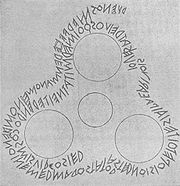
, but there is no historically sound basis to this tale.) The Ancient Greek alphabet was in turn based upon the Phoenician alphabet. From the Cumae alphabet, the Etruscan alphabet was derived and the Romans eventually adopted 21 of the original 26 Etruscan letters:
The letter ⟨C⟩ was the western form of the Greek gamma
, but it was used for the sounds /ɡ/ and /k/ alike, possibly under the influence of Etruscan
, which lacked any voiced plosives
. Later, probably during the 3rd century BC, the letter ⟨Z⟩ — unneeded to write Latin properly — was replaced with the new letter ⟨G⟩, a ⟨C⟩ modified with a small vertical stroke, which took its place in the alphabet. From then on, ⟨G⟩ represented the voiced
plosive /ɡ/, while ⟨C⟩ was generally reserved for the voiceless plosive /k/. The letter ⟨K⟩ was used only rarely, in a small number of words such as Kalendae
, often interchangeably with ⟨C⟩.
After the Roman conquest of Greece
in the 1st century BC, Latin adopted the Greek letters ⟨Y⟩ and ⟨Z⟩ (or readopted, in the latter case) to write Greek
loanwords, placing them at the end of the alphabet. An attempt by the emperor Claudius
to introduce three additional letters
did not last. Thus it was that during the classical Latin
period the Latin alphabet contained 23 letters:
 The Latin names of some of these letters are disputed. In general, however, the Romans did not use the traditional (Semitic
-derived) names as in Greek: the names of the plosives were formed by adding /eː/ to their sound (except for ⟨K⟩ and ⟨Q⟩, which needed different vowels to be distinguished from ⟨C⟩) and the names of the continuant
s consisted either of the bare sound, or the sound preceded by /e/. The letter ⟨Y⟩ when introduced was probably called "hy" /hyː/ as in Greek, the name upsilon
not being in use yet, but this was changed to "i Graeca" (Greek i) as Latin speakers had difficulty distinguishing its foreign sound /y/ from /i/. ⟨Z⟩ was given its Greek name, zeta
. For the Latin sounds represented by the various letters see Latin spelling and pronunciation
; for the names of the letters in English see English alphabet
.
Old Roman cursive script, also called majuscule cursive and capitalis cursive, was the everyday form of handwriting used for writing letters, by merchants writing business accounts, by schoolchildren learning the Latin alphabet, and even emperors
issuing commands. A more formal style of writing was based on Roman square capitals
, but cursive was used for quicker, informal writing. It was most commonly used from about the 1st century BC to the 3rd century, but it probably existed earlier than that. It led to Uncial, a majuscule script commonly used from the 3rd to 8th centuries AD by Latin and Greek scribes.
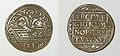
New Roman cursive script, also known as minuscule cursive, was in use from the 3rd century to the 7th century, and uses letter forms that are more recognizable to modern eyes; ⟨a⟩, ⟨b⟩, ⟨d⟩, and ⟨e⟩ had taken a more familiar shape, and the other letters were proportionate to each other. This script evolved into the medieval scripts known as Merovingian
and Carolingian minuscule
.
 It was not until the Middle Ages
that the letter ⟨W
⟩ (originally a ligature
of two ⟨V
⟩s) was added to the Latin alphabet, to represent sounds from the Germanic languages which did not exist in medieval Latin, and only after the Renaissance
did the convention of treating ⟨I
⟩ and ⟨U
⟩ as vowel
s, and
⟨J
⟩ and ⟨V
⟩ as consonant
s, become established. Prior to that, the former had been merely allographs
of the latter.
With the fragmentation of political power, the style of writing
changed and varied greatly throughout the Middle Ages, even after the invention of the printing press
. Early deviations from the classical forms were the uncial script, a development of the Old Roman cursive, and various so-called minuscule scripts that developed from New Roman cursive, of which the Carolingian minuscule
was the most influential, introducing the lower case forms of the letters, as well as other writing conventions that have since become standard.
The languages that use the Latin script today generally use capital letters to begin paragraphs and sentences and proper nouns. The rules for capitalization
have changed over time, and different languages have varied in their rules for capitalization. Old English
, for example, was rarely written with even proper nouns capitalized; whereas Modern English
of the 18th century had frequently all nouns capitalized, in the same way that Modern German
is written today, e.g. "Alle Schwestern der alten Stadt hatten die Vögel gesehen".
, from the Italian Peninsula
to the lands surrounding the Mediterranean Sea
with the expansion of the Roman Empire
. The eastern half of the Empire, including Greece
, Turkey
, the Levant
, and Egypt
, continued to use Greek
as a lingua franca
, but Latin was widely spoken in the western half, and as the western Romance languages
evolved out of Latin, they continued to use and adapt the Latin alphabet.
With the spread of Western Christianity
during the Middle Ages
, the script was gradually adopted by the peoples of northern Europe
who spoke Celtic languages
(displacing the Ogham
alphabet) or Germanic languages
(displacing earlier Runic alphabet
s), Baltic languages
, as well as by the speakers of several Uralic languages
, most notably Hungarian
, Finnish
and Estonian
. The alphabet also came into use for writing the West Slavic languages
and several South Slavic languages
, as the people who spoke them adopted Roman Catholicism
.
Alphabet
An alphabet is a standard set of letters—basic written symbols or graphemes—each of which represents a phoneme in a spoken language, either as it exists now or as it was in the past. There are other systems, such as logographies, in which each character represents a word, morpheme, or semantic...
used in the world
World
World is a common name for the whole of human civilization, specifically human experience, history, or the human condition in general, worldwide, i.e. anywhere on Earth....
today. It evolved from a western variety of the Greek alphabet
Greek alphabet
The Greek alphabet is the script that has been used to write the Greek language since at least 730 BC . The alphabet in its classical and modern form consists of 24 letters ordered in sequence from alpha to omega...
called the Cumaean alphabet, which was adopted and modified by the Etruscans who ruled early Rome. The Etruscan alphabet was in turn adopted and further modified by the ancient Roman
Ancient Rome
Ancient Rome was a thriving civilization that grew on the Italian Peninsula as early as the 8th century BC. Located along the Mediterranean Sea and centered on the city of Rome, it expanded to one of the largest empires in the ancient world....
s to write the Latin language
Latin
Latin is an Italic language originally spoken in Latium and Ancient Rome. It, along with most European languages, is a descendant of the ancient Proto-Indo-European language. Although it is considered a dead language, a number of scholars and members of the Christian clergy speak it fluently, and...
.
During the Middle Ages
Middle Ages
The Middle Ages is a periodization of European history from the 5th century to the 15th century. The Middle Ages follows the fall of the Western Roman Empire in 476 and precedes the Early Modern Era. It is the middle period of a three-period division of Western history: Classic, Medieval and Modern...
, the Latin alphabet was adapted to Romance languages
Romance languages
The Romance languages are a branch of the Indo-European language family, more precisely of the Italic languages subfamily, comprising all the languages that descend from Vulgar Latin, the language of ancient Rome...
, direct descendants of Latin, as well as to Celtic
Celtic languages
The Celtic languages are descended from Proto-Celtic, or "Common Celtic"; a branch of the greater Indo-European language family...
, Germanic
Germanic languages
The Germanic languages constitute a sub-branch of the Indo-European language family. The common ancestor of all of the languages in this branch is called Proto-Germanic , which was spoken in approximately the mid-1st millennium BC in Iron Age northern Europe...
, Baltic
Baltic languages
The Baltic languages are a group of related languages belonging to the Balto-Slavic branch of the Indo-European language family and spoken mainly in areas extending east and southeast of the Baltic Sea in Northern Europe...
, and some Slavic languages
Slavic languages
The Slavic languages , a group of closely related languages of the Slavic peoples and a subgroup of Indo-European languages, have speakers in most of Eastern Europe, in much of the Balkans, in parts of Central Europe, and in the northern part of Asia.-Branches:Scholars traditionally divide Slavic...
. With the age of colonialism and Christian evangelism, the Latin script was spread overseas, and applied to indigenous American
Indigenous languages of the Americas
Indigenous languages of the Americas are spoken by indigenous peoples from Alaska and Greenland to the southern tip of South America, encompassing the land masses which constitute the Americas. These indigenous languages consist of dozens of distinct language families as well as many language...
, Australian, Austronesian
Austronesian languages
The Austronesian languages are a language family widely dispersed throughout the islands of Southeast Asia and the Pacific, with a few members spoken on continental Asia that are spoken by about 386 million people. It is on par with Indo-European, Niger-Congo, Afroasiatic and Uralic as one of the...
, East Asia
East Asia
East Asia or Eastern Asia is a subregion of Asia that can be defined in either geographical or cultural terms...
n, and African
Languages of Africa
There are over 2100 and by some counts over 3000 languages spoken natively in Africa in several major language families:*Afro-Asiatic spread throughout the Middle East, North Africa, the Horn of Africa, and parts of the Sahel...
languages. More recently, western linguists
Linguistics
Linguistics is the scientific study of human language. Linguistics can be broadly broken into three categories or subfields of study: language form, language meaning, and language in context....
have also tended to prefer the Latin alphabet or the International Phonetic Alphabet
International Phonetic Alphabet
The International Phonetic Alphabet "The acronym 'IPA' strictly refers [...] to the 'International Phonetic Association'. But it is now such a common practice to use the acronym also to refer to the alphabet itself that resistance seems pedantic...
(itself largely based on the Latin alphabet) when transcribing or creating written standards for non-European languages, such as the African reference alphabet
African reference alphabet
An African reference alphabet was first proposed in 1978 by a UNESCO-organized conference held in Niamey, Niger, and the proposed alphabet was revised in 1982...
.
The term Latin alphabet, used to write Latin, may be distinguished from other alphabets based on the Latin script, which is the basic set of letters common to the various alphabets descended from Latin, such as the English alphabet
English alphabet
The modern English alphabet is a Latin alphabet consisting of 26 letters and 2 ligatures – the same letters that are found in the Basic modern Latin alphabet:...
. These Latin alphabets may discard letters, like the Rotokas alphabet
Rotokas alphabet
The modern Rotokas alphabet is a Latin alphabet consisting of only 12 letters of the Basic modern Latin alphabet:It is the smallest alphabet in use today. The majority of the Rotokas people are literate in their language. In the Rotokas writing system the vowel letters have their IPA values, though...
, or add new letters, like the Danish and Norwegian alphabet
Danish and Norwegian alphabet
The Danish and Norwegian alphabet is based upon the Latin alphabet and has consisted of the following 29 letters since 1917 and 1955 , although Danish did not officially recognize the W as a separate letter until 1980....
. Letter
Letter (alphabet)
A letter is a grapheme in an alphabetic system of writing, such as the Greek alphabet and its descendants. Letters compose phonemes and each phoneme represents a phone in the spoken form of the language....
shapes have changed over the centuries, including the creation for Medieval Latin
Medieval Latin
Medieval Latin was the form of Latin used in the Middle Ages, primarily as a medium of scholarly exchange and as the liturgical language of the medieval Roman Catholic Church, but also as a language of science, literature, law, and administration. Despite the clerical origin of many of its authors,...
of lower case forms which did not exist in the Classical period.
Origins
It is generally believed that the RomansAncient Rome
Ancient Rome was a thriving civilization that grew on the Italian Peninsula as early as the 8th century BC. Located along the Mediterranean Sea and centered on the city of Rome, it expanded to one of the largest empires in the ancient world....
adopted the Cumae alphabet, a variant of the Greek alphabet
Greek alphabet
The Greek alphabet is the script that has been used to write the Greek language since at least 730 BC . The alphabet in its classical and modern form consists of 24 letters ordered in sequence from alpha to omega...
, in the 7th century BC from Cumae, a Greek colony
Magna Graecia
Magna Græcia is the name of the coastal areas of Southern Italy on the Tarentine Gulf that were extensively colonized by Greek settlers; particularly the Achaean colonies of Tarentum, Crotone, and Sybaris, but also, more loosely, the cities of Cumae and Neapolis to the north...
in Southern Italy. (Gaius Julius Hyginus
Gaius Julius Hyginus
Gaius Julius Hyginus was a Latin author, a pupil of the famous Cornelius Alexander Polyhistor, and a freedman of Caesar Augustus. He was by Augustus elected superintendent of the Palatine library according to Suetonius' De Grammaticis, 20...
in Fab. 277 mentions the legend that it was Carmenta
Carmenta
In ancient Roman religion and myth, Carmenta was a goddess of childbirth and prophecy, associated with technological innovation as well as the protection of mothers and children, and a patron of midwives...
, the Cimmerian Sibyl
Cimmerian Sibyl
thumb|right| Cimmerian Sibyl by [[Guercino]].The Cimmerian Sibyl, by name Carmentis, was the prophetic priestess presiding over the Apollonian Oracle at Cimmerium in Italy, near Lake Avernus . This sibyl may have been a doublet for the Cumaean since the designation Cimmerian refers to priestesses...
, who altered fifteen letters of the Greek alphabet to become the Latin alphabet, which her son Evander
Evander
In Roman mythology, Evander , also spelled Euander, was a deific culture hero from Arcadia, Greece, who brought the Greek pantheon, laws and alphabet to Italy, where he founded the city of Pallantium on the future site of Rome, sixty years...
introduced into Latium, supposedly 60 years before the Trojan War
Trojan War
In Greek mythology, the Trojan War was waged against the city of Troy by the Achaeans after Paris of Troy took Helen from her husband Menelaus, the king of Sparta. The war is among the most important events in Greek mythology and was narrated in many works of Greek literature, including the Iliad...
, but there is no historically sound basis to this tale.) The Ancient Greek alphabet was in turn based upon the Phoenician alphabet. From the Cumae alphabet, the Etruscan alphabet was derived and the Romans eventually adopted 21 of the original 26 Etruscan letters:
| 𐌀 | 𐌁 | 𐌂 | 𐌃 | 𐌄 | 𐌅 | 𐌆 | 𐌇 | 𐌈 | 𐌉 | 𐌊 | 𐌋 | 𐌌 | 𐌍 | 𐌎 | 𐌏 | 𐌐 | 𐌑 | 𐌒 | 𐌓 | 𐌔 | 𐌕 | 𐌖 | 𐌗 | 𐌘 | 𐌙 | 𐌜 | 𐌚 |
|---|---|---|---|---|---|---|---|---|---|---|---|---|---|---|---|---|---|---|---|---|---|---|---|---|---|---|---|
| A | B | C | D | E | F | Z | H | I | K | L | M | N | O | P | Q | R | S | T | V | X |
The letter ⟨C⟩ was the western form of the Greek gamma
Gamma
Gamma is the third letter of the Greek alphabet. In the system of Greek numerals it has a value of 3. It was derived from the Phoenician letter Gimel . Letters that arose from Gamma include the Roman C and G and the Cyrillic letters Ge Г and Ghe Ґ.-Greek:In Ancient Greek, gamma represented a...
, but it was used for the sounds /ɡ/ and /k/ alike, possibly under the influence of Etruscan
Etruscan language
The Etruscan language was spoken and written by the Etruscan civilization, in what is present-day Italy, in the ancient region of Etruria and in parts of Lombardy, Veneto, and Emilia-Romagna...
, which lacked any voiced plosives
Stop consonant
In phonetics, a plosive, also known as an occlusive or an oral stop, is a stop consonant in which the vocal tract is blocked so that all airflow ceases. The occlusion may be done with the tongue , lips , and &...
. Later, probably during the 3rd century BC, the letter ⟨Z⟩ — unneeded to write Latin properly — was replaced with the new letter ⟨G⟩, a ⟨C⟩ modified with a small vertical stroke, which took its place in the alphabet. From then on, ⟨G⟩ represented the voiced
Voice (phonetics)
Voice or voicing is a term used in phonetics and phonology to characterize speech sounds, with sounds described as either voiceless or voiced. The term, however, is used to refer to two separate concepts. Voicing can refer to the articulatory process in which the vocal cords vibrate...
plosive /ɡ/, while ⟨C⟩ was generally reserved for the voiceless plosive /k/. The letter ⟨K⟩ was used only rarely, in a small number of words such as Kalendae
Kalends
The Calends , correspond to the first days of each month of the Roman calendar. The Romans assigned these calends to the first day of the month, signifying the start of the new moon cycle...
, often interchangeably with ⟨C⟩.
After the Roman conquest of Greece
Greece
Greece , officially the Hellenic Republic , and historically Hellas or the Republic of Greece in English, is a country in southeastern Europe....
in the 1st century BC, Latin adopted the Greek letters ⟨Y⟩ and ⟨Z⟩ (or readopted, in the latter case) to write Greek
Greek language
Greek is an independent branch of the Indo-European family of languages. Native to the southern Balkans, it has the longest documented history of any Indo-European language, spanning 34 centuries of written records. Its writing system has been the Greek alphabet for the majority of its history;...
loanwords, placing them at the end of the alphabet. An attempt by the emperor Claudius
Claudius
Claudius , was Roman Emperor from 41 to 54. A member of the Julio-Claudian dynasty, he was the son of Drusus and Antonia Minor. He was born at Lugdunum in Gaul and was the first Roman Emperor to be born outside Italy...
to introduce three additional letters
Claudian letters
The Claudian letters were developed by, and named after, the Roman Emperor Claudius . He introduced three new letters:*a reversed C to replace BS and PS, much like X stood in for CS and GS...
did not last. Thus it was that during the classical Latin
Classical Latin
Classical Latin in simplest terms is the socio-linguistic register of the Latin language regarded by the enfranchised and empowered populations of the late Roman republic and the Roman empire as good Latin. Most writers during this time made use of it...
period the Latin alphabet contained 23 letters:
| Letter | A A A is the first letter and a vowel in the basic modern Latin alphabet. It is similar to the Ancient Greek letter Alpha, from which it derives.- Origins :... |
B B B is the second letter in the basic modern Latin alphabet. It is used to represent a variety of bilabial sounds , most commonly a voiced bilabial plosive.-History:... |
C C Ĉ or ĉ is a consonant in Esperanto orthography, representing the sound .Esperanto orthography uses a diacritic for all four of its postalveolar consonants, as do the Latin-based Slavic alphabets... |
D D D is the fourth letter in the basic modern Latin alphabet.- History :The Semitic letter Dâlet may have developed from the logogram for a fish or a door. There are various Egyptian hieroglyphs that might have inspired this. In Semitic, Ancient Greek, and Latin, the letter represented ; in the... |
E E E is the fifth letter and a vowel in the basic modern Latin alphabet. It is the most commonly used letter in the Czech, Danish, Dutch, English, French, German, Hungarian, Latin, Norwegian, Spanish, and Swedish languages.-History:... |
F F F is the sixth letter in the basic modern Latin alphabet.-History:The origin of ⟨f⟩ is the Semitic letter vâv that represented a sound like or . Graphically, it originally probably depicted either a hook or a club... |
G G G is the seventh letter in the basic modern Latin alphabet.-History:The letter 'G' was introduced in the Old Latin period as a variant of ⟨c⟩ to distinguish voiced, from voiceless, . The recorded originator of ⟨g⟩ is freedman Spurius Carvilius Ruga, the first Roman to open a fee-paying school,... |
H H H .) is the eighth letter in the basic modern Latin alphabet.-History:The Semitic letter ⟨ח⟩ most likely represented the voiceless pharyngeal fricative . The form of the letter probably stood for a fence or posts.... |
|---|---|---|---|---|---|---|---|---|
| Name | ā | bē | cē | dē | ē | ef | gē | hā |
| Pronunciation (IPA) | /aː/ | /beː/ | /keː/ | /deː/ | /eː/ | /ɛf/ | /ɡeː/ | /haː/ |
| Letter | I I I is the ninth letter and a vowel in the basic modern Latin alphabet.-History:In Semitic, the letter may have originated in a hieroglyph for an arm that represented a voiced pharyngeal fricative in Egyptian, but was reassigned to by Semites, because their word for "arm" began with that sound... | K K K is the eleventh letter of the English and basic modern Latin alphabet.-History and usage:In English, the letter K usually represents the voiceless velar plosive; this sound is also transcribed by in the International Phonetic Alphabet and X-SAMPA.... | L L Ł or ł, described in English as L with stroke, is a letter of the Polish, Kashubian, Sorbian, Łacinka , Łatynka , Wilamowicean, Navajo, Dene Suline, Inupiaq, Zuni, Hupa, and Dogrib alphabets, several proposed alphabets for the Venetian language, and the ISO 11940 romanization of the Thai alphabet... | M M M is the thirteenth letter of the basic modern Latin alphabet.-History:The letter M is derived from the Phoenician Mem, via the Greek Mu . Semitic Mem probably originally pictured water... | N N N is the fourteenth letter in the basic modern Latin alphabet.- History of the forms :One of the most common hieroglyphs, snake, was used in Egyptian writing to stand for a sound like English ⟨J⟩, because the Egyptian word for "snake" was djet... | O O O is the fifteenth letter and a vowel in the basic modern Latin alphabet.The letter was derived from the Semitic `Ayin , which represented a consonant, probably , the sound represented by the Arabic letter ع called `Ayn. This Semitic letter in its original form seems to have been inspired by a... | P P P is the sixteenth letter of the basic modern Latin alphabet.-Usage:In English and most other European languages, P is a voiceless bilabial plosive. Both initial and final Ps can be combined with many other discrete consonants in English words... | Q Q Q is the seventeenth letter of the basic modern Latin alphabet.- History :The Semitic sound value of Qôp was , a sound common to Semitic languages, but not found in English or most Indo-European ones... |
| Name | ī | kā | el | em | en | ō | pē | qū |
| Pronunciation (IPA) | /iː/ | /kaː/ | /ɛl/ | /ɛm/ | /ɛn/ | /oː/ | /peː/ | /kʷuː/ |
| Letter | R R R is the eighteenth letter of the basic modern Latin alphabet.-History:The original Semitic letter may have been inspired by an Egyptian hieroglyph for tp, "head". It was used for by Semites because in their language, the word for "head" was rêš . It developed into Greek Ρ and Latin R... | S S S is the nineteenth letter in the ISO basic Latin alphabet.-History: Semitic Šîn represented a voiceless postalveolar fricative . Greek did not have this sound, so the Greek sigma came to represent... | T T T is the 20th letter in the basic modern Latin alphabet. It is the most commonly used consonant and the second most common letter in the English language.- History :Taw was the last letter of the Western Semitic and Hebrew alphabets... | V V V is the twenty-second letter in the basic modern Latin alphabet.-Letter:The letter V comes from the Semitic letter Waw, as do the modern letters F, U, W, and Y. See F for details.... | X X X is the twenty-fourth letter in the basic modern Latin alphabet.-Uses:In mathematics, x is commonly used as the name for an independent variable or unknown value. The usage of x to represent an independent or unknown variable can be traced back to the Arabic word šay شيء = “thing,” used in Arabic... | Y Y Y is the twenty-fifth letter in the basic modern Latin alphabet and represents either a vowel or a consonant in English.-Name:In Latin, Y was named Y Graeca "Greek Y". This was pronounced as I Graeca "Greek I", since Latin speakers had trouble pronouncing , which was not a native sound... | Z Z Z is the twenty-sixth and final letter of the basic modern Latin alphabet.-Name and pronunciation:In most dialects of English, the letter's name is zed , reflecting its derivation from the Greek zeta but in American English, its name is zee , deriving from a late 17th century English dialectal... | |
| Name | er | es | tē | ū | ex | ī Graeca | zēta | |
| Pronunciation (IPA) | /ɛr/ | /ɛs/ | /teː/ | /uː/ | /ɛks/ | /iː ˈɡrajka/ | /ˈzeːta/ | |
Phoenician alphabet
The Phoenician alphabet, called by convention the Proto-Canaanite alphabet for inscriptions older than around 1050 BC, was a non-pictographic consonantal alphabet, or abjad. It was used for the writing of Phoenician, a Northern Semitic language, used by the civilization of Phoenicia...
-derived) names as in Greek: the names of the plosives were formed by adding /eː/ to their sound (except for ⟨K⟩ and ⟨Q⟩, which needed different vowels to be distinguished from ⟨C⟩) and the names of the continuant
Continuant
A continuant is a sound produced with an incomplete closure of the vocal tract. That is, any sound except a stop or nasal. An affricate is considered to be a complex segment, composed of both a stop and a continuant.-See also:...
s consisted either of the bare sound, or the sound preceded by /e/. The letter ⟨Y⟩ when introduced was probably called "hy" /hyː/ as in Greek, the name upsilon
Upsilon
Upsilon is the 20th letter of the Greek alphabet. In the system of Greek numerals it has a value of 400. It is derived from the Phoenician waw. The name of the letter is pronounced in Modern Greek, and in English , , or...
not being in use yet, but this was changed to "i Graeca" (Greek i) as Latin speakers had difficulty distinguishing its foreign sound /y/ from /i/. ⟨Z⟩ was given its Greek name, zeta
Zeta (letter)
Zeta is the sixth letter of the Greek alphabet. In the system of Greek numerals, it has a value of 7. It was derived from the Phoenician letter Zayin...
. For the Latin sounds represented by the various letters see Latin spelling and pronunciation
Latin spelling and pronunciation
Latin spelling or orthography refers to the spelling of Latin words written in the scripts of all historical phases of Latin from Old Latin to the present. They all use some phase of the same alphabet even though conventional spellings may vary from phase to phase...
; for the names of the letters in English see English alphabet
English alphabet
The modern English alphabet is a Latin alphabet consisting of 26 letters and 2 ligatures – the same letters that are found in the Basic modern Latin alphabet:...
.
Old Roman cursive script, also called majuscule cursive and capitalis cursive, was the everyday form of handwriting used for writing letters, by merchants writing business accounts, by schoolchildren learning the Latin alphabet, and even emperors
Roman Emperor
The Roman emperor was the ruler of the Roman State during the imperial period . The Romans had no single term for the office although at any given time, a given title was associated with the emperor...
issuing commands. A more formal style of writing was based on Roman square capitals
Roman square capitals
Roman square capitals, also called capitalis monumentalis, inscriptional capitals, elegant capitals and quadrata, are an ancient Roman form of writing, and the basis for modern capital letters....
, but cursive was used for quicker, informal writing. It was most commonly used from about the 1st century BC to the 3rd century, but it probably existed earlier than that. It led to Uncial, a majuscule script commonly used from the 3rd to 8th centuries AD by Latin and Greek scribes.
New Roman cursive script, also known as minuscule cursive, was in use from the 3rd century to the 7th century, and uses letter forms that are more recognizable to modern eyes; ⟨a⟩, ⟨b⟩, ⟨d⟩, and ⟨e⟩ had taken a more familiar shape, and the other letters were proportionate to each other. This script evolved into the medieval scripts known as Merovingian
Merovingian script
Merovingian script was a medieval script so called because it was developed in France during the Merovingian dynasty. It was used in the 7th and 8th centuries before the Carolingian dynasty and the development of Carolingian minuscule.-Script types:...
and Carolingian minuscule
Carolingian minuscule
Carolingian or Caroline minuscule is a script developed as a writing standard in Europe so that the Roman alphabet could be easily recognized by the literate class from one region to another. It was used in Charlemagne's empire between approximately 800 and 1200...
.
Medieval and later developments
Middle Ages
The Middle Ages is a periodization of European history from the 5th century to the 15th century. The Middle Ages follows the fall of the Western Roman Empire in 476 and precedes the Early Modern Era. It is the middle period of a three-period division of Western history: Classic, Medieval and Modern...
that the letter ⟨W
W
W is the 23rd letter in the basic modern Latin alphabet.In other Germanic languages, including German, its pronunciation is similar or identical to that of English V...
⟩ (originally a ligature
Ligature (typography)
In writing and typography, a ligature occurs where two or more graphemes are joined as a single glyph. Ligatures usually replace consecutive characters sharing common components and are part of a more general class of glyphs called "contextual forms", where the specific shape of a letter depends on...
of two ⟨V
V
V is the twenty-second letter in the basic modern Latin alphabet.-Letter:The letter V comes from the Semitic letter Waw, as do the modern letters F, U, W, and Y. See F for details....
⟩s) was added to the Latin alphabet, to represent sounds from the Germanic languages which did not exist in medieval Latin, and only after the Renaissance
Renaissance
The Renaissance was a cultural movement that spanned roughly the 14th to the 17th century, beginning in Italy in the Late Middle Ages and later spreading to the rest of Europe. The term is also used more loosely to refer to the historical era, but since the changes of the Renaissance were not...
did the convention of treating ⟨I
I
I is the ninth letter and a vowel in the basic modern Latin alphabet.-History:In Semitic, the letter may have originated in a hieroglyph for an arm that represented a voiced pharyngeal fricative in Egyptian, but was reassigned to by Semites, because their word for "arm" began with that sound...
⟩ and ⟨U
U
U is the twenty-first letter and a vowel in the basic modern Latin alphabet.-History:The letter U ultimately comes from the Semitic letter Waw by way of the letter Y. See the letter Y for details....
⟩ as vowel
Vowel
In phonetics, a vowel is a sound in spoken language, such as English ah! or oh! , pronounced with an open vocal tract so that there is no build-up of air pressure at any point above the glottis. This contrasts with consonants, such as English sh! , where there is a constriction or closure at some...
s, and
⟨J
J
Ĵ or ĵ is a letter in Esperanto orthography representing the sound .While Esperanto orthography uses a diacritic for its four postalveolar consonants, as do the Latin-based Slavic alphabets, the base letters are Romano-Germanic...
⟩ and ⟨V
V
V is the twenty-second letter in the basic modern Latin alphabet.-Letter:The letter V comes from the Semitic letter Waw, as do the modern letters F, U, W, and Y. See F for details....
⟩ as consonant
Consonant
In articulatory phonetics, a consonant is a speech sound that is articulated with complete or partial closure of the vocal tract. Examples are , pronounced with the lips; , pronounced with the front of the tongue; , pronounced with the back of the tongue; , pronounced in the throat; and ,...
s, become established. Prior to that, the former had been merely allographs
Allography
Allography, from the Greek for "other writing", has several meanings which all relate to how words and sounds are written down.-Allographs as authorship:...
of the latter.
With the fragmentation of political power, the style of writing
Palaeography
Palaeography, also spelt paleography is the study of ancient writing. Included in the discipline is the practice of deciphering, reading, and dating historical manuscripts, and the cultural context of writing, including the methods with which writing and books were produced, and the history of...
changed and varied greatly throughout the Middle Ages, even after the invention of the printing press
Printing press
A printing press is a device for applying pressure to an inked surface resting upon a print medium , thereby transferring the ink...
. Early deviations from the classical forms were the uncial script, a development of the Old Roman cursive, and various so-called minuscule scripts that developed from New Roman cursive, of which the Carolingian minuscule
Carolingian minuscule
Carolingian or Caroline minuscule is a script developed as a writing standard in Europe so that the Roman alphabet could be easily recognized by the literate class from one region to another. It was used in Charlemagne's empire between approximately 800 and 1200...
was the most influential, introducing the lower case forms of the letters, as well as other writing conventions that have since become standard.
The languages that use the Latin script today generally use capital letters to begin paragraphs and sentences and proper nouns. The rules for capitalization
Capitalization
Capitalization is writing a word with its first letter as a majuscule and the remaining letters in minuscules . This of course only applies to those writing systems which have a case distinction...
have changed over time, and different languages have varied in their rules for capitalization. Old English
Old English language
Old English or Anglo-Saxon is an early form of the English language that was spoken and written by the Anglo-Saxons and their descendants in parts of what are now England and southeastern Scotland between at least the mid-5th century and the mid-12th century...
, for example, was rarely written with even proper nouns capitalized; whereas Modern English
Modern English
Modern English is the form of the English language spoken since the Great Vowel Shift in England, completed in roughly 1550.Despite some differences in vocabulary, texts from the early 17th century, such as the works of William Shakespeare and the King James Bible, are considered to be in Modern...
of the 18th century had frequently all nouns capitalized, in the same way that Modern German
German language
German is a West Germanic language, related to and classified alongside English and Dutch. With an estimated 90 – 98 million native speakers, German is one of the world's major languages and is the most widely-spoken first language in the European Union....
is written today, e.g. "Alle Schwestern der alten Stadt hatten die Vögel gesehen".
Spread
The Latin alphabet spread, along with the Latin languageLatin
Latin is an Italic language originally spoken in Latium and Ancient Rome. It, along with most European languages, is a descendant of the ancient Proto-Indo-European language. Although it is considered a dead language, a number of scholars and members of the Christian clergy speak it fluently, and...
, from the Italian Peninsula
Italian Peninsula
The Italian Peninsula or Apennine Peninsula is one of the three large peninsulas of Southern Europe , spanning from the Po Valley in the north to the central Mediterranean Sea in the south. The peninsula's shape gives it the nickname Lo Stivale...
to the lands surrounding the Mediterranean Sea
Mediterranean Sea
The Mediterranean Sea is a sea connected to the Atlantic Ocean surrounded by the Mediterranean region and almost completely enclosed by land: on the north by Anatolia and Europe, on the south by North Africa, and on the east by the Levant...
with the expansion of the Roman Empire
Roman Empire
The Roman Empire was the post-Republican period of the ancient Roman civilization, characterised by an autocratic form of government and large territorial holdings in Europe and around the Mediterranean....
. The eastern half of the Empire, including Greece
Greece
Greece , officially the Hellenic Republic , and historically Hellas or the Republic of Greece in English, is a country in southeastern Europe....
, Turkey
Turkey
Turkey , known officially as the Republic of Turkey , is a Eurasian country located in Western Asia and in East Thrace in Southeastern Europe...
, the Levant
Levant
The Levant or ) is the geographic region and culture zone of the "eastern Mediterranean littoral between Anatolia and Egypt" . The Levant includes most of modern Lebanon, Syria, Jordan, Israel, the Palestinian territories, and sometimes parts of Turkey and Iraq, and corresponds roughly to the...
, and Egypt
Egypt
Egypt , officially the Arab Republic of Egypt, Arabic: , is a country mainly in North Africa, with the Sinai Peninsula forming a land bridge in Southwest Asia. Egypt is thus a transcontinental country, and a major power in Africa, the Mediterranean Basin, the Middle East and the Muslim world...
, continued to use Greek
Greek language
Greek is an independent branch of the Indo-European family of languages. Native to the southern Balkans, it has the longest documented history of any Indo-European language, spanning 34 centuries of written records. Its writing system has been the Greek alphabet for the majority of its history;...
as a lingua franca
Lingua franca
A lingua franca is a language systematically used to make communication possible between people not sharing a mother tongue, in particular when it is a third language, distinct from both mother tongues.-Characteristics:"Lingua franca" is a functionally defined term, independent of the linguistic...
, but Latin was widely spoken in the western half, and as the western Romance languages
Romance languages
The Romance languages are a branch of the Indo-European language family, more precisely of the Italic languages subfamily, comprising all the languages that descend from Vulgar Latin, the language of ancient Rome...
evolved out of Latin, they continued to use and adapt the Latin alphabet.
With the spread of Western Christianity
Western Christianity
Western Christianity is a term used to include the Latin Rite of the Catholic Church and groups historically derivative thereof, including the churches of the Anglican and Protestant traditions, which share common attributes that can be traced back to their medieval heritage...
during the Middle Ages
Middle Ages
The Middle Ages is a periodization of European history from the 5th century to the 15th century. The Middle Ages follows the fall of the Western Roman Empire in 476 and precedes the Early Modern Era. It is the middle period of a three-period division of Western history: Classic, Medieval and Modern...
, the script was gradually adopted by the peoples of northern Europe
Northern Europe
Northern Europe is the northern part or region of Europe. Northern Europe typically refers to the seven countries in the northern part of the European subcontinent which includes Denmark, Estonia, Latvia, Lithuania, Norway, Finland and Sweden...
who spoke Celtic languages
Insular Celtic languages
Insular Celtic languages are those Celtic languages that originated in the British Isles, in contrast to the Continental Celtic languages of mainland Europe and Anatolia. All surviving Celtic languages are from the Insular Celtic group; the Continental Celtic languages are extinct...
(displacing the Ogham
Ogham
Ogham is an Early Medieval alphabet used primarily to write the Old Irish language, and occasionally the Brythonic language. Ogham is sometimes called the "Celtic Tree Alphabet", based on a High Medieval Bríatharogam tradition ascribing names of trees to the individual letters.There are roughly...
alphabet) or Germanic languages
Germanic languages
The Germanic languages constitute a sub-branch of the Indo-European language family. The common ancestor of all of the languages in this branch is called Proto-Germanic , which was spoken in approximately the mid-1st millennium BC in Iron Age northern Europe...
(displacing earlier Runic alphabet
Runic alphabet
The runic alphabets are a set of related alphabets using letters known as runes to write various Germanic languages before the adoption of the Latin alphabet and for specialized purposes thereafter...
s), Baltic languages
Baltic languages
The Baltic languages are a group of related languages belonging to the Balto-Slavic branch of the Indo-European language family and spoken mainly in areas extending east and southeast of the Baltic Sea in Northern Europe...
, as well as by the speakers of several Uralic languages
Uralic languages
The Uralic languages constitute a language family of some three dozen languages spoken by approximately 25 million people. The healthiest Uralic languages in terms of the number of native speakers are Hungarian, Finnish, Estonian, Mari and Udmurt...
, most notably Hungarian
Hungarian language
Hungarian is a Uralic language, part of the Ugric group. With some 14 million speakers, it is one of the most widely spoken non-Indo-European languages in Europe....
, Finnish
Finnish language
Finnish is the language spoken by the majority of the population in Finland Primarily for use by restaurant menus and by ethnic Finns outside Finland. It is one of the two official languages of Finland and an official minority language in Sweden. In Sweden, both standard Finnish and Meänkieli, a...
and Estonian
Estonian language
Estonian is the official language of Estonia, spoken by about 1.1 million people in Estonia and tens of thousands in various émigré communities...
. The alphabet also came into use for writing the West Slavic languages
West Slavic languages
The West Slavic languages are a subdivision of the Slavic language group that includes Czech, Polish, Slovak, Kashubian and Sorbian.Classification:* Indo-European** Balto-Slavic*** Slavic**** West Slavic***** Czech-Slovak languages****** Czech...
and several South Slavic languages
South Slavic languages
The South Slavic languages comprise one of three branches of the Slavic languages. There are approximately 30 million speakers, mainly in the Balkans. These are separated geographically from speakers of the other two Slavic branches by a belt of German, Hungarian and Romanian speakers...
, as the people who spoke them adopted Roman Catholicism
Roman Catholic Church
The Catholic Church, also known as the Roman Catholic Church, is the world's largest Christian church, with over a billion members. Led by the Pope, it defines its mission as spreading the gospel of Jesus Christ, administering the sacraments and exercising charity...
.
See also
- Alphabets derived from the LatinAlphabets derived from the LatinA Latin alphabet is an alphabetical writing system that uses letters of the original Roman Latin alphabet and often various extensions, the Latin script...
- BeghilosCalculator spellingCalculator spelling is a technique of spelling words by reading characters upside-down from calculators equipped with certain kinds of seven-segment displays...
(Calculator spelling) - CalligraphyCalligraphyCalligraphy is a type of visual art. It is often called the art of fancy lettering . A contemporary definition of calligraphic practice is "the art of giving form to signs in an expressive, harmonious and skillful manner"...
- CollationCollationCollation is the assembly of written information into a standard order. One common type of collation is called alphabetization, though collation is not limited to ordering letters of the alphabet...
- Euboean alphabet
- Keyboard layoutKeyboard layoutA keyboard layout is any specific mechanical, visual, or functional arrangement of the keys, legends, or key–meaning associations of a computer, typewriter, or other typographic keyboard....
- Latin characters in Unicode
- Latin-1
- Legacy of the Roman EmpireLegacy of the Roman EmpireThe legacy of the Roman Empire refers to the set of cultural values, religious beliefs, as well as technological and other achievements of Ancient Rome which were passed on after the demise of the empire itself and continued to shape other civilizations, a process which continues to this day.-...
- List of Latin letters
- PalaeographyPalaeographyPalaeography, also spelt paleography is the study of ancient writing. Included in the discipline is the practice of deciphering, reading, and dating historical manuscripts, and the cultural context of writing, including the methods with which writing and books were produced, and the history of...
- PenmanshipPenmanshipPenmanship is the technique of writing with the hand using a writing instrument. The various generic and formal historical styles of writing are called hands, whilst an individual personal style of penmanship is referred to as handwriting....
- Phoenician alphabetPhoenician alphabetThe Phoenician alphabet, called by convention the Proto-Canaanite alphabet for inscriptions older than around 1050 BC, was a non-pictographic consonantal alphabet, or abjad. It was used for the writing of Phoenician, a Northern Semitic language, used by the civilization of Phoenicia...
- PinyinPinyinPinyin is the official system to transcribe Chinese characters into the Roman alphabet in China, Malaysia, Singapore and Taiwan. It is also often used to teach Mandarin Chinese and spell Chinese names in foreign publications and used as an input method to enter Chinese characters into...
- Roman letters used in mathematicsRoman letters used in mathematicsMany letters of the Latin alphabet, both capital and small, are used in mathematics, science and engineering to denote by convention specific or abstracted constants, variables of a certain type, units, multipliers, physical entities...
- TypographyTypographyTypography is the art and technique of arranging type in order to make language visible. The arrangement of type involves the selection of typefaces, point size, line length, leading , adjusting the spaces between groups of letters and adjusting the space between pairs of letters...
- Western Latin character sets (computing)Western Latin character sets (computing)Several binary representations of character sets for common Western European languages are compared in this article. These encodings were designed for representation of Italian, Spanish, Portuguese, French, German, Dutch, English, Danish, Swedish, Norwegian, and Icelandic, which use the Latin...