
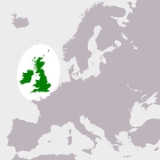
Encyclopedia
Great Britain,
Ireland and several thousand smaller surrounding
islands and
islets form an
archipelago off the northwest coast of continental Europe which is most commonly known as the
British Isles. The term is rejected by some in Ireland—and at times avoided or replaced—in part because of the term's association with the modern British state.
The archipelago contains two sovereign states: the
United Kingdom of Great Britain and Northern Ireland and the
Republic of Ireland. The islands also include the
Isle of Man, a United Kingdom crown dependency. Both states, but not the Isle of Man, are members of the
European Union. Between 1801 and 1922, Great Britain and Ireland together formed the
United Kingdom of Great Britain and Ireland. In 1922, 26 of the 32 counties of Ireland ceased to be a part of the United Kingdom and became the Republic of Ireland. The history of the islands tends to be considered on a national basis.
The islands encompass an area south to north from Pednathise Head to Out Stack,
Shetland in the United Kingdom, and west to east from Tearaght Island in the Republic of Ireland to
Lowestoft Ness in the United Kingdom, containing more than 6,000 islands, amounting to a total land area of 315,134 km˛ . The islands are largely low lying and fertile, though with significant mountainous areas in Ireland, Scotland, Wales, and the north of England. The regional geology is complex, formed by the drifting together of separate regions and shaped by glaciation.
The islands were named after the ancient British, their pre-Roman inhabitants; however, on its own, the dominant modern meaning of the adjective "
British" is "of Great Britain or of the United Kingdom or its people", so the term "British Isles" is often mistakenly interpreted to imply that the
Republic of Ireland is part of the
United Kingdom. The Irish government's policy is to avoid the term and rarely uses it; the Irish media also rarely use it. 'British Isles' has also been used either not to include the island of
Ireland at all in the definition, or else to include just
Northern Ireland.
Geography
The archipelago is made up of more than 6,000 islands, the two biggest being
Great Britain and
Ireland. Great Britain, to the east, covers 216,777 km˛ , over ? of the total archipelago; Ireland, to the west, covers 84,406 km˛ . The other larger islands are situated to the north and west of the archipelago, in the
Hebrides and
Shetland Islands.
The islands that constitute the archipelago include:
- Great Britain
- Ireland
- Ulster: Arranmore, Tory Island
- Connacht: Achill Island, Clew Bay islands, Inishturk, Inishbofin, Inishark, Aran Islands
- Munster: Blasket Islands, Valentia Island, Cape Clear, Sherkin Island, Great Island
- Leinster: Lambay Island, Ireland's Eye
- See also: List of islands of Ireland
- Isle of Man
- See also: List of islands of Isle of Man
The following islands are sometimes also included, though officially are not geographically part of the archipelago:
The islands are at relatively low altitudes, with central Ireland and southern Great Britain particularly low lying. The
Scottish Highlands in the northern part of Great Britain are mountainous, with
Ben Nevis being the highest point on the archipelago at 1,344
m . Other mountainous areas include Wales and parts of the island of Ireland, but only seven peaks in these areas reach above 1,000 m . Lakes on the islands are generally not large, although
Lough Neagh in Northern Ireland is an exception, covering 381 km˛ ; the largest freshwater body in Great Britain is
Loch Lomond at 71.1 km˛ . Neither are rivers particularly long, the rivers
Severn at 354 km and Shannon at 386 km being the longest.
The islands have a temperate marine climate, the North Atlantic Drift which flows from the
Gulf of Mexico brings with it significant moisture and raises temperatures 11 degrees Celsius above the global average for the islands' latitudes. Winters are thus warm and wet, with summers mild and also wet. Most Atlantic
depressions pass to the north of the islands, combined with the general westerly circulation and interactions with the landmass, this imposes an east-west variation in climate.
Geology
An is available.
The British Isles lie at the juncture of several regions with past episodes of
tectonic mountain building. These
orogenic belts form a complex geology which records a huge and varied span of earth history. Of particular note was the Caledonian Orogeny during the Ordovician Period, ca. 488-444 Ma and early Silurian period, when the
craton Baltica collided with the terrane
Avalonia to form the mountains and hills in northern Britain and Ireland. Baltica formed roughly the north western half of Ireland and Scotland. Further collisions caused the Variscan orogeny in the
Devonian and Carboniferous periods, forming the hills of Munster, south-west England, and south Wales. Over the last 500 million years the land which forms the islands has drifted northwest from around 30°S, crossing the
equator around 370 million years ago to reach its present northern latitude.
The islands have been shaped by numerous glaciations during the Quaternary Period, the most recent being the
Devensian. As this ended, the central
Irish Sea was de-glaciated and the
English Channel flooded, with sea levels rising to current levels some 4,000 to 5,000 years ago, leaving the archipelago in its current form.
The islands' geology is highly complex, though there are large amounts of
limestone and
chalk rocks which formed in the Permian and Triassic periods. The west coasts of Ireland and northern Great Britain that directly face the
Atlantic Ocean are generally characterized by long
peninsulas, and headlands and bays; the internal and eastern coasts are "smoother".
History
- See also: History of the Isle of Man, History of the Orkney Islands
As with Prehistoric Scotland [i] generally, the arrival of hunter gatherer [i]s in Orkney [i]...
.
The islands have a long and complex shared history. While this tends to be presented in terms of national narratives, many events transcended modern political boundaries. In particular these borders have little relevance to early times and in that context can be misleading, though useful as an indication of location to the modern reader. It should also be noted that cultural shifts which historians have previously interpreted as evidence of invaders eliminating or displacing the previous populations are now, in the light of genetic evidence, perceived by many archaeologists and historians as being to a considerable extent changes in the culture of the existing population, often brought by groups of immigrants or invaders who at times became a new ruling élite.
Prehistory
At a time when these lands were still joined to continental Europe,
Homo erectus is an extinct species of genus
Homo [i]. ...
brought Palaeolithic tool use to the south east of the modern archipelago some 750,000 years ago followed by the more advanced tool use of
Homo heidelbergensis is an extinct species [i] of the genus [i]
Homo [i] and the direct anc ...
found at Boxgrove. It appears that the
glaciation of
ice ages successively cleared all human life from the area, though human occupation occurred during warmer interglacial periods. Modern humans appear with the Aurignacian culture about 30,000 years ago, famously with the "Red Lady of Paviland" in modern Wales. The last ice age ended around 10,000 years ago, and Mesolithic hunter-gatherers spread to all parts of the archipelago by around 8,000 years ago, at a time when rising sea levels now cut off the islands from the continent. The immigrants came principally from the ice age refuge in what is now the Basque Country, with a smaller immigration from refuges in the modern
Ukraine and
Moldavia. Three quarters of the ancestors of people in the British Isles may have arrived in this wave of immigration.
Around 6,500 years ago farming practices spread to the area with the Neolithic Revolution and the western seaways quickly brought
megalithic culture throughout the islands. The earliest stone house still standing in northern Europe is at
Knap of Howar, in Orkney which also features such monuments as
Maes Howe ranking alongside the
Callanish stone circle on the Isle of Lewis,
Newgrange in Ireland, and
Stonehenge in southern England along with thousands of lesser monuments across the isles, often showing affinities with megalithic monuments in France and Spain. Further cultural shifts in the
bronze age were followed with the building of numerous
hill forts in the
iron age, and increased trade with continental Europe.
Pretani, Romans and Anglo-Saxons
The oldest surviving historical records of the islands preserve fragments of the travels of the
ancient Greek Pytheas around 320 BC and describe Great Britain and Ireland as the islands of
Prettanike with their peoples the
Priteni or
Pretani, a name which may have been used in
Gaul. A later variation on this term as the
Cruithne would come to refer to certain groups. Ireland was referred to as
Ierne "inhabited by the race of
Hiberni", and Britain as
insula Albionum, "island of the Albions". These terms without the collective name appear in the
4th century writings of Avienus which preserve fragments of the Massaliote Periplus of the 6th century BC. Later scholars would associate these tribal societies with the
Celts the
Ancient Greeks reported. Traditionally, theorigin of the Celts was in what is now south-west Germany, though modern evidence suggests they may have migrated from
Anatolia around 7000 B.C. through southern and then western Europe. The
Celtic languages in the British Isles can be subgrouped into the Brythonic languages spoken in most of Britain and Goidelic in Ireland and the west of modern Scotland. Modern genetic evidence suggests that there was not large-scale replacement of inhabitants and that the Celtic influence was largely cultural. In the
Scottish highlands northwards the people the
Romans called Caledonians or
Picts spoke a language which is now unknown. It is aslo possible that southern England was settled by Belgic tribes.
During the first century the Roman conquest of Britain established
Roman Britain which became a province of the
Roman Empire named
Britannia, eventually extending on the island of Britain to
Hadrian's Wall with tribes forming friendly buffer states further north to around the
Firth of Clyde and the
Firth of Forth, and military expeditions beyond that into Caledonia. The interaction of the
Romans with Ireland appears to have largely been limited to some trade. From the 4th century, many Britons migrated across the
English Channel and founded
Brittany.
The departure of the Romans around 410 left numerous kingdoms across the islands. Settlement by Germanic people, such as the
Anglo-Saxons brought
Sub-Roman Britain increasingly coming under their rule in much of what is now England and
south-east Scotland. To the north, the Irish
Dalriadans, also known by the name Scotti expanded their influence to western Scotland.
National formation
The
Vikings appeared in the British Isles in the 790's with raids on
Lindisfarne,
Iona, and the west of Ireland. They provided another wave of immigration, settling in Orkney and Shetland and then
Western Isles,
Caithness,
Sutherland,
Isle of Man,
Galloway, in various places around Ireland,
Northumbria,
East Anglia and
Mercia.
Wessex prevented the further expansion of the Vikings, and achieved a united
kingdom of England in 927, which was then ruled by both English and Viking kings until
1066. Further north, in 900 A.D. Donald II was the first
king of AlbaNorman immigration
The next wave of immigration were Viking descendants, the
Normans. The
Norman Conquest of 1066 brought England under their rule and then extended their influence and power to the rest of the British Isles. The Normans were centralisers and expansionists. Their lands within the British Isles were part of more extensive land holdings in France and elsewhere, and held within a feudal framework. They controlled by the end of the 11th century, only to partially lose it again several times owing to revolts until 1283 when
Edward I successfully enforced Plantagenet supremacy. In 1072 the Normans forced the Scottish king Malcolm III to submit to their feudal overlordship, something they would regularly assert during the mediaeval period. The Normans did not supplant the Scottish political structure, but had great influence over it, eventually supplying the from 1150, and then asserting independence of the Scottish Crown from that of England. The Scottish Crown gradually gained control of Norse areas, annexing the kingdoms of Mann and of the Isles in 1266, and Orkney and Shetland from
Norway in 1472. The Normans were initially
invited to Ireland, here they asserted overlordship, resulting in 1184 with the Pope authorising the feudal Lordship of Ireland. This fell under the English crown with the accession of
John. Formal taxation and government during the middle ages was generally restricted to an arc around Dublin called the Pale.
During the
Middle Ages, the Normans slowly intermarried with the previous populations and adopted their language and customs. In England, the anglicisation of the Norman and Plantagenet elite was driven by the slow erosion of their lands elsewhere, but it was 1362 before English became the language of the law courts.
Protestant reformation and civil wars
The feudal system decayed and by the end of the sixteenth century was replaced by a system of centralised states. The English throne had come under the Welsh
Tudors, who centralised government in England,
Ireland, and
Wales. In 1603
James VI of Scotland brought England and Scotland into personal union and promoted the existence of a modern British identity.
These changes happened at the same time as the
Protestant reformation where the Roman Catholic church had been replaced by national churches to which all people were expected to adhere to. Failure to do so resulted in prosecution for recusancy and heavy fines, and recusants laid themselves open to accusations of treason and loss of land. By 1600 there was a wide range of religious belief within the British Isles from
Presbyterian Calvinists and Independents to episcopal Calvinists to Protestant Episcopalians that retained formal liturgy to Roman Catholicism .
James, and his son,
Charles I, favoured political and religious centralisation and uniformity throughout the British Isles While favouring episcopal,
Armininian churches with a formal liturgy, James followed a policy of relative religious toleration, but expanded the policy of
plantation in Ulster where forfeited lands from Catholics were settled by Scottish and English Protestants. Charles tried to force central, personal government. He attempted to bypass institutions he could not control and impose a uniform non-Calivinistic settlement throughout the British Isles. The result was the Bishops Wars#First Bishops War in Scotland in 1639. This started the
Wars of the Three Kingdoms, a shifting series of conflicts and alliances within the British Isles. The main political blocks were Royalist forces in England, Scotland , and Ireland, English parliamentary forces , Scottish presbyterians , and the Irish Catholic Confederates. By 1649 Parliamentary forces ruled England and executed Charles and the Covenanters had secured Scotland. An alliance between the Confederates and the Royalists in Ireland resulted in the parliamentary conquest of Ireland, followed by a brutal guerrilla campaign which officially ended in 1653.
Charles II repudiated the Irish alliance in 1650 in order to enter one with the Covenanters instead and invaded England. He was defeated in 1651 and the result was that the entire archipelago was brought under the English parliamentary army. There was religious toleration of Protestant denominations , but Catholics were strongly repressed. In Ireland they were disenfranchised and dispossessed with Catholic land ownership dropping from 60% to 8% and the land used to pay debts. Some of the land was given to another wave of Protestant immigrants, especially former soldiers, but these were not sufficient to replace the existing Irish, so Ireland became a land largely owned by protestant landlords with Catholic tenants.
The return of the Stuarts
The restoration of Charles II in 1660 reversed many of the
Commonwealth measures: the three kingdoms were separated again, the episcopalian Churches of England and Ireland re-established, a Presbyterian Church of Scotland established, and Protestant nonconformism repressed. A small proportion of the confiscated lands in Ireland were restored, bringing Catholic ownership up to 20%. In1685 brought Charles' brother,
James II, a Catholic, to the thrones. James suspended the laws discriminating against those not adhering to the national churches; but, he attempted personal rule with a large standing army and heavy-handedly attempted to replace Anglicans with Catholics. This alienated the English establishment who invited the Dutch
William, Prince of Orange to depose James in favour of his daughter,
Mary. On William's landing, James fled first to France and then to Ireland where the government remained loyal to him. Here he was defeated, and the position of the
Protestant Ascendancy cemented with the imposition of Penal Laws there that effectively denied nearly all Catholics any sort of power or substantial property.
James and his descendants attempted to recover the throne
several times over the next sixty years, but failed to gain sufficient active support and were consistently defeated.
Kingdom of Great Britain and social revolutions
The 1707
Act of Union united England and Scotland in the
Kingdom of Great Britain. The next century saw the start of great social changes. Enclosure had been taking place over a long period in England, but the agricultural revolution accelerated the process by which land was privatised, commercialised, and intensively exploited, and caused it to spread throughout the British Isles. This resulted in the displacement of large numbers of people from the land and widespread hardship. In addition, the
industrial revolution saw the displacement of cottage industries by large-scale factories and the rapid growth of industrial towns and cities. The
British Empire grew substantially, stoking the growth in industrial production, bringing in wealth, giving rise to large-scale emigration, and making
London the largest city in Europe.
Social unrest and repressive government accompanied these upheavals. The ideals of the
French Revolution were widely supported and led to a full-scale
rebellion in Ireland. A result of the rebellion was the start of the end of Ascendancy hegemony in Ireland and its political
unification with Great Britain in 1801. Unrest throughout the British Isles continued well into the 19th century, but was increasingly legitimised and able to find an outlet in Parliament from the Great Reform Act of 1832 onwards. The role of religion in determining political markedly decreased from the Catholic Relief Act in 1829 onwards. The social upheavals continued with widespread migration from the countryside to towns and cities and abroad. Ireland suffered a great famine from 1845 until 1849 which resulted in its population dropping by a third through death and migration. This included large-scale movements to Great Britain, especially to the north west of England and western Scotland. Emigration from the whole of the British Isles overseas continued, especially to the English-speaking parts of the British Empire, the United States, and other countries such as
Argentina.
The twentieth century
Prosperity increased through the 19th and into the 20th century, and politics became increasingly popular and democratic. The
Irish War of Independence and subsequent
Irish Civil War led to the 1922 formation of the
Irish Free State, which was a dominion until becoming a
republic in 1949. Six Irish counties remained part of the United Kingdom as
Northern Ireland, initially with devolved government. Since then there have been extensive periods of
unrest. Both the United Kingdom and the Republic of Ireland joined the European Economic Community in 1974. Currently there are devolved governments in
Wales and
Scotland, though in Northern Ireland the
devolved assembly is currently suspended.
Further waves of migration from Ireland to Great Britain took place during times of economic difficulty in the thirties, forties, and fifties, though since then it has grown more prosperous and its
Gross Domestic Product per capita now exceeds that of the United Kingdom. The end of the
British Empire in the latter half of the 20th century saw the end of large-scale emigration; instead, there was immigration to Britain, especially from the
West Indies and the Indian sub-continent, and recently to both Britain and Ireland from eastern
Europe.
Terminology
The term
British Isles is in widespread use, and is defined as "Great Britain and Ireland and adjacent islands". However the term carries additional meanings; political, economic, cultural, geopolitical, legal and cultural, reflecting historical divisions and the fact that the British Isles in general coincided with the geographic area of the former
United Kingdom of Great Britain and Ireland . The use of the term
British Isles has on occasion been interpreted as implying a continued political association with Britain, an inference which causes the term to be both unacceptable and controversial to many people in Ireland a sovereign state that became independent from the Britain some eighty years ago.
The term
British has several different meanings. The
Old English language prefix "Brit-" came from the
Latin Britto of classical times, which itself derived from a
Celtic language term and was used when describing the whole archipelago of islands. Throughout Book 4 of his
Geography,
Strabo is consistent in spelling the island Britain as
Prettanikee; he uses the terms
Prettans or
Brettans loosely to refer to the islands as a group.
Pliny the Elder writing around AD 70 uses a Latin version of the same terminology in section 4.102 of his
Naturalis Historia or "Natural History" is an encyclopedia [i] written by Pliny the Elder [i]. ...
. He writes of Great Britain:
Albion ipsi nomen fuit, cum Britanniae vocarentur omnes de quibus mox paulo dicemus. . In the following section, 4.103, Pliny enumerates the islands he considers to make up the Britannias, listing Great Britain, Ireland, and many smaller islands.
Ptolemy includes Ireland, which he calls
Hibernia, as being part of the island group he calls
Britannia. He titles Book II, Chapter 1 of his
Geography as
Hibernia, Island of Britannia. Since classical times, a meaning of "British" is to refer to the
ancient Britons, and was used in this way by the Anglo-Saxon Chronicle , through Early Modern times to the present day Peter Heylyn, who was to coin the term
British Isles in English, used
British in this way to refer to the ancient Britons, stating that
Britt meant
paint.
The classical name for all the islands associated with Great Britain and Ireland was used by continental mapmakers in Latin or French from the 16th century onwards, such as
Gerardus MercatorThe first use in English of "British Isles" was by Peter Heylin in his
Microcosmus: a little description of the great world in 1621, a collection of his lectures on historical geography. He used this term for both Great Britain and Ireland by reasoning that all the pre-Roman inhabitants in the archipelago would have been ancient Britons owing to the close proximity of the islands to each other, that "ancient writers call this Iland a
Brtti?h Iland", and a quote from
Tacitus that the habits and disposition of the people in Ireland were not much unlike the "
Brittaines". The use of the term as a historical term continues to have a wide use within the United Kingdom to describe the whole archipelago in a geographical sense.
Perspectives in Ireland
Also at the end of the 16th century
British also came to mean as pertaining to the island of Great Britain , and this use grew very quickly with the accession of
James VI of Scots to the English throne. It was used in an Irish context to differentiate those from Great Britain from native Irish in 1641. As a result, in Ireland the use of the name "British Isles" is highly controversial, because of the perception that its use implies a continued constitutional relationship between the sovereign states of the
Republic of Ireland and the
United Kingdom. This perception can often lead to the incorrect belief that the United Kingdom retains sovereignty over the Republic. Due to these geopolitical connotations, the use of the term in the Republic of Ireland is controversial.
According to the Irish Minister for Foreign Affairs Dermot Ahern, British Isles is not an officially recognised or used term, and no branch of the Irish government, including the Department of Foreign Affairs and the Irish Embassy in London, officially uses the term, though rare usage does occur.
Because of the complexity, many bodies avoid describing the Republic of Ireland as being part of the British Isles. Some believe that Ireland left the British Isles when it left the United Kingdom in 1922. Rare mentions of the term "British Isles" do occasionally occur at governmental level in Ireland, with a cabinet minister, Síle de Valera, delivering a speech containing the term, contrary to stated government policy, in 2002.
British Isles has been used in a geographical sense in Irish parliamentary debates, though not by government ministers.
In
Northern Ireland nationalists reject the term
British Isles and use the awkward and ambiguous description
these islands as an alternative, whereas unionists, when countering nationalist insistence on the territorial integrity of the island of Ireland, change the geographical frame of reference to that of the whole archipelago of what they call the
British Isles, according to Guelke. A think tank survey of attitudes found a more complex picture, with a sense of British "national" consciousness among unionists clearly separating them from nationalists in their interviews, and nearly all Catholics expressing difficulty in understanding unionist descriptions of Britishness. Identities were diverse and multi-layered and Irishness was a highly contested identity. In the interviews cited, a unionist perceived the
British Isles as a natural geographical entity while Michael Lavery, chair of the Standing Advisory Commission on Human Rights, defined himself as "primarily Irish, influenced obviously by Europe and the fact that I live in the British Isles and speak English."
The overall opinions of Irish people about the term have never been formally gauged. At a conference held between Northern and Republic academics in mid 2005, only one, a political scientist from