

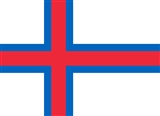
Faroe Islands

Encyclopedia
The Faroe Islands are an island
group situated between the Norwegian Sea
and the North Atlantic Ocean, approximately halfway between Scotland
and Iceland
. The Faroe Islands are a self-governing territory within the Kingdom of Denmark
, along with Denmark
proper and Greenland
. The total area is approximately 1,400 km² (540 sq mi) with a 2010 population of almost 50,000.
The Faroe Islands have been a self-governing dependency
of the Kingdom of Denmark since 1948. Over the years, the Faroese have been granted control of some matters. Areas that remain the responsibility of Denmark include military defence, police, justice, currency and foreign affairs
.
The Faroe Islands were politically associated with Norway
until 1380, when Norway entered the Kalmar Union
with Denmark and Sweden
, which gradually evolved into Danish control of the islands. This association ceased in 1814 when Denmark ceded Norway to Sweden, while Denmark retained control of Norwegian colonies including the Faroe Islands, Iceland and Greenland. The Faroe Islands have two representatives on the Nordic Council
as members of the Danish delegation.
hermits and monk
s from a Hiberno-Scottish mission
are believed to have settled in the 6th century, introducing sheep and goats and the early Irish language. Saint Brendan, an Irish monastic saint, who is supposed to have lived around 484–578, is said to have visited the Faroe Islands on two or three occasions (512–530), naming two of the islands Sheep Island and Paradise Island of Birds.
Later on (c. 850) Norsemen settled the islands, bringing the Old Norse
language that has evolved into the modern Faroese language
spoken today.
These settlers are not thought to have come directly from Scandinavia, but rather from Norse communities surrounding the Irish Sea
, Northern Isles
and Western Isles of Scotland
, including the Shetland and Orkney islands, and Norse-Gaels
. The old Gaelic name for the Faroe Islands, Na Scigirí, means the Skeggjar and probably refers to the Eyja-Skeggjar (Island-Beards), a nickname given to the island dwellers. The aforementioned theories are speculative and are not supported by archeological evidence. However, the immigration of Norwegian Vikings is well documented. Thus, according to the Faroe Islands Government, the Nordic language and culture are derived from the Norwegians, or Norsemen, who settled in the Faroe Islands.
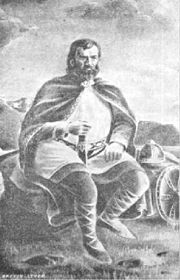 According to Færeyinga Saga
, emigrants who left Norway to escape the tyranny of Harald I of Norway
settled on the islands around the end of the 9th century. Early in the 11th century, Sigmundur Brestirson – whose clan had flourished in the southern islands but had been almost exterminated
by invaders from the northern islands – escaped to Norway. He was sent back to take possession of the islands for Olaf Tryggvason
, King of Norway. Sigmundur introduced Christianity
and, though he was subsequently murdered, Norwegian supremacy
was upheld. Norwegian control of the islands continued until 1380, when Norway entered the Kalmar Union with Denmark, which gradually resulted in Danish control of the islands. The Reformation
reached the Faroes in 1538. When the union between Denmark and Norway was dissolved as a result of the Treaty of Kiel
in 1814, Denmark retained possession of the Faroe Islands.
The trade monopoly
in the Faroe Islands was abolished in 1856, after which the area developed as a modern fishing
nation with its own fleet
. The national awakening since 1888 was initially based on a struggle to maintain the Faroese language
and was thus culturally
oriented, but after 1906 it became politically
oriented, with the foundation of political parties of the Faroe Islands.
On 12 April 1940, the Faroes were occupied by British
troops. The move followed the invasion of Denmark
by Nazi Germany
and had the objective of strengthening British control of the North Atlantic (see Battle of the Atlantic). In 1942–1943 the British Royal Engineers
built the only airport
in the Faroes, Vágar Airport
. Control of the islands reverted to Denmark following the war, but in 1948 home-rule was introduced, with a high degree of local autonomy. In 1973 the Faroe Islands declined to join Denmark in entering the European Community (now European Union
). The islands experienced considerable economic difficulties following the collapse of the fishing industry in the early 1990s, but have since made efforts to diversify
the economy. Support for independence
has grown and is the objective of the Republican Party.
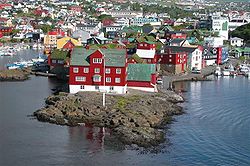 The Faroese government holds executive power
in local government affairs. The head of the government is called the Løgmaður (literally 'law person') or prime minister
in English. Any other member of the cabinet is called a landsstýrismaður
('national committee man').
Today, elections are held in the municipalities, on a national level for the Løgting
('law assembly'), and for the Danish Folketing
. For the Løgting elections there are seven electoral districts, each one comprising a sýsla, while Streymoy is divided into a northern and southern part (Tórshavn
region).
terminated the Danish-Norwegian union, and Norway came under the rule of the King of Sweden, while the Faroe Islands, Iceland, and Greenland
remained Danish possessions. The Løgting was abolished in 1816, and the Faroe Islands were to be governed as an ordinary Danish amt
(county), with the Amtmand
as its head of government. In 1851 the Løgting was reinstated, but served mainly as an advisory body until 1948.
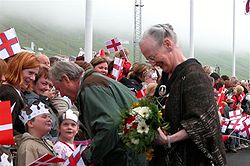 At the end of World War II
some of the population favored independence from Denmark, and on 14 September 1946 an independence referendum
was held on the question of secession
. It was a consultative referendum: the parliament was not bound to follow the people's vote. This was the first time that the Faroese people had been asked whether they favored independence or wanted to continue within the Danish kingdom. The result of the vote was a narrow majority in favor of secession, but the coalition in parliament could not reach agreement on how this outcome should be interpreted and implemented; and because of these irresoluble differences, the coalition
fell apart. A parliamentary election was held a few months later, in which the political parties that favored staying in the Danish kingdom increased their share of the vote and formed a coalition. Based on this, they chose to reject secession. Instead, a compromise
was made and the Folketing
passed a home-rule law that went into effect in 1948. The Faroe Islands' status as a Danish amt was thereby brought to an end; the Faroe Islands were given a high degree of self-governance, supported by a substantial financial subsidy
from Denmark.
At present the islanders are about evenly split between those favoring independence and those who prefer to continue as a part of the Kingdom of Denmark. Within both camps there is a wide range of opinions. Of those who favor independence, some are in favor of an immediate unilateral declaration of independence. Others see it as something to be attained gradually and with the full consent of the Danish government and the Danish nation. In the unionist camp there are also many who foresee and welcome a gradual increase in autonomy even while strong ties with Denmark are maintained.
In 2011, a new draft Faroese constitution is being drawn up. However the draft has been declared by the former Danish Prime Minister, Lars Løkke Rasmussen
, as incompatible with Denmark's constitution and if the Faroese political parties wish to continue with it then they must declare independence.
, the Faroe Islands are not part of the European Union
. Moreover, a protocol to the treaty of accession of Denmark to the European Communities stipulates that Danish nationals residing in the Faroe Islands are not to be considered as Danish nationals within the meaning of the treaties. Hence, Danish people living in the Faroes are not citizens of the European Union
(although other EU nationals living there remain EU citizens). The Faroes are not covered by the Schengen
free movement agreement, but there are no border checks when travelling between the Faroes and any Schengen country. (The Faroes have been part of the Nordic Passport Union
since 1966, and since 2001 there have been no border checks between the Nordic countries and the rest of the Schengen area
as part of the Schengen agreement
.)

Administratively, the islands are divided into 30 municipalities
(kommunur) within which there are 120 or so settlements.
Traditionally, there are also the six sýslur
("regions": Norðoyar
, Eysturoy
, Streymoy
, Vágar
, Sandoy
and Suðuroy
). Although today sýsla
technically means "police district", the term is still commonly used to indicate a geographical region. In earlier times, each sýsla had its own ting
(assembly), the so-called várting ("spring assembly").
.jpg) The Faroe Islands are an island group consisting of 18 major islands about 655 kilometres (407 mi) off the coast of Northern Europe
The Faroe Islands are an island group consisting of 18 major islands about 655 kilometres (407 mi) off the coast of Northern Europe
, between the Norwegian Sea
and the North Atlantic Ocean, about halfway between Iceland
and Norway
, the closest neighbours being the Northern
and Western Isles of Scotland
.
Its coordinates are 62°00′N 06°47′W.
Its area is 1,399 square kilometres (540 sq. mi), and it has no major lakes or rivers. There are 1117 kilometres (694.1 mi) of coastline. The only significant uninhabited island is Lítla Dímun
.
The islands are rugged and rocky with some low peaks; the coasts are mostly cliffs. The highest point is Slættaratindur
, 882 metres (2,893.7 ft) above sea level.
The Faroe Islands are dominated by tholeiitic basalt lava
, which was part of the great Thulean Plateau
during the Paleogene
period.

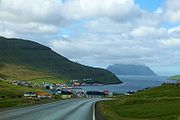
A total eclipse of the sun will be visible from the Faroe Islands on 20 March 2015.
means that the economy remains vulnerable. Petroleum
found close to the Faroese area gives hope for deposits in the immediate area, which may provide a basis for sustained economic prosperity.
11.7% of Faroe Islands' national budget comes as economic aid from Denmark
, which is about the same as 18% of Faroe Islands' total expense budget.
Since 2000, new information technology
and business projects have been fostered in the Faroe Islands to attract new investment. The introduction of Burger King
in Tórshavn
was widely publicized and a sign of the globalization of Faroese culture
. It is not yet known whether these projects will succeed in broadening the islands' economic base. The islands have one of the lowest unemployment rates in Europe, but this should not necessarily be taken as a sign of a recovering economy, as many young students move to Denmark and other countries after leaving high school. This leaves a largely middle-aged and elderly population that may lack the skills and knowledge to fill newly developed positions on the Faroes. In 2008 the Faroes made a $52 million loan to Iceland
, in light of that country's banking woes.
On 5 August 2009, two opposition parties introduced a bill in the Løgting
to adopt the Euro as the national currency, pending a referendum.
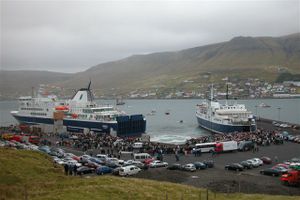
Vágar Airport
has scheduled services from Vágar
Island. The largest Faroese airline
is Atlantic Airways
.
Due to the rocky terrain and relatively small size of the Faroe Islands, its transportation system was not as extensive as in other places of the world. This situation has now changed, and the infrastructure
has been developed extensively. Some 80% of the population of the islands is connected by tunnels through the mountains and between the islands, bridges and causeway
s that link the three largest islands and three other large islands to the northeast together, while the other two large islands to the south of the main area are connected to the main area with new fast ferries
. There are good roads to every village in the islands, except for seven of the smaller islands, six of which only have one village.
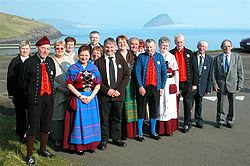 The vast majority of the population are ethnic Faroese
, of Norse
and Gael
ic descent.
Recent DNA analyses have revealed that Y chromosomes, tracing male descent, are 87% Scandinavia
n.
The studies show that mitochondrial DNA
, tracing female descent, is 84% Scottish
/Irish
.
Of the approximately 48,500 inhabitants of the Faroe Islands (16,921 private households (2004)), 98% are citizens of the Kingdom of Denmark, including Faroese, Danish and Greenlandic
people. Proportion of the inhabitants by birthplace: born on the Faroes 91.7%; born in Denmark 5.8%; born in Greenland 0.3%. The largest group of foreigners is Icelanders
, comprising 0.4% of the population, followed by Norwegians
and Polish, each comprising 0.2%. Altogether, on the Faroe Islands there are people of 77 different nationalities.
Faroese
is spoken in the entire area as a first language. It is difficult to say exactly how many people worldwide speak the Faroese language, as many ethnic Faroese live in Denmark, and few who are born there return to the Faroes with their parents or as adults.
The Faroese language is one of the least-spoken of the Germanic languages
. Faroese grammar and vocabulary are most similar to Icelandic
and to the extinct language Old Norse. In contrast, spoken Faroese is very different from Icelandic and is closer to Norwegian
dialects of the west coast of Norway
. While Faroese is the main language in the islands, both Faroese and Danish
are official languages.
Faroese language policy provides for the active creation of new terms in Faroese suitable for modern life.
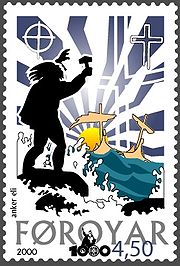 If the first inhabitants of the Faroe Islands were Irish monks, then they must have lived as a very small group of settlers. Later, when the Vikings colonised the islands, there was a considerable increase in the population. However, it never exceeded 5,000 until the 18th century. Around 1349, about half the population perished in the Black Death
plague.
Only with the rise of the deep-sea fishery (and thus independence from agriculture in the islands' harsh terrain) and with general progress in the health service was rapid population growth possible in the Faroes. Beginning in the 18th century, the population increased tenfold in 200 years.
At the beginning of the 1990s the Faroe Islands entered a deep economic crisis leading to heavy emigration; however, this trend reversed in subsequent years to a net immigration.
In the 1990s the old national policy of developing the villages (Bygdamenning) was abandoned, and instead the government started a process of regional development (Økismenning). The term "region" referred to the large islands of the Faroes. Nevertheless the government was unable to press through the structural reform of merging the small rural municipalities in order to create sustainable, decentralised entities that could drive forward regional development. As regional development has been difficult on the administrative level, the government has instead made heavy investment in infrastructure, interconnecting the regions.
In general, it is becoming less valid to regard the Faroes as a society based on separate islands and regions. The huge investments in roads, bridges and sub-sea tunnels (see also Transportation in the Faroe Islands) have bound the islands together, creating a coherent economic and cultural sphere that covers almost 90% of the population. From this perspective it is reasonable to regard the Faroes as a dispersed city or even to refer to it as the Faroese Network City.
.jpg)
, Sigmundur Brestisson
brought Christianity
to the islands in 999. However, archaeology
at a site in Leirvík
suggests that Celtic Christianity
may have arrived at least 150 years earlier. The Faroe Islands' Church Reformation
was completed on 1 January 1540. According to official statistics from 2002, 84.1% of the Faroese population are members of the state church, the Faroese People's Church (Fólkakirkjan), a form of Lutheranism
. The Fólkakirkjan became an independent church in 2007; previously it had been a diocese within the Church of Denmark
. Faroese members of the clergy who have had historical importance include V. U. Hammershaimb (1819–1909), Frederik Petersen
(1853–1917) and, perhaps most significantly, Jákup Dahl
(1878–1944), who had a great influence in ensuring that the Faroese language
was spoken in the church instead of Danish
.
In the late 1820s, the Christian Evangelical
religious movement, the Plymouth Brethren
, was established in England. In 1865 a member of this movement, William Gibson Sloan
, travelled to the Faroes from Shetland. At the turn of the 20th century, the Faroese Plymouth Brethren numbered thirty. Today, approximately 10% of the Faroese population are members of the Open Brethren community (Brøðrasamkoman). About 5% belong to other Christian denominations, such as the charismatic movement
, which started in the 1970s–1980s in the Faroe Islands. There are several charismatic churches around the islands, the largest of which, called Keldan (Spring Water), has about 400 to 450 members. The Adventists operate a private school in Tórshavn. Jehovah's Witnesses
also number four congregations (approximately 80 to 100 members). The Roman Catholic
congregation comprises approximately 170 members. The municipality of Tórshavn
operates their old Franciscan
school. There are also around fifteen Bahá'ís
who meet at four different places. The Ahmadiyya Muslim Community
was established in the Faroe Islands in 2010. Unlike Denmark
, Sweden
, and Iceland
with Forn Siðr, the Faroes have no organised Ásatrú
community, but there is a fair share of pagan lore, song and ritual performed in individuals' houses or in public spaces, rather than in church buildings.
The best-known church buildings in the Faroe Islands include Tórshavn Cathedral
, St. Olaf
's Church and the Magnus Cathedral
in Kirkjubøur
; the Vesturkirkjan and the Maria Church, both of which are situated in Tórshavn; the church of Fámjin
; the octagonal church in Haldarsvík
; Christianskirkjan in Klaksvík
and also the two pictured here.
In 1948, Victor Danielsen (Plymouth Brethren) completed the first Bible
translation into Faroese from different modern languages. Jacob Dahl and Kristian Osvald Viderø (Fólkakirkjan) completed the second translation in 1961. The latter was translated from the original Biblical languages (Hebrew
and Greek
) into Faroese.
culture. The Faroe Islands were long isolated from the main cultural phases and movements that swept across parts of Europe. This means that they have maintained a great part of their traditional culture. The language spoken is Faroese
and it is one of three insular Scandinavian languages descended from the Old Norse
language spoken in Scandinavia in the Viking Age
, the others being Icelandic
and the extinct Norn
, which is thought to have been mutually intelligible with Faroese. Until the 15th century, Faroese had a similar orthography to Icelandic and Norwegian
, but after the Reformation in 1538, the ruling Danes
outlawed its use in schools, churches and official documents. Although a rich spoken tradition survived, for 300 years the language was not written down. This means that all poems and stories were handed down orally. These works were split into the following divisions: sagnir (historical), ævintýr (stories) and kvæði
(ballads), often set to music and the mediaeval chain dance). These were eventually written down in the 19th century.
, is on 29 July, and commemorates the death of Saint Olaf. The celebrations are held in Tórshavn. They start on the evening of the 28th and continue until 31 July.
The official celebration starts on the 29th, with the opening of the Faroese Parliament, a custom that dates back 900 years. This begins with a service held in Tórshavn Cathedral
; all members of parliament as well as civil and church officials walk to the cathedral in a procession. All of the parish ministers take turns giving the sermon. After the service, the procession returns to the parliament for the opening ceremony.
Other celebrations are marked by different kinds of sports competitions, the rowing competition (in Tórshavn Harbour) being the most popular, art exhibitions, pop concerts, and the famous Faroese dance
. The celebrations have many facets, and only a few are mentioned here.
People also mark the occasion by wearing the national Faroese dress.
(in Faroese
Norðurlandahúsið) is the most important cultural institution in the Faroes. Its aim is to support and promote Scandinavia
n and Faroese culture, locally and in the Nordic region. Erlendur Patursson
(1913–1986), Faroese member of the Nordic Council
, raised the idea of a Nordic cultural house in the Faroe Islands. A Nordic competition for architects was held in 1977, in which 158 architects participated. Winners were Ola Steen from Norway
and Kolbrún Ragnarsdóttir from Iceland
. By staying true to folklore
, the architects built the Nordic House to resemble an enchanted hill of elves. The house opened in Tórshavn
in 1983. The Nordic House is a cultural organization under the Nordic Council of Ministers. The Nordic House is run by a steering committee of eight, of whom three are Faroese and five from other Nordic countries. There is also a local advisory body of fifteen members, representing Faroese cultural organizations. The House is managed by a director appointed by the steering committee for a four-year term.
 The Faroe Islands have an active music scene. The islands have their own symphony orchestra, the classical ensemble Aldubáran and many different choirs; the best-known being Havnarkórið. The best-known Faroese composers are Sunleif Rasmussen
and the Dane Kristian Blak
. Blak is also head of the record company Tutl
.
The first Faroese opera was by Sunleif Rasmussen. It is entitled Í Óðamansgarði (The Madman´s Garden), and it had its premiere on 12 October 2006, at the Nordic House. The opera is based on a short story by the writer William Heinesen
.
Young Faroese musicians who have gained much popularity recently are Eivør (Eivør Pálsdóttir), Anna Katrin Egilstrøð, Lena (Lena Andersen), Teitur
(Teitur Lassen), Høgni Reistrup
, Høgni Lisberg
, Heiðrik (Heiðrik á Heygum), Guðrið Hansdóttir and Brandur Enni
.
Well-known bands include Týr
, Gestir, The Ghost
, Boys In A Band
, ORKA, 200, Grandma's Basement, Stargazed, SIC
, and the former band Clickhaze.
The festival of contemporary and classical music, Summartónar, is held each summer. Large open-air music festivals for popular music with both local and international musicians participating are G! Festival
in Gøta in July and Summarfestivalurin
in Klaksvík
in August.
es and uses few fresh vegetables. Mutton
is the basis of many meals, and one of the most popular treats is skerpikjøt
, well aged, wind-dried mutton, which is quite chewy. The drying shed, known as a hjallur, is a standard feature in many Faroese homes, particularly in the small towns and villages. Other traditional foods are ræst kjøt (semi-dried mutton) and ræstur fiskur, matured fish. Another Faroese specialty is Grind og spik
, pilot whale
meat and blubber
. (A parallel meat/fat dish made with offal
is garnatálg
.) Well into the last century, meat and blubber from a pilot whale meant food for a long time. Fresh fish also features strongly in the traditional local diet, as do seabirds, such as Faroese puffin
s, and their eggs. Dried fish is also commonly eaten.
There is one brewery called Föroya Bjór
, which has produced beer since 1888 with exports mainly to Iceland and Denmark. A local specialty is fredrikk, a special brew, made in Nólsoy
. Production of hard alcohol such as snaps
is forbidden in the Faroe Islands, hence the Faroese aqua vit, Aqua Vita, is produced abroad.
Since the friendly British occupation, the Faroese have been fond of British food, in particular fish and chips
and British-style chocolate such as Cadbury Dairy Milk, which is found in many of the island's shops, whereas in Denmark this is scarce.
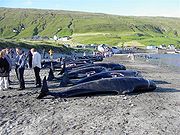 There are records of drive hunts in the Islands dating from 1584. It is regulated by Faroese authorities but not by the International Whaling Commission
as there are disagreements about the Commission's legal authority to regulate small cetacean hunts. Hundreds of long-finned pilot whale
s (Globicephala melaena) are killed annually, mainly during the summer. The hunts, called "grindadráp" in Faroese, are non-commercial and are organized on a community level; anyone can participate. The hunters first surround the pilot whales with a wide semicircle of boats. Then they drive the whales slowly into a bay or to the shallows of a fjord. When a whale is in shallow water a hook is placed in its blowhole so that it may be dragged ashore. Once on land or immobilized in knee-deep water, a cut is made across its top near the blowhole to partially sever its head. The dead animals are then dragged further to shore after the remaining whales have been likewise killed.
Some Faroese
consider the hunt an important part of their culture and history. Animal-rights groups criticize it as being cruel and unnecessary, while the hunters claim in return that most journalists do not exhibit sufficient knowledge of the catch methods or its economic significance.
, which were hosted by the islands in 1989. Ten football teams contest the Faroe Islands Premier League, currently ranked 51st by UEFA's League coefficient. The Faroe Islands are a full member of UEFA
and the Faroe Islands national football team
competes in the UEFA European Football Championship
. The country is also a full member of FIFA
and therefore the Faroe Islands football team, managed by Irish manager Brian Kerr, also competes in the FIFA World Cup
qualifiers. The country won its first ever competitive match when the team defeated Austria
1–0 in a UEFA Euro 1992 qualifier
. On 7 June 2011, the Faroe Islands secured their first competitive win in the UEFA European Championship qualifying rounds in 16 years, when they beat Estonia 2-0 in Toftir. The Faroe Islands compete in the Paralympics
, but have yet to make an appearance in the Olympics
, where they compete as part of Denmark.
is a traditional handicraft. The most distinctive trait of Faroese lace shawls
is the center back gusset
shaping. Each shawl consists of two triangular side panels, a trapezoid-shaped back gusset, an edge treatment, and usually shoulder shaping.
: Cfc). The overall character of the islands' climate is influenced by the strong warming influence of the Atlantic Ocean, which produces the North Atlantic Current
. This, together with the remoteness of any source of warm airflows, ensures that winters are mild (mean temperature 3.0 to 4.0 °C or 37 to 39°F) while summers are cool (mean temperature 9.5 to 10.5 °C or 49 to 51°F).
The islands are windy, cloudy and cool throughout the year with over 260 annual rainy days. The islands lie in the path of depressions moving northeast and this means that strong winds and heavy rain are possible at all times of the year. Sunny days are rare and overcast days are common. Hurricane Faith struck the Faroe Islands on 5 September 1966 with sustained winds over 100 mph (160 km/h) and only then did the storm cease to be a tropical system.
The registration of meteorologic data on the Faroe Islands started in 1867.
.
Faroe is characterised by the lack of trees, resembling Connemara
and Dingle
in Ireland
and the Scottish islands.
A few small plantations consisting of plants collected from similar climates such as Tierra del Fuego
in South America
and Alaska
thrive on the islands.
s and birds attracted to open land like heather
, probably due to the lack of woodland and other suitable habitats. Many species have developed special Faroese sub-species: Common Eider
, European Starling
, Winter Wren
, Common Guillemot
, and Black Guillemot
. The Pied Raven
was endemic to the Faroe Islands, but has now become extinct.
(Lepus timidus), Brown Rat
(Rattus norvegicus) and the House Mouse
(Mus domesticus). Apart from the local domestic sheep breed called Faroes
(depicted on the coat of arms
), a variety of feral
sheep survived on Little Dímun until the mid-19th century.
Grey Seal
s (Halichoerus grypus) are common around the shorelines. Several species of cetacean live in the waters around the Faroe Islands. Best known are the Long-finned Pilot Whale
s (Globicephala melaena), which are still annually hunted by the islanders in accordance with longstanding local tradition. Rare killer whales (Orcinus orca) sometimes visit the Faroese fjords.
, Faroe cow, Faroese sheep, Faroese Goose
and Faroe duck.
resulting from a survey sponsored by NATO, the British Museum
(Natural History) and the Carlsberg Foundation, is preserved in the Ulster Museum
(catalogue numbers: F3195—F3307). It is one of ten exsiccatae sets.
General information
Tourism
Other
Island
An island or isle is any piece of sub-continental land that is surrounded by water. Very small islands such as emergent land features on atolls can be called islets, cays or keys. An island in a river or lake may be called an eyot , or holm...
group situated between the Norwegian Sea
Norwegian Sea
The Norwegian Sea is a marginal sea in the North Atlantic Ocean, northwest of Norway. It is located between the North Sea and the Greenland Sea and adjoins the North Atlantic Ocean to the west and the Barents Sea to the northeast. In the southwest, it is separated from the Atlantic Ocean by a...
and the North Atlantic Ocean, approximately halfway between Scotland
Scotland
Scotland is a country that is part of the United Kingdom. Occupying the northern third of the island of Great Britain, it shares a border with England to the south and is bounded by the North Sea to the east, the Atlantic Ocean to the north and west, and the North Channel and Irish Sea to the...
and Iceland
Iceland
Iceland , described as the Republic of Iceland, is a Nordic and European island country in the North Atlantic Ocean, on the Mid-Atlantic Ridge. Iceland also refers to the main island of the country, which contains almost all the population and almost all the land area. The country has a population...
. The Faroe Islands are a self-governing territory within the Kingdom of Denmark
Kingdom of Denmark
The Kingdom of Denmark or the Danish Realm , is a constitutional monarchy and sovereign state consisting of Denmark proper in northern Europe and two autonomous constituent countries, the Faroe Islands in the North Atlantic and Greenland in North America. Denmark is the hegemonial part, where the...
, along with Denmark
Denmark
Denmark is a Scandinavian country in Northern Europe. The countries of Denmark and Greenland, as well as the Faroe Islands, constitute the Kingdom of Denmark . It is the southernmost of the Nordic countries, southwest of Sweden and south of Norway, and bordered to the south by Germany. Denmark...
proper and Greenland
Greenland
Greenland is an autonomous country within the Kingdom of Denmark, located between the Arctic and Atlantic Oceans, east of the Canadian Arctic Archipelago. Though physiographically a part of the continent of North America, Greenland has been politically and culturally associated with Europe for...
. The total area is approximately 1,400 km² (540 sq mi) with a 2010 population of almost 50,000.
The Faroe Islands have been a self-governing dependency
Rigsfællesskabet
Rigsfællesskabet is a semi-official Danish term for the relations between continental Denmark and its two self-governing insular regions, the Faroe Islands and Greenland, which collectively make up the Kingdom of Denmark.-Legal status:Both the Faroe Islands and Greenland enjoy far-reaching home...
of the Kingdom of Denmark since 1948. Over the years, the Faroese have been granted control of some matters. Areas that remain the responsibility of Denmark include military defence, police, justice, currency and foreign affairs
Foreign Affairs
Foreign Affairs is an American magazine and website on international relations and U.S. foreign policy published since 1922 by the Council on Foreign Relations six times annually...
.
The Faroe Islands were politically associated with Norway
Norway
Norway , officially the Kingdom of Norway, is a Nordic unitary constitutional monarchy whose territory comprises the western portion of the Scandinavian Peninsula, Jan Mayen, and the Arctic archipelago of Svalbard and Bouvet Island. Norway has a total area of and a population of about 4.9 million...
until 1380, when Norway entered the Kalmar Union
Kalmar Union
The Kalmar Union is a historiographical term meaning a series of personal unions that united the three kingdoms of Denmark, Norway , and Sweden under a single monarch, though intermittently and with a population...
with Denmark and Sweden
Sweden
Sweden , officially the Kingdom of Sweden , is a Nordic country on the Scandinavian Peninsula in Northern Europe. Sweden borders with Norway and Finland and is connected to Denmark by a bridge-tunnel across the Öresund....
, which gradually evolved into Danish control of the islands. This association ceased in 1814 when Denmark ceded Norway to Sweden, while Denmark retained control of Norwegian colonies including the Faroe Islands, Iceland and Greenland. The Faroe Islands have two representatives on the Nordic Council
Nordic Council
The Nordic Council is a geo-political, inter-parliamentary forum for co-operation between the Nordic countries. It was established following World War II and its first concrete result was the introduction in 1952 of a common labour market and free movement across borders without passports for the...
as members of the Danish delegation.
History
The early history of the Faroe Islands is not well known, although GaelicGaels
The Gaels or Goidels are speakers of one of the Goidelic Celtic languages: Irish, Scottish Gaelic, and Manx. Goidelic speech originated in Ireland and subsequently spread to western and northern Scotland and the Isle of Man....
hermits and monk
Monk
A monk is a person who practices religious asceticism, living either alone or with any number of monks, while always maintaining some degree of physical separation from those not sharing the same purpose...
s from a Hiberno-Scottish mission
Hiberno-Scottish mission
The Hiberno-Scottish mission was a mission led by Irish and Scottish monks which spread Christianity and established monasteries in Great Britain and continental Europe during the Middle Ages...
are believed to have settled in the 6th century, introducing sheep and goats and the early Irish language. Saint Brendan, an Irish monastic saint, who is supposed to have lived around 484–578, is said to have visited the Faroe Islands on two or three occasions (512–530), naming two of the islands Sheep Island and Paradise Island of Birds.
Later on (c. 850) Norsemen settled the islands, bringing the Old Norse
Old Norse
Old Norse is a North Germanic language that was spoken by inhabitants of Scandinavia and inhabitants of their overseas settlements during the Viking Age, until about 1300....
language that has evolved into the modern Faroese language
Faroese language
Faroese , is an Insular Nordic language spoken by 48,000 people in the Faroe Islands and about 25,000 Faroese people in Denmark and elsewhere...
spoken today.
These settlers are not thought to have come directly from Scandinavia, but rather from Norse communities surrounding the Irish Sea
Irish Sea
The Irish Sea separates the islands of Ireland and Great Britain. It is connected to the Celtic Sea in the south by St George's Channel, and to the Atlantic Ocean in the north by the North Channel. Anglesey is the largest island within the Irish Sea, followed by the Isle of Man...
, Northern Isles
Northern Isles
The Northern Isles is a chain of islands off the north coast of mainland Scotland. The climate is cool and temperate and much influenced by the surrounding seas. There are two main island groups: Shetland and Orkney...
and Western Isles of Scotland
Scotland
Scotland is a country that is part of the United Kingdom. Occupying the northern third of the island of Great Britain, it shares a border with England to the south and is bounded by the North Sea to the east, the Atlantic Ocean to the north and west, and the North Channel and Irish Sea to the...
, including the Shetland and Orkney islands, and Norse-Gaels
Norse-Gaels
The Norse–Gaels were a people who dominated much of the Irish Sea region, including the Isle of Man, and western Scotland for a part of the Middle Ages; they were of Gaelic and Scandinavian origin and as a whole exhibited a great deal of Gaelic and Norse cultural syncretism...
. The old Gaelic name for the Faroe Islands, Na Scigirí, means the Skeggjar and probably refers to the Eyja-Skeggjar (Island-Beards), a nickname given to the island dwellers. The aforementioned theories are speculative and are not supported by archeological evidence. However, the immigration of Norwegian Vikings is well documented. Thus, according to the Faroe Islands Government, the Nordic language and culture are derived from the Norwegians, or Norsemen, who settled in the Faroe Islands.
Færeyinga Saga
The Færeyinga Saga , the Norse saga of Faroemen, is the story of how the Faroes were converted to Christianity and became a part of the Kingdom of Norway.-Summary:It was written in Iceland shortly after 1200...
, emigrants who left Norway to escape the tyranny of Harald I of Norway
Harald I of Norway
Harald Fairhair or Harald Finehair , , son of Halfdan the Black, was the first king of Norway.-Background:Little is known of the historical Harald...
settled on the islands around the end of the 9th century. Early in the 11th century, Sigmundur Brestirson – whose clan had flourished in the southern islands but had been almost exterminated
Genocide
Genocide is defined as "the deliberate and systematic destruction, in whole or in part, of an ethnic, racial, religious, or national group", though what constitutes enough of a "part" to qualify as genocide has been subject to much debate by legal scholars...
by invaders from the northern islands – escaped to Norway. He was sent back to take possession of the islands for Olaf Tryggvason
Olaf I of Norway
Olaf Tryggvason was King of Norway from 995 to 1000. He was the son of Tryggvi Olafsson, king of Viken , and, according to later sagas, the great-grandson of Harald Fairhair, first King of Norway.Olaf played an important part in the often forcible, on pain of torture or death, conversion of the...
, King of Norway. Sigmundur introduced Christianity
Christianity
Christianity is a monotheistic religion based on the life and teachings of Jesus as presented in canonical gospels and other New Testament writings...
and, though he was subsequently murdered, Norwegian supremacy
Supremacy
Supremacy may refer to:* Supremacism, a philosophy that one is superior to others, so dominate, control or rule those who are not* Acts of Supremacy, 16th century laws in England concerning King Henry VIII and the church...
was upheld. Norwegian control of the islands continued until 1380, when Norway entered the Kalmar Union with Denmark, which gradually resulted in Danish control of the islands. The Reformation
Protestant Reformation
The Protestant Reformation was a 16th-century split within Western Christianity initiated by Martin Luther, John Calvin and other early Protestants. The efforts of the self-described "reformers", who objected to the doctrines, rituals and ecclesiastical structure of the Roman Catholic Church, led...
reached the Faroes in 1538. When the union between Denmark and Norway was dissolved as a result of the Treaty of Kiel
Treaty of Kiel
The Treaty of Kiel or Peace of Kiel was concluded between the United Kingdom of Great Britain and Ireland and the Kingdom of Sweden on one side and the Kingdoms of Denmark and Norway on the other side on 14 January 1814 in Kiel...
in 1814, Denmark retained possession of the Faroe Islands.
The trade monopoly
Monopoly
A monopoly exists when a specific person or enterprise is the only supplier of a particular commodity...
in the Faroe Islands was abolished in 1856, after which the area developed as a modern fishing
Fishing
Fishing is the activity of trying to catch wild fish. Fish are normally caught in the wild. Techniques for catching fish include hand gathering, spearing, netting, angling and trapping....
nation with its own fleet
Fishing fleet
A fishing fleet is an aggregate of commercial fishing vessels. The term may be used of all vessels operating out of a particular port, all vessels engaged in a particular type of fishing , or all fishing vessels of a country or region.Although fishing vessels are not formally organized as if they...
. The national awakening since 1888 was initially based on a struggle to maintain the Faroese language
Faroese language
Faroese , is an Insular Nordic language spoken by 48,000 people in the Faroe Islands and about 25,000 Faroese people in Denmark and elsewhere...
and was thus culturally
Culture
Culture is a term that has many different inter-related meanings. For example, in 1952, Alfred Kroeber and Clyde Kluckhohn compiled a list of 164 definitions of "culture" in Culture: A Critical Review of Concepts and Definitions...
oriented, but after 1906 it became politically
Politics
Politics is a process by which groups of people make collective decisions. The term is generally applied to the art or science of running governmental or state affairs, including behavior within civil governments, but also applies to institutions, fields, and special interest groups such as the...
oriented, with the foundation of political parties of the Faroe Islands.
On 12 April 1940, the Faroes were occupied by British
United Kingdom
The United Kingdom of Great Britain and Northern IrelandIn the United Kingdom and Dependencies, other languages have been officially recognised as legitimate autochthonous languages under the European Charter for Regional or Minority Languages...
troops. The move followed the invasion of Denmark
Operation Weserübung
Operation Weserübung was the code name for Germany's assault on Denmark and Norway during the Second World War and the opening operation of the Norwegian Campaign...
by Nazi Germany
Nazi Germany
Nazi Germany , also known as the Third Reich , but officially called German Reich from 1933 to 1943 and Greater German Reich from 26 June 1943 onward, is the name commonly used to refer to the state of Germany from 1933 to 1945, when it was a totalitarian dictatorship ruled by...
and had the objective of strengthening British control of the North Atlantic (see Battle of the Atlantic). In 1942–1943 the British Royal Engineers
Royal Monmouthshire Royal Engineers
The Royal Monmouthshire Royal Engineers is the most senior regiment in the British Territorial Army, having given continuous loyal service to the crown since 1539. It is part of the reserve forces, and is the only remaining Militia unit in the British Army...
built the only airport
Airport
An airport is a location where aircraft such as fixed-wing aircraft, helicopters, and blimps take off and land. Aircraft may be stored or maintained at an airport...
in the Faroes, Vágar Airport
Vágar Airport
Vágar Airport is the only airport in the Faroe Islands, a self-governing territory of the Kingdom of Denmark, and is located east of Sørvágur. Due to the Faroe Islands' rather anomalous status, the airport is not fully subject to the rules of the European Union...
. Control of the islands reverted to Denmark following the war, but in 1948 home-rule was introduced, with a high degree of local autonomy. In 1973 the Faroe Islands declined to join Denmark in entering the European Community (now European Union
European Union
The European Union is an economic and political union of 27 independent member states which are located primarily in Europe. The EU traces its origins from the European Coal and Steel Community and the European Economic Community , formed by six countries in 1958...
). The islands experienced considerable economic difficulties following the collapse of the fishing industry in the early 1990s, but have since made efforts to diversify
Diversity (business)
The "business case for diversity" stems from the progression of the models of diversity within the workplace since the 1960's. The original model for diversity was situated around affirmative action drawing strength from the law and a need to comply with equal employment opportunity objectives...
the economy. Support for independence
Independence
Independence is a condition of a nation, country, or state in which its residents and population, or some portion thereof, exercise self-government, and usually sovereignty, over its territory....
has grown and is the objective of the Republican Party.
Politics
Executive Power
Executive Power is Vince Flynn's fifth novel, and the fourth to feature Mitch Rapp, an American agent that works for the CIA as an operative for a covert counter terrorism unit called the "Orion Team."-Plot summary:...
in local government affairs. The head of the government is called the Løgmaður (literally 'law person') or prime minister
Prime minister
A prime minister is the most senior minister of cabinet in the executive branch of government in a parliamentary system. In many systems, the prime minister selects and may dismiss other members of the cabinet, and allocates posts to members within the government. In most systems, the prime...
in English. Any other member of the cabinet is called a landsstýrismaður
Minister (government)
A minister is a politician who holds significant public office in a national or regional government. Senior ministers are members of the cabinet....
('national committee man').
Today, elections are held in the municipalities, on a national level for the Løgting
Løgting
Løgting is the unicameral parliament of the Faroe Islands, a self-ruling dependency of Denmark.The name literally means "Law Thing" - that is, a law assembly - and derives from Old Norse lǫgþing, which was a name given to ancient assemblies. A ting or Þing has existed on the Faroe Islands for over...
('law assembly'), and for the Danish Folketing
Folketing
The Folketing , is the national parliament of Denmark. The name literally means "People's thing"—that is, the people's governing assembly. It is located in Christiansborg Palace, on the islet of Slotsholmen in central Copenhagen....
. For the Løgting elections there are seven electoral districts, each one comprising a sýsla, while Streymoy is divided into a northern and southern part (Tórshavn
Tórshavn
Tórshavn is the capital and largest town of the Faroe Islands. It is located in the southern part on the east coast of Streymoy. To the north west of the town lies the high mountain Húsareyn, and to the southwest, the high Kirkjubøreyn...
region).
The Faroes and Denmark
The Faroe Islands have been under Danish control since 1388. The 1814 Treaty of KielTreaty of Kiel
The Treaty of Kiel or Peace of Kiel was concluded between the United Kingdom of Great Britain and Ireland and the Kingdom of Sweden on one side and the Kingdoms of Denmark and Norway on the other side on 14 January 1814 in Kiel...
terminated the Danish-Norwegian union, and Norway came under the rule of the King of Sweden, while the Faroe Islands, Iceland, and Greenland
Greenland
Greenland is an autonomous country within the Kingdom of Denmark, located between the Arctic and Atlantic Oceans, east of the Canadian Arctic Archipelago. Though physiographically a part of the continent of North America, Greenland has been politically and culturally associated with Europe for...
remained Danish possessions. The Løgting was abolished in 1816, and the Faroe Islands were to be governed as an ordinary Danish amt
Counties of Denmark
Denmark was until December 31, 2006 divided into 15 counties , and 270 municipalities . On January 1, 2007, the counties were replaced by five Regions and the number of municipalities slashed to 98....
(county), with the Amtmand
Prefect
Prefect is a magisterial title of varying definition....
as its head of government. In 1851 the Løgting was reinstated, but served mainly as an advisory body until 1948.
World War II
World War II, or the Second World War , was a global conflict lasting from 1939 to 1945, involving most of the world's nations—including all of the great powers—eventually forming two opposing military alliances: the Allies and the Axis...
some of the population favored independence from Denmark, and on 14 September 1946 an independence referendum
Faroese independence referendum, 1946
An independence referendum was held in the Faroe Islands on 14 September 1946. The result was 48.7% in favor to 47.2% against. 481 votes or 4.1% were blank or invalid...
was held on the question of secession
Secession
Secession is the act of withdrawing from an organization, union, or especially a political entity. Threats of secession also can be a strategy for achieving more limited goals.-Secession theory:...
. It was a consultative referendum: the parliament was not bound to follow the people's vote. This was the first time that the Faroese people had been asked whether they favored independence or wanted to continue within the Danish kingdom. The result of the vote was a narrow majority in favor of secession, but the coalition in parliament could not reach agreement on how this outcome should be interpreted and implemented; and because of these irresoluble differences, the coalition
Coalition
A coalition is a pact or treaty among individuals or groups, during which they cooperate in joint action, each in their own self-interest, joining forces together for a common cause. This alliance may be temporary or a matter of convenience. A coalition thus differs from a more formal covenant...
fell apart. A parliamentary election was held a few months later, in which the political parties that favored staying in the Danish kingdom increased their share of the vote and formed a coalition. Based on this, they chose to reject secession. Instead, a compromise
Compromise
To compromise is to make a deal where one person gives up part of his or her demand.In arguments, compromise is a concept of finding agreement through communication, through a mutual acceptance of terms—often involving variations from an original goal or desire.Extremism is often considered as...
was made and the Folketing
Folketing
The Folketing , is the national parliament of Denmark. The name literally means "People's thing"—that is, the people's governing assembly. It is located in Christiansborg Palace, on the islet of Slotsholmen in central Copenhagen....
passed a home-rule law that went into effect in 1948. The Faroe Islands' status as a Danish amt was thereby brought to an end; the Faroe Islands were given a high degree of self-governance, supported by a substantial financial subsidy
Subsidy
A subsidy is an assistance paid to a business or economic sector. Most subsidies are made by the government to producers or distributors in an industry to prevent the decline of that industry or an increase in the prices of its products or simply to encourage it to hire more labor A subsidy (also...
from Denmark.
At present the islanders are about evenly split between those favoring independence and those who prefer to continue as a part of the Kingdom of Denmark. Within both camps there is a wide range of opinions. Of those who favor independence, some are in favor of an immediate unilateral declaration of independence. Others see it as something to be attained gradually and with the full consent of the Danish government and the Danish nation. In the unionist camp there are also many who foresee and welcome a gradual increase in autonomy even while strong ties with Denmark are maintained.
In 2011, a new draft Faroese constitution is being drawn up. However the draft has been declared by the former Danish Prime Minister, Lars Løkke Rasmussen
Lars Løkke Rasmussen
Lars Løkke Rasmussen is a Danish politician who served as Prime Minister of Denmark from April 2009 to October 2011. He is the leader of the centre-right liberal party, Venstre....
, as incompatible with Denmark's constitution and if the Faroese political parties wish to continue with it then they must declare independence.
The Faroes and the European Union
As explicitly asserted by both Rome treatiesTreaty of Rome
The Treaty of Rome, officially the Treaty establishing the European Economic Community, was an international agreement that led to the founding of the European Economic Community on 1 January 1958. It was signed on 25 March 1957 by Belgium, France, Italy, Luxembourg, the Netherlands and West Germany...
, the Faroe Islands are not part of the European Union
European Union
The European Union is an economic and political union of 27 independent member states which are located primarily in Europe. The EU traces its origins from the European Coal and Steel Community and the European Economic Community , formed by six countries in 1958...
. Moreover, a protocol to the treaty of accession of Denmark to the European Communities stipulates that Danish nationals residing in the Faroe Islands are not to be considered as Danish nationals within the meaning of the treaties. Hence, Danish people living in the Faroes are not citizens of the European Union
Citizenship of the European Union
Citizenship of the European Union was introduced by the Maastricht Treaty . European citizenship is supplementary to national citizenship and affords rights such as the right to vote in European elections, the right to free movement and the right to consular protection from other EU states'...
(although other EU nationals living there remain EU citizens). The Faroes are not covered by the Schengen
Schengen Agreement
The Schengen Agreement is a treaty signed on 14 June 1985 near the town of Schengen in Luxembourg, between five of the ten member states of the European Economic Community. It was supplemented by the Convention implementing the Schengen Agreement 5 years later...
free movement agreement, but there are no border checks when travelling between the Faroes and any Schengen country. (The Faroes have been part of the Nordic Passport Union
Nordic Passport Union
The Nordic Passport Union allows citizens of the Nordic countries: Denmark , Sweden, Norway, Finland, and Iceland to travel and reside in other Nordic countries without a passport or a residence permit.- Establishment :...
since 1966, and since 2001 there have been no border checks between the Nordic countries and the rest of the Schengen area
Schengen Area
The Schengen Area comprises the territories of twenty-five European countries that have implemented the Schengen Agreement signed in the town of Schengen, Luxembourg, in 1985...
as part of the Schengen agreement
Schengen Agreement
The Schengen Agreement is a treaty signed on 14 June 1985 near the town of Schengen in Luxembourg, between five of the ten member states of the European Economic Community. It was supplemented by the Convention implementing the Schengen Agreement 5 years later...
.)
Regions and municipalities
Administratively, the islands are divided into 30 municipalities
Municipalities of the Faroe Islands
The Faroe Islands are administratively divided in 30 municipalities , with about 120 cities and villages. Until December 31, 2008, there were 34 municipalities, and until December 31, 2004, there were 48 municipalities...
(kommunur) within which there are 120 or so settlements.
Traditionally, there are also the six sýslur
Regions of the Faroe Islands
The Faroe Islands are divided into six regions, seven constituencies and 30 municipalities. The region of Streymoy is composed of two constituencies. Each region has one sheriff....
("regions": Norðoyar
Norðoyar
The six islands in the northeast of the Faroe Islands are together referred to as Norðoyar, i.e. the Northern Isles . These Islands are Kalsoy, Kunoy, Borðoy, Viðoy, Svínoy and Fugloy. Klaksvík is regarded as the natural capital of this region. Norðoyar is sometimes spelled Norðoyggjar.-Further...
, Eysturoy
Eysturoy
Eysturoy means East island and is the second-largest of the Faroe Islands in the North Atlantic, both in size and population. It is separated by a narrow sound from the main island of Streymoy. Eysturoy is extremely rugged, with some 66 separate mountain peaks, including Slættaratindur, the...
, Streymoy
Streymoy
Streymoy is the largest and most populated island of the Faroe Islands. The capital, Tórshavn is located there. The name means "island of currents".- Geography :...
, Vágar
Vágar
Vágar is one of the 18 islands in the archipelago of the Faroe Islands and the most westerly of the large islands. With a size of 178 km² , it ranks number three, behind Streymoy and Eysturoy....
, Sandoy
Sandoy
Sandoy is a small island that is part of the Faroe Islands, an autonomous region of the Kingdom of Denmark. The largest population center on the island is the village of Sandur with a population of six hundred....
and Suðuroy
Suðuroy
Suðuroy is the southernmost of the Faroe Islands. The island covers 163.7 km². In 2010 there were 4763 inhabitants, but there has been a gradual decline in the population numbers ever since the 1950s....
). Although today sýsla
Sýsla
A sýsla is a police district in Iceland and the Faroe Islands, and formerly in Denmark.Spelled syssel, the name still can be found in the Danish district Vendsyssel and in Norway in the title: sysselmann .-Faroe Islands sýsla:* Norðoyar* Eysturoy* Streymoy* Vágar* Sandoy*...
technically means "police district", the term is still commonly used to indicate a geographical region. In earlier times, each sýsla had its own ting
Thing (assembly)
A thing was the governing assembly in Germanic and introduced into some Celtic societies, made up of the free people of the community and presided by lawspeakers, meeting in a place called a thingstead...
(assembly), the so-called várting ("spring assembly").
Geography
Northern Europe
Northern Europe is the northern part or region of Europe. Northern Europe typically refers to the seven countries in the northern part of the European subcontinent which includes Denmark, Estonia, Latvia, Lithuania, Norway, Finland and Sweden...
, between the Norwegian Sea
Norwegian Sea
The Norwegian Sea is a marginal sea in the North Atlantic Ocean, northwest of Norway. It is located between the North Sea and the Greenland Sea and adjoins the North Atlantic Ocean to the west and the Barents Sea to the northeast. In the southwest, it is separated from the Atlantic Ocean by a...
and the North Atlantic Ocean, about halfway between Iceland
Iceland
Iceland , described as the Republic of Iceland, is a Nordic and European island country in the North Atlantic Ocean, on the Mid-Atlantic Ridge. Iceland also refers to the main island of the country, which contains almost all the population and almost all the land area. The country has a population...
and Norway
Norway
Norway , officially the Kingdom of Norway, is a Nordic unitary constitutional monarchy whose territory comprises the western portion of the Scandinavian Peninsula, Jan Mayen, and the Arctic archipelago of Svalbard and Bouvet Island. Norway has a total area of and a population of about 4.9 million...
, the closest neighbours being the Northern
Northern Isles
The Northern Isles is a chain of islands off the north coast of mainland Scotland. The climate is cool and temperate and much influenced by the surrounding seas. There are two main island groups: Shetland and Orkney...
and Western Isles of Scotland
Scotland
Scotland is a country that is part of the United Kingdom. Occupying the northern third of the island of Great Britain, it shares a border with England to the south and is bounded by the North Sea to the east, the Atlantic Ocean to the north and west, and the North Channel and Irish Sea to the...
.
Its coordinates are 62°00′N 06°47′W.
Its area is 1,399 square kilometres (540 sq. mi), and it has no major lakes or rivers. There are 1117 kilometres (694.1 mi) of coastline. The only significant uninhabited island is Lítla Dímun
Lítla Dímun
Lítla Dímun is a small island between the islands of Suðuroy and Stóra Dímun in the Faroe Islands. It is the smallest of the main 18 islands, being less than in area, and is the only uninhabited one...
.
The islands are rugged and rocky with some low peaks; the coasts are mostly cliffs. The highest point is Slættaratindur
Slættaratindur
Slættaratindur is the highest mountain in the Faroe Islands, at an altitude of 882 metres. It is located in the northern part of Eysturoy, between the villages of Eiði, Gjógv, and Funningur....
, 882 metres (2,893.7 ft) above sea level.
The Faroe Islands are dominated by tholeiitic basalt lava
Lava
Lava refers both to molten rock expelled by a volcano during an eruption and the resulting rock after solidification and cooling. This molten rock is formed in the interior of some planets, including Earth, and some of their satellites. When first erupted from a volcanic vent, lava is a liquid at...
, which was part of the great Thulean Plateau
Thulean Plateau
The Thulean Plateau also known as the Thulean Province, was a great basaltic lava plain that existed during the Paleogene Period, which possibly extended over 1,800,000 km2 in the northern Atlantic Ocean region...
during the Paleogene
Paleogene
The Paleogene is a geologic period and system that began 65.5 ± 0.3 and ended 23.03 ± 0.05 million years ago and comprises the first part of the Cenozoic Era...
period.
Distances to nearest countries and islands
- North RonaNorth RonaRona is a remote Scottish island in the North Atlantic. Rona is often referred to as North Rona in order to distinguish it from South Rona . It has an area of and a maximum height of...
, Scotland (uninhabited): 260 kilometres (161.6 mi) - Shetland (FoulaFoulaFoula in the Shetland Islands of Scotland is one of Great Britain’s most remote permanently inhabited islands. Owned since the turn of the 20th century by the Holbourn family, the island was the location for the film The Edge of the World...
) (Scotland): 285 kilometres (177.1 mi) - Orkney (WestrayWestrayWestray is one of the Orkney Islands in Scotland, with a population of around 550 people. Its main village is Pierowall, with a heritage centre, the ruined Lady Kirk and ferries to Papa Westray.-Geography and geology:...
) (Scotland): 300 kilometres (186.4 mi) - Mainland ScotlandScotlandScotland is a country that is part of the United Kingdom. Occupying the northern third of the island of Great Britain, it shares a border with England to the south and is bounded by the North Sea to the east, the Atlantic Ocean to the north and west, and the North Channel and Irish Sea to the...
: 320 kilometres (198.8 mi) - IcelandIcelandIceland , described as the Republic of Iceland, is a Nordic and European island country in the North Atlantic Ocean, on the Mid-Atlantic Ridge. Iceland also refers to the main island of the country, which contains almost all the population and almost all the land area. The country has a population...
: 450 kilometres (279.6 mi) - IrelandIrelandIreland is an island to the northwest of continental Europe. It is the third-largest island in Europe and the twentieth-largest island on Earth...
: 670 kilometres (416.3 mi) - DenmarkDenmarkDenmark is a Scandinavian country in Northern Europe. The countries of Denmark and Greenland, as well as the Faroe Islands, constitute the Kingdom of Denmark . It is the southernmost of the Nordic countries, southwest of Sweden and south of Norway, and bordered to the south by Germany. Denmark...
: 990 kilometres (615.2 mi)
A total eclipse of the sun will be visible from the Faroe Islands on 20 March 2015.
Economy
Economic troubles caused by a collapse of the Faroese fishing industry in the early 1990s brought high unemployment rates of 10 to 15% in the mid 1990s. Unemployment decreased in the later 1990s, down to about 6% at the end of 1998. By June 2008 unemployment had declined to 1.1%, before rising to 3.4% in early 2009. Nevertheless, the almost total dependence on fishing and fish farmingFish farming
Fish farming is the principal form of aquaculture, while other methods may fall under mariculture. Fish farming involves raising fish commercially in tanks or enclosures, usually for food. A facility that releases young fish into the wild for recreational fishing or to supplement a species'...
means that the economy remains vulnerable. Petroleum
Petroleum
Petroleum or crude oil is a naturally occurring, flammable liquid consisting of a complex mixture of hydrocarbons of various molecular weights and other liquid organic compounds, that are found in geologic formations beneath the Earth's surface. Petroleum is recovered mostly through oil drilling...
found close to the Faroese area gives hope for deposits in the immediate area, which may provide a basis for sustained economic prosperity.
11.7% of Faroe Islands' national budget comes as economic aid from Denmark
Denmark
Denmark is a Scandinavian country in Northern Europe. The countries of Denmark and Greenland, as well as the Faroe Islands, constitute the Kingdom of Denmark . It is the southernmost of the Nordic countries, southwest of Sweden and south of Norway, and bordered to the south by Germany. Denmark...
, which is about the same as 18% of Faroe Islands' total expense budget.
Since 2000, new information technology
Information technology
Information technology is the acquisition, processing, storage and dissemination of vocal, pictorial, textual and numerical information by a microelectronics-based combination of computing and telecommunications...
and business projects have been fostered in the Faroe Islands to attract new investment. The introduction of Burger King
Burger King
Burger King, often abbreviated as BK, is a global chain of hamburger fast food restaurants headquartered in unincorporated Miami-Dade County, Florida, United States. The company began in 1953 as Insta-Burger King, a Jacksonville, Florida-based restaurant chain...
in Tórshavn
Tórshavn
Tórshavn is the capital and largest town of the Faroe Islands. It is located in the southern part on the east coast of Streymoy. To the north west of the town lies the high mountain Húsareyn, and to the southwest, the high Kirkjubøreyn...
was widely publicized and a sign of the globalization of Faroese culture
Culture of the Faroe Islands
The culture of the Faroe Islands has its roots in the Nordic culture. The Faroe Islands were long isolated from the main cultural phases and movements that swept across parts of Europe. This means that they have maintained a great part of their traditional culture. The language spoken is Faroese...
. It is not yet known whether these projects will succeed in broadening the islands' economic base. The islands have one of the lowest unemployment rates in Europe, but this should not necessarily be taken as a sign of a recovering economy, as many young students move to Denmark and other countries after leaving high school. This leaves a largely middle-aged and elderly population that may lack the skills and knowledge to fill newly developed positions on the Faroes. In 2008 the Faroes made a $52 million loan to Iceland
Iceland
Iceland , described as the Republic of Iceland, is a Nordic and European island country in the North Atlantic Ocean, on the Mid-Atlantic Ridge. Iceland also refers to the main island of the country, which contains almost all the population and almost all the land area. The country has a population...
, in light of that country's banking woes.
On 5 August 2009, two opposition parties introduced a bill in the Løgting
Løgting
Løgting is the unicameral parliament of the Faroe Islands, a self-ruling dependency of Denmark.The name literally means "Law Thing" - that is, a law assembly - and derives from Old Norse lǫgþing, which was a name given to ancient assemblies. A ting or Þing has existed on the Faroe Islands for over...
to adopt the Euro as the national currency, pending a referendum.
Transport
Vágar Airport
Vágar Airport
Vágar Airport is the only airport in the Faroe Islands, a self-governing territory of the Kingdom of Denmark, and is located east of Sørvágur. Due to the Faroe Islands' rather anomalous status, the airport is not fully subject to the rules of the European Union...
has scheduled services from Vágar
Vágar
Vágar is one of the 18 islands in the archipelago of the Faroe Islands and the most westerly of the large islands. With a size of 178 km² , it ranks number three, behind Streymoy and Eysturoy....
Island. The largest Faroese airline
Airline
An airline provides air transport services for traveling passengers and freight. Airlines lease or own their aircraft with which to supply these services and may form partnerships or alliances with other airlines for mutual benefit...
is Atlantic Airways
Atlantic Airways
Atlantic Airways is the national airline of the Faroe Islands, operating domestic helicopter services and international passenger services as well as search and rescue responsibilities from its base at Vágar Airport, on the Faroese island of Vágar...
.
Due to the rocky terrain and relatively small size of the Faroe Islands, its transportation system was not as extensive as in other places of the world. This situation has now changed, and the infrastructure
Infrastructure
Infrastructure is basic physical and organizational structures needed for the operation of a society or enterprise, or the services and facilities necessary for an economy to function...
has been developed extensively. Some 80% of the population of the islands is connected by tunnels through the mountains and between the islands, bridges and causeway
Causeway
In modern usage, a causeway is a road or railway elevated, usually across a broad body of water or wetland.- Etymology :When first used, the word appeared in a form such as “causey way” making clear its derivation from the earlier form “causey”. This word seems to have come from the same source by...
s that link the three largest islands and three other large islands to the northeast together, while the other two large islands to the south of the main area are connected to the main area with new fast ferries
Ferry
A ferry is a form of transportation, usually a boat, but sometimes a ship, used to carry primarily passengers, and sometimes vehicles and cargo as well, across a body of water. Most ferries operate on regular, frequent, return services...
. There are good roads to every village in the islands, except for seven of the smaller islands, six of which only have one village.
Demographics
Faroese people
The Faroese or Faroe Islanders are a Germanic ethnic group native to the Faeroe Islands. The Faroese are of mixed Norse and Gaelic origins.About 21,000 Faroese live in neighbouring countries, particularly in Denmark, Iceland and Norway....
, of Norse
Scandinavia
Scandinavia is a cultural, historical and ethno-linguistic region in northern Europe that includes the three kingdoms of Denmark, Norway and Sweden, characterized by their common ethno-cultural heritage and language. Modern Norway and Sweden proper are situated on the Scandinavian Peninsula,...
and Gael
Gaël
Gaël is a commune in the Ille-et-Vilaine department of Brittany in north-western France.It lies southwest of Rennes between Saint-Méen-le-Grand and Mauron...
ic descent.
Recent DNA analyses have revealed that Y chromosomes, tracing male descent, are 87% Scandinavia
Scandinavia
Scandinavia is a cultural, historical and ethno-linguistic region in northern Europe that includes the three kingdoms of Denmark, Norway and Sweden, characterized by their common ethno-cultural heritage and language. Modern Norway and Sweden proper are situated on the Scandinavian Peninsula,...
n.
The studies show that mitochondrial DNA
Mitochondrial DNA
Mitochondrial DNA is the DNA located in organelles called mitochondria, structures within eukaryotic cells that convert the chemical energy from food into a form that cells can use, adenosine triphosphate...
, tracing female descent, is 84% Scottish
Scottish people
The Scottish people , or Scots, are a nation and ethnic group native to Scotland. Historically they emerged from an amalgamation of the Picts and Gaels, incorporating neighbouring Britons to the south as well as invading Germanic peoples such as the Anglo-Saxons and the Norse.In modern use,...
/Irish
Irish people
The Irish people are an ethnic group who originate in Ireland, an island in northwestern Europe. Ireland has been populated for around 9,000 years , with the Irish people's earliest ancestors recorded having legends of being descended from groups such as the Nemedians, Fomorians, Fir Bolg, Tuatha...
.
Of the approximately 48,500 inhabitants of the Faroe Islands (16,921 private households (2004)), 98% are citizens of the Kingdom of Denmark, including Faroese, Danish and Greenlandic
Greenlandic
Greenlandic may refer to:* Something of, from, or related to Greenland, the self-governing Danish province located between the Arctic and Atlantic Oceans, east of the Canadian Arctic Archipelago....
people. Proportion of the inhabitants by birthplace: born on the Faroes 91.7%; born in Denmark 5.8%; born in Greenland 0.3%. The largest group of foreigners is Icelanders
Icelanders
Icelanders are a Scandinavian ethnic group and a nation, native to Iceland.On 17 June 1944, when an Icelandic republic was founded the Icelanders became independent from the Danish monarchy. The language spoken is Icelandic, a North Germanic language, and Lutheranism is the predominant religion...
, comprising 0.4% of the population, followed by Norwegians
Norwegians
Norwegians constitute both a nation and an ethnic group native to Norway. They share a common culture and speak the Norwegian language. Norwegian people and their descendants are found in migrant communities worldwide, notably in United States, Canada and Brazil.-History:Towards the end of the 3rd...
and Polish, each comprising 0.2%. Altogether, on the Faroe Islands there are people of 77 different nationalities.
Faroese
Faroese language
Faroese , is an Insular Nordic language spoken by 48,000 people in the Faroe Islands and about 25,000 Faroese people in Denmark and elsewhere...
is spoken in the entire area as a first language. It is difficult to say exactly how many people worldwide speak the Faroese language, as many ethnic Faroese live in Denmark, and few who are born there return to the Faroes with their parents or as adults.
The Faroese language is one of the least-spoken of the Germanic languages
Germanic languages
The Germanic languages constitute a sub-branch of the Indo-European language family. The common ancestor of all of the languages in this branch is called Proto-Germanic , which was spoken in approximately the mid-1st millennium BC in Iron Age northern Europe...
. Faroese grammar and vocabulary are most similar to Icelandic
Icelandic language
Icelandic is a North Germanic language, the main language of Iceland. Its closest relative is Faroese.Icelandic is an Indo-European language belonging to the North Germanic or Nordic branch of the Germanic languages. Historically, it was the westernmost of the Indo-European languages prior to the...
and to the extinct language Old Norse. In contrast, spoken Faroese is very different from Icelandic and is closer to Norwegian
Norwegian language
Norwegian is a North Germanic language spoken primarily in Norway, where it is the official language. Together with Swedish and Danish, Norwegian forms a continuum of more or less mutually intelligible local and regional variants .These Scandinavian languages together with the Faroese language...
dialects of the west coast of Norway
Norway
Norway , officially the Kingdom of Norway, is a Nordic unitary constitutional monarchy whose territory comprises the western portion of the Scandinavian Peninsula, Jan Mayen, and the Arctic archipelago of Svalbard and Bouvet Island. Norway has a total area of and a population of about 4.9 million...
. While Faroese is the main language in the islands, both Faroese and Danish
Danish language
Danish is a North Germanic language spoken by around six million people, principally in the country of Denmark. It is also spoken by 50,000 Germans of Danish ethnicity in the northern parts of Schleswig-Holstein, Germany, where it holds the status of minority language...
are official languages.
Faroese language policy provides for the active creation of new terms in Faroese suitable for modern life.
Population trends (1327–2004)
Black Death
The Black Death was one of the most devastating pandemics in human history, peaking in Europe between 1348 and 1350. Of several competing theories, the dominant explanation for the Black Death is the plague theory, which attributes the outbreak to the bacterium Yersinia pestis. Thought to have...
plague.
Only with the rise of the deep-sea fishery (and thus independence from agriculture in the islands' harsh terrain) and with general progress in the health service was rapid population growth possible in the Faroes. Beginning in the 18th century, the population increased tenfold in 200 years.
At the beginning of the 1990s the Faroe Islands entered a deep economic crisis leading to heavy emigration; however, this trend reversed in subsequent years to a net immigration.
EWLINE
|
EWLINE
|
Urbanisation and regionalisation
The Faroese population is spread across most of the area; it was not until recent decades that significant urbanisation occurred. Industrialisation has been remarkably decentralised, and the area has therefore maintained quite a viable rural culture. Nevertheless, villages with poor harbour facilities have been the losers in the development from agriculture to fishing, and in the most peripheral agricultural areas, also known as the outer islands, there are few young people. In recent decades, the village-based social structure has nevertheless been placed under pressure, giving way to a rise in interconnected "centres" that are better able to provide goods and services than the badly connected periphery. This means that shops and services are now relocating en masse from the villages into the centres, and slowly but steadily the Faroese population is concentrating in and around the centres.In the 1990s the old national policy of developing the villages (Bygdamenning) was abandoned, and instead the government started a process of regional development (Økismenning). The term "region" referred to the large islands of the Faroes. Nevertheless the government was unable to press through the structural reform of merging the small rural municipalities in order to create sustainable, decentralised entities that could drive forward regional development. As regional development has been difficult on the administrative level, the government has instead made heavy investment in infrastructure, interconnecting the regions.
In general, it is becoming less valid to regard the Faroes as a society based on separate islands and regions. The huge investments in roads, bridges and sub-sea tunnels (see also Transportation in the Faroe Islands) have bound the islands together, creating a coherent economic and cultural sphere that covers almost 90% of the population. From this perspective it is reasonable to regard the Faroes as a dispersed city or even to refer to it as the Faroese Network City.
Religion
According to Færeyinga SagaFæreyinga Saga
The Færeyinga Saga , the Norse saga of Faroemen, is the story of how the Faroes were converted to Christianity and became a part of the Kingdom of Norway.-Summary:It was written in Iceland shortly after 1200...
, Sigmundur Brestisson
Sigmundur Brestisson
Sigmundur Brestisson introduced Christianity to the Faroe Islands in 999. He is one of the main characters of the Færeyinga saga.According to the Færeyinga Saga, emigrants who left Norway to escape the tyranny of Harald I of Norway, settled in the islands about the beginning of the 9th century...
brought Christianity
Christianity
Christianity is a monotheistic religion based on the life and teachings of Jesus as presented in canonical gospels and other New Testament writings...
to the islands in 999. However, archaeology
Archaeology
Archaeology, or archeology , is the study of human society, primarily through the recovery and analysis of the material culture and environmental data that they have left behind, which includes artifacts, architecture, biofacts and cultural landscapes...
at a site in Leirvík
Leirvík
Leirvík is a town on the Faroe Islands and was an important regional ferry harbour at the east coast of the second largest island Eysturoy. Leirvík has 867 inhabitants...
suggests that Celtic Christianity
Celtic Christianity
Celtic Christianity or Insular Christianity refers broadly to certain features of Christianity that were common, or held to be common, across the Celtic-speaking world during the Early Middle Ages...
may have arrived at least 150 years earlier. The Faroe Islands' Church Reformation
Protestant Reformation
The Protestant Reformation was a 16th-century split within Western Christianity initiated by Martin Luther, John Calvin and other early Protestants. The efforts of the self-described "reformers", who objected to the doctrines, rituals and ecclesiastical structure of the Roman Catholic Church, led...
was completed on 1 January 1540. According to official statistics from 2002, 84.1% of the Faroese population are members of the state church, the Faroese People's Church (Fólkakirkjan), a form of Lutheranism
Lutheranism
Lutheranism is a major branch of Western Christianity that identifies with the theology of Martin Luther, a German reformer. Luther's efforts to reform the theology and practice of the church launched the Protestant Reformation...
. The Fólkakirkjan became an independent church in 2007; previously it had been a diocese within the Church of Denmark
Church of Denmark
The Evangelical Lutheran Church in Denmark, Church of Denmark or Danish National Church, is the state church and largest denomination in Denmark and Greenland...
. Faroese members of the clergy who have had historical importance include V. U. Hammershaimb (1819–1909), Frederik Petersen
Fríðrikur Petersen
Fríðrikur Petersen was a noted Faroese politician and clergyman of the Faroese People's Church , a form of Lutheranism.-See also:*Faroese People's Church...
(1853–1917) and, perhaps most significantly, Jákup Dahl
Jákup Dahl
Jákup Dahl was a Faroese Provost and Bible translator. In 1908 he became known as a linguist with the first Faroese grammar lessons for school students.- Life and work :...
(1878–1944), who had a great influence in ensuring that the Faroese language
Faroese language
Faroese , is an Insular Nordic language spoken by 48,000 people in the Faroe Islands and about 25,000 Faroese people in Denmark and elsewhere...
was spoken in the church instead of Danish
Danish language
Danish is a North Germanic language spoken by around six million people, principally in the country of Denmark. It is also spoken by 50,000 Germans of Danish ethnicity in the northern parts of Schleswig-Holstein, Germany, where it holds the status of minority language...
.
In the late 1820s, the Christian Evangelical
Evangelicalism
Evangelicalism is a Protestant Christian movement which began in Great Britain in the 1730s and gained popularity in the United States during the series of Great Awakenings of the 18th and 19th century.Its key commitments are:...
religious movement, the Plymouth Brethren
Plymouth Brethren
The Plymouth Brethren is a conservative, Evangelical Christian movement, whose history can be traced to Dublin, Ireland, in the late 1820s. Although the group is notable for not taking any official "church name" to itself, and not having an official clergy or liturgy, the title "The Brethren," is...
, was established in England. In 1865 a member of this movement, William Gibson Sloan
William Gibson Sloan
William Gibson Sloan , was a Plymouth Brethren evangelist to the Faroe Islands and Shetland....
, travelled to the Faroes from Shetland. At the turn of the 20th century, the Faroese Plymouth Brethren numbered thirty. Today, approximately 10% of the Faroese population are members of the Open Brethren community (Brøðrasamkoman). About 5% belong to other Christian denominations, such as the charismatic movement
Charismatic movement
The term charismatic movement is used in varying senses to describe 20th century developments in various Christian denominations. It describes an ongoing international, cross-denominational/non-denominational Christian movement in which individual, historically mainstream congregations adopt...
, which started in the 1970s–1980s in the Faroe Islands. There are several charismatic churches around the islands, the largest of which, called Keldan (Spring Water), has about 400 to 450 members. The Adventists operate a private school in Tórshavn. Jehovah's Witnesses
Jehovah's Witnesses
Jehovah's Witnesses is a millenarian restorationist Christian denomination with nontrinitarian beliefs distinct from mainstream Christianity. The religion reports worldwide membership of over 7 million adherents involved in evangelism, convention attendance of over 12 million, and annual...
also number four congregations (approximately 80 to 100 members). The Roman Catholic
Roman Catholic Church
The Catholic Church, also known as the Roman Catholic Church, is the world's largest Christian church, with over a billion members. Led by the Pope, it defines its mission as spreading the gospel of Jesus Christ, administering the sacraments and exercising charity...
congregation comprises approximately 170 members. The municipality of Tórshavn
Tórshavn
Tórshavn is the capital and largest town of the Faroe Islands. It is located in the southern part on the east coast of Streymoy. To the north west of the town lies the high mountain Húsareyn, and to the southwest, the high Kirkjubøreyn...
operates their old Franciscan
Franciscan
Most Franciscans are members of Roman Catholic religious orders founded by Saint Francis of Assisi. Besides Roman Catholic communities, there are also Old Catholic, Anglican, Lutheran, ecumenical and Non-denominational Franciscan communities....
school. There are also around fifteen Bahá'ís
Bahá'í Faith
The Bahá'í Faith is a monotheistic religion founded by Bahá'u'lláh in 19th-century Persia, emphasizing the spiritual unity of all humankind. There are an estimated five to six million Bahá'ís around the world in more than 200 countries and territories....
who meet at four different places. The Ahmadiyya Muslim Community
Ahmadiyya Muslim Community
The Ahmadiyya Muslim Community is the larger of two communities that arose from the Ahmadiyya movement founded in 1889 in India by Mirza Ghulam Ahmad of Qadian . The original movement split into two factions soon after the death of the founder...
was established in the Faroe Islands in 2010. Unlike Denmark
Denmark
Denmark is a Scandinavian country in Northern Europe. The countries of Denmark and Greenland, as well as the Faroe Islands, constitute the Kingdom of Denmark . It is the southernmost of the Nordic countries, southwest of Sweden and south of Norway, and bordered to the south by Germany. Denmark...
, Sweden
Sweden
Sweden , officially the Kingdom of Sweden , is a Nordic country on the Scandinavian Peninsula in Northern Europe. Sweden borders with Norway and Finland and is connected to Denmark by a bridge-tunnel across the Öresund....
, and Iceland
Iceland
Iceland , described as the Republic of Iceland, is a Nordic and European island country in the North Atlantic Ocean, on the Mid-Atlantic Ridge. Iceland also refers to the main island of the country, which contains almost all the population and almost all the land area. The country has a population...
with Forn Siðr, the Faroes have no organised Ásatrú
Ásatrú
is a form of Germanic neopaganism which developed in the United States from the 1970s....
community, but there is a fair share of pagan lore, song and ritual performed in individuals' houses or in public spaces, rather than in church buildings.
The best-known church buildings in the Faroe Islands include Tórshavn Cathedral
Tórshavn Cathedral
Tórshavner Cathedral is the second oldest received church of the Faroe Islands, on Tinganes in the old town of Tórshavn. Painted white, and roofed with slate, it was established in 1788. The cathedral church lies in the north of the peninsula Tinganes and is one of the main attractions of the town...
, St. Olaf
St. Olaf
-People:* Saint Olaf, King Olaf II of Norway* Saint Olaf of Sweden, King Olof Skötkonung-Institutions:*St. Olaf College, a private, liberal arts college in Northfield, Minnesota*St. Olaf Choir, the a cappella choir of St. Olaf College-Places:...
's Church and the Magnus Cathedral
Magnus Cathedral
Magnus Cathedral is a ruined cathedral in the town of Kirkjubøur in the Faroe Islands. It was built in by Bishop Erlendur about the year 1300, but the building was never completed. The cathedral is to this day in an unfinished state; the building has never had a roof. Magnus Cathedral is the...
in Kirkjubøur
Kirkjubøur
Kirkjubøur is the southernmost village on Streymoy, Faroe Islands and the country's most important historical site.It is located on the west coast and has a view towards the islands Hestur and Koltur.-History:...
; the Vesturkirkjan and the Maria Church, both of which are situated in Tórshavn; the church of Fámjin
Fámjin
Fámjin is a village, located in the middle of the coastline on the western side of Suðuroy, the southernmost island in Faroe Islands. It has a population of around 100....
; the octagonal church in Haldarsvík
Haldarsvík
Haldarsvik is a small village located on the north-east coast of Streymoyin the Sunda Kommuna municipality. In the center of the village there is a small cataract....
; Christianskirkjan in Klaksvík
Klaksvík
Klaksvík is the second largest town of the Faroe Islands.The town is located on Borðoy, which is one of the northernmost islands ....
and also the two pictured here.
In 1948, Victor Danielsen (Plymouth Brethren) completed the first Bible
Bible
The Bible refers to any one of the collections of the primary religious texts of Judaism and Christianity. There is no common version of the Bible, as the individual books , their contents and their order vary among denominations...
translation into Faroese from different modern languages. Jacob Dahl and Kristian Osvald Viderø (Fólkakirkjan) completed the second translation in 1961. The latter was translated from the original Biblical languages (Hebrew
Hebrew language
Hebrew is a Semitic language of the Afroasiatic language family. Culturally, is it considered by Jews and other religious groups as the language of the Jewish people, though other Jewish languages had originated among diaspora Jews, and the Hebrew language is also used by non-Jewish groups, such...
and Greek
Greek language
Greek is an independent branch of the Indo-European family of languages. Native to the southern Balkans, it has the longest documented history of any Indo-European language, spanning 34 centuries of written records. Its writing system has been the Greek alphabet for the majority of its history;...
) into Faroese.
Culture
Culture of the Faroe Islands has its roots in the NordicNordic countries
The Nordic countries make up a region in Northern Europe and the North Atlantic which consists of Denmark, Finland, Iceland, Norway and Sweden and their associated territories, the Faroe Islands, Greenland and Åland...
culture. The Faroe Islands were long isolated from the main cultural phases and movements that swept across parts of Europe. This means that they have maintained a great part of their traditional culture. The language spoken is Faroese
Faroese language
Faroese , is an Insular Nordic language spoken by 48,000 people in the Faroe Islands and about 25,000 Faroese people in Denmark and elsewhere...
and it is one of three insular Scandinavian languages descended from the Old Norse
Old Norse
Old Norse is a North Germanic language that was spoken by inhabitants of Scandinavia and inhabitants of their overseas settlements during the Viking Age, until about 1300....
language spoken in Scandinavia in the Viking Age
Viking Age
Viking Age is the term for the period in European history, especially Northern European and Scandinavian history, spanning the late 8th to 11th centuries. Scandinavian Vikings explored Europe by its oceans and rivers through trade and warfare. The Vikings also reached Iceland, Greenland,...
, the others being Icelandic
Icelandic language
Icelandic is a North Germanic language, the main language of Iceland. Its closest relative is Faroese.Icelandic is an Indo-European language belonging to the North Germanic or Nordic branch of the Germanic languages. Historically, it was the westernmost of the Indo-European languages prior to the...
and the extinct Norn
Norn language
Norn is an extinct North Germanic language that was spoken in Shetland and Orkney, off the north coast of mainland Scotland, and in Caithness. After the islands were pledged to Scotland by Norway in the 15th century, it was gradually replaced by Scots and on the mainland by Scottish...
, which is thought to have been mutually intelligible with Faroese. Until the 15th century, Faroese had a similar orthography to Icelandic and Norwegian
Norwegian language
Norwegian is a North Germanic language spoken primarily in Norway, where it is the official language. Together with Swedish and Danish, Norwegian forms a continuum of more or less mutually intelligible local and regional variants .These Scandinavian languages together with the Faroese language...
, but after the Reformation in 1538, the ruling Danes
Denmark
Denmark is a Scandinavian country in Northern Europe. The countries of Denmark and Greenland, as well as the Faroe Islands, constitute the Kingdom of Denmark . It is the southernmost of the Nordic countries, southwest of Sweden and south of Norway, and bordered to the south by Germany. Denmark...
outlawed its use in schools, churches and official documents. Although a rich spoken tradition survived, for 300 years the language was not written down. This means that all poems and stories were handed down orally. These works were split into the following divisions: sagnir (historical), ævintýr (stories) and kvæði
Kvæði
Kvæði are the old ballads of the Faroe Islands, accompanied by the Faroese dance....
(ballads), often set to music and the mediaeval chain dance). These were eventually written down in the 19th century.
Ólavsøka
The national holiday, ÓlavsøkaÓlavsøka
Ólavsøka is a national holiday of the Faroe Islands, celebrated on July 29. It is the day when Løgting, the Faroese Parliament, opens its session....
, is on 29 July, and commemorates the death of Saint Olaf. The celebrations are held in Tórshavn. They start on the evening of the 28th and continue until 31 July.
The official celebration starts on the 29th, with the opening of the Faroese Parliament, a custom that dates back 900 years. This begins with a service held in Tórshavn Cathedral
Tórshavn Cathedral
Tórshavner Cathedral is the second oldest received church of the Faroe Islands, on Tinganes in the old town of Tórshavn. Painted white, and roofed with slate, it was established in 1788. The cathedral church lies in the north of the peninsula Tinganes and is one of the main attractions of the town...
; all members of parliament as well as civil and church officials walk to the cathedral in a procession. All of the parish ministers take turns giving the sermon. After the service, the procession returns to the parliament for the opening ceremony.
Other celebrations are marked by different kinds of sports competitions, the rowing competition (in Tórshavn Harbour) being the most popular, art exhibitions, pop concerts, and the famous Faroese dance
Faroese dance
The Faroese dance is the national chain dance of the Faroe Islands, accompanied by kvæði, the Faroese ballads.The dance is a mediaeval ring dance, which only survived in the Faroe Islands, while in other European countries it was banned by the church, due to its pagan origin...
. The celebrations have many facets, and only a few are mentioned here.
People also mark the occasion by wearing the national Faroese dress.
The Nordic House in the Faroe Islands
The Nordic House in the Faroe IslandsNordic House in the Faroe Islands
The Nordic House is the most important cultural institution in the Faroe Islands. Its aim is to support and promote Nordic and Faroese culture, locally and in the Nordic region- History :...
(in Faroese
Faroese language
Faroese , is an Insular Nordic language spoken by 48,000 people in the Faroe Islands and about 25,000 Faroese people in Denmark and elsewhere...
Norðurlandahúsið) is the most important cultural institution in the Faroes. Its aim is to support and promote Scandinavia
Scandinavia
Scandinavia is a cultural, historical and ethno-linguistic region in northern Europe that includes the three kingdoms of Denmark, Norway and Sweden, characterized by their common ethno-cultural heritage and language. Modern Norway and Sweden proper are situated on the Scandinavian Peninsula,...
n and Faroese culture, locally and in the Nordic region. Erlendur Patursson
Erlendur Patursson
Erlendur Patursson was a Faroese politician and writer.Erlendur was born in 1913 in Kirkjubøur. He was the son of the politician Jóannes Patursson....
(1913–1986), Faroese member of the Nordic Council
Nordic Council
The Nordic Council is a geo-political, inter-parliamentary forum for co-operation between the Nordic countries. It was established following World War II and its first concrete result was the introduction in 1952 of a common labour market and free movement across borders without passports for the...
, raised the idea of a Nordic cultural house in the Faroe Islands. A Nordic competition for architects was held in 1977, in which 158 architects participated. Winners were Ola Steen from Norway
Norway
Norway , officially the Kingdom of Norway, is a Nordic unitary constitutional monarchy whose territory comprises the western portion of the Scandinavian Peninsula, Jan Mayen, and the Arctic archipelago of Svalbard and Bouvet Island. Norway has a total area of and a population of about 4.9 million...
and Kolbrún Ragnarsdóttir from Iceland
Iceland
Iceland , described as the Republic of Iceland, is a Nordic and European island country in the North Atlantic Ocean, on the Mid-Atlantic Ridge. Iceland also refers to the main island of the country, which contains almost all the population and almost all the land area. The country has a population...
. By staying true to folklore
Folklore
Folklore consists of legends, music, oral history, proverbs, jokes, popular beliefs, fairy tales and customs that are the traditions of a culture, subculture, or group. It is also the set of practices through which those expressive genres are shared. The study of folklore is sometimes called...
, the architects built the Nordic House to resemble an enchanted hill of elves. The house opened in Tórshavn
Tórshavn
Tórshavn is the capital and largest town of the Faroe Islands. It is located in the southern part on the east coast of Streymoy. To the north west of the town lies the high mountain Húsareyn, and to the southwest, the high Kirkjubøreyn...
in 1983. The Nordic House is a cultural organization under the Nordic Council of Ministers. The Nordic House is run by a steering committee of eight, of whom three are Faroese and five from other Nordic countries. There is also a local advisory body of fifteen members, representing Faroese cultural organizations. The House is managed by a director appointed by the steering committee for a four-year term.
Music
Sunleif Rasmussen
Sunleif Rasmussen is the foremost Faroese composer of classical music.Rasmussen studied in Norway, then returned to Tórshavn in the Faroes as music teacher and jazz pianist. From 1990 to 1995 he studied musical composition at the Royal Danish Academy of Music in Copenhagen under Ib Nørholm and...
and the Dane Kristian Blak
Kristian Blak
Kristian Blak , originally from Fredericia, Denmark, lives in the Faroe Islands where he is a composer, musician, and record executive. He is the founder of the Nordic musical ensemble Yggdrasil ....
. Blak is also head of the record company Tutl
Tutl
Tutl is a record label of the Faroe Islands, founded in 1977 by the Danish jazz musician and composer Kristian Blak. The "legendary label" is credited with giving many Faroese musicians their first break, and "has played a major role in giving musicians a chance to record and publish."Tutl is...
.
The first Faroese opera was by Sunleif Rasmussen. It is entitled Í Óðamansgarði (The Madman´s Garden), and it had its premiere on 12 October 2006, at the Nordic House. The opera is based on a short story by the writer William Heinesen
William Heinesen
Andreas William Heinesen was a poet, composer and painter from the Faroe Islands.- His Writing :The Faroese capital Tórshavn is always the centre of Heinesen's writing. He is famous for having once called Tórshavn "The Navel of the World". His writing focuses on contrasts between darkness and...
.
Young Faroese musicians who have gained much popularity recently are Eivør (Eivør Pálsdóttir), Anna Katrin Egilstrøð, Lena (Lena Andersen), Teitur
Teitur
Teitur is a male given name. In Old Norse the word means happy. In Modern Faroese, it is archaic but used as a male given name.-People:*Teitur Lassen , a musical artist from Faroe Islands....
(Teitur Lassen), Høgni Reistrup
Høgni Reistrup
Høgni Reistrup is a singer-songwriter and artist from Tórshavn, Faroe Islands. His influences include Bob Dylan, Nick Drake, and Kári P. Reistrup also has a background in classical music.- Discography :...
, Høgni Lisberg
Høgni Lisberg
Høgni Lisberg is a musician currently living in Leirvík, Eysturoy, and is one of the most famous musicians of the Faroe Islands.-Band and personal history:...
, Heiðrik (Heiðrik á Heygum), Guðrið Hansdóttir and Brandur Enni
Brandur Enni
Brandur Helgason Enni , is a singer and songwriter, he also plays guitar, trumpet, piano and flugelhorn. In August 2006 Brandur moved to Sweden, where he studied music for two years at the Music Production Academy "Musikmakarna"...
.
Well-known bands include Týr
Týr (band)
Týr, , is a folk metal band from the Faroe Islands. Their subject matter revolves almost entirely around old Nordic lore, mythology, and history, taking their name from a Norse god of war. They signed a worldwide deal with Austria's Napalm Records in early 2006, while signed to the Faroese record...
, Gestir, The Ghost
The Ghost (Faroese band)
The Ghost is a Faroese electropop duo consisting of Filip Mortensen on vocals andUrbanus Olsen on electronics.Following their appearance at the Iceland Airwaves music festival, held in Reykjavík, Iceland, the duo received a recording contract with the British Sunday Best record label. The duo also...
, Boys In A Band
Boys In A Band
Boys in a Band are an indie rock band from the Faroe Islands. Formed in 2006 in Gøta, the group comprises vocalist/guitarist Pætur Zachariasson, guitarist Heini, bassist Símun, drummer Rógvi and Heri Schwartz on hammond organ. The band members proclaim to play Cowboy Rock...
, ORKA, 200, Grandma's Basement, Stargazed, SIC
SIC (band)
SIC is a modern hardcore/thrash metal band from Torshavn, the capital of the Faroe Islands.- 2002 - 2006: The First Steps :The band was formed in 2002 by guitarist Eddie Jacobsen. In 2003 singer Mikkjal G. Hansen joined the band and in February 2005 the fold was joined by drummer Magnus Hansen,...
, and the former band Clickhaze.
The festival of contemporary and classical music, Summartónar, is held each summer. Large open-air music festivals for popular music with both local and international musicians participating are G! Festival
G! Festival
The G! Festival is held annually at the seaside village Gøta on Eysturoy. It is one of the two largest music festivals on the Faroe Islands, the other being Summarfestivalurin. It was founded by Sólarn Solmunde and musician Jón Tyril, both locals. Jón is also the present chairman of the festival...
in Gøta in July and Summarfestivalurin
Summarfestivalurin
Summarfestivalurin was first held in August 2004 in Klaksvík in the Faroe Islands. Only 3000 tickets were printed this year and all tickets were sold...
in Klaksvík
Klaksvík
Klaksvík is the second largest town of the Faroe Islands.The town is located on Borðoy, which is one of the northernmost islands ....
in August.
Traditional food
Traditional Faroese food is mainly based on meat, seafood and potatoPotato
The potato is a starchy, tuberous crop from the perennial Solanum tuberosum of the Solanaceae family . The word potato may refer to the plant itself as well as the edible tuber. In the region of the Andes, there are some other closely related cultivated potato species...
es and uses few fresh vegetables. Mutton
Faroes (sheep)
The Faroes is a breed of domestic sheep native to the Faroe Islands. One of the Northern European short-tailed sheep, it is a small, very hardy breed. Faroes ewes weigh around at maturity, and rams are . Rams are horned and ewes are usually polled, and the breed occurs naturally in many different...
is the basis of many meals, and one of the most popular treats is skerpikjøt
Skerpikjøt
Skerpikjøt is a typical dish of the Faroe Islands. It is a type of wind-dried mutton....
, well aged, wind-dried mutton, which is quite chewy. The drying shed, known as a hjallur, is a standard feature in many Faroese homes, particularly in the small towns and villages. Other traditional foods are ræst kjøt (semi-dried mutton) and ræstur fiskur, matured fish. Another Faroese specialty is Grind og spik
Grind og spik
Tvøst og spik is a typical dish of the Faroe Islands, an autonomous province of Denmark. It consists of Pilot Whale meat and blubber.-See also:Whaling in the Faroe Islands...
, pilot whale
Pilot whale
Pilot whales are cetaceans belonging to the genus Globicephala. There are two extant species, the long-finned pilot whale and the short-finned pilot whale . The two are not readily distinguished at sea and analysis of the skulls is the best way to tell the difference between them...
meat and blubber
Blubber
Blubber is a thick layer of vascularized adipose tissue found under the skin of all cetaceans, pinnipeds and sirenians.-Description:Lipid-rich, collagen fiber–laced blubber comprises the hypodermis and covers the whole body, except for parts of the appendages, strongly attached to the musculature...
. (A parallel meat/fat dish made with offal
Offal
Offal , also called, especially in the United States, variety meats or organ meats, refers to the internal organs and entrails of a butchered animal. The word does not refer to a particular list of edible organs, which varies by culture and region, but includes most internal organs other than...
is garnatálg
Garnatálg
Garnatálg is a traditional meat specialty of the Faroe Islands, specifically the town of Trøllanes located in the north of the island of Kalsoy....
.) Well into the last century, meat and blubber from a pilot whale meant food for a long time. Fresh fish also features strongly in the traditional local diet, as do seabirds, such as Faroese puffin
Faroese puffin
Puffin is a culinary speciality of the Faroe Islands, in the North Atlantic Ocean. Atlantic Puffins breed in the islands in large numbers, notably on Mykines, and from July, after the breeding season, it is legal to catch them for food...
s, and their eggs. Dried fish is also commonly eaten.
There is one brewery called Föroya Bjór
Föroya Bjór
Föroya Bjór is a Faroese brewing company founded in 1888 by Símun F. Hansen. The name of the brewery means The Beer of the Faroes. In 1883 Símun F. Hansen went to Denmark to learn the art of brewing and baking. When he returned to the Faroes a few years later he established his own brewery in 1888,...
, which has produced beer since 1888 with exports mainly to Iceland and Denmark. A local specialty is fredrikk, a special brew, made in Nólsoy
Nólsoy
Nólsoy is an island and village in central Faroe Islands, located to the east of the capital Tórshavn in Streymoy. There is only one settlement on the island: Nólsoy on the north-west coast on Stongin, a peninsula attached to the rest of the island by a metres-wide isthmus...
. Production of hard alcohol such as snaps
Snaps
Snaps is a Danish and Swedish word for a small shot of a strong alcoholic beverage taken during the course of a meal. A ritual that is associated with drinking snaps is a tradition in Scandinavia, especially in Denmark and Sweden, where it is very common to drink snaps at holidays such as...
is forbidden in the Faroe Islands, hence the Faroese aqua vit, Aqua Vita, is produced abroad.
Since the friendly British occupation, the Faroese have been fond of British food, in particular fish and chips
Fish and chips
Fish and chips is a popular take-away food in the United Kingdom, Australia, New Zealand and Canada...
and British-style chocolate such as Cadbury Dairy Milk, which is found in many of the island's shops, whereas in Denmark this is scarce.
Whaling
International Whaling Commission
The International Whaling Commission is an international body set up by the terms of the International Convention for the Regulation of Whaling , which was signed in Washington, D.C...
as there are disagreements about the Commission's legal authority to regulate small cetacean hunts. Hundreds of long-finned pilot whale
Long-finned Pilot Whale
The long-finned pilot whale is one of the two species of cetacean in the genus Globicephala. It belongs to the oceanic dolphin family , though its behavior is closer to that of the larger whales.-Description:...
s (Globicephala melaena) are killed annually, mainly during the summer. The hunts, called "grindadráp" in Faroese, are non-commercial and are organized on a community level; anyone can participate. The hunters first surround the pilot whales with a wide semicircle of boats. Then they drive the whales slowly into a bay or to the shallows of a fjord. When a whale is in shallow water a hook is placed in its blowhole so that it may be dragged ashore. Once on land or immobilized in knee-deep water, a cut is made across its top near the blowhole to partially sever its head. The dead animals are then dragged further to shore after the remaining whales have been likewise killed.
Some Faroese
Faroese people
The Faroese or Faroe Islanders are a Germanic ethnic group native to the Faeroe Islands. The Faroese are of mixed Norse and Gaelic origins.About 21,000 Faroese live in neighbouring countries, particularly in Denmark, Iceland and Norway....
consider the hunt an important part of their culture and history. Animal-rights groups criticize it as being cruel and unnecessary, while the hunters claim in return that most journalists do not exhibit sufficient knowledge of the catch methods or its economic significance.
Sport
The Faroe Islands compete in the biennial Island GamesInternational Island Games Association
The International Island Games Association is an organisation the sole purpose of which is to organise the Island Games, a friendly biennial athletic competition between teams from several European islands and other small territories. The IGA liaises with the member island associations and with...
, which were hosted by the islands in 1989. Ten football teams contest the Faroe Islands Premier League, currently ranked 51st by UEFA's League coefficient. The Faroe Islands are a full member of UEFA
UEFA
The Union of European Football Associations , almost always referred to by its acronym UEFA is the administrative and controlling body for European association football, futsal and beach soccer....
and the Faroe Islands national football team
Faroe Islands national football team
The Faroe Islands national football team represents the Faroe Islands in association football and is controlled by the Faroe Islands Football Association, the governing body for football in the Faroe Islands. The Faroe Islands became a member of FIFA in 1988 and UEFA in 1990 and are the third...
competes in the UEFA European Football Championship
UEFA European Football Championship
The UEFA European Football Championship is the main football competition of the men's national football teams governed by UEFA . Held every four years since 1960, in the even-numbered year between World Cup tournaments, it was originally called the UEFA European Nations Cup, changing to the current...
. The country is also a full member of FIFA
FIFA
The Fédération Internationale de Football Association , commonly known by the acronym FIFA , is the international governing body of :association football, futsal and beach football. Its headquarters are located in Zurich, Switzerland, and its president is Sepp Blatter, who is in his fourth...
and therefore the Faroe Islands football team, managed by Irish manager Brian Kerr, also competes in the FIFA World Cup
FIFA World Cup
The FIFA World Cup, often simply the World Cup, is an international association football competition contested by the senior men's national teams of the members of Fédération Internationale de Football Association , the sport's global governing body...
qualifiers. The country won its first ever competitive match when the team defeated Austria
Austria national football team
The Austria national football team is the association football team that represents the country of Austria in international competition and is controlled by the Austrian Football Association ....
1–0 in a UEFA Euro 1992 qualifier
UEFA Euro 1992 qualifying Group 4
Standings and results for Group 4 of the UEFA Euro 1992 qualifying tournament.Group 4 consisted of Austria, Denmark, the Faroe Islands, Northern Ireland and Yugoslavia. Yugoslavia won the group, but were banned from the final tournament due to political reasons. Denmark took their place and ended...
. On 7 June 2011, the Faroe Islands secured their first competitive win in the UEFA European Championship qualifying rounds in 16 years, when they beat Estonia 2-0 in Toftir. The Faroe Islands compete in the Paralympics
Paralympic Games
The Paralympic Games are a major international multi-sport event where athletes with a physical disability compete; this includes athletes with mobility disabilities, amputations, blindness, and Cerebral Palsy. There are Winter and Summer Paralympic Games, which are held immediately following their...
, but have yet to make an appearance in the Olympics
Olympic Games
The Olympic Games is a major international event featuring summer and winter sports, in which thousands of athletes participate in a variety of competitions. The Olympic Games have come to be regarded as the world’s foremost sports competition where more than 200 nations participate...
, where they compete as part of Denmark.
Handcrafts
Lace knittingLace knitting
Lace knitting is a style of knitting characterized by stable "holes" in the fabric arranged with consideration of aesthetic value. Lace is sometimes considered the pinnacle of knitting, because of its complexity and because woven fabrics cannot easily be made to have holes...
is a traditional handicraft. The most distinctive trait of Faroese lace shawls
Faroese lace shawls
A Faroese shawl is a traditional piece of clothing from the Faroe Islands. The most distinguishing characteristic of Faroese shawls is the center back gusset shaping. Each shawl consists of two triangular side panels, a trapezoid-shaped back gusset, an edge treatment, and usually shoulder shaping...
is the center back gusset
Gusset
In sewing, a gusset is a triangular or rhomboid piece of fabric inserted into a seam to add breadth or reduce stress from tight-fitting clothing...
shaping. Each shawl consists of two triangular side panels, a trapezoid-shaped back gusset, an edge treatment, and usually shoulder shaping.
Climate
The climate is classed as Maritime Subarctic according to the (Köppen climate classificationKöppen climate classification
The Köppen climate classification is one of the most widely used climate classification systems. It was first published by Crimea German climatologist Wladimir Köppen in 1884, with several later modifications by Köppen himself, notably in 1918 and 1936...
: Cfc). The overall character of the islands' climate is influenced by the strong warming influence of the Atlantic Ocean, which produces the North Atlantic Current
North Atlantic Current
The North Atlantic Current is a powerful warm ocean current that continues the Gulf Stream northeast. West of Ireland it splits in two; one branch, the Canary Current, goes south, while the other continues north along the coast of northwestern Europe...
. This, together with the remoteness of any source of warm airflows, ensures that winters are mild (mean temperature 3.0 to 4.0 °C or 37 to 39°F) while summers are cool (mean temperature 9.5 to 10.5 °C or 49 to 51°F).
The islands are windy, cloudy and cool throughout the year with over 260 annual rainy days. The islands lie in the path of depressions moving northeast and this means that strong winds and heavy rain are possible at all times of the year. Sunny days are rare and overcast days are common. Hurricane Faith struck the Faroe Islands on 5 September 1966 with sustained winds over 100 mph (160 km/h) and only then did the storm cease to be a tropical system.
The registration of meteorologic data on the Faroe Islands started in 1867.
Flora
The natural vegetation of the Faroe Islands is dominated by Arctic-alpine plants, wildflowers, grasses, moss and lichen. Most of the lowland area is grassland and some is heath, dominated by shrubby heathers, mainly Calluna vulgaris. Among the herbaceous flora that occur in the Faroe Islands is the cosmopolitan Marsh Thistle, Cirsium palustreCirsium palustre
Cirsium palustre, the marsh thistle or European swamp thistle, is a herbaceous biennial species of the genus Cirsium. It is a tall thistle which reaches up to in height. The strong stems have few branches and are covered in small spines...
.
Faroe is characterised by the lack of trees, resembling Connemara
Connemara
Connemara is a district in the west of Ireland consisting of a broad peninsula between Killary Harbour and Kilkieran Bay in the west of County Galway.-Overview:...
and Dingle
Dingle
Dingle is a town in County Kerry, Ireland. The only town on the Dingle Peninsula, it sits on the Atlantic coast, about 49 kilometres southwest of Tralee and 71 kilometres northwest of Killarney....
in Ireland
Ireland
Ireland is an island to the northwest of continental Europe. It is the third-largest island in Europe and the twentieth-largest island on Earth...
and the Scottish islands.
A few small plantations consisting of plants collected from similar climates such as Tierra del Fuego
Tierra del Fuego
Tierra del Fuego is an archipelago off the southernmost tip of the South American mainland, across the Strait of Magellan. The archipelago consists of a main island Isla Grande de Tierra del Fuego divided between Chile and Argentina with an area of , and a group of smaller islands including Cape...
in South America
South America
South America is a continent situated in the Western Hemisphere, mostly in the Southern Hemisphere, with a relatively small portion in the Northern Hemisphere. The continent is also considered a subcontinent of the Americas. It is bordered on the west by the Pacific Ocean and on the north and east...
and Alaska
Alaska
Alaska is the largest state in the United States by area. It is situated in the northwest extremity of the North American continent, with Canada to the east, the Arctic Ocean to the north, and the Pacific Ocean to the west and south, with Russia further west across the Bering Strait...
thrive on the islands.
Birds
The bird fauna of the Faroe Islands is dominated by seabirdSeabird
Seabirds are birds that have adapted to life within the marine environment. While seabirds vary greatly in lifestyle, behaviour and physiology, they often exhibit striking convergent evolution, as the same environmental problems and feeding niches have resulted in similar adaptations...
s and birds attracted to open land like heather
Calluna
Calluna vulgaris is the sole species in the genus Calluna in the family Ericaceae. It is a low-growing perennial shrub growing to tall, or rarely to and taller, and is found widely in Europe and Asia Minor on acidic soils in open sunny situations and in moderate shade...
, probably due to the lack of woodland and other suitable habitats. Many species have developed special Faroese sub-species: Common Eider
Common Eider
The Common Eider, Somateria mollissima, is a large sea-duck that is distributed over the northern coasts of Europe, North America and eastern Siberia. It breeds in Arctic and some northern temperate regions, but winters somewhat farther south in temperate zones, when it can form large flocks on...
, European Starling
European Starling
The Common Starling , also known as the European Starling or just Starling, is a passerine bird in the family Sturnidae.This species of starling is native to most of temperate Europe and western Asia...
, Winter Wren
Winter Wren
The Winter Wren is a very small North American bird and a member of the mainly New World wren family Troglodytidae. It was once lumped with Troglodytes pacificus of western North America and Troglodytes troglodytes of Eurasia under the name Winter Wren.It breeds in coniferous forests from British...
, Common Guillemot
Common Guillemot
The Common Murre or Common Guillemot is a large auk. It is also known as the Thin-billed Murre in North America. It has a circumpolar distribution, occurring in low-Arctic and boreal waters in the North-Atlantic and North Pacific...
, and Black Guillemot
Black Guillemot
The Black Guillemot or Tystie is a medium-sized alcid.Adult birds have black bodies with a white wing patch, a thin dark bill, and red legs and feet. They show white wing linings in flight. In winter, the upperparts are pale grey and the underparts are white. The wings remain black with the large...
. The Pied Raven
Pied Raven
The Pied Raven was a colour morph of the North Atlantic subspecies of the Common Raven which was only found on the Faroe Islands and has disappeared since the mid twentieth century. It had large areas of white feathering, most frequently on the head, the wings and the belly, and its beak was light...
was endemic to the Faroe Islands, but has now become extinct.
Mammals
Only a few species of wild land mammals are found in the Faroe Islands today, all introduced by humans. Three species are thriving on the islands today: Mountain HareMountain Hare
The Mountain Hare , also known as Blue Hare, Tundra Hare, Variable Hare, White Hare, Alpine Hare and Irish Hare, is a hare, which is largely adapted to polar and mountainous habitats. It is distributed from Fennoscandia to eastern Siberia; in addition there are isolated populations in the Alps,...
(Lepus timidus), Brown Rat
Brown Rat
The brown rat, common rat, sewer rat, Hanover rat, Norway rat, Brown Norway rat, Norwegian rat, or wharf rat is one of the best known and most common rats....
(Rattus norvegicus) and the House Mouse
House mouse
The house mouse is a small rodent, a mouse, one of the most numerous species of the genus Mus.As a wild animal the house mouse mainly lives associated with humans, causing damage to crops and stored food....
(Mus domesticus). Apart from the local domestic sheep breed called Faroes
Faroes (sheep)
The Faroes is a breed of domestic sheep native to the Faroe Islands. One of the Northern European short-tailed sheep, it is a small, very hardy breed. Faroes ewes weigh around at maturity, and rams are . Rams are horned and ewes are usually polled, and the breed occurs naturally in many different...
(depicted on the coat of arms
Coat of arms of the Faroe Islands
The coat of arms of the Faroe Islands first appears in one of the mediæval chairs in Kirkjubøur from around the 15th century. It depicts a Ram on a shield. Later uses show a Ram in a seal used by the , members of the Old Faroese law Court, the Løgting....
), a variety of feral
Feral
A feral organism is one that has changed from being domesticated to being wild or untamed. In the case of plants it is a movement from cultivated to uncultivated or controlled to volunteer. The introduction of feral animals or plants to their non-native regions, like any introduced species, may...
sheep survived on Little Dímun until the mid-19th century.
Grey Seal
Grey Seal
The grey seal is found on both shores of the North Atlantic Ocean. It is a large seal of the family Phocidae or "true seals". It is the only species classified in the genus Halichoerus...
s (Halichoerus grypus) are common around the shorelines. Several species of cetacean live in the waters around the Faroe Islands. Best known are the Long-finned Pilot Whale
Long-finned Pilot Whale
The long-finned pilot whale is one of the two species of cetacean in the genus Globicephala. It belongs to the oceanic dolphin family , though its behavior is closer to that of the larger whales.-Description:...
s (Globicephala melaena), which are still annually hunted by the islanders in accordance with longstanding local tradition. Rare killer whales (Orcinus orca) sometimes visit the Faroese fjords.
Domestic animals
The domestic animals of the Faroe Islands are a result of 1,200 years of isolated breeding. As a result, many of the islands' domestic animals are found nowhere else in the world. Faroese domestic breed include Faroe ponyFaroe pony
The Faroe pony, Faeroes Pony, or Faroese Horse, is a small pony, its height is between Because of its height it is technically a pony, but people on the Faroe Islands call it a horse because of its strength. The colors of the pony are mainly brown, chestnut and black...
, Faroe cow, Faroese sheep, Faroese Goose
Faroese Goose
The Faroese goose is probably the oldest form of tame goose in Europe and possibly the direct descendents of the tame geese that the Landnám folk brought from Scandinavia and the British Isles....
and Faroe duck.
Natural history and biology
A collection of Faroese marine algaeAlgae
Algae are a large and diverse group of simple, typically autotrophic organisms, ranging from unicellular to multicellular forms, such as the giant kelps that grow to 65 meters in length. They are photosynthetic like plants, and "simple" because their tissues are not organized into the many...
resulting from a survey sponsored by NATO, the British Museum
British Museum
The British Museum is a museum of human history and culture in London. Its collections, which number more than seven million objects, are amongst the largest and most comprehensive in the world and originate from all continents, illustrating and documenting the story of human culture from its...
(Natural History) and the Carlsberg Foundation, is preserved in the Ulster Museum
Ulster Museum
The Ulster Museum, located in the Botanic Gardens in Belfast, has around 8,000 square metres of public display space, featuring material from the collections of fine art and applied art, archaeology, ethnography, treasures from the Spanish Armada, local history, numismatics, industrial...
(catalogue numbers: F3195—F3307). It is one of ten exsiccatae sets.
See also
Literature
- Irvine, D.E.G. 1982. Seaweeds of the Faroes 1: The flora. Bull. Br. Mus. nat. Hist. (Bot.) 10: 109 - 131
- Tittley, I., Farnham, W.F. and Gray, P.W.G. 1982. Seaweeds of the Faroes 2: Sheltered fjords and sounds. Bull. Br. Mus. nat. Hist. (Bot.) 10: 133 - 151
- Irvine, David Edward Guthrie. 1982. Seaweed of the Faroes 1: The flora. Bull. Br. Mus. nat. Hist. (Bot.) 10(3): 109 - 131
- Alexander Wachter: Färöer selbst entdecken. Edition Elch, Offenbach am Main 2002, ISBN 3-85862-155-2 (German Travel Guide Book about the islands)
External links
Government- Prime Minister's Office - Official site
- National Library of the Faroe Islands
General information
- Faroe Islands at UCB Libraries GovPubs
Tourism
- Visit Faroe Islands official tourist site
- Faroe Islands Tourist Guide
- Pictures from Faroe Islands by various photographers
- Gallery of stunning photos of the Faroe Islands
- Faroeislands.dk - Is a private page covering all villages on the Faroe Islands
- Nordic House - Official site of the Nordic House in the Faroe Islands
- New York Times Travel section feature, March 2007
- Photographs of the Faroe Islands
- How to get to Faroe Islands Via Iceland
Other
- vifanord – a digital library that provides scientific information on the Nordic and Baltic countries as well as the Baltic region as a whole
- Faroe Foraminifera – Deep Sea Fauna: Foraminifera of the Faroe shelf and Faroe-Shetland Channel - an image gallery and description of 56 specimens