
All Topics  
Portuguese language


Portuguese language


Portuguese (
Today it is one of the world's major languages, ranked 6thList of languages by number of native speakers

This is a list of languages ordered by number of native-language speakers, with some data for second-language use....
 according to number of native speakers (approximately 177 million). It is the language with the largest number of speakers in South AmericaSouth America

South America is a continent situated in the western hemisphere and, mostly, the southern hemisphere, bordered on the west b...
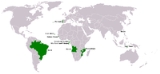
, spoken by nearly all of Brazil's population, which amounts to over 51% of the continent's population even though it is the only Portuguese-speaking nation in the Americas. It is also a major lingua franca in Portugal's former colonial possessions in Africa. It is the official language of ten countries (see the table on the right), also being co-official with SpanishSpanish language

Spanish or Castilian is an Iberian Romance language....
 and FrenchFrench language Overview

French is the third-largest of the Romance languages in terms of number of native speakers, after Spanish and Portuguese, b...
 in Equatorial GuineaEquatorial Guinea

Equatorial Guinea, officially the Republic of Equatorial Guinea, is a country in West Middle Africa, one of the smalle...
, with CantoneseStandard Cantonese

Standard Cantonese is a variant, and is generally considered the prestige dialect of Cantonese Chinese....
 ChineseChinese language

Chinese is a language that forms part of the Sino-Tibetan family of languages....
 in the Chinese special administrative region of MacauMacau Overview

The Macau Special Administrative Region of the People's Republic of China , commonly known as Macau or Macao is...
, and with Tetum in East TimorEast Timor

East Timor, officially the Democratic Republic of Timor-Leste, is a country in Southeast Asia comprising the eastern hal...
. There are sizable communities of Portuguese-speakers in various regions of North America, notably in the United StatesUnited States

The United States of America, also known as the United States, the U.S., the U.S.A., and America, is...
 and in OntarioOntario

Ontario is the most populous and second-largest in area of Canada's ten provinces....
, CanadaCanada Summary

Canada is the world's second-largest country by total area, occupying most of northern North America....
.

SpanishSpain

Spain, officially the Kingdom of Spain , is a European parliamentary monarchy....
 author Miguel de CervantesMiguel de Cervantes

Miguel de Cervantes Saavedra , was a Spanish novelist, poet and playwright....
 once called Portuguese "the sweet language", while Brazilian writer Olavo BilacOlavo Bilac

...
 poetically described it as a última flor do Lácio, inculta e bela: "the last flower of LatiumLatium

Latium is a regione of central Italy, bordered by Tuscany, Umbria, Abruzzo, Marche, Molise, Campania and the Tyrrhenian...
, wild and beautiful".
DialectsPortuguese is a pluricentric languagePluricentric language

A pluricentric language is a language with several standard versions....
 with two main groups of dialectDialect

A dialect is a variety of a language used by people from a particular geographic area....
s, those of BrazilBrazil

Brazil, officially the Federative Republic of Brazil , is the largest and most populous country in South America, and ...
 and those of the Old WorldOld World

The Old World consists of those parts of Earth known to Europeans before the voyages of Christopher Columbus; it includes Eu...
.


Discussion
Ask a question about 'Portuguese language'
Start a new discussion about 'Portuguese language'
Answer questions from other users
Full Discussion Forum


Timeline

1290   King Denis of Portugal decrees that Portuguese be the official language of Portugal, replacing classical Latin in that capacity.


Encyclopedia


Portuguese (
Today it is one of the world's major languages, ranked 6thList of languages by number of native speakers

This is a list of languages ordered by number of native-language speakers, with some data for second-language use....
 according to number of native speakers (approximately 177 million). It is the language with the largest number of speakers in South AmericaSouth America

South America is a continent situated in the western hemisphere and, mostly, the southern hemisphere, bordered on the west b...
, spoken by nearly all of Brazil's population, which amounts to over 51% of the continent's population even though it is the only Portuguese-speaking nation in the Americas. It is also a major lingua franca in Portugal's former colonial possessions in Africa. It is the official language of ten countries (see the table on the right), also being co-official with SpanishSpanish language

Spanish or Castilian is an Iberian Romance language....
 and FrenchFrench language Overview

French is the third-largest of the Romance languages in terms of number of native speakers, after Spanish and Portuguese, b...
 in Equatorial GuineaEquatorial Guinea

Equatorial Guinea, officially the Republic of Equatorial Guinea, is a country in West Middle Africa, one of the smalle...
, with CantoneseStandard Cantonese

Standard Cantonese is a variant, and is generally considered the prestige dialect of Cantonese Chinese....
 ChineseChinese language

Chinese is a language that forms part of the Sino-Tibetan family of languages....
 in the Chinese special administrative region of MacauMacau Overview

The Macau Special Administrative Region of the People's Republic of China , commonly known as Macau or Macao is...
, and with Tetum in East TimorEast Timor

East Timor, officially the Democratic Republic of Timor-Leste, is a country in Southeast Asia comprising the eastern hal...
. There are sizable communities of Portuguese-speakers in various regions of North America, notably in the United StatesUnited States

The United States of America, also known as the United States, the U.S., the U.S.A., and America, is...
 and in OntarioOntario

Ontario is the most populous and second-largest in area of Canada's ten provinces....
, CanadaCanada Summary

Canada is the world's second-largest country by total area, occupying most of northern North America....
.

SpanishSpain

Spain, officially the Kingdom of Spain , is a European parliamentary monarchy....
 author Miguel de CervantesMiguel de Cervantes

Miguel de Cervantes Saavedra , was a Spanish novelist, poet and playwright....
 once called Portuguese "the sweet language", while Brazilian writer Olavo BilacOlavo Bilac

...
 poetically described it as a última flor do Lácio, inculta e bela: "the last flower of LatiumLatium

Latium is a regione of central Italy, bordered by Tuscany, Umbria, Abruzzo, Marche, Molise, Campania and the Tyrrhenian...
, wild and beautiful".

Dialects

Portuguese is a pluricentric languagePluricentric language

A pluricentric language is a language with several standard versions....
 with two main groups of dialectDialect

A dialect is a variety of a language used by people from a particular geographic area....
s, those of BrazilBrazil

Brazil, officially the Federative Republic of Brazil , is the largest and most populous country in South America, and ...
 and those of the Old WorldOld World

The Old World consists of those parts of Earth known to Europeans before the voyages of Christopher Columbus; it includes Eu...
. For historical reasons, the dialects of Africa and Asia are generally closer to those of Portugal than the Brazilian dialects, although in some aspects of their phonetics, especially the pronunciation of unstressed vowels, they resemble Brazilian PortugueseBrazilian Portuguese

Brazilian Portuguese is a collective name for the varieties of Portuguese written and spoken by virtually all the 180 millio...
 more than European PortugueseEuropean Portuguese

European Portuguese is a group of Portuguese dialects spoken in Portugal....
. They have not been studied as widely as European and Brazilian Portuguese.

Audio samples of some dialects of Portuguese are available below. There are some differences between the areas but these are the best approximations possible. For example, the caipira dialect has some differences from the one of Minas Gerais, but in general it is very close. A good example of Brazilian Portuguese may be found in the capital city, BrasíliaBrasília

Braslia is the capital of Brazil with a population of 2,282,049 cation...
, because of the generalized population from all parts of the country.


AngolaAngola

Angola is a country in south-west Africa bordering Namibia, the Democratic Republic of the Congo, and Zambia, and with a wes...


  1. BenguelenseBenguelaBenguela

    Benguela is a port in western Angola, south of Luanda, and capital of Benguela Province....
     province.
  2. LuandaLuanda

    Luanda is the largest city and capital of Angola....
     province.
  3. Sulista — South of Angola.


BrazilBrazil

Brazil, officially the Federative Republic of Brazil , is the largest and most populous country in South America, and ...

  1. CaipiraCaipira

    Caipira is a Brazilian Portuguese term used to designate inhabitants of rural, remote areas of some Brazilian states, partic...
    — States of São PauloSão Paulo (state)

    So Paulo|-| align=center colspan=2 |...
     (countryside; the city of São Paulo and the eastern areas of the state have their own dialect, called paulistano); southern Minas GeraisMinas Gerais

    Minas Gerais|-| align=center colspan=2 |...
    , northern ParanáParaná (state) Overview

    Paran|-| align=center colspan=2 |...
    , GoiásGoiás

    Gois|-| align=center colspan=2 |...
     and Mato Grosso do SulMato Grosso do Sul

    Mato Grosso do Sul|-| align=center colspan=2 |...
    .
  2. CearenseCearáCeará

    Cear|-| align=center colspan=2 |...
    .
  3. BaianoBahiaFacts About Bahia

    Bahia|-| align=center colspan=2 |...
    .
  4. — Variants spoken in the states of Rio de JaneiroRio de Janeiro (state)

    Rio de Janeiro|-| align=center colspan=2 |...
     and Espírito SantoEspírito Santo Overview

    Esprito Santo|-| align=center colspan=2 |...
     (excluding the city of Rio de Janeiro and its adjacent metropolitan areas, which have their own dialect, called cariocaCarioca

    A Carioca is a person born in the city of Rio de Janeiro, Brazil....
    ).
  5. GaúchoGaucho

    Gaucho is a term commonly used to describe residents of the South American pampas, chacos or Patagonian grasslands, found in...
    Rio Grande do SulRio Grande do Sul Summary

    Rio Grande do Sul|-| align=center colspan=2 |...
    . (There are many distinct accents in Rio Grande do Sul, mainly due to the heavy influx of European immigrants of diverse origins, those which have settled several colonies throughout the state.)
  6. MineiroMineiro

    Mineiro is the Portuguese term for the inhabitants of the Brazilian state of Minas Gerais and also the characteristic dialec...
    Minas GeraisMinas Gerais

    Minas Gerais|-| align=center colspan=2 |...
     (not prevalent in the Triângulo MineiroTriângulo Mineiro

    The Tri?ngulo Mineiro is an unofficial region in western Minas Gerais state, Brazil....
    , southern and southeastern Minas GeraisMinas Gerais

    Minas Gerais|-| align=center colspan=2 |...
    ).
  7. northeastern states of BrazilNortheast Region, Brazil

    The Nordeste is composed of the states of Alagoas, Bahia, Ceará, Maranhão, Paraíba, Pernambuco, Piauí, Rio Grande do Norte and Ser...
    .
  8. NortistaAmazon BasinAmazon Basin

    Amazonian redirects here, for other uses see Amazonian...
     states.
  9. Paulistano — Variants spoken around São PauloSão Paulo

    So Paulo is the capital of the state of So Paulo in southeastern Brazil....
     city and the eastern areas of São Paulo state.
  10. Sertanejo — States of GoiásGoiás

    Gois|-| align=center colspan=2 |...
     and Mato GrossoMato Grosso

    Mato Grosso|-| align=center colspan=2 |...
     (the city of CuiabáCuiabá

    colspan="2" bgcolor="#FFDEAD" | Cuiab|----- bgcolor="#FFFFFF"...
     has a particular way of speaking).
  11. Sulista — Variants spoken in the areas between the northern regions of Rio Grande do SulRio Grande do Sul

    Rio Grande do Sul|-| align=center colspan=2 |...
     and southern regions of São Paulo state. (The cities of CuritibaFacts About Curitiba

    Curitiba is the capital city of the Brazilian state of Paran....
    , FlorianópolisFlorianópolis

    Florianpolis is the capital city of Santa Catarina State in southern Brazil....
    , and ItapetiningaItapetininga

    Itapetininga is a municipality in the state of São Paulo in Brazil....
     have fairly distinct accents as well.)


PortugalPortugal

Portugal, officially the Portuguese Republic is located in southwestern Europe on the Iberian Peninsula, and is the w...

  1. (Azorean) — AzoresAzores

    The Azores are an archipelago of Portuguese islands in the middle of the northern Atlantic Ocean, about 1,500 km from Lisb...
    .
  2. AlentejoAlentejo

    Alentejo is a south-central region of Portugal....
  3. AlgarveAlgarve

    * Alcoutim* Aljezur* Castro Marim* Faro...
     (there is a particular dialect in a small part of western Algarve).
  4. — North of BragaBraga

    Braga, a city in northwestern Portugal, is the capital of the district of Braga, the oldest archdiocese and one of the major...
     (hinterland).
  5. — Central Portugal (hinterland).
  6. — Central Portugal.
  7. — Regions of CoimbraCoimbra

    Coimbra is a city and a municipality in Portugal....
     and LisbonLisbon

    Lisbon is the capital and largest city of Portugal....
     (the Lisbon dialect has some peculiar features not shared with the one of Coimbra).
  8. (Madeiran) — MadeiraMadeira

    Madeira is a Portuguese archipelago in the north Atlantic Ocean that lies between and ....
    .
  9. — Regions of Braga and PortoPorto

    Porto, population 263,000 in 15 parishes, with 2,000,000 in the Porto Urban Area, is Portugal's second city....
    .
  10. Trás-os-Montes e Alto DouroTrás-os-Montes e Alto Douro

    Trs-os-Montes e Alto Douro?u}}) is a historical province of Portugal located in the northeastern corner of the country....
    .


Other countries
  • Cape VerdeCape Verde

    The Republic of Cape Verde or Cape Verde is a republic located on an archipelago in the Macaronesia ecoregion of the ...
  • Daman and DiuDaman and Diu

    Daman and Diu is a union territory in India....
    , India — Damaense.
  • East TimorEast Timor

    East Timor, officially the Democratic Republic of Timor-Leste, is a country in Southeast Asia comprising the eastern hal...
  • GoaGoa

    Goa is India's second smallest state in terms of area after Delhi and the fourth smallest in terms of population after Sikk...
    , India — Goês.
  • Guinea-BissauGuinea-Bissau

    Guinea-Bissau, officially the Republic of Guinea-Bissau , is a country in western Africa, and one of the smallest nati...
    .
  • MacauMacau

    The Macau Special Administrative Region of the People's Republic of China , commonly known as Macau or Macao is...
    , China —
  • MozambiqueMozambique

    Mozambique, officially the Republic of Mozambique , is a country in southeastern Africa bordering to the Indian Ocean ...
  • São Tomé and PríncipeSão Tomé and Príncipe Overview

    So Tom and Prncipe}}/), officially the Democratic Republic of So Tom and Prncipe, is an island nation in the Gulf of G...
  • UruguayUruguay

    Uruguay, officially the Eastern Republic of Uruguay or the Republic East of the Uruguay , is a country located ...
    Dialectos Portugueses del Uruguay (DPU)Riverense Portuñol language

    The Riverense Portu?ol or Riverense Portunhol, also known as Fronterizo or Fronteiri?o is a mixed language...
    .


Differences between dialects are mostly of accentAccent (linguistics)

In linguistics, an accent is a pronunciation characteristic of a particular group of people relative to another group....
 and vocabularyVocabulary

A vocabulary is a set of words known to a person or other entity, or that are part of a specific language....
, but between the Brazilian dialects and other dialects, especially in their most coloquial forms, there can also be some grammatical differences. The Portuguese-based creolePortuguese Creole Overview

Portuguese creoles are creole languages which have been significantly influenced by Portuguese....
s spoken in various parts of Africa, Asia, and the Americas are independent languages which should not be confused with Portuguese itself.

History


Arriving in the Iberian Peninsula in 216 BC, the Romans brought with them the Latin language, from which all Romance languages descend. The language was spread by arriving Roman soldiers, settlers and merchants, who built Roman cities mostly near the settlements of previous civilizations.
Medieval
Portuguese poetry
Das que vejo
nom desejo
outra senhor se vós nom,
e desejo
tam sobejo,
mataria um leon,
senhor do meu coraçom:
fim roseta,
bela sobre toda fror,
fim roseta,
nom me meta
em tal coita voss'amor!
João de Lobeira
(c. 1270–1330)


Between AD 409 and 711, as the Roman Empire collapsed in Western Europe, the Iberian Peninsula was conquered by Germanic peoples. The occupiers, mainly SuebiSuebi

The Suebi or Suevi were Elbe-Germanics whose origin was near the Baltic Sea....
 and Visigoths, quickly adopted late Roman culture and the Vulgar LatinVulgar Latin

Vulgar Latin is a blanket term covering the vernacular dialects of the Latin language spoken mostly in the western province...
 dialects of the peninsula. After the MoorishMoors

The Moors were the medieval Muslim inhabitants of al-Andalus and the Maghreb and western Africa, whose culture is often cal...
 invasion of 711, ArabicArabic language

The Arabic language , or simply Arabic , is the largest member of the Semitic branch of the Afro-Asiatic language fami...
 became the administrative language in the conquered regions, but most of the population continued to speak a form of RomanceRomance languages

The Romance languages, a major branch of the Indo-European language family, comprise all languages that descended from Latin...
 commonly known as Mozarabic. The influence exerted by Arabic on the Romance dialects spoken in the Christian kingdoms of the north was small, affecting mainly their lexicon.

The earliest surviving records of a distinctively Portuguese language are administrative documents of the 9th century, still interspersed with many Latin phrases. Today this phase is known as Proto-Portuguese (between the 9th and the 12th centuries). In the first period of Old Portuguese — Galician-PortugueseGalician-Portuguese

Galician-Portuguese was an Iberian Romance language, spoken in the Middle Ages, in the western area of the Iberian Peninsula...
 Period (from the 12th to the 14th century) — the language gradually came into general use. For some time, it was the language of preference for lyric poetryLyric poetry

Lyric poetry is a form of poetry that does not attempt to tell a story, as do epic poetry and dramatic poetry, but is of a m...
 in Christian Hispania, much like Occitan was the language of the poetry of the troubadours. Portugal was formally recognized as an independent kingdom by the Kingdom of LeonKingdom of León

The city of Len was founded by the Roman Seventh Legion ...
 in 1143, with Afonso HenriquesAfonso I of Portugal

Afonso I of Portugal , more commonly known as Afonso Henriques , or also Affonso , Alfonso or Alphonso or...
 as king. In 1290, king DinisDenis of Portugal

Denis of PortugalAs heir to the throne prince Dinis was summoned by his father to share government responsibilities....
 created the first Portuguese university in Lisbon (the Estudos Gerais, later moved to CoimbraCoimbra Overview

Coimbra is a city and a municipality in Portugal....
) and decreed that Portuguese, then simply called the "common language" should be known as the Portuguese language and used officially.

In the second period of Old Portuguese, from the 14th to the 16th century, with the Portuguese discoveriesFacts About Age of Discovery

The Page of Discovery or Age of Exploration was a period from the early 15th century and continuing into the early 17t...
, the language was taken to many regions of AsiaAsia

Asia is the largest and most populous continent or region, depending on the definition....
, AfricaAfrica

Africa is one of the greatest sized continents of the Earth....
 and the AmericasAmericas

he Americas are the lands of the Western hemisphere or New World consisting of the continents of North America and South Ame...
 (nowadays, the great majority of Portuguese speakers live in Brazil, in South America). By the 16th century it had become a lingua francaLingua franca

A lingua franca is any language widely used beyond the population of its native speakers....
in Asia and Africa, used not only for colonial administration and trade but also for communication between local officials and Europeans of all nationalities. Its spread was helped by mixed marriages between Portuguese and local people, and by its association with Roman Catholic missionaryMissionary Overview

A missionary is traditionally defined as a propagator of religion who works to convert those outside that community; someone...
 efforts, which led to the formation of a creole languageCreole language

A creole language, or just creole, is a well-defined and stable language that originated from a non-trivial combinati...
 called KristangKristang language Summary

Papi Kristang, or just Kristang, is a creole language....
 in many parts of Asia (from the word cristão, "Christian"). The language continued to be popular in parts of Asia until the 19th century. Some Portuguese-speaking Christian communities in IndiaIndia Overview

India , officially the Republic of India, is a country in South Asia....
, Sri LankaSri Lanka

Sri Lanka, officially the Democratic Socialist Republic of Sri Lanka , is a tropical island nation off the southeast c...
, MalaysiaMalaysia

Malaysia is a federation of 13 states in Southeast Asia, formed in 1963....
, and IndonesiaIndonesia

Indonesia, officially the Republic of Indonesia , is a nation of islands consisting of 18,110 islands in the South Eas...
 preserved their language even after they were isolated from Portugal.

The end of the Old Portuguese period was marked by the publication of the Cancioneiro Geral by Garcia de ResendeGarcia de Resende

Garcia de Resende was a Portuguese poet and editor....
, in 1516. The early times of Modern Portuguese, which spans from the 16th century to present day, were characterized by an increase in the number of learned words borrowed from Classical Latin and Classical Greek since the Renaissance, which greatly enriched the lexicon.

Characterization

A distinctive feature of Portuguese is that it preserved the stressed vowels of Vulgar LatinVulgar Latin

Vulgar Latin is a blanket term covering the vernacular dialects of the Latin language spoken mostly in the western province...
, which became diphthongs in other Romance languages; cf. Fr. pierre, Sp. piedra, It. pietra, Port. pedra, from Lat. petra; or Sp. fuego, It. fuoco, Port. fogo, from Lat. focum. Another characteristic of early Portuguese was the loss of l and n, sometimes followed by the merger of the two surrounding vowels, or by the insertion of an epenthetic vowelFacts About Epenthesis

In poetry and phonetics, epenthesis is the insertion of a consonant, a vowel, or a whole syllable into a word, usually to fa...
 between them: cf. Lat. salire, tenere, catena, Sp. salir, tener, cadena, Port. sair, ter, cadeia.

When the elidedElision

Elision is the omission of one or more sounds in a word or phrase, producing a result that is easier for the speaker to pron...
 consonant was n, it often nasalizedNasalization

In phonetics, nasalization is the production of a sound while the velum is lowered, so that some air escapes through the nos...
 the preceding vowel: cf. Lat. manum, rana, bonum, Port. mão, rãa, bõo (now mão, , bom). This process was the source of most of the nasal diphthongs which are typical of Portuguese. In particular, the Latin endings -anem, -anum and -onem became -ão in most cases, cf. Lat. canem, germanum, rationem with Modern Port. cão, irmão, razão, and their plurals -anes, -anos, -ones normally became -ães, -ãos, -ões, cf. cães, irmãos, razões.

Movement to make Portuguese an official language of the UN

There is a growing number of people in the Portuguese speaking media and the internet who are presenting the case to the CPLP and other organizations to run a debate in the LusophoneLusophone

A Lusophone is someone who speaks the Portuguese language natively or by adoption....
 community with the purpose of bringing forward a petition to make Portuguese an official language of the United Nations.

In October 2005, during the international Convention of the that took place in Tavira, Portugal a petition was written and unanimously approved whose text can be found on the internet with the title Petição Para Tornar Oficial o Idioma Português na ONU.

Romulo Alexandre Soares, president of the Brazil-Portugal Chamber highlights that the positioning of Brazil in the international arena as one of the emergent powers of the 21 century, the size of its population, and the presence of the language around the world provides legitimacy and justifies a petition to the UN to make the Portuguese an official language at the UN.

Vocabulary

Most of the lexicon of Portuguese is derived from Latin. Nevertheless, because of the MoorishMoors

The Moors were the medieval Muslim inhabitants of al-Andalus and the Maghreb and western Africa, whose culture is often cal...
 occupation of the Iberian PeninsulaIberian Peninsula Overview

The Iberian Peninsula, or Iberia, is located in the extreme southwest of Europe....
 during the Middle Ages, and the participation of Portugal in the Age of DiscoveryAge of Discovery

The Page of Discovery or Age of Exploration was a period from the early 15th century and continuing into the early 17t...
, it has adopted loanwords from all over the world.

Very few Portuguese words can be traced to the pre-Roman inhabitants of PortugalPre-Roman peoples of the Iberian Peninsula

This is a list of the Pre-Roman peoples of the Iberian peninsula . ...
, which included the Gallaeci, LusitaniansLusitanians

The Lusitanians were a tribe, or various tribes, from the western Iberian peninsula, which became the Roman province of Lusi...
, CelticiFacts About Celtici

The Celtici were an ancient Celtic tribe of Lusitania, akin either to the Lusitanians and Gallaecians or the Celtiberians, l...
 and CynetesFacts About Cynetes

The Cynetes or Conii were a people living in today's Algarve and Low Alentejo regions of southern Portugal before the ...
. The Phoenicians and Carthaginians, briefly present, also left some scarce traces. Some notable examples are abóbora "pumpkin" and bezerro "year-old calf", from the nearby Celtiberian languageCeltiberian language

Celtiberian is an extinct Celtic language spoken by the Celtiberians in central Spain before and during the Roman Empire....
 (probably through the Celtici); cerveja "beer", from CelticCeltic languages

The Celtic languages are the languages descended from Proto-Celtic, or "Common Celtic", a branch of the greater Indo-Europea...
; saco "bag", from Phoenician; and cachorro "dog, puppy", from BasqueBasque language Summary

Basque is the language spoken by the Basque people who inhabit the Pyrenees in North-Central Spain and the adjoining region...
.

In the 5th century, the Iberian Peninsula (the RomanAncient Rome

Ancient Rome was a civilization that grew out of the city-state of Rome, founded in the Italian Peninsula circa the 9th cent...
 HispaniaHispania

Hispania was the name given by the Romans to the whole of the Iberian Peninsula and to two provinces created there in the pe...
) was conquered by the GermanicGermanic peoples

The Germanic peoples are groups of people identified by their use of the Germanic languages that are descended from Proto-Ge...
 Suevi and Visigoths. As they adopted the Roman civilization and language, however, these people contributed only a few words to the lexicon, mostly related to warfare — such as espora "spur", estaca "stake", and guerra "war", from GothicGothic language

The Gothic language is an extinct Germanic language that was spoken by the Goths and specifically by the Visigoths....
 *spaúra, *stakka, and *wirro, respectively.

Between the 9th and 15th centuries Portuguese acquired about 1000 words from ArabicArabic language

The Arabic language , or simply Arabic , is the largest member of the Semitic branch of the Afro-Asiatic language fami...
 by influence of Moorish IberiaAl-Andalus

Al-Andalus was the Arabic name given to those parts of the Iberian Peninsula governed by Muslims from 711 to 1492....
. They are often recognizable by the initial Arabic article a(l)-, and include many common words such as aldeia "village" from ?????? aldaya, alface "lettuce" from ???? alkhass, armazém "warehouse" from ?????? almahazan, and azeite "olive oil" from ??? azzait. From Arabic came also the grammatically peculiar word oxaláInsha'Allah

Insha'Allah is an Arabic term evoked by Muslims to indicate hope for an aforementioned event to occur in the future....
 "hopefully". The Mozambican currency name meticalMozambican metical

The metical is the currency of Mozambique....
 was derived from the word ????? mi?qal, a unit of weight. The word Mozambique itself is from the Arabic name of sultan Muça Alebique (Musa Alibiki). The name of the Portuguese town of FátimaFátima, Portugal

Ftima is a city in Portugal famous for the religious visions that are said to have taken place there in 1917....
 comes from the name of one of the daughters of the prophet MuhammadFacts About Muhammad

Muhammad 570-632 CE, was an Arab religious and political leader and the historical founder of Islam....
.

Starting in the 15th century, the Portuguese maritime explorations led to the introduction of many loanwords from AsiaAsia

Asia is the largest and most populous continent or region, depending on the definition....
n languages. For instance, catana "cutlass" from Japanese katana; corja "rabble" from Malay kórchchu; and chá "tea" from ChineseChinese language

Chinese is a language that forms part of the Sino-Tibetan family of languages....
 cháFacts About Tea

Tea is the second most popular beverage in the world ....
.

From South America came batata "potatoPotato

The potato is a perennial plant of the Solanaceae, or nightshade, family, commonly grown for its starchy tuber....
", from TainoTaíno

The Tano are pre-Colombian indigenous inhabitants of the Bahamas and the Greater Antilles islands, which include Cuba, Hispa...
; ananás and abacaxi, from Tupi-Guarani naná and TupiTupi language

The Tupi language is according to Ethnologue a ....
 ibá cati, respectively (two species of pineapplePineapple

The pineapple is a tropical ground and fruit , native to Brazil, Bolivia, Peru, and Paraguay....
), and tucano "toucanToucan

Toucans are near passerine birds from the neotropics....
" from GuaraniGuaraní language

Guaran is an Amerindian language of South America that belongs to the Tup-Guaran subfamily....
 tucan. See List of Brazil state name etymologiesList of Brazil state name etymologies Summary

Most of Brazilian state names are based on native indigenous placenames, while others were given by Portuguese and other European ...
, for some more examples.

From the 16th to the 19th century, the role of Portugal as intermediary in the Atlantic slave tradeAtlantic slave trade Summary

The Atlantic slave trade was the purchase of people in and transport from West Africa and Central Africa into slavery in the...
, with the establishment of large Portuguese colonies in Angola, Mozambique, and Brazil, Portuguese got several words of African and Amerind origin, especially names for most of the animals and plants found in those territories. While those terms are mostly used in the former colonies, many became current in European Portuguese as well. From Kimbundu, for example, came kifumate ? cafuné "head caress", kusula ? caçula "youngest child", marimbondo "tropical wasp", and kubungula ? bungular "to dance like a wizard".

Finally, it has received a steady influx of loanwords from other European languages. For example, melena "hair lock", fiambre "wet-cured ham" (in contrast with presunto "dry-cured ham" from Latin prae-exsuctus "dehydrated"), and castelhano "Castilian", from Spanish; colchete/crochê "bracket"/"crochet", paletó "jacket", batom "lipstick", and filé/filete "steak"/"slice" respectively, from French crochet, paletot, bâton, filet; macarrão "pasta", piloto "pilot", carroça "carriage", and barraca "barrack", from Italian maccherone, pilota, carrozza, baracca; and bife "steak", futebol, revólver, estoque, folclore, from English beef, football, revolver, stock, folklore.

Classification and related languages


Portuguese belongs to the West IberianWest Iberian languages

West Iberian languages is a subcategory of Romance languages, which includes Spanish, the languages derived from Galician-Po...
 branch of the Romance languages, and it has special ties with the following members of this group:

  • GalicianGalician language

    Galician is a language of the Western Ibero-Romance branch, spoken in Galicia, an autonomous community with the constitution...
     and the FalaFala language

    Fala language is a Romance language from the Portuguese-Galician subgroup spoken in Spain by about 10,500 people, of which 5...
    , its closest relatives. See below.
  • SpanishSpanish language

    Spanish or Castilian is an Iberian Romance language....
    , the major language closest to Portuguese. (See also Differences between Spanish and PortugueseDifferences between Spanish and Portuguese

    Spanish and Portuguese are two of the most widely spoken languages in the world today....
    .)
  • MirandeseMirandese language

    The Mirandese language is a Romance language sparsely spoken in a small area of northeastern Portugal, in Miranda do Douro m...
    , another West Iberian language spoken in Portugal.
  • Judeo-PortugueseJudeo-Portuguese

    Judeo-Portuguese is the generally extinct Jewish language of the Jews of Portugal....
     and Judeo-SpanishLadino language

    Ladino is a Romance language, derived mainly from Old Castilian and Hebrew....
    , languages spoken by Sephardic Jews, which remained close to Portuguese and Spanish.


Despite the obvious lexical and grammatical similarities between Portuguese and other Romance languages, it is not mutually intelligible with most of them. Apart from Galician, Portuguese speakers will usually need some formal study of basic grammar and vocabulary, before attaining a reasonable level of comprehension of those languages, and vice-versa.

Galician and the Fala

The closest language to Portuguese is Galician, spoken in the autonomous community of Galicia (northwestern Spain). The two were at one time a single language, known today as Galician-PortugueseGalician-Portuguese

Galician-Portuguese was an Iberian Romance language, spoken in the Middle Ages, in the western area of the Iberian Peninsula...
, but since the political separation of Portugal from Galicia they have diverged somewhat, especially in pronunciation and vocabulary. Nevertheless, the core vocabulary and grammar of Galician are still noticeably closer to Portuguese than to Spanish. In particular, like Portuguese, it uses the future subjunctive, the personal infinitive, and the synthetic pluperfect (see the section on the grammar of Portuguese, below). Mutual intelligibility (estimated at 85% by R. A. Hall, Jr., 1989) is good between Galicians and northern Portuguese, but poorer between Galicians and speakers from central Portugal.

The Fala language is another descendant of Galician-Portuguese, spoken by a small number of people in the Spanish towns of Valverdi du Fresnu, As Ellas and Sa Martín de Trebellu (autonomous community of ExtremaduraExtremadura Overview

Extremadura is an autonomous community of western Spain....
, near the border with Portugal).

Influence on other languages

Many languages have borrowed wordsFacts About Loanword

A loanword is a word directly taken into one language from another with little or no translation....
 from Portuguese, such as Indonesian, Sri LankaSri Lanka Overview

Sri Lanka, officially the Democratic Socialist Republic of Sri Lanka , is a tropical island nation off the southeast c...
n TamilSri Lanka Tamils (native)

Sri Lankan Tamils also self identified as Eelam Tamils, Ceylonese or Ilankai Tamils are today a trans-national...
 and Sinhalese (see Sri Lanka Indo-PortugueseSri Lanka Indo-Portuguese language

Sri Lanka Indo-Portuguese or Sri Lanka Portuguese Creole is a language spoken in Sri Lanka....
), MalayMalay language

The Malay language, also known locally as Bahasa Melayu or Bahasa Malaysia, is an Austronesian language spoken by th...
, BengaliBengali language

Bengali or Bangla is an Indo-Aryan language of East South Asia, evolved from Prakrit, Pali and Sanskrit....
, English, HindiHindi

Hindi , an Indo-European language spoken mainly in northern and central India, is the official language of the Union governm...
, KonkaniFacts About Konkani language

Konkani is a language of India, and belongs to the Indo-European family of languages....
, MarathiMarathi language

Marathi is an Indo-Aryan language spoken by the Maharashtrian people of western India....
, TetumTetum language

Tetum is an Austronesian language, and one of its forms, Tetum- Praca, is one of the national languages of East Timor....
, XitsongaTsonga language

The Tsonga or Xitsonga language is spoken in southern Africa by the Tsonga people, also known as the Shangaan....
, Papiamentu, JapaneseJapanese language

Japanese is a language spoken by over 127 million people, mainly in Japan, but also by Japanese emigrant communities around...
, Bajan Creole (Spoken in Barbados), Lanc-PatuáLanc-Patuá Summary

Lanc-Patu? is a creole language spoken in the state of Amap? in Brazil, primarily now around the capital, Macap?....
 (spoken in northern Brazil) and Sranan TongoSranan Tongo Summary

Sranan is a creole language spoken as a native language by approximately 120,000 people in Suriname....
 (spoken in Suriname). It left a strong influence on the língua brasílica, a Tupi-Guarani language which was the most widely spoken in BrazilBrazil

Brazil, officially the Federative Republic of Brazil , is the largest and most populous country in South America, and ...
 until the 18th century, and on the language spoken around SikkaSikka

Sikka is a regency in East Nusa Tenggara province, Indonesia, on the island Flores....
 in Flores IslandFlores

Flores is one of the Lesser Sunda Islands, an island arc with an estimated area of 14,300 km extending east from the Java i...
, IndonesiaIndonesia

Indonesia, officially the Republic of Indonesia , is a nation of islands consisting of 18,110 islands in the South Eas...
. In nearby LarantukaLarantuka

Larantuka is a subdistrict of East Flores Regency, on the eastern end of Flores Island, East Nusa Tenggara, Indonesia....
, Portuguese is used for prayers in Holy WeekHoly Week

Holy Week is the Christian week from Palm Sunday through Holy Saturday....
 rituals.
The Japanese-Portuguese dictionary Nippo JishoNippo Jisho

The Nippo Jisho or Vocabvlario da Lingoa de Iapam was a Japanese to Portuguese dictionary published in Nagasaki, Ja...
(1603) was the first dictionary of Japanese in a European language, a product of JesuitSociety of Jesus

The Society of Jesus is a Christian religious order of the Catholic Church in direct service to the Pope....
 missionary activity in JapanJapan

is an island country in East Asia. Located in the Pacific Ocean, it lies to the east of China, Korea, and Russia, stretching from...
. Building on the work of earlier Portuguese missionaries, the Dictionarium Anamiticum, Lusitanum et Latinum (Annamite-Portuguese-Latin dictionary) of Alexandre de Rhodes (1651) introduced the modern orthography of VietnameseFacts About Vietnamese alphabet

The Vietnamese alphabet, called ch? qu?c ng?, usually shortened to qu?c ng?, is the current writing syst...
, which is based on the orthography of 17th-century Portuguese. The RomanizationRomanization Overview

In linguistics, romanization is the representation of a word or language with the Roman alphabet, or a system for doing so, ...
 of ChineseChinese language

Chinese is a language that forms part of the Sino-Tibetan family of languages....
 was also influenced by the Portuguese language (among others), particularly regarding Chinese surnamesList of common Chinese surnames

This is a list of the top 100 most common Chinese surnames according to a study published in 2006....
; one example is Mei.

See also List of English words of Portuguese originList of English words of Portuguese origin

This is a list of English words borrowed or derived from Portuguese:...
, Loan words in IndonesianLoan words in Indonesian Overview

The Indonesian language has absorbed many loanwords from other languages:...
, Japanese words of Portuguese originJapanese words of Portuguese origin

Many Japanese words of Portuguese origin entered the Japanese language when Portuguese Jesuit priests introduced Christian i...
, Borrowed words in MalayFacts About Malay language

The Malay language, also known locally as Bahasa Melayu or Bahasa Malaysia, is an Austronesian language spoken by th...
, Sinhala words of Portuguese originSinhala words of Portuguese origin

This article is about Sinhala words of Portuguese origin....
, Loan words from Portuguese in Sri Lankan TamilLoan words in Sri Lankan Tamil Summary

Loan words in Sri Lankan Tamil came about due contact between colonial powers and the native population....
.

Derived languages

Beginning in the 16th century, the extensive contacts between Portuguese travelers and settlers, African slaves, and local populations led to the appearance of many pidginPidgin

A pidgin, or contact language, is the name given to any language created, usually spontaneously, out of a mixture of o...
s with varying amounts of Portuguese influence. As these pidgins became the mother tongue of succeeding generations, they evolved into fully fledged creole languageCreole language

A creole language, or just creole, is a well-defined and stable language that originated from a non-trivial combinati...
s, which remained in use in many parts of Asia and Africa until the 18th century. Some Portuguese-based or Portuguese-influenced creoles are still spoken today, by over 3 million people worldwide, especially people of partial PortuguesePortuguese people

The Portuguese people are the ethnic group or nation native to the country of Portugal, in the Iberian peninsula of southwes...
 ancestry.

Phonology


There is a maximum of 9 oral vowels and 19 consonants, though some varieties of the language have fewer phonemes (Brazilian Portuguese has only 8 oral vowel phonePhone

Within phonetics, a phone is:* a speech sound or gesture considered as a physical event without regard to its place in the ...
s). There are also five nasal vowels, which some linguists regard as allophones of the oral vowels, ten oral diphthongDiphthong

In phonetics, a diphthong is a vowel combination in a single syllable involving a quick but smooth movement from one vowel ...
s, and five nasal diphthongs.

Vowels


To the seven vowels of Vulgar LatinVulgar Latin Overview

Vulgar Latin is a blanket term covering the vernacular dialects of the Latin language spoken mostly in the western province...
, European Portuguese has added two near central vowelsMid-centralized vowel

A mid-centralized vowel is a vowel closer to the center of the vowel space than some point of reference....
, one of which tends to be elidedElision

Elision is the omission of one or more sounds in a word or phrase, producing a result that is easier for the speaker to pron...
 in rapid speechRelaxed pronunciation

Relaxed pronunciation is a phenomenon that happens when the syllables of common words are slurred together....
, like the e caduc of FrenchFrench language

French is the third-largest of the Romance languages in terms of number of native speakers, after Spanish and Portuguese, b...
 (represented either as , or , or ). The high vowels and the low vowels are four distinct phonemes, and they alternate in various forms of apophonyApophony

In linguistics, apophony is the alternation of sounds within a word that indicates grammatical information....
. Like CatalanCatalan language

Catalan is a Romance language, the national language of Andorra and co-official in the Spanish autonomous communities of B...
, Portuguese uses vowel quality to contrast stressed syllables with unstressed syllables: isolated vowels tend to be raisedVowel

In phonetics, a vowel is a sound in spoken language that is characterized by an open configuration of the vocal tract so tha...
, and in some cases centralized, when unstressed. Nasal diphthongs occur mostly at the end of words.

Consonants

caption | Consonant phonemes of Portuguese
Bilabial Labio-
dental
DentalDental consonant

Dentals are consonants such as t, d, n, and l articulated with either the lower teeth, the upper teeth, or b...
AlveolarAlveolar consonant

Alveolar consonants are articulated with the tongue against or close to the superior alveolar ridge, which is called that be...
Post-
alveolar
Palatal VelarVelar consonant

Velars are consonants articulated with the back part of the tongue...
Uvular
Plosives     
NasalsNasal consonant

A nasal consonant is produced when the velum—that fleshy part of the palate near the back—is lowered, allowing a...
       
Fricatives    
LateralFacts About Lateral consonant

Laterals are "L"-like consonants pronounced with an occlusion made somewhere along the axis of the tongue, while air from th...
s
        
FlapsFlap consonant

In phonetics, a flap or tap is a type of consonantal sound, which is produced with a single contraction of the muscles...


The consonant inventory of Portuguese is fairly conservative. The medieval affricates , , , merged with the fricatives , , , , respectively, but not with each other, and there were no other significant changes to the consonant phonemes since then. However, some remarkable dialectal variants and allophoneAllophone

In phonetics, an allophone is one of several similar phones that belong to the same phoneme....
s have appeared, among which:

  • In many regions of Brazil, and have the affricate allophones and , respectively, before and ..


  • At the end of a syllable, the phoneme has the allophone in Brazilian Portuguese (L-vocalizationL-vocalization

    In linguistics, l-vocalization is a process by which an sound is replaced by a vowel or semivowel sound....
    ).


  • In many parts of Brazil and Angola, intervocalic is pronounced as a nasalizedNasalization Overview

    In phonetics, nasalization is the production of a sound while the velum is lowered, so that some air escapes through the nos...
     palatal approximantPalatal approximant

    The palatal approximant is a type of consonantal sound, used in very many spoken languages....
      which nasalizes the preceding vowel, so that for instance is pronounced .


  • In most of Brazil, the alveolar sibilants and occur in complementary distribution at the end of syllables, depending on whether the consonant that follows is voiceless or voiced, as in English. But in most of Portugal and parts of Brazil sibilants are postalveolar at the end of syllables, before voiceless consonants, and before voiced consonants (in Judeo-SpanishLadino language

    Ladino is a Romance language, derived mainly from Old Castilian and Hebrew....
    , is often replaced with at the end of syllables, too).


  • There is considerable dialectal variation in the value of the rhoticRhotic consonant

    Rhotic consonants, or "R"-like sounds, are non-lateral liquid consonants....
     phoneme . See Guttural R in PortugueseFacts About Guttural R

    In linguistics, guttural R refers to pronunciation of the phoneme R as a guttural consonant....
    , for details.

Writing system

Written varieties
Portugal/Africa/Asia Brazil translation
anónimoanônimoanonymous
factofatofact
ideiaidéiaidea
direcçãodireçãodirection
óptimoótimogreat
frequentefreqüentefrequent
voovôoflight

Portuguese is written with the Latin alphabetLatin alphabet

The Latin alphabet, also called the Roman alphabet, is the most widely used alphabetic writing system in the world tod...
, making use of five diacriticDiacritic

A diacritical mark or diacritic, sometimes called an accent mark, is a mark added to a letter to alter a word's ...
s to denote stress, vowel height, contraction, nasalization, and other sound changes (acute accent, grave accent, circumflex accent, tilde, and cedilla). Brazilian PortugueseBrazilian Portuguese

Brazilian Portuguese is a collective name for the varieties of Portuguese written and spoken by virtually all the 180 millio...
 also uses the diaeresis mark. Accented characters and digraphs are not counted as separate letters for collationCollation

In textual criticism and bibliography, collation is the reading of two texts side-by-side in order to note their difference...
 purposes.

Brazilian vs. European spelling


There are some minor differences between the orthographies of Brazil and other Portuguese language countries. One of the most pervasive is the use of acute accents in the European/African/Asian orthography in many words such as sinónimo, where the Brazilian orthography has a circumflex accent, sinônimo. Another important difference is that Brazilian spelling often lacks c or p before c, ç, or t, where the European orthography has them; for example, cf. Brazilian fato with European facto, "fact", or Brazilian objeto with European objecto, "object". Some of these spelling differences reflect differences in the pronunciation of the words, but others are merely graphic.

Examples

Excerpt from the Portuguese national epicNational epic

A national epic is an epic poem or similar work which seeks or is believed to capture and express the essence or spirit of a...