

Modern Greek

Encyclopedia
Modern Greek refers to the varieties of the Greek language
spoken in the modern era. The beginning of the "modern" period of the language is often symbolically assigned to the fall of the Byzantine Empire
in 1453, even though that date marks no clear linguistic boundary and many characteristic modern features of the language had been present centuries earlier - from the fourth to the fifteenth century AD. During most of the period, the language existed in a situation of diglossia
(due in part to the dark ages
), with regional spoken dialects existing side by side with learned, archaic written forms. Most notably, during much of the 19th and 20th centuries, it was known in the competing varieties of popular Demotic
and learned Katharevousa
. Today, standard modern Greek, based on Demotic, is the official language of both Greece
and Cyprus
. Greek is spoken today by approximately 12-15 million people, mainly in Greece and Cyprus, but also by minority and immigrant communities in many other countries.
. All surviving forms of modern Greek, except the Tsakonian
dialect, are descendants of the common supra-regional (Koine
) as it was spoken in late antiquity. As such, they can ultimately be classified as descendants of Attic
, the dialect spoken in and around Athens
in the classical era. Tsakonian, an isolated dialect spoken today by a dwindling community in the Peloponnese
, is a descendant of the ancient Doric
dialect. Some other dialects have preserved elements of various ancient non-Attic dialects, but Attic Koine is nevertheless regarded by most scholars as the principal source of all of them.
, Bulgaria
and Turkey
, as well as in several countries in the Black Sea
area (Ukraine
, Russia
, Georgia
, Armenia
) and around the Mediterranean Sea
(Southern Italy, Egypt
). The language is also spoken by emigrant communities in many countries in Western Europe, North America, Australia
, as well as in Argentina
, Brazil
and others. Countries with notable number of speakers of Greek as a foreign language
are Serbia
, Albania
, Bulgaria
and Romania
.
of Greece
where it is spoken by about 99.5% of the population. It is also, alongside Turkish
, one of the two official languages of Cyprus
. Because of the membership of Greece and Cyprus in the European Union, Greek is one of the 23 official languages of the European Union
. Greek is officially recognised as a minority language in parts of Italy
, Armenia
, Ukraine
and Albania
.
The main dialect
s of modern Greek are:
, from which it descends. It is universally spoken in the urban parts of Greece, with minor variation in the vernacular forms used in rural Greece and the Greek diaspora
.
Standard Modern Greek evolved from the Southern Demotic dialects, primarily those of Peloponnese
, and is thus, ultimately, a descendant of the ancient Koiné of the Hellenistic era. After Greece gained independence from the Ottoman Empire
in 1829, the dual-language status of the late Byzantine Empire
was re-adopted. The vernacular speech was Demotic (a term similar to "popular") and the official state dialect was Katharevousa
("purified"). Demotic was the language of daily vernacular use, whereas Katharevousa, a more archaic form closer to Attic, was used for formal purposes such as literature, newscasting and official documents. In the course of the 20th century, Demotic saw a slow functional expansion as it was adopted gradually in more and more domains of life, including literature and some parts of journalism and education. The competition between the two forms, known as the "language question
" remained a hotly contested ideological issue during much of the early and mid 20th century, and official policies towards the extent of use of Demotic in education and administration changed multiple times. In 1976 Katharevousa was finally replaced by Demotic as the official language of the Greek state. However, by this time, the form of Demotic actually used in practice was marked by a considerable amount of influence from Katharevousa, because during its expansion to new communicative domains it had enriched its vocabulary through internal loans from the learned tradition. It is for this reason that modern linguistics has adopted terms like Standard Modern Greek or "Modern Koiné" for the resulting variety, distinguishing it from "pure" traditional Demotic.
). In the consonants, Modern Greek has two series of fricatives in lieu of the Ancient Greek voiced
and aspirated
voiceless
plosives. Modern Greek has not preserved length distinctions, either in the vowels or in the consonants.
additionally has a special final form. There are two diacritical symbols, the acute accent
which indicates stress
and the diaeresis marking a vowel letter as not being part of a digraph
. Greek has a mixed historical and phonemic orthography
, where historical spellings are used if their pronunciation matches modern usage. The correspondence between consonant phoneme
s and graphemes is largely unique, but several of the vowels can be spelled in multiple ways. Thus reading
is easy but spelling
is difficult.
A number of diacritical signs
were used until 1982, when they were officially dropped from Greek spelling as no longer corresponding to the modern pronunciation of the language. Monotonic orthography is today used in official usage, in schools and for most purposes of everyday writing in Greece. Polytonic orthography, besides being used for older varieties of Greek, is still used in book printing, especially for academic and belletristic purposes, and in everyday use by some conservative writers and elderly people. The Greek Orthodox Church continues to use polytonic and the late Archbishop Christodoulos
of Athens and the Holy Synod of the Church of Greece have requested the reintroduction of polytonic as the official script.
The Greek vowel letters with their pronunciation are: ⟨α⟩ [a], ⟨ε⟩ [e̞], ⟨η⟩ [i], ⟨ι⟩ [i], ⟨ο⟩ [o̞], ⟨υ⟩ [i], ⟨ω⟩ [o̞]. There are also vowel digraphs which are phonetically monophthongal: ⟨αι⟩ [e̞], ⟨ει⟩ [i], ⟨οι⟩ [i], ⟨ου⟩ [u], ⟨υι⟩ [i]. The three digraphs ⟨αυ⟩, ⟨ευ⟩ and ⟨ηυ⟩ are pronounced [af], [e̞f] and [if] except when followed by voiced consonants or vowels, in which case they are pronounced [av], [e̞v] and [iv] respectively.
Modern Greek has also four diphthongs: ⟨αη⟩ (or ⟨άη⟩) [aj], ⟨αϊ⟩ (or ⟨άι⟩) [aj], ⟨οη⟩ (or ⟨όη⟩) [o̞j] and ⟨οϊ⟩ (or ⟨όι⟩) [o̞j] (diphthongs can better be transcribed using the IPA non-syllabic diacritic under [i] instead of the approximant [j]).
The Greek letters ⟨β⟩ and ⟨δ⟩ are pronounced [v] and [ð] respectively. The letter ⟨γ⟩ is generally pronounced [ɣ], but before the mid or close front vowels, it is pronounced [ʝ] (or [ʑ] and [ʒ] in some dialects, notably those of Crete and the Mani). Μoreover, before the mid or close back vowels, tends to be pronounced further back than a prototypical velar, between a velar [ɣ] and an uvular [ɢ] (transcribed [ɣ̄]).
The letters ⟨θ⟩, ⟨φ⟩ and ⟨χ⟩ are pronounced [θ], [f] and [x] respectively. The letter ⟨χ⟩, before mid or close front vowels, is pronounced [ç] (or [ɕ] and [ʃ] in some dialects, notably those of Crete and the Mani) and before the mid or close back vowels, it tends to be pronounced as a postvelar [x̱]. The letter ⟨ξ⟩ stands for the sequence /ks/ and ⟨ψ⟩ for /ps/. The digraphs ⟨γγ⟩ and ⟨γκ⟩ are generally pronounced [ɡ] in everyday speech, but are pronounced [ɟ] before the front vowels [e̞] and [i] and tend to be pronounced [ɡ̄] before the back [o̞] and [u]. When these digraphs are preceded by a vowel, they are pronounced [ŋɡ] in formal speech ([ɲɟ] before the front vowels [e̞] and [i] and [ŋ̄ɡ̄] before the back [o̞] and [u]). The digraph ⟨γγ⟩ may be pronounced [ŋɣ] in some words ([ɲʝ] before front vowels and [ŋ̄ɣ̄] before back ones). The pronunciation [ŋk] for the digraph ⟨γκ⟩ is extremely rare, but could be heard in literary and scholarly words or when reading ancient texts (by a few readers); normally it retains its "original" pronunciation [ŋk] only in the trigraph ⟨γκτ⟩ where ⟨τ⟩ prevents the sonorization of ⟨κ⟩ by ⟨γ⟩ (hence [ŋkt]).
. It is one of only two Indo-European languages that has retained a synthetic passive, the other being Albanian (the North Germanic passive is a recent innovation based on a grammaticalized reflexive pronoun
). Noticeable changes in grammar (compared to classical Greek) include the loss of the dative case
, the optative mood
, the infinitive
, the dual number
, and the participle
s (except the past participle); the adoption of the gerund
; the reduction in the number of noun declension
s, and the number of distinct forms in each declension; the adoption of the modal particle
(a contraction of → → → ) to denote future and conditional tenses; the introduction of auxiliary verb
forms for certain tenses; the extension to the future tense of the aspectual distinction between present/imperfect and aorist; the loss of the third person imperative, and the simplification of the system of grammatical prefixes, such as augmentation
and reduplication
. Some of these features are shared with other languages spoken in the Balkan peninsula (see Balkan linguistic union
), although not others, such as the postposed article.
Because of the influence of Katharevousa, however, Demotic is not commonly used in its purest form, and archaism
s are still widely used, especially in writing and in more formal speech, as well as in some everyday expressions, such as the dative ('OK', literally 'in order') or the third person imperative ! ('long live!').
(by the United Nations
):
Greek language
Greek is an independent branch of the Indo-European family of languages. Native to the southern Balkans, it has the longest documented history of any Indo-European language, spanning 34 centuries of written records. Its writing system has been the Greek alphabet for the majority of its history;...
spoken in the modern era. The beginning of the "modern" period of the language is often symbolically assigned to the fall of the Byzantine Empire
Byzantine Empire
The Byzantine Empire was the Eastern Roman Empire during the periods of Late Antiquity and the Middle Ages, centred on the capital of Constantinople. Known simply as the Roman Empire or Romania to its inhabitants and neighbours, the Empire was the direct continuation of the Ancient Roman State...
in 1453, even though that date marks no clear linguistic boundary and many characteristic modern features of the language had been present centuries earlier - from the fourth to the fifteenth century AD. During most of the period, the language existed in a situation of diglossia
Diglossia
In linguistics, diglossia refers to a situation in which two dialects or languages are used by a single language community. In addition to the community's everyday or vernacular language variety , a second, highly codified variety is used in certain situations such as literature, formal...
(due in part to the dark ages
Greek Dark Ages
The Greek Dark Age or Ages also known as Geometric or Homeric Age are terms which have regularly been used to refer to the period of Greek history from the presumed Dorian invasion and end of the Mycenaean Palatial civilization around 1200 BC, to the first signs of the Greek city-states in the 9th...
), with regional spoken dialects existing side by side with learned, archaic written forms. Most notably, during much of the 19th and 20th centuries, it was known in the competing varieties of popular Demotic
Dimotiki
Demotic Greek or dimotiki is the modern vernacular form of the Greek language. The term has been in use since 1818. Demotic refers particularly to the form of the language that evolved naturally from ancient Greek, in opposition to the artificially archaic Katharevousa, which was the official...
and learned Katharevousa
Katharevousa
Katharevousa , is a form of the Greek language conceived in the early 19th century as a compromise between Ancient Greek and the Modern Greek of the time, with a vocabulary largely based on ancient forms, but a much-simplified grammar. Originally, it was widely used both for literary and official...
. Today, standard modern Greek, based on Demotic, is the official language of both Greece
Greece
Greece , officially the Hellenic Republic , and historically Hellas or the Republic of Greece in English, is a country in southeastern Europe....
and Cyprus
Cyprus
Cyprus , officially the Republic of Cyprus , is a Eurasian island country, member of the European Union, in the Eastern Mediterranean, east of Greece, south of Turkey, west of Syria and north of Egypt. It is the third largest island in the Mediterranean Sea.The earliest known human activity on the...
. Greek is spoken today by approximately 12-15 million people, mainly in Greece and Cyprus, but also by minority and immigrant communities in many other countries.
Classification
Greek forms an independent branch of the Indo-European languagesIndo-European languages
The Indo-European languages are a family of several hundred related languages and dialects, including most major current languages of Europe, the Iranian plateau, and South Asia and also historically predominant in Anatolia...
. All surviving forms of modern Greek, except the Tsakonian
Tsakonian language
Tsakonian, Tsaconian, Tzakonian or Tsakonic is a Hellenic language, spoken in the Tsakonian region of the Peloponnese, Greece....
dialect, are descendants of the common supra-regional (Koine
Koine Greek
Koine Greek is the universal dialect of the Greek language spoken throughout post-Classical antiquity , developing from the Attic dialect, with admixture of elements especially from Ionic....
) as it was spoken in late antiquity. As such, they can ultimately be classified as descendants of Attic
Attic Greek
Attic Greek is the prestige dialect of Ancient Greek that was spoken in Attica, which includes Athens. Of the ancient dialects, it is the most similar to later Greek, and is the standard form of the language studied in courses of "Ancient Greek". It is sometimes included in Ionic.- Origin and range...
, the dialect spoken in and around Athens
Athens
Athens , is the capital and largest city of Greece. Athens dominates the Attica region and is one of the world's oldest cities, as its recorded history spans around 3,400 years. Classical Athens was a powerful city-state...
in the classical era. Tsakonian, an isolated dialect spoken today by a dwindling community in the Peloponnese
Peloponnese
The Peloponnese, Peloponnesos or Peloponnesus , is a large peninsula , located in a region of southern Greece, forming the part of the country south of the Gulf of Corinth...
, is a descendant of the ancient Doric
Doric Greek
Doric or Dorian was a dialect of ancient Greek. Its variants were spoken in the southern and eastern Peloponnese, Crete, Rhodes, some islands in the southern Aegean Sea, some cities on the coasts of Asia Minor, Southern Italy, Sicily, Epirus and Macedon. Together with Northwest Greek, it forms the...
dialect. Some other dialects have preserved elements of various ancient non-Attic dialects, but Attic Koine is nevertheless regarded by most scholars as the principal source of all of them.
Geographic distribution
Modern Greek is spoken by about 12 million people mainly in Greece and Cyprus. There are also traditional Greek-speaking settlements in the neighboring countries AlbaniaAlbania
Albania , officially known as the Republic of Albania , is a country in Southeastern Europe, in the Balkans region. It is bordered by Montenegro to the northwest, Kosovo to the northeast, the Republic of Macedonia to the east and Greece to the south and southeast. It has a coast on the Adriatic Sea...
, Bulgaria
Bulgaria
Bulgaria , officially the Republic of Bulgaria , is a parliamentary democracy within a unitary constitutional republic in Southeast Europe. The country borders Romania to the north, Serbia and Macedonia to the west, Greece and Turkey to the south, as well as the Black Sea to the east...
and Turkey
Turkey
Turkey , known officially as the Republic of Turkey , is a Eurasian country located in Western Asia and in East Thrace in Southeastern Europe...
, as well as in several countries in the Black Sea
Black Sea
The Black Sea is bounded by Europe, Anatolia and the Caucasus and is ultimately connected to the Atlantic Ocean via the Mediterranean and the Aegean seas and various straits. The Bosphorus strait connects it to the Sea of Marmara, and the strait of the Dardanelles connects that sea to the Aegean...
area (Ukraine
Ukraine
Ukraine is a country in Eastern Europe. It has an area of 603,628 km², making it the second largest contiguous country on the European continent, after Russia...
, Russia
Russia
Russia or , officially known as both Russia and the Russian Federation , is a country in northern Eurasia. It is a federal semi-presidential republic, comprising 83 federal subjects...
, Georgia
Georgia (country)
Georgia is a sovereign state in the Caucasus region of Eurasia. Located at the crossroads of Western Asia and Eastern Europe, it is bounded to the west by the Black Sea, to the north by Russia, to the southwest by Turkey, to the south by Armenia, and to the southeast by Azerbaijan. The capital of...
, Armenia
Armenia
Armenia , officially the Republic of Armenia , is a landlocked mountainous country in the Caucasus region of Eurasia...
) and around the Mediterranean Sea
Mediterranean Sea
The Mediterranean Sea is a sea connected to the Atlantic Ocean surrounded by the Mediterranean region and almost completely enclosed by land: on the north by Anatolia and Europe, on the south by North Africa, and on the east by the Levant...
(Southern Italy, Egypt
Egypt
Egypt , officially the Arab Republic of Egypt, Arabic: , is a country mainly in North Africa, with the Sinai Peninsula forming a land bridge in Southwest Asia. Egypt is thus a transcontinental country, and a major power in Africa, the Mediterranean Basin, the Middle East and the Muslim world...
). The language is also spoken by emigrant communities in many countries in Western Europe, North America, Australia
Australia
Australia , officially the Commonwealth of Australia, is a country in the Southern Hemisphere comprising the mainland of the Australian continent, the island of Tasmania, and numerous smaller islands in the Indian and Pacific Oceans. It is the world's sixth-largest country by total area...
, as well as in Argentina
Argentina
Argentina , officially the Argentine Republic , is the second largest country in South America by land area, after Brazil. It is constituted as a federation of 23 provinces and an autonomous city, Buenos Aires...
, Brazil
Brazil
Brazil , officially the Federative Republic of Brazil , is the largest country in South America. It is the world's fifth largest country, both by geographical area and by population with over 192 million people...
and others. Countries with notable number of speakers of Greek as a foreign language
Foreign language
A foreign language is a language indigenous to another country. It is also a language not spoken in the native country of the person referred to, i.e. an English speaker living in Japan can say that Japanese is a foreign language to him or her...
are Serbia
Serbia
Serbia , officially the Republic of Serbia , is a landlocked country located at the crossroads of Central and Southeast Europe, covering the southern part of the Carpathian basin and the central part of the Balkans...
, Albania
Albania
Albania , officially known as the Republic of Albania , is a country in Southeastern Europe, in the Balkans region. It is bordered by Montenegro to the northwest, Kosovo to the northeast, the Republic of Macedonia to the east and Greece to the south and southeast. It has a coast on the Adriatic Sea...
, Bulgaria
Bulgaria
Bulgaria , officially the Republic of Bulgaria , is a parliamentary democracy within a unitary constitutional republic in Southeast Europe. The country borders Romania to the north, Serbia and Macedonia to the west, Greece and Turkey to the south, as well as the Black Sea to the east...
and Romania
Romania
Romania is a country located at the crossroads of Central and Southeastern Europe, on the Lower Danube, within and outside the Carpathian arch, bordering on the Black Sea...
.
Official status
Greek is the official languageOfficial language
An official language is a language that is given a special legal status in a particular country, state, or other jurisdiction. Typically a nation's official language will be the one used in that nation's courts, parliament and administration. However, official status can also be used to give a...
of Greece
Greece
Greece , officially the Hellenic Republic , and historically Hellas or the Republic of Greece in English, is a country in southeastern Europe....
where it is spoken by about 99.5% of the population. It is also, alongside Turkish
Turkish language
Turkish is a language spoken as a native language by over 83 million people worldwide, making it the most commonly spoken of the Turkic languages. Its speakers are located predominantly in Turkey and Northern Cyprus with smaller groups in Iraq, Greece, Bulgaria, the Republic of Macedonia, Kosovo,...
, one of the two official languages of Cyprus
Cyprus
Cyprus , officially the Republic of Cyprus , is a Eurasian island country, member of the European Union, in the Eastern Mediterranean, east of Greece, south of Turkey, west of Syria and north of Egypt. It is the third largest island in the Mediterranean Sea.The earliest known human activity on the...
. Because of the membership of Greece and Cyprus in the European Union, Greek is one of the 23 official languages of the European Union
European Union
The European Union is an economic and political union of 27 independent member states which are located primarily in Europe. The EU traces its origins from the European Coal and Steel Community and the European Economic Community , formed by six countries in 1958...
. Greek is officially recognised as a minority language in parts of Italy
Italy
Italy , officially the Italian Republic languages]] under the European Charter for Regional or Minority Languages. In each of these, Italy's official name is as follows:;;;;;;;;), is a unitary parliamentary republic in South-Central Europe. To the north it borders France, Switzerland, Austria and...
, Armenia
Armenia
Armenia , officially the Republic of Armenia , is a landlocked mountainous country in the Caucasus region of Eurasia...
, Ukraine
Ukraine
Ukraine is a country in Eastern Europe. It has an area of 603,628 km², making it the second largest contiguous country on the European continent, after Russia...
and Albania
Albania
Albania , officially known as the Republic of Albania , is a country in Southeastern Europe, in the Balkans region. It is bordered by Montenegro to the northwest, Kosovo to the northeast, the Republic of Macedonia to the east and Greece to the south and southeast. It has a coast on the Adriatic Sea...
.
Varieties
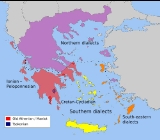
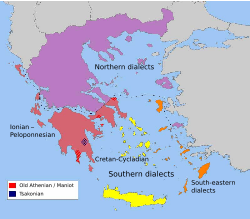 |
| Map showing the distribution of major modern Greek dialect areas |
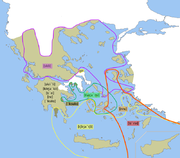 |
| Map showing important isogloss Isogloss An isogloss—also called a heterogloss —is the geographical boundary of a certain linguistic feature, such as the pronunciation of a vowel, the meaning of a word, or use of some syntactic feature... es between the traditional modern Greek dialects (c. 1900).
|
The main dialect
Dialect
The term dialect is used in two distinct ways, even by linguists. One usage refers to a variety of a language that is a characteristic of a particular group of the language's speakers. The term is applied most often to regional speech patterns, but a dialect may also be defined by other factors,...
s of modern Greek are:
- Demotic Greek (Δημοτική): Strictly speaking "Demotic" refers to all popular varieties of Modern Greek which followed a common evolution path from KoineKoine GreekKoine Greek is the universal dialect of the Greek language spoken throughout post-Classical antiquity , developing from the Attic dialect, with admixture of elements especially from Ionic....
and have retained a high degree of mutual intelligibilityMutual intelligibilityIn linguistics, mutual intelligibility is recognized as a relationship between languages or dialects in which speakers of different but related languages can readily understand each other without intentional study or extraordinary effort...
to the present day. As shown in Ptochoprodromic and AcriticDigenis AcritasDigenes Akrites , known in folksongs as Digenes Akritas , is the most famous of the Acritic Songs. The epic details the life of its eponymous hero, Basil, a man, as the epithet signifies, of mixed Roman and Syrian blood...
poems, Demotic Greek was already before the 11th century the vernacular, "Roman" language of the Byzantine GreeksByzantine GreeksByzantine Greeks or Byzantines is a conventional term used by modern historians to refer to the medieval Greek or Hellenised citizens of the Byzantine Empire, centered mainly in Constantinople, the southern Balkans, the Greek islands, Asia Minor , Cyprus and the large urban centres of the Near East...
, notably in peninsular GreeceGreeceGreece , officially the Hellenic Republic , and historically Hellas or the Republic of Greece in English, is a country in southeastern Europe....
, the Greek islands, coastal Asia MinorAnatoliaAnatolia is a geographic and historical term denoting the westernmost protrusion of Asia, comprising the majority of the Republic of Turkey...
, ConstantinopleConstantinopleConstantinople was the capital of the Roman, Eastern Roman, Byzantine, Latin, and Ottoman Empires. Throughout most of the Middle Ages, Constantinople was Europe's largest and wealthiest city.-Names:...
and CyprusCyprusCyprus , officially the Republic of Cyprus , is a Eurasian island country, member of the European Union, in the Eastern Mediterranean, east of Greece, south of Turkey, west of Syria and north of Egypt. It is the third largest island in the Mediterranean Sea.The earliest known human activity on the...
. Today, a standardised variety of Demotic Greek is the official language of the Hellenic Republic (Greece) and Cyprus, and is referred to as the "Standard Modern Greek", or less strictly simply as "Modern Greek" or "Demotic".
- Demotic Greek comprises various regional varieties with minor linguistic differences, mainly in phonology and vocabulary. Due to their high degree of mutual intelligibility, Greek linguists refer to those varieties as "idioms" of a wider "Demotic dialect", known as "Koine Modern Greek" (Koini Neoelliniki - 'common Neo-Hellenic'). Most English-speaking linguistics tend to refer to them as "dialects", emphasising degrees of variation only when necessary. Demotic Greek varieties are divided into two main groups, Northern and Southern:
- Examples of Northern dialects are RumeliaRumeliaRumelia was an historical region comprising the territories of the Ottoman Empire in Europe...
n, EpiroteEpirusThe name Epirus, from the Greek "Ήπειρος" meaning continent may refer to:-Geographical:* Epirus - a historical and geographical region of the southwestern Balkans, straddling modern Greece and Albania...
, ThessalianThessalyThessaly is a traditional geographical region and an administrative region of Greece, comprising most of the ancient region of the same name. Before the Greek Dark Ages, Thessaly was known as Aeolia, and appears thus in Homer's Odyssey....
, MacedonianMacedonia (Greece)Macedonia is a geographical and historical region of Greece in Southern Europe. Macedonia is the largest and second most populous Greek region...
, ThracianThraceThrace is a historical and geographic area in southeast Europe. As a geographical concept, Thrace designates a region bounded by the Balkan Mountains on the north, Rhodope Mountains and the Aegean Sea on the south, and by the Black Sea and the Sea of Marmara on the east...
. - The Southern category is divided into groups that include variety groups from:
- MegaraMegaraMegara is an ancient city in Attica, Greece. It lies in the northern section of the Isthmus of Corinth opposite the island of Salamis, which belonged to Megara in archaic times, before being taken by Athens. Megara was one of the four districts of Attica, embodied in the four mythic sons of King...
, AeginaAeginaAegina is one of the Saronic Islands of Greece in the Saronic Gulf, from Athens. Tradition derives the name from Aegina, the mother of Aeacus, who was born in and ruled the island. During ancient times, Aegina was a rival to Athens, the great sea power of the era.-Municipality:The municipality...
, AthensAthensAthens , is the capital and largest city of Greece. Athens dominates the Attica region and is one of the world's oldest cities, as its recorded history spans around 3,400 years. Classical Athens was a powerful city-state...
, CymeCyme (Aeolis)Cyme was an Aeol city in Aeolis close to the kingdom of Lydia. The Aeolians regarded Cyme as the largest and most important of their twelve cities, which were located on the coastline of Asia Minor...
(Old Athenian) and Mani PeninsulaMani PeninsulaThe Mani Peninsula , also long known as Maina or Maïna, is a geographical and cultural region in Greece. Mani is the central peninsula of the three which extend southwards from the Peloponnese in southern Greece. To the east is the Laconian Gulf, to the west the Messenian Gulf...
(Maniot) - PeloponnesePeloponneseThe Peloponnese, Peloponnesos or Peloponnesus , is a large peninsula , located in a region of southern Greece, forming the part of the country south of the Gulf of Corinth...
(except Mani), CycladesCycladesThe Cyclades is a Greek island group in the Aegean Sea, south-east of the mainland of Greece; and a former administrative prefecture of Greece. They are one of the island groups which constitute the Aegean archipelago. The name refers to the islands around the sacred island of Delos...
and CreteCreteCrete is the largest and most populous of the Greek islands, the fifth largest island in the Mediterranean Sea, and one of the thirteen administrative regions of Greece. It forms a significant part of the economy and cultural heritage of Greece while retaining its own local cultural traits...
, Ionian IslandsIonian IslandsThe Ionian Islands are a group of islands in Greece. They are traditionally called the Heptanese, i.e...
, Northern EpirusNorthern EpirusNorthern Epirus is a term used to refer to those parts of the historical region of Epirus, in the western Balkans, that are part of the modern Albania. The term is used mostly by Greeks and is associated with the existence of a substantial ethnic Greek population in the region...
, SmyrnaSmyrnaSmyrna was an ancient city located at a central and strategic point on the Aegean coast of Anatolia. Thanks to its advantageous port conditions, its ease of defence and its good inland connections, Smyrna rose to prominence. The ancient city is located at two sites within modern İzmir, Turkey...
and ConstantinopleConstantinopleConstantinople was the capital of the Roman, Eastern Roman, Byzantine, Latin, and Ottoman Empires. Throughout most of the Middle Ages, Constantinople was Europe's largest and wealthiest city.-Names:... - DodecaneseDodecaneseThe Dodecanese are a group of 12 larger plus 150 smaller Greek islands in the Aegean Sea, of which 26 are inhabited. Τhis island group generally defines the eastern limit of the Sea of Crete. They belong to the Southern Sporades island group...
and CyprusCypriot GreekThe Cypriot dialect of Modern Greek, known as Kypriaka , Cypriot Greek is spoken by 750,000 people in Cyprus and diaspora Greek Cypriots.Cypriot Greek is distinct enough that it can be classified as a distinct dialect of the Standard Greek....
.
- Megara
- Demotic Greek has officially been taught in monotonic Greek script since 1982. Polytonic script remains popular in intellectual circles.
- KatharevousaKatharevousaKatharevousa , is a form of the Greek language conceived in the early 19th century as a compromise between Ancient Greek and the Modern Greek of the time, with a vocabulary largely based on ancient forms, but a much-simplified grammar. Originally, it was widely used both for literary and official...
(Καθαρεύουσα): A semi-artificial sociolectSociolectIn sociolinguistics, a sociolect or social dialect is a variety of language associated with a social group such as a socioeconomic class, an ethnic group, an age group, etc....
promoted in the 19th century at the foundation of the modern Greek state, as a compromise between Classical Greek and modern Demotic. It was the official language of modern Greece until 1976. Katharevousa is written in polytonic Greek script. Also, while Demotic Greek contains loanwords from Turkish, Italian, Latin, and other languages, these have for the most part been purged from Katharevousa. See also Greek language questionGreek language questionThe Greek language question was a dispute discussing the question whether the language of the Greek people or a cultivated imitation of Ancient Greek should be the official language of the Greek nation. It was a highly controversial topic in the 19th and 20th centuries and was finally resolved...
.
- Pontic (Ποντιακά): Originally spoken in the PontusPontusPontus or Pontos is a historical Greek designation for a region on the southern coast of the Black Sea, located in modern-day northeastern Turkey. The name was applied to the coastal region in antiquity by the Greeks who colonized the area, and derived from the Greek name of the Black Sea: Πόντος...
region of Asia MinorAsia MinorAsia Minor is a geographical location at the westernmost protrusion of Asia, also called Anatolia, and corresponds to the western two thirds of the Asian part of Turkey...
until most of its speakers were displaced to mainland Greece during the great population exchange between Greece and Turkey that followed the Destruction of SmyrnaGreat Fire of SmyrnaThe Great Fire of Smyrna or the Catastrophe of Smyrna was a fire that destroyed much of the port city of Izmir in September 1922. Eye-witness reports state that the fire began on 13 September 1922 and lasted until it was largely extinguished on September 22...
. It hails from Hellenistic and Medieval KoineMedieval GreekMedieval Greek, also known as Byzantine Greek, is the stage of the Greek language between the beginning of the Middle Ages around 600 and the Ottoman conquest of the city of Constantinople in 1453. The latter date marked the end of the Middle Ages in Southeast Europe...
but preserves characteristics of IonicIonic GreekIonic Greek was a subdialect of the Attic–Ionic dialect group of Ancient Greek .-History:Ionic dialect appears to have spread originally from the Greek mainland across the Aegean at the time of the Dorian invasions, around the 11th Century B.C.By the end of the Greek Dark Ages in the 5th Century...
since ancient colonisations. Pontic evolved as a separate dialect from Demotic Greek as a result of the region's isolation from the Greek mainstream that followed the Battle of ManzikertBattle of ManzikertThe Battle of Manzikert , was fought between the Byzantine Empire and Seljuq Turks led by Alp Arslan on August 26, 1071 near Manzikert...
.
- CappadocianCappadocian Greek languageCappadocian , also known as Cappadocian Greek or Asia Minor Greek, is a mixed language formerly spoken in Cappadocia . In the population exchange between Greece and Turkey in the 1920s, Cappadocian speakers were forced to emigrate to Greece, where they were resettled in various locations,...
(Καππαδοκικά): A dialect close to and of the same fate as Pontic. Hails directly from the Alexandrian dialect, and its speakers settled in mainland Greece during the great population exchanges.
- Southern Italian or Italiot (Κατωιταλιώτικα): Comprising both CalabrianGreek-Calabrian dialectThe Calabrian dialect of Greek, or Greek-Bovesian, is the version of Italian Greek used by the ethnic Griko people in Calabria, as opposed to the Italian Greek dialect spoken in the Grecìa Salentina. Both are remnants of the ancient and Byzantine Greek colonisation of the region...
and Griko varieties, it is spoken by around 15 villages in the regions of CalabriaCalabriaCalabria , in antiquity known as Bruttium, is a region in southern Italy, south of Naples, located at the "toe" of the Italian Peninsula. The capital city of Calabria is Catanzaro....
and ApuliaApuliaApulia is a region in Southern Italy bordering the Adriatic Sea in the east, the Ionian Sea to the southeast, and the Strait of Òtranto and Gulf of Taranto in the south. Its most southern portion, known as Salento peninsula, forms a high heel on the "boot" of Italy. The region comprises , and...
. The Southern Italian dialect is the last living trace of Hellenic elements in Southern Italy that once formed Magna GraeciaMagna GraeciaMagna Græcia is the name of the coastal areas of Southern Italy on the Tarentine Gulf that were extensively colonized by Greek settlers; particularly the Achaean colonies of Tarentum, Crotone, and Sybaris, but also, more loosely, the cities of Cumae and Neapolis to the north...
. Its origins can be traced to the Dorian Greek settlers who colonised the area from SpartaSpartaSparta or Lacedaemon, was a prominent city-state in ancient Greece, situated on the banks of the River Eurotas in Laconia, in south-eastern Peloponnese. It emerged as a political entity around the 10th century BC, when the invading Dorians subjugated the local, non-Dorian population. From c...
and CorinthCorinthCorinth is a city and former municipality in Corinthia, Peloponnese, Greece. Since the 2011 local government reform it is part of the municipality Corinth, of which it is the seat and a municipal unit...
in 700 BC. However, it has received significant Koine Greek influence through Byzantine Greek colonisers who re-introduced Greek language to the region, starting with JustinianJustinian IJustinian I ; , ; 483– 13 or 14 November 565), commonly known as Justinian the Great, was Byzantine Emperor from 527 to 565. During his reign, Justinian sought to revive the Empire's greatness and reconquer the lost western half of the classical Roman Empire.One of the most important figures of...
's conquest of ItalyItalyItaly , officially the Italian Republic languages]] under the European Charter for Regional or Minority Languages. In each of these, Italy's official name is as follows:;;;;;;;;), is a unitary parliamentary republic in South-Central Europe. To the north it borders France, Switzerland, Austria and...
in late antiquity and continuing through the Middle Ages. Griko and Demotic are mutually intelligible to some extent, but the former shares some common characteristics with Tsakonian.
- Yevanic: A recently extinct language of RomanioteRomaniotesThe Romaniotes or Romaniots are a Jewish population who have lived in the territory of today's Greece and neighboring areas with large Greek populations for more than 2,000 years. Their languages were Yevanic, a Greek dialect, and Greek. They derived their name from the old name for the people...
Jews. The language was already in decline for centuries until most of its speakers were killed in the Holocaust. Afterward, the language was mostly kept by remaining Romaniote emigrants to IsraelIsraelThe State of Israel is a parliamentary republic located in the Middle East, along the eastern shore of the Mediterranean Sea...
, where it was displaced by modern HebrewModern HebrewModern Hebrew , also known as Israeli Hebrew or Modern Israeli Hebrew, is the language spoken in Israel and in some Jewish communities worldwide, from the early 20th century to the present....
.
- TsakonianTsakonian languageTsakonian, Tsaconian, Tzakonian or Tsakonic is a Hellenic language, spoken in the Tsakonian region of the Peloponnese, Greece....
(Τσακωνικά): Spoken in its full form today only in a small number of villages around the town of Leonidion in the region of ArcadiaArcadiaArcadia is one of the regional units of Greece. It is part of the administrative region of Peloponnese. It is situated in the central and eastern part of the Peloponnese peninsula. It takes its name from the mythological character Arcas. In Greek mythology, it was the home of the god Pan...
in Southern PeloponnesePeloponneseThe Peloponnese, Peloponnesos or Peloponnesus , is a large peninsula , located in a region of southern Greece, forming the part of the country south of the Gulf of Corinth...
, but partially spoken further afield in the area. Tsakonian evolved directly from Laconian (ancient Spartan) and therefore descends from the DoricDoric GreekDoric or Dorian was a dialect of ancient Greek. Its variants were spoken in the southern and eastern Peloponnese, Crete, Rhodes, some islands in the southern Aegean Sea, some cities on the coasts of Asia Minor, Southern Italy, Sicily, Epirus and Macedon. Together with Northwest Greek, it forms the...
branch of the Greek language. It has limited input from Hellenistic Koine and is significantly different from and not mutually intelligible with other Greek varieties (such as Demotic Greek and Pontic). Some linguists consider it a separate language because of this.
Demotic as Koiné (Standard) Modern Greek
Standard Modern Greek (Κοινή Νεοελληνική) refers to the form of Demotic that was chosen as the official language of Greece and Cyprus. The Greek term "Κοινή Νεοελληνική", besides its literal meaning of "Common Modern Greek", also evokes the parallel with the ancient KoinéKoine Greek
Koine Greek is the universal dialect of the Greek language spoken throughout post-Classical antiquity , developing from the Attic dialect, with admixture of elements especially from Ionic....
, from which it descends. It is universally spoken in the urban parts of Greece, with minor variation in the vernacular forms used in rural Greece and the Greek diaspora
Greek diaspora
The Greek diaspora, also known as Hellenic Diaspora or Diaspora of Hellenism, is a term used to refer to the communities of Greek people living outside the traditional Greek homelands, but more commonly in southeast Europe and Asia Minor...
.
Standard Modern Greek evolved from the Southern Demotic dialects, primarily those of Peloponnese
Peloponnese
The Peloponnese, Peloponnesos or Peloponnesus , is a large peninsula , located in a region of southern Greece, forming the part of the country south of the Gulf of Corinth...
, and is thus, ultimately, a descendant of the ancient Koiné of the Hellenistic era. After Greece gained independence from the Ottoman Empire
Ottoman Empire
The Ottoman EmpireIt was usually referred to as the "Ottoman Empire", the "Turkish Empire", the "Ottoman Caliphate" or more commonly "Turkey" by its contemporaries...
in 1829, the dual-language status of the late Byzantine Empire
Byzantine Empire
The Byzantine Empire was the Eastern Roman Empire during the periods of Late Antiquity and the Middle Ages, centred on the capital of Constantinople. Known simply as the Roman Empire or Romania to its inhabitants and neighbours, the Empire was the direct continuation of the Ancient Roman State...
was re-adopted. The vernacular speech was Demotic (a term similar to "popular") and the official state dialect was Katharevousa
Katharevousa
Katharevousa , is a form of the Greek language conceived in the early 19th century as a compromise between Ancient Greek and the Modern Greek of the time, with a vocabulary largely based on ancient forms, but a much-simplified grammar. Originally, it was widely used both for literary and official...
("purified"). Demotic was the language of daily vernacular use, whereas Katharevousa, a more archaic form closer to Attic, was used for formal purposes such as literature, newscasting and official documents. In the course of the 20th century, Demotic saw a slow functional expansion as it was adopted gradually in more and more domains of life, including literature and some parts of journalism and education. The competition between the two forms, known as the "language question
Greek language question
The Greek language question was a dispute discussing the question whether the language of the Greek people or a cultivated imitation of Ancient Greek should be the official language of the Greek nation. It was a highly controversial topic in the 19th and 20th centuries and was finally resolved...
" remained a hotly contested ideological issue during much of the early and mid 20th century, and official policies towards the extent of use of Demotic in education and administration changed multiple times. In 1976 Katharevousa was finally replaced by Demotic as the official language of the Greek state. However, by this time, the form of Demotic actually used in practice was marked by a considerable amount of influence from Katharevousa, because during its expansion to new communicative domains it had enriched its vocabulary through internal loans from the learned tradition. It is for this reason that modern linguistics has adopted terms like Standard Modern Greek or "Modern Koiné" for the resulting variety, distinguishing it from "pure" traditional Demotic.
Phonology
A series of radical sound shifts, which the Greek language underwent mainly during the period of Koine, has led to a phonological system in Modern Greek that is significantly different from that of Ancient Greek. Instead of the rich vowel system of Ancient Greek, with its four vowel-height levels, length distinction, and multiple diphthongs, Modern Greek has a very simple system of five vowels. This came about through a series of mergers, especially towards /i/ (iotacismIotacism
Iotacism is the process by which a number of vowels and diphthongs in Ancient Greek converged in pronunciation so that they all sound like iota in Modern Greek....
). In the consonants, Modern Greek has two series of fricatives in lieu of the Ancient Greek voiced
Voice (phonetics)
Voice or voicing is a term used in phonetics and phonology to characterize speech sounds, with sounds described as either voiceless or voiced. The term, however, is used to refer to two separate concepts. Voicing can refer to the articulatory process in which the vocal cords vibrate...
and aspirated
Aspiration (phonetics)
In phonetics, aspiration is the strong burst of air that accompanies either the release or, in the case of preaspiration, the closure of some obstruents. To feel or see the difference between aspirated and unaspirated sounds, one can put a hand or a lit candle in front of one's mouth, and say pin ...
voiceless
Voiceless
In linguistics, voicelessness is the property of sounds being pronounced without the larynx vibrating. Phonologically, this is a type of phonation, which contrasts with other states of the larynx, but some object that the word "phonation" implies voicing, and that voicelessness is the lack of...
plosives. Modern Greek has not preserved length distinctions, either in the vowels or in the consonants.
Writing system
Modern Greek is written in the Greek alphabet, which has 24 letters, each with a capital and lowercase (small) form. The letter sigmaSigma
Sigma is the eighteenth letter of the Greek alphabet, and carries the 'S' sound. In the system of Greek numerals it has a value of 200. When used at the end of a word, and the word is not all upper case, the final form is used, e.g...
additionally has a special final form. There are two diacritical symbols, the acute accent
Acute accent
The acute accent is a diacritic used in many modern written languages with alphabets based on the Latin, Cyrillic, and Greek scripts.-Apex:An early precursor of the acute accent was the apex, used in Latin inscriptions to mark long vowels.-Greek:...
which indicates stress
Stress (linguistics)
In linguistics, stress is the relative emphasis that may be given to certain syllables in a word, or to certain words in a phrase or sentence. The term is also used for similar patterns of phonetic prominence inside syllables. The word accent is sometimes also used with this sense.The stress placed...
and the diaeresis marking a vowel letter as not being part of a digraph
Digraph (orthography)
A digraph or digram is a pair of characters used to write one phoneme or a sequence of phonemes that does not correspond to the normal values of the two characters combined...
. Greek has a mixed historical and phonemic orthography
Orthography
The orthography of a language specifies a standardized way of using a specific writing system to write the language. Where more than one writing system is used for a language, for example Kurdish, Uyghur, Serbian or Inuktitut, there can be more than one orthography...
, where historical spellings are used if their pronunciation matches modern usage. The correspondence between consonant phoneme
Phoneme
In a language or dialect, a phoneme is the smallest segmental unit of sound employed to form meaningful contrasts between utterances....
s and graphemes is largely unique, but several of the vowels can be spelled in multiple ways. Thus reading
Reading (process)
Reading is a complex cognitive process of decoding symbols for the intention of constructing or deriving meaning . It is a means of language acquisition, of communication, and of sharing information and ideas...
is easy but spelling
Spelling
Spelling is the writing of one or more words with letters and diacritics. In addition, the term often, but not always, means an accepted standard spelling or the process of naming the letters...
is difficult.
A number of diacritical signs
Greek diacritics
Greek orthography has used a variety of diacritics starting in the Hellenistic period. The complex polytonic orthography notates Ancient Greek phonology...
were used until 1982, when they were officially dropped from Greek spelling as no longer corresponding to the modern pronunciation of the language. Monotonic orthography is today used in official usage, in schools and for most purposes of everyday writing in Greece. Polytonic orthography, besides being used for older varieties of Greek, is still used in book printing, especially for academic and belletristic purposes, and in everyday use by some conservative writers and elderly people. The Greek Orthodox Church continues to use polytonic and the late Archbishop Christodoulos
Christodoulos
Christodoulos was Archbishop of Athens and All Greece and as such the primate of the Autocephalous Orthodox Church of Greece, from 1998 until his death, in 2008.- Early life and career :...
of Athens and the Holy Synod of the Church of Greece have requested the reintroduction of polytonic as the official script.
The Greek vowel letters with their pronunciation are: ⟨α⟩ [a], ⟨ε⟩ [e̞], ⟨η⟩ [i], ⟨ι⟩ [i], ⟨ο⟩ [o̞], ⟨υ⟩ [i], ⟨ω⟩ [o̞]. There are also vowel digraphs which are phonetically monophthongal: ⟨αι⟩ [e̞], ⟨ει⟩ [i], ⟨οι⟩ [i], ⟨ου⟩ [u], ⟨υι⟩ [i]. The three digraphs ⟨αυ⟩, ⟨ευ⟩ and ⟨ηυ⟩ are pronounced [af], [e̞f] and [if] except when followed by voiced consonants or vowels, in which case they are pronounced [av], [e̞v] and [iv] respectively.
Modern Greek has also four diphthongs: ⟨αη⟩ (or ⟨άη⟩) [aj], ⟨αϊ⟩ (or ⟨άι⟩) [aj], ⟨οη⟩ (or ⟨όη⟩) [o̞j] and ⟨οϊ⟩ (or ⟨όι⟩) [o̞j] (diphthongs can better be transcribed using the IPA non-syllabic diacritic under [i] instead of the approximant [j]).
The Greek letters ⟨β⟩ and ⟨δ⟩ are pronounced [v] and [ð] respectively. The letter ⟨γ⟩ is generally pronounced [ɣ], but before the mid or close front vowels, it is pronounced [ʝ] (or [ʑ] and [ʒ] in some dialects, notably those of Crete and the Mani). Μoreover, before the mid or close back vowels, tends to be pronounced further back than a prototypical velar, between a velar [ɣ] and an uvular [ɢ] (transcribed [ɣ̄]).
The letters ⟨θ⟩, ⟨φ⟩ and ⟨χ⟩ are pronounced [θ], [f] and [x] respectively. The letter ⟨χ⟩, before mid or close front vowels, is pronounced [ç] (or [ɕ] and [ʃ] in some dialects, notably those of Crete and the Mani) and before the mid or close back vowels, it tends to be pronounced as a postvelar [x̱]. The letter ⟨ξ⟩ stands for the sequence /ks/ and ⟨ψ⟩ for /ps/. The digraphs ⟨γγ⟩ and ⟨γκ⟩ are generally pronounced [ɡ] in everyday speech, but are pronounced [ɟ] before the front vowels [e̞] and [i] and tend to be pronounced [ɡ̄] before the back [o̞] and [u]. When these digraphs are preceded by a vowel, they are pronounced [ŋɡ] in formal speech ([ɲɟ] before the front vowels [e̞] and [i] and [ŋ̄ɡ̄] before the back [o̞] and [u]). The digraph ⟨γγ⟩ may be pronounced [ŋɣ] in some words ([ɲʝ] before front vowels and [ŋ̄ɣ̄] before back ones). The pronunciation [ŋk] for the digraph ⟨γκ⟩ is extremely rare, but could be heard in literary and scholarly words or when reading ancient texts (by a few readers); normally it retains its "original" pronunciation [ŋk] only in the trigraph ⟨γκτ⟩ where ⟨τ⟩ prevents the sonorization of ⟨κ⟩ by ⟨γ⟩ (hence [ŋkt]).
Grammar
Modern Greek is largely a synthetic languageSynthetic language
In linguistic typology, a synthetic language is a language with a high morpheme-per-word ratio, as opposed to a low morpheme-per-word ratio in what is described as an isolating language...
. It is one of only two Indo-European languages that has retained a synthetic passive, the other being Albanian (the North Germanic passive is a recent innovation based on a grammaticalized reflexive pronoun
Reflexive pronoun
A reflexive pronoun is a pronoun that is preceded by the noun, adjective, adverb or pronoun to which it refers within the same clause. In generative grammar, a reflexive pronoun is an anaphor that must be bound by its antecedent...
). Noticeable changes in grammar (compared to classical Greek) include the loss of the dative case
Dative case
The dative case is a grammatical case generally used to indicate the noun to whom something is given, as in "George gave Jamie a drink"....
, the optative mood
Optative mood
The optative mood is a grammatical mood that indicates a wish or hope. It is similar to the cohortative mood, and closely related to the subjunctive mood....
, the infinitive
Infinitive
In grammar, infinitive is the name for certain verb forms that exist in many languages. In the usual description of English, the infinitive of a verb is its basic form with or without the particle to: therefore, do and to do, be and to be, and so on are infinitives...
, the dual number
Dual (grammatical number)
Dual is a grammatical number that some languages use in addition to singular and plural. When a noun or pronoun appears in dual form, it is interpreted as referring to precisely two of the entities identified by the noun or pronoun...
, and the participle
Participle
In linguistics, a participle is a word that shares some characteristics of both verbs and adjectives. It can be used in compound verb tenses or voices , or as a modifier...
s (except the past participle); the adoption of the gerund
Gerund
In linguistics* As applied to English, it refers to the usage of a verb as a noun ....
; the reduction in the number of noun declension
Declension
In linguistics, declension is the inflection of nouns, pronouns, adjectives, and articles to indicate number , case , and gender...
s, and the number of distinct forms in each declension; the adoption of the modal particle
Modal particle
In linguistics, modal particles are always uninflected words, and are a type of grammatical particle. Their function is that of reflecting the mood or attitude of the speaker or narrator, in that they are not reflexive but change the mood of the verb. Languages that use a lot of modal particles in...
(a contraction of → → → ) to denote future and conditional tenses; the introduction of auxiliary verb
Auxiliary verb
In linguistics, an auxiliary verb is a verb that gives further semantic or syntactic information about a main or full verb. In English, the extra meaning provided by an auxiliary verb alters the basic meaning of the main verb to make it have one or more of the following functions: passive voice,...
forms for certain tenses; the extension to the future tense of the aspectual distinction between present/imperfect and aorist; the loss of the third person imperative, and the simplification of the system of grammatical prefixes, such as augmentation
Augment (linguistics)
In linguistics, the augment is a syllable added to the beginning of the word in certain Indo-European languages, most notably Greek, Armenian, and the Indo-Iranian languages such as Sanskrit, to form the past tenses.-Indo-European languages:...
and reduplication
Reduplication
Reduplication in linguistics is a morphological process in which the root or stem of a word is repeated exactly or with a slight change....
. Some of these features are shared with other languages spoken in the Balkan peninsula (see Balkan linguistic union
Balkan linguistic union
The Balkan sprachbund or linguistic area is the ensemble of areal features—similarity in grammar, syntax, vocabulary and phonology—among the languages of the Balkans. Several features are found across these languages though not all need apply to every single language...
), although not others, such as the postposed article.
Because of the influence of Katharevousa, however, Demotic is not commonly used in its purest form, and archaism
Archaism
In language, an archaism is the use of a form of speech or writing that is no longer current. This can either be done deliberately or as part of a specific jargon or formula...
s are still widely used, especially in writing and in more formal speech, as well as in some everyday expressions, such as the dative ('OK', literally 'in order') or the third person imperative ! ('long live!').
Some common words and phrases
| English | Modern Greek | Pronunciation |
|---|---|---|
| Greek (man) | Έλληνας | [ˈe̞linas]. |
| Greek (woman) | Ελληνίδα | [ˌe̞liˈniða]. |
| Greek (language) | Ελληνικά | [e̞ˌliniˈka]. |
| good morning | καλημέρα | [ˌkaliˈme̞ra]. |
| good evening | καλησπέρα | [ˌkaliˈspe̞ra]. |
| good night | καληνύχτα | [ˌkaliˈnixta]. |
| good-bye | χαίρετε (formal), αντίο (semi-formal), γεια σου or γεια σας (informal) | [ˈçe̞re̞te̞], [aˈdio̞], [ˈʝasu], [ˈʝa-sas] . |
| madam! | κυρία | [kiˈria] (used only for living persons) |
| please | παρακαλώ | [paˌrakaˈlo̞]. |
| sir! | κύριε | [ˈkirie] (used only for living persons) |
| sorry | συγνώμη | [siˈɣno̞mi]. |
| thank you | ευχαριστώ | [e̞fˌxariˈsto̞]. |
| that | αυτό, (ε)κείνο | [afˈto̞]; [(e̞)ˈcino̞]. |
| this | αυτό, (ε)τούτο | [afˈto̞]; [(e̞)ˈtuto̞]. |
| yes | ναι | [ne̞]. |
| no | όχι | [ˈo̞çi]. |
| generic toast | εις υγείαν! (lit. "to health") or more colloquially γεια μας! (lit. "our health") | [ˌis iˈʝi.an], [ˈʝa mas]. |
| juice | χυμός | [çiˈmo̞s̠]. |
| water | νερό | [ne̞ˈro̞]. |
| wine | κρασί | [kraˈsi]. |
Sample text
The following is a sample text in Modern Greek of the Article 1 of the Universal Declaration of Human RightsUniversal Declaration of Human Rights
The Universal Declaration of Human Rights is a declaration adopted by the United Nations General Assembly . The Declaration arose directly from the experience of the Second World War and represents the first global expression of rights to which all human beings are inherently entitled...
(by the United Nations
United Nations
The United Nations is an international organization whose stated aims are facilitating cooperation in international law, international security, economic development, social progress, human rights, and achievement of world peace...
):
External links
- Portal for the Greek Language (modern & ancient)
- Hellenic National Corpus of the Institute for Language & Speech Processing
- ILSP PsychoLinguistic Resource (online tools and information)
Courses
- Online course "Filoglossia" by ILSP
- Greek online course "Greek by Radio" from Cyprus radio broadcasting CyBC in English, 105 lessons with Real audio files
Dictionaries and glossaries
- Greek-English Dictionary Georgacas for Modern Greek Literature
- Triantafyllides Dictionary for Modern Greek
- Modern Greek - English glossary
- English-Greek Dictionary (Modern Greek)