
Breton is a
Celtic languageThe Celtic languages are descended from Proto-Celtic, or "Common Celtic"; a branch of the greater Indo-European language family...
spoken in
BrittanyBrittany is a cultural and administrative region in the north-west of France. Previously a kingdom and then a duchy, Brittany was united to the Kingdom of France in 1532 as a province. Brittany has also been referred to as Less, Lesser or Little Britain...
,
FranceThe French Republic , The French Republic , The French Republic , (commonly known as France , is a unitary semi-presidential republic in Western Europe with several overseas territories and islands located on other continents and in the Indian, Pacific, and Atlantic oceans. Metropolitan France...
. Breton is a
Brythonic languageThe Brythonic or Brittonic languages form one of the two branches of the Insular Celtic language family, the other being Goidelic. The name Brythonic was derived by Welsh Celticist John Rhys from the Welsh word Brython, meaning an indigenous Briton as opposed to an Anglo-Saxon or Gael...
, descended from the
CelticThe Celtic languages are descended from Proto-Celtic, or "Common Celtic"; a branch of the greater Indo-European language family...
British language brought from
Great BritainGreat Britain or Britain is an island situated to the northwest of Continental Europe. It is the ninth largest island in the world, and the largest European island, as well as the largest of the British Isles...
to
ArmoricaArmorica or Aremorica is the name given in ancient times to the part of Gaul that includes the Brittany peninsula and the territory between the Seine and Loire rivers, extending inland to an indeterminate point and down the Atlantic coast...
by migrating
BritonsThe Britons were the Celtic people culturally dominating Great Britain from the Iron Age through the Early Middle Ages. They spoke the Insular Celtic language known as British or Brythonic...
during the
Early Middle AgesThe Early Middle Ages was the period of European history lasting from the 5th century to approximately 1000. The Early Middle Ages followed the decline of the Western Roman Empire and preceded the High Middle Ages...
. Like the other Brythonic languages,
WelshWelsh is a member of the Brythonic branch of the Celtic languages spoken natively in Wales, by some along the Welsh border in England, and in Y Wladfa...
and
CornishCornish is a Brythonic Celtic language and a recognised minority language of the United Kingdom. Along with Welsh and Breton, it is directly descended from the ancient British language spoken throughout much of Britain before the English language came to dominate...
, it is classified as an
Insular Celtic languageInsular Celtic languages are those Celtic languages that originated in the British Isles, in contrast to the Continental Celtic languages of mainland Europe and Anatolia. All surviving Celtic languages are from the Insular Celtic group; the Continental Celtic languages are extinct...
. Breton is most closely related to Cornish, as both are thought to have evolved from a Southwestern Brythonic protolanguage. The other
regional languageA regional language is a language spoken in an area of a nation state, whether it be a small area, a federal state or province, or some wider area....
of Brittany,
GalloGallo is a regional language of France. Gallo is a Romance language, one of the Oïl languages. It is the historic language of the region of Upper Brittany and some neighboring portions of Normandy, but today is spoken by only a small minority of the population, having been largely superseded by...
, is a Langue d'oïl derived from
LatinLatin is an Italic language originally spoken in Latium and Ancient Rome. It, along with most European languages, is a descendant of the ancient Proto-Indo-European language. Although it is considered a dead language, a number of scholars and members of the Christian clergy speak it fluently, and...
.
History and status
Breton is spoken in Lower Brittany, roughly to the west of a line linking
PlouhaPlouha is a commune in the Côtes-d'Armor department in Bretagne in northwestern France.-Population:Inhabitants of Plouha are called plouhatins.-International relations:Plouha is twinned with Killorglin located in County Kerry, Ireland....
and
La Roche-BernardLa Roche-Bernard is a commune in the Morbihan department of Brittany in north-western France. Inhabitants of La Roche-Bernard are called in French Rochois for men and Rochoises for women....
(east of
VannesVannes is a commune in the Morbihan department in Brittany in north-western France. It was founded over 2000 years ago.-Geography:Vannes is located on the Gulf of Morbihan at the mouth of two rivers, the Marle and the Vincin. It is around 100 km northwest of Nantes and 450 km south west...
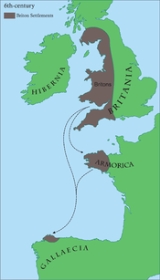
). It comes from a Brytonic language community (see image) between
Great BritainGreat Britain or Britain is an island situated to the northwest of Continental Europe. It is the ninth largest island in the world, and the largest European island, as well as the largest of the British Isles...
and
ArmoricaArmorica or Aremorica is the name given in ancient times to the part of Gaul that includes the Brittany peninsula and the territory between the Seine and Loire rivers, extending inland to an indeterminate point and down the Atlantic coast...
(present-day Brittany), and even Galicia. It was the language of the upper classes until the 12th century. However, afterwards it was only the language of the simple people of West Brittany (Breizh Izel), while the nobility, followed by the
bourgeoisieIn sociology and political science, bourgeoisie describes a range of groups across history. In the Western world, between the late 18th century and the present day, the bourgeoisie is a social class "characterized by their ownership of capital and their related culture." A member of the...
, adopted
FrenchFrench is a Romance language spoken as a first language in France, the Romandy region in Switzerland, Wallonia and Brussels in Belgium, Monaco, the regions of Quebec and Acadia in Canada, and by various communities elsewhere. Second-language speakers of French are distributed throughout many parts...
. As a written language, the Duchy of Brittany used
LatinLatin is an Italic language originally spoken in Latium and Ancient Rome. It, along with most European languages, is a descendant of the ancient Proto-Indo-European language. Although it is considered a dead language, a number of scholars and members of the Christian clergy speak it fluently, and...
, switching to French in the 15th century. There exists a limited tradition of
Breton literatureBreton literature may refer to literature in the Breton language or the broader literary tradition of Brittany in the three other main languages of the area, namely, Latin, Gallo and French – all of which have had strong mutual linguistic and cultural influences.-Old and Middle Breton...
. Some Old Breton vocabulary remains in the present day as
philosophicalPhilosophy is the study of general and fundamental problems, such as those connected with existence, knowledge, values, reason, mind, and language. Philosophy is distinguished from other ways of addressing such problems by its critical, generally systematic approach and its reliance on rational...
and scientific terms in Modern Breton.
The French Monarchy did not concern itself with the
minorityA minority language is a language spoken by a minority of the population of a territory. Such people are termed linguistic minorities or language minorities.-International politics:...
languages of France. The
revolutionary periodThe French Revolution , sometimes distinguished as the 'Great French Revolution' , was a period of radical social and political upheaval in France and Europe. The absolute monarchy that had ruled France for centuries collapsed in three years...
saw the introduction of policies favouring French over the regional languages, pejoratively referred to as
patoisPatois is any language that is considered nonstandard, although the term is not formally defined in linguistics. It can refer to pidgins, creoles, dialects, and other forms of native or local speech, but not commonly to jargon or slang, which are vocabulary-based forms of cant...
. It was assumed by the revolutionaries that
reactionaryThe term reactionary refers to viewpoints that seek to return to a previous state in a society. The term is meant to describe one end of a political spectrum whose opposite pole is "radical". While it has not been generally considered a term of praise it has been adopted as a self-description by...
and
monarchistA monarchy is a form of government in which the office of head of state is usually held until death or abdication and is often hereditary and includes a royal house. In some cases, the monarch is elected...
forces preferred
regional languageA regional language is a language spoken in an area of a nation state, whether it be a small area, a federal state or province, or some wider area....
s in an attempt to keep the peasant masses under-informed. In 1794, Barère submitted to the Comité de salut public his "report on the idioms", in which he said that "federalism and superstition speak breton". Under the
ThirdThe French Third Republic was the republican government of France from 1870, when the Second French Empire collapsed due to the French defeat in the Franco-Prussian War, to 1940, when France was overrun by Nazi Germany during World War II, resulting in the German and Italian occupations of France...
,
FourthThe French Fourth Republic was the republican government of France between 1946 and 1958, governed by the fourth republican constitution. It was in many ways a revival of the Third Republic, which was in place before World War II, and suffered many of the same problems...
and
Fifth republicsThe Fifth Republic is the fifth and current republican constitution of France, introduced on 4 October 1958. The Fifth Republic emerged from the collapse of the French Fourth Republic, replacing the prior parliamentary government with a semi-presidential system...
, humiliating practices aimed at stamping out the Breton language and culture prevailed in state schools until the late 1960s.
Today, despite the political centralization of France and the important influence of the media, Breton is still spoken as an everyday language by about 200,000 people. This is, however, down from 1.3 million in 1930. At the beginning of the 20th century, half of the population of Lower Brittany knew only Breton, the other half being bilingual. By 1950, there were only 100,000 monolingual Bretons, and a rapid decline since with only small handfuls of elderly monolingual speakers as of 2009. A statistical survey in 1997 found around 300,000 speakers in Breizh izel, of which about 190,000 were aged 60 or over. Few of those of the 15-19 year-old age-group spoke Breton, which is now considered to be an
endangered languageAn endangered language is a language that is at risk of falling out of use. If it loses all its native speakers, it becomes a dead language. If eventually no one speaks the language at all it becomes an "extinct language"....
.
In 1925, thanks to Professor
Roparz HemonRoparz Hemon , officially named Louis-Paul Némo, was a Breton author and scholar of Breton expression.He was the author of numerous dictionaries, grammars, poems and short stories...
, the first issue of the review
GwalarnGwalarn was a Breton language literary journal. By extension, the term refers to the style of literature that it encouraged. 166 issues appeared between 1925 and May 1944....
appeared. During its 19-year run, Gwalarn tried to raise the language to the level of other great “international” languages by creating original works covering all genres and by proposing Breton translations of internationally-recognized foreign works.
In 1946, Al Liamm replaced Gwalarn. Other periodicals appeared and began to give Breton a fairly large body of literature for a minority language.
In 1977,
Diwan schoolsDiwan is a federation of Breton language-medium schools in Brittany .-Concept:The Diwan concept, which allows children to learn French and Breton through immersion was inspired by the Gaelscoileanna movement in Ireland, Ikastolak movement in the Basque Country and the Mudiad Ysgolion Meithrin...
were founded to teach Breton by
immersionLanguage immersion is a method of teaching a second language in which the target language is used as the means of instruction. Unlike more traditional language courses, where the target language is simply the subject material, language immersion uses the target language as a teaching tool,...
. They taught a few thousand young people from elementary school to high school. See the education section for more information.
The
AsterixAsterix or The Adventures of Asterix is a series of French comic books written by René Goscinny and illustrated by Albert Uderzo . The series first appeared in French in the magazine Pilote on October 29, 1959...
comic series has been translated into Breton. This is notable because, according to the comic, the
GaulGaul was a region of Western Europe during the Iron Age and Roman era, encompassing present day France, Luxembourg and Belgium, most of Switzerland, the western part of Northern Italy, as well as the parts of the Netherlands and Germany on the left bank of the Rhine. The Gauls were the speakers of...
ish village where Asterix lives is in the
Armoric peninsulaArmorica or Aremorica is the name given in ancient times to the part of Gaul that includes the Brittany peninsula and the territory between the Seine and Loire rivers, extending inland to an indeterminate point and down the Atlantic coast...
, which is now Brittany. Some other comics have also been translated into Breton, including
TintinThe Adventures of Tintin is a series of classic comic books created by Belgian artist , who wrote under the pen name of Hergé...
,
SpirouSpirou et Fantasio is one of the most popular classic Franco-Belgian comic strips. The series, which has been running since 1938, shares many characteristics with other European humorous adventure comics like Tintin and Asterix...
,
TiteufTiteuf is a magazine series created by Zep which was adapted into an animated TV series, and appears in the dedicated comics magazine Tchô!.-Publication history:...
,
Hägar the HorribleHägar the Horrible is the title and main character of an American comic strip created by cartoonist Dik Browne , and syndicated by King Features Syndicate. It first appeared in February 1973, and was an immediate success. Since Browne's retirement in 1988 , his son Chris Browne has continued the...
,
PeanutsPeanuts is a syndicated daily and Sunday American comic strip written and illustrated by Charles M. Schulz, which ran from October 2, 1950, to February 13, 2000, continuing in reruns afterward...
and
YakariYakari is a Franco-Belgian comic book series, aimed at a younger audience, written by Job and illustrated by Derib....
.
Some movies (
Lancelot du LacLancelot du Lac is 1974 film that was written and directed by Robert Bresson. It relates the story of Lancelot and Guinevere's love as Camelot and the Round Table fall apart...
,
Shakespeare in LoveShakespeare in Love is a 1998 British-American comedy film directed by John Madden and written by Marc Norman and playwright Tom Stoppard....
, Marion du Faouet, Sezneg) and TV series (Columbo,
Perry MasonPerry Mason is an American legal drama produced by Paisano Productions that ran from September 1957 to May 1966 on CBS. The title character, portrayed by Raymond Burr, is a fictional Los Angeles defense attorney who originally appeared in detective fiction by Erle Stanley Gardner...
) are also broadcast in Breton.
Some poets, linguists, and writers who have written in Breton, for example Yann-Ber Kalloc'h,
Roparz HemonRoparz Hemon , officially named Louis-Paul Némo, was a Breton author and scholar of Breton expression.He was the author of numerous dictionaries, grammars, poems and short stories...
, Anjela Duval,
Pêr-Jakez HeliasPêr-Jakez Helias, baptised Pierre-Jacques Hélias, nom de plume Pierre-Jakez Hélias was a Breton stage actor, journalist, author, poet, and writer for radio who worked in the French and Breton languages....
and Youenn Gwernig, are now known internationally.
Today, Breton is the only living
Celtic languageThe Celtic languages are descended from Proto-Celtic, or "Common Celtic"; a branch of the greater Indo-European language family...
that is not recognized as an official or regional language. The French State refuses to change the second article of the
ConstitutionThe Fifth Republic is the fifth and current republican constitution of France, introduced on 4 October 1958. The Fifth Republic emerged from the collapse of the French Fourth Republic, replacing the prior parliamentary government with a semi-presidential system...
(added in 1994), which states that “the language of the Republic is French”.
The first Breton dictionary, the Catholicon, was also the first French dictionary. Edited by Jehan Lagadec in 1464, it was a trilingual work containing Breton, French and Latin. Today the existence of bilingual dictionaries directly from Breton into languages such as English, Dutch, German, Spanish and Welsh demonstrates the determination of a new generation to gain international recognition for Breton. There also exists a monolingual dictionary, Geriadur Brezhoneg an Here, defining Breton words in Breton. The first edition of 1995 contained about 10,000 words, and the second edition of 2001 contains 20,000 words.
Geographic distribution and dialects
Breton is spoken mainly in Western Brittany, but also in a more dispersed way in Eastern Brittany (where
GalloGallo is a regional language of France. Gallo is a Romance language, one of the Oïl languages. It is the historic language of the region of Upper Brittany and some neighboring portions of Normandy, but today is spoken by only a small minority of the population, having been largely superseded by...
is spoken alongside Breton and French), and in areas around the world that have Breton immigrants.
The dialects of Breton as identified by
EthnologueEthnologue: Languages of the World is a web and print publication of SIL International , a Christian linguistic service organization, which studies lesser-known languages, to provide the speakers with Bibles in their native language and support their efforts in language development.The Ethnologue...
are Leoneg, Tregerieg, Gwenedeg, and Kerneveg (in French, respectively: léonard,
trégorroisTrégorrois Breton is the dialect of Breton spoken in Trégor .-Distinguishing characteristics:Trégorrois differs from other varieties of the language in a number of ways:...
, vannetais, and cornouaillais). A fifth dialect was spoken up to the beginning of the 20th century in the
GuérandeThe medieval town of Guérande is located in the département of Loire-Atlantique in western France.The inhabitants are so called Guérandais, for men, and Guérandaise, for women....
region. There are no clear borders between those dialect areas because the language varies slightly from one village to the next. Compared to the other dialects, the Gwenedeg dialect is somewhat more distinct due to several pronunciation specificities.
Official status
State
Breton is not an
official languageAn official language is a language that is given a special legal status in a particular country, state, or other jurisdiction. Typically a nation's official language will be the one used in that nation's courts, parliament and administration. However, official status can also be used to give a...
of
FranceThe French Republic , The French Republic , The French Republic , (commonly known as France , is a unitary semi-presidential republic in Western Europe with several overseas territories and islands located on other continents and in the Indian, Pacific, and Atlantic oceans. Metropolitan France...
, despite pleas from autonomists and others for official recognition and for the language to be guaranteed a place in schools, the media, and other aspects of public life.
Constitution
In July 2008, the French
ConstitutionA constitution is a set of fundamental principles or established precedents according to which a state or other organization is governed. These rules together make up, i.e. constitute, what the entity is...
was amended adding article 75-1, stating les langues régionales appartiennent au patrimoine de la France (the regional languages belong to the heritage of
FranceThe French Republic , The French Republic , The French Republic , (commonly known as France , is a unitary semi-presidential republic in Western Europe with several overseas territories and islands located on other continents and in the Indian, Pacific, and Atlantic oceans. Metropolitan France...
). This is an important step in the recognition of Breton and other minority languages of France; however, it doesn't explicitly give more actual recognition, rights or funds to these languages.
Region
Nevertheless, the regional and departmental authorities do use Breton to a very limited extent, for example in signage. Some bilingual signage may also be seen, such as
street nameA street name or odonym is an identifying name given to a street. The street name usually forms part of the address...
signs in Breton towns, and one station of the
Rennes metro systemOpened on 15 March 2002, the metro in Rennes is based on the Siemens Transportation Systems VAL technology. There is one line, the 9.4-km A Line, which runs north-west to south-east from J.F...
has signs in both French and Breton.
Under French law (the
Toubon LawThe Toubon Law , is a law of the French government mandating the use of the French language in official government publications, in all advertisements, in all workplaces, in commercial contracts, in some other commercial communication contexts, in all government-financed schools, and some other...
), it is illegal for commercial signage to be in Breton alone; it must be bilingual or else in French alone. Since commercial signage usually has limited physical space, signage is normally in French alone.
Ofis ar BrezhonegThe Public Office for the Breton Language was established on 15 October 2010, in place on the Ofis ar Brezhoneg/Office de la langue bretonne created on 1 May 1999 by the Region of Brittany in France for the promotion and development of the Breton language....
, the Breton language agency, was set up in 1999 by the Brittany region to promote and develop the use of Breton. It created the
Ya d'ar brezhonegYa d'ar brezhoneg is a campaign launched by the Ofis ar Brezhoneg in order to stimulate the use of the Breton language in daily life in Brittany, western France. In the first phase, started on 5 October 2001, civil society was targeted. Over 560 enterprises and organisations have signed the...
campaign, signed by enterprises, organisations and communes to promote the use of Breton, for example by installing bilingual signage or translating their website.
Education
An attempt by the French government to incorporate the independent Breton-language immersion schools (called
DiwanDiwan is a federation of Breton language-medium schools in Brittany .-Concept:The Diwan concept, which allows children to learn French and Breton through immersion was inspired by the Gaelscoileanna movement in Ireland, Ikastolak movement in the Basque Country and the Mudiad Ysgolion Meithrin...
) into the state education system was blocked by the French
Constitutional CouncilThe Constitutional Council is the highest constitutional authority in France. It was established by the Constitution of the Fifth Republic on 4 October 1958, and its duty is to ensure that the principles and rules of the constitution are upheld.Its main activity is to rule on whether proposed...
on the grounds that, as the 1992 amendment to the Constitution of the 5th Republic states that French is the language of the Republic, no other language may be used as a language of instruction in state schools. The
Toubon LawThe Toubon Law , is a law of the French government mandating the use of the French language in official government publications, in all advertisements, in all workplaces, in commercial contracts, in some other commercial communication contexts, in all government-financed schools, and some other...
states that French is the language of public education, which means that Breton-language schools do not receive funding from the national government, though the Brittany Region may fund them.
The
Diwan schoolsDiwan is a federation of Breton language-medium schools in Brittany .-Concept:The Diwan concept, which allows children to learn French and Breton through immersion was inspired by the Gaelscoileanna movement in Ireland, Ikastolak movement in the Basque Country and the Mudiad Ysgolion Meithrin...
were founded in 1977 to teach Breton by
immersionLanguage immersion is a method of teaching a second language in which the target language is used as the means of instruction. Unlike more traditional language courses, where the target language is simply the subject material, language immersion uses the target language as a teaching tool,...
. They taught a few thousand young people from elementary school to high school. They gained more and more fame owing to their high level of results in school exams.
Another teaching method is a bilingual approach by
Div Yezh ("Two Languages") in the State schools, created in 1979, and
Dihun ("Awakening") in the Catholic schools, created in 1990.
Statistics
In 2011, 14,174 students (about 1.55% of all students in Brittany) attended Diwan, Div Yezh and Dihun schools, a number rapidly growing yearly. The president of the Regional Council, Jean-Yves Le Drian wanted the number to be 20,000 in 2010, though this is unlikely to be realised.
Some 4,500 to 5,000 adults followed a Breton language course (evening course, correspondence, ...) in 2007. The family transmission of Breton in 1999 is estimated to be only 3%.
Evolution of the percentage of students in bilingual education.
| Year | Number | Percentage of all students in Brittany |
| 2005 |
10,397 |
1.24% |
| 2006 |
11,092 |
1.30% |
| 2007 |
11,732 |
1.38% |
| 2008 |
12,333 |
± 1.4% |
| 2009 |
13,077 |
± 1.45% |
| 2010 |
13,493 |
± 1.48% |
| 2011 |
14,174 |
± 1.55% |
Percentage of students in bilingual education per department.
| Department | Primary education (2008) |
FinistèreFinistère is a département of France, in the extreme west of Brittany.-History:The name Finistère derives from the Latin Finis Terræ, meaning end of the earth, and may be compared with Land's End on the opposite side of the English Channel... |
4.71% |
| Morbihan Morbihan is a department in Brittany, situated in the northwest of France. It is named after the Morbihan , the enclosed sea that is the principal feature of the coastline.-History:... |
4.3% |
| Côtes-d'Armor Côtes-d'Armor is a department in the north of Brittany, in northwestern France.-History:Côtes-du-Nord was one of the original 83 departments created during the French Revolution on 4 March 1790. It was created from part of the former province of Brittany. Its name was changed in 1990 to... |
2.86% |
| Ille-et-Vilaine Ille-et-Vilaine is a department of France, located in the region of Brittany in the northwest of the country.- History :Ille-et-Vilaine is one of the original 83 departments created during the French Revolution on March 4, 1790... |
0.71% |
| Loire-Atlantique Loire-Atlantique is a department on the west coast of France named after the Loire River and the Atlantic Ocean.-History:... |
0.29% |
Municipalities
The ten communes with the highest percentage of students in bilingual primary education, listed with their total population.
| Commune | Percentage (2008) | Population (2007) |
Saint-RivoalSaint-Rivoal is a commune in the Finistère department in Bretagne in northwestern France.-Population:Inhabitants of Saint-Rivoal are called Saint-Rivoaliens.-Breton language:... (Finistère) |
100% |
177 |
| Plounévez-Moëdec Plounévez-Moëdec is a commune in the Côtes-d'Armor department in Bretagne in northwestern France.-Population:Inhabitants of Plounévez-Moëdec are called plounévéziens.-Breton language:... (Côtes-d'Armor) |
61.07% |
1 461 |
| Bulat-Pestivien Bulat-Pestivien is a commune in the Côtes-d'Armor department in Bretagne in northwestern France.-Population:The inhabitants of Bulat-Pestivien are known in French as Bulatois.-External links:* *... (Côtes-d'Armor) |
46% |
493 |
CommanaCommana is a commune in the Finistère department of Brittany in northwestern France.-Population:Inhabitants of Commana are called in French Commanéens.-References:** ;-External links:* *... (Finistère) |
45.1% |
1 061 |
CavanCavan is the county town of County Cavan in the Republic of Ireland. The town lies in the north central part of Ireland, near the border with Northern Ireland... (Côtes-d'Armor) |
38.43% |
1 425 |
GuégonGuégon is a commune in the Morbihan department of Brittany in north-western France.-Breton language:In 2008, there was 35,21% of the children attended the bilingual schools in primary education.-External links:* * -References:* *... (Morbihan) |
35.21% |
2 432 |
| Rostrenen Rostrenen is a commune in the Côtes-d'Armor department in Bretagne in northwestern France.-Breton language:The municipality launched a linguistic plan through Ya d'ar brezhoneg on September 13, 2004.... (Côtes-d'Armor) |
34.5% |
3 655 |
LannilisLannilis is a commune in the Finistère department of Brittany in north-western France.-Population:Inhabitants of Lannilis are called in French Lannilisiens.-Breton language:... (Finistère) |
33.17% |
5 121 |
PabuPabu is a commune in the Côtes-d'Armor department of Brittany in northwestern France.-Population:Inhabitants of Pabu are called pabuais.-External links:* *... (Côtes-d'Armor) |
32.46% |
2 923 |
MelrandMelrand is a commune in the Morbihan department of Brittany in north-western France.-Breton language:In 2008, 31.4% of children in the commune attended schools taught in Breton and French for their primary education.-References:* * -External links:... (Morbihan) |
31.4% |
1 558 |
The ten communes with the highest total population, listed with their percentages of students in bilingual primary education.
| Commune | Percentage (2008) | Population (2007) |
NantesNantes is a city in western France, located on the Loire River, from the Atlantic coast. The city is the 6th largest in France, while its metropolitan area ranks 8th with over 800,000 inhabitants.... (Loire-Atlantique) |
1.4% |
290 943 |
RennesRennes is a city in the east of Brittany in northwestern France. Rennes is the capital of the region of Brittany, as well as the Ille-et-Vilaine department.-History:... (Ille-et-Vilaine) |
2.87% |
213 096 |
BrestBrest is a city in the Finistère department in Brittany in northwestern France. Located in a sheltered position not far from the western tip of the Breton peninsula, and the western extremity of metropolitan France, Brest is an important harbour and the second French military port after Toulon... (Finistère) |
1.94% |
146 519 |
Saint-NazaireSaint-Nazaire , is a commune in the Loire-Atlantique department in western France.The town has a major harbour, on the right bank of the Loire River estuary, near the Atlantic Ocean. The town is at the south of the second-largest swamp in France, called "la Brière"... (Loire-Atlantique) |
0.41% |
71 046 |
| Quimper (Finistère) |
3.17% |
67 255 |
LorientLorient, or L'Orient, is a commune and a seaport in the Morbihan department in Brittany in north-western France.-History:At the beginning of the 17th century, merchants who were trading with India had established warehouses in Port-Louis... (Morbihan) |
2.71% |
59 805 |
VannesVannes is a commune in the Morbihan department in Brittany in north-western France. It was founded over 2000 years ago.-Geography:Vannes is located on the Gulf of Morbihan at the mouth of two rivers, the Marle and the Vincin. It is around 100 km northwest of Nantes and 450 km south west... (Morbihan) |
7.71% |
55 383 |
| Saint-Malo Saint-Malo is a walled port city in Brittany in northwestern France on the English Channel. It is a sub-prefecture of the Ille-et-Vilaine.-Demographics:The population can increase to up to 200,000 in the summer tourist season... (Ille-et-Vilaine) |
0.55% |
50 206 |
Saint-BrieucSaint-Brieuc is a commune in the Côtes-d'Armor department in Brittany in northwestern France.-History:Saint-Brieuc is named after a Welsh monk Brioc, who evangelized the region in the 6th century and established an oratory there... (Côtes-d'Armor) |
3.98% |
48 178 |
| Saint-Herblain Saint-Herblain is a commune in the Loire-Atlantique department in western France.It is the largest suburb of the city of Nantes, and lies adjacent to its west side.... (Loire-Atlantique) |
0% |
44 364 |
Other forms of education
Next to bilingual education (including Breton-medium education), there are "initiations" of Breton in the primary education, primarily in the department of Finistère. These initiations are 1 to 3 hours per week and consist of songs, games, ...
There are also schools in secondary education (
collègeA college is an educational institution or a constituent part of an educational institution. Usage varies in English-speaking nations...
s and lycées) offering courses of Breton (given as either foreign language or option, instead of e.g. German, Spanish, ...), and there are about 5,000 pupils in the universities in Brittany who take this option.
Vowels
Vowels in Breton may be short or long (see
Vowel lengthIn linguistics, vowel length is the perceived duration of a vowel sound. Often the chroneme, or the "longness", acts like a consonant, and may etymologically be one, such as in Australian English. While not distinctive in most dialects of English, vowel length is an important phonemic factor in...
). All unstressed vowels are short; stressed vowels can be short or long. All vowels can be
nasalizedIn phonetics, nasalization is the production of a sound while the velum is lowered, so that some air escapes through the nose during the production of the sound by the mouth...
.
|
Front A front vowel is a type of vowel sound used in some spoken languages. The defining characteristic of a front vowel is that the tongue is positioned as far in front as possible in the mouth without creating a constriction that would be classified as a consonant. Front vowels are sometimes also...
|
Rounded |
Back A back vowel is a type of vowel sound used in spoken languages. The defining characteristic of a back vowel is that the tongue is positioned as far back as possible in the mouth without creating a constriction that would be classified as a consonant. Back vowels are sometimes also called dark...
|
| High |
i /i/ |
u /y/ |
ou /u/ |
| High-Mid |
e /e/ |
eu /ø/ |
o /o/ |
| Open Mid An open-mid vowel is a type of vowel sound used in some spoken languages. The defining characteristic of an open-mid vowel is that the tongue is positioned two-thirds of the way from an open vowel to a mid vowel...
|
/ɛ/ |
/œ/ |
/ɔ/ |
| Low |
/a/ |
|
a /ɑ/ |
Diphthongs are /ai, ei/.
Consonants
|
BilabialIn phonetics, a bilabial consonant is a consonant articulated with both lips. The bilabial consonants identified by the International Phonetic Alphabet are:...
|
Labio- dentalIn phonetics, labiodentals are consonants articulated with the lower lip and the upper teeth.-Labiodental consonant in IPA:The labiodental consonants identified by the International Phonetic Alphabet are:...
|
AlveolarAlveolar consonants are articulated with the tongue against or close to the superior alveolar ridge, which is called that because it contains the alveoli of the superior teeth...
|
Post- alveolarPostalveolar consonants are consonants articulated with the tongue near or touching the back of the alveolar ridge, further back in the mouth than the alveolar consonants, which are at the ridge itself, but not as far back as the hard palate...
|
PalatalPalatal consonants are consonants articulated with the body of the tongue raised against the hard palate...
|
VelarVelars are consonants articulated with the back part of the tongue against the soft palate, the back part of the roof of the mouth, known also as the velum)....
|
UvularUvulars are consonants articulated with the back of the tongue against or near the uvula, that is, further back in the mouth than velar consonants. Uvulars may be plosives, fricatives, nasal stops, trills, or approximants, though the IPA does not provide a separate symbol for the approximant, and...
|
GlottalGlottal consonants, also called laryngeal consonants, are consonants articulated with the glottis. Many phoneticians consider them, or at least the so-called fricative, to be transitional states of the glottis without a point of articulation as other consonants have; in fact, some do not consider...
|
| plain |
lab. Labialization is a secondary articulatory feature of sounds in some languages. Labialized sounds involve the lips while the remainder of the oral cavity produces another sound. The term is normally restricted to consonants. When vowels involve the lips, they are called rounded.The most common...
|
plain |
lab. Labialization is a secondary articulatory feature of sounds in some languages. Labialized sounds involve the lips while the remainder of the oral cavity produces another sound. The term is normally restricted to consonants. When vowels involve the lips, they are called rounded.The most common...
|
| Plosive |
voiceless In linguistics, voicelessness is the property of sounds being pronounced without the larynx vibrating. Phonologically, this is a type of phonation, which contrasts with other states of the larynx, but some object that the word "phonation" implies voicing, and that voicelessness is the lack of...
|
/p/ |
|
/t/ |
|
|
|
/k/ |
|
|
| voiced Voice or voicing is a term used in phonetics and phonology to characterize speech sounds, with sounds described as either voiceless or voiced. The term, however, is used to refer to two separate concepts. Voicing can refer to the articulatory process in which the vocal cords vibrate...
|
/b/ |
|
/d/ |
|
|
|
/ɡ/ |
gw /ɡʷ/ |
|
| Nasal A nasal consonant is a type of consonant produced with a lowered velum in the mouth, allowing air to escape freely through the nose. Examples of nasal consonants in English are and , in words such as nose and mouth.- Definition :...
|
/m/ |
|
/n/ |
|
gn /ɲ/ |
|
|
|
|
| Trill In phonetics, a trill is a consonantal sound produced by vibrations between the articulator and the place of articulation. Standard Spanish <rr> as in perro is an alveolar trill, while in Parisian French it is almost always uvular....
|
|
|
|
|
|
|
|
|
/ʀ/ |
| Fricative Fricatives are consonants produced by forcing air through a narrow channel made by placing two articulators close together. These may be the lower lip against the upper teeth, in the case of ; the back of the tongue against the soft palate, in the case of German , the final consonant of Bach; or...
|
voiceless |
|
/f/ |
/s/ |
ch /ʃ/ |
|
|
c'h /x/ |
|
|
h, zh /h/ |
| voiced |
|
/v/ |
z, zh /z/ |
j /ʒ/ |
|
|
|
|
|
| Approximant Approximants are speech sounds that involve the articulators approaching each other but not narrowly enough or with enough articulatory precision to create turbulent airflow. Therefore, approximants fall between fricatives, which do produce a turbulent airstream, and vowels, which produce no...
|
central A central or medial consonant is a consonant sound that is produced when air flows across the center of the mouth over the tongue. The class contrasts with lateral consonants, in which air flows over the sides of the tongue rather than down its center....
|
|
|
|
|
y /j/ |
u /ɥ/ |
|
w /w/ |
|
lateralA lateral is an el-like consonant, in which airstream proceeds along the sides of the tongue, but is blocked by the tongue from going through the middle of the mouth....
|
|
|
/l/ |
|
lh /ʎ/ |
|
|
|
|
Verbal aspect
As in
EnglishEnglish is a West Germanic language that arose in the Anglo-Saxon kingdoms of England and spread into what was to become south-east Scotland under the influence of the Anglian medieval kingdom of Northumbria...
, and the other Celtic languages a variety of verbal constructions are available to express
grammatical aspectIn linguistics, the grammatical aspect of a verb is a grammatical category that defines the temporal flow in a given action, event, or state, from the point of view of the speaker...
, for example showing a distinction between progressive and habitual actions:
| Breton |
English |
Irish |
Welsh |
| Me zo o komz gant ma amezeg |
"I am talking with my neighbour" |
"Táim ag labhairt le mo chomharsain" |
"Dw i'n siarad â fy nghymydog |
| Me a gomz gant ma amezeg [bep mintin] |
"I talk with my neighbour [every morning]" |
"Labhraím le mo chomharsain [gach maidin]" |
"Siaradaf â fy nghymydog [bob bore] |
"Conjugated" prepositions
As in other modern
Celtic languagesThe Celtic languages are descended from Proto-Celtic, or "Common Celtic"; a branch of the greater Indo-European language family...
, Breton pronouns are fused into preceding prepositions to produce a sort of
"conjugated" prepositionIn some languages, an inflected preposition, or conjugated preposition, is a word formed from the contraction of a preposition with a personal pronoun. For instance, in Scottish Gaelic, to say "before him," one can not say *, but , which historically developed from a fusion of pronoun and...
. Below are some examples in Breton,
CornishCornish is a Brythonic Celtic language and a recognised minority language of the United Kingdom. Along with Welsh and Breton, it is directly descended from the ancient British language spoken throughout much of Britain before the English language came to dominate...
,
WelshWelsh is a member of the Brythonic branch of the Celtic languages spoken natively in Wales, by some along the Welsh border in England, and in Y Wladfa...
, and
IrishIrish , also known as Irish Gaelic, is a Goidelic language of the Indo-European language family, originating in Ireland and historically spoken by the Irish people. Irish is now spoken as a first language by a minority of Irish people, as well as being a second language of a larger proportion of...
.
| Breton |
Cornish |
Welsh |
Irish |
Scottish Gaelic |
Manx |
English |
ul levr zo ganin a book is with-me |
yma lyver genev |
mae llyfr gennyf |
tá leabhar agam |
tha leabhar agam |
ta lioar aym |
I have a book |
un died zo ganit a drink is with-you |
yma diwes genes |
mae diod gennyt |
tá deoch agat |
tha deoch agad |
ta jiogh ayd |
you have a drink |
un urzhiataer zo gantañ a computer is with-him |
yma amontyer ganso |
mae cyfrifiadur ganddo |
tá ríomhaire aige |
tha coimpiutair aige |
ta co-earrooder echey |
he has a computer |
ur bugel zo ganti a child is with-her |
yma flogh gensy |
mae plentyn ganddi |
tá leanbh aici |
tha leanabh aice |
ta lhiannoo eck |
she has a child |
ur c'harr zo ganimp (or ganeomp) a car is with-us |
yma carr genen |
mae car gennym |
tá gluaisteán/carr againn |
tha càr againn |
ta gleashtan/carr ain |
we have a car |
un ti zo ganeoc'h a house is with-you |
yma chi genowgh |
mae tŷ gennych |
tá teach agaibh |
tha taigh agaibh |
ta thie eu |
you [pl] have a house |
arc'hant zo ganto (or gante) money is with-them |
yma mona gansans |
mae arian ganddynt |
tá airgead acu |
tha airgead aca |
ta argid oc |
they have money |
Note that in the examples above the Goidelic languagesThe Goidelic languages or Gaelic languages are one of the two branches of the Insular Celtic languages, the other consisting of the Brythonic languages. Goidelic languages historically formed a dialect continuum stretching from the south of Ireland through the Isle of Man to the north of Scotland...
(Irish, Scottish Gaelic and Manx) use the preposition meaning "at" to show possession while the Brythonic languagesThe Brythonic or Brittonic languages form one of the two branches of the Insular Celtic language family, the other being Goidelic. The name Brythonic was derived by Welsh Celticist John Rhys from the Welsh word Brython, meaning an indigenous Briton as opposed to an Anglo-Saxon or Gael...
use "with". The Goidelic languages, however, do use the preposition "with" to express "belong to" (Irish "is liom an leabhar", Scottish "is leam an leabhar", Manx "she lhiam yn lioar" The book belongs to me).
Note also that the above examples of Welsh are the formal written language. The order and preposition may differ slightly in colloquial Welsh (Formal "mae car gennym", North Wales "mae gynnon ni gar", South Wales "mae car gyda ni").
Initial consonant mutations
Breton has four initial
consonant mutationConsonant mutation is when a consonant in a word changes according to its morphological and/or syntactic environment.Mutation phenomena occur in languages around the world. A prototypical example of consonant mutation is the initial consonant mutation of all modern Celtic languages...
s: though modern Breton lost the nasal mutation of
WelshWelsh is a member of the Brythonic branch of the Celtic languages spoken natively in Wales, by some along the Welsh border in England, and in Y Wladfa...
, it also has a 'hard' mutation, in which voiced stops become voiceless, and a 'mixed' mutation, which is a mixture of hard and soft mutations.
Consonant Mutation in Breton
| Consonant |
Mutations |
| Soft | Aspirant | Hard | Mixed |
| p [p] |
b [b] |
f [f] |
|
|
| t [t] |
d [d] |
z [z] |
|
|
| k [k] |
g [ɡ] |
c'h [x] |
|
|
| b [b] |
v [v] |
|
p [p] |
v [v] |
| d [d] |
z [z] |
|
t [t] |
t [t] |
| g [ɡ] |
c'h [ɣ] |
|
k [k] |
c'h [ɣ] |
| gw [ɡʷ] |
w [w] |
|
kw [kw] |
w [w] |
| m [m] |
v [v] |
|
|
v [v] |
Vocabulary
Some words that passed into French and in English
The English words
dolmenA dolmen—also known as a portal tomb, portal grave, dolmain , cromlech , anta , Hünengrab/Hünenbett , Adamra , Ispun , Hunebed , dös , goindol or quoit—is a type of single-chamber megalithic tomb, usually consisting of...
and
menhirA menhir is a large upright standing stone. Menhirs may be found singly as monoliths, or as part of a group of similar stones. Their size can vary considerably; but their shape is generally uneven and squared, often tapering towards the top...
have been borrowed from French, which supposedly took them from Breton. However, this is uncertain: for instance, menhir is peulvan or maen hir ("long stone"), maen sav ("straight stone") (two words : noun + adjective) in Breton. Dolmen is a misconstructed word (it should be taol-vaen). Some studies state that these words were borrowed from
CornishCornish is a Brythonic Celtic language and a recognised minority language of the United Kingdom. Along with Welsh and Breton, it is directly descended from the ancient British language spoken throughout much of Britain before the English language came to dominate...
. Maen hir can be directly translated from Welsh as "long stone" (which is exactly what a menhir or maen hir is).
To jabber in foreign tongue : French baragouiner from bara 'bread' and gwin 'wine'.
Sea gull (big one) : French goéland from gwelan same root as gull (Welsh gwylan.)
Orthography
The first Breton texts, contained in the Leyde manuscript, were written at the end of the 8th century: fifty years prior to the Strasbourg Oaths, considered to be the earliest example of
FrenchFrench is a Romance language spoken as a first language in France, the Romandy region in Switzerland, Wallonia and Brussels in Belgium, Monaco, the regions of Quebec and Acadia in Canada, and by various communities elsewhere. Second-language speakers of French are distributed throughout many parts...
. After centuries of orthography
calqueIn linguistics, a calque or loan translation is a word or phrase borrowed from another language by literal, word-for-word or root-for-root translation.-Calque:...
d on the French model, in the 1830s Le Gonidec created a modern phonetic system.
During the early years of the 20th century, a group of writers known as Emglev ar Skrivanerien elaborated and reformed Le Gonidec's system, making it more suitable as a super-dialectal representation of the dialects of
CornouailleCornouaille is a historic region in Brittany, in northwest France. The name is identical to the French name for the Duchy of Cornwall, since the area was settled by migrant princes from Cornwall...
, Leon and Trégor. This KLT (from Kernev, Leon and Treger, the Breton names for Cornouaille, Leon and Trégor) orthography was established in 1911. At the same time writers using the more divergent Vannetais dialect developed a system also based on that of Le Gonidec to represent their dialect.
Following proposals made during the 1920s, the KLT and Vannetais orthographies were merged in 1941 to create an orthographic system that could represent all four dialects. One of the most salient features of this ("wholly unified") orthography was the inclusion of the zh
digraphA digraph or digram is a pair of characters used to write one phoneme or a sequence of phonemes that does not correspond to the normal values of the two characters combined...
, which represents a /h/ in Vannetais, which corresponds to a /z/ in the KLT dialects.
In 1955 a new orthography was proposed by
François Falc'hunFrançois Falc'hun was a controversial French linguist known for his theories about the origin of the Breton language. He was also an ordained Canon in the Catholic clergy.Falc'hun was professor at the Universities of Rennes and Brest...
and the group Emgleo Breiz, which had the aim of using a set of graphemes closer to the conventions of French. This Orthographie Universitaire ("University Orthography", known in Breton as Skolveurieg) was given official recognition by the French authorities as the "official orthography of Breton in French education". This orthography was met with strong opposition and is largely only used by the magazine Brud Nevez and the publishing house Emgléo Breiz.
Between 1971 and 1974 a new standard orthography has been devised — the etrerannyezhel or interdialectale. This system is based on derivation of the words.
Today the majority of writers continue to use the Peurunvan orthography, including most Breton-language schools.
Alphabet
Breton is written in the
Latin alphabetThe Latin alphabet, also called the Roman alphabet, is the most recognized alphabet used in the world today. It evolved from a western variety of the Greek alphabet called the Cumaean alphabet, which was adopted and modified by the Etruscans who ruled early Rome...
. Peurunvan, the most commonly used orthography, consists of the following letters:
- a, b, ch, c'h, d, e, f, g, h, i, j, k, l, m, n, o, p, r, s, t, u, v, w, y, z
The
circumflexThe circumflex is a diacritic used in the written forms of many languages, and is also commonly used in various romanization and transcription schemes. It received its English name from Latin circumflexus —a translation of the Greek περισπωμένη...
,
grave accentThe grave accent is a diacritical mark used in written Breton, Catalan, Corsican, Dutch, French, Greek , Italian, Mohawk, Norwegian, Occitan, Portuguese, Scottish Gaelic, Vietnamese, Welsh, Romansh, and other languages.-Greek:The grave accent was first used in the polytonic orthography of Ancient...
, trema and
tildeThe tilde is a grapheme with several uses. The name of the character comes from Portuguese and Spanish, from the Latin titulus meaning "title" or "superscription", though the term "tilde" has evolved and now has a different meaning in linguistics....
appear on some letters. These
diacriticA diacritic is a glyph added to a letter, or basic glyph. The term derives from the Greek διακριτικός . Diacritic is both an adjective and a noun, whereas diacritical is only an adjective. Some diacritical marks, such as the acute and grave are often called accents...
s are used in the following way:
- â, ê, î, ô, û, ù, ü, ñ
See
http://en.wikiversity.org/wiki/Introduction_to_Breton/Breton_pronunciation for an introduction to the Breton alphabet and pronunciation.
Differences between Skolveurieg and Peurunvan
Both orthographies use the above alphabet, although é is used only in Skolveurieg.
Differences between the two systems are particularly noticeable in word endings. In Peurunvan, final
obstruentAn obstruent is a consonant sound formed by obstructing airflow, causing increased air pressure in the vocal tract, such as [k], [d͡ʒ] and [f]. In phonetics, articulation may be divided into two large classes: obstruents and sonorants....
s, which are devoiced in absolute final position and voiced in
sandhiSandhi is a cover term for a wide variety of phonological processes that occur at morpheme or word boundaries . Examples include the fusion of sounds across word boundaries and the alteration of sounds due to neighboring sounds or due to the grammatical function of adjacent words...
, before voiced sounds are represented by a grapheme that indicates a voiceless sound. In OU they are written as voiced but represented as voiceless before suffixes: braz big, brasoc'h bigger.
In addition, Peurunvan maintains the KLT convention, which distinguishes noun/adjective pairs with nouns written with a final voiced consonant and adjectives with a voiceless one. There is, however, no distinction in pronunciation, e.g. brezhoneg Breton language vs. brezhonek Breton (adj).
Some examples of words in the different orthographies:
| Etrerannyezhel (1975) |
Peurunvan (1941) |
Skolveurieg (1956) |
| glaw |
glav |
glao |
| piw |
piv |
piou |
| levr |
levr |
leor |
| ewid |
evit |
evid |
| gant |
gant |
gand |
| anezhi |
anezhi |
anezi |
| ouzhpenn |
ouzhpenn |
ouspenn |
| brawañ |
bravañ |
brava |
| pelec'h |
pelec'h |
peleh |
Lord's Prayer
- Hon Tad,
- c'hwi hag a zo en Neñv,
- ra vo santelaet hoc'h ano.
- Ra zeuio ho Rouantelezh.
- Ra vo graet ho youl war an douar evel en neñv.
- Roit dimp hizio bara hor bevañs.
- Distaolit dimp hon dleoù
- evel m' hor bo ivez distaolet d' hon dleourion.
- Ha n' hon lezit ket da vont gant an temptadur,
- met hon dieubit eus an Droug.
Words and phrases in Breton
Visitors to Brittany may encounter words and phrases (especially on signs and posters) such as the following:
| Breton | English |
| deuet mat |
welcome |
| deuet mat oc'h |
you're welcome |
| Breizh |
Brittany |
| brezhoneg |
Breton (language) |
| ti, "ty" |
house |
| ti-kêr |
town hall |
| kreiz-kêr |
town centre |
| da bep lec'h |
all directions |
| skol |
school |
| skol-veur |
university |
| bagad A bagad is a Breton band, composed of bagpipes , bombards and drums . The pipe band tradition in Brittany was inspired by the Scottish example and has developed since the mid-20th century... |
pipe band (nearly) |
| fest-noz |
lit. "night fête", a fest deiz or "day fête" also exists |
| kenavo |
goodbye |
| krampouezh |
pancakes (a pancake = ur grampouezhenn) |
| sistr |
cider |
| chouchen Chouchen is an alcoholic beverage popular in Brittany, France. A form of mead, it is made from the fermentation of honey in water. Chouchen normally contains 14% alcohol by volume... n |
Breton meadMead , also called honey wine, is an alcoholic beverage that is produced by fermenting a solution of honey and water. It may also be produced by fermenting a solution of water and honey with grain mash, which is strained immediately after fermentation...
|
| yec'hed mat |
Cheers! |
| war vor atav |
always at sea |
| kouign amann Kouign-amann , Breton pl. kouignoù-amann) is a Breton cake. It is a round crusty cake, made with a dough akin to bread dough with sugar sprinkled between layers. The resulting cake is slowly baked until the butter puffs up the dough and the sugar caramelizes. The name derives from the Breton... |
rich butter and sugar cake |
See also
- Armoricani
The Armoricani were a tribe living in the area now called Brittany and all along the coast up to Dieppe in Normandy. They inhabited the area in the Iron Age, though there is plenty of evidence of earlier settlement in that part of Gaul. Strabo and Poseidonius describe the Armoricani as belonging...
- Gaelic revival
The Gaelic revival was the late-nineteenth-century national revival of interest in the Irish language and Irish Gaelic culture...
Irish language revival
- Julian Maunoir
Julien Maunoir , was a French-born Jesuit priest known as the "Apostle of Brittany". He was beatified in 1951 by Pope Pius XII and is commemorated by the Roman Catholic Church on 29 January and 2 July....
, 17th century Breton language orthographer
- List of Celtic language media
External links
Dictionaries
Learning