

Bulgarian language

Encyclopedia
Bulgarian is an Indo-European language
, a member of the Slavic
linguistic group.
Bulgarian, along with the closely related Macedonian language
, demonstrates several linguistic characteristics that set it apart from all other Slavic languages
such as the elimination of case declension
, the development of a suffixed definite article
(see Balkan linguistic union
), the lack of a verb infinitive
, and the retention and further development of the Proto-Slavic
verb system. Various evidential
verb forms exist to express unwitnessed, retold, and doubtful action. Estimates of the number of people around the world who speak Bulgarian fluently range from about 9 to 12 million.
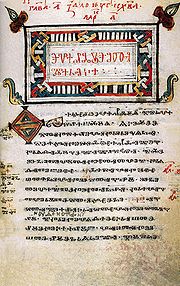 Bulgarian was the first "Slavic" language attested in writing. As Slavic linguistic unity lasted into late antiquity, in the oldest manuscripts this language was initially referred to as языкъ словяньскъ, "the Slavic language". In the Middle Bulgarian period this name was gradually replaced by the name языкъ блъгарьскъ, the "Bulgarian language". In some cases, the name языкъ блъгарьскъ was used not only with regard to the contemporary Middle Bulgarian language of the copyist but also to the period of Old Bulgarian. A most notable example of anachronism is the Service of St. Cyril
from Skopje (Скопски миней), a 13th-century Middle Bulgarian manuscript from northern Macedonia
according to which St. Cyril preached with "Bulgarian" books among the Moravian Slavs. The first mention of the language as the "Bulgarian language" instead of the "Slavonic language" comes in the work of the Greek clergy of the Bulgarian Archbishopric of Ohrid
in the 11th century, for example in the Greek
hagiography of Saint Clement of Ohrid by Theophylact
of Ohrid (late 11th century).
During the Middle Bulgarian period, the language underwent dramatic changes, losing the Slavonic case system, but preserving the rich verb system (while the development was exactly the opposite in other Slavic languages) and developing a definite article. Consequently, modern Bulgarian is about as far from Russian as Swedish
is from German
. It was influenced by proto-Bulgar and its non-Slavic neighbors in the Balkan linguistic union
(mostly grammatically) and later also by Turkish
, which was the official language of the Ottoman Empire
, in the form of the Ottoman Turkish language
, mostly lexically. As a national revival
occurred towards the end of the period of Ottoman rule (mostly during the 19th century), a modern Bulgarian literary language gradually emerged which drew heavily on Church Slavonic/Old Bulgarian (and to some extent on literary Russian
, which had preserved many lexical items from Church Slavonic) and later reduced the number of Turkish and other Balkanic loans. Today one difference between Bulgarian dialects in the country and literary spoken Bulgarian is the significant presence of Old Bulgarian words and even word forms in the latter. Russian loans are distinguished from Old Bulgarian ones on the basis of the presence of specifically Russian phonetic changes, as in оборот (turnover, rev), непонятен (incomprehensible), ядро (nucleus) and others. As usual in such cases, many other loans from French, English and the classical language
s have subsequently entered the language as well.
Modern Bulgarian was based essentially on the Eastern dialects of the language, but its pronunciation is in many respects a compromise between East and West Bulgarian (see especially the phonetic sections below). Following the efforts of some figures of the National awakening of Bulgaria
(the most notable among them being Neofit Rilski
and Ivan Bogorov
), there had been many attempts to codify
a standard
Bulgarian language; however, there was much argument surrounding the choice of norms. Between 1835–1878 more than 25 proposals were put forward and "linguistic chaos" ensued. Eventually the Eastern dialects prevailed and in 1899 the Ministry of Education officially codified a standard Bulgarian language based on the Drinov-Ivanchev orthography..
 The language is mainly split into two broad dialect areas, based on the different reflexes of the Common Slavic yat
vowel . This split, which occurred at some point during the Middle Ages, led to the development of Bulgaria's:
The literary language norm, which is generally based on the Eastern dialects, also has the Eastern alternating reflex of yat. However, it has not incorporated the general Eastern umlaut of all synchronic or even historic "ya" sounds into "e" before front vowels – e.g. поляна (polyana) vs полени (poleni) "meadow – meadows" or even жаба (zhaba) vs жеби (zhebi) "frog – frogs", even though it co-occurs with the yat alternation in almost all Eastern dialects that have it (except a few dialects along the yat border, e.g. in the Pleven
region).
More examples of the yat umlaut in the literary language are:
Until 1945, Bulgarian orthography did not reveal this alternation and used the original Old Slavic
Cyrillic letter yat , which was commonly called двойно е (dvoyno e) at the time, to express the historical yat vowel or at least root vowels displaying the ya – e alternation. The letter was used in each occurrence of such a root, regardless of the actual pronunciation of the vowel: thus, both mlyako and mlekar were spelled with . Among other things, this was seen as a way to "reconcile" the Western and the Eastern dialects and maintain language unity at a time when much of Bulgaria's Western dialect area was controlled by Serbia
and Greece
, but there were still hopes and occasional attempts to recover it. With the 1945 orthographic reform, this letter was abolished and the present spelling was introduced, reflecting the alternation in pronunciation.
This had implications for some grammatical constructions:
Sometimes, with the changes, words began to be spelled as other words with different meanings, e.g.:
In spite of the literary norm regarding the yat vowel, many people living in Western Bulgaria, including the capital Sofia
, will fail to observe its rules. While the norm requires the realizations vidyal vs videli (he has seen; they have seen), some natives of Western Bulgaria will preserve their local dialect pronunciation with "e" for all instances of "yat" (e.g. videl, videli). Others, attempting to adhere to the norm, will actually use the "ya" sound even in cases where the standard language has "e" (e.g. vidyal, vidyali). The latter hypercorrection is called свръхякане ("svrah-yakane" ≈"over-softening").
as a group of Bulgarian dialects. The local variants of the name of the language are balgàrtski, bolgàrtski, bulgàrtski, bògartski, bogàrtski, bùgarski or bugàrski. However, the Bulgarian codifiers did not want to make any allowances for a pluricentric Bulgarian language, which might have included the Macedonian dialects. After WWII, the question about the Bulgarian character of the language in the territory of the Republic of Macedonia was put aside in the name of Bulgarian-Yugoslavian friendship under the pressure of the Soviet Union
. After 1958 when the pressure from Moscow decreased, Sofia turned back to the view that the Macedonian language
did not exist as a separate language. Some modern linguists consider Macedonian dialects still as Bulgarian, but this view is politically controversial.
introduced the Glagolitic alphabet
which was devised by the Saints Cyril and Methodius
in the 850s. The Glagolitic alphabet was gradually superseded in later centuries by the Cyrillic script, developed around the Preslav Literary School
, Bulgaria
in the beginning of the 10th century.
Several Cyrillic alphabets with 28 to 44 letters were used in the beginning and the middle of the 19th century during the efforts on the codification of Modern Bulgarian until an alphabet with 32 letters, proposed by Marin Drinov
, gained prominence in the 1870s. The alphabet of Marin Drinov was used until the orthographic reform of 1945 when the letters yat
, called "double e"), and yus
, called "big yus" or "ъ кръстато") were removed from the alphabet, reducing the number of letters to 30.
With the accession of Bulgaria to the European Union on January 1, 2007, Cyrillic became the third official alphabet of the EU.
The following table gives the letters of the Bulgarian alphabet, along with the IPA values for the sound of each letter:
* See Wikipedia:IPA for Bulgarian and Macedonian for details.
1 The romanizations of these characters differ from the current version, ISO 9:1995, as it was never officially adopted as a Bulgarian standard.
Most letters in the Bulgarian alphabet stand for just one specific sound. Three letters stand for the single expression of combinations of sounds, namely щ (sht), ю
(yu), and я
(ya). Two sounds do not correspond to separate letters, but are expressed as the combination of two letters, namely дж (/dʒ/) and дз (/dz/). The letter ь marks the softening (palatalization
) of any consonant before /ɔ/.
A letter that represents a voiced consonant can represent its voiceless counterpart and vice versa when adjacent to a voiceless or voiced consonant, respectively, or when a voiced consonant is syllable final, for example - вторник /ftornik/ - Tuesday, нож /nɔʃ/ - knife, сграда /zgradɐ/ - building, сватба /svadbɐ/ - wedding.
The names of the letters are simple representations of their phonetic values, with all consonants being followed by /ɤ/ – thus the alphabet goes: /a/ – /bɤ/ – /vɤ/, etc. Й is known as "и-kratko" (short /i/), Ъ as "er-golyam" (large Er
), and Ь as "er-maluk" (small Er). When saying the alphabet fast, people often omit to say Й and Ь, and say Ъ simply as /ɤ/.
For the transliteration
of Bulgarian into the Latin script (romanization
), see Romanization of Bulgarian
.
Bulgarian's eight vowels may be grouped in three pairs according to their backness: front, central and back. All vowels are relatively lax, as in most other Slavic languages
, and unlike the tense vowels
, for example, in the Germanic languages
. Unstressed vowels tend to be shorter and weaker compared to their stressed
counterparts, and the corresponding pairs of open and closed vowels approach each other with a tendency to merge, above all as low (open
and open-mid
) vowels are raised and shift towards the high (close
and close-mid
) ones. However, the coalescence is not always complete. The vowels are often distinguished in emphatic or deliberately distinct pronunciation, and reduction is strongest in colloquial speech. Besides that, some linguists distinguish two degrees of reduction, as they have found that a clearer distinction tends to be maintained in the syllable immediately preceding the stressed one. The complete merger of the pair /a/ – /ɤ/ is regarded as most common, while the status of /ɔ/ vs /u/ is less clear. A coalescence of /ɛ/ and /i/ is not allowed in formal speech and is regarded as a provincial (East Bulgarian) dialect feature; instead, unstressed /ɛ/ is both raised and centralized, approaching [ɤ]. The /ɤ/ vowel itself does not exist as a phoneme
in other Slavic languages, though a similar reduced vowel transcribed as [ə] does occur.
: /j/, being equivalent to y in English like in yes. It is expressed graphically with the letter й
, as in най /naj/ ("most"), тролей /trɔlɛj/ ("trolleybus"), except when it precedes /a/ or /u/, in which case the combination of two phonemes is expressed with a single letter, respectively я or ю: (e.g. ютия /jutija/ "(flat) iron").
/x/. The contrast 'voiced vs. voiceless' is neutralized in word-final position, where all obstruents are pronounced as voiceless
(as in most Slavic languages
); this neutralization is, however, not reflected in the spelling.
Among some Eastern Bulgarian speakers, consonants are sometimes palatalized before the vowels /i/ and /ɛ/. This is not the case in Standard Bulgarian. The realization of the phoneme л /l/ varies along the same principles: one of its allophones, involving a raising of the back of the tongue and a lowering of its middle part in a way identical to the velarized lateral
, occurs in all positions, except before the vowels /i/ and /ɛ/, where a more "clear" version with a slight raising of the middle part of the tongue occurs. The latter pre-front realization is traditionally (and incorrectly) called "soft l", even though it is not palatalized. In some Western Bulgarian dialects, this allophonic variation does not exist. Some sources claim the existence of palatalized phonemes in Bulgarian.
Furthermore, in the speech of many young people the more common and arguably velarized allophone of /l/ is often realized as a labiovelar approximant [w]. This phenomenon, colloquially known as мързеливо "л" (lazy "l") in Bulgaria, was first registered in the 1970s and isn't connected to original dialects. Similar developments, termed L-vocalization
, have occurred in many languages, including Polish
, Serbo-Croatian
, Brazilian Portuguese
and certain dialects of English such as Cockney
and AAVE.
s (e.g. ѝ 'to her', vs. и, 'and'), or in order to signify the dialectal deviation from the standard pronunciation. In such cases, stress is signified by placing a grave accent
on the vowel of the stressed syllable.For practical purposes, the grave accent can be combined
with letters by pasting the symbol "̀" directly after the designated letter. An alternative is to use the keyboard shortcut Alt + 0300 (if working under a Windows operating system), or to add the decimal HTML code "̀" after the targeted stressed vowel if editing HTML source code. See "Accute accent" diacritic character in Unicode, Unicode character "Cyrillic small letter i with grave" and Unicode character "Cyrillic capital letter i with grave" for the exact Unicode characters that utilize the grave accent
. Retrieved 2010-06-21.
grammatical gender
, number
, case
(only vocative
) and definiteness
in Bulgarian. Adjectives and adjectival pronouns agree with nouns in number and gender. Pronouns have gender and number and retain (as in nearly all Indo-European languages
) a more significant part of the case system.
There are three grammatical genders in Bulgarian: masculine, feminine and neuter. The gender of the noun can largely be inferred from its ending: nouns ending in a consonant ("zero ending") are generally masculine (for example, град /ɡrat/ 'city', син /sin/ 'son', мъж /mɤʃ/ 'man'; those ending in –а/–я (-a/-ya) (жена /ʒɛ'na/ 'woman', дъщеря /dɐʃtɛr'ja/ 'daughter', улица /'ulitsɐ/ 'street') are normally feminine; and nouns ending in –е, –о are almost always neuter (дете /dɛtɛ/ 'child', езеро /'ɛzɛro/ 'lake'), as are those rare words (usually loanwords) that end in –и, –у, and –ю (цунами /tso'nami/ 'tsunami', табу /tɐ'bu/ 'taboo', меню /mɛ'nju/ 'menu'). Perhaps the most significant exception from the above are the relatively numerous nouns that end in a consonant and yet are feminine: these comprise, firstly, a large group of nouns with zero ending expressing quality, degree or an abstraction, including all nouns ending on –ост/–ест -{ost/est} (мъдрост /'mɤdrost/ 'wisdom', низост /'nizost/ 'vileness', прелест /'prɛlɛst/ 'loveliness', болест /'bɔlɛst/ 'sickness', любов /ljo'bɔf/ 'love'), and secondly, a much smaller group of irregular nouns with zero ending which define tangible objects or concepts (кръв /krɤf/ 'blood', кост /kɔst/ 'bone', вечер /'vɛtʃɛr/ 'evening', нoщ /nɔʃt/ 'night'). There are also some commonly used words that end in a vowel and yet are masculine: баща 'father', дядо 'grandfather', чичо / вуйчо 'uncle', and others.
The plural forms of the nouns do not express their gender as clearly as the singular ones, but may also provide some clues to it: the ending –и (-i) is more likely to be used with a masculine or feminine noun (факти /'fakti/ 'facts', болести /'bɔlɛsti/ 'sicknesses'), while one in –а/–я belongs more often to a neuter noun (езера /ɛzɛ'ra/ 'lakes'). Also, the plural ending –ове /-ɔvɛ/ occurs only in masculine nouns.
Two numbers are distinguished in Bulgarian – singular
and plural
. A variety of plural suffixes is used, and the choice between them is partly determined by their ending in singular and partly influenced by gender; in addition, irregular declension and alternative plural forms are common. Words ending in –а/–я (which are usually feminine) generally have the plural ending –и, upon dropping of the singular ending. Of nouns ending in a consonant, the feminine ones also use –и, whereas the masculine ones usually have –и for polysyllables and –ове for monosyllables (however, exceptions are especially common in this group). Nouns ending in –о/–е (most of which are neuter) mostly use the suffixes –а, –я (both of which require the dropping of the singular endings) and –та.
With cardinal number
s and related words such as няколко ('several'), masculine nouns use a special count form in –а/–я, which stems from the Proto-Slavonic dual: двама/трима ученика ('two/three students') versus тези ученици ('these students'); cf. feminine две/три/тези жени ('two/three/these women') and neuter две/три/тези деца ('two/three/these children'). However, a recently developed language norm requires that count forms should only be used with masculine nouns that do not denote persons. Thus, двама/трима ученици is perceived as more correct than двама/трима ученика, while the distinction is retained in cases such as два/три молива ('two/three pencils') versus тези моливи ('these pencils').
Cases exist only in the personal pronoun
s (as they do in many other modern Indo-European languages
), with nominative
, accusative
, dative
and vocative
forms. Vestiges are present in the masculine personal interrogative pronoun кой ("who") and in a number of phraseological units and sayings. The major exception are vocative
forms, which are still in use for masculine (with the endings -e, -o and -ю) and feminine nouns (-[ь/й]o and -e) in the singular. However, there is a tendency to avoid them in many personal names, as the use of feminine name forms in -[ь/й]o and of the potential vocative forms of foreign names has come to be considered rude or rustic. Thus, Иване means 'hey, Ivan', while the corresponding feminine forms Елено ('hey, Elena'),
Маргарито ('hey, Margarita') are today seen as rude or, at best, unceremonious, and declining foreign names as in *Джоне ('hey, John') or *Саймъне ('hey, Simon') could only be considered humorous. Interestingly, the prohibition on constructing vocative forms for foreign names does not apply to names from Classical Antiquity
, with the source languages having the vocative case as well: cf Цезаре' ('Oh Caesar
'), Перикле ('Oh Pericles
'), Зевсе ('Oh Zeus
'), etc.
Case remnants
Some key words do retain their cases, which today are no longer considered nominative
, accusative
and dative
, but rather as being subject, direct object and indirect object parts of speech:
In modern Bulgarian, definiteness is expressed by a definite article
which is postfixed to the noun, much like in the Scandinavian languages or Romanian
(indefinite: човек, 'person'; definite: човекът, "the person") or to the first nominal constituent of definite noun phrases (indefinite: добър човек, 'a good person'; definite: добрият човек, "the good person"). There are four singular definite articles. Again, the choice between them is largely determined by the noun's ending in the singular. Nouns that end in a consonant and are masculine use –ът/–ят, when they are grammatical subjects, and –а/–я elsewhere. Nouns that end in a consonant and are feminine, as well as nouns that end in –а/–я (most of which are feminine, too) use –та. Nouns that end in –е/–о use –то.
The plural definite article is –те for all nouns except for those, whose plural form ends in –а/–я; these get –тa instead. When postfixed to adjectives the definite articles are –ят/–я for masculine gender (again, with the longer form being reserved for grammatical subjects), –та for feminine gender, –то for neuter gender, and –те for plural.
Bulgarian verbs express lexical aspect: perfective verbs signify the completion of the action of the verb and form past perfective (aorist) forms; imperfective ones are neutral with regard to it and form past imperfective forms. Most Bulgarian verbs can be grouped in perfective-imperfective pairs (imperfective<>perfective: идвам<>дойда "come", пристигам<>пристигна “arrive”). Perfective verbs can be usually formed from imperfective ones by suffixation or prefixation, but the resultant verb often deviates in meaning from the original. In the pair examples above, aspect is stem-specific and therefore there is no difference in meaning.
In Bulgarian, there is also grammatical aspect
. Three grammatical aspects are distinguishable: neutral, perfect and pluperfect. The neutral aspect comprises the three simple tenses and the future tense. The pluperfect is manifest in tenses that use double or triple auxiliary "be" participles like the past pluperfect subjunctive. Perfect constructions use a single auxiliary "be".
The traditional interpretation is that in addition to the four moods (наклонения /naklonenija/) shared by most other European languages – indicative (изявително, /izʲavitelno/) imperative
(повелително /povelitelno/), subjunctive
(подчинително /podtʃinitelno/) and conditional
(условно, /uslovno/) – in Bulgarian there is one more to describe a generalistic category of unwitnessed events – the inferential
(преизказно /preˈizkazno/) mood.
There are three grammatically distinctive positions in time – present, past and future – which combine with aspect and mood to produce a number of formations. Normally, in grammar books these formations are viewed as separate tenses – i. e. "past imperfect" would mean that the verb is in past tense, in the imperfective aspect, and in the indicative mood (since no other mood is shown). There are more than 40 different tenses across Bulgarian's two aspects and five moods.
In the indicative mood, there are three simple tenses:
In the indicative there are also the following compound tenses:
The four perfect constructions above can vary in aspect depending on the aspect of the main-verb participle; they are in fact pairs of imperfective and perfective aspects. Verbs in forms using past participles also vary in voice and gender.
There is only one simple tense in the imperative mood
– the present – and there are simple forms only for the second person using the suffixes -и/-й (-i, -y/i) for singular and -ете/-йте (-ete, -yte) for plural; e.g., уча /utʃa/ ('to study'): учи /utʃi/, sg., учете /utʃete/, pl.; играя /iɡraja/ 'to play': играй /iɡraj/, играйте /iɡrajte/. There are compound imperative forms for all persons and numbers in the present compound imperative (да играе, da iɡrae/), the present perfect compound imperative (да е играл, /da e iɡral/) and the rarely used present pluperfect compound imperative (да е бил играл, /da e bil iɡral/).
The conditional mood
consists of five compound tenses, most of which are not grammatically distinguishable. The present, future and past conditional use a special past form of the stem би- (bi – "be") and the past participle (бих учил, /bix utʃil/, 'I would study'). The past future conditional and the past future perfect conditional coincide in form with the respective indicative tenses.
The subjunctive mood
is rarely documented as a separate verb form in Bulgarian, (being, morphologically, a sub-instance of the quasi-infinitive
construction with the particle да and a normal finite verb form), but nevertheless it is used regularly. The most common form, often mistaken for the present tense, is the present subjunctive ([пo-добре] да отидa (po-dobre) da otida/, 'I had better go'). The difference between the present indicative and the present subjunctive tense is that the subjunctive can be formed by both perfective and imperfective verbs. It has completely replaced the infinitive and the supine from complex expressions (see below). It is also employed to express opinion about possible future events. The past perfect subjunctive ([пo-добре] да бях отишъл (po-dobre) da bʲax otiʃɤl/, 'I'd had better be gone') refers to possible events in the past, which did not take place, and the present pluperfect subjunctive (да съм бил отишъл /da sɤm bil otiʃɤl/), which may be used about both past and future events arousing feelings of incontinence, suspicion, etc. and has no perfect to English translation.
The inferential mood
has five pure tenses. Two of them are simple – past aorist inferential and past imperfect inferential – and are formed by the past participles of perfective and imperfective verbs, respectively. There are also three compound tenses – past future inferential, past future perfect inferential and past perfect inferential. All these tenses' forms are gender-specific in the singular. There are also conditional and compound-imperative crossovers. The existence of inferential forms has been attributed to Turkic influences by most Bulgarian linguists. Morphologically, they are derived from the perfect.
s:
The participles are inflected by gender, number, and definiteness, and are coordinated with the subject when forming compound tenses (see tenses above). When used in attributive role the inflection attributes are coordinated with the noun that is being attributed.
way to form adverbs is to derive them from the neuter singular form of the corresponding adjective (бързо (fast), силно (hard), странно (strange), although adjectives ending in -ки use the masculine singular form, also in -ки, instead: юнашки (heroically), мъжки (bravely, like a man), майсторски (skilfully). The same pattern is used to form adverbs from the (adjective-like) ordinal numerals, e.g. първо (firstly), второ (secondly), трето (thirdly), and in some cases from (adjective-like) cardinal numerals, e.g. двойно (twice as/double), тройно (three times as), петорно (five times as).
The remaining adverbs are formed in ways that are no longer productive in the language. A small number are original (not derived from other words), for example: тук (here), там (there), вътре (inside), вън (outside), много (very/much) etc. The rest are mostly fossilized case forms, such as:
Adverbs can sometimes be reduplicated to emphasize the qualitative or quantitative properties of actions, moods or relations as performed by the subject of the sentence: "бавно-бавно" ("rather slowly"), "едва-едва" ("with great difficulty"), "съвсем-съвсем" ("quite", "thoroughly").
The remaining 25% to 30% are loanwords from a number of languages, as well as derivations of such words. The languages which have contributed most to Bulgarian are Russian
and Turkish
, and to a lesser extent French
. Latin
and Greek
are the source of many words, used mostly in international terminology. Many of the numerous loanwords from Turkish
(and, via Turkish, from Arabic
and Persian
) which were adopted into Bulgarian during the long period of Ottoman
rule, have been substituted with native terms. In addition, both specialized (usually coming from the field of science
) and commonplace English
words (notably abstract, commodity/service-related or technical terms) have also penetrated Bulgarian since the second half of the 20th century, especially since 1989. A noteworthy portion of this English-derived terminology has attained some unique features in the process of its introduction to native speakers and this has resulted in peculiar derivations that slightly set the newly formed loanwords apart from the original words (mainly in pronunciation), although many loanwords are completely identical to the source words. A growing number of international neologisms are also being widely adopted.
, mostly for emphatic purposes. For example, the following constructions are common in colloquial Bulgarian:
The phenomenon is practically obligatory in the spoken language in the case of inversion signalling information structure (in writing, clitic doubling may be skipped in such instances, with a somewhat bookish effect):
Sometimes, the doubling signals syntactic relations, thus:
This is contrasted with:
In this case, clitic doubling can be a colloquial alternative of the more formal or bookish passive voice, which would be constructed as follows:
Clitic doubling is also fully obligatory, both in the spoken and in the written norm, in clauses including several special expressions that use the short accusative and dative pronouns, like играе ми се (I feel like playing), студено ми е (I am cold), боли ме ръката (my arm hurts):
While the particle ли generally goes after the verb, it can go after a noun or adjective if a contrast is needed:
A verb is not always necessary, e.g. when presenting a choice:
Rhetorical questions can be formed by adding ли to a question word, thus forming a "double interrogative" –
The same construction +не ('no') is an emphasised positive –
The verb съм /sɤm/съм is pronounced similar to English "sum". – 'to be' is also used as an auxiliary
for forming the perfect, the passive and the conditional
:
Two alternate forms of съм exist:
Ще
The impersonal verb щe (lit. 'it wants')ще – from the verb щa – 'to want.' The present tense of this verb in the sense of 'to want' is archaic and only used colloquially. Instead, искам /iskam/ is used. is used to for forming the (positive) future tense: – 'I am going' – 'I will be going'
The negative future is formed with the invariable construction няма да /ɲama da/ (see няма below) Formed from the impersonal verb няма (lit. 'it does not have') and the subjunctive particle да /da/ ('that') : – 'I will not be going'
The past tense of this verb – щях /ʃtʲax/ is conjugated to form the past conditional ('would have' – again, with да, since it is irrealis): – 'I would have gone;' /ʃteʃe da otideʃ/ 'you would have gone'
Имам and нямам
The verbs имам /imam/ ('to have') and нямам /ɲamam/ ('to not have'):
} ('there is still time' – compare Spanish hay);
} ('there is no one there').
Usually done by adding -че, -це or -(ч)ка. The gender of the word is thus changed, usually to the neuter: ('car') → /koˈlitʃka/ ('baby's buggy') or /kote/ ('cat') → /kotentse/ ('kitten')
Sometimes proper noun
s and words referring to friends or family members can have a diminutive ending added to show affection. These constructions are all referred to as "na galeno" (lit. "caressing" form):
Such words can be used both from parent to child, and vice-versa, as can:
Personal names are shortened and made neuter:
There is an interesting trend (which is comparatively modern, although it might well have deeper, dormant roots) where the feminine ending "-ka" and the definite article suffix "-ta" ("the") are added to male names – note that this is affectionate and not at all insulting (in fact, the endings are not even really considered as being "feminine"):
The female equivalent would be to add the neuter ending "-to" to the diminutive form:
Augmentative
This is to present words to sound larger – usually by adding "-shte":
Some words only exist in an augmentative form – e.g.
In Bulgarian, there are several conjunctions all translating into English as "but", which are all used in distinct situations. They are но (no), ама (amà), а (a), ами (amì), and ала (alà) (and обаче (obache) – "however", identical in use to но).
While there is some overlapping between their uses, in many cases they are specific. For example, ami is used for a choice – ne tova, ami onova – "not this one, but that one" (comp. Spanish sino), while ama is often used to provide extra information or an opinion – kazah go, ama sgreshih – "I said it, but I was wrong". Meanwhile, a provides contrast between two situations, and in some sentences can even be translated as "although", "while" or even "and" – az rabotya, a toy blee – "I'm working, and he's daydreaming".
Very often, different words can be used to alter the emphasis of a sentence – e.g. while "pusha, no ne tryabva" and "pusha, a ne tryabva" both mean "I smoke, but I shouldn't", the first sounds more like a statement of fact ("...but I mustn't"), while the second feels more like a judgement ("...but I oughtn't"). Similarly, az ne iskam, ama toy iska and az ne iskam, a toy iska both mean "I don't want to, but he does", however the first emphasises the fact that he wants to, while the second emphaseses the wanting rather than the person.
Ala is interesting in that, while it feels archaic, it is often used in poetry and frequently in children's stories, since it has quite a moral/ominous feel to it.
Some common expressions use these words, and some can be used alone as interjections:
Vocative particles
Bulgarian has several abstract particles which are used to strengthen a statement. These have no precise translation in English.Perhaps most similar in use is the tag "man", but the Bulgarian particles are more abstract still. The particles are strictly informal and can even be considered rude by some people and in some situations. They are mostly used at the end of questions or instructions.
Modal Particles
These are "tagged" on to the beginning or end of a sentence to express the mood of the speaker in relation to the situation. They are mostly interrogative or slightly imperative
in nature. There is no change in the grammatical mood when these are used (although they may be expressed through different grammatical moods in other languages).
Intentional particles
These express intent or desire, perhaps even pleading. They can be seen as a sort of cohortative side to the language. (Since they can be used by themselves, they could even be considered as verbs in their own right.) They are also highly informal.
These particles can be combined with the vocative particles for greater effect, e.g. ya da vidya, be (let me see), or even exclusively in combinations with them, with no other elements, e.g. haide, de! (come on!); nedey, de! (I told you not to!).
Example phrases include:
An interesting phenomenon is that these can be strung along one after another in quite long constructions, e.g.,
An extreme (colloquial) sentence, with almost no physical meaning in it whatsoever – yet which does have perfect meaning to the Bulgarian ear – would be :
—Note: the subject of the sentence is simply the pronoun "taya" (lit. "this one here"; colloq. "she").
Similar "meaningless" expressions are extremely common in spoken Bulgarian, especially when the speaker is finding it difficult to describe something.
(In the above two examples, the formal expression uses a plural verb but a singular pronoun, which allows speakers to distinguish the two grammatical forms.)
Also, some very frequent expressions have been borrowed from other languages. Most of them are somewhat informal.
Dictionaries
Courses
Indo-European languages
The Indo-European languages are a family of several hundred related languages and dialects, including most major current languages of Europe, the Iranian plateau, and South Asia and also historically predominant in Anatolia...
, a member of the Slavic
Slavic languages
The Slavic languages , a group of closely related languages of the Slavic peoples and a subgroup of Indo-European languages, have speakers in most of Eastern Europe, in much of the Balkans, in parts of Central Europe, and in the northern part of Asia.-Branches:Scholars traditionally divide Slavic...
linguistic group.
Bulgarian, along with the closely related Macedonian language
Macedonian language
Macedonian is a South Slavic language spoken as a first language by approximately 2–3 million people principally in the region of Macedonia but also in the Macedonian diaspora...
, demonstrates several linguistic characteristics that set it apart from all other Slavic languages
Slavic languages
The Slavic languages , a group of closely related languages of the Slavic peoples and a subgroup of Indo-European languages, have speakers in most of Eastern Europe, in much of the Balkans, in parts of Central Europe, and in the northern part of Asia.-Branches:Scholars traditionally divide Slavic...
such as the elimination of case declension
Grammatical case
In grammar, the case of a noun or pronoun is an inflectional form that indicates its grammatical function in a phrase, clause, or sentence. For example, a pronoun may play the role of subject , of direct object , or of possessor...
, the development of a suffixed definite article
Definite Article
Definite Article is the title of British comedian Eddie Izzard's 1996 performance released on VHS. It was recorded on different nights at the Shaftesbury Theatre...
(see Balkan linguistic union
Balkan linguistic union
The Balkan sprachbund or linguistic area is the ensemble of areal features—similarity in grammar, syntax, vocabulary and phonology—among the languages of the Balkans. Several features are found across these languages though not all need apply to every single language...
), the lack of a verb infinitive
Infinitive
In grammar, infinitive is the name for certain verb forms that exist in many languages. In the usual description of English, the infinitive of a verb is its basic form with or without the particle to: therefore, do and to do, be and to be, and so on are infinitives...
, and the retention and further development of the Proto-Slavic
Proto-Slavic language
Proto-Slavic is the proto-language from which Slavic languages later emerged. It was spoken before the seventh century AD. As with most other proto-languages, no attested writings have been found; the language has been reconstructed by applying the comparative method to all the attested Slavic...
verb system. Various evidential
Evidentiality
In linguistics, evidentiality is, broadly, the indication of the nature of evidence for a given statement; that is, whether evidence exists for the statement and/or what kind of evidence exists. An evidential is the particular grammatical element that indicates evidentiality...
verb forms exist to express unwitnessed, retold, and doubtful action. Estimates of the number of people around the world who speak Bulgarian fluently range from about 9 to 12 million.
History
The development of the Bulgarian language may be divided into several periods.- Prehistoric period – occurred between the Slavonic migration to eastern Balkans and the mission of Saints Cyril and MethodiusSaints Cyril and MethodiusSaints Cyril and Methodius were two Byzantine Greek brothers born in Thessaloniki in the 9th century. They became missionaries of Christianity among the Slavic peoples of Bulgaria, Great Moravia and Pannonia. Through their work they influenced the cultural development of all Slavs, for which they...
to Great Moravia in the 860s. - Old BulgarianOld Church SlavonicOld Church Slavonic or Old Church Slavic was the first literary Slavic language, first developed by the 9th century Byzantine Greek missionaries Saints Cyril and Methodius who were credited with standardizing the language and using it for translating the Bible and other Ancient Greek...
(9th to 11th century, also referred to as Old Church SlavonicOld Church SlavonicOld Church Slavonic or Old Church Slavic was the first literary Slavic language, first developed by the 9th century Byzantine Greek missionaries Saints Cyril and Methodius who were credited with standardizing the language and using it for translating the Bible and other Ancient Greek...
) – a literary norm of the early southern dialect of the Common Slavic language from which Bulgarian evolved. It was used by Saints Cyril and MethodiusSaints Cyril and MethodiusSaints Cyril and Methodius were two Byzantine Greek brothers born in Thessaloniki in the 9th century. They became missionaries of Christianity among the Slavic peoples of Bulgaria, Great Moravia and Pannonia. Through their work they influenced the cultural development of all Slavs, for which they...
and their disciples to translate the BibleBibleThe Bible refers to any one of the collections of the primary religious texts of Judaism and Christianity. There is no common version of the Bible, as the individual books , their contents and their order vary among denominations...
and other liturgical literature from GreekGreek languageGreek is an independent branch of the Indo-European family of languages. Native to the southern Balkans, it has the longest documented history of any Indo-European language, spanning 34 centuries of written records. Its writing system has been the Greek alphabet for the majority of its history;...
into Slavic. - Middle Bulgarian (12th to 15th century) – a literary norm that evolved from the earlier Old Bulgarian, after major innovations were accepted. It was a language of rich literary activity and the official administration language of the Second Bulgarian EmpireSecond Bulgarian EmpireThe Second Bulgarian Empire was a medieval Bulgarian state which existed between 1185 and 1396 . A successor of the First Bulgarian Empire, it reached the peak of its power under Kaloyan and Ivan Asen II before gradually being conquered by the Ottomans in the late 14th-early 15th century...
. - Modern Bulgarian – dates from the 16th century onwards, undergoing general grammar and syntax changes in the 18th and 19th centuries. Present-day written Bulgarian language was standardized on the basis of the 19th-century Bulgarian vernacular. The historical development of the Bulgarian language can be described as a transition from a highly synthetic languageSynthetic languageIn linguistic typology, a synthetic language is a language with a high morpheme-per-word ratio, as opposed to a low morpheme-per-word ratio in what is described as an isolating language...
(Old Bulgarian) to a typical analytic language (Modern Bulgarian) with Middle Bulgarian as a midpoint in this transition.
Saints Cyril and Methodius
Saints Cyril and Methodius were two Byzantine Greek brothers born in Thessaloniki in the 9th century. They became missionaries of Christianity among the Slavic peoples of Bulgaria, Great Moravia and Pannonia. Through their work they influenced the cultural development of all Slavs, for which they...
from Skopje (Скопски миней), a 13th-century Middle Bulgarian manuscript from northern Macedonia
Macedonia (region)
Macedonia is a geographical and historical region of the Balkan peninsula in southeastern Europe. Its boundaries have changed considerably over time, but nowadays the region is considered to include parts of five Balkan countries: Greece, the Republic of Macedonia, Bulgaria, Albania, Serbia, as...
according to which St. Cyril preached with "Bulgarian" books among the Moravian Slavs. The first mention of the language as the "Bulgarian language" instead of the "Slavonic language" comes in the work of the Greek clergy of the Bulgarian Archbishopric of Ohrid
Bulgarian Archbishopric of Ohrid
The Archbishopric of Ochrid was an autonomous Orthodox Church under the tutelage of the Ecumenical Patriarch of Constantinople between 1019 and 1767...
in the 11th century, for example in the Greek
Greek language
Greek is an independent branch of the Indo-European family of languages. Native to the southern Balkans, it has the longest documented history of any Indo-European language, spanning 34 centuries of written records. Its writing system has been the Greek alphabet for the majority of its history;...
hagiography of Saint Clement of Ohrid by Theophylact
Theophylact of Bulgaria
Theophylact of Ohrid was a Greek archbishop of Ohrid and commentator on the Bible.-Life:...
of Ohrid (late 11th century).
During the Middle Bulgarian period, the language underwent dramatic changes, losing the Slavonic case system, but preserving the rich verb system (while the development was exactly the opposite in other Slavic languages) and developing a definite article. Consequently, modern Bulgarian is about as far from Russian as Swedish
Swedish language
Swedish is a North Germanic language, spoken by approximately 10 million people, predominantly in Sweden and parts of Finland, especially along its coast and on the Åland islands. It is largely mutually intelligible with Norwegian and Danish...
is from German
German language
German is a West Germanic language, related to and classified alongside English and Dutch. With an estimated 90 – 98 million native speakers, German is one of the world's major languages and is the most widely-spoken first language in the European Union....
. It was influenced by proto-Bulgar and its non-Slavic neighbors in the Balkan linguistic union
Balkan linguistic union
The Balkan sprachbund or linguistic area is the ensemble of areal features—similarity in grammar, syntax, vocabulary and phonology—among the languages of the Balkans. Several features are found across these languages though not all need apply to every single language...
(mostly grammatically) and later also by Turkish
Turkish language
Turkish is a language spoken as a native language by over 83 million people worldwide, making it the most commonly spoken of the Turkic languages. Its speakers are located predominantly in Turkey and Northern Cyprus with smaller groups in Iraq, Greece, Bulgaria, the Republic of Macedonia, Kosovo,...
, which was the official language of the Ottoman Empire
Ottoman Empire
The Ottoman EmpireIt was usually referred to as the "Ottoman Empire", the "Turkish Empire", the "Ottoman Caliphate" or more commonly "Turkey" by its contemporaries...
, in the form of the Ottoman Turkish language
Ottoman Turkish language
The Ottoman Turkish language or Ottoman language is the variety of the Turkish language that was used for administrative and literary purposes in the Ottoman Empire. It borrows extensively from Arabic and Persian, and was written in a variant of the Perso-Arabic script...
, mostly lexically. As a national revival
Romantic nationalism
Romantic nationalism is the form of nationalism in which the state derives its political legitimacy as an organic consequence of the unity of those it governs...
occurred towards the end of the period of Ottoman rule (mostly during the 19th century), a modern Bulgarian literary language gradually emerged which drew heavily on Church Slavonic/Old Bulgarian (and to some extent on literary Russian
Russian language
Russian is a Slavic language used primarily in Russia, Belarus, Uzbekistan, Kazakhstan, Tajikistan and Kyrgyzstan. It is an unofficial but widely spoken language in Ukraine, Moldova, Latvia, Turkmenistan and Estonia and, to a lesser extent, the other countries that were once constituent republics...
, which had preserved many lexical items from Church Slavonic) and later reduced the number of Turkish and other Balkanic loans. Today one difference between Bulgarian dialects in the country and literary spoken Bulgarian is the significant presence of Old Bulgarian words and even word forms in the latter. Russian loans are distinguished from Old Bulgarian ones on the basis of the presence of specifically Russian phonetic changes, as in оборот (turnover, rev), непонятен (incomprehensible), ядро (nucleus) and others. As usual in such cases, many other loans from French, English and the classical language
Classical language
A classical language is a language with a literature that is classical. According to UC Berkeley linguist George L. Hart, it should be ancient, it should be an independent tradition that arose mostly on its own, not as an offshoot of another tradition, and it must have a large and extremely rich...
s have subsequently entered the language as well.
Modern Bulgarian was based essentially on the Eastern dialects of the language, but its pronunciation is in many respects a compromise between East and West Bulgarian (see especially the phonetic sections below). Following the efforts of some figures of the National awakening of Bulgaria
National awakening of Bulgaria
Bulgarian nationalism emerged in the early 19th century under the influence of western ideas such as liberalism and nationalism, which trickled into the country after the French revolution, mostly via Greece, although there were stirrings in the 18th century. Russia, as fellow Orthodox Slavs, could...
(the most notable among them being Neofit Rilski
Neofit Rilski
Neofit Rilski or Neophyte of Rila , born Nikola Poppetrov Benin was a 19th-century Bulgarian monk, teacher and artist, and an important figure of the Bulgarian National Revival....
and Ivan Bogorov
Ivan Bogorov
Ivan Bogorov was a noted Bulgarian encyclopedist from the time of the National Revival. Educated in medicine, he also worked in the spheres of industry, economy, transport, geography, journalism and linguistics....
), there had been many attempts to codify
Codification (linguistics)
In linguistics, codification is the process of standardizing and developing a norm for a language.Codifying a language can vary from case to case and depends on the stage of standardization that already exists...
a standard
Standard language
A standard language is a language variety used by a group of people in their public discourse. Alternatively, varieties become standard by undergoing a process of standardization, during which it is organized for description in grammars and dictionaries and encoded in such reference works...
Bulgarian language; however, there was much argument surrounding the choice of norms. Between 1835–1878 more than 25 proposals were put forward and "linguistic chaos" ensued. Eventually the Eastern dialects prevailed and in 1899 the Ministry of Education officially codified a standard Bulgarian language based on the Drinov-Ivanchev orthography..
Dialects
Yat
Yat or Jat is the thirty-second letter of the old Cyrillic alphabet. Its name in Old Church Slavonic is jěd’ or iad’ . In the common scientific Latin transliteration for old Slavic languages, the letter is represented by e with caron: .The yat represented a Common Slavic long vowel...
vowel . This split, which occurred at some point during the Middle Ages, led to the development of Bulgaria's:
- Western dialects (informally called твърд говор/tvurd govor – "hard speech")
- the former yat is pronounced "e" in all positions. e.g. млеко (mlekò) – milk, хлеб (hleb) – bread.
- Eastern dialects (informally called мек говор/mek govor – "soft speech")
- the former yat alternates between "ya" and "e": it is pronounced "ya" if it is under stress and the next syllable does not contain a front vowelFront vowelA front vowel is a type of vowel sound used in some spoken languages. The defining characteristic of a front vowel is that the tongue is positioned as far in front as possible in the mouth without creating a constriction that would be classified as a consonant. Front vowels are sometimes also...
(e or i) – e.g. мляко (mlyàko), хляб (hlyab), and "ye" otherwise – e.g. млекар (mlekàr) – milkman, хлебар (hlebàr) – baker. This rule obtains in most Eastern dialects, although some have "ya", or a special "open e" sound, in all positions.
- the former yat alternates between "ya" and "e": it is pronounced "ya" if it is under stress and the next syllable does not contain a front vowel
The literary language norm, which is generally based on the Eastern dialects, also has the Eastern alternating reflex of yat. However, it has not incorporated the general Eastern umlaut of all synchronic or even historic "ya" sounds into "e" before front vowels – e.g. поляна (polyana) vs полени (poleni) "meadow – meadows" or even жаба (zhaba) vs жеби (zhebi) "frog – frogs", even though it co-occurs with the yat alternation in almost all Eastern dialects that have it (except a few dialects along the yat border, e.g. in the Pleven
Pleven
Pleven is the seventh most populous city in Bulgaria. Located in the northern part of the country, it is the administrative centre of Pleven Province, as well as of the subordinate Pleven municipality...
region).
More examples of the yat umlaut in the literary language are:
- mlyàko (milk) [n.] → mlekàr (milkman); mlèchen (milky), etc.
- syàdam (sit) [vb.] → sedàlka (seat); sedàlishte (seat, e.g. of government), etc.
- svyat (holy) [adj.] → svetètz (saint); svetìlishte (sanctuary), etc.
Until 1945, Bulgarian orthography did not reveal this alternation and used the original Old Slavic
Old Church Slavonic
Old Church Slavonic or Old Church Slavic was the first literary Slavic language, first developed by the 9th century Byzantine Greek missionaries Saints Cyril and Methodius who were credited with standardizing the language and using it for translating the Bible and other Ancient Greek...
Cyrillic letter yat , which was commonly called двойно е (dvoyno e) at the time, to express the historical yat vowel or at least root vowels displaying the ya – e alternation. The letter was used in each occurrence of such a root, regardless of the actual pronunciation of the vowel: thus, both mlyako and mlekar were spelled with . Among other things, this was seen as a way to "reconcile" the Western and the Eastern dialects and maintain language unity at a time when much of Bulgaria's Western dialect area was controlled by Serbia
Serbia
Serbia , officially the Republic of Serbia , is a landlocked country located at the crossroads of Central and Southeast Europe, covering the southern part of the Carpathian basin and the central part of the Balkans...
and Greece
Greece
Greece , officially the Hellenic Republic , and historically Hellas or the Republic of Greece in English, is a country in southeastern Europe....
, but there were still hopes and occasional attempts to recover it. With the 1945 orthographic reform, this letter was abolished and the present spelling was introduced, reflecting the alternation in pronunciation.
This had implications for some grammatical constructions:
- The third person plural pronoun and its derivatives. Before 1945 the pronoun "they" was spelled (tě), and its derivatives took this as the root. After the orthographic change, the pronoun and its derivatives were given an equal share of soft and hard spellings:
- "they" – те (te) → "them" – тях (tyah);
- "their(s)" – tehen (masc.); tyahna (fem.); tyahno (neut.); tehni (plur.)
- adjectives received the same treatment as :
- "whole" – tsyal → "the whole...": tseliyat (masc.); tsyalata (fem.); tsyaloto (neut.); tselite (plur.)
Sometimes, with the changes, words began to be spelled as other words with different meanings, e.g.:
- (svět) – "holy" became свят (svyat), spelt and pronounced the same as свят – "world".
- (tě) – "they" became те (te), the same as the second person direct object pronoun те – "you".
In spite of the literary norm regarding the yat vowel, many people living in Western Bulgaria, including the capital Sofia
Sofia
Sofia is the capital and largest city of Bulgaria and the 12th largest city in the European Union with a population of 1.27 million people. It is located in western Bulgaria, at the foot of Mount Vitosha and approximately at the centre of the Balkan Peninsula.Prehistoric settlements were excavated...
, will fail to observe its rules. While the norm requires the realizations vidyal vs videli (he has seen; they have seen), some natives of Western Bulgaria will preserve their local dialect pronunciation with "e" for all instances of "yat" (e.g. videl, videli). Others, attempting to adhere to the norm, will actually use the "ya" sound even in cases where the standard language has "e" (e.g. vidyal, vidyali). The latter hypercorrection is called свръхякане ("svrah-yakane" ≈"over-softening").
Relationship to Macedonian
Most sources in and out of Bulgaria before the Second World War referred to the southern Slavonic dialect continuum covering the area of today's Republic of MacedoniaRepublic of Macedonia
Macedonia , officially the Republic of Macedonia , is a country located in the central Balkan peninsula in Southeast Europe. It is one of the successor states of the former Yugoslavia, from which it declared independence in 1991...
as a group of Bulgarian dialects. The local variants of the name of the language are balgàrtski, bolgàrtski, bulgàrtski, bògartski, bogàrtski, bùgarski or bugàrski. However, the Bulgarian codifiers did not want to make any allowances for a pluricentric Bulgarian language, which might have included the Macedonian dialects. After WWII, the question about the Bulgarian character of the language in the territory of the Republic of Macedonia was put aside in the name of Bulgarian-Yugoslavian friendship under the pressure of the Soviet Union
Soviet Union
The Soviet Union , officially the Union of Soviet Socialist Republics , was a constitutionally socialist state that existed in Eurasia between 1922 and 1991....
. After 1958 when the pressure from Moscow decreased, Sofia turned back to the view that the Macedonian language
Macedonian language
Macedonian is a South Slavic language spoken as a first language by approximately 2–3 million people principally in the region of Macedonia but also in the Macedonian diaspora...
did not exist as a separate language. Some modern linguists consider Macedonian dialects still as Bulgarian, but this view is politically controversial.
Alphabet
In 886 AD, the Bulgarian EmpireFirst Bulgarian Empire
The First Bulgarian Empire was a medieval Bulgarian state founded in the north-eastern Balkans in c. 680 by the Bulgars, uniting with seven South Slavic tribes...
introduced the Glagolitic alphabet
Glagolitic alphabet
The Glagolitic alphabet , also known as Glagolitsa, is the oldest known Slavic alphabet. The name was not coined until many centuries after its creation, and comes from the Old Slavic glagolъ "utterance" . The verb glagoliti means "to speak"...
which was devised by the Saints Cyril and Methodius
Saints Cyril and Methodius
Saints Cyril and Methodius were two Byzantine Greek brothers born in Thessaloniki in the 9th century. They became missionaries of Christianity among the Slavic peoples of Bulgaria, Great Moravia and Pannonia. Through their work they influenced the cultural development of all Slavs, for which they...
in the 850s. The Glagolitic alphabet was gradually superseded in later centuries by the Cyrillic script, developed around the Preslav Literary School
Preslav Literary School
The Preslav Literary School was the first literary school in the medieval Bulgarian Empire. It was established by Boris I in 885 or 886 in Bulgaria's capital, Pliska...
, Bulgaria
Bulgaria
Bulgaria , officially the Republic of Bulgaria , is a parliamentary democracy within a unitary constitutional republic in Southeast Europe. The country borders Romania to the north, Serbia and Macedonia to the west, Greece and Turkey to the south, as well as the Black Sea to the east...
in the beginning of the 10th century.
Several Cyrillic alphabets with 28 to 44 letters were used in the beginning and the middle of the 19th century during the efforts on the codification of Modern Bulgarian until an alphabet with 32 letters, proposed by Marin Drinov
Marin Drinov
Professor Marin Stoyanov Drinov was a Bulgarian historian and philologist from the National Revival period who lived and worked in Russia through most of his life...
, gained prominence in the 1870s. The alphabet of Marin Drinov was used until the orthographic reform of 1945 when the letters yat
Yat
Yat or Jat is the thirty-second letter of the old Cyrillic alphabet. Its name in Old Church Slavonic is jěd’ or iad’ . In the common scientific Latin transliteration for old Slavic languages, the letter is represented by e with caron: .The yat represented a Common Slavic long vowel...
, called "double e"), and yus
Yus
Little Yus and Big Yus , or Jus, are letters of the Cyrillic script, representing two Common Slavonic nasal vowels in the early Cyrillic and Glagolitic alphabets. Each can occur in iotified form , formed as ligatures with the letter Decimal I...
, called "big yus" or "ъ кръстато") were removed from the alphabet, reducing the number of letters to 30.
With the accession of Bulgaria to the European Union on January 1, 2007, Cyrillic became the third official alphabet of the EU.
The following table gives the letters of the Bulgarian alphabet, along with the IPA values for the sound of each letter:
| Bulgarian alphabet | ISO 9 ISO 9 The international standard ISO 9 establishes a system for the transliteration into Latin characters of Cyrillic characters constituting the alphabets of many Slavic and some non-Slavic languages.... |
Official transliteration Romanization of Bulgarian Romanization of Bulgarian is the practice of transliteration of text in the Bulgarian language from its conventional Cyrillic orthography into the Latin alphabet. Romanization can be used for various purposes, such as rendering of proper names and place names in foreign-language contexts, or for... |
IPA International Phonetic Alphabet The International Phonetic Alphabet "The acronym 'IPA' strictly refers [...] to the 'International Phonetic Association'. But it is now such a common practice to use the acronym also to refer to the alphabet itself that resistance seems pedantic... * |
Name of Letter | English equivalent |
|---|---|---|---|---|---|
| А а | A a | A a | /a/ or /ɐ/ | a | a as in "adorable" |
| Б б | B b | B b | /b/ | бъ | b as in "bug" |
| В в | V v | V v | /v/ | въ | v as in "vet" |
| Г г | G g | G g | /ɡ/ | гъ | g as in "god" |
| Д д | D d | D d | /d/ | дъ | d as in "dog" |
| Е е | E e | E e | /ɛ/ | е | e as in "best" |
| Ж ж | Ž ž | Zh zh | /ʒ/ | жъ | s as in "treasure" |
| З з | Z z | Z z | /z/ | зъ | z as in "zoo" |
| И и | I i | I i | /i/ | и | i as in "igloo" |
| Й й | J j | Y y | /j/ | и кратко | y as in "yes" or combined with <о> as йо, for a pronunciation like yo in "yoyo" |
| К к | K k | K k | /k/ | къ | c as in "cat" |
| Л л | L l | L l | /l/ or /ɫ/ | лъ | l as in "call" |
| М м | M m | M m | /m/ | мъ | m as in "man" |
| Н н | N n | N n | /n/ | нъ | n as in "normal" |
| О о | O o | O o | /ɔ/ or /o/ | о | o as in "order" |
| П п | P p | P p | /p/ | пъ | p as in "pet" |
| Р р | R r | R r | /r/ | ръ | r as in "restaurant" |
| С с | S s | S s | /s/ | съ | s as in "sound" |
| Т т | T t | T t | /t/ | тъ | t as in "top" |
| У у | U u | U u | /u/ or /o/ | y | оо as in "tool" |
| Ф ф | F f | F f | /f/ | фъ | f as in "food" |
| Х х | H h | H h | /x/ | хъ | ch as in Scottish "loch" |
| Ц ц | C c | Ts ts | /t͡s/ | цъ | ts as in "fits" |
| Ч ч | Č č | Ch ch | /t͡ʃ/ | чъ | ch as in "chip" |
| Ш ш | Š š | Sh sh | /ʃ/ | шъ | sh as in "shot" |
| Щ щ | Št št1 | Sht sht | /ʃt/ | щъ | sht as in "shtick" |
| Ъ ъ | Ă ă1 | A a | /ɤ/ or /ɐ/ | ер голям | u as in "turn" |
| Ь ь | J j1 | Y y | /j/ | ер малък | combined with <о> as ьо, for a pronunciation like yo in "yoyo" less often with e as ьe, pronounced like ye in "yet" |
| Ю ю | Ju ju1 | Yu yu | /ju/ | ю | u as in "menu" |
| Я я | Ja ja1 | Ya ya | /ja/ | я | ya as in "yarn" |
* See Wikipedia:IPA for Bulgarian and Macedonian for details.
1 The romanizations of these characters differ from the current version, ISO 9:1995, as it was never officially adopted as a Bulgarian standard.
Most letters in the Bulgarian alphabet stand for just one specific sound. Three letters stand for the single expression of combinations of sounds, namely щ (sht), ю
Yu (Cyrillic)
Yu is a letter of the Cyrillic alphabet. After a palatalized consonant, it represents the close back rounded vowel , somewhat like the pronunciation of ⟨oo⟩ in "boot"; elsewhere it is a so-called iotated vowel representing the combination , like the pronunciation of ⟨you⟩ in "youth"...
(yu), and я
Ya (Cyrillic)
Ya is a letter of the Cyrillic alphabet, the civil script variant of Old Cyrillic Little Yus . Among modern Slavonic languages it is used by Russian, Belarusian, Ukrainian and Bulgarian to represent both the combination in initial or post-vocalic position and after a palatalised consonant; in...
(ya). Two sounds do not correspond to separate letters, but are expressed as the combination of two letters, namely дж (/dʒ/) and дз (/dz/). The letter ь marks the softening (palatalization
Palatalization
In linguistics, palatalization , also palatization, may refer to two different processes by which a sound, usually a consonant, comes to be produced with the tongue in a position in the mouth near the palate....
) of any consonant before /ɔ/.
A letter that represents a voiced consonant can represent its voiceless counterpart and vice versa when adjacent to a voiceless or voiced consonant, respectively, or when a voiced consonant is syllable final, for example - вторник /ftornik/ - Tuesday, нож /nɔʃ/ - knife, сграда /zgradɐ/ - building, сватба /svadbɐ/ - wedding.
The names of the letters are simple representations of their phonetic values, with all consonants being followed by /ɤ/ – thus the alphabet goes: /a/ – /bɤ/ – /vɤ/, etc. Й is known as "и-kratko" (short /i/), Ъ as "er-golyam" (large Er
Yer
The letter yer of the Cyrillic alphabet, also spelled jer or er, is known as the hard sign in the modern Russian and Rusyn alphabets and as er golyam in the Bulgarian alphabet...
), and Ь as "er-maluk" (small Er). When saying the alphabet fast, people often omit to say Й and Ь, and say Ъ simply as /ɤ/.
For the transliteration
Transliteration
Transliteration is a subset of the science of hermeneutics. It is a form of translation, and is the practice of converting a text from one script into another...
of Bulgarian into the Latin script (romanization
Romanization
In linguistics, romanization or latinization is the representation of a written word or spoken speech with the Roman script, or a system for doing so, where the original word or language uses a different writing system . Methods of romanization include transliteration, for representing written...
), see Romanization of Bulgarian
Romanization of Bulgarian
Romanization of Bulgarian is the practice of transliteration of text in the Bulgarian language from its conventional Cyrillic orthography into the Latin alphabet. Romanization can be used for various purposes, such as rendering of proper names and place names in foreign-language contexts, or for...
.
Vowels
| Front | Central | Back | |
|---|---|---|---|
| High | и /i/ | у /u/, /o/ | |
| Mid | е /ɛ/ | ъ /ɤ/, /ɐ/Sometimes transcribed as /ə/. | о /ɔ/, /o/ |
| Low | а /a/, /ɐ/ |
Bulgarian's eight vowels may be grouped in three pairs according to their backness: front, central and back. All vowels are relatively lax, as in most other Slavic languages
Slavic languages
The Slavic languages , a group of closely related languages of the Slavic peoples and a subgroup of Indo-European languages, have speakers in most of Eastern Europe, in much of the Balkans, in parts of Central Europe, and in the northern part of Asia.-Branches:Scholars traditionally divide Slavic...
, and unlike the tense vowels
Tenseness
In phonology, tenseness is a particular vowel quality that is phonemically contrastive in many languages, including English. It has also occasionally been used to describe contrasts in consonants. Unlike most distinctive features, the feature [tense] can be interpreted only relatively, that is, in...
, for example, in the Germanic languages
Germanic languages
The Germanic languages constitute a sub-branch of the Indo-European language family. The common ancestor of all of the languages in this branch is called Proto-Germanic , which was spoken in approximately the mid-1st millennium BC in Iron Age northern Europe...
. Unstressed vowels tend to be shorter and weaker compared to their stressed
Stress (linguistics)
In linguistics, stress is the relative emphasis that may be given to certain syllables in a word, or to certain words in a phrase or sentence. The term is also used for similar patterns of phonetic prominence inside syllables. The word accent is sometimes also used with this sense.The stress placed...
counterparts, and the corresponding pairs of open and closed vowels approach each other with a tendency to merge, above all as low (open
Open vowel
An open vowel is defined as a vowel sound in which the tongue is positioned as far as possible from the roof of the mouth. Open vowels are sometimes also called low vowels in reference to the low position of the tongue...
and open-mid
Open-mid vowel
An open-mid vowel is a type of vowel sound used in some spoken languages. The defining characteristic of an open-mid vowel is that the tongue is positioned two-thirds of the way from an open vowel to a mid vowel...
) vowels are raised and shift towards the high (close
Close vowel
A close vowel is a type of vowel sound used in many spoken languages. The defining characteristic of a close vowel is that the tongue is positioned as close as possible to the roof of the mouth without creating a constriction that would be classified as a consonant.This term is prescribed by the...
and close-mid
Close-mid vowel
A close-mid vowel is a type of vowel sound used in some spoken languages. The defining characteristic of a close-mid vowel is that the tongue is positioned two-thirds of the way from a close vowel to a mid vowel...
) ones. However, the coalescence is not always complete. The vowels are often distinguished in emphatic or deliberately distinct pronunciation, and reduction is strongest in colloquial speech. Besides that, some linguists distinguish two degrees of reduction, as they have found that a clearer distinction tends to be maintained in the syllable immediately preceding the stressed one. The complete merger of the pair /a/ – /ɤ/ is regarded as most common, while the status of /ɔ/ vs /u/ is less clear. A coalescence of /ɛ/ and /i/ is not allowed in formal speech and is regarded as a provincial (East Bulgarian) dialect feature; instead, unstressed /ɛ/ is both raised and centralized, approaching [ɤ]. The /ɤ/ vowel itself does not exist as a phoneme
Phoneme
In a language or dialect, a phoneme is the smallest segmental unit of sound employed to form meaningful contrasts between utterances....
in other Slavic languages, though a similar reduced vowel transcribed as [ə] does occur.
Semivowels
The Bulgarian language possesses one semivowelSemivowel
In phonetics and phonology, a semivowel is a sound, such as English or , that is phonetically similar to a vowel sound but functions as the syllable boundary rather than as the nucleus of a syllable.-Classification:...
: /j/, being equivalent to y in English like in yes. It is expressed graphically with the letter й
Short I
Short I is a letter of the Cyrillic alphabet. It is made of the Cyrillic letter И with a breve.Short I represents the palatal approximant , like the pronunciation of ⟨y⟩ in toy....
, as in най /naj/ ("most"), тролей /trɔlɛj/ ("trolleybus"), except when it precedes /a/ or /u/, in which case the combination of two phonemes is expressed with a single letter, respectively я or ю: (e.g. ютия /jutija/ "(flat) iron").
Consonants
Bulgarian has a total of 35 consonant phonemes (see table below). According to the criterion of sonority, the Bulgarian consonants may be divided into 12 pairs (voiced<>voiceless). The only consonant without a counterpart is the voiceless velar fricativeVoiceless velar fricative
The voiceless velar fricative is a type of consonantal sound used in some spoken languages. The sound was part of the consonant inventory of Old English and can still be found in some dialects of English, most notably in Scottish English....
/x/. The contrast 'voiced vs. voiceless' is neutralized in word-final position, where all obstruents are pronounced as voiceless
Final obstruent devoicing
Final obstruent devoicing or terminal devoicing is a systematic phonological process occurring in languages such as German, Dutch, Polish, and Russian, among others...
(as in most Slavic languages
Slavic languages
The Slavic languages , a group of closely related languages of the Slavic peoples and a subgroup of Indo-European languages, have speakers in most of Eastern Europe, in much of the Balkans, in parts of Central Europe, and in the northern part of Asia.-Branches:Scholars traditionally divide Slavic...
); this neutralization is, however, not reflected in the spelling.
Characteristics of the Bulgarian consonants
The Bulgarian consonants б /b/, в /v/, г /ɡ/, д /d/, з /z/, к /k/, л /l//ɫ/, м /m/, н /n/, п /p/, р /r/, с /s/, т /t/, ф /f/, ц /t͡s/ aren't palatalized.Among some Eastern Bulgarian speakers, consonants are sometimes palatalized before the vowels /i/ and /ɛ/. This is not the case in Standard Bulgarian. The realization of the phoneme л /l/ varies along the same principles: one of its allophones, involving a raising of the back of the tongue and a lowering of its middle part in a way identical to the velarized lateral
Velarized alveolar lateral approximant
-See also:* Lateral consonant* Velarization* l-vocalization* Ł...
, occurs in all positions, except before the vowels /i/ and /ɛ/, where a more "clear" version with a slight raising of the middle part of the tongue occurs. The latter pre-front realization is traditionally (and incorrectly) called "soft l", even though it is not palatalized. In some Western Bulgarian dialects, this allophonic variation does not exist. Some sources claim the existence of palatalized phonemes in Bulgarian.
Furthermore, in the speech of many young people the more common and arguably velarized allophone of /l/ is often realized as a labiovelar approximant [w]. This phenomenon, colloquially known as мързеливо "л" (lazy "l") in Bulgaria, was first registered in the 1970s and isn't connected to original dialects. Similar developments, termed L-vocalization
L-vocalization
In linguistics, l-vocalization is a process by which an sound is replaced by a vowel or semivowel sound. This happens most often to velarized .-English:...
, have occurred in many languages, including Polish
Polish language
Polish is a language of the Lechitic subgroup of West Slavic languages, used throughout Poland and by Polish minorities in other countries...
, Serbo-Croatian
Serbo-Croatian language
Serbo-Croatian or Serbo-Croat, less commonly Bosnian/Croatian/Serbian , is a South Slavic language with multiple standards and the primary language of Serbia, Croatia, Bosnia and Herzegovina, and Montenegro...
, Brazilian Portuguese
Brazilian Portuguese
Brazilian Portuguese is a group of Portuguese dialects written and spoken by most of the 190 million inhabitants of Brazil and by a few million Brazilian emigrants, mainly in the United States, United Kingdom, Portugal, Canada, Japan and Paraguay....
and certain dialects of English such as Cockney
Cockney
The term Cockney has both geographical and linguistic associations. Geographically and culturally, it often refers to working class Londoners, particularly those in the East End...
and AAVE.
Table
| Bilabial | Labio- Dental |
Dental | Alveolar Alveolar consonant Alveolar consonants are articulated with the tongue against or close to the superior alveolar ridge, which is called that because it contains the alveoli of the superior teeth... |
Post Postalveolar consonant Postalveolar consonants are consonants articulated with the tongue near or touching the back of the alveolar ridge, further back in the mouth than the alveolar consonants, which are at the ridge itself, but not as far back as the hard palate... - Alveolar Postalveolar consonant Postalveolar consonants are consonants articulated with the tongue near or touching the back of the alveolar ridge, further back in the mouth than the alveolar consonants, which are at the ridge itself, but not as far back as the hard palate... |
Palatal Palatal consonant Palatal consonants are consonants articulated with the body of the tongue raised against the hard palate... |
Velar Velar consonant Velars are consonants articulated with the back part of the tongue against the soft palate, the back part of the roof of the mouth, known also as the velum).... |
||||||||
|---|---|---|---|---|---|---|---|---|---|---|---|---|---|---|
| Nasal Nasal consonant A nasal consonant is a type of consonant produced with a lowered velum in the mouth, allowing air to escape freely through the nose. Examples of nasal consonants in English are and , in words such as nose and mouth.- Definition :... |
m | n | ||||||||||||
| Plosive | p | b | t | d | k | ɡ | ||||||||
| Affricate Affricate consonant Affricates are consonants that begin as stops but release as a fricative rather than directly into the following vowel.- Samples :... |
t͡s | d͡z | t͡ʃ | d͡ʒ | ||||||||||
| Fricative Fricative consonant Fricatives are consonants produced by forcing air through a narrow channel made by placing two articulators close together. These may be the lower lip against the upper teeth, in the case of ; the back of the tongue against the soft palate, in the case of German , the final consonant of Bach; or... |
f | v | s | z | ʃ | ʒ | x | |||||||
| Approximant Approximant consonant Approximants are speech sounds that involve the articulators approaching each other but not narrowly enough or with enough articulatory precision to create turbulent airflow. Therefore, approximants fall between fricatives, which do produce a turbulent airstream, and vowels, which produce no... |
j | |||||||||||||
| Trill Trill consonant In phonetics, a trill is a consonantal sound produced by vibrations between the articulator and the place of articulation. Standard Spanish <rr> as in perro is an alveolar trill, while in Parisian French it is almost always uvular.... |
r | |||||||||||||
| Lateral Lateral consonant A lateral is an el-like consonant, in which airstream proceeds along the sides of the tongue, but is blocked by the tongue from going through the middle of the mouth.... |
ɫ | l | ||||||||||||
Word stress
Bulgarian word stress is dynamic. Stressed syllables are louder and longer than unstressed ones. Stress, like Russian and other East Slavic languages, is also lexical rather than fixed as in French, Latin or the West Slavic ones, i.e. it may fall on any syllable of a polysyllabic word and its position may vary in inflection and derivation, for example, мъж /mɤʃ/ ('man'), мъжът /mɤˈʒɤt/ ('the man'). Bulgarian stress is also distinctive: for example, в'ълна /ˈvɤɫnɐ/ ('wool') and вълн'а /vɤɫˈna/ ('wave') are only differentiated by stress. Stress usually isn't signified in written text, though it may be indicated in cases with minimal pairMinimal pair
In phonology, minimal pairs are pairs of words or phrases in a particular language, which differ in only one phonological element, such as a phone, phoneme, toneme or chroneme and have distinct meanings...
s (e.g. ѝ 'to her', vs. и, 'and'), or in order to signify the dialectal deviation from the standard pronunciation. In such cases, stress is signified by placing a grave accent
Grave accent
The grave accent is a diacritical mark used in written Breton, Catalan, Corsican, Dutch, French, Greek , Italian, Mohawk, Norwegian, Occitan, Portuguese, Scottish Gaelic, Vietnamese, Welsh, Romansh, and other languages.-Greek:The grave accent was first used in the polytonic orthography of Ancient...
on the vowel of the stressed syllable.For practical purposes, the grave accent can be combined
Combining character
In digital typography, combining characters are characters that are intended to modify other characters. The most common combining characters in the Latin script are the combining diacritical marks ....
with letters by pasting the symbol "̀" directly after the designated letter. An alternative is to use the keyboard shortcut Alt + 0300 (if working under a Windows operating system), or to add the decimal HTML code "̀" after the targeted stressed vowel if editing HTML source code. See "Accute accent" diacritic character in Unicode, Unicode character "Cyrillic small letter i with grave" and Unicode character "Cyrillic capital letter i with grave" for the exact Unicode characters that utilize the grave accent
Grave accent
The grave accent is a diacritical mark used in written Breton, Catalan, Corsican, Dutch, French, Greek , Italian, Mohawk, Norwegian, Occitan, Portuguese, Scottish Gaelic, Vietnamese, Welsh, Romansh, and other languages.-Greek:The grave accent was first used in the polytonic orthography of Ancient...
. Retrieved 2010-06-21.
Grammar
The parts of speech in Bulgarian are divided in 10 different types, which are categorized in two broad classes: mutable and immutable. The difference is that mutable parts of speech vary grammatically, whereas the immutable ones do not change, regardless of their use. The five classes of mutables are: nouns, adjectives, numerals, pronouns and verbs. Syntactically, the first four of these form the group of the noun or the nominal group. The immutables are: adverbs, prepositions, conjunctions, particles and interjections. Verbs and adverbs form the group of the verb or the verbal group.Nominal morphology
Nouns and adjectives have the categoriesGrammatical category
A grammatical category is a semantic distinction which is reflected in a morphological paradigm. Grammatical categories can have one or more exponents. For instance, the feature [number] has the exponents [singular] and [plural] in English and many other languages...
grammatical gender
Grammatical gender
Grammatical gender is defined linguistically as a system of classes of nouns which trigger specific types of inflections in associated words, such as adjectives, verbs and others. For a system of noun classes to be a gender system, every noun must belong to one of the classes and there should be...
, number
Grammatical number
In linguistics, grammatical number is a grammatical category of nouns, pronouns, and adjective and verb agreement that expresses count distinctions ....
, case
Grammatical case
In grammar, the case of a noun or pronoun is an inflectional form that indicates its grammatical function in a phrase, clause, or sentence. For example, a pronoun may play the role of subject , of direct object , or of possessor...
(only vocative
Vocative case
The vocative case is the case used for a noun identifying the person being addressed and/or occasionally the determiners of that noun. A vocative expression is an expression of direct address, wherein the identity of the party being spoken to is set forth expressly within a sentence...
) and definiteness
Definite Article
Definite Article is the title of British comedian Eddie Izzard's 1996 performance released on VHS. It was recorded on different nights at the Shaftesbury Theatre...
in Bulgarian. Adjectives and adjectival pronouns agree with nouns in number and gender. Pronouns have gender and number and retain (as in nearly all Indo-European languages
Indo-European languages
The Indo-European languages are a family of several hundred related languages and dialects, including most major current languages of Europe, the Iranian plateau, and South Asia and also historically predominant in Anatolia...
) a more significant part of the case system.
Gender
There are three grammatical genders in Bulgarian: masculine, feminine and neuter. The gender of the noun can largely be inferred from its ending: nouns ending in a consonant ("zero ending") are generally masculine (for example, град /ɡrat/ 'city', син /sin/ 'son', мъж /mɤʃ/ 'man'; those ending in –а/–я (-a/-ya) (жена /ʒɛ'na/ 'woman', дъщеря /dɐʃtɛr'ja/ 'daughter', улица /'ulitsɐ/ 'street') are normally feminine; and nouns ending in –е, –о are almost always neuter (дете /dɛtɛ/ 'child', езеро /'ɛzɛro/ 'lake'), as are those rare words (usually loanwords) that end in –и, –у, and –ю (цунами /tso'nami/ 'tsunami', табу /tɐ'bu/ 'taboo', меню /mɛ'nju/ 'menu'). Perhaps the most significant exception from the above are the relatively numerous nouns that end in a consonant and yet are feminine: these comprise, firstly, a large group of nouns with zero ending expressing quality, degree or an abstraction, including all nouns ending on –ост/–ест -{ost/est} (мъдрост /'mɤdrost/ 'wisdom', низост /'nizost/ 'vileness', прелест /'prɛlɛst/ 'loveliness', болест /'bɔlɛst/ 'sickness', любов /ljo'bɔf/ 'love'), and secondly, a much smaller group of irregular nouns with zero ending which define tangible objects or concepts (кръв /krɤf/ 'blood', кост /kɔst/ 'bone', вечер /'vɛtʃɛr/ 'evening', нoщ /nɔʃt/ 'night'). There are also some commonly used words that end in a vowel and yet are masculine: баща 'father', дядо 'grandfather', чичо / вуйчо 'uncle', and others.
The plural forms of the nouns do not express their gender as clearly as the singular ones, but may also provide some clues to it: the ending –и (-i) is more likely to be used with a masculine or feminine noun (факти /'fakti/ 'facts', болести /'bɔlɛsti/ 'sicknesses'), while one in –а/–я belongs more often to a neuter noun (езера /ɛzɛ'ra/ 'lakes'). Also, the plural ending –ове /-ɔvɛ/ occurs only in masculine nouns.
Number
Two numbers are distinguished in Bulgarian – singular
Grammatical number
In linguistics, grammatical number is a grammatical category of nouns, pronouns, and adjective and verb agreement that expresses count distinctions ....
and plural
Plural
In linguistics, plurality or [a] plural is a concept of quantity representing a value of more-than-one. Typically applied to nouns, a plural word or marker is used to distinguish a value other than the default quantity of a noun, which is typically one...
. A variety of plural suffixes is used, and the choice between them is partly determined by their ending in singular and partly influenced by gender; in addition, irregular declension and alternative plural forms are common. Words ending in –а/–я (which are usually feminine) generally have the plural ending –и, upon dropping of the singular ending. Of nouns ending in a consonant, the feminine ones also use –и, whereas the masculine ones usually have –и for polysyllables and –ове for monosyllables (however, exceptions are especially common in this group). Nouns ending in –о/–е (most of which are neuter) mostly use the suffixes –а, –я (both of which require the dropping of the singular endings) and –та.
With cardinal number
Cardinal number
In mathematics, cardinal numbers, or cardinals for short, are a generalization of the natural numbers used to measure the cardinality of sets. The cardinality of a finite set is a natural number – the number of elements in the set. The transfinite cardinal numbers describe the sizes of infinite...
s and related words such as няколко ('several'), masculine nouns use a special count form in –а/–я, which stems from the Proto-Slavonic dual: двама/трима ученика ('two/three students') versus тези ученици ('these students'); cf. feminine две/три/тези жени ('two/three/these women') and neuter две/три/тези деца ('two/three/these children'). However, a recently developed language norm requires that count forms should only be used with masculine nouns that do not denote persons. Thus, двама/трима ученици is perceived as more correct than двама/трима ученика, while the distinction is retained in cases such as два/три молива ('two/three pencils') versus тези моливи ('these pencils').
Case
Cases exist only in the personal pronoun
Personal pronoun
Personal pronouns are pronouns used as substitutes for proper or common nouns. All known languages contain personal pronouns.- English personal pronouns :English in common use today has seven personal pronouns:*first-person singular...
s (as they do in many other modern Indo-European languages
Indo-European languages
The Indo-European languages are a family of several hundred related languages and dialects, including most major current languages of Europe, the Iranian plateau, and South Asia and also historically predominant in Anatolia...
), with nominative
Nominative case
The nominative case is one of the grammatical cases of a noun or other part of speech, which generally marks the subject of a verb or the predicate noun or predicate adjective, as opposed to its object or other verb arguments...
, accusative
Accusative case
The accusative case of a noun is the grammatical case used to mark the direct object of a transitive verb. The same case is used in many languages for the objects of prepositions...
, dative
Dative case
The dative case is a grammatical case generally used to indicate the noun to whom something is given, as in "George gave Jamie a drink"....
and vocative
Vocative case
The vocative case is the case used for a noun identifying the person being addressed and/or occasionally the determiners of that noun. A vocative expression is an expression of direct address, wherein the identity of the party being spoken to is set forth expressly within a sentence...
forms. Vestiges are present in the masculine personal interrogative pronoun кой ("who") and in a number of phraseological units and sayings. The major exception are vocative
Vocative case
The vocative case is the case used for a noun identifying the person being addressed and/or occasionally the determiners of that noun. A vocative expression is an expression of direct address, wherein the identity of the party being spoken to is set forth expressly within a sentence...
forms, which are still in use for masculine (with the endings -e, -o and -ю) and feminine nouns (-[ь/й]o and -e) in the singular. However, there is a tendency to avoid them in many personal names, as the use of feminine name forms in -[ь/й]o and of the potential vocative forms of foreign names has come to be considered rude or rustic. Thus, Иване means 'hey, Ivan', while the corresponding feminine forms Елено ('hey, Elena'),
Маргарито ('hey, Margarita') are today seen as rude or, at best, unceremonious, and declining foreign names as in *Джоне ('hey, John') or *Саймъне ('hey, Simon') could only be considered humorous. Interestingly, the prohibition on constructing vocative forms for foreign names does not apply to names from Classical Antiquity
Classical antiquity
Classical antiquity is a broad term for a long period of cultural history centered on the Mediterranean Sea, comprising the interlocking civilizations of ancient Greece and ancient Rome, collectively known as the Greco-Roman world...
, with the source languages having the vocative case as well: cf Цезаре' ('Oh Caesar
Caesar (title)
Caesar is a title of imperial character. It derives from the cognomen of Julius Caesar, the Roman dictator...
'), Перикле ('Oh Pericles
Pericles
Pericles was a prominent and influential statesman, orator, and general of Athens during the city's Golden Age—specifically, the time between the Persian and Peloponnesian wars...
'), Зевсе ('Oh Zeus
Zeus
In the ancient Greek religion, Zeus was the "Father of Gods and men" who ruled the Olympians of Mount Olympus as a father ruled the family. He was the god of sky and thunder in Greek mythology. His Roman counterpart is Jupiter and his Etruscan counterpart is Tinia.Zeus was the child of Cronus...
'), etc.
Case remnants
Some key words do retain their cases, which today are no longer considered nominative
Nominative case
The nominative case is one of the grammatical cases of a noun or other part of speech, which generally marks the subject of a verb or the predicate noun or predicate adjective, as opposed to its object or other verb arguments...
, accusative
Accusative case
The accusative case of a noun is the grammatical case used to mark the direct object of a transitive verb. The same case is used in many languages for the objects of prepositions...
and dative
Dative case
The dative case is a grammatical case generally used to indicate the noun to whom something is given, as in "George gave Jamie a drink"....
, but rather as being subject, direct object and indirect object parts of speech:
- All personal pronouns – e.g. masculine singular:
- той, /tɔj/ ('he') – него, /ˈnɛɡo/ ('him') – нему, /ˈnɛmo/ ('to him' [archaic]).These last two are similar to their opposites не го, /nɛ ˈɡo/ and не му, /nɛ ˈmu/ ('not...(to) him'). The issue is similar with the feminine forms: нея, /ˈnɛjɐ/ ('to her') vs. не я /nɛ ˈja/ ('not...her')
- The masculine interrogative pronoun кой, /kɔj/ ('who') and all of its derivatives – these, however, are not declined for all masculine nouns, but only when they refer to men:
- кой /kɔj/ ('who') – кого /koˈɡɔ/ ('whom') – кому /koˈmu/ ('to whom' [very rarely used]).All of these are becoming ever rarer in modern Bulgarian, especially кому and its derivatives. Instead of this, people often say на кого /na koɡɔ/ or even на кой /na kɔj/; the latter even beginning to replace the former, although this usage is currently frowned upon.
- the words някой /njakoj/ ('someone') and никой /nikoj/ ('no one') follow the same pattern as кой;
- всеки /vsɛki/ ('everyone') and друг /druk/ ('someone else') are similar (-иго; -иму), but extremely rare.
- the relative clauseRelative clauseA relative clause is a subordinate clause that modifies a noun phrase, most commonly a noun. For example, the phrase "the man who wasn't there" contains the noun man, which is modified by the relative clause who wasn't there...
s който /kɔjto/ ('who/that'), когото /koɡɔto/ ('whom/that') and комуто /komuto/ ('to whom/that') – again, only declined when referring to men – i.e.- човекът с когото говоря /tʃovɛkɤt, s koɡɔto ɡovorja/ ('the man that I'm talking to')
- столът, на който седя /stɔɫɐt, na kɔjto sɛdjɐ/ ('the chair that I'm sitting on')
- кой /kɔj/ ('who') – кого /koˈɡɔ/ ('whom') – кому /koˈmu/ ('to whom' [very rarely used]).All of these are becoming ever rarer in modern Bulgarian, especially кому and its derivatives. Instead of this, people often say на кого /na koɡɔ/ or even на кой /na kɔj/; the latter even beginning to replace the former, although this usage is currently frowned upon.
Definiteness (article)
In modern Bulgarian, definiteness is expressed by a definite article
Definite Article
Definite Article is the title of British comedian Eddie Izzard's 1996 performance released on VHS. It was recorded on different nights at the Shaftesbury Theatre...
which is postfixed to the noun, much like in the Scandinavian languages or Romanian
Romanian language
Romanian Romanian Romanian (or Daco-Romanian; obsolete spellings Rumanian, Roumanian; self-designation: română, limba română ("the Romanian language") or românește (lit. "in Romanian") is a Romance language spoken by around 24 to 28 million people, primarily in Romania and Moldova...
(indefinite: човек, 'person'; definite: човекът, "the person") or to the first nominal constituent of definite noun phrases (indefinite: добър човек, 'a good person'; definite: добрият човек, "the good person"). There are four singular definite articles. Again, the choice between them is largely determined by the noun's ending in the singular. Nouns that end in a consonant and are masculine use –ът/–ят, when they are grammatical subjects, and –а/–я elsewhere. Nouns that end in a consonant and are feminine, as well as nouns that end in –а/–я (most of which are feminine, too) use –та. Nouns that end in –е/–о use –то.
The plural definite article is –те for all nouns except for those, whose plural form ends in –а/–я; these get –тa instead. When postfixed to adjectives the definite articles are –ят/–я for masculine gender (again, with the longer form being reserved for grammatical subjects), –та for feminine gender, –то for neuter gender, and –те for plural.
Adjective and numeral inflection
Both groups agree in gender and number with the noun they are appended to. They may also take the definite article as explained above.Pronouns
Pronouns may vary in gender, number, definiteness and are the only parts of speech that have retained case inflexions. Three cases are exhibited by some groups of pronouns – nominative, accusative and dative. The distinguishable types of pronouns include the following: personal, relative, reflexive, interrogative, negative, indefinitive, summative and possessive.Verbal morphology and grammar
The Bulgarian verb can take up to 3,000 distinct forms, as it varies in person, number, voice, aspect, mood, tense and even gender.Finite verbal forms
Finite verbal forms are simple or compound and agree with subjects in person (first, second and third) and number (singular, plural) in Bulgarian. In addition to that, past compound forms using participles vary in gender (masculine, feminine, neuter) and voice (active and passive) as well as aspect (perfective/aorist and imperfective).Aspect
Bulgarian verbs express lexical aspect: perfective verbs signify the completion of the action of the verb and form past perfective (aorist) forms; imperfective ones are neutral with regard to it and form past imperfective forms. Most Bulgarian verbs can be grouped in perfective-imperfective pairs (imperfective<>perfective: идвам<>дойда "come", пристигам<>пристигна “arrive”). Perfective verbs can be usually formed from imperfective ones by suffixation or prefixation, but the resultant verb often deviates in meaning from the original. In the pair examples above, aspect is stem-specific and therefore there is no difference in meaning.
In Bulgarian, there is also grammatical aspect
Grammatical aspect
In linguistics, the grammatical aspect of a verb is a grammatical category that defines the temporal flow in a given action, event, or state, from the point of view of the speaker...
. Three grammatical aspects are distinguishable: neutral, perfect and pluperfect. The neutral aspect comprises the three simple tenses and the future tense. The pluperfect is manifest in tenses that use double or triple auxiliary "be" participles like the past pluperfect subjunctive. Perfect constructions use a single auxiliary "be".
Mood
The traditional interpretation is that in addition to the four moods (наклонения /naklonenija/) shared by most other European languages – indicative (изявително, /izʲavitelno/) imperative
Imperative mood
The imperative mood expresses commands or requests as a grammatical mood. These commands or requests urge the audience to act a certain way. It also may signal a prohibition, permission, or any other kind of exhortation.- Morphology :...
(повелително /povelitelno/), subjunctive
Subjunctive mood
In grammar, the subjunctive mood is a verb mood typically used in subordinate clauses to express various states of irreality such as wish, emotion, possibility, judgment, opinion, necessity, or action that has not yet occurred....
(подчинително /podtʃinitelno/) and conditional
Conditional mood
In linguistics, the conditional mood is the inflectional form of the verb used in the independent clause of a conditional sentence to refer to a hypothetical state of affairs, or an uncertain event, that is contingent on another set of circumstances...
(условно, /uslovno/) – in Bulgarian there is one more to describe a generalistic category of unwitnessed events – the inferential
Inferential mood
The inferential mood is used to report a nonwitnessed event without confirming it, but the same forms also function as admiratives in the Balkan languages in which they occur. The inferential mood is used in some languages such as Turkish to convey information about events, which were not directly...
(преизказно /preˈizkazno/) mood.
Tense
There are three grammatically distinctive positions in time – present, past and future – which combine with aspect and mood to produce a number of formations. Normally, in grammar books these formations are viewed as separate tenses – i. e. "past imperfect" would mean that the verb is in past tense, in the imperfective aspect, and in the indicative mood (since no other mood is shown). There are more than 40 different tenses across Bulgarian's two aspects and five moods.
In the indicative mood, there are three simple tenses:
- Present tense is a temporally unmarked simple form made up of the verbal stem and a complex suffix composed of the thematic vowel /e/, /i/ or /a/ and the person/number ending (пристигам, pristigam, "I arrive/I am arriving"); only imperfective verbs can stand in the present indicative tense independently;
- Past imperfect is a simple verb form used to express an action which is contemporaneous or subordinate to other past actions; it is made up of an imperfective or a perfective verbal stem and the person/number ending (пристигаx /pristiɡax/, пристигнеx /pristiɡnex/, 'I was arriving');
- Past aorist is a simple form used to express a temporarily independent, specific past action; it is made up of a perfective or an imperfective verbal stem and the person/number ending (пристигнах, /pristiɡnax/, 'I arrived', четох, /tʃetox/, 'I read');
In the indicative there are also the following compound tenses:
- Future tense is a compound form made of the particle ще /ʃte/ and present tense (ще уча /ʃte utʃa/, 'I will study'); negation is expressed by the construction няма да /ɲama da/ and present tense (няма да уча /ɲama da utʃa/, or the old-fashioned form не ще уча, /ne ʃte utʃa/ 'I will not study');
- Past future tense is a compound form used to express an action which was to be completed in the past but was future as regards another past action; it is made up of the past imperfect of the verb ща /ʃta/ ('will'), the particle да /da/ ('to') and the present tense of the verb (e.g. щях да уча, /ʃtʲax da utʃa/, 'I was going to study');
- Present perfect is a compound form used to express an action which was completed in the past but is relevant for or related to the present; it is made up of the present tense of the verb съм /sɤm/ ('be') and the past participle (e.g. съм учил /sɤm utʃil/, 'I have studied');
- Past perfect is a compound form used to express an action which was completed in the past and is relative to another past action; it is made up of the past tense of the verb съм and the past participle (e.g. бях учил /bʲax utʃil/, 'I had studied');
- Future perfect is a compound form used to express an action which is to take place in the future before another future action; it is made up of the future tense of the verb съм and the past participle (e.g. ще съм учил /ʃte sɤm utʃil/, 'I will have studied');
- Past future perfect is a compound form used to express a past action which is future with respect to a past action which itself is prior to another past action; it is made up of the past imperfect of ща, the particle да the present tense of the verb съм and the past participle of the verb (e.g. щях да съм учил, /ʃtʲax da sɤm utʃil/, 'I would have studied').
The four perfect constructions above can vary in aspect depending on the aspect of the main-verb participle; they are in fact pairs of imperfective and perfective aspects. Verbs in forms using past participles also vary in voice and gender.
There is only one simple tense in the imperative mood
Imperative mood
The imperative mood expresses commands or requests as a grammatical mood. These commands or requests urge the audience to act a certain way. It also may signal a prohibition, permission, or any other kind of exhortation.- Morphology :...
– the present – and there are simple forms only for the second person using the suffixes -и/-й (-i, -y/i) for singular and -ете/-йте (-ete, -yte) for plural; e.g., уча /utʃa/ ('to study'): учи /utʃi/, sg., учете /utʃete/, pl.; играя /iɡraja/ 'to play': играй /iɡraj/, играйте /iɡrajte/. There are compound imperative forms for all persons and numbers in the present compound imperative (да играе, da iɡrae/), the present perfect compound imperative (да е играл, /da e iɡral/) and the rarely used present pluperfect compound imperative (да е бил играл, /da e bil iɡral/).
The conditional mood
Conditional mood
In linguistics, the conditional mood is the inflectional form of the verb used in the independent clause of a conditional sentence to refer to a hypothetical state of affairs, or an uncertain event, that is contingent on another set of circumstances...
consists of five compound tenses, most of which are not grammatically distinguishable. The present, future and past conditional use a special past form of the stem би- (bi – "be") and the past participle (бих учил, /bix utʃil/, 'I would study'). The past future conditional and the past future perfect conditional coincide in form with the respective indicative tenses.
The subjunctive mood
Subjunctive mood
In grammar, the subjunctive mood is a verb mood typically used in subordinate clauses to express various states of irreality such as wish, emotion, possibility, judgment, opinion, necessity, or action that has not yet occurred....
is rarely documented as a separate verb form in Bulgarian, (being, morphologically, a sub-instance of the quasi-infinitive
Infinitive
In grammar, infinitive is the name for certain verb forms that exist in many languages. In the usual description of English, the infinitive of a verb is its basic form with or without the particle to: therefore, do and to do, be and to be, and so on are infinitives...
construction with the particle да and a normal finite verb form), but nevertheless it is used regularly. The most common form, often mistaken for the present tense, is the present subjunctive ([пo-добре] да отидa (po-dobre) da otida/, 'I had better go'). The difference between the present indicative and the present subjunctive tense is that the subjunctive can be formed by both perfective and imperfective verbs. It has completely replaced the infinitive and the supine from complex expressions (see below). It is also employed to express opinion about possible future events. The past perfect subjunctive ([пo-добре] да бях отишъл (po-dobre) da bʲax otiʃɤl/, 'I'd had better be gone') refers to possible events in the past, which did not take place, and the present pluperfect subjunctive (да съм бил отишъл /da sɤm bil otiʃɤl/), which may be used about both past and future events arousing feelings of incontinence, suspicion, etc. and has no perfect to English translation.
The inferential mood
Grammatical mood
In linguistics, grammatical mood is a grammatical feature of verbs, used to signal modality. That is, it is the use of verbal inflections that allow speakers to express their attitude toward what they are saying...
has five pure tenses. Two of them are simple – past aorist inferential and past imperfect inferential – and are formed by the past participles of perfective and imperfective verbs, respectively. There are also three compound tenses – past future inferential, past future perfect inferential and past perfect inferential. All these tenses' forms are gender-specific in the singular. There are also conditional and compound-imperative crossovers. The existence of inferential forms has been attributed to Turkic influences by most Bulgarian linguists. Morphologically, they are derived from the perfect.
Non-finite verbal forms
Bulgarian has the following participleParticiple
In linguistics, a participle is a word that shares some characteristics of both verbs and adjectives. It can be used in compound verb tenses or voices , or as a modifier...
s:
- Present active participle (сегашно деятелно причастие) is formed from imperfective stems with the addition of the suffixes –ащ/–ещ/–ящ (четящ, 'reading') and is used only attributively;
- Present passive participle (сегашно страдателно причастие) is formed by the addition of the suffixes -им/аем/уем (четим, 'that can be read, readable');
- Past active aorist participle (минало свършено деятелно причастие) is formed by the addition of the suffix –л– to perfective stems (чел, '[have] read');
- Past active imperfect participle (минало несвършено деятелно причастие) is formed by the addition of the suffixes –ел/–ал/–ял to imperfective stems (четял, '[have been] reading');
- Past passive aorist participle (минало свършено страдателно причастие) is formed from aorist/perfective stems with the addition of the suffixes -н/–т (прочетен, 'read'; убит, 'killed'); it is used predicatively and attributively;
- Past passive imperfect participle (минало несвършено страдателно причастие) is formed from imperfective stems with the addition of the suffix –н (прочитан, '[been] read'); убивaн, '[been] being killed'); it is used predicatively and attributively;
- Adverbial participleAdverbial participleAdverbial participles are built out of a verb , and in most cases they play the role of the sentence element called adverbial in the grammar of some languages...
(деепричастие) is usually formed from imperfective present stems with the suffix –(е)йки (четейки, 'while reading'), relates an action contemporaneous with and subordinate to the main verb and is originally a Western Bulgarian form.
The participles are inflected by gender, number, and definiteness, and are coordinated with the subject when forming compound tenses (see tenses above). When used in attributive role the inflection attributes are coordinated with the noun that is being attributed.
Adverbs
The most productiveProductivity (linguistics)
In linguistics, productivity is the degree to which native speakers use a particular grammatical process, especially in word formation. Since use to produce novel structures is the clearest proof of usage of a grammatical process, the evidence most often appealed to as establishing productivity is...
way to form adverbs is to derive them from the neuter singular form of the corresponding adjective (бързо (fast), силно (hard), странно (strange), although adjectives ending in -ки use the masculine singular form, also in -ки, instead: юнашки (heroically), мъжки (bravely, like a man), майсторски (skilfully). The same pattern is used to form adverbs from the (adjective-like) ordinal numerals, e.g. първо (firstly), второ (secondly), трето (thirdly), and in some cases from (adjective-like) cardinal numerals, e.g. двойно (twice as/double), тройно (three times as), петорно (five times as).
The remaining adverbs are formed in ways that are no longer productive in the language. A small number are original (not derived from other words), for example: тук (here), там (there), вътре (inside), вън (outside), много (very/much) etc. The rest are mostly fossilized case forms, such as:
- archaic locative forms of some adjectives, e.g. добре (well), зле (badly), твърде (too, rather), and nouns горе (up), утре (tomorrow), лете (in the summer);
- archaic instrumental forms of some adjectives, e.g. тихом (quietly), скришом (furtively), слепешком (blindly), and nouns, e.g. денем (during the day), нощем (during the night), редом (one next to the other), духом (spiritually), цифром (in figures), словом (with words); or verbs: тичешком (while running), лежешком (while lying), стоешком (while standing).
- archaic accusative forms of some nouns: днес (today),нощес (tonight) сутрин (in the morning), зимъс (in winter);
- archaic genitive forms of some nouns: довечера (tonight), снощи (last night), вчера (yesterday);
- homonymous and etymologically identical to the feminine singular form of the corresponding adjective used with the definite article: здравата (hard), слепешката (gropingly); the same pattern has been applied to some verbs, e.g. тичешката (while running), лежешката (while lying), стоешката (while standing).
- derived from cardinal numerals by means of a non-productive suffix: веднъж (once), дваж (twice), триж (thrice);
Adverbs can sometimes be reduplicated to emphasize the qualitative or quantitative properties of actions, moods or relations as performed by the subject of the sentence: "бавно-бавно" ("rather slowly"), "едва-едва" ("with great difficulty"), "съвсем-съвсем" ("quite", "thoroughly").
Lexis
Most of the word-stock of modern Bulgarian consists of derivations of some 2,000 words inherited from proto-Slavic through the mediation of Old and Middle Bulgarian. Thus, the native lexical terms in Bulgarian account for 70% to 75% of the lexicon.The remaining 25% to 30% are loanwords from a number of languages, as well as derivations of such words. The languages which have contributed most to Bulgarian are Russian
Russian language
Russian is a Slavic language used primarily in Russia, Belarus, Uzbekistan, Kazakhstan, Tajikistan and Kyrgyzstan. It is an unofficial but widely spoken language in Ukraine, Moldova, Latvia, Turkmenistan and Estonia and, to a lesser extent, the other countries that were once constituent republics...
and Turkish
Turkish language
Turkish is a language spoken as a native language by over 83 million people worldwide, making it the most commonly spoken of the Turkic languages. Its speakers are located predominantly in Turkey and Northern Cyprus with smaller groups in Iraq, Greece, Bulgaria, the Republic of Macedonia, Kosovo,...
, and to a lesser extent French
French language
French is a Romance language spoken as a first language in France, the Romandy region in Switzerland, Wallonia and Brussels in Belgium, Monaco, the regions of Quebec and Acadia in Canada, and by various communities elsewhere. Second-language speakers of French are distributed throughout many parts...
. Latin
Latin
Latin is an Italic language originally spoken in Latium and Ancient Rome. It, along with most European languages, is a descendant of the ancient Proto-Indo-European language. Although it is considered a dead language, a number of scholars and members of the Christian clergy speak it fluently, and...
and Greek
Greek language
Greek is an independent branch of the Indo-European family of languages. Native to the southern Balkans, it has the longest documented history of any Indo-European language, spanning 34 centuries of written records. Its writing system has been the Greek alphabet for the majority of its history;...
are the source of many words, used mostly in international terminology. Many of the numerous loanwords from Turkish
Turkish language
Turkish is a language spoken as a native language by over 83 million people worldwide, making it the most commonly spoken of the Turkic languages. Its speakers are located predominantly in Turkey and Northern Cyprus with smaller groups in Iraq, Greece, Bulgaria, the Republic of Macedonia, Kosovo,...
(and, via Turkish, from Arabic
Arabic language
Arabic is a name applied to the descendants of the Classical Arabic language of the 6th century AD, used most prominently in the Quran, the Islamic Holy Book...
and Persian
Persian language
Persian is an Iranian language within the Indo-Iranian branch of the Indo-European languages. It is primarily spoken in Iran, Afghanistan, Tajikistan and countries which historically came under Persian influence...
) which were adopted into Bulgarian during the long period of Ottoman
Ottoman Empire
The Ottoman EmpireIt was usually referred to as the "Ottoman Empire", the "Turkish Empire", the "Ottoman Caliphate" or more commonly "Turkey" by its contemporaries...
rule, have been substituted with native terms. In addition, both specialized (usually coming from the field of science
Science
Science is a systematic enterprise that builds and organizes knowledge in the form of testable explanations and predictions about the universe...
) and commonplace English
English language
English is a West Germanic language that arose in the Anglo-Saxon kingdoms of England and spread into what was to become south-east Scotland under the influence of the Anglian medieval kingdom of Northumbria...
words (notably abstract, commodity/service-related or technical terms) have also penetrated Bulgarian since the second half of the 20th century, especially since 1989. A noteworthy portion of this English-derived terminology has attained some unique features in the process of its introduction to native speakers and this has resulted in peculiar derivations that slightly set the newly formed loanwords apart from the original words (mainly in pronunciation), although many loanwords are completely identical to the source words. A growing number of international neologisms are also being widely adopted.
Syntax
Bulgarian employs clitic doublingClitic doubling
In linguistics, clitic doubling, or pronominal reduplication is a phenomenon by which clitic pronouns appear in verb phrases together with the full noun phrases that they refer to .Clitic doubling is found in many languages, including Albanian, Arumanian, Macedonian, Bulgarian,...
, mostly for emphatic purposes. For example, the following constructions are common in colloquial Bulgarian:
- Аз (го) дадох подаръка на Мария.
- Аз (ѝ го) дадох подаръка на Мария.
The phenomenon is practically obligatory in the spoken language in the case of inversion signalling information structure (in writing, clitic doubling may be skipped in such instances, with a somewhat bookish effect):
- Подаръка (ѝ) го дадох на Мария.
- На Мария ѝ (го) дадох подаръка.
Sometimes, the doubling signals syntactic relations, thus:
- Петър и Иван ги изядоха вълците.
- Transl.: "Petar and Ivan were eaten by the wolves".
This is contrasted with:
- Петър и Иван изядоха вълците.
- Transl.: "Petar and Ivan ate the wolves".
In this case, clitic doubling can be a colloquial alternative of the more formal or bookish passive voice, which would be constructed as follows:
- Петър и Иван бяха изядени от вълците.
Clitic doubling is also fully obligatory, both in the spoken and in the written norm, in clauses including several special expressions that use the short accusative and dative pronouns, like играе ми се (I feel like playing), студено ми е (I am cold), боли ме ръката (my arm hurts):
- На мен ми се спи, а на Иван му се играе.
- Transl.: "I feel like sleeping, and Ivan feels like playing."
- На нас ни е студено, а на вас ви е топло. are formed with the particle ли after the verb; a subject is not necessary, as the verbal conjugation suggests who is performing the action:
- Идваш – 'you are coming'; Идваш ли? – 'are you coming?'
While the particle ли generally goes after the verb, it can go after a noun or adjective if a contrast is needed:
- Идваш ли с нас? – 'are you coming with us?';
- С нас ли идваш? – 'are you coming with us
' ?
A verb is not always necessary, e.g. when presenting a choice:
- Той ли? – 'him?'; Жълтият ли? – 'the yellow one?'The word или ('either') has a similar etymological root: и + ли ('and') – e.g. (или) Жълтият или червеният – '(either) the yellow one or the red one.' wiktionary
Rhetorical questions can be formed by adding ли to a question word, thus forming a "double interrogative" –
- Кой? – 'Who?'; Кой ли?! – 'I wonder who(?)'
The same construction +не ('no') is an emphasised positive –
- Кой беше там? – 'Who was there?' – Кой ли не! – 'Nearly everyone! (lit. 'I wonder who wasn't there')
Significant verbs
СъмThe verb съм /sɤm/съм is pronounced similar to English "sum". – 'to be' is also used as an auxiliary
Auxiliary verb
In linguistics, an auxiliary verb is a verb that gives further semantic or syntactic information about a main or full verb. In English, the extra meaning provided by an auxiliary verb alters the basic meaning of the main verb to make it have one or more of the following functions: passive voice,...
for forming the perfect, the passive and the conditional
Conditional mood
In linguistics, the conditional mood is the inflectional form of the verb used in the independent clause of a conditional sentence to refer to a hypothetical state of affairs, or an uncertain event, that is contingent on another set of circumstances...
:
- past tense – /udaril sɤm/ – 'I have hit'
- passive – /udaren sɤm/ – 'I am hit'
- past passive – /bʲax udaren/ – 'I was hit'
- conditional – /bix udaril/ – 'I would hit'
Two alternate forms of съм exist:
- бъда /ˈbɤda/ – interchangeable with съм in most tenses and moods, but never in the present indicativePresent IndicativePresent Indicative is a 1972 Hungarian drama film directed by Péter Bacsó. The film was selected as the Hungarian entry for the Best Foreign Language Film at the 45th Academy Awards, but was not accepted as a nominee.-Cast:...
– e.g. /iskam da bɤda/ ('I want to be'), /ʃte bɤda tuk/ ('I will be here'); in the imperative, only бъда is used – /bɤda tuk/ ('be here'); - бивам /ˈbivam/ – slightly archaic, imperfective form of бъда – e.g. /bivaʃe zaplaʃen/ ('he used to get threats'); in contemporary usage, it is mostly used in the negative to mean "ought not", e.g. /ne biva da puʃiʃ/ ('you shouldn't smoke').It is a common reply to the question Kak e? 'How are things?' (lit. 'how is it?') – /biva/ 'alright' (lit. 'it [repetitively] is') or /kak si/ 'How are you?' -/ˈbivam/ 'I'm OK'.
Ще
The impersonal verb щe (lit. 'it wants')ще – from the verb щa – 'to want.' The present tense of this verb in the sense of 'to want' is archaic and only used colloquially. Instead, искам /iskam/ is used. is used to for forming the (positive) future tense: – 'I am going' – 'I will be going'
The negative future is formed with the invariable construction няма да /ɲama da/ (see няма below) Formed from the impersonal verb няма (lit. 'it does not have') and the subjunctive particle да /da/ ('that') : – 'I will not be going'
The past tense of this verb – щях /ʃtʲax/ is conjugated to form the past conditional ('would have' – again, with да, since it is irrealis): – 'I would have gone;' /ʃteʃe da otideʃ/ 'you would have gone'
Имам and нямам
The verbs имам /imam/ ('to have') and нямам /ɲamam/ ('to not have'):
- the third person singular of these two can be used impersonally to mean 'there is/there are' or 'there isn't/aren't any,'They can also be used on their own as a reply, with no object following: има – 'there are some'; /ɲama/ – 'there aren't any' – compare German keine. e.g.,
} ('there is still time' – compare Spanish hay);
} ('there is no one there').
- The impersonal form няма is used in the negative future – (see ще above).
- няма used on its own can mean simply 'I won't' – a simple refusal to a suggestion or instruction.
Diminutives and augmentatives
DiminutiveUsually done by adding -че, -це or -(ч)ка. The gender of the word is thus changed, usually to the neuter: ('car') → /koˈlitʃka/ ('baby's buggy') or /kote/ ('cat') → /kotentse/ ('kitten')
- Affectionate Form
Sometimes proper noun
Proper noun
A proper noun or proper name is a noun representing a unique entity , as distinguished from a common noun, which represents a class of entities —for example, city, planet, person or corporation)...
s and words referring to friends or family members can have a diminutive ending added to show affection. These constructions are all referred to as "na galeno" (lit. "caressing" form):
- mayka (mother) → maychitse; tatko (father) → tatentse
Such words can be used both from parent to child, and vice-versa, as can:
- batko (big brother) → batentse; priyatel (friend) → priyatelche.
Personal names are shortened and made neuter:
- Georgi → Gosho/Gotse, Mihail → Misho, Angel → Gele/Acho, Ivan → Vanko, Vasil → Vasko
- Anna → Ani, Irina → Reni
There is an interesting trend (which is comparatively modern, although it might well have deeper, dormant roots) where the feminine ending "-ka" and the definite article suffix "-ta" ("the") are added to male names – note that this is affectionate and not at all insulting (in fact, the endings are not even really considered as being "feminine"):
- Ivan → Vànkata, Acho → Àchkata.
The female equivalent would be to add the neuter ending "-to" to the diminutive form:
- Nadia → Nadeto, Sonia → Soncheto
Augmentative
This is to present words to sound larger – usually by adding "-shte":
- chovek (person) → chovechishte (huge person) (note the root change k→ch)
Some words only exist in an augmentative form – e.g.
- zrelishte "(awesome) spectacle" (from the old Slavic root "to see")
- svlachishte "landslide" – from svlicham "to drag down"
Conjunctions and particles
- "But"
In Bulgarian, there are several conjunctions all translating into English as "but", which are all used in distinct situations. They are но (no), ама (amà), а (a), ами (amì), and ала (alà) (and обаче (obache) – "however", identical in use to но).
While there is some overlapping between their uses, in many cases they are specific. For example, ami is used for a choice – ne tova, ami onova – "not this one, but that one" (comp. Spanish sino), while ama is often used to provide extra information or an opinion – kazah go, ama sgreshih – "I said it, but I was wrong". Meanwhile, a provides contrast between two situations, and in some sentences can even be translated as "although", "while" or even "and" – az rabotya, a toy blee – "I'm working, and he's daydreaming".
Very often, different words can be used to alter the emphasis of a sentence – e.g. while "pusha, no ne tryabva" and "pusha, a ne tryabva" both mean "I smoke, but I shouldn't", the first sounds more like a statement of fact ("...but I mustn't"), while the second feels more like a judgement ("...but I oughtn't"). Similarly, az ne iskam, ama toy iska and az ne iskam, a toy iska both mean "I don't want to, but he does", however the first emphasises the fact that he wants to, while the second emphaseses the wanting rather than the person.
Ala is interesting in that, while it feels archaic, it is often used in poetry and frequently in children's stories, since it has quite a moral/ominous feel to it.
Some common expressions use these words, and some can be used alone as interjections:
- da, ama ne (lit. "yes, but no") – means "you're wrong to think so".
- ama can be tagged onto a sentence to express surprise: ama toy spi! – "he's sleeping!"
- ами! – "you don't say!", "really!"
Vocative particles
Bulgarian has several abstract particles which are used to strengthen a statement. These have no precise translation in English.Perhaps most similar in use is the tag "man", but the Bulgarian particles are more abstract still. The particles are strictly informal and can even be considered rude by some people and in some situations. They are mostly used at the end of questions or instructions.
- бе (be) – the most common particle. It can be used to strengthen a statement or, sometimes, to indicate derision of an opinion, aided by the tone of voice. (Originally purely masculine, it can now be used towards both men and women.)
- kazhi mi, be – tell me (insistence); taka li, be? – is that so? (derisive); vyarno li, be? – you don't say!.
- де (de) – expresses urgency, sometimes pleading.
- stavay, de! – come on, get up!
- ма (ma) (feminine only) – originally simply the feminine counterpart of be, but today perceived as rude and derisive (compare the similar evolution of the vocative forms of feminine names).
- бре (bre, masculine), мари(mari, feminine) – similar to be and ma, but archaic. Although informal, can sometimes be heard being used by older people.
Modal Particles
These are "tagged" on to the beginning or end of a sentence to express the mood of the speaker in relation to the situation. They are mostly interrogative or slightly imperative
Imperative mood
The imperative mood expresses commands or requests as a grammatical mood. These commands or requests urge the audience to act a certain way. It also may signal a prohibition, permission, or any other kind of exhortation.- Morphology :...
in nature. There is no change in the grammatical mood when these are used (although they may be expressed through different grammatical moods in other languages).
- нали (nalì) – is a universal affirmative tag, like "isn't it"/"won't you", etc. (it is invariable, like the French n'est-ce pas). It can be placed almost anywhere in the sentence, and does not always require a verb:
- shte doydesh, nali? – you are coming, aren't you?; nali iskaha? – didn't they want to?; nali onzi? – that one, right?;
- it can express quite complex thoughts through simple constructions – nali nyamashe? – "I thought you weren't going to!" or "I thought there weren't any!" (depending on context – the verb nyama presents general negation/lacking, see "nyama", above).
- дали (dalì) – expresses uncertainty (if in the middle of a clause, can be translated as "whether") – e.g. dali shte doyde? – "do you think he will come?"
- нима (nimà) – presents disbelief ~"don't tell me that..." – e.g. nima iskash?! – "don't tell me you want to!". It is slightly archaic, but still in use. Can be used on its own as an interjectionInterjectionIn grammar, an interjection or exclamation is a word used to express an emotion or sentiment on the part of the speaker . Filled pauses such as uh, er, um are also considered interjections...
– nima!
- дано (danò) – expresses hope – shte doyde – "he will come"; dano doyde – "I hope he comes" (comp. Spanish ojalá). Grammatically, dano is entirely separate from the verb nadyavam se – "to hope".
- нека (nèka) – means "let('s)" – e.g. neka doyde – "let him come"; when used in the first person, it expresses extreme politeness: neka da otidem... – "let us go" (in colloquial situations, haide, below, is used instead).
- neka, as an interjection, can also be used to express judgement or even SchadenfreudeSchadenfreudeSchadenfreude is pleasure derived from the misfortunes of others. This German word is used as a loanword in English and some other languages, and has been calqued in Danish and Norwegian as skadefryd and Swedish as skadeglädje....
– neka mu! – "he deserves it!".
- neka, as an interjection, can also be used to express judgement or even Schadenfreude
Intentional particles
These express intent or desire, perhaps even pleading. They can be seen as a sort of cohortative side to the language. (Since they can be used by themselves, they could even be considered as verbs in their own right.) They are also highly informal.
- хайде (hàide) – "come on", "let's"
- e.g. haide, po-burzo – "faster!"
- я (ya) – "let me" – exclusively when asking someone else for something. It can even be used on its own as a request or instruction (depending on the tone used), indicating that the speaker wants to partake in or try whatever the listener is doing.
- ya da vidya – let me see; ya? or ya! – "let me.../give me..."
- недей (nedèi) (plur. nedèyte) – can be used to issue a negative instruction – e.g. nedey da idvash – "don't come" (nedey + subjunctive). In some dialects, the construction nedey idva (nedey + preterite) is used instead. As an interjection – nedei! – "don't!" (See section on imperative mood).
These particles can be combined with the vocative particles for greater effect, e.g. ya da vidya, be (let me see), or even exclusively in combinations with them, with no other elements, e.g. haide, de! (come on!); nedey, de! (I told you not to!).
Pronouns of Quality
Bulgarian has several pronouns of quality which have no direct parallels in English – kakuv (what sort of); takuv (this sort of); onakuv (that sort of – colloq.); nyakakuv (some sort of); nikakuv (no sort of); vsyakakuv (every sort of); and the relative pronoun kakuvto (the sort of...that...). The adjective ednakuv ("the same") derives from the same radical.Like the demonstratives, these take the same form as pronouns as they do as adjectives – ie. takuv means both "this kind of..." (adj.) and this kind of person/thing (pron., depending on the context).Example phrases include:
- kakuv chovek?! – "what person?!"; kakuv chovek e toy? – what sort of person is he?
- ne poznavam takuv – "I don't know any (people like that)" (lit. "I don't know this sort of (person)")
- nyakakvi hora – lit. "some type of people", but the understood meaning is "a bunch of people I don't know"
- vsyakakvi hora – "all sorts of people"
- kakuv iskash? – "which type do you want?"; nikakuv! – "I don't want any!"/"none!"
An interesting phenomenon is that these can be strung along one after another in quite long constructions, e.g.,
| word | literal meaning | sentence | meaning of sentence as a whole |
|---|---|---|---|
| – | – | edna kola | a car |
| takava | this sort of | edna takava kola... | this car (that i'm trying to describe) |
| nikakva | no sort of | edna takava nikakva kola | this worthless car (that i'm trying to describe) |
| nyakakva | some sort of | edna takava nyakakva nikakva kola | this sort of worthless car (that I'm trying to describe) |
An extreme (colloquial) sentence, with almost no physical meaning in it whatsoever – yet which does have perfect meaning to the Bulgarian ear – would be :
- "kakva e taya takava edna nyakakva nikakva?!"
- inferred translation – "what kind of no-good person is she?"
- literal translation: "what kind of – is – this one here (she) – this sort of – one – some sort of – no sort of"
—Note: the subject of the sentence is simply the pronoun "taya" (lit. "this one here"; colloq. "she").
Similar "meaningless" expressions are extremely common in spoken Bulgarian, especially when the speaker is finding it difficult to describe something.
Miscellaneous
- The commonly cited phenomenon of Bulgarian people shaking their head for "yes" and nodding for "no" is true but, with the influence of Western culture, ever rarer, and almost non-existent among the younger generation. (It should be noted, however, that the shaking and nodding are not identical to the Western gestures. The "nod" for no is actually an upward movement of the head rather than a downward one, while the shaking of the head for yes is not completely horizontal, but also has a slight "wavy" aspect to it.)
- A dental clickDental clickDental clicks are a family of click consonants found, as constituents of words, only in Africa and in the Damin ritual jargon of Australia. The tut-tut! or tsk! tsk! sound used to express disapproval or pity is a dental click, although it isn't a speech sound in that context.The symbol in the...
[ǀ] (similar to the English "tsk") also means "no" (informal), as does ъ-ъ [ʔə-ʔə] (the only occurrence in Bulgarian of the glottal stopGlottal stopThe glottal stop, or more fully, the voiceless glottal plosive, is a type of consonantal sound used in many spoken languages. In English, the feature is represented, for example, by the hyphen in uh-oh! and by the apostrophe or [[ʻokina]] in Hawaii among those using a preservative pronunciation of...
). The two are often said with the upward 'nod'.
- A dental click
- Bulgarian has an extensive vocabulary covering family relationshipsKinship terminologyKinship terminology refers to the various systems used in languages to refer to the persons to whom an individual is related through kinship. Different societies classify kinship relations differently and therefore use different systems of kinship terminology - for example some languages...
. The biggest range of words is for uncles and aunts – e.g. chicho (your father's brother), vuicho (your mother's brother), svako (your aunt's husband); an even larger amount of synonyms for these three exists in the various dialects of Bulgarian, including kaleko, lelincho, tetin, etc. The words do not only refer to the closest members of the family (such as brat – brother, but batko/bate – older brother, sestra – sister, but kaka – older sister), but extend to its furthest reaches, e.g. badzhanak from Old Bulgarian pashenog (the relationship of the husbands of two sisters to each other) and etarva (the relationships of two brothers' wives to each other). For all in-laws, there are specific names, e.g. a woman's husband's brother is her dever and his husband's sister is her zalva. In the traditional rural extended family before 1900, there existed separate subcategories for different brothers-in-law/sisters-in-law of a woman with regard to their age relative to hers, e.g. instead of simply a dever there could be a braino (older), a draginko (younger), or an ubavenkyo (who is still a child).
- As with many Slavic languages, the double negative in Bulgarian is grammatically correct, while some forms of it, when used instead of a single negative form, are grammatically incorrect. The following are literal translations of grammatically correct Bulgarian sentences that utilize a double or multiple negation: "Никой никъде никога нищо не е направил." (multiple negation without the use of a compound double negative form, i.e. using a listing of several successive single negation words) – "Nobody never nowhere nothing did not do." (translated as "nobody has ever done anything, anywhere"); "Никога не съм бил там." (double negation without the use of a compound double negative form, i.e. using a listing of several successive single negation words) – I did not there never go ("[I] have never been there"); Никога никакви чувства не съм имал! – I have not never had no feelings! (I have never had any feelings!). The same applies for Macedonian.
Comparison with other Slavic languages
| Bulgarian (Български) | Macedonian (Македонски) | Serbian (Српски/Srpski) | Russian (Русский) | Polish (Polski) | English |
|---|---|---|---|---|---|
| дърво | дрво | дрво/drvo | дерево | drzewo | tree |
| картоф/компир/барабой | компир | кромпир/krompir | картофель | ziemniak, kartofel | potato |
| котка | мачка | мачка/mačka | кошка | kot | cat |
| куче, пес | куче, пес | пас/pas | собака, пёс | pies | dog |
| къща, дом | куќа, дом | кућа, дом / kuća, dom | дом | dom | house, home |
| маса | маса | сто/sto | стол | stół | table (furniture) |
| мляко | млеко | млеко/mleko | молоко | mleko | milk |
| стол | стол | столица/stolica | стул | krzesło | chair |
| Bulgarian (Български) | Macedonian (Македонски) | Serbian (Српски/Srpski) | Russian (Русский) | Polish (Polski) | English |
|---|---|---|---|---|---|
| имам | имам | имам/imam | имею | mam | I have |
| искам, желая | сакам | желим, хоћу/želim, hoću | хочу, желаю | chcę | I want |
| правя,върша | правам, вршам | вршим/vršim | делаю | robię | I do |
| ходя, вървя | одам, врвам | ходам/hodam | хожу | chodzę | I walk |
| говоря, думам, приказвам, казвам | зборувам, говорам | говорим/govorim | говорю | mówię | I talk |
| намирам | наоѓам | налазим/nalazim | нахожу | znajduję | I find |
| ям | јадам, ручам | једем/jedem | ем | jem | I eat |
| пия | пијам | пијем/pijem | пью | piję | I drink |
Common expressions
- Здравей (zdravéy) – Hello
- Здрасти (zdrásti) – Hi This is a more informal form of Здравей In polite conversation, the "Vi" form is used by both parties: zdraveyte.
- Добро утро (dobró útro) – Good morning
- Добър ден (dóbər dén) – Good day
- Добър вечер (dóbər vécher) – Good evening
- Лека нощ (léka nósht) – Good night
- Довиждане (dovízhdane) – Good-bye
- Как се казваш? (kak se kazvash) – What is your name (informal)?
- Кой си ти? (kóy si ti) [informal, masculine] – Who are you?
- Коя си ти? (kоyá si ti) [informal, feminine] – Who are you?
- Кой сте вие? (kóy ste víe) [formal, masculine]
- Коя сте вие? (kоyá ste víe) [formal, feminine] – Who are you?
(In the above two examples, the formal expression uses a plural verb but a singular pronoun, which allows speakers to distinguish the two grammatical forms.)
- Кои сте вие? (kоí ste víe) [plural form] – Who are you?
- Как си? (kák si) [informal] – How are you?
- Как сте? (kák sté) [formal, and also plural form] – How are you?
- Да (dá) – Yes
- Не (né) – No
- Може би (mózhe bí) – Maybe
- Какво правиш? (kakvó právish) [informal] – What are you doing?
- Какво правите? (kakvó právite) [formal, and also plural form] – What are you doing?
- Добре съм (dobré səm) – I’m fine
- Всичко [най-]хубаво (vsíchko [nay-]húbavo) – All the best
- Поздрави (pózdravi) – Regards
- Благодаря (blagodaryə́) [formal and informal] – Thank you
- Моля (mólya) – Please
- Моля (mólia) – You're welcome
- Извинете! (izvinéte) [formal] – Excuse me!
- Извинявай! (izvinyávai) [informal] – Sorry!
- Обичам те! (obícham te) – I love you!
- Колко е часът? (kólko e chasə́t) – What’s the time?
- Говорите ли…? (govórite li…) – Do you speak…?
- …английски (anglíyski) – English
- …български (bə́lgarski) – Bulgarian
- …немски (némski) – German
- …полски (polski) – Polish
- …руски (ruski) – Russian
- …холандски (holándski) – Dutch
- …гръцки (grə́tski) – Greek
- …сръбски (srə́bski) – Serbian
- …италиански (italiánski) – Italian
- …испански (ispánski) – Spanish
- …френски (frénski) – French
- …японски (yapónski) – Japanese
- …китайски (kitáyski) – Chinese
- …корейски (koréyski) – Korean
- …арабски (arabski) – Arabic
- Ще се видим скоро (shté sé vídim skóro) – We'll see each other soon
- Ще се видим утре (shté sé vídim útre) – We'll see each other tomorrow
Also, some very frequent expressions have been borrowed from other languages. Most of them are somewhat informal.
- Мерси (mersí) – Thank you; from French (although this word is probably even more common than native "Благодаря", it is inappropriate in very official or solemn contexts)
- Чао (cháo) – Bye; from ItalianCiaoThe word "ciao" is an informal Italian verbal salutation or greeting, meaning either "hello", "goodbye", "bye" or "hi". Originally from the Venetian language, it was adopted into the Italian language and eventually entered the vocabulary of English and of many other languages around the world...
(the informal counterpart of native "Довиждане", this word is more common than the native) - Cупep (súper) – Super; (from English, colloquial; note – "Super" remains the same regardless of quantity or gender, although an even more colloquial adjective суперски (súperski) does decline as usual)
- Aло (álo) – Hello on the phone; from French (unlike the above, this word is stylistically neutral).
- Здраве да е! (zdràve da e) – lit. "may there (at least) be health" (used when things have not gone as well as the speaker might have hoped.)
See also
- Ausbausprache – Abstandsprache – Dachsprache
- Balkan sprachbund
- Macedonian languageMacedonian languageMacedonian is a South Slavic language spoken as a first language by approximately 2–3 million people principally in the region of Macedonia but also in the Macedonian diaspora...
- Romanization of BulgarianRomanization of BulgarianRomanization of Bulgarian is the practice of transliteration of text in the Bulgarian language from its conventional Cyrillic orthography into the Latin alphabet. Romanization can be used for various purposes, such as rendering of proper names and place names in foreign-language contexts, or for...
- Slavic language (Greece)
- Torlakian dialectTorlakian dialectTorlakian or Torlak is a name given to the group of South Slavic dialects of southeastern Serbia , northeastern Macedonia , western Bulgaria , which is intermediate between Serbian, Bulgarian and Macedonian.Some linguists classify it as an Old-Shtokavian dialect of Serbian or a fourth dialect of...
- Banat Bulgarian language
- Swadesh list of Bulgarian wordsSwadesh list of Slavic languagesOnce it split off from Proto-Indo-European, the proto-Slavic period probably encompassed a period of stability lasting 2000 years. Following this period of stability, a small period of time—only several centuries—of rapid change occurred before the breakup of Slavic linguistic unity...
- Bulgarian nameBulgarian nameCompared to other systems, the Bulgarian name system can be said to be rather simple. As a whole, it has considerable similarities with most other European name systems, and with those of other Slavic peoples in particular....
External links
Linguistic reports- Ethnologue report for Bulgarian
- Bulgarian at Omniglot
- Bulgarian phrasebook at Wikitravel
- Bulgarian Swadesh list of basic vocabulary words (from Wiktionary's Swadesh list appendix)
- The Bulgarian Language – Website with material to learn Bulgarian
Dictionaries
- Bulgarian–English–Bulgarian Online dictionary from SA Dictionary
- Online Dual English–Bulgarian dictionary
- Online automatic translation between Bulgarian, English, French, German, Italian, and Spanish
- Bulgarian Dictionary: from Webster’s Dictionary
- Bulgarian bilingual dictionaries
- Englisch-Bulgarian (Cyrillic) Dictionary
Courses