
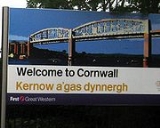
Cornish is a
BrythonicThe Brythonic or Brittonic languages form one of the two branches of the Insular Celtic language family, the other being Goidelic. The name Brythonic was derived by Welsh Celticist John Rhys from the Welsh word Brython, meaning an indigenous Briton as opposed to an Anglo-Saxon or Gael...
CelticThe Celtic languages are descended from Proto-Celtic, or "Common Celtic"; a branch of the greater Indo-European language family...
language and a recognised minority language of the
United KingdomThe United Kingdom of Great Britain and Northern IrelandIn the United Kingdom and Dependencies, other languages have been officially recognised as legitimate autochthonous languages under the European Charter for Regional or Minority Languages...
. Along with
WelshWelsh is a member of the Brythonic branch of the Celtic languages spoken natively in Wales, by some along the Welsh border in England, and in Y Wladfa...
and
BretonBreton is a Celtic language spoken in Brittany , France. Breton is a Brythonic language, descended from the Celtic British language brought from Great Britain to Armorica by migrating Britons during the Early Middle Ages. Like the other Brythonic languages, Welsh and Cornish, it is classified as...
, it is directly descended from the ancient
British languageThe British language was an ancient Celtic language spoken in Britain.British language may also refer to:* Any of the Languages of the United Kingdom.*The Welsh language or the Brythonic languages more generally* British English...
spoken throughout much of Britain before the English language came to dominate. The language continued to function as a common
communityThe term community has two distinct meanings:*a group of interacting people, possibly living in close proximity, and often refers to a group that shares some common values, and is attributed with social cohesion within a shared geographical location, generally in social units larger than a household...
language in parts of
CornwallCornwall is a unitary authority and ceremonial county of England, within the United Kingdom. It is bordered to the north and west by the Celtic Sea, to the south by the English Channel, and to the east by the county of Devon, over the River Tamar. Cornwall has a population of , and covers an area of...
until the late 18th century. Some children used the language to converse in, and families used it as a language of the home through the 19th century and possibly into the 20th. Some elderly speakers were known to be still living into the 20th century including one still alive in 1914. A process to revive the language was started in the early 20th century, continuing to this day.
The
revivalRevival may refer to:*Resuscitation of a person*Language revival of an extinct language*Revival of a defunct team*Revival of a former television series*Revival of a former hit play in a new production...
of Cornish began in 1904 when
Henry JennerHenry Jenner FSA was a British scholar of the Celtic languages, a Cornish cultural activist, and the chief originator of the Cornish language revival....
, a Celtic language enthusiast, published his book Handbook of the Cornish Language. Jenner's work was based on Cornish as it was spoken in the 18th century, although his pupil
Robert Morton NanceRobert Morton Nance was a leading authority on the Cornish language, nautical archaeologist, and joint founder of the Old Cornwall Society....
later steered the revival to the style of the 16th century, before the language became more heavily influenced by
EnglishEnglish is a West Germanic language that arose in the Anglo-Saxon kingdoms of England and spread into what was to become south-east Scotland under the influence of the Anglian medieval kingdom of Northumbria...
. This set the tone for the next few decades; as the revival gained pace, learners of the language disagreed on which style of Cornish to use, and a number of competing orthographies were in use by the end of the century.
Nevertheless, many Cornish language textbooks and works of literature have been published over the decades, and an increasing number of people are studying the language. Recent developments include Cornish
musicCornwall has been historically Celtic, though Celtic-derived musical traditions had been moribund for some time before being revived during a late 20th century roots revival.-History:...
,
independent filmAn independent film, or indie film, is a professional film production resulting in a feature film that is produced mostly or completely outside of the major film studio system. In addition to being produced and distributed by independent entertainment companies, independent films are also produced...
s and children's books. A small number of children in Cornwall have been brought up to be bilingual native speakers, and the language is taught in many schools. Cornish gained official recognition under the
European Charter for Regional or Minority LanguagesThe European Charter for Regional or Minority Languages is a European treaty adopted in 1992 under the auspices of the Council of Europe to protect and promote historical regional and minority languages in Europe...
in 2002, and in 2008 a
Standard Written FormThe Standard Written Form or SWF of the Cornish language is an orthography standard that is designed to "provide public bodies and the educational system with a universally acceptable, inclusive, and neutral orthography"...
was agreed in an attempt to unify the orthographies and move forward the revival. The first Cornish language
crècheChild care or day care is care of a child during the day by a person other than the child's legal guardians, typically performed by someone outside the child's immediate family...
opened in 2010.
Classification
Cornish is one of the
Brythonic languagesThe Brythonic or Brittonic languages form one of the two branches of the Insular Celtic language family, the other being Goidelic. The name Brythonic was derived by Welsh Celticist John Rhys from the Welsh word Brython, meaning an indigenous Briton as opposed to an Anglo-Saxon or Gael...
, which constitute a branch of the
Celtic languagesThe Celtic languages are descended from Proto-Celtic, or "Common Celtic"; a branch of the greater Indo-European language family...
. This branch also includes the
WelshWelsh is a member of the Brythonic branch of the Celtic languages spoken natively in Wales, by some along the Welsh border in England, and in Y Wladfa...
,
BretonBreton is a Celtic language spoken in Brittany , France. Breton is a Brythonic language, descended from the Celtic British language brought from Great Britain to Armorica by migrating Britons during the Early Middle Ages. Like the other Brythonic languages, Welsh and Cornish, it is classified as...
, the extinct
CumbricCumbric was a variety of the Celtic British language spoken during the Early Middle Ages in the Hen Ogledd or "Old North", or what is now northern England and southern Lowland Scotland, the area anciently known as Cumbria. It was closely related to Old Welsh and the other Brythonic languages...
, and perhaps the hypothetical Ivernic languages. The Scottish Gaelic,
IrishIrish , also known as Irish Gaelic, is a Goidelic language of the Indo-European language family, originating in Ireland and historically spoken by the Irish people. Irish is now spoken as a first language by a minority of Irish people, as well as being a second language of a larger proportion of...
, and
ManxManx , also known as Manx Gaelic, and as the Manks language, is a Goidelic language of the Indo-European language family, historically spoken by the Manx people. Only a small minority of the Island's population is fluent in the language, but a larger minority has some knowledge of it...
languages are part of the separate
GoidelicThe Goidelic languages or Gaelic languages are one of the two branches of the Insular Celtic languages, the other consisting of the Brythonic languages. Goidelic languages historically formed a dialect continuum stretching from the south of Ireland through the Isle of Man to the north of Scotland...
branch. Cornish shares about 80% basic vocabulary with Breton, 75% with Welsh, 35% with Irish, and 35% with Scottish Gaelic.
History
Historical background
Cornish evolved from the British language spoken throughout Britain south of the
Firth of ForthThe Firth of Forth is the estuary or firth of Scotland's River Forth, where it flows into the North Sea, between Fife to the north, and West Lothian, the City of Edinburgh and East Lothian to the south...
during the
Iron AgeThe British Iron Age is a conventional name used in the archaeology of Great Britain, referring to the prehistoric and protohistoric phases of the Iron-Age culture of the main island and the smaller islands, typically excluding prehistoric Ireland, and which had an independent Iron Age culture of...
and
Roman periodRoman Britain was the part of the island of Great Britain controlled by the Roman Empire from AD 43 until ca. AD 410.The Romans referred to the imperial province as Britannia, which eventually comprised all of the island of Great Britain south of the fluid frontier with Caledonia...
. Some scholars have proposed that the language split into
WesternWestern Brythonic was one of two dialects into which the British language split during the Early Middle Ages; its counterpart was Southwestern Brythonic. The reason and date for the split is often given as the Battle of Deorham in 577, at which point the victorious Saxons of Wessex essentially cut...
and Southwestern dialects, perhaps after the
Battle of DeorhamThe Battle of Deorham or Dyrham was fought in 577 between the West Saxons under Ceawlin and Cuthwine and the Britons of the West Country. The location, Deorham, is usually taken to refer to Dyrham in South Gloucestershire. The battle was a major victory for the West Saxons, who took three important...
in about
577Year 577 was a common year starting on Friday of the Julian calendar. The denomination 577 for this year has been used since the early medieval period, when the Anno Domini calendar era became the prevalent method in Europe for naming years.- Europe :* Battle of Deorham: The Anglo-Saxons under...
. This Southwestern Brythonic dialect later evolved into Cornish as well as
BretonBreton is a Celtic language spoken in Brittany , France. Breton is a Brythonic language, descended from the Celtic British language brought from Great Britain to Armorica by migrating Britons during the Early Middle Ages. Like the other Brythonic languages, Welsh and Cornish, it is classified as...
, while Western Brythonic became the
ancestorAn ancestor is a parent or the parent of an ancestor ....
to
WelshWelsh is a member of the Brythonic branch of the Celtic languages spoken natively in Wales, by some along the Welsh border in England, and in Y Wladfa...
and
CumbricCumbric was a variety of the Celtic British language spoken during the Early Middle Ages in the Hen Ogledd or "Old North", or what is now northern England and southern Lowland Scotland, the area anciently known as Cumbria. It was closely related to Old Welsh and the other Brythonic languages...
.
The proto-Cornish language developed after the Southwest Britons of
SomersetThe ceremonial and non-metropolitan county of Somerset in South West England borders Bristol and Gloucestershire to the north, Wiltshire to the east, Dorset to the south-east, and Devon to the south-west. It is partly bounded to the north and west by the Bristol Channel and the estuary of the...
,
DorsetDorset , is a county in South West England on the English Channel coast. The county town is Dorchester which is situated in the south. The Hampshire towns of Bournemouth and Christchurch joined the county with the reorganisation of local government in 1974...
,
DevonDevon is a large county in southwestern England. The county is sometimes referred to as Devonshire, although the term is rarely used inside the county itself as the county has never been officially "shired", it often indicates a traditional or historical context.The county shares borders with...
and
CornwallCornwall is a unitary authority and ceremonial county of England, within the United Kingdom. It is bordered to the north and west by the Celtic Sea, to the south by the English Channel, and to the east by the county of Devon, over the River Tamar. Cornwall has a population of , and covers an area of...
became linguistically separated from the West Britons of later
WalesWales is a country that is part of the United Kingdom and the island of Great Britain, bordered by England to its east and the Atlantic Ocean and Irish Sea to its west. It has a population of three million, and a total area of 20,779 km²...
after the
Battle of DeorhamThe Battle of Deorham or Dyrham was fought in 577 between the West Saxons under Ceawlin and Cuthwine and the Britons of the West Country. The location, Deorham, is usually taken to refer to Dyrham in South Gloucestershire. The battle was a major victory for the West Saxons, who took three important...
in about 577. The area controlled by the Southwest Britons was progressively reduced by the expansion of
WessexThe Kingdom of Wessex or Kingdom of the West Saxons was an Anglo-Saxon kingdom of the West Saxons, in South West England, from the 6th century, until the emergence of a united English state in the 10th century, under the Wessex dynasty. It was to be an earldom after Canute the Great's conquest...
over the next few centuries; in
927Year 927 was a common year starting on Monday of the Julian calendar.- Asia :* The Chu State is founded by Ma Yin....
AthelstanAthelstan , called the Glorious, was the King of England from 924 or 925 to 939. He was the son of King Edward the Elder, grandson of Alfred the Great and nephew of Æthelflæd of Mercia...
drove the south west Celts out of
ExeterExeter is a historic city in Devon, England. It lies within the ceremonial county of Devon, of which it is the county town as well as the home of Devon County Council. Currently the administrative area has the status of a non-metropolitan district, and is therefore under the administration of the...
and in
936Year 936 was a leap year starting on Friday of the Julian calendar.- Asia :* King Taejo of Goryeo defeats Hubaekje....
he set the east bank of the
TamarThe Tamar is a river in South West England, that forms most of the border between Devon and Cornwall . It is one of several British rivers whose ancient name is assumed to be derived from a prehistoric river word apparently meaning "dark flowing" and which it shares with the River Thames.The...
as the boundary between
Anglo-SaxonAnglo-Saxon may refer to:* Anglo-Saxons, a group that invaded Britain** Old English, their language** Anglo-Saxon England, their history, one of various ships* White Anglo-Saxon Protestant, an ethnicity* Anglo-Saxon economy, modern macroeconomic term...
WessexThe Kingdom of Wessex or Kingdom of the West Saxons was an Anglo-Saxon kingdom of the West Saxons, in South West England, from the 6th century, until the emergence of a united English state in the 10th century, under the Wessex dynasty. It was to be an earldom after Canute the Great's conquest...
and Celtic Cornwall. "Exeter was cleansed of its defilement by wiping out that filthy race" (
William of MalmesburyWilliam of Malmesbury was the foremost English historian of the 12th century. C. Warren Hollister so ranks him among the most talented generation of writers of history since Bede, "a gifted historical scholar and an omnivorous reader, impressively well versed in the literature of classical,...
, writing around 1120). There is no record of him taking his campaigns into Cornwall. It seems probable that
HywelHuwal was a Brythonic monarch of the early to mid-10th century recorded in the Anglo-Saxon Chronicle. The Chronicle refers to him as "king of the West Welsh", the usual Anglo-Saxon name for the Cornish or southwestern Britons...
, King of the Cornish, agreed to pay tribute to Athelstan and thus avoided more attacks and maintained a high degree of autonomy. However, the Cornish language continued to flourish well through the
Middle AgesThe Middle Ages is a periodization of European history from the 5th century to the 15th century. The Middle Ages follows the fall of the Western Roman Empire in 476 and precedes the Early Modern Era. It is the middle period of a three-period division of Western history: Classic, Medieval and Modern...
, reaching a peak of about 39,000 speakers in the 13th century. However, the number of Cornish speakers is thought to have declined thereafter.
The earliest written record of the Cornish language, dating from the 9th century AD, is a
glossA gloss is a brief notation of the meaning of a word or wording in a text. It may be in the language of the text, or in the reader's language if that is different....
in a
LatinLatin is an Italic language originally spoken in Latium and Ancient Rome. It, along with most European languages, is a descendant of the ancient Proto-Indo-European language. Although it is considered a dead language, a number of scholars and members of the Christian clergy speak it fluently, and...
manuscriptA manuscript or handwrite is written information that has been manually created by someone or some people, such as a hand-written letter, as opposed to being printed or reproduced some other way...
of
De Consolatione PhilosophiaeConsolation of Philosophy is a philosophical work by Boethius, written around the year 524. It has been described as the single most important and influential work in the West on Medieval and early Renaissance Christianity, and is also the last great Western work that can be called Classical.-...
by Boethius, which used the words ud rocashaas. The phrase means "it (the mind) hated the gloomy places".
Tudor Period to Restoration
In the reign of Henry VIII we have an
accountAccounting is a systematic way to record transactions.An Account refers to assets, liabilities, income, expenses, and equity, as represented by individual ledger pages, to which changes in value are chronologically recorded with debit and credit entries. These entries, referred to as postings,...
given by Andrew Borde in his Boke of the Introduction of Knowledge, written in 1542. He states, "In Cornwall is two speches, the one is naughty Englysshe, and the other is Cornysshe speche. And there be many men and women the which cannot speake one worde of Englysshe, but all Cornyshe."
At the time of the
Prayer Book rebellionThe Prayer Book Rebellion, Prayer Book Revolt, Prayer Book Rising, Western Rising or Western Rebellion was a popular revolt in Cornwall and Devon, in 1549. In 1549 the Book of Common Prayer, presenting the theology of the English Reformation, was introduced...
of 1549, which was a reaction to Parliament passing the first
Act of UniformityThe Act of Uniformity 1549 established The Book of Common Prayer as the sole legal form of worship in England...
, people in many areas of Cornwall did not speak or understand English (the intention of the Act was to replace worship in Latin with worship in English, which was known, by the lawmakers, not to be universally spoken throughout England. Instead of simply banning Latin, however, the Act was framed so as to enforce English). In 1549, this imposition of a new language was sometimes a matter of life and death: over 4,000 people who protested against the imposition of an English Prayer book were massacred by the king's (
Edward VI of EnglandEdward VI was the King of England and Ireland from 28 January 1547 until his death. He was crowned on 20 February at the age of nine. The son of Henry VIII and Jane Seymour, Edward was the third monarch of the Tudor dynasty and England's first monarch who was raised as a Protestant...
) army. Their leaders were executed and the people suffered numerous reprisals.
The rebels' document claimed they wanted a return to the old religious services and ended 'We the Cornishmen (whereof certain of us understand no English) utterly refuse this new English' (altered spelling).
Edward SeymourEdward Seymour, 1st Duke of Somerset, 1st Earl of Hertford, 1st Viscount Beauchamp of Hache, KG, Earl Marshal was Lord Protector of England in the period between the death of Henry VIII in 1547 and his own indictment in 1549....
, Duke of
SomersetThe ceremonial and non-metropolitan county of Somerset in South West England borders Bristol and Gloucestershire to the north, Wiltshire to the east, Dorset to the south-east, and Devon to the south-west. It is partly bounded to the north and west by the Bristol Channel and the estuary of the...
, replied to the Cornishmen, inquiring as to why they should be offended by services in English when they had them in Latin, which they also did not understand. Through many factors, including loss of life and the spread of English, the
Prayer Book RebellionThe Prayer Book Rebellion, Prayer Book Revolt, Prayer Book Rising, Western Rising or Western Rebellion was a popular revolt in Cornwall and Devon, in 1549. In 1549 the Book of Common Prayer, presenting the theology of the English Reformation, was introduced...
proved a turning-point for the Cornish language. Indeed, some recent research has suggested that estimates of the Cornish-speaking population prior to the rebellion may have been low, making the decline even more drastic.
By this time the language must already have been in decline from its earlier heyday, and the situation worsened over the course of the next century. Richard Carew in his 1602 work The Survey of Cornwall, notices the almost total extirpation of the Cornish language in his days. He says; The principal love and knowledge of this language liveth in
Dr. KennallDr John Kennall, LL.D. was Archdeacon of Oxford and a noted pluralist.Canon of 8th preb., Christ Church, Oxford, from 1559–1592, Archdeacon of Oxford, Oxford, from 1561-1592, Canon of 6th preb., Rochester, from 1556–1559, and Archdeacon of Rochester, 1554–1560...
, the civilian, and with him lieth buried.
TowednackTowednack is a village and civil parish in Cornwall, United Kingdom. The parish is bounded by those of Zennor in the west, Gulval in the south, Ludgvan in the east and St Ives in the north...
is claimed to be the location of the last church in which services were conducted in the Cornish language (in 1678), though the same claim has been made for
LudgvanLudgvan is a civil parish and village in Cornwall, England, UK. The village is situated 2½ miles northeast of Penzance.The parish includes the villages of Ludgvan, Crowlas, Canon's Town and Long Rock...
and for Landewednack. Carew also said Most of the inhabitants can speak no word of Cornish, but very few are ignorant of the English; and yet some so affect their own, as to a stranger they will not speak it; for if meeting them by chance, you inquire the way, or any such matter, your answer shall be, "Meea navidna caw zasawzneck", "I can speak no Saxonage".
18th-20th centuries
It will probably be impossible to establish who the definitive "last native speaker" of Cornish was owing to the lack of extensive research done at the time and the obvious impossibility of finding audio recordings dating from the era. There is also difficulty with what exactly is meant by "last native speaker", as this has been interpreted in differing ways. Some scholars prefer to use terms such as "last monoglot speaker", to refer to a person whose only language was Cornish, "last native speaker", to refer to a person who may have been bilingual in both English and Cornish and furthermore, "last person with traditional knowledge", that is to say someone who had an extensive knowledge of Cornish from traditional sources but had not studied the language per se.
The last known
monoglotMonoglottism or, more commonly, monolingualism or unilingualism is the condition of being able to speak only a single language...
Cornish speaker is believed to have been
Chesten MarchantChesten Marchant or Cheston Marchant, who died in 1676 at Gwithian, Cornwall is believed to have been the last monoglot Cornish speaker, as opposed to other speakers such as Dolly Pentreath who could also speak English.-References:...
, who died in 1676 at
Gwithianbeach2Gwithian is a coastal village in west Cornwall, United Kingdom. It is situated three miles northeast of Hayle and four miles east of St Ives, Cornwall across St Ives Bay....
. It is not known when she was born.
William ScawenWilliam Scawen was a one of the pioneers in the revival of the Cornish Language in England. He was a politician who sat in the House of Commons in 1640 and fought for the Royalist cause in the English Civil War....
, writing in the 1680s, states that Marchant had a "slight" understanding of English and had been married twice.
In 1742,
Captain Samuel BarringtonRear Admiral Samuel Barrington RN was a British admiral.Samuel was the fourth son of John Shute Barrington, 1st Viscount Barrington of Beckett Hall at Shrivenham in Berkshire...
of the
Royal NavyThe Royal Navy is the naval warfare service branch of the British Armed Forces. Founded in the 16th century, it is the oldest service branch and is known as the Senior Service...
made a voyage to
BrittanyBrittany is a cultural and administrative region in the north-west of France. Previously a kingdom and then a duchy, Brittany was united to the Kingdom of France in 1532 as a province. Brittany has also been referred to as Less, Lesser or Little Britain...
, taking with him a Cornish sailor of
Mount's BayMount's Bay is a large, sweeping bay on the English Channel coast of Cornwall in the United Kingdom, stretching from the Lizard Point to Gwennap Head on the eastern side of the Land's End peninsula. Towards the middle of the bay is St Michael's Mount...
. He was astonished that this sailor could make himself understood in
BretonBreton is a Celtic language spoken in Brittany , France. Breton is a Brythonic language, descended from the Celtic British language brought from Great Britain to Armorica by migrating Britons during the Early Middle Ages. Like the other Brythonic languages, Welsh and Cornish, it is classified as...
. In 1768, Barrington's brother
Daines BarringtonDaines Barrington, FRS was an English lawyer, antiquary and naturalist.Barrington was the fourth son of the first Viscount Barrington. He was educated for the profession of the law, and after filling various posts, was appointed a Welsh judge in 1757 and afterwards second justice of Chester...
searched for speakers of the Cornish language and at
MouseholeMousehole is a village and fishing port in Cornwall, United Kingdom. It is situated approximately 2½ miles south of Penzance on the shore of Mount's Bay.The village is in the civil parish of Penzance...
found
Dolly PentreathDolly Pentreath, or Dorothy Pentreath was probably the last fluent native speaker of the Cornish language, prior to its revival in 1904 and the subsequent small number of children brought up as bilingual native speakers of revived Cornish.She is often stated to have been the last monoglot speaker...
, a fish seller then aged about 82, who "could speak Cornish very fluently". In 1775, he published an account of her in the
Society of Antiquaries of LondonThe Society of Antiquaries of London is a learned society "charged by its Royal Charter of 1751 with 'the encouragement, advancement and furtherance of the study and knowledge of the antiquities and history of this and other countries'." It is based at Burlington House, Piccadilly, London , and is...
' journal Archaeologia, entitled On the Expiration of the Cornish Language. He reported that he had also found at Mousehole two other women, some ten or twelve years younger than Pentreath, who could not speak Cornish readily, but who understood it. Pentreath, who died in 1777, is popularly claimed to be the last
native speakerA first language is the language a person has learned from birth or within the critical period, or that a person speaks the best and so is often the basis for sociolinguistic identity...
of Cornish. Notwithstanding her reported last words, "Me ne vidn kewsel Sowsnek!" ("I will not speak English!"), she spoke at least some English.
Peter Berresford EllisPeter Berresford Ellis is an English historian, literary biographer, and novelist who has published over 90 books to date either under his own name or his pseudonyms Peter Tremayne and Peter MacAlan. He has also published 95 short stories...
poses the question of who was the last speaker of the language, and replies that "We shall never know, for a language does not die suddenly, snuffed out with one last remaining speaker... it lingers on for many years after it has ceased as a form of communication, many people still retaining enough knowledge from their childhood to embark on conversations..." He also notes that in 1777 John Nancarrow of
MarazionMarazion is a civil parish and town in Cornwall, United Kingdom. It is situated on the shore of Mount's Bay, two miles east of Penzance and one mile east of Long Rock.St Michael's Mount is half-a-mile offshore from Marazion...
(Cornish: Marghasyow), not yet forty, could speak the language, and that into the next century some Cornish people "retained a knowledge of the entire
Lord's PrayerThe Lord's Prayer is a central prayer in Christianity. In the New Testament of the Christian Bible, it appears in two forms: in the Gospel of Matthew as part of the discourse on ostentation in the Sermon on the Mount, and in the Gospel of Luke, which records Jesus being approached by "one of his...
and
CreedA creed is a statement of belief—usually a statement of faith that describes the beliefs shared by a religious community—and is often recited as part of a religious service. When the statement of faith is longer and polemical, as well as didactic, it is not called a creed but a Confession of faith...
in the language". Both Pryce, in his Archaeologia Cornu-Britannica (1790), and Whitaker, vicar of Ruan-Lanihorne, in his Supplement to Polwhele's History of Cornwall (1799), mention two or three people, known to them, able to speak Cornish. Polwhele himself mentions in his History of Cornwall, vol. v (1806), an engineer from Truro called Thompson, whom he met in 1789. Thompson was the author of Dolly Pentreath's epitaph and is said to have known far more Cornish than she ever did.
The Reverend John Bannister stated in 1871 that "The close of the 18th century witnessed the final extinction, as spoken language, of the old Celtic vernacular of Cornwall". However, there is some evidence that Cornish continued, albeit in limited usage by a handful of speakers, through the late 19th century. Matthias Wallis of St. Buryan certified in 1859 that his grandmother, Ann Wallis, who had died around 1844, had spoken Cornish well. He also stated that a Jane Barnicoate, who had died circa 1857, could speak Cornish too.
J. Gwyn GriffithsJohn Gwyn Griffiths , was a Welsh poet, Egyptologist and nationalist political activist who spent the largest span of his career lecturing at Swansea University.-Early history:...
commented that "there were Cornish immigrants who spoke the language in the leadmine villages of North Cardiganshire, Mid-Wales, in the 1850s". Mary Kelynack, the
MadronMadron is a civil parish and village in west Cornwall, United Kingdom. It is a large rural parish on the Penwith peninsula north of Penzance.Madron village is situated approximately two miles northwest of Penzance town centre....
born 84 year old who walked up to London to see the Great Exhibition in 1851 and was presented to the Queen, was believed to have been a Cornish speaker. In 1875 six speakers all in their sixties were discovered in Cornwall. John Tremethack, died 1852 at the age of eighty-seven, is believed to have known Cornish and passed some of it on to his daughter. George Badcock, grandfather of Bernard Victor of Mousehole, taught some Cornish to his grandson. The farmer
John DaveyJohn Davey or Davy was a Cornish farmer who was one of the last people with some traditional knowledge of the Cornish language. Jenner states that he level of his ability in the language is unclear, but was probably restricted to a few words and phrases...
, who died in 1891 at
BoswednackBoswednack is a village in the parish of Zennor near the north coast of the Penwith peninsula in Cornwall, United Kingdom....
,
ZennorZennor is a village and civil parish in Cornwall in England. The parish includes the villages of Zennor, Boswednack and Porthmeor and the hamlet of Treen. It is located on the north coast, about north of Penzance. Alphabetically, the parish is the last in Britain—its name comes from the Cornish...
, may have been the last person with some traditional knowledge of Cornish. However, other traces survived. Fishermen in West Penwith were counting fish using a rhyme derived from Cornish into the 20th century.
There is good evidence that at least three native speakers outlived John Davey junior: Jacob Care of St Ives (d. 1892); Elizabeth Vingoe of Higher Boswarva, Madron (d. 1903 and who taught at least some Cornish to her son); and John Mann, who was interviewed in his St Just home by Richard Hall (himself Elizabeth Vingoe's nephew) in 1914, Mann was then 80. He told Hall that, when a child in Boswednack, Zennor, he and several other children always conversed in Cornish while at play together. This would have been around 1840-1850. They would certainly have known Cornish speaker Anne Berryman (1766–1854), also of Boswednack. In 1935 a retired policeman, Mr Therris, reported that when he was a youth in about 1875 he used to go to sea fishing with some Newlyn fishermen who were in the habit of speaking Cornish while on the boat and held conversations which lasted up to ten minutes at a time. The foreman supervising the launching of boats at St Ives in the 1920s would shout "Hunchi boree" which means Heave away now! possibly the last recorded sentence of traditional Cornish.
Further into the 20th Century we get Arnie Weekes, a Canadian-Cornishman, who claimed that his mother's family came from an unbroken line of Cornish speakers. It was found on his several visits to Cornwall in the late 1990s that either he or his parents had learned the Unified form of revived Cornish and therefore any trace of traditional Cornish was lost. In 2007 it was reported by an R Salmon of New Zealand, on the BBC's Your Voice: Multilingual Nation website, that "Much Cornish was passed down through my family" giving the possibility that other families of Cornish extraction around the world possess traditional knowledge of Cornish.
In 2010 Rhisiart Tal-e-bot disputed the death of Cornish saying that the grandparents of a student of his had spoken Cornish at home. He said: “It’s a myth. There was never a time when the language completely died out, people always had some knowledge of the language although it went quite underground.” Likewise Andrew George MP for St Ives has stated that "In the early part of the century, my grandparents on the Lizard were speaking Cornish in a dialect form at home".
Revived language
In the 20th century a conscious effort was made to revive Cornish as a language for everyday use in speech and writing (see below for further details about the dialects of modern Cornish).
This revival can be traced to the work of Jenner, who in 1904 published his work A Handbook of the Cornish Language. This formed the basis for the language revival and learning. According to the sociologist Kenneth MacKinnon, Jenner wrote "There has never been a time when there has been no person in Cornwall without [sic] a knowledge of the Cornish language."
The number of Cornish speakers is growing. Determining a figure for the number of Cornish speakers depends on how the ability to speak the language is defined. One figure for the mean amount of people who know a few basic words, such as knowing that "Kernow" means "Cornwall", was 300,000; the same survey gave the figure of people able to have simple conversations at 3,000. The Cornish Language Strategy project commissioned research to provide quantitative and qualitative evidence for the number of Cornish speakers: due to the success of the revival project it was estimated that 2,000 people were fluent (surveyed in spring 2008), an increase from the estimated 300 people who spoke Cornish fluently suggested in a study by Kenneth MacKinnon in 2000.
Cornish continues to survive in the place-names of Cornwall, as well as in
Cornish surnamesCornish surnames are surnames used by Cornish people and often derived from the Cornish language. Such surnames for the common people emerged in the Middle Ages, although the nobility probably had surnames much earlier on. Not until the later Middle Ages did it become necessary for a common man to...
, and knowledge of the language helps the understanding of these ancient meanings. Many Cornish names are adopted for children, pets, houses and boats. There is now an increasing amount of Cornish literature, in which poetry is the most important genre, particularly in oral form or as song or as traditional Cornish chants historically performed in marketplaces during religious holidays and public festivals and gatherings. Cornwall Council's (Cornish: Konsel Kernow) policy is to support the language. A motion passed in November 2009 approved the council's use of Cornish. The policy notes the "place of the Cornish language as a unique cultural asset" and requires the council to promote Cornish in line with the European Charter for Regional or Minority Languages. One effect of the policy is that worn out road signs are replaced by bilingual ones.
There are regular periodicals solely in the language such as the monthly An Gannas, An Gowsva, and An Garrick.
BBC Radio CornwallBBC Radio Cornwall is the BBC Local Radio service for Cornwall and the Isles of Scilly in the United Kingdom. It broadcasts from its studios on Phoenix Wharf in Truro on 95.2 in the east, 96.0 on the Isles of Scilly and 103.9 in the west MHz FM, as well as on DAB.Andrew George, MP for St Ives, has...
has a regular news broadcast in Cornish, and sometimes has other programmes and features for learners and enthusiasts. Local newspapers such as the
Western Morning NewsThe Western Morning News is a politically independent daily regional newspaper founded in 1860 and covering Devon and Cornwall and parts of Somerset and Dorset.-Organisation:...
regularly have articles in Cornish, and newspapers such as The Packet, The West Briton and The Cornishman also support the movement.
There is now also an online radio service in Cornish called
Radyo an Gernewegva. It publishes a half an hour podcast per week, based on a magazine format. It includes music in Cornish as well as interviews and features.
The language has financial sponsorship from many sources, including the
Millennium CommissionThe Millennium Commission in the United Kingdom was set up to aid communities at the end of the 2nd millennium and the start of the 3rd millennium. It used funding raised through the UK National Lottery....
. A number of language organisations exist in Cornwall including (in alphabetical order)
Agan TavasAgan Tavas is a society which exists to promote the Cornish language, and is represented on the Cornish Language Partnership. It was formed in 1987 to promote the use of Cornish as a spoken language. At that time only those observed to be using the language fluently could become members by...
(Our Language), the Cornish sub-group of the
European Bureau for Lesser-Used LanguagesThe European Bureau for Lesser-Used Languages is a non-governmental organisation that was set up to promote linguistic diversity and languages. It was founded in 1982...
,
Gorseth KernowGorseth Kernow is a non-political Cornish organisation, which exists to maintain the national Celtic spirit of Cornwall in the United Kingdom.-History:...
,
Kesva an Taves KernewekKesva an Taves Kernewek is an organisation that promotes the Cornish language. It was founded in 1967 by Gorseth Kernow and the Federation of Old Cornwall Societies. It is represented on the official language body, the Cornish Language Partnership.It currently has 18 members, 13 elected and 5...
(the Cornish Language Board),
Kowethas an Yeth KernewekKowethas an Yeth Kernewek is a Cornish language association which exists to promote,encourage and foster the use of the Cornish language...
(the Cornish Language Fellowship), and
Teere ha Tavas (Land and Language). One organisation,
DallethDalleth was a support organisation for parents and families bringing up children to speak Cornish. It organised camps and other children's activities, mostly during Cornish Language related events...
(now defunct), promoted the language to pre-school children. There are many popular ceremonies, some ancient, some modern, which use the language or are entirely in the language. The language has been officially recognised as one of the historical regional and minority languages in Europe (see European recognition below).
UNESCO'sThe United Nations Educational, Scientific and Cultural Organization is a specialized agency of the United Nations...
Atlas of World Languages classifies Cornish as "critically endangered". UNESCO has acknowledged that a previous classification of 'extinct', which came under fierce criticism from Cornish speakers, "does not reflect the current situation for Cornish".
European recognition
On 5 November 2002, in answer to a Parliamentary Question, Local Government and Regions Minister
Nick RaynsfordWyvill Richard Nicolls Raynsford , known as Nick Raynsford, is a British Labour Party politician. A government minister from 1997 to 2005, he has been the Member of Parliament for Greenwich & Woolwich since 1997, having previously been MP for Greenwich from 1992 to 1997, and for Fulham from 1986...
said:
Officials will be starting discussions with Cornwall Council and Cornish language organisations to ensure the views of Cornish speakers and people wanting to learn Cornish are taken into account in implementing the Charter.
Government funding for the Cornish language
In June 2005, after much pressure from language groups and others such as the
Gorseth KernowGorseth Kernow is a non-political Cornish organisation, which exists to maintain the national Celtic spirit of Cornwall in the United Kingdom.-History:...
, the government allocated £80,000 per year for three years of direct central government funding to the Cornish language. There have been complaints however that in the same period Ulster Scots is being allocated £1,000,000 per year of direct government funding. This comes after the British government acknowledged in its 1st
European Charter for Regional or Minority LanguagesThe European Charter for Regional or Minority Languages is a European treaty adopted in 1992 under the auspices of the Council of Europe to protect and promote historical regional and minority languages in Europe...
compliance report that: "There are no current demands from within the school system for Ulster-Scots to be taught as a language. There have been concerns that while the ECRML Level II Cornish language remains in the slow lane, the Ulster-Scots language is to be made a ECRML Level III language."
Sources on Traditional Cornish
The Southwestern Brythonic, or Southwestern Brittonic, language evolved into Cornish, shrinking from the whole southwest of England into the western tip of Cornwall with time.
Kenneth H. JacksonKenneth Hurlstone Jackson was an English linguist and a translator who specialised in the Celtic languages. He demonstrated how the text of the Ulster Cycle of tales, written circa AD 1100, preserves an oral tradition originating some six centuries earlier and reflects Celtic Irish society of the...
has divided this long period into several sub-periods, each having different linguistic innovations.
"Primitive Cornish" existed between about 600 and 800 AD, but nothing survives from this time. The "Old Cornish" period was between 800 and 1200 AD, for which there is a Cornish-Latin dictionary (the Vocabularium Cornicum or Cottonian Vocabulary; MS. Cotton Vespasian A.xiv) and various 10th century glosses in Latin manuscripts such as the
Bodmin manumissionsThe Bodmin manumissions or Bodmin Gospels is a manuscript supposed to be of the 9th century. The document is of interest to language scholars as it contains writing in Latin, Saxon and Cornish texts....
giving the Cornish names of freed slaves.
Prophetiae Merlini (
Prophecy of MerlinProphecy of Merlin , sometimes called The Prophecy of Ambrosius Merlin concerning the Seven Kings, is a 12th-century poem written in Latin hexameters by John of Cornwall, which he claimed was based or revived from a lost manuscript in the Cornish language. The original manuscript is unique and...
) a manuscript dating from about 1133 written in
LatinLatin is an Italic language originally spoken in Latium and Ancient Rome. It, along with most European languages, is a descendant of the ancient Proto-Indo-European language. Although it is considered a dead language, a number of scholars and members of the Christian clergy speak it fluently, and...
by John of Cornwall, contains some margin notes in the Cornish language. The original
manuscriptA manuscript or handwrite is written information that has been manually created by someone or some people, such as a hand-written letter, as opposed to being printed or reproduced some other way...
is unique and currently held in a
codexA codex is a book in the format used for modern books, with multiple quires or gatherings typically bound together and given a cover.Developed by the Romans from wooden writing tablets, its gradual replacement...
at the
Vatican LibraryThe Vatican Library is the library of the Holy See, currently located in Vatican City. It is one of the oldest libraries in the world and contains one of the most significant collections of historical texts. Formally established in 1475, though in fact much older, it has 75,000 codices from...
. The manuscript attracted little attention from the scholarly world until 1876 when Whitley Stokes undertook a brief analysis of the Cornish and Welsh vocabulary found in John's marginal commentary.
The "Middle Cornish" period between 1200 and 1578 has many sources of information, mostly religious texts. There are about 20,000 lines of text in total. Various plays were written by the canons of
Glasney CollegeGlasney College was founded in 1265 at Penryn, Cornwall, by Bishop Bronescombe and was a centre of ecclesiastical power in medieval Cornwall and probably the best known and most important of Cornwall's religious institutions.-History:...
, intended to educate the Cornish people about the Bible and the Celtic saints.
The "Late Cornish" period from 1578 to about 1800 has fewer sources of information on the language. In this period there was considerable input from the English language. In 1776 William Bodinar, who had learnt Cornish from fishermen, wrote a letter in Cornish which was probably the last prose in the language. However, the last verse was the
Cranken RhymeThe "Cranken Rhyme" is a Cornish-language song known by John Davey, one of the last people with some knowledge of the tongue. It was recorded by J. Hobson Matthews in his History of St. Ives, Lelant, Towednack, and Zennor, and is probably the latest known traditional Cornish verse.Matthews records...
written in the late 19th century by
John DaveyJohn Davey or Davy was a Cornish farmer who was one of the last people with some traditional knowledge of the Cornish language. Jenner states that he level of his ability in the language is unclear, but was probably restricted to a few words and phrases...
of
BoswednackBoswednack is a village in the parish of Zennor near the north coast of the Penwith peninsula in Cornwall, United Kingdom....
.
William Bodinar's letter 1776
This is an example of Cornish written by the hand of a native speaker
http://corpus.kernewek.cymru247.net/wb.txt. The text is also interesting from a sociolinguistic point of view in that Bodinar speaks about the contemporary state of the Cornish language in 1776.
| Bodinar's original spelling |
Curnoack Nowedga or Modern Cornish transcription |
Bluth vee ew try egance a pemp.
Thera vee dean bodgack an puscas.
Me rig deskey Cornoack termen me vee mawe.
Me vee de more gen seara vee a pemp dean mouy en cock.
Me rig scantlower clowes eden ger Sowsnack en cock rag sythen warebar.
Na riga vee biscath gwellas lever Cornoack.
Me deskey Cornoack moas da more gen tees coath.
Nag es mouy vel pager po pemp en dreav nye ell clapia Cornoack leben,
poble coath pager egance blouth.
Cornoack ewe oll naceaves gen poble younk. |
Bluth vee ewe try egence a pemp.
Theara vee dean Bodjack an poscas.
Me rig deskey Cornoack termen me vee mawe.
Me vee demore gen seara vee a pemp dean moy en cock.
Me rig scantlower clowes eden ger Sowsnack cowes en cock rag sythen ware Bar.
Na rig a vee Biscath gwellas lever Cornoack.
Me deskey Cornoack moas da maor gen tees coath.
Na ges moye vel pager po pemp en dreav nye ell clapia Cornoack leben,
poble coath pager egence blouth.
Cornoack ewe oll neceaves gen poble younk. |
| Standard Written Form The Standard Written Form or SWF of the Cornish language is an orthography standard that is designed to "provide public bodies and the educational system with a universally acceptable, inclusive, and neutral orthography"... transcription (Late variant) |
Kernowek Standard Kernowek Standard is a variety of revived Cornish and a proposed set of revisions to the Standard Written Form. Developed gradually by a group called UdnFormScrefys , it was published as a proposal in a series of revisions. Its principal authors were Michael Everson, Neil Kennedy, and Nicholas... transcription |
Bloodh ve ew trei ugens ha pymp.
Th ero’ve den bohojek an puskes.
Me rug desky Kernowek e’n termyn me veu maw.
Me veu dhe mor gen sira ve ha pymp den moy e’n cok.
Me rug scant lowr clowes udn ger Sowsnek cowsys e’n cok rag seythen warbar’.
Na ruga'vy byscath gweles lyver Kernowek.
Me rug desky Kernowek o’ mos dhe mor gen tus coth.
Nag eus moy ’vel pajar po pymp e’n drev nei ell clappya Kernowek lebmyn,
pobel coth pajar ugens bloodh.
Kernowek ew oll nakevys gen pobel yonk. |
Bloodh vy yw try ugans ha pymp.
Th’erovy den bohojak an pùscas.
Me wrug desky Kernowek termyn me veu maw.
Me veu de mor gen sîra vy ha pymp den moy i’n côk.
Me wrug scantlowr clowes udn ger Sowsnek côwsys i’n cok rag seythen warbarth.
Na wrug avy byscath gweles lyver Kernowek.
Me wrug desky Kernowek ow mos de mor gen tus coth.
Nag eus moy ’vell pajer po pymp i’n dre ny yll clappya Kernowek lebmyn,
pobel coth pajer ugans bloodh.
Kernowek yw oll nakevys gen pobel yonk. |
| Kernewek Kemmyn Kernewek Kemmyn is a variety of the revived Cornish language.Kernewek Kemmyn was developed, mainly by Ken George, from Unified Cornish in 1986. It takes much of its inspiration from medieval sources, particularly Cornish passion plays, as well as Breton and to a lesser extent Welsh... or Common Cornish translation |
English translation |
[Ow] bloedh vy [yw] tri ugens ha pymp.
Yth esov vy den boghosek an puskes.
My a wrug dyski Kernewek [y'n] termyn [ha] my a veu maw.
My a veu dhe'n mor gans [ow] sira vy ha pymp den moy y'n kok.
My a wrug skantlowr klywes unn ger Sowsnek y'n kok rag seythun warbarth.
Ny wruga vy bythkweyth gweles lyver Kernewek.
My a wrug dyski Kernewek ow mos dhe'n mor gans tus koth.
Nyns eus moy es peswar po pymp y'n trev ni a yll klappya Kernewek lemmyn,
pobel goth peswar ugens bloedh.
Kernewek yw oll ankevys gans pobel yowynk. |
I'm sixty-five years old.
I'm a humble fisherman.
I learnt Cornish when I was a boy.
I was at sea with my father and five more men in a fishing boat.
I heard scant a single word of English in the boat for in seven days.
I did not ever see a Cornish book.
I learnt Cornish going to sea with the old men.
There are no more than four or five in our village who can talk Cornish now,
old people, eighty years old.
Cornish is all forgotten by the young people. |
Place-name evidence
Further information on traditional Cornish can be obtained from the place-names (toponyms) of Cornwall that not only reflect meaning but also language change throughout the period in which Cornish was spoken in Cornwall. The place-names have been analysed into elements for which meanings have been inferred.
Rise of Cornish studies
William ScawenWilliam Scawen was a one of the pioneers in the revival of the Cornish Language in England. He was a politician who sat in the House of Commons in 1640 and fought for the Royalist cause in the English Civil War....
produced an epic manuscript on the declining Cornish language that continually evolved until he died in 1689, aged 89. He was the first person to realise the language was dying out and wrote detailed manuscripts which he started working on when he was 78. The only version that was ever published was a short first draft, but the final version, which he worked on until his death, is hundreds of pages long. At the same time a group of scholars, led by John Keigwin (nephew of William Scawen), of Mousehole, tried to preserve and further the Cornish language. They left behind a large number of translations of parts of the Bible, proverbs and songs. This group was contacted by the Welsh linguist
Edward LhuydEdward Lhuyd was a Welsh naturalist, botanist, linguist, geographer and antiquary. He is also known by the Latinized form of his name, Eduardus Luidius....
who came to Cornwall to study the language.
Early Modern Cornish was the subject of a study published by Lhuyd in 1707, and differs from the medieval language in having a considerably simpler structure and grammar. Such differences included the wide use of certain modal affixes that, although out of use by Lhuyd's time, had a considerable effect on the word-order of medieval Cornish. The medieval language also possessed two additional tenses for expressing past events and an extended set of possessive suffixes. Edward Lhuyd theorises that the language of this time was heavily inflected, possessing not just the genitive, ablative and locative cases so common in Early Modern Cornish, but also dative and accusative cases, and even a vocative case, although historical references to this are rare.
John WhitakerJohn Whitaker B.D., F.S.A. , was an English historian and Anglican clergyman. Besides historical studies on the Roman Empire and on the early history of Great Britain he was a reviewer for London magazines and a poet.-Life:He was the son of James Whitaker, innkeeper, and was born in Manchester on...
the Manchester-born rector of Ruan Lanihorne, studied the decline of the Cornish language. In his 1804 work the Ancient Cathedral of Cornwall he concluded that: "[T]he English Liturgy, was not desired by the Cornish, but forced upon them by the tyranny of England, at a time when the English language was yet unknown in Cornwall. This act of tyranny was at once gross barbarity to the Cornish people, and a death blow to the Cornish language.".
Robert Williams published the first comprehensive Cornish dictionary in 1865, the Lexicon Cornu-Britannicum. As a result of the discovery of additional ancient Cornish manuscripts, 2000 new words were added to the vocabulary by Whitley Stokes in A Cornish Glossary. William C. Borlase published Proverbs and Rhymes in Cornish in 1866 while A Glossary of Cornish Place Names was produced by John Bannister in the same year. Dr
Frederick JagoFred W. P. Jago, , MB, was a scholar best known for his work The Ancient Language and the Dialect of Cornwall, originally published 1882, by Netherton and Worth of Truro. He also published a Cornish dictionary in 1887. He settled at Bodmin in 1843 and practised medicine there.-External links:...
published his English-Cornish Dictionary in 1882.
Revival
During the 19th century the Cornish language was the subject of antiquarian interest and a number of lectures were given on the subject and pamphlets on it were published. In 1904 the Cornish Revival began with publication of
Henry JennerHenry Jenner FSA was a British scholar of the Celtic languages, a Cornish cultural activist, and the chief originator of the Cornish language revival....
's Handbook of the Cornish Language. The publication included Cornish spelling as it was last used when Cornish was a community language in the 18th century. This orthography had never been standardised and so had many variants. In response to this a unified system of spelling was needed, and, in 1929
Robert Morton NanceRobert Morton Nance was a leading authority on the Cornish language, nautical archaeologist, and joint founder of the Old Cornwall Society....
standardised a form of Cornish with
Unified CornishUnified Cornish is a variety of revived Cornish. Developed gradually by Morton Nance during and before the 1930s, it derived its name from its standardisation of the variant spellings of traditional Cornish MSS...
based upon written Middle Cornish from the Medieval period. Nance was a purist who tended to prefer older ‘Celtic’ forms rather than the historically more recent forms deriving from Middle and Early Modern English. Nevertheless, Nance's system became the standard form for Cornish and remained so until the 1980s, when people started to challenge Unified Cornish feeling that it too was flawed.
Ken GeorgeKenneth J. George, writing as Ken George, is an oceanographer, poet, and linguist noted as being the originator of Kernewek Kemmyn, an orthography for the Cornish language supporters claimed to be more faithful to Middle Cornish phonology than its precursor . Kernewek Kemmyn was introduced in 1987...
studied the sounds of Cornish based on the early works of Lluyd, and had sought to create a bridge between Unified and Late Cornish, as had been used by
Henry JennerHenry Jenner FSA was a British scholar of the Celtic languages, a Cornish cultural activist, and the chief originator of the Cornish language revival....
, but instead George devised a new system on realising the flaws in Unified Cornish. This was held to have the advantage of the written word accurately representing the spoken word based upon George’s own theories. George's system, or the phonemic system as it later became known, was officially named
Kernewek KemmynKernewek Kemmyn is a variety of the revived Cornish language.Kernewek Kemmyn was developed, mainly by Ken George, from Unified Cornish in 1986. It takes much of its inspiration from medieval sources, particularly Cornish passion plays, as well as Breton and to a lesser extent Welsh...
(Common Cornish) and after a one year discussion the Cornish Language Board agreed to adopt it in 1987. This decision caused division in the Cornish language community, especially since people had been using Nance's old system for years and were unfamiliar with the new one.
These divisions continued when
Kernewek KemmynKernewek Kemmyn is a variety of the revived Cornish language.Kernewek Kemmyn was developed, mainly by Ken George, from Unified Cornish in 1986. It takes much of its inspiration from medieval sources, particularly Cornish passion plays, as well as Breton and to a lesser extent Welsh...
was itself challenged in 1995 by
Nicholas WilliamsNicholas Jonathan Anselm Williams , writing as Nicholas Williams or sometimes N.J.A...
in his book "Cornish Today" that listed 26 major flaws in
Kernewek KemmynKernewek Kemmyn is a variety of the revived Cornish language.Kernewek Kemmyn was developed, mainly by Ken George, from Unified Cornish in 1986. It takes much of its inspiration from medieval sources, particularly Cornish passion plays, as well as Breton and to a lesser extent Welsh...
and devised yet another new form of Unified Cornish, namely "Unified Cornish Revised". A dictionary of Unified Cornish Revised appeared later, selling enough to merit a second edition, and to date this is considered the most comprehensive dictionary of the Cornish language. A reply to "Cornish Today" appeared soon after in the book "Kernewek Kemmyn – Cornish for the Twenty First Century" by Ken George and Paul Dunbar to which a reply appeared in 2007.
In order to end this ceaseless in-fighting and polemics that many feel have hindered the Cornish language's revival, it was decided to aim for a Standard Written Form once and for all. The fourth and final Standard Written Form draft was generated on 30 May 2008. Another step forward came on 17 June 2009, when it was reported that for the unity and future of the Cornish language a decision was made by the bards of the
Gorseth KernowGorseth Kernow is a non-political Cornish organisation, which exists to maintain the national Celtic spirit of Cornwall in the United Kingdom.-History:...
at their annual meeting under the leadership of Grand Bard
Vanessa BeemanVanessa Beeman was born Vanessa Hocking in Nairobi and at a younger age lived in Tanzania. Her father Kaspar Hocking was employed as a Government entomologist in East Africa.-Early life:...
. By an overwhelming majority and after two decades of debate they adopted the Standard Written Form (SWF) for their ceremonies and correspondence. From the earliest days under Grand Bards
Henry JennerHenry Jenner FSA was a British scholar of the Celtic languages, a Cornish cultural activist, and the chief originator of the Cornish language revival....
and Morton Nance the 'Unified Form' has been used for the Gorsedd ceremony.
Unified Cornish
The first successful attempt to
reviveLanguage revitalization, language revival or reversing language shift is the attempt by interested parties, including individuals, cultural or community groups, governments, or political authorities, to reverse the decline of a language. If the decline is severe, the language may be endangered,...
Cornish was largely the work of
Henry JennerHenry Jenner FSA was a British scholar of the Celtic languages, a Cornish cultural activist, and the chief originator of the Cornish language revival....
and
Robert Morton NanceRobert Morton Nance was a leading authority on the Cornish language, nautical archaeologist, and joint founder of the Old Cornwall Society....
in the early part of the twentieth century. Jenner published his "Handbook of the Cornish Language" in 1904 while Nance published "Cornish For All" in 1929. A. S. D. Smith produced Lessons in Spoken Cornish in 1931.
The resulting system was called
Unified CornishUnified Cornish is a variety of revived Cornish. Developed gradually by Morton Nance during and before the 1930s, it derived its name from its standardisation of the variant spellings of traditional Cornish MSS...
or UC (Kernewek Uny[e]s, KU) and was based mainly on Middle Cornish (the language of the fourteenth and fifteenth centuries — a high point for Cornish literature), with a standardised spelling and an extended vocabulary based largely on
BretonBreton is a Celtic language spoken in Brittany , France. Breton is a Brythonic language, descended from the Celtic British language brought from Great Britain to Armorica by migrating Britons during the Early Middle Ages. Like the other Brythonic languages, Welsh and Cornish, it is classified as...
and
WelshWelsh is a member of the Brythonic branch of the Celtic languages spoken natively in Wales, by some along the Welsh border in England, and in Y Wladfa...
. A dictionary of Unified Cornish was published by Nance in the 1930s. For many years, this was the "modern Cornish" language, and many people still use it today.
Shortcomings in Unified Cornish had to do in part with the stiff and archaizing literary style Nance had employed, and in part with a realisation that Nance's phonology lacked some distinctions which must have existed in traditional Cornish. In the 1970s,
Tim SaundersTim Saunders is a Cornish language poet who also writes poetry and journalism in the Welsh, Irish, Breton and Cornish languages. He is resident in Cardiff but is of Cornish descent. He is a bard of the Gorseth Kernow, a literary historian and editor of 'The Wheel' – an anthology of modern poetry in...
raised a number of issues of communicative efficiency, but his initiative had no influence and later developments are entirely independent.
Modern Cornish or Revived Late Cornish
In the early 1980s,
Richard GendallRichard Gendall is a British expert on the Cornish language, born in 1924. He is the founder of "Modern Cornish"/Curnoack Nowedga, which split off during the 1980s. Whereas Ken George mainly went to Medieval Cornish as the inspiration for his revival, Gendall went to the last surviving records of...
, who had worked with Nance, published a new system based on the works of writers such as
Nicholas BosonNicholas Boson was a writer in, and preserver of, the Cornish language. He was born in Newlyn to a landowning and merchant family involved in the pilchard fisheries....
and
John BosonJohn Boson was a writer in the Cornish language. The son of Nicholas Boson, he was born in Paul, Cornwall. He taught Cornish to William Gwavas. His works in Cornish include an epitaph for the language scholar John Keigwin, and the "Pilchard Curing Rhyme". He also translated parts of the Bible, the...
, William Rowe, Thomas Tonkin and others, some of the last Cornish writers before the language's extinction. This system, called
Modern CornishModern Cornish is a variety of the revived Cornish language. It is sometimes called Revived Late Cornish or Kernuack Dewethas, to distinguish it from other forms of contemporary revived Cornish....
(Kernûak Nowedga) by its proponents, differs from Unified Cornish in using the English-influenced orthographies of the 17th and 18th centuries, though there are also differences of vocabulary and grammar. It is sometimes called "Revived Late Cornish" or RLC as well. Writers of Late Cornish often wrote Cornish using the English orthographic equivalent of the nearest equivalent English sound. For instance, the word for 'good' typically spelt dâ 'good' could also be written daa, and the word for 'month' could be spelt mîz or meez. The need for standard spelling when learning a language has led the
Cornish Language CouncilCussel an Tavas Kernuak is an organisation promoting the revival of the Cornish language, and is represented on the Cornish Language Partnership. The CLC encourages research into the Cornish of all periods but supports the teaching and dissemination of modern rather than medieval Cornish...
to adopt the Revived Late Cornish spelling standardised by Gendall and Neil Kennedy. This makes sparing use of accents (as did writers of Modern Cornish at the time).
Kernewek Kemmyn or Common Cornish
In 1986
Ken GeorgeKenneth J. George, writing as Ken George, is an oceanographer, poet, and linguist noted as being the originator of Kernewek Kemmyn, an orthography for the Cornish language supporters claimed to be more faithful to Middle Cornish phonology than its precursor . Kernewek Kemmyn was introduced in 1987...
developed a revised orthography (and phonology) for Revived Cornish, which became known as
Kernewek KemmynKernewek Kemmyn is a variety of the revived Cornish language.Kernewek Kemmyn was developed, mainly by Ken George, from Unified Cornish in 1986. It takes much of its inspiration from medieval sources, particularly Cornish passion plays, as well as Breton and to a lesser extent Welsh...
or KK (lit. Common Cornish). It was subsequently adopted by
the Cornish Language BoardKesva an Taves Kernewek is an organisation that promotes the Cornish language. It was founded in 1967 by Gorseth Kernow and the Federation of Old Cornwall Societies. It is represented on the official language body, the Cornish Language Partnership.It currently has 18 members, 13 elected and 5...
as their preferred system. It retained a Middle Cornish base but made the spelling more systematic by applying
phonemic orthographic theoryA phonemic orthography is a writing system where the written graphemes correspond to phonemes, the spoken sounds of the language. In terms of orthographic depth, these are termed shallow orthographies, contrasting with deep orthographies...
, and for the first time set out clear rules relating spelling to pronunciation. The revised system is claimed to have been taken up enthusiastically by the majority of Cornish speakers and learners, and advocates of this orthography claim that it was especially welcomed by teachers. Nevertheless, many Cornish speakers chose to continue using Unified Cornish. Despite later criticism by
Nicholas WilliamsNicholas Jonathan Anselm Williams , writing as Nicholas Williams or sometimes N.J.A...
(see below),
Kernewek KemmynKernewek Kemmyn is a variety of the revived Cornish language.Kernewek Kemmyn was developed, mainly by Ken George, from Unified Cornish in 1986. It takes much of its inspiration from medieval sources, particularly Cornish passion plays, as well as Breton and to a lesser extent Welsh...
has retained the support of many active Cornish speakers.
Unified Cornish Revised
In 1995 an alternative revision of Unified Cornish known as Unified Cornish Revised or UCR (Kernowek Unys Amendys, KUA) was proposed by Nicholas Williams. UCR built on traditional Unified Cornish, making the spellings regular while keeping as close as possible to the orthographic practices of the medieval scribes. The rationale behind UCR was that only attested Cornish can serve as a guide to its phonology, and that other attempts at regularisation had on the one hand introduced alien elements and on the other hand not known how to interpret the variations in extant material, which it turned to explain in accordance with the assumptions of nineteenth-century Middle European philology. In common with Kernewek Kemmyn, UCR made use of Tudor and Late Cornish prose materials unavailable to Nance. Williams published his English–Cornish Dictionary in this orthography in 2000; the second edition was published in 2006. Like the other orthographies, UCR also has its adherents and its detractors.
Unification projects
In practice these different written forms do not prevent Cornish-speakers from communicating with each other effectively. Cornish has been successfully revived as a viable language for communication. Nevertheless there is still much scope for improving the standard and accuracy of the spoken language. The language is spoken mainly with the older generations, but is currently being taught at some Cornish primary and secondary schools.
In response to the orthographic mayhem, the Cornish Language Partnership has initiated a period of review. In 2007 an independent Cornish Language Commission consisting of sociolinguists and linguists from outside of Cornwall was formed to review the four existing forms (UC, RLC, KK, and UCR) and consider whether any of those could be suitable to be a Single Written Form for Cornish, or whether a new fifth form should be adopted. Two groups made proposals of compromise orthographies.
- The UdnFormScrefys (Single Written Form) Group proposed an orthography called Kernowek Standard
Kernowek Standard is a variety of revived Cornish and a proposed set of revisions to the Standard Written Form. Developed gradually by a group called UdnFormScrefys , it was published as a proposal in a series of revisions. Its principal authors were Michael Everson, Neil Kennedy, and Nicholas...
(KS) which is based on traditional orthographic forms and also has a clear relation between spelling and pronunciation, taking both Middle Cornish and Late Cornish dialects of Revived Cornish into account. Since the publication of the Standard Written Form, KS evolved to become a set of proposed amendments to the SWF. For more information, see Kernowek StandardKernowek Standard is a variety of revived Cornish and a proposed set of revisions to the Standard Written Form. Developed gradually by a group called UdnFormScrefys , it was published as a proposal in a series of revisions. Its principal authors were Michael Everson, Neil Kennedy, and Nicholas...
.
- Two members of the CLP's Linguistic Working Group, Albert Bock and Benjamin Bruch, proposed another orthography called Kernowek Dasunys (KD) which endeavours to reconcile UC, KK, RLC, and UCR orthographies.
Standard Written Form
In May 2008 the Partnership agreed on a single written form to be known as
Standard Written FormThe Standard Written Form or SWF of the Cornish language is an orthography standard that is designed to "provide public bodies and the educational system with a universally acceptable, inclusive, and neutral orthography"...
(SWF), to be used by Cornwall Council for education and public life. The Cornish Language Partnership has specified that Furv Skrifys Savonek (FSS) is the SWF translation for Standard Written Form. Users of UCR and KS prefer the term Form Screfys Standard.
On Friday, 9 May 2008, the Cornish Language Partnership met with the specification for the Standard Written Form as the main item on the agenda. All four Cornish language groups, Unified Cornish, Unified Cornish Revised, Common Cornish and Modern Cornish were represented at this meeting. Reactions were mixed from the various language groups, Kowethas an Yeth Kernewek, Cussel an Tavaz Kernûak, Kesva an Taves Kernewek and Agan Tavas, but the majority wanted resolution and acceptance. The Cornish Language Partnership said that it would 'create an opportunity to break down barriers and the agreement marked a significant stepping stone in the Cornish language.'. The vote to ratify the SWF was carried and on 19 May 2008 it was announced that the single written form had been agreed. Eric Brooke, chairman of the Cornish Language Partnership, said: "This marks a significant stepping-stone in the development of the Cornish language. In time this step will allow the Cornish language to move forward to become part of the lives of all in Cornwall."
Phonetics and phonology
The pronunciation of Cornish is based on the records of the linguist
Edward LhuydEdward Lhuyd was a Welsh naturalist, botanist, linguist, geographer and antiquary. He is also known by the Latinized form of his name, Eduardus Luidius....
who visited Cornwall in 1700. The traditional texts are also used to extract the pronunciation, since many early texts are poems and many of the later texts were written phonetically due to the lack of both an orthographic standard and an education in Cornish. The traditional Cornish dialect and accent of English is also used for clues as to the pronunciation, and has been shown to match phonological characteristics of the traditional language.
Consonants
This is a table of the phonology of Revived Cornish as recommended for the pronunciation of Unified Cornish Revised (UCR) orthography, using symbols from the International Phonetic Alphabet (IPA).
| |
bilabialIn phonetics, a bilabial consonant is a consonant articulated with both lips. The bilabial consonants identified by the International Phonetic Alphabet are:...
|
labio- dentalIn phonetics, labiodentals are consonants articulated with the lower lip and the upper teeth.-Labiodental consonant in IPA:The labiodental consonants identified by the International Phonetic Alphabet are:...
|
dental Interdental consonants are produced by placing the blade of the tongue against the upper incisors...
|
alveolarAlveolar consonants are articulated with the tongue against or close to the superior alveolar ridge, which is called that because it contains the alveoli of the superior teeth...
|
post- alveolarIn phonetics, palato-alveolar consonants are postalveolar consonants, nearly always sibilants, that are weakly palatalized with a domed tongue...
|
palatalPalatal consonants are consonants articulated with the body of the tongue raised against the hard palate...
|
labio-velar |
velarVelars are consonants articulated with the back part of the tongue against the soft palate, the back part of the roof of the mouth, known also as the velum)....
|
glottalGlottal consonants, also called laryngeal consonants, are consonants articulated with the glottis. Many phoneticians consider them, or at least the so-called fricative, to be transitional states of the glottis without a point of articulation as other consonants have; in fact, some do not consider...
|
| plosive |
p b |
|
|
t d |
|
|
|
k ɡ |
|
| nasal A nasal consonant is a type of consonant produced with a lowered velum in the mouth, allowing air to escape freely through the nose. Examples of nasal consonants in English are and , in words such as nose and mouth.- Definition :...
|
m |
|
|
n |
|
|
|
ŋ |
|
| fricative Fricatives are consonants produced by forcing air through a narrow channel made by placing two articulators close together. These may be the lower lip against the upper teeth, in the case of ; the back of the tongue against the soft palate, in the case of German , the final consonant of Bach; or...
|
|
f v |
θ ð |
s z |
ʃ ʒ |
|
|
x |
h |
| approximant |
|
|
|
ɹ |
|
j |
ʍ w |
|
|
lateral approximantA lateral is an el-like consonant, in which airstream proceeds along the sides of the tongue, but is blocked by the tongue from going through the middle of the mouth....
|
|
|
|
l |
|
|
|
|
|
Vowels
These are tables of the phonology of Revived Cornish as recommended for the pronunciation of
Kernowek StandardKernowek Standard is a variety of revived Cornish and a proposed set of revisions to the Standard Written Form. Developed gradually by a group called UdnFormScrefys , it was published as a proposal in a series of revisions. Its principal authors were Michael Everson, Neil Kennedy, and Nicholas...
(KS) orthography, using symbols from the
International Phonetic AlphabetThe International Phonetic Alphabet "The acronym 'IPA' strictly refers [...] to the 'International Phonetic Association'. But it is now such a common practice to use the acronym also to refer to the alphabet itself that resistance seems pedantic...
(IPA).
| |
Front A front vowel is a type of vowel sound used in some spoken languages. The defining characteristic of a front vowel is that the tongue is positioned as far in front as possible in the mouth without creating a constriction that would be classified as a consonant. Front vowels are sometimes also...
|
Near- front A near-front vowel is a type of vowel sound used in some spoken languages. The defining characteristic of a near-front vowel is that the tongue is positioned as in a front vowel, but slightly further back in the mouth. The near-front vowels identified by the International Phonetic Alphabet are:*...
|
Central A central vowel is a type of vowel sound used in some spoken languages. The defining characteristic of a central vowel is that the tongue is positioned halfway between a front vowel and a back vowel...
|
Near- back A near-back vowel is a type of vowel sound used in some spoken languages. The defining characteristic of a near-back vowel is that the tongue is positioned as in a back vowel, but slightly further forward in the mouth...
|
Back A back vowel is a type of vowel sound used in spoken languages. The defining characteristic of a back vowel is that the tongue is positioned as far back as possible in the mouth without creating a constriction that would be classified as a consonant. Back vowels are sometimes also called dark...
|
| Close A close vowel is a type of vowel sound used in many spoken languages. The defining characteristic of a close vowel is that the tongue is positioned as close as possible to the roof of the mouth without creating a constriction that would be classified as a consonant.This term is prescribed by the...
|
|
| Near-close A near-close vowel is a type of vowel sound used in some spoken languages. The defining characteristic of a near-close vowel is that the tongue is positioned similarly to a close vowel, but slightly less constricted. Near-close vowels are sometimes described as lax variants of the fully close vowels...
|
| Close-mid A close-mid vowel is a type of vowel sound used in some spoken languages. The defining characteristic of a close-mid vowel is that the tongue is positioned two-thirds of the way from a close vowel to a mid vowel...
|
| Mid A mid vowel is a vowel sound used in some spoken languages. The defining characteristic of a mid vowel is that the tongue is positioned mid-way between an open vowel and a close vowel...
|
| Open-mid An open-mid vowel is a type of vowel sound used in some spoken languages. The defining characteristic of an open-mid vowel is that the tongue is positioned two-thirds of the way from an open vowel to a mid vowel...
|
| Near-open A near-open vowel is a type of vowel sound used in some spoken languages. The defining characteristic of a near-open vowel is that the tongue is positioned similarly to an open vowel, but slightly more constricted. Near-open vowels are sometimes described as lax variants of the fully open vowels...
|
| Open An open vowel is defined as a vowel sound in which the tongue is positioned as far as possible from the roof of the mouth. Open vowels are sometimes also called low vowels in reference to the low position of the tongue...
|
Speakers who prefer a later pronunciation merge the rounded vowels with the unrounded one.