
All Topics  
Serbian language

 
Serbian Language

   Email Print
   Bookmark   Link


Serbian language


The Serbian language (Serbian Cyrillic
Serbian language

name=Serbian|nativename=|pronunciation=['sr?pski?]|familycolor=Indo-European|map=|states=See below under "Official status", besides that in Croatia and as an immigrant's language spread over Central Europe and Western Europe, as well as Northern America...
: ?????? ?????, Serbian Latin
Serbian language

name=Serbian|nativename=|pronunciation=['sr?pski?]|familycolor=Indo-European|map=|states=See below under "Official status", besides that in Croatia and as an immigrant's language spread over Central Europe and Western Europe, as well as Northern America...
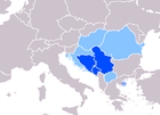
: srpski jezik) is a South Slavic language, spoken chiefly in Serbia
Serbia

Serbia , officially the Republic of Serbia , is a country in Central Europe and Balkans Europe, covering the southern part of the Pannonian Plain and the central part of the Balkans....
, Bosnia and Herzegovina
Bosnia and Herzegovina

Bosnia and Herzegovina is a country on the Balkans peninsula of South Eastern Europe with an area of 51,129 square kilometres . Bordered by Croatia to the north, west and south, Serbia to the east, and Montenegro to the south, Bosnia and Herzegovina is Landlocked#Nearly landlocked, except for 26 kilometres of the Adriatic Sea coas...
, Montenegro
Montenegro

Montenegro , Montenegrin language/Serbian language: ???? ????, Crna Gora , ) is a country located in Balkans. It has a coast on the Adriatic Sea to the south and is bordered by Croatia to the west, Bosnia and Herzegovina to the northwest, Serbia to the north, Kosovo to the east and Albania to the south....
, Croatia
Croatia

Croatia , officially the Republic of Croatia , is a Central European country at the crossroads of Pannonian Plain, Balkans, and the Mediterranean Sea....
, and in the Serbian diaspora
Serbian diaspora

There are currently 3.5 million Serbs in diaspora throughout the world . The Serbs diaspora was the consequence of either voluntary departure, coercion and/or forced migrations or Deportation that occurred in six big waves:...
. It is the only entirely phonetic language in the world
World

World is a common name for the planet Earth seen from a human worldview, as a place inhabited by human beings. It is often used to signify the sum of human experience and history, or the 'human condition' in general....
. Standard Serbian is based on the Shtokavian dialect
Shtokavian dialect

Shtokavian or ?tokavian is the main dialect of the Bosnian language, Croatian language and Serbian language languages.The ?tokavian dialect is spoken in Serbia, Montenegro, Bosnia and Herzegovina, the southern part of Austria?s Burgenland, and in part of Croatia....
, like the modern Croatian
Croatian language

Croatian language is a South Slavic languages which is used primarily in Croatia, by Croats in Bosnia and Herzegovina, in neighbouring countries where Croats are Indigenous peoples, in Italian region of Molise, and parts of the Croats diaspora....
 and Bosnian
Bosnian language

Bosnian , sometimes referred as Bosniak/Bosniac language , is a South Slavic languages native to the Bosniaks and all other citizens of Bosnia and Herzegovina who consider it to be their mother tongue....
, with which it is mutually intelligible, and was previously unified with under the standard known as Serbo-Croatian
Serbo-Croatian

The Serbo-Croatian language or Croato-Serbian language is a South Slavic language diasystem. The Serbo-Croatian language was used as an umbrella term for dialects spoken in Serbia, Croatia, Montenegro, Bosnia and Herzegovina; it was one of the official languages of Yugoslavia from 1918 to 1991 ....
. It counts among the official (and minority) languages of Serbia
Serbia

Serbia , officially the Republic of Serbia , is a country in Central Europe and Balkans Europe, covering the southern part of the Pannonian Plain and the central part of the Balkans....
, Bosnia and Herzegovina
Bosnia and Herzegovina

Bosnia and Herzegovina is a country on the Balkans peninsula of South Eastern Europe with an area of 51,129 square kilometres . Bordered by Croatia to the north, west and south, Serbia to the east, and Montenegro to the south, Bosnia and Herzegovina is Landlocked#Nearly landlocked, except for 26 kilometres of the Adriatic Sea coas...
, Montenegro
Montenegro

Montenegro , Montenegrin language/Serbian language: ???? ????, Crna Gora , ) is a country located in Balkans. It has a coast on the Adriatic Sea to the south and is bordered by Croatia to the west, Bosnia and Herzegovina to the northwest, Serbia to the north, Kosovo to the east and Albania to the south....
, Croatia
Croatia

Croatia , officially the Republic of Croatia , is a Central European country at the crossroads of Pannonian Plain, Balkans, and the Mediterranean Sea....
, Romania
Romania

Romania is a country located in Southeastern Europe Central Europe, North of the Balkan Peninsula, on the Lower Danube, within and outside the Carpathian Mountains, bordering on the Black Sea....
, Republic of Macedonia
Republic of Macedonia

The Republic of Macedonia , , often referred to simply as Macedonia, is a landlocked country on the Balkans in southeastern Europe. It is bordered by Serbia to the north, Bulgaria to the east, Greece to the south and Albania to the west....
 and Hungary
Hungary

Hungary , officially in English the Republic of Hungary , is a landlocked country in the Carpathian Basin of Central Europe, bordered by Austria, Slovakia, Ukraine, Romania, Serbia, Croatia, and Slovenia....
.

The alphabet
Alphabet

An alphabet is a standardized set of letter basic written symbols each of which roughly represents a phoneme, a spoken language, either as it exists now or as it was in the past....
 used to write Serbian is a variation
Serbian Cyrillic alphabet

The Serbian Cyrillic alphabet is the official and traditional alphabet used to write the Serbian language. It is an adaptation of the Cyrillic alphabet for the Serbian language, and was developed in 1818 by Serbs linguistics Vuk Stefanovic Karad?ic....
 on the Cyrillic alphabet
Cyrillic alphabet

The Cyrillic alphabet is a family of alphabets, subsets of which are used by five Slavic languages national languages as well as non-Slavic . It is also used by many other languages of Eastern Europe, the Caucasus, Siberia and other languages in the past....
, was devised by Vuk Stefanovic Karadžic
Vuk Stefanovic Karadžic

Vuk Stefanovic Karad?ic was a Serbs linguistics and major reformer of the Serbian language....
.


Discussion
Ask a question about 'Serbian language'
Start a new discussion about 'Serbian language'
Answer questions from other users
Full Discussion Forum


Encyclopedia


The Serbian language (Serbian Cyrillic
Serbian language

name=Serbian|nativename=|pronunciation=['sr?pski?]|familycolor=Indo-European|map=|states=See below under "Official status", besides that in Croatia and as an immigrant's language spread over Central Europe and Western Europe, as well as Northern America...
: ?????? ?????, Serbian Latin
Serbian language

name=Serbian|nativename=|pronunciation=['sr?pski?]|familycolor=Indo-European|map=|states=See below under "Official status", besides that in Croatia and as an immigrant's language spread over Central Europe and Western Europe, as well as Northern America...
: srpski jezik) is a South Slavic language, spoken chiefly in Serbia
Serbia

Serbia , officially the Republic of Serbia , is a country in Central Europe and Balkans Europe, covering the southern part of the Pannonian Plain and the central part of the Balkans....
, Bosnia and Herzegovina
Bosnia and Herzegovina

Bosnia and Herzegovina is a country on the Balkans peninsula of South Eastern Europe with an area of 51,129 square kilometres . Bordered by Croatia to the north, west and south, Serbia to the east, and Montenegro to the south, Bosnia and Herzegovina is Landlocked#Nearly landlocked, except for 26 kilometres of the Adriatic Sea coas...
, Montenegro
Montenegro

Montenegro , Montenegrin language/Serbian language: ???? ????, Crna Gora , ) is a country located in Balkans. It has a coast on the Adriatic Sea to the south and is bordered by Croatia to the west, Bosnia and Herzegovina to the northwest, Serbia to the north, Kosovo to the east and Albania to the south....
, Croatia
Croatia

Croatia , officially the Republic of Croatia , is a Central European country at the crossroads of Pannonian Plain, Balkans, and the Mediterranean Sea....
, and in the Serbian diaspora
Serbian diaspora

There are currently 3.5 million Serbs in diaspora throughout the world . The Serbs diaspora was the consequence of either voluntary departure, coercion and/or forced migrations or Deportation that occurred in six big waves:...
. It is the only entirely phonetic language in the world
World

World is a common name for the planet Earth seen from a human worldview, as a place inhabited by human beings. It is often used to signify the sum of human experience and history, or the 'human condition' in general....
. Standard Serbian is based on the Shtokavian dialect
Shtokavian dialect

Shtokavian or ?tokavian is the main dialect of the Bosnian language, Croatian language and Serbian language languages.The ?tokavian dialect is spoken in Serbia, Montenegro, Bosnia and Herzegovina, the southern part of Austria?s Burgenland, and in part of Croatia....
, like the modern Croatian
Croatian language

Croatian language is a South Slavic languages which is used primarily in Croatia, by Croats in Bosnia and Herzegovina, in neighbouring countries where Croats are Indigenous peoples, in Italian region of Molise, and parts of the Croats diaspora....
 and Bosnian
Bosnian language

Bosnian , sometimes referred as Bosniak/Bosniac language , is a South Slavic languages native to the Bosniaks and all other citizens of Bosnia and Herzegovina who consider it to be their mother tongue....
, with which it is mutually intelligible, and was previously unified with under the standard known as Serbo-Croatian
Serbo-Croatian

The Serbo-Croatian language or Croato-Serbian language is a South Slavic language diasystem. The Serbo-Croatian language was used as an umbrella term for dialects spoken in Serbia, Croatia, Montenegro, Bosnia and Herzegovina; it was one of the official languages of Yugoslavia from 1918 to 1991 ....
. It counts among the official (and minority) languages of Serbia
Serbia

Serbia , officially the Republic of Serbia , is a country in Central Europe and Balkans Europe, covering the southern part of the Pannonian Plain and the central part of the Balkans....
, Bosnia and Herzegovina
Bosnia and Herzegovina

Bosnia and Herzegovina is a country on the Balkans peninsula of South Eastern Europe with an area of 51,129 square kilometres . Bordered by Croatia to the north, west and south, Serbia to the east, and Montenegro to the south, Bosnia and Herzegovina is Landlocked#Nearly landlocked, except for 26 kilometres of the Adriatic Sea coas...
, Montenegro
Montenegro

Montenegro , Montenegrin language/Serbian language: ???? ????, Crna Gora , ) is a country located in Balkans. It has a coast on the Adriatic Sea to the south and is bordered by Croatia to the west, Bosnia and Herzegovina to the northwest, Serbia to the north, Kosovo to the east and Albania to the south....
, Croatia
Croatia

Croatia , officially the Republic of Croatia , is a Central European country at the crossroads of Pannonian Plain, Balkans, and the Mediterranean Sea....
, Romania
Romania

Romania is a country located in Southeastern Europe Central Europe, North of the Balkan Peninsula, on the Lower Danube, within and outside the Carpathian Mountains, bordering on the Black Sea....
, Republic of Macedonia
Republic of Macedonia

The Republic of Macedonia , , often referred to simply as Macedonia, is a landlocked country on the Balkans in southeastern Europe. It is bordered by Serbia to the north, Bulgaria to the east, Greece to the south and Albania to the west....
 and Hungary
Hungary

Hungary , officially in English the Republic of Hungary , is a landlocked country in the Carpathian Basin of Central Europe, bordered by Austria, Slovakia, Ukraine, Romania, Serbia, Croatia, and Slovenia....
.

The alphabet
Alphabet

An alphabet is a standardized set of letter basic written symbols each of which roughly represents a phoneme, a spoken language, either as it exists now or as it was in the past....
 used to write Serbian is a variation
Serbian Cyrillic alphabet

The Serbian Cyrillic alphabet is the official and traditional alphabet used to write the Serbian language. It is an adaptation of the Cyrillic alphabet for the Serbian language, and was developed in 1818 by Serbs linguistics Vuk Stefanovic Karad?ic....
 on the Cyrillic alphabet
Cyrillic alphabet

The Cyrillic alphabet is a family of alphabets, subsets of which are used by five Slavic languages national languages as well as non-Slavic . It is also used by many other languages of Eastern Europe, the Caucasus, Siberia and other languages in the past....
, was devised by Vuk Stefanovic Karadžic
Vuk Stefanovic Karadžic

Vuk Stefanovic Karad?ic was a Serbs linguistics and major reformer of the Serbian language....
. The Serbian Latin alphabet is based on Ljudevit Gaj
Ljudevit Gaj

Ljudevit Gaj was a Croatian linguist, politician, journalist and writer. He was the central person of the Croatian national reformation or the Illyrian Movement....
's reform.

Serbian orthography is very consistent: it is an approximation of the principle "one letter per sound". This principle is represented by Adelung's saying, "Write as you speak and read as it is written", the principle used by Vuk Karadžic
Vuk Stefanovic Karadžic

Vuk Stefanovic Karad?ic was a Serbs linguistics and major reformer of the Serbian language....
 when reforming the Cyrillic orthography of Serbian in the 19th century.

Most of the European linguists from outside the Balkans regard still scientifically the Serbian, Croatian, Bosnian and Montenegrin languages as just one language — the Serbo-Croatian.

Writing system

Standard Serbian language uses both Serbian Cyrillic script and Serbian Latin script (latinica). Although Serbian language authorities recognize the official status for both scripts in contemporary standard Serbian language, due to historical reasons Cyrillic was made the Official script
Official script

An official script is a writing system that is specifically designated to be official in the constitutions or other applicable laws of country, states, and other territories....
 of Serbia's administration by the 2006 Constitution
Constitution of Serbia

The current Constitution of Serbia was approved by a Serbian constitutional referendum, 2006 held in 2006 during October 28 and October 29. It was officially proclaimed by the Parliament of Serbia on 8 November 2006, replacing the Constitution of 1990....
. But the law does not regulate scripts in standard language
Standard language

A standard language is a particular variety of a language that has been given either legal or quasi-legal status. As it is usually the form promoted in schools and the media, it is usually considered by speakers of the language to be more "correct" in some sense than other dialects....
, or standard language itself by any means, leaving the choice of script as a matter of personal preference and to the free will in all aspects of life, except in government paperwork production and in official written communication with state officials.

Alphabetic order


The sort order
Collation

Collation is the assembly of written information into a standard order. One common type of collation is called alphabetisation, though collation is not limited to ordering letters of the alphabet....
 of the cirilica (????????) alphabet:
  • Cyrillic order (called Azbuka: ? ? ? ? ? ? ? ? ? ? ? ? ? ? ? ? ? ? ? ? ? ? ? ? ? ? ? ? ? ?


The sort order
Collation

Collation is the assembly of written information into a standard order. One common type of collation is called alphabetisation, though collation is not limited to ordering letters of the alphabet....
 of the latinica (????????) alphabet:
  • Latin order (called Abeceda (???????): A B C C C D Dž Đ E F G H I J K L Lj M N Nj O P R S Š T U V Z Ž


The following table provides the upper and lower case forms of the Serbian Cyrillic alphabet, along with the Serbian Latin equivalent and the IPA
International Phonetic Alphabet

The International Phonetic Alphabet "The acronym 'IPA' strictly refers [...] to the 'International Phonetic Association'. But it is now such a common practice to use the acronym also to refer to the alphabet itself that resistance seems pedantic....
 value for each letter, in Cyrillic sort order:

Cyrillic Alphabet
Cyrillic alphabet

The Cyrillic alphabet is a family of alphabets, subsets of which are used by five Slavic languages national languages as well as non-Slavic . It is also used by many other languages of Eastern Europe, the Caucasus, Siberia and other languages in the past....

Latin alphabet
Latin alphabet

The Latin alphabet, also called the Roman alphabet, is the most widely used alphabetic writing system in the world today. It evolved from the western variety of the Greek alphabet called the Cumae alphabet, and was initially developed by the Ancient Romes to write the Latin....

IPA
International Phonetic Alphabet

The International Phonetic Alphabet "The acronym 'IPA' strictly refers [...] to the 'International Phonetic Association'. But it is now such a common practice to use the acronym also to refer to the alphabet itself that resistance seems pedantic....
? ?
A (Cyrillic)

A is the first letter of the Cyrillic alphabet.It arose directly from the Greek letter Alpha . In the Early Cyrillic alphabet its name was "???" az and it had a numerical value of 1 ....

A
? ?
Be (Cyrillic)

eading=Cyrillic letter Be|Image=...

B
? ?
Ve (Cyrillic)

eading=Cyrillic letter Ve|Image=...

V
? ?
Ge (Cyrillic)

eading=Cyrillic letter Ge|Image=...

G
? ?
De (Cyrillic)

eading=Cyrillic letter De|Image=...

D
? ?
Dje

eading=Cyrillic letter Dje|Image=...

Đ
? ?
Ye (Cyrillic)

Ye, or E , is a letter of the Cyrillic alphabet. It looks exactly like the Latin letter E. In Bulgarian language, Macedonian language, Serbian language, and Ukrainian language, it is called E, and represents the vowel or ....

E
? ?
Zhe (Cyrillic)

eading=Cyrillic letter Zhe|Image=...

Ž
? ?
Ze (Cyrillic)

Ze is a letter of the Cyrillic alphabet, representing the consonant . It's easily confusable with the figure 3 . It can also be confused with the Russian letter E , which represents the vowel when it does not follow a soft consonant....

Z
? ?
I (Cyrillic)

I or Y is a letter of almost all ancient and modern Cyrillic alphabets, representing typically , or . Small cursive Cyrillic ? looks like Latin u ....

I
Cyrillic Alphabet
Cyrillic alphabet

The Cyrillic alphabet is a family of alphabets, subsets of which are used by five Slavic languages national languages as well as non-Slavic . It is also used by many other languages of Eastern Europe, the Caucasus, Siberia and other languages in the past....

Latin alphabet
Latin alphabet

The Latin alphabet, also called the Roman alphabet, is the most widely used alphabetic writing system in the world today. It evolved from the western variety of the Greek alphabet called the Cumae alphabet, and was initially developed by the Ancient Romes to write the Latin....

IPA
International Phonetic Alphabet

The International Phonetic Alphabet "The acronym 'IPA' strictly refers [...] to the 'International Phonetic Association'. But it is now such a common practice to use the acronym also to refer to the alphabet itself that resistance seems pedantic....
? ?
Je (Cyrillic)

eading=Cyrillic letter Je|Image=...

J
? ?
Ka (Cyrillic)

eading=Cyrillic letter Ka|Image=...

K
? ?
El (Cyrillic)

eading=Cyrillic letter El|Image=...

L
? ?
Lje

The Cyrillic alphabet letter lj was originally a ligature of El and Soft sign and represents a palatal lateral approximant , a sound similar to the palatalized alveolar lateral represented by the digraph ?? ....

Lj
? ?
Em (Cyrillic)

Em is a letter of the Cyrillic alphabet, representing a bilabial nasal consonant unless it is before a palatalization vowel when it represents . It is derived from the Greek letter mu ....

M
? ?
En (Cyrillic)

eading=Cyrillic letter En|Image=...

N
? ?
Nje

The Cyrillic_alphabet letter Nje is a ligature of En and Soft sign. It is used in Macedonian language and Serbian language, where it represents a voiced palatal nasal [], similar to Spanish ? in "se?or" ....

Nj
? ?
O (Cyrillic)

O is a letter of the Cyrillic alphabet, representing the vowel word-initially and after hard consonants. In Russian language it may represent the sounds in unstressed positions, due to the phenomenon of akanye....

O
? ?
Pe (Cyrillic)

eading=Cyrillic letter Pe|Image=...

P
? ?
Er (Cyrillic)

eading=Cyrillic letter Er|Image=...

R
Cyrillic Alphabet
Cyrillic alphabet

The Cyrillic alphabet is a family of alphabets, subsets of which are used by five Slavic languages national languages as well as non-Slavic . It is also used by many other languages of Eastern Europe, the Caucasus, Siberia and other languages in the past....

Latin alphabet
Latin alphabet

The Latin alphabet, also called the Roman alphabet, is the most widely used alphabetic writing system in the world today. It evolved from the western variety of the Greek alphabet called the Cumae alphabet, and was initially developed by the Ancient Romes to write the Latin....

IPA
International Phonetic Alphabet

The International Phonetic Alphabet "The acronym 'IPA' strictly refers [...] to the 'International Phonetic Association'. But it is now such a common practice to use the acronym also to refer to the alphabet itself that resistance seems pedantic....
? ?
Es (Cyrillic)

eading=Cyrillic letter Es|Image=...

S
? ?
Te (Cyrillic)

eading=Cyrillic letter Te|Image=...

T
? ?
Tshe

Tshe is the 23rd letter in the Serbian Cyrillic alphabet. Depending on the letter order, it is either the fifth letter or the 23rd letter . It represents a voiceless alveolo-palatal affricate, , the sound produced in Serbian from a voiceless alveolar plosive by iotation....

C
? ?
U (Cyrillic)

U is a letter of the Cyrillic alphabet, representing the vowel after non-palatalized consonants.In some languages variations of this letter are used:...

U
? ?
F
? ?
H
? ?
Tse (Cyrillic)

eading=Cyrillic letter Tse|Image=...

C
? ?
Che (Cyrillic)

Che or Cha is a letter of the Cyrillic alphabet. It represents the Voiceless postalveolar affricate . In Russian there is a small number of words where che is pronounced as ....

C
? ?
Dzhe

eading=Cyrillic letter Dzhe|Image=...


? ?
Sha

eading=Cyrillic letter Sha|Image=...

Š


Phonology


Vowels

The Serbian vowel
Vowel

In phonetics, a vowel is a sound in spoken language, such as English ah! or oh! , pronounced with an open vocal tract so that there is no build-up of air pressure at any point above the glottis....
 system is simple, with only five vowels. All vowels are monophthong
Monophthong

A monophthong is a "pure" vowel sound, one whose articulation at both beginning and end is relatively fixed, and which does not semivowel towards a new position of articulation; compare diphthong....
s. The vowels are as follows:

Cyrillic script Latin script IPA
International Phonetic Alphabet

The International Phonetic Alphabet "The acronym 'IPA' strictly refers [...] to the 'International Phonetic Association'. But it is now such a common practice to use the acronym also to refer to the alphabet itself that resistance seems pedantic....
Description English approximation
? i close front unrounded
Close front unrounded vowel

The close front unrounded vowel is a type of vowel sound, used in many spoken languages. The symbol in the International Phonetic Alphabet that represents this sound is , and the equivalent X-SAMPA symbol is i....
seek
? e (open-)mid front unrounded
Open-mid front unrounded vowel

The open-mid front unrounded vowel is a type of vowel sound, used in some Speech communication languages. The symbol in the International Phonetic Alphabet that represents this sound is , and the equivalent X-SAMPA symbol is E....
net
? a open central unrounded
Open front unrounded vowel

The open front unrounded vowel is a type of vowel sound, used in some Speech communication languages. The symbol in the International Phonetic Alphabet that represents this sound is , and the equivalent X-SAMPA symbol is a....
father
? o (open-)mid back rounded
Open-mid back rounded vowel

The open-mid back rounded vowel is a type of vowel sound, used in some Speech communication languages. The symbol in the International Phonetic Alphabet that represents this sound is , and the equivalent X-SAMPA symbol is O....
caught (British)
? u closed back rounded
Close back rounded vowel

The close back rounded vowel is a type of vowel sound, used in some spoken languages. The symbol in the International Phonetic Alphabet that represents this sound is , and the equivalent X-SAMPA symbol is u....
boom


Consonants

The consonant
Consonant

In articulatory phonetics, a consonant is a speech sound that is articulated with complete or partial closure of the upper vocal tract, the upper vocal tract being defined as that part of the vocal tract that lies above the larynx....
 system is more complicated, and its characteristic features are series of affricate and palatal
Palatal consonant

Palatal consonants are consonants articulated with the body of the tongue raised against the hard palate . Consonants with the tip of the tongue curled back against the palate are called retroflex consonant....
 consonants. Voicing is phonemic
Phoneme

In human language, a phoneme is the smallest posited linguistically distinctive unit of sound. Phonemes carry no semantic content themselves. In theoretical terms, phonemes are not the physical segment s themselves, but cognitive abstractions or categorizations of them....
, but aspiration
Aspiration (phonetics)

In phonetics, aspiration is the strong burst of Earth's atmosphere that accompanies either the release or, in the case of preaspiration, the closure of some obstruents....
 is not. The consonant phoneme table for Serbian is as follows (corresponding Latin letters are below the IPA
International Phonetic Alphabet

The International Phonetic Alphabet "The acronym 'IPA' strictly refers [...] to the 'International Phonetic Association'. But it is now such a common practice to use the acronym also to refer to the alphabet itself that resistance seems pedantic....
 symbols)

Consonant Phonemes of Serbian
Bilabial Labio-
Dental
Dental
Dental consonant

In linguistics, a dental consonant or dental is a consonant that is articulated with the tongue against the upper teeth, such as , , , and in some languages....
Alveolar
Alveolar consonant

Alveolar consonants are articulated with the tongue against or close to the superior alveolar ridge, which is called that because it contains the Dental alveolus of the superior teeth....
Post
Postalveolar consonant

Postalveolar consonants are consonants articulated with the tongue near or touching the back of the alveolar ridge, placing them a bit further back in the mouth than the alveolar consonants, which are at the ridge itself, but not as far back as the hard palate ....
-
Alveolar
Postalveolar consonant

Postalveolar consonants are consonants articulated with the tongue near or touching the back of the alveolar ridge, placing them a bit further back in the mouth than the alveolar consonants, which are at the ridge itself, but not as far back as the hard palate ....
Palatal Velar
Velar consonant

Velars are consonants articulated with the back part of the tongue against the soft palate, the back part of the roof of the mouth, known also as the Soft palate)....
Nasal
Nasal consonant

A nasal consonant is produced with a lowered soft palate in the mouth, allowing air to escape freely through the nose. The oral cavity still acts as a resonance chamber for the sound, but the air does not escape through the mouth as it is blocked by the tongue....

?
  
?
 
?
 
Plosive?? ??   ??
Affricate
Affricate consonant

Affricate consonants begin as stop consonants but release as a fricative consonant rather than directly into the following vowel....
  ?  ???? 
Fricative
Fricative consonant

Fricatives are consonants produced by forcing air through a narrow channel made by placing two Place of articulation close together. These may be the lower lip against the upper teeth, in the case of ; the back of the tongue against the soft palate, in the case of German language , the final consonant of Bach; or the side of the tongue ag...
 ? ?? ?? 
?
Approximant
Approximant consonant

Approximants are speech sounds that could be regarded as intermediate between vowels and "typical" consonants. In the articulation of approximants, articulatory organs produce a narrowing of the vocal tract, but leave enough space for air to flow without much audible turbulence....
  ? 
J
 
Trill
Trill consonant

In phonetics, a trill is a consonantal sound produced by vibrations between the articulator and the place of articulation. Standard Spanish <rr > as in perro is an alveolar trill, while in Parisian French it is almost always uvular trill....
  
?
  
Lateral
Lateral consonant

Laterals are "L"-like consonants pronounced with an occlusion made somewhere along the axis of the tongue, while air from the lungs escapes at one side or both sides of the tongue....
  
?

?


can be syllabic, playing the role of a vowel in certain words (it can even have a long accent). For example, the tongue-twister
Tongue-twister

A tongue-twister is a phrase that is designed to be difficult to articulate properly. Tongue-twisters may rely on similar but distinct phonemes , unfamiliar constructs in loanwords, or other features of a language....
 na vrh brda vrba mrda involves four words with syllabic . A similar feature exists in Czech
Czech language

Czech is a West Slavic language with about 12 million native speakers; it is the majority language in the Czech Republic and spoken by Czech people worldwide....
, Slovak
Slovak language

The Slovak language , sometimes incorrectly called ?Slovakian?, is an Indo-European languages that belongs to the West Slavic languages .The Czech and Slovak languages are Mutual intelligibility which means that even after the dissolution of Czechoslovakia Czech may be used in all official proceedings and documents in Slovakia, and vice ver...
, Macedonian
Macedonian language

Macedonian is the official language of the Republic of Macedonia and is a part of the Eastern group of South Slavic languages. Macedonian is closely related to and shares a high degree of mutual intelligibility with the Bulgarian language, Serbian language, Bosnian language, and Croatian language languages....
 and many other languages. In some vernacular
Vernacular

Vernacular refers to the native language of a country or a locality. In general linguistics, it is used to describe local languages as opposed to Lingua franca, official standards or global languages....
s can be syllabic as well. However, in the standard language, it appears only in loanwords as in the name for the Czech river Vltava for instance, or ?????? (debakl), ?????? (monokl) and ?????? (bicikl).

In Serbian, the phonemes , , , and (in contrast to Croatian and Bosnian vernaculars) have an independent phonetic realization in most vernaculars.

Phonetic interactions

While the basic sound system is fairly simple, Serbian phonology
Phonology

Phonology is the systematic use of sound to encode meaning in any spoken human language, or the field of linguistics studying this use. Just as a language has syntax and vocabulary, it also has a phonology in the sense of a sound system....
 is very complicated: there are numerous interactions (sandhi
Sandhi

Sandhi is a cover term for a wide variety of phonology processes that occur at morpheme or word boundaries . Examples include the fusion of sounds across word boundaries and the alteration of sounds due to neighboring sounds or due to the grammatical function of adjacent words....
 rules) between sounds at morpheme
Morpheme

In morpheme-based morphology, a is the smallest linguistic unit that has semantics Meaning .In spoken language, morphemes are composed of phonemes , and in written language morphemes are composed of graphemes ....
 boundaries which cause sound changes, with numerous exceptions. The changes include:

  • Two types of iotation
    Iotation

    Iotation is a form of palatalization which occurs in Slavic languages. In most of them, iotated consonants are called soft consonants and the process of iotation is called softening....
    • So called older, reflected in all Slavic languages
    • So called newer: d, t, l, n + j > d, c, lj, nj.
  • Three types of palatalization
    Palatalization

    Palatalization or palatalisation generally refers to two phenomena:*As a process or the result of a process, the effect that front vowels and the palatal approximant frequently have on consonants;...
    , reflected in all Slavic languages:
    • First, involving shift of velar consonant
      Velar consonant

      Velars are consonants articulated with the back part of the tongue against the soft palate, the back part of the roof of the mouth, known also as the Soft palate)....
      s k, g and h into postalveolar c, ž and š in front of front vowel
      Front vowel

      A front vowel is a type of vowel sound used in some spoken languages. The defining characteristic of a front vowel is that the tongue is positioned as far forward as possible in the mouth without creating a constriction that would be classified as a consonant....
      s e and i,
    • Second (also known as "sibilarization"), involving shift of k, g and h into alveolar
      Alveolar consonant

      Alveolar consonants are articulated with the tongue against or close to the superior alveolar ridge, which is called that because it contains the Dental alveolus of the superior teeth....
       c, z and s in front of e and i
    • Little-known third, involving shift of k, g, h into c, z, s after e, i and a.
  • Voicing
    Voice (phonetics)

    Voice or voicing is a term used in phonetics and phonology to characterize speech sound, with sounds described as either voiceless or voiced....
     and Devoicing
    Devoicing

    Devoicing is a Phonology process whereby a consonant that is normally voice becomes devoiced due to the influence of a phonological element in its phonological environment....
     assimilation
    Assimilation (linguistics)

    Assimilation is a common phonological process by which the phonetics of a speech segment becomes more like that of another segment in a word . A common example of assimilation would be "don't be silly" where the and in "don't" become and , where said naturally in many accents and discourse styles ....
  • Assimilation
    Assimilation (linguistics)

    Assimilation is a common phonological process by which the phonetics of a speech segment becomes more like that of another segment in a word . A common example of assimilation would be "don't be silly" where the and in "don't" become and , where said naturally in many accents and discourse styles ....
     by place of articulation
    Place of articulation

    In articulatory phonetics, the place of articulation of a consonant is the point of contact, where an obstruction occurs in the vocal tract between an active articulator and a passive articulator ....
  • Elision
    Elision

    Elision is the omission of one or more sounds in a word or phrase, producing a result that is easier for the speaker to pronounce. Sometimes, sounds may be elided for euphony effect....
     in complex consonant clusters
  • L?O shift, where final and pre-consonant *l was changed into an /o/
  • "Labile A", referring to sound a occurring only in nominative
    Nominative case

    The nominative case is a grammatical case for a noun, which generally marks the subject of a verb, as opposed to its object or other verb arguments....
     and genitive
    Genitive case

    In grammar, the genitive case or possessive case is the grammatical case that marks a noun as modifying another noun. It often marks a noun as being the possessor of another noun but it can also indicate various relationships other than possession; certain verbs may take argument in the genitive case; and it may have adverbial uses ....
      plural of nouns with several suffix
    Suffix

    In grammar, a suffix is an affix which is placed after the stem of a word. Common examples are case endings, which indicate the grammatical case of nouns or adjectives, and verb endings, which form the grammatical conjugation of verbs....
    es (most commonly -ak and -ac): tocak ('wheel') (N) ? tocka (G) ? tocku (D) etc.


Voicing and devoicing
In consonant cluster
Consonant cluster

In linguistics, a consonant cluster is a group of consonants which have no intervening vowel. In English, for example, the groups and are consonant clusters in the word splits....
s all consonants are either voiced or voiceless. All the consonants are voiced (if the last consonant is normally voiced) or voiceless (if the last consonant is normally voiceless). This rule does not apply to approximants a consonant cluster may contain voiced approximants and voiceless consonants; as well as to foreign words ("Washington" would be transcribed as VašinGton/?????????), personal names and when consonants are not inside of one syllable.

Prosody


Accents
Serbian has an extended system of accentuation. From the phonological point of view it has four accents which are divided into two groups according to their quality:
  • there are two accents with falling intonation ("old accents")- the short one and the long one
  • there are two accents with rise in intonation ("new accents")- the short one and the long one


However, their realization varies according to vernacular. That is why Danicic
Đuro Danicic

?uro Danicic , was a Serbian philology, translator, linguistic historian and lexicographer. He was a prolific scholar at the Great School in Belgrade....
, Budmani
Pero Budmani

'Pero Budmani' born in Ragusa was a Croatian linguist and philologist, who first used the name Serbo-Croatian in his book of grammar . The Vuk Karad?ic- based effort of language standardization lasted the remainder of the century, and culminated in the 1899 publication of Tomo Maretic?s Gramatika i stilistika hrvatskoga ili srpskoga kn...
, Matešic and other scholars have given different descriptions of the four Serbian accents. The old accents are rather close to Italian and English accent types, and the new ones to German (this can easily be seen through loanwords).

Here is one phonetic realization of 4 Serbian accents:

  1. Short falling (kratkosilazni; symbol `` – double grave
    Grave accent

    The grave accent is a diacritical mark used in written Catalan language, French language, Greek language until 1982 , Italian language, Norwegian language, Occitan language, Portuguese language, Scottish Gaelic language, Vietnamese language, Welsh language, Dutch language, and other languages....
    ) as in Mďlica (PNfem). Pronunciation: ('i' is stressed and short, as in English thick,cut).
  2. Long falling (dugosilazni; symbol ^) as in pîvo ('beer'). Pronunciation: ('i' is stressed, first low, then high and then again low, as in English seek, Italian Gino, Marco).
  3. Short rising (kratkouzlazni; symbol ` – grave
    Grave accent

    The grave accent is a diacritical mark used in written Catalan language, French language, Greek language until 1982 , Italian language, Norwegian language, Occitan language, Portuguese language, Scottish Gaelic language, Vietnamese language, Welsh language, Dutch language, and other languages....
    )as in mŕskara ('eye makeup'). Pronunciation: (the first 'a' is slightly stressed, the second 'a' is higher than the first one, and the third 'a' is even higher than the second one, as in German Arbeiter, Matratze).
  4. Long rising (dugouzlazni; symbol ´) as in cokoláda ('chocolate'). Pronunciation: ('a' is stressed, longer than the other vowels, and the intonation is slightly rising, as in German Balade or Schokolade).


The "finest" realization—the differences between the accents are relatively small, words are pronounced without any special effort—can be found in the most respectable vernaculars of Piva and Drobnjak and in Belgrade and partly in familiar vernaculars in Kolubara district and southwestern Banat. These two groups of vernaculars gave the base for Belgrade old speaker school. Already in surrounding Nikšic
Nikšic

Nik?ic is a city in Montenegro . In 2003 the city had a total population of 58,212.Nik?ic is located in Nik?ic plain, at the foot of Mount Trebjesa....
 (Montenegro), Dubrovnik
Dubrovnik

||-|File:Main street-Dubrovnik-2.jpg|-|File:Old City, Dubrovnik.jpg|-|File:Dubrovnik-F.Tudjman-Bridge.jpg|-|File:Onofrio's Fountain, Dubrovnik, Croatia.JPG...
 (Croatia), Užice
Užice

U?ice is a town and municipality located in Serbia at 43.87? North, 19.84? East. The 2002 Census Data records that the town has a total population of 55,025....
 (Serbia) area stress is more intensive. Modern surveys have shown for instance, that there is a minimal difference in Piva and Drobnjak (where the family of Vuk Stefanovic Karadžic
Vuk Stefanovic Karadžic

Vuk Stefanovic Karad?ic was a Serbs linguistics and major reformer of the Serbian language....
 had come from) between the syllables that carry short-stressed accent with fall intonation and the short-stressed with rise intonation. In the first edition of Vuk's dictionary (1818), Vuk even marked these two accents as one and the same accent. The difference between the short-stressed accent with falling acentuation and the short-stressed with rise accent is almost lost in two-syllable words (cf. the surveys of Pavle Ivic on Serbian prosody). The informal speech- slang in Belgrade has very special, neutralized accentuation (the oppositions falling/rising, short/long is only partly based on genuine word accents, far more on phonetic letter structure of the word).

Unstressed lengths
Not only the stressed syllables can be short or long. Other syllables have that feature as well. In neo-shtokavian vernaculars, the unstressed long syllable (unstressed length) can occur only after the accented syllable (these lengths are usually called postaccent lengths. Their symbol is macron
Macron

A macron, from Greek language meaning "long", is a diacritic ? placed over or under a vowel which was originally used to mark a Long syllable#Syllable weight in classical poetry in Meter #Greek and Latin, but has now been taken also to indicate that the vowel is long vowel....
 (-): dčvojka ('girl'), Jugňslavija ('Yugoslavia').

The phonetic realization of postaccent lengths is different. In vernaculars of Piva and Drobnjak they are rather very short, without any stress components. In some other East Herzegovinian vernaculars, they are almost stressed (of course, less intense than the really stressed syllable). In many vernaculars—for instance in Belgrade
Belgrade

Belgrade is the capital and largest city of Serbia. The city lies on international waterway, at the confluence of the Sava River and Danube rivers, where the Pannonian Plain meets the Balkan Peninsula....
, and in many places in Vojvodina
Vojvodina

The Autonomous Province of Vojvodina is an Subdivisions of Serbia in Serbia, containing about 27% of its total population according to the 2002 Census....
—postaccents lengths are almost lost. That's why foreign students are not expected to pay much attention to them.

History
Before 1400, most Serbian vernaculars had two accents, both with fall intonation—the short one and the long one. That is why they are called "old accents". By 1500, the old accents moved by one syllable towards the beginning of the word, changing their quality to rising accents. For instance junâk (hero) became jůnak. The old accents logically remained only when they were on first syllable. Not all dialects had this evolution; those who had it are called neo-shtokavian. The irradiation point was in east Herzegovina
Herzegovina

Herzegovina is the southern region of Bosnia-Herzegovina, comprising 11.419 sq km or around 22% of the total area of the present-day country....
, between Prokletije
Prokletije

Prokletije or North Albanian Alps Both the highest peak in Montenegro and Kosovo are located here. The highest peak in Albania though is Mount Korab which is high and is located in the east of the country....
 mountains and town of Trebinje
Trebinje

Trebinje is the southern-most municipality and town in Bosnia and Herzegovina. It is located in the Republika Srpska entity in southeastern Herzegovina at , some 10km from the Adriatic Sea....
. Since the 16th century people had been emigrating from this area. The biggest migrations were to the north, then toward Military Krajina and to the seaside (Dalmatia
Dalmatia

Dalmatia is a region on the eastern coast of the Adriatic Sea, situated mostly in modern Croatia and spreading between the island of Rab in the northwest and the Bay of Kotor in the southeast....
, Istria
Istria

File:Istria Croatian Adriatic.pngIstria , formerly Histria , is the largest peninsula in the Adriatic Sea. The peninsula is located at the head of the Adriatic between the Gulf of Trieste and the Bay of Kvarner....
, Dubrovnik
Dubrovnik

||-|File:Main street-Dubrovnik-2.jpg|-|File:Old City, Dubrovnik.jpg|-|File:Dubrovnik-F.Tudjman-Bridge.jpg|-|File:Onofrio's Fountain, Dubrovnik, Croatia.JPG...
 area, including the islands of Mljet
Mljet

Mljet is the most southerly and easterly of the larger Adriatic islands of the Dalmatia region of Croatia....
 and Šipan
Šipan

?ipan also Sipano is the largest of the Elaphiti Islands, 17 km northwest of Dubrovnik, Croatia; separated from the mainland coast by the Kolocepski Channel; area 16.5 km?; population 500 ....
). In the 1920s and 1930s the royal government tried to settle people from this poor mountainous area to the Kosovo basin. Vojvodina
Vojvodina

The Autonomous Province of Vojvodina is an Subdivisions of Serbia in Serbia, containing about 27% of its total population according to the 2002 Census....
 was settled with inhabitants from this area after WWII.

When all old accents had moved to the beginning of the word for one syllable, this was the result:

  • In words with two or more syllables the last syllable cannot be stressed
  • One-syllable words can have only falling accents
  • In polysyllabic words, if an inner syllable is stressed, then it can have only a rising accent (there are exceptions- in standard and in many vernaculars, for instance when there is a ` - - combination)
  • In a word with two or more syllables, if the first syllable is stressed, than it can have any of the four accents.


Grammar


Conjugation

Serbian verbs are conjugated in 4 past forms - perfect
Perfect aspect

The perfect aspect is variously considered either an grammatical aspect or grammatical tense which calls a listener's attention to the consequences generated by an action, rather than the action itself....
, aorist
Aorist

Aorist is an grammatical aspect or, used more specifically, a verb grammatical tense in some Indo-European languages such as Greek language. The term is also used for unrelated concepts in some other languages, such as Turkish language....
, imperfect, and pluperfect - of which the last two have a very limited use (imperfect is still used in some dialects, but majority of native Serbian speakers consider it archaic); 1 future tense
Future tense

In grammar, the future tense is a verb form that marks the event described by the verb as not having happened yet, but expected to happen in the future , or to happen subsequent to some other event, whether that is past, present, or future ....
 (aka 1st future tense - as opposed to the 2nd future tense or the future exact, which is considered a tense of the conditional mood
Conditional mood

The conditional mood is the form of the verb used in conditional sentences to refer to a hypothetical state of affairs, or an uncertain event that is contingent on another set of circumstances....
 by some contemporary linguists), and 1 present tense
Present tense

The present tense is the Grammatical tense that may be used to express:* action at the present* a state of being;* a habitual action;* an occurrence in the near future; or...
. These are the tenses of the indicative mood. Apart from the indicative mood, there is also the imperative mood
Imperative mood

The imperative mood is a grammatical mood that expresses direct commands or requests. It is also used to signal a prohibition, permission or any other kind of exhortation....
. The conditional mood has two more tenses, the 1st conditional (commonly used in conditional clauses, both for possible and impossible conditional clauses), and the 2nd conditional (without use in spoken language - it should be used for impossible conditional clauses). Serbian has active and passive voice.

As for the non-finite verb forms, Serbian has 1 infinitive
Infinitive

In grammar, infinitive is the name for certain verb forms that exist in many languages. In the usual description of English language, the infinitive of a verb is its basic form with or without the grammatical particle to: therefore, do and to do, be and to be, and so on are infinitives....
, 2 adjectival participle
Adjectival participle

Adjectival participles are built out of a verb , and in most cases they play the role of the sentence element called attribute in the grammar of some languages ....
s (the active and the passive), and 2 adverbial participle
Adverbial participle

Adverbal participles are built out of a verb , and in most cases they play the role of the sentence element called adverbial in the grammar of some languages ....
s (the present and the past).

Vocabulary

  • Most of the words in Serbian are of Slavic
    Slavic languages

    File:Slavic europe.svgThe Slavic languages , a group of closely related languages of the Slavic peoples and a subgroup of Indo-European languages, have speakers in most of Eastern Europe, in much of the Balkans, in parts of Central Europe, and in the northern part of Asia....
     origin. That means that their roots continue some words reconstructed for Proto-Slavic language
    Proto-Slavic language

    Proto-Slavic is the proto-language from which Slavic languages later emerged. It was spoken before the seventh century. As with all other proto-languages, no attested writings have been found; the language has been reconstructed by applying the comparative method to all the attested Slavic languages as well as other Indo-European languages....
    . For instance, srce ('heart'), plav ('blue').


  • There are many loanwords from different languages:
  1. There are plenty of loanwords from German
    German language

    German is a West Germanic languages, thus related to and classified alongside English language and Dutch language. It is one of the world's world language and the most widely spoken mother tongue in the European Union....
    . The great number of them are specific for vernaculars which were situated in the Austrian monarchy (Vojvodina
    Vojvodina

    The Autonomous Province of Vojvodina is an Subdivisions of Serbia in Serbia, containing about 27% of its total population according to the 2002 Census....
    , Slavonija, Lika
    Lika

    Lika is a mountainous region in central Croatia, roughly bound by the Velebit mountain from the southwest and the Pljesevica mountain from the northeast....
     and partly Bosnia
    Bosnia and Herzegovina

    Bosnia and Herzegovina is a country on the Balkans peninsula of South Eastern Europe with an area of 51,129 square kilometres . Bordered by Croatia to the north, west and south, Serbia to the east, and Montenegro to the south, Bosnia and Herzegovina is Landlocked#Nearly landlocked, except for 26 kilometres of the Adriatic Sea coas...
    ). Most cultural words attested before World War II
    World War II

    World War II, or the Second World War , was a global military conflict which involved a Participants in World War II, including all of the great powers, organised into two opposing military alliances: the Allies of World War II and the Axis powers....
    , were borrowed from (or via) German, even when they are of French or English
    English language

    English is a West Germanic language that originated in Anglo-Saxon England and has lingua franca status in many parts of the world as a result of the military, economic, scientific, political and cultural influence of the British Empire in the 18th, 19th and early 20th centuries and that of the United States from the mid 20th century onwa...
     origin (šorc, boks). The accent is an excellent indicator for that, since German loanwords in Serbian have rising accents.
  2. Italian
    Italian language

    Italian is a Romance languages spoken by about 63 million people as a first language, primarily in Italy. In Switzerland, Italian is one of four Linguistic geography of Switzerlands....
     words in standard language were often borrowed via German (makarone). If they were taken directly from Italian, they show specific, not regular, adaptations. For instance špagčte for Italian spaghetti rather than the "expected" špŕgete. The most common Serbian greeting is "Cao", after the Italian "Ciao"
    1. On the other hand, as in Croatian
      Croatian language

      Croatian language is a South Slavic languages which is used primarily in Croatia, by Croats in Bosnia and Herzegovina, in neighbouring countries where Croats are Indigenous peoples, in Italian region of Molise, and parts of the Croats diaspora....
      , there are plenty of Italian loanwords in the coastal vernaculars (in Spic, Paštrovici
      Paštrovici

      The Pa?trovici is a Serb clan in Montenegro....
      , Boka Kotorska, Dubrovnik
      Dubrovnik

      ||-|File:Main street-Dubrovnik-2.jpg|-|File:Old City, Dubrovnik.jpg|-|File:Dubrovnik-F.Tudjman-Bridge.jpg|-|File:Onofrio's Fountain, Dubrovnik, Croatia.JPG...
       area and at Kvarner coast), as well as in the vernaculars near the co?st. In some Croatian vernaculars, Italian loanwords made up to 40-50% of the vernacular vocabulary in the 1930s. Most common are words borrowed from Venetian
      Venetian language

      Venetian or Venetan is a Romance languages spoken by over two million people, mostly in the Veneto region of Italy. The language is called v?neto in Venetian, veneto in Italian; the variant spoken in Venice is called venexi?n/venesi?n or veneziano, respectively....
       (brancin, altroke, ardura, karonja ('lazy man'), pršut(a)). Some toponyms such as Budva
      Budva

      Budva is a coastal town in Montenegro. It has around 15,000 inhabitants, and is a centre of Budva municipality. The coastal area around Budva, called the Budva Riviera , is the centre of Montenegro's tourism, and is well known for its sandy beaches, diverse nightlife, and beautiful examples of Mediterranean architecture....
       and Boka Kotorska ('bay of Kotor') are borrowed from Venetian.
    2. In the coastal area, many words were borrowed from the Dalmatian language
      Dalmatian language

      Dalmatian is an extinct Romance languages formerly spoken in the Dalmatia region of Croatia, and as far south as Kotor in Montenegro.The Dalmatian speakers lived in the coastal towns: Zadar, Trogir, Split , Dubrovnik and Kotor , each of these cities having a local dialect, and also on the islands of Krk, Cres and Rab ....
       (murina, imbut), a Romance language, that was extinct by 1900. Many toponyms were also borrowed from Dalmatian (Kakrc, Luštica, Lovcen, Sutomore
      Sutomore

      Sutomore is a small coastal town in Bar Municipality, Montenegro. A 2003 census put the population at 1,827....
      < Sancta Maria).
  3. The number of Turkish
    Turkish language

    Turkish is a language spoken by over 63 million people worldwide, making it the most commonly spoken of the Turkic languages. Its speakers are located predominantly in Turkey and Cyprus, with smaller groups in Iraq, Greece, Bulgaria, the Republic of Macedonia, Kosovo, Albania and other parts of Eastern Europe....
     loanwords is also significant. There are according to Abdulah Skaljic, ("Turcizmi u srpskohrvatskom jeziku" - "Svjetlost" Sarajevo), 8,742 Turkish words, but far fewer than that number are in use today. Most of these words are not Turkish in origin but Persian
    Persian language

    name=Persian|nativename=|pronunciation=[f??r'si]|image=|caption=Farsi in Perso-Arabic script |states= Iran, Afghanistan, Tajikistan, Uzbekistan, and Bahrain....
    ; they entered Serbian via Turkish. However, these words are disappearing from the standard language at a faster rate than loanwords from any other language. In Belgrade
    Belgrade

    Belgrade is the capital and largest city of Serbia. The city lies on international waterway, at the confluence of the Sava River and Danube rivers, where the Pannonian Plain meets the Balkan Peninsula....
    , for instance, cakšire (???????) was the only word for trousers before World War II, today pantalone (?????????) is current; some 30-50 years ago avlija (?????? < Turkish avli) was a common word for courtyard or backyard in Belgrade, today it is dvorište (????????); only 15 years ago caršav was usual for tablecloth, today it is stoljnjak (???????). The greatest number of Turkish loanwords were and are in the vernaculars of south Serbia
    Serbia

    Serbia , officially the Republic of Serbia , is a country in Central Europe and Balkans Europe, covering the southern part of the Pannonian Plain and the central part of the Balkans....
    , followed by those of Bosnia and Herzegovina
    Bosnia and Herzegovina

    Bosnia and Herzegovina is a country on the Balkans peninsula of South Eastern Europe with an area of 51,129 square kilometres . Bordered by Croatia to the north, west and south, Serbia to the east, and Montenegro to the south, Bosnia and Herzegovina is Landlocked#Nearly landlocked, except for 26 kilometres of the Adriatic Sea coas...
     and central Serbia. Many Turkish loanwords are usual in the vernaculars of Vojvodina
    Vojvodina

    The Autonomous Province of Vojvodina is an Subdivisions of Serbia in Serbia, containing about 27% of its total population according to the 2002 Census....
    , Slavonija, Montenegro
    Montenegro

    Montenegro , Montenegrin language/Serbian language: ???? ????, Crna Gora , ) is a country located in Balkans. It has a coast on the Adriatic Sea to the south and is bordered by Croatia to the west, Bosnia and Herzegovina to the northwest, Serbia to the north, Kosovo to the east and Albania to the south....
     and Lika
    Lika

    Lika is a mountainous region in central Croatia, roughly bound by the Velebit mountain from the southwest and the Pljesevica mountain from the northeast....
     as well.
  4. Greek
    Greek language

    Greek is an Indo-European languages native to the southern Balkan peninsula, the language of the Greek people. It forms an independent branch within Indo-European....
     loanwords were very common in Old Serbian (Serbian-Slavonic). Some words are present and common in the modern vernaculars of central Serbia (as well as other areas) and in the standard language: hiljada, tiganj, patos. Almost every word of the Serbian Orthodox
    Eastern Orthodox Church

    The Eastern Orthodox Church is the second largest single Christian communion in the world with an estimated 225 million members worldwide. It is considered by its adherents to be the Four Marks of the Church established by Jesus Christ and his Apostles nearly 2000 years ago....
     ceremonies are of Greek origin (parastos (????????)).
  5. The number of Hungarian
    Hungarian language

    Hungarian is a Uralic languages unrelated to most other languages in Europe. It is mainly spoken in Hungary and by the Hungarian minorities in the seven neighbouring countries....
     loanwords in the standard language is small: bitanga (???????), alas, ašov). However, they are present in some vernaculars of Vojvodina
    Vojvodina

    The Autonomous Province of Vojvodina is an Subdivisions of Serbia in Serbia, containing about 27% of its total population according to the 2002 Census....
     and Slavonia
    Slavonia

    Slavonia is a geographical and historical region in eastern Croatia. It is a fertile agricultural and forested lowland bounded, in part, by the Drava river in the north, the Sava river in the south, and the Danube river in the east....
     and also in historical documents, local literature. Some place names in northern central Serbia as Barajevo
    Barajevo

    Barajevo is a List of Belgrade neighborhoods and one of 17 municipalities which constitute the Belgrade, the capital of Serbia....
    , are probably of Hungarian origin.
  • Classical international words (words mainly with Latin
    Latin

    Latin is an Italic language, historically spoken in Latium and Ancient Rome. Through the Military history of the Roman Empire, Latin spread throughout the Mediterranean and a large part of Europe....
     or Greek roots) are adapted in Serbian like in most European languages, not translated as in Croatian
    Croatian language

    Croatian language is a South Slavic languages which is used primarily in Croatia, by Croats in Bosnia and Herzegovina, in neighbouring countries where Croats are Indigenous peoples, in Italian region of Molise, and parts of the Croats diaspora....
    . For instance Serbian atmosfera, Croatian ozracje, S telegraf, C brzojav, S avion, C zrakoplov.
  • Two Serbian words that are used in many of the world's languages are vampire
    Vampire

    Vampires are mythology or folklore Revenant who subsist by feeding on the blood of the living. In folkloric tales, the undead vampires often visited loved ones and caused mischief or deaths in the neighbourhoods they inhabited when they were alive....
     and paprika
    Paprika

    Paprika is a spice made from the grinding of many dried sweet red or green bell peppers . In many European countries, the word paprika also refers to bell peppers themselves....
    . Slivovitz
    Slivovitz

    Slivovitz is a distilled beverage made from Damson plums. It is frequently called plum brandy If anyone else has a dictionary of some Slavic language that translates your word for slivovitz as "plum brandy", please add additional citations here. and is part of the category of drinks called rakia....
     and cevapcici
    Cevapcici

    Cevapcici or Cevapi in some regions, is a Balkan dish of grilled minced meat, of oriental origin, found in the countries of southeastern Europe....
     are Serbian words which have spread together with the Serbian food/drink they refer to. Paprika and slivovitz are borrowed via German; paprika itself entered German via Hungarian. Vampire entered most West European languages through German-language texts in the early 18th century and has since spread widely in the world.


Serbian literature


Jevandj
Serbian literature emerged in the Middle Ages
Middle Ages

File:Karl 1 mit papst gelasius gregor1 sacramentar v karl d kahlen.jpgThe Middle Ages of European history are a period in history which lasted for roughly a millennium, commonly dated from the fall of the Roman Empire in the 5th century to the beginning of the Early Modern Period in the 16th century, marked by the division of Western Christi...
, and included such works as Miroslavljevo jevandelje (Miroslav's Gospel
Miroslav's Gospel

Miroslav Gospels is a 362-page illuminated manuscript Gospel Book on parchment, with very rich decorations. It is one of the oldest surviving documents written in Serbian language, along with the Chronicle of the Priest of Duklja....
) in 1192 and Dušanov zakonik (Dušan's Code
Dušan's Code

File:DusanovZakonik.jpgDu?an's Code is a legal code, one of two the most significant cultural-historical monuments of medieval Serbia, accompanying St....
) in 1349. Little secular medieval literature has been preserved, but what there is shows that it was in accord with its time; for example, Serbian Alexandride, a book about Alexander the Great
Alexander the Great

Alexander the Great , also known as Alexander III of Macedon was an ancient Greeks King of Macedon . He was one of the most successful military commanders of all time and is presumed undefeated in battle....
, and a translation of Tristan and Iseult
Tristan and Iseult

The legend of Tristan and Iseult is an influential romance and tragedy, retold in numerous sources with as many variations. The tragic story is of the adulterous love between the Cornwall knight Tristan and the Ireland princess Iseult ....
 into Serbian. Although not belonging to the literature proper, the corpus of Serbian literacy in the 14th and 15th centuries contains numerous legal, commercial and administrative texts with marked presence of Serbian vernacular juxtaposed on the matrix of Serbian Church Slavonic.

In the mid-15th century, Serbia was conquered by the Ottoman Empire
Ottoman Empire

The Ottoman Empire , also known by its contemporaries as the Turkish Empire or Turkey , was an empire that lasted from 1299?1923. It was Treaty of Lausanne by the Republic of Turkey, which was officially proclaimed on October 29, 1923....
 and, for the next 400 years there was no opportunity for the creation of secular written literature. However, some of the greatest literary works in Serbian come from this time, in the form of oral literature, the most notable form being Serbian epic poetry
Serbian epic poetry

Serbian epic poetry is a form of epic poetry originating in the Serbian lands, today's Serbia, Bosnia and Herzegovina, Montenegro and Croatia. The main cycles were composed by unknown Serb authors between the 14th and 19th centuries....
. The epic poems were mainly written down in the 19th century, and preserved in oral tradition up to the 1950s, a few centuries or even a millennium longer then by most other "epic folks". Goethe
Johann Wolfgang von Goethe

was a Germans writer and according to George Eliot, "Germany's greatest man of letters? and the last true polymath to walk the earth." Goethe's works span the fields of poetry, drama, literature, theology, philosophy, humanism and science....
 and Jacob Grimm
Jacob Grimm

Jacob Ludwig Carl Grimm , German Confederation philologist, jurist and mythology, was born at Hanau, in Hesse-Kassel . He is best known as the discoverer of Grimm's Law, the author of the monumental German Dictionary, his Deutsche Mythologie and more popularly, as one of the Brothers Grimm, as the editor of Grimm's Fairy Tales....
 learned Serbian in order to read Serbian epic poetry in original. By the end of the 18th century, the written literature had become estranged from the spoken language. In the second half of the 18th century, the new language appeared, called Slavonic-Serbian. This artificial idiom superseded the works of poets and historians like Gavrilo Stefanovic Venclovic, who wrote in essentially modern Serbian in the 1720s. These vernacular compositions have remained cloistered from the general public and received due attention only with the advent of modern literary historians and writers like Milorad Pavic
Milorad Pavic (writer)

Milorad Pavic is a noted Serbian poet, prose writer, translator, and literary historian.Pavic has written five novels that have been translated into English language: Dictionary of the Khazars: A Lexicon Novel, Landscape Painted With Tea, Inner Side of the Wind, Last Love in Constantinople and Unique Item as well as m...
. In the early 19th century, Vuk Stefanovic Karadžic
Vuk Stefanovic Karadžic

Vuk Stefanovic Karad?ic was a Serbs linguistics and major reformer of the Serbian language....
, promoted the spoken language
Spoken language

A spoken language is a human natural language in which the words are uttered through the mouth. Most human languages are spoken languages.Speech communication stands in contrast to sign language and written language....
 of the people as a literary norm.

Dictionaries

Serious Serbian and Croatian dictionaries regularly include Croatian only, and Serbian only words. Three Serbian words that are used in many of the world's languages are vampire
Vampire

Vampires are mythology or folklore Revenant who subsist by feeding on the blood of the living. In folkloric tales, the undead vampires often visited loved ones and caused mischief or deaths in the neighbourhoods they inhabited when they were alive....
, paprika
Paprika

Paprika is a spice made from the grinding of many dried sweet red or green bell peppers . In many European countries, the word paprika also refers to bell peppers themselves....
 (borrowed via Hungarian
Hungarian language

Hungarian is a Uralic languages unrelated to most other languages in Europe. It is mainly spoken in Hungary and by the Hungarian minorities in the seven neighbouring countries....
), and slivovitz
Slivovitz

Slivovitz is a distilled beverage made from Damson plums. It is frequently called plum brandy If anyone else has a dictionary of some Slavic language that translates your word for slivovitz as "plum brandy", please add additional citations here. and is part of the category of drinks called rakia....
. The English word nightmare
Nightmare

A nightmare is a dream which causes a strong unpleasant emotional response from the sleeper, typically fear or horror, being in situations of extreme danger, or the sensations of pain, bad events, falling, drowning or death....
 is also most probably of Serbian origin. It originated from the name of a demon in Serbian folklore - Mora
Mora (mythology)

Mora are mostly malevolent folkloric beings associated with sleep that in some form or another can be found throughout Europe.In Polish folklore, mora are the souls of living people that leave the body during the night, and are seen as wisps of straw or hair or as moths....
, which denotes a female demon that comes at night and sits upon its sleeping victims, giving them bad dreams.

Standard dictionaries

  • Recnik srpskohrvatskog književnog i narodnog jezika (Dictionary of Serbo-Croatian standard language and vernaculars) is the biggest dictionary of Serbian and still unfinished. Starting with 1959, 16 volumes were published, about 40 are expected. Works of Croatian authors are excerpted, if published before 1991.
  • Recnik srpskohrvatskoga književnog jezika in 6 volumes, started as a common project of Matica srpska
    Matica srpska

    The Matica srpska is the oldest cultural-scientific institution of Serbia.The Matica srpska was founded in 1826 in Budapest and moved to Novi Sad in 1864....
     and Matica hrvatska
    Matica hrvatska

    The Matica hrvatska is one of the oldest Croatian cultural institutions, dating back to 1842. The name is somewhat idiosyncratic, with the term matica translated roughly as "matrix", "foundation", or "parent body", and the adjective hrvatska as referring to Croatia and/or the Croats....
    , but only the first three volumes were also published in Croato-Serbian (hrvatskosrpski).


  • There are no high-standard volume dictionaries whether of Serbian nor of Croatian language. Matica srpska
    Matica srpska

    The Matica srpska is the oldest cultural-scientific institution of Serbia.The Matica srpska was founded in 1826 in Budapest and moved to Novi Sad in 1864....
     is preparing one. Several volume dictionaries were published in Croatia (for the Croatian language) since the 1990s (Anic, Enciklopedijski rjecnik, Hrvatski rjecnik).


Bilingual dictionaries

  • Standard dictionaries
  • Specialized dictionaries
  • Phraseological dictionaries


Historical dictionaries

The Rjecnik hrvatskoga ili srpskoga jezika (I-XXIII), published by the Yugoslav academy of sciencies and arts (JAZU
Croatian Academy of Sciences and Arts

The Croatian Academy of Sciences and Arts is the national academy of Croatia. For most of its existence it was known as Yugoslav Academy of Sciences and Arts ....
) from 1880 to 1976, is the only general historical dictionary of Serbo-Croatian
Serbo-Croatian

The Serbo-Croatian language or Croato-Serbian language is a South Slavic language diasystem. The Serbo-Croatian language was used as an umbrella term for dialects spoken in Serbia, Croatia, Montenegro, Bosnia and Herzegovina; it was one of the official languages of Yugoslavia from 1918 to 1991 ....
 language. His first editor was Đuro Danicic
Đuro Danicic

?uro Danicic , was a Serbian philology, translator, linguistic historian and lexicographer. He was a prolific scholar at the Great School in Belgrade....
, followed by Pero Budmani
Pero Budmani

'Pero Budmani' born in Ragusa was a Croatian linguist and philologist, who first used the name Serbo-Croatian in his book of grammar . The Vuk Karad?ic- based effort of language standardization lasted the remainder of the century, and culminated in the 1899 publication of Tomo Maretic?s Gramatika i stilistika hrvatskoga ili srpskoga kn...
 and famous Vukovian Tomislav Maretic
Tomislav Maretic

Tomislav Maretic , one of the greatest Croatian linguists and lexicographers.He attended primary school in Virovitica and the gymnasium in Vara?din, Po?ega and Zagreb....
. The sources of this are, especially in first volumes, mainly Štokavian.

Etymological dictionaries


The standard and the only completed etymological dictionary of Serbian is the "Skok", written by the Croatian linguist Petar Skok
Petar Skok

Petar Skok is a Croatian linguist, and one of the world's foremost onomastics experts.From 1892 to 1900 he attended Royal gymnasium in Rakovac near the Karlovac....
: Etimologijski rjecnik hrvatskoga ili srpskoga jezika ("Etymological Dictionary of Croatian or Serbian"). I-IV. Zagreb
Zagreb

Zagreb is the Capital and the largest city of Croatia. Zagreb is the Culture of Croatia, Croatian Academy of Sciences and Arts, Cinema of Croatia, Economy of Croatia and Government of Croatia center of the Croatia....
 1971-1974.

There is also a new monumental Etimološki recnik srpskog jezika (Etymological Dictionary of Serbian). So far, two volumes have been published: I (with words on A-), and II (Ba-Bd).

There are specialized etymological dictionaries for German, Italian, Dalmatian, Turkish, Greek, Hungarian, Russian, English and other loanwords (cf. chapter word origin).

Dialect dictionaries


  • Kosovsko-resavski dialect dictionaries:
Gliša Elezovic, Recnik kosovsko-metohiskog dijalekta I-II. 1932/1935.
  • Prizren-Timok (Torlakian) dialect dictionaries:
Brana Mitrovic, Recnik leskovackog govora. Leskovac 1984.
Nikola Živkovic, Recnik pirotskog govora. Pirot, 1987.
Miodrag Markovic, Recnik crnoreckog govora I-II. 1986/1993.
Jakša Dinic, Recnik timockog govora I-III.1988-1992.
Jakša Dinic, Timocki dijalekatski recnik ,(Institut za srpski jezik, Monografije 4;ISBN 978-86-82873-17-4) Beograd 2008 ,
Momcilo Zlatanovic, Recnik govora južne Srbije. Vranje, 1998, 1–491.
  • East-Herzegowinian dialect dictionaries:
Milija Stanic, Uskocki recnik I–II. Beograd 1990/1991.
Miloš Vujicic, Recnik govora Prošcenja kod Mojkovca. Podgorica, 1995.
Srdan Music, Romanizmi u severozapadnoj Boki Kotorskoj. 1972.
Mihailo Bojanic/ Rastislava Trivunac, Rjecnik dubrovackog govora. Beograd 2003.
Svetozar Gagovic, Iz leksike Pive. Beograd 2004.
  • Zeta-Pester dialect:
Rada Stijovic, Iz leksike Vasojevica. 1990.
Drago Cupic Željko Cupic, Recnik govora Zagaraca. 1997.
Vesna Lipovac-Radulovic, Romanizmi u Crnoj Gori jugoistocni dio Boke Kotorske. Cetinje Titograd, 1981.
Vesna Lipovac-Radulovic, Romanizmi u Budvi i Paštrovicima. Novi Sad 1997.
  • Others:
Recnik sprskih govora Vojvodine. Novi Sad.
Mile Tomic, Recnik radimskog govora dijaspora, Rumunija. 1989.


Geographic distribution

Figures of speakers according to countries:
  • Serbia
    Serbia

    Serbia , officially the Republic of Serbia , is a country in Central Europe and Balkans Europe, covering the southern part of the Pannonian Plain and the central part of the Balkans....
    : 6,540,699
  • Montenegro
    Montenegro

    Montenegro , Montenegrin language/Serbian language: ???? ????, Crna Gora , ) is a country located in Balkans. It has a coast on the Adriatic Sea to the south and is bordered by Croatia to the west, Bosnia and Herzegovina to the northwest, Serbia to the north, Kosovo to the east and Albania to the south....
    : 401,382
  • Bosnia-Herzegovina: 1,600,000
  • Germany
    Germany

    Germany , officially the Federal Republic of Germany , is a country in Central Europe. It is bordered to the north by the North Sea, Denmark, and the Baltic Sea; to the east by Poland and the Czech Republic; to the south by Austria and Switzerland; and to the west by France, Luxembourg, Belgium, and the Netherlands....
    : around 507,000
  • USA: around 500,000
  • Brazil
    Brazil

    Brazil , officially the Federative Republic of Brazil , is a country in South America. It is the List of countries and outlying territories by total area country by geographical area, occupying nearly half of South America, the List of countries by population country, and the fourth most populous democracy in the world....
    : 233,818 (2001)
  • Canada
    Canada

    Canada is a country occupying most of northern North America, extending from the Atlantic Ocean in the east to the Pacific Ocean in the west and northward into the Arctic Ocean....
    : 55,545 (, 40,580 of that in Ontario
    Ontario

    Ontario is a Provinces and territories of Canada located in the Central Canada part of Canada, the largest by population and second largest, after Quebec, in total area....
    )
  • Croatia
    Croatia

    Croatia , officially the Republic of Croatia , is a Central European country at the crossroads of Pannonian Plain, Balkans, and the Mediterranean Sea....
    : 44,629
  • Republic of Macedonia
    Republic of Macedonia

    The Republic of Macedonia , , often referred to simply as Macedonia, is a landlocked country on the Balkans in southeastern Europe. It is bordered by Serbia to the north, Bulgaria to the east, Greece to the south and Albania to the west....
    : 33,315 (2001)
  • Romania
    Romania

    Romania is a country located in Southeastern Europe Central Europe, North of the Balkan Peninsula, on the Lower Danube, within and outside the Carpathian Mountains, bordering on the Black Sea....
    : 20,377 (2001)
  • Australia
    Australia

    Australia, officially the Commonwealth of Australia, is a country in the southern hemisphere comprising the Australia of the world's smallest continent, the major island of Tasmania, and numerous list of islands of Australia in the Indian Ocean and Pacific Oceans....
    : 100,000 (2001)


Differences among similar languages


See also

  • Serbian Cyrillic alphabet
    Serbian Cyrillic alphabet

    The Serbian Cyrillic alphabet is the official and traditional alphabet used to write the Serbian language. It is an adaptation of the Cyrillic alphabet for the Serbian language, and was developed in 1818 by Serbs linguistics Vuk Stefanovic Karad?ic....
  • Serbian proverbs
    Serbian proverbs

    A list of Serbs proverbs is provided at Wikiquote:Serbian proverbs.There are further untranslated proverbs on this page's Talk:Serbian proverbs....
  • Famous non-Serbs who were speaking or learning the language
    List of Serbs

    Below are lists of prominent ethnic Serbs and people from Serbia.}...
  • Šatrovacki
    Šatrovacki

    ?atrovacki is a feature of permuting syllables of words used in Serbian language, Croatian language, Bosnian language and Macedonian language. It is similar to verlan in French language....
     (slang form)
  • Romano-Serbian language
    Romano-Serbian language

    The Serbian Romani language is the mixed language of Serbian language and Romani language . It is spoken by the Romani people in Serbia. In October 2005 the first text on the grammar of the Romani language in Serbia was published by linguist Rajko Djuric, titled "Gramatika e Rromane chibaki - ????????? ??????? ??????"....
     (mix with Romany)
  • Swadesh list of Serbo-Croatian words
    Swadesh list of Slavic languages

    Once it split off from Proto-Indo-European language, the proto-Slavic period probably encompassed a period of stability lasting 2000 years. Following this period of stability, a small period of time?only several centuries?of rapid change occurred before the breakup of Slavic linguistic unity....


External links

  • and Serbian - English Dictionary.
  • an article by linguist Pavle Ivic
    Pavle Ivic

    Professor Pavle Ivic was a leading South Slavic and general Dialectology and Phonology. Both his field work and his synthesizing studies were extensive and authoritative....
     at Project Rastko
    Project Rastko

    Project Rastko - Internet Library of Serb Culture is a non-profit and non-governmental publishing, cultural and educational project dedicated to Serbs and Serb-related arts and humanities....
  • , Serbianna.com, 23 January 2007
  • Learn Serbian online for free.
  • incl.sound file


Online dictionaries