

Southern Europe

Unanswered Questions

Encyclopedia
The term Southern Europe, at its most general definition, is used to mean "all countries in the south of Europe". However, the concept, at different times, has had different meanings, providing additional political
, linguistic
and cultural
context to the definition in addition to the typical geographical
, phytogeographic
or climatic
approach. Most coastal countries in the United Nations
-designated southern Europe border the Mediterranean Sea
. Exceptions are Portugal
which has only Atlantic
coastline, Serbia
and the Republic of Macedonia
, which are landlocked, and Bulgaria
, which borders the Black Sea
.
Countries geographically considered part of southern Europe include:
Iberian Peninsula
(British overseas territory) (including: Madeira
and Azores
) (including: Balearic Islands
)
Balkans
(below Sava and Kupa
) (including: Aegean Islands
, Crete
, and Ionian Islands
) (below Sava and Danube
)
, Zagreb
, Međimurje and Zagorje
) are sometimes considered as Central Europe
) (geographically part of Asia
but considered European for historic and cultural reasons) (including: Gozo
) (Northern Dobruja
is considered Southern European and sometimes Wallachia
. Transylvania is sometimes considered as Central Europe
) (northern regions (Vojvodina
, northern Belgrade
, Mačva region
) are sometimes considered as Central Europe
) (region of Primorska)
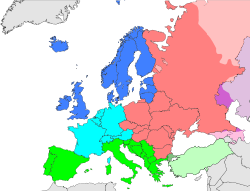 For its official works and publications, the United Nations Organization groups countries under a classification of regions. Southern Europe, as defined by the United Nations
(the sub-regions according to the UN), comprises the following countries and territories:
(can be included in Western Europe politically as it is a territory of the United Kingdom) (including: Aegean Islands
, Crete
, and Ionian Islands
) (including: Sardinia
and Sicily
) (including: Gozo
) (including: Madeira
and Azores
) (including: Balearic Islands
)
As of 2009, there were 163,865,210 people living in Southern Europe with an average population density of 74 inhabitants per square kilometer:
, which has become a typically known characteristic of the area. The humid subtropical climate is a southern european climate too (Northern Italy, Bulgaria...).
Those areas of Mediterranean climate present similar vegetations and landscapes throughout, including dry hill
s, small plain
s, pine
forest
s and olive
tree
s.
The area which is considered climatically Southern Europe is: (coasts) (coasts) (southeast coast, and the island of Corsica
) (except the Po River plain
and Alps
region) (south) (coasts) (the whole of the country except the northern coast)
.png) Southern Europe's flora
Southern Europe's flora
is that of the Mediterranean Region, one of the phytochoria recognized by Armen Takhtajan
. The Mediterranean and Submediterranean climate regions in Europe comprise the following countries and territories: (the southern and southeastern part, and the island of Corsica
) (including: Aegean Islands, Crete, and Ionian Islands) (the southwestern part till the Lake Balaton
) (only the southern part along the Danube
river) (except for the northwestern part) (only Ticino
) (only the southern part of Crimea
)
Romance languages
Romance languages and modern Greek are the heirs of Latin and ancient Greek as the main historical languages of the Mediterranean area.
Romance languages have spread from the Italian peninsula, and are emblematic of southern-western Europe: the "Latin Arch" (Romania and Moldova are an exception on that point); modern Greek is used in Greece and Cyprus.
Greek language
: Himariote
: Cypriot Greek
: Cappadocian
, Cretan
, Maniot
, Pontic, Tsakonian
, Romano-Greek
, Yevanic
: Griko
: Pontic: Crimean Greek
Albanian language
Albanian is also a language rooted in southern Europe, spoken in the Balkan peninsula.
Arvanitika
:
Gheg: Northern Albania West Macedonia South-east Montenegro South Serbia
Tosk: Southern Albania Greek Epirus West Macedonia Arbëria
South Slavic languages
Slavic languages that are now spoken in southern Europe are not rooted in the Mediterranean area nor spoken mainly in those areas: In that sense those languages are not part of the linguistic definition of southern Europe, since they are logically associated with their "core". That said, southern Slavic languages form a quite homogenous area, geographically separated from north Slavic languages by Hungary and Romania.
Germanic languages
Due to the English colonisation in Malta and Gibraltar, Germanic languages have a little presence in southern Europe, far from the core of Germanic languages in northwestern Europe. Malta uses English as a second language in some cases (after Maltese, which still is the original and main native language). In Gibraltar, English is the official language but Spanish and Llanito
(mix of Andalusian, Spanish with some English) are also spoken.
Basque language
The Basque language is a linguistic isolate spoken by the Basque people, who inhabit the Basque Country, a region spanning an area in northeastern Spain and southwestern France.
Policy
A policy is typically described as a principle or rule to guide decisions and achieve rational outcome. The term is not normally used to denote what is actually done, this is normally referred to as either procedure or protocol...
, linguistic
Linguistics
Linguistics is the scientific study of human language. Linguistics can be broadly broken into three categories or subfields of study: language form, language meaning, and language in context....
and cultural
Culture
Culture is a term that has many different inter-related meanings. For example, in 1952, Alfred Kroeber and Clyde Kluckhohn compiled a list of 164 definitions of "culture" in Culture: A Critical Review of Concepts and Definitions...
context to the definition in addition to the typical geographical
Geography
Geography is the science that studies the lands, features, inhabitants, and phenomena of Earth. A literal translation would be "to describe or write about the Earth". The first person to use the word "geography" was Eratosthenes...
, phytogeographic
Phytogeography
Phytogeography , also called geobotany, is the branch of biogeography that is concerned with the geographic distribution of plant species...
or climatic
Clime
The seven climes was a notion of dividing the Earth into zones in Classical Antiquity....
approach. Most coastal countries in the United Nations
United Nations
The United Nations is an international organization whose stated aims are facilitating cooperation in international law, international security, economic development, social progress, human rights, and achievement of world peace...
-designated southern Europe border the Mediterranean Sea
Mediterranean Sea
The Mediterranean Sea is a sea connected to the Atlantic Ocean surrounded by the Mediterranean region and almost completely enclosed by land: on the north by Anatolia and Europe, on the south by North Africa, and on the east by the Levant...
. Exceptions are Portugal
Portugal
Portugal , officially the Portuguese Republic is a country situated in southwestern Europe on the Iberian Peninsula. Portugal is the westernmost country of Europe, and is bordered by the Atlantic Ocean to the West and South and by Spain to the North and East. The Atlantic archipelagos of the...
which has only Atlantic
Atlantic Ocean
The Atlantic Ocean is the second-largest of the world's oceanic divisions. With a total area of about , it covers approximately 20% of the Earth's surface and about 26% of its water surface area...
coastline, Serbia
Serbia
Serbia , officially the Republic of Serbia , is a landlocked country located at the crossroads of Central and Southeast Europe, covering the southern part of the Carpathian basin and the central part of the Balkans...
and the Republic of Macedonia
Republic of Macedonia
Macedonia , officially the Republic of Macedonia , is a country located in the central Balkan peninsula in Southeast Europe. It is one of the successor states of the former Yugoslavia, from which it declared independence in 1991...
, which are landlocked, and Bulgaria
Bulgaria
Bulgaria , officially the Republic of Bulgaria , is a parliamentary democracy within a unitary constitutional republic in Southeast Europe. The country borders Romania to the north, Serbia and Macedonia to the west, Greece and Turkey to the south, as well as the Black Sea to the east...
, which borders the Black Sea
Black Sea
The Black Sea is bounded by Europe, Anatolia and the Caucasus and is ultimately connected to the Atlantic Ocean via the Mediterranean and the Aegean seas and various straits. The Bosphorus strait connects it to the Sea of Marmara, and the strait of the Dardanelles connects that sea to the Aegean...
.
Geographical definition
Geographically, southern Europe is the southern half of the landmass of Europe. This definition is relative, with no clear limits.Countries geographically considered part of southern Europe include:
Iberian PeninsulaIberian PeninsulaThe Iberian Peninsula , sometimes called Iberia, is located in the extreme southwest of Europe and includes the modern-day sovereign states of Spain, Portugal and Andorra, as well as the British Overseas Territory of Gibraltar...
(British overseas territory) (including: MadeiraMadeira
Madeira is a Portuguese archipelago that lies between and , just under 400 km north of Tenerife, Canary Islands, in the north Atlantic Ocean and an outermost region of the European Union...
and Azores
Azores
The Archipelago of the Azores is composed of nine volcanic islands situated in the middle of the North Atlantic Ocean, and is located about west from Lisbon and about east from the east coast of North America. The islands, and their economic exclusion zone, form the Autonomous Region of the...
) (including: Balearic Islands
Balearic Islands
The Balearic Islands are an archipelago of Spain in the western Mediterranean Sea, near the eastern coast of the Iberian Peninsula.The four largest islands are: Majorca, Minorca, Ibiza and Formentera. The archipelago forms an autonomous community and a province of Spain with Palma as the capital...
)
BalkansBalkansThe Balkans is a geopolitical and cultural region of southeastern Europe...
(below Sava and KupaKupa (river)
The Kupa or Kolpa river forms a natural border between north-west Croatia and southeast Slovenia.The Kupa originates in Croatia in the mountainous region of Gorski kotar, northeast of Rijeka, in the area of Risnjak National Park...
) (including: Aegean Islands
Aegean Islands
The Aegean Islands are the group of islands in the Aegean Sea, with mainland Greece to the west and north and Turkey to the east; the island of Crete delimits the sea to the south, those of Rhodes, Karpathos and Kasos to the southeast...
, Crete
Crete
Crete is the largest and most populous of the Greek islands, the fifth largest island in the Mediterranean Sea, and one of the thirteen administrative regions of Greece. It forms a significant part of the economy and cultural heritage of Greece while retaining its own local cultural traits...
, and Ionian Islands
Ionian Islands
The Ionian Islands are a group of islands in Greece. They are traditionally called the Heptanese, i.e...
) (below Sava and Danube
Danube
The Danube is a river in the Central Europe and the Europe's second longest river after the Volga. It is classified as an international waterway....
)
-
-
 Republic of Kosovo (contested independence) (East ThraceEast ThraceEast Thrace or Eastern Thrace , also known as Turkish Thrace, is the part of the modern republic of Turkey that is geographically part of Europe, all in the eastern part of the historical region of Thrace; most of Turkey is in Anatolia, also known as Asia Minor. Turkish Thrace is also called...
)
-
Other
(northern regions (SlavoniaSlavonia
Slavonia is a geographical and historical region in eastern Croatia...
, Zagreb
Zagreb
Zagreb is the capital and the largest city of the Republic of Croatia. It is in the northwest of the country, along the Sava river, at the southern slopes of the Medvednica mountain. Zagreb lies at an elevation of approximately above sea level. According to the last official census, Zagreb's city...
, Međimurje and Zagorje
Hrvatsko Zagorje
Hrvatsko Zagorje is a region north of Zagreb, Croatia. It comprises the whole area north of Medvednica mountain up to Slovenia in the north and west, and up to the regions of Međimurje and Podravina in the north and east...
) are sometimes considered as Central Europe
Central Europe
Central Europe or alternatively Middle Europe is a region of the European continent lying between the variously defined areas of Eastern and Western Europe...
) (geographically part of Asia
Asia
Asia is the world's largest and most populous continent, located primarily in the eastern and northern hemispheres. It covers 8.7% of the Earth's total surface area and with approximately 3.879 billion people, it hosts 60% of the world's current human population...
but considered European for historic and cultural reasons) (including: Gozo
Gozo
Gozo is a small island of the Maltese archipelago in the Mediterranean Sea. The island is part of the Southern European country of Malta; after the island of Malta itself, it is the second-largest island in the archipelago...
) (Northern Dobruja
Northern Dobruja
Northern Dobruja is the part of Dobruja within the borders of Romania. It lies between the lower Danube river and the Black Sea, bordered in south by Bulgarian Southern Dobruja.-Geography:...
is considered Southern European and sometimes Wallachia
Wallachia
Wallachia or Walachia is a historical and geographical region of Romania. It is situated north of the Danube and south of the Southern Carpathians...
. Transylvania is sometimes considered as Central Europe
Central Europe
Central Europe or alternatively Middle Europe is a region of the European continent lying between the variously defined areas of Eastern and Western Europe...
) (northern regions (Vojvodina
Vojvodina
Vojvodina, officially called Autonomous Province of Vojvodina is an autonomous province of Serbia. Its capital and largest city is Novi Sad...
, northern Belgrade
Belgrade
Belgrade is the capital and largest city of Serbia. It is located at the confluence of the Sava and Danube rivers, where the Pannonian Plain meets the Balkans. According to official results of Census 2011, the city has a population of 1,639,121. It is one of the 15 largest cities in Europe...
, Mačva region
Macva
Mačva is a geographical region in Serbia, mostly situated in the northwest of Central Serbia. It is located in a fertile plain between the Sava and Drina rivers. The chief town of this region is Šabac. The modern Mačva District of Serbia is named after the region, although the region of Mačva...
) are sometimes considered as Central Europe
Central Europe
Central Europe or alternatively Middle Europe is a region of the European continent lying between the variously defined areas of Eastern and Western Europe...
) (region of Primorska)
United Nations geoscheme
United Nations
The United Nations is an international organization whose stated aims are facilitating cooperation in international law, international security, economic development, social progress, human rights, and achievement of world peace...
(the sub-regions according to the UN), comprises the following countries and territories:
(can be included in Western Europe politically as it is a territory of the
United Kingdom) (including: Aegean IslandsAegean Islands
The Aegean Islands are the group of islands in the Aegean Sea, with mainland Greece to the west and north and Turkey to the east; the island of Crete delimits the sea to the south, those of Rhodes, Karpathos and Kasos to the southeast...
, Crete
Crete
Crete is the largest and most populous of the Greek islands, the fifth largest island in the Mediterranean Sea, and one of the thirteen administrative regions of Greece. It forms a significant part of the economy and cultural heritage of Greece while retaining its own local cultural traits...
, and Ionian Islands
Ionian Islands
The Ionian Islands are a group of islands in Greece. They are traditionally called the Heptanese, i.e...
) (including: Sardinia
Sardinia
Sardinia is the second-largest island in the Mediterranean Sea . It is an autonomous region of Italy, and the nearest land masses are the French island of Corsica, the Italian Peninsula, Sicily, Tunisia and the Spanish Balearic Islands.The name Sardinia is from the pre-Roman noun *sard[],...
and Sicily
Sicily
Sicily is a region of Italy, and is the largest island in the Mediterranean Sea. Along with the surrounding minor islands, it constitutes an autonomous region of Italy, the Regione Autonoma Siciliana Sicily has a rich and unique culture, especially with regard to the arts, music, literature,...
) (including: Gozo
Gozo
Gozo is a small island of the Maltese archipelago in the Mediterranean Sea. The island is part of the Southern European country of Malta; after the island of Malta itself, it is the second-largest island in the archipelago...
) (including: Madeira
Madeira
Madeira is a Portuguese archipelago that lies between and , just under 400 km north of Tenerife, Canary Islands, in the north Atlantic Ocean and an outermost region of the European Union...
and Azores
Azores
The Archipelago of the Azores is composed of nine volcanic islands situated in the middle of the North Atlantic Ocean, and is located about west from Lisbon and about east from the east coast of North America. The islands, and their economic exclusion zone, form the Autonomous Region of the...
) (including: Balearic Islands
Balearic Islands
The Balearic Islands are an archipelago of Spain in the western Mediterranean Sea, near the eastern coast of the Iberian Peninsula.The four largest islands are: Majorca, Minorca, Ibiza and Formentera. The archipelago forms an autonomous community and a province of Spain with Palma as the capital...
)
As of 2009, there were 163,865,210 people living in Southern Europe with an average population density of 74 inhabitants per square kilometer:
| Southern Europe: | ||||
| Country | Area (km²) |
Population (2010 est.) |
Population density (per km²) |
Capital |
|---|---|---|---|---|
 Albania AlbaniaAlbania Albania , officially known as the Republic of Albania , is a country in Southeastern Europe, in the Balkans region. It is bordered by Montenegro to the northwest, Kosovo to the northeast, the Republic of Macedonia to the east and Greece to the south and southeast. It has a coast on the Adriatic Sea... |
28,748 | 3,695,000 | 111.1 | Tirana Tirana Tirana is the capital and the largest city of Albania. Modern Tirana was founded as an Ottoman town in 1614 by Sulejman Bargjini, a local ruler from Mullet, although the area has been continuously inhabited since antiquity. Tirana became Albania's capital city in 1920 and has a population of over... |
 Andorra AndorraAndorra Andorra , officially the Principality of Andorra , also called the Principality of the Valleys of Andorra, , is a small landlocked country in southwestern Europe, located in the eastern Pyrenees mountains and bordered by Spain and France. It is the sixth smallest nation in Europe having an area of... |
467.63 | 84,082 | 179.8 | Andorra la Vella Andorra la Vella Andorra la Vella is the capital of the Co-principality of Andorra, and is located high in the east Pyrenees between France and Spain. It is also the name of the parish that surrounds the capital.... |
 Bosnia and Herzegovina Bosnia and HerzegovinaBosnia and Herzegovina Bosnia and Herzegovina , sometimes called Bosnia-Herzegovina or simply Bosnia, is a country in Southern Europe, on the Balkan Peninsula. Bordered by Croatia to the north, west and south, Serbia to the east, and Montenegro to the southeast, Bosnia and Herzegovina is almost landlocked, except for the... |
51,129 | 4,613,414 | 90.2 | Sarajevo Sarajevo Sarajevo |Bosnia]], surrounded by the Dinaric Alps and situated along the Miljacka River in the heart of Southeastern Europe and the Balkans.... |
 Croatia CroatiaCroatia Croatia , officially the Republic of Croatia , is a unitary democratic parliamentary republic in Europe at the crossroads of the Mitteleuropa, the Balkans, and the Mediterranean. Its capital and largest city is Zagreb. The country is divided into 20 counties and the city of Zagreb. Croatia covers ... |
56,594 | 4,489,409 | 81 | Zagreb Zagreb Zagreb is the capital and the largest city of the Republic of Croatia. It is in the northwest of the country, along the Sava river, at the southern slopes of the Medvednica mountain. Zagreb lies at an elevation of approximately above sea level. According to the last official census, Zagreb's city... |
 Gibraltar GibraltarGibraltar Gibraltar is a British overseas territory located on the southern end of the Iberian Peninsula at the entrance of the Mediterranean. A peninsula with an area of , it has a northern border with Andalusia, Spain. The Rock of Gibraltar is the major landmark of the region... (United Kingdom United Kingdom The United Kingdom of Great Britain and Northern IrelandIn the United Kingdom and Dependencies, other languages have been officially recognised as legitimate autochthonous languages under the European Charter for Regional or Minority Languages... ) |
6.8 | 29,431 | 4,328 | Gibraltar Gibraltar Gibraltar is a British overseas territory located on the southern end of the Iberian Peninsula at the entrance of the Mediterranean. A peninsula with an area of , it has a northern border with Andalusia, Spain. The Rock of Gibraltar is the major landmark of the region... |
 Greece GreeceGreece Greece , officially the Hellenic Republic , and historically Hellas or the Republic of Greece in English, is a country in southeastern Europe.... |
131,990 | 11,295,002 | 85.3 | Athens Athens Athens , is the capital and largest city of Greece. Athens dominates the Attica region and is one of the world's oldest cities, as its recorded history spans around 3,400 years. Classical Athens was a powerful city-state... |
 Italy ItalyItaly Italy , officially the Italian Republic languages]] under the European Charter for Regional or Minority Languages. In each of these, Italy's official name is as follows:;;;;;;;;), is a unitary parliamentary republic in South-Central Europe. To the north it borders France, Switzerland, Austria and... |
301,338 | 60,418,711 | 200.5 | Rome Rome Rome is the capital of Italy and the country's largest and most populated city and comune, with over 2.7 million residents in . The city is located in the central-western portion of the Italian Peninsula, on the Tiber River within the Lazio region of Italy.Rome's history spans two and a half... |
 Republic of Macedonia Republic of MacedoniaRepublic of Macedonia Macedonia , officially the Republic of Macedonia , is a country located in the central Balkan peninsula in Southeast Europe. It is one of the successor states of the former Yugoslavia, from which it declared independence in 1991... |
25,713 | 2,114,550 | 82.2 | Skopje Skopje Skopje is the capital and largest city of the Republic of Macedonia with about a third of the total population. It is the country's political, cultural, economic, and academic centre... |
 Malta MaltaMalta Malta , officially known as the Republic of Malta , is a Southern European country consisting of an archipelago situated in the centre of the Mediterranean, south of Sicily, east of Tunisia and north of Libya, with Gibraltar to the west and Alexandria to the east.Malta covers just over in... |
316 | 412,966 | 1,306.8 | Valletta Valletta Valletta is the capital of Malta, colloquially known as Il-Belt in Maltese. It is located in the central-eastern portion of the island of Malta, and the historical city has a population of 6,098. The name "Valletta" is traditionally reserved for the historic walled citadel that serves as Malta's... |
 Montenegro MontenegroMontenegro Montenegro Montenegrin: Crna Gora Црна Гора , meaning "Black Mountain") is a country located in Southeastern Europe. It has a coast on the Adriatic Sea to the south-west and is bordered by Croatia to the west, Bosnia and Herzegovina to the northwest, Serbia to the northeast and Albania to the... |
13,812 | 672,181 | 50 | Podgorica Podgorica Podgorica , is the capital and largest city of Montenegro.Podgorica's favourable position at the confluence of the Ribnica and Morača rivers and the meeting point of the fertile Zeta Plain and Bjelopavlići Valley has encouraged settlement... |
 Portugal PortugalPortugal Portugal , officially the Portuguese Republic is a country situated in southwestern Europe on the Iberian Peninsula. Portugal is the westernmost country of Europe, and is bordered by the Atlantic Ocean to the West and South and by Spain to the North and East. The Atlantic archipelagos of the... |
92,090 | 11,317,192 | 114 | Lisbon Lisbon Lisbon is the capital city and largest city of Portugal with a population of 545,245 within its administrative limits on a land area of . The urban area of Lisbon extends beyond the administrative city limits with a population of 3 million on an area of , making it the 9th most populous urban... |
 San Marino San MarinoSan Marino San Marino, officially the Republic of San Marino , is a state situated on the Italian Peninsula on the eastern side of the Apennine Mountains. It is an enclave surrounded by Italy. Its size is just over with an estimated population of over 30,000. Its capital is the City of San Marino... |
61.2 | 31,716 | 501 | City of San Marino |
 Serbia SerbiaSerbia Serbia , officially the Republic of Serbia , is a landlocked country located at the crossroads of Central and Southeast Europe, covering the southern part of the Carpathian basin and the central part of the Balkans... |
88,361 | 7,306,677 | 107.46 | Belgrade Belgrade Belgrade is the capital and largest city of Serbia. It is located at the confluence of the Sava and Danube rivers, where the Pannonian Plain meets the Balkans. According to official results of Census 2011, the city has a population of 1,639,121. It is one of the 15 largest cities in Europe... |
 Slovenia SloveniaSlovenia Slovenia , officially the Republic of Slovenia , is a country in Central and Southeastern Europe touching the Alps and bordering the Mediterranean. Slovenia borders Italy to the west, Croatia to the south and east, Hungary to the northeast, and Austria to the north, and also has a small portion of... |
20,273 | 2,054,199 | 99.6 | Ljubljana Ljubljana Ljubljana is the capital of Slovenia and its largest city. It is the centre of the City Municipality of Ljubljana. It is located in the centre of the country in the Ljubljana Basin, and is a mid-sized city of some 270,000 inhabitants... |
 Spain SpainSpain Spain , officially the Kingdom of Spain languages]] under the European Charter for Regional or Minority Languages. In each of these, Spain's official name is as follows:;;;;;;), is a country and member state of the European Union located in southwestern Europe on the Iberian Peninsula... |
504,030 | 46,030,109 | 93 | Madrid Madrid Madrid is the capital and largest city of Spain. The population of the city is roughly 3.3 million and the entire population of the Madrid metropolitan area is calculated to be 6.271 million. It is the third largest city in the European Union, after London and Berlin, and its metropolitan... |
 Vatican City Vatican CityVatican City Vatican City , or Vatican City State, in Italian officially Stato della Città del Vaticano , which translates literally as State of the City of the Vatican, is a landlocked sovereign city-state whose territory consists of a walled enclave within the city of Rome, Italy. It has an area of... |
0.44 | 826 | 1877 | Vatican City Vatican City Vatican City , or Vatican City State, in Italian officially Stato della Città del Vaticano , which translates literally as State of the City of the Vatican, is a landlocked sovereign city-state whose territory consists of a walled enclave within the city of Rome, Italy. It has an area of... |
| Total | 1,338,694 | 163,865,210 | 74.05 |
Climatical definition
Southern Europe's most emblematic climate is that of the Mediterranean climateMediterranean climate
A Mediterranean climate is the climate typical of most of the lands in the Mediterranean Basin, and is a particular variety of subtropical climate...
, which has become a typically known characteristic of the area. The humid subtropical climate is a southern european climate too (Northern Italy, Bulgaria...).
Those areas of Mediterranean climate present similar vegetations and landscapes throughout, including dry hill
Hill
A hill is a landform that extends above the surrounding terrain. Hills often have a distinct summit, although in areas with scarp/dip topography a hill may refer to a particular section of flat terrain without a massive summit A hill is a landform that extends above the surrounding terrain. Hills...
s, small plain
Plain
In geography, a plain is land with relatively low relief, that is flat or gently rolling. Prairies and steppes are types of plains, and the archetype for a plain is often thought of as a grassland, but plains in their natural state may also be covered in shrublands, woodland and forest, or...
s, pine
Pine
Pines are trees in the genus Pinus ,in the family Pinaceae. They make up the monotypic subfamily Pinoideae. There are about 115 species of pine, although different authorities accept between 105 and 125 species.-Etymology:...
forest
Forest
A forest, also referred to as a wood or the woods, is an area with a high density of trees. As with cities, depending where you are in the world, what is considered a forest may vary significantly in size and have various classification according to how and what of the forest is composed...
s and olive
Olive
The olive , Olea europaea), is a species of a small tree in the family Oleaceae, native to the coastal areas of the eastern Mediterranean Basin as well as northern Iran at the south end of the Caspian Sea.Its fruit, also called the olive, is of major agricultural importance in the...
tree
Tree
A tree is a perennial woody plant. It is most often defined as a woody plant that has many secondary branches supported clear of the ground on a single main stem or trunk with clear apical dominance. A minimum height specification at maturity is cited by some authors, varying from 3 m to...
s.
The area which is considered climatically Southern Europe is: (coasts) (coasts) (southeast coast, and the island of Corsica
Corsica
Corsica is an island in the Mediterranean Sea. It is located west of Italy, southeast of the French mainland, and north of the island of Sardinia....
) (except the Po River plain
Po Valley
The Po Valley, Po Plain, Plain of the Po, or Padan Plain is a major geographical feature of Italy. It extends approximately in an east-west direction, with an area of 46,000 km² including its Venetic extension not actually related to the Po River basin; it runs from the Western Alps to the...
and Alps
Alps
The Alps is one of the great mountain range systems of Europe, stretching from Austria and Slovenia in the east through Italy, Switzerland, Liechtenstein and Germany to France in the west....
region) (south) (coasts) (the whole of the country except the northern coast)
Phytogeographical definition
Flora
Flora is the plant life occurring in a particular region or time, generally the naturally occurring or indigenous—native plant life. The corresponding term for animals is fauna.-Etymology:...
is that of the Mediterranean Region, one of the phytochoria recognized by Armen Takhtajan
Armen Takhtajan
Armen Leonovich Takhtajan or Takhtajian , was a Soviet-Armenian botanist, one of the most important figures in 20th century plant evolution and systematics and biogeography. His other interests included morphology of flowering plants, paleobotany, and the flora of the Caucasus...
. The Mediterranean and Submediterranean climate regions in Europe comprise the following countries and territories: (the southern and southeastern part, and the island of Corsica
Corsica
Corsica is an island in the Mediterranean Sea. It is located west of Italy, southeast of the French mainland, and north of the island of Sardinia....
) (including: Aegean Islands, Crete, and Ionian Islands) (the southwestern part till the Lake Balaton
Lake Balaton
Lake Balaton is a freshwater lake in the Transdanubian region of Hungary. It is the largest lake in Central Europe, and one of its foremost tourist destinations. As Hungary is landlocked , Lake Balaton is often affectionately called the "Hungarian Sea"...
) (only the southern part along the Danube
Danube
The Danube is a river in the Central Europe and the Europe's second longest river after the Volga. It is classified as an international waterway....
river) (except for the northwestern part) (only Ticino
Ticino
Canton Ticino or Ticino is the southernmost canton of Switzerland. Named after the Ticino river, it is the only canton in which Italian is the sole official language...
) (only the southern part of Crimea
Crimea
Crimea , or the Autonomous Republic of Crimea , is a sub-national unit, an autonomous republic, of Ukraine. It is located on the northern coast of the Black Sea, occupying a peninsula of the same name...
)
Romance languagesRomance languagesThe Romance languages are a branch of the Indo-European language family, more precisely of the Italic languages subfamily, comprising all the languages that descend from Vulgar Latin, the language of ancient Rome...
Romance languages and modern Greek are the heirs of Latin and ancient Greek as the main historical languages of the Mediterranean area.Romance languages have spread from the Italian peninsula, and are emblematic of southern-western Europe: the "Latin Arch" (Romania and Moldova are an exception on that point); modern Greek is used in Greece and Cyprus.
- CatalanCatalan languageCatalan is a Romance language, the national and only official language of Andorra and a co-official language in the Spanish autonomous communities of Catalonia, the Balearic Islands and Valencian Community, where it is known as Valencian , as well as in the city of Alghero, on the Italian island...
: FrenchFrench languageFrench is a Romance language spoken as a first language in France, the Romandy region in Switzerland, Wallonia and Brussels in Belgium, Monaco, the regions of Quebec and Acadia in Canada, and by various communities elsewhere. Second-language speakers of French are distributed throughout many parts...
, Occitan, Franco-ProvençalFranco-Provençal languageFranco-Provençal , Arpitan, or Romand is a Romance language with several distinct dialects that form a linguistic sub-group separate from Langue d'Oïl and Langue d'Oc. The name Franco-Provençal was given to the language by G.I...
, CatalanCatalan languageCatalan is a Romance language, the national and only official language of Andorra and a co-official language in the Spanish autonomous communities of Catalonia, the Balearic Islands and Valencian Community, where it is known as Valencian , as well as in the city of Alghero, on the Italian island...
, CorsicanCorsican languageCorsican is a Italo-Dalmatian Romance language spoken and written on the islands of Corsica and northern Sardinia . Corsican is the traditional native language of the Corsican people, and was long the vernacular language alongside the Italian, official language in Corsica until 1859, which was...
: ItalianItalian languageItalian is a Romance language spoken mainly in Europe: Italy, Switzerland, San Marino, Vatican City, by minorities in Malta, Monaco, Croatia, Slovenia, France, Libya, Eritrea, and Somalia, and by immigrant communities in the Americas and Australia...
, FriulianFriulian languageFriulan , is a Romance language belonging to the Rhaeto-Romance family, spoken in the Friuli region of northeastern Italy. Friulan has around 800,000 speakers, the vast majority of whom also speak Italian...
, Ladin, SardinianSardinian languageSardinian is a Romance language spoken and written on most of the island of Sardinia . It is considered the most conservative of the Romance languages in terms of phonology and is noted for its Paleosardinian substratum....
, CatalanCatalan languageCatalan is a Romance language, the national and only official language of Andorra and a co-official language in the Spanish autonomous communities of Catalonia, the Balearic Islands and Valencian Community, where it is known as Valencian , as well as in the city of Alghero, on the Italian island...
, Occitan, Franco-ProvençalFranco-Provençal languageFranco-Provençal , Arpitan, or Romand is a Romance language with several distinct dialects that form a linguistic sub-group separate from Langue d'Oïl and Langue d'Oc. The name Franco-Provençal was given to the language by G.I...
, plus the so-called "Italian dialects", not officially recognised by Italian Republic (PiedmontesePiedmontese languagePiedmontese is a Romance language spoken by over 2 million people in Piedmont, northwest Italy. It is geographically and linguistically included in the Northern Italian group . It is part of the wider western group of Romance languages, including French, Occitan, and Catalan.Many European and...
, Ligurian, Lombard, VenetianVenetian languageVenetian or Venetan is a Romance language spoken as a native language by over two million people, mostly in the Veneto region of Italy, where of five million inhabitants almost all can understand it. It is sometimes spoken and often well understood outside Veneto, in Trentino, Friuli, Venezia...
, Emiliano and RomagnoloEmiliano-RomagnoloEmiliano-Romagnolo is a Romance language mostly spoken in Emilia-Romagna, Italy and San Marino. It belongs to the Northern Italian group within Romance languages , which is included in the wider group of western Romance languages...
, NeapolitanNeapolitan languageNeapolitan is the language of the city and region of Naples , and Campania. On October 14, 2008 a law by the Region of Campania stated that the Neapolitan language had to be protected....
, SicilianSicilian languageSicilian is a Romance language. Its dialects make up the Extreme-Southern Italian language group, which are spoken on the island of Sicily and its satellite islands; in southern and central Calabria ; in the southern parts of Apulia, the Salento ; and Campania, on the Italian mainland, where it is...
): RomanianRomanian languageRomanian Romanian Romanian (or Daco-Romanian; obsolete spellings Rumanian, Roumanian; self-designation: română, limba română ("the Romanian language") or românește (lit. "in Romanian") is a Romance language spoken by around 24 to 28 million people, primarily in Romania and Moldova...
: FrenchFrench languageFrench is a Romance language spoken as a first language in France, the Romandy region in Switzerland, Wallonia and Brussels in Belgium, Monaco, the regions of Quebec and Acadia in Canada, and by various communities elsewhere. Second-language speakers of French are distributed throughout many parts...
, Monégasque: PortuguesePortuguese languagePortuguese is a Romance language that arose in the medieval Kingdom of Galicia, nowadays Galicia and Northern Portugal. The southern part of the Kingdom of Galicia became independent as the County of Portugal in 1095...
, MirandeseMirandese languageThe Mirandese language is a Romance language belonging to the Astur-Leonese linguistic group, sparsely spoken in a small area of northeastern Portugal, in the municipalities of Miranda do Douro, Mogadouro and Vimioso...
: RomanianRomanian languageRomanian Romanian Romanian (or Daco-Romanian; obsolete spellings Rumanian, Roumanian; self-designation: română, limba română ("the Romanian language") or românește (lit. "in Romanian") is a Romance language spoken by around 24 to 28 million people, primarily in Romania and Moldova...
: ItalianItalian languageItalian is a Romance language spoken mainly in Europe: Italy, Switzerland, San Marino, Vatican City, by minorities in Malta, Monaco, Croatia, Slovenia, France, Libya, Eritrea, and Somalia, and by immigrant communities in the Americas and Australia...
: SpanishSpanish languageSpanish , also known as Castilian , is a Romance language in the Ibero-Romance group that evolved from several languages and dialects in central-northern Iberia around the 9th century and gradually spread with the expansion of the Kingdom of Castile into central and southern Iberia during the...
, CatalanCatalan languageCatalan is a Romance language, the national and only official language of Andorra and a co-official language in the Spanish autonomous communities of Catalonia, the Balearic Islands and Valencian Community, where it is known as Valencian , as well as in the city of Alghero, on the Italian island...
, GalicianGalician languageGalician is a language of the Western Ibero-Romance branch, spoken in Galicia, an autonomous community located in northwestern Spain, where it is co-official with Castilian Spanish, as well as in border zones of the neighbouring territories of Asturias and Castile and León.Modern Galician and...
(plus AragoneseAragonese languageAragonese is a Romance language now spoken in a number of local varieties by between 10,000 and 30,000 people over the valleys of the Aragón River, Sobrarbe and Ribagorza in Aragon, Spain...
, AsturianAsturian languageAsturian is a Romance language of the West Iberian group, Astur-Leonese Subgroup, spoken in the Spanish Region of Asturias by the Asturian people...
, LeoneseLeonese languageThe Leonese language is the endonym term used to refer to all vernacular Romance dialects of the Astur-Leonese linguistic group in the Spanish provinces of León and Zamora; Astur-Leonese also includes the dialects...
, ExtremaduranExtremaduran languageExtremaduran is a Romance language, spoken by several hundred thousand people in Spain, in an area covering the north-western part of the autonomous community of Extremadura and adjoining areas in the province of Salamanca....
): FrenchFrench languageFrench is a Romance language spoken as a first language in France, the Romandy region in Switzerland, Wallonia and Brussels in Belgium, Monaco, the regions of Quebec and Acadia in Canada, and by various communities elsewhere. Second-language speakers of French are distributed throughout many parts...
, ItalianItalian languageItalian is a Romance language spoken mainly in Europe: Italy, Switzerland, San Marino, Vatican City, by minorities in Malta, Monaco, Croatia, Slovenia, France, Libya, Eritrea, and Somalia, and by immigrant communities in the Americas and Australia...
, Romansh: ItalianItalian languageItalian is a Romance language spoken mainly in Europe: Italy, Switzerland, San Marino, Vatican City, by minorities in Malta, Monaco, Croatia, Slovenia, France, Libya, Eritrea, and Somalia, and by immigrant communities in the Americas and Australia...
Greek languageGreek languageGreek is an independent branch of the Indo-European family of languages. Native to the southern Balkans, it has the longest documented history of any Indo-European language, spanning 34 centuries of written records. Its writing system has been the Greek alphabet for the majority of its history;...
: HimarioteHimariote Greek dialect
The Himariote Greek dialect is a dialect of the Greek language that is mainly spoken by ethnic Greeks in the Himarë region of Albania. Despite the small distances between the towns in the region, there exists some dialectal variation, most prominently in accent.-Classification:Despite the fact...
: Cypriot Greek
Cypriot Greek
The Cypriot dialect of Modern Greek, known as Kypriaka , Cypriot Greek is spoken by 750,000 people in Cyprus and diaspora Greek Cypriots.Cypriot Greek is distinct enough that it can be classified as a distinct dialect of the Standard Greek....
: Cappadocian
Cappadocian Greek language
Cappadocian , also known as Cappadocian Greek or Asia Minor Greek, is a mixed language formerly spoken in Cappadocia . In the population exchange between Greece and Turkey in the 1920s, Cappadocian speakers were forced to emigrate to Greece, where they were resettled in various locations,...
, Cretan
Cretan Greek
Cretan Greek is a dialect of the Greek language, spoken by more than half a million people in Crete and many thousands in the diaspora....
, Maniot
Maniots
The Maniots or Maniates are the Greek inhabitants of the Mani Peninsula located in the southern Peloponnese in the Greek prefecture of Laconia and prefecture of Messinia. They were also formerly known as Mainotes and the peninsula as Maina. The Maniots are the direct descendants of the Spartans...
, Pontic, Tsakonian
Tsakonian language
Tsakonian, Tsaconian, Tzakonian or Tsakonic is a Hellenic language, spoken in the Tsakonian region of the Peloponnese, Greece....
, Romano-Greek
Romano-Greek language
Romano-Greek is a nearly extinct mixed language , spoken by the Romani people in Greece that arose from language contact between Romani speaking people and the Greek language. Typologically the language is structured on Greek with heavy lexical borrowing from Romani....
, Yevanic
Yevanic language
Yevanic, otherwise known as Judeo-Greek, was the dialect of the Romaniotes, the group of Greek Jews whose existence in Greece is documented since the Hellenistic period. Its linguistic lineage stems from the Hellenistic Koine and includes Hebrew elements as well. It was mutually intelligible with...
: Griko
Griko language
Griko, sometimes spelled Grico, is a form of the Greek language which is spoken by the Griko people in southern Italy. The Greeks consider it as a Modern Greek dialect and often call it Katoitaliotika or Grekanika...
: Pontic: Crimean Greek
Greeks in Ukraine
A Greek presence throughout the Black Sea area existed long before the beginnings of Kievan Rus. For most of their history in this area, the history of the Greeks in Russia and in Ukraine forms a single narrative, of which a division according to present-day boundaries would be an artificial...
Albanian languageAlbanian languageAlbanian is an Indo-European language spoken by approximately 7.6 million people, primarily in Albania and Kosovo but also in other areas of the Balkans in which there is an Albanian population, including western Macedonia, southern Montenegro, southern Serbia and northwestern Greece...
Albanian is also a language rooted in southern Europe, spoken in the Balkan peninsula.Arvanitika
Arvanitika
Arvanitika also known Arvanitic is the variety of Albanian traditionally spoken by the Arvanites, a population group in Greece...
:
Gheg: Northern Albania West Macedonia South-east Montenegro South Serbia
Tosk: Southern Albania Greek Epirus West Macedonia Arbëria
South Slavic languagesSouth Slavic languagesThe South Slavic languages comprise one of three branches of the Slavic languages. There are approximately 30 million speakers, mainly in the Balkans. These are separated geographically from speakers of the other two Slavic branches by a belt of German, Hungarian and Romanian speakers...
Slavic languages that are now spoken in southern Europe are not rooted in the Mediterranean area nor spoken mainly in those areas: In that sense those languages are not part of the linguistic definition of southern Europe, since they are logically associated with their "core". That said, southern Slavic languages form a quite homogenous area, geographically separated from north Slavic languages by Hungary and Romania.
- BosnianBosnian languageBosnian is a South Slavic language, spoken by Bosniaks. As a standardized form of the Shtokavian dialect, it is one of the three official languages of Bosnia and Herzegovina....
, CroatianCroatian languageCroatian is the collective name for the standard language and dialects spoken by Croats, principally in Croatia, Bosnia and Herzegovina, the Serbian province of Vojvodina and other neighbouring countries...
, SerbianSerbian languageSerbian is a form of Serbo-Croatian, a South Slavic language, spoken by Serbs in Serbia, Bosnia and Herzegovina, Montenegro, Croatia and neighbouring countries....
: BulgarianBulgarian languageBulgarian is an Indo-European language, a member of the Slavic linguistic group.Bulgarian, along with the closely related Macedonian language, demonstrates several linguistic characteristics that set it apart from all other Slavic languages such as the elimination of case declension, the...
: CroatianCroatian languageCroatian is the collective name for the standard language and dialects spoken by Croats, principally in Croatia, Bosnia and Herzegovina, the Serbian province of Vojvodina and other neighbouring countries...
: MacedonianMacedonian languageMacedonian is a South Slavic language spoken as a first language by approximately 2–3 million people principally in the region of Macedonia but also in the Macedonian diaspora...
: MontenegrinMontenegrin languageMontenegrin is a name used for the Serbo-Croatian language as spoken by Montenegrins; it also refers to an incipient standardized form of the Shtokavian dialect of Serbo-Croatian used as the official language of Montenegro...
, SerbianSerbian languageSerbian is a form of Serbo-Croatian, a South Slavic language, spoken by Serbs in Serbia, Bosnia and Herzegovina, Montenegro, Croatia and neighbouring countries....
: SerbianSerbian languageSerbian is a form of Serbo-Croatian, a South Slavic language, spoken by Serbs in Serbia, Bosnia and Herzegovina, Montenegro, Croatia and neighbouring countries....
: Slovene: Slovene (in Eastern Friuli-Venezia GiuliaFriuli-Venezia GiuliaFriuli–Venezia Giulia is one of the twenty regions of Italy, and one of five autonomous regions with special statute. The capital is Trieste. It has an area of 7,858 km² and about 1.2 million inhabitants. A natural opening to the sea for many Central European countries, the region is...
)
Germanic languagesGermanic languagesThe Germanic languages constitute a sub-branch of the Indo-European language family. The common ancestor of all of the languages in this branch is called Proto-Germanic , which was spoken in approximately the mid-1st millennium BC in Iron Age northern Europe...
Due to the English colonisation in Malta and Gibraltar, Germanic languages have a little presence in southern Europe, far from the core of Germanic languages in northwestern Europe. Malta uses English as a second language in some cases (after Maltese, which still is the original and main native language). In Gibraltar, English is the official language but Spanish and LlanitoLlanito
Llanito or Yanito is an Andalusian Spanish based creole spoken in the British overseas territory of Gibraltar. It consists of an eclectic mix of Andalusian Spanish and British English, marked by a great deal of code switching and loanwords from many other Mediterranean languages.Gibraltarians also...
(mix of Andalusian, Spanish with some English) are also spoken.
- EnglishEnglish languageEnglish is a West Germanic language that arose in the Anglo-Saxon kingdoms of England and spread into what was to become south-east Scotland under the influence of the Anglian medieval kingdom of Northumbria...
: English: GermanGerman languageGerman is a West Germanic language, related to and classified alongside English and Dutch. With an estimated 90 – 98 million native speakers, German is one of the world's major languages and is the most widely-spoken first language in the European Union....
(in South TyrolSouth TyrolSouth Tyrol , also known by its Italian name Alto Adige, is an autonomous province in northern Italy. It is one of the two autonomous provinces that make up the autonomous region of Trentino-Alto Adige/Südtirol. The province has an area of and a total population of more than 500,000 inhabitants...
and some small areas in the Northern part of the country)
Basque languageBasque languageBasque is the ancestral language of the Basque people, who inhabit the Basque Country, a region spanning an area in northeastern Spain and southwestern France. It is spoken by 25.7% of Basques in all territories...
The Basque language is a linguistic isolate spoken by the Basque people, who inhabit the Basque Country, a region spanning an area in northeastern Spain and southwestern France.
- Basque: Basque