

East Slavic languages

Encyclopedia
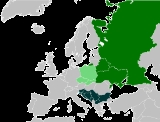
The East Slavic languages constitute one of three regional subgroups of Slavic languages
, currently spoken in Eastern Europe
. It is the group with the largest numbers of speakers, far out-numbering the Western
and Southern Slavic
groups. Current East Slavic languages are Belarusian
, Russian
, Ukrainian
. Rusyn
is considered to be either a separate language or a dialect of Ukrainian.
The East Slavic languages descend from a common predecessor
, the language of the medieval Kievan Rus'
(9th to 13th centuries).
All these languages use the Cyrillic alphabet
, but with particular modifications.
n dialect, which shares features from the both languages. East Polesian is a transitional step between Belarusian and Ukrainian on the one hand, and between South Russian and Ukrainian on the other hand. While Belarusian and Southern Russian form a continuous area, making it virtually impossible to draw a line between two languages. Central or Middle Russian (with its Moscow sub-dialect), the transitional step between the North and the South, became a base for the Russian literary standard. Northern Russian with its ancient variation, Old Novgorod dialect
, has many original and archaic features. As well, being several centuries in one state
Belarusian and Ukrainian share many common elements, lexical and grammatical above all. Ruthenian
, the mixed Belarusian-Ukrainian literally language with Church Slavonic substratum
and Polish
adstratum, was an official language in Belarus and Ukraine until the end of the 17th century.
 When the common Old East Slavic language
became separated from the ancient Slavic tongue common to all Slavs is difficult to ascertain, though in the 12th century the common language of Rus is still referred to in contemporary as Slavic.
Therefore, a crucial differentiation has to be made between the history of the East Slavic dialects and that of the literary languages employed by the Eastern Slavs. Although most ancient texts betray the dialect their author(s) and/or scribe(s) spoke, it is also clearly visible that they tried to write in a language different from their dialects and to avoid those mistakes that enable us nowadays to locate them.
In both cases one has to keep in mind that the history of the East Slavic languages is of course a history of written text
s. We do not know how the writers of the preserved texts would have spoken in every-day life.
and Macedonia
, which were written in Old Church Slavonic
. The Church Slavonic language was strictly used only in text, while the colloquial language of the Bulgarians
was communicated in its spoken form.
Throughout the Middle Ages (and in some way up to the present day) there existed a duality between the Church Slavonic language used as some kind of 'higher' register (not only) in religious texts and the popular tongue used as a 'lower' register for secular texts. It has been suggested to describe this situation as diglossia
, although there do exist mixed texts where it is sometimes very hard to determine why a given author used a popular or a Church Slavonic form in a given context. Church Slavonic was a major factor in the evolution of modern Russian, where there still exists a "high stratum" of words that were imported from this language.
the official view was that the Belarusian ("White Russian"), Ukrainian ("Little Russian"), and Russian ("Great Russian") languages were dialects of one common "Russian" language (the common languages of Eastern Slavic countries). In the course of the 20th century, "Great Russian" came to be known as Russian proper, "Little Russian" as Ukrainian and "White Russian" as Belarusian.
Slavic languages
The Slavic languages , a group of closely related languages of the Slavic peoples and a subgroup of Indo-European languages, have speakers in most of Eastern Europe, in much of the Balkans, in parts of Central Europe, and in the northern part of Asia.-Branches:Scholars traditionally divide Slavic...
, currently spoken in Eastern Europe
Eastern Europe
Eastern Europe is the eastern part of Europe. The term has widely disparate geopolitical, geographical, cultural and socioeconomic readings, which makes it highly context-dependent and even volatile, and there are "almost as many definitions of Eastern Europe as there are scholars of the region"...
. It is the group with the largest numbers of speakers, far out-numbering the Western
West Slavic languages
The West Slavic languages are a subdivision of the Slavic language group that includes Czech, Polish, Slovak, Kashubian and Sorbian.Classification:* Indo-European** Balto-Slavic*** Slavic**** West Slavic***** Czech-Slovak languages****** Czech...
and Southern Slavic
South Slavic languages
The South Slavic languages comprise one of three branches of the Slavic languages. There are approximately 30 million speakers, mainly in the Balkans. These are separated geographically from speakers of the other two Slavic branches by a belt of German, Hungarian and Romanian speakers...
groups. Current East Slavic languages are Belarusian
Belarusian language
The Belarusian language , sometimes referred to as White Russian or White Ruthenian, is the language of the Belarusian people...
, Russian
Russian language
Russian is a Slavic language used primarily in Russia, Belarus, Uzbekistan, Kazakhstan, Tajikistan and Kyrgyzstan. It is an unofficial but widely spoken language in Ukraine, Moldova, Latvia, Turkmenistan and Estonia and, to a lesser extent, the other countries that were once constituent republics...
, Ukrainian
Ukrainian language
Ukrainian is a language of the East Slavic subgroup of the Slavic languages. It is the official state language of Ukraine. Written Ukrainian uses a variant of the Cyrillic alphabet....
. Rusyn
Rusyn language
Rusyn , also known in English as Ruthenian, is an East Slavic language variety spoken by the Rusyns of Central Europe. Some linguists treat it as a distinct language and it has its own ISO 639-3 code; others treat it as a dialect of Ukrainian...
is considered to be either a separate language or a dialect of Ukrainian.
The East Slavic languages descend from a common predecessor
Proto-language
A proto-language in the tree model of historical linguistics is the common ancestor of the languages that form a language family. Occasionally, the German term Ursprache is used instead.Often the proto-language is not known directly...
, the language of the medieval Kievan Rus'
Kievan Rus'
Kievan Rus was a medieval polity in Eastern Europe, from the late 9th to the mid 13th century, when it disintegrated under the pressure of the Mongol invasion of 1237–1240....
(9th to 13th centuries).
All these languages use the Cyrillic alphabet
Cyrillic alphabet
The Cyrillic script or azbuka is an alphabetic writing system developed in the First Bulgarian Empire during the 10th century AD at the Preslav Literary School...
, but with particular modifications.
Differentiation
The East Slavic territory shows definitely a linguistic continuum with many transitional dialects. Between Belarusian and Ukrainian there is the PolesiaPolesia
Polesia is one of the largest European swampy areas, located in the south-western part of the Eastern-European Lowland, mainly within Belarus and Ukraine but also partly within Poland and Russia...
n dialect, which shares features from the both languages. East Polesian is a transitional step between Belarusian and Ukrainian on the one hand, and between South Russian and Ukrainian on the other hand. While Belarusian and Southern Russian form a continuous area, making it virtually impossible to draw a line between two languages. Central or Middle Russian (with its Moscow sub-dialect), the transitional step between the North and the South, became a base for the Russian literary standard. Northern Russian with its ancient variation, Old Novgorod dialect
Old Novgorod dialect
Old Novgorod dialect is a term introduced by Andrey Zaliznyak to describe the astonishingly diverse linguistic features of the Old East Slavic birch bark writings from the 11th to 15th centuries excavated in Novgorod and its surroundings...
, has many original and archaic features. As well, being several centuries in one state
Polish-Lithuanian Commonwealth
The Polish–Lithuanian Commonwealth was a dualistic state of Poland and Lithuania ruled by a common monarch. It was the largest and one of the most populous countries of 16th- and 17th‑century Europe with some and a multi-ethnic population of 11 million at its peak in the early 17th century...
Belarusian and Ukrainian share many common elements, lexical and grammatical above all. Ruthenian
Ruthenian language
Ruthenian, or Old Ruthenian , is a term used for the varieties of Eastern Slavonic spoken in the Grand Duchy of Lithuania and later in the East Slavic territories of the Polish–Lithuanian Commonwealth....
, the mixed Belarusian-Ukrainian literally language with Church Slavonic substratum
Substratum
In linguistics, a stratum or strate is a language that influences, or is influenced by another through contact. A substratum is a language which has lower power or prestige than another, while a superstratum is the language that has higher power or prestige. Both substratum and superstratum...
and Polish
Polish language
Polish is a language of the Lechitic subgroup of West Slavic languages, used throughout Poland and by Polish minorities in other countries...
adstratum, was an official language in Belarus and Ukraine until the end of the 17th century.
Features
| Isogloss Isogloss An isogloss—also called a heterogloss —is the geographical boundary of a certain linguistic feature, such as the pronunciation of a vowel, the meaning of a word, or use of some syntactic feature... es | Northern Russian | Standard Russian (Moscow dialect) | Southern Russian | Belarusian | Ukrainian |
|---|---|---|---|---|---|
| reduction of unstressed /o/ (akanye Akanye Akanye or akanje is a phonological phenomenon in Slavic languages in which speakers pronounce the sound a instead of o. The most familiar example is probably Russian akanye... ) |
no | yesExcept for the Polesian dialect of Brest Brest, Belarus Brest , formerly also Brest-on-the-Bug and Brest-Litovsk , is a city in Belarus at the border with Poland opposite the city of Terespol, where the Bug River and Mukhavets rivers meet... |
noExcept for the Eastern Polesia Polesia Polesia is one of the largest European swampy areas, located in the south-western part of the Eastern-European Lowland, mainly within Belarus and Ukraine but also partly within Poland and Russia... n dialect |
||
| PSl *g | /g/ | /ɣ/ | /ɦ/ | ||
| pretonic /ʲe/ (yakanye) | /ʲe/ | /ʲɪ/ | /ʲæ/ | /e/Consonants are hard before /e/ | |
| PSl *i | /i/ | /ɪ/Except for some dialects | |||
| PSl *y | /ɨ/ | ||||
| stressed CoC | /o/ | /i/In some Ukrainian dialects C/o/C can be /y~y̯e~y̯i~u̯o/In some Ukrainian dialects PSl *ě can be /e̝~i̯ɛ/ | |||
| PSl *ě | /e̝~i̯ɛ~i/ | /e/ | |||
| PSl *č | /t͡ʃʲ/It also can be /ʃʲ/ in Southern Russian | /tʂ/ | |||
| PSl *c | /t͡s/It also can be /s/ in South Russian | /t͡ɕ/ | |||
| PSl *skj, zgj | /ʃʲː/,It can be /ʃʲt͡ʃʲ/, /ʂː/ /ʒʲː/ | /ʂtʂ/, /ʐdʐ/ | |||
| soft dental stop Dental stop In phonetics and phonology, a dental stop is a type of consonantal sound, made with the tongue in contact with the upper teeth , held tightly enough to block the passage of air .... s |
/tʲ/ , /dʲ/In Russian light affrication can occur /tˢʲ/ , /dˢʲ/ | /t͡ɕ/ , /d͡ʑ/ | /tʲ/ , /dʲ/ | ||
| PSl *v | /v/ | /w~u̯/ | |||
| /f/ (including devoiced /v/) | /f/Nevertheless in some Northern Russian sub-dialects /v/ is not devoiced to /f/ | /x~xv~xw~xu̯/ | |||
| Protetic /v~w~u̯/ | noExcept for восемь "eight" and some others | yes | |||
| PSl * -ъj-, -ьj- | /oj/, /ej/ | /ɨj/, /ij/ | /ɪj/ | ||
| PSl * CrьC, ClьC, CrъC, CrъC |
/rʲe/, /lʲe/, /ro/, /lo/, |
/rɨ/, /lʲi/, /rɨ/, /lɨ/ |
/rɪ/, /lɪ/, /rɪ/, /lɪ/ |
||
| Hardening of soft /rʲ/ | no | yesAll /r/ in Belarusian, partially in Ukrainian | |||
| Hardening of final soft labial Labial Labial may refer to:*the lips*the labia *In linguistics, a labial consonant*In zoology, the labial scales... s |
no | yes | |||
| PSl adj. end. *-ьjь | /ej/ | /ij/,Only unstressed, Church Slavonic influence /ej/ | /ej/Stressed, unstressed is usually reduced to [ʲəj] | /ij/ | /ɪj/, /ij/ |
| PSl adj. end. *-ъjь | /oj/ | /ɨj/, /oj/ | /oj/Stressed, unstressed is usually reduced to [əj] | /ɨj/ | /ɪj/ |
| Vocative case | yes | noNew Vocative from a pure stem: мам, пап, Машь, Вань etc. | yes | ||
| 3 sg. & pl. Pres. Ind. | /t/ | /tʲ/ | /t͡ɕ/Affrication of /tʲ/ | /tʲ/ | |
| Droping out of 3 sg. Pres. Ind. |
no | yes | |||
| 3 sg. musc. Past. Ind. | /v~w~u̯/In the dialect of Vologda Vologda Vologda is a city and the administrative, cultural, and scientific center of Vologda Oblast, Russia, located on the Vologda River. The city is a major transport knot of the Northwest of Russia. Vologda is among the Russian cities possessing an especially valuable historical heritage... |
/l/ | /v~w~u̯/ | ||
| 2nd palatalization Slavic second palatalization Slavic second palatalization is a Proto-Slavic sound change, that manifested as a regressive palatalization of inherited Balto-Slavic velars and velar fricative, chronologically occurring after the first and the third palatalization.-Motivation:... in oblique cases |
no | yes | |||
History
Old East Slavic language
Old East Slavic or Old Ruthenian was a language used in 10th-15th centuries by East Slavs in the Kievan Rus' and states which evolved after the collapse of the Kievan Rus...
became separated from the ancient Slavic tongue common to all Slavs is difficult to ascertain, though in the 12th century the common language of Rus is still referred to in contemporary as Slavic.
Therefore, a crucial differentiation has to be made between the history of the East Slavic dialects and that of the literary languages employed by the Eastern Slavs. Although most ancient texts betray the dialect their author(s) and/or scribe(s) spoke, it is also clearly visible that they tried to write in a language different from their dialects and to avoid those mistakes that enable us nowadays to locate them.
In both cases one has to keep in mind that the history of the East Slavic languages is of course a history of written text
Writing
Writing is the representation of language in a textual medium through the use of a set of signs or symbols . It is distinguished from illustration, such as cave drawing and painting, and non-symbolic preservation of language via non-textual media, such as magnetic tape audio.Writing most likely...
s. We do not know how the writers of the preserved texts would have spoken in every-day life.
Influence of Church Slavonic
After the conversion of the East Slavic region to Christianity the people used service books borrowed from BulgariaBulgaria
Bulgaria , officially the Republic of Bulgaria , is a parliamentary democracy within a unitary constitutional republic in Southeast Europe. The country borders Romania to the north, Serbia and Macedonia to the west, Greece and Turkey to the south, as well as the Black Sea to the east...
and Macedonia
Macedonia (region)
Macedonia is a geographical and historical region of the Balkan peninsula in southeastern Europe. Its boundaries have changed considerably over time, but nowadays the region is considered to include parts of five Balkan countries: Greece, the Republic of Macedonia, Bulgaria, Albania, Serbia, as...
, which were written in Old Church Slavonic
Old Church Slavonic
Old Church Slavonic or Old Church Slavic was the first literary Slavic language, first developed by the 9th century Byzantine Greek missionaries Saints Cyril and Methodius who were credited with standardizing the language and using it for translating the Bible and other Ancient Greek...
. The Church Slavonic language was strictly used only in text, while the colloquial language of the Bulgarians
Bulgarians
The Bulgarians are a South Slavic nation and ethnic group native to Bulgaria and neighbouring regions. Emigration has resulted in immigrant communities in a number of other countries.-History and ethnogenesis:...
was communicated in its spoken form.
Throughout the Middle Ages (and in some way up to the present day) there existed a duality between the Church Slavonic language used as some kind of 'higher' register (not only) in religious texts and the popular tongue used as a 'lower' register for secular texts. It has been suggested to describe this situation as diglossia
Diglossia
In linguistics, diglossia refers to a situation in which two dialects or languages are used by a single language community. In addition to the community's everyday or vernacular language variety , a second, highly codified variety is used in certain situations such as literature, formal...
, although there do exist mixed texts where it is sometimes very hard to determine why a given author used a popular or a Church Slavonic form in a given context. Church Slavonic was a major factor in the evolution of modern Russian, where there still exists a "high stratum" of words that were imported from this language.
Current status
All of these languages are today separate in their own right. In the Russian EmpireRussian Empire
The Russian Empire was a state that existed from 1721 until the Russian Revolution of 1917. It was the successor to the Tsardom of Russia and the predecessor of the Soviet Union...
the official view was that the Belarusian ("White Russian"), Ukrainian ("Little Russian"), and Russian ("Great Russian") languages were dialects of one common "Russian" language (the common languages of Eastern Slavic countries). In the course of the 20th century, "Great Russian" came to be known as Russian proper, "Little Russian" as Ukrainian and "White Russian" as Belarusian.