

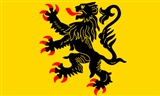
Nord-Pas de Calais

Encyclopedia
Nord-Pas de Calais Nord for short, is one of the 27 regions
of France. It consists of the departments of Nord and Pas-de-Calais, in the north and has a border with Belgium
. Most of the region was once part of the Southern Netherlands
, within the Low Countries
, and gradually became part of France between 1477 and 1678. The historical provinces
now included in Nord-Pas-de-Calais are Artois
, Boulonnais
, Calaisis, Cambraisis, French Flanders
, French Hainaut and portions of northern Picardy
, and the regional nickname Bassin Minier or Meiners-Bassen (Miners' or Mining Basin in the region's two languages) derived from historically large mining deposits. These provincial designations are still frequently used by the inhabitants, which offers a sense of civic pride.
With its 323.7 people per km2 on just over 12,400 km2, it is a densely populated region, having some four million inhabitants—seven percent of France's total population, making it the fourth most populous region in the country—83% of whom live in urban communities. Its administrative centre and largest city is Lille
. The second largest city is Calais
, which serves as a major continental economic/transportation hub with Dover
of Great Britain
42 kilometres (26.1 mi) away; the White Cliffs of Dover
are visible from Calais on a clear day. Other major towns include Valenciennes
, Lens
, Douai
, Béthune
, Dunkirk, Maubeuge
, Boulogne
, Arras, Cambrai
and Saint-Omer
.
name of the Strait of Dover
). The regional council, however, spells the name Nord-Pas de Calais.
The northern part of the region was historically a part of Flanders
, with Douai as its capital. The minority who wish to evidence the historical links the region has with Belgium and the Netherlands prefer to call this region the French Low Countries, which also means French Netherlands in French (French: Pays-Bas français; Dutch: Franse Nederlanden or Franse Lage Landen). Various petitions, which have impact on the population but not on the politicians nor the local governments, are currently taking place in favour of renaming.
Other alternative names are Région Flandre(s)-Artois, Hauts-de-France, ('Upper France') and Picardie-du-Nord ('Northern Picardy
'). Even the regional nickname Bassin des Minieres is gaining popularity and the momentum for a regional renaming wants less representation of being "French" and more of being "Belgian", while the peoples are patriotic to France but proud to be Flemish.
, who was born in Lille, called the region a "fatal avenue" through which invading armies repeatedly passed. Over the centuries, it was conquered in turn by the Celtic Belgae
, the Romans
, the Germanic Franks
, England, the Spanish and Austrian Netherlands, and the United Provinces of Holland
, until the final French annexation in the early 18th century.
During the 4th and 5th centuries, the Roman practice of coopting Germanic tribes to provide military and defense services along the route from Boulogne to Cologne created a Germanic-Romance linguistic border in the region that persisted until the 8th century. By the 9th century most inhabitants north of Lille spoke a dialect of Middle Dutch, while the inhabitants to the south spoke a variety of Romance dialects. This linguistic border is still evident today in the place names of the region. Beginning in the 9th century, the linguistic border began a steady move to north and the east. By the end of the 13th century the linguistic border had shifted to the river Lys in the south and Cap-Griz-Nez in the west.
During the Middle Ages, the Pas-de-Calais department comprised County of Boulogne
and the County of Artois
, while the Nord department was mostly made up of the southern portions of the County of Flanders
and the County of Hainaut
. Boulogne, Artois, and Flanders were fiefs of the French crown, while Hainaut was within the Holy Roman Empire
. Calais
, from 1347 to 1558, when it was recovered by the French throne, was an English possession. In the 15th century all of the territories, except Calais, were united under the rule of the Dukes of Burgundy
, along with other territories in northern France and areas in what is now Belgium
, Luxembourg
, and the Netherlands
. With the death of the Burgundian duke Charles the Bold in 1477, the Boulonnais and Artois were seized by the French crown, while Flanders and Hainaut were inherited by Charles's daughter Marie. Shortly thereafter, in 1492, Artois was ceded back to Marie's son Philip the Handsome
, as part of an attempt to keep Philip's father, Emperor Maximilian I
, neutral in French King Charles VIII's
prospective invasion of Italy.
Thus, most of the territories of what is now Nord-Pas-de-Calais were reunited to the Burgundian inheritance, which had passed through Marie's marriage to the House of Habsburg. These territories formed an integral part of the Seventeen Provinces
of the Netherlands as they were defined during the reign of Philip's son, Emperor Charles V
, and passed to Charles's son, Philip II of Spain
. When the Netherlands revolted against Spanish rule, beginning in 1566, the territories in what is now Nord-Pas-de-Calais were those most loyal to the throne, and proved the base from which the Duke of Parma
was able to bring the whole southern part of the Netherlands back under Spanish control.
During the wars between France and Spain in the 17th century (1635-1659
, 1667-1668
, 1672-1678
, 1688-1697), these territories became the principal seat of conflict between the two states. French control over the area was gradually established - Artois was annexed in 1659, and most of the current Nord department had been acquired by the Treaty of Nijmegen in 1678. The current borders were mostly established by the time of the Treaty of Ryswick
in 1697.
The area, previously divided among the French provinces of Flanders
, Artois
, and Picardy
, was divided into its present two departments following the French Revolution
of 1789. Under Napoleon I
the French boundary was extended to include all of Flanders and present-day Belgium
until the Treaty of Waterloo in 1815 restored the original French boundary.
During the 19th century, the region underwent major industrialisation and became one of the leading industrial regions of France, second only to Alsace-Lorraine
. Nord-Pas-de-Calais was barely touched by the Franco-Prussian War
of 1870; indeed, the war actually helped it to cement its leading role in French industry due to the loss of Alsace-Lorraine to Germany. However, it suffered catastrophic damage in the two World Wars of the 20th century. In the First World War, much of the region was occupied by Germany. Many of its towns and hundreds of square miles of land were wrecked in four years of trench warfare
, with the region suffering more damage than any other part of France.
German occupation of France during World War II
The Nord-Pas-de-Calais region was used for Vengeance weapon installations, including extensive V-1 "ski sites" that launched attacks on England and massive bunker
s for the V-2 rocket
and V-3 cannon. Operation Crossbow
counteroffensive bombing devastated many of the region's towns. Although most of the region was liberated in September 1944, Dunkirk was the last French town to be freed from German occupation (9 May 1945). The region's numerous war cemeteries and memorials include Canada's
Vimy Memorial
.
Post-World War II
Since the war, the region has suffered from severe economic difficulties (see Economy below) but has benefited from the opening of the Channel Tunnel
and the growth in cross-Channel traffic in general.
-speaking, it also has two significant minority language
communities: the western Flemings, whose presence is evident in the many Dutch placenames in the area and who speak French Flemish, a variety of the West Flemish
dialect of Dutch
(perhaps 20,000 inhabitants of Nord-Pas-de-Calais use Flemish daily and an estimated 40,000 use it occasionally, both, primarily in and around the arrondissement of Dunkirk ); and the Picards, who speak the Picard language
, or Ch'ti (speakers, "chitimi", have been working to revive the nearly-extinct regional speech since the 1980s). Although neighbouring Belgium currently recognizes and fosters both Picard and Dutch, and a few city-level governments within Nord-Pas-de-Calais have introduced initiatives to encourage both languages, the national French government maintains a policy of linguistic unity
and generally ignores both languages, as it does with other regional languages in France.
The region's ethnic diversity has been affected by repeated waves of immigrant workers from abroad: Belgians
, some Irish
and Welsh
from Britain, before 1910; Poles, Czechs
, Italians
, and Portuguese
in the 1920s and 1930s; North Africans, Greeks
, Slovaks
and Yugoslavs since 1945; several thousand descendants of Chinese
and Vietnamese
ditch diggers and railroad crews hired by French government contractors in World War I
; some Turks
have settled in the region, beginning in the 1960s; and large cities like Lille, Calais, and Boulogne are home to sizable communities of British
, Dutch
, Scandinavian
, Sub-Saharan African, and Latin American immigrants and their descendants.
The French state has sought to boost the region's relatively neglected culture. In 2004, it was announced that a branch of the Louvre
would be opened in the city of Lens. For decades, the Nord-Pas-de-Calais has been viewed as a conservative
region when compared culturally to the rest of France , but recently the region has at times displayed left-wing tendencies. In the early 2000s, the leftist Green Party
won the largest number of votes to nearly carry a majority in regional and local representation. The Greens managed to attract many conservative voters from small towns and farmers moved by the Greens' commitment to boosting agri-industry.
The region's religious profile is representative of France as a whole, with the majority (85%) being Roman Catholic, but not all members regularly attend church or practice every element of Roman Catholicism. Other Christian groups are found in the region: Protestants, Eastern Orthodox, and Mormons
have a few churches. North Africans have introduced Islam
to the region, and small but growing communities of Buddhists
and Hindus
have been established in recent years. In World War II
, 18,000 of the region's French Jews were victims of the Nazi
occupation, but a small Jewish
community remains active as it has been for hundreds of years.
s and traditional textile
manufacture. It suffered badly in both World Wars and recovered less quickly than did other parts of France. In recent years, it has experienced economic slumps as the mines closed, the steel industry declined and the textile industry ran into problems. Between 1975-1984, the region lost over 130,000 jobs and unemployment rose to 14% of the working population, well above the national average. The region has, however, benefited from major government and European Union
investment over the past 20 years. The opening of the Channel Tunnel
in 1994 was welcomed in the region as a means of boosting its prosperity. Tourism, particularly in Lille
at the apex of the London-Brussels-Paris railway lines, has grown considerably, to the extent that in 2004, 7 million passengers used the Eurostar
, as well as 2 million vehicles on the Eurotunnel
(formerly Le Shuttle). In addition to the trains, in 2002, there were about 15 million passengers from the three major ferry ports of the region (Calais
, Dunkirk and Boulogne
).
The regional educational system of the académie de Lille includes 1 million pupils and students. Higher education and research are supported within the Université Lille Nord de France
.
Régions of France
France is divided into 27 administrative regions , 22 of which are in Metropolitan France, and five of which are overseas. Corsica is a territorial collectivity , but is considered a region in mainstream usage, and is even shown as such on the INSEE website...
of France. It consists of the departments of Nord and Pas-de-Calais, in the north and has a border with Belgium
Belgium
Belgium , officially the Kingdom of Belgium, is a federal state in Western Europe. It is a founding member of the European Union and hosts the EU's headquarters, and those of several other major international organisations such as NATO.Belgium is also a member of, or affiliated to, many...
. Most of the region was once part of the Southern Netherlands
Southern Netherlands
Southern Netherlands were a part of the Low Countries controlled by Spain , Austria and annexed by France...
, within the Low Countries
Low Countries
The Low Countries are the historical lands around the low-lying delta of the Rhine, Scheldt, and Meuse rivers, including the modern countries of Belgium, the Netherlands, Luxembourg and parts of northern France and western Germany....
, and gradually became part of France between 1477 and 1678. The historical provinces
Provinces of France
The Kingdom of France was organised into provinces until March 4, 1790, when the establishment of the département system superseded provinces. The provinces of France were roughly equivalent to the historic counties of England...
now included in Nord-Pas-de-Calais are Artois
Artois
Artois is a former province of northern France. Its territory has an area of around 4000 km² and a population of about one million. Its principal cities are Arras , Saint-Omer, Lens and Béthune.-Location:...
, Boulonnais
Boulonnais (land area)
The Boulonnais is a coastal area of northern France, around Calais and Boulogne-sur-Mer. It has a curved belt of chalk downs which run into the sea at both ends, and geologically is the east end of the Weald-Artois Anticline.- Administration :...
, Calaisis, Cambraisis, French Flanders
French Flanders
French Flanders is a part of the historical County of Flanders in present-day France. The region today lies in the modern-day region of Nord-Pas de Calais, the department of Nord, and roughly corresponds to the arrondissements of Lille, Douai and Dunkirk on the Belgian border.-Geography:French...
, French Hainaut and portions of northern Picardy
Picardy
This article is about the historical French province. For other uses, see Picardy .Picardy is a historical province of France, in the north of France...
, and the regional nickname Bassin Minier or Meiners-Bassen (Miners' or Mining Basin in the region's two languages) derived from historically large mining deposits. These provincial designations are still frequently used by the inhabitants, which offers a sense of civic pride.
With its 323.7 people per km2 on just over 12,400 km2, it is a densely populated region, having some four million inhabitants—seven percent of France's total population, making it the fourth most populous region in the country—83% of whom live in urban communities. Its administrative centre and largest city is Lille
Lille
Lille is a city in northern France . It is the principal city of the Lille Métropole, the fourth-largest metropolitan area in the country behind those of Paris, Lyon and Marseille. Lille is situated on the Deûle River, near France's border with Belgium...
. The second largest city is Calais
Calais
Calais is a town in Northern France in the department of Pas-de-Calais, of which it is a sub-prefecture. Although Calais is by far the largest city in Pas-de-Calais, the department's capital is its third-largest city of Arras....
, which serves as a major continental economic/transportation hub with Dover
Dover
Dover is a town and major ferry port in the home county of Kent, in South East England. It faces France across the narrowest part of the English Channel, and lies south-east of Canterbury; east of Kent's administrative capital Maidstone; and north-east along the coastline from Dungeness and Hastings...
of Great Britain
Great Britain
Great Britain or Britain is an island situated to the northwest of Continental Europe. It is the ninth largest island in the world, and the largest European island, as well as the largest of the British Isles...
42 kilometres (26.1 mi) away; the White Cliffs of Dover
White cliffs of Dover
The White Cliffs of Dover are cliffs which form part of the British coastline facing the Strait of Dover and France. The cliffs are part of the North Downs formation. The cliff face, which reaches up to , owes its striking façade to its composition of chalk accentuated by streaks of black flint...
are visible from Calais on a clear day. Other major towns include Valenciennes
Valenciennes
Valenciennes is a commune in the Nord department in northern France.It lies on the Scheldt river. Although the city and region had seen a steady decline between 1975 and 1990, it has since rebounded...
, Lens
Lens, Pas-de-Calais
Lens is a commune in the Pas-de-Calais department in northern France. It is one of France's large Picarde cities along with Lille, Valenciennes, Amiens, Roubaix, Tourcoing, Arras, and Douai.-Metropolitan area:...
, Douai
Douai
-Main sights:Douai's ornate Gothic style belfry was begun in 1380, on the site of an earlier tower. The 80 m high structure includes an impressive carillon, consisting of 62 bells spanning 5 octaves. The originals, some dating from 1391 were removed in 1917 during World War I by the occupying...
, Béthune
Béthune
Béthune is a city in northern France, sub-prefecture of the Pas-de-Calais department.-Geography:Béthune is located in the former province of Artois. It is situated South-East of Calais, West of Lille, and North of Paris.-Landmarks:...
, Dunkirk, Maubeuge
Maubeuge
Maubeuge is a commune in the Nord department in northern France.It is situated on both banks of the Sambre , east of Valenciennes and about from the Belgian border.-History:...
, Boulogne
Boulogne-sur-Mer
-Road:* Metropolitan bus services are operated by the TCRB* Coach services to Calais and Dunkerque* A16 motorway-Rail:* The main railway station is Gare de Boulogne-Ville and located in the south of the city....
, Arras, Cambrai
Cambrai
Cambrai is a commune in the Nord department in northern France. It is a sub-prefecture of the department.Cambrai is the seat of an archdiocese whose jurisdiction was immense during the Middle Ages. The territory of the Bishopric of Cambrai, roughly coinciding with the shire of Brabant, included...
and Saint-Omer
Saint-Omer
Saint-Omer , a commune and sub-prefecture of the Pas-de-Calais department west-northwest of Lille on the railway to Calais. The town is named after Saint Audomar, who brought Christianity to the area....
.
Name
The name Nord-Pas-de-Calais combines the names of the constituent departments of Nord (literally 'North', the northernmost department of France) and Pas-de-Calais ('Strait of Calais', the FrenchFrench language
French is a Romance language spoken as a first language in France, the Romandy region in Switzerland, Wallonia and Brussels in Belgium, Monaco, the regions of Quebec and Acadia in Canada, and by various communities elsewhere. Second-language speakers of French are distributed throughout many parts...
name of the Strait of Dover
Strait of Dover
The Strait of Dover or Dover Strait is the strait at the narrowest part of the English Channel. The shortest distance across the strait is from the South Foreland, 6 kilometres northeast of Dover in the county of Kent, England, to Cap Gris Nez, a cape near to Calais in the French of...
). The regional council, however, spells the name Nord-Pas de Calais.
The northern part of the region was historically a part of Flanders
Flanders
Flanders is the community of the Flemings but also one of the institutions in Belgium, and a geographical region located in parts of present-day Belgium, France and the Netherlands. "Flanders" can also refer to the northern part of Belgium that contains Brussels, Bruges, Ghent and Antwerp...
, with Douai as its capital. The minority who wish to evidence the historical links the region has with Belgium and the Netherlands prefer to call this region the French Low Countries, which also means French Netherlands in French (French: Pays-Bas français; Dutch: Franse Nederlanden or Franse Lage Landen). Various petitions, which have impact on the population but not on the politicians nor the local governments, are currently taking place in favour of renaming.
Other alternative names are Région Flandre(s)-Artois, Hauts-de-France, ('Upper France') and Picardie-du-Nord ('Northern Picardy
Picardy
This article is about the historical French province. For other uses, see Picardy .Picardy is a historical province of France, in the north of France...
'). Even the regional nickname Bassin des Minieres is gaining popularity and the momentum for a regional renaming wants less representation of being "French" and more of being "Belgian", while the peoples are patriotic to France but proud to be Flemish.
History
Inhabited since prehistoric times, the Nord-Pas-de-Calais region has always been a strategic (and hence one of the most fought-over) region in Europe. French President Charles de GaulleCharles de Gaulle
Charles André Joseph Marie de Gaulle was a French general and statesman who led the Free French Forces during World War II. He later founded the French Fifth Republic in 1958 and served as its first President from 1959 to 1969....
, who was born in Lille, called the region a "fatal avenue" through which invading armies repeatedly passed. Over the centuries, it was conquered in turn by the Celtic Belgae
Belgae
The Belgae were a group of tribes living in northern Gaul, on the west bank of the Rhine, in the 3rd century BC, and later also in Britain, and possibly even Ireland...
, the Romans
Ancient Rome
Ancient Rome was a thriving civilization that grew on the Italian Peninsula as early as the 8th century BC. Located along the Mediterranean Sea and centered on the city of Rome, it expanded to one of the largest empires in the ancient world....
, the Germanic Franks
Franks
The Franks were a confederation of Germanic tribes first attested in the third century AD as living north and east of the Lower Rhine River. From the third to fifth centuries some Franks raided Roman territory while other Franks joined the Roman troops in Gaul. Only the Salian Franks formed a...
, England, the Spanish and Austrian Netherlands, and the United Provinces of Holland
Dutch Republic
The Dutch Republic — officially known as the Republic of the Seven United Netherlands , the Republic of the United Netherlands, or the Republic of the Seven United Provinces — was a republic in Europe existing from 1581 to 1795, preceding the Batavian Republic and ultimately...
, until the final French annexation in the early 18th century.
During the 4th and 5th centuries, the Roman practice of coopting Germanic tribes to provide military and defense services along the route from Boulogne to Cologne created a Germanic-Romance linguistic border in the region that persisted until the 8th century. By the 9th century most inhabitants north of Lille spoke a dialect of Middle Dutch, while the inhabitants to the south spoke a variety of Romance dialects. This linguistic border is still evident today in the place names of the region. Beginning in the 9th century, the linguistic border began a steady move to north and the east. By the end of the 13th century the linguistic border had shifted to the river Lys in the south and Cap-Griz-Nez in the west.
During the Middle Ages, the Pas-de-Calais department comprised County of Boulogne
Count of Boulogne
The county of Boulogne was a historical region in the Low Countries. It consisted of a part of the present-day French département of the Pas-de-Calais , in parts of which there is still a Dutch-speaking minority....
and the County of Artois
Artois
Artois is a former province of northern France. Its territory has an area of around 4000 km² and a population of about one million. Its principal cities are Arras , Saint-Omer, Lens and Béthune.-Location:...
, while the Nord department was mostly made up of the southern portions of the County of Flanders
County of Flanders
The County of Flanders was one of the territories constituting the Low Countries. The county existed from 862 to 1795. It was one of the original secular fiefs of France and for centuries was one of the most affluent regions in Europe....
and the County of Hainaut
County of Hainaut
The County of Hainaut was a historical region in the Low Countries with its capital at Mons . In English sources it is often given the archaic spelling Hainault....
. Boulogne, Artois, and Flanders were fiefs of the French crown, while Hainaut was within the Holy Roman Empire
Holy Roman Empire
The Holy Roman Empire was a realm that existed from 962 to 1806 in Central Europe.It was ruled by the Holy Roman Emperor. Its character changed during the Middle Ages and the Early Modern period, when the power of the emperor gradually weakened in favour of the princes...
. Calais
Calais
Calais is a town in Northern France in the department of Pas-de-Calais, of which it is a sub-prefecture. Although Calais is by far the largest city in Pas-de-Calais, the department's capital is its third-largest city of Arras....
, from 1347 to 1558, when it was recovered by the French throne, was an English possession. In the 15th century all of the territories, except Calais, were united under the rule of the Dukes of Burgundy
Duke of Burgundy
Duke of Burgundy was a title borne by the rulers of the Duchy of Burgundy, a small portion of traditional lands of Burgundians west of river Saône which in 843 was allotted to Charles the Bald's kingdom of West Franks...
, along with other territories in northern France and areas in what is now Belgium
Belgium
Belgium , officially the Kingdom of Belgium, is a federal state in Western Europe. It is a founding member of the European Union and hosts the EU's headquarters, and those of several other major international organisations such as NATO.Belgium is also a member of, or affiliated to, many...
, Luxembourg
Luxembourg
Luxembourg , officially the Grand Duchy of Luxembourg , is a landlocked country in western Europe, bordered by Belgium, France, and Germany. It has two principal regions: the Oesling in the North as part of the Ardennes massif, and the Gutland in the south...
, and the Netherlands
Netherlands
The Netherlands is a constituent country of the Kingdom of the Netherlands, located mainly in North-West Europe and with several islands in the Caribbean. Mainland Netherlands borders the North Sea to the north and west, Belgium to the south, and Germany to the east, and shares maritime borders...
. With the death of the Burgundian duke Charles the Bold in 1477, the Boulonnais and Artois were seized by the French crown, while Flanders and Hainaut were inherited by Charles's daughter Marie. Shortly thereafter, in 1492, Artois was ceded back to Marie's son Philip the Handsome
Philip I of Castile
Philip I , known as Philip the Handsome or the Fair, was the first Habsburg King of Castile...
, as part of an attempt to keep Philip's father, Emperor Maximilian I
Maximilian I, Holy Roman Emperor
Maximilian I , the son of Frederick III, Holy Roman Emperor and Eleanor of Portugal, was King of the Romans from 1486 and Holy Roman Emperor from 1493 until his death, though he was never in fact crowned by the Pope, the journey to Rome always being too risky...
, neutral in French King Charles VIII's
Charles VIII of France
Charles VIII, called the Affable, , was King of France from 1483 to his death in 1498. Charles was a member of the House of Valois...
prospective invasion of Italy.
Thus, most of the territories of what is now Nord-Pas-de-Calais were reunited to the Burgundian inheritance, which had passed through Marie's marriage to the House of Habsburg. These territories formed an integral part of the Seventeen Provinces
Seventeen Provinces
The Seventeen Provinces were a personal union of states in the Low Countries in the 15th century and 16th century, roughly covering the current Netherlands, Belgium, Luxembourg, a good part of the North of France , and a small part of Western Germany.The Seventeen Provinces were originally held by...
of the Netherlands as they were defined during the reign of Philip's son, Emperor Charles V
Charles V, Holy Roman Emperor
Charles V was ruler of the Holy Roman Empire from 1519 and, as Charles I, of the Spanish Empire from 1516 until his voluntary retirement and abdication in favor of his younger brother Ferdinand I and his son Philip II in 1556.As...
, and passed to Charles's son, Philip II of Spain
Philip II of Spain
Philip II was King of Spain, Portugal, Naples, Sicily, and, while married to Mary I, King of England and Ireland. He was lord of the Seventeen Provinces from 1556 until 1581, holding various titles for the individual territories such as duke or count....
. When the Netherlands revolted against Spanish rule, beginning in 1566, the territories in what is now Nord-Pas-de-Calais were those most loyal to the throne, and proved the base from which the Duke of Parma
Alexander Farnese, Duke of Parma
Alexander Farnese was Duke of Parma and Piacenza from 1586 to 1592, and Governor of the Spanish Netherlands from 1578 to 1592.-Biography:...
was able to bring the whole southern part of the Netherlands back under Spanish control.
During the wars between France and Spain in the 17th century (1635-1659
Franco-Spanish War (1653)
The Franco-Spanish War was a military conflict that was the result of French involvement in the Thirty Years' War. After Swedish allies were forced to seek terms with the Holy Roman Empire, First Minister, Cardinal Richelieu declared war on Spain because French territory was now surrounded by the...
, 1667-1668
War of Devolution
The War of Devolution saw Louis XIV's French armies overrun the Habsburg-controlled Spanish Netherlands and the Franche-Comté, but forced to give most of it back by a Triple Alliance of England, Sweden, and the Dutch Republic in the Treaty of Aix-la-Chapelle.-Background:Louis's claims to the...
, 1672-1678
Franco-Dutch War
The Franco-Dutch War, often called simply the Dutch War was a war fought by France, Sweden, the Bishopric of Münster, the Archbishopric of Cologne and England against the United Netherlands, which were later joined by the Austrian Habsburg lands, Brandenburg and Spain to form a quadruple alliance...
, 1688-1697), these territories became the principal seat of conflict between the two states. French control over the area was gradually established - Artois was annexed in 1659, and most of the current Nord department had been acquired by the Treaty of Nijmegen in 1678. The current borders were mostly established by the time of the Treaty of Ryswick
Treaty of Ryswick
The Treaty of Ryswick or Ryswyck was signed on 20 September 1697 and named after Ryswick in the Dutch Republic. The treaty settled the Nine Years' War, which pitted France against the Grand Alliance of England, Spain, the Holy Roman Empire and the United Provinces.Negotiations started in May...
in 1697.
The area, previously divided among the French provinces of Flanders
French Flanders
French Flanders is a part of the historical County of Flanders in present-day France. The region today lies in the modern-day region of Nord-Pas de Calais, the department of Nord, and roughly corresponds to the arrondissements of Lille, Douai and Dunkirk on the Belgian border.-Geography:French...
, Artois
Artois
Artois is a former province of northern France. Its territory has an area of around 4000 km² and a population of about one million. Its principal cities are Arras , Saint-Omer, Lens and Béthune.-Location:...
, and Picardy
Picardy
This article is about the historical French province. For other uses, see Picardy .Picardy is a historical province of France, in the north of France...
, was divided into its present two departments following the French Revolution
French Revolution
The French Revolution , sometimes distinguished as the 'Great French Revolution' , was a period of radical social and political upheaval in France and Europe. The absolute monarchy that had ruled France for centuries collapsed in three years...
of 1789. Under Napoleon I
Napoleon I
Napoleon Bonaparte was a French military and political leader during the latter stages of the French Revolution.As Napoleon I, he was Emperor of the French from 1804 to 1815...
the French boundary was extended to include all of Flanders and present-day Belgium
Belgium
Belgium , officially the Kingdom of Belgium, is a federal state in Western Europe. It is a founding member of the European Union and hosts the EU's headquarters, and those of several other major international organisations such as NATO.Belgium is also a member of, or affiliated to, many...
until the Treaty of Waterloo in 1815 restored the original French boundary.
During the 19th century, the region underwent major industrialisation and became one of the leading industrial regions of France, second only to Alsace-Lorraine
Alsace-Lorraine
The Imperial Territory of Alsace-Lorraine was a territory created by the German Empire in 1871 after it annexed most of Alsace and the Moselle region of Lorraine following its victory in the Franco-Prussian War. The Alsatian part lay in the Rhine Valley on the west bank of the Rhine River and east...
. Nord-Pas-de-Calais was barely touched by the Franco-Prussian War
Franco-Prussian War
The Franco-Prussian War or Franco-German War, often referred to in France as the 1870 War was a conflict between the Second French Empire and the Kingdom of Prussia. Prussia was aided by the North German Confederation, of which it was a member, and the South German states of Baden, Württemberg and...
of 1870; indeed, the war actually helped it to cement its leading role in French industry due to the loss of Alsace-Lorraine to Germany. However, it suffered catastrophic damage in the two World Wars of the 20th century. In the First World War, much of the region was occupied by Germany. Many of its towns and hundreds of square miles of land were wrecked in four years of trench warfare
Trench warfare
Trench warfare is a form of occupied fighting lines, consisting largely of trenches, in which troops are largely immune to the enemy's small arms fire and are substantially sheltered from artillery...
, with the region suffering more damage than any other part of France.
German occupation of France during World War II
The Nord-Pas-de-Calais region was used for Vengeance weapon installations, including extensive V-1 "ski sites" that launched attacks on England and massive bunker
Bunker
A military bunker is a hardened shelter, often buried partly or fully underground, designed to protect the inhabitants from falling bombs or other attacks...
s for the V-2 rocket
V-2 rocket
The V-2 rocket , technical name Aggregat-4 , was a ballistic missile that was developed at the beginning of the Second World War in Germany, specifically targeted at London and later Antwerp. The liquid-propellant rocket was the world's first long-range combat-ballistic missile and first known...
and V-3 cannon. Operation Crossbow
Operation Crossbow
Crossbow was the code name of the World War II campaign of Anglo-American "operations against all phases of the German long-range weapons programme—operations against research and development of the weapons, their manufacture, transportation and their launching sites, and against missiles in flight"...
counteroffensive bombing devastated many of the region's towns. Although most of the region was liberated in September 1944, Dunkirk was the last French town to be freed from German occupation (9 May 1945). The region's numerous war cemeteries and memorials include Canada's
Canada
Canada is a North American country consisting of ten provinces and three territories. Located in the northern part of the continent, it extends from the Atlantic Ocean in the east to the Pacific Ocean in the west, and northward into the Arctic Ocean...
Vimy Memorial
Vimy Memorial
The Canadian National Vimy Memorial is a memorial site in France dedicated to the memory of Canadian Expeditionary Force members killed during the First World War. It also serves as the place of commemoration for First World War Canadian soldiers killed or presumed dead in France who have no known...
.
Post-World War II
Since the war, the region has suffered from severe economic difficulties (see Economy below) but has benefited from the opening of the Channel Tunnel
Channel Tunnel
The Channel Tunnel is a undersea rail tunnel linking Folkestone, Kent in the United Kingdom with Coquelles, Pas-de-Calais near Calais in northern France beneath the English Channel at the Strait of Dover. At its lowest point, it is deep...
and the growth in cross-Channel traffic in general.
Demographics
While the region is predominantly FrenchFrench language
French is a Romance language spoken as a first language in France, the Romandy region in Switzerland, Wallonia and Brussels in Belgium, Monaco, the regions of Quebec and Acadia in Canada, and by various communities elsewhere. Second-language speakers of French are distributed throughout many parts...
-speaking, it also has two significant minority language
Minority language
A minority language is a language spoken by a minority of the population of a territory. Such people are termed linguistic minorities or language minorities.-International politics:...
communities: the western Flemings, whose presence is evident in the many Dutch placenames in the area and who speak French Flemish, a variety of the West Flemish
West Flemish
West Flemish , , , Fransch vlaemsch in French Flemish) is a group of dialects or regional language related to Dutch spoken in parts of the Netherlands, Belgium, and France....
dialect of Dutch
Dutch language
Dutch is a West Germanic language and the native language of the majority of the population of the Netherlands, Belgium, and Suriname, the three member states of the Dutch Language Union. Most speakers live in the European Union, where it is a first language for about 23 million and a second...
(perhaps 20,000 inhabitants of Nord-Pas-de-Calais use Flemish daily and an estimated 40,000 use it occasionally, both, primarily in and around the arrondissement of Dunkirk ); and the Picards, who speak the Picard language
Picard language
Picard is a language closely related to French, and as such is one of the larger group of Romance languages. It is spoken in two regions in the far north of France – Nord-Pas-de-Calais and Picardy – and in parts of the Belgian region of Wallonia, the district of Tournai and a part of...
, or Ch'ti (speakers, "chitimi", have been working to revive the nearly-extinct regional speech since the 1980s). Although neighbouring Belgium currently recognizes and fosters both Picard and Dutch, and a few city-level governments within Nord-Pas-de-Calais have introduced initiatives to encourage both languages, the national French government maintains a policy of linguistic unity
Language policy in France
France has one official language, the French language. The French government does not regulate the choice of language in publications by individuals but the use of French is required by law in commercial and workplace communications...
and generally ignores both languages, as it does with other regional languages in France.
The region's ethnic diversity has been affected by repeated waves of immigrant workers from abroad: Belgians
Belgians
Belgians are people originating from the Kingdom of Belgium, a federal state in Western Europe.-Etymology:Belgians are a relatively "new" people...
, some Irish
Irish people
The Irish people are an ethnic group who originate in Ireland, an island in northwestern Europe. Ireland has been populated for around 9,000 years , with the Irish people's earliest ancestors recorded having legends of being descended from groups such as the Nemedians, Fomorians, Fir Bolg, Tuatha...
and Welsh
Welsh people
The Welsh people are an ethnic group and nation associated with Wales and the Welsh language.John Davies argues that the origin of the "Welsh nation" can be traced to the late 4th and early 5th centuries, following the Roman departure from Britain, although Brythonic Celtic languages seem to have...
from Britain, before 1910; Poles, Czechs
Czech people
Czechs, or Czech people are a western Slavic people of Central Europe, living predominantly in the Czech Republic. Small populations of Czechs also live in Slovakia, Austria, the United States, the United Kingdom, Chile, Argentina, Canada, Germany, Russia and other countries...
, Italians
Italian people
The Italian people are an ethnic group that share a common Italian culture, ancestry and speak the Italian language as a mother tongue. Within Italy, Italians are defined by citizenship, regardless of ancestry or country of residence , and are distinguished from people...
, and Portuguese
Portuguese people
The Portuguese are a nation and ethnic group native to the country of Portugal, in the west of the Iberian peninsula of south-west Europe. Their language is Portuguese, and Roman Catholicism is the predominant religion....
in the 1920s and 1930s; North Africans, Greeks
Greeks
The Greeks, also known as the Hellenes , are a nation and ethnic group native to Greece, Cyprus and neighboring regions. They also form a significant diaspora, with Greek communities established around the world....
, Slovaks
Slovaks
The Slovaks, Slovak people, or Slovakians are a West Slavic people that primarily inhabit Slovakia and speak the Slovak language, which is closely related to the Czech language.Most Slovaks today live within the borders of the independent Slovakia...
and Yugoslavs since 1945; several thousand descendants of Chinese
Chinese people
The term Chinese people may refer to any of the following:*People with Han Chinese ethnicity ....
and Vietnamese
Vietnamese people
The Vietnamese people are an ethnic group originating from present-day northern Vietnam and southern China. They are the majority ethnic group of Vietnam, comprising 86% of the population as of the 1999 census, and are officially known as Kinh to distinguish them from other ethnic groups in Vietnam...
ditch diggers and railroad crews hired by French government contractors in World War I
World War I
World War I , which was predominantly called the World War or the Great War from its occurrence until 1939, and the First World War or World War I thereafter, was a major war centred in Europe that began on 28 July 1914 and lasted until 11 November 1918...
; some Turks
Turkish people
Turkish people, also known as the "Turks" , are an ethnic group primarily living in Turkey and in the former lands of the Ottoman Empire where Turkish minorities had been established in Bulgaria, Cyprus, Bosnia and Herzegovina, Georgia, Greece, Kosovo, Macedonia, and Romania...
have settled in the region, beginning in the 1960s; and large cities like Lille, Calais, and Boulogne are home to sizable communities of British
British people
The British are citizens of the United Kingdom, of the Isle of Man, any of the Channel Islands, or of any of the British overseas territories, and their descendants...
, Dutch
Dutch people
The Dutch people are an ethnic group native to the Netherlands. They share a common culture and speak the Dutch language. Dutch people and their descendants are found in migrant communities worldwide, notably in Suriname, Chile, Brazil, Canada, Australia, South Africa, New Zealand, and the United...
, Scandinavian
Scandinavians
Scandinavians are a group of Germanic peoples, inhabiting Scandinavia and to a lesser extent countries associated with Scandinavia, and speaking Scandinavian languages. The group includes Danes, Norwegians and Swedes, and additionally the descendants of Scandinavian settlers such as the Icelandic...
, Sub-Saharan African, and Latin American immigrants and their descendants.
The French state has sought to boost the region's relatively neglected culture. In 2004, it was announced that a branch of the Louvre
Louvre
The Musée du Louvre – in English, the Louvre Museum or simply the Louvre – is one of the world's largest museums, the most visited art museum in the world and a historic monument. A central landmark of Paris, it is located on the Right Bank of the Seine in the 1st arrondissement...
would be opened in the city of Lens. For decades, the Nord-Pas-de-Calais has been viewed as a conservative
Conservatism
Conservatism is a political and social philosophy that promotes the maintenance of traditional institutions and supports, at the most, minimal and gradual change in society. Some conservatives seek to preserve things as they are, emphasizing stability and continuity, while others oppose modernism...
region when compared culturally to the rest of France , but recently the region has at times displayed left-wing tendencies. In the early 2000s, the leftist Green Party
The Greens (France)
The Greens were a Green political party to the centre-left of the political spectrum in France. They had officially been in existence since 1984, but their spiritual roots could be traced as far back as René Dumont’s candidacy for the presidency in 1974...
won the largest number of votes to nearly carry a majority in regional and local representation. The Greens managed to attract many conservative voters from small towns and farmers moved by the Greens' commitment to boosting agri-industry.
The region's religious profile is representative of France as a whole, with the majority (85%) being Roman Catholic, but not all members regularly attend church or practice every element of Roman Catholicism. Other Christian groups are found in the region: Protestants, Eastern Orthodox, and Mormons
Mormons
The Mormons are a religious and cultural group related to Mormonism, a religion started by Joseph Smith during the American Second Great Awakening. A vast majority of Mormons are members of The Church of Jesus Christ of Latter-day Saints while a minority are members of other independent churches....
have a few churches. North Africans have introduced Islam
Islam
Islam . The most common are and . : Arabic pronunciation varies regionally. The first vowel ranges from ~~. The second vowel ranges from ~~~...
to the region, and small but growing communities of Buddhists
Buddhism
Buddhism is a religion and philosophy encompassing a variety of traditions, beliefs and practices, largely based on teachings attributed to Siddhartha Gautama, commonly known as the Buddha . The Buddha lived and taught in the northeastern Indian subcontinent some time between the 6th and 4th...
and Hindus
Hinduism
Hinduism is the predominant and indigenous religious tradition of the Indian Subcontinent. Hinduism is known to its followers as , amongst many other expressions...
have been established in recent years. In World War II
World War II
World War II, or the Second World War , was a global conflict lasting from 1939 to 1945, involving most of the world's nations—including all of the great powers—eventually forming two opposing military alliances: the Allies and the Axis...
, 18,000 of the region's French Jews were victims of the Nazi
Nazism
Nazism, the common short form name of National Socialism was the ideology and practice of the Nazi Party and of Nazi Germany...
occupation, but a small Jewish
History of the Jews in France
The history of the Jews of France dates back over 2,000 years. In the early Middle Ages, France was a center of Jewish learning, but persecution increased as the Middle Ages wore on...
community remains active as it has been for hundreds of years.
Economy
Nord-Pas-de-Calais became a major centre of heavy industry in the 19th century with coal mines, steel millSteel mill
A steel mill or steelworks is an industrial plant for the manufacture of steel.Steel is an alloy of iron and carbon. It is produced in a two-stage process. First, iron ore is reduced or smelted with coke and limestone in a blast furnace, producing molten iron which is either cast into pig iron or...
s and traditional textile
Textile
A textile or cloth is a flexible woven material consisting of a network of natural or artificial fibres often referred to as thread or yarn. Yarn is produced by spinning raw fibres of wool, flax, cotton, or other material to produce long strands...
manufacture. It suffered badly in both World Wars and recovered less quickly than did other parts of France. In recent years, it has experienced economic slumps as the mines closed, the steel industry declined and the textile industry ran into problems. Between 1975-1984, the region lost over 130,000 jobs and unemployment rose to 14% of the working population, well above the national average. The region has, however, benefited from major government and European Union
European Union
The European Union is an economic and political union of 27 independent member states which are located primarily in Europe. The EU traces its origins from the European Coal and Steel Community and the European Economic Community , formed by six countries in 1958...
investment over the past 20 years. The opening of the Channel Tunnel
Channel Tunnel
The Channel Tunnel is a undersea rail tunnel linking Folkestone, Kent in the United Kingdom with Coquelles, Pas-de-Calais near Calais in northern France beneath the English Channel at the Strait of Dover. At its lowest point, it is deep...
in 1994 was welcomed in the region as a means of boosting its prosperity. Tourism, particularly in Lille
Lille
Lille is a city in northern France . It is the principal city of the Lille Métropole, the fourth-largest metropolitan area in the country behind those of Paris, Lyon and Marseille. Lille is situated on the Deûle River, near France's border with Belgium...
at the apex of the London-Brussels-Paris railway lines, has grown considerably, to the extent that in 2004, 7 million passengers used the Eurostar
Eurostar
Eurostar is a high-speed railway service connecting London with Paris and Brussels. All its trains traverse the Channel Tunnel between England and France, owned and operated separately by Eurotunnel....
, as well as 2 million vehicles on the Eurotunnel
Eurotunnel
Groupe Eurotunnel S.A. manages and operates the Channel Tunnel between Britain and France. The Company operates the car shuttle services and earns revenue on other trains passing through the tunnel...
(formerly Le Shuttle). In addition to the trains, in 2002, there were about 15 million passengers from the three major ferry ports of the region (Calais
Calais
Calais is a town in Northern France in the department of Pas-de-Calais, of which it is a sub-prefecture. Although Calais is by far the largest city in Pas-de-Calais, the department's capital is its third-largest city of Arras....
, Dunkirk and Boulogne
Boulogne-sur-Mer
-Road:* Metropolitan bus services are operated by the TCRB* Coach services to Calais and Dunkerque* A16 motorway-Rail:* The main railway station is Gare de Boulogne-Ville and located in the south of the city....
).
Major communities
- LilleLilleLille is a city in northern France . It is the principal city of the Lille Métropole, the fourth-largest metropolitan area in the country behind those of Paris, Lyon and Marseille. Lille is situated on the Deûle River, near France's border with Belgium...
and surrounding area is home to over 1.5 million inhabitants.
The regional educational system of the académie de Lille includes 1 million pupils and students. Higher education and research are supported within the Université Lille Nord de France
Université Lille Nord de France
The University of Lille -Nord de France , located in Lille, France, is a center for higher education, academic research and doctoral studies located over multiple campuses in the Academie de Lille....
.